1
Conceptual Data Model
Logical Data Model
Physical Data Model
CommunicationFocus
(High)
(Low)
ImplementationFocus
(Low)
(High)
2
Enterprise
Data Model
Big picture
(at Enterprise level)
Data Modelling in Business Analysis
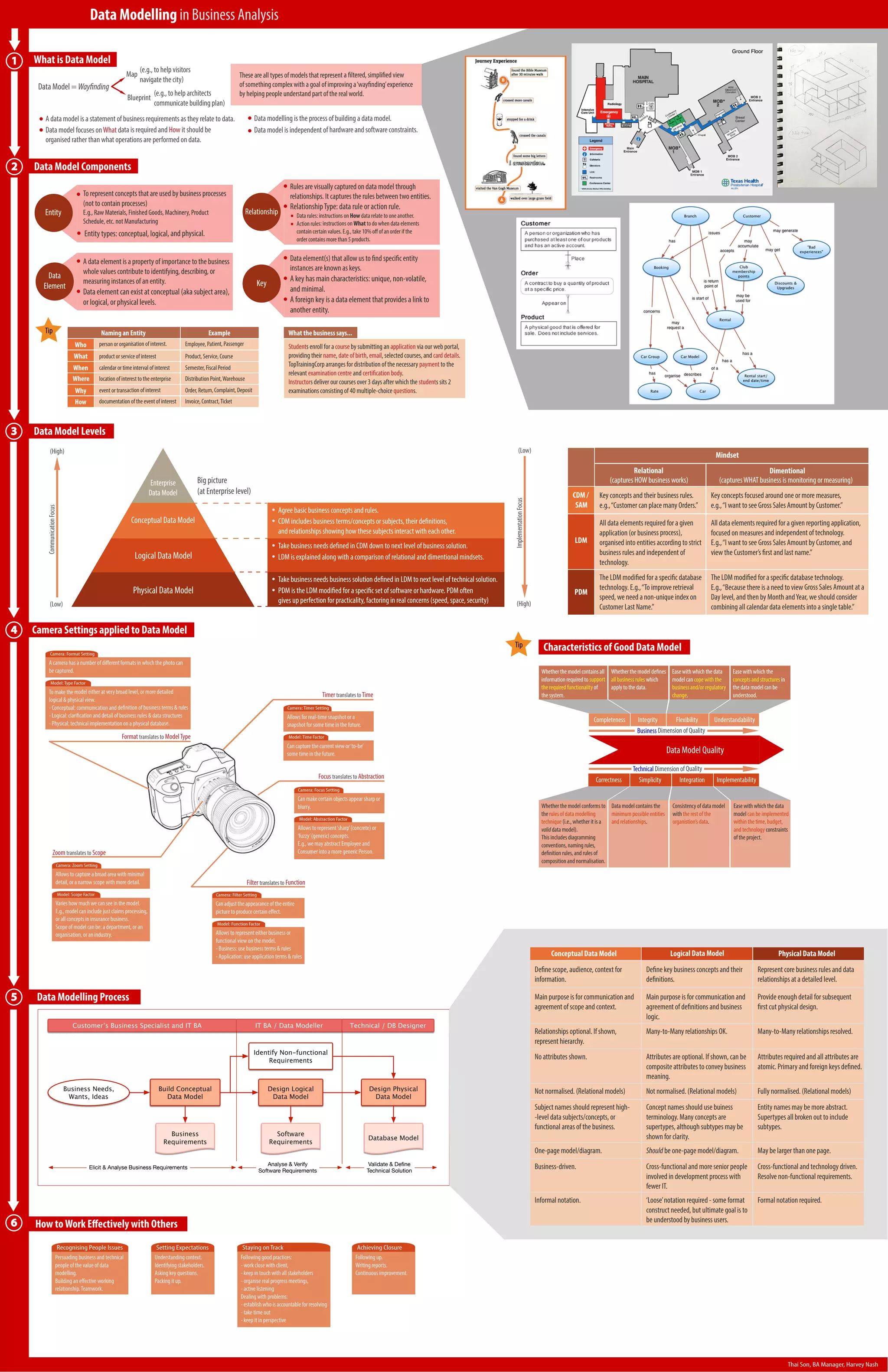
Data modelling is the process of building a data model.
Data Model = Wayfinding
Map
Blueprint
These are all types of models that represent a filtered, simplified view
of something complex with a goal of improving a‘wayfinding’experience
by helping people understand part of the real world.(e.g., to help architects
communicate building plan)
(e.g., to help visitors
navigate the city)
Data model focuses onWhat data is required and How it should be
organised rather than what operations are performed on data.
Data model is independent of hardware and software constraints.
4
Timer translates toTime
Allows for real-time snapshot or a
snapshot for some time in the future.
Camera: Timer Setting
Can capture the current view or‘to-be’
some time in the future.
Model: Time Factor
Focus translates to Abstraction
Can make certain objects appear sharp or
blurry.
Camera: Focus Setting
Allows to represent‘sharp’(concrete) or
‘fuzzy’(generic) concepts.
E.g., we may abstract Employee and
Consumer into a more generic Person.
Model: Abstraction Factor
Filter translates to Function
Can adjust the appearance of the entire
picture to produce certain effect.
Camera: Filter Setting
Allows to represent either business or
functional view on the model.
- Business: use business terms & rules
- Application: use application terms & rules
Model: Function Factor
Format translates to ModelType
A camera has a number of different formats in which the photo can
be captured.
Camera: Format Setting
To make the model either at very broad level, or more detailed
logical & physical view.
- Conceptual: communication and definition of business terms & rules
- Logical: clarification and detail of business rules & data structures
- Physical: technical implementation on a physical database.
Model: Type Factor
Zoom translates to Scope
Allows to capture a broad area with minimal
detail, or a narrow scope with more detail.
Camera: Zoom Setting
Varies how much we can see in the model.
E.g., model can include just claims processing,
or all concepts in insurance business.
Scope of model can be: a department, or an
organisation, or an industry.
Model: Scope Factor
5
3
Entity
To represent concepts that are used by business processes
(not to contain processes)
E.g., Raw Materials, Finished Goods, Machinery, Product
Schedule, etc. not Manufacturing
Entity types: conceptual, logical, and physical.
Data
Element
A data element is a property of importance to the business
whole values contribute to identifying, describing, or
measuring instances of an entity.
Data element can exist at conceptual (aka subject area),
or logical, or physical levels.
Relationship
Rules are visually captured on data model through
relationships. It captures the rules between two entities.
RelationshipType: data rule or action rule.
Data rules: instructions on How data relate to one another.
Action rules: instructions on What to do when data elements
contain certain values. E.g., take 10% off of an order if the
order contains more than 5 products.
Key
Data element(s) that allow us to find specific entity
instances are known as keys.
A key has main characteristics: unique, non-volatile,
and minimal.
A foreign key is a data element that provides a link to
another entity.
Agree basic business concepts and rules.
CDM includes business terms/concepts or subjects, their definitions,
and relationships showing how these subjects interact with each other.
Take business needs defined in CDM down to next level of business solution.
LDM is explained along with a comparison of relational and dimentional mindsets.
Key concepts and their business rules.
e.g.,“Customer can place many Orders.”
Key concepts focused around one or more measures,
e.g.,“I want to see Gross Sales Amount by Customer.”
All data elements required for a given
application (or business process),
organised into entities according to strict
business rules and independent of
technology.
All data elements required for a given reporting application,
focused on measures and independent of technology.
E.g.,“I want to see Gross Sales Amount by Customer, and
view the Customer’s first and last name.”
The LDM modified for a specific database
technology. E.g.,“To improve retrieval
speed, we need a non-unique index on
Customer Last Name.”
The LDM modified for a specific database technology.
E.g.,“Because there is a need to view Gross Sales Amount at a
Day level, and then by Month andYear, we should consider
combining all calendar data elements into a single table.”
Relational Dimentional
(captures HOW business works) (capturesWHAT business is monitoring or measuring)
CDM /
SAM
LDM
PDM
Mindset
Take business needs business solution defined in LDM to next level of technical solution.
PDM is the LDM modified for a specific set of software or hardware. PDM often
gives up perfection for practicality, factoring in real concerns (speed, space, security)
What is Data Model
Data Model Components
Data Model Levels
Camera Settings applied to Data Model
Data Modelling Process
How toWork Effectively with Others
Build Conceptual
Data Model
Business Needs,
Wants, Ideas
Design Logical
Data Model
Business
Requirements
Customerʼs Business Specialist and IT BA
Software
Requirements
Design Physical
Data Model
Database Model
IT BA / Data Modeller
Elicit & Analyse Business Requirements
Technical / DB Designer
Identify Non-functional
Requirements
Analyse & Verify
Software Requirements
Validate & Define
Technical Solution
Define scope, audience, context for
information.
Define key business concepts and their
definitions.
Main purpose is for communication and
agreement of scope and context.
Main purpose is for communication and
agreement of definitions and business
logic.
Relationships optional. If shown,
represent hierarchy.
Many-to-Many relationships OK.
Conceptual Data Model Logical Data Model Physical Data Model
Represent core business rules and data
relationships at a detailed level.
Provide enough detail for subsequent
first cut physical design.
Many-to-Many relationships resolved.
No attributes shown. Attributes are optional. If shown, can be
composite attributes to convey business
meaning.
Attributes required and all attributes are
atomic. Primary and foreign keys defined.
Not normalised. (Relational models) Not normalised. (Relational models) Fully normalised. (Relational models)
Subject names should represent high-
-level data subjects/concepts, or
functional areas of the business.
Concept names should use buiness
terminology. Many concepts are
supertypes, although subtypes may be
shown for clarity.
Entity names may be more abstract.
Supertypes all broken out to include
subtypes.
One-page model/diagram. Should be one-page model/diagram. May be larger than one page.
Business-driven. Cross-functional and more senior people
involved in development process with
fewer IT.
Cross-functional and technology driven.
Resolve non-functional requirements.
Informal notation. ‘Loose’notation required - some format
construct needed, but ultimate goal is to
be understood by business users.
Formal notation required.
6
Tip
person or organisation of interest. Employee, Patient, Passenger
Naming an Entity Example
product or service of interest Product, Service, Course
calendar or time interval of interest Semester, Fiscal Period
location of interest to the enterprise Distribution Point,WarehouseWhere
event or transaction of interest Order, Return, Complaint, Deposit
documentation of the event of interest Invoice, Contract,Ticket
Who
What
When
Why
How
What the business says...
Students enroll for a course by submitting an application via our web portal,
providing their name, date of birth, email, selected courses, and card details.
TopTrainingCorp arranges for distribution of the necessary payment to the
relevant examination centre and certification body.
Instructors deliver our courses over 3 days after which the students sits 2
examinations consisting of 40 multiple-choice questions.
Completeness Integrity Flexibility Understandability
Correctness Simplicity Integration Implementability
Data Model Quality
Business Dimension of Quality
Technical Dimension of Quality
Whether the model conforms to
the rules of data modelling
technique (i.e., whether it is a
validdata model).
This includes diagramming
conventions, naming rules,
definition rules, and rules of
composition and normalisation.
Data model contains the
minimum possible entities
and relationships.
Consistency of data model
with the rest of the
organistion’s data.
Ease with which the data
model can be implemented
within the time, budget,
and technology constraints
of the project.
Whether the model contains all
information required to support
the required functionality of
the system.
Whether the model defines
all business rules which
apply to the data.
Ease with which the data
model can cope with the
business and/or regulatory
change.
Ease with which the
concepts and structures in
the data model can be
understood.
Characteristics of Good Data Model
Persuading business and technical
people of the value of data
modelling.
Building an effective working
relationship.Teamwork.
Recognising People Issues
Understanding context.
Identifying stakeholders.
Asking key questions.
Packing it up.
Setting Expectations
Following good practices:
- work close with client,
- keep in touch with all stakeholders
- organise real progress meetings,
- active listening
Dealing with problems:
- establish who is accountable for resolving
- take time out
- keep it in perspective
Staying on Track
Following up.
Writing reports.
Continuous improvement.
Achieving Closure
Tip
Thai Son, BA Manager, Harvey Nash
A data model is a statement of business requirements as they relate to data.

Itlc hanoi ba day 3 - thai son - data modelling

  • 1.
    1 Conceptual Data Model LogicalData Model Physical Data Model CommunicationFocus (High) (Low) ImplementationFocus (Low) (High) 2 Enterprise Data Model Big picture (at Enterprise level) Data Modelling in Business Analysis Data modelling is the process of building a data model. Data Model = Wayfinding Map Blueprint These are all types of models that represent a filtered, simplified view of something complex with a goal of improving a‘wayfinding’experience by helping people understand part of the real world.(e.g., to help architects communicate building plan) (e.g., to help visitors navigate the city) Data model focuses onWhat data is required and How it should be organised rather than what operations are performed on data. Data model is independent of hardware and software constraints. 4 Timer translates toTime Allows for real-time snapshot or a snapshot for some time in the future. Camera: Timer Setting Can capture the current view or‘to-be’ some time in the future. Model: Time Factor Focus translates to Abstraction Can make certain objects appear sharp or blurry. Camera: Focus Setting Allows to represent‘sharp’(concrete) or ‘fuzzy’(generic) concepts. E.g., we may abstract Employee and Consumer into a more generic Person. Model: Abstraction Factor Filter translates to Function Can adjust the appearance of the entire picture to produce certain effect. Camera: Filter Setting Allows to represent either business or functional view on the model. - Business: use business terms & rules - Application: use application terms & rules Model: Function Factor Format translates to ModelType A camera has a number of different formats in which the photo can be captured. Camera: Format Setting To make the model either at very broad level, or more detailed logical & physical view. - Conceptual: communication and definition of business terms & rules - Logical: clarification and detail of business rules & data structures - Physical: technical implementation on a physical database. Model: Type Factor Zoom translates to Scope Allows to capture a broad area with minimal detail, or a narrow scope with more detail. Camera: Zoom Setting Varies how much we can see in the model. E.g., model can include just claims processing, or all concepts in insurance business. Scope of model can be: a department, or an organisation, or an industry. Model: Scope Factor 5 3 Entity To represent concepts that are used by business processes (not to contain processes) E.g., Raw Materials, Finished Goods, Machinery, Product Schedule, etc. not Manufacturing Entity types: conceptual, logical, and physical. Data Element A data element is a property of importance to the business whole values contribute to identifying, describing, or measuring instances of an entity. Data element can exist at conceptual (aka subject area), or logical, or physical levels. Relationship Rules are visually captured on data model through relationships. It captures the rules between two entities. RelationshipType: data rule or action rule. Data rules: instructions on How data relate to one another. Action rules: instructions on What to do when data elements contain certain values. E.g., take 10% off of an order if the order contains more than 5 products. Key Data element(s) that allow us to find specific entity instances are known as keys. A key has main characteristics: unique, non-volatile, and minimal. A foreign key is a data element that provides a link to another entity. Agree basic business concepts and rules. CDM includes business terms/concepts or subjects, their definitions, and relationships showing how these subjects interact with each other. Take business needs defined in CDM down to next level of business solution. LDM is explained along with a comparison of relational and dimentional mindsets. Key concepts and their business rules. e.g.,“Customer can place many Orders.” Key concepts focused around one or more measures, e.g.,“I want to see Gross Sales Amount by Customer.” All data elements required for a given application (or business process), organised into entities according to strict business rules and independent of technology. All data elements required for a given reporting application, focused on measures and independent of technology. E.g.,“I want to see Gross Sales Amount by Customer, and view the Customer’s first and last name.” The LDM modified for a specific database technology. E.g.,“To improve retrieval speed, we need a non-unique index on Customer Last Name.” The LDM modified for a specific database technology. E.g.,“Because there is a need to view Gross Sales Amount at a Day level, and then by Month andYear, we should consider combining all calendar data elements into a single table.” Relational Dimentional (captures HOW business works) (capturesWHAT business is monitoring or measuring) CDM / SAM LDM PDM Mindset Take business needs business solution defined in LDM to next level of technical solution. PDM is the LDM modified for a specific set of software or hardware. PDM often gives up perfection for practicality, factoring in real concerns (speed, space, security) What is Data Model Data Model Components Data Model Levels Camera Settings applied to Data Model Data Modelling Process How toWork Effectively with Others Build Conceptual Data Model Business Needs, Wants, Ideas Design Logical Data Model Business Requirements Customerʼs Business Specialist and IT BA Software Requirements Design Physical Data Model Database Model IT BA / Data Modeller Elicit & Analyse Business Requirements Technical / DB Designer Identify Non-functional Requirements Analyse & Verify Software Requirements Validate & Define Technical Solution Define scope, audience, context for information. Define key business concepts and their definitions. Main purpose is for communication and agreement of scope and context. Main purpose is for communication and agreement of definitions and business logic. Relationships optional. If shown, represent hierarchy. Many-to-Many relationships OK. Conceptual Data Model Logical Data Model Physical Data Model Represent core business rules and data relationships at a detailed level. Provide enough detail for subsequent first cut physical design. Many-to-Many relationships resolved. No attributes shown. Attributes are optional. If shown, can be composite attributes to convey business meaning. Attributes required and all attributes are atomic. Primary and foreign keys defined. Not normalised. (Relational models) Not normalised. (Relational models) Fully normalised. (Relational models) Subject names should represent high- -level data subjects/concepts, or functional areas of the business. Concept names should use buiness terminology. Many concepts are supertypes, although subtypes may be shown for clarity. Entity names may be more abstract. Supertypes all broken out to include subtypes. One-page model/diagram. Should be one-page model/diagram. May be larger than one page. Business-driven. Cross-functional and more senior people involved in development process with fewer IT. Cross-functional and technology driven. Resolve non-functional requirements. Informal notation. ‘Loose’notation required - some format construct needed, but ultimate goal is to be understood by business users. Formal notation required. 6 Tip person or organisation of interest. Employee, Patient, Passenger Naming an Entity Example product or service of interest Product, Service, Course calendar or time interval of interest Semester, Fiscal Period location of interest to the enterprise Distribution Point,WarehouseWhere event or transaction of interest Order, Return, Complaint, Deposit documentation of the event of interest Invoice, Contract,Ticket Who What When Why How What the business says... Students enroll for a course by submitting an application via our web portal, providing their name, date of birth, email, selected courses, and card details. TopTrainingCorp arranges for distribution of the necessary payment to the relevant examination centre and certification body. Instructors deliver our courses over 3 days after which the students sits 2 examinations consisting of 40 multiple-choice questions. Completeness Integrity Flexibility Understandability Correctness Simplicity Integration Implementability Data Model Quality Business Dimension of Quality Technical Dimension of Quality Whether the model conforms to the rules of data modelling technique (i.e., whether it is a validdata model). This includes diagramming conventions, naming rules, definition rules, and rules of composition and normalisation. Data model contains the minimum possible entities and relationships. Consistency of data model with the rest of the organistion’s data. Ease with which the data model can be implemented within the time, budget, and technology constraints of the project. Whether the model contains all information required to support the required functionality of the system. Whether the model defines all business rules which apply to the data. Ease with which the data model can cope with the business and/or regulatory change. Ease with which the concepts and structures in the data model can be understood. Characteristics of Good Data Model Persuading business and technical people of the value of data modelling. Building an effective working relationship.Teamwork. Recognising People Issues Understanding context. Identifying stakeholders. Asking key questions. Packing it up. Setting Expectations Following good practices: - work close with client, - keep in touch with all stakeholders - organise real progress meetings, - active listening Dealing with problems: - establish who is accountable for resolving - take time out - keep it in perspective Staying on Track Following up. Writing reports. Continuous improvement. Achieving Closure Tip Thai Son, BA Manager, Harvey Nash A data model is a statement of business requirements as they relate to data.