4.8.7 T QUALITY ASSURANCE
TECHNIQUES
SAVITRIBAI PHULE PUNE UNIVERSITY
Syllabus of Final Year B. Pharmacy
(EFFECTIVE FROM ACADEMIC YEAR 2018-19)
PATTERN 2015
Hello!
I am Shrikant Kavitake
M Pharm (Pharmaceutics)
DATTAKALA COLLEGE OF PHARMACY
Swami-Chincholi, Daund, Pune.
2
1.
Introduction
3
 Quality
 Quality Assurance
 Quality Control
 IPQC
 Responsibilities
 Master Production
and Control Record
(MPCR)
 Batch Production
and Control Record
(BPCR)
‘’
Definition;
Quality is that the drug or drug product meets
its prespecified quality attributes or regulatory
specifications.
OR
It has also been stated that a drug
manufactured in compliance with cGMP is a
high quality drug or drug product.
4
Quality Assurance;
▣ According to WHO, quality assurance is a wide
ranging concept covering all matters that individually
or collectively influence the quality of a pharmaceutical
product.
▣ Quality assurance can be divided into major areas:
development, quality control, production, distribution,
and inspections.
▣ ISO 9000 defines as "part of quality management
focused on providing confidence that quality
requirements will be fulfilled"
5
Quality Control;
▣ ISO 9000 defines quality control as "A part of quality
management focused on fulfilling quality requirements".
▣ It is that part of GMP concerned with sampling,
specification & testing, documentation & release
procedures which ensure that the necessary & relevant
tests are performed & the product is released for use only
after ascertaining it’s quality.
6
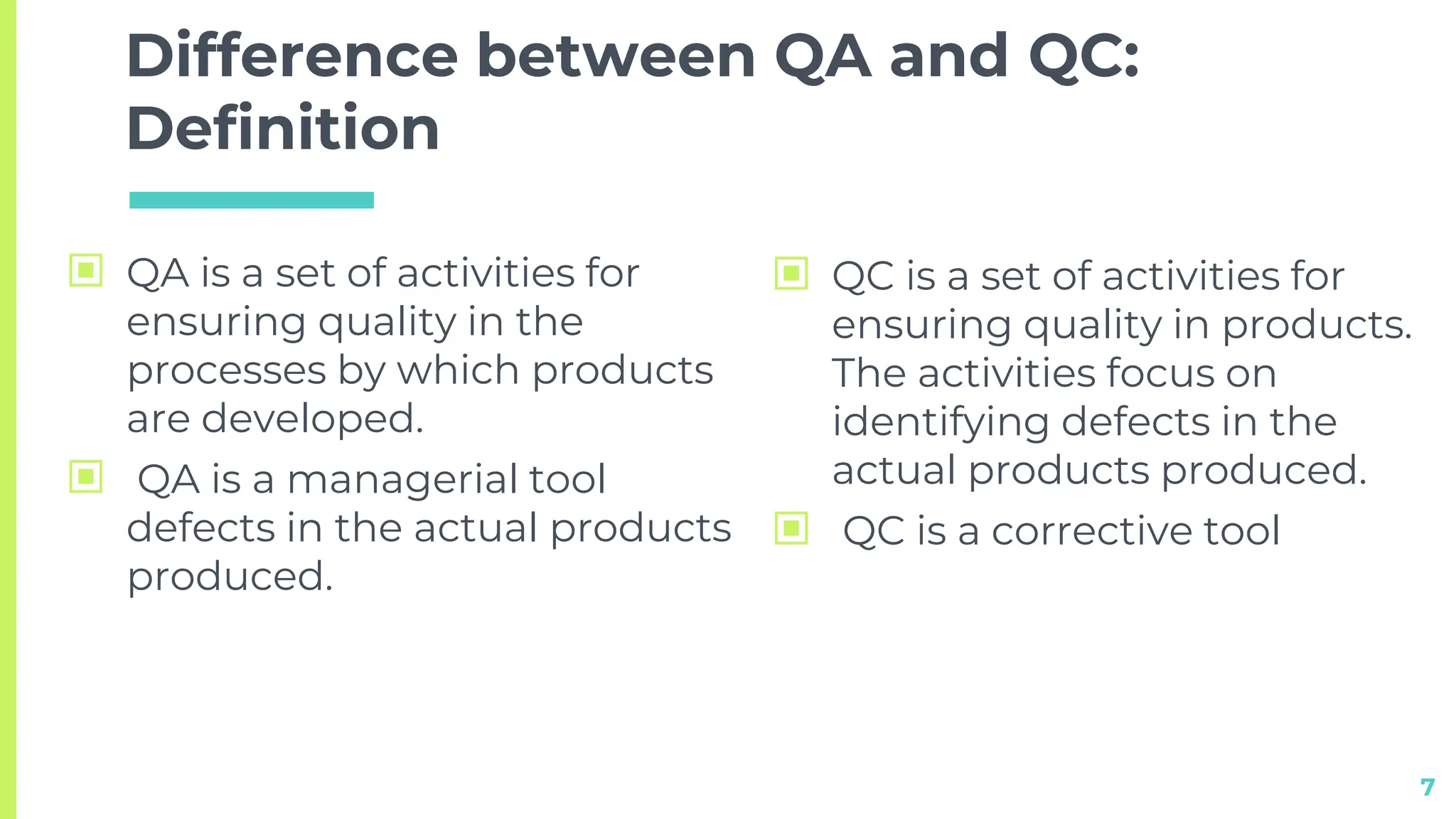
Difference between QA and QC:
Definition
▣ QA is a set of activities for
ensuring quality in the
processes by which products
are developed.
▣ QA is a managerial tool
defects in the actual products
produced.
7
▣ QC is a set of activities for
ensuring quality in products.
The activities focus on
identifying defects in the
actual products produced.
▣ QC is a corrective tool
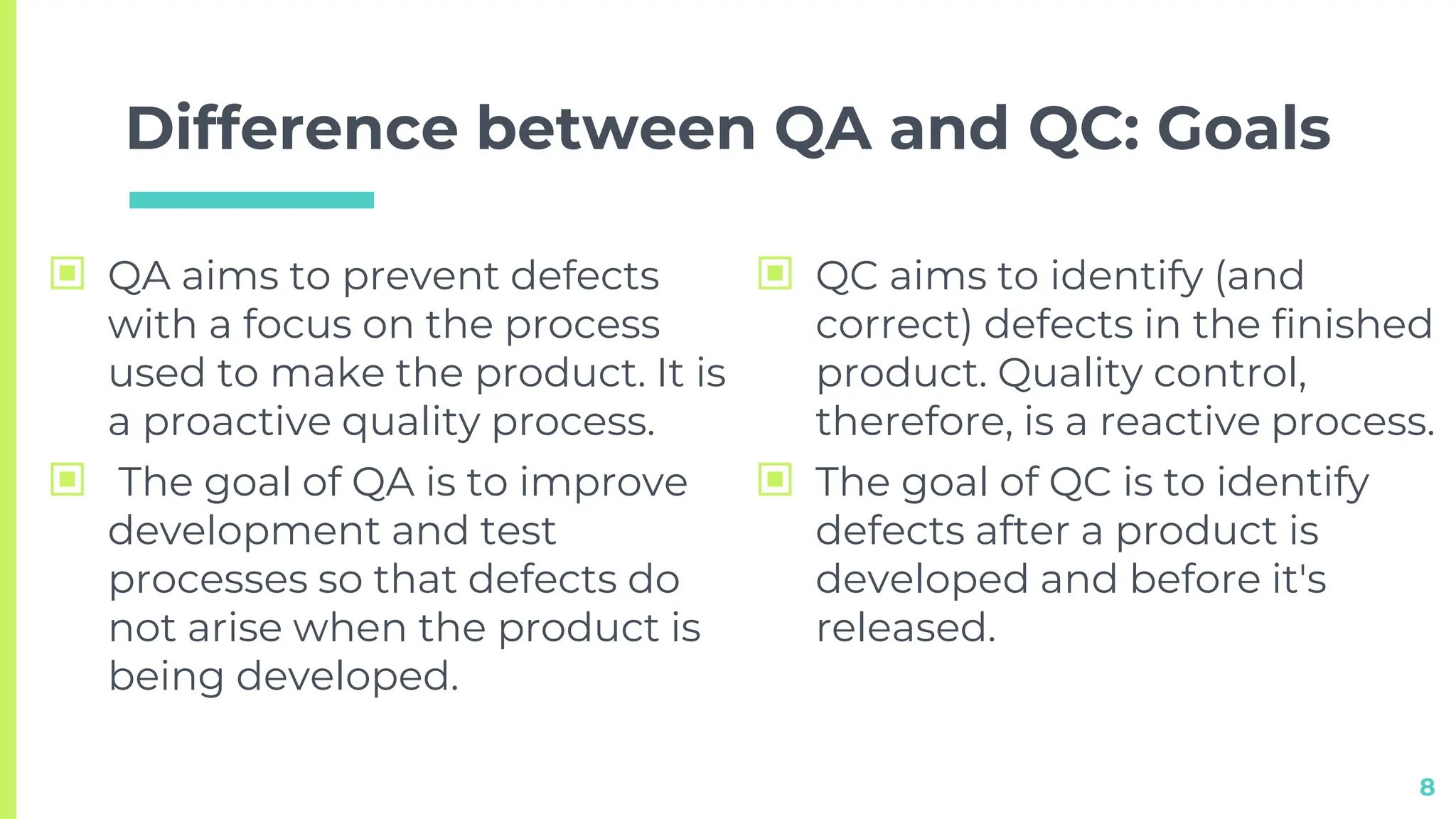
Difference between QA and QC: Goals
▣ QA aims to prevent defects
with a focus on the process
used to make the product. It is
a proactive quality process.
▣ The goal of QA is to improve
development and test
processes so that defects do
not arise when the product is
being developed.
8
▣ QC aims to identify (and
correct) defects in the finished
product. Quality control,
therefore, is a reactive process.
▣ The goal of QC is to identify
defects after a product is
developed and before it's
released.
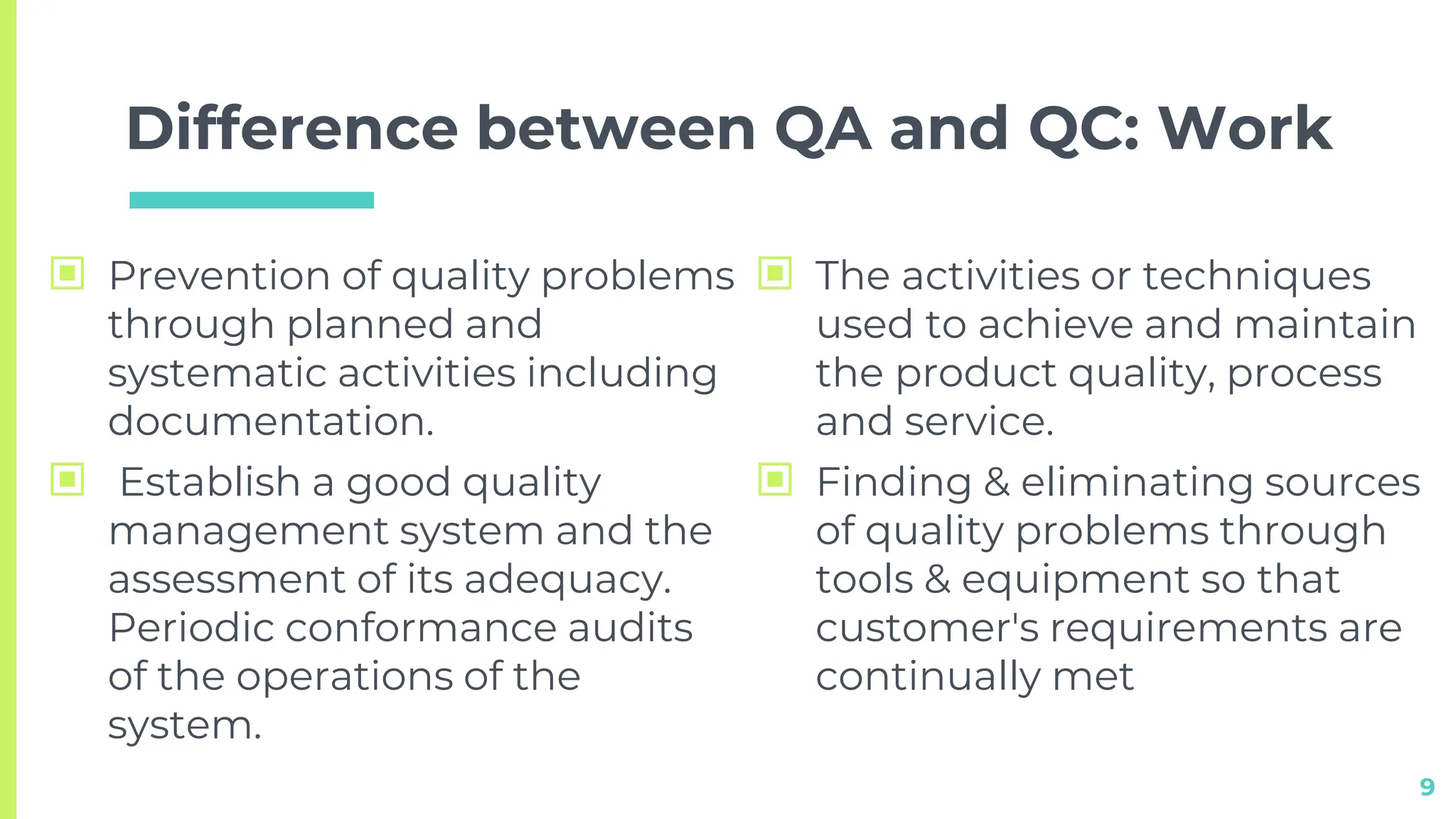
Difference between QA and QC: Work
▣ Prevention of quality problems
through planned and
systematic activities including
documentation.
▣ Establish a good quality
management system and the
assessment of its adequacy.
Periodic conformance audits
of the operations of the
system.
9
▣ The activities or techniques
used to achieve and maintain
the product quality, process
and service.
▣ Finding & eliminating sources
of quality problems through
tools & equipment so that
customer's requirements are
continually met
Difference between QA and QC:
Responsibility
▣ Everyone on the team
involved in developing the
product is responsible for
quality assurance.
▣ Verification is an example of
QA.
10
▣ Quality control is usually the
responsibility of a specific
team that tests the product for
defects.
▣ Validation is an example of QC.
Responsibilities of QA
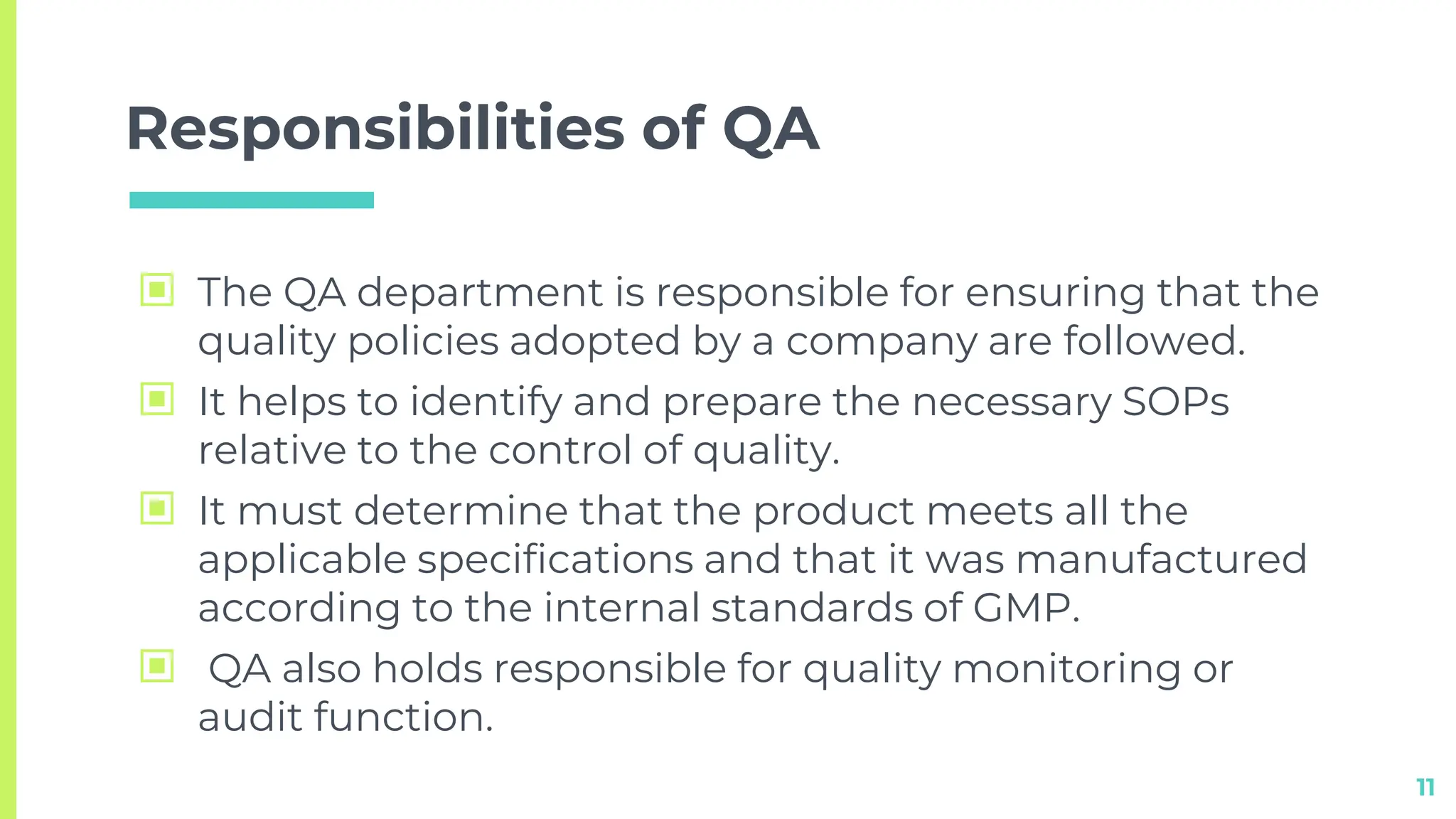
▣ The QA department is responsible for ensuring that the
quality policies adopted by a company are followed.
▣ It helps to identify and prepare the necessary SOPs
relative to the control of quality.
▣ It must determine that the product meets all the
applicable specifications and that it was manufactured
according to the internal standards of GMP.
▣ QA also holds responsible for quality monitoring or
audit function.
11
Contin…
▣ QA functions to assess operations continually and to
advise and guide them towards full compliance with all
applicable internal and external regulations.
12
Responsibilities of QC
▣ QC is responsible for the day-to-day control of quality
within the company.
▣ This department is responsible for analytical testing of
incoming raw materials and inspection of packaging
components, including labelling.
▣ They conduct in-process testing when required,
perform environmental monitoring, and inspect
operations for compliance.
▣ They also conduct the required tests on finished dosage
form. 13
Contin…
▣ QC plays a major role in the selection of qualified
vendors from whom raw materials are purchased.
Testing of representative samples is required, and in
many cases, an audit of vendor’s operations is
necessary to determine their suitability and degree of
compliance with GMPs prior to their being approved.
▣ The environmental areas for manufacturing of various
dosage forms are tested and inspected by QC
department.
14
IPQC
IN PROCESS QUALITY CONTROL
15
Role Of QA in IPQC
16
There are some critical steps to be followed in this:
▣ QA before start-up
• Environmental and microbiologic control and
sanitation
• Manufacturing Working Formula Procedures
• Raw Materials
• Manufacturing Equipment
Contin…
▣ QA at start-up
 Raw Material Processing
 Compounding
 Packaging Materials Control
 Labels Control
 Finished Product Control
17
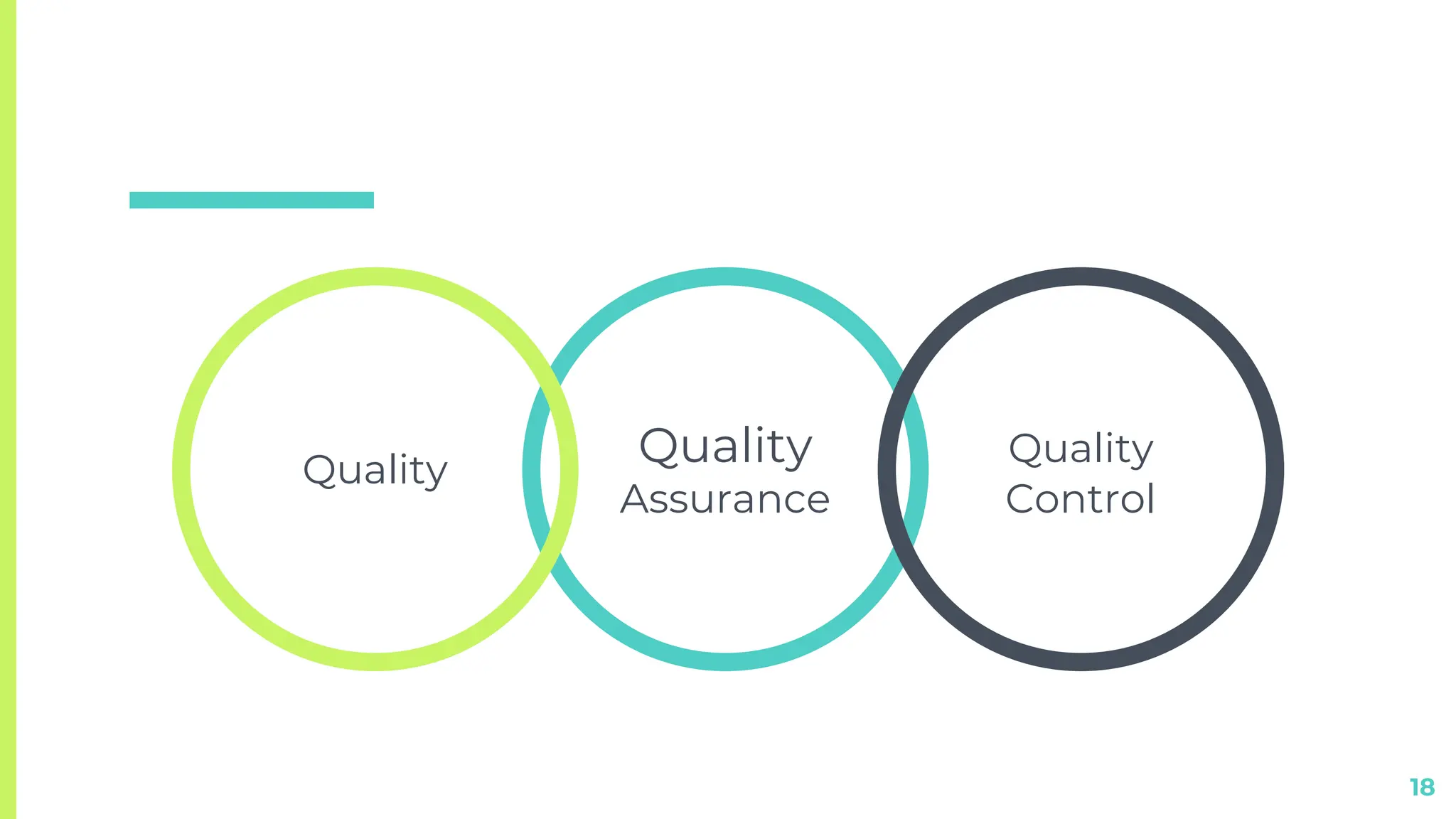
Quality
Assurance
Quality
Quality
Control
18
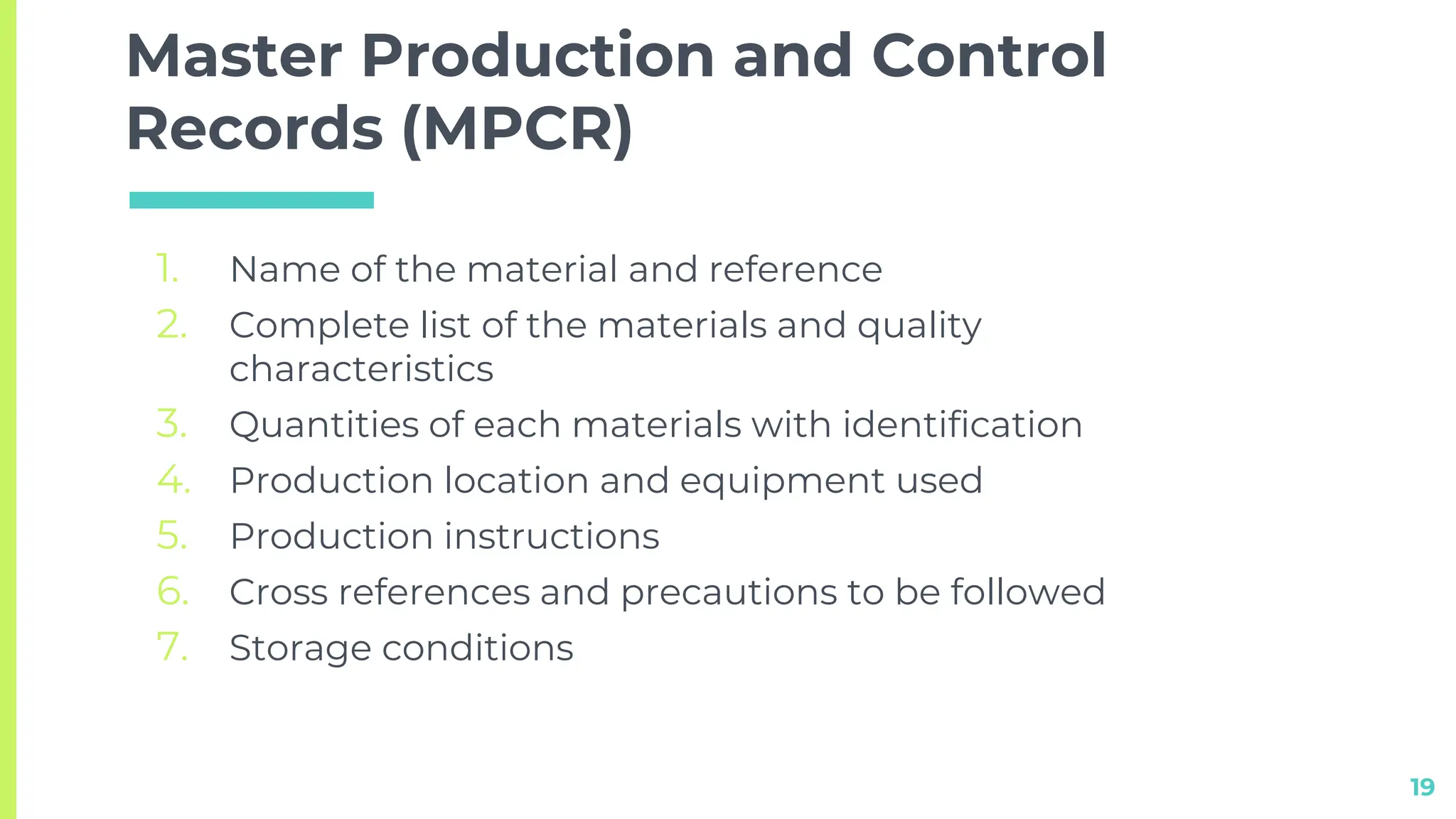
Master Production and Control
Records (MPCR)
19
1. Name of the material and reference
2. Complete list of the materials and quality
characteristics
3. Quantities of each materials with identification
4. Production location and equipment used
5. Production instructions
6. Cross references and precautions to be followed
7. Storage conditions
Batch Production and Control
Records (BPCR)
20
1. BPCR contains detailed information of production
2. BPCR should be numbered with a unique
identification number, dated and signed
3. Written procedure for investigation for critical
process and batch failure
4. Specifications should be identified
5. Completion of significant steps (Process deviation,
OOS, Critical process parameters, Sampling, In-
process results, yield and results)
Thanks!
Any questions?
You can find me at
kavitakeshrikant@gmail.com
Kavitakes.dkcop@dattakala.edu.in
21
2.
Calibration &
Qualifications

Chapter 1 QA & QC, ROLES AND RESPONISIBILITIES

  • 1.
    4.8.7 T QUALITYASSURANCE TECHNIQUES SAVITRIBAI PHULE PUNE UNIVERSITY Syllabus of Final Year B. Pharmacy (EFFECTIVE FROM ACADEMIC YEAR 2018-19) PATTERN 2015
  • 2.
    Hello! I am ShrikantKavitake M Pharm (Pharmaceutics) DATTAKALA COLLEGE OF PHARMACY Swami-Chincholi, Daund, Pune. 2
  • 3.
    1. Introduction 3  Quality  QualityAssurance  Quality Control  IPQC  Responsibilities  Master Production and Control Record (MPCR)  Batch Production and Control Record (BPCR)
  • 4.
    ‘’ Definition; Quality is thatthe drug or drug product meets its prespecified quality attributes or regulatory specifications. OR It has also been stated that a drug manufactured in compliance with cGMP is a high quality drug or drug product. 4
  • 5.
    Quality Assurance; ▣ Accordingto WHO, quality assurance is a wide ranging concept covering all matters that individually or collectively influence the quality of a pharmaceutical product. ▣ Quality assurance can be divided into major areas: development, quality control, production, distribution, and inspections. ▣ ISO 9000 defines as "part of quality management focused on providing confidence that quality requirements will be fulfilled" 5
  • 6.
    Quality Control; ▣ ISO9000 defines quality control as "A part of quality management focused on fulfilling quality requirements". ▣ It is that part of GMP concerned with sampling, specification & testing, documentation & release procedures which ensure that the necessary & relevant tests are performed & the product is released for use only after ascertaining it’s quality. 6
  • 7.
    Difference between QAand QC: Definition ▣ QA is a set of activities for ensuring quality in the processes by which products are developed. ▣ QA is a managerial tool defects in the actual products produced. 7 ▣ QC is a set of activities for ensuring quality in products. The activities focus on identifying defects in the actual products produced. ▣ QC is a corrective tool
  • 8.
    Difference between QAand QC: Goals ▣ QA aims to prevent defects with a focus on the process used to make the product. It is a proactive quality process. ▣ The goal of QA is to improve development and test processes so that defects do not arise when the product is being developed. 8 ▣ QC aims to identify (and correct) defects in the finished product. Quality control, therefore, is a reactive process. ▣ The goal of QC is to identify defects after a product is developed and before it's released.
  • 9.
    Difference between QAand QC: Work ▣ Prevention of quality problems through planned and systematic activities including documentation. ▣ Establish a good quality management system and the assessment of its adequacy. Periodic conformance audits of the operations of the system. 9 ▣ The activities or techniques used to achieve and maintain the product quality, process and service. ▣ Finding & eliminating sources of quality problems through tools & equipment so that customer's requirements are continually met
  • 10.
    Difference between QAand QC: Responsibility ▣ Everyone on the team involved in developing the product is responsible for quality assurance. ▣ Verification is an example of QA. 10 ▣ Quality control is usually the responsibility of a specific team that tests the product for defects. ▣ Validation is an example of QC.
  • 11.
    Responsibilities of QA ▣The QA department is responsible for ensuring that the quality policies adopted by a company are followed. ▣ It helps to identify and prepare the necessary SOPs relative to the control of quality. ▣ It must determine that the product meets all the applicable specifications and that it was manufactured according to the internal standards of GMP. ▣ QA also holds responsible for quality monitoring or audit function. 11
  • 12.
    Contin… ▣ QA functionsto assess operations continually and to advise and guide them towards full compliance with all applicable internal and external regulations. 12
  • 13.
    Responsibilities of QC ▣QC is responsible for the day-to-day control of quality within the company. ▣ This department is responsible for analytical testing of incoming raw materials and inspection of packaging components, including labelling. ▣ They conduct in-process testing when required, perform environmental monitoring, and inspect operations for compliance. ▣ They also conduct the required tests on finished dosage form. 13
  • 14.
    Contin… ▣ QC playsa major role in the selection of qualified vendors from whom raw materials are purchased. Testing of representative samples is required, and in many cases, an audit of vendor’s operations is necessary to determine their suitability and degree of compliance with GMPs prior to their being approved. ▣ The environmental areas for manufacturing of various dosage forms are tested and inspected by QC department. 14
  • 15.
  • 16.
    Role Of QAin IPQC 16 There are some critical steps to be followed in this: ▣ QA before start-up • Environmental and microbiologic control and sanitation • Manufacturing Working Formula Procedures • Raw Materials • Manufacturing Equipment
  • 17.
    Contin… ▣ QA atstart-up  Raw Material Processing  Compounding  Packaging Materials Control  Labels Control  Finished Product Control 17
  • 18.
  • 19.
    Master Production andControl Records (MPCR) 19 1. Name of the material and reference 2. Complete list of the materials and quality characteristics 3. Quantities of each materials with identification 4. Production location and equipment used 5. Production instructions 6. Cross references and precautions to be followed 7. Storage conditions
  • 20.
    Batch Production andControl Records (BPCR) 20 1. BPCR contains detailed information of production 2. BPCR should be numbered with a unique identification number, dated and signed 3. Written procedure for investigation for critical process and batch failure 4. Specifications should be identified 5. Completion of significant steps (Process deviation, OOS, Critical process parameters, Sampling, In- process results, yield and results)
  • 21.
    Thanks! Any questions? You canfind me at kavitakeshrikant@gmail.com Kavitakes.dkcop@dattakala.edu.in 21
  • 22.