Concentrated Solar Power
Technology
A small story…
Fusion Fission
120000 years to
reach outer surface
n
n p
n p
Tritium
Hydrogen
Isotope
Deuterium
Hydrogen
Isotope
n n
np
p
n n n
p
p
Helium
Neutron
(Energy)
Manipulating Solar Light
Solar light
Natural
E.g.- Plant ,
Ecosystem
Machine-made
Solar Photovoltaic
Solar Thermal Power
A Legend
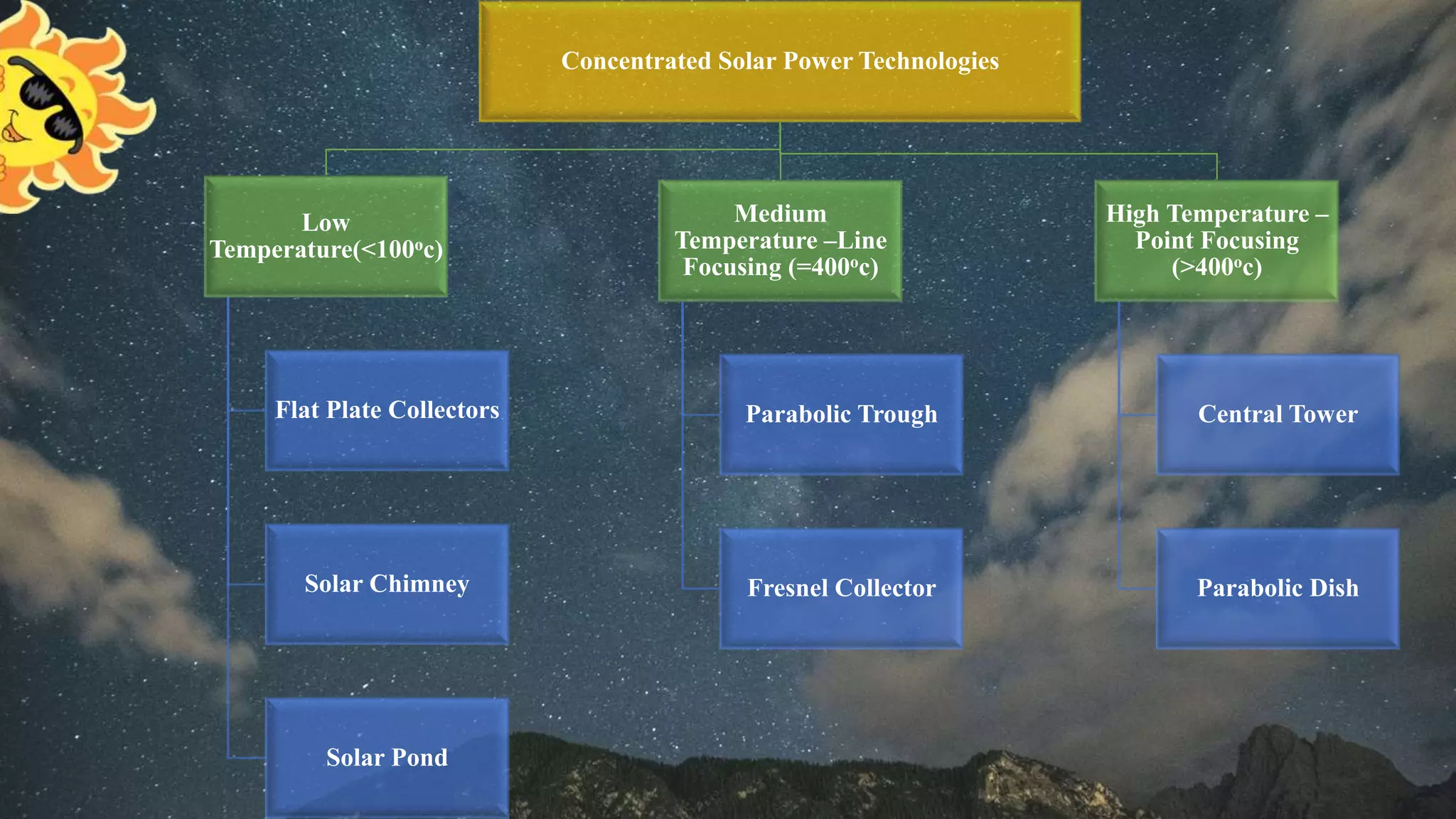
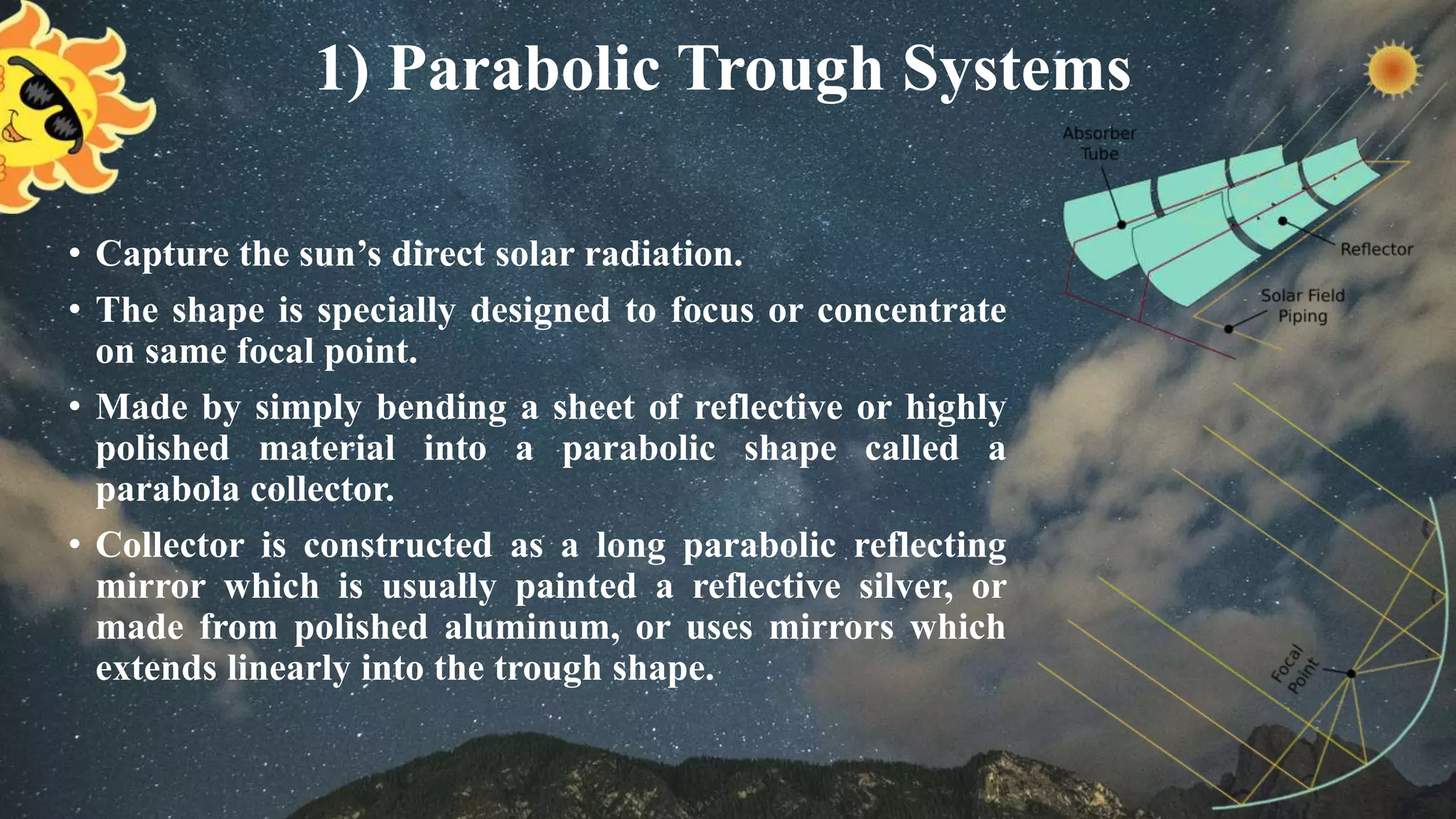
• Archimedes used a giant mirror, or set of mirrors, to set fire to
Roman ships attacking his home city of Syracuse in 212 B.C.
• In 2010, U.S. President Obama even challenged the hosts of the
TV show MythBusters to test the problem and come to a
definitive conclusion.
• Did it actually happen?
• The MythBusters conclusion was that although in theory setting a
ship on fire with mirrors might be possible, it seems an unlikely
method to be used in battle.
Solar Thermal Power Tech
Focal
length
Magnifying Glass:
For every concentrated solar power technology,
Focal point plays the major role in it. So lets begin the
presentation , with quick example from magnifying glass.
Why Concentrated Solar Power (CSP)
PV Technology CSP Technology
Solar irradiation is harnessed by exposing to sun. Solar irradiation is harnessed by concentrating on
single point or over the tube.
Thermal energy can be stored in form of chemical
energy.
Can store thermal energy directly.
PV cells are flat to absorb irradiation. CSP has mirrors to reflect irradiation.
Low efficiency. Higher Efficiency .
Involves conversion of DC to AC. Can be made direct AC generation.
Does not provide peak loads. CSP provides peak, intermediate or base load
capacities.
Concentrated Solar Power Technologies
Low
Temperature(<100oc)
Flat Plate Collectors
Solar Chimney
Solar Pond
Medium
Temperature –Line
Focusing (=400oc)
Parabolic Trough
Fresnel Collector
High Temperature –
Point Focusing
(>400oc)
Central Tower
Parabolic Dish
1) Parabolic Trough Systems
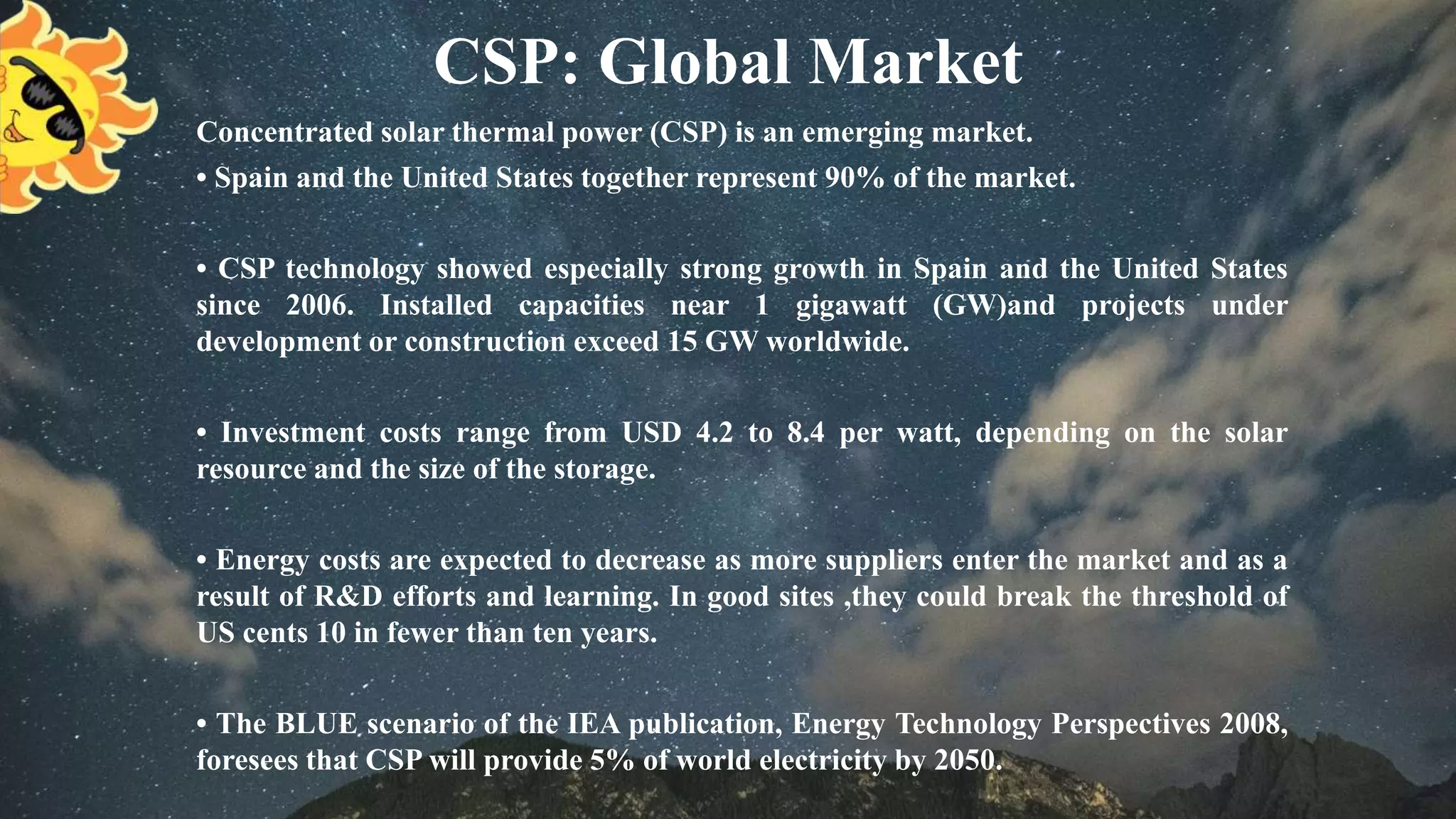
• Capture the sun’s direct solar radiation.
• The shape is specially designed to focus or concentrate
on same focal point.
• Made by simply bending a sheet of reflective or highly
polished material into a parabolic shape called a
parabola collector.
• Collector is constructed as a long parabolic reflecting
mirror which is usually painted a reflective silver, or
made from polished aluminum, or uses mirrors which
extends linearly into the trough shape.
1) Parabolic Trough Systems
oA metal black heat tube inside a sealed glass tube which can also
be evacuated is used to reduce heat losses
oThe heat transfer fluid - mixture of water and other additive’s or
thermal oil
oReaching temperatures from 200oc to 400oc
1) Parabolic Trough Systems
For commercial application:
The oil circulating around a closed loop active system is used.
Generate steam at very high temperatures of up to 400oc.
Efficiencies of around 12%.
Tracking system is provided to keep them at the correct focal point.
400oC steam
2) Power Tower Systems
 A large number of flat, sun-tracking mirrors, known as HELIOSTATS(1), focus sunlight onto a
receiver at the top of a TALL TOWER(2).
 Heat-transfer fluid(3) heated in the receiver is used to heat a working fluid.
 Which, in turn, is used in a conventional turbine generator(4) to produce electricity.
 Some power towers use water/steam as the heat-transfer fluid.
 Other advanced designs are experimenting with high temperature
molten salts or sand-like particles to maximize the power
cycle temperature.
2) Power Tower Systems
Projects currently undergoing in India
• A 1MW solar power system is currently being installed at the Solar Energy Center at Delhi, India
• Temp generated 600-800 oC .
• Can provide energy without any interception for 24 hrs
3) Dish Stirling
 High temperature point focusing collector
 Temp range -700- 800oc
 Uses disc concentrator
 High efficiency – 30%
 Dual axis tracking
 E.g. Used in our college hostel for
producing stream for cooking purpose
 Only used for small scale purpose
right now
 Heat storage difficulty
4) Fresnel Collector
o Temp-400oC
o Line focusing type
o Line receiver
o Flat or curved conc. Mirrors
o Commercially under development
o High wind resistance up to (105mph)
o Reliance commissions 100 MW concentrated
solar power plant in Rajasthan, India
o Its an Rs 2,100 crore 100 MW solar CSP
project which currently connected with the
grid
CSP: Global Market
Concentrated solar thermal power (CSP) is an emerging market.
• Spain and the United States together represent 90% of the market.
• CSP technology showed especially strong growth in Spain and the United States
since 2006. Installed capacities near 1 gigawatt (GW)and projects under
development or construction exceed 15 GW worldwide.
• Investment costs range from USD 4.2 to 8.4 per watt, depending on the solar
resource and the size of the storage.
• Energy costs are expected to decrease as more suppliers enter the market and as a
result of R&D efforts and learning. In good sites ,they could break the threshold of
US cents 10 in fewer than ten years.
• The BLUE scenario of the IEA publication, Energy Technology Perspectives 2008,
foresees that CSP will provide 5% of world electricity by 2050.
CSP Global Market: Outlook and Barrier
• The building of CSP plant creates 8 to 10 jobs per megawatt of equivalent electrical solar
capacity in the construction and manufacturing of components.
• Areas suitable to CSP technologies are found between 15° to 40° parallels– and occasionally
at higher latitude.
• The deployment of CSP plants is driven by feed-in tariffs in Spain, and Renewable Energy
Portfolio Standards and a grant programmed in the United States.
• Low costs of fossil fuels remain an important barrier on grid – even more so in countries
where fossil fuels prices are kept below world prices by direct or indirect government
subsidies.
• CSP Suitable areas are often semi-arid and water scarcity might be an issue, unless costlier
dry cooling is used.
CSP: Global Water Poverty
India’s Concentrated Solar Power (CSP)
• India has only 52.5 MW of Concentrating Solar Power (CSP) in operation
• however there are seven solar thermal projects of 470 MW aggregate capacity scheduled to
be completed under the first phase of the Jawaharlal Nehru National Solar Mission.
• The Jawaharlal Nehru National Solar Mission was launched on the 11th January, 2010 by the Prime
Minister setting an ambitious goal of deploying 20 GW of solar capacity by 2022
• The Mission was divided into three phases: the first one up to 2013, second phase from 2013 to 2017
and the third phase from 2017 to 2022
• In the first phase, seven Concentrating Solar Thermal Power (CSP) proposals were selected totaling
470 MW with bids between Rs 10.49/kWh and Rs 12.24/kWh
Environmental Impact
• CSP has a number of environmental effects, particularly on water use, land use and the
use of hazardous materials.
• Clean mirrors. Cleaning agents like Hydrochloric acid, Sulfuric acid, Nitric acid,
Hydrogen Fluoride are also used for semiconductor surface cleaning.
Effects on wildlife:-
• Insects can be attracted to the bright light caused by CSP
• And as a result birds that hunt them can be killed by being burned if they fly near the
point where light is being focused.
Solar Chimney
• The solar chimney is essentially an open-loop NCS with a large solar collector at
the bottom, which absorbs solar energy
• In the process, it heats up the air, which rises to create a circulation
• The tall chimney helps to increase the buoyancy force and the circulation rate
• A solar chimney is used for a variety of applications
such as passive cooling and ventilation of buildings
• For the large-scale solar chimney systems, there may
be several wind turbines inside as it is difficult
• And its many limited due to natural convection
affected by buoyancy which acts as a driving force
comes into existence
Solar Pond
• The top fresh water zone called “surface zone”.
• The bottom salt water zone called “storage zone”.
• When sunlight incidence on the surface of the pond , it starts to heat up the lower
salt zone of the pond.
• The salty water cannot rise because it is heavier than the fresh water that is on top
of the pond.
• Heat loss upwards is prevented.
• The bottom of the pond is warmed to extremely high
temperatures - it can reach about 90°C
• Which is high enough to initiate and run an organic rankine
cycle engine
Upcoming CSP Technologies
Microwave transmitting satellites:-
• These satellites orbit at geostationary orbit
(GEO), about 35,000 km above earth’s
surface
• Solar reflectors spanning up to 3 km
weighing over 80,000 metric tons
• They would be capable of generating multiple
giga watts of power, enough to power a major
U.S. City
• The estimated cost of launching, assembling
and operating a microwave-equipped
• It would likely require as many as 40
launches to assemble it
• On earth, the rectenna used for collecting the
microwave beam would be anywhere
between 3 and 10 km in diameter
IT’S HIGHLY UNLIKELY!!
Conclusion
• CSP has significant cost reduction potential – immediately and with
future innovative developments
• CSP has strong growth potential in many countries – mainly those
with high irradiation in the world‘s sun belt.
• As technologies and market participants develop, dynamics towards
lower prices will increase in the industry.
• As specific costs decrease, new markets will be opened up.
Millions saw the apple fall ,
but
Newton asked why ?
Any Queries ?
And Many Thanks For Your Patient Listening

concentrated solar power technology - csp

  • 1.
  • 2.
    A small story… FusionFission 120000 years to reach outer surface n n p n p Tritium Hydrogen Isotope Deuterium Hydrogen Isotope n n np p n n n p p Helium Neutron (Energy)
  • 3.
    Manipulating Solar Light Solarlight Natural E.g.- Plant , Ecosystem Machine-made Solar Photovoltaic Solar Thermal Power
  • 4.
    A Legend • Archimedesused a giant mirror, or set of mirrors, to set fire to Roman ships attacking his home city of Syracuse in 212 B.C. • In 2010, U.S. President Obama even challenged the hosts of the TV show MythBusters to test the problem and come to a definitive conclusion. • Did it actually happen? • The MythBusters conclusion was that although in theory setting a ship on fire with mirrors might be possible, it seems an unlikely method to be used in battle.
  • 5.
    Solar Thermal PowerTech Focal length Magnifying Glass: For every concentrated solar power technology, Focal point plays the major role in it. So lets begin the presentation , with quick example from magnifying glass.
  • 6.
    Why Concentrated SolarPower (CSP) PV Technology CSP Technology Solar irradiation is harnessed by exposing to sun. Solar irradiation is harnessed by concentrating on single point or over the tube. Thermal energy can be stored in form of chemical energy. Can store thermal energy directly. PV cells are flat to absorb irradiation. CSP has mirrors to reflect irradiation. Low efficiency. Higher Efficiency . Involves conversion of DC to AC. Can be made direct AC generation. Does not provide peak loads. CSP provides peak, intermediate or base load capacities.
  • 7.
    Concentrated Solar PowerTechnologies Low Temperature(<100oc) Flat Plate Collectors Solar Chimney Solar Pond Medium Temperature –Line Focusing (=400oc) Parabolic Trough Fresnel Collector High Temperature – Point Focusing (>400oc) Central Tower Parabolic Dish
  • 8.
    1) Parabolic TroughSystems • Capture the sun’s direct solar radiation. • The shape is specially designed to focus or concentrate on same focal point. • Made by simply bending a sheet of reflective or highly polished material into a parabolic shape called a parabola collector. • Collector is constructed as a long parabolic reflecting mirror which is usually painted a reflective silver, or made from polished aluminum, or uses mirrors which extends linearly into the trough shape.
  • 9.
    1) Parabolic TroughSystems oA metal black heat tube inside a sealed glass tube which can also be evacuated is used to reduce heat losses oThe heat transfer fluid - mixture of water and other additive’s or thermal oil oReaching temperatures from 200oc to 400oc
  • 10.
    1) Parabolic TroughSystems For commercial application: The oil circulating around a closed loop active system is used. Generate steam at very high temperatures of up to 400oc. Efficiencies of around 12%. Tracking system is provided to keep them at the correct focal point. 400oC steam
  • 11.
    2) Power TowerSystems  A large number of flat, sun-tracking mirrors, known as HELIOSTATS(1), focus sunlight onto a receiver at the top of a TALL TOWER(2).  Heat-transfer fluid(3) heated in the receiver is used to heat a working fluid.  Which, in turn, is used in a conventional turbine generator(4) to produce electricity.  Some power towers use water/steam as the heat-transfer fluid.  Other advanced designs are experimenting with high temperature molten salts or sand-like particles to maximize the power cycle temperature.
  • 12.
    2) Power TowerSystems Projects currently undergoing in India • A 1MW solar power system is currently being installed at the Solar Energy Center at Delhi, India • Temp generated 600-800 oC . • Can provide energy without any interception for 24 hrs
  • 13.
    3) Dish Stirling High temperature point focusing collector  Temp range -700- 800oc  Uses disc concentrator  High efficiency – 30%  Dual axis tracking  E.g. Used in our college hostel for producing stream for cooking purpose  Only used for small scale purpose right now  Heat storage difficulty
  • 14.
    4) Fresnel Collector oTemp-400oC o Line focusing type o Line receiver o Flat or curved conc. Mirrors o Commercially under development o High wind resistance up to (105mph) o Reliance commissions 100 MW concentrated solar power plant in Rajasthan, India o Its an Rs 2,100 crore 100 MW solar CSP project which currently connected with the grid
  • 15.
    CSP: Global Market Concentratedsolar thermal power (CSP) is an emerging market. • Spain and the United States together represent 90% of the market. • CSP technology showed especially strong growth in Spain and the United States since 2006. Installed capacities near 1 gigawatt (GW)and projects under development or construction exceed 15 GW worldwide. • Investment costs range from USD 4.2 to 8.4 per watt, depending on the solar resource and the size of the storage. • Energy costs are expected to decrease as more suppliers enter the market and as a result of R&D efforts and learning. In good sites ,they could break the threshold of US cents 10 in fewer than ten years. • The BLUE scenario of the IEA publication, Energy Technology Perspectives 2008, foresees that CSP will provide 5% of world electricity by 2050.
  • 16.
    CSP Global Market:Outlook and Barrier • The building of CSP plant creates 8 to 10 jobs per megawatt of equivalent electrical solar capacity in the construction and manufacturing of components. • Areas suitable to CSP technologies are found between 15° to 40° parallels– and occasionally at higher latitude. • The deployment of CSP plants is driven by feed-in tariffs in Spain, and Renewable Energy Portfolio Standards and a grant programmed in the United States. • Low costs of fossil fuels remain an important barrier on grid – even more so in countries where fossil fuels prices are kept below world prices by direct or indirect government subsidies. • CSP Suitable areas are often semi-arid and water scarcity might be an issue, unless costlier dry cooling is used.
  • 17.
  • 18.
    India’s Concentrated SolarPower (CSP) • India has only 52.5 MW of Concentrating Solar Power (CSP) in operation • however there are seven solar thermal projects of 470 MW aggregate capacity scheduled to be completed under the first phase of the Jawaharlal Nehru National Solar Mission. • The Jawaharlal Nehru National Solar Mission was launched on the 11th January, 2010 by the Prime Minister setting an ambitious goal of deploying 20 GW of solar capacity by 2022 • The Mission was divided into three phases: the first one up to 2013, second phase from 2013 to 2017 and the third phase from 2017 to 2022 • In the first phase, seven Concentrating Solar Thermal Power (CSP) proposals were selected totaling 470 MW with bids between Rs 10.49/kWh and Rs 12.24/kWh
  • 19.
    Environmental Impact • CSPhas a number of environmental effects, particularly on water use, land use and the use of hazardous materials. • Clean mirrors. Cleaning agents like Hydrochloric acid, Sulfuric acid, Nitric acid, Hydrogen Fluoride are also used for semiconductor surface cleaning. Effects on wildlife:- • Insects can be attracted to the bright light caused by CSP • And as a result birds that hunt them can be killed by being burned if they fly near the point where light is being focused.
  • 20.
    Solar Chimney • Thesolar chimney is essentially an open-loop NCS with a large solar collector at the bottom, which absorbs solar energy • In the process, it heats up the air, which rises to create a circulation • The tall chimney helps to increase the buoyancy force and the circulation rate • A solar chimney is used for a variety of applications such as passive cooling and ventilation of buildings • For the large-scale solar chimney systems, there may be several wind turbines inside as it is difficult • And its many limited due to natural convection affected by buoyancy which acts as a driving force comes into existence
  • 21.
    Solar Pond • Thetop fresh water zone called “surface zone”. • The bottom salt water zone called “storage zone”. • When sunlight incidence on the surface of the pond , it starts to heat up the lower salt zone of the pond. • The salty water cannot rise because it is heavier than the fresh water that is on top of the pond. • Heat loss upwards is prevented. • The bottom of the pond is warmed to extremely high temperatures - it can reach about 90°C • Which is high enough to initiate and run an organic rankine cycle engine
  • 22.
    Upcoming CSP Technologies Microwavetransmitting satellites:- • These satellites orbit at geostationary orbit (GEO), about 35,000 km above earth’s surface • Solar reflectors spanning up to 3 km weighing over 80,000 metric tons • They would be capable of generating multiple giga watts of power, enough to power a major U.S. City • The estimated cost of launching, assembling and operating a microwave-equipped • It would likely require as many as 40 launches to assemble it • On earth, the rectenna used for collecting the microwave beam would be anywhere between 3 and 10 km in diameter IT’S HIGHLY UNLIKELY!!
  • 23.
    Conclusion • CSP hassignificant cost reduction potential – immediately and with future innovative developments • CSP has strong growth potential in many countries – mainly those with high irradiation in the world‘s sun belt. • As technologies and market participants develop, dynamics towards lower prices will increase in the industry. • As specific costs decrease, new markets will be opened up.
  • 24.
    Millions saw theapple fall , but Newton asked why ? Any Queries ? And Many Thanks For Your Patient Listening