CON 123
Cementitious Materials


Session 4
Hydraulic Cement Specifications
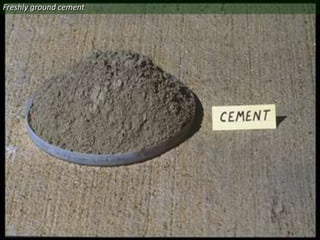
Freshly ground cement


                        2
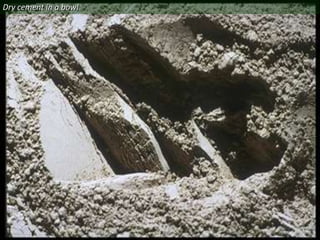
Dry cement in a bowl


                       3
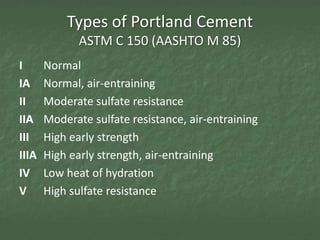
Types of Portland Cement
              ASTM C 150 (AASHTO M 85)
I      Normal
IA     Normal, air-entraining
II     Moderate sulfate resistance
IIA    Moderate sulfate resistance, air-entraining
III    High early strength
IIIA   High early strength, air-entraining
IV     Low heat of hydration
V      High sulfate resistance
Cement Types
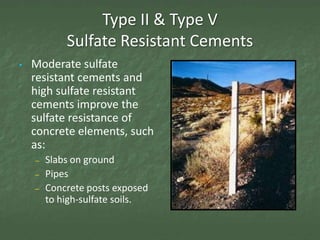
Type II & Type V
            Sulfate Resistant Cements
•   Moderate sulfate
    resistant cements and
    high sulfate resistant
    cements improve the
    sulfate resistance of
    concrete elements, such
    as:
    –   Slabs on ground
    –   Pipes
    –   Concrete posts exposed
        to high-sulfate soils.
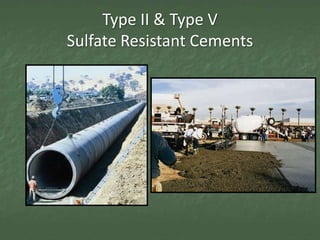
Type II & Type V
Sulfate Resistant Cements
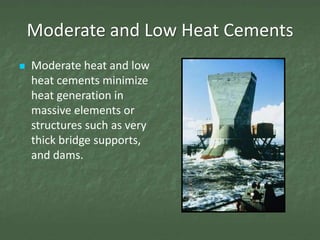
Moderate and Low Heat Cements
   Moderate heat and low
    heat cements minimize
    heat generation in
    massive elements or
    structures such as very
    thick bridge supports,
    and dams.
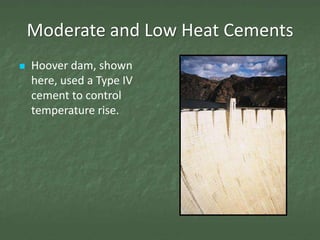
Moderate and Low Heat Cements
   Hoover dam, shown
    here, used a Type IV
    cement to control
    temperature rise.
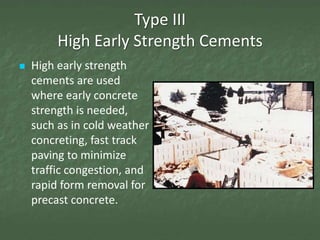
Type III
         High Early Strength Cements
   High early strength
    cements are used
    where early concrete
    strength is needed,
    such as in cold weather
    concreting, fast track
    paving to minimize
    traffic congestion, and
    rapid form removal for
    precast concrete.
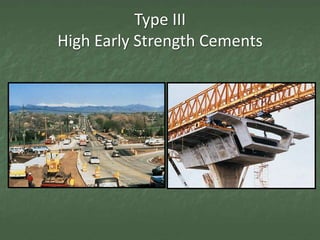
Type III
High Early Strength Cements
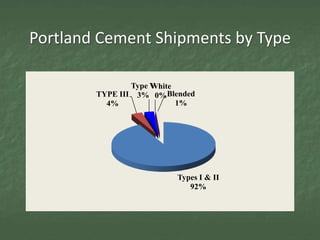
Portland Cement Shipments by Type

                Type V
                     White
        TYPE III 3% 0%Blended
          4%               1%


                         Types I & II
                            92%
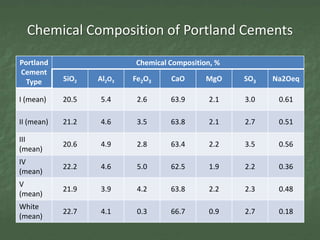
Chemical Composition of Portland Cements

Portland                   Chemical Composition, %
Cement
  Type      SiO2   Al2O3   Fe2O3    CaO       MgO    SO3   Na2Oeq

I (mean)    20.5   5.4      2.6     63.9      2.1    3.0    0.61

II (mean)   21.2   4.6      3.5     63.8      2.1    2.7    0.51

III
            20.6   4.9      2.8     63.4      2.2    3.5    0.56
(mean)
IV
            22.2   4.6      5.0     62.5      1.9    2.2    0.36
(mean)
V
            21.9   3.9      4.2     63.8      2.2    2.3    0.48
(mean)
White
            22.7   4.1      0.3     66.7      0.9    2.7    0.18
(mean)
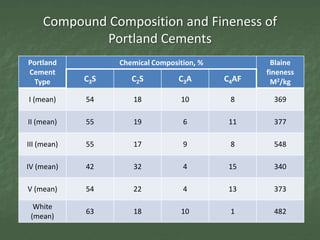
Compound Composition and Fineness of
             Portland Cements
Portland           Chemical Composition, %           Blaine
Cement                                              fineness
  Type       C3S      C2S          C3A       C4AF    M2/kg

I (mean)     54       18           10         8       369

II (mean)    55       19            6         11      377

III (mean)   55       17            9         8       548

IV (mean)    42       32            4         15      340

V (mean)     54       22            4         13      373

  White
             63       18           10         1       482
 (mean)
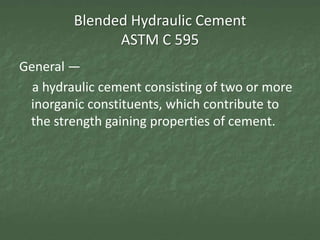
Blended Hydraulic Cement
               ASTM C 595
General —
  a hydraulic cement consisting of two or more
 inorganic constituents, which contribute to
 the strength gaining properties of cement.
Blended Cements
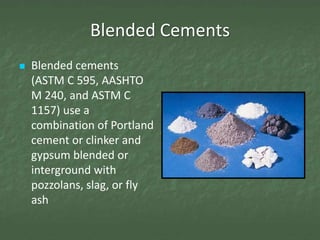
   Blended cements
    (ASTM C 595, AASHTO
    M 240, and ASTM C
    1157) use a
    combination of Portland
    cement or clinker and
    gypsum blended or
    interground with
    pozzolans, slag, or fly
    ash
Blended Cements
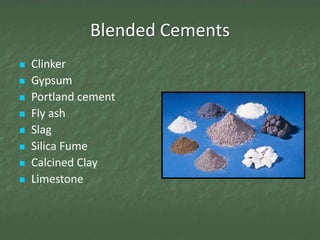
   Clinker
   Gypsum
   Portland cement
   Fly ash
   Slag
   Silica Fume
   Calcined Clay
   Limestone
ASTM C595 Blended Cements
   Interground or blended
       IP, IS
   MS Moderate sulfate resistance
   HS High sulfate resistance
   MH Moderate heat
   LH Low heat
Hydraulic Blended Cements
       ASTM C 595 (AASHTO M 240)
   Type IS
      PortlandBlast-Furnace Slag Cement
      Up to 95% slag content

   Type IP
      Portland-PozzolanCement
      Up to 40% pozzolan
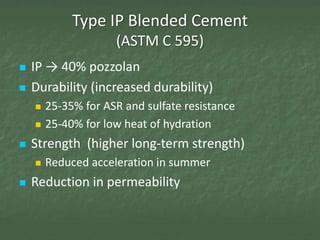
Type IP Blended Cement
                     (ASTM C 595)
   IP → 40% pozzolan
   Durability (increased durability)
       25-35% for ASR and sulfate resistance
       25-40% for low heat of hydration
   Strength (higher long-term strength)
       Reduced acceleration in summer
   Reduction in permeability
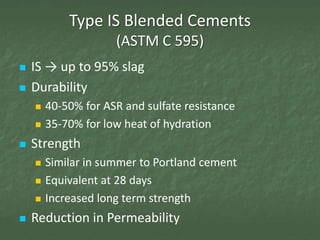
Type IS Blended Cements
                     (ASTM C 595)
   IS → up to 95% slag
   Durability
       40-50% for ASR and sulfate resistance
       35-70% for low heat of hydration
   Strength
       Similar in summer to Portland cement
       Equivalent at 28 days
       Increased long term strength
   Reduction in Permeability
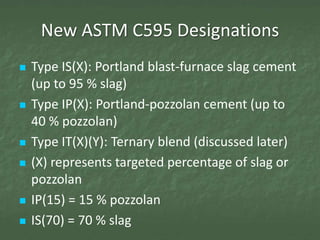
New ASTM C595 Designations
   Type IS(X): Portland blast-furnace slag cement
    (up to 95 % slag)
   Type IP(X): Portland-pozzolan cement (up to
    40 % pozzolan)
   Type IT(X)(Y): Ternary blend (discussed later)
   (X) represents targeted percentage of slag or
    pozzolan
   IP(15) = 15 % pozzolan
   IS(70) = 70 % slag
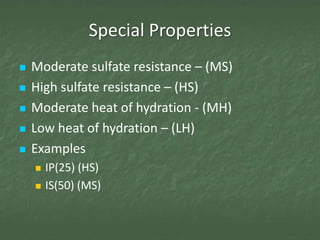
Special Properties
   Moderate sulfate resistance – (MS)
   High sulfate resistance – (HS)
   Moderate heat of hydration - (MH)
   Low heat of hydration – (LH)
   Examples
       IP(25) (HS)
       IS(50) (MS)
New in 2009
          Ternary Blended Cements
   The new cement type in C595 is a TERNARY BLENDED
    CEMENT and is designated IT. The basic description
    of a ternary cement is that it contains 2 SCMs along
    with portland cement or clinker.
   In close reading of C595 this option existed
    previously for pozzolans, but the change makes it
    clear when a ternary cement is used and what its
    composition is.
New in 2009
           Ternary Blended Cements
   The concept of the change is that all of the same
    chemical and physical limits apply for ternary blended
    cements as applied to Type IS and IP BINARY blended
    cements.
   If the SCM present in the highest amount is a
    slag, requirements of Type IS apply. If a pozzolan is
    present in larger amount, the requirements of Type IP
    apply.
   To provide information for customers as to exactly what
    the ternary cement composition is, both the amount and
    type of SCM is defined in the cement nomenclature.
New in 2009
     Ternary Blended Cements (Summary)
   New Type IT
   1 slag and 1 pozzolan or 2 pozzolans
   Same chemical and physical limits for ternary
    blended cements as for binary blended
    cements (IP or IS) with the same predominant
    SCM
   Amount and type of SCMs used in
    nomenclature
Ternary Blended Cements
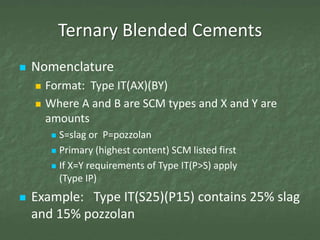
   The naming convention is shown here: The
    cement is called a TYPE IT with the amounts
    and types of SCM identified in parentheses.
   Generically this Type IT(AX)(BY) where A and B
    are the types of SCMs and X and Y are their
    corresponding amounts, in percentage by
    mass.
Ternary Blended Cements
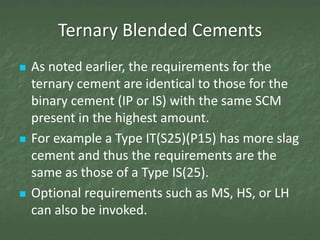
   Nomenclature
       Format: Type IT(AX)(BY)
       Where A and B are SCM types and X and Y are
        amounts
          S=slag or P=pozzolan
          Primary (highest content) SCM listed first

          If X=Y requirements of Type IT(P>S) apply
           (Type IP)
   Example: Type IT(S25)(P15) contains 25% slag
    and 15% pozzolan
Ternary Blended Cements
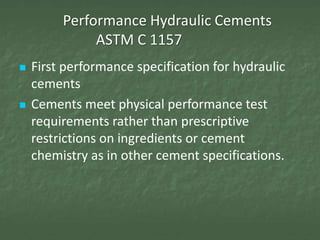
   As noted earlier, the requirements for the
    ternary cement are identical to those for the
    binary cement (IP or IS) with the same SCM
    present in the highest amount.
   For example a Type IT(S25)(P15) has more slag
    cement and thus the requirements are the
    same as those of a Type IS(25).
   Optional requirements such as MS, HS, or LH
    can also be invoked.
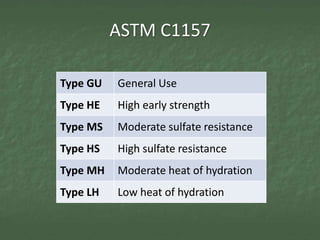
Performance Hydraulic Cements
              ASTM C 1157
   First performance specification for hydraulic
    cements
   Cements meet physical performance test
    requirements rather than prescriptive
    restrictions on ingredients or cement
    chemistry as in other cement specifications.
ASTM C1157

Type GU   General Use
Type HE   High early strength
Type MS   Moderate sulfate resistance
Type HS   High sulfate resistance
Type MH   Moderate heat of hydration
Type LH   Low heat of hydration
Applications for Commonly
               Used Cements
   Check the local availability of specific cements
    as all cements are not available everywhere.
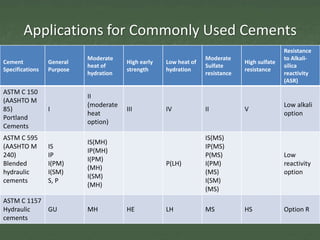
Applications for Commonly Used Cements
                                                                                              Resistance
                           Moderate                               Moderate                    to Alkali-
Cement           General               High early   Low heat of                High sulfate
                           heat of                                Sulfate                     silica
Specifications   Purpose               strength     hydration                  resistance
                           hydration                              resistance                  reactivity
                                                                                              (ASR)
ASTM C 150
                           II
(AASHTO M
                           (moderate                                                          Low alkali
85)              I                     III          IV            II           V
                           heat                                                               option
Portland
                           option)
Cements
ASTM C 595                                                        IS(MS)
                           IS(MH)
(AASHTO M        IS                                               IP(MS)
                           IP(MH)
240)             IP                                               P(MS)                       Low
                           I(PM)
Blended          I(PM)                              P(LH)         I(PM)                       reactivity
                           (MH)
hydraulic        I(SM)                                            (MS)                        option
                           I(SM)
cements          S, P                                             I(SM)
                           (MH)
                                                                  (MS)
ASTM C 1157
Hydraulic   GU             MH          HE           LH            MS           HS             Option R
cements
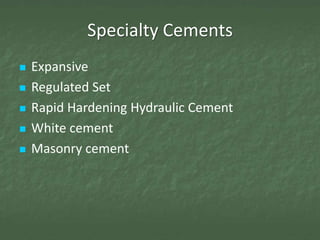
Specialty Cements
   Expansive
   Regulated Set
   Rapid Hardening Hydraulic Cement
   White cement
   Masonry cement
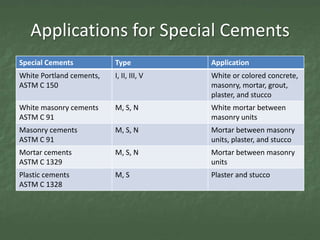
Applications for Special Cements
Special Cements           Type            Application
White Portland cements,   I, II, III, V   White or colored concrete,
ASTM C 150                                masonry, mortar, grout,
                                          plaster, and stucco
White masonry cements     M, S, N         White mortar between
ASTM C 91                                 masonry units
Masonry cements           M, S, N         Mortar between masonry
ASTM C 91                                 units, plaster, and stucco
Mortar cements            M, S, N         Mortar between masonry
ASTM C 1329                               units
Plastic cements           M, S            Plaster and stucco
ASTM C 1328
Applications for Special Cements
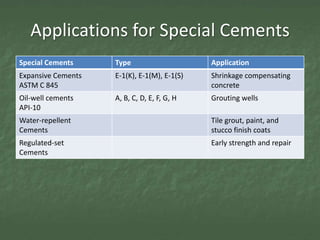
Special Cements     Type                     Application
Expansive Cements   E-1(K), E-1(M), E-1(S)   Shrinkage compensating
ASTM C 845                                   concrete
Oil-well cements    A, B, C, D, E, F, G, H   Grouting wells
API-10
Water-repellent                              Tile grout, paint, and
Cements                                      stucco finish coats
Regulated-set                                Early strength and repair
Cements
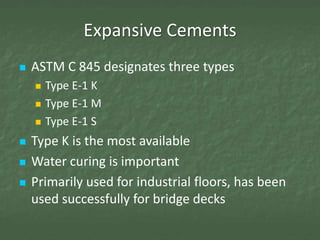
Expansive Cements
   ASTM C 845 designates three types
       Type E-1 K
       Type E-1 M
       Type E-1 S
   Type K is the most available
   Water curing is important
   Primarily used for industrial floors, has been
    used successfully for bridge decks
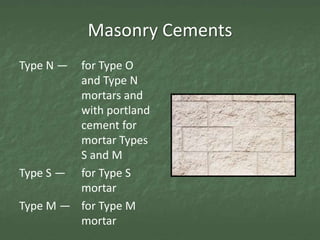
Masonry Cements
Type N — for Type O
         and Type N
         mortars and
         with portland
         cement for
         mortar Types
         S and M
Type S — for Type S
         mortar
Type M — for Type M
         mortar
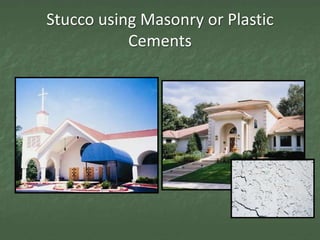
Stucco using Masonry or Plastic
           Cements
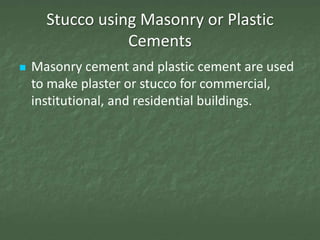
Stucco using Masonry or Plastic
                 Cements
   Masonry cement and plastic cement are used
    to make plaster or stucco for commercial,
    institutional, and residential buildings.
White Cement
   Negligible amounts of iron and magnesium
   Manufactured to ASTM C 150 requirements
       Type I
       Type III
   Used in white or colored concrete
       Barriers and parapets
       Noise walls
       White roofs
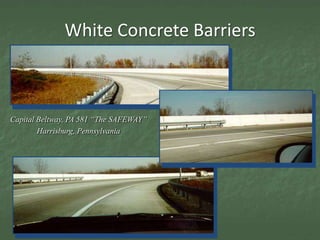
White Concrete Barriers
   Photos on the next slide represent white
    concrete barriers used on the Capital Beltway
    located in Harrisburg, Pennsylvania. They were
    roughly constructed in 1997.
   As you can see, these barriers are highly
    visible, increasing safety for all drivers at time
    of day.
White Concrete Barriers


Capital Beltway, PA 581 “The SAFEWAY”
        Harrisburg, Pennsylvania
Hydraulic Cement Specifications
Please return to Blackboard and watch the
following video:
 Video 1: Types of Portland Cement

CON 123 - Session 4 - Hydraulic Cement Specifications

  • 1.
    CON 123 Cementitious Materials Session4 Hydraulic Cement Specifications
  • 2.
  • 3.
    Dry cement ina bowl 3
  • 4.
    Types of PortlandCement ASTM C 150 (AASHTO M 85) I Normal IA Normal, air-entraining II Moderate sulfate resistance IIA Moderate sulfate resistance, air-entraining III High early strength IIIA High early strength, air-entraining IV Low heat of hydration V High sulfate resistance
  • 5.
  • 6.
    Type II &Type V Sulfate Resistant Cements • Moderate sulfate resistant cements and high sulfate resistant cements improve the sulfate resistance of concrete elements, such as: – Slabs on ground – Pipes – Concrete posts exposed to high-sulfate soils.
  • 7.
    Type II &Type V Sulfate Resistant Cements
  • 8.
    Moderate and LowHeat Cements  Moderate heat and low heat cements minimize heat generation in massive elements or structures such as very thick bridge supports, and dams.
  • 9.
    Moderate and LowHeat Cements  Hoover dam, shown here, used a Type IV cement to control temperature rise.
  • 10.
    Type III High Early Strength Cements  High early strength cements are used where early concrete strength is needed, such as in cold weather concreting, fast track paving to minimize traffic congestion, and rapid form removal for precast concrete.
  • 11.
    Type III High EarlyStrength Cements
  • 12.
    Portland Cement Shipmentsby Type Type V White TYPE III 3% 0%Blended 4% 1% Types I & II 92%
  • 13.
    Chemical Composition ofPortland Cements Portland Chemical Composition, % Cement Type SiO2 Al2O3 Fe2O3 CaO MgO SO3 Na2Oeq I (mean) 20.5 5.4 2.6 63.9 2.1 3.0 0.61 II (mean) 21.2 4.6 3.5 63.8 2.1 2.7 0.51 III 20.6 4.9 2.8 63.4 2.2 3.5 0.56 (mean) IV 22.2 4.6 5.0 62.5 1.9 2.2 0.36 (mean) V 21.9 3.9 4.2 63.8 2.2 2.3 0.48 (mean) White 22.7 4.1 0.3 66.7 0.9 2.7 0.18 (mean)
  • 14.
    Compound Composition andFineness of Portland Cements Portland Chemical Composition, % Blaine Cement fineness Type C3S C2S C3A C4AF M2/kg I (mean) 54 18 10 8 369 II (mean) 55 19 6 11 377 III (mean) 55 17 9 8 548 IV (mean) 42 32 4 15 340 V (mean) 54 22 4 13 373 White 63 18 10 1 482 (mean)
  • 15.
    Blended Hydraulic Cement ASTM C 595 General — a hydraulic cement consisting of two or more inorganic constituents, which contribute to the strength gaining properties of cement.
  • 16.
    Blended Cements  Blended cements (ASTM C 595, AASHTO M 240, and ASTM C 1157) use a combination of Portland cement or clinker and gypsum blended or interground with pozzolans, slag, or fly ash
  • 17.
    Blended Cements  Clinker  Gypsum  Portland cement  Fly ash  Slag  Silica Fume  Calcined Clay  Limestone
  • 18.
    ASTM C595 BlendedCements  Interground or blended  IP, IS  MS Moderate sulfate resistance  HS High sulfate resistance  MH Moderate heat  LH Low heat
  • 19.
    Hydraulic Blended Cements ASTM C 595 (AASHTO M 240)  Type IS  PortlandBlast-Furnace Slag Cement  Up to 95% slag content  Type IP  Portland-PozzolanCement  Up to 40% pozzolan
  • 20.
    Type IP BlendedCement (ASTM C 595)  IP → 40% pozzolan  Durability (increased durability)  25-35% for ASR and sulfate resistance  25-40% for low heat of hydration  Strength (higher long-term strength)  Reduced acceleration in summer  Reduction in permeability
  • 21.
    Type IS BlendedCements (ASTM C 595)  IS → up to 95% slag  Durability  40-50% for ASR and sulfate resistance  35-70% for low heat of hydration  Strength  Similar in summer to Portland cement  Equivalent at 28 days  Increased long term strength  Reduction in Permeability
  • 22.
    New ASTM C595Designations  Type IS(X): Portland blast-furnace slag cement (up to 95 % slag)  Type IP(X): Portland-pozzolan cement (up to 40 % pozzolan)  Type IT(X)(Y): Ternary blend (discussed later)  (X) represents targeted percentage of slag or pozzolan  IP(15) = 15 % pozzolan  IS(70) = 70 % slag
  • 23.
    Special Properties  Moderate sulfate resistance – (MS)  High sulfate resistance – (HS)  Moderate heat of hydration - (MH)  Low heat of hydration – (LH)  Examples  IP(25) (HS)  IS(50) (MS)
  • 24.
    New in 2009 Ternary Blended Cements  The new cement type in C595 is a TERNARY BLENDED CEMENT and is designated IT. The basic description of a ternary cement is that it contains 2 SCMs along with portland cement or clinker.  In close reading of C595 this option existed previously for pozzolans, but the change makes it clear when a ternary cement is used and what its composition is.
  • 25.
    New in 2009 Ternary Blended Cements  The concept of the change is that all of the same chemical and physical limits apply for ternary blended cements as applied to Type IS and IP BINARY blended cements.  If the SCM present in the highest amount is a slag, requirements of Type IS apply. If a pozzolan is present in larger amount, the requirements of Type IP apply.  To provide information for customers as to exactly what the ternary cement composition is, both the amount and type of SCM is defined in the cement nomenclature.
  • 26.
    New in 2009 Ternary Blended Cements (Summary)  New Type IT  1 slag and 1 pozzolan or 2 pozzolans  Same chemical and physical limits for ternary blended cements as for binary blended cements (IP or IS) with the same predominant SCM  Amount and type of SCMs used in nomenclature
  • 27.
    Ternary Blended Cements  The naming convention is shown here: The cement is called a TYPE IT with the amounts and types of SCM identified in parentheses.  Generically this Type IT(AX)(BY) where A and B are the types of SCMs and X and Y are their corresponding amounts, in percentage by mass.
  • 28.
    Ternary Blended Cements  Nomenclature  Format: Type IT(AX)(BY)  Where A and B are SCM types and X and Y are amounts  S=slag or P=pozzolan  Primary (highest content) SCM listed first  If X=Y requirements of Type IT(P>S) apply (Type IP)  Example: Type IT(S25)(P15) contains 25% slag and 15% pozzolan
  • 29.
    Ternary Blended Cements  As noted earlier, the requirements for the ternary cement are identical to those for the binary cement (IP or IS) with the same SCM present in the highest amount.  For example a Type IT(S25)(P15) has more slag cement and thus the requirements are the same as those of a Type IS(25).  Optional requirements such as MS, HS, or LH can also be invoked.
  • 30.
    Performance Hydraulic Cements ASTM C 1157  First performance specification for hydraulic cements  Cements meet physical performance test requirements rather than prescriptive restrictions on ingredients or cement chemistry as in other cement specifications.
  • 31.
    ASTM C1157 Type GU General Use Type HE High early strength Type MS Moderate sulfate resistance Type HS High sulfate resistance Type MH Moderate heat of hydration Type LH Low heat of hydration
  • 32.
    Applications for Commonly Used Cements  Check the local availability of specific cements as all cements are not available everywhere.
  • 33.
    Applications for CommonlyUsed Cements Resistance Moderate Moderate to Alkali- Cement General High early Low heat of High sulfate heat of Sulfate silica Specifications Purpose strength hydration resistance hydration resistance reactivity (ASR) ASTM C 150 II (AASHTO M (moderate Low alkali 85) I III IV II V heat option Portland option) Cements ASTM C 595 IS(MS) IS(MH) (AASHTO M IS IP(MS) IP(MH) 240) IP P(MS) Low I(PM) Blended I(PM) P(LH) I(PM) reactivity (MH) hydraulic I(SM) (MS) option I(SM) cements S, P I(SM) (MH) (MS) ASTM C 1157 Hydraulic GU MH HE LH MS HS Option R cements
  • 34.
    Specialty Cements  Expansive  Regulated Set  Rapid Hardening Hydraulic Cement  White cement  Masonry cement
  • 35.
    Applications for SpecialCements Special Cements Type Application White Portland cements, I, II, III, V White or colored concrete, ASTM C 150 masonry, mortar, grout, plaster, and stucco White masonry cements M, S, N White mortar between ASTM C 91 masonry units Masonry cements M, S, N Mortar between masonry ASTM C 91 units, plaster, and stucco Mortar cements M, S, N Mortar between masonry ASTM C 1329 units Plastic cements M, S Plaster and stucco ASTM C 1328
  • 36.
    Applications for SpecialCements Special Cements Type Application Expansive Cements E-1(K), E-1(M), E-1(S) Shrinkage compensating ASTM C 845 concrete Oil-well cements A, B, C, D, E, F, G, H Grouting wells API-10 Water-repellent Tile grout, paint, and Cements stucco finish coats Regulated-set Early strength and repair Cements
  • 37.
    Expansive Cements  ASTM C 845 designates three types  Type E-1 K  Type E-1 M  Type E-1 S  Type K is the most available  Water curing is important  Primarily used for industrial floors, has been used successfully for bridge decks
  • 38.
    Masonry Cements Type N— for Type O and Type N mortars and with portland cement for mortar Types S and M Type S — for Type S mortar Type M — for Type M mortar
  • 39.
    Stucco using Masonryor Plastic Cements
  • 40.
    Stucco using Masonryor Plastic Cements  Masonry cement and plastic cement are used to make plaster or stucco for commercial, institutional, and residential buildings.
  • 41.
    White Cement  Negligible amounts of iron and magnesium  Manufactured to ASTM C 150 requirements  Type I  Type III  Used in white or colored concrete  Barriers and parapets  Noise walls  White roofs
  • 42.
    White Concrete Barriers  Photos on the next slide represent white concrete barriers used on the Capital Beltway located in Harrisburg, Pennsylvania. They were roughly constructed in 1997.  As you can see, these barriers are highly visible, increasing safety for all drivers at time of day.
  • 43.
    White Concrete Barriers CapitalBeltway, PA 581 “The SAFEWAY” Harrisburg, Pennsylvania
  • 44.
    Hydraulic Cement Specifications Pleasereturn to Blackboard and watch the following video:  Video 1: Types of Portland Cement