Computing Science
in Local Authority
Secondary Schools
January 2022
Contents
Introduction.........................................................................................................................................4
Survey of Computing Science Provision In Secondary Schools,
Provisional Results ............................................................................................................................5
Computing Science Teacher FTE .................................................................................................5
Schools with single person Computing Science teachers ...........................................................5
Provision of Computing Science in 36 Schools with zero FTE CS
Teachers from Survey Data ...........................................................................................................5
Collated Survey and External Data - FTE Computing Science
Teachers.............................................................................................................................................6
S1/2 Overall ....................................................................................................................................7
Survey Results - National Qualifications...........................................................................................8
SQA NQ Presentations Over Time ...................................................................................................9
Computing Science presentations.................................................................................................9
Computing Science National Qualifications (and historical
equivalent) only, by SCQF level ....................................................................................................9
Computing Science, Information Systems and NPA presentations ..........................................10
Computing Science National Qualifications, Information Systems
and Digital NPAs by SCQF level .................................................................................................10
Local Authority Secondary Schools Presenting National
Qualifications in Computing Science over time ..........................................................................11
Computing Science National Qualifications Curriculum Content Offer
Over Time.........................................................................................................................................12
SCQF Level 4 ...............................................................................................................................12
SCQF Level 5 ...............................................................................................................................13
SCQF Level 6 ...............................................................................................................................13
National Progression Awards / Other Senior Phase Offers...........................................................14
Learner Uptake of Digital/Computing NPAs from Local Authority
Secondary Schools over time by SCQF level.............................................................................14
Number of Local Authority Secondary schools presenting 1+
Computing/Digital NPA over time ................................................................................................15
Specific National Progression Awards Provision asked in Survey ............................................15
Other NPAs and Senior Phase Offers in Schools from Survey
Responses ....................................................................................................................................15
Attainment/SIMD quintile profile of NQ Computing Science Courses
(Insight).............................................................................................................................................16
National 5 Computing Science ....................................................................................................16
Higher Computing Science ..........................................................................................................17
Advanced Higher Computing Science.........................................................................................17
Recommendations ...........................................................................................................................18
4 | Document title
Introduction
This paper provides anoverview of Computing Science delivery in Local Authority Secondary schools. Education
Scotland carried out a survey of 356 schools between July 2021 and October 2021. The survey was promoted via
local authority technologies leads, Computing Science teacher groups and Education Scotland officer contacts
with local authorities and RICs. At the point of writing, the survey has had 309/356 unique local authority school
responses. This represents 86.8% of local authority secondary schools. While this is themajority of schools, it is
acknowledged that the survey data is not complete and that this paper should be treatedasprovisional in this
respect.
The survey collecteddata relating toComputing teacher numbers, delivery of Computing Science in S1/2 and
opportunities for learners to study Computing Science or relatedcourses in the senior phase.
This paper does not look at specific data relating to the gender gapin Computing Science, which has been well
documented recently. The purpose of the paper is to examine the provision of Computing Science nationally and
identify areaswhere support could be offered.
The data relating to SQA qualifications has been taken from SQA website and supported by additional queries to
the SQA enquiries team. Statistics and information - SQA
Additional data relating to teacher numbers in the 48 local authorityschools who have yet to respond has been
taken from a recent public FOI request relating to Computing Scienceteachernumbersinlocal authorities.
Data relating toattainment and deprivation has been takenfrom Insight.
Data relating toschools was takenfrom Pupil census: supplementary statistics- gov.scot (www.gov.scot)
5 | Document title
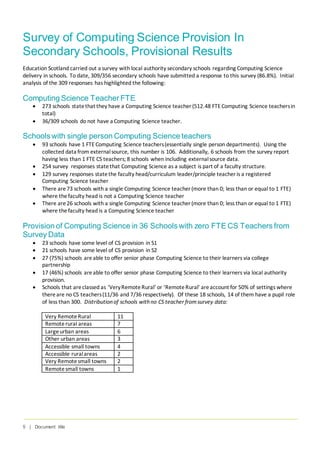
Survey of Computing Science Provision In
Secondary Schools, Provisional Results
Education Scotland carried out a survey with local authority secondary schools regarding Computing Science
delivery in schools. To date, 309/356 secondary schools have submitted a response to this survey (86.8%). Initial
analysis of the 309 responses has highlighted the following:
Computing Science Teacher FTE
• 273 schools statethat they have a Computing Science teacher (512.48 FTE Computing Science teachersin
total)
• 36/309 schools do not have a Computing Science teacher.
Schools with single person Computing Science teachers
• 93 schools have 1 FTE Computing Science teachers(essentially single person departments). Using the
collected data from externalsource, this number is 106. Additionally, 6 schools from the survey report
having less than 1 FTE CS teachers; 8 schools when including externalsource data.
• 254 survey responses statethat Computing Science as a subject is part of a faculty structure.
• 129 survey responses statethe faculty head/curriculum leader/principle teacher is a registered
Computing Science teacher
• There are73 schools with a single Computing Science teacher (more than 0; less than or equal to 1 FTE)
where thefaculty head is not a Computing Science teacher
• There are26 schools with a single Computing Science teacher (more than 0; less than or equal to 1 FTE)
where thefaculty head is a Computing Science teacher
Provision of Computing Science in 36 Schools with zero FTE CS Teachers from
Survey Data
• 23 schools have some level of CS provision in S1
• 21 schools have some level of CS provision in S2
• 27 (75%) schools areable to offer senior phase Computing Science to their learners via college
partnership
• 17 (46%) schools areable to offer senior phase Computing Science to their learners via local authority
provision.
• Schools that areclassed as ‘VeryRemoteRural’ or ‘RemoteRural’ areaccount for 50% of settings where
thereare no CS teachers(11/36 and 7/36 respectively). Of these 18 schools, 14 of them have a pupil role
of less than 300. Distributionof schools withno CS teacher fromsurvey data:
Very RemoteRural 11
Remoterural areas 7
Largeurban areas 6
Other urban areas 3
Accessible small towns 4
Accessible ruralareas 2
Very Remotesmall towns 2
Remotesmall towns 1
6 | Document title
Collated Survey and External Data - FTE
Computing Science Teachers
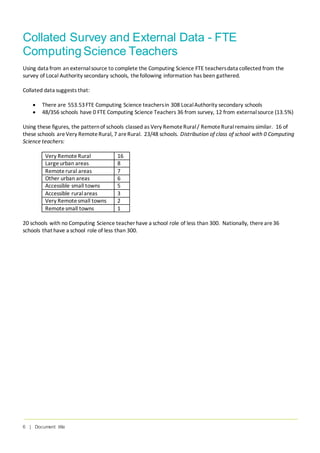
Using data from an externalsource to complete the Computing Science FTE teachersdata collected from the
survey of Local Authority secondary schools, thefollowing information has been gathered.
Collated data suggests that:
• There are 553.53FTE Computing Science teachersin 308 LocalAuthority secondary schools
• 48/356 schools have 0 FTE Computing Science Teachers 36 from survey, 12 from externalsource (13.5%)
Using these figures, the patternof schools classed as Very RemoteRural/ RemoteRuralremains similar. 16 of
these schools areVery RemoteRural, 7 areRural. 23/48 schools. Distribution of class of school with 0 Computing
Science teachers:
Very RemoteRural 16
Largeurban areas 8
Remoterural areas 7
Other urban areas 6
Accessible small towns 5
Accessible ruralareas 3
Very Remotesmall towns 2
Remotesmall towns 1
20 schools with no Computing Science teacher have a school role of less than 300. Nationally, thereare36
schools that have a school role of less than 300.
7 | Document title
S1/2 Overall
278 / 309 (90% of responses) offer Computing Science*, either as discretesubject or as part of wider digital
course or mixed with Business Education in S1.
• Of the 278 offers, 244 courses are delivered by, or with, Computing Science teachers.
• The averageperiod length is 51 minutes
• The averagenumber of Computing periods per week is 1.17
* If schools who have not responded all report no Computing Science experiences in S1, this could be 278/356 (78%)
If schools who have not responded all report they do offer Computing Science experiences in S1, this could be 325/356 (91.3%)
280 / 309 (91% of responses) offer Computing Science**, either as a discrete subject or as part of wider digital
course or mixed with Business Education in S2.
• Of the 280 offers, 247 courses are delivered by, or with, Computing Science teachers.
• The averageperiod length is 51 minutes
• The averagenumber of Computing periods per week is 1.18
** If schools who have not responded all report no Computing Science experiences in S1, this could be 278/356 (78%)
If schools who have not responded all report they do offer Computing Science experiences in S1, this could be 327/356 (91.9%)
The S1/2 BGE content experience in S1/2 varies. However, most S1/2 courses reference content and skills that
articulatewithComputing Science qualifications. The most common being:
• Software develop through the use of Scratch/ Python
• Physical computing with Microbit
• Computer Systems
• Web Development (HTML/CSS)
• Databases
• Cyber Security
There aremany courses that include wider digitalskills in the context of multimedia, including graphics and
animation. S1/2 courses often include referenceto functional digitalskills. A word cloud based on free text
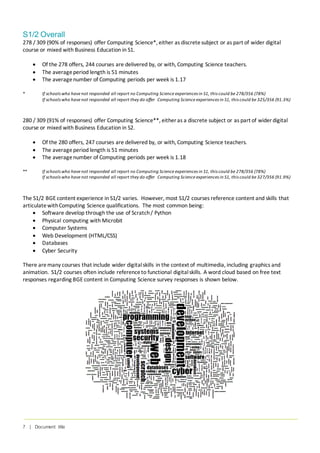
responses regarding BGE content in Computing Science survey responses is shown below.
8 | Document title
Survey Results - National Qualifications
Of the 309 responses:
• 256 (82.7%) offer National 4 Computing Science
• 265 (85.7%) offer National 5 Computing Science
• 257 (83.1%) offer Higher Computing Science
• 118 (38.3%) offer Advanced Higher Computing Science
For context, in 2020, SQA reported that thenumber of local authority secondary schools nationally that
presented National Qualifications in Computing Science at:
• National 5: 80.7%
• Higher: 71.4%
• Advanced Higher: 25.2%
The survey also asked schools if senior phase Computing courses wereavailable via local college or local authority
arrangements:
• 178/309 can access senior phase Computing courses via local collegearrangements
• 170/309 can access senior phase Computing courses via local authorityshared provision arrangements
9 | Document title
SQA NQ Presentations Over Time
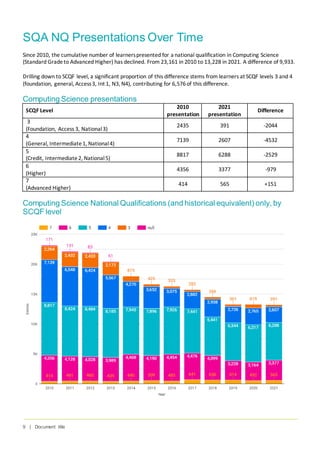
Since 2010, the cumulative number of learnerspresented for a national qualification in Computing Science
(Standard Gradeto Advanced Higher) has declined. From 23,161 in 2010 to 13,228 in 2021. A difference of 9,933.
Drilling down to SCQF level, a significant proportion of this difference stems from learners at SCQF levels 3 and 4
(foundation, general, Access3, Int 1, N3, N4), contributing for 6,576of this difference.
Computing Science presentations
SCQF Level
2010
presentation
2021
presentation
Difference
3
(Foundation, Access 3, National3)
2435 391 -2044
4
(General, Intermediate1, National4)
7139 2607 -4532
5
(Credit, Intermediate2, National5)
8817 6288 -2529
6
(Higher)
4356 3377 -979
7
(Advanced Higher)
414 565 +151
Computing Science National Qualifications (and historical equivalent) only, by
SCQF level
10 | Document title
Changes to course content of pre NationalQualification courses maybe a factor in these figures, particularlyat
SCQF levels 3 and 4. Standard Gradeand Higher Still courses at this level were significantly more focussed on
application skills, whereas, National Qualifications aremuch more syntax/code focussed. See next section for
further details.
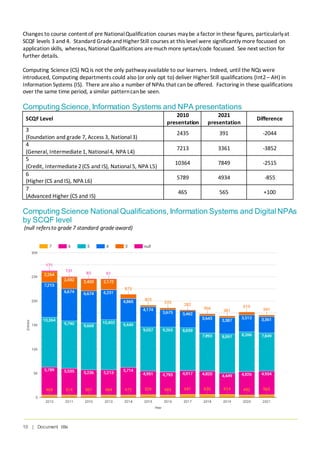
Computing Science (CS) NQ is not the only pathwayavailable to our learners. Indeed, until the NQs were
introduced, Computing departments could also (or only opt to) deliver Higher Still qualifications (Int2– AH) in
Information Systems (IS). There arealso a number of NPAs that can be offered. Factoring in these qualifications
over the same time period, a similar patterncanbe seen.
Computing Science, Information Systems and NPA presentations
SCQF Level
2010
presentation
2021
presentation
Difference
3
(Foundation and grade 7, Access 3, National3)
2435 391 -2044
4
(General, Intermediate1, National4, NPA L4)
7213 3361 -3852
5
(Credit, Intermediate2(CS and IS), National5, NPA L5)
10364 7849 -2515
6
(Higher (CS and IS), NPA L6)
5789 4934 -855
7
(Advanced Higher (CS and IS)
465 565 +100
Computing Science National Qualifications, Information Systems and Digital NPAs
by SCQF level
(null refersto grade 7 standard grade award)
11 | Document title
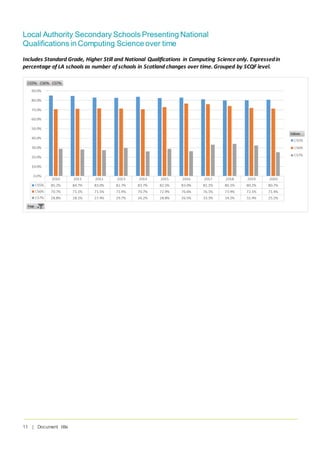
Local Authority Secondary Schools Presenting National
Qualifications in Computing Science over time
Includes Standard Grade, Higher Still and National Qualifications in Computing Science only. Expressedin
percentage of LA schools as number of schools in Scotland changes over time. Grouped by SCQF level.
12 | Document title
Computing Science National Qualifications
Curriculum Content Offer Over Time
The course content of Computing Science qualifications over time has changed significantly. Particularlyat SCQF
levels 3 and 4. Thehistoric courses at these levels did not have thesame focus as current qualifications. Much of
the content was applications and systems based. As the qualifications developed, much of this content was
removed and replaced with softwaredesign and development and web development.
When theHigher Still course Information Systems was available, a number of schools opted for this as their S5/6
Level 6 offer as a progression from Standard GradeComputing. As a result of the discontinuation of Standard
Gradeand Information Systems, schools had to changetheir offer to theNational Qualification Computing
Science route. This may have had an effect on uptake. InformationSystems as a course also had a higher uptake
of femalelearners (average30-34%) compared to Computing.
Summary of the content changes over time for different Computing Science courses at levels 4-6 can be seen in
the following tables.
SCQF Level 4
Standard Grade ComputingStudies(General) Intermediate1 ComputingStudies
Computer Applications(60 hours);
Computer Systems(20hours);
Computer Programming(40hours);
ProjectWork (30hours);
Flexibility (10hours)
Computer Application Software(40 hours);
Computer Systems (40 hours);
Optional Unit
[SoftwareDevelopment;InformationSystems;The
Internet] (40 hours)
2004 Update
2006 Update Computer Applications(40 hours);
MultimediaApplications(40hours);
Optional Unit
[Computers and theInternet;Information and theInternet]
(40 hours)
Computer Applications(60 hours);
Computer Systems(20hours);
Computer Programming(40hours);
ProjectWork (30hours);
Flexibility (10hours)
2014 National4 ComputingScienceCourse Specification
SoftwareDesign and Development;
Information SystemsDesign and Development
Added ValueUnit
13 | Document title
SCQF Level 5
Standard Grade ComputingStudies
(Credit)
Intermediate2 Computing Intermediate2 Information
Systems
1999 Arrangements
Computer Applications(60 hours);
Computer Systems(20hours);
Computer Programming(40hours);
ProjectWork (30hours);
Flexibility (10hours)
Computer Systems - includingapplications
(40 hours);
SoftwareDevelopment(40 hours);
ComputingProject(40hours);
DatabaseSystems(40hours);
Information Organisation (40
hours);
Optional Unit[Computer
Application Software;Expert
Systems;Hypermedia] (40hours)
2006 update
Computer Applications(60 hours);
Computer Systems(20hours);
Computer Programming(40hours);
ProjectWork (30hours);
Flexibility (10hours)
Computer Systems (40 hours);
SoftwareDevelopment(40 hours);
Optional Unit[ArtificialIntelligence;
Computer Networking;Multimedia
Technology] (40hours)
UsingInformation (40hours);
DatabaseSystems(40hours);
Optional Unit[ExpertSystems;
Applied Multimedia;TheInternet]
40 hours)
2013 END 2014 END
2014 National5 ComputingScienceCourse Specification
SoftwareDesign and Development;
Information SystemsDesign and Development
2017 Update
SoftwareDesign and Development;
DatabaseDesignandDevelopment;
Web Design and Development;
Computer Systems
SCQF Level 6
Higher Computing Higher InformationSystems
Computer Systems (40 hours);
SoftwareDevelopment(40 hours);
Optional Unit
[Artificial Intelligence;Computer Programming;Computer
Networking;MultimediaTechnology] (40 hours)
DatabaseSystems(40hours);
Information Organisation (40 hours);
Optional Unit
[Computer ApplicationSoftware;ExpertSystems;
Hypermedia] (40hours)
2006 Update
Computer Systems (40 hours);
SoftwareDevelopment(40 hours);
Optional Unit
[Artificial Intelligence;Computer Networking;Multimedia
Technology] (40hours)
UsingInformation (40hours);
Relational DatabaseSystems (40hours);
Optional Unit
[ExpertSystems;Applied Multimedia;TheInternet] 40
hours)
2014 END
2014 HigherComputingScience CourseSpecification
SoftwareDesign and Development;
Information SystemsDesign and Development
2018 Update
SoftwareDesign and Development;
DatabaseDesignandDevelopment;
Web Design and Development;
Computer Systems
14 | Document title
National Progression Awards / Other Senior Phase
Offers
In 2012 SQA introduced NationalProgression Awards in thearea of Computing and Digital. Thecurrent
availability of NPAs offered by SQA include:
ComputerGames Development SCQFlevel4,5 & 6 Digital Media Editing SCQFlevel 5
ComputerNetworks SCQFlevel 5 Digital Media Production SCQFlevel6
ComputerRefurbishment SCQFlevel4 Digital Passport SCQFlevel4, 5, & 6
Computers and DigitalPhotographySCQFlevel5 Mobile Technology SCQFlevel4 & 5
CyberSecurity SCQF4,5 & 6 PC Passport SCQFLevel4,5& 6
DataScienceat SCQF level 4,5 and 6 ProfessionalComputerFundamentals SCQFlevel6
Digital Literacy SCQF level 3 SocialSoftwareSCQF level 4
Digital Media SCQFlevel 4, 5 & 6 SoftwareDevelopment SCQFlevel4
Digital Media Basics SCQFlevel 4 SoftwareDevelopment SCQFlevel6
Digital Media Animation SCQFlevel 5 Web Design SCQFlevel 5
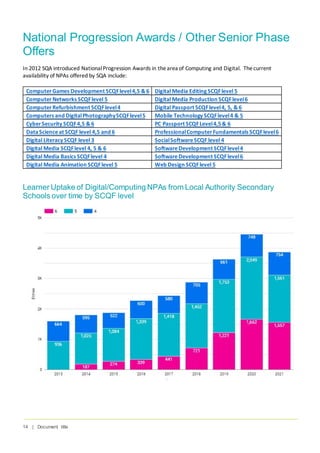
Learner Uptake of Digital/Computing NPAs from Local Authority Secondary
Schools over time by SCQF level
15 | Document title
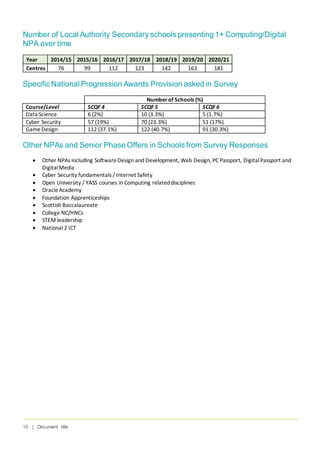
Number of Local Authority Secondary schools presenting 1+ Computing/Digital
NPA over time
Year 2014/15 2015/16 2016/17 2017/18 2018/19 2019/20 2020/21
Centres 76 99 112 123 142 163 181
Specific National Progression Awards Provision asked in Survey
Numberof Schools (%)
Course/Level SCQF 4 SCQF 5 SCQF 6
Data Science 6 (2%) 10 (3.3%) 5 (1.7%)
Cyber Security 57 (19%) 70 (23.3%) 51 (17%)
GameDesign 112 (37.1%) 122 (40.7%) 91 (30.3%)
Other NPAs and Senior Phase Offers in Schools from Survey Responses
• Other NPAs including SoftwareDesign and Development, Web Design, PC Passport, DigitalPassport and
DigitalMedia
• Cyber Security fundamentals / Internet Safety
• Open University / YASS courses in Computing relateddisciplines
• OracleAcademy
• Foundation Apprenticeships
• Scottish Baccalaureate
• College NC/HNCs
• STEM leadership
• National 2 ICT
16 | Document title
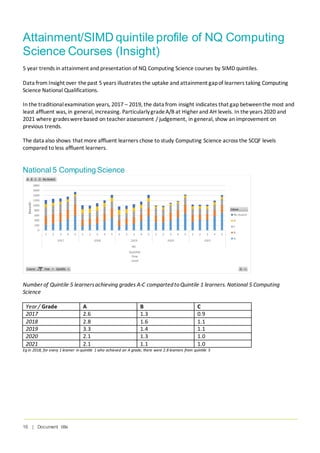
Attainment/SIMD quintile profile of NQ Computing
Science Courses (Insight)
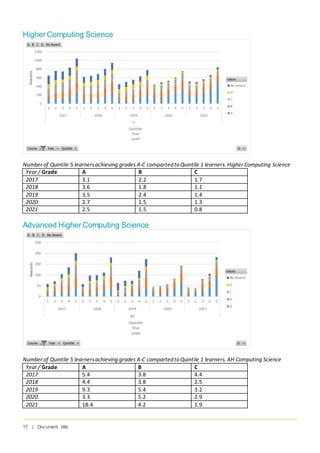
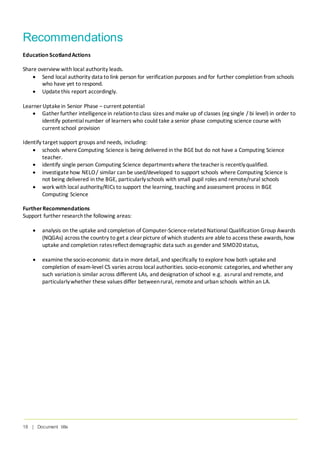
5 year trends in attainment and presentation of NQ Computing Science courses by SIMD quintiles.
Data from Insight over thepast 5 years illustrates the uptake and attainment gapof learners taking Computing
Science National Qualifications.
In the traditionalexamination years, 2017 – 2019, the data from insight indicates that gap betweenthe most and
least affluent was, in general, increasing. ParticularlygradeA/B at Higher and AH levels. In theyears 2020 and
2021 where gradeswerebased on teacher assessment / judgement, in general, show an improvement on
previous trends.
The data also shows that more affluent learners chose to study Computing Science across the SCQF levels
compared to less affluent learners.
National 5 Computing Science
Number of Quintile 5 learnersachieving grades A-C compartedtoQuintile 1 learners. National 5 Computing
Science
Year / Grade A B C
2017 2.6 1.3 0.9
2018 2.8 1.6 1.1
2019 3.3 1.4 1.1
2020 2.1 1.3 1.0
2021 2.1 1.1 1.0
Eg in 2018, for every 1 learner in quintile 1 who achieved an A grade, there were 2.8 learners from quintile 5
17 | Document title
Higher Computing Science
Number of Quintile 5 learnersachieving grades A-C compartedtoQuintile 1 learners. Higher Computing Science
Year / Grade A B C
2017 3.1 2.2 1.7
2018 3.6 1.8 1.1
2019 3.5 2.4 1.4
2020 2.7 1.5 1.3
2021 2.5 1.5 0.8
Advanced Higher Computing Science
Number of Quintile 5 learnersachieving grades A-C compartedtoQuintile 1 learners. AH Computing Science
Year / Grade A B C
2017 5.4 3.8 4.4
2018 4.4 3.8 2.5
2019 9.3 5.4 3.2
2020 3.3 5.2 2.9
2021 18.4 4.2 1.9
18 | Document title
Recommendations
Education ScotlandActions
Share overview with local authority leads.
• Send local authority data to link person for verification purposes and for further completion from schools
who have yet to respond.
• Updatethis report accordingly.
Learner Uptakein Senior Phase – current potential
• Gather further intelligencein relationto class sizes and make up of classes (eg single / bi level) in order to
identify potentialnumber of learners who could take a senior phase computing science course with
current school provision
Identify target support groups and needs, including:
• schools whereComputing Science is being delivered in the BGE but do not have a Computing Science
teacher.
• identify single person Computing Science departmentswhere theteacher is recentlyqualified.
• investigatehow NELO/ similar can be used/developed to support schools where Computing Science is
not being delivered in the BGE, particularlyschools with small pupil roles and remote/rural schools
• work with local authority/RICs to support the learning, teaching and assessment process in BGE
Computing Science
FurtherRecommendations
Support further researchthe following areas:
• analysis on the uptake and completion of Computer-Science-related National Qualification Group Awards
(NQGAs) across the country to get a clear picture of which students are ableto access these awards, how
uptake and completion ratesreflect demographic data such as gender and SIMD20status,
• examine thesocio-economic data in more detail, and specifically to explore how both uptakeand
completion of exam-level CS varies across local authorities. socio-economic categories, and whether any
such variationis similar across different LAs, and designation of school e.g. asrural and remote, and
particularlywhether these values differ betweenrural, remoteand urban schools within an LA.
Education Scotland
Denholm House
Almondvale Business Park
Almondvale Way
Livingston EH54 6GA
T +44 (0)131 244 4330
E enquiries@educationscotland.gsi.gov.uk
www.education.gov.scot
© Crown Copyright, Choose an item.
You may re-use this information (excluding images and logos) free of charge in any
format or medium, under the terms of the Open Government Licence providing that it is
reproduced accurately and not in a misleading context. The material must be
acknowledged as Education Scotland copyright and the document title specified.
To view this licence, visit http://nationalarchives.gov.uk/doc/open-government-licence or
e-mail: psi@nationalarchives.gsi.gov.uk
Where we have identified any third party copyright information you will need to obtain
permission from the copyright holders concerned.

Computing Science in Local Authority secondary schools

  • 1.
    Computing Science in LocalAuthority Secondary Schools January 2022
  • 2.
    Contents Introduction.........................................................................................................................................4 Survey of ComputingScience Provision In Secondary Schools, Provisional Results ............................................................................................................................5 Computing Science Teacher FTE .................................................................................................5 Schools with single person Computing Science teachers ...........................................................5 Provision of Computing Science in 36 Schools with zero FTE CS Teachers from Survey Data ...........................................................................................................5 Collated Survey and External Data - FTE Computing Science Teachers.............................................................................................................................................6 S1/2 Overall ....................................................................................................................................7 Survey Results - National Qualifications...........................................................................................8 SQA NQ Presentations Over Time ...................................................................................................9 Computing Science presentations.................................................................................................9 Computing Science National Qualifications (and historical equivalent) only, by SCQF level ....................................................................................................9 Computing Science, Information Systems and NPA presentations ..........................................10 Computing Science National Qualifications, Information Systems and Digital NPAs by SCQF level .................................................................................................10 Local Authority Secondary Schools Presenting National Qualifications in Computing Science over time ..........................................................................11 Computing Science National Qualifications Curriculum Content Offer Over Time.........................................................................................................................................12 SCQF Level 4 ...............................................................................................................................12 SCQF Level 5 ...............................................................................................................................13 SCQF Level 6 ...............................................................................................................................13 National Progression Awards / Other Senior Phase Offers...........................................................14 Learner Uptake of Digital/Computing NPAs from Local Authority Secondary Schools over time by SCQF level.............................................................................14 Number of Local Authority Secondary schools presenting 1+ Computing/Digital NPA over time ................................................................................................15 Specific National Progression Awards Provision asked in Survey ............................................15 Other NPAs and Senior Phase Offers in Schools from Survey Responses ....................................................................................................................................15 Attainment/SIMD quintile profile of NQ Computing Science Courses (Insight).............................................................................................................................................16 National 5 Computing Science ....................................................................................................16 Higher Computing Science ..........................................................................................................17 Advanced Higher Computing Science.........................................................................................17 Recommendations ...........................................................................................................................18
  • 4.
    4 | Documenttitle Introduction This paper provides anoverview of Computing Science delivery in Local Authority Secondary schools. Education Scotland carried out a survey of 356 schools between July 2021 and October 2021. The survey was promoted via local authority technologies leads, Computing Science teacher groups and Education Scotland officer contacts with local authorities and RICs. At the point of writing, the survey has had 309/356 unique local authority school responses. This represents 86.8% of local authority secondary schools. While this is themajority of schools, it is acknowledged that the survey data is not complete and that this paper should be treatedasprovisional in this respect. The survey collecteddata relating toComputing teacher numbers, delivery of Computing Science in S1/2 and opportunities for learners to study Computing Science or relatedcourses in the senior phase. This paper does not look at specific data relating to the gender gapin Computing Science, which has been well documented recently. The purpose of the paper is to examine the provision of Computing Science nationally and identify areaswhere support could be offered. The data relating to SQA qualifications has been taken from SQA website and supported by additional queries to the SQA enquiries team. Statistics and information - SQA Additional data relating to teacher numbers in the 48 local authorityschools who have yet to respond has been taken from a recent public FOI request relating to Computing Scienceteachernumbersinlocal authorities. Data relating toattainment and deprivation has been takenfrom Insight. Data relating toschools was takenfrom Pupil census: supplementary statistics- gov.scot (www.gov.scot)
  • 5.
    5 | Documenttitle Survey of Computing Science Provision In Secondary Schools, Provisional Results Education Scotland carried out a survey with local authority secondary schools regarding Computing Science delivery in schools. To date, 309/356 secondary schools have submitted a response to this survey (86.8%). Initial analysis of the 309 responses has highlighted the following: Computing Science Teacher FTE • 273 schools statethat they have a Computing Science teacher (512.48 FTE Computing Science teachersin total) • 36/309 schools do not have a Computing Science teacher. Schools with single person Computing Science teachers • 93 schools have 1 FTE Computing Science teachers(essentially single person departments). Using the collected data from externalsource, this number is 106. Additionally, 6 schools from the survey report having less than 1 FTE CS teachers; 8 schools when including externalsource data. • 254 survey responses statethat Computing Science as a subject is part of a faculty structure. • 129 survey responses statethe faculty head/curriculum leader/principle teacher is a registered Computing Science teacher • There are73 schools with a single Computing Science teacher (more than 0; less than or equal to 1 FTE) where thefaculty head is not a Computing Science teacher • There are26 schools with a single Computing Science teacher (more than 0; less than or equal to 1 FTE) where thefaculty head is a Computing Science teacher Provision of Computing Science in 36 Schools with zero FTE CS Teachers from Survey Data • 23 schools have some level of CS provision in S1 • 21 schools have some level of CS provision in S2 • 27 (75%) schools areable to offer senior phase Computing Science to their learners via college partnership • 17 (46%) schools areable to offer senior phase Computing Science to their learners via local authority provision. • Schools that areclassed as ‘VeryRemoteRural’ or ‘RemoteRural’ areaccount for 50% of settings where thereare no CS teachers(11/36 and 7/36 respectively). Of these 18 schools, 14 of them have a pupil role of less than 300. Distributionof schools withno CS teacher fromsurvey data: Very RemoteRural 11 Remoterural areas 7 Largeurban areas 6 Other urban areas 3 Accessible small towns 4 Accessible ruralareas 2 Very Remotesmall towns 2 Remotesmall towns 1
  • 6.
    6 | Documenttitle Collated Survey and External Data - FTE Computing Science Teachers Using data from an externalsource to complete the Computing Science FTE teachersdata collected from the survey of Local Authority secondary schools, thefollowing information has been gathered. Collated data suggests that: • There are 553.53FTE Computing Science teachersin 308 LocalAuthority secondary schools • 48/356 schools have 0 FTE Computing Science Teachers 36 from survey, 12 from externalsource (13.5%) Using these figures, the patternof schools classed as Very RemoteRural/ RemoteRuralremains similar. 16 of these schools areVery RemoteRural, 7 areRural. 23/48 schools. Distribution of class of school with 0 Computing Science teachers: Very RemoteRural 16 Largeurban areas 8 Remoterural areas 7 Other urban areas 6 Accessible small towns 5 Accessible ruralareas 3 Very Remotesmall towns 2 Remotesmall towns 1 20 schools with no Computing Science teacher have a school role of less than 300. Nationally, thereare36 schools that have a school role of less than 300.
  • 7.
    7 | Documenttitle S1/2 Overall 278 / 309 (90% of responses) offer Computing Science*, either as discretesubject or as part of wider digital course or mixed with Business Education in S1. • Of the 278 offers, 244 courses are delivered by, or with, Computing Science teachers. • The averageperiod length is 51 minutes • The averagenumber of Computing periods per week is 1.17 * If schools who have not responded all report no Computing Science experiences in S1, this could be 278/356 (78%) If schools who have not responded all report they do offer Computing Science experiences in S1, this could be 325/356 (91.3%) 280 / 309 (91% of responses) offer Computing Science**, either as a discrete subject or as part of wider digital course or mixed with Business Education in S2. • Of the 280 offers, 247 courses are delivered by, or with, Computing Science teachers. • The averageperiod length is 51 minutes • The averagenumber of Computing periods per week is 1.18 ** If schools who have not responded all report no Computing Science experiences in S1, this could be 278/356 (78%) If schools who have not responded all report they do offer Computing Science experiences in S1, this could be 327/356 (91.9%) The S1/2 BGE content experience in S1/2 varies. However, most S1/2 courses reference content and skills that articulatewithComputing Science qualifications. The most common being: • Software develop through the use of Scratch/ Python • Physical computing with Microbit • Computer Systems • Web Development (HTML/CSS) • Databases • Cyber Security There aremany courses that include wider digitalskills in the context of multimedia, including graphics and animation. S1/2 courses often include referenceto functional digitalskills. A word cloud based on free text responses regarding BGE content in Computing Science survey responses is shown below.
  • 8.
    8 | Documenttitle Survey Results - National Qualifications Of the 309 responses: • 256 (82.7%) offer National 4 Computing Science • 265 (85.7%) offer National 5 Computing Science • 257 (83.1%) offer Higher Computing Science • 118 (38.3%) offer Advanced Higher Computing Science For context, in 2020, SQA reported that thenumber of local authority secondary schools nationally that presented National Qualifications in Computing Science at: • National 5: 80.7% • Higher: 71.4% • Advanced Higher: 25.2% The survey also asked schools if senior phase Computing courses wereavailable via local college or local authority arrangements: • 178/309 can access senior phase Computing courses via local collegearrangements • 170/309 can access senior phase Computing courses via local authorityshared provision arrangements
  • 9.
    9 | Documenttitle SQA NQ Presentations Over Time Since 2010, the cumulative number of learnerspresented for a national qualification in Computing Science (Standard Gradeto Advanced Higher) has declined. From 23,161 in 2010 to 13,228 in 2021. A difference of 9,933. Drilling down to SCQF level, a significant proportion of this difference stems from learners at SCQF levels 3 and 4 (foundation, general, Access3, Int 1, N3, N4), contributing for 6,576of this difference. Computing Science presentations SCQF Level 2010 presentation 2021 presentation Difference 3 (Foundation, Access 3, National3) 2435 391 -2044 4 (General, Intermediate1, National4) 7139 2607 -4532 5 (Credit, Intermediate2, National5) 8817 6288 -2529 6 (Higher) 4356 3377 -979 7 (Advanced Higher) 414 565 +151 Computing Science National Qualifications (and historical equivalent) only, by SCQF level
  • 10.
    10 | Documenttitle Changes to course content of pre NationalQualification courses maybe a factor in these figures, particularlyat SCQF levels 3 and 4. Standard Gradeand Higher Still courses at this level were significantly more focussed on application skills, whereas, National Qualifications aremuch more syntax/code focussed. See next section for further details. Computing Science (CS) NQ is not the only pathwayavailable to our learners. Indeed, until the NQs were introduced, Computing departments could also (or only opt to) deliver Higher Still qualifications (Int2– AH) in Information Systems (IS). There arealso a number of NPAs that can be offered. Factoring in these qualifications over the same time period, a similar patterncanbe seen. Computing Science, Information Systems and NPA presentations SCQF Level 2010 presentation 2021 presentation Difference 3 (Foundation and grade 7, Access 3, National3) 2435 391 -2044 4 (General, Intermediate1, National4, NPA L4) 7213 3361 -3852 5 (Credit, Intermediate2(CS and IS), National5, NPA L5) 10364 7849 -2515 6 (Higher (CS and IS), NPA L6) 5789 4934 -855 7 (Advanced Higher (CS and IS) 465 565 +100 Computing Science National Qualifications, Information Systems and Digital NPAs by SCQF level (null refersto grade 7 standard grade award)
  • 11.
    11 | Documenttitle Local Authority Secondary Schools Presenting National Qualifications in Computing Science over time Includes Standard Grade, Higher Still and National Qualifications in Computing Science only. Expressedin percentage of LA schools as number of schools in Scotland changes over time. Grouped by SCQF level.
  • 12.
    12 | Documenttitle Computing Science National Qualifications Curriculum Content Offer Over Time The course content of Computing Science qualifications over time has changed significantly. Particularlyat SCQF levels 3 and 4. Thehistoric courses at these levels did not have thesame focus as current qualifications. Much of the content was applications and systems based. As the qualifications developed, much of this content was removed and replaced with softwaredesign and development and web development. When theHigher Still course Information Systems was available, a number of schools opted for this as their S5/6 Level 6 offer as a progression from Standard GradeComputing. As a result of the discontinuation of Standard Gradeand Information Systems, schools had to changetheir offer to theNational Qualification Computing Science route. This may have had an effect on uptake. InformationSystems as a course also had a higher uptake of femalelearners (average30-34%) compared to Computing. Summary of the content changes over time for different Computing Science courses at levels 4-6 can be seen in the following tables. SCQF Level 4 Standard Grade ComputingStudies(General) Intermediate1 ComputingStudies Computer Applications(60 hours); Computer Systems(20hours); Computer Programming(40hours); ProjectWork (30hours); Flexibility (10hours) Computer Application Software(40 hours); Computer Systems (40 hours); Optional Unit [SoftwareDevelopment;InformationSystems;The Internet] (40 hours) 2004 Update 2006 Update Computer Applications(40 hours); MultimediaApplications(40hours); Optional Unit [Computers and theInternet;Information and theInternet] (40 hours) Computer Applications(60 hours); Computer Systems(20hours); Computer Programming(40hours); ProjectWork (30hours); Flexibility (10hours) 2014 National4 ComputingScienceCourse Specification SoftwareDesign and Development; Information SystemsDesign and Development Added ValueUnit
  • 13.
    13 | Documenttitle SCQF Level 5 Standard Grade ComputingStudies (Credit) Intermediate2 Computing Intermediate2 Information Systems 1999 Arrangements Computer Applications(60 hours); Computer Systems(20hours); Computer Programming(40hours); ProjectWork (30hours); Flexibility (10hours) Computer Systems - includingapplications (40 hours); SoftwareDevelopment(40 hours); ComputingProject(40hours); DatabaseSystems(40hours); Information Organisation (40 hours); Optional Unit[Computer Application Software;Expert Systems;Hypermedia] (40hours) 2006 update Computer Applications(60 hours); Computer Systems(20hours); Computer Programming(40hours); ProjectWork (30hours); Flexibility (10hours) Computer Systems (40 hours); SoftwareDevelopment(40 hours); Optional Unit[ArtificialIntelligence; Computer Networking;Multimedia Technology] (40hours) UsingInformation (40hours); DatabaseSystems(40hours); Optional Unit[ExpertSystems; Applied Multimedia;TheInternet] 40 hours) 2013 END 2014 END 2014 National5 ComputingScienceCourse Specification SoftwareDesign and Development; Information SystemsDesign and Development 2017 Update SoftwareDesign and Development; DatabaseDesignandDevelopment; Web Design and Development; Computer Systems SCQF Level 6 Higher Computing Higher InformationSystems Computer Systems (40 hours); SoftwareDevelopment(40 hours); Optional Unit [Artificial Intelligence;Computer Programming;Computer Networking;MultimediaTechnology] (40 hours) DatabaseSystems(40hours); Information Organisation (40 hours); Optional Unit [Computer ApplicationSoftware;ExpertSystems; Hypermedia] (40hours) 2006 Update Computer Systems (40 hours); SoftwareDevelopment(40 hours); Optional Unit [Artificial Intelligence;Computer Networking;Multimedia Technology] (40hours) UsingInformation (40hours); Relational DatabaseSystems (40hours); Optional Unit [ExpertSystems;Applied Multimedia;TheInternet] 40 hours) 2014 END 2014 HigherComputingScience CourseSpecification SoftwareDesign and Development; Information SystemsDesign and Development 2018 Update SoftwareDesign and Development; DatabaseDesignandDevelopment; Web Design and Development; Computer Systems
  • 14.
    14 | Documenttitle National Progression Awards / Other Senior Phase Offers In 2012 SQA introduced NationalProgression Awards in thearea of Computing and Digital. Thecurrent availability of NPAs offered by SQA include: ComputerGames Development SCQFlevel4,5 & 6 Digital Media Editing SCQFlevel 5 ComputerNetworks SCQFlevel 5 Digital Media Production SCQFlevel6 ComputerRefurbishment SCQFlevel4 Digital Passport SCQFlevel4, 5, & 6 Computers and DigitalPhotographySCQFlevel5 Mobile Technology SCQFlevel4 & 5 CyberSecurity SCQF4,5 & 6 PC Passport SCQFLevel4,5& 6 DataScienceat SCQF level 4,5 and 6 ProfessionalComputerFundamentals SCQFlevel6 Digital Literacy SCQF level 3 SocialSoftwareSCQF level 4 Digital Media SCQFlevel 4, 5 & 6 SoftwareDevelopment SCQFlevel4 Digital Media Basics SCQFlevel 4 SoftwareDevelopment SCQFlevel6 Digital Media Animation SCQFlevel 5 Web Design SCQFlevel 5 Learner Uptake of Digital/Computing NPAs from Local Authority Secondary Schools over time by SCQF level
  • 15.
    15 | Documenttitle Number of Local Authority Secondary schools presenting 1+ Computing/Digital NPA over time Year 2014/15 2015/16 2016/17 2017/18 2018/19 2019/20 2020/21 Centres 76 99 112 123 142 163 181 Specific National Progression Awards Provision asked in Survey Numberof Schools (%) Course/Level SCQF 4 SCQF 5 SCQF 6 Data Science 6 (2%) 10 (3.3%) 5 (1.7%) Cyber Security 57 (19%) 70 (23.3%) 51 (17%) GameDesign 112 (37.1%) 122 (40.7%) 91 (30.3%) Other NPAs and Senior Phase Offers in Schools from Survey Responses • Other NPAs including SoftwareDesign and Development, Web Design, PC Passport, DigitalPassport and DigitalMedia • Cyber Security fundamentals / Internet Safety • Open University / YASS courses in Computing relateddisciplines • OracleAcademy • Foundation Apprenticeships • Scottish Baccalaureate • College NC/HNCs • STEM leadership • National 2 ICT
  • 16.
    16 | Documenttitle Attainment/SIMD quintile profile of NQ Computing Science Courses (Insight) 5 year trends in attainment and presentation of NQ Computing Science courses by SIMD quintiles. Data from Insight over thepast 5 years illustrates the uptake and attainment gapof learners taking Computing Science National Qualifications. In the traditionalexamination years, 2017 – 2019, the data from insight indicates that gap betweenthe most and least affluent was, in general, increasing. ParticularlygradeA/B at Higher and AH levels. In theyears 2020 and 2021 where gradeswerebased on teacher assessment / judgement, in general, show an improvement on previous trends. The data also shows that more affluent learners chose to study Computing Science across the SCQF levels compared to less affluent learners. National 5 Computing Science Number of Quintile 5 learnersachieving grades A-C compartedtoQuintile 1 learners. National 5 Computing Science Year / Grade A B C 2017 2.6 1.3 0.9 2018 2.8 1.6 1.1 2019 3.3 1.4 1.1 2020 2.1 1.3 1.0 2021 2.1 1.1 1.0 Eg in 2018, for every 1 learner in quintile 1 who achieved an A grade, there were 2.8 learners from quintile 5
  • 17.
    17 | Documenttitle Higher Computing Science Number of Quintile 5 learnersachieving grades A-C compartedtoQuintile 1 learners. Higher Computing Science Year / Grade A B C 2017 3.1 2.2 1.7 2018 3.6 1.8 1.1 2019 3.5 2.4 1.4 2020 2.7 1.5 1.3 2021 2.5 1.5 0.8 Advanced Higher Computing Science Number of Quintile 5 learnersachieving grades A-C compartedtoQuintile 1 learners. AH Computing Science Year / Grade A B C 2017 5.4 3.8 4.4 2018 4.4 3.8 2.5 2019 9.3 5.4 3.2 2020 3.3 5.2 2.9 2021 18.4 4.2 1.9
  • 18.
    18 | Documenttitle Recommendations Education ScotlandActions Share overview with local authority leads. • Send local authority data to link person for verification purposes and for further completion from schools who have yet to respond. • Updatethis report accordingly. Learner Uptakein Senior Phase – current potential • Gather further intelligencein relationto class sizes and make up of classes (eg single / bi level) in order to identify potentialnumber of learners who could take a senior phase computing science course with current school provision Identify target support groups and needs, including: • schools whereComputing Science is being delivered in the BGE but do not have a Computing Science teacher. • identify single person Computing Science departmentswhere theteacher is recentlyqualified. • investigatehow NELO/ similar can be used/developed to support schools where Computing Science is not being delivered in the BGE, particularlyschools with small pupil roles and remote/rural schools • work with local authority/RICs to support the learning, teaching and assessment process in BGE Computing Science FurtherRecommendations Support further researchthe following areas: • analysis on the uptake and completion of Computer-Science-related National Qualification Group Awards (NQGAs) across the country to get a clear picture of which students are ableto access these awards, how uptake and completion ratesreflect demographic data such as gender and SIMD20status, • examine thesocio-economic data in more detail, and specifically to explore how both uptakeand completion of exam-level CS varies across local authorities. socio-economic categories, and whether any such variationis similar across different LAs, and designation of school e.g. asrural and remote, and particularlywhether these values differ betweenrural, remoteand urban schools within an LA.
  • 19.
    Education Scotland Denholm House AlmondvaleBusiness Park Almondvale Way Livingston EH54 6GA T +44 (0)131 244 4330 E enquiries@educationscotland.gsi.gov.uk www.education.gov.scot © Crown Copyright, Choose an item. You may re-use this information (excluding images and logos) free of charge in any format or medium, under the terms of the Open Government Licence providing that it is reproduced accurately and not in a misleading context. The material must be acknowledged as Education Scotland copyright and the document title specified. To view this licence, visit http://nationalarchives.gov.uk/doc/open-government-licence or e-mail: psi@nationalarchives.gsi.gov.uk Where we have identified any third party copyright information you will need to obtain permission from the copyright holders concerned.