Three years on -
what has England learnt?
Miles Berry
University of Roehampton
@mberry | #CodeEducaLAB
18 October 2017
These slides: bit.ly/CodeEducaLAB
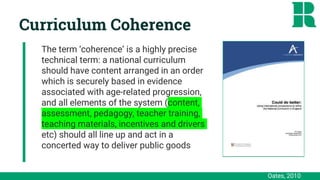
Oates, 2010
Curriculum Coherence
The term ‘coherence’ is a highly precise
technical term: a national curriculum
should have content arranged in an order
which is securely based in evidence
associated with age-related progression,
and all elements of the system (content,
assessment, pedagogy, teacher training,
teaching materials, incentives and drivers
etc) should all line up and act in a
concerted way to deliver public goods
The term ‘coherence’ is a highly precise
technical term: a national curriculum
should have content arranged in an order
which is securely based in evidence
associated with age-related progression,
and all elements of the system (content,
assessment, pedagogy, teacher training,
teaching materials, incentives and drivers
etc) should all line up and act in a
concerted way to deliver public goods
Content
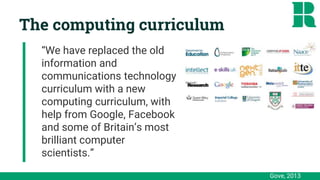
The computing curriculum
“We have replaced the old
information and
communications technology
curriculum with a new
computing curriculum, with
help from Google, Facebook
and some of Britain’s most
brilliant computer
scientists.”
Gove, 2013
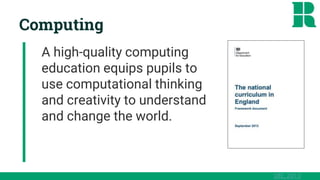
Computing
DfE, 2013
A high-quality computing
education equips pupils to
use computational thinking
and creativity to understand
and change the world.
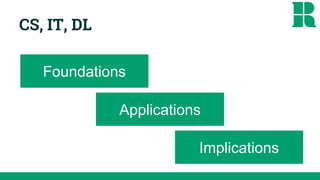
Foundations
Applications
Implications
CS, IT, DL
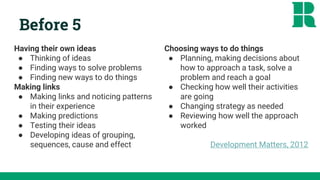
Before 5
Having their own ideas
● Thinking of ideas
● Finding ways to solve problems
● Finding new ways to do things
Making links
● Making links and noticing patterns
in their experience
● Making predictions
● Testing their ideas
● Developing ideas of grouping,
sequences, cause and effect
Choosing ways to do things
● Planning, making decisions about
how to approach a task, solve a
problem and reach a goal
● Checking how well their activities
are going
● Changing strategy as needed
● Reviewing how well the approach
worked
Development Matters, 2012
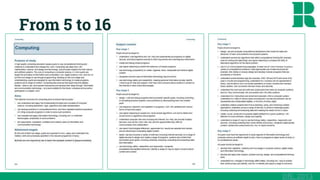
From 5 to 16
DfE, 2013
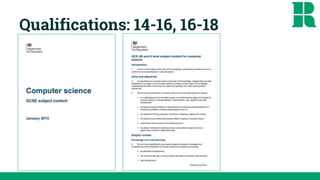
Qualifications: 14-16, 16-18
Assessment
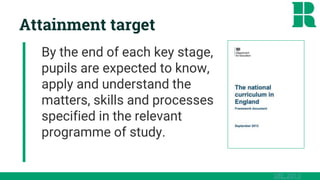
Attainment target
DfE, 2013
By the end of each key stage,
pupils are expected to know,
apply and understand the
matters, skills and processes
specified in the relevant
programme of study.
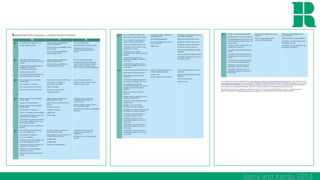
Berry and Kemp, 2014
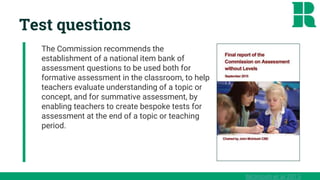
Test questions
The Commission recommends the
establishment of a national item bank of
assessment questions to be used both for
formative assessment in the classroom, to help
teachers evaluate understanding of a topic or
concept, and for summative assessment, by
enabling teachers to create bespoke tests for
assessment at the end of a topic or teaching
period.
McIntosh et al 2015
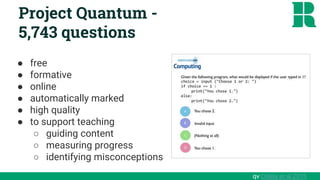
Project Quantum -
5,743 questions
● free
● formative
● online
● automatically marked
● high quality
● to support teaching
○ guiding content
○ measuring progress
○ identifying misconceptions
qv Oates et al 2015
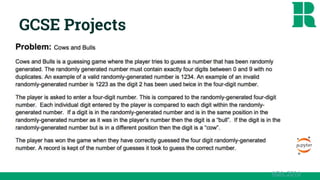
GCSE Projects
AQA, 2016
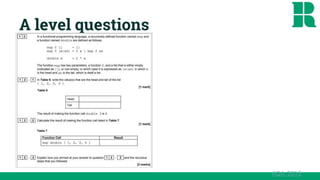
A level questions
AQA, 2015
AQA, 2015
Pedagogy
programming = algorithms + code
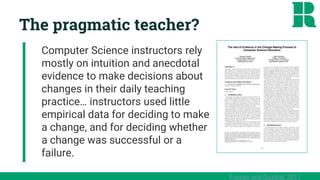
The pragmatic teacher?
Computer Science instructors rely
mostly on intuition and anecdotal
evidence to make decisions about
changes in their daily teaching
practice… instructors used little
empirical data for deciding to make
a change, and for deciding whether
a change was successful or a
failure.
Fossati and Guzdial, 2011
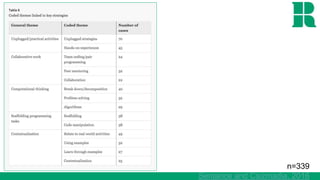
n=339
Sentance and Csizmadia, 2016
What we’re learning about teaching computing
● It’s not about the code - think before you click
● You don’t have to use a computer
● It’s easier to read code than to write code
● It’s easier to edit code that to start from a blank screen
● Making things matters
● Pair programming is powerful
● Debugging helps grow mindsets
● Go for depth not breadth
● Look for interesting contexts
● This is for everyone
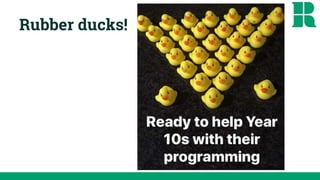
Rubber ducks!
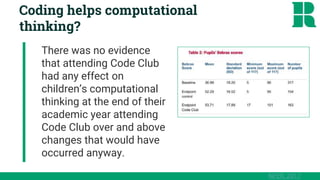
Coding helps computational
thinking?
There was no evidence
that attending Code Club
had any effect on
children’s computational
thinking at the end of their
academic year attending
Code Club over and above
changes that would have
occurred anyway.
NFER, 2017
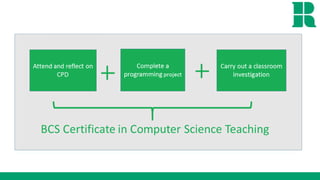
Teacher training
Teaching matters
The quality of an
education system
cannot exceed the
quality of its teachers
Interview South Korea 2007, cited in Barber and Mourshed 2007
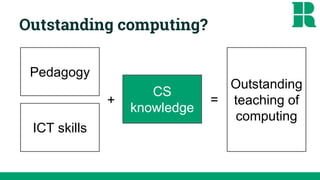
Outstanding computing?
Pedagogy
ICT skills
CS
knowledge
Outstanding
teaching of
computing
+ =
CS
knowledge
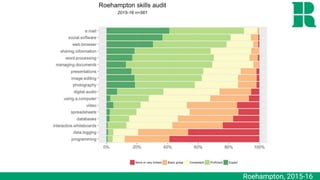
Roehampton, 2015-16
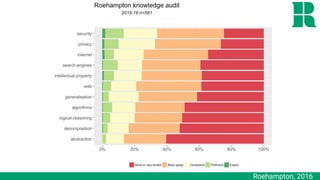
Roehampton, 2016
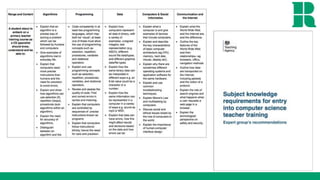
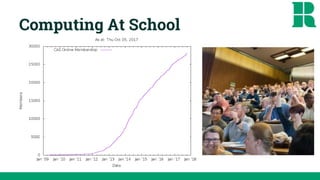
Computing At School
Network of Excellence
Master teachers
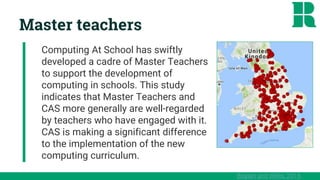
Computing At School has swiftly
developed a cadre of Master Teachers
to support the development of
computing in schools. This study
indicates that Master Teachers and
CAS more generally are well-regarded
by teachers who have engaged with it.
CAS is making a significant difference
to the implementation of the new
computing curriculum.
Boylan and Willis, 2016
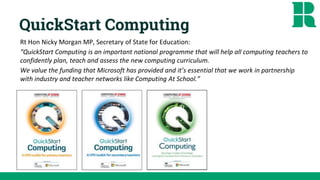
QuickStart Computing
Rt Hon Nicky Morgan MP, Secretary of State for Education:
“QuickStart Computing is an important national programme that will help all computing teachers to
confidently plan, teach and assess the new computing curriculum.
We value the funding that Microsoft has provided and it’s essential that we work in partnership
with industry and teacher networks like Computing At School.”
Teaching materials
Oates, 2014 and BESA / The Publishers Association, 2015
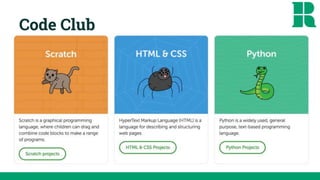
Code Club
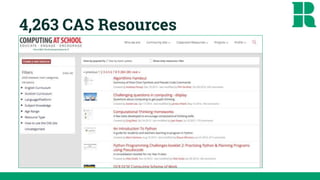
4,263 CAS Resources
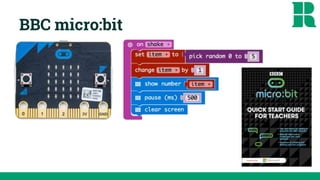
BBC micro:bit
Raspberry Pi
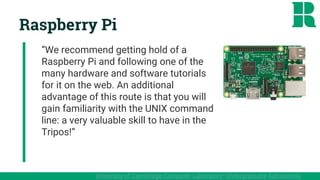
“We recommend getting hold of a
Raspberry Pi and following one of the
many hardware and software tutorials
for it on the web. An additional
advantage of this route is that you will
gain familiarity with the UNIX command
line: a very valuable skill to have in the
Tripos!”
University of Cambridge Computer Laboratory: Undergraduate Admissions
Incentives and drivers
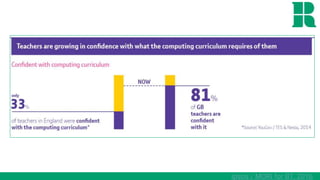
Ipsos / MORI for BT, 2016
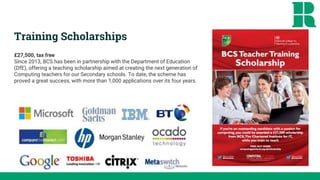
Training Scholarships
£27,500, tax free
Since 2013, BCS has been in partnership with the Department of Education
(DfE), offering a teaching scholarship aimed at creating the next generation of
Computing teachers for our Secondary schools. To date, the scheme has
proved a great success, with more than 1,000 applications over its four years.
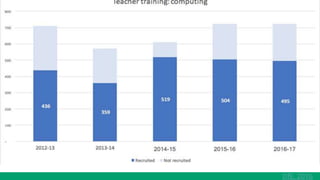
DfE, 2016
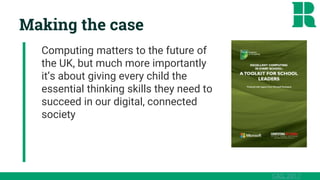
Making the case
Computing matters to the future of
the UK, but much more importantly
it’s about giving every child the
essential thinking skills they need to
succeed in our digital, connected
society
CAS, 2017
DfE, 2013, qv BCS 2012
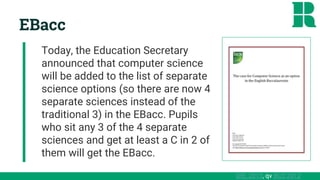
EBacc
Today, the Education Secretary
announced that computer science
will be added to the list of separate
science options (so there are now 4
separate sciences instead of the
traditional 3) in the EBacc. Pupils
who sit any 3 of the 4 separate
sciences and get at least a C in 2 of
them will get the EBacc.
Kemp, Wong and Berry, 2016
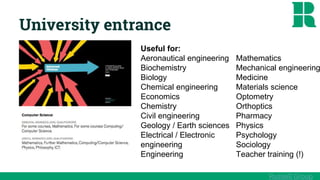
University entrance
Useful for:
Aeronautical engineering
Biochemistry
Biology
Chemical engineering
Economics
Chemistry
Civil engineering
Geology / Earth sciences
Electrical / Electronic
engineering
Engineering
Mathematics
Mechanical engineering
Medicine
Materials science
Optometry
Orthoptics
Pharmacy
Physics
Psychology
Sociology
Teacher training (!)
Russell Group
Shadbolt, 2016
Royal Society:
Computing Education
The curriculum is in its infancy and in the next few years students will become more and
more proficient in computing, meaning the curriculum, its assessment and the resources
available will need to evolve.
The Society wants to convene a consortium of educational partners, science
organisations and businesses willing and able to take forward a strategic plan to support
computing education in schools.
The first stage of the project will pull together evidence-based proposals for the
programmes and policies that need to be in place to make the school computing
curriculum flourish.
This will involve a six-month research stage to examine computing teaching in schools
today and establish priority objectives for the second stage. A report will be published in
mid 2017.
Concluding remarks
Writing a curriculum framework isn’t enough
Plan for coherence
Training and resources are vital for success
Pedagogy?
Try to get the transition right
CS for all
@mberry
m.berry@roehampton.ac.uk
milesberry.net
These slides: bit.ly/CodeEducaLAB
Questions?
URLs
These slides: bit.ly/intef17
My blog: milesberry.net
My email: m.berry@roehampton.ac.uk
Computing At School: computingatschool.org.uk
Barefoot Computing: barefootcas.org.uk
QuickStart Computing: primary.quickstartcomputing.org and bit.ly/qsks3
Project Quantum: bit.ly/projectquantum
CAS TV: youtube.com/user/computingatschool
Raspberry Pi: raspberrypi.org
Code Club: codeclubprojects.org
Hello World: helloworld.cc
micro:bit: microbit.org
Switched On Computing: switchedoncomputing.co.uk

Three years on - what has Englhand learnt?

  • 1.
    Three years on- what has England learnt? Miles Berry University of Roehampton @mberry | #CodeEducaLAB 18 October 2017 These slides: bit.ly/CodeEducaLAB
  • 2.
    Oates, 2010 Curriculum Coherence Theterm ‘coherence’ is a highly precise technical term: a national curriculum should have content arranged in an order which is securely based in evidence associated with age-related progression, and all elements of the system (content, assessment, pedagogy, teacher training, teaching materials, incentives and drivers etc) should all line up and act in a concerted way to deliver public goods The term ‘coherence’ is a highly precise technical term: a national curriculum should have content arranged in an order which is securely based in evidence associated with age-related progression, and all elements of the system (content, assessment, pedagogy, teacher training, teaching materials, incentives and drivers etc) should all line up and act in a concerted way to deliver public goods
  • 4.
  • 5.
    The computing curriculum “Wehave replaced the old information and communications technology curriculum with a new computing curriculum, with help from Google, Facebook and some of Britain’s most brilliant computer scientists.” Gove, 2013
  • 6.
    Computing DfE, 2013 A high-qualitycomputing education equips pupils to use computational thinking and creativity to understand and change the world.
  • 7.
  • 8.
    Before 5 Having theirown ideas ● Thinking of ideas ● Finding ways to solve problems ● Finding new ways to do things Making links ● Making links and noticing patterns in their experience ● Making predictions ● Testing their ideas ● Developing ideas of grouping, sequences, cause and effect Choosing ways to do things ● Planning, making decisions about how to approach a task, solve a problem and reach a goal ● Checking how well their activities are going ● Changing strategy as needed ● Reviewing how well the approach worked Development Matters, 2012
  • 9.
    From 5 to16 DfE, 2013
  • 10.
  • 11.
  • 12.
    Attainment target DfE, 2013 Bythe end of each key stage, pupils are expected to know, apply and understand the matters, skills and processes specified in the relevant programme of study.
  • 13.
  • 14.
    Test questions The Commissionrecommends the establishment of a national item bank of assessment questions to be used both for formative assessment in the classroom, to help teachers evaluate understanding of a topic or concept, and for summative assessment, by enabling teachers to create bespoke tests for assessment at the end of a topic or teaching period. McIntosh et al 2015
  • 15.
    Project Quantum - 5,743questions ● free ● formative ● online ● automatically marked ● high quality ● to support teaching ○ guiding content ○ measuring progress ○ identifying misconceptions qv Oates et al 2015
  • 16.
  • 17.
  • 18.
  • 19.
  • 20.
  • 22.
    The pragmatic teacher? ComputerScience instructors rely mostly on intuition and anecdotal evidence to make decisions about changes in their daily teaching practice… instructors used little empirical data for deciding to make a change, and for deciding whether a change was successful or a failure. Fossati and Guzdial, 2011
  • 23.
  • 24.
    What we’re learningabout teaching computing ● It’s not about the code - think before you click ● You don’t have to use a computer ● It’s easier to read code than to write code ● It’s easier to edit code that to start from a blank screen ● Making things matters ● Pair programming is powerful ● Debugging helps grow mindsets ● Go for depth not breadth ● Look for interesting contexts ● This is for everyone
  • 25.
  • 26.
    Coding helps computational thinking? Therewas no evidence that attending Code Club had any effect on children’s computational thinking at the end of their academic year attending Code Club over and above changes that would have occurred anyway. NFER, 2017
  • 27.
  • 28.
    Teaching matters The qualityof an education system cannot exceed the quality of its teachers Interview South Korea 2007, cited in Barber and Mourshed 2007
  • 29.
  • 31.
  • 32.
  • 33.
  • 34.
  • 35.
    Master teachers Computing AtSchool has swiftly developed a cadre of Master Teachers to support the development of computing in schools. This study indicates that Master Teachers and CAS more generally are well-regarded by teachers who have engaged with it. CAS is making a significant difference to the implementation of the new computing curriculum. Boylan and Willis, 2016
  • 37.
    QuickStart Computing Rt HonNicky Morgan MP, Secretary of State for Education: “QuickStart Computing is an important national programme that will help all computing teachers to confidently plan, teach and assess the new computing curriculum. We value the funding that Microsoft has provided and it’s essential that we work in partnership with industry and teacher networks like Computing At School.”
  • 39.
  • 40.
    Oates, 2014 andBESA / The Publishers Association, 2015
  • 43.
  • 44.
  • 45.
  • 46.
    Raspberry Pi “We recommendgetting hold of a Raspberry Pi and following one of the many hardware and software tutorials for it on the web. An additional advantage of this route is that you will gain familiarity with the UNIX command line: a very valuable skill to have in the Tripos!” University of Cambridge Computer Laboratory: Undergraduate Admissions
  • 47.
  • 48.
    Ipsos / MORIfor BT, 2016
  • 49.
    Training Scholarships £27,500, taxfree Since 2013, BCS has been in partnership with the Department of Education (DfE), offering a teaching scholarship aimed at creating the next generation of Computing teachers for our Secondary schools. To date, the scheme has proved a great success, with more than 1,000 applications over its four years.
  • 50.
  • 51.
    Making the case Computingmatters to the future of the UK, but much more importantly it’s about giving every child the essential thinking skills they need to succeed in our digital, connected society CAS, 2017
  • 52.
    DfE, 2013, qvBCS 2012 EBacc Today, the Education Secretary announced that computer science will be added to the list of separate science options (so there are now 4 separate sciences instead of the traditional 3) in the EBacc. Pupils who sit any 3 of the 4 separate sciences and get at least a C in 2 of them will get the EBacc.
  • 53.
    Kemp, Wong andBerry, 2016
  • 58.
    University entrance Useful for: Aeronauticalengineering Biochemistry Biology Chemical engineering Economics Chemistry Civil engineering Geology / Earth sciences Electrical / Electronic engineering Engineering Mathematics Mechanical engineering Medicine Materials science Optometry Orthoptics Pharmacy Physics Psychology Sociology Teacher training (!) Russell Group
  • 59.
  • 61.
    Royal Society: Computing Education Thecurriculum is in its infancy and in the next few years students will become more and more proficient in computing, meaning the curriculum, its assessment and the resources available will need to evolve. The Society wants to convene a consortium of educational partners, science organisations and businesses willing and able to take forward a strategic plan to support computing education in schools. The first stage of the project will pull together evidence-based proposals for the programmes and policies that need to be in place to make the school computing curriculum flourish. This will involve a six-month research stage to examine computing teaching in schools today and establish priority objectives for the second stage. A report will be published in mid 2017.
  • 63.
    Concluding remarks Writing acurriculum framework isn’t enough Plan for coherence Training and resources are vital for success Pedagogy? Try to get the transition right CS for all
  • 64.
  • 65.
    URLs These slides: bit.ly/intef17 Myblog: milesberry.net My email: m.berry@roehampton.ac.uk Computing At School: computingatschool.org.uk Barefoot Computing: barefootcas.org.uk QuickStart Computing: primary.quickstartcomputing.org and bit.ly/qsks3 Project Quantum: bit.ly/projectquantum CAS TV: youtube.com/user/computingatschool Raspberry Pi: raspberrypi.org Code Club: codeclubprojects.org Hello World: helloworld.cc micro:bit: microbit.org Switched On Computing: switchedoncomputing.co.uk