Numeracy and Maths Transforming lives through learning
@digilearnscot
@lal_edscot
For Scotland's learners, with Scotland's educators
Quick and Easy: Literacy Wins for Online Learning
Exploring Screening Shorts and film literacy to develop higher order
thinking skills
Julie Jamieson @JulieAndreaJam1
George Milliken @ictcrowd
Transforming lives through learning
For Scotland's learners, with Scotland's educators
structure
Principles of online learning
Screening Shorts site
Practical demonstration
Discuss/questions
Transforming lives through learning
For Scotland's learners, with Scotland's educators
Online Learning
• Teaching quality
• Access to technology
• Peer interactions
• Supporting pupils to work independently
• Different approaches to remote learning suit
different types of content and pupils
EEF (2021)
Developing literacy
with digital slides
Transforming lives through learning
For Scotland’s learners with Scotland’s educators
For Scotland's learners, with Scotland's educators
Accessibility Tools
Microsoft Immersive Reader, Dictate
and Lens (DEMO)
Google Docs Voice Typing and
Chrome extensions (R&W)
iPad Voice Control, Voice Over and
Highlight Content
Document title For Scotland's learners, with Scotland's educators
Investing in education technology is no longer
an option, but a necessity…. Students unable to
navigate through a complex digital landscape
will no longer be able to participate fully I
economic, social and cultural life around them.”
-OECD
Why?
For Scotland's learners, with Scotland's educators
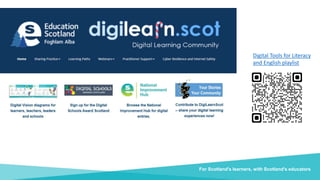
Digital Tools for Literacy
and English playlist
Document title Transforming lives through learning
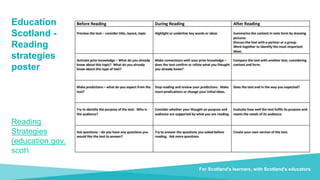
Education
Scotland -
Reading
strategies
poster
Reading
Strategies
(education.gov.
scot)
For Scotland's learners, with Scotland's educators
Transforming lives through learning
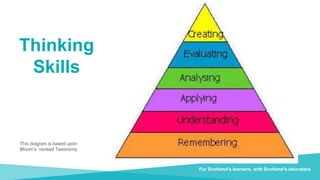
Thinking
Skills
This diagram is based upon
Bloom’s revised Taxonomy.
For Scotland's learners, with Scotland's educators
Document title Transforming lives through learning
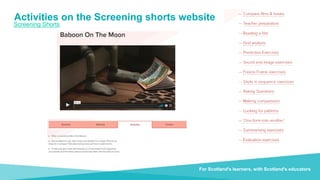
Activities on the Screening shorts website
For Scotland's learners, with Scotland's educators
Screening Shorts
Document title For Scotland's learners, with Scotland's educators
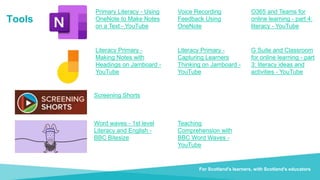
Tools
Do luchd-ionnsachaidh na h-Alba, le luchd-foghlaim Alba
Voice Recording
Feedback Using
OneNote
Word waves - 1st level
Literacy and English -
BBC Bitesize
Screening Shorts
Teaching
Comprehension with
BBC Word Waves -
YouTube
For Scotland's learners, with Scotland's educators
Primary Literacy - Using
OneNote to Make Notes
on a Text - YouTube
Literacy Primary -
Making Notes with
Headings on Jamboard -
YouTube
Literacy Primary -
Capturing Learners
Thinking on Jamboard -
YouTube
G Suite and Classroom
for online learning - part
3: literacy ideas and
activities - YouTube
O365 and Teams for
online learning - part 4:
literacy - YouTube
Document title For Scotland's learners, with Scotland's educators
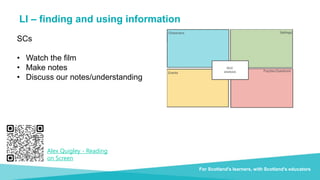
LI – finding and using information
Do luchd-ionnsachaidh na h-Alba, le luchd-foghlaim Alba
SCs
• Watch the film
• Make notes
• Discuss our notes/understanding
For Scotland's learners, with Scotland's educators
Alex Quigley - Reading
on Screen
Document title For Scotland's learners, with Scotland's educators
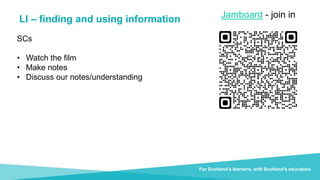
LI – finding and using information
Do luchd-ionnsachaidh na h-Alba, le luchd-foghlaim Alba
SCs
• Watch the film
• Make notes
• Discuss our notes/understanding
For Scotland's learners, with Scotland's educators
Jamboard - join in
Transforming lives through learning
For Scotland’s learners with Scotland’s educators
For Scotland's learners, with Scotland's educators
Evaluation
For Scotland's learners, with Scotland's educators
Numeracy and Maths Transforming lives through learning
For Scotland's learners, with Scotland's educators
Education Scotland
Denholm House
Almondvale Business Park
Almondvale Way
Livingston EH54 6GA
T +44 (0)131 244 5000
E enquiries@educationscotland.gsi.gov.uk

Quick Wins for Literacy: Screening Shorts

  • 1.
    Numeracy and MathsTransforming lives through learning @digilearnscot @lal_edscot For Scotland's learners, with Scotland's educators Quick and Easy: Literacy Wins for Online Learning Exploring Screening Shorts and film literacy to develop higher order thinking skills Julie Jamieson @JulieAndreaJam1 George Milliken @ictcrowd
  • 2.
    Transforming lives throughlearning For Scotland's learners, with Scotland's educators structure Principles of online learning Screening Shorts site Practical demonstration Discuss/questions
  • 3.
    Transforming lives throughlearning For Scotland's learners, with Scotland's educators Online Learning • Teaching quality • Access to technology • Peer interactions • Supporting pupils to work independently • Different approaches to remote learning suit different types of content and pupils EEF (2021) Developing literacy with digital slides
  • 4.
    Transforming lives throughlearning For Scotland’s learners with Scotland’s educators For Scotland's learners, with Scotland's educators Accessibility Tools Microsoft Immersive Reader, Dictate and Lens (DEMO) Google Docs Voice Typing and Chrome extensions (R&W) iPad Voice Control, Voice Over and Highlight Content
  • 5.
    Document title ForScotland's learners, with Scotland's educators Investing in education technology is no longer an option, but a necessity…. Students unable to navigate through a complex digital landscape will no longer be able to participate fully I economic, social and cultural life around them.” -OECD Why? For Scotland's learners, with Scotland's educators Digital Tools for Literacy and English playlist
  • 6.
    Document title Transforminglives through learning Education Scotland - Reading strategies poster Reading Strategies (education.gov. scot) For Scotland's learners, with Scotland's educators
  • 7.
    Transforming lives throughlearning Thinking Skills This diagram is based upon Bloom’s revised Taxonomy. For Scotland's learners, with Scotland's educators
  • 8.
    Document title Transforminglives through learning Activities on the Screening shorts website For Scotland's learners, with Scotland's educators Screening Shorts
  • 9.
    Document title ForScotland's learners, with Scotland's educators Tools Do luchd-ionnsachaidh na h-Alba, le luchd-foghlaim Alba Voice Recording Feedback Using OneNote Word waves - 1st level Literacy and English - BBC Bitesize Screening Shorts Teaching Comprehension with BBC Word Waves - YouTube For Scotland's learners, with Scotland's educators Primary Literacy - Using OneNote to Make Notes on a Text - YouTube Literacy Primary - Making Notes with Headings on Jamboard - YouTube Literacy Primary - Capturing Learners Thinking on Jamboard - YouTube G Suite and Classroom for online learning - part 3: literacy ideas and activities - YouTube O365 and Teams for online learning - part 4: literacy - YouTube
  • 10.
    Document title ForScotland's learners, with Scotland's educators LI – finding and using information Do luchd-ionnsachaidh na h-Alba, le luchd-foghlaim Alba SCs • Watch the film • Make notes • Discuss our notes/understanding For Scotland's learners, with Scotland's educators Alex Quigley - Reading on Screen
  • 11.
    Document title ForScotland's learners, with Scotland's educators LI – finding and using information Do luchd-ionnsachaidh na h-Alba, le luchd-foghlaim Alba SCs • Watch the film • Make notes • Discuss our notes/understanding For Scotland's learners, with Scotland's educators Jamboard - join in
  • 12.
    Transforming lives throughlearning For Scotland’s learners with Scotland’s educators For Scotland's learners, with Scotland's educators
  • 13.
    Evaluation For Scotland's learners,with Scotland's educators
  • 14.
    Numeracy and MathsTransforming lives through learning For Scotland's learners, with Scotland's educators Education Scotland Denholm House Almondvale Business Park Almondvale Way Livingston EH54 6GA T +44 (0)131 244 5000 E enquiries@educationscotland.gsi.gov.uk

Editor's Notes

  • #2 This is a front cover page and can only be used once. Use the corresponding blue internal and back pages if you are using this page. You may add a title and a subtitle if needed only. Do not add anything else or move elements around.
  • #3 What is data? Who has it? How do they use it?
  • #4 What is data? Who has it? How do they use it?
  • #5 We have collated ideas to help you plan, teach and assess digital literacy and skills in this document. It's available on the Improvement Hub https://education.gov.scot/improvement/learning-resources/what-digital-learning-might-look-like/
  • #6 Demo lesson CodeSpark and Everyone Can Code
  • #7 This reading strategies poster which has been developed by Education Scotland, it could also be used for a film text. It is organised into before, during and after reading or in this case watching the film.
  • #8 Thinking skills can be broken down into different stages.  These go from the basic skills of remembering and understanding information, to more complex skills that are often referred to as “higher order” thinking skills. These are known as creating, evaluating and analysing. Remembering skills help us to find information –noting, listing, describing, naming, Understanding skills help us to make sense of information – summarising, explaining, inferring, discussing Applying skills allow us to use the information in a new (but similar) situation – using, making a chart/diagram, drawing We now move on to the ‘higher order’ skills Analysing is where we interact with the information – taking it apart, organising it, comparing/contrasting etc Evaluating helps us to critically examine information and make some judgements – we can reflect, review, assess, argue Creating allows us to use information to create something new – designing, construction, planning, inventing etc.
  • #9 When you have signed into Glow you can Browse the films on offer. We have selected Baboon on the moon to focus on today. When you click on the film page you will find a range of suggested questions and activities. Some of these have already been organised into analysing and creative sections. From the home page we can also click on video tutorials, you can find one for Baboon on the moon which has lots of ideas and suggestions,. If you return to the home page you will also find teaching activities which can be used for lots of different films. Many of these are very helpful for thinking skills – including comparing films and books, grid analysis, making comparisons, looking for patterns, summarising and evaluation exercises.
  • #10 Providing starters like this encourage learner engagement from the outset. Open ended investigations allow for exploration and dialogue. They can also provide opportunity to observe learning and help identify any potential misconceptions. Can be scaffolded to incorporate support and challenge and differentiated to suit ability. Typical responses/stretch questions might include:-   30 and 7 – I wonder is there another way to represent 37 by partitioning in different ways? Why might this be useful? We are really good at partitioning in the EY within 10 and this seems to stop beyond P1 or P2. 29 and 1 more (so here you are rounding to the nearest set of ten). I wonder why this might be useful? Is it odd or even? How do you know? Can you convince me using a picture or concrete materials? Can you use tally marks? (here they will see the 7 as a five and a 2) Can you use materials to make the numeral? Is this numeral easy to half? Why/why not? Can you make a picture showing the numeral in digits, words and a quantity to match? What happens when you add 10 to this? What do you notice? (could use the 100 square for this) Can you think of an easy way to add 5 to this? (Partition into a 3 and a 2) Is it closer to 100 or 0? Can you think of a calculation whereby 37 is the answer? Would it matter if it was 37p or 37cm?
  • #11 Providing starters like this encourage learner engagement from the outset. Open ended investigations allow for exploration and dialogue. They can also provide opportunity to observe learning and help identify any potential misconceptions. Can be scaffolded to incorporate support and challenge and differentiated to suit ability. Typical responses/stretch questions might include:-   30 and 7 – I wonder is there another way to represent 37 by partitioning in different ways? Why might this be useful? We are really good at partitioning in the EY within 10 and this seems to stop beyond P1 or P2. 29 and 1 more (so here you are rounding to the nearest set of ten). I wonder why this might be useful? Is it odd or even? How do you know? Can you convince me using a picture or concrete materials? Can you use tally marks? (here they will see the 7 as a five and a 2) Can you use materials to make the numeral? Is this numeral easy to half? Why/why not? Can you make a picture showing the numeral in digits, words and a quantity to match? What happens when you add 10 to this? What do you notice? (could use the 100 square for this) Can you think of an easy way to add 5 to this? (Partition into a 3 and a 2) Is it closer to 100 or 0? Can you think of a calculation whereby 37 is the answer? Would it matter if it was 37p or 37cm?
  • #12 Providing starters like this encourage learner engagement from the outset. Open ended investigations allow for exploration and dialogue. They can also provide opportunity to observe learning and help identify any potential misconceptions. Can be scaffolded to incorporate support and challenge and differentiated to suit ability. Typical responses/stretch questions might include:-   30 and 7 – I wonder is there another way to represent 37 by partitioning in different ways? Why might this be useful? We are really good at partitioning in the EY within 10 and this seems to stop beyond P1 or P2. 29 and 1 more (so here you are rounding to the nearest set of ten). I wonder why this might be useful? Is it odd or even? How do you know? Can you convince me using a picture or concrete materials? Can you use tally marks? (here they will see the 7 as a five and a 2) Can you use materials to make the numeral? Is this numeral easy to half? Why/why not? Can you make a picture showing the numeral in digits, words and a quantity to match? What happens when you add 10 to this? What do you notice? (could use the 100 square for this) Can you think of an easy way to add 5 to this? (Partition into a 3 and a 2) Is it closer to 100 or 0? Can you think of a calculation whereby 37 is the answer? Would it matter if it was 37p or 37cm?
  • #13 When using a blended approach there are some key considerations to take into consideration. This may be more challenging for some contexts and your approach will depend on what your LA policy is around this. It is important that you closely follow local guidance on this. Regardless of the approach you use LI and SC will be crucial when learners are taking forward some of their learning independently. Great LI/SC presentations are available on the moderation hub. Some of the tools George will provide today will provide ideas for how learning could be facilitated. E.g . Self-marking quizzes and a link to further learning should the learner not understand parts of the learning.
  • #16 This is a front cover page and can only be used once. Use the corresponding blue internal and back pages if you are using this page. You may add a title and a subtitle if needed only. Do not add anything else or move elements around.