Computer Viruses 
Ali F. Al Sarraf 
Eng. Ali F. Al Sarraf E-Mail: ali.alsarraf@outlook.com 1
Introduction 
 A computer virus is a program or piece of code that is loaded onto your computer 
without your knowledge and runs against your wishes. Viruses can also replicate 
themselves. All computer viruses are man-made. A simple virus that can make 
a copy of itself over and over again is relatively easy to produce. Even such a 
simple virus is dangerous because it will quickly use all available memory and 
bring the system to a halt. An even more dangerous type of virus is one capable of 
transmitting itself across networks and by passing security systems. 
 Since 1987, when a virus infected ARPANET, a large network used by the Defense 
Department and many universities, many antivirus programs have become 
available. These programs periodically check your computer system for the best-known 
types of viruses. 
 Some people distinguish between general viruses and worms. A worm is a special 
type of virus that can replicate itself and use memory, but cannot attach itself to 
other programs. 
Eng. Ali F. Al Sarraf E-Mail: ali.alsarraf@outlook.com 2
History of Computers Viruses 
 Computer viruses have been around for a long, long time — pretty much as long as 
personal computing and mainstream software development — and they've been 
making international news since the Internet graduated from a researcher's toy to 
a tool for consumers. 
 If you've ever wondered what the first viruses were like and just how bad or 
dangerous they were, this info graphic should be an interesting read for you. And 
the Space Invaders graphics will be easy on your nerdy eyes, too. 
 While the first virus in this brief history coincided with the birth of the 3.5-inch 
floppy disk, a lot of the malware we see these days relies on social media or 
mobile apps for transmission, adequate proof (as if any was needed) that with any 
innovation comes an opportunity for exploitation. 
 The twist these days is that more viruses are specifically targeted to steal personal 
data and make money for their creators, which was not necessarily a goal for 
many of the virus-writing hackers of the late 1980s and early 1990s. In fact, 
according to this data, the first money-making computer virus didn't hit PCs until 
2003. 
Eng. Ali F. Al Sarraf E-Mail: ali.alsarraf@outlook.com 3
Brain Virus – in 1986 
Origin - Pakistan 
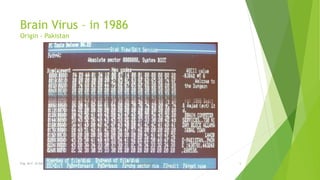
 The first virus to infect PC Computers was discovered in 1986. named BRAIN, 
it spread around the world VIA FLOPPY DISKS. But was not meant to be a 
destructive virus, which is why authors included their name and contact 
information in the virus code. 
 The authors were identified as Brothers AMJAD FAROOD and BASIT FAROOD 
from Lahore, BAKISTAN. 
 Today the run a successful internet service provider called BRAIN 
TELECOMMUNICATION LTD. 
Eng. Ali F. Al Sarraf E-Mail: ali.alsarraf@outlook.com 4
Brain Virus – in 1986 
Origin - Pakistan 
Eng. Ali F. Al Sarraf E-Mail: ali.alsarraf@outlook.com 5
Stoned Virus – 1987 
Origin – New Zealand 
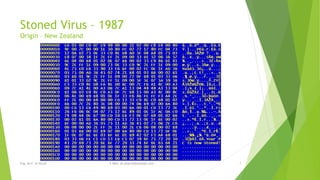
 Before there was the World Wide Web, the computer viruses spread via 
floppy disks. One of the earliest was the 1987 boot-sector virus Stoned, which 
taunted infected users with the on-screen message, "Your computer is now 
stoned." 
 Several variants of the virus were written by copycats, ushering in the 
practice of hackers updating existing virus code to create more infections. 
Eng. Ali F. Al Sarraf E-Mail: ali.alsarraf@outlook.com 6
Stoned Virus – 1987 
Origin – New Zealand 
Eng. Ali F. Al Sarraf E-Mail: ali.alsarraf@outlook.com 7
Form Virus – 1990 
Origin – Switzerland 
 Form was a boot sector virus isolated in Switzerland in the summer of 1990 
which became very common worldwide. The origin of Form is widely listed as 
Switzerland, but this may be an assumption based on its isolation locale. The 
only notable characteristics of Form are that it infects the boot sector instead 
of the Master Boot Record (MBR) and the clicking noises associated with some 
infections. Infections under Form can result in severe data damage if 
operating system characteristics are not identical to those Form assumes. 
 It is notable for arguably being the most common virus in the world for a 
period during the early 1990s. 
 
Eng. Ali F. Al Sarraf E-Mail: ali.alsarraf@outlook.com 8
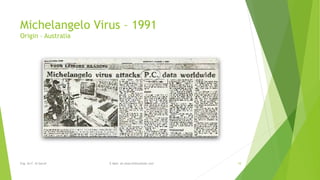
Michelangelo Virus – 1991 
Origin – Australia 
 The Michelangelo virus is a computer virus first discovered in 4 February 1991 
in Australia The virus was designed to infect DOS systems, but did not engage the operating 
system or make any OS calls. Michelangelo, like all boot sector viruses, basically operated at 
the BIOS level. Each year, the virus remained dormant until March 6, the birthday 
of Renaissance artist Michelangelo. There is no reference to the artist in the virus, and it is 
doubtful that the virus writer intended Michelangelo to be referenced to the virus. 
Michelangelo is a variant of the already endemic Stoned virus. 
 On March 6, if the PC is an AT or a PS/2, the virus overwrites the first one hundred sectors of 
the hard disk with nulls. The virus assumes a geometry of 256 cylinders, 4 heads, 
17 sectors per track. Although all the user's data would still be on the hard disk, it would be 
irretrievable for the average user. 
 On hard disks, the virus moves the original master boot record to cylinder 0, head 0, sector 7. 
 On floppy disks, if the disk is 360 KB, the virus moves the original boot sector to cylinder 0, 
head 1, sector 3. 
 On other disks, the virus moves the original boot sector to cylinder 0, head 1, sector 14. 
Eng. Ali F. Al Sarraf E-Mail: ali.alsarraf@outlook.com 9
Michelangelo Virus – 1991 
Origin – Australia 
Eng. Ali F. Al Sarraf E-Mail: ali.alsarraf@outlook.com 10
VCL Virus – 1992 
Origin – USA 
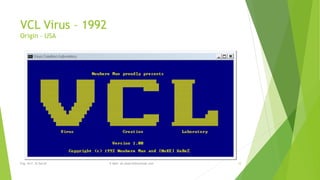
 The Virus Creation Laboratory, or VCL, as it is known, was one of the earliest 
attempts to provide a virus creation tool so that individuals with little to no 
programming expertise could mass-create computer viruses. 
 A hacker dubbed "Nowhere Man", of the NUKE hacker group, released it in 
July 1992. 
 However, it was later discovered that viruses created with the Virus Creation 
Laboratory were often ineffective, as many anti-virus programs of the day 
caught them easily. Also, many viruses created by the program did not work 
at all - and often, their source codes could not be compiled. Due to a limited 
feature set and bugs, the Virus Creation Laboratory did not become popular 
with virus writers, who preferred to write their own. 
Eng. Ali F. Al Sarraf E-Mail: ali.alsarraf@outlook.com 11
VCL Virus – 1992 
Origin – USA 
Eng. Ali F. Al Sarraf E-Mail: ali.alsarraf@outlook.com 12
HAPPY 99 Virus – 1999 
Origin – Unknown 
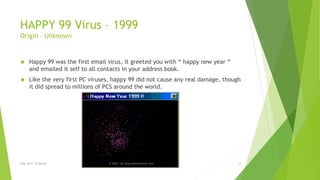
 Happy 99 was the first email virus, it greeted you with “ happy new year “ 
and emailed it self to all contacts in your address book. 
 Like the very first PC viruses, happy 99 did not cause any real damage, though 
it did spread to millions of PCS around the world. 
Eng. Ali F. Al Sarraf E-Mail: ali.alsarraf@outlook.com 13
Love letter Virus – 2000 
Origin – Philippines 
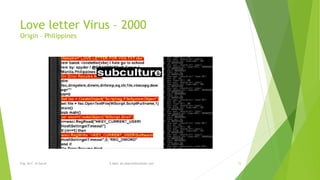
 ILOVEYOU, sometimes referred to as Love Letter, was a computer worm that 
attacked tens of millions of Windows personal computers on and after 5 May 
2000 local time in the Philippines when it started spreading as an email 
message with the subject line "ILOVEYOU" and the attachment "LOVE-LETTER-FOR- 
YOU.txt.vbs". The latter file extension (in this case, 'VBS' - a type 
of interpreted file) was most often hidden by default on Windows computers 
of the time, leading unwitting users to think it was a normal text file. 
Opening the attachment activated the Visual Basic script. The worm did 
damage on the local machine, overwriting image files, and sent a copy of 
itself to the first 50 addresses in the Windows Address Book used by Microsoft 
Outlook. 
Eng. Ali F. Al Sarraf E-Mail: ali.alsarraf@outlook.com 14
Love letter Virus – 2000 
Origin – Philippines 
Eng. Ali F. Al Sarraf E-Mail: ali.alsarraf@outlook.com 15
SASSER Virus – 2004 
Origin – Germany 
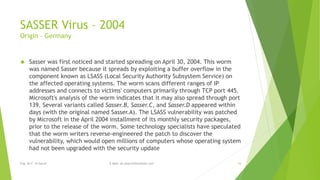
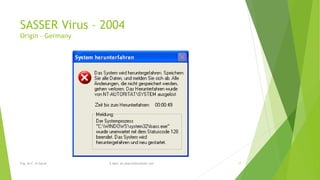
 Sasser was first noticed and started spreading on April 30, 2004. This worm 
was named Sasser because it spreads by exploiting a buffer overflow in the 
component known as LSASS (Local Security Authority Subsystem Service) on 
the affected operating systems. The worm scans different ranges of IP 
addresses and connects to victims' computers primarily through TCP port 445. 
Microsoft's analysis of the worm indicates that it may also spread through port 
139. Several variants called Sasser.B, Sasser.C, and Sasser.D appeared within 
days (with the original named Sasser.A). The LSASS vulnerability was patched 
by Microsoft in the April 2004 installment of its monthly security packages, 
prior to the release of the worm. Some technology specialists have speculated 
that the worm writers reverse-engineered the patch to discover the 
vulnerability, which would open millions of computers whose operating system 
had not been upgraded with the security update 
Eng. Ali F. Al Sarraf E-Mail: ali.alsarraf@outlook.com 16
SASSER Virus – 2004 
Origin – Germany 
Eng. Ali F. Al Sarraf E-Mail: ali.alsarraf@outlook.com 17
Types Of Viruses 
1. Boot Sector Virus 
 The term “boot sector” is a generic name that seems to originally come from 
MS-DOS but is now applied generally to the boot information used by any 
operating system. In modern computers this is usually called the “master boot 
record,” and it is the first sector on a partitioned storage device. 
 Boot sector viruses became popular because of the use of floppy disks to boot 
a computer. The widespread usage of the Internet and the death of the floppy 
has made other means of virus transmission more effective. 
Eng. Ali F. Al Sarraf E-Mail: ali.alsarraf@outlook.com 18
Types Of Viruses 
2. Browser Hijacker 
 This type of virus, which can spread itself in numerous ways including 
voluntary download, effectively hijacks certain browser functions, usually in 
the form of re-directing the user automatically to particular sites. It’s usually 
assumed that this tactic is designed to increase revenue from web 
advertisements. 
 There are a lot of such viruses, and they usually have “search” included 
somewhere in their description. Cool Web Search may be the most well known 
example, but others are nearly as common. 
Eng. Ali F. Al Sarraf E-Mail: ali.alsarraf@outlook.com 19
Types Of Viruses 
3. Direct Action Virus 
 This type of virus, unlike most, only comes into action when the file 
containing the virus is executed. The payload is delivered and then the virus 
essentially becomes dormant – it takes no other action unless an infected file 
is executed again. 
 Most viruses do not use the direct action method of reproduction simply 
because it is not prolific, but viruses of this type have done damage in the 
past. The Vienna virus, which briefly threatened computers in 1988, is one 
such example of a direct action virus. 
Eng. Ali F. Al Sarraf E-Mail: ali.alsarraf@outlook.com 20
Types Of Viruses 
4. File Infector Virus 
 Perhaps the most common type of virus, the file infector takes root in a host 
file and then begins its operation when the file is executed. The virus may 
completely overwrite the file that it infects, or may only replace parts of the 
file, or may not replace anything but instead re-write the file so that the 
virus is executed rather than the program the user intended. 
 Although called a “file virus” the definition doesn’t apply to all viruses in all 
files generally – for example, the macro virus below is not referred to by the 
file virus. Instead, the definition is usually meant to refer only to viruses 
which use an executable file format, such as .exe, as their host. 
Eng. Ali F. Al Sarraf E-Mail: ali.alsarraf@outlook.com 21
Types Of Viruses 
5. Macro Virus 
 A wide variety of programs, including productivity applications like Microsoft 
Excel, provide support for Macros – special actions programmed into the 
document using a specific macro programming language. Unfortunately, this 
makes it possible for a virus to be hidden inside a seemingly benign 
document. 
 Macro viruses very widely in terms of payload. The most well known macro 
virus is probably Melissa, a Word document supposedly containing the 
passwords to pornographic websites. The virus also exploited Word’s link to 
Microsoft Outlook in order to automatically email copies of itself. 
Eng. Ali F. Al Sarraf E-Mail: ali.alsarraf@outlook.com 22
Types Of Viruses 
6. Multipartite Virus 
 While some viruses are happy to spread via one method or deliver a single 
payload, Multipartite viruses want it all. A virus of this type may spread in 
multiple ways, and it may take different actions on an infected computer 
depending on variables, such as the operating system installed or the 
existence of certain files. 
Eng. Ali F. Al Sarraf E-Mail: ali.alsarraf@outlook.com 23
Types Of Viruses 
7. Polymorphic Virus 
 Another jack-of-all-trades, the Polymorphic virus actually mutates over time 
or after every execution, changing the code used to deliver its payload. 
Alternatively, or in addition, a Polymorphic virus may guard itself with an 
encryption algorithm that automatically alters itself when certain conditions 
are met. 
 The goal of this trickery is evasion. Antivirus programs often find viruses by 
the specific code used. Obscuring or changing the code of a virus can help it 
avoid detection. 
Eng. Ali F. Al Sarraf E-Mail: ali.alsarraf@outlook.com 24
Types Of Viruses 
8. Resident Virus 
 This broad virus definition applies to any virus that inserts itself into a 
system’s memory. It then may take any number of actions and run 
independently of the file that was originally infected. 
 A resident virus can be compared to a direct payload virus, which does not 
insert itself into the system’s memory and therefore only takes action when 
an infected file is executed. 
Eng. Ali F. Al Sarraf E-Mail: ali.alsarraf@outlook.com 25
Types Of Viruses 
9. Web Scripting Virus 
 Many websites execute complex code in order to provide interesting content. 
Displaying online video in your browser, for example, requires the execution 
of a specific code language that provides both the video itself and the player 
interface. 
 Of course, this code can sometimes be exploited, making it possible for a 
virus to infect a computer or take actions on a computer through a website. 
Although malicious sites are sometimes created with purposely infected code, 
many such cases of virus exist because of code inserted into a site without the 
webmaster’s knowledge. 
Eng. Ali F. Al Sarraf E-Mail: ali.alsarraf@outlook.com 26
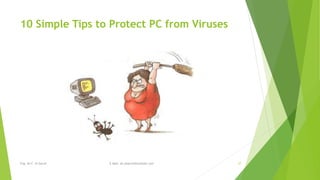
10 Simple Tips to Protect PC from Viruses 
Eng. Ali F. Al Sarraf E-Mail: ali.alsarraf@outlook.com 27
10 Simple Tips to Protect PC from Viruses 
1. The first thing I would recommend – is to read about current viruses. It is 
difficult to protect your computer from viruses if you do not even know what 
they are. You can get it from here: http://www.securelist.com/en/ 
2. If you really care about the security of your computer, arm it with the best 
anti-virus software. If you do not have antivirus software on your computer, then 
you probably get some virus in the first hour of work on the Internet. It’s easy! In 
addition to paying Kaspersky, Norton and free Avast, Microsoft Security Essentials 
is Best and Free. 
3. Also update your antivirus software as often as possible. Typically, antivirus 
software is updated every day. Do not forget to do it manually, if not configured 
to automatically update. 
Eng. Ali F. Al Sarraf E-Mail: ali.alsarraf@outlook.com 28
10 Simple Tips to Protect PC from Viruses 
4. Be sensible: do not visit untrusted websites containing illegal software, links, 
etc. 
5. Update need not only anti-virus, but the whole system too Windows update. 
These updates include improved security systems that will help in the fight 
against viruses and other problems. Remember: If you do not perform regular 
updates to Windows, you leave your computer in a vulnerable state. 
6. The main channel of the spread of viruses is e-mail. Be careful with e-mails, 
when you have something to bother them, it is better not to open. These days a 
lot of mails are phishing mails that redirects you to fake webpages. So, avoid 
opening such mails. 
Eng. Ali F. Al Sarraf E-Mail: ali.alsarraf@outlook.com 29
10 Simple Tips to Protect PC from Viruses 
7. If you are serious about protecting your computer, you can change your e-mail 
and receive only text messages. You can also disable the ability to open email 
attachments. This is what Hotmail, Gmail and Yahoo mails are doing by default. 
8. Do not use peer (p2p) network. Such programs include for example, Torrents. 
These programs allow you to download files from other users. You have no way of 
knowing that you’re actually downloading, until the file is completely 
downloaded to your computer. 
9. Download files only from reliable web sites and sources. Of course, it is 
impossible do not download anything, but you must remember that the file that 
you download may not match the name and content. 
10. Make sure that your computer has a firewall. Windows comes with built-in 
firewall, but you can use any other (eg, Zone Alarm). If you don’t have other 
firewall, then enable default Windows Firewall 
Eng. Ali F. Al Sarraf E-Mail: ali.alsarraf@outlook.com 30
The End 
Eng. Ali F. Al Sarraf E-Mail: ali.alsarraf@outlook.com 31

Computer viruses

  • 1.
    Computer Viruses AliF. Al Sarraf Eng. Ali F. Al Sarraf E-Mail: ali.alsarraf@outlook.com 1
  • 2.
    Introduction  Acomputer virus is a program or piece of code that is loaded onto your computer without your knowledge and runs against your wishes. Viruses can also replicate themselves. All computer viruses are man-made. A simple virus that can make a copy of itself over and over again is relatively easy to produce. Even such a simple virus is dangerous because it will quickly use all available memory and bring the system to a halt. An even more dangerous type of virus is one capable of transmitting itself across networks and by passing security systems.  Since 1987, when a virus infected ARPANET, a large network used by the Defense Department and many universities, many antivirus programs have become available. These programs periodically check your computer system for the best-known types of viruses.  Some people distinguish between general viruses and worms. A worm is a special type of virus that can replicate itself and use memory, but cannot attach itself to other programs. Eng. Ali F. Al Sarraf E-Mail: ali.alsarraf@outlook.com 2
  • 3.
    History of ComputersViruses  Computer viruses have been around for a long, long time — pretty much as long as personal computing and mainstream software development — and they've been making international news since the Internet graduated from a researcher's toy to a tool for consumers.  If you've ever wondered what the first viruses were like and just how bad or dangerous they were, this info graphic should be an interesting read for you. And the Space Invaders graphics will be easy on your nerdy eyes, too.  While the first virus in this brief history coincided with the birth of the 3.5-inch floppy disk, a lot of the malware we see these days relies on social media or mobile apps for transmission, adequate proof (as if any was needed) that with any innovation comes an opportunity for exploitation.  The twist these days is that more viruses are specifically targeted to steal personal data and make money for their creators, which was not necessarily a goal for many of the virus-writing hackers of the late 1980s and early 1990s. In fact, according to this data, the first money-making computer virus didn't hit PCs until 2003. Eng. Ali F. Al Sarraf E-Mail: ali.alsarraf@outlook.com 3
  • 4.
    Brain Virus –in 1986 Origin - Pakistan  The first virus to infect PC Computers was discovered in 1986. named BRAIN, it spread around the world VIA FLOPPY DISKS. But was not meant to be a destructive virus, which is why authors included their name and contact information in the virus code.  The authors were identified as Brothers AMJAD FAROOD and BASIT FAROOD from Lahore, BAKISTAN.  Today the run a successful internet service provider called BRAIN TELECOMMUNICATION LTD. Eng. Ali F. Al Sarraf E-Mail: ali.alsarraf@outlook.com 4
  • 5.
    Brain Virus –in 1986 Origin - Pakistan Eng. Ali F. Al Sarraf E-Mail: ali.alsarraf@outlook.com 5
  • 6.
    Stoned Virus –1987 Origin – New Zealand  Before there was the World Wide Web, the computer viruses spread via floppy disks. One of the earliest was the 1987 boot-sector virus Stoned, which taunted infected users with the on-screen message, "Your computer is now stoned."  Several variants of the virus were written by copycats, ushering in the practice of hackers updating existing virus code to create more infections. Eng. Ali F. Al Sarraf E-Mail: ali.alsarraf@outlook.com 6
  • 7.
    Stoned Virus –1987 Origin – New Zealand Eng. Ali F. Al Sarraf E-Mail: ali.alsarraf@outlook.com 7
  • 8.
    Form Virus –1990 Origin – Switzerland  Form was a boot sector virus isolated in Switzerland in the summer of 1990 which became very common worldwide. The origin of Form is widely listed as Switzerland, but this may be an assumption based on its isolation locale. The only notable characteristics of Form are that it infects the boot sector instead of the Master Boot Record (MBR) and the clicking noises associated with some infections. Infections under Form can result in severe data damage if operating system characteristics are not identical to those Form assumes.  It is notable for arguably being the most common virus in the world for a period during the early 1990s.  Eng. Ali F. Al Sarraf E-Mail: ali.alsarraf@outlook.com 8
  • 9.
    Michelangelo Virus –1991 Origin – Australia  The Michelangelo virus is a computer virus first discovered in 4 February 1991 in Australia The virus was designed to infect DOS systems, but did not engage the operating system or make any OS calls. Michelangelo, like all boot sector viruses, basically operated at the BIOS level. Each year, the virus remained dormant until March 6, the birthday of Renaissance artist Michelangelo. There is no reference to the artist in the virus, and it is doubtful that the virus writer intended Michelangelo to be referenced to the virus. Michelangelo is a variant of the already endemic Stoned virus.  On March 6, if the PC is an AT or a PS/2, the virus overwrites the first one hundred sectors of the hard disk with nulls. The virus assumes a geometry of 256 cylinders, 4 heads, 17 sectors per track. Although all the user's data would still be on the hard disk, it would be irretrievable for the average user.  On hard disks, the virus moves the original master boot record to cylinder 0, head 0, sector 7.  On floppy disks, if the disk is 360 KB, the virus moves the original boot sector to cylinder 0, head 1, sector 3.  On other disks, the virus moves the original boot sector to cylinder 0, head 1, sector 14. Eng. Ali F. Al Sarraf E-Mail: ali.alsarraf@outlook.com 9
  • 10.
    Michelangelo Virus –1991 Origin – Australia Eng. Ali F. Al Sarraf E-Mail: ali.alsarraf@outlook.com 10
  • 11.
    VCL Virus –1992 Origin – USA  The Virus Creation Laboratory, or VCL, as it is known, was one of the earliest attempts to provide a virus creation tool so that individuals with little to no programming expertise could mass-create computer viruses.  A hacker dubbed "Nowhere Man", of the NUKE hacker group, released it in July 1992.  However, it was later discovered that viruses created with the Virus Creation Laboratory were often ineffective, as many anti-virus programs of the day caught them easily. Also, many viruses created by the program did not work at all - and often, their source codes could not be compiled. Due to a limited feature set and bugs, the Virus Creation Laboratory did not become popular with virus writers, who preferred to write their own. Eng. Ali F. Al Sarraf E-Mail: ali.alsarraf@outlook.com 11
  • 12.
    VCL Virus –1992 Origin – USA Eng. Ali F. Al Sarraf E-Mail: ali.alsarraf@outlook.com 12
  • 13.
    HAPPY 99 Virus– 1999 Origin – Unknown  Happy 99 was the first email virus, it greeted you with “ happy new year “ and emailed it self to all contacts in your address book.  Like the very first PC viruses, happy 99 did not cause any real damage, though it did spread to millions of PCS around the world. Eng. Ali F. Al Sarraf E-Mail: ali.alsarraf@outlook.com 13
  • 14.
    Love letter Virus– 2000 Origin – Philippines  ILOVEYOU, sometimes referred to as Love Letter, was a computer worm that attacked tens of millions of Windows personal computers on and after 5 May 2000 local time in the Philippines when it started spreading as an email message with the subject line "ILOVEYOU" and the attachment "LOVE-LETTER-FOR- YOU.txt.vbs". The latter file extension (in this case, 'VBS' - a type of interpreted file) was most often hidden by default on Windows computers of the time, leading unwitting users to think it was a normal text file. Opening the attachment activated the Visual Basic script. The worm did damage on the local machine, overwriting image files, and sent a copy of itself to the first 50 addresses in the Windows Address Book used by Microsoft Outlook. Eng. Ali F. Al Sarraf E-Mail: ali.alsarraf@outlook.com 14
  • 15.
    Love letter Virus– 2000 Origin – Philippines Eng. Ali F. Al Sarraf E-Mail: ali.alsarraf@outlook.com 15
  • 16.
    SASSER Virus –2004 Origin – Germany  Sasser was first noticed and started spreading on April 30, 2004. This worm was named Sasser because it spreads by exploiting a buffer overflow in the component known as LSASS (Local Security Authority Subsystem Service) on the affected operating systems. The worm scans different ranges of IP addresses and connects to victims' computers primarily through TCP port 445. Microsoft's analysis of the worm indicates that it may also spread through port 139. Several variants called Sasser.B, Sasser.C, and Sasser.D appeared within days (with the original named Sasser.A). The LSASS vulnerability was patched by Microsoft in the April 2004 installment of its monthly security packages, prior to the release of the worm. Some technology specialists have speculated that the worm writers reverse-engineered the patch to discover the vulnerability, which would open millions of computers whose operating system had not been upgraded with the security update Eng. Ali F. Al Sarraf E-Mail: ali.alsarraf@outlook.com 16
  • 17.
    SASSER Virus –2004 Origin – Germany Eng. Ali F. Al Sarraf E-Mail: ali.alsarraf@outlook.com 17
  • 18.
    Types Of Viruses 1. Boot Sector Virus  The term “boot sector” is a generic name that seems to originally come from MS-DOS but is now applied generally to the boot information used by any operating system. In modern computers this is usually called the “master boot record,” and it is the first sector on a partitioned storage device.  Boot sector viruses became popular because of the use of floppy disks to boot a computer. The widespread usage of the Internet and the death of the floppy has made other means of virus transmission more effective. Eng. Ali F. Al Sarraf E-Mail: ali.alsarraf@outlook.com 18
  • 19.
    Types Of Viruses 2. Browser Hijacker  This type of virus, which can spread itself in numerous ways including voluntary download, effectively hijacks certain browser functions, usually in the form of re-directing the user automatically to particular sites. It’s usually assumed that this tactic is designed to increase revenue from web advertisements.  There are a lot of such viruses, and they usually have “search” included somewhere in their description. Cool Web Search may be the most well known example, but others are nearly as common. Eng. Ali F. Al Sarraf E-Mail: ali.alsarraf@outlook.com 19
  • 20.
    Types Of Viruses 3. Direct Action Virus  This type of virus, unlike most, only comes into action when the file containing the virus is executed. The payload is delivered and then the virus essentially becomes dormant – it takes no other action unless an infected file is executed again.  Most viruses do not use the direct action method of reproduction simply because it is not prolific, but viruses of this type have done damage in the past. The Vienna virus, which briefly threatened computers in 1988, is one such example of a direct action virus. Eng. Ali F. Al Sarraf E-Mail: ali.alsarraf@outlook.com 20
  • 21.
    Types Of Viruses 4. File Infector Virus  Perhaps the most common type of virus, the file infector takes root in a host file and then begins its operation when the file is executed. The virus may completely overwrite the file that it infects, or may only replace parts of the file, or may not replace anything but instead re-write the file so that the virus is executed rather than the program the user intended.  Although called a “file virus” the definition doesn’t apply to all viruses in all files generally – for example, the macro virus below is not referred to by the file virus. Instead, the definition is usually meant to refer only to viruses which use an executable file format, such as .exe, as their host. Eng. Ali F. Al Sarraf E-Mail: ali.alsarraf@outlook.com 21
  • 22.
    Types Of Viruses 5. Macro Virus  A wide variety of programs, including productivity applications like Microsoft Excel, provide support for Macros – special actions programmed into the document using a specific macro programming language. Unfortunately, this makes it possible for a virus to be hidden inside a seemingly benign document.  Macro viruses very widely in terms of payload. The most well known macro virus is probably Melissa, a Word document supposedly containing the passwords to pornographic websites. The virus also exploited Word’s link to Microsoft Outlook in order to automatically email copies of itself. Eng. Ali F. Al Sarraf E-Mail: ali.alsarraf@outlook.com 22
  • 23.
    Types Of Viruses 6. Multipartite Virus  While some viruses are happy to spread via one method or deliver a single payload, Multipartite viruses want it all. A virus of this type may spread in multiple ways, and it may take different actions on an infected computer depending on variables, such as the operating system installed or the existence of certain files. Eng. Ali F. Al Sarraf E-Mail: ali.alsarraf@outlook.com 23
  • 24.
    Types Of Viruses 7. Polymorphic Virus  Another jack-of-all-trades, the Polymorphic virus actually mutates over time or after every execution, changing the code used to deliver its payload. Alternatively, or in addition, a Polymorphic virus may guard itself with an encryption algorithm that automatically alters itself when certain conditions are met.  The goal of this trickery is evasion. Antivirus programs often find viruses by the specific code used. Obscuring or changing the code of a virus can help it avoid detection. Eng. Ali F. Al Sarraf E-Mail: ali.alsarraf@outlook.com 24
  • 25.
    Types Of Viruses 8. Resident Virus  This broad virus definition applies to any virus that inserts itself into a system’s memory. It then may take any number of actions and run independently of the file that was originally infected.  A resident virus can be compared to a direct payload virus, which does not insert itself into the system’s memory and therefore only takes action when an infected file is executed. Eng. Ali F. Al Sarraf E-Mail: ali.alsarraf@outlook.com 25
  • 26.
    Types Of Viruses 9. Web Scripting Virus  Many websites execute complex code in order to provide interesting content. Displaying online video in your browser, for example, requires the execution of a specific code language that provides both the video itself and the player interface.  Of course, this code can sometimes be exploited, making it possible for a virus to infect a computer or take actions on a computer through a website. Although malicious sites are sometimes created with purposely infected code, many such cases of virus exist because of code inserted into a site without the webmaster’s knowledge. Eng. Ali F. Al Sarraf E-Mail: ali.alsarraf@outlook.com 26
  • 27.
    10 Simple Tipsto Protect PC from Viruses Eng. Ali F. Al Sarraf E-Mail: ali.alsarraf@outlook.com 27
  • 28.
    10 Simple Tipsto Protect PC from Viruses 1. The first thing I would recommend – is to read about current viruses. It is difficult to protect your computer from viruses if you do not even know what they are. You can get it from here: http://www.securelist.com/en/ 2. If you really care about the security of your computer, arm it with the best anti-virus software. If you do not have antivirus software on your computer, then you probably get some virus in the first hour of work on the Internet. It’s easy! In addition to paying Kaspersky, Norton and free Avast, Microsoft Security Essentials is Best and Free. 3. Also update your antivirus software as often as possible. Typically, antivirus software is updated every day. Do not forget to do it manually, if not configured to automatically update. Eng. Ali F. Al Sarraf E-Mail: ali.alsarraf@outlook.com 28
  • 29.
    10 Simple Tipsto Protect PC from Viruses 4. Be sensible: do not visit untrusted websites containing illegal software, links, etc. 5. Update need not only anti-virus, but the whole system too Windows update. These updates include improved security systems that will help in the fight against viruses and other problems. Remember: If you do not perform regular updates to Windows, you leave your computer in a vulnerable state. 6. The main channel of the spread of viruses is e-mail. Be careful with e-mails, when you have something to bother them, it is better not to open. These days a lot of mails are phishing mails that redirects you to fake webpages. So, avoid opening such mails. Eng. Ali F. Al Sarraf E-Mail: ali.alsarraf@outlook.com 29
  • 30.
    10 Simple Tipsto Protect PC from Viruses 7. If you are serious about protecting your computer, you can change your e-mail and receive only text messages. You can also disable the ability to open email attachments. This is what Hotmail, Gmail and Yahoo mails are doing by default. 8. Do not use peer (p2p) network. Such programs include for example, Torrents. These programs allow you to download files from other users. You have no way of knowing that you’re actually downloading, until the file is completely downloaded to your computer. 9. Download files only from reliable web sites and sources. Of course, it is impossible do not download anything, but you must remember that the file that you download may not match the name and content. 10. Make sure that your computer has a firewall. Windows comes with built-in firewall, but you can use any other (eg, Zone Alarm). If you don’t have other firewall, then enable default Windows Firewall Eng. Ali F. Al Sarraf E-Mail: ali.alsarraf@outlook.com 30
  • 31.
    The End Eng.Ali F. Al Sarraf E-Mail: ali.alsarraf@outlook.com 31