EVOLUTION OF
COMPUTER
PRESENTED BY
ALFIYA MODDASIR
CALSS- 5/E
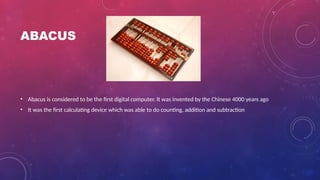
ABACUS
• Abacus is considered to be the first digital computer. It was invented by the Chinese 4000 years ago
• It was the first calculating device which was able to do counting, addition and subtraction
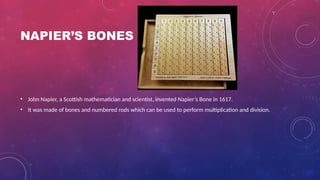
NAPIER’S BONES
• John Napier, a Scottish mathematician and scientist, invented Napier’s Bone in 1617.
• It was made of bones and numbered rods which can be used to perform multiplication and division.
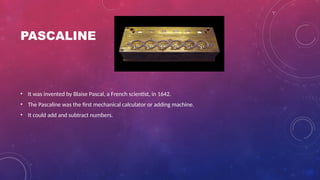
PASCALINE
• It was invented by Blaise Pascal, a French scientist, in 1642.
• The Pascaline was the first mechanical calculator or adding machine.
• It could add and subtract numbers.
LEIBNIZ CALCULATOR
• A German mathematician-philosopher, Gottfried Wilhelm Leibniz developed a machine called Stepped
Reckoner or Leibniz Calculator in 1673.
• It was capable of performing all mathematical calculations like addition, subtraction, multiplication,
division and even finding square root.
• It could store data using ‘memory store’ for the first time.
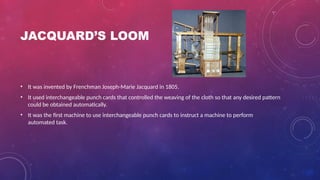
JACQUARD’S LOOM
• It was invented by Frenchman Joseph-Marie Jacquard in 1805.
• It used interchangeable punch cards that controlled the weaving of the cloth so that any desired pattern
could be obtained automatically.
• It was the first machine to use interchangeable punch cards to instruct a machine to perform
automated task.
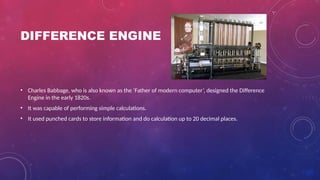
DIFFERENCE ENGINE
• Charles Babbage, who is also known as the ‘Father of modern computer’, designed the Difference
Engine in the early 1820s.
• It was capable of performing simple calculations.
• It used punched cards to store information and do calculation up to 20 decimal places.
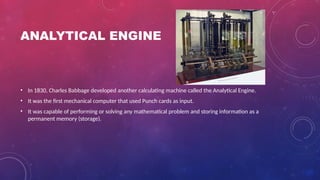
ANALYTICAL ENGINE
• In 1830, Charles Babbage developed another calculating machine called the Analytical Engine.
• It was the first mechanical computer that used Punch cards as input.
• It was capable of performing or solving any mathematical problem and storing information as a
permanent memory (storage).
TABULATING MACHINE
• Herman Hollerith, an American scientist, invented this machine in the year 1890.
• It was a mechanical tabulator that was based on Punch cards.
• It used Punched cards to input and store data and information.
• It could read the data, process it and produce the output.
• This machine was used by the U.S. Census in the year 1890.
• In 1924, Hollerith’s Tabulating Machine Company became International Business Machine(IBM).
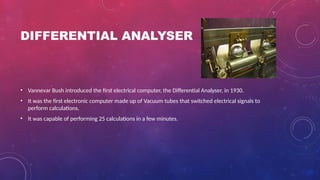
DIFFERENTIAL ANALYSER
• Vannevar Bush introduced the first electrical computer, the Differential Analyser, in 1930.
• It was the first electronic computer made up of Vacuum tubes that switched electrical signals to
perform calculations.
• It was capable of performing 25 calculations in a few minutes.
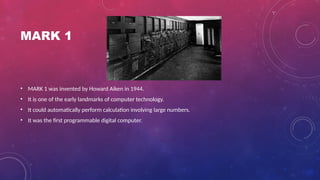
MARK 1
• MARK 1 was invented by Howard Aiken in 1944.
• It is one of the early landmarks of computer technology.
• It could automatically perform calculation involving large numbers.
• It was the first programmable digital computer.
THANK YOU

Evolution of Computer-Evolution of Computer

  • 1.
  • 2.
    ABACUS • Abacus isconsidered to be the first digital computer. It was invented by the Chinese 4000 years ago • It was the first calculating device which was able to do counting, addition and subtraction
  • 3.
    NAPIER’S BONES • JohnNapier, a Scottish mathematician and scientist, invented Napier’s Bone in 1617. • It was made of bones and numbered rods which can be used to perform multiplication and division.
  • 4.
    PASCALINE • It wasinvented by Blaise Pascal, a French scientist, in 1642. • The Pascaline was the first mechanical calculator or adding machine. • It could add and subtract numbers.
  • 5.
    LEIBNIZ CALCULATOR • AGerman mathematician-philosopher, Gottfried Wilhelm Leibniz developed a machine called Stepped Reckoner or Leibniz Calculator in 1673. • It was capable of performing all mathematical calculations like addition, subtraction, multiplication, division and even finding square root. • It could store data using ‘memory store’ for the first time.
  • 6.
    JACQUARD’S LOOM • Itwas invented by Frenchman Joseph-Marie Jacquard in 1805. • It used interchangeable punch cards that controlled the weaving of the cloth so that any desired pattern could be obtained automatically. • It was the first machine to use interchangeable punch cards to instruct a machine to perform automated task.
  • 7.
    DIFFERENCE ENGINE • CharlesBabbage, who is also known as the ‘Father of modern computer’, designed the Difference Engine in the early 1820s. • It was capable of performing simple calculations. • It used punched cards to store information and do calculation up to 20 decimal places.
  • 8.
    ANALYTICAL ENGINE • In1830, Charles Babbage developed another calculating machine called the Analytical Engine. • It was the first mechanical computer that used Punch cards as input. • It was capable of performing or solving any mathematical problem and storing information as a permanent memory (storage).
  • 9.
    TABULATING MACHINE • HermanHollerith, an American scientist, invented this machine in the year 1890. • It was a mechanical tabulator that was based on Punch cards. • It used Punched cards to input and store data and information. • It could read the data, process it and produce the output. • This machine was used by the U.S. Census in the year 1890. • In 1924, Hollerith’s Tabulating Machine Company became International Business Machine(IBM).
  • 10.
    DIFFERENTIAL ANALYSER • VannevarBush introduced the first electrical computer, the Differential Analyser, in 1930. • It was the first electronic computer made up of Vacuum tubes that switched electrical signals to perform calculations. • It was capable of performing 25 calculations in a few minutes.
  • 11.
    MARK 1 • MARK1 was invented by Howard Aiken in 1944. • It is one of the early landmarks of computer technology. • It could automatically perform calculation involving large numbers. • It was the first programmable digital computer.
  • 12.