Computer Security:
Principles and Practice
First Edition
by William Stallings and Lawrie Brown
Lecture slides by Lawrie Brown
Chapter 1 – Overview
Overview
Computer Security: protection afforded
to an automated information system in
order to attain the applicable objectives of
preserving the integrity, availability and
confidentiality of information system
resources (includes hardware, software,
firmware, information/data, and
telecommunications).
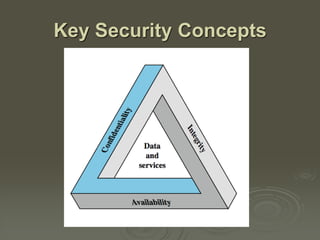
Key Security Concepts
Computer Security Challenges
1. not simple
2. must consider potential attacks
3. procedures used counter-intuitive
4. involve algorithms and secret info
5. must decide where to deploy mechanisms
6. battle of wits between attacker / admin
7. not perceived on benefit until fails
8. requires regular monitoring
9. too often an after-thought
10. regarded as impediment to using system
Security Terminology
Vulnerabilities and Attacks
 system resource vulnerabilities may
 be corrupted (loss of integrity)
 become leaky (loss of confidentiality)
 become unavailable (loss of availability)
 attacks are threats carried out and may be
 passive
 active
 insider
 outsider
Countermeasures
 means used to deal with security attacks
 prevent
 detect
 recover
 may result in new vulnerabilities
 will have residual vulnerability
 goal is to minimize risk given constraints
Threat Consequences
 unauthorized disclosure
 exposure, interception, inference, intrusion
 deception
 masquerade, falsification, repudiation
 disruption
 incapacitation, corruption, obstruction
 usurpation
 misappropriation, misuse
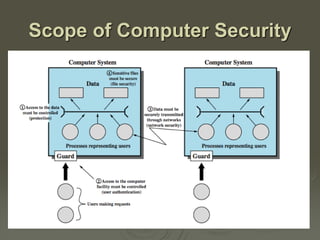
Scope of Computer Security
Network Security Attacks
 classify as passive or active
 passive attacks are eavesdropping
 release of message contents
 traffic analysis
 are hard to detect so aim to prevent
 active attacks modify/fake data
 masquerade
 replay
 modification
 denial of service
 hard to prevent so aim to detect
Security Functional
Requirements
 technical measures:
 access control; identification & authentication; system &
communication protection; system & information integrity
 management controls and procedures
 awareness & training; audit & accountability; certification,
accreditation, & security assessments; contingency
planning; maintenance; physical & environmental
protection; planning; personnel security; risk assessment;
systems & services acquisition
 overlapping technical and management:
 configuration management; incident response; media
protection
X.800 Security Architecture
 X.800, Security Architecture for OSI
 systematic way of defining requirements
for security and characterizing approaches
to satisfying them
 defines:
 security attacks - compromise security
 security mechanism - act to detect, prevent,
recover from attack
 security service - counter security attacks
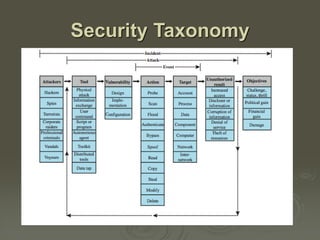
Security Taxonomy
Security Trends
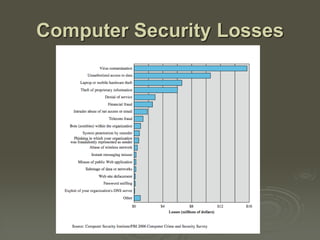
Computer Security Losses
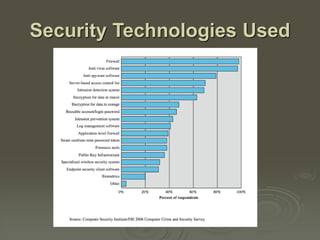
Security Technologies Used
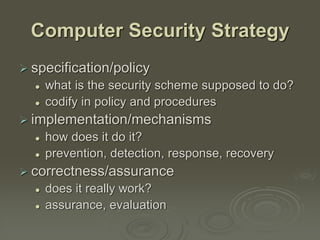
Computer Security Strategy
 specification/policy
 what is the security scheme supposed to do?
 codify in policy and procedures
 implementation/mechanisms
 how does it do it?
 prevention, detection, response, recovery
 correctness/assurance
 does it really work?
 assurance, evaluation
Summary
 security concepts
 terminology
 functional requirements
 security architecture
 security trends
 security strategy

Computer security priciple and practice

  • 1.
    Computer Security: Principles andPractice First Edition by William Stallings and Lawrie Brown Lecture slides by Lawrie Brown Chapter 1 – Overview
  • 2.
    Overview Computer Security: protectionafforded to an automated information system in order to attain the applicable objectives of preserving the integrity, availability and confidentiality of information system resources (includes hardware, software, firmware, information/data, and telecommunications).
  • 3.
  • 4.
    Computer Security Challenges 1.not simple 2. must consider potential attacks 3. procedures used counter-intuitive 4. involve algorithms and secret info 5. must decide where to deploy mechanisms 6. battle of wits between attacker / admin 7. not perceived on benefit until fails 8. requires regular monitoring 9. too often an after-thought 10. regarded as impediment to using system
  • 5.
  • 6.
    Vulnerabilities and Attacks system resource vulnerabilities may  be corrupted (loss of integrity)  become leaky (loss of confidentiality)  become unavailable (loss of availability)  attacks are threats carried out and may be  passive  active  insider  outsider
  • 7.
    Countermeasures  means usedto deal with security attacks  prevent  detect  recover  may result in new vulnerabilities  will have residual vulnerability  goal is to minimize risk given constraints
  • 8.
    Threat Consequences  unauthorizeddisclosure  exposure, interception, inference, intrusion  deception  masquerade, falsification, repudiation  disruption  incapacitation, corruption, obstruction  usurpation  misappropriation, misuse
  • 9.
  • 10.
    Network Security Attacks classify as passive or active  passive attacks are eavesdropping  release of message contents  traffic analysis  are hard to detect so aim to prevent  active attacks modify/fake data  masquerade  replay  modification  denial of service  hard to prevent so aim to detect
  • 11.
    Security Functional Requirements  technicalmeasures:  access control; identification & authentication; system & communication protection; system & information integrity  management controls and procedures  awareness & training; audit & accountability; certification, accreditation, & security assessments; contingency planning; maintenance; physical & environmental protection; planning; personnel security; risk assessment; systems & services acquisition  overlapping technical and management:  configuration management; incident response; media protection
  • 12.
    X.800 Security Architecture X.800, Security Architecture for OSI  systematic way of defining requirements for security and characterizing approaches to satisfying them  defines:  security attacks - compromise security  security mechanism - act to detect, prevent, recover from attack  security service - counter security attacks
  • 13.
  • 14.
  • 15.
  • 16.
  • 17.
    Computer Security Strategy specification/policy  what is the security scheme supposed to do?  codify in policy and procedures  implementation/mechanisms  how does it do it?  prevention, detection, response, recovery  correctness/assurance  does it really work?  assurance, evaluation
  • 18.
    Summary  security concepts terminology  functional requirements  security architecture  security trends  security strategy