PENGANTAR TEKNOLOGI INFORMASI
UNIVERSITAS TEKNOKRAT INDONESIA
FAKULTAS EKONOMI DAN BISNIS
Introduction Information Technology
1
UNIVERSITAS TEKNOKRAT INDONESIA
FAKULTAS EKONOMI DAN BISNIS
Yusra Fernando, M.Kom
yusra.fernando@teknokrat.ac.id
CONTACT ME
2
IT INFRASTRUCTURE
UNIVERSITAS TEKNOKRAT INDONESIA
FAKULTAS EKONOMI DAN BISNIS
Infrastruktur Teknologi Informasi
3
Objectives
The purpose of IT infrastructure management is to provide structure and control of
the functions responsible for diverse technical operations which generally involve
hardware, software, and networking in both physical and virtual environments. The
main goal is to minimize downtime and maintain business productivity.
4
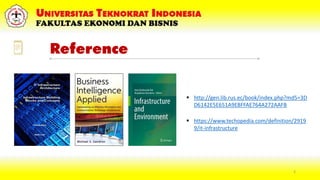
Reference
5
 https://www.techopedia.com/definition/2919
9/it-infrastructure
 http://gen.lib.rus.ec/book/index.php?md5=3D
D6142E5E651A9EBFFAE764A272AAFB
Definition - What does IT Infrastructure
mean?
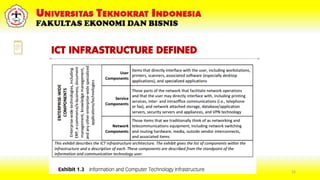
IT infrastructure - refers to the composite hardware, software, network resources
and services required for the existence, operation and management of an
enterprise IT environment. It allows an organization to deliver IT solutions and
services to its employees, partners and/or customers and is usually internal to an
organization and deployed within owned facilities.
What is "IT Infrastructure"
• Computing Platforms
• Data and Voice Telecom Networks
• Application Software
• Physical Facilities
• IT Management
• IT Policies
• IT Education Services
What is "IT Infrastructure“ - Explain
• IT infrastructure consists of all components that somehow play a role in overall IT and IT-
enabled operations. It can be used for internal business operations or developing customer IT or
business solutions.
• Typically, a standard IT infrastructure consists of the following components:
• Hardware: Servers, computers, data centers, switches, hubs and routers, and other equipment
• Software: Enterprise resource planning (ERP), customer relationship management (CRM),
productivity applications and more
• Network: Network enablement, internet connectivity, firewall and security
• Meatware: Human users, such as network administrators (NA), developers, designers and end
users with access to any IT appliance or service are also part of an IT infrastructure, specifically
with the advent of user-centric IT service development.
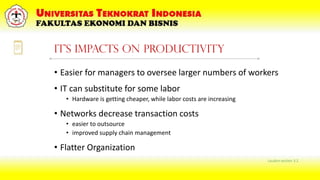
IT's Impacts on Productivity
• Easier for managers to oversee larger numbers of workers
• IT can substitute for some labor
• Hardware is getting cheaper, while labor costs are increasing
• Networks decrease transaction costs
• easier to outsource
• improved supply chain management
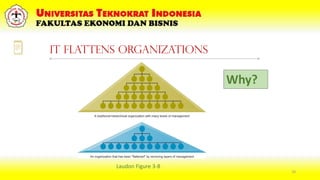
• Flatter Organization
Laudon section 3.2
10
IT Flattens Organizations
Laudon Figure 3-8
Why?
11
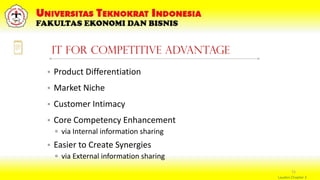
IT for Competitive Advantage
• Product Differentiation
• Market Niche
• Customer Intimacy
• Core Competency Enhancement
▫ via Internal information sharing
• Easier to Create Synergies
▫ via External information sharing
Laudon Chapter 3
12
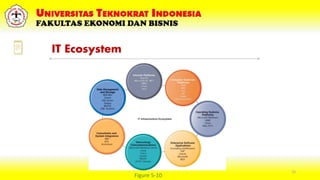
IT Ecosystem
Figure 5-10
13
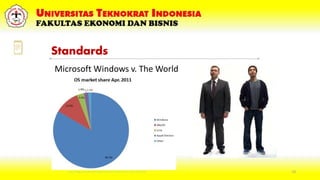
Standards
Microsoft Windows v. The World
http://blog.consumerpla.net/2011/05/os-market-share-april-2011.html
14
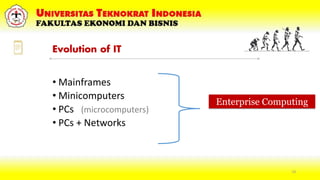
Evolution of IT
• Mainframes
• Minicomputers
• PCs (microcomputers)
• PCs + Networks
Enterprise Computing
15
Why the Evolution?
1. Moore's Law
2. Declining Communication Costs
3. Costs of Storage
4. Standards
16
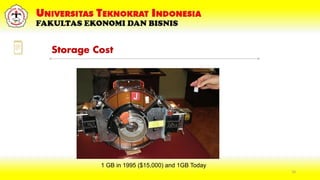
Storage Cost
1 GB in 1995 ($15,000) and 1GB Today
17
Future Infrastructure Trends
 Cloud Computing
 Software as a Service = subscription to a cloud-based application
 Server Virtualization
 Autonomic Computing
 self repairing computers
 more Grid Computing
 supercomputers on the cheap
BUSINESS INTELLIGENCE AND ICT INFRSTRUCTURE
UNIVERSITAS TEKNOKRAT INDONESIA
FAKULTAS EKONOMI DAN BISNIS
18
19
ICT AND BUSINESS INTELLIGENCE
Business intelligence (BI) - is a set of techniques that takes
business data and creates information from those data so that
managers can make decisions. In that way, organizations create
business intelligence. We see many vendors offering BI solutions,
which come in many varieties, including stand-alone solutions and
solutions that are additions to larger suites of business applications.
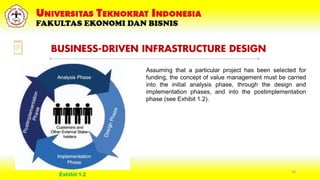
BUSINESS-DRIVEN INFRASTRUCTURE DESIGN
20
Assuming that a particular project has been selected for
funding, the concept of value management must be carried
into the initial analysis phase, through the design and
implementation phases, and into the postimplementation
phase (see Exhibit 1.2).
Exhibit 1.2
21
ICT INFRASTRUCTURE DEFINED
22
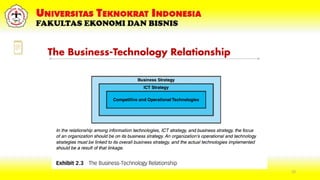
The Business-Technology Relationship
23
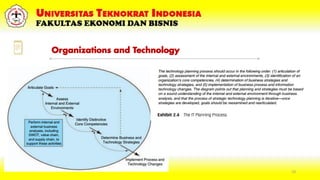
Organizations and Technology
24
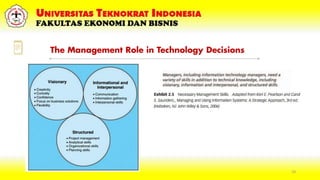
The Management Role in Technology Decisions
• ICT projects must be managed as investments in the organization and support
its competitive positioning. Organizations must know how they manage their
portfolio of projects and what to do when projects do not deliver as planned.
There is no cookbook approach to value management or getting your
organization to realize a return on its investment in ICT. Each project must be
approached from a predefined investment management standpoint where the
organization knows what it expects from its investments before funding them
and has processes in place to ensure that the ICT projects continue
to provide a return
•
25
CONCLUSION
THANK YOU ...
UNIVERSITAS TEKNOKRAT INDONESIA
FAKULTAS EKONOMI DAN BISNIS
YUSRA FERNANDO, S.KOM., M.KOM
26

06 - IT Infrastructure (shared).pdf

  • 1.
    PENGANTAR TEKNOLOGI INFORMASI UNIVERSITASTEKNOKRAT INDONESIA FAKULTAS EKONOMI DAN BISNIS Introduction Information Technology 1
  • 2.
    UNIVERSITAS TEKNOKRAT INDONESIA FAKULTASEKONOMI DAN BISNIS Yusra Fernando, M.Kom yusra.fernando@teknokrat.ac.id CONTACT ME 2
  • 3.
    IT INFRASTRUCTURE UNIVERSITAS TEKNOKRATINDONESIA FAKULTAS EKONOMI DAN BISNIS Infrastruktur Teknologi Informasi 3
  • 4.
    Objectives The purpose ofIT infrastructure management is to provide structure and control of the functions responsible for diverse technical operations which generally involve hardware, software, and networking in both physical and virtual environments. The main goal is to minimize downtime and maintain business productivity. 4
  • 5.
  • 6.
    Definition - Whatdoes IT Infrastructure mean? IT infrastructure - refers to the composite hardware, software, network resources and services required for the existence, operation and management of an enterprise IT environment. It allows an organization to deliver IT solutions and services to its employees, partners and/or customers and is usually internal to an organization and deployed within owned facilities.
  • 7.
    What is "ITInfrastructure" • Computing Platforms • Data and Voice Telecom Networks • Application Software • Physical Facilities • IT Management • IT Policies • IT Education Services
  • 8.
    What is "ITInfrastructure“ - Explain • IT infrastructure consists of all components that somehow play a role in overall IT and IT- enabled operations. It can be used for internal business operations or developing customer IT or business solutions. • Typically, a standard IT infrastructure consists of the following components: • Hardware: Servers, computers, data centers, switches, hubs and routers, and other equipment • Software: Enterprise resource planning (ERP), customer relationship management (CRM), productivity applications and more • Network: Network enablement, internet connectivity, firewall and security • Meatware: Human users, such as network administrators (NA), developers, designers and end users with access to any IT appliance or service are also part of an IT infrastructure, specifically with the advent of user-centric IT service development.
  • 9.
    IT's Impacts onProductivity • Easier for managers to oversee larger numbers of workers • IT can substitute for some labor • Hardware is getting cheaper, while labor costs are increasing • Networks decrease transaction costs • easier to outsource • improved supply chain management • Flatter Organization Laudon section 3.2
  • 10.
  • 11.
    11 IT for CompetitiveAdvantage • Product Differentiation • Market Niche • Customer Intimacy • Core Competency Enhancement ▫ via Internal information sharing • Easier to Create Synergies ▫ via External information sharing Laudon Chapter 3
  • 12.
  • 13.
    13 Standards Microsoft Windows v.The World http://blog.consumerpla.net/2011/05/os-market-share-april-2011.html
  • 14.
    14 Evolution of IT •Mainframes • Minicomputers • PCs (microcomputers) • PCs + Networks Enterprise Computing
  • 15.
    15 Why the Evolution? 1.Moore's Law 2. Declining Communication Costs 3. Costs of Storage 4. Standards
  • 16.
    16 Storage Cost 1 GBin 1995 ($15,000) and 1GB Today
  • 17.
    17 Future Infrastructure Trends Cloud Computing  Software as a Service = subscription to a cloud-based application  Server Virtualization  Autonomic Computing  self repairing computers  more Grid Computing  supercomputers on the cheap
  • 18.
    BUSINESS INTELLIGENCE ANDICT INFRSTRUCTURE UNIVERSITAS TEKNOKRAT INDONESIA FAKULTAS EKONOMI DAN BISNIS 18
  • 19.
    19 ICT AND BUSINESSINTELLIGENCE Business intelligence (BI) - is a set of techniques that takes business data and creates information from those data so that managers can make decisions. In that way, organizations create business intelligence. We see many vendors offering BI solutions, which come in many varieties, including stand-alone solutions and solutions that are additions to larger suites of business applications.
  • 20.
    BUSINESS-DRIVEN INFRASTRUCTURE DESIGN 20 Assumingthat a particular project has been selected for funding, the concept of value management must be carried into the initial analysis phase, through the design and implementation phases, and into the postimplementation phase (see Exhibit 1.2). Exhibit 1.2
  • 21.
  • 22.
  • 23.
  • 24.
    24 The Management Rolein Technology Decisions
  • 25.
    • ICT projectsmust be managed as investments in the organization and support its competitive positioning. Organizations must know how they manage their portfolio of projects and what to do when projects do not deliver as planned. There is no cookbook approach to value management or getting your organization to realize a return on its investment in ICT. Each project must be approached from a predefined investment management standpoint where the organization knows what it expects from its investments before funding them and has processes in place to ensure that the ICT projects continue to provide a return • 25 CONCLUSION
  • 26.
    THANK YOU ... UNIVERSITASTEKNOKRAT INDONESIA FAKULTAS EKONOMI DAN BISNIS YUSRA FERNANDO, S.KOM., M.KOM 26