PENGANTAR TEKNOLOGI INFORMASI
UNIVERSITAS TEKNOKRAT INDONESIA
FAKULTAS EKONOMI DAN BISNIS
Introduction Information Technology
1
UNIVERSITAS TEKNOKRAT INDONESIA
FAKULTAS EKONOMI DAN BISNIS
Yusra Fernando, M.Kom
yusra.fernando@teknokrat.ac.id
CONTACT ME
2
Introduction to Computer Hardware
UNIVERSITAS TEKNOKRAT INDONESIA
FAKULTAS EKONOMI DAN BISNIS
Pengenalan Perangkat Lunak Computer
3
4
Computer Hardware
Objectives Learning
 Students are able to explain hardware function.
 What is the purpose of hardware in a computer?
 Indicate the names and functions of hardware ports and the parts of the motherboard.
 Identify the names and distinguishing features of different kinds of input and output
devices.
 Describe how the CPU processes data and instructions and controls the operation of all
other devices.
 Identify the names, distinguishing features, and units for measuring different kinds of
memory and storage devices.
 Search your personal computer for the various hardware components it contains.
5
Reference
 https://courses.lumenlearning.com/computerapps/chapte
r/reading-hardware/
6
 http://gen.lib.rus.ec/book/index.php?md5=87B08BF
4B62F2FA93AF1745A2ABD62B6
Introduction
• Hardware - is the most visible part of any information
system: the equipment such as computers, scanners
and printers that is used to capture data, transform it
and present it to the user as output. Although we will
focus mainly on the personal computer (PC) and the
peripheral devices that are commonly used with it, the
same principles apply to the complete range of
computers:
Introduction
Supercomputers - a term used to denote the
fastest computing engines available at any given
time, which are used for running exceptionally
demanding scientific applications.
Introduction
Mainframe computers - which provide high-capacity
processing and data storage facilities to hundreds or
even thousands of users operating from (dumb)
terminals.
Introduction
Servers, which have large data storage capacities
enabling users to share files and application software,
although processing will typically occur on the user’s
own machine.
Workstations, which provide high-level performance
for individual users in computationally intensive fields
such as engineering.
Introduction
Personal computers (including laptop/notebook computers) have a
connected monitor, keyboard and CPU, and have developed into a
convenient and flexible business tool capable of operating independently
or as part of an organizational network.
Mobile devices such as personal digital assistants or the latest generation
of cellular telephones, offer maximum portability plus wireless
connection to the internet, although they do not offer the full
functionality of a PC.
Hardware & Software?
• Hardware
• The physical equipment used to process
information
• Software
• Instructions that, with the help of people,
command the hardware to perform desired
tasks
13
The term "Hardware" refers to the physical elements of a computer; the
machinery or the electronics in a computer. A basic computer consists of 4
components:
•Input unit
•CPU
•Memory unit
•Output unit
https://en.wikiversity.org/wiki/Computer_hardware_and_software
Hardware
14
Examples of hardware in a computer are the keyboard (Input unit), the monitor (output unit), the
mouse (Input unit),the printer (output unit),the speaker (output unit),the memory and the CPU. Like
the CPU, most of a computer's hardware cannot be seen; It's inside the computer case.
https://en.wikiversity.org/wiki/Computer_hardware_and_software
Hardware
15
 The motherboard is the home of I/O in a computer. The motherboard is a piece of hardware
that makes connections in the right places between all of the other components in a
computer.
 It tells data where it should go. It is sometimes necessary to add functionality to a computer
to keep it up to date, or make it better.
 The amount of I/O a computer has can be changed, by adding expansion cards to the
motherboard.
 Sometimes functionality can be added through a universal port, a port that supports
multiple kinds of I/O to a motherboard. USB, FireWire, and Thunderbolt (types of I/O)
support multiple data types; Your keyboard and mouse typically connect to your computer's
motherboard via USB.
https://en.wikiversity.org/wiki/Computer_hardware_and_software
Hardware
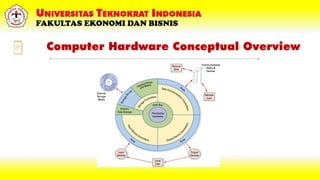
Computer Hardware Conceptual Overview
Computer Devices
Processing hardware
Controls the peripheral devices, as directed by computer software
Data bus
Electrical connection managing the flow of data between the
processing hardware and the rest of the computer
Computer Devices
Adaptors (controllers)
Reside inside the computer and convert commands and data from the
data bus into signals that peripheral devices can use
Port
A connection between the computer box and a device outside the
computer
Computer Devices
Input, output, and communications devices
Transfer data between a computer and its users or other computers
Storage devices
Save data for later processing
Uses of Input Hardware
Active data entry
A person uses an input device to enter data into a computer
Passive data entry
The computer obtains information without the active participation of a
user
Control
A person uses an input device to control the tasks or actions of the
computer.
Input Devices
Keyboard
Consists of a plastic or metal housing containing keys that, when
pressed, send a signal to the computer
Pointing devices
Allow the user to control the movement of a cursor (pointer) on the
screen
Input Devices
Formatted Text Readers
Read text formatted specifically for the device in use
Image Capture Devices
Include scanners, digital still cameras, and digital camcorders
Input Devices
Hardware Component
UNIVERSITAS TEKNOKRAT INDONESIA
FAKULTAS EKONOMI DAN BISNIS
YUSRA FERNANDO, S.KOM., M.KOM
24
25
Hardware is divided into 5 groups:
1. Input Devices
2. Processing Devices
3. Output Devices
4. Storage Devices
5. Communication Devices
26
Hardware is divided into 5 groups:
1. Input Devices
2. Processing Devices
3. Output Devices
4. Storage Devices
5. Communication Devices
Multiple Choice ..
UNIVERSITAS TEKNOKRAT INDONESIA
FAKULTAS EKONOMI DAN BISNIS
27
28
Question
RAM' stands for …
a. Random Access Memory
b. Read Access Memory
c. Read Arithmetic Memory
d. Random Arithmetic Memory
1
practice
29
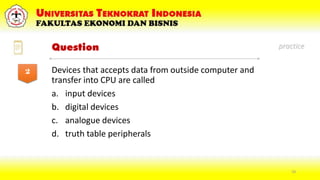
Question
Devices that accepts data from outside computer and
transfer into CPU are called
a. input devices
b. digital devices
c. analogue devices
d. truth table peripherals
2
practice
30
Question
Central Processing Unit (CPU) consists of
a. control unit
b. arithmetic and logic unit
c. main store
d. all of above
3
practice
31
Question
Place where large amounts of data are stored outside
central processing unit is called
a. backing store
b. peripherals
c. control unit
d. AL unit
4
practice
32
Question
Devices that are under control of computer and are directly
connected to computer peripherals are termed as
a. off-line devices
b. on-line devices
c. IN gate device
d. IF gate device
5
practice
33
Question
'main store' of CPU is also called
a. main memory
b. temporary memory
c. immediate access store
d. both A and C
6
practice
34
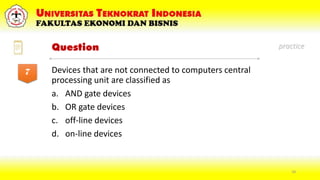
Question
Devices that are not connected to computers central
processing unit are classified as
a. AND gate devices
b. OR gate devices
c. off-line devices
d. on-line devices
7
practice
THANK YOU ...
UNIVERSITAS TEKNOKRAT INDONESIA
FAKULTAS EKONOMI DAN BISNIS
YUSRA FERNANDO, S.KOM., M.KOM
35
Summary
• Computer Instructions or data, anything that can be stored electronically is
Software
• Hardware is one that is tangible. The storage devices (Hard disk, CD’s etc.,),
mouse, keyboard CPU and display devices (Monitor) are Hardware.
• Types of Software - (System Software, Application Software, Open source
Software and , Proprietary Software)
• System software - is a term referring to any computer software which manages and
controls the hardware so that application software can perform a task.
• Virus - unscrupulous programmers deliberately construct harmful programs (called
viruses) that instruct your program to perform destructive activities, such as erasing a
disk drive

Chp 04 - Hardware PTI - (Shared).pdf

  • 1.
    PENGANTAR TEKNOLOGI INFORMASI UNIVERSITASTEKNOKRAT INDONESIA FAKULTAS EKONOMI DAN BISNIS Introduction Information Technology 1
  • 2.
    UNIVERSITAS TEKNOKRAT INDONESIA FAKULTASEKONOMI DAN BISNIS Yusra Fernando, M.Kom yusra.fernando@teknokrat.ac.id CONTACT ME 2
  • 3.
    Introduction to ComputerHardware UNIVERSITAS TEKNOKRAT INDONESIA FAKULTAS EKONOMI DAN BISNIS Pengenalan Perangkat Lunak Computer 3
  • 4.
  • 5.
    Objectives Learning  Studentsare able to explain hardware function.  What is the purpose of hardware in a computer?  Indicate the names and functions of hardware ports and the parts of the motherboard.  Identify the names and distinguishing features of different kinds of input and output devices.  Describe how the CPU processes data and instructions and controls the operation of all other devices.  Identify the names, distinguishing features, and units for measuring different kinds of memory and storage devices.  Search your personal computer for the various hardware components it contains. 5
  • 6.
  • 7.
    Introduction • Hardware -is the most visible part of any information system: the equipment such as computers, scanners and printers that is used to capture data, transform it and present it to the user as output. Although we will focus mainly on the personal computer (PC) and the peripheral devices that are commonly used with it, the same principles apply to the complete range of computers:
  • 8.
    Introduction Supercomputers - aterm used to denote the fastest computing engines available at any given time, which are used for running exceptionally demanding scientific applications.
  • 9.
    Introduction Mainframe computers -which provide high-capacity processing and data storage facilities to hundreds or even thousands of users operating from (dumb) terminals.
  • 10.
    Introduction Servers, which havelarge data storage capacities enabling users to share files and application software, although processing will typically occur on the user’s own machine. Workstations, which provide high-level performance for individual users in computationally intensive fields such as engineering.
  • 11.
    Introduction Personal computers (includinglaptop/notebook computers) have a connected monitor, keyboard and CPU, and have developed into a convenient and flexible business tool capable of operating independently or as part of an organizational network. Mobile devices such as personal digital assistants or the latest generation of cellular telephones, offer maximum portability plus wireless connection to the internet, although they do not offer the full functionality of a PC.
  • 12.
    Hardware & Software? •Hardware • The physical equipment used to process information • Software • Instructions that, with the help of people, command the hardware to perform desired tasks
  • 13.
    13 The term "Hardware"refers to the physical elements of a computer; the machinery or the electronics in a computer. A basic computer consists of 4 components: •Input unit •CPU •Memory unit •Output unit https://en.wikiversity.org/wiki/Computer_hardware_and_software Hardware
  • 14.
    14 Examples of hardwarein a computer are the keyboard (Input unit), the monitor (output unit), the mouse (Input unit),the printer (output unit),the speaker (output unit),the memory and the CPU. Like the CPU, most of a computer's hardware cannot be seen; It's inside the computer case. https://en.wikiversity.org/wiki/Computer_hardware_and_software Hardware
  • 15.
    15  The motherboardis the home of I/O in a computer. The motherboard is a piece of hardware that makes connections in the right places between all of the other components in a computer.  It tells data where it should go. It is sometimes necessary to add functionality to a computer to keep it up to date, or make it better.  The amount of I/O a computer has can be changed, by adding expansion cards to the motherboard.  Sometimes functionality can be added through a universal port, a port that supports multiple kinds of I/O to a motherboard. USB, FireWire, and Thunderbolt (types of I/O) support multiple data types; Your keyboard and mouse typically connect to your computer's motherboard via USB. https://en.wikiversity.org/wiki/Computer_hardware_and_software Hardware
  • 16.
  • 17.
    Computer Devices Processing hardware Controlsthe peripheral devices, as directed by computer software Data bus Electrical connection managing the flow of data between the processing hardware and the rest of the computer
  • 18.
    Computer Devices Adaptors (controllers) Resideinside the computer and convert commands and data from the data bus into signals that peripheral devices can use Port A connection between the computer box and a device outside the computer
  • 19.
    Computer Devices Input, output,and communications devices Transfer data between a computer and its users or other computers Storage devices Save data for later processing
  • 20.
    Uses of InputHardware Active data entry A person uses an input device to enter data into a computer Passive data entry The computer obtains information without the active participation of a user Control A person uses an input device to control the tasks or actions of the computer.
  • 21.
    Input Devices Keyboard Consists ofa plastic or metal housing containing keys that, when pressed, send a signal to the computer Pointing devices Allow the user to control the movement of a cursor (pointer) on the screen
  • 22.
    Input Devices Formatted TextReaders Read text formatted specifically for the device in use Image Capture Devices Include scanners, digital still cameras, and digital camcorders
  • 23.
  • 24.
    Hardware Component UNIVERSITAS TEKNOKRATINDONESIA FAKULTAS EKONOMI DAN BISNIS YUSRA FERNANDO, S.KOM., M.KOM 24
  • 25.
    25 Hardware is dividedinto 5 groups: 1. Input Devices 2. Processing Devices 3. Output Devices 4. Storage Devices 5. Communication Devices
  • 26.
    26 Hardware is dividedinto 5 groups: 1. Input Devices 2. Processing Devices 3. Output Devices 4. Storage Devices 5. Communication Devices
  • 27.
    Multiple Choice .. UNIVERSITASTEKNOKRAT INDONESIA FAKULTAS EKONOMI DAN BISNIS 27
  • 28.
    28 Question RAM' stands for… a. Random Access Memory b. Read Access Memory c. Read Arithmetic Memory d. Random Arithmetic Memory 1 practice
  • 29.
    29 Question Devices that acceptsdata from outside computer and transfer into CPU are called a. input devices b. digital devices c. analogue devices d. truth table peripherals 2 practice
  • 30.
    30 Question Central Processing Unit(CPU) consists of a. control unit b. arithmetic and logic unit c. main store d. all of above 3 practice
  • 31.
    31 Question Place where largeamounts of data are stored outside central processing unit is called a. backing store b. peripherals c. control unit d. AL unit 4 practice
  • 32.
    32 Question Devices that areunder control of computer and are directly connected to computer peripherals are termed as a. off-line devices b. on-line devices c. IN gate device d. IF gate device 5 practice
  • 33.
    33 Question 'main store' ofCPU is also called a. main memory b. temporary memory c. immediate access store d. both A and C 6 practice
  • 34.
    34 Question Devices that arenot connected to computers central processing unit are classified as a. AND gate devices b. OR gate devices c. off-line devices d. on-line devices 7 practice
  • 35.
    THANK YOU ... UNIVERSITASTEKNOKRAT INDONESIA FAKULTAS EKONOMI DAN BISNIS YUSRA FERNANDO, S.KOM., M.KOM 35
  • 36.
    Summary • Computer Instructionsor data, anything that can be stored electronically is Software • Hardware is one that is tangible. The storage devices (Hard disk, CD’s etc.,), mouse, keyboard CPU and display devices (Monitor) are Hardware. • Types of Software - (System Software, Application Software, Open source Software and , Proprietary Software) • System software - is a term referring to any computer software which manages and controls the hardware so that application software can perform a task. • Virus - unscrupulous programmers deliberately construct harmful programs (called viruses) that instruct your program to perform destructive activities, such as erasing a disk drive