LAN, MAN &WAN
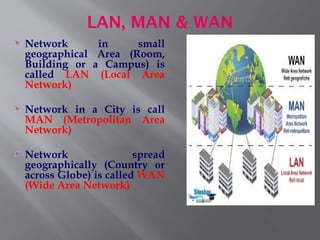
Network in small
geographical Area (Room,
Building or a Campus) is
called LAN (Local Area
Network)
Network in a City is call
MAN (Metropolitan Area
Network)
Network spread
geographically (Country or
across Globe) is called WAN
(Wide Area Network)
3.
Applications of Networks
ResourceSharing
Hardware (computing resources, disks, printers)
Software (application software)
Information Sharing
Easy accessibility from anywhere (files, databases)
Search Capability (WWW)
Communication
Email
Message broadcast
Remote computing
Distributed processing (GRID Computing)
4.
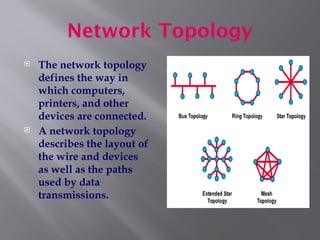
Network Topology
Thenetwork topology
defines the way in
which computers,
printers, and other
devices are connected.
A network topology
describes the layout of
the wire and devices
as well as the paths
used by data
transmissions.
5.
Local Area Network(LAN)
LAN connects network devices in such a way that personal
computers and workstations can share data, tools, and programs.
The group of computers and devices are connected together by a
switch, or stack of switches, using a private addressing scheme as
defined by the TCP/IP protocol.
Data transmits at a very fast rate as the number of computers linked
is limited.
By definition, the connections must be high-speed and relatively
inexpensive hardware (Such as hubs, network adapters, and
Ethernet cables).
LANs cover a smaller geographical area (Size is limited to a few
kilometres) and are privately owned. One can use it for an office
building, home, hospital, school, etc.
LAN is easy to design and maintain.
A Communication medium used for LAN has twisted-pair cables
and coaxial cables.
It covers a short distance, and so the error and noise are minimized.
6.
Early LANshad data rates in the 4 to 16 Mbps range.
Today, speeds are normally 100 or 1000 Mbps.
Propagation delay is very short in a LAN.
LAN has a range up to 2km. A LAN typically relies
mostly on wired connections for increased speed and
security, but wireless connections can also be part of
a LAN.
The fault tolerance of a LAN is more and there is less
congestion in this network. For example A bunch of
students playing Counter-Strike in the same room
(without internet).
7.
Advantages
Provides fastdata transfer rates and
high-speed communication.
Easy to set up and manage.
Can be used to share peripheral devices
such as printers and scanners.
Provides increased security and fault
tolerance compared to WANs.
8.
Disadvantages
Limited geographicalcoverage.
Limited scalability and may require
significant infrastructure upgrades to
accommodate growth.
May experience congestion and network
performance issues with increased usage.
9.
Metropolitan Area Network(MAN)
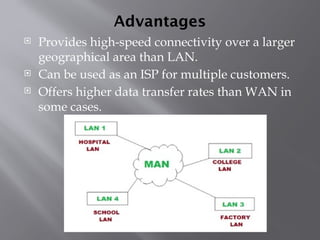
MAN or Metropolitan area Network covers a larger
area than that covered by a LAN and a smaller area
as compared to WAN.
MAN has a range of 5-50km. It connects two or more
computers that are apart but reside in the same or
different cities.
It covers a large geographical area and may serve as
an ISP (Internet Service Provider).
MAN is designed for customers who need high-
speed connectivity. Speeds of MAN range in terms of
Mbps. It’s hard to design and maintain a
Metropolitan Area Network.
10.
Advantages
Provides high-speedconnectivity over a larger
geographical area than LAN.
Can be used as an ISP for multiple customers.
Offers higher data transfer rates than WAN in
some cases.
11.
Disadvantages
Can beexpensive to set up and maintain.
May experience congestion and network
performance issues with increased usage.
May have limited fault tolerance and security
compared to LANs.
12.
Wide Area Network(WAN)
WAN is a computer network that extends over a large
geographical area, although it might be confined
within the bounds of a state or country.
WAN has a range of above 50 km. A WAN could be a
connection of LAN connecting to other LANs via
telephone lines and radio waves and may be limited
to an enterprise (a corporation or an organization) or
accessible to the public.
The technology is high-speed and relatively
expensive.
There are two types of WAN: Switched WAN and
Point-to-Point WAN. WAN is difficult to design and
maintain.
Due to long-distance transmission, the noise and
error tend to be more in WAN.
13.
WAN’s datarate is slow about a 10th LAN’s
speed since it involves increased distance and
increased number of servers and terminals etc.
The speed of WAN ranges from a few kilobits per
second (Kbps) to megabits per second (Mbps).
Propagation delay is one of the biggest problems
faced here.
Devices used for the transmission of data through
WAN are Optic wires, Microwaves, and Satellites.
An example of a Switched WAN is the
asynchronous transfer mode (ATM) network and
Point-to-Point WAN is a dial-up line that connects
a home computer to the Internet.
14.
Advantages
Covers largegeographical areas and can
connect remote locations.
Provides connectivity to the internet.
Offers remote access to resources and
applications.
Can be used to support multiple users and
applications simultaneously.
15.
Disadvantages
Can beexpensive to set up and maintain.
Offers slower data transfer rates than LAN or
MAN.
May experience higher latency and longer
propagation delays due to longer distances and
multiple network hops.
May have lower fault tolerance and security
compared to LANs.