DATA SCIENCE
AND
ANALYTICS
Topic
Bayer's Theorem, Naive Bayer's classifier
Real-Life Applications of Bayes’
Theorem:-
Bayesian inference is very important and has found application in various
activities, including medicine, science, philosophy, engineering, sports, law, etc.
Some of the most common applications of Bayes’ Theorem in real life are :
• Spam Filtering
• Weather Forecasting
• DNA Testing
• Financial Forecasting
• Fault Diagnosis in Engineering
• Drug Testing
Baye’s theorem:-
•Bayes’ Theorem is used to determine the conditional probability of an
event.
• It was named after an English statistician, Thomas Bayes who
discovered this formula in 1763.
•It is used to find the probability of an event, based on prior knowledge
of conditions that might be related to that event.
•For example, if we want to find the probability that a white marble
drawn at random came from the first bag, given that a white marble has
already been drawn, and there are three bags each containing some
white and black marbles, then we can use Bayes’ Theorem.
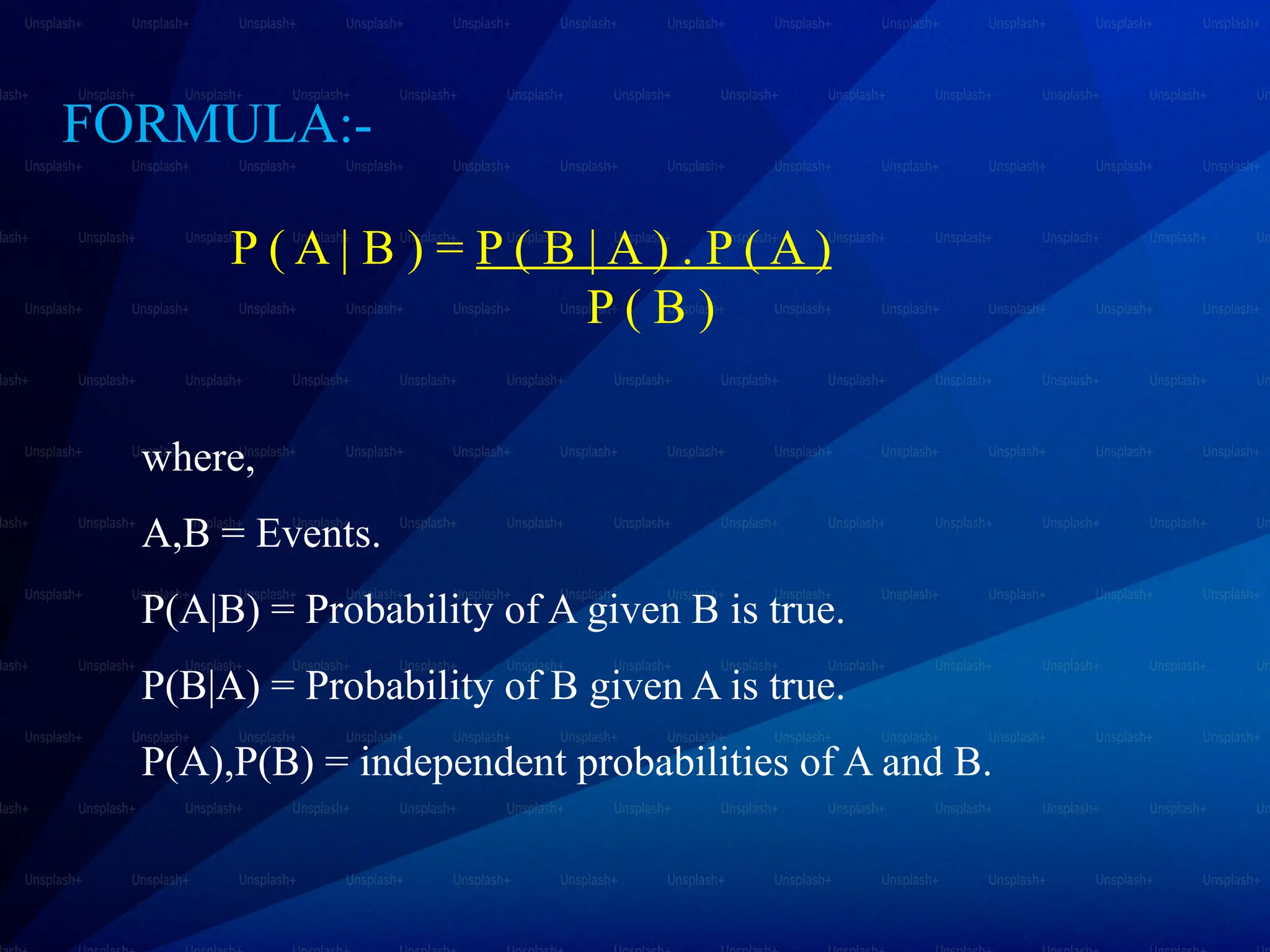
P ( A | B ) = P ( B | A ) . P ( A )
P ( B )
where,
A,B = Events.
P(A|B) = Probability of A given B is true.
P(B|A) = Probability of B given A is true.
P(A),P(B) = independent probabilities of A and B.
FORMULA:-
Naive Bayes Classifier:-
•Naive Bayes algorithm is a supervised learning algorithm, which is
based on Bayes theorem and used for solving classification problems.
•It is mainly used in text classification that includes a high-dimensional
training dataset.
•Naive Bayes Classifier is one of the simple and most effective
classification algorithms which helps in building the fast machine
learning models that can make quick predictions.
•It is a probabilistic classifier, which means it predicts on the basis of the
probability of an object.
•Some popular examples of Naive Bayes Algorithm are spam filtration,
sentimental analysis, and classifying articles.
Why is it called Naive Bayes?
•The Naive Bayes algorithm is comprised of two words Naive and
Bayes, which can be described as:
•Naive: It is called Naive because it assumes that the occurrence of a
certain feature is independent of the occurrence of other features. Such
as if the fruit is identified on the bases of color, shape, and taste, then
red, spherical, and sweet fruit is recognized as an apple. Hence each
feature individually contributes to identify that it is an apple without
depending on each other.
•Bayes: It is called Bayes because it depends on the principle of Bayes
Theroem.
Working of Naive Bayes’ Classifier:-
•Working of Naive Bayes’ Classifier can be understood with the help of the
below example:
•Suppose we have a dataset of Weather conditions and corresponding target
variable “Play”. So using this dataset we need to decide that whether we
should play or not on a particular day according to the weather conditions.
1. Convert the given dataset into frequency tables.
2. Generate Likelihood table by finding the probabilities of given features.
3. Now, use Bayes theorem to calculate the posterior probability.
• Problem: If the whether is sunny, then the player should play or not?
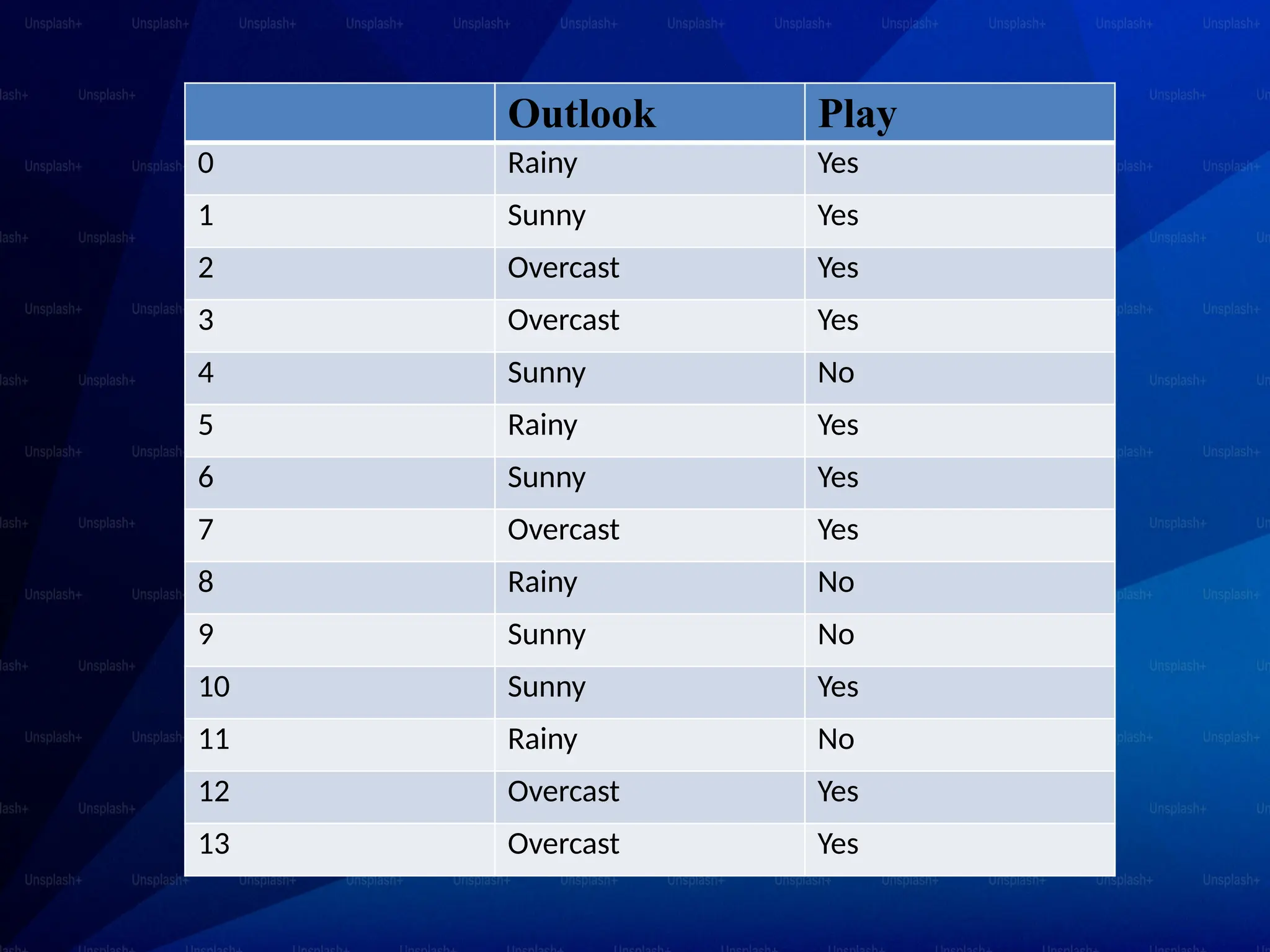
• Solution: To solve this, first consider the below dataset.
Outlook Play
0 Rainy Yes
1 Sunny Yes
2 Overcast Yes
3 Overcast Yes
4 Sunny No
5 Rainy Yes
6 Sunny Yes
7 Overcast Yes
8 Rainy No
9 Sunny No
10 Sunny Yes
11 Rainy No
12 Overcast Yes
13 Overcast Yes
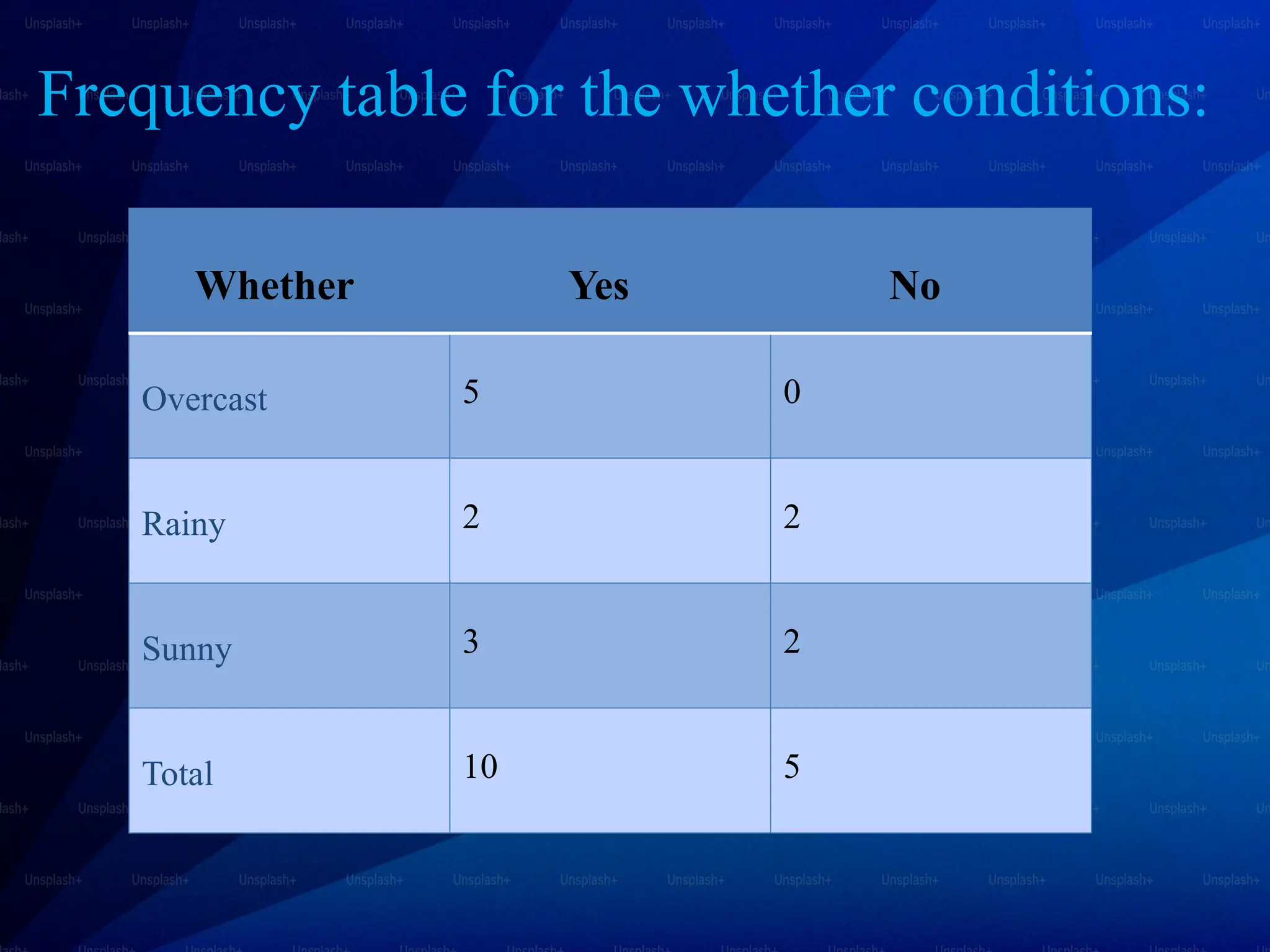
Whether Yes No
Overcast 5 0
Rainy 2 2
Sunny 3 2
Total 10 5
Frequency table for the whether conditions:
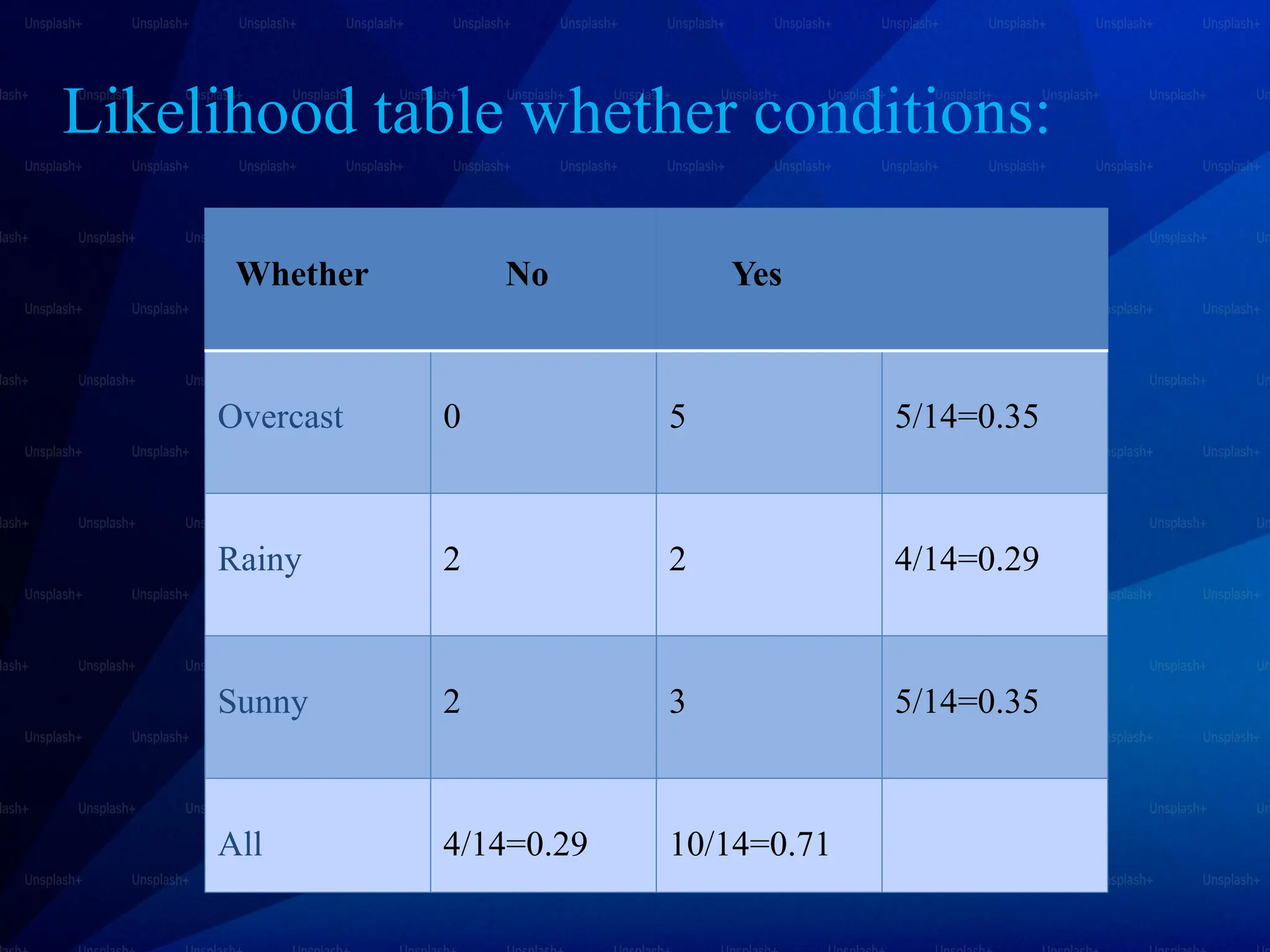
Likelihood table whether conditions:
Whether No Yes
Overcast 0 5 5/14=0.35
Rainy 2 2 4/14=0.29
Sunny 2 3 5/14=0.35
All 4/14=0.29 10/14=0.71
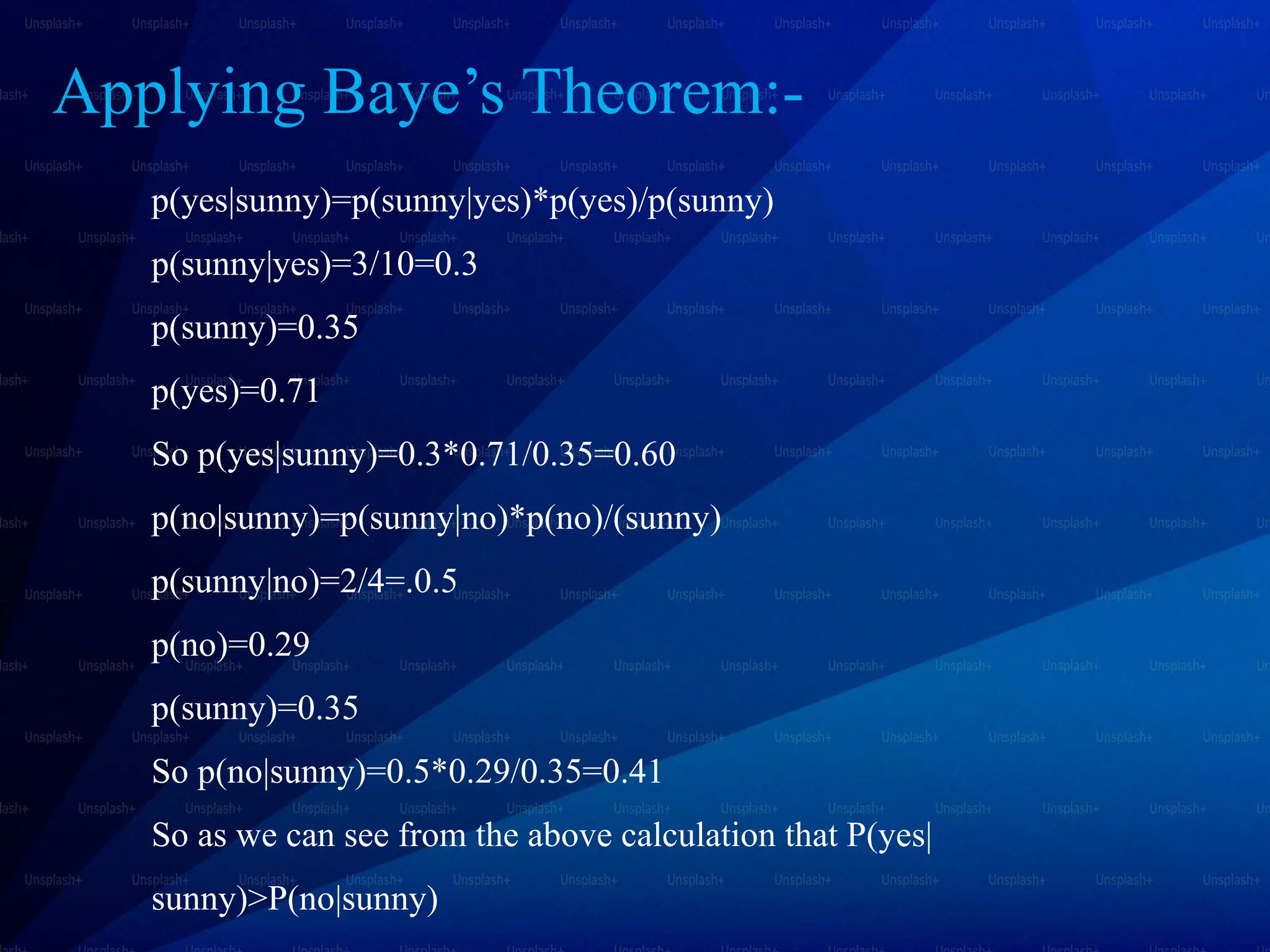
Applying Baye’s Theorem:-
p(yes|sunny)=p(sunny|yes)*p(yes)/p(sunny)
p(sunny|yes)=3/10=0.3
p(sunny)=0.35
p(yes)=0.71
So p(yes|sunny)=0.3*0.71/0.35=0.60
p(no|sunny)=p(sunny|no)*p(no)/(sunny)
p(sunny|no)=2/4=.0.5
p(no)=0.29
p(sunny)=0.35
So p(no|sunny)=0.5*0.29/0.35=0.41
So as we can see from the above calculation that P(yes|
sunny)>P(no|sunny)
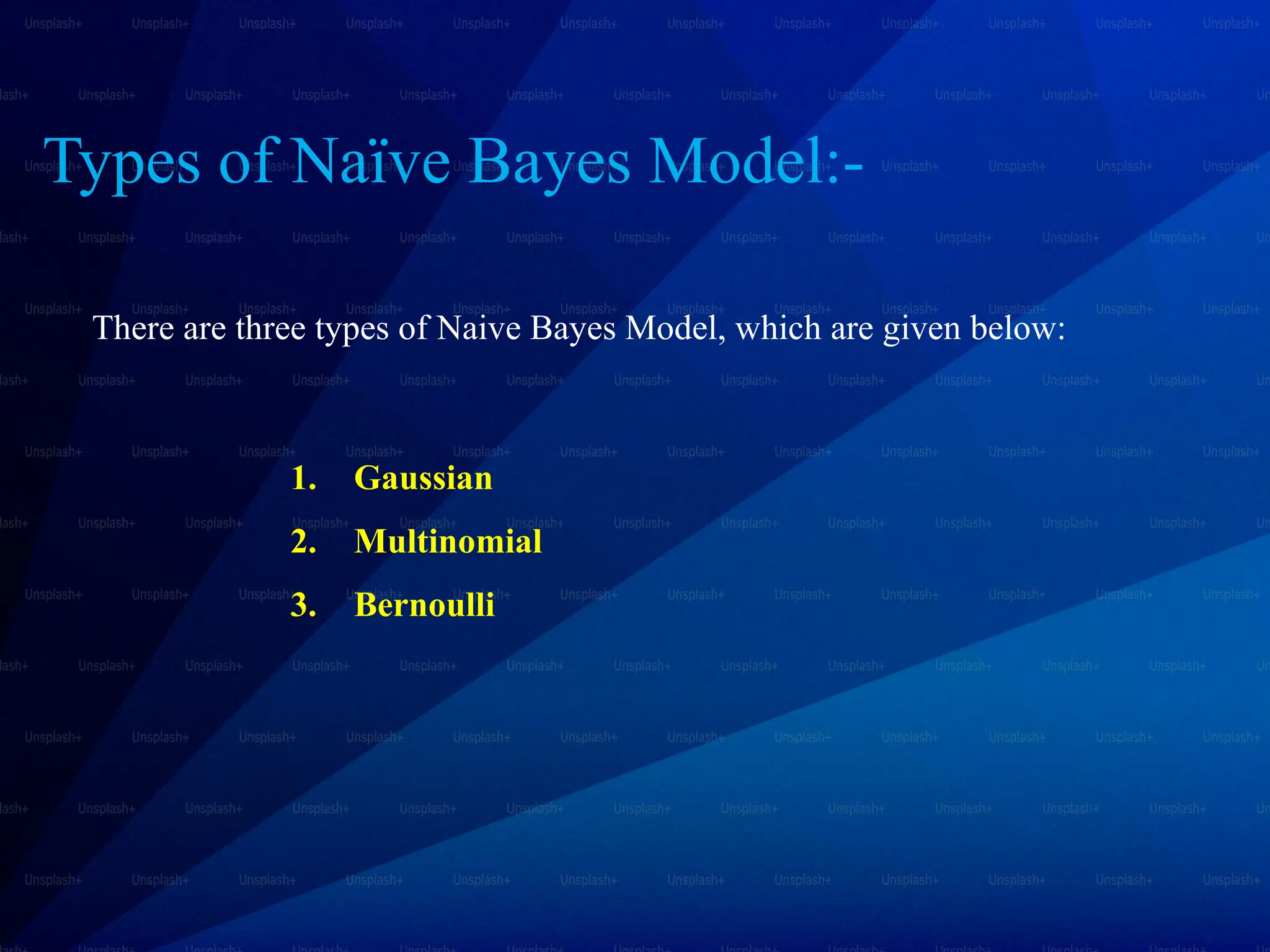
Types of Naïve Bayes Model:-
There are three types of Naive Bayes Model, which are given below:
1. Gaussian
2. Multinomial
3. Bernoulli
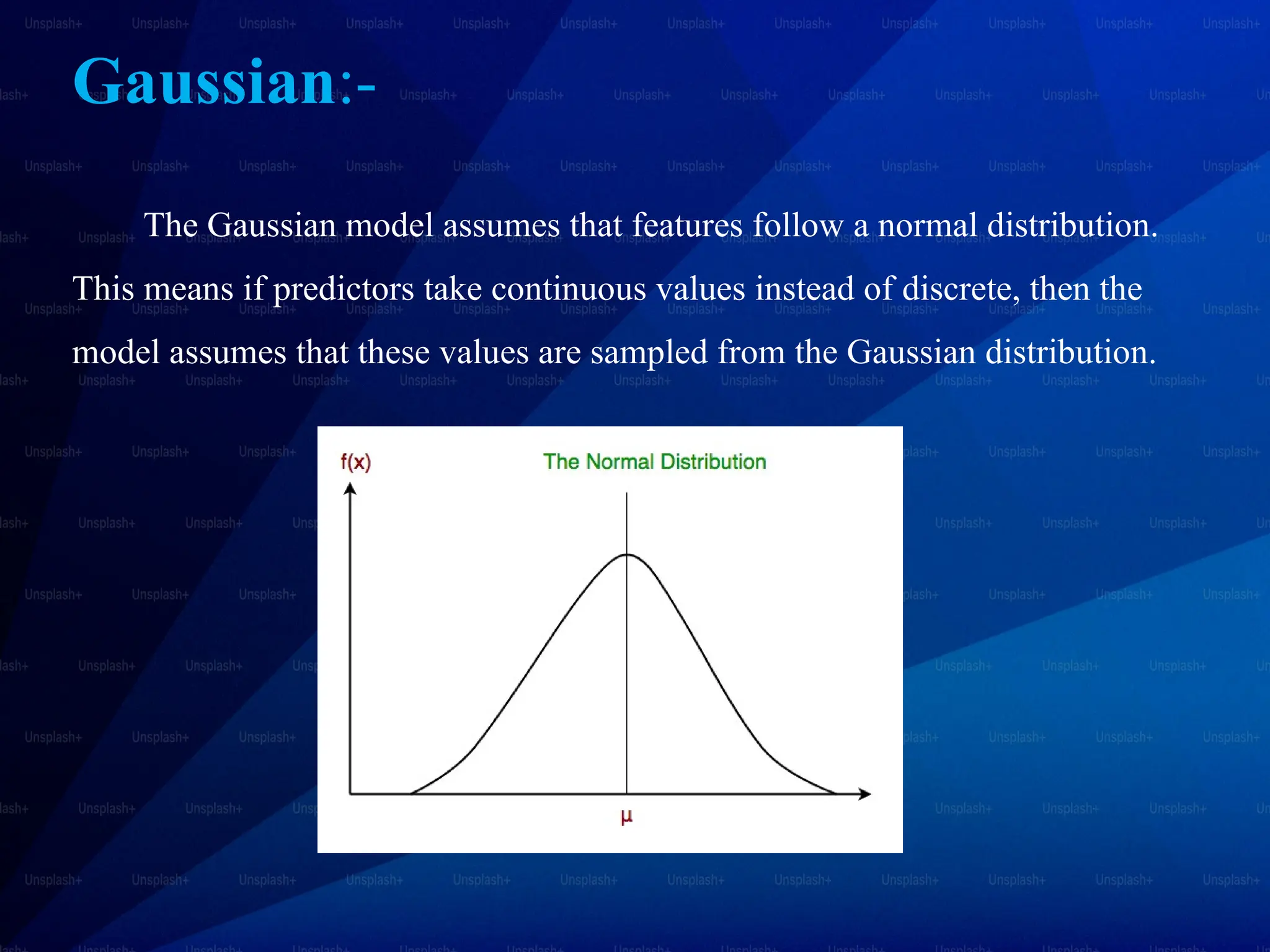
Gaussian:-
The Gaussian model assumes that features follow a normal distribution.
This means if predictors take continuous values instead of discrete, then the
model assumes that these values are sampled from the Gaussian distribution.
Multinomial:-
The Multinomial Naïve Bayes classifier is used when the data is
multinomial distributed. It is primarily used for document classification
problems, it means a particular document belongs to which category such
as Sports, Politics, education, etc.
The classifier uses the frequency of words for the predictors.
Bernoulli:-
The Bernoulli classifier works similar to the Multinomial classifier,
but the predictor variables are the independent Booleans variables.
Such as if a particular word is present or not in a document. This model
is also famous for document classification tasks.
Applications of Naive Bayes Classifier:-
1. Spam Email Filtering
2. Text Classification
3. Medical Diagnosis
4. Credit Scoring
5. Weather Prediction
Advantages of Naive Bayes Classifier:-
•Easy to implement and computationally efficient.
•Effective in cases with a large number of features.
•Performs well even with limited training data.
•It performs well in the presence of categorical features.
•For numerical features data is assumed to come from
normal distributions.
Disadvantages of Naive Bayes Classifier:-
•Assumes that features are independent, which may not
always hold in real-world data.
•Can be influenced by irrelevant attributes.
•May assign zero probability to unseen events, leading to
poor generalization.
Thank You

Bayer's Theorem Naive Bayer's classifier

  • 1.
  • 2.
    Real-Life Applications ofBayes’ Theorem:- Bayesian inference is very important and has found application in various activities, including medicine, science, philosophy, engineering, sports, law, etc. Some of the most common applications of Bayes’ Theorem in real life are : • Spam Filtering • Weather Forecasting • DNA Testing • Financial Forecasting • Fault Diagnosis in Engineering • Drug Testing
  • 3.
    Baye’s theorem:- •Bayes’ Theoremis used to determine the conditional probability of an event. • It was named after an English statistician, Thomas Bayes who discovered this formula in 1763. •It is used to find the probability of an event, based on prior knowledge of conditions that might be related to that event. •For example, if we want to find the probability that a white marble drawn at random came from the first bag, given that a white marble has already been drawn, and there are three bags each containing some white and black marbles, then we can use Bayes’ Theorem.
  • 5.
    P ( A| B ) = P ( B | A ) . P ( A ) P ( B ) where, A,B = Events. P(A|B) = Probability of A given B is true. P(B|A) = Probability of B given A is true. P(A),P(B) = independent probabilities of A and B. FORMULA:-
  • 6.
    Naive Bayes Classifier:- •NaiveBayes algorithm is a supervised learning algorithm, which is based on Bayes theorem and used for solving classification problems. •It is mainly used in text classification that includes a high-dimensional training dataset. •Naive Bayes Classifier is one of the simple and most effective classification algorithms which helps in building the fast machine learning models that can make quick predictions. •It is a probabilistic classifier, which means it predicts on the basis of the probability of an object. •Some popular examples of Naive Bayes Algorithm are spam filtration, sentimental analysis, and classifying articles.
  • 7.
    Why is itcalled Naive Bayes? •The Naive Bayes algorithm is comprised of two words Naive and Bayes, which can be described as: •Naive: It is called Naive because it assumes that the occurrence of a certain feature is independent of the occurrence of other features. Such as if the fruit is identified on the bases of color, shape, and taste, then red, spherical, and sweet fruit is recognized as an apple. Hence each feature individually contributes to identify that it is an apple without depending on each other. •Bayes: It is called Bayes because it depends on the principle of Bayes Theroem.
  • 8.
    Working of NaiveBayes’ Classifier:- •Working of Naive Bayes’ Classifier can be understood with the help of the below example: •Suppose we have a dataset of Weather conditions and corresponding target variable “Play”. So using this dataset we need to decide that whether we should play or not on a particular day according to the weather conditions. 1. Convert the given dataset into frequency tables. 2. Generate Likelihood table by finding the probabilities of given features. 3. Now, use Bayes theorem to calculate the posterior probability. • Problem: If the whether is sunny, then the player should play or not? • Solution: To solve this, first consider the below dataset.
  • 9.
    Outlook Play 0 RainyYes 1 Sunny Yes 2 Overcast Yes 3 Overcast Yes 4 Sunny No 5 Rainy Yes 6 Sunny Yes 7 Overcast Yes 8 Rainy No 9 Sunny No 10 Sunny Yes 11 Rainy No 12 Overcast Yes 13 Overcast Yes
  • 10.
    Whether Yes No Overcast5 0 Rainy 2 2 Sunny 3 2 Total 10 5 Frequency table for the whether conditions:
  • 11.
    Likelihood table whetherconditions: Whether No Yes Overcast 0 5 5/14=0.35 Rainy 2 2 4/14=0.29 Sunny 2 3 5/14=0.35 All 4/14=0.29 10/14=0.71
  • 12.
    Applying Baye’s Theorem:- p(yes|sunny)=p(sunny|yes)*p(yes)/p(sunny) p(sunny|yes)=3/10=0.3 p(sunny)=0.35 p(yes)=0.71 Sop(yes|sunny)=0.3*0.71/0.35=0.60 p(no|sunny)=p(sunny|no)*p(no)/(sunny) p(sunny|no)=2/4=.0.5 p(no)=0.29 p(sunny)=0.35 So p(no|sunny)=0.5*0.29/0.35=0.41 So as we can see from the above calculation that P(yes| sunny)>P(no|sunny)
  • 13.
    Types of NaïveBayes Model:- There are three types of Naive Bayes Model, which are given below: 1. Gaussian 2. Multinomial 3. Bernoulli
  • 14.
    Gaussian:- The Gaussian modelassumes that features follow a normal distribution. This means if predictors take continuous values instead of discrete, then the model assumes that these values are sampled from the Gaussian distribution.
  • 15.
    Multinomial:- The Multinomial NaïveBayes classifier is used when the data is multinomial distributed. It is primarily used for document classification problems, it means a particular document belongs to which category such as Sports, Politics, education, etc. The classifier uses the frequency of words for the predictors. Bernoulli:- The Bernoulli classifier works similar to the Multinomial classifier, but the predictor variables are the independent Booleans variables. Such as if a particular word is present or not in a document. This model is also famous for document classification tasks.
  • 16.
    Applications of NaiveBayes Classifier:- 1. Spam Email Filtering 2. Text Classification 3. Medical Diagnosis 4. Credit Scoring 5. Weather Prediction
  • 17.
    Advantages of NaiveBayes Classifier:- •Easy to implement and computationally efficient. •Effective in cases with a large number of features. •Performs well even with limited training data. •It performs well in the presence of categorical features. •For numerical features data is assumed to come from normal distributions.
  • 18.
    Disadvantages of NaiveBayes Classifier:- •Assumes that features are independent, which may not always hold in real-world data. •Can be influenced by irrelevant attributes. •May assign zero probability to unseen events, leading to poor generalization.
  • 19.