Dental Implant Surgery
Stage I & II Procedures
Moustafa El-Ghareeb BDS, MS
Associate Clinical Professor
Oral & Maxillofacial Surgery

This program of instruction is protected by copyright ©. No portion of
this program of instruction may be reproduced, recorded or transferred
by any means electronic, digital, photographic, mechanical etc., or by
any information storage or retrieval system, without prior permission.
Osseointegration
A direct structural
and functional
connection
between ordered,
living bone and
the surface of a
load-carrying
implant
(Brånemark, 1985)

Cortical bone

Cancellous bone

Per-Ingvar Brånemark
Osseointegration
Micromotion at the
bone-implant
interface beyond 150
μm results in fibrous
encapsulation instead
of osseointegration
(Szmukler-Moncler et
al. 1998)
Osseointegration
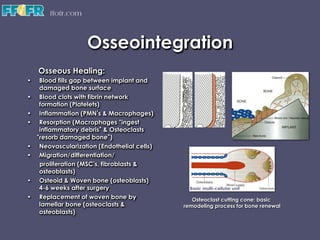
Osseous Healing:
• 
• 
• 
• 

• 
• 

• 
• 

Blood fills gap between implant and
damaged bone surface
Blood clots with fibrin network
formation (Platelets)
Inflammation (PMN s & Macrophages)
Resorption (Macrophages ingest
inflammatory debris & Osteoclasts
resorb damaged bone )
Neovascularization (Endothelial cells)
Migration/differentiation/
proliferation (MSC s, fibroblasts &
osteoblasts)
Osteoid & Woven bone (osteoblasts)
4-6 weeks after surgery
Replacement of woven bone by
lamellar bone (osteoclasts &
osteoblasts)

Basic multi-cellular unit

Osteoclast cutting cone: basic
remodeling process for bone renewal
Osseointegration
Osseous Healing:
Distant Osteogenesis
only

Machined Smooth Surface

Contact & Distant
Osteogenesis

Rough or Enhanced Surface
Improves Cell Attachment
Osseointegration
Enhanced Surfaces:
•  Acid etched
•  Sand blasted
Subtractive
•  Titanium oxide
blasted
Additive
•  HA coated
•  Anodized

SLA®

Acid Etched

TiUnite®

TiOblast™
Peri-Implant Soft Tissue
Healing & Biology
•  Bone resorption occurs to
create a proper soft tissue
seal around implants
•  The term biologic width is
used when describing the
soft tissue dimensions around
implants
•  Epithelial cells are attached
by hemidesmosomes & basal
lamina
•  Collagen fibers are oriented
parallel to the implant
surface

CTA
Osseointegration
Original Brånemark Protocol
• 
• 

Implants must be sterile
Made of highly biocompatible
material such as titanium
(covered by a biologically inert
TiO2 layer)
•  Inserted with atraumatic surgical
technique that avoids
overheating of bone
•  Implants must have good initial
stability at the time of placement
•  Implants must not be subjected
to functional forces during initial
healing period
A non-loaded healing period:
1.  Anterior MN: 3 m
2.  Posterior MN: 4 m
3.  Maxilla: 6 m

Submerged & Non-loaded
Traditional Loading
Maxilla: 6 months
Ant MN: 3 months
Post MN: 4 months

Two-Stage

Cover
Screw
Stage 1 Surgery

Healing
Abutment

Stage 2 Surgery

One-Stage

Final
Restoration

Healing
Abutment

Final
Restoration
Surgical Considerations
• 
• 
• 
• 
• 

Informed consent signed
Preoperative ABx
Chlorhexidine mouth rinse
Standard sterile technique
Atraumatic surgical
technique:
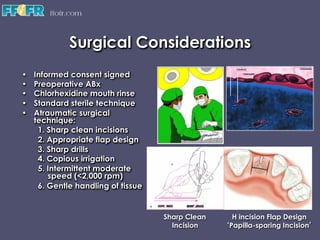
1.  Sharp clean incisions
2.  Appropriate flap design
3.  Sharp drills
4.  Copious irrigation
5.  Intermittent moderate
speed (<2,000 rpm)
6.  Gentle handling of tissue

Sharp Clean
Incision

H incision Flap Design
‘Papilla-sparing Incision’
Surgical Considerations
• 

• 

• 

• 

• 

Excessive surgical trauma
and thermal injury result in
osseonecrosis and fibrous
encapsulation
Temperature over 47 °C for 1
min causes heat necrosis in
bone (Eriksson & Albrektsson
1983)
Heat generation is affected
by speed, load placed on
drill, drill sharpness and
design
Precise osteotomy
preparation by surgeon to
achieve good primary
stability
Good primary closure

47 °C

Precise osteotomy
preparation

Good Primary
Closure
From Larry Peterson,
Contemporary Oral
& Maxillofacial Surgery,
3rd Edition
Surgical Considerations
Implant Design

• 

• 

Primary mechanical
stability is provided by
implant design, bone
quality & precise
osteotomy preparation
The transition from
primary mechanical
stability to biologic
stability takes place
during early wound
healing & is provided by
newly formed bone

Threaded
Implant

Cylinder-Type
Implant
Press-fit

Precise Osteotomy
Preparation
Stage One Surgery
•  When to tap?
•  When to
countersink?

• Coolant (copious irrigation)
• Sharp drills
• Temp over 47 °C for 1 min
causes heat necrosis in bone
(Eriksson & Albrektsson 1983)
• Up & down motion for effective irrigation
• Avoid over-torque (Implant over-tightening
causes bone micro-fractures/bone necrosis)
Stage One Surgery
•  Twist drills are longer than selected
implants
•  Countersink only in presence of thick
cortical layer
•  Excessive countersinking in poor quality
bone may compromise primary stability
•  Tap only in dense bone (most implants
are self tapping i.e. self threading)
•  Placement torque should not exceed 45
Ncm
Anatomical Considerations
5.0 mm

Mental Nerve

IAN
2 mm

3 mm
Mental Nerve exiting without
Anterior Looping

Mental Nerve
Anterior Looping
Anatomical Considerations
Heasman 1988

Rajchel et al 1986

IAN
IAN

Lingual Nerve

Lingual Nerve

Wilson 1989
Anatomical Considerations

Nasal Cavity & Maxillary Sinus
Anatomical Considerations
Alveolar Bone Contours

Labial Concavity

Lingual Concavity
Lingual plate perforation
Lingual Artery: Hemorrhage
Lingual Nerve: Nerve damage
How to Assess Implant Primary
Stability?
1. 
• 
• 
• 

• 

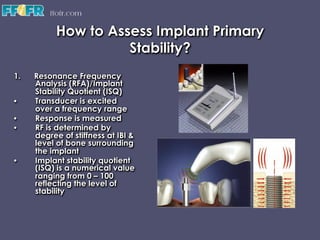
Resonance Frequency
Analysis (RFA)/Implant
Stability Quotient (ISQ)
Transducer is excited
over a frequency range
Response is measured
RF is determined by
degree of stiffness at IBI &
level of bone surrounding
the implant
Implant stability quotient
(ISQ) is a numerical value
ranging from 0 – 100
reflecting the level of
stability
How to Assess Implant Primary
Stability?
2. Implant insertion torque
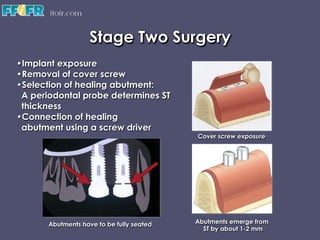
Stage Two Surgery
• Implant exposure
• Removal of cover screw
• Selection of healing abutment:
A periodontal probe determines ST
thickness
• Connection of healing
abutment using a screw driver

Abutments have to be fully seated

Cover screw exposure

Abutments emerge from
ST by about 1-2 mm
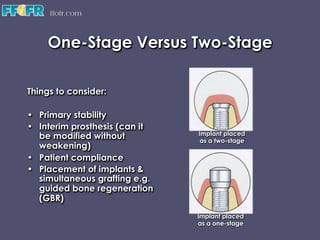
One-Stage Versus Two-Stage
Things to consider:
•  Primary stability
•  Interim prosthesis (can it
be modified without
weakening)
•  Patient compliance
•  Placement of implants &
simultaneous grafting e.g.
guided bone regeneration
(GBR)

Implant placed
as a two-stage

Implant placed
as a one-stage
One-Stage Versus Two-Stage
When to consider one-stage placement?
1.  The implant has good primary stability
2.  The interim prosthesis can be modified to
accommodate the healing abutment
3.  Implant placement is associated with no
grafting or minimal grafting
Extraction & Immediate Implant Placement
Evaluation at the time of C/S
1. 
Smile line (SL)
Ø 

2. 

Gingival Biotype (GB)
Ø 

3. 
4. 
5. 

Avoid in thin scalloped GB as it
is usually associated with thin
labial bone plate

Infection-free site
Inflammation-free site
Check radiographically for
proximity of apex of socket to
vital structures e.g. IAN,
Maxillary sinus &Nasal cavity
Ø 

6. 

Avoid in high SL

Avoid if there is proximity

Look for features that lead to
good primary stability e.g.
short and small roots, wide
inter-radicular bone, small
tooth size (molars vs. bicuspids
vs. incisors)

Thin Scalloped

Thick Blunted
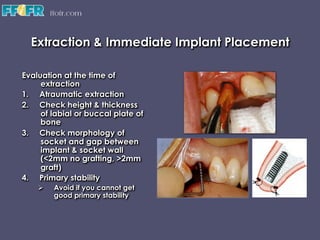
Extraction & Immediate Implant Placement
Evaluation at the time of
extraction
1.  Atraumatic extraction
2.  Check height & thickness
of labial or buccal plate of
bone
3.  Check morphology of
socket and gap between
implant & socket wall
(<2mm no grafting, >2mm
graft)
4.  Primary stability
Ø 

Avoid if you cannot get
good primary stability
Thank you
v Visit ffofr.org for hundreds of additional
lectures on Complete Dentures, Implant
Dentistry, Removable Partial Dentures,
Esthetic Dentistry and Maxillofacial
Prosthetics.
v The lectures are free.
v Our objective is to create the best and most
comprehensive online programs of instruction
in Prosthodontics

Stage i & ii surgery

  • 1.
    Dental Implant Surgery StageI & II Procedures Moustafa El-Ghareeb BDS, MS Associate Clinical Professor Oral & Maxillofacial Surgery This program of instruction is protected by copyright ©. No portion of this program of instruction may be reproduced, recorded or transferred by any means electronic, digital, photographic, mechanical etc., or by any information storage or retrieval system, without prior permission.
  • 2.
    Osseointegration A direct structural andfunctional connection between ordered, living bone and the surface of a load-carrying implant (Brånemark, 1985) Cortical bone Cancellous bone Per-Ingvar Brånemark
  • 3.
    Osseointegration Micromotion at the bone-implant interfacebeyond 150 μm results in fibrous encapsulation instead of osseointegration (Szmukler-Moncler et al. 1998)
  • 4.
    Osseointegration Osseous Healing: •  •  •  •  •  •  •  •  Blood fillsgap between implant and damaged bone surface Blood clots with fibrin network formation (Platelets) Inflammation (PMN s & Macrophages) Resorption (Macrophages ingest inflammatory debris & Osteoclasts resorb damaged bone ) Neovascularization (Endothelial cells) Migration/differentiation/ proliferation (MSC s, fibroblasts & osteoblasts) Osteoid & Woven bone (osteoblasts) 4-6 weeks after surgery Replacement of woven bone by lamellar bone (osteoclasts & osteoblasts) Basic multi-cellular unit Osteoclast cutting cone: basic remodeling process for bone renewal
  • 5.
    Osseointegration Osseous Healing: Distant Osteogenesis only MachinedSmooth Surface Contact & Distant Osteogenesis Rough or Enhanced Surface Improves Cell Attachment
  • 6.
    Osseointegration Enhanced Surfaces: •  Acidetched •  Sand blasted Subtractive •  Titanium oxide blasted Additive •  HA coated •  Anodized SLA® Acid Etched TiUnite® TiOblast™
  • 7.
    Peri-Implant Soft Tissue Healing& Biology •  Bone resorption occurs to create a proper soft tissue seal around implants •  The term biologic width is used when describing the soft tissue dimensions around implants •  Epithelial cells are attached by hemidesmosomes & basal lamina •  Collagen fibers are oriented parallel to the implant surface CTA
  • 8.
    Osseointegration Original Brånemark Protocol •  •  Implantsmust be sterile Made of highly biocompatible material such as titanium (covered by a biologically inert TiO2 layer) •  Inserted with atraumatic surgical technique that avoids overheating of bone •  Implants must have good initial stability at the time of placement •  Implants must not be subjected to functional forces during initial healing period A non-loaded healing period: 1.  Anterior MN: 3 m 2.  Posterior MN: 4 m 3.  Maxilla: 6 m Submerged & Non-loaded
  • 9.
    Traditional Loading Maxilla: 6months Ant MN: 3 months Post MN: 4 months Two-Stage Cover Screw Stage 1 Surgery Healing Abutment Stage 2 Surgery One-Stage Final Restoration Healing Abutment Final Restoration
  • 10.
    Surgical Considerations •  •  •  •  •  Informed consentsigned Preoperative ABx Chlorhexidine mouth rinse Standard sterile technique Atraumatic surgical technique: 1.  Sharp clean incisions 2.  Appropriate flap design 3.  Sharp drills 4.  Copious irrigation 5.  Intermittent moderate speed (<2,000 rpm) 6.  Gentle handling of tissue Sharp Clean Incision H incision Flap Design ‘Papilla-sparing Incision’
  • 11.
    Surgical Considerations •  •  •  •  •  Excessive surgicaltrauma and thermal injury result in osseonecrosis and fibrous encapsulation Temperature over 47 °C for 1 min causes heat necrosis in bone (Eriksson & Albrektsson 1983) Heat generation is affected by speed, load placed on drill, drill sharpness and design Precise osteotomy preparation by surgeon to achieve good primary stability Good primary closure 47 °C Precise osteotomy preparation Good Primary Closure From Larry Peterson, Contemporary Oral & Maxillofacial Surgery, 3rd Edition
  • 12.
    Surgical Considerations Implant Design •  •  Primarymechanical stability is provided by implant design, bone quality & precise osteotomy preparation The transition from primary mechanical stability to biologic stability takes place during early wound healing & is provided by newly formed bone Threaded Implant Cylinder-Type Implant Press-fit Precise Osteotomy Preparation
  • 13.
    Stage One Surgery • When to tap? •  When to countersink? • Coolant (copious irrigation) • Sharp drills • Temp over 47 °C for 1 min causes heat necrosis in bone (Eriksson & Albrektsson 1983) • Up & down motion for effective irrigation • Avoid over-torque (Implant over-tightening causes bone micro-fractures/bone necrosis)
  • 14.
    Stage One Surgery • Twist drills are longer than selected implants •  Countersink only in presence of thick cortical layer •  Excessive countersinking in poor quality bone may compromise primary stability •  Tap only in dense bone (most implants are self tapping i.e. self threading) •  Placement torque should not exceed 45 Ncm
  • 15.
    Anatomical Considerations 5.0 mm MentalNerve IAN 2 mm 3 mm Mental Nerve exiting without Anterior Looping Mental Nerve Anterior Looping
  • 16.
    Anatomical Considerations Heasman 1988 Rajchelet al 1986 IAN IAN Lingual Nerve Lingual Nerve Wilson 1989
  • 17.
  • 18.
    Anatomical Considerations Alveolar BoneContours Labial Concavity Lingual Concavity Lingual plate perforation Lingual Artery: Hemorrhage Lingual Nerve: Nerve damage
  • 19.
    How to AssessImplant Primary Stability? 1.  •  •  •  •  Resonance Frequency Analysis (RFA)/Implant Stability Quotient (ISQ) Transducer is excited over a frequency range Response is measured RF is determined by degree of stiffness at IBI & level of bone surrounding the implant Implant stability quotient (ISQ) is a numerical value ranging from 0 – 100 reflecting the level of stability
  • 20.
    How to AssessImplant Primary Stability? 2. Implant insertion torque
  • 21.
    Stage Two Surgery • Implantexposure • Removal of cover screw • Selection of healing abutment: A periodontal probe determines ST thickness • Connection of healing abutment using a screw driver Abutments have to be fully seated Cover screw exposure Abutments emerge from ST by about 1-2 mm
  • 22.
    One-Stage Versus Two-Stage Thingsto consider: •  Primary stability •  Interim prosthesis (can it be modified without weakening) •  Patient compliance •  Placement of implants & simultaneous grafting e.g. guided bone regeneration (GBR) Implant placed as a two-stage Implant placed as a one-stage
  • 23.
    One-Stage Versus Two-Stage Whento consider one-stage placement? 1.  The implant has good primary stability 2.  The interim prosthesis can be modified to accommodate the healing abutment 3.  Implant placement is associated with no grafting or minimal grafting
  • 24.
    Extraction & ImmediateImplant Placement Evaluation at the time of C/S 1.  Smile line (SL) Ø  2.  Gingival Biotype (GB) Ø  3.  4.  5.  Avoid in thin scalloped GB as it is usually associated with thin labial bone plate Infection-free site Inflammation-free site Check radiographically for proximity of apex of socket to vital structures e.g. IAN, Maxillary sinus &Nasal cavity Ø  6.  Avoid in high SL Avoid if there is proximity Look for features that lead to good primary stability e.g. short and small roots, wide inter-radicular bone, small tooth size (molars vs. bicuspids vs. incisors) Thin Scalloped Thick Blunted
  • 25.
    Extraction & ImmediateImplant Placement Evaluation at the time of extraction 1.  Atraumatic extraction 2.  Check height & thickness of labial or buccal plate of bone 3.  Check morphology of socket and gap between implant & socket wall (<2mm no grafting, >2mm graft) 4.  Primary stability Ø  Avoid if you cannot get good primary stability
  • 26.
  • 27.
    v Visit ffofr.org forhundreds of additional lectures on Complete Dentures, Implant Dentistry, Removable Partial Dentures, Esthetic Dentistry and Maxillofacial Prosthetics. v The lectures are free. v Our objective is to create the best and most comprehensive online programs of instruction in Prosthodontics