ICDL MODULE 1:
Computer Essentials
http://www.icdl.org
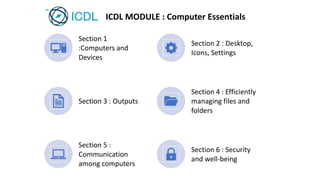
ICDL MODULE : Computer Essentials
Section 1
:Computers and
Devices
Section 2 : Desktop,
Icons, Settings
Section 3 : Outputs
Section 4 : Efficiently
managing files and
folders
Section 5 :
Communication
among computers
Section 6 : Security
and well-being
ICDL MODULE 1: Computer Essentials
http://www.icdlasia.org
Section 1 :Computers and Devices
What is ICT?
The set of tools used to store, transmit and use information is commonly described using the term
ICT, i.e.
Information and Communication Technology. It deals with the possibility of managing, processing
and representing
information thanks to the help of computers and all types of technologies connected to them.
ICDL MODULE 1: Computer Essentials
Section 1 :Computers and Devices
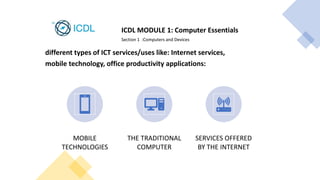
different types of ICT services/uses like: Internet services,
mobile technology, office productivity applications:
MOBILE
TECHNOLOGIES
THE TRADITIONAL
COMPUTER
SERVICES OFFERED
BY THE INTERNET
ICDL MODULE 1: Computer Essentials
http://www.icdlasia.org
Section 1 :Computers and Devices
Internet Services for Consumers :
Many businesses use computers to manage their employees’ records, as
well as for accounting and payroll functions.
Insurance companies use computers to process claims. In this way, more
than 95 per cent of claims are resolved automatically.
Governments use computers to analyze census information and keep track
of public records.
Hospitals use computers to diagnose, monitor and treat patients.
Schools and universities use computers to keep track of student
registrations and academic records.
ICDL MODULE 1: Computer Essentials
http://www.icdlasia.org
Section 1 :Computers and Devices
E-commerce:
This refers to the buying and selling of products through an electronic system,
such as the internet. Not all aspects of e-commerce are necessarily electronic, for
example, after a customer makes a purchase, their item is shipped by post. E-
Commerce is used by all types of businesses to sell all types of products,
including clothing, toys, computers, electronic equipment, airline tickets, food,
jewelry, books, and medicine.
ICDL MODULE 1: Computer Essentials
Section 1 :Computers and Devices
E-banking:
This is the system that enables financial
institutions to provide services to their customers
through the internet orother electronic media,
such as mobile phones, which may also be called
mobile banking (m-banking).
E-Banking enables customers to perform
a range of financial transactions from
any location where there is access to
anappropriate network.
Typically, these transactions include
transferring funds between accounts,
obtaining account balances and transaction
summaries, making account payments,
ordering cheque books, setting up standing
orders and receiving notification of account
transactions via SMS.
As e-banking technology becomes more
advanced, the types of transactions that
a bank can provide to its customers will
become more sophisticated and give
greater flexibility and convenience.
ICDL MODULE 1: Computer Essentials
http://www.icdlasia.org
Section 1 :Computers and Devices
E-government:
This is the electronic system that many local and state governments use to provide services
to their citizens.
E-Government enables citizens to register for access to public records, such as census
information, government budgets, specific articles of legislation, etc. With e-government, it
is possible to perform any number of functions related to government, such as file income
tax returns, register to vote, change and update personal information (such as a postal
address), apply for government benefits (like grants or scholarships), renew a driver’s
license, and request and submit forms.
ICDL MODULE 1: Computer Essentials
http://www.icdlasia.org
Section 1 :Computers and Devices
E-learning:
This refers to the system of education that schools – typically third-level institutions such as
universities – provide
to registered users. E-Learning benefits its users through flexibility as there is no need for
learners to go to a physical
classroom. It is quite common for people to take e-learning courses from institutions in other
countries.
Teleworking:
With the development of better telecommunications and better security software, many
people now work from
home. This is called teleworking and it is fast becoming a popular option with many
organizations
ICDL MODULE 1: Computer Essentials
http://www.icdlasia.org
Section 1 :Computers and Devices
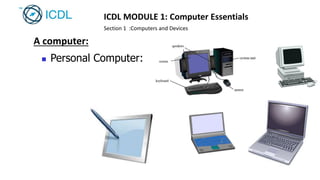
A computer:
 Personal Computer:
ICDL MODULE 1: Computer Essentials
http://www.icdlasia.org
Section 1 :Computers and Devices
Processing
 Carried out by CPU (Central Processing Unit)
 Calculations – addition, multiplication ...
 Logical – Program control, “If… then…”
 Control of memory, storage and
peripheral devices
 Speed measured in Gigahertz (GHz)
ICDL MODULE 1: Computer Essentials
http://www.icdlasia.org
Section 1 :Computers and Devices
Types of Memory – RAM
Random Access Memory (RAM)
 Temporary
 Programs currently being used
 Data being processed
 Open documents, spreadsheets etc.
 Results etc. saved back to hard disk
ICDL MODULE 1: Computer Essentials
http://www.icdlasia.org
Section 1 :Computers and Devices
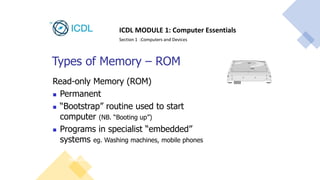
Types of Memory – ROM
Read-only Memory (ROM)
 Permanent
 “Bootstrap” routine used to start
computer (NB. “Booting up”)
 Programs in specialist “embedded”
systems eg. Washing machines, mobile phones
ICDL MODULE 1: Computer Essentials
http://www.icdlasia.org
Section 1 :Computers and Devices
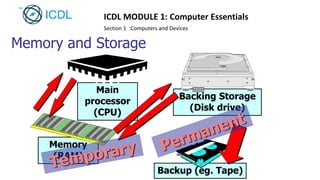
Memory and Storage
Main
processor
(CPU)
Memory
(RAM)
Backing Storage
(Disk drive)
Backup (eg. Tape)
ICDL MODULE 1: Computer Essentials
http://www.icdlasia.org
Section 1 :Computers and Devices
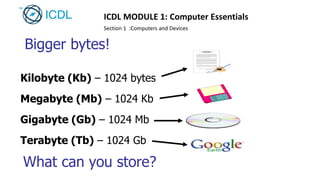
Bigger bytes!
Kilobyte (Kb) – 1024 bytes
Megabyte (Mb) – 1024 Kb
Gigabyte (Gb) – 1024 Mb
Terabyte (Tb) – 1024 Gb
What can you store?
ICDL MODULE 1: Computer Essentials
http://www.icdlasia.org
Section 1 :Computers and Devices
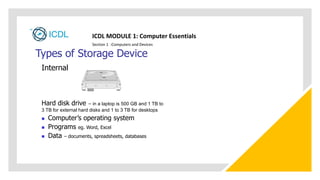
Types of Storage Device
Internal
Hard disk drive – in a laptop is 500 GB and 1 TB to
3 TB for external hard disks and 1 to 3 TB for desktops
 Computer’s operating system
 Programs eg. Word, Excel
 Data – documents, spreadsheets, databases
ICDL MODULE 1: Computer Essentials
http://www.icdlasia.org
Section 1 :Computers and Devices
Types of Storage Device
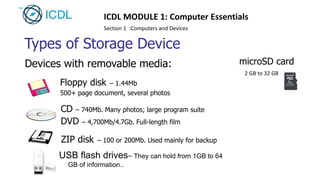
Devices with removable media:
Floppy disk – 1.44Mb
500+ page document, several photos
CD – 740Mb. Many photos; large program suite
DVD – 4,700Mb/4.7Gb. Full-length film
ZIP disk – 100 or 200Mb. Used mainly for backup
USB flash drives– They can hold from 1GB to 64
GB of information..
microSD card
2 GB to 32 GB
ICDL MODULE 1: Computer Essentials
http://www.icdlasia.org
Section 1 :Computers and Devices
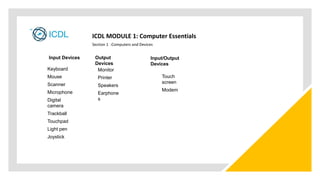
Input Devices
Keyboard
Mouse
Scanner
Microphone
Digital
camera
Trackball
Touchpad
Light pen
Joystick
Output
Devices
Monitor
Printer
Speakers
Earphone
s
Input/Output
Devices
Touch
screen
Modem
ICDL MODULE 1: Computer Essentials
http://www.icdlasia.org
Section 1 :Computers and Devices
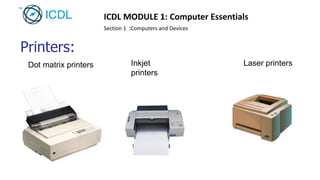
Printers:
Dot matrix printers Inkjet
printers
Laser printers
ICDL MODULE 1: Computer Essentials
http://www.icdlasia.org
Section 1 :Computers and Devices
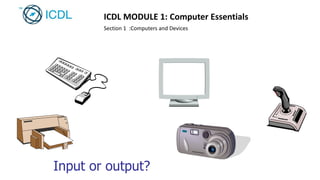
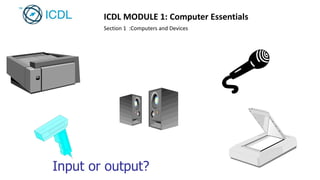
Input or output?
ICDL MODULE 1: Computer Essentials
http://www.icdlasia.org
Section 1 :Computers and Devices
Input or output?
ICDL MODULE 1: Computer Essentials
http://www.icdlasia.org
Section 1 :Computers and Devices
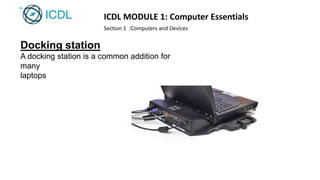
Docking station
A docking station is a common addition for
many
laptops
ICDL MODULE 1: Computer Essentials
http://www.icdlasia.org
Section 1 :Computers and Devices
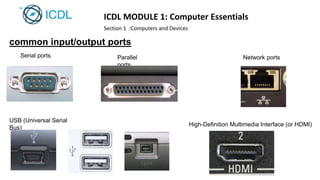
common input/output ports
Serial ports Parallel
ports
Network ports
USB (Universal Serial
Bus)
High-Definition Multimedia Interface (or HDMI)
ICDL MODULE 1: Computer Essentials
http://www.icdlasia.org
Section 1 :Computers and Devices
Types of programs
An operating system, such as Windows,
Common examples of operating systems are:
● Microsoft Windows, variants of which, e.g. Windows 7 and Windows 10, are the most common operating systems
in use on PC compatible computers.
● Ubuntu and Fedora, which are Linux-based and run on PC-compatible computers.
● MacOS, which runs on Apple and Intel hardware.
● iOS, which runs on many hand-held devices, such as Apple iPhones and iPads.
● Android, which runs on many hand-held devices, such as Samsung smartphones and tablets
ICDL MODULE 1: Computer Essentials
http://www.icdlasia.org
Section 1 :Computers and Devices
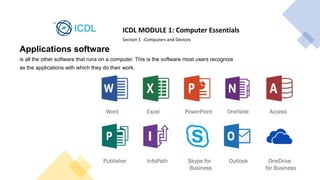
Applications software
is all the other software that runs on a computer. This is the software most users recognize
as the applications with which they do their work.
ICDL MODULE 1: Computer Essentials
http://www.icdlasia.org
Section 1 :Computers and Devices
ICDL MODULE 1: Computer Essentials
http://www.icdlasia.org
Section 1 :Computers and Devices

Computer Essentials - Part 1 (IT Concepts).pptx

  • 1.
    ICDL MODULE 1: ComputerEssentials http://www.icdl.org
  • 2.
    ICDL MODULE :Computer Essentials Section 1 :Computers and Devices Section 2 : Desktop, Icons, Settings Section 3 : Outputs Section 4 : Efficiently managing files and folders Section 5 : Communication among computers Section 6 : Security and well-being
  • 3.
    ICDL MODULE 1:Computer Essentials http://www.icdlasia.org Section 1 :Computers and Devices What is ICT? The set of tools used to store, transmit and use information is commonly described using the term ICT, i.e. Information and Communication Technology. It deals with the possibility of managing, processing and representing information thanks to the help of computers and all types of technologies connected to them.
  • 4.
    ICDL MODULE 1:Computer Essentials Section 1 :Computers and Devices different types of ICT services/uses like: Internet services, mobile technology, office productivity applications: MOBILE TECHNOLOGIES THE TRADITIONAL COMPUTER SERVICES OFFERED BY THE INTERNET
  • 5.
    ICDL MODULE 1:Computer Essentials http://www.icdlasia.org Section 1 :Computers and Devices Internet Services for Consumers : Many businesses use computers to manage their employees’ records, as well as for accounting and payroll functions. Insurance companies use computers to process claims. In this way, more than 95 per cent of claims are resolved automatically. Governments use computers to analyze census information and keep track of public records. Hospitals use computers to diagnose, monitor and treat patients. Schools and universities use computers to keep track of student registrations and academic records.
  • 6.
    ICDL MODULE 1:Computer Essentials http://www.icdlasia.org Section 1 :Computers and Devices E-commerce: This refers to the buying and selling of products through an electronic system, such as the internet. Not all aspects of e-commerce are necessarily electronic, for example, after a customer makes a purchase, their item is shipped by post. E- Commerce is used by all types of businesses to sell all types of products, including clothing, toys, computers, electronic equipment, airline tickets, food, jewelry, books, and medicine.
  • 7.
    ICDL MODULE 1:Computer Essentials Section 1 :Computers and Devices E-banking: This is the system that enables financial institutions to provide services to their customers through the internet orother electronic media, such as mobile phones, which may also be called mobile banking (m-banking). E-Banking enables customers to perform a range of financial transactions from any location where there is access to anappropriate network. Typically, these transactions include transferring funds between accounts, obtaining account balances and transaction summaries, making account payments, ordering cheque books, setting up standing orders and receiving notification of account transactions via SMS. As e-banking technology becomes more advanced, the types of transactions that a bank can provide to its customers will become more sophisticated and give greater flexibility and convenience.
  • 8.
    ICDL MODULE 1:Computer Essentials http://www.icdlasia.org Section 1 :Computers and Devices E-government: This is the electronic system that many local and state governments use to provide services to their citizens. E-Government enables citizens to register for access to public records, such as census information, government budgets, specific articles of legislation, etc. With e-government, it is possible to perform any number of functions related to government, such as file income tax returns, register to vote, change and update personal information (such as a postal address), apply for government benefits (like grants or scholarships), renew a driver’s license, and request and submit forms.
  • 9.
    ICDL MODULE 1:Computer Essentials http://www.icdlasia.org Section 1 :Computers and Devices E-learning: This refers to the system of education that schools – typically third-level institutions such as universities – provide to registered users. E-Learning benefits its users through flexibility as there is no need for learners to go to a physical classroom. It is quite common for people to take e-learning courses from institutions in other countries. Teleworking: With the development of better telecommunications and better security software, many people now work from home. This is called teleworking and it is fast becoming a popular option with many organizations
  • 10.
    ICDL MODULE 1:Computer Essentials http://www.icdlasia.org Section 1 :Computers and Devices A computer:  Personal Computer:
  • 11.
    ICDL MODULE 1:Computer Essentials http://www.icdlasia.org Section 1 :Computers and Devices Processing  Carried out by CPU (Central Processing Unit)  Calculations – addition, multiplication ...  Logical – Program control, “If… then…”  Control of memory, storage and peripheral devices  Speed measured in Gigahertz (GHz)
  • 12.
    ICDL MODULE 1:Computer Essentials http://www.icdlasia.org Section 1 :Computers and Devices Types of Memory – RAM Random Access Memory (RAM)  Temporary  Programs currently being used  Data being processed  Open documents, spreadsheets etc.  Results etc. saved back to hard disk
  • 13.
    ICDL MODULE 1:Computer Essentials http://www.icdlasia.org Section 1 :Computers and Devices Types of Memory – ROM Read-only Memory (ROM)  Permanent  “Bootstrap” routine used to start computer (NB. “Booting up”)  Programs in specialist “embedded” systems eg. Washing machines, mobile phones
  • 14.
    ICDL MODULE 1:Computer Essentials http://www.icdlasia.org Section 1 :Computers and Devices Memory and Storage Main processor (CPU) Memory (RAM) Backing Storage (Disk drive) Backup (eg. Tape)
  • 15.
    ICDL MODULE 1:Computer Essentials http://www.icdlasia.org Section 1 :Computers and Devices Bigger bytes! Kilobyte (Kb) – 1024 bytes Megabyte (Mb) – 1024 Kb Gigabyte (Gb) – 1024 Mb Terabyte (Tb) – 1024 Gb What can you store?
  • 16.
    ICDL MODULE 1:Computer Essentials http://www.icdlasia.org Section 1 :Computers and Devices Types of Storage Device Internal Hard disk drive – in a laptop is 500 GB and 1 TB to 3 TB for external hard disks and 1 to 3 TB for desktops  Computer’s operating system  Programs eg. Word, Excel  Data – documents, spreadsheets, databases
  • 17.
    ICDL MODULE 1:Computer Essentials http://www.icdlasia.org Section 1 :Computers and Devices Types of Storage Device Devices with removable media: Floppy disk – 1.44Mb 500+ page document, several photos CD – 740Mb. Many photos; large program suite DVD – 4,700Mb/4.7Gb. Full-length film ZIP disk – 100 or 200Mb. Used mainly for backup USB flash drives– They can hold from 1GB to 64 GB of information.. microSD card 2 GB to 32 GB
  • 18.
    ICDL MODULE 1:Computer Essentials http://www.icdlasia.org Section 1 :Computers and Devices Input Devices Keyboard Mouse Scanner Microphone Digital camera Trackball Touchpad Light pen Joystick Output Devices Monitor Printer Speakers Earphone s Input/Output Devices Touch screen Modem
  • 19.
    ICDL MODULE 1:Computer Essentials http://www.icdlasia.org Section 1 :Computers and Devices Printers: Dot matrix printers Inkjet printers Laser printers
  • 20.
    ICDL MODULE 1:Computer Essentials http://www.icdlasia.org Section 1 :Computers and Devices Input or output?
  • 21.
    ICDL MODULE 1:Computer Essentials http://www.icdlasia.org Section 1 :Computers and Devices Input or output?
  • 22.
    ICDL MODULE 1:Computer Essentials http://www.icdlasia.org Section 1 :Computers and Devices Docking station A docking station is a common addition for many laptops
  • 23.
    ICDL MODULE 1:Computer Essentials http://www.icdlasia.org Section 1 :Computers and Devices common input/output ports Serial ports Parallel ports Network ports USB (Universal Serial Bus) High-Definition Multimedia Interface (or HDMI)
  • 24.
    ICDL MODULE 1:Computer Essentials http://www.icdlasia.org Section 1 :Computers and Devices Types of programs An operating system, such as Windows, Common examples of operating systems are: ● Microsoft Windows, variants of which, e.g. Windows 7 and Windows 10, are the most common operating systems in use on PC compatible computers. ● Ubuntu and Fedora, which are Linux-based and run on PC-compatible computers. ● MacOS, which runs on Apple and Intel hardware. ● iOS, which runs on many hand-held devices, such as Apple iPhones and iPads. ● Android, which runs on many hand-held devices, such as Samsung smartphones and tablets
  • 25.
    ICDL MODULE 1:Computer Essentials http://www.icdlasia.org Section 1 :Computers and Devices Applications software is all the other software that runs on a computer. This is the software most users recognize as the applications with which they do their work.
  • 26.
    ICDL MODULE 1:Computer Essentials http://www.icdlasia.org Section 1 :Computers and Devices
  • 27.
    ICDL MODULE 1:Computer Essentials http://www.icdlasia.org Section 1 :Computers and Devices