National Conference on Recent
Progress and Developments in
Pharmaceutical Sciences
DFT: Tools and
Protocols for Drug
Design
Rajesh K. Das
Department of Chemistry
University of North Bengal
Parameters
• Computer Aided Drug Design
• Introduction to molecular modeling
• Types of molecular modeling
• Quantum mechanics
o Ab- initio methods
o Semi-empirical methods
o DFT
• Applications
• References
Computer Aided DrugDesign
used to facilitate the design and discovery of new therapeutic
drugs.
 used at any of the following stages of drug discovery –
Hit identification using virtual screening.
QSAR
Objective ofCADD
• TO CHANGE FROM :
• Random screening against
disease assays.
• Natural products
• synthetic chemicals.
• CHANGE TO :
• Rational drug design and testing
• Speed up screening process
• Efficient screening
• De novo design
• Integration of testing into design
process
Introduction to molecular modeling
• Use of all sort of different strategies to
modes and to deduce information of a
system at the atomic level.
• It is possible to conclude that
computational chemistry is the
nucleus of molecular modeling.
• Because it includes the all
methodologies used in computational
chemistry like computation of the energy
of a molecular system, energy
minimization, Monte Carlo methods or
molecular dynamics.
Molecular ModelingStrategies
• Direct Drug Designing
• Designing of lead molecule.
• receptor site geometry is known;
• docking step with energy
minimization can be used to predict
binding strength.
• Indirect drug design
• receptor is unknown
• The indirect drug design is done from
the structure activity relation with a
hypothetical receptor site.
Quantum Mechanics
information about both nuclear position and
distribution.
Arrangement and interaction of electron and
nuclei of a molecular system.
nuclei are arranged in the space
 the corresponding electron are spread all over
the system in a continuous electronic density
 computed by solving the Schrodinger equation
Features
Quantum Mechanics
Applications
• For biomolecules this process can be done
within the Born- oppenheimer approximation
• the purposes of the Hartee-Fock self
consistent field is the appropriate procedure
to compute the electronic density and the
energy of the system
Types Of
Quantum
Mechanics
Ab-Initio
Methods
Hartree-Fock
Approximation
Density
Functional
Theory
Semi-
Imperical
Methods
Hartree-FockApproximation
• The central field approximation means columbic
electron-electron repulsion is taken into account.
• The energies are calculated in units called
Hartrees(1 Hartree= 27.2116 eV).
• Polyelectronic wave function for an atom as the
product of one-electron wave function.
Hartree-FockApproximation
•Advantages-
1. Small system
2. System requiring high
accuracy
• Disadvantages-
1. Computationally expensive
2. time consuming.
Semi-Empirical Method
• Semi-empirical quantum chemistry method is
based on the Hartree-Fock formalism, but make
many approximations.
• They are very important in computational chemistry
for treating large molecules where the full Hartree-
Fock method without the approximations is too
expensive.
.
Semi-Empirical Method
• Advantages-
 Semi-empirical calculations
are very fast compared to Ab
initio and even to Density
functional theory
 Medium sized
systems(hundreds of atoms)
• Disadvantages-
 Low accuracy
Density functionalTheory
• Advantages-
 Small system
 High accuracy
• Disadvantages-
 Difficulties to describe intermolecular
interactions, especially vander Waals
forces, charge transfer excitations;
transition states, global potential
energy surfaces and some other
strongly correlated system
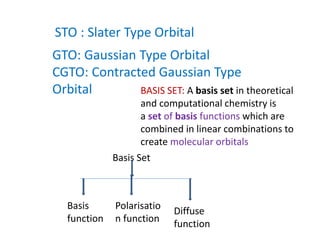
STO : Slater Type Orbital
GTO: Gaussian Type Orbital
CGTO: Contracted Gaussian Type
Orbital BASIS SET: A basis set in theoretical
and computational chemistry is
a set of basis functions which are
combined in linear combinations to
create molecular orbitals
Basis Set
Basis
function
Polarisatio
n function
Diffuse
function
STO Basis Set Development: STO - nG
n= no. of Gaussian primitive function
used to represent one STO
STO-3G
STO-4G
STO-6G
STO-3G* (polarised version of STO-3G)
Pople Basis Set : X-YZg
X=no. of primitive Gaussian basis funcion
Y= linear combination of Y primitive
Gaussian function
Z= linear combination of Z primitive Gaussian
function
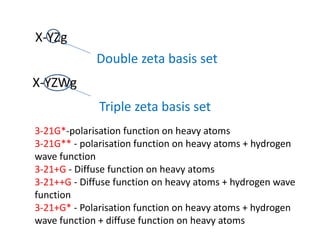
X-YZg
Double zeta basis set
X-YZWg
Triple zeta basis set
3-21G*-polarisation function on heavy atoms
3-21G** - polarisation function on heavy atoms + hydrogen
wave function
3-21+G - Diffuse function on heavy atoms
3-21++G - Diffuse function on heavy atoms + hydrogen wave
function
3-21+G* - Polarisation function on heavy atoms + hydrogen
wave function + diffuse function on heavy atoms
UHF = For open shell molecules, uses different MOs for the
different spinning of electrons.
RHF = For closed shell molecules, uses same MOs twice for the
different spinning of electrons.
B3LYP = The exact energy function is expressed in terms of Kohn-
Sham orbitals rather than the density. It is known as implicit
density functional.
One of the most commonly version is B3LYP (Becke, 3-parameter,
Lee-Yang-Peer.
RB3LYP: opposite spin in the open shell
UB3LYP: unpaired spin in the open shell
Restricted Unrestricted
Output Descriptors
HOMO
LUMO
Dipole Moment
Global Reactivity Descriptors:
Ionisation Potential (I)= EHOMO
Electron Affinity (A) = -ELUMO
Chemical Potential (µ) = (EHOMO+ELUMO)/2
Global hardness (ɳ) = (ELUMO-EHOMO)/2
Global softness (S) = 1/ɳ
Electronegativity (σ) = - µ
Electrophilicity index (ω) = µ2/2ɳ
Fig: Chemical Structure (A), optimized structure using DFT-RB3LYP 6-31(G) of HAM
A
B
Table 1: Calculated energy values (eV) of Hamamelitanin in
different solvents
using DFT-RB3LYP 6-31(G)
Compou
nd
EHOMO
(eV)
ELUMO
(eV)
EHOMO-1
(eV)
ELUMO+1
(eV)
ELUMO –
EHOMO
(eV)
ELUMO+1-
EHOMO-1
(eV)
Etotal (eV)
Gas -155.859 -34.207 -161.708 -21.176 121.652 140.532 -49696.25
Water -159.487 -32.282 -163.263 -25.619 127.205 137.644 -49695.38
DMSO -159.265 -31.394 -160.746 -23.323 127.871 137.423 -49695.68
CHN -159.117 -28.876 -160.153 -20.954 130.241 139.199 -49695.85
The chemical reactivity of the HAM in the various solvents follows the order:
Gas > Water > DMSO > Cyclohexane
Out of the 34 tested compounds 10 models have
the best docked as compared to the standard
drug hamamelitanin.
All compounds docked in the same domain of receptor
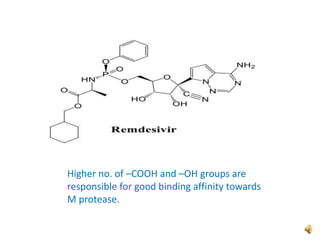
Higher no. of –COOH and –OH groups are
responsible for good binding affinity towards
M protease.
Remdesivir
HAM RA
Plants : Ocimum Sanctum (Tulsi), Zingiber Officinale
(Ginger), Justicial Adhatoda (Vasaka)
Docking of Ligand to the Active site of Receptor
Optimized Inhibitors
HOMO
LUMO
DM
ETOTAL
logP
MV
BBB
PPB
TPSA
Natoms
nON
nOHNH
nrotb
CMC
MDDR
WDI
Rule of five
Drug-
likeness
Drug Score
IC50
(µM)
Molecular
Docking
Optimized
Structure
(Using MD
simulation)
∆G binding
(kcal/mol)
Protein (PDB)
Inhibitors (binding db)
ADME
PreADMET
mol
inspiration
Osiris
Property
Explorer
Functionalisation
QM
Best potential Drugs
?
References
• Practical application of computer aided drug design, By Paul S.
Charifson, marcel dekker INC.
• Chapter 3, molecular modeling techniques, By Swami
Ramanand Teerth Marathwada University.
• Basis of molecular modeling and docking, slide share
• https://www.slideshare.net/ashwinimushunuri96/applications
-of-molecular-modeling
• https://www.slideshare.net/RikeshlalShrestha/molecular-
modelling-75429338
Acknowledgement
 Late Prof. Dr. Asim K. Bothra, Raiganj University to
motivate me to conduct research work in this field.
 High-Performance Computing (HPC) cluster of the
University of North Bengal for the computational
facility
 UGC, New Delhi for start- up grant
https://www.amazon.com/dp/1636481892
https://www.elivapress.com/en/book/book-
1539516993/
DFT Presentation.pptx

DFT Presentation.pptx

  • 1.
    National Conference onRecent Progress and Developments in Pharmaceutical Sciences DFT: Tools and Protocols for Drug Design Rajesh K. Das Department of Chemistry University of North Bengal
  • 2.
    Parameters • Computer AidedDrug Design • Introduction to molecular modeling • Types of molecular modeling • Quantum mechanics o Ab- initio methods o Semi-empirical methods o DFT • Applications • References
  • 3.
    Computer Aided DrugDesign usedto facilitate the design and discovery of new therapeutic drugs.  used at any of the following stages of drug discovery – Hit identification using virtual screening. QSAR
  • 4.
    Objective ofCADD • TOCHANGE FROM : • Random screening against disease assays. • Natural products • synthetic chemicals. • CHANGE TO : • Rational drug design and testing • Speed up screening process • Efficient screening • De novo design • Integration of testing into design process
  • 5.
    Introduction to molecularmodeling • Use of all sort of different strategies to modes and to deduce information of a system at the atomic level. • It is possible to conclude that computational chemistry is the nucleus of molecular modeling. • Because it includes the all methodologies used in computational chemistry like computation of the energy of a molecular system, energy minimization, Monte Carlo methods or molecular dynamics.
  • 6.
    Molecular ModelingStrategies • DirectDrug Designing • Designing of lead molecule. • receptor site geometry is known; • docking step with energy minimization can be used to predict binding strength. • Indirect drug design • receptor is unknown • The indirect drug design is done from the structure activity relation with a hypothetical receptor site.
  • 7.
    Quantum Mechanics information aboutboth nuclear position and distribution. Arrangement and interaction of electron and nuclei of a molecular system. nuclei are arranged in the space  the corresponding electron are spread all over the system in a continuous electronic density  computed by solving the Schrodinger equation Features
  • 9.
    Quantum Mechanics Applications • Forbiomolecules this process can be done within the Born- oppenheimer approximation • the purposes of the Hartee-Fock self consistent field is the appropriate procedure to compute the electronic density and the energy of the system
  • 10.
  • 11.
    Hartree-FockApproximation • The centralfield approximation means columbic electron-electron repulsion is taken into account. • The energies are calculated in units called Hartrees(1 Hartree= 27.2116 eV). • Polyelectronic wave function for an atom as the product of one-electron wave function.
  • 12.
    Hartree-FockApproximation •Advantages- 1. Small system 2.System requiring high accuracy • Disadvantages- 1. Computationally expensive 2. time consuming.
  • 13.
    Semi-Empirical Method • Semi-empiricalquantum chemistry method is based on the Hartree-Fock formalism, but make many approximations. • They are very important in computational chemistry for treating large molecules where the full Hartree- Fock method without the approximations is too expensive. .
  • 14.
    Semi-Empirical Method • Advantages- Semi-empirical calculations are very fast compared to Ab initio and even to Density functional theory  Medium sized systems(hundreds of atoms) • Disadvantages-  Low accuracy
  • 15.
    Density functionalTheory • Advantages- Small system  High accuracy • Disadvantages-  Difficulties to describe intermolecular interactions, especially vander Waals forces, charge transfer excitations; transition states, global potential energy surfaces and some other strongly correlated system
  • 16.
    STO : SlaterType Orbital GTO: Gaussian Type Orbital CGTO: Contracted Gaussian Type Orbital BASIS SET: A basis set in theoretical and computational chemistry is a set of basis functions which are combined in linear combinations to create molecular orbitals Basis Set Basis function Polarisatio n function Diffuse function
  • 17.
    STO Basis SetDevelopment: STO - nG n= no. of Gaussian primitive function used to represent one STO STO-3G STO-4G STO-6G STO-3G* (polarised version of STO-3G) Pople Basis Set : X-YZg X=no. of primitive Gaussian basis funcion Y= linear combination of Y primitive Gaussian function Z= linear combination of Z primitive Gaussian function
  • 18.
    X-YZg Double zeta basisset X-YZWg Triple zeta basis set 3-21G*-polarisation function on heavy atoms 3-21G** - polarisation function on heavy atoms + hydrogen wave function 3-21+G - Diffuse function on heavy atoms 3-21++G - Diffuse function on heavy atoms + hydrogen wave function 3-21+G* - Polarisation function on heavy atoms + hydrogen wave function + diffuse function on heavy atoms
  • 19.
    UHF = Foropen shell molecules, uses different MOs for the different spinning of electrons. RHF = For closed shell molecules, uses same MOs twice for the different spinning of electrons. B3LYP = The exact energy function is expressed in terms of Kohn- Sham orbitals rather than the density. It is known as implicit density functional. One of the most commonly version is B3LYP (Becke, 3-parameter, Lee-Yang-Peer. RB3LYP: opposite spin in the open shell UB3LYP: unpaired spin in the open shell Restricted Unrestricted
  • 21.
    Output Descriptors HOMO LUMO Dipole Moment GlobalReactivity Descriptors: Ionisation Potential (I)= EHOMO Electron Affinity (A) = -ELUMO Chemical Potential (µ) = (EHOMO+ELUMO)/2 Global hardness (ɳ) = (ELUMO-EHOMO)/2 Global softness (S) = 1/ɳ Electronegativity (σ) = - µ Electrophilicity index (ω) = µ2/2ɳ
  • 23.
    Fig: Chemical Structure(A), optimized structure using DFT-RB3LYP 6-31(G) of HAM A B
  • 24.
    Table 1: Calculatedenergy values (eV) of Hamamelitanin in different solvents using DFT-RB3LYP 6-31(G) Compou nd EHOMO (eV) ELUMO (eV) EHOMO-1 (eV) ELUMO+1 (eV) ELUMO – EHOMO (eV) ELUMO+1- EHOMO-1 (eV) Etotal (eV) Gas -155.859 -34.207 -161.708 -21.176 121.652 140.532 -49696.25 Water -159.487 -32.282 -163.263 -25.619 127.205 137.644 -49695.38 DMSO -159.265 -31.394 -160.746 -23.323 127.871 137.423 -49695.68 CHN -159.117 -28.876 -160.153 -20.954 130.241 139.199 -49695.85 The chemical reactivity of the HAM in the various solvents follows the order: Gas > Water > DMSO > Cyclohexane
  • 25.
    Out of the34 tested compounds 10 models have the best docked as compared to the standard drug hamamelitanin.
  • 29.
    All compounds dockedin the same domain of receptor
  • 35.
    Higher no. of–COOH and –OH groups are responsible for good binding affinity towards M protease.
  • 36.
  • 42.
    Plants : OcimumSanctum (Tulsi), Zingiber Officinale (Ginger), Justicial Adhatoda (Vasaka)
  • 43.
    Docking of Ligandto the Active site of Receptor
  • 44.
    Optimized Inhibitors HOMO LUMO DM ETOTAL logP MV BBB PPB TPSA Natoms nON nOHNH nrotb CMC MDDR WDI Rule offive Drug- likeness Drug Score IC50 (µM) Molecular Docking Optimized Structure (Using MD simulation) ∆G binding (kcal/mol) Protein (PDB) Inhibitors (binding db) ADME PreADMET mol inspiration Osiris Property Explorer Functionalisation QM Best potential Drugs ?
  • 45.
    References • Practical applicationof computer aided drug design, By Paul S. Charifson, marcel dekker INC. • Chapter 3, molecular modeling techniques, By Swami Ramanand Teerth Marathwada University. • Basis of molecular modeling and docking, slide share • https://www.slideshare.net/ashwinimushunuri96/applications -of-molecular-modeling • https://www.slideshare.net/RikeshlalShrestha/molecular- modelling-75429338
  • 46.
    Acknowledgement  Late Prof.Dr. Asim K. Bothra, Raiganj University to motivate me to conduct research work in this field.  High-Performance Computing (HPC) cluster of the University of North Bengal for the computational facility  UGC, New Delhi for start- up grant
  • 47.