National Alliance
for Water Innovation
NAWI Materials & Manufacturing Topic Area
Advanced Electrode Materials
Machine Learning Platform for Catalyst Design
Anubhav Jain, Wei Tong, Haotian Wang, Shiqiang (Nick) Zou, Meagan Mauter, Jason Monnell
Duo Wang, Shengcun Ma, Shaoyun Hao, Ao Xie, Zilan Yang, Charlie Merriam
LBNL, Rice University, Auburn University, Stanford University, & EPRI
NAWI Fall Alliance Meeting
Nov 1, 2022
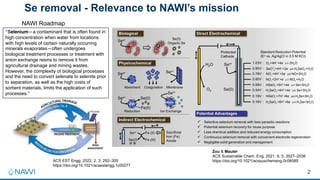
Se removal - Relevance to NAWI’s mission
2
“Selenium—a contaminant that is often found in
high concentration when water from locations
with high levels of certain naturally occurring
minerals evaporates—often undergoes
biological treatment processes or treatment with
anion exchange resins to remove it from
agricultural drainage and mining wastes.
However, the complexity of biological processes
and the need to convert selenate to selenite prior
to separation, as well as the high costs of
sorbent materials, limits the application of such
processes.”
NAWI Roadmap
ACS EST Engg. 2022, 2, 3, 292–305
https://doi.org/10.1021/acsestengg.1c00277
Zou & Mauter
ACS Sustainable Chem. Eng. 2021, 9, 5, 2027–2036
https://doi.org/10.1021/acssuschemeng.0c06585
Prior results
3
Zou & Mauter
ACS Sustainable Chem. Eng. 2021, 9, 5, 2027–2036
https://doi.org/10.1021/acssuschemeng.0c06585
Major challenges to be addressed
1. Improve efficiency and reduce costs
2. Minimize side reactions, in particular in
complex water matrices
3. Scale to prototype reactor
4
Project objectives
[1] DOI: 10.1021acscatal.9b02179
Autonomous
Precise
Resilient
Intensified
Modular
Electrified
Control voltage
Targets a single or a few solutes
Easily adjusted for variable water quality
No need for regeneration;
no brine to dispose
No high-pressure equipment;
no moving parts
Compatible with distributed DC power
• Background: New
advancements in machine
learning, theory, and
automated labs can accelerate
materials development
timelines
Can we apply these
techniques to water treatment?
• Our 3-year outcome:
demonstrate commercially
viable system for Se removal
Singh & Goldsmith ACS Catal. 2020, 10.
Werth et al. ACS ES&T Engg. 2021, 1
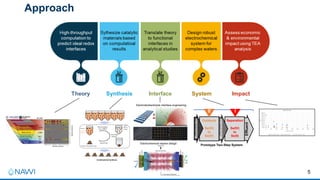
Approach
5
$0.00
$10.00
$20.00
$30.00
$40.00
$50.00
$60.00
$70.00
$80.00
0 100 200 300 400 500 600 700 800 900
$/m
3
Flow in m3/hr
Cost Curve
Normalized CAPEX Normalized OPEX 15-year lifecycle LCOW
6
Overview of computational approach
calculating the
adsorption and
activation energies
for monometallic systems
versus various
adsorbates
generating
linear scaling
relationships
estimating the
TOF and
selectivity from
microkinetic
modelling
plotting the TOF
volcano plot
from the
previous results
evaluating and
screening TOF
for calculated
bimetallic
materials
calculating
adsorption
energies for
bimetallic
materials
[1] DOI: 10.1021/acscatal.9b02179
[1]
[1] BM systems
metal oxides
more…
7
Calculations reproduce experimental trends in
turnover frequency for nitrate reduction
Oxygen binding energy
Nitrogen binding energy
turnover frequencies (TOF)
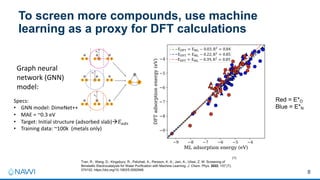
To screen more compounds, use machine
learning as a proxy for DFT calculations
8
Graph neural
network (GNN)
model:
Specs:
• GNN model: DimeNet++
• MAE = ~0.3 eV
• Target: Initial structure (adsorbed slab)à!"#$
• Training data: ~100k (metals only)
Red = E*O
Blue = E*N
(1)
Tran, R.; Wang, D.; Kingsbury, R.; Palizhati, A.; Persson, K. A.; Jain, A.; Ulissi, Z. W. Screening of
Bimetallic Electrocatalysts for Water Purification with Machine Learning. J. Chem. Phys. 2022, 157 (7),
074102. https://doi.org/10.1063/5.0092948.
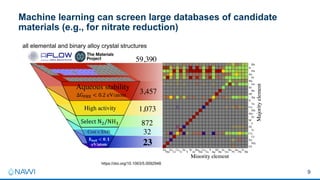
Machine learning can screen large databases of candidate
materials (e.g., for nitrate reduction)
9
all elemental and binary alloy crystal structures
https://doi.org/10.1063/5.0092948
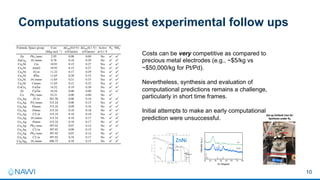
Computations suggest experimental follow ups
10
Costs can be very competitive as compared to
precious metal electrodes (e.g., ~$5/kg vs
~$50,000/kg for Pt/Pd).
Nevertheless, synthesis and evaluation of
computational predictions remains a challenge,
particularly in short time frames.
Initial attempts to make an early computational
prediction were unsuccessful.
ZnNi
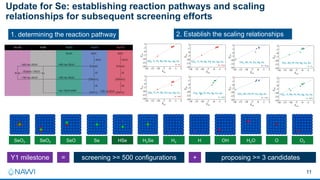
11
Update for Se: establishing reaction pathways and scaling
relationships for subsequent screening efforts
screening >= 500 configurations proposing >= 3 candidates
Y1 milestone +
=
1. determining the reaction pathway
HSe
SeO3 Se H2Se H O
H2O
SeO2 SeO H2 OH O2
2. Establish the scaling relationships
Approach
12
$0.00
$10.00
$20.00
$30.00
$40.00
$50.00
$60.00
$70.00
$80.00
0 100 200 300 400 500 600 700 800 900
$/m
3
Flow in m3/hr
Cost Curve
Normalized CAPEX Normalized OPEX 15-year lifecycle LCOW
Use robots to assist in rapid synthesis of
candidates (Molecular Foundry, LBNL)
13
Reaction station
• Eight 20 mL vials one
time, our current
testing volume is 10
mL
• Heating and shaking
of the reactants can
be applied
Stock solution station
• No shaking/stirring is
available
• 5 spots for stock
solutions, with a
volume of 50 mL for
each stock solution
Four pipettes
W. Tong (LBNL)
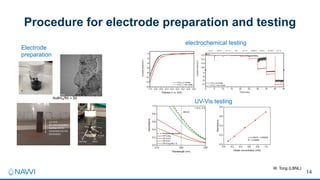
Procedure for electrode preparation and testing
14
1/2 inch
(for electrocatalyst
loading and be
immersed into the
electrolyte)
electrocatalyst slurry
RE
(AgCl/Ag)
CE
(Pt wire)
WE
(Rh/C)
NaBH4/Rh = 30
electrochemical testing
UV-Vis testing
Electrode
preparation
W. Tong (LBNL)
Approach
15
$0.00
$10.00
$20.00
$30.00
$40.00
$50.00
$60.00
$70.00
$80.00
0 100 200 300 400 500 600 700 800 900
$/m
3
Flow in m3/hr
Cost Curve
Normalized CAPEX Normalized OPEX 15-year lifecycle LCOW
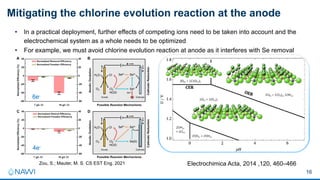
Mitigating the chlorine evolution reaction at the anode
16
• In a practical deployment, further effects of competing ions need to be taken into account and the
electrochemical system as a whole needs to be optimized
• For example, we must avoid chlorine evolution reaction at anode as it interferes with Se removal
Electrochimica Acta, 2014 ,120, 460–466
Zou, S.; Mauter, M. S. CS EST Eng. 2021
6e-
4e-
Suppress CER and enhance OER
17
Doping Sn into RuO2 could
effectively suppress the Faradaic
efficiency RuO2 toward CER and
enhance the selectivity.
Cl- concentration in seawater: 0.5 M.
Electrolyte: 0.1 M KH2PO4
0.5 M NaCl
Reference electrode: saturated
calomel electrode
Counter electrode: carbon rod
H. Wang (Rice)
Approach
18
$0.00
$10.00
$20.00
$30.00
$40.00
$50.00
$60.00
$70.00
$80.00
0 100 200 300 400 500 600 700 800 900
$/m
3
Flow in m3/hr
Cost Curve
Normalized CAPEX Normalized OPEX 15-year lifecycle LCOW
Baseline study on cost effective cathodes materials shows
promising Se(IV) removal performance and energy efficiency
19
Se
50 µm
Working
electrode
Current
density
24-hour removal
performance
Faradaic
efficiency
Reuse/
Reversibility
Au
0.21 mA
cm-2 97% 6.9% Regenerable
Ni
0.14 mA
cm-2 70% 15.9%
Non-regenerable,
dissolution
Graphite
0.14 mA
cm-2 94% 28.0% TBD
N. Zou (Auburn)
20
Summary
• Electrochemical water treatment would achieve many of the A-PRIME goals,
but a realistic system has yet to be developed. This project aims to demonstrate
such a system for Se reduction.
• While our project is in its early stages, we already making headway towards
several technical challenges
• development of computational & experimental screening pipeline
• mitigation of chlorine evolution reaction
• testing of different materials systems for Se removal
• Although the remainder of Y1 is expected to still require more methods
development, in Years 2 & 3 of the project we expect to concentrate more on Se
removal performance with different system materials, conditions, and
configurations
QUESTIONS

Machine Learning for Catalyst Design

  • 1.
    National Alliance for WaterInnovation NAWI Materials & Manufacturing Topic Area Advanced Electrode Materials Machine Learning Platform for Catalyst Design Anubhav Jain, Wei Tong, Haotian Wang, Shiqiang (Nick) Zou, Meagan Mauter, Jason Monnell Duo Wang, Shengcun Ma, Shaoyun Hao, Ao Xie, Zilan Yang, Charlie Merriam LBNL, Rice University, Auburn University, Stanford University, & EPRI NAWI Fall Alliance Meeting Nov 1, 2022
  • 2.
    Se removal -Relevance to NAWI’s mission 2 “Selenium—a contaminant that is often found in high concentration when water from locations with high levels of certain naturally occurring minerals evaporates—often undergoes biological treatment processes or treatment with anion exchange resins to remove it from agricultural drainage and mining wastes. However, the complexity of biological processes and the need to convert selenate to selenite prior to separation, as well as the high costs of sorbent materials, limits the application of such processes.” NAWI Roadmap ACS EST Engg. 2022, 2, 3, 292–305 https://doi.org/10.1021/acsestengg.1c00277 Zou & Mauter ACS Sustainable Chem. Eng. 2021, 9, 5, 2027–2036 https://doi.org/10.1021/acssuschemeng.0c06585
  • 3.
    Prior results 3 Zou &Mauter ACS Sustainable Chem. Eng. 2021, 9, 5, 2027–2036 https://doi.org/10.1021/acssuschemeng.0c06585 Major challenges to be addressed 1. Improve efficiency and reduce costs 2. Minimize side reactions, in particular in complex water matrices 3. Scale to prototype reactor
  • 4.
    4 Project objectives [1] DOI:10.1021acscatal.9b02179 Autonomous Precise Resilient Intensified Modular Electrified Control voltage Targets a single or a few solutes Easily adjusted for variable water quality No need for regeneration; no brine to dispose No high-pressure equipment; no moving parts Compatible with distributed DC power • Background: New advancements in machine learning, theory, and automated labs can accelerate materials development timelines Can we apply these techniques to water treatment? • Our 3-year outcome: demonstrate commercially viable system for Se removal Singh & Goldsmith ACS Catal. 2020, 10. Werth et al. ACS ES&T Engg. 2021, 1
  • 5.
    Approach 5 $0.00 $10.00 $20.00 $30.00 $40.00 $50.00 $60.00 $70.00 $80.00 0 100 200300 400 500 600 700 800 900 $/m 3 Flow in m3/hr Cost Curve Normalized CAPEX Normalized OPEX 15-year lifecycle LCOW
  • 6.
    6 Overview of computationalapproach calculating the adsorption and activation energies for monometallic systems versus various adsorbates generating linear scaling relationships estimating the TOF and selectivity from microkinetic modelling plotting the TOF volcano plot from the previous results evaluating and screening TOF for calculated bimetallic materials calculating adsorption energies for bimetallic materials [1] DOI: 10.1021/acscatal.9b02179 [1] [1] BM systems metal oxides more…
  • 7.
    7 Calculations reproduce experimentaltrends in turnover frequency for nitrate reduction Oxygen binding energy Nitrogen binding energy turnover frequencies (TOF)
  • 8.
    To screen morecompounds, use machine learning as a proxy for DFT calculations 8 Graph neural network (GNN) model: Specs: • GNN model: DimeNet++ • MAE = ~0.3 eV • Target: Initial structure (adsorbed slab)à!"#$ • Training data: ~100k (metals only) Red = E*O Blue = E*N (1) Tran, R.; Wang, D.; Kingsbury, R.; Palizhati, A.; Persson, K. A.; Jain, A.; Ulissi, Z. W. Screening of Bimetallic Electrocatalysts for Water Purification with Machine Learning. J. Chem. Phys. 2022, 157 (7), 074102. https://doi.org/10.1063/5.0092948.
  • 9.
    Machine learning canscreen large databases of candidate materials (e.g., for nitrate reduction) 9 all elemental and binary alloy crystal structures https://doi.org/10.1063/5.0092948
  • 10.
    Computations suggest experimentalfollow ups 10 Costs can be very competitive as compared to precious metal electrodes (e.g., ~$5/kg vs ~$50,000/kg for Pt/Pd). Nevertheless, synthesis and evaluation of computational predictions remains a challenge, particularly in short time frames. Initial attempts to make an early computational prediction were unsuccessful. ZnNi
  • 11.
    11 Update for Se:establishing reaction pathways and scaling relationships for subsequent screening efforts screening >= 500 configurations proposing >= 3 candidates Y1 milestone + = 1. determining the reaction pathway HSe SeO3 Se H2Se H O H2O SeO2 SeO H2 OH O2 2. Establish the scaling relationships
  • 12.
    Approach 12 $0.00 $10.00 $20.00 $30.00 $40.00 $50.00 $60.00 $70.00 $80.00 0 100 200300 400 500 600 700 800 900 $/m 3 Flow in m3/hr Cost Curve Normalized CAPEX Normalized OPEX 15-year lifecycle LCOW
  • 13.
    Use robots toassist in rapid synthesis of candidates (Molecular Foundry, LBNL) 13 Reaction station • Eight 20 mL vials one time, our current testing volume is 10 mL • Heating and shaking of the reactants can be applied Stock solution station • No shaking/stirring is available • 5 spots for stock solutions, with a volume of 50 mL for each stock solution Four pipettes W. Tong (LBNL)
  • 14.
    Procedure for electrodepreparation and testing 14 1/2 inch (for electrocatalyst loading and be immersed into the electrolyte) electrocatalyst slurry RE (AgCl/Ag) CE (Pt wire) WE (Rh/C) NaBH4/Rh = 30 electrochemical testing UV-Vis testing Electrode preparation W. Tong (LBNL)
  • 15.
    Approach 15 $0.00 $10.00 $20.00 $30.00 $40.00 $50.00 $60.00 $70.00 $80.00 0 100 200300 400 500 600 700 800 900 $/m 3 Flow in m3/hr Cost Curve Normalized CAPEX Normalized OPEX 15-year lifecycle LCOW
  • 16.
    Mitigating the chlorineevolution reaction at the anode 16 • In a practical deployment, further effects of competing ions need to be taken into account and the electrochemical system as a whole needs to be optimized • For example, we must avoid chlorine evolution reaction at anode as it interferes with Se removal Electrochimica Acta, 2014 ,120, 460–466 Zou, S.; Mauter, M. S. CS EST Eng. 2021 6e- 4e-
  • 17.
    Suppress CER andenhance OER 17 Doping Sn into RuO2 could effectively suppress the Faradaic efficiency RuO2 toward CER and enhance the selectivity. Cl- concentration in seawater: 0.5 M. Electrolyte: 0.1 M KH2PO4 0.5 M NaCl Reference electrode: saturated calomel electrode Counter electrode: carbon rod H. Wang (Rice)
  • 18.
    Approach 18 $0.00 $10.00 $20.00 $30.00 $40.00 $50.00 $60.00 $70.00 $80.00 0 100 200300 400 500 600 700 800 900 $/m 3 Flow in m3/hr Cost Curve Normalized CAPEX Normalized OPEX 15-year lifecycle LCOW
  • 19.
    Baseline study oncost effective cathodes materials shows promising Se(IV) removal performance and energy efficiency 19 Se 50 µm Working electrode Current density 24-hour removal performance Faradaic efficiency Reuse/ Reversibility Au 0.21 mA cm-2 97% 6.9% Regenerable Ni 0.14 mA cm-2 70% 15.9% Non-regenerable, dissolution Graphite 0.14 mA cm-2 94% 28.0% TBD N. Zou (Auburn)
  • 20.
    20 Summary • Electrochemical watertreatment would achieve many of the A-PRIME goals, but a realistic system has yet to be developed. This project aims to demonstrate such a system for Se reduction. • While our project is in its early stages, we already making headway towards several technical challenges • development of computational & experimental screening pipeline • mitigation of chlorine evolution reaction • testing of different materials systems for Se removal • Although the remainder of Y1 is expected to still require more methods development, in Years 2 & 3 of the project we expect to concentrate more on Se removal performance with different system materials, conditions, and configurations
  • 21.