An AI-driven closed-loop facility
for materials synthesis
Multi-area LDRD Update
11/9/2023
PI: Gerbrand Ceder (MSD)
Co-PIs: Haegyum Kim (MSD), Anubhav Jain (ETA-ESDR),
Martin Kunz (ALS), Carolin Sutter-Fella (MF)
Slides (already) posted to hackingmaterials.lbl.gov
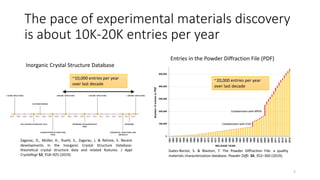
The pace of experimental materials discovery
is about 10K-20K entries per year
Entries in the Powder Diffraction File (PDF)
Collaboration with ICSD
Collaboration with MPDS
~20,000 entries per year
over last decade
Gates-Rector, S. & Blanton, T. The Powder Diffraction File: a quality
materials characterization database. Powder Diffr. 34, 352–360 (2019).
Inorganic Crystal Structure Database
~10,000 entries per year
over last decade
Zagorac, D., Müller, H., Ruehl, S., Zagorac, J. & Rehme, S. Recent
developments in the Inorganic Crystal Structure Database:
theoretical crystal structure data and related features. J Appl
Crystallogr 52, 918–925 (2019).
2
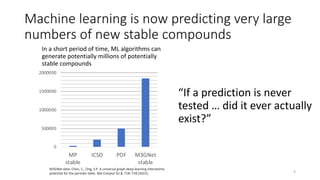
Machine learning is now predicting very large
numbers of new stable compounds
0
500000
1000000
1500000
2000000
MP
stable
ICSD PDF M3GNet
stable
In a short period of time, ML algorithms can
generate potentially millions of potentially
stable compounds
M3GNet data: Chen, C., Ong, S.P. A universal graph deep learning interatomic
potential for the periodic table. Nat Comput Sci 2, 718–728 (2022).
“If a prediction is never
tested … did it ever actually
exist?”
3
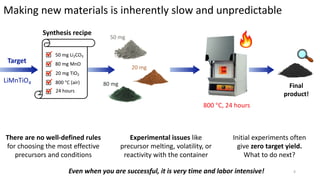
Synthesis recipe
50 mg Li2CO3
80 mg MnO
20 mg TiO2
800 °C (air)
24 hours
50 mg
80 mg
Target
LiMnTiO4
20 mg
800 °C, 24 hours
Final
product!
There are no well-defined rules
for choosing the most effective
precursors and conditions
Experimental issues like
precursor melting, volatility, or
reactivity with the container
Initial experiments often
give zero target yield.
What to do next?
Making new materials is inherently slow and unpredictable
Even when you are successful, it is very time and labor intensive! 4
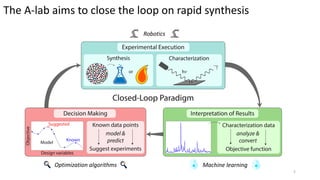
The A-lab aims to close the loop on rapid synthesis
Robotics
Optimization algorithms Machine learning
5
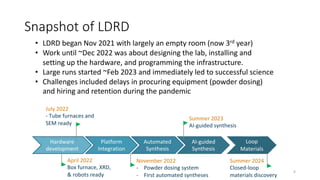
Snapshot of LDRD
July 2022
- Tube furnaces and
SEM ready
Hardware
development
Platform
Integration
Automated
Synthesis
AI-guided
Synthesis
April 2022
Box furnace, XRD,
& robots ready
November 2022
- Powder dosing system
- First automated syntheses
Summer 2023
AI-guided synthesis
Closed-
Loop
Materials
Discovery
Summer 2024
Closed-loop
materials discovery
• LDRD began Nov 2021 with largely an empty room (now 3rd year)
• Work until ~Dec 2022 was about designing the lab, installing and
setting up the hardware, and programming the infrastructure.
• Large runs started ~Feb 2023 and immediately led to successful science
• Challenges included delays in procuring equipment (powder dosing)
and hiring and retention during the pandemic
6
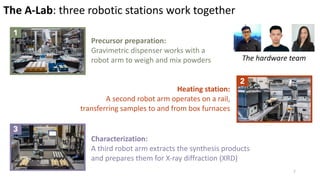
The A-Lab: three robotic stations work together
Precursor preparation:
Gravimetric dispenser works with a
robot arm to weigh and mix powders
Heating station:
A second robot arm operates on a rail,
transferring samples to and from box furnaces
Characterization:
A third robot arm extracts the synthesis products
and prepares them for X-ray diffraction (XRD)
The hardware team
7
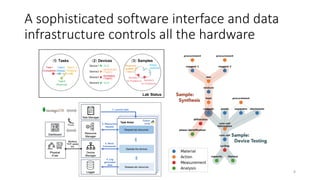
A sophisticated software interface and data
infrastructure controls all the hardware
8
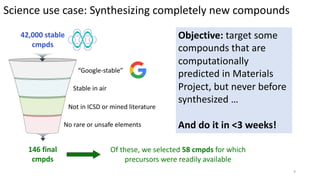
Science use case: Synthesizing completely new compounds
42,000 stable
cmpds
146 final
cmpds
“Google-stable”
Stable in air
Not in ICSD or mined literature
Of these, we selected 58 cmpds for which
precursors were readily available
No rare or unsafe elements
Objective: target some
compounds that are
computationally
predicted in Materials
Project, but never before
synthesized …
And do it in <3 weeks!
9
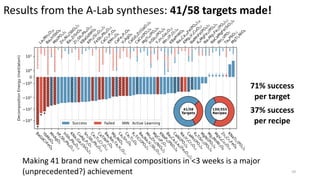
Results from the A-Lab syntheses: 41/58 targets made!
Making 41 brand new chemical compositions in <3 weeks is a major
(unprecedented?) achievement
71% success
per target
37% success
per recipe
10
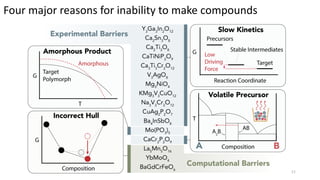
Four major reasons for inability to make compounds
11
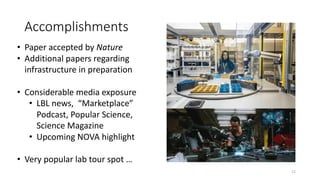
Accomplishments
• Paper accepted by Nature
• Additional papers regarding
infrastructure in preparation
• Considerable media exposure
• LBL news, “Marketplace”
Podcast, Popular Science,
Science Magazine
• Upcoming NOVA highlight
• Very popular lab tour spot …
12
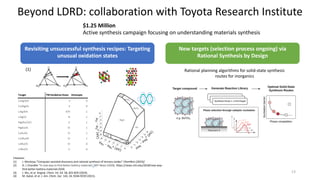
Beyond LDRD: collaboration with Toyota Research Institute
$1.25 Million
Active synthesis campaign focusing on understanding materials synthesis
Revisiting unsuccessful synthesis recipes: Targeting
unusual oxidation states
New targets (selection process ongoing) via
Rational Synthesis by Design
Target TM Oxidation State Attempts
CaAg3O4 II 0
Ca3AgO4 II 0
LiAg3O4 II/III 1
LiAgO2 III 1
Mg(RuO3)2 V 1
MgRuO4 VI 1
CaRuO4 VI 1
Ca3RuO6 VI 1
Li4RuO5 VI 0
Li5RuO5 V 0
Rational planning algorithms for solid-state synthesis
routes for inorganics
Citations:
(1) J. Montoya “Computer-assisted discovery and rational synthesis of ternary oxides” ChemRxiv (2023)/
(2) D. L Chandler “A new way to find better battery materials” MIT News (2018). https://news.mit.edu/2018/new-way-
find-better-battery-materials-0326
(3) J. Wu, et al. Angew. Chem. Int. Ed. 58, 825-829 (2019).
(4) M. Aykol, et al. J. Am. Chem. Soc. 143, 24, 9244-9259 (2021).
(1)
13
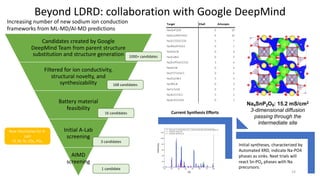
Candidates created by Google
DeepMind Team from parent structure
substitution and structure generation
Filtered for ion conductivity,
structural novelty, and
synthesizability
Battery material
feasibility
Initial A-Lab
screening
AIMD
screening
Beyond LDRD: collaboration with Google DeepMind
Increasing number of new sodium ion conduction
frameworks from ML-MD/AI-MD predictions
New chemistries for A-
Lab!
Cl, Br, Te, CO3, PO4
Na4SnP2O9: 15.2 mS/cm2
3-dimensional diffusion
passing through the
intermediate site
1000+ candidates
168 candidates
16 candidates
3 candidates
1 candidate
Initial syntheses, characterized by
Automated XRD, indicate Na-PO4
phases as sinks. Next trials will
react Sn-PO4 phases with Na
precursors.
Current Synthesis Efforts
Target Ehull Attempts
Na4SnP2O9 0 19
Na5Ca2Al(PO4)4 6 14
Na2(CO2)(CO3) 5 7
Na3Rb2(PO4)3 0 7
Na5HoCl8 0 6
Na2CaBr4 0 5
Na2In(PO4)(CO3) 3 4
Na5InCl8 0 4
Na2Ti(TeO4)3 0 4
Na2CaClBr3 5 3
Na3BiCl6 0 3
NaTaTeO6 0 2
Na3In(CO3)3 5 1
Na2In3(CO3)6 0 1
14
Integration within LBNL programs and next steps
• A-lab is now a critical component of several LBNL programs:
• Materials Project
• Data-Driven Synthesis science
• JCESR (Director’s funds)
• Also part of proposed work:
• ESRA battery hub
• Na-battery lab call proposal
• ACCELERATE call (killed in LBNL down-select)
• Is planned to be a core component of Charter Hill Facility
• New capabilities (e.g., glove box synthesis and handling) are planned which should
open new possibilities for applications and funding areas
• Ideas are welcome! 15

An AI-driven closed-loop facility for materials synthesis

  • 1.
    An AI-driven closed-loopfacility for materials synthesis Multi-area LDRD Update 11/9/2023 PI: Gerbrand Ceder (MSD) Co-PIs: Haegyum Kim (MSD), Anubhav Jain (ETA-ESDR), Martin Kunz (ALS), Carolin Sutter-Fella (MF) Slides (already) posted to hackingmaterials.lbl.gov
  • 2.
    The pace ofexperimental materials discovery is about 10K-20K entries per year Entries in the Powder Diffraction File (PDF) Collaboration with ICSD Collaboration with MPDS ~20,000 entries per year over last decade Gates-Rector, S. & Blanton, T. The Powder Diffraction File: a quality materials characterization database. Powder Diffr. 34, 352–360 (2019). Inorganic Crystal Structure Database ~10,000 entries per year over last decade Zagorac, D., Müller, H., Ruehl, S., Zagorac, J. & Rehme, S. Recent developments in the Inorganic Crystal Structure Database: theoretical crystal structure data and related features. J Appl Crystallogr 52, 918–925 (2019). 2
  • 3.
    Machine learning isnow predicting very large numbers of new stable compounds 0 500000 1000000 1500000 2000000 MP stable ICSD PDF M3GNet stable In a short period of time, ML algorithms can generate potentially millions of potentially stable compounds M3GNet data: Chen, C., Ong, S.P. A universal graph deep learning interatomic potential for the periodic table. Nat Comput Sci 2, 718–728 (2022). “If a prediction is never tested … did it ever actually exist?” 3
  • 4.
    Synthesis recipe 50 mgLi2CO3 80 mg MnO 20 mg TiO2 800 °C (air) 24 hours 50 mg 80 mg Target LiMnTiO4 20 mg 800 °C, 24 hours Final product! There are no well-defined rules for choosing the most effective precursors and conditions Experimental issues like precursor melting, volatility, or reactivity with the container Initial experiments often give zero target yield. What to do next? Making new materials is inherently slow and unpredictable Even when you are successful, it is very time and labor intensive! 4
  • 5.
    The A-lab aimsto close the loop on rapid synthesis Robotics Optimization algorithms Machine learning 5
  • 6.
    Snapshot of LDRD July2022 - Tube furnaces and SEM ready Hardware development Platform Integration Automated Synthesis AI-guided Synthesis April 2022 Box furnace, XRD, & robots ready November 2022 - Powder dosing system - First automated syntheses Summer 2023 AI-guided synthesis Closed- Loop Materials Discovery Summer 2024 Closed-loop materials discovery • LDRD began Nov 2021 with largely an empty room (now 3rd year) • Work until ~Dec 2022 was about designing the lab, installing and setting up the hardware, and programming the infrastructure. • Large runs started ~Feb 2023 and immediately led to successful science • Challenges included delays in procuring equipment (powder dosing) and hiring and retention during the pandemic 6
  • 7.
    The A-Lab: threerobotic stations work together Precursor preparation: Gravimetric dispenser works with a robot arm to weigh and mix powders Heating station: A second robot arm operates on a rail, transferring samples to and from box furnaces Characterization: A third robot arm extracts the synthesis products and prepares them for X-ray diffraction (XRD) The hardware team 7
  • 8.
    A sophisticated softwareinterface and data infrastructure controls all the hardware 8
  • 9.
    Science use case:Synthesizing completely new compounds 42,000 stable cmpds 146 final cmpds “Google-stable” Stable in air Not in ICSD or mined literature Of these, we selected 58 cmpds for which precursors were readily available No rare or unsafe elements Objective: target some compounds that are computationally predicted in Materials Project, but never before synthesized … And do it in <3 weeks! 9
  • 10.
    Results from theA-Lab syntheses: 41/58 targets made! Making 41 brand new chemical compositions in <3 weeks is a major (unprecedented?) achievement 71% success per target 37% success per recipe 10
  • 11.
    Four major reasonsfor inability to make compounds 11
  • 12.
    Accomplishments • Paper acceptedby Nature • Additional papers regarding infrastructure in preparation • Considerable media exposure • LBL news, “Marketplace” Podcast, Popular Science, Science Magazine • Upcoming NOVA highlight • Very popular lab tour spot … 12
  • 13.
    Beyond LDRD: collaborationwith Toyota Research Institute $1.25 Million Active synthesis campaign focusing on understanding materials synthesis Revisiting unsuccessful synthesis recipes: Targeting unusual oxidation states New targets (selection process ongoing) via Rational Synthesis by Design Target TM Oxidation State Attempts CaAg3O4 II 0 Ca3AgO4 II 0 LiAg3O4 II/III 1 LiAgO2 III 1 Mg(RuO3)2 V 1 MgRuO4 VI 1 CaRuO4 VI 1 Ca3RuO6 VI 1 Li4RuO5 VI 0 Li5RuO5 V 0 Rational planning algorithms for solid-state synthesis routes for inorganics Citations: (1) J. Montoya “Computer-assisted discovery and rational synthesis of ternary oxides” ChemRxiv (2023)/ (2) D. L Chandler “A new way to find better battery materials” MIT News (2018). https://news.mit.edu/2018/new-way- find-better-battery-materials-0326 (3) J. Wu, et al. Angew. Chem. Int. Ed. 58, 825-829 (2019). (4) M. Aykol, et al. J. Am. Chem. Soc. 143, 24, 9244-9259 (2021). (1) 13
  • 14.
    Candidates created byGoogle DeepMind Team from parent structure substitution and structure generation Filtered for ion conductivity, structural novelty, and synthesizability Battery material feasibility Initial A-Lab screening AIMD screening Beyond LDRD: collaboration with Google DeepMind Increasing number of new sodium ion conduction frameworks from ML-MD/AI-MD predictions New chemistries for A- Lab! Cl, Br, Te, CO3, PO4 Na4SnP2O9: 15.2 mS/cm2 3-dimensional diffusion passing through the intermediate site 1000+ candidates 168 candidates 16 candidates 3 candidates 1 candidate Initial syntheses, characterized by Automated XRD, indicate Na-PO4 phases as sinks. Next trials will react Sn-PO4 phases with Na precursors. Current Synthesis Efforts Target Ehull Attempts Na4SnP2O9 0 19 Na5Ca2Al(PO4)4 6 14 Na2(CO2)(CO3) 5 7 Na3Rb2(PO4)3 0 7 Na5HoCl8 0 6 Na2CaBr4 0 5 Na2In(PO4)(CO3) 3 4 Na5InCl8 0 4 Na2Ti(TeO4)3 0 4 Na2CaClBr3 5 3 Na3BiCl6 0 3 NaTaTeO6 0 2 Na3In(CO3)3 5 1 Na2In3(CO3)6 0 1 14
  • 15.
    Integration within LBNLprograms and next steps • A-lab is now a critical component of several LBNL programs: • Materials Project • Data-Driven Synthesis science • JCESR (Director’s funds) • Also part of proposed work: • ESRA battery hub • Na-battery lab call proposal • ACCELERATE call (killed in LBNL down-select) • Is planned to be a core component of Charter Hill Facility • New capabilities (e.g., glove box synthesis and handling) are planned which should open new possibilities for applications and funding areas • Ideas are welcome! 15