Computational Chemistry Robots ACS Sep 2005 Computational Chemistry Robots J. A. Townsend, P. Murray-Rust,  S. M. Tyrrell, Y. Zhang [email_address]
Can high-throughput computation provide a  reliable “experimental” resource for  molecular properties? Can protocols be automated? Can we believe the results?
Aspects of complete automation Humans must validate  protocols  rather than individual data Low rates of error must be addressed Users should know the rates of error and degree of conformance
Approaches to conformance Explore limits of job behaviour (times, convergence, etc.) Analyse reproducibility Vary and analyse effects of parameters and algorithms Compare output with other “measurements” of same quantity
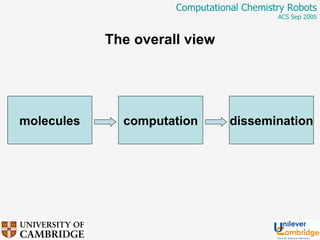
The overall view molecules computation dissemination
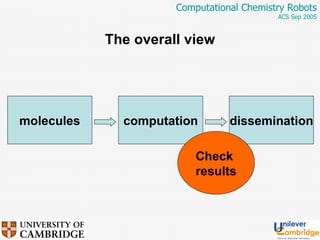
The overall view molecules computation dissemination Check  results
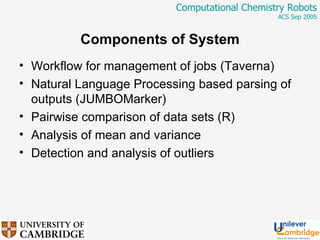
Components of System Workflow for management of jobs (Taverna) Natural Language Processing based parsing of outputs (JUMBOMarker) Pairwise comparison of data sets (R) Analysis of mean and variance Detection and analysis of outliers
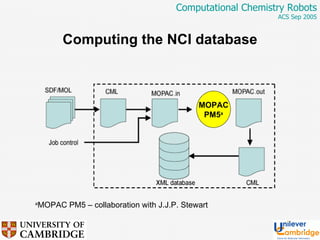
Computing the NCI database MOPAC PM5 a a MOPAC PM5 – collaboration with J.J.P. Stewart
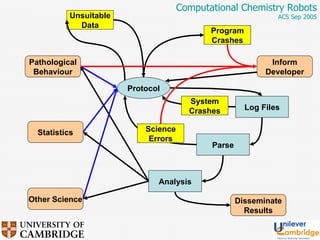
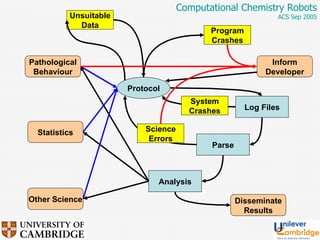
Protocol Log Files Parse System Crashes Science Errors Analysis Pathological Behaviour Statistics Other Science Disseminate Results Unsuitable Data Program Crashes Inform Developer
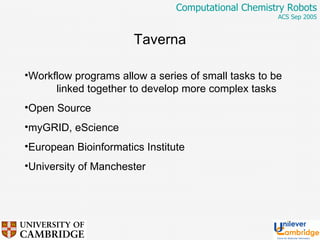
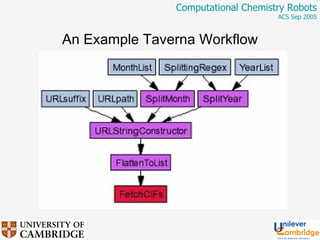
Taverna Workflow programs allow a series of small tasks to be  linked together to develop more complex tasks Open Source myGRID, eScience European Bioinformatics Institute University of Manchester
An Example Taverna Workflow
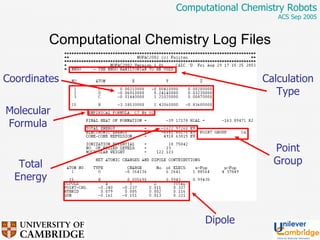
Parsing Log Files to CML Coordinates Molecular Formula Calculation Type Point Group Dipole Total Energy Computational Chemistry Log Files
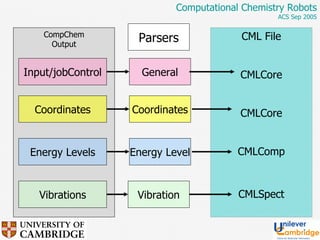
CompChem Output Coordinates Energy Levels Vibrations Coordinates Energy Level Vibration CML File CMLCore CMLCore CMLComp CMLSpect Input/jobControl General Parsers
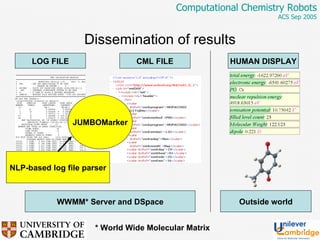
Dissemination of results LOG FILE CML FILE HUMAN DISPLAY WWMM* Server and DSpace Outside world JUMBOMarker NLP-based log file parser * World Wide Molecular Matrix
InChI: IUPAC International Chemical Identifier A non-proprietary unique identifier for the representation of chemical structures. A normal, canonicalised and serialised form of a chemical connection table. InChI FAQ: http://wwmm.ch.cam.ac.uk/inchifaq/
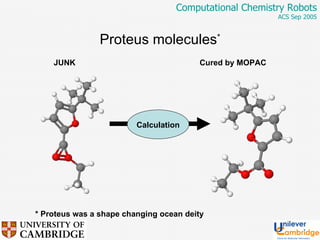
Proteus molecules * Calculation JUNK     Cured by MOPAC * Proteus was a shape changing ocean deity
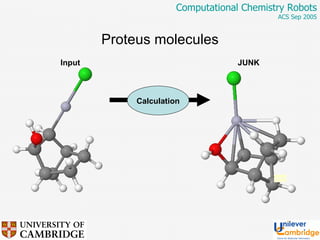
Proteus molecules Calculation Input     JUNK
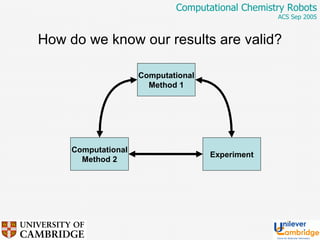
How do we know our results are valid? Computational Method 1 Computational Method 2 Experiment
J.J.P. Stewart’s example Calculated   H f   –  Expt   H f
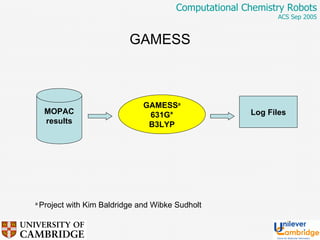
GAMESS MOPAC results GAMESS a 631G* B3LYP Log Files a  Project with Kim Baldridge and Wibke Sudholt
Protocol Log Files Parse System Crashes Science Errors Analysis Pathological Behaviour Statistics Other Science Disseminate Results Unsuitable Data Program Crashes Inform Developer
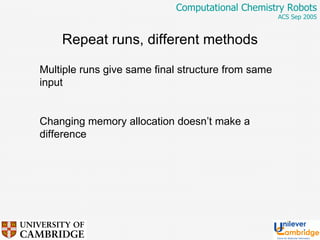
Repeat runs, different methods Multiple runs give same final structure from same input Changing memory allocation doesn’t make a difference
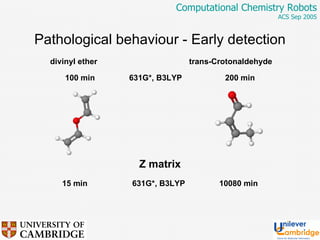
Pathological behaviour - Early detection 100 min 631G*, B3LYP 200 min 15 min   631G*, B3LYP   10080 min divinyl ether  trans-Crotonaldehyde Z matrix
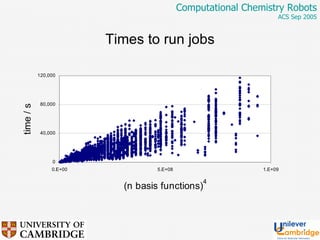
Times to run jobs
Analysis of different computational methods Mean  - Overall difference Normality  - Distribution of values Outliers  - Unusual molecules? Variance  - Spread of the data, depends    on both distributions.    (standard deviation)
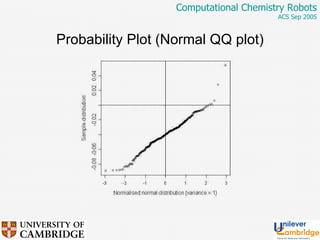
Probability Plot (Normal QQ plot)
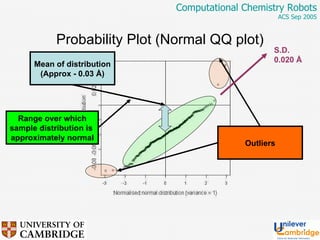
Mean of distribution (Approx - 0.03  Å ) Range over which sample distribution is  approximately normal Outliers Probability Plot (Normal QQ plot) S.D. 0.020  Å
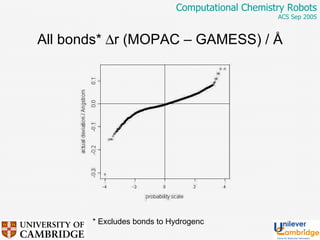
All bonds*   r (MOPAC – GAMESS) /  Å * Excludes bonds to Hydrogenc
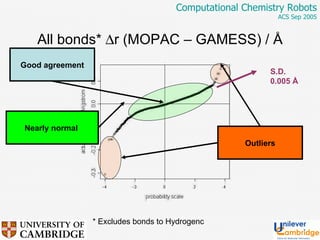
All bonds*   r (MOPAC – GAMESS) /  Å Good agreement Nearly normal  Outliers S.D. 0.005  Å * Excludes bonds to Hydrogenc
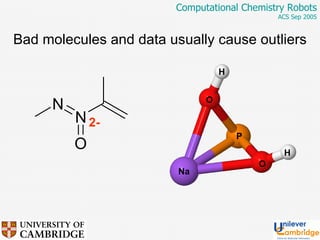
2- Bad molecules and data usually cause outliers Na P O O H H
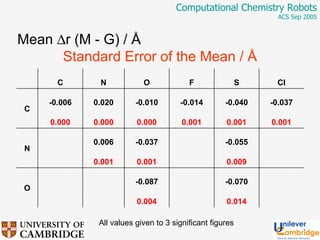
Mean   r (M - G) /  Å  Standard Error of the Mean / Å All values given to 3 significant figures   C N O F S Cl C -0.006 0.020 -0.010 -0.014 -0.040 -0.037 0.000 0.000 0.000 0.001 0.001 0.001 N   0.006 -0.037   -0.055     0.001 0.001   0.009   O     -0.087   -0.070       0.004   0.014  
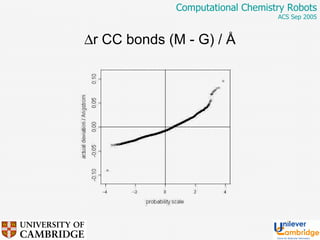
 r CC bonds (M - G) /  Å
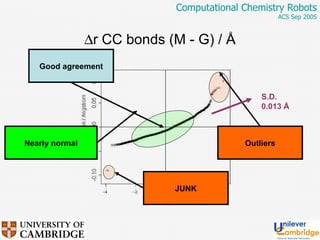
 r CC bonds (M - G) /  Å Good agreement Nearly normal Outliers S.D. 0.013  Å JUNK
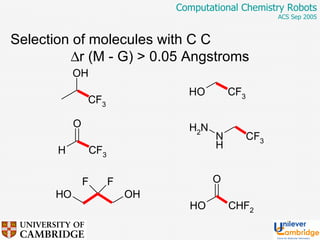
Selection of molecules with C C   r (M - G) > 0.05 Angstroms
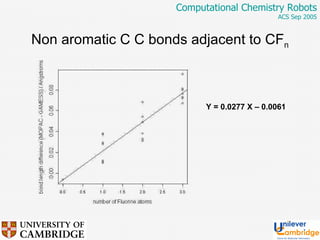
Y = 0.0277 X – 0.0061 Non aromatic C C bonds adjacent to CF n
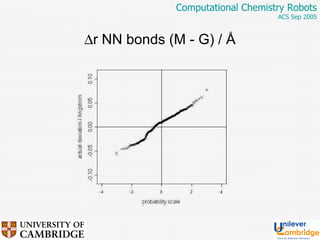
 r NN bonds (M - G) /  Å
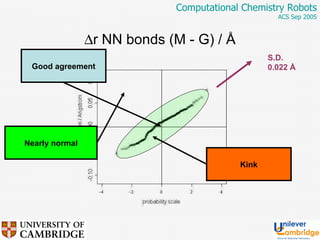
Good agreement Nearly normal Kink S.D. 0.022  Å  r NN bonds (M - G) /  Å
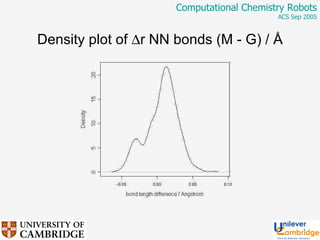
Density plot of   r NN bonds (M - G) /  Å
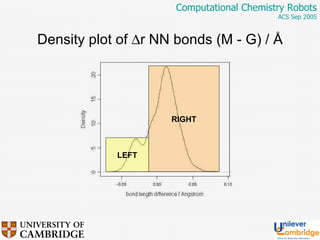
LEFT RIGHT Density plot of   r NN bonds (M - G) /  Å
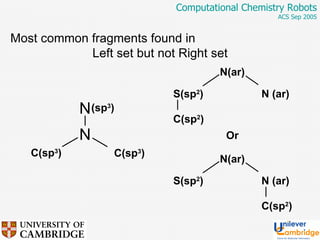
Most common fragments found in  Left set but not Right set C(sp 3 ) C(sp 3 ) (sp 3 ) S(sp 2 ) N(ar) N (ar) C(sp 2 ) S(sp 2 ) N(ar) N (ar) C(sp 2 ) Or
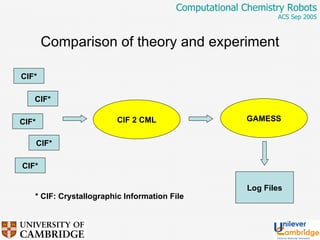
GAMESS Log Files Comparison of theory and experiment CIF* CIF* CIF* CIF* CIF* CIF 2 CML * CIF: Crystallographic Information File
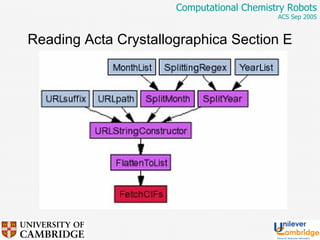
Reading Acta Crystallographica Section E
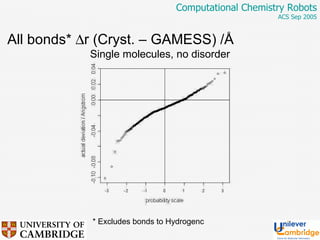
All bonds*   r (Cryst. – GAMESS) / Å  Single molecules, no disorder * Excludes bonds to Hydrogenc
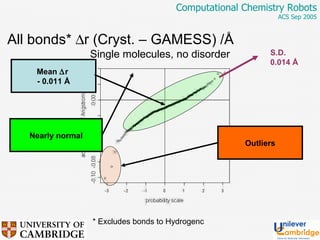
All bonds*   r (Cryst. – GAMESS) / Å  Single molecules, no disorder Mean   r  - 0.011  Å Nearly normal Outliers S.D. 0.014  Å * Excludes bonds to Hydrogenc
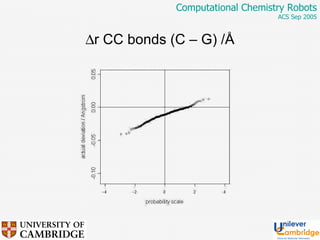
 r CC bonds (C – G) / Å
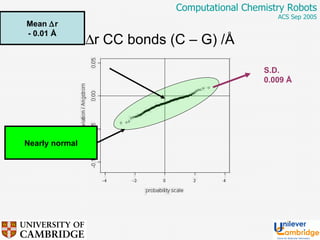
Mean   r - 0.01  Å Nearly normal S.D. 0.009  Å  r CC bonds (C – G) / Å
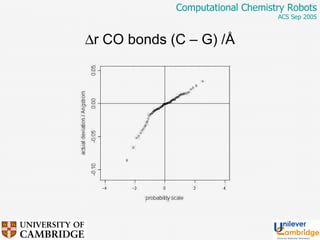
 r CO bonds (C – G) / Å
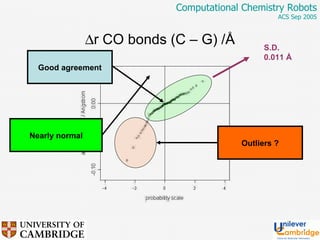
Good agreement Nearly normal Outliers ? S.D. 0.011  Å  r CO bonds (C – G) / Å
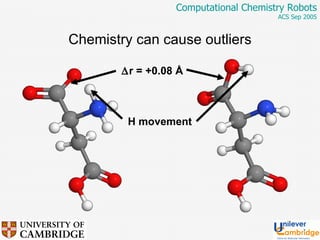
 r = +0.08  Å Chemistry can cause outliers H movement
Conclusions Protocols can be automated Machines can highlight unusual behaviour, geometries and distribution of results for humans to consider Computational programs can provide high quality “experimental” molecular properties
Thanks J.J.P. Stewart Kim Baldridge Wibke Sudholt Simon Tyrrell Yong Zhang Peter Murray-Rust Unilever
Questions Homepage: http://wwmm.ch.cam.ac.uk InChI FAQ: http://wwmm.ch.cam.ac.uk/inchifaq R: http:// www.r-project.org Taverna: http://taverna.sourceforge.net/ MOPAC 2002: http://www.cachesoftware.com/mopac/ GAMESS: http:// www.msg.ameslab.gov/GAMESS/GAMESS.html

Computational Chemistry Robots

  • 1.
    Computational Chemistry RobotsACS Sep 2005 Computational Chemistry Robots J. A. Townsend, P. Murray-Rust, S. M. Tyrrell, Y. Zhang [email_address]
  • 2.
    Can high-throughput computationprovide a reliable “experimental” resource for molecular properties? Can protocols be automated? Can we believe the results?
  • 3.
    Aspects of completeautomation Humans must validate protocols rather than individual data Low rates of error must be addressed Users should know the rates of error and degree of conformance
  • 4.
    Approaches to conformanceExplore limits of job behaviour (times, convergence, etc.) Analyse reproducibility Vary and analyse effects of parameters and algorithms Compare output with other “measurements” of same quantity
  • 5.
    The overall viewmolecules computation dissemination
  • 6.
    The overall viewmolecules computation dissemination Check results
  • 7.
    Components of SystemWorkflow for management of jobs (Taverna) Natural Language Processing based parsing of outputs (JUMBOMarker) Pairwise comparison of data sets (R) Analysis of mean and variance Detection and analysis of outliers
  • 8.
    Computing the NCIdatabase MOPAC PM5 a a MOPAC PM5 – collaboration with J.J.P. Stewart
  • 9.
    Protocol Log FilesParse System Crashes Science Errors Analysis Pathological Behaviour Statistics Other Science Disseminate Results Unsuitable Data Program Crashes Inform Developer
  • 10.
    Taverna Workflow programsallow a series of small tasks to be linked together to develop more complex tasks Open Source myGRID, eScience European Bioinformatics Institute University of Manchester
  • 11.
  • 12.
    Parsing Log Filesto CML Coordinates Molecular Formula Calculation Type Point Group Dipole Total Energy Computational Chemistry Log Files
  • 13.
    CompChem Output CoordinatesEnergy Levels Vibrations Coordinates Energy Level Vibration CML File CMLCore CMLCore CMLComp CMLSpect Input/jobControl General Parsers
  • 14.
    Dissemination of resultsLOG FILE CML FILE HUMAN DISPLAY WWMM* Server and DSpace Outside world JUMBOMarker NLP-based log file parser * World Wide Molecular Matrix
  • 15.
    InChI: IUPAC InternationalChemical Identifier A non-proprietary unique identifier for the representation of chemical structures. A normal, canonicalised and serialised form of a chemical connection table. InChI FAQ: http://wwmm.ch.cam.ac.uk/inchifaq/
  • 16.
    Proteus molecules *Calculation JUNK Cured by MOPAC * Proteus was a shape changing ocean deity
  • 17.
  • 18.
    How do weknow our results are valid? Computational Method 1 Computational Method 2 Experiment
  • 19.
    J.J.P. Stewart’s exampleCalculated  H f – Expt  H f
  • 20.
    GAMESS MOPAC resultsGAMESS a 631G* B3LYP Log Files a Project with Kim Baldridge and Wibke Sudholt
  • 21.
    Protocol Log FilesParse System Crashes Science Errors Analysis Pathological Behaviour Statistics Other Science Disseminate Results Unsuitable Data Program Crashes Inform Developer
  • 22.
    Repeat runs, differentmethods Multiple runs give same final structure from same input Changing memory allocation doesn’t make a difference
  • 23.
    Pathological behaviour -Early detection 100 min 631G*, B3LYP 200 min 15 min 631G*, B3LYP 10080 min divinyl ether trans-Crotonaldehyde Z matrix
  • 24.
  • 25.
    Analysis of differentcomputational methods Mean - Overall difference Normality - Distribution of values Outliers - Unusual molecules? Variance - Spread of the data, depends on both distributions. (standard deviation)
  • 26.
  • 27.
    Mean of distribution(Approx - 0.03 Å ) Range over which sample distribution is approximately normal Outliers Probability Plot (Normal QQ plot) S.D. 0.020 Å
  • 28.
    All bonds*  r (MOPAC – GAMESS) / Å * Excludes bonds to Hydrogenc
  • 29.
    All bonds*  r (MOPAC – GAMESS) / Å Good agreement Nearly normal Outliers S.D. 0.005 Å * Excludes bonds to Hydrogenc
  • 30.
    2- Bad moleculesand data usually cause outliers Na P O O H H
  • 31.
    Mean r (M - G) / Å Standard Error of the Mean / Å All values given to 3 significant figures   C N O F S Cl C -0.006 0.020 -0.010 -0.014 -0.040 -0.037 0.000 0.000 0.000 0.001 0.001 0.001 N   0.006 -0.037   -0.055     0.001 0.001   0.009   O     -0.087   -0.070       0.004   0.014  
  • 32.
     r CCbonds (M - G) / Å
  • 33.
     r CCbonds (M - G) / Å Good agreement Nearly normal Outliers S.D. 0.013 Å JUNK
  • 34.
    Selection of moleculeswith C C  r (M - G) > 0.05 Angstroms
  • 35.
    Y = 0.0277X – 0.0061 Non aromatic C C bonds adjacent to CF n
  • 36.
     r NNbonds (M - G) / Å
  • 37.
    Good agreement Nearlynormal Kink S.D. 0.022 Å  r NN bonds (M - G) / Å
  • 38.
    Density plot of  r NN bonds (M - G) / Å
  • 39.
    LEFT RIGHT Densityplot of  r NN bonds (M - G) / Å
  • 40.
    Most common fragmentsfound in Left set but not Right set C(sp 3 ) C(sp 3 ) (sp 3 ) S(sp 2 ) N(ar) N (ar) C(sp 2 ) S(sp 2 ) N(ar) N (ar) C(sp 2 ) Or
  • 41.
    GAMESS Log FilesComparison of theory and experiment CIF* CIF* CIF* CIF* CIF* CIF 2 CML * CIF: Crystallographic Information File
  • 42.
  • 43.
    All bonds*  r (Cryst. – GAMESS) / Å Single molecules, no disorder * Excludes bonds to Hydrogenc
  • 44.
    All bonds*  r (Cryst. – GAMESS) / Å Single molecules, no disorder Mean  r - 0.011 Å Nearly normal Outliers S.D. 0.014 Å * Excludes bonds to Hydrogenc
  • 45.
     r CCbonds (C – G) / Å
  • 46.
    Mean r - 0.01 Å Nearly normal S.D. 0.009 Å  r CC bonds (C – G) / Å
  • 47.
     r CObonds (C – G) / Å
  • 48.
    Good agreement Nearlynormal Outliers ? S.D. 0.011 Å  r CO bonds (C – G) / Å
  • 49.
     r =+0.08 Å Chemistry can cause outliers H movement
  • 50.
    Conclusions Protocols canbe automated Machines can highlight unusual behaviour, geometries and distribution of results for humans to consider Computational programs can provide high quality “experimental” molecular properties
  • 51.
    Thanks J.J.P. StewartKim Baldridge Wibke Sudholt Simon Tyrrell Yong Zhang Peter Murray-Rust Unilever
  • 52.
    Questions Homepage: http://wwmm.ch.cam.ac.ukInChI FAQ: http://wwmm.ch.cam.ac.uk/inchifaq R: http:// www.r-project.org Taverna: http://taverna.sourceforge.net/ MOPAC 2002: http://www.cachesoftware.com/mopac/ GAMESS: http:// www.msg.ameslab.gov/GAMESS/GAMESS.html