Building Adequate, Livable, Affordable and Inclusive Filipino Communities
Outline of Presentation
1.Introduction to CLUP/Land Use Planning
 What is CLUP?
 Legal Mandates
 Plans Connectivity/Relationship with other Plans
 2014 Guidelines
 Planning Methods and Approaches
Outline of Presentation
2. CLUP Formulation Process
• CLUP Formulation Procedure (12 Step Process)
• Special Studies Areas inputs to Land Use Plan
• Mainstreaming of CDRA to Land Use Plan
• Urban Plan and Design
Introduction to
CLUP/Land Use Planning
Part I Presentation
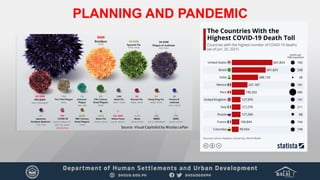
PLANNING AND PANDEMIC
Introduction to CLUP
(Land Use Planning)
Comprehensive Land Use Plan
Refers to a document embodying
specific proposals for guiding growth
and development of city or
municipality.
Legal Basis
Article XIII, Section 1 (1987 Constitution)
… the State shall regulate the acquisition,
ownership, use and disposition of property and its
increment…
Article XII, Section 6 (1987 Constitution)
The use of property bears a social function and all
economic agents shall contribute to the common
good.
Section 20 (RA 7160)
The local government unit shall, in conformity with
existing law, continue to prepare their respective
Comprehensive Land Use Plans enacted through
zoning ordinances which shall be the primary and
dominant bases for the future use of the land
resources.
Section 447 (2) (vii) and Section 458 (2) (vii) (RA 7160)
“Adopt a Comprehensive Land Use Plan for the
city/municipality: provided that the formulation, adoption or
modification of said plan shall be in coordination with the
approved Provincial Comprehensive Land Use Plan”.
Section 5 II (e) RA 11201 (DHSUD)
Formulate and prescribe land use planning and
zoning standards and regulations for the guidance of
cities and municipalities in the formulation of their
respective CLUPs.
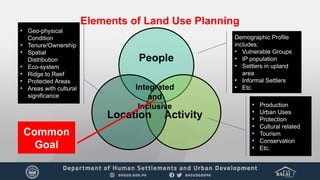
Elements of Land Use Planning
People
Activity
Location
Integrated
and
Inclusive
Demographic Profile
includes;
• Vulnerable Groups
• IP population
• Settlers in upland
area
• Informal Settlers
• Etc.
• Geo-physical
Condition
• Tenure/Ownership
• Spatial
Distribution
• Eco-system
• Ridge to Reef
• Protected Areas
• Areas with cultural
significance
• Production
• Urban Uses
• Protection
• Cultural related
• Tourism
• Conservation
• Etc.
Common
Goal
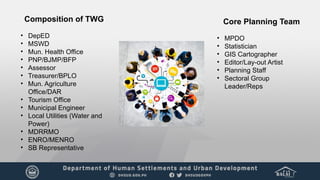
Composition of TWG
• DepED
• MSWD
• Mun. Health Office
• PNP/BJMP/BFP
• Assessor
• Treasurer/BPLO
• Mun. Agriculture
Office/DAR
• Tourism Office
• Municipal Engineer
• Local Utilities (Water and
Power)
• MDRRMO
• ENRO/MENRO
• SB Representative
Core Planning Team
• MPDO
• Statistician
• GIS Cartographer
• Editor/Lay-out Artist
• Planning Staff
• Sectoral Group
Leader/Reps
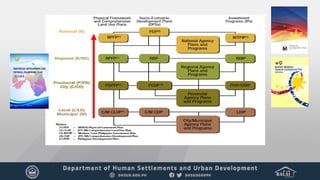
PLANS CONNECTIVITY
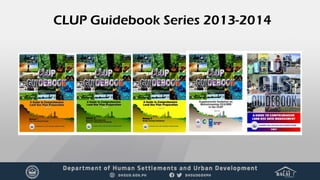
CLUP Guidebook Series 2013-2014
Planning Principles and Approaches
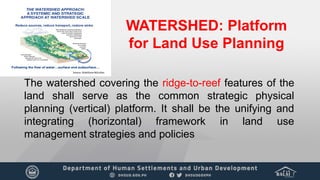
The watershed covering the ridge-to-reef features of the
land shall serve as the common strategic physical
planning (vertical) platform. It shall be the unifying and
integrating (horizontal) framework in land use
management strategies and policies
WATERSHED: Platform
for Land Use Planning
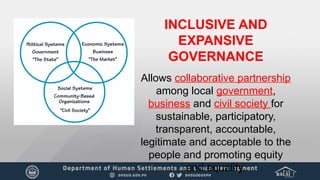
INCLUSIVE AND
EXPANSIVE
GOVERNANCE
Allows collaborative partnership
among local government,
business and civil society for
sustainable, participatory,
transparent, accountable,
legitimate and acceptable to the
people and promoting equity
and equality.
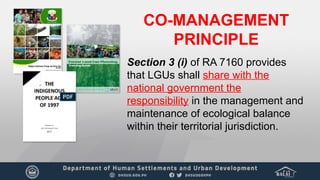
CO-MANAGEMENT
PRINCIPLE
Section 3 (i) of RA 7160 provides
that LGUs shall share with the
national government the
responsibility in the management and
maintenance of ecological balance
within their territorial jurisdiction.
GENDER
RESPONSIVENESS AND
SENSITIVITY
Integration of gender and
population interrelationships in the
entire planning process-plan
formulation, implementation,
monitoring and evaluation.
Integration of Barangay
Development Plans (Bottom-
Up Approach)
Integration of Barangay Development
Plans into city or municipal plan which
the LGUs can adopt in the formulation of
the CLUP. Harmonization of development
goals, identifies and reconciles
inconsistencies and incompatibilities in
land use proposals among adjacent
barangays.
Top-to-Bottom
Approach
Provincial Physical
Framework Plan may serve
as basis and framework for
the formulation and updating
of CLUP.
The primary planning area includes
all component barangays and
city/municipal waters extending 15
kilometers from the shoreline for
coastal LGUs.
CLUP covers a planning period of
nine years at the minimum. It may be
reviewed every three years coinciding
with the term of the locally elected
officials.
THANK YOU!
Building Adequate, Livable, Affordable and Inclusive
Filipino Communities

CLUP Overview will give the readers.pptx

  • 1.
    Building Adequate, Livable,Affordable and Inclusive Filipino Communities
  • 2.
    Outline of Presentation 1.Introductionto CLUP/Land Use Planning  What is CLUP?  Legal Mandates  Plans Connectivity/Relationship with other Plans  2014 Guidelines  Planning Methods and Approaches
  • 3.
    Outline of Presentation 2.CLUP Formulation Process • CLUP Formulation Procedure (12 Step Process) • Special Studies Areas inputs to Land Use Plan • Mainstreaming of CDRA to Land Use Plan • Urban Plan and Design
  • 4.
    Introduction to CLUP/Land UsePlanning Part I Presentation
  • 5.
  • 6.
  • 7.
    Comprehensive Land UsePlan Refers to a document embodying specific proposals for guiding growth and development of city or municipality.
  • 8.
  • 9.
    Article XIII, Section1 (1987 Constitution) … the State shall regulate the acquisition, ownership, use and disposition of property and its increment… Article XII, Section 6 (1987 Constitution) The use of property bears a social function and all economic agents shall contribute to the common good.
  • 10.
    Section 20 (RA7160) The local government unit shall, in conformity with existing law, continue to prepare their respective Comprehensive Land Use Plans enacted through zoning ordinances which shall be the primary and dominant bases for the future use of the land resources.
  • 11.
    Section 447 (2)(vii) and Section 458 (2) (vii) (RA 7160) “Adopt a Comprehensive Land Use Plan for the city/municipality: provided that the formulation, adoption or modification of said plan shall be in coordination with the approved Provincial Comprehensive Land Use Plan”.
  • 12.
    Section 5 II(e) RA 11201 (DHSUD) Formulate and prescribe land use planning and zoning standards and regulations for the guidance of cities and municipalities in the formulation of their respective CLUPs.
  • 13.
    Elements of LandUse Planning People Activity Location Integrated and Inclusive Demographic Profile includes; • Vulnerable Groups • IP population • Settlers in upland area • Informal Settlers • Etc. • Geo-physical Condition • Tenure/Ownership • Spatial Distribution • Eco-system • Ridge to Reef • Protected Areas • Areas with cultural significance • Production • Urban Uses • Protection • Cultural related • Tourism • Conservation • Etc. Common Goal
  • 14.
    Composition of TWG •DepED • MSWD • Mun. Health Office • PNP/BJMP/BFP • Assessor • Treasurer/BPLO • Mun. Agriculture Office/DAR • Tourism Office • Municipal Engineer • Local Utilities (Water and Power) • MDRRMO • ENRO/MENRO • SB Representative Core Planning Team • MPDO • Statistician • GIS Cartographer • Editor/Lay-out Artist • Planning Staff • Sectoral Group Leader/Reps
  • 15.
  • 17.
  • 18.
  • 19.
    The watershed coveringthe ridge-to-reef features of the land shall serve as the common strategic physical planning (vertical) platform. It shall be the unifying and integrating (horizontal) framework in land use management strategies and policies WATERSHED: Platform for Land Use Planning
  • 20.
    INCLUSIVE AND EXPANSIVE GOVERNANCE Allows collaborativepartnership among local government, business and civil society for sustainable, participatory, transparent, accountable, legitimate and acceptable to the people and promoting equity and equality.
  • 21.
    CO-MANAGEMENT PRINCIPLE Section 3 (i)of RA 7160 provides that LGUs shall share with the national government the responsibility in the management and maintenance of ecological balance within their territorial jurisdiction.
  • 22.
    GENDER RESPONSIVENESS AND SENSITIVITY Integration ofgender and population interrelationships in the entire planning process-plan formulation, implementation, monitoring and evaluation.
  • 23.
    Integration of Barangay DevelopmentPlans (Bottom- Up Approach) Integration of Barangay Development Plans into city or municipal plan which the LGUs can adopt in the formulation of the CLUP. Harmonization of development goals, identifies and reconciles inconsistencies and incompatibilities in land use proposals among adjacent barangays.
  • 24.
    Top-to-Bottom Approach Provincial Physical Framework Planmay serve as basis and framework for the formulation and updating of CLUP.
  • 25.
    The primary planningarea includes all component barangays and city/municipal waters extending 15 kilometers from the shoreline for coastal LGUs.
  • 26.
    CLUP covers aplanning period of nine years at the minimum. It may be reviewed every three years coinciding with the term of the locally elected officials.
  • 27.
    THANK YOU! Building Adequate,Livable, Affordable and Inclusive Filipino Communities