LaraibTariq
PharmD
5th
Factorsaffectingthe
Solubility&stabilityofdrug
Factorsaffectingsolubility
Temperature:
Basically, solubility increases with temperature. It is the case for most of the
solvents. The situation is though different for gases. With increase of the
temperature they became less soluble in each other and in water, but more
soluble in organic solvents.
The solubility of a given solute in a given solvent typically depends on
temperature. Many salts show a large increase in solubility with temperature.
Some solutes exhibit solubility that is fairly independent of temperature. A few,
such as cerium (III) sulfate, become less soluble in water as temperature
increases. This temperature dependence is sometimes referred to as retrograde
or inverse solubility, and exists when a salt’s dissolution is exothermic; this can be
explained because, according to Le Chatelier’s principle, extra heat will cause the
equilibrium for an exothermic process to shifttowards the reactants.
Polarity
In most cases solutes dissolve in solvents that have a similar polarity. Chemists
use a popular aphorism to describe this feature of solutes and solvents: “Like
dissolves like”. Non-polar solutes do not dissolve in polar solvents and the other
way round.
Particle size
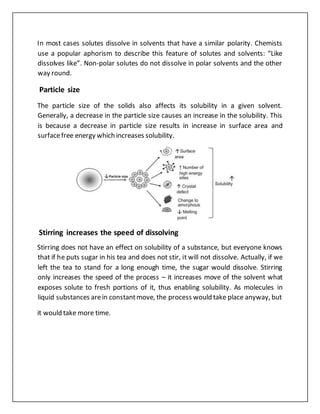
The particle size of the solids also affects its solubility in a given solvent.
Generally, a decrease in the particle size causes an increase in the solubility. This
is because a decrease in particle size results in increase in surface area and
surfacefree energy which increases solubility.
Stirring increases the speed of dissolving
Stirring does not have an effect on solubility of a substance, but everyone knows
that if he puts sugar in his tea and does not stir, it will not dissolve. Actually, if we
left the tea to stand for a long enough time, the sugar would dissolve. Stirring
only increases the speed of the process – it increases move of the solvent what
exposes solute to fresh portions of it, thus enabling solubility. As molecules in
liquid substances arein constantmove, the process would take place anyway, but
it would take more time.
Effect of intermolecular forces in solubility
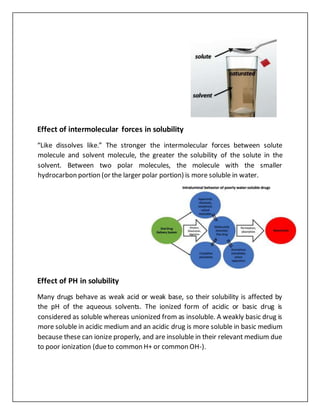
“Like dissolves like.” The stronger the intermolecular forces between solute
molecule and solvent molecule, the greater the solubility of the solute in the
solvent. Between two polar molecules, the molecule with the smaller
hydrocarbon portion (or the larger polar portion) is more soluble in water.
Effect of PH in solubility
Many drugs behave as weak acid or weak base, so their solubility is affected by
the pH of the aqueous solvents. The ionized form of acidic or basic drug is
considered as soluble whereas unionized from as insoluble. A weakly basic drug is
more soluble in acidic medium and an acidic drug is more soluble in basic medium
because these can ionize properly, and are insoluble in their relevant medium due
to poor ionization (dueto common H+ or common OH-).
Solubility of liquids in liquids
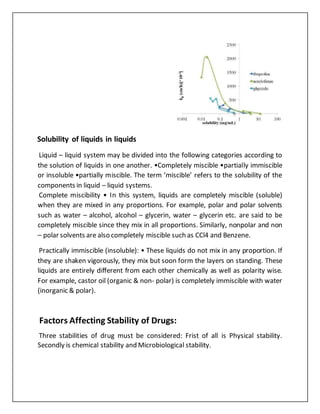
Liquid – liquid system may be divided into the following categories according to
the solution of liquids in one another. •Completely miscible •partially immiscible
or insoluble •partially miscible. The term ‘miscible’ refers to the solubility of the
components in liquid – liquid systems.
Complete miscibility • In this system, liquids are completely miscible (soluble)
when they are mixed in any proportions. For example, polar and polar solvents
such as water – alcohol, alcohol – glycerin, water – glycerin etc. are said to be
completely miscible since they mix in all proportions. Similarly, nonpolar and non
– polar solvents are also completely miscible such as CCl4 and Benzene.
Practically immiscible (insoluble): • These liquids do not mix in any proportion. If
they are shaken vigorously, they mix but soon form the layers on standing. These
liquids are entirely different from each other chemically as well as polarity wise.
For example, castor oil (organic & non- polar) is completely immiscible with water
(inorganic & polar).
Factors Affecting Stability of Drugs:
Three stabilities of drug must be considered: Frist of all is Physical stability.
Secondly is chemical stability and Microbiological stability.
Physical Stability: Physical instabilities possibilities are: Crystal formation in
pharmaceutical preparations Causes:
 Polymorphism phenomena: i.e. Chloramphenicol (change of amorphous to
crystalline form).
 Saturated solution: by different temperature precipitation of solute may
occur.
 In suspension: when very fine powder is used a part of suspending agent
will dissolvethen precipitate as crystal.
Loss of volatile substances from pharmaceutical dosage forms: Examples:
Aromatic waters, Elixirs, Spirits.
In emulsions loss of water lead to separation of the two phases and change to
other type.
Creams: especially oil/water, they become dry by loss of water
Chemical stability:
High temperature can drive moisture out of a sample and render the material
apparently stable otherwise prone to hydrolysis. I.e. above 65% relative humidity
the beta formof chlortetracycline hydrochloridetransforms into alpha form.
Microbiological stability:
Contamination from microorganisms is a big problem for all formulations
containing moisture but it can be a bother in solid dosage forms also if some
natural polymers are used because many natural polymers are fertile sources of
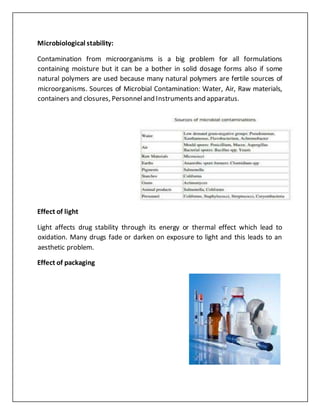
microorganisms. Sources of Microbial Contamination: Water, Air, Raw materials,
containers and closures, Personneland Instruments and apparatus.
Effect of light
Light affects drug stability through its energy or thermal effect which lead to
oxidation. Many drugs fade or darken on exposure to light and this leads to an
aesthetic problem.
Effect of packaging
Material, Glass, Plastics, Metal, and Rubber. Glass is resistant to chemical and
physical change and is the most commonly used material. It is resistant to
chemical and physicalchange and is the most commonly used material.
Plastics
The problems with plastic are: 1. Migration of the drug through the plastic into
the environment. 2. Transfer of environmental moisture, oxygen, and other
elements into the pharmaceutical product. 3. Leaching of container ingredients
into the drug. 4. Adsorption of the active drug or excipients by the plastic.
Metals
Various alloys and aluminum tubes may be utilized as containers for emulsions,
ointments, creams and pastes. Limitation: They may cause corrosion and
precipitation in the drug product. Overcome: Coating the tubes with polymers
may reducethese tendencies.
Rubber
Rubber also has the problems of extraction of drug ingredients and leaching of
container ingredients. The pretreatment of rubber vial stoppers and closures with
water and steam reduces potential leaching.
References:
 https://www.solubilityofthings.com/basics/factors_affecting_solubility.php
 https://www.slideshare.net/zoraizhaiderzoraizhaider/solubility-60163308
 Vigneron J. Stability: Ten pieces of advice. EJHP Science 2008; 14:2.

Compounding and dispensing errors (2)

  • 1.
  • 2.
    Temperature: Basically, solubility increaseswith temperature. It is the case for most of the solvents. The situation is though different for gases. With increase of the temperature they became less soluble in each other and in water, but more soluble in organic solvents. The solubility of a given solute in a given solvent typically depends on temperature. Many salts show a large increase in solubility with temperature. Some solutes exhibit solubility that is fairly independent of temperature. A few, such as cerium (III) sulfate, become less soluble in water as temperature increases. This temperature dependence is sometimes referred to as retrograde or inverse solubility, and exists when a salt’s dissolution is exothermic; this can be explained because, according to Le Chatelier’s principle, extra heat will cause the equilibrium for an exothermic process to shifttowards the reactants. Polarity
  • 3.
    In most casessolutes dissolve in solvents that have a similar polarity. Chemists use a popular aphorism to describe this feature of solutes and solvents: “Like dissolves like”. Non-polar solutes do not dissolve in polar solvents and the other way round. Particle size The particle size of the solids also affects its solubility in a given solvent. Generally, a decrease in the particle size causes an increase in the solubility. This is because a decrease in particle size results in increase in surface area and surfacefree energy which increases solubility. Stirring increases the speed of dissolving Stirring does not have an effect on solubility of a substance, but everyone knows that if he puts sugar in his tea and does not stir, it will not dissolve. Actually, if we left the tea to stand for a long enough time, the sugar would dissolve. Stirring only increases the speed of the process – it increases move of the solvent what exposes solute to fresh portions of it, thus enabling solubility. As molecules in liquid substances arein constantmove, the process would take place anyway, but it would take more time.
  • 4.
    Effect of intermolecularforces in solubility “Like dissolves like.” The stronger the intermolecular forces between solute molecule and solvent molecule, the greater the solubility of the solute in the solvent. Between two polar molecules, the molecule with the smaller hydrocarbon portion (or the larger polar portion) is more soluble in water. Effect of PH in solubility Many drugs behave as weak acid or weak base, so their solubility is affected by the pH of the aqueous solvents. The ionized form of acidic or basic drug is considered as soluble whereas unionized from as insoluble. A weakly basic drug is more soluble in acidic medium and an acidic drug is more soluble in basic medium because these can ionize properly, and are insoluble in their relevant medium due to poor ionization (dueto common H+ or common OH-).
  • 5.
    Solubility of liquidsin liquids Liquid – liquid system may be divided into the following categories according to the solution of liquids in one another. •Completely miscible •partially immiscible or insoluble •partially miscible. The term ‘miscible’ refers to the solubility of the components in liquid – liquid systems. Complete miscibility • In this system, liquids are completely miscible (soluble) when they are mixed in any proportions. For example, polar and polar solvents such as water – alcohol, alcohol – glycerin, water – glycerin etc. are said to be completely miscible since they mix in all proportions. Similarly, nonpolar and non – polar solvents are also completely miscible such as CCl4 and Benzene. Practically immiscible (insoluble): • These liquids do not mix in any proportion. If they are shaken vigorously, they mix but soon form the layers on standing. These liquids are entirely different from each other chemically as well as polarity wise. For example, castor oil (organic & non- polar) is completely immiscible with water (inorganic & polar). Factors Affecting Stability of Drugs: Three stabilities of drug must be considered: Frist of all is Physical stability. Secondly is chemical stability and Microbiological stability.
  • 6.
    Physical Stability: Physicalinstabilities possibilities are: Crystal formation in pharmaceutical preparations Causes:  Polymorphism phenomena: i.e. Chloramphenicol (change of amorphous to crystalline form).  Saturated solution: by different temperature precipitation of solute may occur.  In suspension: when very fine powder is used a part of suspending agent will dissolvethen precipitate as crystal. Loss of volatile substances from pharmaceutical dosage forms: Examples: Aromatic waters, Elixirs, Spirits. In emulsions loss of water lead to separation of the two phases and change to other type. Creams: especially oil/water, they become dry by loss of water Chemical stability: High temperature can drive moisture out of a sample and render the material apparently stable otherwise prone to hydrolysis. I.e. above 65% relative humidity the beta formof chlortetracycline hydrochloridetransforms into alpha form.
  • 7.
    Microbiological stability: Contamination frommicroorganisms is a big problem for all formulations containing moisture but it can be a bother in solid dosage forms also if some natural polymers are used because many natural polymers are fertile sources of microorganisms. Sources of Microbial Contamination: Water, Air, Raw materials, containers and closures, Personneland Instruments and apparatus. Effect of light Light affects drug stability through its energy or thermal effect which lead to oxidation. Many drugs fade or darken on exposure to light and this leads to an aesthetic problem. Effect of packaging
  • 8.
    Material, Glass, Plastics,Metal, and Rubber. Glass is resistant to chemical and physical change and is the most commonly used material. It is resistant to chemical and physicalchange and is the most commonly used material. Plastics The problems with plastic are: 1. Migration of the drug through the plastic into the environment. 2. Transfer of environmental moisture, oxygen, and other elements into the pharmaceutical product. 3. Leaching of container ingredients into the drug. 4. Adsorption of the active drug or excipients by the plastic. Metals Various alloys and aluminum tubes may be utilized as containers for emulsions, ointments, creams and pastes. Limitation: They may cause corrosion and precipitation in the drug product. Overcome: Coating the tubes with polymers may reducethese tendencies. Rubber Rubber also has the problems of extraction of drug ingredients and leaching of container ingredients. The pretreatment of rubber vial stoppers and closures with water and steam reduces potential leaching. References:  https://www.solubilityofthings.com/basics/factors_affecting_solubility.php  https://www.slideshare.net/zoraizhaiderzoraizhaider/solubility-60163308  Vigneron J. Stability: Ten pieces of advice. EJHP Science 2008; 14:2.