Compound Sentences
http://englishgrammarexplained.wordpress.com/
Compound Sentence
• < 2 independent clauses
• Independent clauses are of equal
importance
• connected by:
– comma + coordinating conjunction (and, but,
or)
– colon
– semicolon
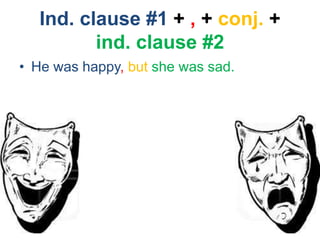
Ind. clause #1 + , + conj. +
ind. clause #2
• He was happy, but she was sad.
Common Errors:
Comma Splice
• Adding two independent clauses with just a
comma
– Ex:
• John was happy, Sally was sad.
• Ways to fix it:
–John was happy, but Sally was sad.
–John was happy. Sally was sad.
–John was happy; Sally was sad.
• Clarification, meaning
– One burning word that needs clarification
• Jean Van Jean’s troubles could all be traced to one
sin: he was born poor.
– The first sentence contains the burning word, sin, that
begs the question: What “sin”?
Ind. clause: explanatory or
clarification ind. clause
Ind. clause: explanatory or
clarification ind. clause
• Clarification, meaning
– Strange or peculiar content that begs
explanation
• Joseph died with a smile: he believed he was
finally going to heaven.
– There is no particular burning word in the first sentence
that we are curious for the meaning of, yet the contrast of
someone smiling as he is dying does make us curious.
The sentence that follows resolves the suspense.
Ind. Clause #1; Ind. Clause #2
(IC1 helps better understand IC2)
• Sentence #1 needs to be still on the
reader’s mind in order to understand
sentence #2
– Example
• Spartacus entered the city; all the slaves cheered
him.
Ind. Clause #1; Ind. Clause #2
(a parallel structure)
• I am a Taurus; my brother is a Gemini.
– There is clearly a connection between these
two ind. clauses.
– The first states what sign I am; the second
states what sign my brother is.
• I am a Taurus. My brother is a Gemini.
– Not wrong, but:
• fails to acknowledge connection
• sounds choppy
Ind. Clause #1; Ind. Clause #2
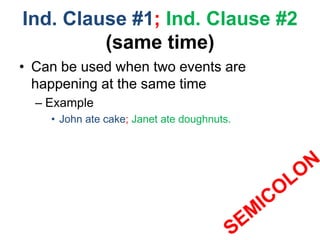
(same time)
• Can be used when two events are
happening at the same time
– Example
• John ate cake; Janet ate doughnuts.
Ind. Clause #1; Ind. Clause #2
(show a contrast)
• Can be used when there is a contrast
– Ex.
• Janet was infuriated; John was disappointed.
[In this sentence there is a contrast between how
Janet feels and how John feels]
Bonus: Elliptical structure
• When the verb is repeated twice  verb
can be taken out on the second sentence
– Example
• I ate the apple; my brother, the orange.
[In this case the verb “ate” is left out and replaced by
a comma.]
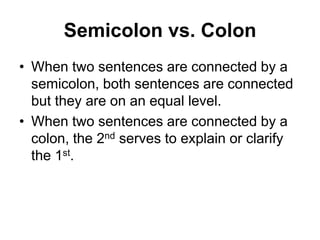
Semicolon vs. Colon
• When two sentences are connected by a
semicolon, both sentences are connected
but they are on an equal level.
• When two sentences are connected by a
colon, the 2nd serves to explain or clarify
the 1st.

Compound sentences

  • 1.
  • 2.
    Compound Sentence • <2 independent clauses • Independent clauses are of equal importance • connected by: – comma + coordinating conjunction (and, but, or) – colon – semicolon
  • 3.
    Ind. clause #1+ , + conj. + ind. clause #2 • He was happy, but she was sad.
  • 4.
    Common Errors: Comma Splice •Adding two independent clauses with just a comma – Ex: • John was happy, Sally was sad. • Ways to fix it: –John was happy, but Sally was sad. –John was happy. Sally was sad. –John was happy; Sally was sad.
  • 5.
    • Clarification, meaning –One burning word that needs clarification • Jean Van Jean’s troubles could all be traced to one sin: he was born poor. – The first sentence contains the burning word, sin, that begs the question: What “sin”? Ind. clause: explanatory or clarification ind. clause
  • 6.
    Ind. clause: explanatoryor clarification ind. clause • Clarification, meaning – Strange or peculiar content that begs explanation • Joseph died with a smile: he believed he was finally going to heaven. – There is no particular burning word in the first sentence that we are curious for the meaning of, yet the contrast of someone smiling as he is dying does make us curious. The sentence that follows resolves the suspense.
  • 7.
    Ind. Clause #1;Ind. Clause #2 (IC1 helps better understand IC2) • Sentence #1 needs to be still on the reader’s mind in order to understand sentence #2 – Example • Spartacus entered the city; all the slaves cheered him.
  • 8.
    Ind. Clause #1;Ind. Clause #2 (a parallel structure) • I am a Taurus; my brother is a Gemini. – There is clearly a connection between these two ind. clauses. – The first states what sign I am; the second states what sign my brother is. • I am a Taurus. My brother is a Gemini. – Not wrong, but: • fails to acknowledge connection • sounds choppy
  • 9.
    Ind. Clause #1;Ind. Clause #2 (same time) • Can be used when two events are happening at the same time – Example • John ate cake; Janet ate doughnuts.
  • 10.
    Ind. Clause #1;Ind. Clause #2 (show a contrast) • Can be used when there is a contrast – Ex. • Janet was infuriated; John was disappointed. [In this sentence there is a contrast between how Janet feels and how John feels]
  • 11.
    Bonus: Elliptical structure •When the verb is repeated twice  verb can be taken out on the second sentence – Example • I ate the apple; my brother, the orange. [In this case the verb “ate” is left out and replaced by a comma.]
  • 12.
    Semicolon vs. Colon •When two sentences are connected by a semicolon, both sentences are connected but they are on an equal level. • When two sentences are connected by a colon, the 2nd serves to explain or clarify the 1st.