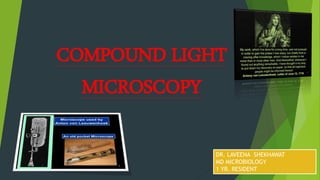
COMPOUND LIGHT
MICROSCOPY
DR. LAVEENA SHEKHAWAT
MD MICROBIOLOGY
1 YR. RESIDENT
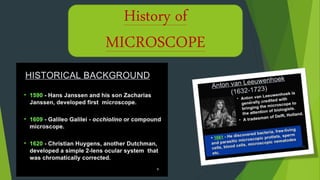
History of
MICROSCOPE
Types of Microscopy
• Brightfield or Light Microscopy
• Dark ground Microscopy
• Phase contrast Microscopy
• Fluorescent Microscopy
• Confocal Microscopy
• Electron Microscopy
PRINCIPLEDefinition & Principle
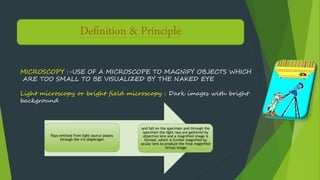
MICROSCOPY :-USE OF A MICROSCOPE TO MAGNIFY OBJECTS WHICH
ARE TOO SMALL TO BE VISUALIZED BY THE NAKED EYE
Light microscopy or bright field microscopy : Dark images with bright
background
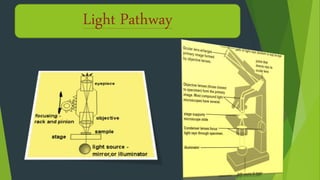
Rays emitted from light source passes
through the iris diaphragm
and fall on the specimen and through the
specimen the light rays are gathered by
objective lens and a magnified image is
formed ,which is further magnified by
ocular lens to produce the final magnified
virtual image
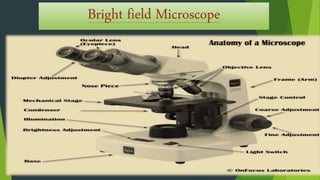
Bright field Microscope
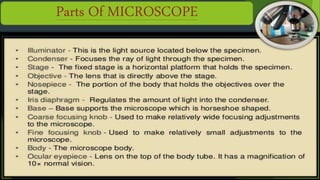
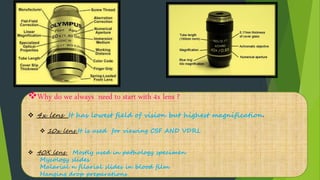
Parts Of MICROSCOPE
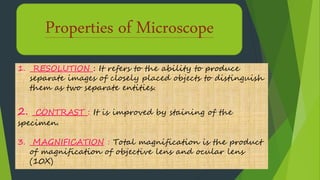
Properties of Microscope
1. RESOLUTION : It refers to the ability to produce
separate images of closely placed objects to distinguish
them as two separate entities.
2. CONTRAST : It is improved by staining of the
specimen.
3. MAGNIFICATION : Total magnification is the product
of magnification of objective lens and ocular lens
(10X)
Light Pathway
i
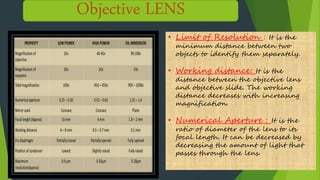
Objective LENS
• Limit of Resolution : It is the
minimum distance between two
objects to identify them separately.
• Working distance: It is the
distance between the objective lens
and objective slide. The working
distance decreases with increasing
magnification.
• Numerical Aperture : It is the
ratio of diameter of the lens to its
focal length. It can be decreased by
decreasing the amount of light that
passes through the lens.
Why do we always need to start with 4x lens ?
 4x lens It has lowest field of vision but highest magnification.
 10x lens It is used for viewing CSF AND VDRL
 40X lens Mostly used in pathology specimen
Mycology slides
Malarial n filarial slides in blood film
Hanging drop preparations
Advantages and
disadvantages of light
microscopy
Handling of MicroscopesMaintenance of Microscopes
THANK
YOU

Compound light microscopy by dr. laveena

  • 1.
    COMPOUND LIGHT MICROSCOPY DR. LAVEENASHEKHAWAT MD MICROBIOLOGY 1 YR. RESIDENT
  • 2.
  • 3.
    Types of Microscopy •Brightfield or Light Microscopy • Dark ground Microscopy • Phase contrast Microscopy • Fluorescent Microscopy • Confocal Microscopy • Electron Microscopy
  • 4.
    PRINCIPLEDefinition & Principle MICROSCOPY:-USE OF A MICROSCOPE TO MAGNIFY OBJECTS WHICH ARE TOO SMALL TO BE VISUALIZED BY THE NAKED EYE Light microscopy or bright field microscopy : Dark images with bright background Rays emitted from light source passes through the iris diaphragm and fall on the specimen and through the specimen the light rays are gathered by objective lens and a magnified image is formed ,which is further magnified by ocular lens to produce the final magnified virtual image
  • 5.
  • 6.
  • 7.
    Properties of Microscope 1.RESOLUTION : It refers to the ability to produce separate images of closely placed objects to distinguish them as two separate entities. 2. CONTRAST : It is improved by staining of the specimen. 3. MAGNIFICATION : Total magnification is the product of magnification of objective lens and ocular lens (10X)
  • 8.
  • 9.
    i Objective LENS • Limitof Resolution : It is the minimum distance between two objects to identify them separately. • Working distance: It is the distance between the objective lens and objective slide. The working distance decreases with increasing magnification. • Numerical Aperture : It is the ratio of diameter of the lens to its focal length. It can be decreased by decreasing the amount of light that passes through the lens.
  • 10.
    Why do wealways need to start with 4x lens ?  4x lens It has lowest field of vision but highest magnification.  10x lens It is used for viewing CSF AND VDRL  40X lens Mostly used in pathology specimen Mycology slides Malarial n filarial slides in blood film Hanging drop preparations
  • 12.
  • 13.
  • 14.