University of Salahaddin
College of Education
Environmental science department
1
Halala Rahman Qadir
9/12/2017
Definition of compost
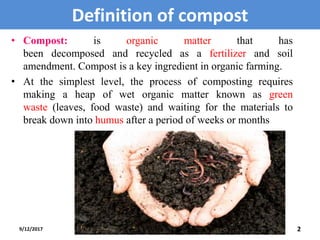
• Compost: is organic matter that has
been decomposed and recycled as a fertilizer and soil
amendment. Compost is a key ingredient in organic farming.
• At the simplest level, the process of composting requires
making a heap of wet organic matter known as green
waste (leaves, food waste) and waiting for the materials to
break down into humus after a period of weeks or months
9/12/2017 2
Advantages of Using Compos​t
• Compost, or black gold as it is sometimes referred to, offers many
benefits to gardeners. Forexample, Compost can:​
• Promote healthy microbe growth within soil.
• Feed the entire soil food web, which in turn enhances the health of
natural soil.
• Create a more nutrient-rich soil which enables plants and vegetables
to feed themselves.
• Deliver crickets and earthworms to soil, with these organisms
providing their own unique benefits.
• Aerate soil and enable it to retain moisture thanks to improved
drainage and water retention.
• Assist in the resistance against disease for tomatoes and various
types of vegetables.
• Control weeds. 9/12/2017
3
• Time is the main drawback of compost, if you are planning to
make your own. It is important to bearing mind that you may have
to wait a few months for home-made compost to become effective,
asmatter takes a while to decay.​
• Another thing to remember when making your compost is to never
add plant remnants containing soil-borne pathogens to the mixture.
Doing so can cause an infestation in healthy plants.​
9/12/2017 4
Disadvantages of Using Compost
The simplest way to distinguish between compost and
fertilizer is to remember this: Compost feeds the soil
and fertilizer feeds the plants.
9/12/2017 5
What Is the Difference Between Compost and
Fertilizer?
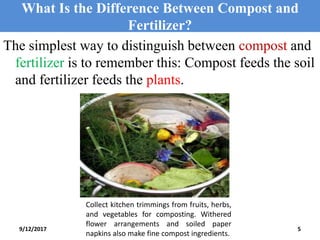
Collect kitchen trimmings from fruits, herbs,
and vegetables for composting. Withered
flower arrangements and soiled paper
napkins also make fine compost ingredients.
How Compost Helps Your Soil
• Compost contains nutrients that your plants need for
optimum growth, such as nitrogen, phosphorus, and
potassium.
• Nutrients are released at the rate your plants need them.
• The organic matter in compost binds with soil particles
(sand, silt, and clay) to form small aggregates, or crumbs.
• Increases water-holding capacity of soil.
• Neutralizes various soil toxins and metals, such as
cadmium and lead, by bonding with them so they can’t be
taken up by plants.
• Acts as a pH buffer so plants are less dependent on a
specific soil pH.
9/12/2017 6
9/12/2017 7
9/12/2017 8

Compost

  • 1.
    University of Salahaddin Collegeof Education Environmental science department 1 Halala Rahman Qadir 9/12/2017
  • 2.
    Definition of compost •Compost: is organic matter that has been decomposed and recycled as a fertilizer and soil amendment. Compost is a key ingredient in organic farming. • At the simplest level, the process of composting requires making a heap of wet organic matter known as green waste (leaves, food waste) and waiting for the materials to break down into humus after a period of weeks or months 9/12/2017 2
  • 3.
    Advantages of UsingCompos​t • Compost, or black gold as it is sometimes referred to, offers many benefits to gardeners. Forexample, Compost can:​ • Promote healthy microbe growth within soil. • Feed the entire soil food web, which in turn enhances the health of natural soil. • Create a more nutrient-rich soil which enables plants and vegetables to feed themselves. • Deliver crickets and earthworms to soil, with these organisms providing their own unique benefits. • Aerate soil and enable it to retain moisture thanks to improved drainage and water retention. • Assist in the resistance against disease for tomatoes and various types of vegetables. • Control weeds. 9/12/2017 3
  • 4.
    • Time isthe main drawback of compost, if you are planning to make your own. It is important to bearing mind that you may have to wait a few months for home-made compost to become effective, asmatter takes a while to decay.​ • Another thing to remember when making your compost is to never add plant remnants containing soil-borne pathogens to the mixture. Doing so can cause an infestation in healthy plants.​ 9/12/2017 4 Disadvantages of Using Compost
  • 5.
    The simplest wayto distinguish between compost and fertilizer is to remember this: Compost feeds the soil and fertilizer feeds the plants. 9/12/2017 5 What Is the Difference Between Compost and Fertilizer? Collect kitchen trimmings from fruits, herbs, and vegetables for composting. Withered flower arrangements and soiled paper napkins also make fine compost ingredients.
  • 6.
    How Compost HelpsYour Soil • Compost contains nutrients that your plants need for optimum growth, such as nitrogen, phosphorus, and potassium. • Nutrients are released at the rate your plants need them. • The organic matter in compost binds with soil particles (sand, silt, and clay) to form small aggregates, or crumbs. • Increases water-holding capacity of soil. • Neutralizes various soil toxins and metals, such as cadmium and lead, by bonding with them so they can’t be taken up by plants. • Acts as a pH buffer so plants are less dependent on a specific soil pH. 9/12/2017 6
  • 7.
  • 8.