Product Governance & Compliance
Webinar 2 - Wake Up Your
Compliance with Automation
Presented by:
Charles Vernor, Solutions Consultant
Dries D’Hooghe, Environmental Compliance Consultant
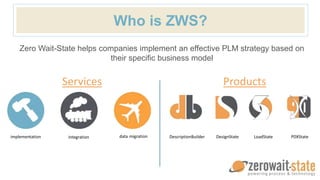
Who is ZWS?
Zero Wait-State helps companies implement an effective PLM strategy based on
their specific business model
Services Products
implementation integration data migration DescriptionBuilder DesignState LoadState PDXState
Today’s Agenda
1. Pros and Cons: Part Research Vendors
2. Pros and Cons: Directly with Suppliers
3. LoadState Demonstration
4. Highlight Useful Process Extensions
5. Q&A
PROS AND CONS: PART RESEARCH VENDORS
What to expect when paying for manufacturer part data and research
Part Research Vendors
• Your company receive compliance data through a single entity
– Fast access to available manufacturer part data
– Provides data research for companies if necessary
• Pricing fluctuates based on features and data volume
• The quality of the compliance data is higher
– Consistent format from supplier to supplier
– Validated for data entry errors and misinformation
• Some companies that offer this service:
– Total Parts Plus (CMM)
– Intertek / Decernis (gComply Plus)
– IHS CAPS Universe
– SiliconExpert
– Q Point (GDX)
Part Research Vendors – Web Services
• Vendors have developed automations and data access
services to complement their user interfaces
– Added convenience to the customer
– Enabled automatic push or pull of information
– Keeps customer’s PLM system up to date
• A web XML service is a common feature with providers today
• The received format (XML, Excel, etc.) can be transformed
into an Agile-supported format and imported into PG&C
Part Research Vendors - Pitfalls
• Automation is useful, but due diligence is still required
– Data errors can still be present which impacts BOM compliance
– Compliance users must still review and sign off on incoming data
– Set up a release workflow with multiple reviewers
• LoadState can perform additional custom validations to improve data
quality and enforce company standards
• Any errors or issues will be uploaded to declaration for review
• Agile notifications can be sent to necessary observers
Part Research Vendors - Summary
• Positives:
– Outsourced compliance data research
– Avoids working directly with many suppliers or manufacturers
– Consistent, error-free data validations
• Negatives:
– More costly, especially for high-mix companies
– Specialized parts will take more time for research (or may not
be supported)
PROS AND CONS: DIRECTLY WITH SUPPLIERS
What to expect when requesting information directly with individual suppliers
Request for Information (RFI) Process
• The RFI process is an inquiry initiated by your company to a
representative with the manufacturer or supplier
• Performed in variety of formats (phone, fax, letter, email)
• Can track RFI progress in Agile declaration workflow
• May require follow-ups with some suppliers and there can be
delays getting the information needed
RFI Process: Processing Info
Option 1 (Manual Data Entry):
1. Inspect the document
2. Add the information into Agile declaration
3. Mark the compliance status if not calculable
• Compliance data entry can be streamlined
• Slower method of getting information into Agile
Request for Information (RFI) Process
Option 2 (Data Import Tool):
1. Inspect the document
2. Use LoadState or other utility to transform the data into Agile format
3. Import the data onto the declaration, item or manufacturer part
• LoadState can monitor an import folder and will automatically
generate and populate declarations for every file imported
• LoadState templates can perform custom validations or interpret
compliance results based on company rules or constraints
Request for Information (RFI) Process
• To use LoadState with your RFI process:
1. Establish a compliance template format in Excel
2. Store a blank form to send to supplier representatives
3. Receive responses and import
• Not all suppliers will fill out information in your form if
they already have produced the data
• Some Excel manipulation may be required
Request for Information (RFI) Process
• Positives:
– Lower cost for your company
– Manageable for companies with fewer manufacturer parts
– Large companies have influence over data format
• Negatives:
– Time consuming for high-mix companies supporting many suppliers
– Slower response times getting information from certain companies
– May encounter numerous data formats
Supplier Access to Agile PLM
• The Agile PLM platform supports user accounts for your
suppliers or manufacturers, if your security policy allows
• Suppliers can log in and create new declarations for their
parts and submit them to the compliance team for review
• Simplifies the data entry for your compliance team, which
would only need to review and sign off on the information
Supplier Access to Agile PLM
• Some companies may not be familiar or accommodating in
working inside your company’s Agile PLM instance
• Training classes and process documentation will be involved
with getting your suppliers on board with this method
• Smaller companies may not be able to enforce this process
on all suppliers, and may need to use other input methods
Supplier Access to Agile PLM
• Positives:
– Less data entry for your compliance team
– Larger companies can enforce this approach with suppliers
• Negatives:
– User account setup and access can be cumbersome
– Training and documentation required for proper use
– Smaller companies may experience delays in receiving data
LOADSTATE DEMONSTRATION
Interactive Demonstration
HIGHLIGHT USEFUL PROCESS EXTENSIONS
Additional automations that improve productivity and data quality
BOM Specification Assignment
• To track regulations for a product in PG&C:
1. Create specification object(s) in Agile (REACH, RoHS, etc.)
2. Add specification(s) to top-level of your product assembly
3. Trigger rollup to propagate the specification(s) to the lowest level
• This process can be very manual and time consuming if
repeated for many products
• Regulations differ based on product type, and there is often
not a clear definition for your engineers to follow
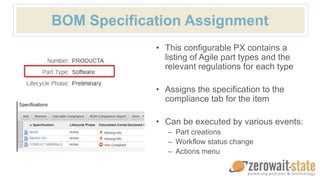
• This configurable PX contains a
listing of Agile part types and the
relevant regulations for each type
• Assigns the specification to the
compliance tab for the item
• Can be executed by various events:
– Part creations
– Workflow status change
– Actions menu
BOM Specification Assignment
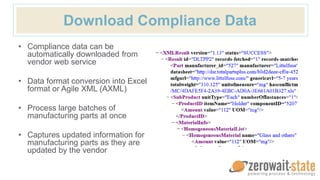
• Compliance data can be
automatically downloaded from
vendor web service
• Data format conversion into Excel
format or Agile XML (AXML)
• Process large batches of
manufacturing parts at once
• Captures updated information for
manufacturing parts as they are
updated by the vendor
Download Compliance Data
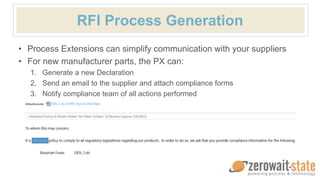
• Process Extensions can simplify communication with your suppliers
• For new manufacturer parts, the PX can:
1. Generate a new Declaration
2. Send an email to the supplier and attach compliance forms
3. Notify compliance team of all actions performed
RFI Process Generation
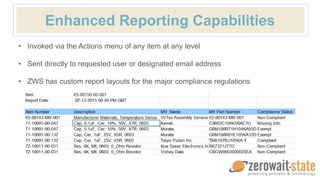
Enhanced Reporting Capabilities
• Useful for complex evaluations of regulatory rules
• Saves time spent from searching and transforming Agile data
• Breaks down product BOMs and can pinpoint the source of
compliance issues
• Report formatted in Excel, which is easy to understand and
collaborate
• Invoked via the Actions menu of any item at any level
• Sent directly to requested user or designated email address
• ZWS has custom report layouts for the major compliance regulations
Enhanced Reporting Capabilities
WE WILL NOW OPEN UP THE AUDIO TO VIEWER QUESTIONS.
PART THREE WEBINAR
“In-depth Discussion on the Ever-Changing Regulatory Environment for Product Development”
May 6, 2015 at 10 am CST
COMPLIANCE@ZEROWAIT-STATE.COM
Contact us if you have any questions!

Compliance in PLM Webinar 2

  • 1.
    Product Governance &Compliance Webinar 2 - Wake Up Your Compliance with Automation Presented by: Charles Vernor, Solutions Consultant Dries D’Hooghe, Environmental Compliance Consultant
  • 2.
    Who is ZWS? ZeroWait-State helps companies implement an effective PLM strategy based on their specific business model Services Products implementation integration data migration DescriptionBuilder DesignState LoadState PDXState
  • 3.
    Today’s Agenda 1. Prosand Cons: Part Research Vendors 2. Pros and Cons: Directly with Suppliers 3. LoadState Demonstration 4. Highlight Useful Process Extensions 5. Q&A
  • 4.
    PROS AND CONS:PART RESEARCH VENDORS What to expect when paying for manufacturer part data and research
  • 5.
    Part Research Vendors •Your company receive compliance data through a single entity – Fast access to available manufacturer part data – Provides data research for companies if necessary • Pricing fluctuates based on features and data volume • The quality of the compliance data is higher – Consistent format from supplier to supplier – Validated for data entry errors and misinformation • Some companies that offer this service: – Total Parts Plus (CMM) – Intertek / Decernis (gComply Plus) – IHS CAPS Universe – SiliconExpert – Q Point (GDX)
  • 6.
    Part Research Vendors– Web Services • Vendors have developed automations and data access services to complement their user interfaces – Added convenience to the customer – Enabled automatic push or pull of information – Keeps customer’s PLM system up to date • A web XML service is a common feature with providers today • The received format (XML, Excel, etc.) can be transformed into an Agile-supported format and imported into PG&C
  • 7.
    Part Research Vendors- Pitfalls • Automation is useful, but due diligence is still required – Data errors can still be present which impacts BOM compliance – Compliance users must still review and sign off on incoming data – Set up a release workflow with multiple reviewers • LoadState can perform additional custom validations to improve data quality and enforce company standards • Any errors or issues will be uploaded to declaration for review • Agile notifications can be sent to necessary observers
  • 8.
    Part Research Vendors- Summary • Positives: – Outsourced compliance data research – Avoids working directly with many suppliers or manufacturers – Consistent, error-free data validations • Negatives: – More costly, especially for high-mix companies – Specialized parts will take more time for research (or may not be supported)
  • 9.
    PROS AND CONS:DIRECTLY WITH SUPPLIERS What to expect when requesting information directly with individual suppliers
  • 10.
    Request for Information(RFI) Process • The RFI process is an inquiry initiated by your company to a representative with the manufacturer or supplier • Performed in variety of formats (phone, fax, letter, email) • Can track RFI progress in Agile declaration workflow • May require follow-ups with some suppliers and there can be delays getting the information needed
  • 11.
    RFI Process: ProcessingInfo Option 1 (Manual Data Entry): 1. Inspect the document 2. Add the information into Agile declaration 3. Mark the compliance status if not calculable • Compliance data entry can be streamlined • Slower method of getting information into Agile
  • 12.
    Request for Information(RFI) Process Option 2 (Data Import Tool): 1. Inspect the document 2. Use LoadState or other utility to transform the data into Agile format 3. Import the data onto the declaration, item or manufacturer part • LoadState can monitor an import folder and will automatically generate and populate declarations for every file imported • LoadState templates can perform custom validations or interpret compliance results based on company rules or constraints
  • 13.
    Request for Information(RFI) Process • To use LoadState with your RFI process: 1. Establish a compliance template format in Excel 2. Store a blank form to send to supplier representatives 3. Receive responses and import • Not all suppliers will fill out information in your form if they already have produced the data • Some Excel manipulation may be required
  • 14.
    Request for Information(RFI) Process • Positives: – Lower cost for your company – Manageable for companies with fewer manufacturer parts – Large companies have influence over data format • Negatives: – Time consuming for high-mix companies supporting many suppliers – Slower response times getting information from certain companies – May encounter numerous data formats
  • 15.
    Supplier Access toAgile PLM • The Agile PLM platform supports user accounts for your suppliers or manufacturers, if your security policy allows • Suppliers can log in and create new declarations for their parts and submit them to the compliance team for review • Simplifies the data entry for your compliance team, which would only need to review and sign off on the information
  • 16.
    Supplier Access toAgile PLM • Some companies may not be familiar or accommodating in working inside your company’s Agile PLM instance • Training classes and process documentation will be involved with getting your suppliers on board with this method • Smaller companies may not be able to enforce this process on all suppliers, and may need to use other input methods
  • 17.
    Supplier Access toAgile PLM • Positives: – Less data entry for your compliance team – Larger companies can enforce this approach with suppliers • Negatives: – User account setup and access can be cumbersome – Training and documentation required for proper use – Smaller companies may experience delays in receiving data
  • 18.
  • 19.
    HIGHLIGHT USEFUL PROCESSEXTENSIONS Additional automations that improve productivity and data quality
  • 20.
    BOM Specification Assignment •To track regulations for a product in PG&C: 1. Create specification object(s) in Agile (REACH, RoHS, etc.) 2. Add specification(s) to top-level of your product assembly 3. Trigger rollup to propagate the specification(s) to the lowest level • This process can be very manual and time consuming if repeated for many products • Regulations differ based on product type, and there is often not a clear definition for your engineers to follow
  • 21.
    • This configurablePX contains a listing of Agile part types and the relevant regulations for each type • Assigns the specification to the compliance tab for the item • Can be executed by various events: – Part creations – Workflow status change – Actions menu BOM Specification Assignment
  • 22.
    • Compliance datacan be automatically downloaded from vendor web service • Data format conversion into Excel format or Agile XML (AXML) • Process large batches of manufacturing parts at once • Captures updated information for manufacturing parts as they are updated by the vendor Download Compliance Data
  • 23.
    • Process Extensionscan simplify communication with your suppliers • For new manufacturer parts, the PX can: 1. Generate a new Declaration 2. Send an email to the supplier and attach compliance forms 3. Notify compliance team of all actions performed RFI Process Generation
  • 24.
    Enhanced Reporting Capabilities •Useful for complex evaluations of regulatory rules • Saves time spent from searching and transforming Agile data • Breaks down product BOMs and can pinpoint the source of compliance issues • Report formatted in Excel, which is easy to understand and collaborate
  • 25.
    • Invoked viathe Actions menu of any item at any level • Sent directly to requested user or designated email address • ZWS has custom report layouts for the major compliance regulations Enhanced Reporting Capabilities
  • 26.
    WE WILL NOWOPEN UP THE AUDIO TO VIEWER QUESTIONS.
  • 27.
    PART THREE WEBINAR “In-depthDiscussion on the Ever-Changing Regulatory Environment for Product Development” May 6, 2015 at 10 am CST
  • 28.

Editor's Notes

  • #29 Speak on Substances rollup – external rollup Part Level REACH, Article level reach Substances rollup is calculated overnight - Other PLM tools cant do this Searching and reporting framework