Writing
Your Food
Safety
Plan
Food Safety Modernization
Act (FSMA) Part II
Food, Nutrition, and Packaging Science Department
College of Agriculture, Forestry and Life Sciences
223 P&A Bldg. Clemson, South Carolina (864) 656-3397
Overview of Regulation
President Obama
signed FSMA into law
January 4, 2011
Responding
Preventing
Final Rule was
published on
September 17, 2015
4.8 million 128,000 3,000
Americans Yearly
Cost of a Recall
•  http://fortune.com/2016/07/21/chipotles-e-coli-hangover-lingers-as-sales-plunge-again/
•  http://www.denverpost.com/2016/07/21/decline-in-chipotle-sales-slows-but-restaurant-
chain-is-slow-to-recover-from-food-safety-crisis/
•  http://ir.chipotle.com/phoenix.zhtml?c=194775&p=irol-reportsAnnual
Quick Facts
•  Chipotle has over
2,000 Restaurants
•  “Food with Integrity”
(Fresh instead of Frozen)
•  Followed regulations,
but no HACCP plan
Estimated Cost of Recall: >$300 Million
Costs
•  Food Safety Training Cost: ???
•  Sales Decline: 23.6% ($1.2
billion to $998.4 million)
•  Promotions: Profits fell 82%
due to promotions ($140.2
million to $25.6 million)
•  Legal Costs: ???
Cost of Recall
Estimated Cost of a Recall: >$2.7 Million
Costs
2015 and 2016 Recalls
•  Cleaning Kitchen:
$200,000
•  Disposal of Ice Cream:
$2.5 million
•  Cost of Training: ???
•  Economic Impact: ???
•  http://www.foodsafetynews.com/2016/08/130962/#.WAozlJMrKb8
•  https://jenis.com/recall/
•  http://www.inc.com/kimberly-weisul/how-one-small-company-became-the-jedi-knights-of-ice-cream.html
Quick Facts
•  Jeni’s Splendid Ice Cream
has 23 Scoop Shops
•  High-End Groceries
•  Online Mail Orders
•  $25 million Annual Sales
•  265 tons of Ice Cream
Disposed
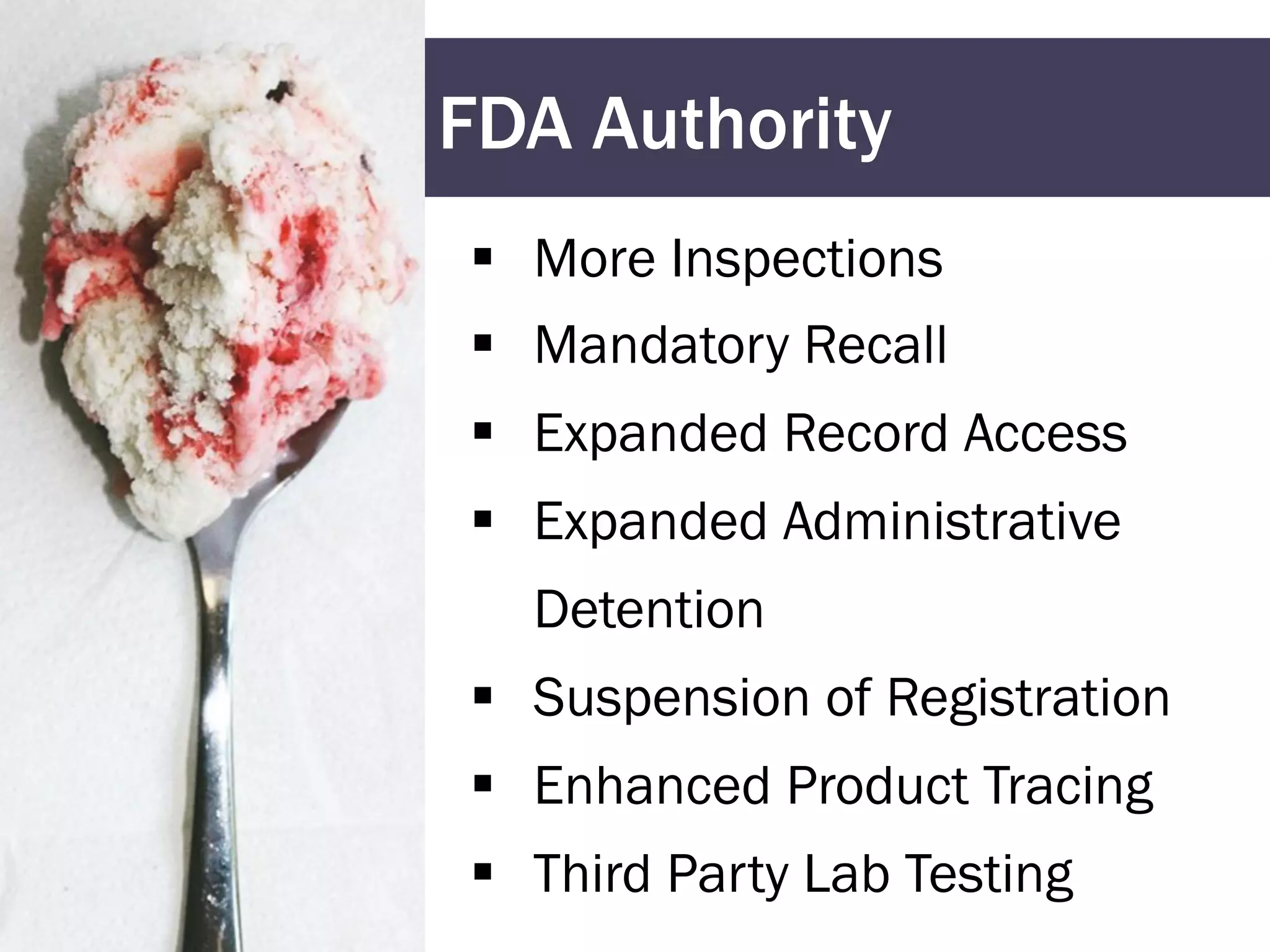
FDA Authority
§  More Inspections
§  Mandatory Recall
§  Expanded Record Access
§  Expanded Administrative
Detention
§  Suspension of Registration
§  Enhanced Product Tracing
§  Third Party Lab Testing
Some Compliance Dates
Very Small Business
September 17, 2018
(less than $1 million per year in
annual sales and market value of
products held without sale)
*Exempt from hazard analysis and
risk-based preventive controls with
documentation
Business subject to PMO
September 17, 2018
Small Business
September 17, 2017
(less than 500 employees)
Other Businesses
September 17, 2016
Retail Establishments
*Exempt
Qualified Facility
(1) during the 3-years preceding, the average annual monetary
value of the food manufactured, processed, packed or held at
such facility that is sold directly to qualified end users
exceeded the average annual monetary value of food sold to
all other purchasers; and
(2) the average annual monetary value of all food sold during
the 3-years preceding was less that $500,000, adjusted for
inflation
A facility that is a very small business
or both of the following apply
Where to Begin?
Training for PCQI through
Food Safety Preventive
Control Alliance (FSPCA)
Training course dates can be
found at www.ifsh.iit.edu/fspca
Training - FSPCA Preventive
Controls for Human Food
Designate a Food Safety
Team
•  Preventive Control Qualified
Individual (PCQI)
•  Recall Team
•  Employees
•  Qualified Auditor
PCQI Responsibilities: Preparing the Food Safety Plan, Validation of
Preventive Controls, Review of Records, and Reanalysis of Food
Safety Plan
What’s Required in your Food
Safety Plan?
1 Current Good Manufacturing Practices
(CGMPs)
2 Hazard Analysis
3 Preventive Controls
6 Recall Plan
4 Monitoring and Corrective Action
5 Verification and Validation
7 Reanalysis of Food Safety Plan
Components of your CGMPs
•  Personnel
•  Plant and grounds
•  Sanitary operations
•  Defect Action Levels
•  Equipment and utensils
•  Processes and controls
•  Warehousing and distribution
•  Sanitary facilities and controls
•  Holding and distribution
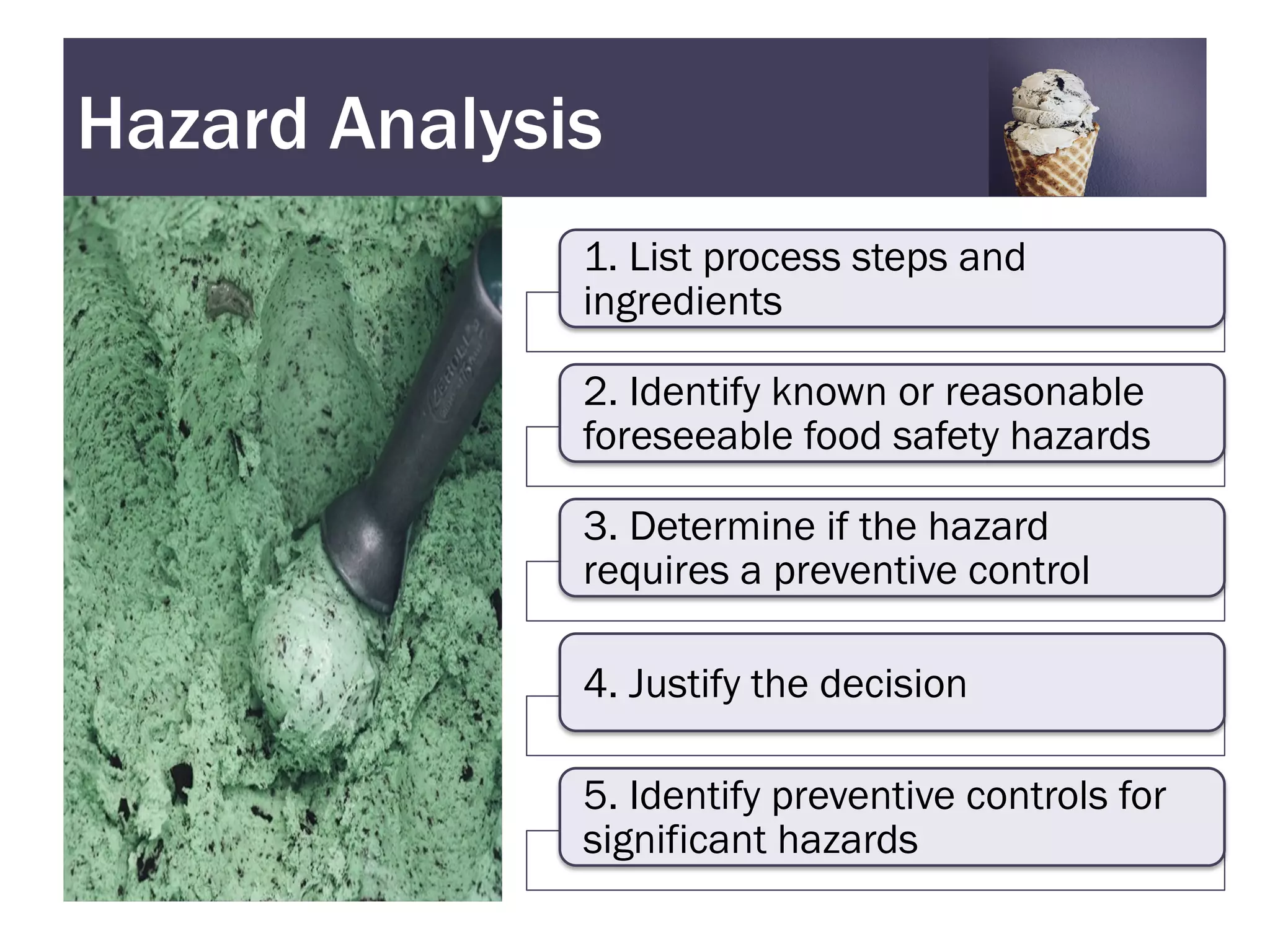
Hazard Analysis
1. List process steps and
ingredients
2. Identify known or reasonable
foreseeable food safety hazards
3. Determine if the hazard
requires a preventive control
4. Justify the decision
5. Identify preventive controls for
significant hazards
Preventive Controls
Sanitation Controls
GMPs in Place
Daily Sanitation
Supply-Chain
Controls
3rd Party Audit
Allergen Controls
Cross Contact Prevention
Proper Storage
Process Controls
Pasteurization
Heat Treatment (Cook Time)
Monitoring and Corrective Action
•  Monitoring: written procedures,
including frequency of
performance
•  Corrective Action: used to identify
and correct a problem with
implementation of preventive
control
KEEP RECORDS
Minimum of 2 years
Verification and Validation
Verification: are the
controls in the plan being
properly implemented?
Validation: does the
plan actually control the
hazards?
Environmental Monitoring
for Ready-To-Eat Foods
(i.e. ice cream)
Recall Plan
Must describe steps to take and
assign responsibility to:
•  Notify direct customers
•  Notify the public
•  Conduct effectiveness checks
•  Execute disposition of food
Required for any food with a hazard requiring a
preventive controls
Food Safety Plan Reanalysis
Reanalysis must be
Performed:
•  At least every 3 years
•  Major change to
product/process
•  New potential hazards
•  Preventive control is
ineffective
•  Unanticipated problem Reanalysis must be performed
or overseen by the PCQI
Summary
1. Identify
Hazard 2. Understand
Cause
3. Implement
Preventive
Controls
4. Monitor
Effectiveness
5. Review
& Adjust
Outdated ingredient specs
not matching supplier
procedures
Unforeseen Issue
What Will it Cost?
•  Initial
–  Employee (75% of time for 3 months, $20/hr.): $7,200
–  PCQI Certification: $700-900
–  Mock Recall (1 day (8hrs.), 5 Employees, $20/hr.): $800
•  On Going
–  Labor/Recording Keeping: (25% of time, 1 year est.,
$20/hr): $10,400
–  Training: $1,209/employee
–  3rd Party Audit (Eagle Certification Group): $3,800
Estimated Cost for Food Safety Plan: $24,209
Resources
•  Clemson Extension (Example Food Safety Plan,
Training Manual, and PowerPoint)
–  http://www.clemson.edu/extension/publications/
index.html
•  Food Safety Preventive Control Alliance (FSPCA)
–  https://www.ifsh.iit.edu/fspca
•  FDA
–  http://www.fda.gov/Food/GuidanceRegulation/FSMA/
–  http://www.fda.gov/Food/GuidanceRegulation/
FoodFacilityRegistration/QualifiedFacilityAttestation/
ucm496263.htm
Food, Nutrition, and Packaging Science Department
College of Agriculture, Forestry and Life Sciences
223 P&A Bldg. Clemson, South Carolina (864) 656-3397
Katie Worley
kpworle@g.clemson.edu
Dr. Johnny McGregor
johnny@clemson.edu
Quiz: What are
your requirements
for FSMA?
Group
Activity
Question 1
You buy Mr. Green Jeans farm fresh
strawberries from the local farmers market to
use in your ice cream. Your company has made
an average of $1.5 million over the past 3
years selling to grocery stores and scoop
shops and has 50 employees. You are not
required to follow PMO. What is your FSMA
classification (small, very small, retail, etc.)
and what procedures would you need to follow
under FSMA?
Question 1 Answer
•  Classification: Small Business
•  Required for FSMA:
– GMPs and a Food Safety Plan (Hazard Analysis,
Preventive Controls, Recall Plan, etc.)
– Preventive Controls may include:
•  Washing the strawberries to reduce chemical hazards
(pesticides) and remove physical hazards such as
rocks
•  Heat Treating the strawberries to reduce biological
hazards
•  Supply Chain Control
Additional Information Question 1
– If a farm falls under the produce law, which
regulates the water purity and other safety
hazards, then they will have a certificate that
ensures that the produce is safe. If the farm is
exempt from the produce law, they may have a
GAPs audit.
–  As a business, you need to decide if you will use
a supplier that does not have GAPs audit or fall
under the produce law. If you choose to use the
supplier lacking these, what processes will you
do to control the hazards?
Question 2
Your company receives mix from a commercial
mix manufacturer and you batch freeze to make
ice cream. Your average sales are $750,000
annually by selling ice cream in your scoop
shop and at fairs and festivals in a concession
trailer. The fairs are over a 300 mile radius in
the tri-state area. What is your FSMA
classification (small, very small, retail, etc.)
and what procedures must you follow?
Question 2 Answer
•  Classification: Very Small Business (Qualified
Facility)
•  Required for FSMA:
– GMPs and Training Records
•  Recommended:
– Make sure your suppliers are compliant with
FSMA
– Maintain records
Question 3
An ice cream mix manufacturing company has
25 employees and has an average gross sales
of $1.5 million. The mix is then distributed
wholesale. You are required to comply with the
PMO. What is your FSMA classification (small,
very small, etc.) and what are you required to
make available to your customers?
Question 3 Answer
•  Classification: Small Business (Subject to
PMO)
•  Required to Provide to Customers:
– Allow customers to perform a 3rd party audit or
you as the company can have a 3rd party audit
done on your facility and provide all customers
with the audit report
– Food Safety Reports
Question 4
Your 25 person company makes ice cream
that is sold in your retail operations. You also
distribute to restaurants and grocery stores in
Austin, Dallas, and Fort Worth. Your gross
sales are $2.5 million annually, of which 30%
is in your retail scoop shop, 10% is sold to local
restaurants and 60% is sold in grocery stores.
What is your FSMA classification (small, very
small, retail, etc.) and what are your
requirements?
Question 4 Answer
•  Classification: Small Business
•  Required for FSMA:
– Everything!
– GMPs, Hazard Analysis, Preventive Controls,
Monitoring/Verification/Validation, Recall Plan,
Reanalysis
Food, Nutrition, and Packaging Science Department
College of Agriculture, Forestry and Life Sciences
223 P&A Bldg. Clemson, South Carolina (864) 656-3397
Katie Worley
kpworle@g.clemson.edu
www.linkedin.com/in/katie-worley
Dr. Johnny McGregor
johnny@clemson.edu

Writing Your Food Safety Plan- NICRA

  • 1.
    Writing Your Food Safety Plan Food SafetyModernization Act (FSMA) Part II Food, Nutrition, and Packaging Science Department College of Agriculture, Forestry and Life Sciences 223 P&A Bldg. Clemson, South Carolina (864) 656-3397
  • 2.
    Overview of Regulation PresidentObama signed FSMA into law January 4, 2011 Responding Preventing Final Rule was published on September 17, 2015 4.8 million 128,000 3,000 Americans Yearly
  • 3.
    Cost of aRecall •  http://fortune.com/2016/07/21/chipotles-e-coli-hangover-lingers-as-sales-plunge-again/ •  http://www.denverpost.com/2016/07/21/decline-in-chipotle-sales-slows-but-restaurant- chain-is-slow-to-recover-from-food-safety-crisis/ •  http://ir.chipotle.com/phoenix.zhtml?c=194775&p=irol-reportsAnnual Quick Facts •  Chipotle has over 2,000 Restaurants •  “Food with Integrity” (Fresh instead of Frozen) •  Followed regulations, but no HACCP plan Estimated Cost of Recall: >$300 Million Costs •  Food Safety Training Cost: ??? •  Sales Decline: 23.6% ($1.2 billion to $998.4 million) •  Promotions: Profits fell 82% due to promotions ($140.2 million to $25.6 million) •  Legal Costs: ???
  • 4.
    Cost of Recall EstimatedCost of a Recall: >$2.7 Million Costs 2015 and 2016 Recalls •  Cleaning Kitchen: $200,000 •  Disposal of Ice Cream: $2.5 million •  Cost of Training: ??? •  Economic Impact: ??? •  http://www.foodsafetynews.com/2016/08/130962/#.WAozlJMrKb8 •  https://jenis.com/recall/ •  http://www.inc.com/kimberly-weisul/how-one-small-company-became-the-jedi-knights-of-ice-cream.html Quick Facts •  Jeni’s Splendid Ice Cream has 23 Scoop Shops •  High-End Groceries •  Online Mail Orders •  $25 million Annual Sales •  265 tons of Ice Cream Disposed
  • 5.
    FDA Authority §  MoreInspections §  Mandatory Recall §  Expanded Record Access §  Expanded Administrative Detention §  Suspension of Registration §  Enhanced Product Tracing §  Third Party Lab Testing
  • 6.
    Some Compliance Dates VerySmall Business September 17, 2018 (less than $1 million per year in annual sales and market value of products held without sale) *Exempt from hazard analysis and risk-based preventive controls with documentation Business subject to PMO September 17, 2018 Small Business September 17, 2017 (less than 500 employees) Other Businesses September 17, 2016 Retail Establishments *Exempt
  • 7.
    Qualified Facility (1) duringthe 3-years preceding, the average annual monetary value of the food manufactured, processed, packed or held at such facility that is sold directly to qualified end users exceeded the average annual monetary value of food sold to all other purchasers; and (2) the average annual monetary value of all food sold during the 3-years preceding was less that $500,000, adjusted for inflation A facility that is a very small business or both of the following apply
  • 8.
    Where to Begin? Trainingfor PCQI through Food Safety Preventive Control Alliance (FSPCA) Training course dates can be found at www.ifsh.iit.edu/fspca Training - FSPCA Preventive Controls for Human Food Designate a Food Safety Team •  Preventive Control Qualified Individual (PCQI) •  Recall Team •  Employees •  Qualified Auditor PCQI Responsibilities: Preparing the Food Safety Plan, Validation of Preventive Controls, Review of Records, and Reanalysis of Food Safety Plan
  • 9.
    What’s Required inyour Food Safety Plan? 1 Current Good Manufacturing Practices (CGMPs) 2 Hazard Analysis 3 Preventive Controls 6 Recall Plan 4 Monitoring and Corrective Action 5 Verification and Validation 7 Reanalysis of Food Safety Plan
  • 10.
    Components of yourCGMPs •  Personnel •  Plant and grounds •  Sanitary operations •  Defect Action Levels •  Equipment and utensils •  Processes and controls •  Warehousing and distribution •  Sanitary facilities and controls •  Holding and distribution
  • 11.
    Hazard Analysis 1. Listprocess steps and ingredients 2. Identify known or reasonable foreseeable food safety hazards 3. Determine if the hazard requires a preventive control 4. Justify the decision 5. Identify preventive controls for significant hazards
  • 12.
    Preventive Controls Sanitation Controls GMPsin Place Daily Sanitation Supply-Chain Controls 3rd Party Audit Allergen Controls Cross Contact Prevention Proper Storage Process Controls Pasteurization Heat Treatment (Cook Time)
  • 13.
    Monitoring and CorrectiveAction •  Monitoring: written procedures, including frequency of performance •  Corrective Action: used to identify and correct a problem with implementation of preventive control KEEP RECORDS Minimum of 2 years
  • 14.
    Verification and Validation Verification:are the controls in the plan being properly implemented? Validation: does the plan actually control the hazards? Environmental Monitoring for Ready-To-Eat Foods (i.e. ice cream)
  • 15.
    Recall Plan Must describesteps to take and assign responsibility to: •  Notify direct customers •  Notify the public •  Conduct effectiveness checks •  Execute disposition of food Required for any food with a hazard requiring a preventive controls
  • 16.
    Food Safety PlanReanalysis Reanalysis must be Performed: •  At least every 3 years •  Major change to product/process •  New potential hazards •  Preventive control is ineffective •  Unanticipated problem Reanalysis must be performed or overseen by the PCQI
  • 17.
    Summary 1. Identify Hazard 2.Understand Cause 3. Implement Preventive Controls 4. Monitor Effectiveness 5. Review & Adjust
  • 18.
    Outdated ingredient specs notmatching supplier procedures Unforeseen Issue
  • 19.
    What Will itCost? •  Initial –  Employee (75% of time for 3 months, $20/hr.): $7,200 –  PCQI Certification: $700-900 –  Mock Recall (1 day (8hrs.), 5 Employees, $20/hr.): $800 •  On Going –  Labor/Recording Keeping: (25% of time, 1 year est., $20/hr): $10,400 –  Training: $1,209/employee –  3rd Party Audit (Eagle Certification Group): $3,800 Estimated Cost for Food Safety Plan: $24,209
  • 20.
    Resources •  Clemson Extension(Example Food Safety Plan, Training Manual, and PowerPoint) –  http://www.clemson.edu/extension/publications/ index.html •  Food Safety Preventive Control Alliance (FSPCA) –  https://www.ifsh.iit.edu/fspca •  FDA –  http://www.fda.gov/Food/GuidanceRegulation/FSMA/ –  http://www.fda.gov/Food/GuidanceRegulation/ FoodFacilityRegistration/QualifiedFacilityAttestation/ ucm496263.htm
  • 21.
    Food, Nutrition, andPackaging Science Department College of Agriculture, Forestry and Life Sciences 223 P&A Bldg. Clemson, South Carolina (864) 656-3397 Katie Worley kpworle@g.clemson.edu Dr. Johnny McGregor johnny@clemson.edu
  • 22.
    Quiz: What are yourrequirements for FSMA?
  • 23.
  • 24.
    Question 1 You buyMr. Green Jeans farm fresh strawberries from the local farmers market to use in your ice cream. Your company has made an average of $1.5 million over the past 3 years selling to grocery stores and scoop shops and has 50 employees. You are not required to follow PMO. What is your FSMA classification (small, very small, retail, etc.) and what procedures would you need to follow under FSMA?
  • 25.
    Question 1 Answer • Classification: Small Business •  Required for FSMA: – GMPs and a Food Safety Plan (Hazard Analysis, Preventive Controls, Recall Plan, etc.) – Preventive Controls may include: •  Washing the strawberries to reduce chemical hazards (pesticides) and remove physical hazards such as rocks •  Heat Treating the strawberries to reduce biological hazards •  Supply Chain Control
  • 26.
    Additional Information Question1 – If a farm falls under the produce law, which regulates the water purity and other safety hazards, then they will have a certificate that ensures that the produce is safe. If the farm is exempt from the produce law, they may have a GAPs audit. –  As a business, you need to decide if you will use a supplier that does not have GAPs audit or fall under the produce law. If you choose to use the supplier lacking these, what processes will you do to control the hazards?
  • 27.
    Question 2 Your companyreceives mix from a commercial mix manufacturer and you batch freeze to make ice cream. Your average sales are $750,000 annually by selling ice cream in your scoop shop and at fairs and festivals in a concession trailer. The fairs are over a 300 mile radius in the tri-state area. What is your FSMA classification (small, very small, retail, etc.) and what procedures must you follow?
  • 28.
    Question 2 Answer • Classification: Very Small Business (Qualified Facility) •  Required for FSMA: – GMPs and Training Records •  Recommended: – Make sure your suppliers are compliant with FSMA – Maintain records
  • 29.
    Question 3 An icecream mix manufacturing company has 25 employees and has an average gross sales of $1.5 million. The mix is then distributed wholesale. You are required to comply with the PMO. What is your FSMA classification (small, very small, etc.) and what are you required to make available to your customers?
  • 30.
    Question 3 Answer • Classification: Small Business (Subject to PMO) •  Required to Provide to Customers: – Allow customers to perform a 3rd party audit or you as the company can have a 3rd party audit done on your facility and provide all customers with the audit report – Food Safety Reports
  • 31.
    Question 4 Your 25person company makes ice cream that is sold in your retail operations. You also distribute to restaurants and grocery stores in Austin, Dallas, and Fort Worth. Your gross sales are $2.5 million annually, of which 30% is in your retail scoop shop, 10% is sold to local restaurants and 60% is sold in grocery stores. What is your FSMA classification (small, very small, retail, etc.) and what are your requirements?
  • 32.
    Question 4 Answer • Classification: Small Business •  Required for FSMA: – Everything! – GMPs, Hazard Analysis, Preventive Controls, Monitoring/Verification/Validation, Recall Plan, Reanalysis
  • 33.
    Food, Nutrition, andPackaging Science Department College of Agriculture, Forestry and Life Sciences 223 P&A Bldg. Clemson, South Carolina (864) 656-3397 Katie Worley kpworle@g.clemson.edu www.linkedin.com/in/katie-worley Dr. Johnny McGregor johnny@clemson.edu