


Proper Recordkeeping and
Documentation:
The Key to Reducing Risk and Liabilities
Melanie Neumann, The Acheson Group
James P. Reynolds, Lineage Logistics
Holly Mockus, Alchemy Systems
Melanie Neumann,
J. D., M.S.
EVP & CFO
The Acheson Group, LLC
3
Overview
What do the rules require for record keeping
How do you approach record keeping and
documentation for compliance
Other legal considerations
4
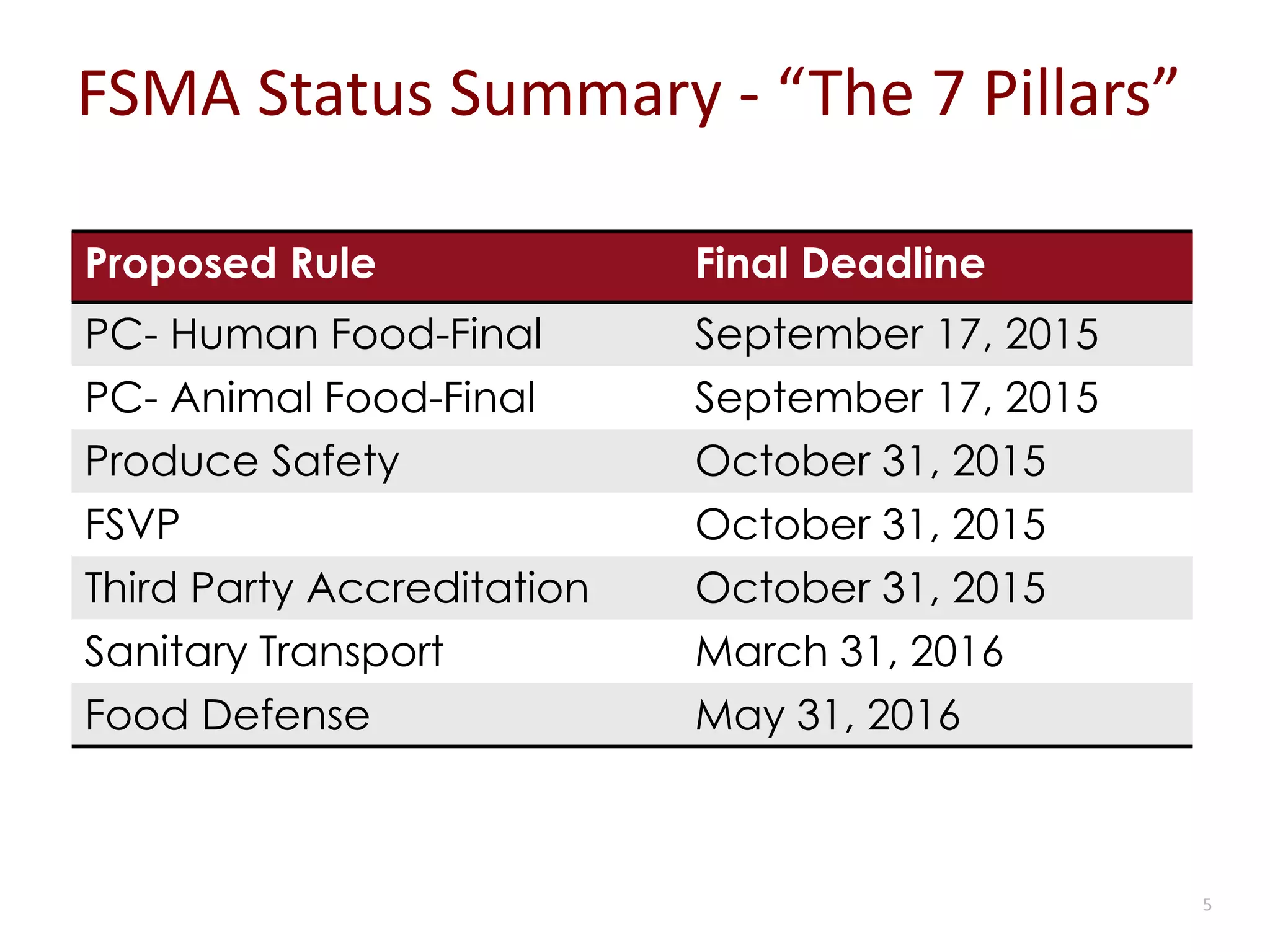
FSMA Status Summary - “The 7 Pillars”
Proposed Rule Final Deadline
PC- Human Food-Final September 17, 2015
PC- Animal Food-Final September 17, 2015
Produce Safety October 31, 2015
FSVP October 31, 2015
Third Party Accreditation October 31, 2015
Sanitary Transport March 31, 2016
Food Defense May 31, 2016
5
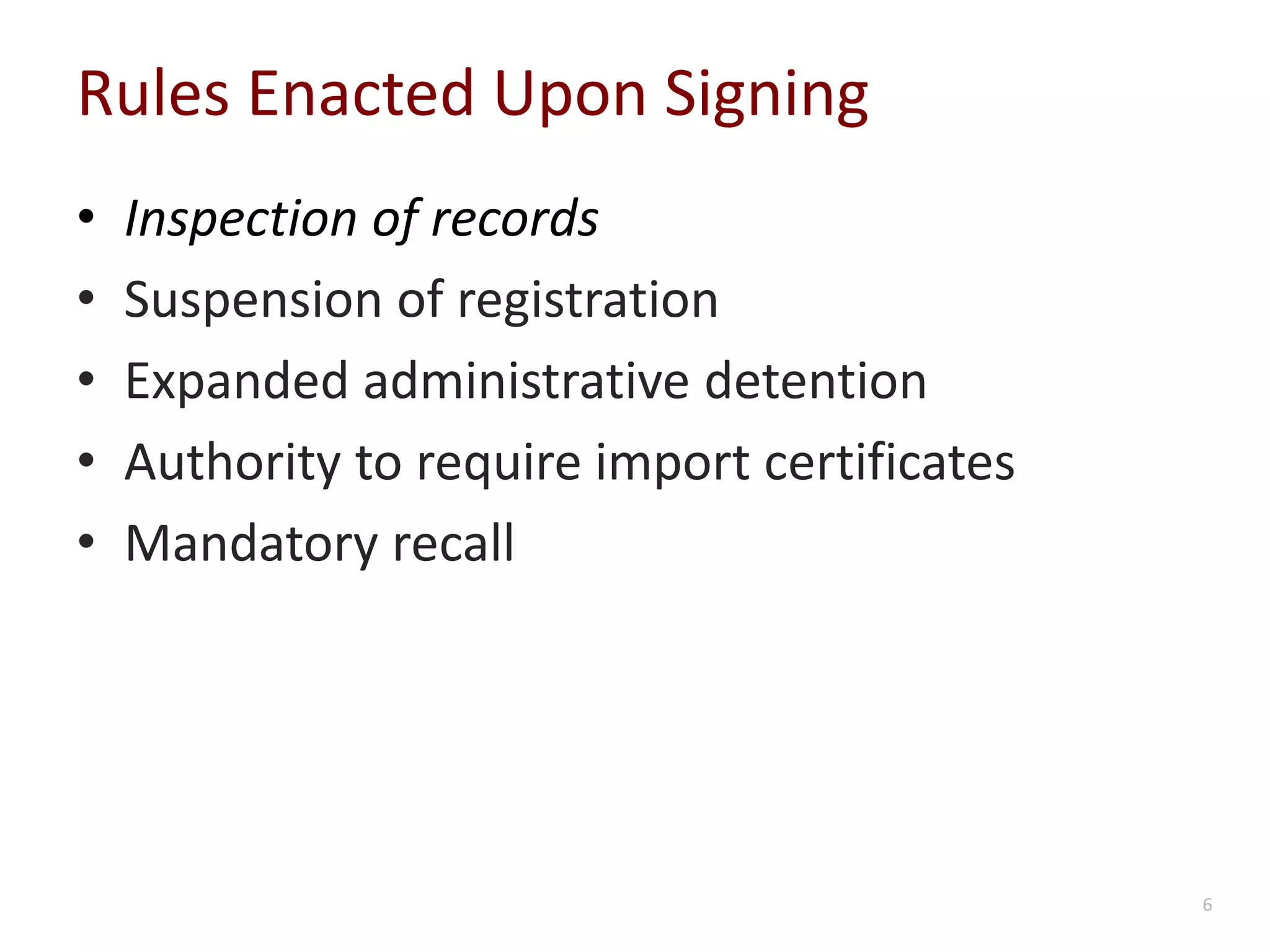
Rules Enacted Upon Signing
• Inspection of records
• Suspension of registration
• Expanded administrative detention
• Authority to require import certificates
• Mandatory recall
6
The Food Safety Plan-A Key Required
Document
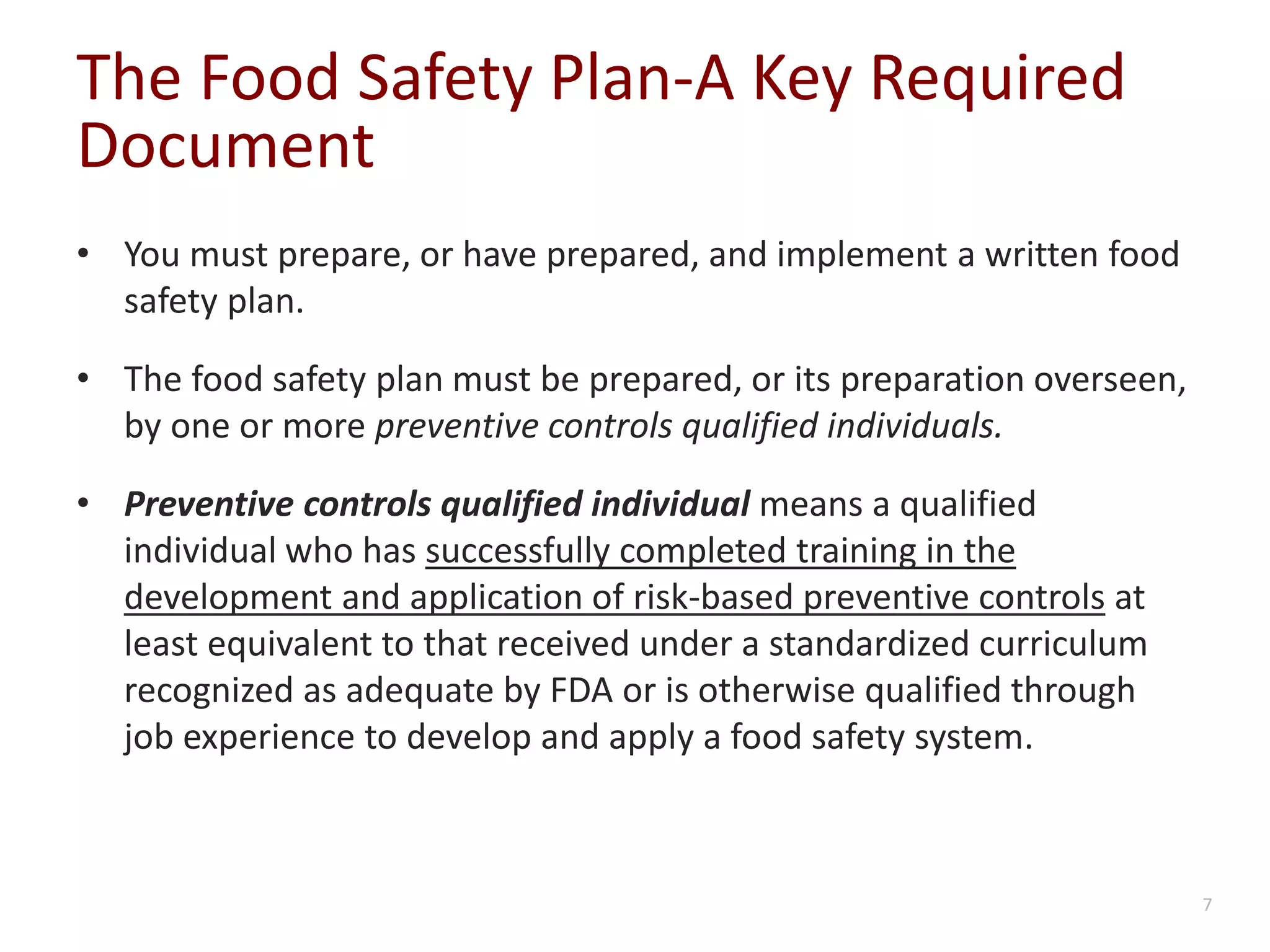
• You must prepare, or have prepared, and implement a written food
safety plan.
• The food safety plan must be prepared, or its preparation overseen,
by one or more preventive controls qualified individuals.
• Preventive controls qualified individual means a qualified
individual who has successfully completed training in the
development and application of risk-based preventive controls at
least equivalent to that received under a standardized curriculum
recognized as adequate by FDA or is otherwise qualified through
job experience to develop and apply a food safety system.
7
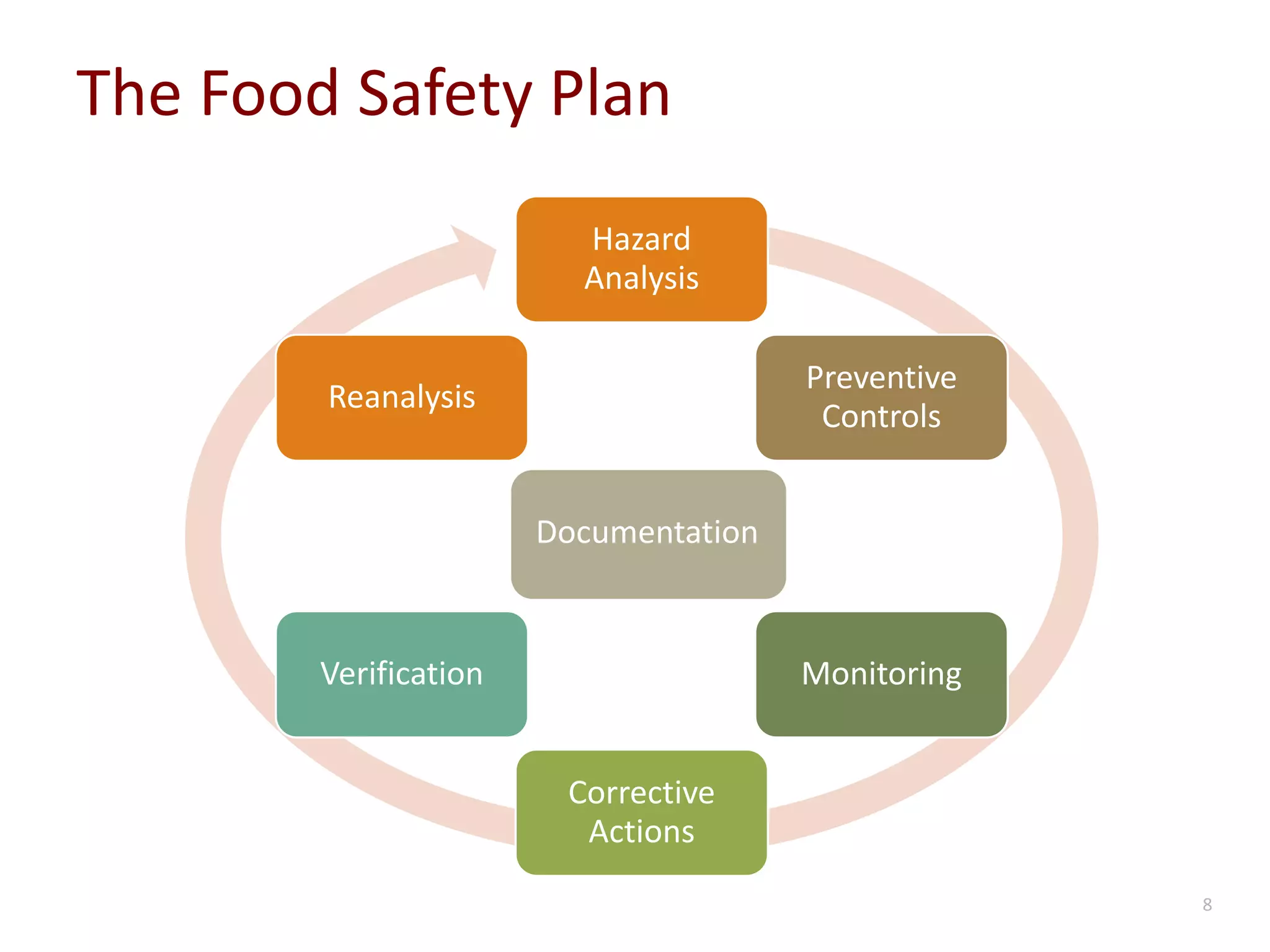
The Food Safety Plan
Hazard
Analysis
Preventive
Controls
Monitoring
Corrective
Actions
Verification
Reanalysis
Documentation
8
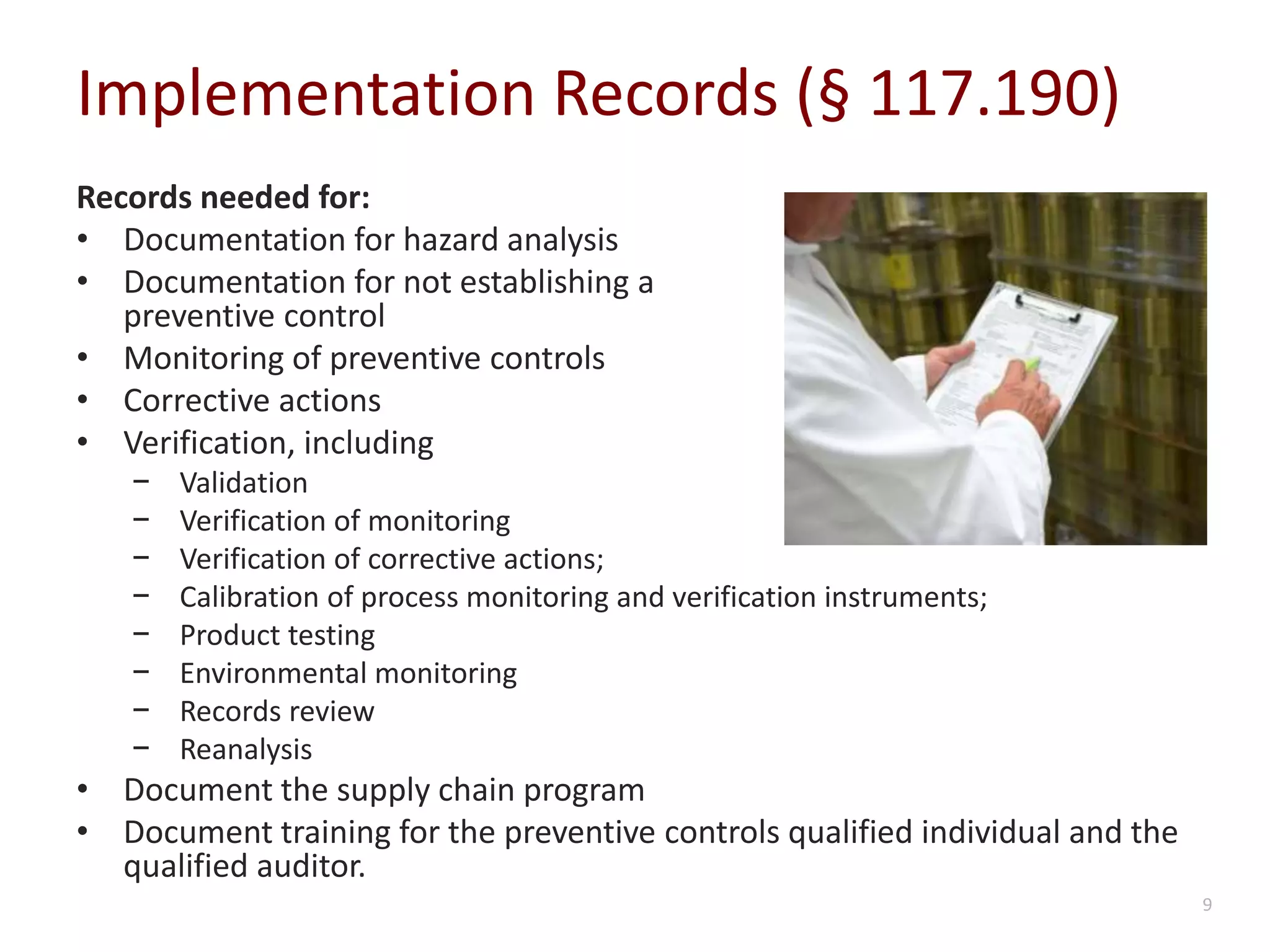
Implementation Records (§ 117.190)
Records needed for:
• Documentation for hazard analysis
• Documentation for not establishing a
preventive control
• Monitoring of preventive controls
• Corrective actions
• Verification, including
− Validation
− Verification of monitoring
− Verification of corrective actions;
− Calibration of process monitoring and verification instruments;
− Product testing
− Environmental monitoring
− Records review
− Reanalysis
• Document the supply chain program
• Document training for the preventive controls qualified individual and the
qualified auditor.
9
Records for Supply Chain (§ 117.475)
• Must have a written plan
• If importer must have documentation showing to be in compliance
with FSVP
• Documentation of the approval of a supplier
• Procedures for receiving raw materials
• Documentation demonstrating use of the written procedures for
receiving raw materials
• Documentation of the determination of the appropriate supplier
verification
• Documentation of the conduct of the onsite audit (lots of details)
• Sampling and testing (lots of details)
• Review of the suppliers food safety records
• Verification activities other than onsite audit
• Actions taken with regard to non-compliance
10
Required Records
• All records can be stored off site, with exception of the
written food safety plan, as long as they are accessible within
24 hours of a request for official review
– Food Safety Plan records do not need to be stored in one
location or in “one binder”
• Record retention begins after the applicable compliance date
• Records must also document
– Training
– Reanalysis
• Electronic records exempt from 21 CFR Part 11, however must
be equivalent to paper records and handwritten signatures
11
Legal Considerations
• Admissions Against Interest
• Speculation
• Strict Liability
– The Park Doctrine:
• The Park Doctrine is based on a 1975 U.S. Supreme Court case
affirming FDA’s right to bring a criminal misdemeanor case against
corporate executives based on a strict liability theory.
• A corporate official can be held criminally liable for violations of
the FD&C Act even if the official did not intend for the violations to
occur.
• NO ACTUAL KNOWLEDGE OR NEGLIGENCE REQUIRED
• Complaint Management People, Process & Systems are Key!
12
Thank You
melanie@achesongroup.com
13
James P.
Reynolds
Director of Food
Safety & Compliance
Lineage
14
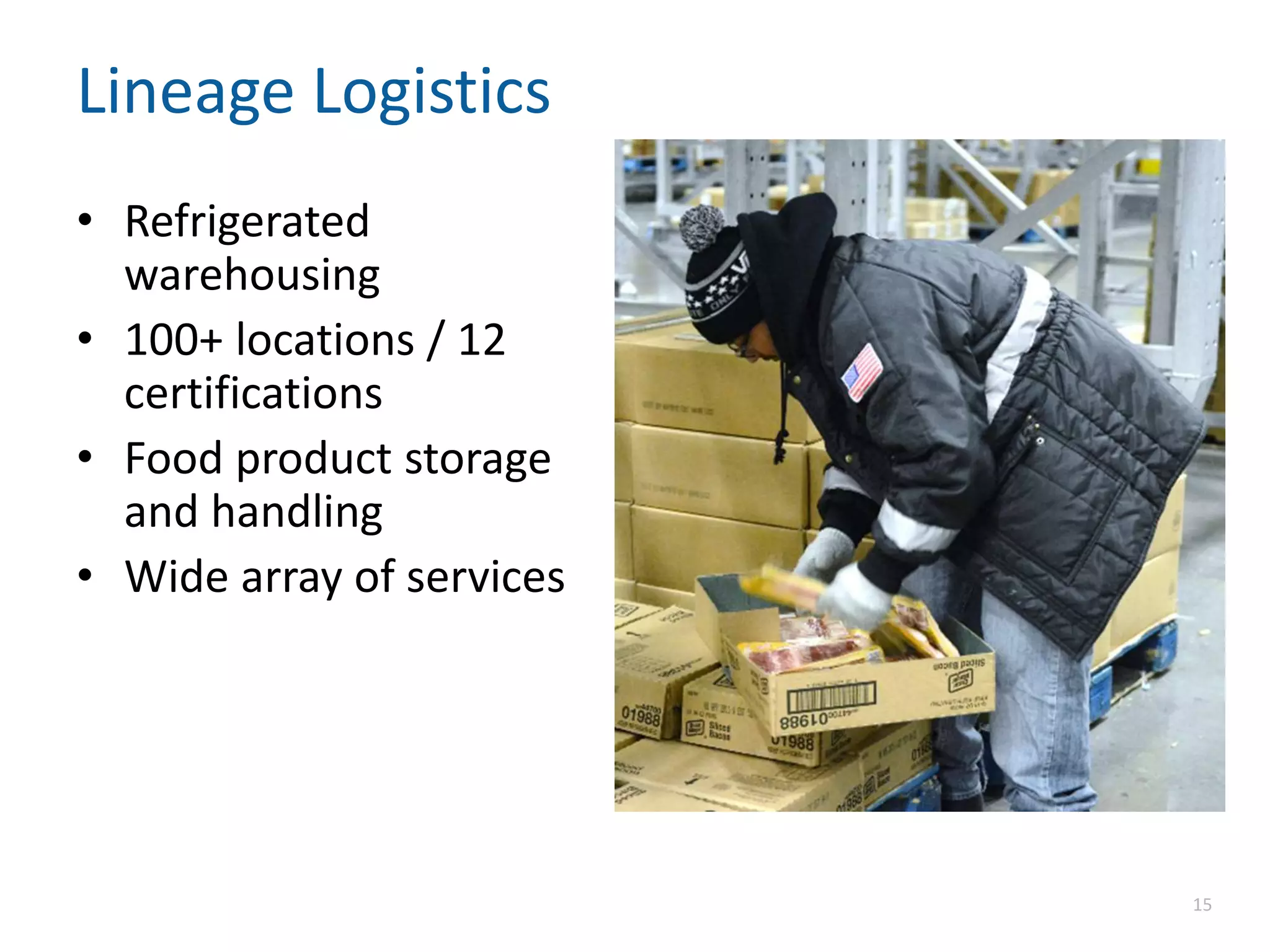
Lineage Logistics
• Refrigerated
warehousing
• 100+ locations / 12
certifications
• Food product storage
and handling
• Wide array of services
15
Background
• Joined Lineage Logistics in 2012
• 20+ year career in Naval Aviation
• Documentation
– Operational status
– Lessons learned
– Compliance
16
Overview
1. Objectives & relationships
2. Role of management
3. Common pitfalls
17
Recordkeeping Objectives
1. Operations/communication
2. Demonstrate effective food safety
3. Audit & regulatory compliance
18
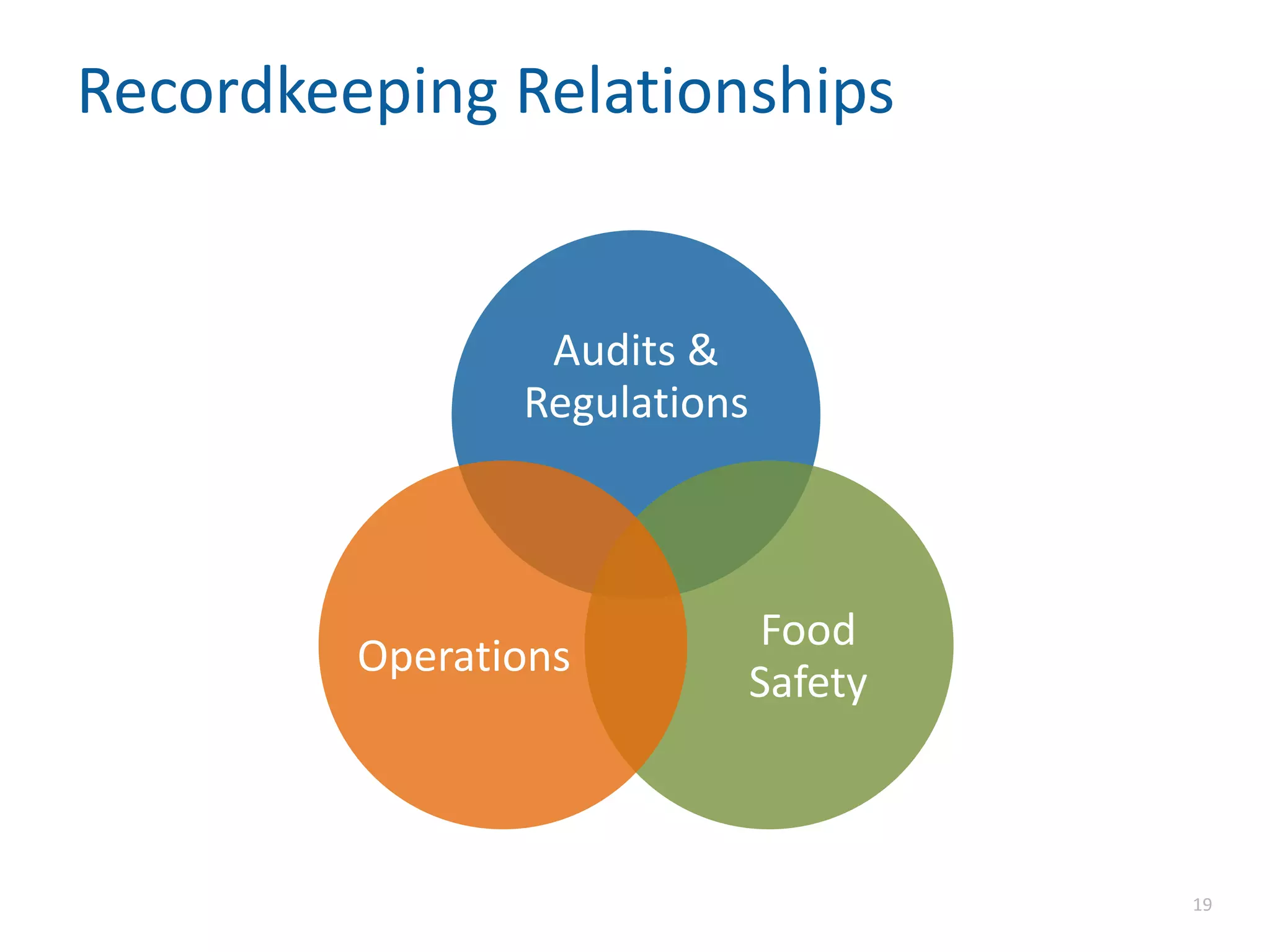
Recordkeeping Relationships
Audits &
Regulations
Food
Safety
Operations
19
Operations
1. Incoming & outbound inspections
2. Storage temperatures
3. Inventory control
4. Value-added services
– Effectiveness
– Capturing of costs
20
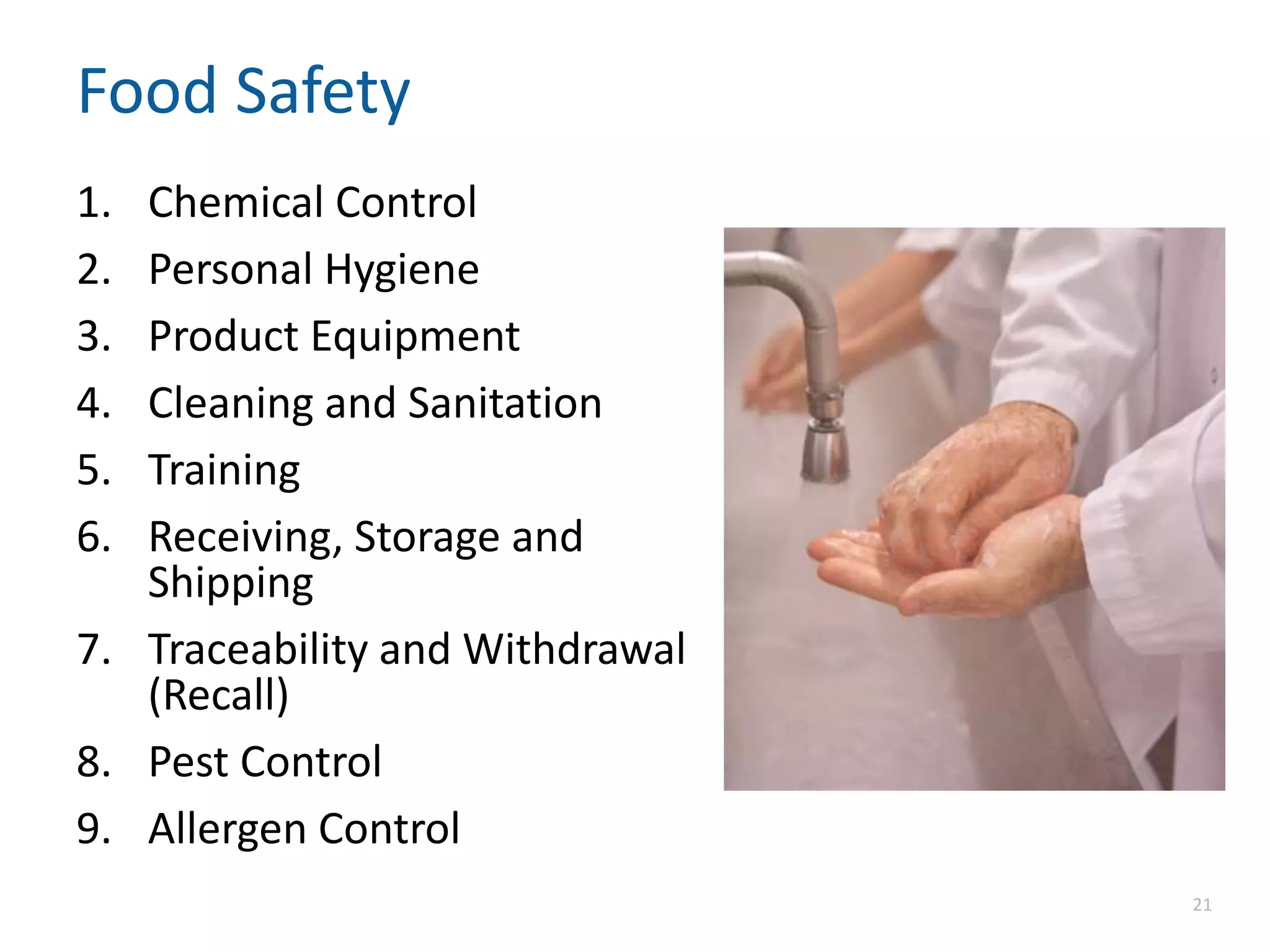
Food Safety
1. Chemical Control
2. Personal Hygiene
3. Product Equipment
4. Cleaning and Sanitation
5. Training
6. Receiving, Storage and
Shipping
7. Traceability and Withdrawal
(Recall)
8. Pest Control
9. Allergen Control
21
Audits & Regulations
22
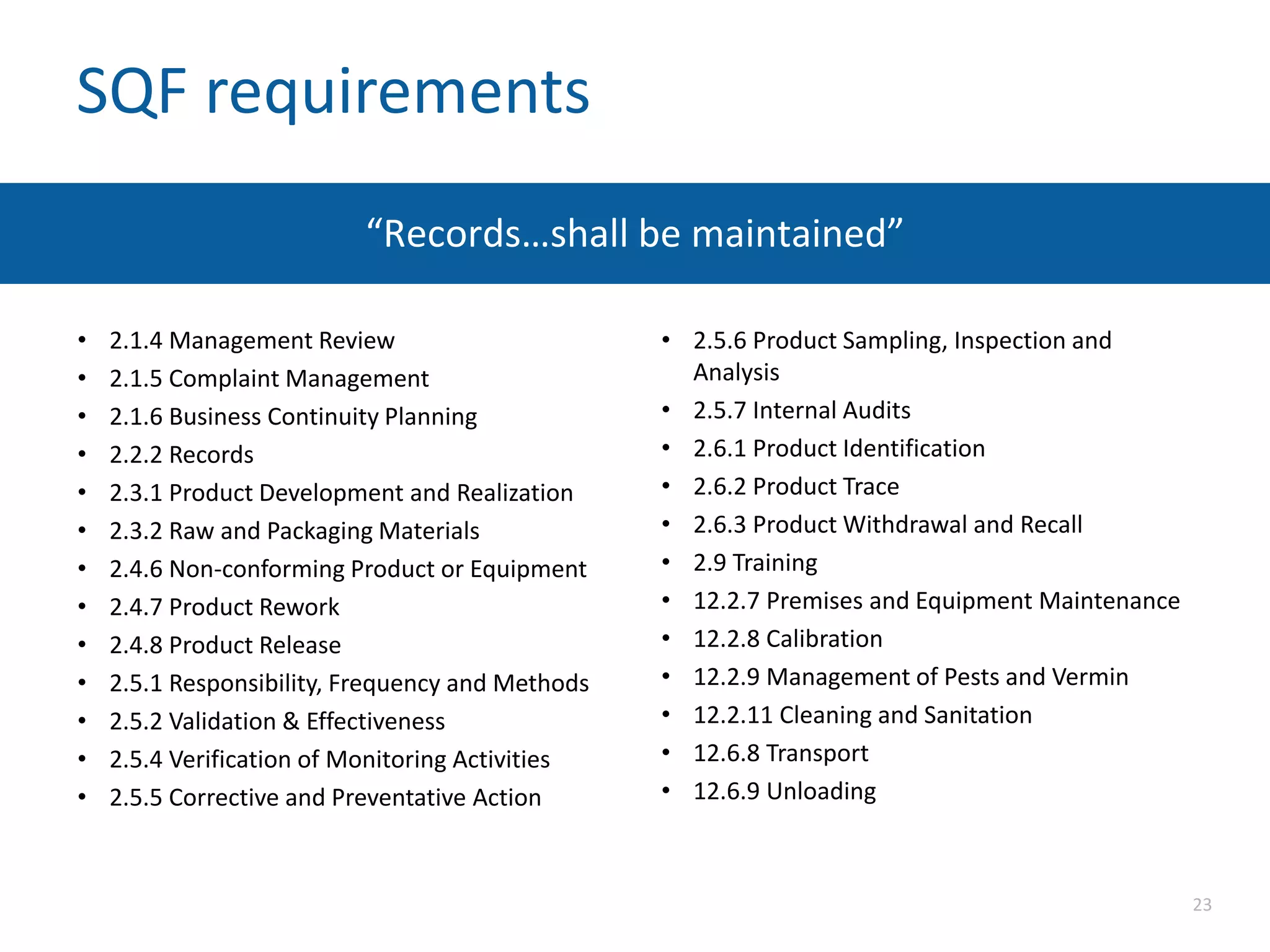
SQF requirements
“Records…shall be maintained”
• 2.1.4 Management Review
• 2.1.5 Complaint Management
• 2.1.6 Business Continuity Planning
• 2.2.2 Records
• 2.3.1 Product Development and Realization
• 2.3.2 Raw and Packaging Materials
• 2.4.6 Non-conforming Product or Equipment
• 2.4.7 Product Rework
• 2.4.8 Product Release
• 2.5.1 Responsibility, Frequency and Methods
• 2.5.2 Validation & Effectiveness
• 2.5.4 Verification of Monitoring Activities
• 2.5.5 Corrective and Preventative Action
• 2.5.6 Product Sampling, Inspection and
Analysis
• 2.5.7 Internal Audits
• 2.6.1 Product Identification
• 2.6.2 Product Trace
• 2.6.3 Product Withdrawal and Recall
• 2.9 Training
• 12.2.7 Premises and Equipment Maintenance
• 12.2.8 Calibration
• 12.2.9 Management of Pests and Vermin
• 12.2.11 Cleaning and Sanitation
• 12.6.8 Transport
• 12.6.9 Unloading
23
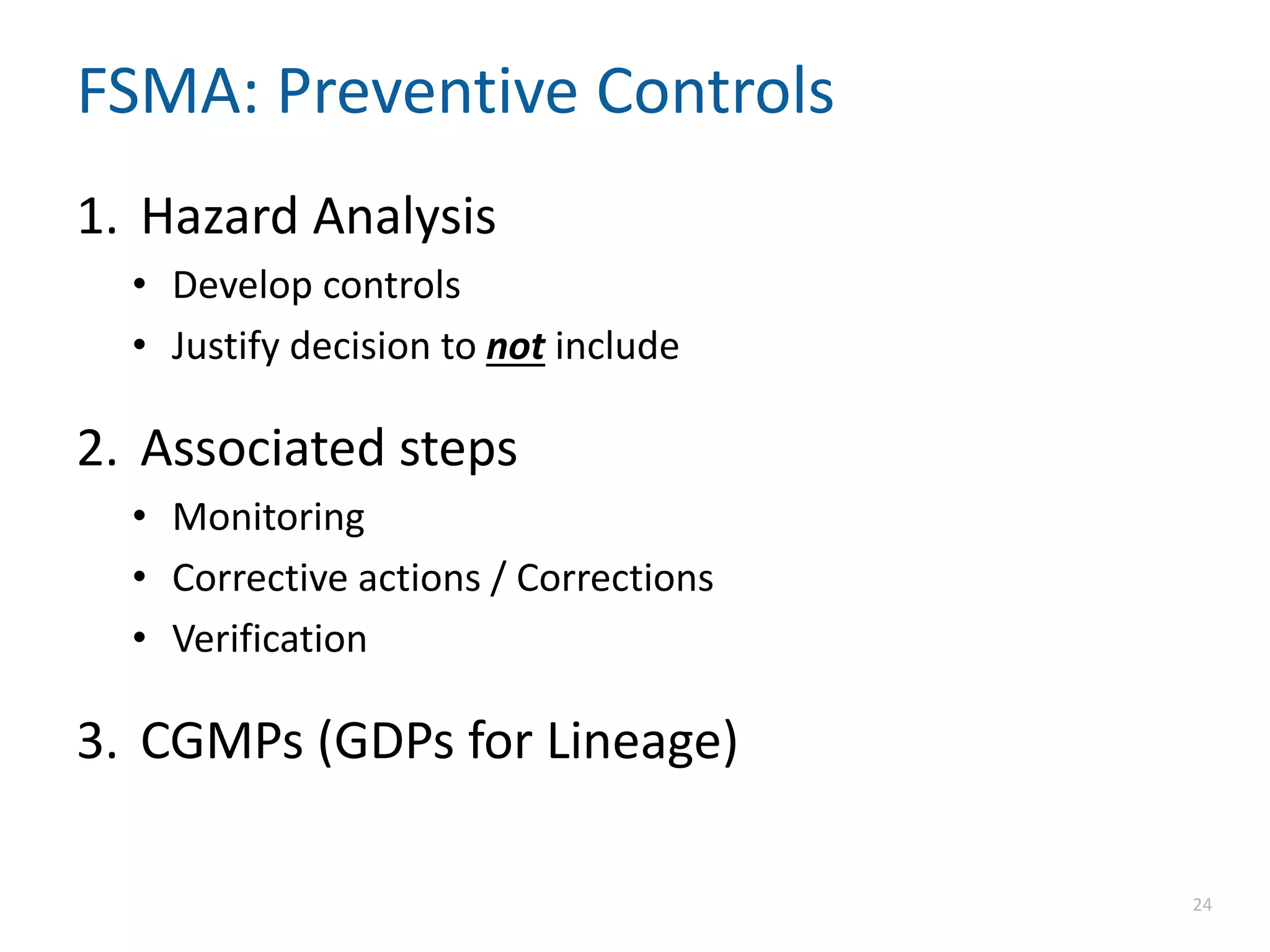
FSMA: Preventive Controls
1. Hazard Analysis
• Develop controls
• Justify decision to not include
2. Associated steps
• Monitoring
• Corrective actions / Corrections
• Verification
3. CGMPs (GDPs for Lineage)
24
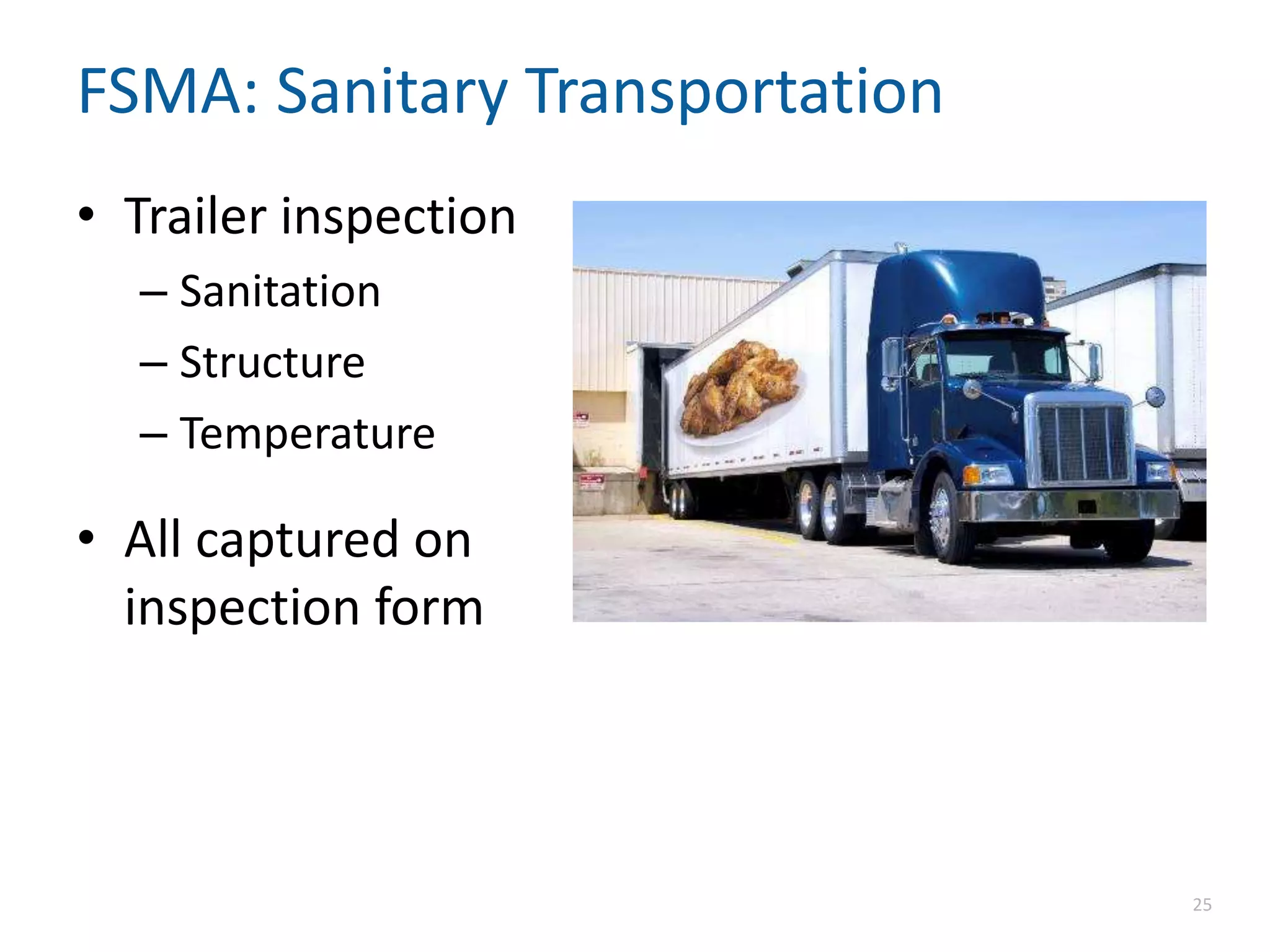
FSMA: Sanitary Transportation
• Trailer inspection
– Sanitation
– Structure
– Temperature
• All captured on
inspection form
25
HACCP
1. CCP management
2. Temperature control
3. Corrective actions
26
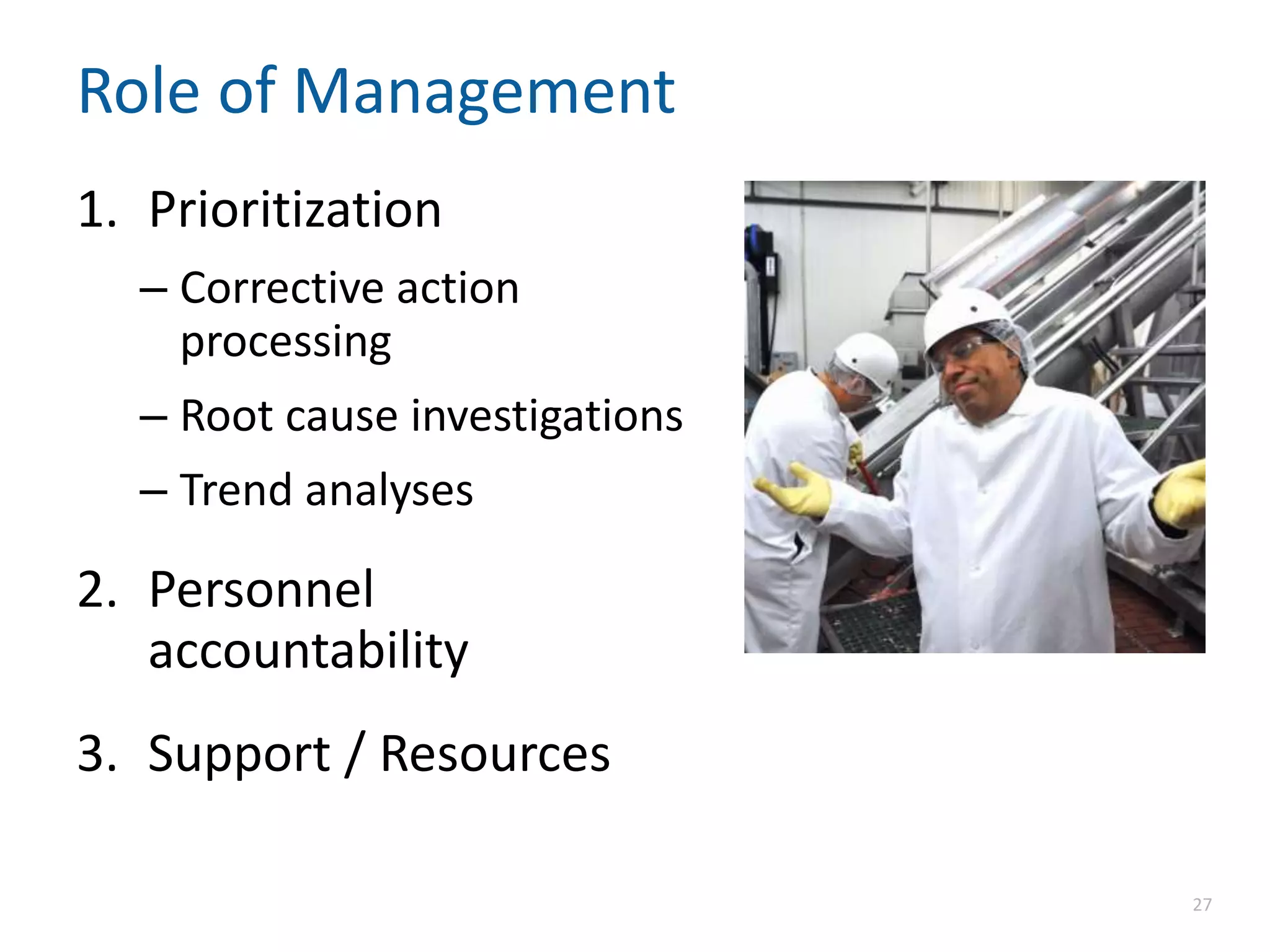
Role of Management
1. Prioritization
– Corrective action
processing
– Root cause investigations
– Trend analyses
2. Personnel
accountability
3. Support / Resources
27
Common pitfalls
1. “Check in the block”
record format
2. Overly complex
documentation
3. Poor system of verification
4. Inadequate management
commitment
28
Summary
1. Commitment to consistency
2. Pay attention to the details
3. Organizational discipline
29
Holly Mockus
Product Manager
Alchemy
Record Description
• An account of something, preserved in a lasting form.
• Typically made as the activity occurs
• Functions as evidence of activities performed
• Proves you did what you said you were going to do
• Required by regulation(s)
• Paints a picture of the product, process, plant, and culture
31
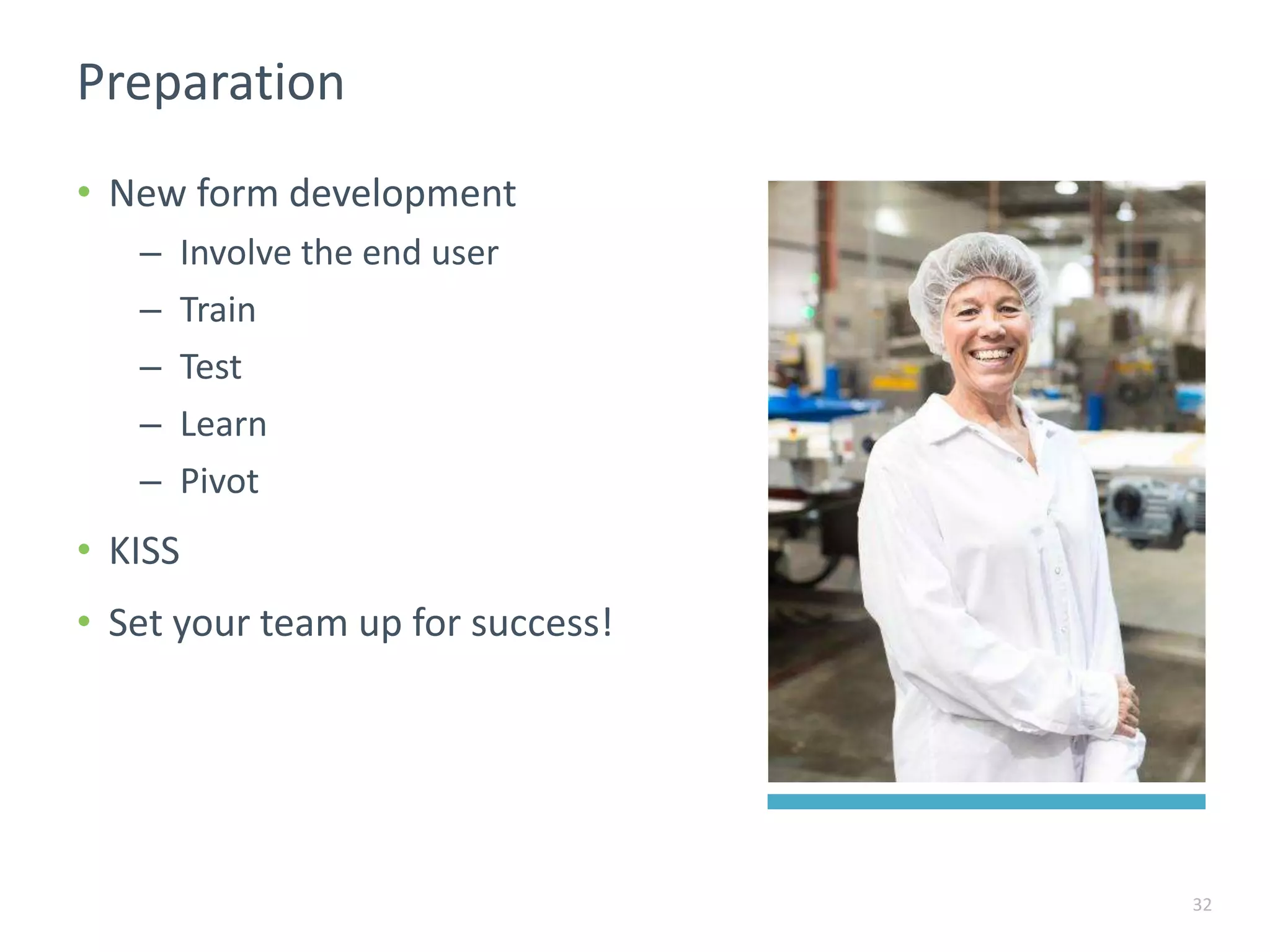
Preparation
32
• New form development
– Involve the end user
– Train
– Test
– Learn
– Pivot
• KISS
• Set your team up for success!
Customize
33
• Create forms that meet the exact need
• Reassess
– Changes
– High level of errors
– Feedback
– Procedure updates
• Track and Trend
– Don’t collect data to collect data
Include:
34
• Date
• Product
• Facility name and location
• Initials / Signature
• Time
• Work Instructions
• Critical limits / Action limits
Uniformity
35
Require consistency in all documentation
• AM / PM or military time
• Date format
• Signatures or initials
• Product name or product code
• Header info
• Footer info
• Logo
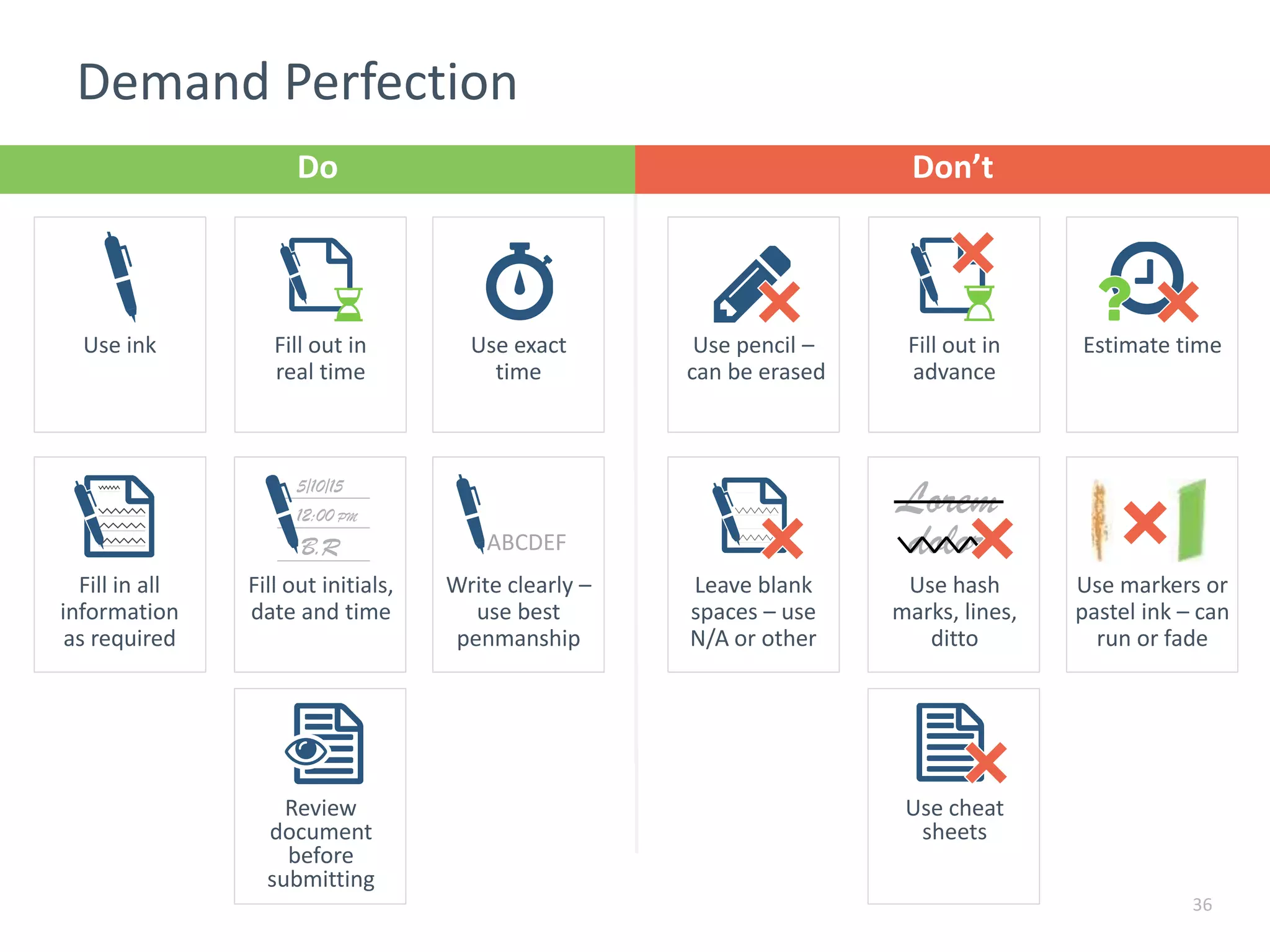
Demand Perfection
36
Do Don’t
Use ink Fill out in
real time
Fill out initials,
date and time
ABCDEF
Review
document
before
submitting
Use exact
time
Fill in all
information
as required
Write clearly –
use best
penmanship
Use pencil –
can be erased
Fill out in
advance
Use hash
marks, lines,
ditto
Use cheat
sheets
Estimate time
Leave blank
spaces – use
N/A or other
Use markers or
pastel ink – can
run or fade
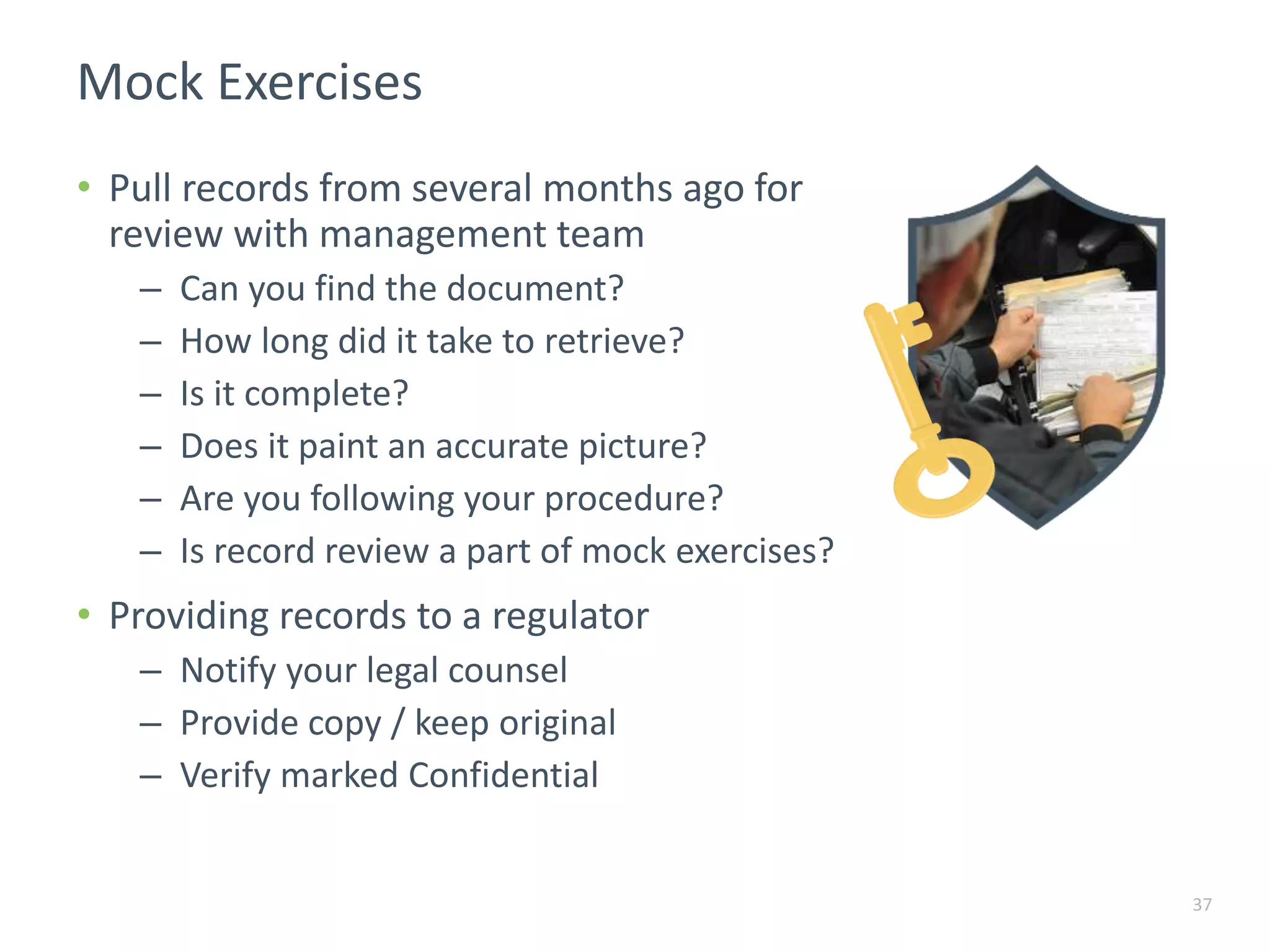
Mock Exercises
37
• Pull records from several months ago for
review with management team
– Can you find the document?
– How long did it take to retrieve?
– Is it complete?
– Does it paint an accurate picture?
– Are you following your procedure?
– Is record review a part of mock exercises?
• Providing records to a regulator
– Notify your legal counsel
– Provide copy / keep original
– Verify marked Confidential
Questions?

SQF Conference 2015: PROPER RECORDKEEPING AND DOCUMENTATION: THE KEY TO REDUCING RISK AND LIABILITIES

  • 2.
    Proper Recordkeeping and Documentation: TheKey to Reducing Risk and Liabilities Melanie Neumann, The Acheson Group James P. Reynolds, Lineage Logistics Holly Mockus, Alchemy Systems
  • 3.
    Melanie Neumann, J. D.,M.S. EVP & CFO The Acheson Group, LLC 3
  • 4.
    Overview What do therules require for record keeping How do you approach record keeping and documentation for compliance Other legal considerations 4
  • 5.
    FSMA Status Summary- “The 7 Pillars” Proposed Rule Final Deadline PC- Human Food-Final September 17, 2015 PC- Animal Food-Final September 17, 2015 Produce Safety October 31, 2015 FSVP October 31, 2015 Third Party Accreditation October 31, 2015 Sanitary Transport March 31, 2016 Food Defense May 31, 2016 5
  • 6.
    Rules Enacted UponSigning • Inspection of records • Suspension of registration • Expanded administrative detention • Authority to require import certificates • Mandatory recall 6
  • 7.
    The Food SafetyPlan-A Key Required Document • You must prepare, or have prepared, and implement a written food safety plan. • The food safety plan must be prepared, or its preparation overseen, by one or more preventive controls qualified individuals. • Preventive controls qualified individual means a qualified individual who has successfully completed training in the development and application of risk-based preventive controls at least equivalent to that received under a standardized curriculum recognized as adequate by FDA or is otherwise qualified through job experience to develop and apply a food safety system. 7
  • 8.
    The Food SafetyPlan Hazard Analysis Preventive Controls Monitoring Corrective Actions Verification Reanalysis Documentation 8
  • 9.
    Implementation Records (§117.190) Records needed for: • Documentation for hazard analysis • Documentation for not establishing a preventive control • Monitoring of preventive controls • Corrective actions • Verification, including − Validation − Verification of monitoring − Verification of corrective actions; − Calibration of process monitoring and verification instruments; − Product testing − Environmental monitoring − Records review − Reanalysis • Document the supply chain program • Document training for the preventive controls qualified individual and the qualified auditor. 9
  • 10.
    Records for SupplyChain (§ 117.475) • Must have a written plan • If importer must have documentation showing to be in compliance with FSVP • Documentation of the approval of a supplier • Procedures for receiving raw materials • Documentation demonstrating use of the written procedures for receiving raw materials • Documentation of the determination of the appropriate supplier verification • Documentation of the conduct of the onsite audit (lots of details) • Sampling and testing (lots of details) • Review of the suppliers food safety records • Verification activities other than onsite audit • Actions taken with regard to non-compliance 10
  • 11.
    Required Records • Allrecords can be stored off site, with exception of the written food safety plan, as long as they are accessible within 24 hours of a request for official review – Food Safety Plan records do not need to be stored in one location or in “one binder” • Record retention begins after the applicable compliance date • Records must also document – Training – Reanalysis • Electronic records exempt from 21 CFR Part 11, however must be equivalent to paper records and handwritten signatures 11
  • 12.
    Legal Considerations • AdmissionsAgainst Interest • Speculation • Strict Liability – The Park Doctrine: • The Park Doctrine is based on a 1975 U.S. Supreme Court case affirming FDA’s right to bring a criminal misdemeanor case against corporate executives based on a strict liability theory. • A corporate official can be held criminally liable for violations of the FD&C Act even if the official did not intend for the violations to occur. • NO ACTUAL KNOWLEDGE OR NEGLIGENCE REQUIRED • Complaint Management People, Process & Systems are Key! 12
  • 13.
  • 14.
    James P. Reynolds Director ofFood Safety & Compliance Lineage 14
  • 15.
    Lineage Logistics • Refrigerated warehousing •100+ locations / 12 certifications • Food product storage and handling • Wide array of services 15
  • 16.
    Background • Joined LineageLogistics in 2012 • 20+ year career in Naval Aviation • Documentation – Operational status – Lessons learned – Compliance 16
  • 17.
    Overview 1. Objectives &relationships 2. Role of management 3. Common pitfalls 17
  • 18.
    Recordkeeping Objectives 1. Operations/communication 2.Demonstrate effective food safety 3. Audit & regulatory compliance 18
  • 19.
  • 20.
    Operations 1. Incoming &outbound inspections 2. Storage temperatures 3. Inventory control 4. Value-added services – Effectiveness – Capturing of costs 20
  • 21.
    Food Safety 1. ChemicalControl 2. Personal Hygiene 3. Product Equipment 4. Cleaning and Sanitation 5. Training 6. Receiving, Storage and Shipping 7. Traceability and Withdrawal (Recall) 8. Pest Control 9. Allergen Control 21
  • 22.
  • 23.
    SQF requirements “Records…shall bemaintained” • 2.1.4 Management Review • 2.1.5 Complaint Management • 2.1.6 Business Continuity Planning • 2.2.2 Records • 2.3.1 Product Development and Realization • 2.3.2 Raw and Packaging Materials • 2.4.6 Non-conforming Product or Equipment • 2.4.7 Product Rework • 2.4.8 Product Release • 2.5.1 Responsibility, Frequency and Methods • 2.5.2 Validation & Effectiveness • 2.5.4 Verification of Monitoring Activities • 2.5.5 Corrective and Preventative Action • 2.5.6 Product Sampling, Inspection and Analysis • 2.5.7 Internal Audits • 2.6.1 Product Identification • 2.6.2 Product Trace • 2.6.3 Product Withdrawal and Recall • 2.9 Training • 12.2.7 Premises and Equipment Maintenance • 12.2.8 Calibration • 12.2.9 Management of Pests and Vermin • 12.2.11 Cleaning and Sanitation • 12.6.8 Transport • 12.6.9 Unloading 23
  • 24.
    FSMA: Preventive Controls 1.Hazard Analysis • Develop controls • Justify decision to not include 2. Associated steps • Monitoring • Corrective actions / Corrections • Verification 3. CGMPs (GDPs for Lineage) 24
  • 25.
    FSMA: Sanitary Transportation •Trailer inspection – Sanitation – Structure – Temperature • All captured on inspection form 25
  • 26.
    HACCP 1. CCP management 2.Temperature control 3. Corrective actions 26
  • 27.
    Role of Management 1.Prioritization – Corrective action processing – Root cause investigations – Trend analyses 2. Personnel accountability 3. Support / Resources 27
  • 28.
    Common pitfalls 1. “Checkin the block” record format 2. Overly complex documentation 3. Poor system of verification 4. Inadequate management commitment 28
  • 29.
    Summary 1. Commitment toconsistency 2. Pay attention to the details 3. Organizational discipline 29
  • 30.
  • 31.
    Record Description • Anaccount of something, preserved in a lasting form. • Typically made as the activity occurs • Functions as evidence of activities performed • Proves you did what you said you were going to do • Required by regulation(s) • Paints a picture of the product, process, plant, and culture 31
  • 32.
    Preparation 32 • New formdevelopment – Involve the end user – Train – Test – Learn – Pivot • KISS • Set your team up for success!
  • 33.
    Customize 33 • Create formsthat meet the exact need • Reassess – Changes – High level of errors – Feedback – Procedure updates • Track and Trend – Don’t collect data to collect data
  • 34.
    Include: 34 • Date • Product •Facility name and location • Initials / Signature • Time • Work Instructions • Critical limits / Action limits
  • 35.
    Uniformity 35 Require consistency inall documentation • AM / PM or military time • Date format • Signatures or initials • Product name or product code • Header info • Footer info • Logo
  • 36.
    Demand Perfection 36 Do Don’t Useink Fill out in real time Fill out initials, date and time ABCDEF Review document before submitting Use exact time Fill in all information as required Write clearly – use best penmanship Use pencil – can be erased Fill out in advance Use hash marks, lines, ditto Use cheat sheets Estimate time Leave blank spaces – use N/A or other Use markers or pastel ink – can run or fade
  • 37.
    Mock Exercises 37 • Pullrecords from several months ago for review with management team – Can you find the document? – How long did it take to retrieve? – Is it complete? – Does it paint an accurate picture? – Are you following your procedure? – Is record review a part of mock exercises? • Providing records to a regulator – Notify your legal counsel – Provide copy / keep original – Verify marked Confidential
  • 38.