INTRODUCTION
Background
Cultivation isthe process of propagating
organisms by providing the proper environmental
conditions. Growing microorganisms are making
replicas of themselves, and they require the
elements present in their chemical composition.
Nutrients must provide these elements in
metabolically accessible form. In addition,
organisms require metabolic energy to synthesize
macromolecules and maintain essential chemical
gradients across their membranes.
3.
Factors that mustbe
controlled during growth
include the nutrients, pH,
temperature, aeration, salt
concentration, and ionic
strength of the medium.
4.
Environmental Factors Affecting
Growth
Asuitable growth medium
must contain all the nutrients
required by the organism to be
cultivated, and such factors as
pH, temperature, and aeration
must be carefully controlled
5.
Nutrients
In general, thefollowing must be provided:
1. hydrogen donors and acceptors: about 2 g/L;
2. carbon source: about 1 g/L;
3. nitrogen source: about 1 g/L;
4. minerals: sulfur and phosphorus, about 50
mg/L of each, and trace elements, 0.1–1 mg/L
of each;
5. growth factors: amino acids, purines, and
pyrimidines, about 50 mg/L of each, and
vitamins, 0.1–1 mg/L of each.
6.
pH
Most organisms havea fairly narrow
optimal pH range. The optimal pH must be
empirically determined for each species.
Most organisms (neutralophiles) grow best
at a pH of 6.0–8.0, although some forms
(acidophils) have optima as low as pH 3.0
and others (alkaliphiles) have optima as
high as pH 10.5.
7.
Temperature
Different microbial speciesvary widely
in their optimal temperature ranges for
growth: Psychrophilic forms grow best at
low temperatures (15–20°C); Mesophilic
forms grow best at 30–37°C; and most
Thermophilic forms grow best at 50–60°C.
Most organisms are mesophilic; 30°C is
optimal for many free-living forms, and the
body temperature of the host is optimal for
symbionts of warm-blooded animals.
8.
[cont.]
Microorganisms share with
plantsand animals the heat-
shock response, a transient
synthesis of a set of “heat-shock
proteins,” when exposed to a
sudden rise in temperature above
the growth optimum.
Did you know…?
9.
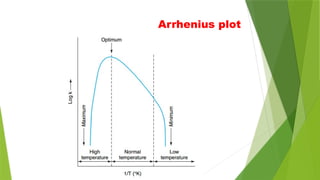
The relationship ofgrowth rate to
temperature for any given microorganism
is seen in a typical Arrhenius plot.
Arrhenius showed that the logarithm of the
velocity of any chemical reaction (log k) is
a linear function of the reciprocal of the
temperature (1/T); since cell growth is the
result of a set of chemical reactions, it
might be expected to show this
relationship
[cont.]
[cont.]
Beyond their effectson growth
rate, extremes of temperature
kill microorganisms. Extreme
heat is used to sterilize
preparations; extreme cold also
kills microbial cells, although it
cannot be used safely for
sterilization.
Did you know…?
12.
Bacteria also exhibita phenomenon
called cold shock: the killing of cells by
rapid—as opposed to slow—cooling. For
example, the rapid cooling of Escherichia
coli from 37°C to 5°C can kill 90% of the
cells. A number of compounds protect
cells from either freezing or cold shock;
glycerol and dimethyl sulfoxide are most
commonly used.
[cont.]
13.
Aeration
Many organisms areobligate
aerobes, specifically requiring
oxygen as hydrogen acceptor; some
are facultative, able to live
aerobically or anaerobically; and
others are obligate anaerobes,
requiring a substance other than
oxygen as hydrogen acceptor and
being sensitive to oxygen inhibition.
14.
Ionic Strength and
OsmoticPressure
To a lesser extent, such factors as osmotic
pressure and salt concentration may have to be
controlled. For most organisms, the properties
of ordinary media are satisfactory; however, for
marine forms and organisms adapted to growth
in strong sugar solutions, for example, these
factors must be considered. Organisms
requiring high salt concentrations called
halophilic; those requiring high osmotic
pressures are called osmophilic.
1. Growing Cellsof a Given Species
Microorganisms observed microscopically to be growing
in a natural environment may prove exceedingly difficult
to grow in pure culture in an artificial medium. Certain
parasitic forms, for example, have never been cultivated
outside the host. In general, however, a suitable medium
can be devised by carefully reproducing the conditions
found in the organism’s natural environment. The pH,
temperature, and aeration are simple to duplicate; the
nutrients present the major problem. The contribution
made by the living environment is important and difficult
to analyze; a parasite may require an extract of the host
tissue, and a free-living form may require a substance
excreted by a microorganism with which it is associated
in nature. Considerable experimentation may be
necessary in order to determine the requirements of the
organism.
17.
2. Microbiologic Examinationof Natural
Materials
A given natural material may contain many
different microenvironments, each providing a
niche for a different species. Plating a sample
of the material under one set of conditions
will allow a selected group of forms to
produce colonies but will cause many other
types to be overlooked. For this reason, it is
customary to plate out samples of the
material using as many different media and
conditions of incubation as is practicable. Six
to eight different culture conditions are not
an unreasonable number if most of the forms
present are to be discovered.
18.
3. Isolation ofa Particular Type of
Microorganism
A small sample of soil, if
handled properly, will yield a
different type of organism for
every microenvironment present.
For fertile soil (moist, aerated,
rich in minerals and organic
matter) this means that hundreds
or even thousands of types can
be isolated.
19.
This is doneby selecting for the
desired type. One gram of soil, for
example, is inoculated into a flask of
liquid medium that has been made up
for the purpose of favoring one type
of organism, eg, aerobic nitrogen
fixers (azotobacter).
[cont.]
20.
In this case,the medium contains no
combined nitrogen and is incubated
aerobically. If cells of azotobacter are present
in the soil, they will grow well in this medium;
forms unable to fix nitrogen will grow only to
the extent that the soil has introduced
contaminating fixed nitrogen into the medium.
When the culture is fully grown, therefore, the
percentage of azotobacter in the total
population will have increased greatly; the
method thus called “enrichment culture.”
[cont.]
21.
4. Isolation ofMicroorganism in Pure Culture
In order to study the properties of
a given organism, it is necessary to
handle it in pure culture free of all
other types of organisms. To do this,
a single cell must be isolated from all
other cells and cultivated in such a
manner that its collective progeny
also remain isolated. Several
methods are available… [cont]






![[cont.]
Microorganisms share with
plants and animals the heat-
shock response, a transient
synthesis of a set of “heat-shock
proteins,” when exposed to a
sudden rise in temperature above
the growth optimum.
Did you know…?](https://image.slidesharecdn.com/cultivationofmicroorganism-251110163058-36b74629/85/CULTIVATION_OF_MICROORGANISM-pptxuplodjdn-8-320.jpg)
![The relationship of growth rate to
temperature for any given microorganism
is seen in a typical Arrhenius plot.
Arrhenius showed that the logarithm of the
velocity of any chemical reaction (log k) is
a linear function of the reciprocal of the
temperature (1/T); since cell growth is the
result of a set of chemical reactions, it
might be expected to show this
relationship
[cont.]](https://image.slidesharecdn.com/cultivationofmicroorganism-251110163058-36b74629/85/CULTIVATION_OF_MICROORGANISM-pptxuplodjdn-9-320.jpg)
![[cont.]
Beyond their effects on growth
rate, extremes of temperature
kill microorganisms. Extreme
heat is used to sterilize
preparations; extreme cold also
kills microbial cells, although it
cannot be used safely for
sterilization.
Did you know…?](https://image.slidesharecdn.com/cultivationofmicroorganism-251110163058-36b74629/85/CULTIVATION_OF_MICROORGANISM-pptxuplodjdn-11-320.jpg)
![Bacteria also exhibit a phenomenon
called cold shock: the killing of cells by
rapid—as opposed to slow—cooling. For
example, the rapid cooling of Escherichia
coli from 37°C to 5°C can kill 90% of the
cells. A number of compounds protect
cells from either freezing or cold shock;
glycerol and dimethyl sulfoxide are most
commonly used.
[cont.]](https://image.slidesharecdn.com/cultivationofmicroorganism-251110163058-36b74629/85/CULTIVATION_OF_MICROORGANISM-pptxuplodjdn-12-320.jpg)




![This is done by selecting for the
desired type. One gram of soil, for
example, is inoculated into a flask of
liquid medium that has been made up
for the purpose of favoring one type
of organism, eg, aerobic nitrogen
fixers (azotobacter).
[cont.]](https://image.slidesharecdn.com/cultivationofmicroorganism-251110163058-36b74629/85/CULTIVATION_OF_MICROORGANISM-pptxuplodjdn-19-320.jpg)
![In this case, the medium contains no
combined nitrogen and is incubated
aerobically. If cells of azotobacter are present
in the soil, they will grow well in this medium;
forms unable to fix nitrogen will grow only to
the extent that the soil has introduced
contaminating fixed nitrogen into the medium.
When the culture is fully grown, therefore, the
percentage of azotobacter in the total
population will have increased greatly; the
method thus called “enrichment culture.”
[cont.]](https://image.slidesharecdn.com/cultivationofmicroorganism-251110163058-36b74629/85/CULTIVATION_OF_MICROORGANISM-pptxuplodjdn-20-320.jpg)
![4. Isolation of Microorganism in Pure Culture
In order to study the properties of
a given organism, it is necessary to
handle it in pure culture free of all
other types of organisms. To do this,
a single cell must be isolated from all
other cells and cultivated in such a
manner that its collective progeny
also remain isolated. Several
methods are available… [cont]](https://image.slidesharecdn.com/cultivationofmicroorganism-251110163058-36b74629/85/CULTIVATION_OF_MICROORGANISM-pptxuplodjdn-21-320.jpg)
![Plating
Dilution
[cont.]](https://image.slidesharecdn.com/cultivationofmicroorganism-251110163058-36b74629/85/CULTIVATION_OF_MICROORGANISM-pptxuplodjdn-22-320.jpg)


![[Micro] growth and culturing of bacteria](https://cdn.slidesharecdn.com/ss_thumbnails/xfkdsyhfs92guomky6hu-signature-2127a2ca5368c7fdfd023e8d90dde3fc0b9fe7d91346a4189562c9f63dc0d19d-poli-150819190754-lva1-app6892-thumbnail.jpg?width=640&height=640&fit=bounds)


