© Fraunhofer
COMPLETELY WIRELESS REAL-TIME
SENSORS FOR SMART FACTORY
APPLICATIONS
6th M2M Alliance Academic Day, Cologne 2017
© Fraunhofer
CONTENT
 Introduction
 Applications and Requirements
 Wireless Real-Time Data Transmission Scheme
 Wireless Energy Transmission Scheme
 Conclusion
© Fraunhofer
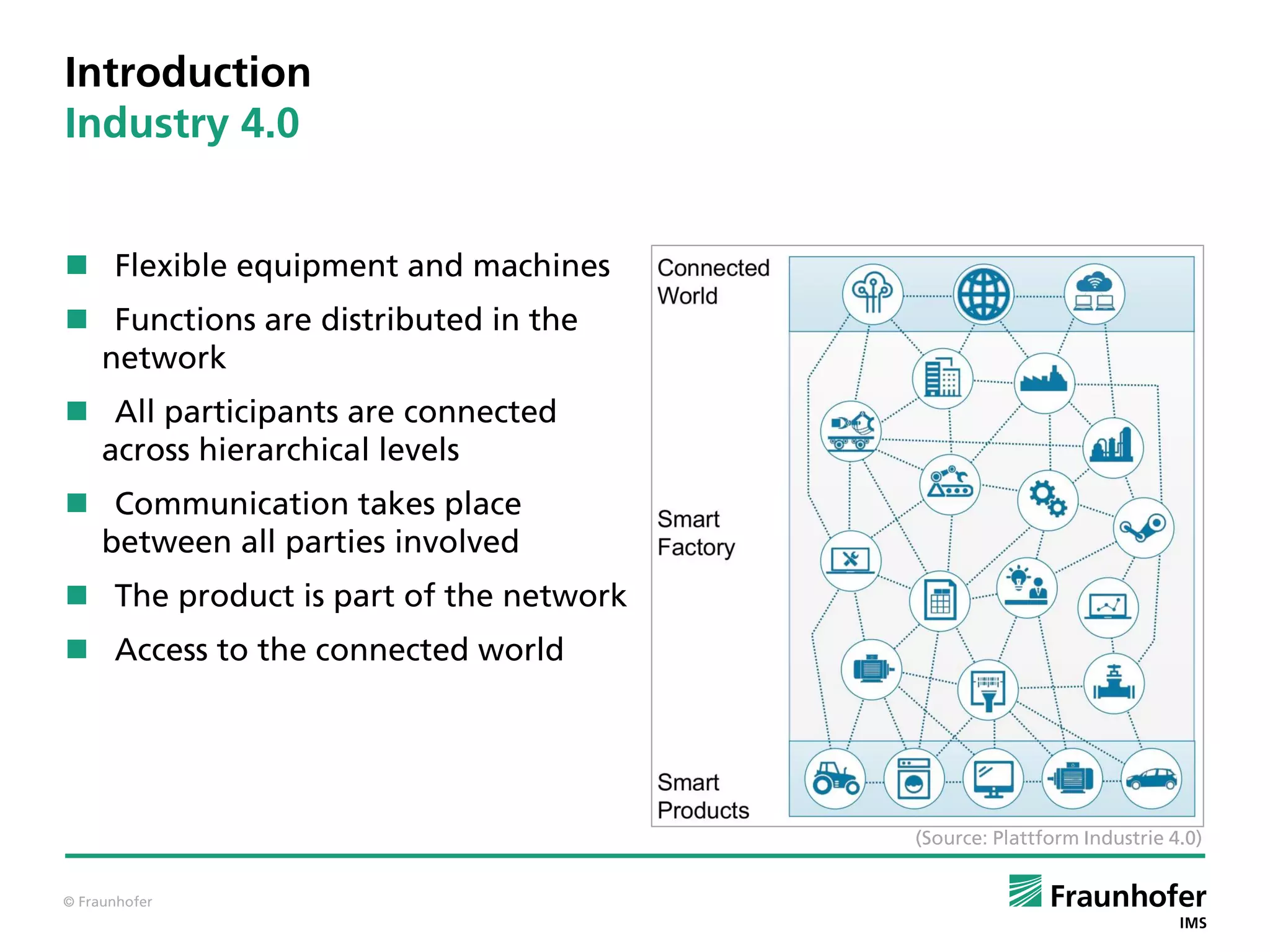
Introduction
Industry 4.0
 Flexible equipment and machines
 Functions are distributed in the
network
 All participants are connected
across hierarchical levels
 Communication takes place
between all parties involved
 The product is part of the network
 Access to the connected world
(Source: Plattform Industrie 4.0)
© Fraunhofer
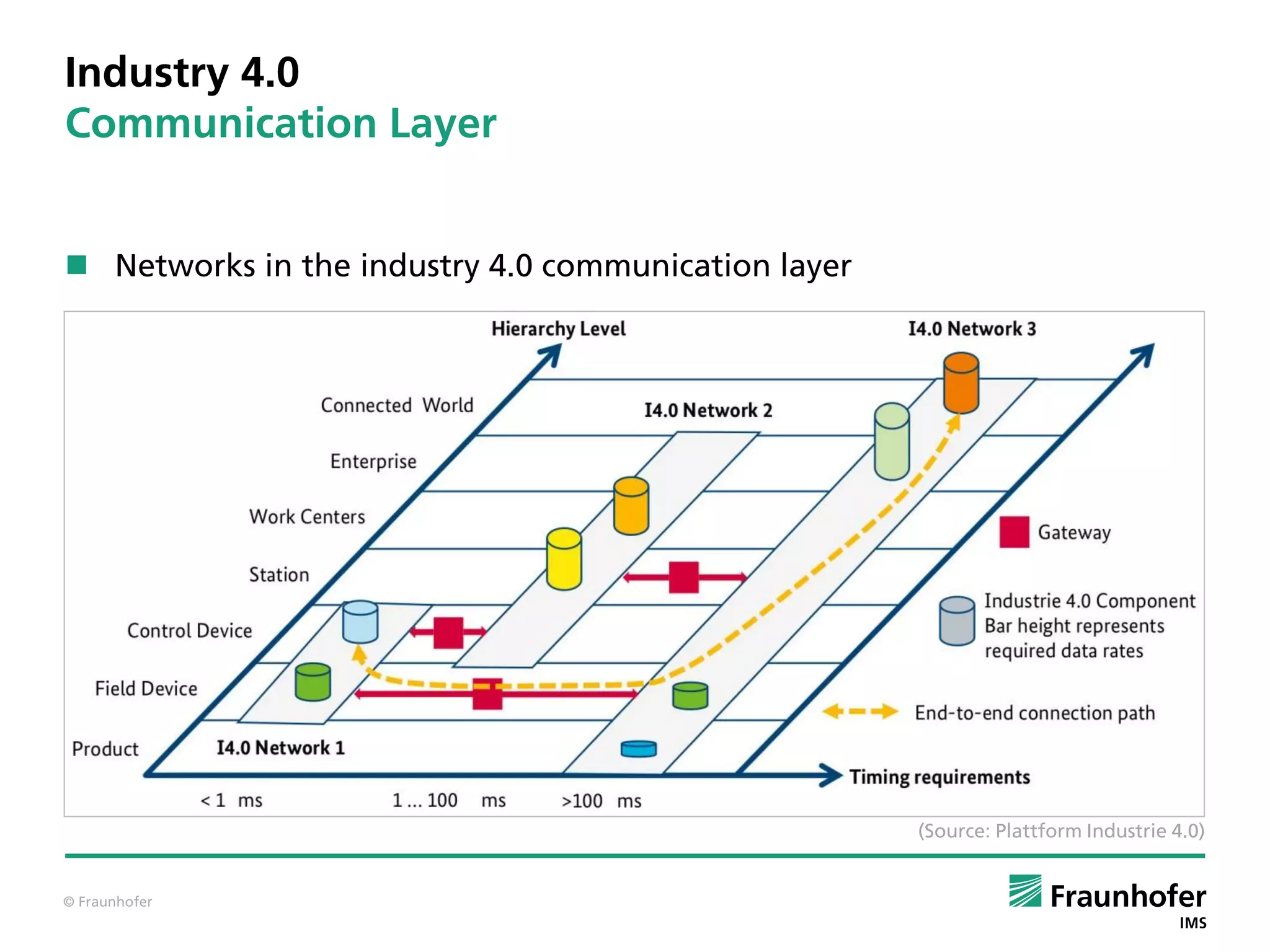
Industry 4.0
Communication Layer
 Networks in the industry 4.0 communication layer
(Source: Plattform Industrie 4.0)
© Fraunhofer
Wireless Communication
Motivation
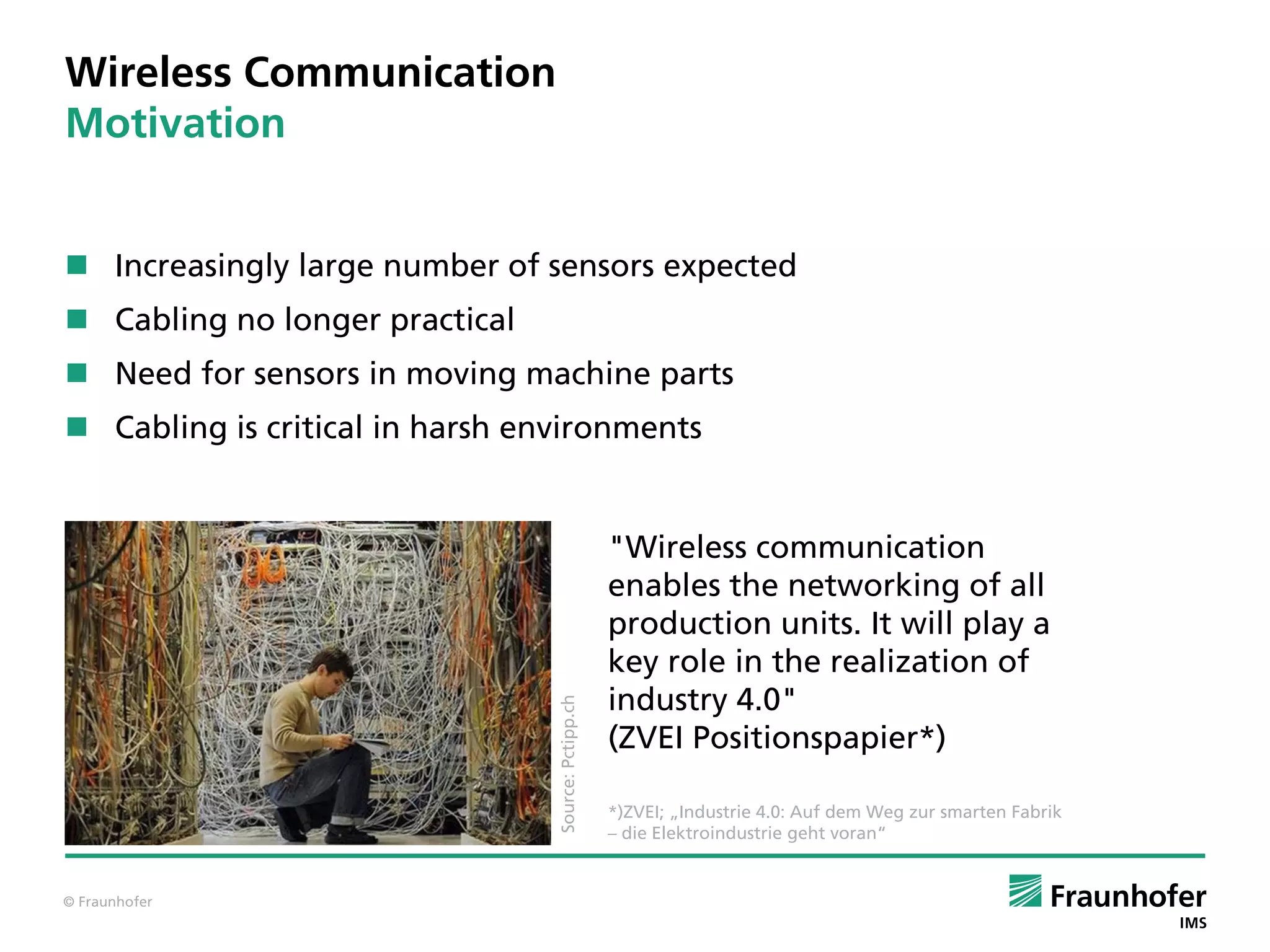
 Increasingly large number of sensors expected
 Cabling no longer practical
 Need for sensors in moving machine parts
 Cabling is critical in harsh environments
Source:Pctipp.ch
"Wireless communication
enables the networking of all
production units. It will play a
key role in the realization of
industry 4.0"
(ZVEI Positionspapier*)
*)ZVEI; „Industrie 4.0: Auf dem Weg zur smarten Fabrik
– die Elektroindustrie geht voran“
© Fraunhofer
CONTENT
 Introduction
 Applications and Requirements
 Wireless Real-Time Data Transmission Scheme
 Wireless Energy Transmission Scheme
 Conclusion
© Fraunhofer
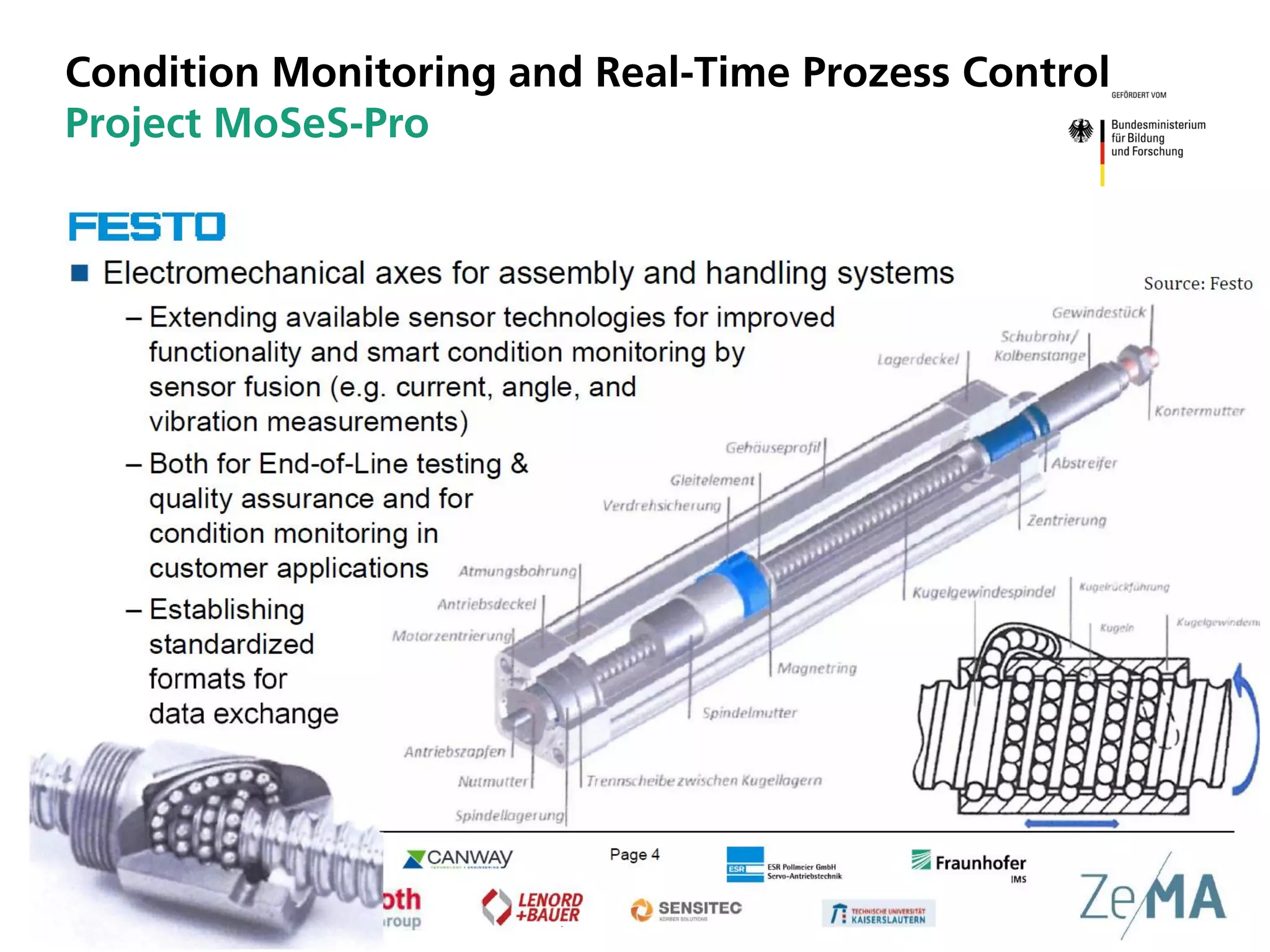
Condition Monitoring and Real-Time Prozess Control
Project MoSeS-Pro
© Fraunhofer
Condition Monitoring and Real-Time Prozess Control
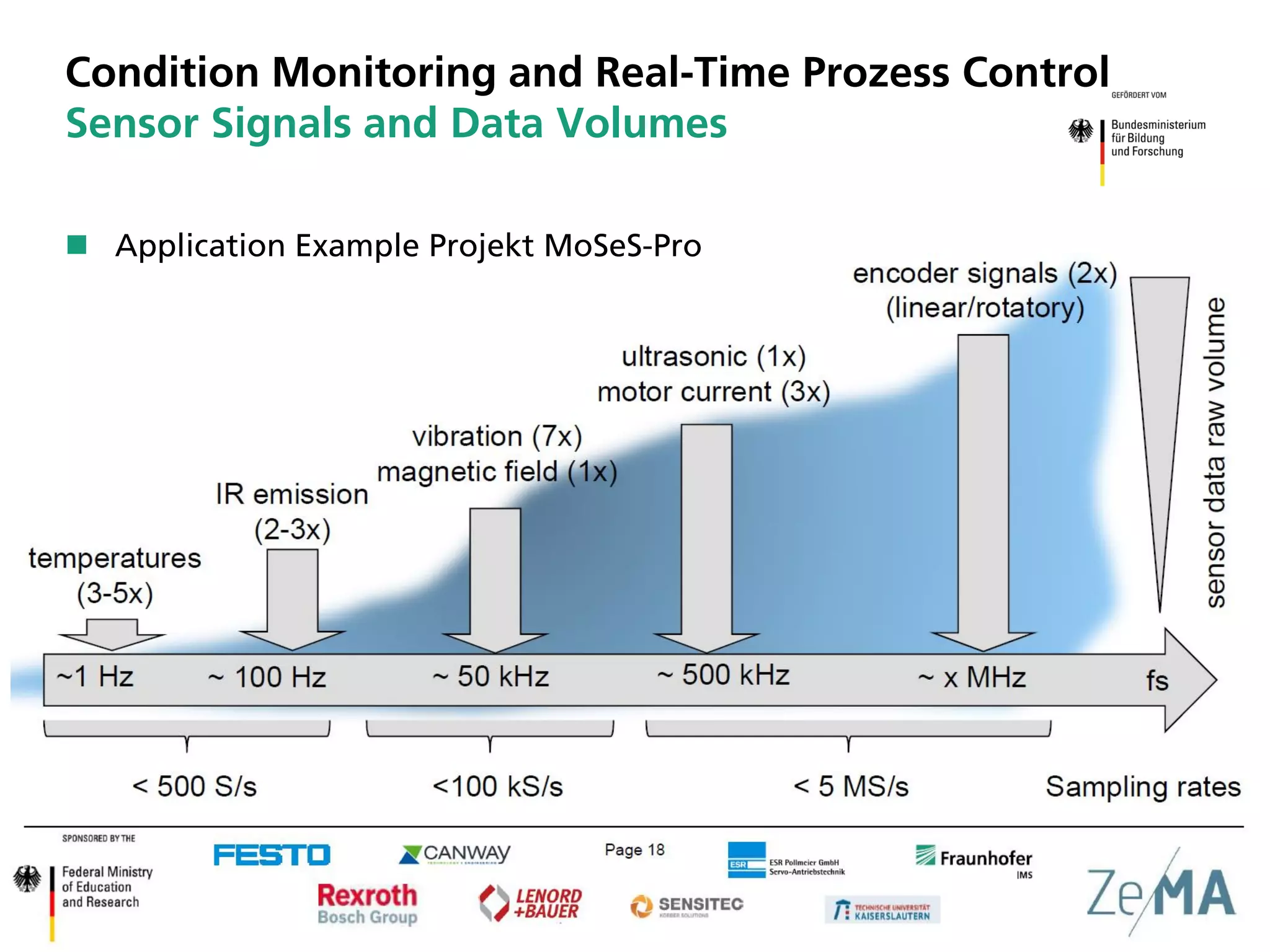
Sensor Signals and Data Volumes
(Source: ZEMA Saarbrücken)
 Application Example Projekt MoSeS-Pro
© Fraunhofer
Industrial Networking
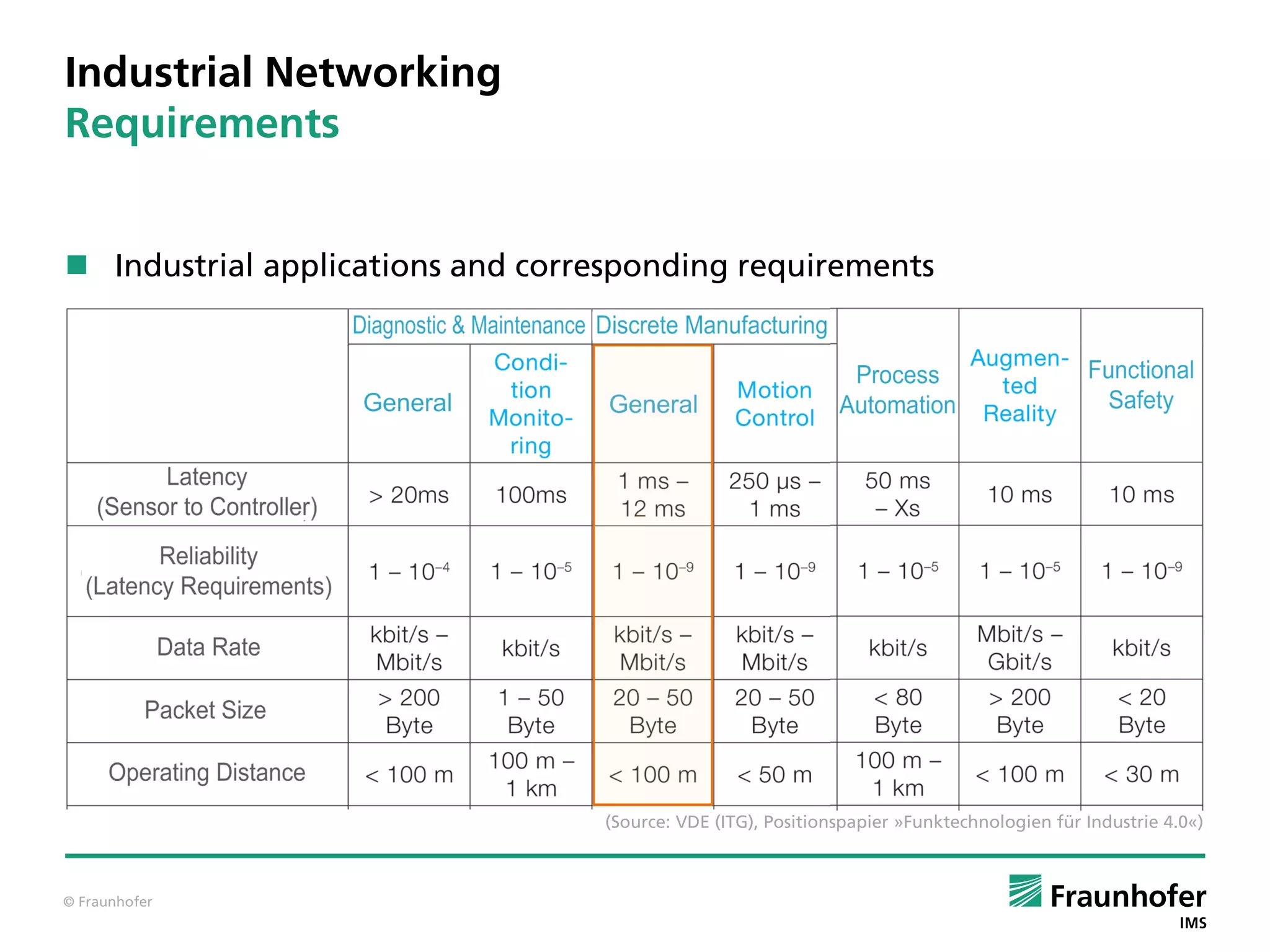
Requirements
 Industrial applications and corresponding requirements
(Source: VDE (ITG), Positionspapier »Funktechnologien für Industrie 4.0«)
© Fraunhofer
CONTENT
 Introduction
 Applications and Requirements
 Wireless Real-Time Data Transmission Scheme
 Wireless Energy Transmission Scheme
 Conclusion
© Fraunhofer
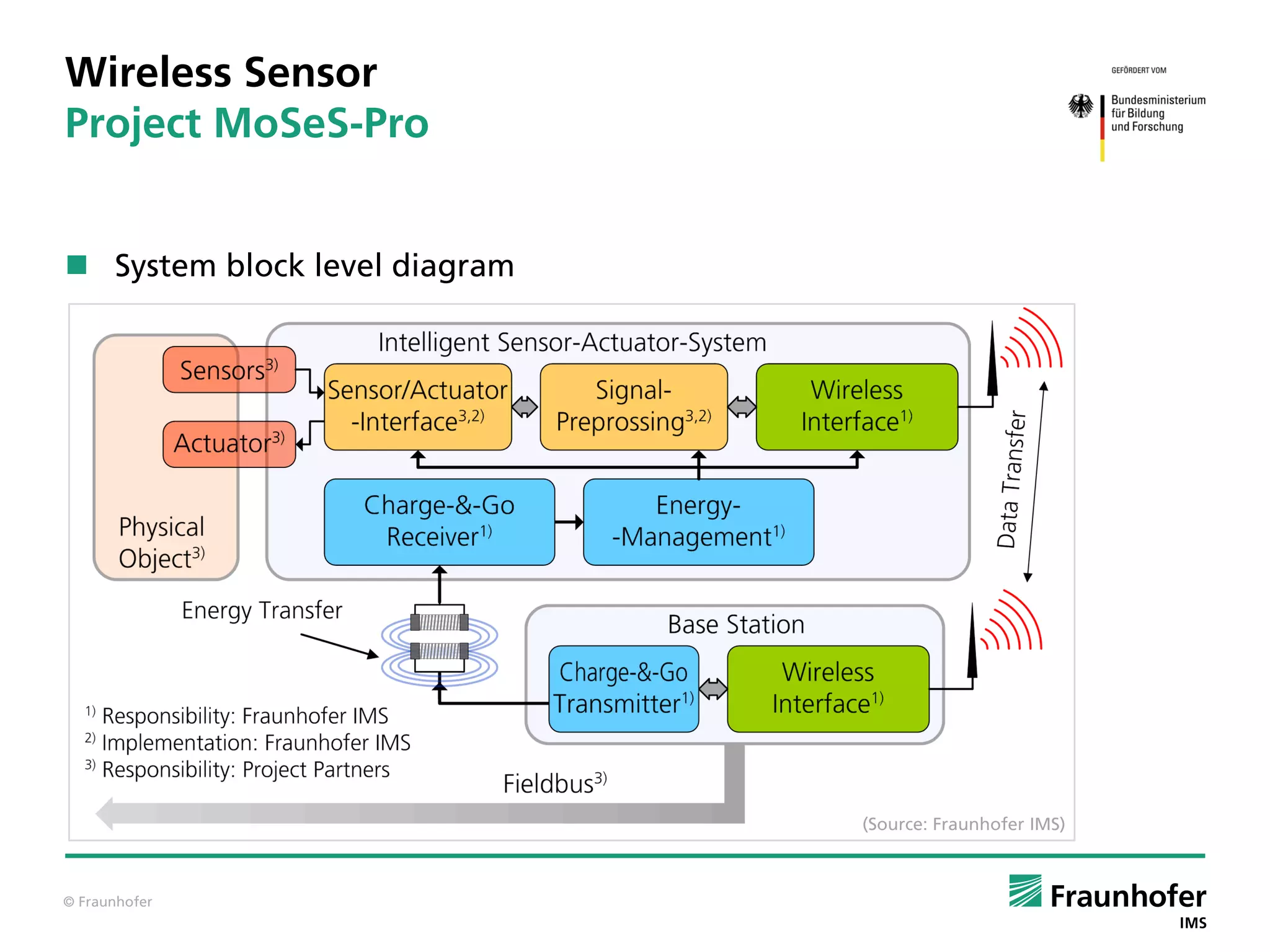
Wireless Sensor
Project MoSeS-Pro
 System block level diagram
(Source: Fraunhofer IMS)
© Fraunhofer
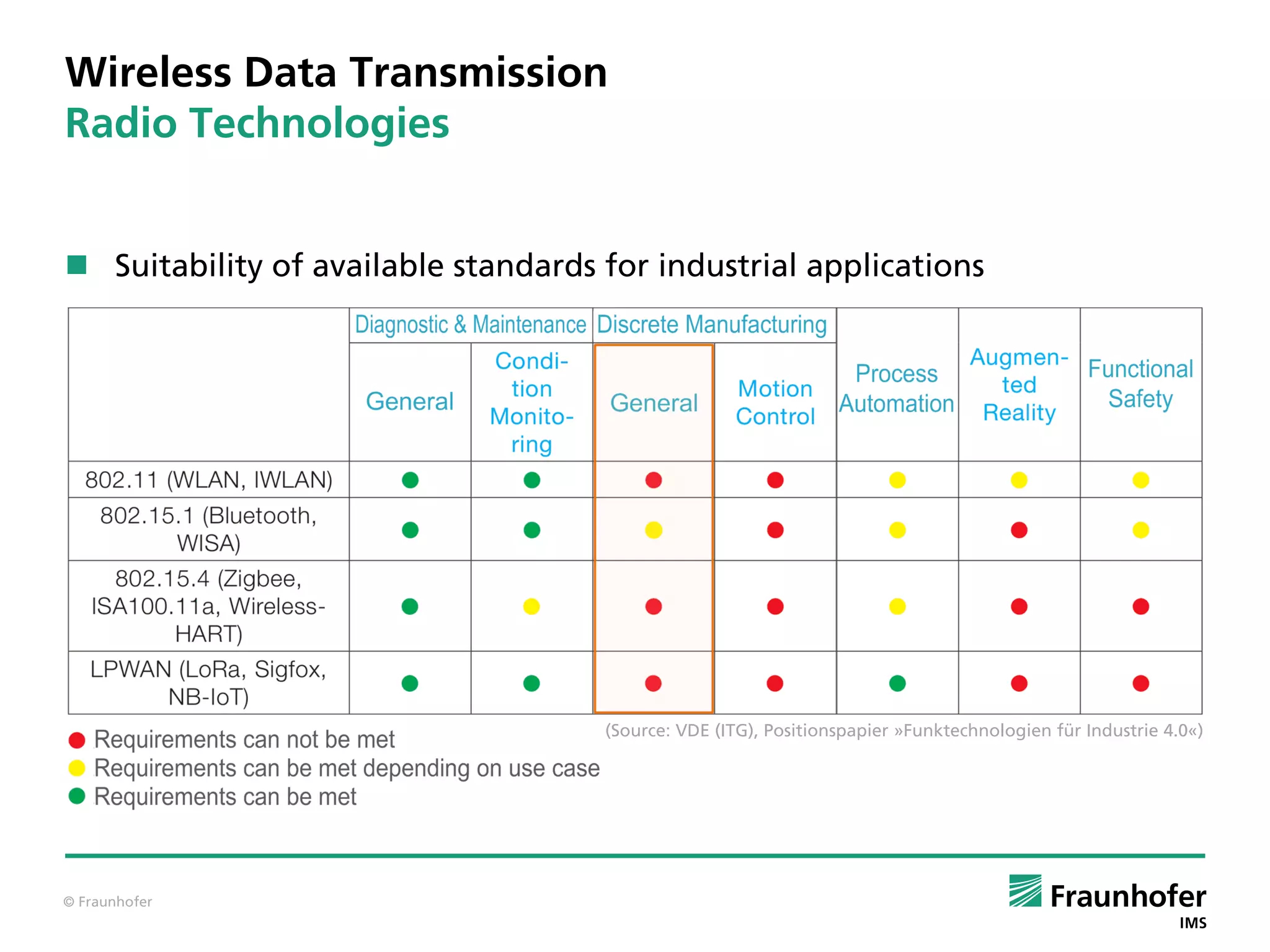
Wireless Data Transmission
Radio Technologies
 Suitability of available standards for industrial applications
(Source: VDE (ITG), Positionspapier »Funktechnologien für Industrie 4.0«)
© Fraunhofer
Wireless Data Transmission
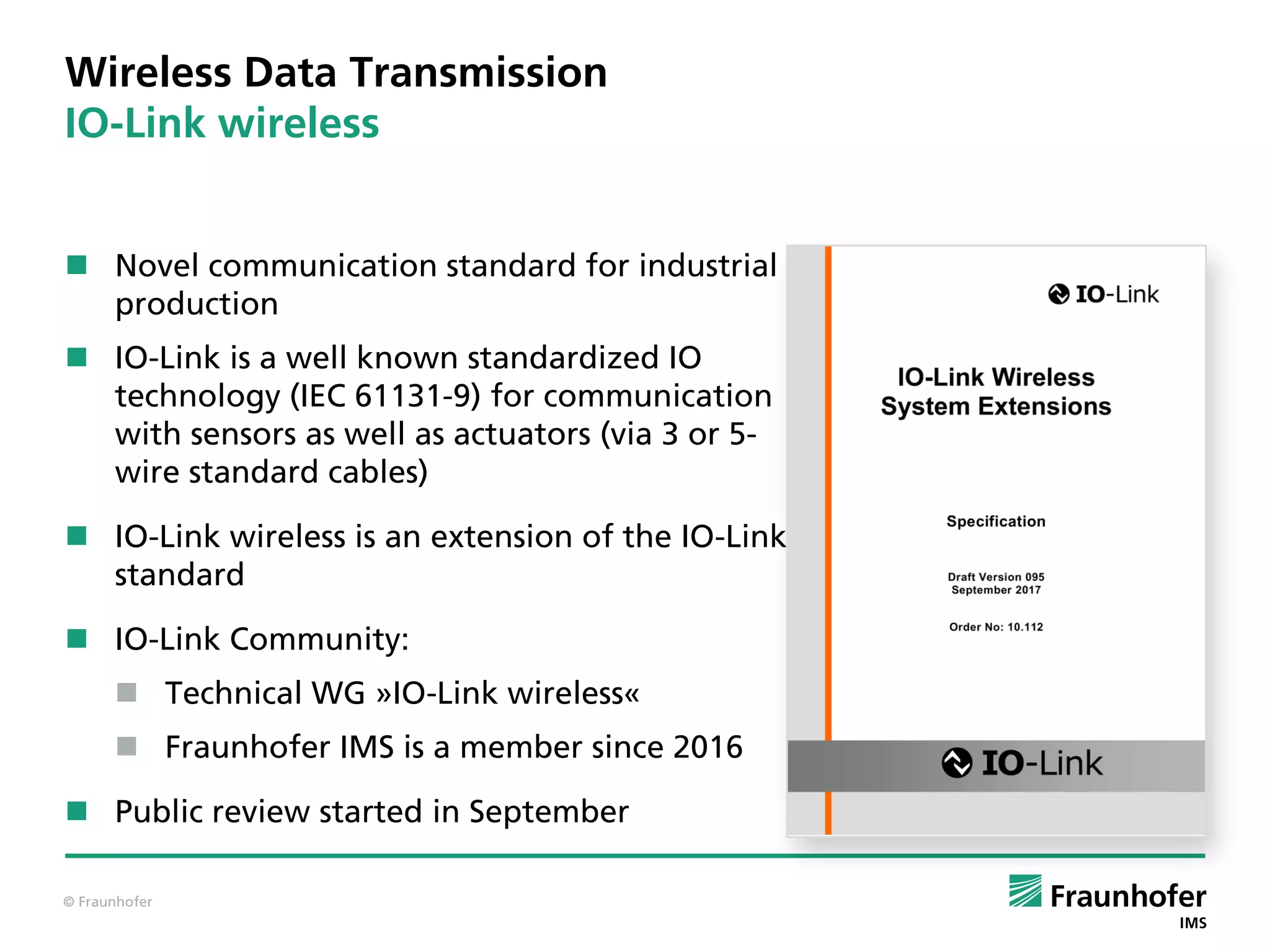
IO-Link wireless
 Novel communication standard for industrial
production
 IO-Link is a well known standardized IO
technology (IEC 61131-9) for communication
with sensors as well as actuators (via 3 or 5-
wire standard cables)
 IO-Link wireless is an extension of the IO-Link
standard
 IO-Link Community:
 Technical WG »IO-Link wireless«
 Fraunhofer IMS is a member since 2016
 Public review started in September
© Fraunhofer
Wireless Data Transmission
IO-Link wireless
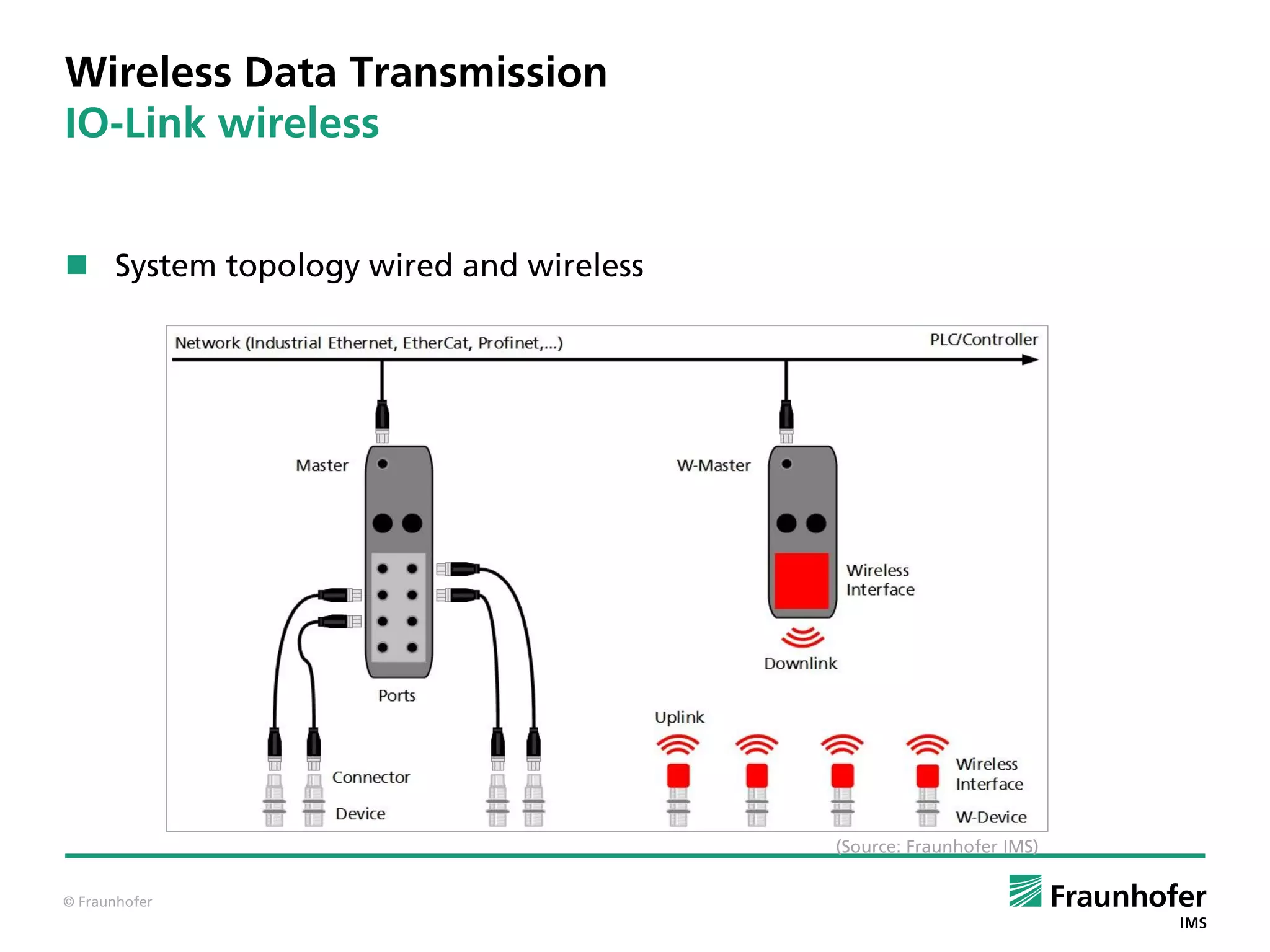
 System topology wired and wireless
(Source: Fraunhofer IMS)
© Fraunhofer
IO-Link wireless
Properties
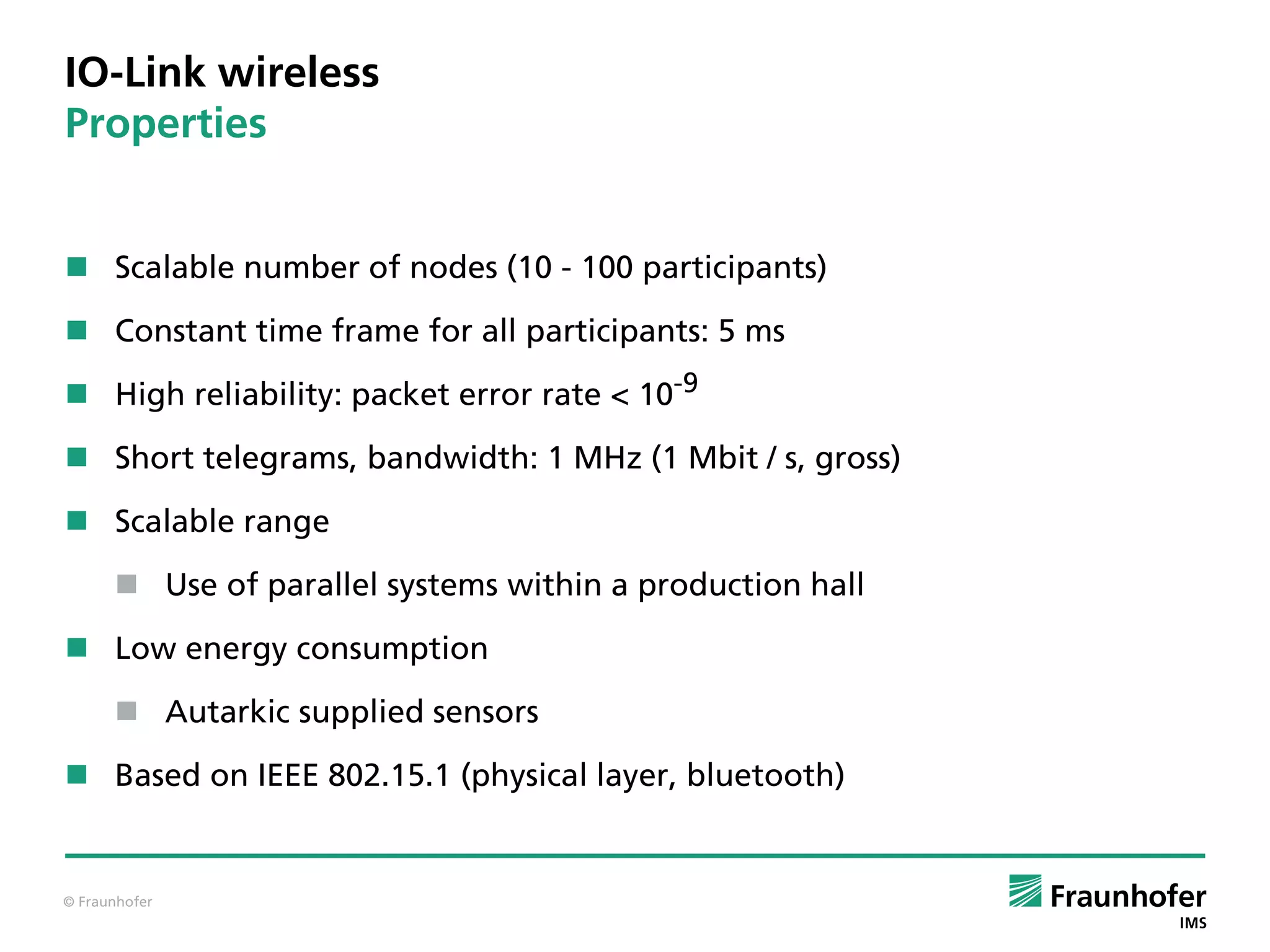
 Scalable number of nodes (10 - 100 participants)
 Constant time frame for all participants: 5 ms
 High reliability: packet error rate < 10-9
 Short telegrams, bandwidth: 1 MHz (1 Mbit / s, gross)
 Scalable range
 Use of parallel systems within a production hall
 Low energy consumption
 Autarkic supplied sensors
 Based on IEEE 802.15.1 (physical layer, bluetooth)
© Fraunhofer
IO-Link wireless
Properties
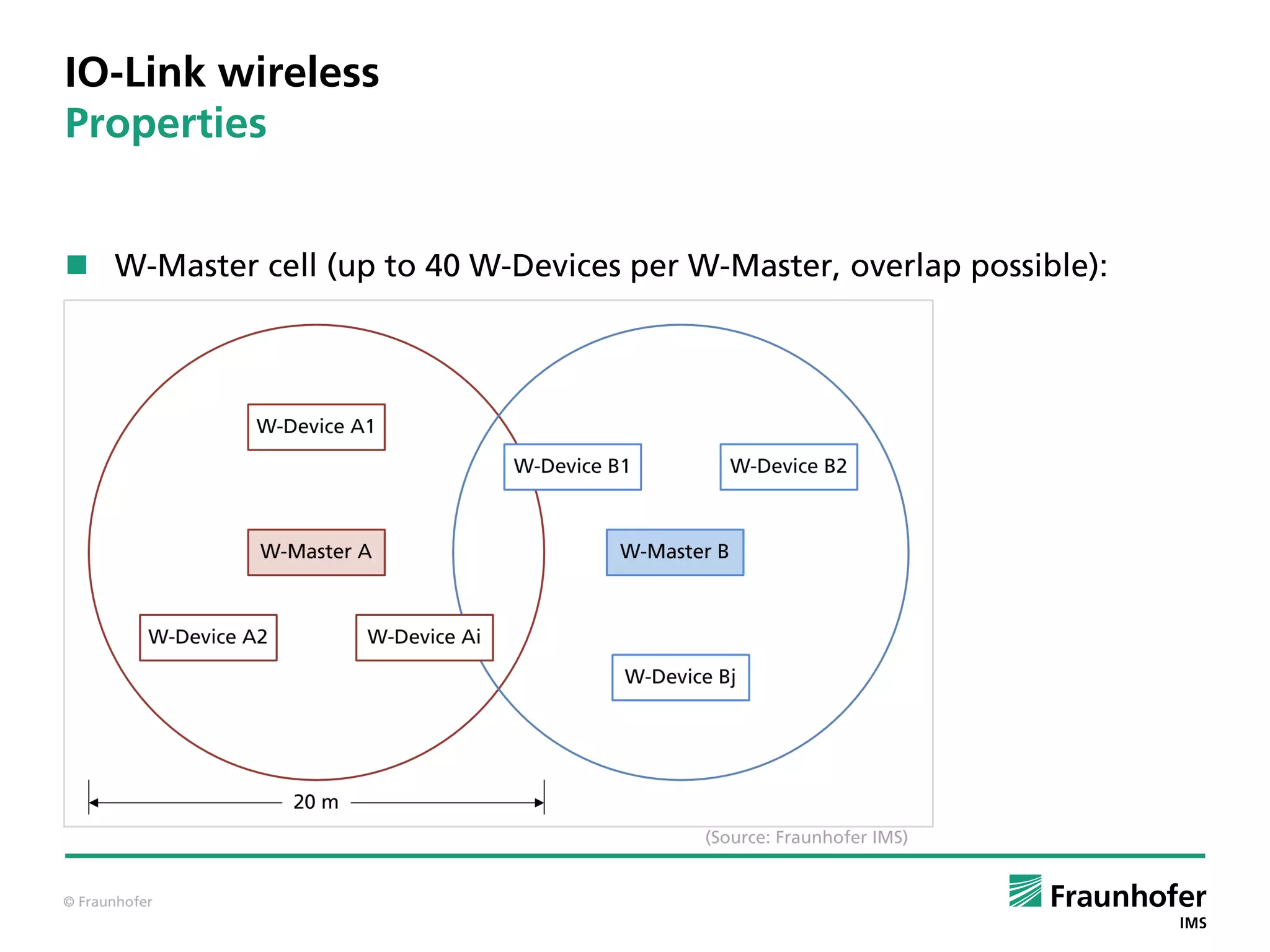
 W-Master cell (up to 40 W-Devices per W-Master, overlap possible):
(Source: Fraunhofer IMS)
© Fraunhofer
IO-Link wireless
Properties
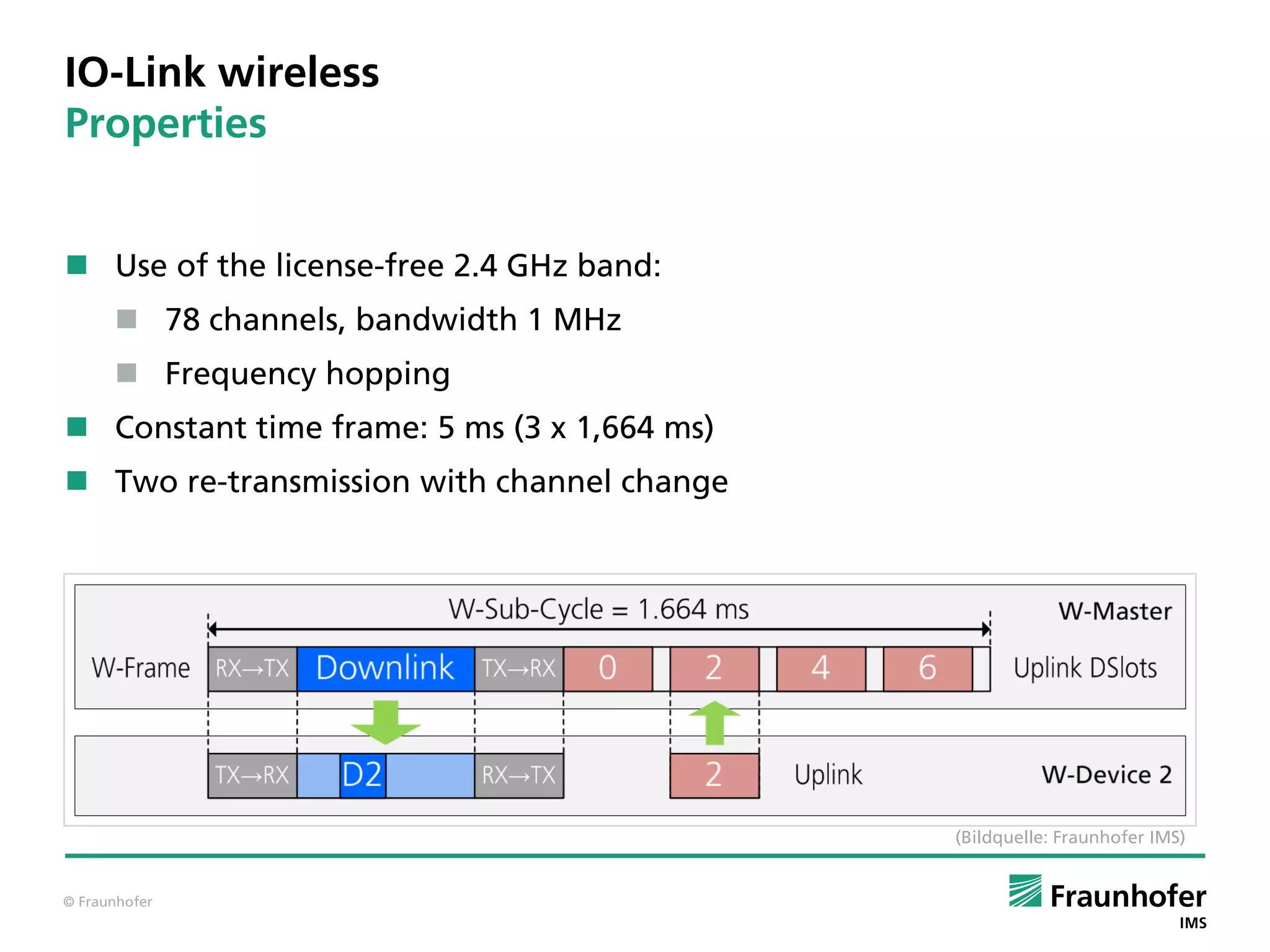
 Use of the license-free 2.4 GHz band:
 78 channels, bandwidth 1 MHz
 Frequency hopping
 Constant time frame: 5 ms (3 x 1,664 ms)
 Two re-transmission with channel change
(Bildquelle: Fraunhofer IMS)
© Fraunhofer
IO-Link wireless
Methods
 Frequency hopping
 Coexistence mechanisms like dynamic adaptive black listing
 Re-transmissions in each slot
 Error protection coding
© Fraunhofer
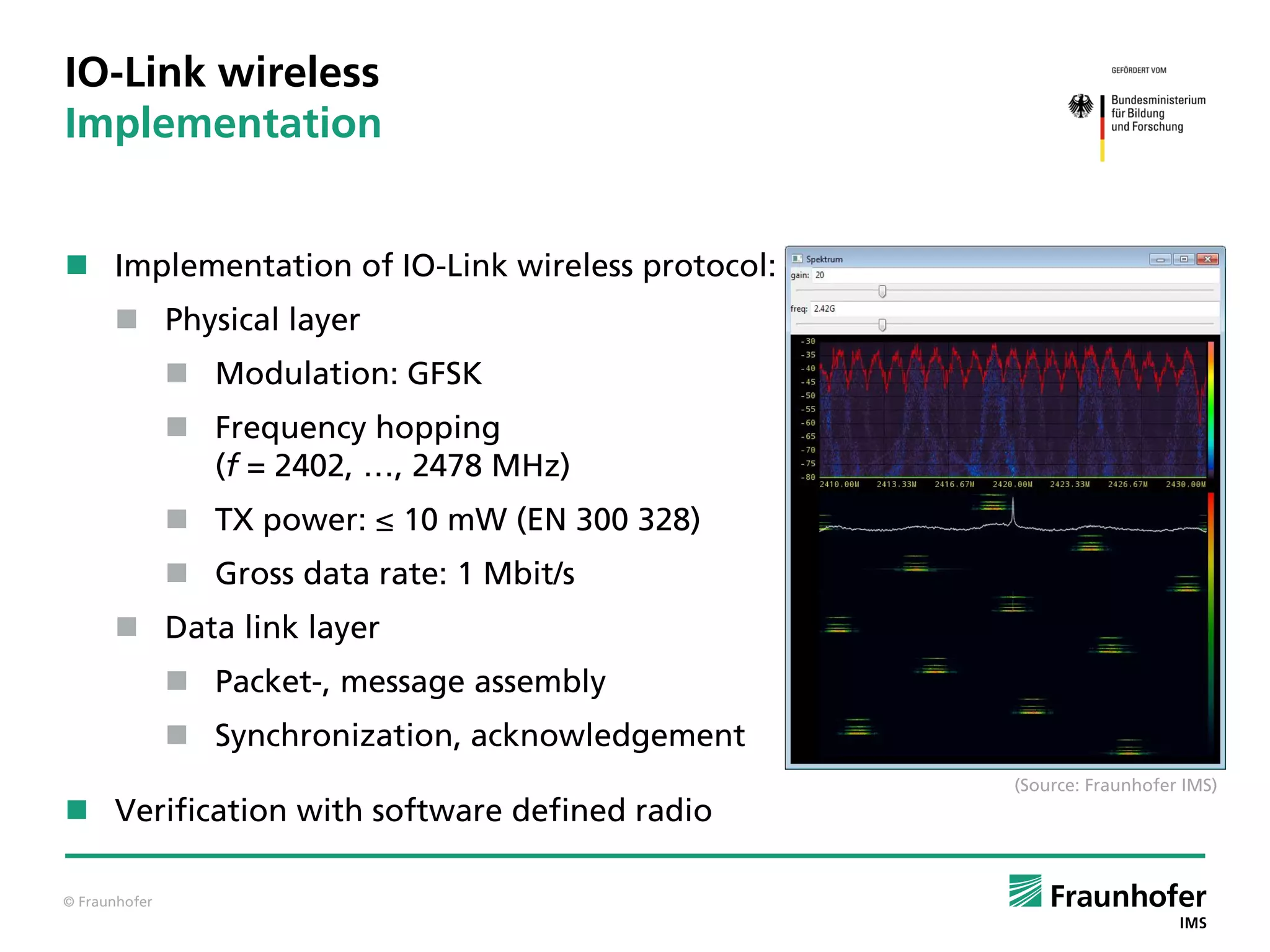
IO-Link wireless
Implementation
 Implementation of IO-Link wireless protocol:
 Physical layer
 Modulation: GFSK
 Frequency hopping
(f = 2402, …, 2478 MHz)
 TX power: ≤ 10 mW (EN 300 328)
 Gross data rate: 1 Mbit/s
 Data link layer
 Packet-, message assembly
 Synchronization, acknowledgement
 Verification with software defined radio
(Source: Fraunhofer IMS)
© Fraunhofer
CONTENT
 Introduction
 Applications and Requirements
 Wireless Real-Time Data Transmission Scheme
 Wireless Energy Transmission Scheme
 Conclusion
© Fraunhofer
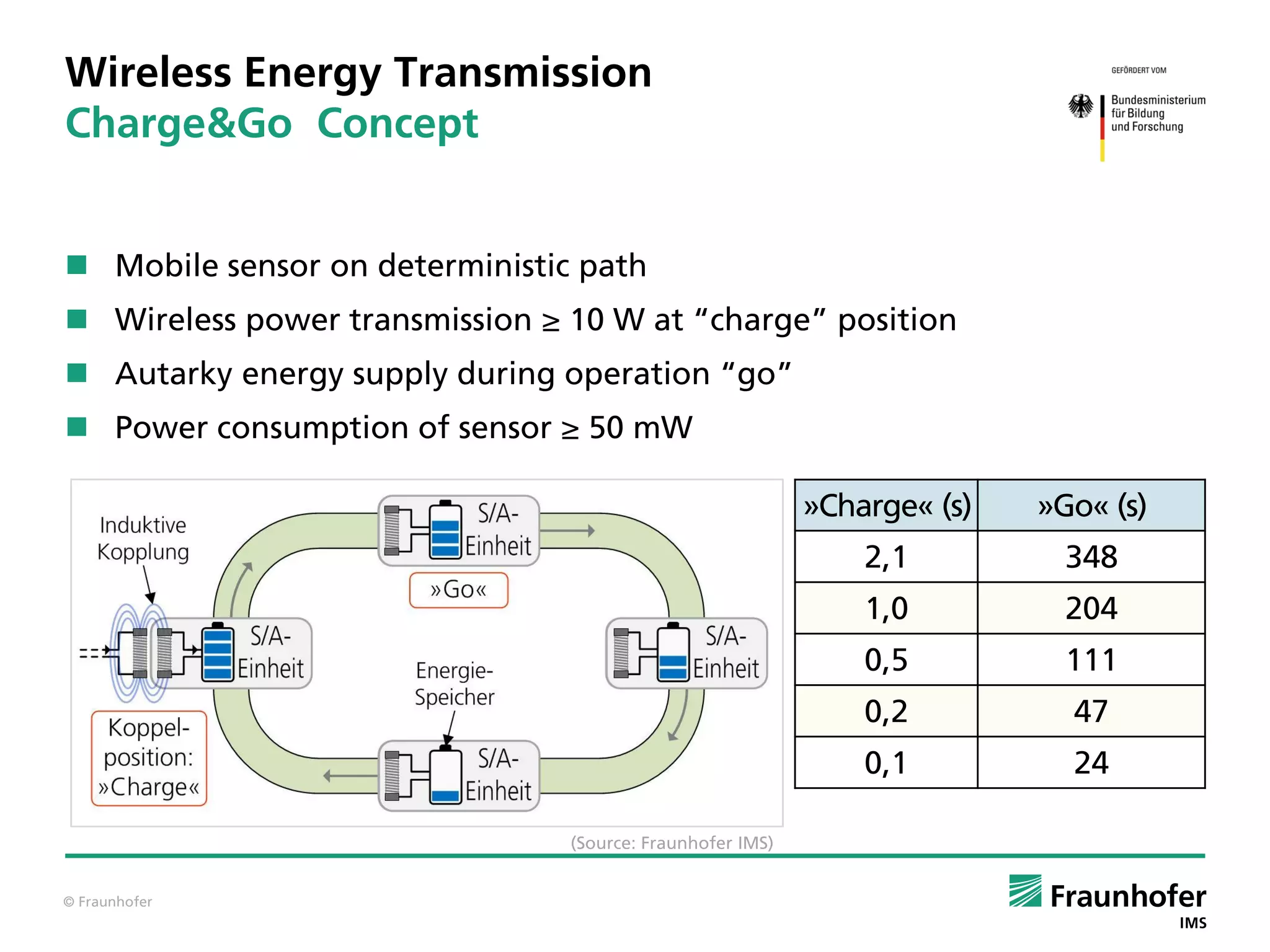
Wireless Energy Transmission
Charge&Go Concept
 Mobile sensor on deterministic path
 Wireless power transmission ≥ 10 W at “charge” position
 Autarky energy supply during operation “go”
 Power consumption of sensor ≥ 50 mW
»Charge« (s) »Go« (s)
2,1 348
1,0 204
0,5 111
0,2 47
0,1 24
(Source: Fraunhofer IMS)
© Fraunhofer Vertraulich
Wireless Energy Transmission
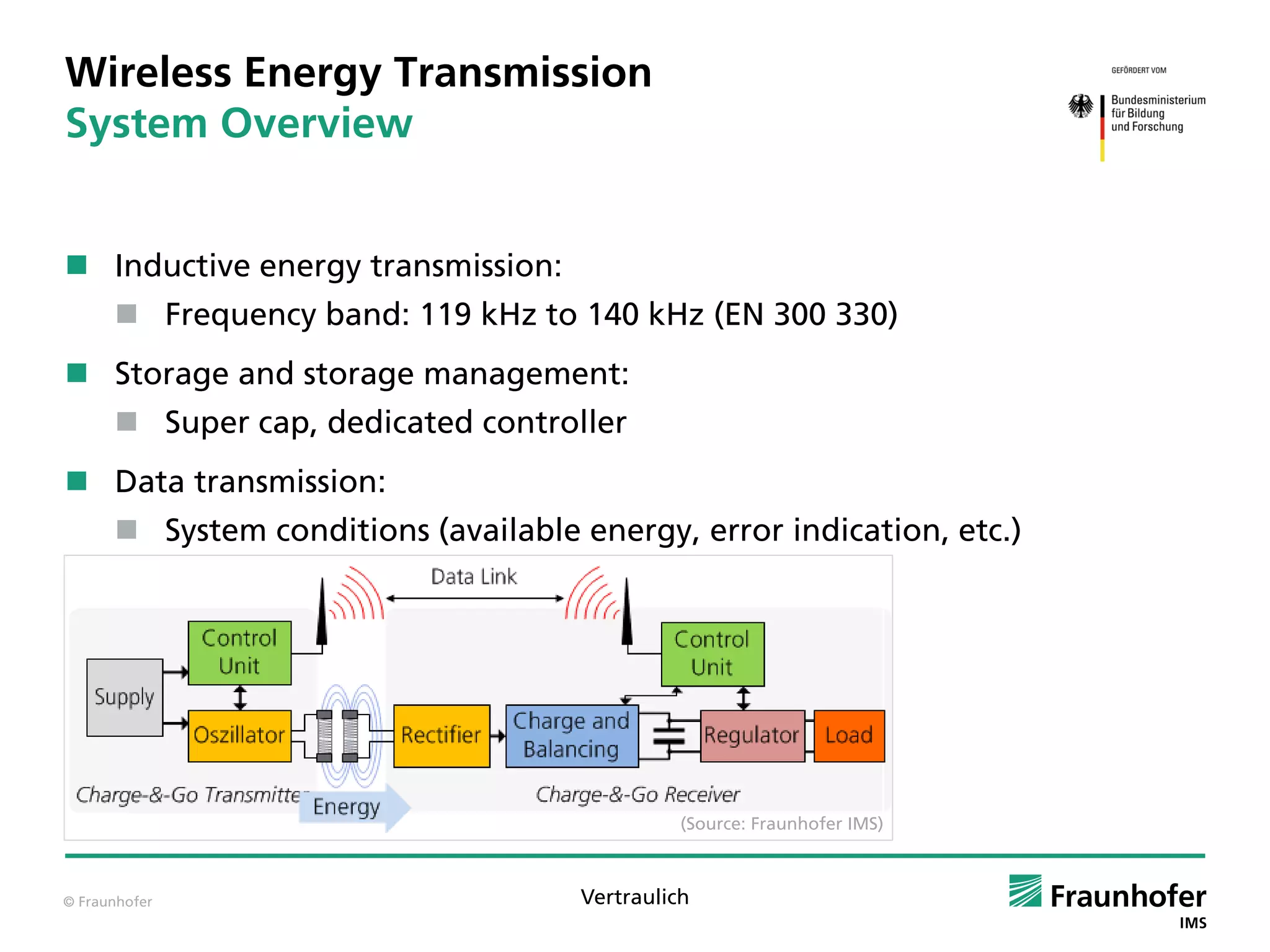
System Overview
 Inductive energy transmission:
 Frequency band: 119 kHz to 140 kHz (EN 300 330)
 Storage and storage management:
 Super cap, dedicated controller
 Data transmission:
 System conditions (available energy, error indication, etc.)
(Source: Fraunhofer IMS)
© Fraunhofer Vertraulich
Wireless Energy Transmission
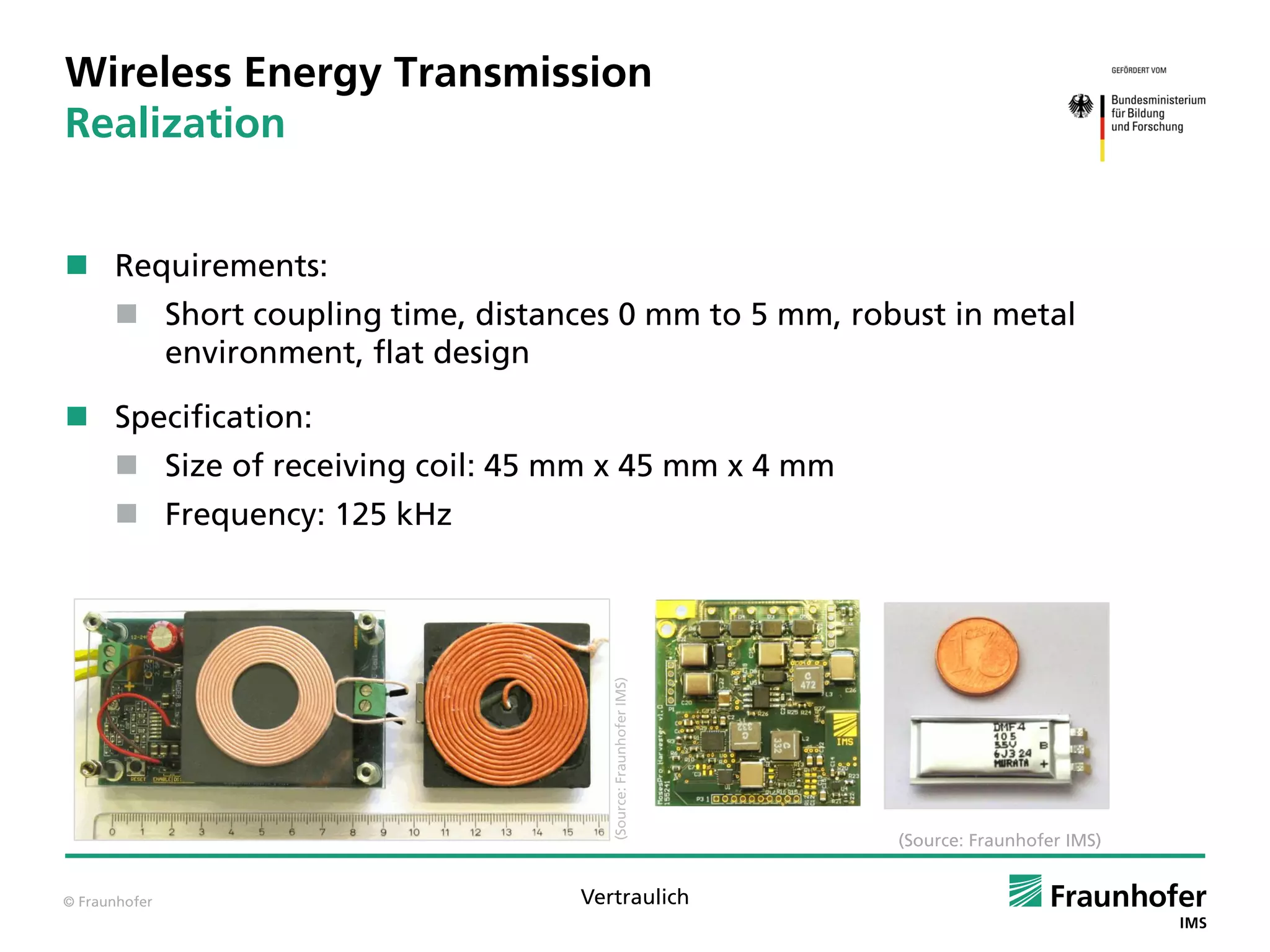
Realization
 Requirements:
 Short coupling time, distances 0 mm to 5 mm, robust in metal
environment, flat design
 Specification:
 Size of receiving coil: 45 mm x 45 mm x 4 mm
 Frequency: 125 kHz
(Source:FraunhoferIMS)
(Source: Fraunhofer IMS)
© Fraunhofer
Wireless Energy Transmission
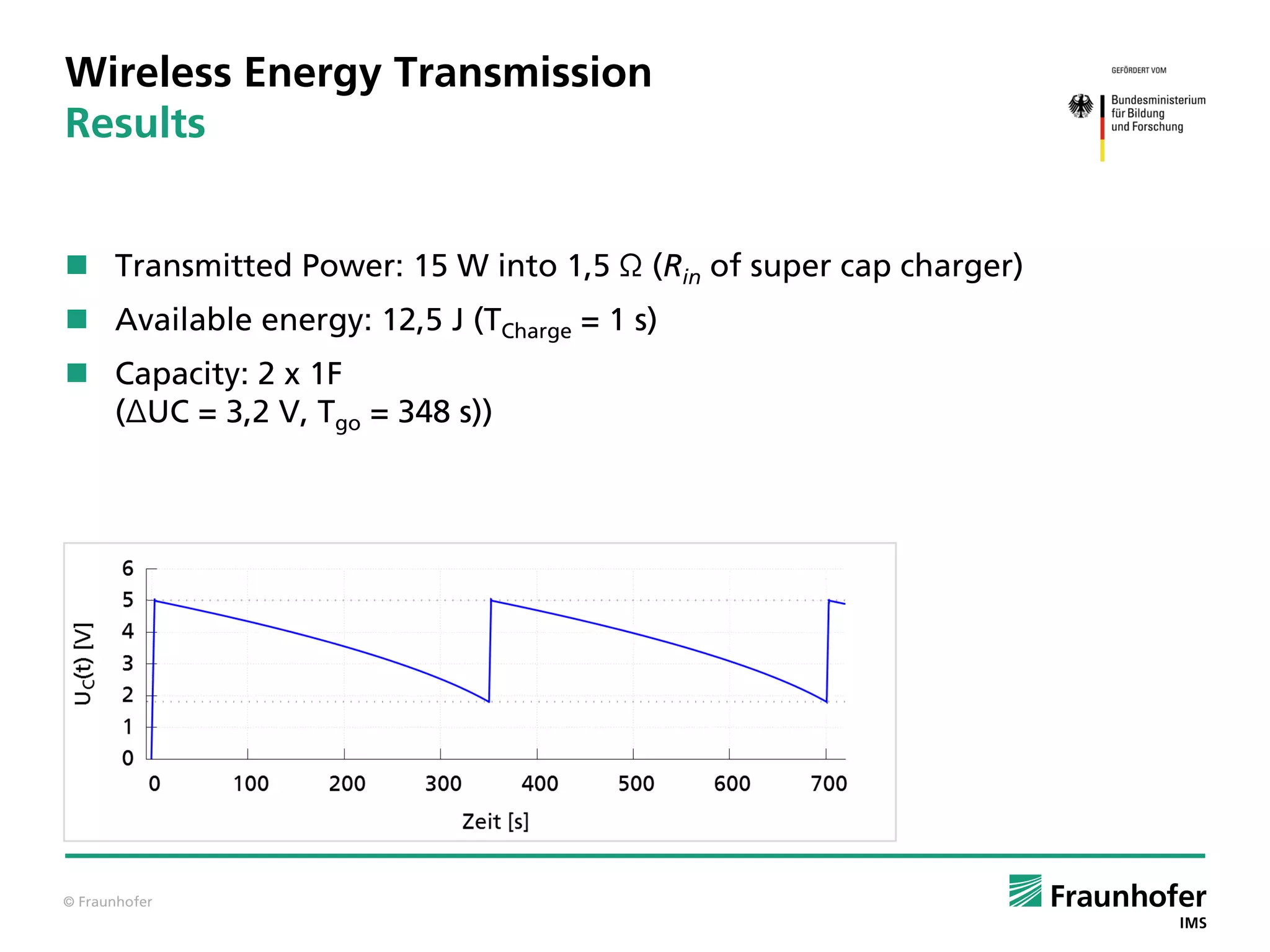
Results
 Transmitted Power: 15 W into 1,5 Ω (Rin of super cap charger)
 Available energy: 12,5 J (TCharge = 1 s)
 Capacity: 2 x 1F
(∆UC = 3,2 V, Tgo = 348 s))
© Fraunhofer
CONTENT
 Introduction
 Applications and Requirements
 Wireless Real-Time Data Transmission Scheme
 Wireless Energy Transmission Scheme
 Conclusion
© Fraunhofer
Conclusion
Completely Wireless Real-Time Sensors
 Wireless communication enables the networking of all production units
 It will play a key role in the realization of industry 4.0
 Standard for robust wireless real-time communication
for industrial production needed
 The novel IO-Link wireless standard will fulfill requirements
 “Charge and Go” is a potential approach to supply wireless sensors
wirelessly with energy

Completely Wireless Real-Time Sensors for Smart Factory Applications

  • 1.
    © Fraunhofer COMPLETELY WIRELESSREAL-TIME SENSORS FOR SMART FACTORY APPLICATIONS 6th M2M Alliance Academic Day, Cologne 2017
  • 2.
    © Fraunhofer CONTENT  Introduction Applications and Requirements  Wireless Real-Time Data Transmission Scheme  Wireless Energy Transmission Scheme  Conclusion
  • 3.
    © Fraunhofer Introduction Industry 4.0 Flexible equipment and machines  Functions are distributed in the network  All participants are connected across hierarchical levels  Communication takes place between all parties involved  The product is part of the network  Access to the connected world (Source: Plattform Industrie 4.0)
  • 4.
    © Fraunhofer Industry 4.0 CommunicationLayer  Networks in the industry 4.0 communication layer (Source: Plattform Industrie 4.0)
  • 5.
    © Fraunhofer Wireless Communication Motivation Increasingly large number of sensors expected  Cabling no longer practical  Need for sensors in moving machine parts  Cabling is critical in harsh environments Source:Pctipp.ch "Wireless communication enables the networking of all production units. It will play a key role in the realization of industry 4.0" (ZVEI Positionspapier*) *)ZVEI; „Industrie 4.0: Auf dem Weg zur smarten Fabrik – die Elektroindustrie geht voran“
  • 6.
    © Fraunhofer CONTENT  Introduction Applications and Requirements  Wireless Real-Time Data Transmission Scheme  Wireless Energy Transmission Scheme  Conclusion
  • 7.
    © Fraunhofer Condition Monitoringand Real-Time Prozess Control Project MoSeS-Pro
  • 8.
    © Fraunhofer Condition Monitoringand Real-Time Prozess Control Sensor Signals and Data Volumes (Source: ZEMA Saarbrücken)  Application Example Projekt MoSeS-Pro
  • 9.
    © Fraunhofer Industrial Networking Requirements Industrial applications and corresponding requirements (Source: VDE (ITG), Positionspapier »Funktechnologien für Industrie 4.0«)
  • 10.
    © Fraunhofer CONTENT  Introduction Applications and Requirements  Wireless Real-Time Data Transmission Scheme  Wireless Energy Transmission Scheme  Conclusion
  • 11.
    © Fraunhofer Wireless Sensor ProjectMoSeS-Pro  System block level diagram (Source: Fraunhofer IMS)
  • 12.
    © Fraunhofer Wireless DataTransmission Radio Technologies  Suitability of available standards for industrial applications (Source: VDE (ITG), Positionspapier »Funktechnologien für Industrie 4.0«)
  • 13.
    © Fraunhofer Wireless DataTransmission IO-Link wireless  Novel communication standard for industrial production  IO-Link is a well known standardized IO technology (IEC 61131-9) for communication with sensors as well as actuators (via 3 or 5- wire standard cables)  IO-Link wireless is an extension of the IO-Link standard  IO-Link Community:  Technical WG »IO-Link wireless«  Fraunhofer IMS is a member since 2016  Public review started in September
  • 14.
    © Fraunhofer Wireless DataTransmission IO-Link wireless  System topology wired and wireless (Source: Fraunhofer IMS)
  • 15.
    © Fraunhofer IO-Link wireless Properties Scalable number of nodes (10 - 100 participants)  Constant time frame for all participants: 5 ms  High reliability: packet error rate < 10-9  Short telegrams, bandwidth: 1 MHz (1 Mbit / s, gross)  Scalable range  Use of parallel systems within a production hall  Low energy consumption  Autarkic supplied sensors  Based on IEEE 802.15.1 (physical layer, bluetooth)
  • 16.
    © Fraunhofer IO-Link wireless Properties W-Master cell (up to 40 W-Devices per W-Master, overlap possible): (Source: Fraunhofer IMS)
  • 17.
    © Fraunhofer IO-Link wireless Properties Use of the license-free 2.4 GHz band:  78 channels, bandwidth 1 MHz  Frequency hopping  Constant time frame: 5 ms (3 x 1,664 ms)  Two re-transmission with channel change (Bildquelle: Fraunhofer IMS)
  • 18.
    © Fraunhofer IO-Link wireless Methods Frequency hopping  Coexistence mechanisms like dynamic adaptive black listing  Re-transmissions in each slot  Error protection coding
  • 19.
    © Fraunhofer IO-Link wireless Implementation Implementation of IO-Link wireless protocol:  Physical layer  Modulation: GFSK  Frequency hopping (f = 2402, …, 2478 MHz)  TX power: ≤ 10 mW (EN 300 328)  Gross data rate: 1 Mbit/s  Data link layer  Packet-, message assembly  Synchronization, acknowledgement  Verification with software defined radio (Source: Fraunhofer IMS)
  • 20.
    © Fraunhofer CONTENT  Introduction Applications and Requirements  Wireless Real-Time Data Transmission Scheme  Wireless Energy Transmission Scheme  Conclusion
  • 21.
    © Fraunhofer Wireless EnergyTransmission Charge&Go Concept  Mobile sensor on deterministic path  Wireless power transmission ≥ 10 W at “charge” position  Autarky energy supply during operation “go”  Power consumption of sensor ≥ 50 mW »Charge« (s) »Go« (s) 2,1 348 1,0 204 0,5 111 0,2 47 0,1 24 (Source: Fraunhofer IMS)
  • 22.
    © Fraunhofer Vertraulich WirelessEnergy Transmission System Overview  Inductive energy transmission:  Frequency band: 119 kHz to 140 kHz (EN 300 330)  Storage and storage management:  Super cap, dedicated controller  Data transmission:  System conditions (available energy, error indication, etc.) (Source: Fraunhofer IMS)
  • 23.
    © Fraunhofer Vertraulich WirelessEnergy Transmission Realization  Requirements:  Short coupling time, distances 0 mm to 5 mm, robust in metal environment, flat design  Specification:  Size of receiving coil: 45 mm x 45 mm x 4 mm  Frequency: 125 kHz (Source:FraunhoferIMS) (Source: Fraunhofer IMS)
  • 24.
    © Fraunhofer Wireless EnergyTransmission Results  Transmitted Power: 15 W into 1,5 Ω (Rin of super cap charger)  Available energy: 12,5 J (TCharge = 1 s)  Capacity: 2 x 1F (∆UC = 3,2 V, Tgo = 348 s))
  • 25.
    © Fraunhofer CONTENT  Introduction Applications and Requirements  Wireless Real-Time Data Transmission Scheme  Wireless Energy Transmission Scheme  Conclusion
  • 26.
    © Fraunhofer Conclusion Completely WirelessReal-Time Sensors  Wireless communication enables the networking of all production units  It will play a key role in the realization of industry 4.0  Standard for robust wireless real-time communication for industrial production needed  The novel IO-Link wireless standard will fulfill requirements  “Charge and Go” is a potential approach to supply wireless sensors wirelessly with energy