Telemecanique Sensors
The future of wireless
March 2016 / White paper
Eric Domont
Simply easy!
Wireless technologies are pervading most of our
daily activities, both personal and professional.
Today’s wireless communication devices keep us
constantly connected saving us time
and making us more productive.
Today’s manufacturing operations, as well as utilities
monitoring and control, are all about saving time, and
increasing productivity. Therefore wireless technologies
are finding their way to those industrial applications as
well as in our homes.
What type of technology do industrial wireless
sensors use?
Zigbee is the preferred technology for wireless
sensor communication up to 100 meters in
the line of sight, or 25 meters in a factory
environment, as part of a «Wireless Personal
Area Network». This distance can be increased
by installing repeating antennas.
Zigbee is part of the IEEE 802 family of wireless
protocols governing the worldwide 2.4 GHz
band, together with Bluetooth and Wifi.
It is cost effective, small in size, and low power,
made of just enough hardware and firmware to
transmit intermittent data at a low speed rate
(250 kb/s maximum) compared to other wireless
protocols.
IEEE 802-15-4 specifies different frequency
ranges depending on geographies. Schneider
Electric and Telemecanique Sensors choice
for industrial applications is 2.4 GHz, giving our
wireless solutions worldwide acceptance.
Telemecanique Sensors, through its parent
company Schneider Electric, is a member of the
Zigbee Alliance, aiming at further developing
the Zigbee technical standard, and promoting
its usage worldwide, in residential and industrial
applications.
“The zigbee protocol is a good solution for industrial
wireless applications; cost effective and small size. It is
made of just enough hardware and firmware to transmit
intermittent data at a low speed rate.”
Where are industrial wireless sensors used?
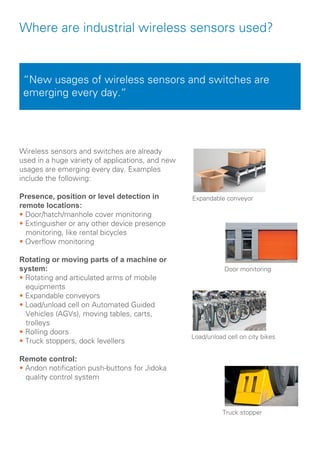
Wireless sensors and switches are already
used in a huge variety of applications, and new
usages are emerging every day. Examples
include the following:
Presence, position or level detection in
remote locations:
• Door/hatch/manhole cover monitoring
• Extinguisher or any other device presence 	 	
monitoring, like rental bicycles
• Overflow monitoring
Rotating or moving parts of a machine or
system:
• Rotating and articulated arms of mobile
equipments
• Expandable conveyors
• Load/unload cell on Automated Guided
Vehicles (AGVs), moving tables, carts, 			
trolleys
• Rolling doors
• Truck stoppers, dock levellers
Remote control:
• Andon notification push-buttons for Jidoka
quality control system	
	
“New usages of wireless sensors and switches are
emerging every day.“
Expandable conveyor
Door monitoring
Load/unload cell on city bikes
Truck stopper
What are the benefits of industrial wireless
sensors?
Wireless is not always the right fit for all applications. Although ZigBee
networks are secured by 128 bit symmetric encryption keys, and although IEEE
specifications intend to make all related wireless protocols interoperable, the
transmission cannot be guaranteed 100%.
A risk analysis needs to be performed in front of each target use case, in the same
way as the designers assess the risk of broken cable, both in terms of occurrence
and criticity.
As soon as the risk associated to wireless technology is acceptable, or lower than
the risk of broken cable, then the move to wireless makes sense.
In case of mission critical applications like the remote control of an overhead crane,
Schneider Electric launched eXLhoist control station, featuring a wireless ESTOP
push-button that is SIL3 Ple certified.
“In the same way as designers assess the risk of a
broken cable, a risk analysis needs to be conducted in
front of each target use case.“
• Reduced installation time and cost, both for new 	
machinery and revamping of existing installations.
• No more down time due to broken wires.
• Energy efficient and environmentally friendly. As 		
it is self-powered there is no battery replacement or 	
recycling costs.
What about communication reliability?
What type of power supplies do industrial
wireless sensors use?
Most connected objects of our domestic day to day life are battery powered.
Battery technology is improving very fast, every year providing more energy, for a
longer time, in a smaller footprint.
However, in an industrial wireless sensor that is intended to operate for 10 or
more years, it is still difficult to make the battery as compact as the communication
hardware.
Therefore Schneider Electric and Telemecanique Sensors looked for energy
harvesting technologies that could generate locally the energy required for
innovative wireless communication.
Mechanical energy harvester technology is a very good approach that is now
applied both on Harmony push-buttons and Telemecanique limit-switches.
It is independent of ambient light or vibration or temperature, as the energy is
generated by the actuation of the push-button or the limit-switch actuation head. It
is long lasting, consistent with industrial machinery life cycles.
When the operator pushes the button, or when the limit-switch head is actuated,
mechanical energy is transformed into electrical energy. This supplies the
transmission of a one-time radio message to one or multiple receivers.
In addition, up to 32 push buttons and/or limit-switches can be synchronized to
one receiver, providing even greater mobility in any environment. This batteryless
solution offers permanent availability, benefits the environment and eliminates
costly battery maintenance, re-charging and recycling.
“Mechanical energy harvester technology is a very good
approach, long lasting and consistent with industrial
machinery cycles. It is independent of ambient light,
vibration or temperature, as the energy is generated
by the actuation of the push-button or the limit-switch
actuation head.”
Wireless made real
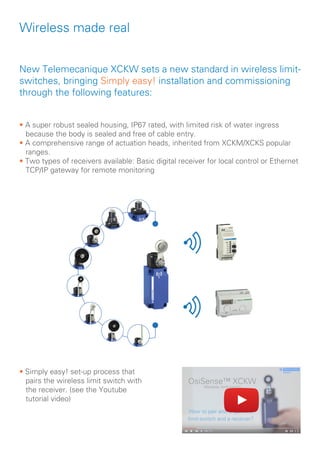
• A super robust sealed housing, IP67 rated, with limited risk of water ingress 		
because the body is sealed and free of cable entry.
• A comprehensive range of actuation heads, inherited from XCKM/XCKS popular 	
ranges.
• Two types of receivers available: Basic digital receiver for local control or Ethernet 	
TCP/IP gateway for remote monitoring
New Telemecanique XCKW sets a new standard in wireless limit-
switches, bringing Simply easy! installation and commissioning
through the following features:
• Simply easy! set-up process that 	
pairs the wireless limit switch with 	
the receiver. (see the Youtube
tutorial video)
What’s next for industrial wireless sensors?
Miniaturization:
As wireless and energy harvesting technologies become more popular on the
market, we can anticipate their integration in smaller and smaller form-factors,
including miniature limit-switches, and more low power electronic sensors
LPWAN (Low Power Wide Area Networks):
Low Power Wide Area Networks are the next big thing on top of Wireless Personal
Area Networks like Zigbee. In the near future those LPWANs will allow any sensor,
anywhere, to communicate digital and/or analog status directly to the cloud, without
the hardware costs and subscription constraint of current GPRS technology.
This will bring disruptive changes in the automation architectures for process,
manufacturing and infrastructure asset management, opening brand new fields of
innovation for automation designers.
Eric Domont
Telemecanique Sensors
Marketing Director
Schneider Electric Industries SAS
Head Office
35, rue Joseph Monier – CS 30323
F92506 Rueil-Malmaison Cedex
FRANCE
www.tesensors.com
Due to the constant evolution of standards and equipment, the specifications indicated in the text and
images of this document can only be guaranteed after confirmation by our departments.
Print: Schneider Electric
©2016 Schneider Electric. All Rights Reserved. Schneider Electric, OsiSense, and Telemecanique are trademarks owned
by Schneider Electric Industries SAS or its affiliated companies. All other trademarks are property of their respective
owners.

Wireless sensors white paper

  • 1.
    Telemecanique Sensors The futureof wireless March 2016 / White paper Eric Domont Simply easy!
  • 2.
    Wireless technologies arepervading most of our daily activities, both personal and professional. Today’s wireless communication devices keep us constantly connected saving us time and making us more productive. Today’s manufacturing operations, as well as utilities monitoring and control, are all about saving time, and increasing productivity. Therefore wireless technologies are finding their way to those industrial applications as well as in our homes.
  • 3.
    What type oftechnology do industrial wireless sensors use? Zigbee is the preferred technology for wireless sensor communication up to 100 meters in the line of sight, or 25 meters in a factory environment, as part of a «Wireless Personal Area Network». This distance can be increased by installing repeating antennas. Zigbee is part of the IEEE 802 family of wireless protocols governing the worldwide 2.4 GHz band, together with Bluetooth and Wifi. It is cost effective, small in size, and low power, made of just enough hardware and firmware to transmit intermittent data at a low speed rate (250 kb/s maximum) compared to other wireless protocols. IEEE 802-15-4 specifies different frequency ranges depending on geographies. Schneider Electric and Telemecanique Sensors choice for industrial applications is 2.4 GHz, giving our wireless solutions worldwide acceptance. Telemecanique Sensors, through its parent company Schneider Electric, is a member of the Zigbee Alliance, aiming at further developing the Zigbee technical standard, and promoting its usage worldwide, in residential and industrial applications. “The zigbee protocol is a good solution for industrial wireless applications; cost effective and small size. It is made of just enough hardware and firmware to transmit intermittent data at a low speed rate.”
  • 4.
    Where are industrialwireless sensors used? Wireless sensors and switches are already used in a huge variety of applications, and new usages are emerging every day. Examples include the following: Presence, position or level detection in remote locations: • Door/hatch/manhole cover monitoring • Extinguisher or any other device presence monitoring, like rental bicycles • Overflow monitoring Rotating or moving parts of a machine or system: • Rotating and articulated arms of mobile equipments • Expandable conveyors • Load/unload cell on Automated Guided Vehicles (AGVs), moving tables, carts, trolleys • Rolling doors • Truck stoppers, dock levellers Remote control: • Andon notification push-buttons for Jidoka quality control system “New usages of wireless sensors and switches are emerging every day.“ Expandable conveyor Door monitoring Load/unload cell on city bikes Truck stopper
  • 5.
    What are thebenefits of industrial wireless sensors? Wireless is not always the right fit for all applications. Although ZigBee networks are secured by 128 bit symmetric encryption keys, and although IEEE specifications intend to make all related wireless protocols interoperable, the transmission cannot be guaranteed 100%. A risk analysis needs to be performed in front of each target use case, in the same way as the designers assess the risk of broken cable, both in terms of occurrence and criticity. As soon as the risk associated to wireless technology is acceptable, or lower than the risk of broken cable, then the move to wireless makes sense. In case of mission critical applications like the remote control of an overhead crane, Schneider Electric launched eXLhoist control station, featuring a wireless ESTOP push-button that is SIL3 Ple certified. “In the same way as designers assess the risk of a broken cable, a risk analysis needs to be conducted in front of each target use case.“ • Reduced installation time and cost, both for new machinery and revamping of existing installations. • No more down time due to broken wires. • Energy efficient and environmentally friendly. As it is self-powered there is no battery replacement or recycling costs. What about communication reliability?
  • 6.
    What type ofpower supplies do industrial wireless sensors use? Most connected objects of our domestic day to day life are battery powered. Battery technology is improving very fast, every year providing more energy, for a longer time, in a smaller footprint. However, in an industrial wireless sensor that is intended to operate for 10 or more years, it is still difficult to make the battery as compact as the communication hardware. Therefore Schneider Electric and Telemecanique Sensors looked for energy harvesting technologies that could generate locally the energy required for innovative wireless communication. Mechanical energy harvester technology is a very good approach that is now applied both on Harmony push-buttons and Telemecanique limit-switches. It is independent of ambient light or vibration or temperature, as the energy is generated by the actuation of the push-button or the limit-switch actuation head. It is long lasting, consistent with industrial machinery life cycles. When the operator pushes the button, or when the limit-switch head is actuated, mechanical energy is transformed into electrical energy. This supplies the transmission of a one-time radio message to one or multiple receivers. In addition, up to 32 push buttons and/or limit-switches can be synchronized to one receiver, providing even greater mobility in any environment. This batteryless solution offers permanent availability, benefits the environment and eliminates costly battery maintenance, re-charging and recycling. “Mechanical energy harvester technology is a very good approach, long lasting and consistent with industrial machinery cycles. It is independent of ambient light, vibration or temperature, as the energy is generated by the actuation of the push-button or the limit-switch actuation head.”
  • 7.
    Wireless made real •A super robust sealed housing, IP67 rated, with limited risk of water ingress because the body is sealed and free of cable entry. • A comprehensive range of actuation heads, inherited from XCKM/XCKS popular ranges. • Two types of receivers available: Basic digital receiver for local control or Ethernet TCP/IP gateway for remote monitoring New Telemecanique XCKW sets a new standard in wireless limit- switches, bringing Simply easy! installation and commissioning through the following features: • Simply easy! set-up process that pairs the wireless limit switch with the receiver. (see the Youtube tutorial video)
  • 8.
    What’s next forindustrial wireless sensors? Miniaturization: As wireless and energy harvesting technologies become more popular on the market, we can anticipate their integration in smaller and smaller form-factors, including miniature limit-switches, and more low power electronic sensors LPWAN (Low Power Wide Area Networks): Low Power Wide Area Networks are the next big thing on top of Wireless Personal Area Networks like Zigbee. In the near future those LPWANs will allow any sensor, anywhere, to communicate digital and/or analog status directly to the cloud, without the hardware costs and subscription constraint of current GPRS technology. This will bring disruptive changes in the automation architectures for process, manufacturing and infrastructure asset management, opening brand new fields of innovation for automation designers.
  • 9.
    Eric Domont Telemecanique Sensors MarketingDirector Schneider Electric Industries SAS Head Office 35, rue Joseph Monier – CS 30323 F92506 Rueil-Malmaison Cedex FRANCE www.tesensors.com Due to the constant evolution of standards and equipment, the specifications indicated in the text and images of this document can only be guaranteed after confirmation by our departments. Print: Schneider Electric ©2016 Schneider Electric. All Rights Reserved. Schneider Electric, OsiSense, and Telemecanique are trademarks owned by Schneider Electric Industries SAS or its affiliated companies. All other trademarks are property of their respective owners.