Low-Power Wide-Area
Overview Oliver Wilps
September 2017
2
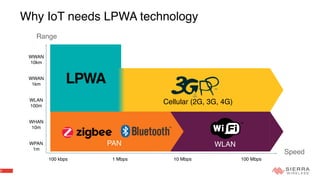
Why IoT needs LPWA technology
Cellular (2G, 3G, 4G)
WWAN
1km
WLAN
100m
WHAN
10m
WPAN
1m
100 kbps 1 Mbps 10 Mbps 100 Mbps
WWAN
10km
Range
Speed
LPWA
PAN WLAN
3
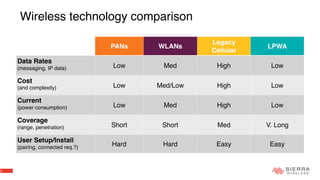
Wireless technology comparison
PANs WLANs
Legacy

Cellular
LPWA
Data Rates
(messaging, IP data) Low Med High Low
Cost

(and complexity) Low Med/Low High Low
Current 

(power consumption) Low Med High Low
Coverage

(range, penetration) Short Short Med V. Long
User Setup/Install
(pairing, connected req.?)
Hard Hard Easy Easy
4
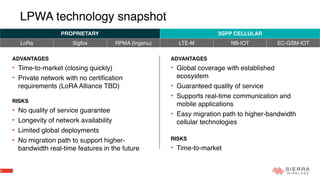
LPWA technology snapshot
ADVANTAGES
• Time-to-market (closing quickly)
• Private network with no certification
requirements (LoRA Alliance TBD)
RISKS
• No quality of service guarantee
• Longevity of network availability
• Limited global deployments
• No migration path to support higher-
bandwidth real-time features in the future
PROPRIETARY 3GPP CELLULAR
LoRa Sigfox RPMA (Ingenu) LTE-M NB-IOT EC-GSM-IOT
ADVANTAGES
• Global coverage with established
ecosystem
• Guaranteed quality of service
• Supports real-time communication and
mobile applications
• Easy migration path to higher-bandwidth
cellular technologies
RISKS
• Time-to-market
5
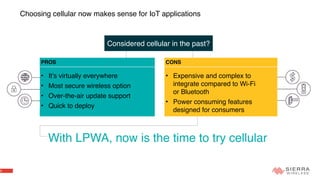
PROS
• It’s virtually everywhere
• Most secure wireless option
• Over-the-air update support
• Quick to deploy
CONS
• Expensive and complex to

integrate compared to Wi-Fi

or Bluetooth
• Power consuming features 

designed for consumers
With LPWA, now is the time to try cellular
Considered cellular in the past?
Choosing cellular now makes sense for IoT applications

6
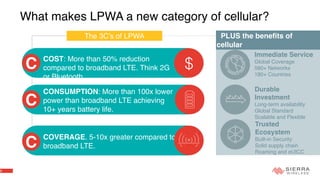
What makes LPWA a new category of cellular?
C COST: More than 50% reduction
compared to broadband LTE. Think 2G
or Bluetooth.
C
CONSUMPTION: More than 100x lower
power than broadband LTE achieving
10+ years battery life.
C
COVERAGE. 5-10x greater compared to
broadband LTE.
$
Immediate Service
Global Coverage
580+ Networks
180+ Countries
Durable
Investment
Long-term availability

Global Standard
Scalable and Flexible
Trusted
Ecosystem
Built-in Security
Solid supply chain
Roaming and eUICC
PLUS the benefits of
cellular
The 3C’s of LPWA
7
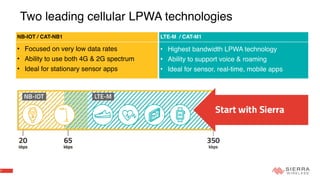
Two leading cellular LPWA technologies
LTE-M / CAT-M1 

• Highest bandwidth LPWA technology
• Ability to support voice & roaming
• Ideal for sensor, real-time, mobile apps
NB-IOT / CAT-NB1

• Focused on very low data rates
• Ability to use both 4G & 2G spectrum
• Ideal for stationary sensor apps
8
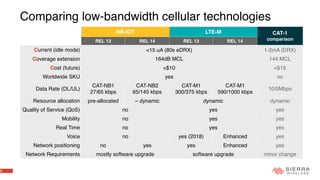
Comparing low-bandwidth cellular technologies
NB-IOT LTE-M CAT-1
comparisonREL 13 REL 14 REL 13 REL 14
Current (idle mode) <15 uA (80s eDRX) 1-2mA (DRX)
Coverage extension 164dB MCL 144 MCL
Cost (future) <$10 <$15
Worldwide SKU yes no
Data Rate (DL/UL)
CAT-NB1
27/65 kbps
CAT-NB2
65/145 kbps
CAT-M1
300/375 kbps
CAT-M1
590/1000 kbps
10/5Mbps
Resource allocation pre-allocated ~ dynamic dynamic dynamic
Quality of Service (QoS) no yes yes
Mobility no yes yes
Real Time no yes yes
Voice no yes (2018) Enhanced yes
Network positioning no yes yes Enhanced yes
Network Requirements mostly software upgrade software upgrade minor change
9
Comparing low-bandwidth cellular technologies
NB-IOT LTE-M CAT-1
comparisonREL 13 REL 14 REL 13 REL 14
Current (idle mode) <15 uA (80s eDRX) 1-2mA (DRX)
Coverage extension 164dB MCL 144 MCL
Cost (future) <$10 <$15
Worldwide SKU yes no
Data Rate (DL/UL)
CAT-NB1
27/65 kbps
CAT-NB2
65/145 kbps
CAT-M1
300/375 kbps
CAT-M1
590/1000 kbps
10/5Mbps
Resource allocation pre-allocated ~ dynamic dynamic dynamic
Quality of Service (QoS) no yes yes
Mobility no yes yes
Real Time no yes yes
Voice no yes (2018) Enhanced yes
Network positioning no yes yes Enhanced yes
Network Requirements mostly software upgrade software upgrade minor change
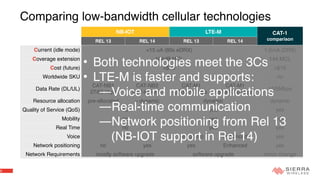
• Both technologies meet the 3Cs
• LTE-M is faster and supports:
―Voice and mobile applications
―Real-time communication
―Network positioning from Rel 13 

(NB-IOT support in Rel 14)
10
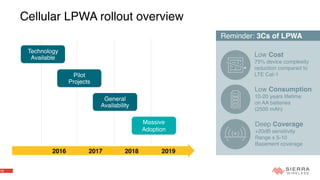
Cellular LPWA rollout overview
2016 2017 2018 2019
Technology
Available
Pilot

Projects
General

Availability
Massive

Adoption
Low Cost
75% device complexity
reduction compared to
LTE Cat-1
Low Consumption
10-20 years lifetime

on AA batteries

(2500 mAh)
Deep Coverage
+20dB sensitivity

Range x 5-10

Basement coverage
Reminder: 3Cs of LPWA
11
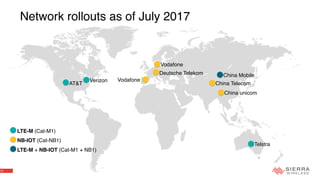
Network rollouts as of July 2017
AT&T
Verizon
Telstra
China Mobile
China Telecom
China unicom
LTE-M (Cat-M1)
NB-IOT (Cat-NB1)
LTE-M + NB-IOT (Cat-M1 + NB1)
Deutsche Telekom
Vodafone
Vodafone
12
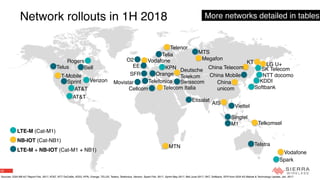
Network rollouts in 1H 2018
Telus Bell
AT&T
Verizon
KPN
Telstra
Spark
Rogers
Orange
Telefonica
China Mobile
KDDI
Softbank
NTT docomo
LTE-M (Cat-M1)
NB-IOT (Cat-NB1)
Vodafone
Deutsche
Telekom
LTE-M + NB-IOT (Cat-M1 + NB1)
China
unicom
China Telecom
Telecom Italia
Vodafone
Sprint
SFR
Telia
Megafon
M1
LG U+KT
Sources: GSA NB-IoT Report Feb. 2017; AT&T, NTT DoCoMo, KDDI, KPN, Orange, TELUS, Telstra, Telefonica, Verizon, Spark Feb. 2017, Sprint May 2017, Bell June 2017; SKT, Softbank, SFR from GSA 4G Market & Technology Update, Jan. 2017
AT&T
Singtel
Telkomsel
AIS
Viettel
T-Mobile
SK Telecom
SwisscomMovistar
Telenor
Cellcom
EE
O2
MTN
Etisalat
MTS
More networks detailed in tables
13
LPWA FEATURES

Full network
rollouts does not
mean all features
have been
implemented
• Power consumption
• PSM: available now
• eDRX: ready for testing, network launches
expected in early 2018 (requires module
firmware upgrade)
• Coverage
• Mode A: being tested now
• Mode B: future feature dependent on
network availability (requires module
firmware upgrade)
14
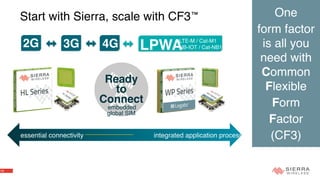
Start with Sierra, scale with CF3™ One
form factor
is all you
need with
Common
Flexible
Form
Factor
(CF3)essential connectivity integrated application processing
Ready
to
Connect
embedded
global SIM
2G 3G 4G LPWALTE-M / Cat-M1
NB-IOT / Cat-NB1
15
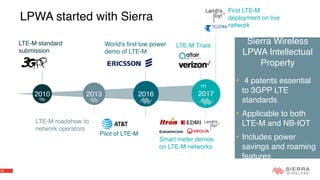
LPWA started with Sierra
2010
LTE-M standard
submission
20162013
LTE-M roadshow to
network operators
World’s first low power
demo of LTE-M
Pilot of LTE-M
2017
LTE-M Trials
Smart meter demos
on LTE-M networks
1H
First LTE-M
deployment on live
network
Sierra Wireless
LPWA Intellectual
Property
• 4 patents essential
to 3GPP LTE
standards
• Applicable to both
LTE-M and NB-IOT
• Includes power
savings and roaming
features
Know the limitations of proprietary technologies
APPENDIX 2
17
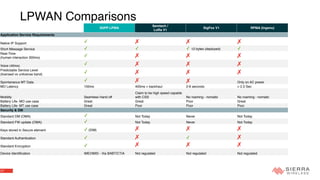
LPWAN Comparisons
3GPP LPWA
Semtech /
LoRa V1
SigFox V1 RPMA (Ingenu)
Application Service Requirements
Native IP Support ✓ ✗ ✗ ✗
Short Message Service ✓ ✓ ✓ 12 bytes (deployed) ✓
Real-Time 

(human interaction 300ms) ✓ ✗ ✗ ✗
Voice (40ms) ✓ ✗ ✗ ✗
Predictable Service Level

(licensed vs unlicense band)
✓ ✗ ✗ ✗
Spontaneous MT Data ✓ ✗ ✗ Only on AC power
MO Latency 100ms 400ms + backhaul 2-6 seconds > 2.3 Sec
Mobility Seamless Hand off
Claim to be high speed capable
with CSS No roaming - nomatic No roaming - nomatic
Battery Life- MO use case Great Great Poor Great
Battery Life- MT use case Great Poor Poor Poor
Security & DM
Standard DM (OMA) ✓ Not Today Never Not Today
Standard FW update (OMA) ✓ Not Today Never Not Today
Keys stored in Secure element ✓ (SIM) ✗ ✗ ✗
Standard Authentication ✓ ✗ ✓ ✗
Standard Encryption ✓ ✗ ✗ ✗
Device Identification IMEI/IMSI - Via BABT/CTIA Not regulated Not regulated Not regulated
18
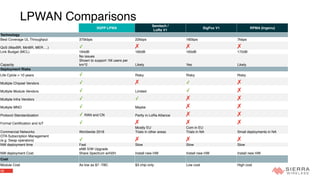
LPWAN Comparisons
Feature 3GPP LPWA
Semtech /
LoRa V1
SigFox V1 RPMA (Ingenu)
Technology
Best Coverage UL Throughput 375kbps 22kbps 160bps 7kbps
QoS (MaxBR, MinBR, MER….) ✓ ✗ ✗ ✗
Link Budget (MCL) 164dB 160dB 165dB 172dB
Capacity
No issues

Shown to support 1M users per
km^2 Likely Yes Likely
Deployment Risks
Life Cylcle > 10 years ✓ Risky Risky Risky
Multiple Chipset Vendors ✓ ✗ ✓ ✗
Multiple Module Vendors ✓ Limited ✓ ✗
Multiple Infra Vendors ✓ ✓ ✗ ✗
Multiple MNO ✓ Maybe ✗ ✗
Protocol Standardization ✓ RAN and CN Partly in LoRa Alliance ✗ ✗
Formal Certification and IoT ✓ ✗ ✗ ✗
Commercial Networks Worldwide 2018
Mostly EU

Trials in other areas
Com in EU
Trials in NA Small deployments in NA
OTA Subscription Management

(e.g. Swap operators) ✓ ✗ ✗ ✗
NW deployment time Fast Slow Slow Slow
NW deployment Cost
eNB S/W Upgrade

Share Spectrum w/H2H Install new HW Install new HW Install new HW
Cost
Module Cost As low as $7 -TBC $3 chip only Low cost High cost
Deeper Dive on Network Rollouts
APPENDIX 1
20
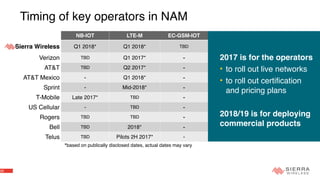
Timing of key operators in NAM
NB-IOT LTE-M EC-GSM-IOT
Sierra Wireless Q1 2018* Q1 2018* TBD
Verizon TBD Q1 2017* -
AT&T TBD Q2 2017* -
AT&T Mexico - Q1 2018* -
Sprint - Mid-2018* -
T-Mobile Late 2017* TBD -
US Cellular - TBD -
Rogers TBD TBD -
Bell TBD 2018* -
Telus TBD Pilots 2H 2017* -
*based on publically disclosed dates, actual dates may vary
2017 is for the operators
• to roll out live networks
• to roll out certification
and pricing plans
2018/19 is for deploying
commercial products
21
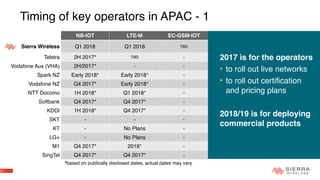
Timing of key operators in APAC - 1
NB-IOT LTE-M EC-GSM-IOT
Sierra Wireless Q1 2018 Q1 2018 TBD
Telstra 2H 2017* TBD -
Vodafone Aus (VHA) 2H/2017* - -
Spark NZ Early 2018* Early 2018* -
Vodafone NZ Q4 2017* Early 2018* -
NTT Docomo 1H 2018* Q1 2018* -
Softbank Q4 2017* Q4 2017* -
KDDI 1H 2018* Q4 2017* -
SKT - - -
KT - No Plans -
LG+ - No Plans -
M1 Q4 2017* 2018* -
SingTel Q4 2017* Q4 2017* -
*based on publically disclosed dates, actual dates may vary
2017 is for the operators
• to roll out live networks
• to roll out certification
and pricing plans
2018/19 is for deploying
commercial products
22
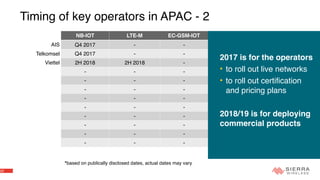
Timing of key operators in APAC - 2
NB-IOT LTE-M EC-GSM-IOT
AIS Q4 2017 - -
Telkomsel Q4 2017 - -
Viettel 2H 2018 2H 2018 -
- - -
- - -
- - -
- - -
- - -
- - -
- - -
- - -
- - -
*based on publically disclosed dates, actual dates may vary
2017 is for the operators
• to roll out live networks
• to roll out certification
and pricing plans
2018/19 is for deploying
commercial products
Thank you.Oliver Wilps
+49 171 86 55 668

Low-Power Wide Area - Overview

  • 1.
  • 2.
    2 Why IoT needsLPWA technology Cellular (2G, 3G, 4G) WWAN 1km WLAN 100m WHAN 10m WPAN 1m 100 kbps 1 Mbps 10 Mbps 100 Mbps WWAN 10km Range Speed LPWA PAN WLAN
  • 3.
    3 Wireless technology comparison PANsWLANs Legacy
 Cellular LPWA Data Rates (messaging, IP data) Low Med High Low Cost
 (and complexity) Low Med/Low High Low Current 
 (power consumption) Low Med High Low Coverage
 (range, penetration) Short Short Med V. Long User Setup/Install (pairing, connected req.?) Hard Hard Easy Easy
  • 4.
    4 LPWA technology snapshot ADVANTAGES •Time-to-market (closing quickly) • Private network with no certification requirements (LoRA Alliance TBD) RISKS • No quality of service guarantee • Longevity of network availability • Limited global deployments • No migration path to support higher- bandwidth real-time features in the future PROPRIETARY 3GPP CELLULAR LoRa Sigfox RPMA (Ingenu) LTE-M NB-IOT EC-GSM-IOT ADVANTAGES • Global coverage with established ecosystem • Guaranteed quality of service • Supports real-time communication and mobile applications • Easy migration path to higher-bandwidth cellular technologies RISKS • Time-to-market
  • 5.
    5 PROS • It’s virtuallyeverywhere • Most secure wireless option • Over-the-air update support • Quick to deploy CONS • Expensive and complex to
 integrate compared to Wi-Fi
 or Bluetooth • Power consuming features 
 designed for consumers With LPWA, now is the time to try cellular Considered cellular in the past? Choosing cellular now makes sense for IoT applications

  • 6.
    6 What makes LPWAa new category of cellular? C COST: More than 50% reduction compared to broadband LTE. Think 2G or Bluetooth. C CONSUMPTION: More than 100x lower power than broadband LTE achieving 10+ years battery life. C COVERAGE. 5-10x greater compared to broadband LTE. $ Immediate Service Global Coverage 580+ Networks 180+ Countries Durable Investment Long-term availability
 Global Standard Scalable and Flexible Trusted Ecosystem Built-in Security Solid supply chain Roaming and eUICC PLUS the benefits of cellular The 3C’s of LPWA
  • 7.
    7 Two leading cellularLPWA technologies LTE-M / CAT-M1 
 • Highest bandwidth LPWA technology • Ability to support voice & roaming • Ideal for sensor, real-time, mobile apps NB-IOT / CAT-NB1
 • Focused on very low data rates • Ability to use both 4G & 2G spectrum • Ideal for stationary sensor apps
  • 8.
    8 Comparing low-bandwidth cellulartechnologies NB-IOT LTE-M CAT-1 comparisonREL 13 REL 14 REL 13 REL 14 Current (idle mode) <15 uA (80s eDRX) 1-2mA (DRX) Coverage extension 164dB MCL 144 MCL Cost (future) <$10 <$15 Worldwide SKU yes no Data Rate (DL/UL) CAT-NB1 27/65 kbps CAT-NB2 65/145 kbps CAT-M1 300/375 kbps CAT-M1 590/1000 kbps 10/5Mbps Resource allocation pre-allocated ~ dynamic dynamic dynamic Quality of Service (QoS) no yes yes Mobility no yes yes Real Time no yes yes Voice no yes (2018) Enhanced yes Network positioning no yes yes Enhanced yes Network Requirements mostly software upgrade software upgrade minor change
  • 9.
    9 Comparing low-bandwidth cellulartechnologies NB-IOT LTE-M CAT-1 comparisonREL 13 REL 14 REL 13 REL 14 Current (idle mode) <15 uA (80s eDRX) 1-2mA (DRX) Coverage extension 164dB MCL 144 MCL Cost (future) <$10 <$15 Worldwide SKU yes no Data Rate (DL/UL) CAT-NB1 27/65 kbps CAT-NB2 65/145 kbps CAT-M1 300/375 kbps CAT-M1 590/1000 kbps 10/5Mbps Resource allocation pre-allocated ~ dynamic dynamic dynamic Quality of Service (QoS) no yes yes Mobility no yes yes Real Time no yes yes Voice no yes (2018) Enhanced yes Network positioning no yes yes Enhanced yes Network Requirements mostly software upgrade software upgrade minor change • Both technologies meet the 3Cs • LTE-M is faster and supports: ―Voice and mobile applications ―Real-time communication ―Network positioning from Rel 13 
 (NB-IOT support in Rel 14)
  • 10.
    10 Cellular LPWA rolloutoverview 2016 2017 2018 2019 Technology Available Pilot
 Projects General
 Availability Massive
 Adoption Low Cost 75% device complexity reduction compared to LTE Cat-1 Low Consumption 10-20 years lifetime
 on AA batteries
 (2500 mAh) Deep Coverage +20dB sensitivity
 Range x 5-10
 Basement coverage Reminder: 3Cs of LPWA
  • 11.
    11 Network rollouts asof July 2017 AT&T Verizon Telstra China Mobile China Telecom China unicom LTE-M (Cat-M1) NB-IOT (Cat-NB1) LTE-M + NB-IOT (Cat-M1 + NB1) Deutsche Telekom Vodafone Vodafone
  • 12.
    12 Network rollouts in1H 2018 Telus Bell AT&T Verizon KPN Telstra Spark Rogers Orange Telefonica China Mobile KDDI Softbank NTT docomo LTE-M (Cat-M1) NB-IOT (Cat-NB1) Vodafone Deutsche Telekom LTE-M + NB-IOT (Cat-M1 + NB1) China unicom China Telecom Telecom Italia Vodafone Sprint SFR Telia Megafon M1 LG U+KT Sources: GSA NB-IoT Report Feb. 2017; AT&T, NTT DoCoMo, KDDI, KPN, Orange, TELUS, Telstra, Telefonica, Verizon, Spark Feb. 2017, Sprint May 2017, Bell June 2017; SKT, Softbank, SFR from GSA 4G Market & Technology Update, Jan. 2017 AT&T Singtel Telkomsel AIS Viettel T-Mobile SK Telecom SwisscomMovistar Telenor Cellcom EE O2 MTN Etisalat MTS More networks detailed in tables
  • 13.
    13 LPWA FEATURES
 Full network rolloutsdoes not mean all features have been implemented • Power consumption • PSM: available now • eDRX: ready for testing, network launches expected in early 2018 (requires module firmware upgrade) • Coverage • Mode A: being tested now • Mode B: future feature dependent on network availability (requires module firmware upgrade)
  • 14.
    14 Start with Sierra,scale with CF3™ One form factor is all you need with Common Flexible Form Factor (CF3)essential connectivity integrated application processing Ready to Connect embedded global SIM 2G 3G 4G LPWALTE-M / Cat-M1 NB-IOT / Cat-NB1
  • 15.
    15 LPWA started withSierra 2010 LTE-M standard submission 20162013 LTE-M roadshow to network operators World’s first low power demo of LTE-M Pilot of LTE-M 2017 LTE-M Trials Smart meter demos on LTE-M networks 1H First LTE-M deployment on live network Sierra Wireless LPWA Intellectual Property • 4 patents essential to 3GPP LTE standards • Applicable to both LTE-M and NB-IOT • Includes power savings and roaming features
  • 16.
    Know the limitationsof proprietary technologies APPENDIX 2
  • 17.
    17 LPWAN Comparisons 3GPP LPWA Semtech/ LoRa V1 SigFox V1 RPMA (Ingenu) Application Service Requirements Native IP Support ✓ ✗ ✗ ✗ Short Message Service ✓ ✓ ✓ 12 bytes (deployed) ✓ Real-Time 
 (human interaction 300ms) ✓ ✗ ✗ ✗ Voice (40ms) ✓ ✗ ✗ ✗ Predictable Service Level
 (licensed vs unlicense band) ✓ ✗ ✗ ✗ Spontaneous MT Data ✓ ✗ ✗ Only on AC power MO Latency 100ms 400ms + backhaul 2-6 seconds > 2.3 Sec Mobility Seamless Hand off Claim to be high speed capable with CSS No roaming - nomatic No roaming - nomatic Battery Life- MO use case Great Great Poor Great Battery Life- MT use case Great Poor Poor Poor Security & DM Standard DM (OMA) ✓ Not Today Never Not Today Standard FW update (OMA) ✓ Not Today Never Not Today Keys stored in Secure element ✓ (SIM) ✗ ✗ ✗ Standard Authentication ✓ ✗ ✓ ✗ Standard Encryption ✓ ✗ ✗ ✗ Device Identification IMEI/IMSI - Via BABT/CTIA Not regulated Not regulated Not regulated
  • 18.
    18 LPWAN Comparisons Feature 3GPPLPWA Semtech / LoRa V1 SigFox V1 RPMA (Ingenu) Technology Best Coverage UL Throughput 375kbps 22kbps 160bps 7kbps QoS (MaxBR, MinBR, MER….) ✓ ✗ ✗ ✗ Link Budget (MCL) 164dB 160dB 165dB 172dB Capacity No issues
 Shown to support 1M users per km^2 Likely Yes Likely Deployment Risks Life Cylcle > 10 years ✓ Risky Risky Risky Multiple Chipset Vendors ✓ ✗ ✓ ✗ Multiple Module Vendors ✓ Limited ✓ ✗ Multiple Infra Vendors ✓ ✓ ✗ ✗ Multiple MNO ✓ Maybe ✗ ✗ Protocol Standardization ✓ RAN and CN Partly in LoRa Alliance ✗ ✗ Formal Certification and IoT ✓ ✗ ✗ ✗ Commercial Networks Worldwide 2018 Mostly EU
 Trials in other areas Com in EU Trials in NA Small deployments in NA OTA Subscription Management
 (e.g. Swap operators) ✓ ✗ ✗ ✗ NW deployment time Fast Slow Slow Slow NW deployment Cost eNB S/W Upgrade
 Share Spectrum w/H2H Install new HW Install new HW Install new HW Cost Module Cost As low as $7 -TBC $3 chip only Low cost High cost
  • 19.
    Deeper Dive onNetwork Rollouts APPENDIX 1
  • 20.
    20 Timing of keyoperators in NAM NB-IOT LTE-M EC-GSM-IOT Sierra Wireless Q1 2018* Q1 2018* TBD Verizon TBD Q1 2017* - AT&T TBD Q2 2017* - AT&T Mexico - Q1 2018* - Sprint - Mid-2018* - T-Mobile Late 2017* TBD - US Cellular - TBD - Rogers TBD TBD - Bell TBD 2018* - Telus TBD Pilots 2H 2017* - *based on publically disclosed dates, actual dates may vary 2017 is for the operators • to roll out live networks • to roll out certification and pricing plans 2018/19 is for deploying commercial products
  • 21.
    21 Timing of keyoperators in APAC - 1 NB-IOT LTE-M EC-GSM-IOT Sierra Wireless Q1 2018 Q1 2018 TBD Telstra 2H 2017* TBD - Vodafone Aus (VHA) 2H/2017* - - Spark NZ Early 2018* Early 2018* - Vodafone NZ Q4 2017* Early 2018* - NTT Docomo 1H 2018* Q1 2018* - Softbank Q4 2017* Q4 2017* - KDDI 1H 2018* Q4 2017* - SKT - - - KT - No Plans - LG+ - No Plans - M1 Q4 2017* 2018* - SingTel Q4 2017* Q4 2017* - *based on publically disclosed dates, actual dates may vary 2017 is for the operators • to roll out live networks • to roll out certification and pricing plans 2018/19 is for deploying commercial products
  • 22.
    22 Timing of keyoperators in APAC - 2 NB-IOT LTE-M EC-GSM-IOT AIS Q4 2017 - - Telkomsel Q4 2017 - - Viettel 2H 2018 2H 2018 - - - - - - - - - - - - - - - - - - - - - - - - - - - - *based on publically disclosed dates, actual dates may vary 2017 is for the operators • to roll out live networks • to roll out certification and pricing plans 2018/19 is for deploying commercial products
  • 23.