Machine to Machine Communications
(When the machines start talking)
Dr. Rajesh P Barnwal
Senior Scientist
AI & IoT Lab, Information Technology Group
CSIR-Central Mechanical Engineering Research Institute,
Durgapur
Disclaimer: This presentation is just for information purpose and compiled from materials (images + texts) available on Internet in public domain.
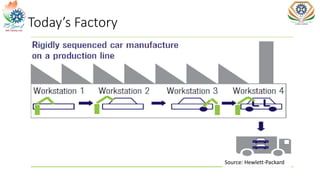
Today’s Factory
Source: Hewlett-Packard
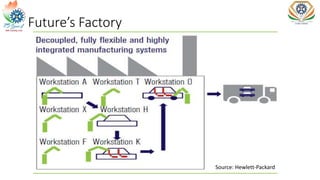
Future’s Factory
Source: Hewlett-Packard
What makes the difference over here?
• The capability of communicating the customized requirements to the
assembly line
• The capability to customize the assembly sequence to meet on-demand
design requirements
• The capability of work synchronization between two non pre-configured
machines
• The capability of sensing each machines’ occupancy level and re-route
the manufacturing process
What is the enabling technology?
Machine to Machine (M2M) Communication
Technology
Let’s see where M2M can help?
Source: Youtube
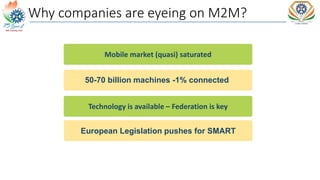
Why companies are eyeing on M2M?
50-70 billion machines -1% connected
Mobile market (quasi) saturated
European Legislation pushes for SMART
Technology is available – Federation is key
M2M in Manufacturing
•An Industry 4.0 manufacturing industry -
•Comprises of:
• Smart machines
• Smart warehouses and
• Smart production facilities
•Should be capable of:
• autonomously exchanging information
• triggering actions
• controlling each other independently
M2M for human ease and efficiency
• It saves the human operator from repetitive, boring and
time consuming work
• It helps human operators in real-time working based on
data rather than experience
• It provides opportunities to evolve continuously
Summarily:
• Machine-to-Machine (M2M) means no human intervention
while devices are communicating end-to-end. [Mischa Dohler]
What is M2M?
•Its technology of communication between –
• Machine–sensor/actuator that is monitoring/actuating
• To–network to operate end-to-end communication
• Machine–device that is processing gathered information
Networks for M2M
• Wired (Ethernet, fiber optics etc.) – dedicated
cabling between sensors and gateway
• Pros: Very reliable, very high data rates, low
latency, secure
• Cons: Expensive to roll out, not scalable, no
mobility
• Wireless
• Capillary : Short-range link/ network
• Cellular : Long-range cellular network
Networks for M2M
•Wireless
• Capillary (WLAN, BLE, Zigbee etc.)
• pros: cheap-to-roll out, generally scalable, low power
• cons: short range, low rates, weaker security, interference,
lack of universal infrastructure/coverage
• Cellular (3G, LTE, WiMax etc.)
• pros: excellent coverage, mobility, roaming, generally secure,
infrastructure
• cons: expensive, not cheap to maintain, not power efficient, delays
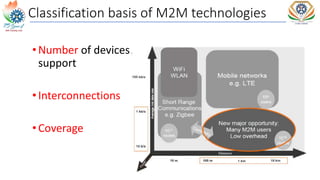
Classification basis of M2M technologies
• Number of devices to
support
•Interconnections
• Coverage
Challenges in M2M Communications
• Design for huge number of devices
• Reduction of control signalling
• Optimization for low data transmissions
• Cost reduction
• Congestion control algorithms (for cellular)
• Load distribution/balancing
• Security, e.g., denial of service
• Traffic Models
Design of Capillary M2M
• Mostly embedded design, low power, low cost design
• Short-range communication systems
• Each node typically consists of these basic elements:
– Sensor
– Radio chip
– Microcontroller
– Energy supply
Design of Capillary M2M
• Targets:
• Low – cost
• Low – complexity
• Small – size
• Low – energy
• Problems:
• Different vendors (characteristics, inoperability between devices)
• Interference, fading
• MAC protocols were designed for humans
• Scalability
Designing M2M with Cellular technologies
• Advantages:
• Capillary networks only provide local coverage
• Users are already familiar with the infrastructure
• Easier configuration: suitable for short-term deployments
• Cellular networks provide ubiquitous coverage and global
connectivity today
• Mobility and High-Speed Data Transmission
• Interference can be managed
• Challenges for operators:
• Higher power requirements
• High cost and applications complexity
Current cellular M2M technologies
• Current cellular systems are designed for Human-to-human
(H2H):
• Not so many human users
• We tolerate delay even for voice connections
• We like to download a lot, mainly high-bandwidth data
• We are ok to recharge our mobiles daily.
• New paradigm:
• Enormous number of M2M nodes
• Applications are delay-intolerant (mainly control)
• No traffic/mainly uplink
• Nodes need to operate autonomously for a long time
• Automated security and trust mechanisms.
Optimization possibilities for M2M
• May be based on specific scenario requirement:
• Low Mobility – Reduce reporting frequency
• Time Controlled
• Time Tolerant – Applications that can delay transmissions
• Small Data Transmissions
• Priority Alarm Message – Maximum priority for alarm
traffic
• Secure Connection
• Location Specific Trigger – Location information from
operators
• Infrequent transmission
WiFi (HaLow) for M2M Communication
• IEEE 802.11ah use cases target low data rate, long range
applications (metering, sensors, automation)
• Battery operated devices should limit the power
consumption by:
• limiting the packet transmissions
• limiting the awake/receive time (for low transit power devices, RX
power consumption may be comparable with TX power
consumption)
• Listening for beacons/traffic information maps (TIM) frames
consumes power:
• clock drift during long sleep requires an early wake up
• reception of beacon may require several milliseconds
Future Roadmap
• Challenges for capillary community:
• Reliability: despite license-exempt bands
• Range: multihop/mesh seems to be a must
• Delays: minimize end-to-end delay
• Standards: interoperability
• Infrastructure: maintenance
• Challenges for cellular community:
• Nodes: management of huge amounts sending small packets
• Rates: fairly low and rather uplink from small packets
• Power: high efficiency
• Delays: quick wakeup after sleep
• Application: to operate not disturbing current networks.
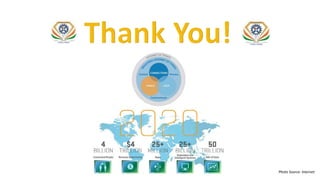
Photo Source: Internet

Machine-to-Machine Communications

  • 1.
    Machine to MachineCommunications (When the machines start talking) Dr. Rajesh P Barnwal Senior Scientist AI & IoT Lab, Information Technology Group CSIR-Central Mechanical Engineering Research Institute, Durgapur Disclaimer: This presentation is just for information purpose and compiled from materials (images + texts) available on Internet in public domain.
  • 2.
  • 3.
  • 4.
    What makes thedifference over here? • The capability of communicating the customized requirements to the assembly line • The capability to customize the assembly sequence to meet on-demand design requirements • The capability of work synchronization between two non pre-configured machines • The capability of sensing each machines’ occupancy level and re-route the manufacturing process
  • 5.
    What is theenabling technology? Machine to Machine (M2M) Communication Technology
  • 6.
    Let’s see whereM2M can help? Source: Youtube
  • 7.
    Why companies areeyeing on M2M? 50-70 billion machines -1% connected Mobile market (quasi) saturated European Legislation pushes for SMART Technology is available – Federation is key
  • 8.
    M2M in Manufacturing •AnIndustry 4.0 manufacturing industry - •Comprises of: • Smart machines • Smart warehouses and • Smart production facilities •Should be capable of: • autonomously exchanging information • triggering actions • controlling each other independently
  • 9.
    M2M for humanease and efficiency • It saves the human operator from repetitive, boring and time consuming work • It helps human operators in real-time working based on data rather than experience • It provides opportunities to evolve continuously Summarily: • Machine-to-Machine (M2M) means no human intervention while devices are communicating end-to-end. [Mischa Dohler]
  • 10.
    What is M2M? •Itstechnology of communication between – • Machine–sensor/actuator that is monitoring/actuating • To–network to operate end-to-end communication • Machine–device that is processing gathered information
  • 11.
    Networks for M2M •Wired (Ethernet, fiber optics etc.) – dedicated cabling between sensors and gateway • Pros: Very reliable, very high data rates, low latency, secure • Cons: Expensive to roll out, not scalable, no mobility • Wireless • Capillary : Short-range link/ network • Cellular : Long-range cellular network
  • 12.
    Networks for M2M •Wireless •Capillary (WLAN, BLE, Zigbee etc.) • pros: cheap-to-roll out, generally scalable, low power • cons: short range, low rates, weaker security, interference, lack of universal infrastructure/coverage • Cellular (3G, LTE, WiMax etc.) • pros: excellent coverage, mobility, roaming, generally secure, infrastructure • cons: expensive, not cheap to maintain, not power efficient, delays
  • 13.
    Classification basis ofM2M technologies • Number of devices to support •Interconnections • Coverage
  • 14.
    Challenges in M2MCommunications • Design for huge number of devices • Reduction of control signalling • Optimization for low data transmissions • Cost reduction • Congestion control algorithms (for cellular) • Load distribution/balancing • Security, e.g., denial of service • Traffic Models
  • 15.
    Design of CapillaryM2M • Mostly embedded design, low power, low cost design • Short-range communication systems • Each node typically consists of these basic elements: – Sensor – Radio chip – Microcontroller – Energy supply
  • 16.
    Design of CapillaryM2M • Targets: • Low – cost • Low – complexity • Small – size • Low – energy • Problems: • Different vendors (characteristics, inoperability between devices) • Interference, fading • MAC protocols were designed for humans • Scalability
  • 17.
    Designing M2M withCellular technologies • Advantages: • Capillary networks only provide local coverage • Users are already familiar with the infrastructure • Easier configuration: suitable for short-term deployments • Cellular networks provide ubiquitous coverage and global connectivity today • Mobility and High-Speed Data Transmission • Interference can be managed • Challenges for operators: • Higher power requirements • High cost and applications complexity
  • 18.
    Current cellular M2Mtechnologies • Current cellular systems are designed for Human-to-human (H2H): • Not so many human users • We tolerate delay even for voice connections • We like to download a lot, mainly high-bandwidth data • We are ok to recharge our mobiles daily. • New paradigm: • Enormous number of M2M nodes • Applications are delay-intolerant (mainly control) • No traffic/mainly uplink • Nodes need to operate autonomously for a long time • Automated security and trust mechanisms.
  • 19.
    Optimization possibilities forM2M • May be based on specific scenario requirement: • Low Mobility – Reduce reporting frequency • Time Controlled • Time Tolerant – Applications that can delay transmissions • Small Data Transmissions • Priority Alarm Message – Maximum priority for alarm traffic • Secure Connection • Location Specific Trigger – Location information from operators • Infrequent transmission
  • 20.
    WiFi (HaLow) forM2M Communication • IEEE 802.11ah use cases target low data rate, long range applications (metering, sensors, automation) • Battery operated devices should limit the power consumption by: • limiting the packet transmissions • limiting the awake/receive time (for low transit power devices, RX power consumption may be comparable with TX power consumption) • Listening for beacons/traffic information maps (TIM) frames consumes power: • clock drift during long sleep requires an early wake up • reception of beacon may require several milliseconds
  • 21.
    Future Roadmap • Challengesfor capillary community: • Reliability: despite license-exempt bands • Range: multihop/mesh seems to be a must • Delays: minimize end-to-end delay • Standards: interoperability • Infrastructure: maintenance • Challenges for cellular community: • Nodes: management of huge amounts sending small packets • Rates: fairly low and rather uplink from small packets • Power: high efficiency • Delays: quick wakeup after sleep • Application: to operate not disturbing current networks.
  • 22.