Real Time Pose Control of 6-RSS Parallel Robot
Sahar Alinia
Supervisor:
Prof.Wen-Fang Xie
Faculty of mechanical & industrial Engineering
April 2016
The Fonds de recherche du
Québec-Nature et technologies
(FQRNT )group
Acknowledgement
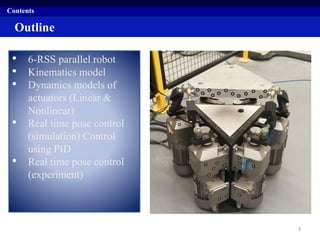
• 6-RSS parallel robot
• Kinematics model
• Dynamics models of
actuators (Linear &
Nonlinear)
• Real time pose control
(simulation) Control
using PID
• Real time pose control
(experiment)
Outline
3
Contents
Introduction
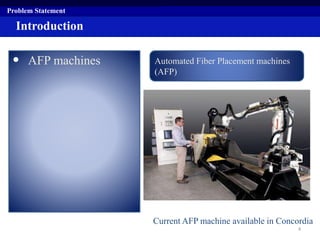
• AFP machines
Problem Statement
Automated Fiber Placement machines
(AFP)
Current AFP machine available in Concordia
4
Introduction
Problem Statement
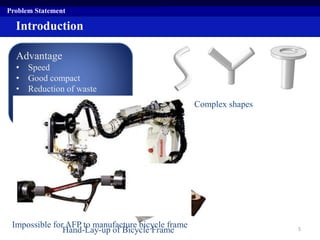
Advantage
• Speed
• Good compact
• Reduction of waste
Disadvantage
• Complex shapes
Complex shapes
Hand-Lay-up of Bicycle Frame
Impossible for AFP to manufacture bicycle frame 5
Introduction
• AFP machines
• Adding DOF
• Serial Robot
Problem Statement
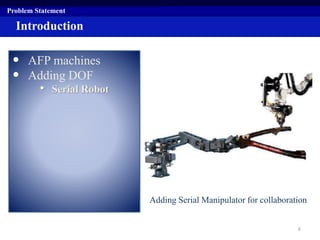
Adding Serial Manipulator for collaboration
6
Introduction
• AFP machines
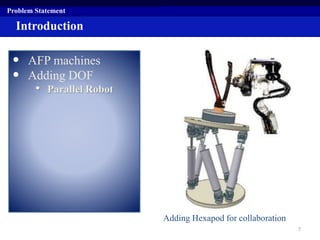
• Adding DOF
• Parallel Robot
Problem Statement
Adding Hexapod for collaboration
7
Objectives of the research work
• Obtaining the exact pose
of end-effector (EE)
• Kinematics of parallel
robot
• Dynamic modeling of
actuators
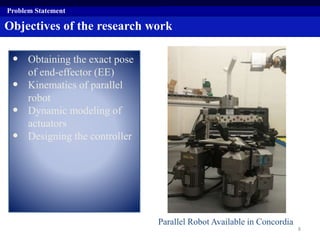
• Designing the controller
Problem Statement
Parallel Robot Available in Concordia
8
• Parallel robot
• Introduction
Parallel Robots
Kinematics Modeling
EE
Kinematic
chains
Fixed base
Link
joint
Entertainment Device for movie theater (1928) [1]
Flight simulator (1965) [1]
9
• Parallel robot
• Introduction
• Application
[4]
Parallel Robots
Kinematics Modeling
[2]
[1]
[3]
Literature Review
• Kinematics
• Analytical Methods
Literature Review
• Tsai et al 3-DOF [5]
• Huang et al. 6-DOF [6]
• Shi et al. 6-DOF [7]
General Stewart Platform [6] 11
Literature Review
• Kinematics
• Analytical Methods
• Numerical Methods
Literature Review
• Cleary et al. 6-DOF [8]
• Liu et al. 6-DOF [9]
• Wang 6-DOF [10]
General Stewart Platform [10] 12
Literature Review
• Kinematics
• Analytical examples
• Numerical examples
• Identification of
BLDC motor
Literature Review
• Kara et al. RLS [11]
• Wu et al. Tylor expansion theorem
[12]
• Farid et al. PSO [13]
13
Literature Review
• Kinematics
• Analytical examples
• Numerical examples
• Identification of
BLDC motor
• Control the pose of
EE
Literature Review
• Huang et al. Sliding mode control 6-
DOF [14]
• Zhu et al. ARC 3-DOF [15]
• Bo et al. Control algorithm
based on fuzzy logic and PID control
3-DOF [16]
14
6-RSS parallel Robot
• Parallel robot
• Introduction
• Advantages
• Application
• 6-RSS Parallel
robot
• Introduction
Kinematics Modeling
15
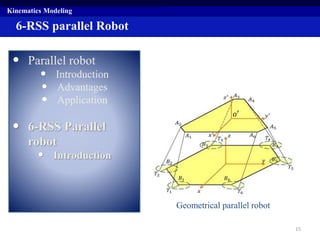
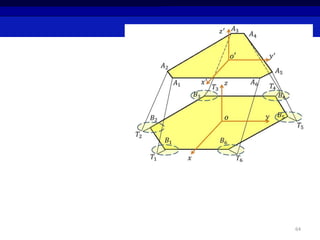
Geometrical parallel robot
𝑜′
Kinematics Modeling
• Parallel robot
• Introduction
• Advantages
• Application
• 6-RSS Parallel
robot
• Introduction
• Kinematics
Kinematics Modeling
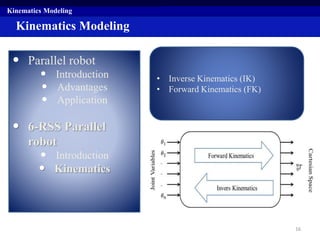
• Inverse Kinematics (IK)
• Forward Kinematics (FK)
16
Inverse Kinematics
Kinematics Modeling
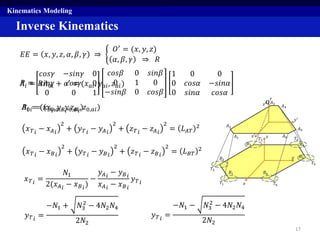
𝐸𝐸 = 𝑥, 𝑦, 𝑧, 𝛼, 𝛽, 𝛾 ⇒
𝑂′
= (𝑥, 𝑦, 𝑧)
𝛼, 𝛽, 𝛾 ⇒ 𝑅
𝑅 =
𝑐𝑜𝑠𝛾 −𝑠𝑖𝑛𝛾 0
𝑠𝑖𝑛𝛾 𝑐𝑜𝑠𝛾 0
0 0 1
𝑐𝑜𝑠𝛽 0 𝑠𝑖𝑛𝛽
0 1 0
−𝑠𝑖𝑛𝛽 0 𝑐𝑜𝑠𝛽
1 0 0
0 𝑐𝑜𝑠𝛼 −𝑠𝑖𝑛𝛼
0 𝑠𝑖𝑛𝛼 𝑐𝑜𝑠𝛼
𝐴𝑖 = 𝑅𝐴0𝑖 + 𝑜′
= (𝑥 𝑎𝑖, 𝑦 𝑎𝑖, 𝑧 𝑎𝑖)
𝐴0𝑖 = (𝑥0,𝑎𝑖, 𝑦0,𝑎𝑖, 𝑧0,𝑎𝑖)𝐵𝑖 = (𝑥 𝐵 𝑖
, 𝑦 𝐵 𝑖
, 𝑧 𝐵 𝑖
)
𝑥 𝑇 𝑖 − 𝑥 𝐴 𝑖
2
+ 𝑦 𝑇 𝑖 − 𝑦 𝐴 𝑖
2
+ 𝑧 𝑇 𝑖 − 𝑧 𝐴 𝑖
2
= 𝐿 𝐴𝑇
2
𝑥 𝑇 𝑖 − 𝑥 𝐵 𝑖
2
+ 𝑦 𝑇 𝑖
− 𝑦 𝐵 𝑖
2
+ 𝑧 𝑇 𝑖 − 𝑧 𝐵 𝑖
2
= 𝐿 𝐵𝑇
2
𝑥 𝑇 𝑖 =
𝑁1
2(𝑥 𝐴 𝑖 − 𝑥 𝐵 𝑖)
−
𝑦 𝐴 𝑖
− 𝑦 𝐵 𝑖
𝑥 𝐴 𝑖 − 𝑥 𝐵 𝑖
𝑦 𝑇 𝑖
𝑦 𝑇 𝑖 =
−𝑁1 + 𝑁3
2
− 4𝑁2 𝑁4
2𝑁2
𝑦 𝑇 𝑖
=
−𝑁1 − 𝑁3
2
− 4𝑁2 𝑁4
2𝑁2
17
𝑜′
Inverse Kinematics
Kinematics Modeling
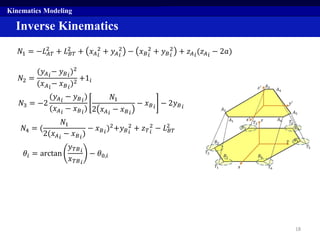
𝑁4 = (
𝑁1
2(𝑥 𝐴 𝑖 − 𝑥 𝐵 𝑖)
− 𝑥 𝐵 𝑖)2
+𝑦 𝐵 𝑖
2
+ 𝑧 𝑇 𝑖
2
− 𝐿 𝐵𝑇
2
𝑁2 =
(𝑦 𝐴 𝑖
− 𝑦 𝐵 𝑖)2
(𝑥 𝐴 𝑖
− 𝑥 𝐵 𝑖)2 +1𝑖
𝑁3 = −2
(𝑦 𝐴 𝑖 − 𝑦 𝐵 𝑖)
(𝑥 𝐴 𝑖 − 𝑥 𝐵 𝑖)
𝑁1
2 𝑥 𝐴 𝑖 − 𝑥 𝐵 𝑖
− 𝑥 𝐵 𝑖 − 2𝑦 𝐵 𝑖
𝜃𝑖 = arctan
𝑦 𝑇𝐵 𝑖
𝑥 𝑇𝐵 𝑖
− 𝜃0,𝑖
𝑁1 = −𝐿 𝐴𝑇
2
+ 𝐿 𝐵𝑇
2
+ 𝑥 𝐴 𝑖
2
+ 𝑦 𝐴 𝑖
2
− 𝑥 𝐵 𝑖
2
+ 𝑦 𝐵 𝑖
2
+ 𝑧 𝐴 𝑖(𝑧 𝐴 𝑖 − 2𝑎)
18
Modeling of Actuators
• Parallel robot
• Introduction
• Advantages
• Application
• 6-RSS Parallel
robot
• Introduction
• Kinematics
• Actuators’ modeling
Modeling of Actuators
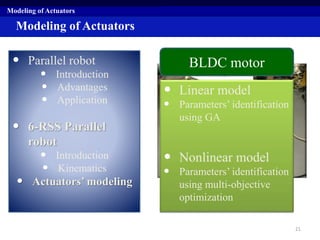
6-RSS parallel robot’s actuators
• Linear model
• Parameters’ identification
using GA
• Nonlinear model
• Parameters’ identification
using multi-objective
optimization
BLDC motor
21
Modeling of Actuators
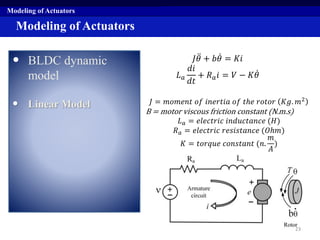
• BLDC dynamic
model
• Linear Model
Modeling of Actuators
𝐽 𝜃 + 𝑏 𝜃 = 𝐾𝑖
𝐿 𝑎
𝑑𝑖
𝑑𝑡
+ 𝑅 𝑎 𝑖 = 𝑉 − 𝐾 𝜃
𝐽 = 𝑚𝑜𝑚𝑒𝑛𝑡 𝑜𝑓 𝑖𝑛𝑒𝑟𝑡𝑖𝑎 𝑜𝑓 𝑡ℎ𝑒 𝑟𝑜𝑡𝑜𝑟 𝐾𝑔. 𝑚2
B = motor viscous friction constant (N.m.s)
𝐿 𝑎 = 𝑒𝑙𝑒𝑐𝑡𝑟𝑖𝑐 𝑖𝑛𝑑𝑢𝑐𝑡𝑎𝑛𝑐𝑒 (𝐻)
𝑅 𝑎 = 𝑒𝑙𝑒𝑐𝑡𝑟𝑖𝑐 𝑟𝑒𝑠𝑖𝑠𝑡𝑎𝑛𝑐𝑒 (𝑂ℎ𝑚)
𝐾 = 𝑡𝑜𝑟𝑞𝑢𝑒 𝑐𝑜𝑛𝑠𝑡𝑎𝑛𝑡 (𝑛.
𝑚
𝐴
)
23
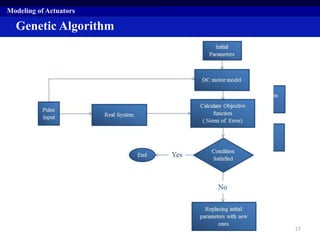
Genetic Algorithm
Modeling of Actuators
27
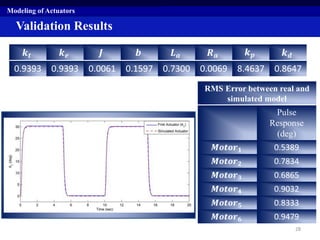
Comparing real motor with identified one
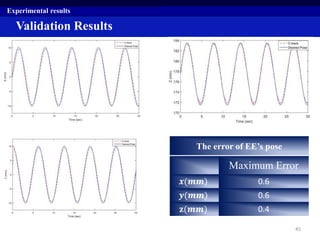
Validation Results
Modeling of Actuators
RMS Error between real and
simulated model
Pulse
Response
(deg)
𝑴𝒐𝒕𝒐𝒓 𝟏 0.5389
𝑴𝒐𝒕𝒐𝒓 𝟐 0.7834
𝑴𝒐𝒕𝒐𝒓 𝟑 0.6865
𝑴𝒐𝒕𝒐𝒓 𝟒 0.9032
𝑴𝒐𝒕𝒐𝒓 𝟓 0.8333
𝑴𝒐𝒕𝒐𝒓 𝟔 0.9479
28
𝒌 𝒕 𝒌 𝒆 𝑱 𝒃 𝑳 𝒂 𝑹 𝒂 𝒌 𝒑 𝒌 𝒅
0.9393 0.9393 0.0061 0.1597 0.7300 0.0069 8.4637 0.8647
Modeling of Actuators
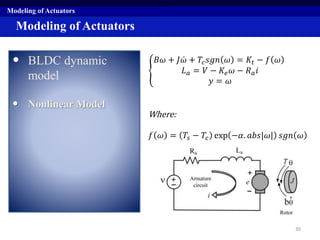
• BLDC dynamic
model
• Nonlinear Model
Modeling of Actuators
𝐵𝜔 + 𝐽 𝜔 + 𝑇𝑐 𝑠𝑔𝑛 𝜔 = 𝐾𝑡 − 𝑓 𝜔
𝐿 𝑎 = 𝑉 − 𝐾𝑒 𝜔 − 𝑅 𝑎 𝑖
𝑦 = 𝜔
Where:
𝑓 𝜔 = 𝑇𝑠 − 𝑇𝑐 exp −𝛼. 𝑎𝑏𝑠|𝜔| 𝑠𝑔𝑛 𝜔
30
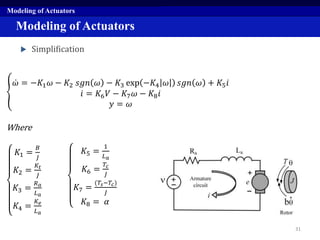
Modeling of Actuators
𝜔 = −𝐾1 𝜔 − 𝐾2 𝑠𝑔𝑛 𝜔 − 𝐾3 exp −𝐾4 𝜔 𝑠𝑔𝑛 𝜔 + 𝐾5 𝑖
𝑖 = 𝐾6 𝑉 − 𝐾7 𝜔 − 𝐾8 𝑖
𝑦 = 𝜔
Where
𝐾1 =
𝐵
𝐽
𝐾2 =
𝐾𝑡
𝐽
𝐾3 =
𝑅 𝑎
𝐿 𝑎
𝐾4 =
𝐾 𝑒
𝐿 𝑎
𝐾5 =
1
𝐿 𝑎
𝐾6 =
𝑇𝑐
𝐽
𝐾7 =
(𝑇𝑠−𝑇𝑐)
𝐽
𝐾8 = 𝛼
 Simplification
31
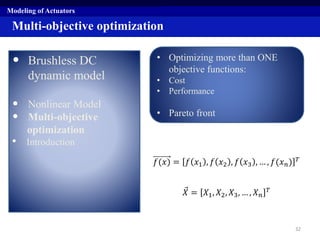
Multi-objective optimization
• Brushless DC
dynamic model
• Nonlinear Model
• Multi-objective
optimization
• Introduction
Modeling of Actuators
• Optimizing more than ONE
objective functions:
• Cost
• Performance
• Pareto front
𝑓(𝑥) = 𝑓 𝑥1 , 𝑓 𝑥2 , 𝑓 𝑥3 , … , 𝑓(𝑥 𝑛) 𝑇
𝑋 = 𝑋1, 𝑋2, 𝑋3, … , 𝑋 𝑛
𝑇
32
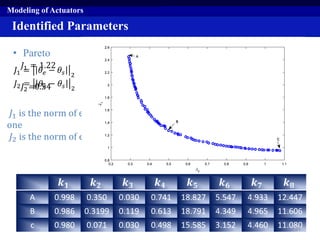
Identified Parameters
Modeling of Actuators
𝐽1 = 𝜃𝑒 − 𝜃𝑠 2
𝐽2 = 𝜃𝑒 − 𝜃𝑠 2
• Pareto
𝐽1 is the norm of error between the pulse response and experimental
one
𝐽2 is the norm of error between sine response and experimental one.
𝐽1 = 1.22
𝐽2=0.54
𝒌 𝟏 𝒌 𝟐 𝒌 𝟑 𝒌 𝟒 𝒌 𝟓 𝒌 𝟔 𝒌 𝟕 𝒌 𝟖
A 0.998 0.350 0.030 0.741 18.827 5.547 4.933 12.447
B 0.986 0.3199 0.119 0.613 18.791 4.349 4.965 11.606
c 0.980 0.071 0.030 0.498 15.585 3.152 4.460 11.08033
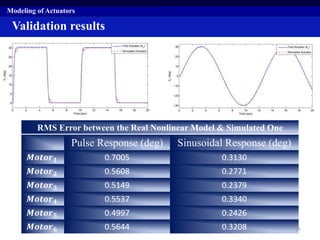
Validation results
Modeling of Actuators
RMS Error between the Real Nonlinear Model & Simulated One
Pulse Response (deg) Sinusoidal Response (deg)
𝑴𝒐𝒕𝒐𝒓 𝟏 0.7005 0.3130
𝑴𝒐𝒕𝒐𝒓 𝟐 0.5608 0.2771
𝑴𝒐𝒕𝒐𝒓 𝟑 0.5149 0.2379
𝑴𝒐𝒕𝒐𝒓 𝟒 0.5537 0.3340
𝑴𝒐𝒕𝒐𝒓 𝟓 0.4997 0.2426
𝑴𝒐𝒕𝒐𝒓 𝟔 0.5644 0.3208 35
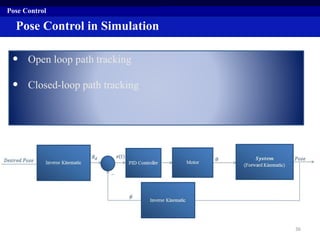
Pose Control in Simulation
• Open loop path tracking
• Closed-loop path tracking
Pose Control
36
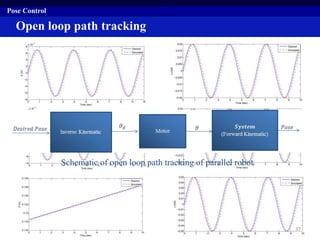
Open loop path tracking
Pose Control
37
Schematic of open loop path tracking of parallel robot
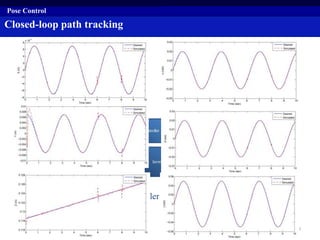
Closed-loop path tracking
Pose Control
39
Schematic of proposed controller in presence of noise and disturbance
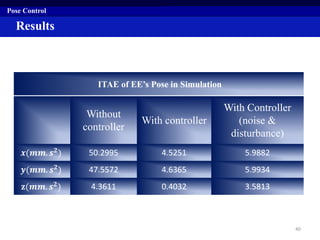
Results
Pose Control
ITAE of EE’s Pose in Simulation
Without
controller
With controller
With Controller
(noise &
disturbance)
𝒙(𝒎𝒎. 𝒔 𝟐
) 50.2995 4.5251 5.9882
𝒚(𝒎𝒎. 𝒔 𝟐) 47.5572 4.6365 5.9934
𝐳(𝒎𝒎. 𝒔 𝟐) 4.3611 0.4032 3.5813
40
Experimental results
• C-track
• Introduction
Experimental results
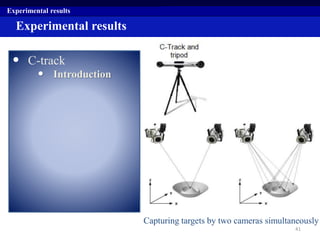
Capturing targets by two cameras simultaneously
41
• C-track
• Introduction
• Modeling the robot in
VXelements
Experimental results
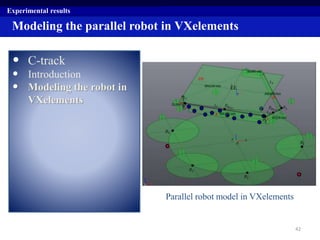
Parallel robot model in VXelements
Modeling the parallel robot in VXelements
42
EE
Calibration
Experimental results
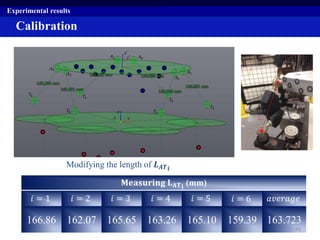
Modifying the length of 𝑳 𝑨𝑻 𝒊
𝐌𝐞𝐚𝐬𝐮𝐫𝐢𝐧𝐠 𝐋 𝐀𝐓 𝐢 (mm)
𝑖 = 1 𝑖 = 2 𝑖 = 3 𝑖 = 4 𝑖 = 5 𝑖 = 6 𝑎𝑣𝑒𝑟𝑎𝑔𝑒
166.86 162.07 165.65 163.26 165.10 159.39 163.723
43
Calibration
Experimental results
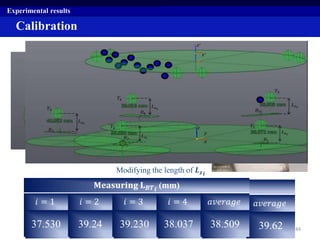
Modifying the length of 𝑳 𝑩𝑻 𝒊
Modifying the length of 𝑳 𝒛 𝒊
𝐌𝐞𝐚𝐬𝐮𝐫𝐢𝐧𝐠 𝐋 𝐳 𝐢 (mm)
𝑖 = 1 𝑖 = 2 𝑖 = 3 𝑖 = 4 𝑖 = 5 𝑎𝑣𝑒𝑟𝑎𝑔𝑒
40.952 39.836 39.372 38.903 39.016 39.62
𝐌𝐞𝐚𝐬𝐮𝐫𝐢𝐧𝐠 𝐋 𝑩𝑻 𝒊 (mm)
𝑖 = 1 𝑖 = 2 𝑖 = 3 𝑖 = 4 𝑎𝑣𝑒𝑟𝑎𝑔𝑒
37.530 39.24 39.230 38.037 38.509 44
Validation Results
Experimental results
The error of EE’s pose
Maximum Error
𝒙(𝒎𝒎) 0.6
𝒚(𝒎𝒎) 0.6
𝐳(𝒎𝒎) 0.4
45
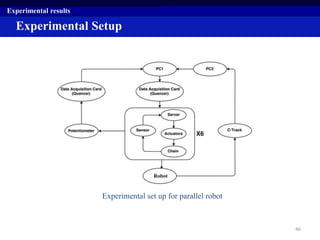
Experimental Setup
Experimental results
46
Experimental set up for parallel robot
Robot
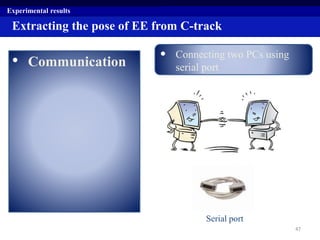
• Communication
Experimental results
Extracting the pose of EE from C-track
• Connecting two PCs using
serial port
Serial port
47
Experimental results
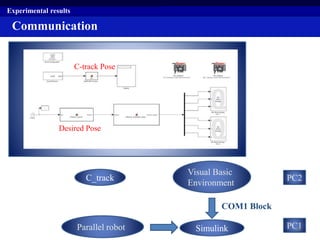
Communication
COM1 Block
PC2
PC1
C-track Pose
Desired Pose
C_track
Visual Basic
Environment
SimulinkParallel robot 48
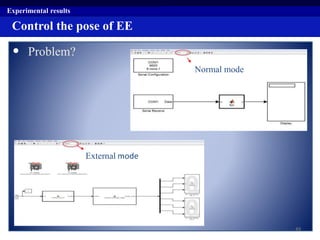
• Problem?
Experimental results
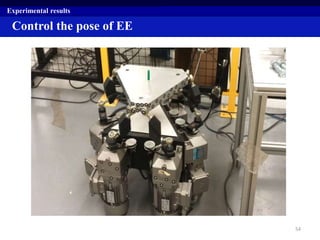
Control the pose of EE
Normal mode
External mode
49
50
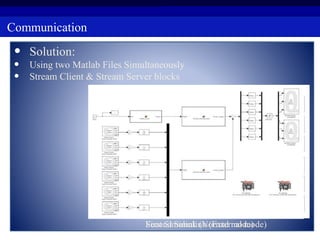
• Solution:
• Using two Matlab Files Simultaneously
• Stream Client & Stream Server blocks
Communication
First Simulink (Normal mode)Second Simulink (External mode)
Experimental results
Control the pose of EE
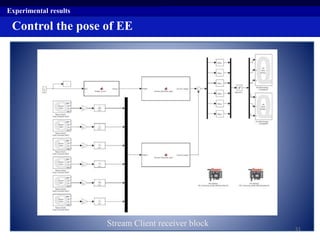
Stream Client receiver block
51
52
Experimental results
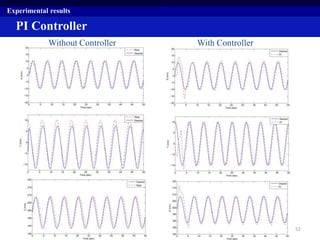
PI Controller
Without Controller With Controller
Experimental results
53
PI Controller
Without Controller With Controller
Experimental results
Control the pose of EE
54
• Communication
• Problem
• Solution
• Pose control
• Results
Experimental results
Control the pose of EE
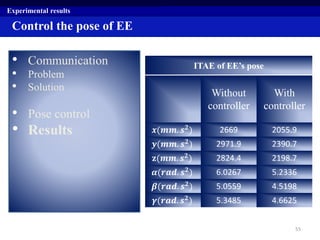
ITAE of EE’s pose
Without
controller
With
controller
𝒙(𝒎𝒎. 𝒔 𝟐) 2669 2055.9
𝒚(𝒎𝒎. 𝒔 𝟐) 2971.9 2390.7
𝐳(𝒎𝒎. 𝒔 𝟐) 2824.4 2198.7
𝜶(𝒓𝒂𝒅. 𝒔 𝟐) 6.0267 5.2336
𝜷(𝒓𝒂𝒅. 𝒔 𝟐) 5.0559 4.5198
𝜸(𝒓𝒂𝒅. 𝒔 𝟐) 5.3485 4.6625
55
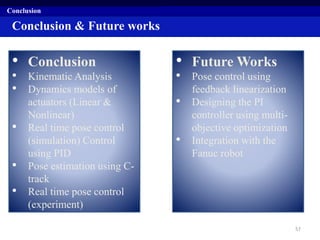
• Conclusion
• Kinematic Analysis
• Dynamics models of
actuators (Linear &
Nonlinear)
• Real time pose control
(simulation) Control
using PID
• Pose estimation using C-
track
• Real time pose control
(experiment)
Conclusion
Conclusion & Future works
• Future Works
• Pose control using
feedback linearization
• Designing the PI
controller using multi-
objective optimization
• Integration with the
Fanuc robot
57
Publications:
1. Alinia, S., Hemmatian, M., Xie, W.F. and Zeng, R., 2015, May. Posture control of 3-DOF
parallel manipulator using feedback linearization and model reference adaptive control.
In Electrical and Computer Engineering (CCECE), 2015 IEEE 28th Canadian
Conference on (pp. 1145-1150). IEEE.
2. Sahar Alinia, Amir Hajiloo, Wen-Fang Xie, Suong Hoa, 2015, Identification of the
dynamic model of 6 RSS parallel robot’s actuators. Poster IROS. IEEE
3. Sahar Alinia, Wen-Fang Xie, Xiao-Ming Zhang. 2016, Modeling and pose control of a 6-
RSS parallel robot using multi-objective optimization ,CSME accepted
58
1. http://www.mecademic.com/What-is-a-parallel-robot.html
2. http://www.boomsbeat.com
3. http://allaboutroboticsurgery.com/surgicalrobots/surgicalrobotspage3.html
4. http://robotsfacts.weebly.com/worker-robots.html
5. Tsai, M.S., Shiau, T.N., Tsai, Y.J. and Chang, T.H., 2003. Direct kinematic analysis of a 3-PRS parallel
mechanism. Mechanism and Machine Theory,38(1), pp.71-83.
6. Huang, X., Liao, Q., Wei, S., Qiang, X. and Huang, S., 2007, August. Forward kinematics of the 6-6 Stewart
platform with planar base and platform using algebraic elimination. In Automation and Logistics, 2007 IEEE
International Conference on (pp. 2655-2659). IEEE.
7. Shi, X. and Fenton, R.G., 1992. Solution to the forward instantaneous kinematics for a general 6-DOF Stewart
platform. Mechanism and machine theory, 27(3), pp.251-259.
8. Cleary, K. and Brooks, T., 1993, May. Kinematic analysis of a novel 6-dof parallel manipulator. In Robotics
and Automation, 1993. Proceedings., 1993 IEEE International Conference on (pp. 708-713). IEEE.
9. Liu, K., Fitzgerald, J.M. and Lewis, F.L., 1993. Kinematic analysis of a Stewart platform
manipulator. Industrial Electronics, IEEE Transactions on,40(2), pp.282-293.
10. Wang, Y., 2006, June. An incremental method for forward kinematics of parallel manipulators. In Robotics,
Automation and Mechatronics, 2006 IEEE Conference on (pp. 1-5). IEEE.
11. Kara, T. and Eker, I., 2004. Nonlinear modeling and identification of a DC motor for bidirectional operation
with real time experiments. Energy Conversion and Management, 45(7), pp.1087-1106.
12. Wu, W., 2012. DC motor parameter identification using speed step responses. Modelling and Simulation in
Engineering, 2012, p.30.
59
Reference
Reference
13. Farid, A.M. and Barakati, S.M., 2014, May. DC Motor neuro-fuzzy controller using PSO identification.
In Electrical Engineering (ICEE), 2014 22nd Iranian Conference on (pp. 1162-1167). IEEE.
14. Huang, C.I., Chang, C.F., Yu, M.Y. and Fu, L.C., 2004, July. Sliding-mode tracking control of the Stewart
platform. In Control Conference, 2004. 5th Asian (Vol. 1, pp. 562-569). IEEE.
15. Zhu, X., Tao, G., Yao, B. and Cao, J., 2008. Adaptive robust posture control of parallel manipulator
driven by pneumatic muscles with redundancy.Mechatronics, IEEE/ASME Transactions on, 13(4),
pp.441-450.
16. Bo, Y., Zhongcai, P. and Zhiyong, T., 2011, August. Fuzzy PID control of Stewart platform. In Fluid
Power and Mechatronics (FPM), 2011 International Conference on (pp. 763-768). IEEE.
17. Chen, S.H. and Fu, L.C., 2013. Output feedback sliding mode control for a Stewart platform with a
nonlinear observer-based forward kinematics solution. Control Systems Technology, IEEE Transactions
on, 21(1), pp.176-185.
60
Reference
Reference
61
Thank You
64
𝑜′
𝑜

Complete (2)

  • 1.
    Real Time PoseControl of 6-RSS Parallel Robot Sahar Alinia Supervisor: Prof.Wen-Fang Xie Faculty of mechanical & industrial Engineering April 2016
  • 2.
    The Fonds derecherche du Québec-Nature et technologies (FQRNT )group Acknowledgement
  • 3.
    • 6-RSS parallelrobot • Kinematics model • Dynamics models of actuators (Linear & Nonlinear) • Real time pose control (simulation) Control using PID • Real time pose control (experiment) Outline 3 Contents
  • 4.
    Introduction • AFP machines ProblemStatement Automated Fiber Placement machines (AFP) Current AFP machine available in Concordia 4
  • 5.
    Introduction Problem Statement Advantage • Speed •Good compact • Reduction of waste Disadvantage • Complex shapes Complex shapes Hand-Lay-up of Bicycle Frame Impossible for AFP to manufacture bicycle frame 5
  • 6.
    Introduction • AFP machines •Adding DOF • Serial Robot Problem Statement Adding Serial Manipulator for collaboration 6
  • 7.
    Introduction • AFP machines •Adding DOF • Parallel Robot Problem Statement Adding Hexapod for collaboration 7
  • 8.
    Objectives of theresearch work • Obtaining the exact pose of end-effector (EE) • Kinematics of parallel robot • Dynamic modeling of actuators • Designing the controller Problem Statement Parallel Robot Available in Concordia 8
  • 9.
    • Parallel robot •Introduction Parallel Robots Kinematics Modeling EE Kinematic chains Fixed base Link joint Entertainment Device for movie theater (1928) [1] Flight simulator (1965) [1] 9
  • 10.
    • Parallel robot •Introduction • Application [4] Parallel Robots Kinematics Modeling [2] [1] [3]
  • 11.
    Literature Review • Kinematics •Analytical Methods Literature Review • Tsai et al 3-DOF [5] • Huang et al. 6-DOF [6] • Shi et al. 6-DOF [7] General Stewart Platform [6] 11
  • 12.
    Literature Review • Kinematics •Analytical Methods • Numerical Methods Literature Review • Cleary et al. 6-DOF [8] • Liu et al. 6-DOF [9] • Wang 6-DOF [10] General Stewart Platform [10] 12
  • 13.
    Literature Review • Kinematics •Analytical examples • Numerical examples • Identification of BLDC motor Literature Review • Kara et al. RLS [11] • Wu et al. Tylor expansion theorem [12] • Farid et al. PSO [13] 13
  • 14.
    Literature Review • Kinematics •Analytical examples • Numerical examples • Identification of BLDC motor • Control the pose of EE Literature Review • Huang et al. Sliding mode control 6- DOF [14] • Zhu et al. ARC 3-DOF [15] • Bo et al. Control algorithm based on fuzzy logic and PID control 3-DOF [16] 14
  • 15.
    6-RSS parallel Robot •Parallel robot • Introduction • Advantages • Application • 6-RSS Parallel robot • Introduction Kinematics Modeling 15 Geometrical parallel robot 𝑜′
  • 16.
    Kinematics Modeling • Parallelrobot • Introduction • Advantages • Application • 6-RSS Parallel robot • Introduction • Kinematics Kinematics Modeling • Inverse Kinematics (IK) • Forward Kinematics (FK) 16
  • 17.
    Inverse Kinematics Kinematics Modeling 𝐸𝐸= 𝑥, 𝑦, 𝑧, 𝛼, 𝛽, 𝛾 ⇒ 𝑂′ = (𝑥, 𝑦, 𝑧) 𝛼, 𝛽, 𝛾 ⇒ 𝑅 𝑅 = 𝑐𝑜𝑠𝛾 −𝑠𝑖𝑛𝛾 0 𝑠𝑖𝑛𝛾 𝑐𝑜𝑠𝛾 0 0 0 1 𝑐𝑜𝑠𝛽 0 𝑠𝑖𝑛𝛽 0 1 0 −𝑠𝑖𝑛𝛽 0 𝑐𝑜𝑠𝛽 1 0 0 0 𝑐𝑜𝑠𝛼 −𝑠𝑖𝑛𝛼 0 𝑠𝑖𝑛𝛼 𝑐𝑜𝑠𝛼 𝐴𝑖 = 𝑅𝐴0𝑖 + 𝑜′ = (𝑥 𝑎𝑖, 𝑦 𝑎𝑖, 𝑧 𝑎𝑖) 𝐴0𝑖 = (𝑥0,𝑎𝑖, 𝑦0,𝑎𝑖, 𝑧0,𝑎𝑖)𝐵𝑖 = (𝑥 𝐵 𝑖 , 𝑦 𝐵 𝑖 , 𝑧 𝐵 𝑖 ) 𝑥 𝑇 𝑖 − 𝑥 𝐴 𝑖 2 + 𝑦 𝑇 𝑖 − 𝑦 𝐴 𝑖 2 + 𝑧 𝑇 𝑖 − 𝑧 𝐴 𝑖 2 = 𝐿 𝐴𝑇 2 𝑥 𝑇 𝑖 − 𝑥 𝐵 𝑖 2 + 𝑦 𝑇 𝑖 − 𝑦 𝐵 𝑖 2 + 𝑧 𝑇 𝑖 − 𝑧 𝐵 𝑖 2 = 𝐿 𝐵𝑇 2 𝑥 𝑇 𝑖 = 𝑁1 2(𝑥 𝐴 𝑖 − 𝑥 𝐵 𝑖) − 𝑦 𝐴 𝑖 − 𝑦 𝐵 𝑖 𝑥 𝐴 𝑖 − 𝑥 𝐵 𝑖 𝑦 𝑇 𝑖 𝑦 𝑇 𝑖 = −𝑁1 + 𝑁3 2 − 4𝑁2 𝑁4 2𝑁2 𝑦 𝑇 𝑖 = −𝑁1 − 𝑁3 2 − 4𝑁2 𝑁4 2𝑁2 17 𝑜′
  • 18.
    Inverse Kinematics Kinematics Modeling 𝑁4= ( 𝑁1 2(𝑥 𝐴 𝑖 − 𝑥 𝐵 𝑖) − 𝑥 𝐵 𝑖)2 +𝑦 𝐵 𝑖 2 + 𝑧 𝑇 𝑖 2 − 𝐿 𝐵𝑇 2 𝑁2 = (𝑦 𝐴 𝑖 − 𝑦 𝐵 𝑖)2 (𝑥 𝐴 𝑖 − 𝑥 𝐵 𝑖)2 +1𝑖 𝑁3 = −2 (𝑦 𝐴 𝑖 − 𝑦 𝐵 𝑖) (𝑥 𝐴 𝑖 − 𝑥 𝐵 𝑖) 𝑁1 2 𝑥 𝐴 𝑖 − 𝑥 𝐵 𝑖 − 𝑥 𝐵 𝑖 − 2𝑦 𝐵 𝑖 𝜃𝑖 = arctan 𝑦 𝑇𝐵 𝑖 𝑥 𝑇𝐵 𝑖 − 𝜃0,𝑖 𝑁1 = −𝐿 𝐴𝑇 2 + 𝐿 𝐵𝑇 2 + 𝑥 𝐴 𝑖 2 + 𝑦 𝐴 𝑖 2 − 𝑥 𝐵 𝑖 2 + 𝑦 𝐵 𝑖 2 + 𝑧 𝐴 𝑖(𝑧 𝐴 𝑖 − 2𝑎) 18
  • 19.
    Modeling of Actuators •Parallel robot • Introduction • Advantages • Application • 6-RSS Parallel robot • Introduction • Kinematics • Actuators’ modeling Modeling of Actuators 6-RSS parallel robot’s actuators • Linear model • Parameters’ identification using GA • Nonlinear model • Parameters’ identification using multi-objective optimization BLDC motor 21
  • 20.
    Modeling of Actuators •BLDC dynamic model • Linear Model Modeling of Actuators 𝐽 𝜃 + 𝑏 𝜃 = 𝐾𝑖 𝐿 𝑎 𝑑𝑖 𝑑𝑡 + 𝑅 𝑎 𝑖 = 𝑉 − 𝐾 𝜃 𝐽 = 𝑚𝑜𝑚𝑒𝑛𝑡 𝑜𝑓 𝑖𝑛𝑒𝑟𝑡𝑖𝑎 𝑜𝑓 𝑡ℎ𝑒 𝑟𝑜𝑡𝑜𝑟 𝐾𝑔. 𝑚2 B = motor viscous friction constant (N.m.s) 𝐿 𝑎 = 𝑒𝑙𝑒𝑐𝑡𝑟𝑖𝑐 𝑖𝑛𝑑𝑢𝑐𝑡𝑎𝑛𝑐𝑒 (𝐻) 𝑅 𝑎 = 𝑒𝑙𝑒𝑐𝑡𝑟𝑖𝑐 𝑟𝑒𝑠𝑖𝑠𝑡𝑎𝑛𝑐𝑒 (𝑂ℎ𝑚) 𝐾 = 𝑡𝑜𝑟𝑞𝑢𝑒 𝑐𝑜𝑛𝑠𝑡𝑎𝑛𝑡 (𝑛. 𝑚 𝐴 ) 23
  • 21.
    Genetic Algorithm Modeling ofActuators 27 Comparing real motor with identified one
  • 22.
    Validation Results Modeling ofActuators RMS Error between real and simulated model Pulse Response (deg) 𝑴𝒐𝒕𝒐𝒓 𝟏 0.5389 𝑴𝒐𝒕𝒐𝒓 𝟐 0.7834 𝑴𝒐𝒕𝒐𝒓 𝟑 0.6865 𝑴𝒐𝒕𝒐𝒓 𝟒 0.9032 𝑴𝒐𝒕𝒐𝒓 𝟓 0.8333 𝑴𝒐𝒕𝒐𝒓 𝟔 0.9479 28 𝒌 𝒕 𝒌 𝒆 𝑱 𝒃 𝑳 𝒂 𝑹 𝒂 𝒌 𝒑 𝒌 𝒅 0.9393 0.9393 0.0061 0.1597 0.7300 0.0069 8.4637 0.8647
  • 23.
    Modeling of Actuators •BLDC dynamic model • Nonlinear Model Modeling of Actuators 𝐵𝜔 + 𝐽 𝜔 + 𝑇𝑐 𝑠𝑔𝑛 𝜔 = 𝐾𝑡 − 𝑓 𝜔 𝐿 𝑎 = 𝑉 − 𝐾𝑒 𝜔 − 𝑅 𝑎 𝑖 𝑦 = 𝜔 Where: 𝑓 𝜔 = 𝑇𝑠 − 𝑇𝑐 exp −𝛼. 𝑎𝑏𝑠|𝜔| 𝑠𝑔𝑛 𝜔 30
  • 24.
    Modeling of Actuators Modelingof Actuators 𝜔 = −𝐾1 𝜔 − 𝐾2 𝑠𝑔𝑛 𝜔 − 𝐾3 exp −𝐾4 𝜔 𝑠𝑔𝑛 𝜔 + 𝐾5 𝑖 𝑖 = 𝐾6 𝑉 − 𝐾7 𝜔 − 𝐾8 𝑖 𝑦 = 𝜔 Where 𝐾1 = 𝐵 𝐽 𝐾2 = 𝐾𝑡 𝐽 𝐾3 = 𝑅 𝑎 𝐿 𝑎 𝐾4 = 𝐾 𝑒 𝐿 𝑎 𝐾5 = 1 𝐿 𝑎 𝐾6 = 𝑇𝑐 𝐽 𝐾7 = (𝑇𝑠−𝑇𝑐) 𝐽 𝐾8 = 𝛼  Simplification 31
  • 25.
    Multi-objective optimization • BrushlessDC dynamic model • Nonlinear Model • Multi-objective optimization • Introduction Modeling of Actuators • Optimizing more than ONE objective functions: • Cost • Performance • Pareto front 𝑓(𝑥) = 𝑓 𝑥1 , 𝑓 𝑥2 , 𝑓 𝑥3 , … , 𝑓(𝑥 𝑛) 𝑇 𝑋 = 𝑋1, 𝑋2, 𝑋3, … , 𝑋 𝑛 𝑇 32
  • 26.
    Identified Parameters Modeling ofActuators 𝐽1 = 𝜃𝑒 − 𝜃𝑠 2 𝐽2 = 𝜃𝑒 − 𝜃𝑠 2 • Pareto 𝐽1 is the norm of error between the pulse response and experimental one 𝐽2 is the norm of error between sine response and experimental one. 𝐽1 = 1.22 𝐽2=0.54 𝒌 𝟏 𝒌 𝟐 𝒌 𝟑 𝒌 𝟒 𝒌 𝟓 𝒌 𝟔 𝒌 𝟕 𝒌 𝟖 A 0.998 0.350 0.030 0.741 18.827 5.547 4.933 12.447 B 0.986 0.3199 0.119 0.613 18.791 4.349 4.965 11.606 c 0.980 0.071 0.030 0.498 15.585 3.152 4.460 11.08033
  • 27.
    Validation results Modeling ofActuators RMS Error between the Real Nonlinear Model & Simulated One Pulse Response (deg) Sinusoidal Response (deg) 𝑴𝒐𝒕𝒐𝒓 𝟏 0.7005 0.3130 𝑴𝒐𝒕𝒐𝒓 𝟐 0.5608 0.2771 𝑴𝒐𝒕𝒐𝒓 𝟑 0.5149 0.2379 𝑴𝒐𝒕𝒐𝒓 𝟒 0.5537 0.3340 𝑴𝒐𝒕𝒐𝒓 𝟓 0.4997 0.2426 𝑴𝒐𝒕𝒐𝒓 𝟔 0.5644 0.3208 35
  • 28.
    Pose Control inSimulation • Open loop path tracking • Closed-loop path tracking Pose Control 36
  • 29.
    Open loop pathtracking Pose Control 37 Schematic of open loop path tracking of parallel robot
  • 30.
    Closed-loop path tracking PoseControl 39 Schematic of proposed controller in presence of noise and disturbance
  • 31.
    Results Pose Control ITAE ofEE’s Pose in Simulation Without controller With controller With Controller (noise & disturbance) 𝒙(𝒎𝒎. 𝒔 𝟐 ) 50.2995 4.5251 5.9882 𝒚(𝒎𝒎. 𝒔 𝟐) 47.5572 4.6365 5.9934 𝐳(𝒎𝒎. 𝒔 𝟐) 4.3611 0.4032 3.5813 40
  • 32.
    Experimental results • C-track •Introduction Experimental results Capturing targets by two cameras simultaneously 41
  • 33.
    • C-track • Introduction •Modeling the robot in VXelements Experimental results Parallel robot model in VXelements Modeling the parallel robot in VXelements 42 EE
  • 34.
    Calibration Experimental results Modifying thelength of 𝑳 𝑨𝑻 𝒊 𝐌𝐞𝐚𝐬𝐮𝐫𝐢𝐧𝐠 𝐋 𝐀𝐓 𝐢 (mm) 𝑖 = 1 𝑖 = 2 𝑖 = 3 𝑖 = 4 𝑖 = 5 𝑖 = 6 𝑎𝑣𝑒𝑟𝑎𝑔𝑒 166.86 162.07 165.65 163.26 165.10 159.39 163.723 43
  • 35.
    Calibration Experimental results Modifying thelength of 𝑳 𝑩𝑻 𝒊 Modifying the length of 𝑳 𝒛 𝒊 𝐌𝐞𝐚𝐬𝐮𝐫𝐢𝐧𝐠 𝐋 𝐳 𝐢 (mm) 𝑖 = 1 𝑖 = 2 𝑖 = 3 𝑖 = 4 𝑖 = 5 𝑎𝑣𝑒𝑟𝑎𝑔𝑒 40.952 39.836 39.372 38.903 39.016 39.62 𝐌𝐞𝐚𝐬𝐮𝐫𝐢𝐧𝐠 𝐋 𝑩𝑻 𝒊 (mm) 𝑖 = 1 𝑖 = 2 𝑖 = 3 𝑖 = 4 𝑎𝑣𝑒𝑟𝑎𝑔𝑒 37.530 39.24 39.230 38.037 38.509 44
  • 36.
    Validation Results Experimental results Theerror of EE’s pose Maximum Error 𝒙(𝒎𝒎) 0.6 𝒚(𝒎𝒎) 0.6 𝐳(𝒎𝒎) 0.4 45
  • 37.
  • 38.
    • Communication Experimental results Extractingthe pose of EE from C-track • Connecting two PCs using serial port Serial port 47
  • 39.
    Experimental results Communication COM1 Block PC2 PC1 C-trackPose Desired Pose C_track Visual Basic Environment SimulinkParallel robot 48
  • 40.
    • Problem? Experimental results Controlthe pose of EE Normal mode External mode 49
  • 41.
    50 • Solution: • Usingtwo Matlab Files Simultaneously • Stream Client & Stream Server blocks Communication First Simulink (Normal mode)Second Simulink (External mode)
  • 42.
    Experimental results Control thepose of EE Stream Client receiver block 51
  • 43.
  • 44.
  • 45.
  • 46.
    • Communication • Problem •Solution • Pose control • Results Experimental results Control the pose of EE ITAE of EE’s pose Without controller With controller 𝒙(𝒎𝒎. 𝒔 𝟐) 2669 2055.9 𝒚(𝒎𝒎. 𝒔 𝟐) 2971.9 2390.7 𝐳(𝒎𝒎. 𝒔 𝟐) 2824.4 2198.7 𝜶(𝒓𝒂𝒅. 𝒔 𝟐) 6.0267 5.2336 𝜷(𝒓𝒂𝒅. 𝒔 𝟐) 5.0559 4.5198 𝜸(𝒓𝒂𝒅. 𝒔 𝟐) 5.3485 4.6625 55
  • 47.
    • Conclusion • KinematicAnalysis • Dynamics models of actuators (Linear & Nonlinear) • Real time pose control (simulation) Control using PID • Pose estimation using C- track • Real time pose control (experiment) Conclusion Conclusion & Future works • Future Works • Pose control using feedback linearization • Designing the PI controller using multi- objective optimization • Integration with the Fanuc robot 57
  • 48.
    Publications: 1. Alinia, S.,Hemmatian, M., Xie, W.F. and Zeng, R., 2015, May. Posture control of 3-DOF parallel manipulator using feedback linearization and model reference adaptive control. In Electrical and Computer Engineering (CCECE), 2015 IEEE 28th Canadian Conference on (pp. 1145-1150). IEEE. 2. Sahar Alinia, Amir Hajiloo, Wen-Fang Xie, Suong Hoa, 2015, Identification of the dynamic model of 6 RSS parallel robot’s actuators. Poster IROS. IEEE 3. Sahar Alinia, Wen-Fang Xie, Xiao-Ming Zhang. 2016, Modeling and pose control of a 6- RSS parallel robot using multi-objective optimization ,CSME accepted 58
  • 49.
    1. http://www.mecademic.com/What-is-a-parallel-robot.html 2. http://www.boomsbeat.com 3.http://allaboutroboticsurgery.com/surgicalrobots/surgicalrobotspage3.html 4. http://robotsfacts.weebly.com/worker-robots.html 5. Tsai, M.S., Shiau, T.N., Tsai, Y.J. and Chang, T.H., 2003. Direct kinematic analysis of a 3-PRS parallel mechanism. Mechanism and Machine Theory,38(1), pp.71-83. 6. Huang, X., Liao, Q., Wei, S., Qiang, X. and Huang, S., 2007, August. Forward kinematics of the 6-6 Stewart platform with planar base and platform using algebraic elimination. In Automation and Logistics, 2007 IEEE International Conference on (pp. 2655-2659). IEEE. 7. Shi, X. and Fenton, R.G., 1992. Solution to the forward instantaneous kinematics for a general 6-DOF Stewart platform. Mechanism and machine theory, 27(3), pp.251-259. 8. Cleary, K. and Brooks, T., 1993, May. Kinematic analysis of a novel 6-dof parallel manipulator. In Robotics and Automation, 1993. Proceedings., 1993 IEEE International Conference on (pp. 708-713). IEEE. 9. Liu, K., Fitzgerald, J.M. and Lewis, F.L., 1993. Kinematic analysis of a Stewart platform manipulator. Industrial Electronics, IEEE Transactions on,40(2), pp.282-293. 10. Wang, Y., 2006, June. An incremental method for forward kinematics of parallel manipulators. In Robotics, Automation and Mechatronics, 2006 IEEE Conference on (pp. 1-5). IEEE. 11. Kara, T. and Eker, I., 2004. Nonlinear modeling and identification of a DC motor for bidirectional operation with real time experiments. Energy Conversion and Management, 45(7), pp.1087-1106. 12. Wu, W., 2012. DC motor parameter identification using speed step responses. Modelling and Simulation in Engineering, 2012, p.30. 59 Reference Reference
  • 50.
    13. Farid, A.M.and Barakati, S.M., 2014, May. DC Motor neuro-fuzzy controller using PSO identification. In Electrical Engineering (ICEE), 2014 22nd Iranian Conference on (pp. 1162-1167). IEEE. 14. Huang, C.I., Chang, C.F., Yu, M.Y. and Fu, L.C., 2004, July. Sliding-mode tracking control of the Stewart platform. In Control Conference, 2004. 5th Asian (Vol. 1, pp. 562-569). IEEE. 15. Zhu, X., Tao, G., Yao, B. and Cao, J., 2008. Adaptive robust posture control of parallel manipulator driven by pneumatic muscles with redundancy.Mechatronics, IEEE/ASME Transactions on, 13(4), pp.441-450. 16. Bo, Y., Zhongcai, P. and Zhiyong, T., 2011, August. Fuzzy PID control of Stewart platform. In Fluid Power and Mechatronics (FPM), 2011 International Conference on (pp. 763-768). IEEE. 17. Chen, S.H. and Fu, L.C., 2013. Output feedback sliding mode control for a Stewart platform with a nonlinear observer-based forward kinematics solution. Control Systems Technology, IEEE Transactions on, 21(1), pp.176-185. 60 Reference Reference
  • 51.
  • 52.

Editor's Notes

  • #3 For finding this project
  • #4 The aim of the FQRNT project is to add 6-RSS parallel robot to afp machines. Since the manderal is located to ee obtaining…
  • #5 Automated fiber placement machines are used to manufacture composite structure with simple shapes. They are designed mainly for the manufacture of airframe components having the shape of shallow plates or shells, or bodies of revolution such as tubes of different cross sections (circular, elliptical, or the cross section of airplane fuselage).
  • #6 These machines have improved the methods of manufacture of composites in terms of speed,repeatability, good compact and reduction of the waste, while they are not capable to produce complex shapes such as tubes with T shapes or Y shapes or closed loop bicycle frames For example, the current Procycle fiber bicycle frame is manufactured by hand-lay-up (Figure 4) . So, it is impossible to use the current AFP to wrap the fiber around the closed loop frame or the part of frame – ―Y‖ shape tube.
  • #7 some improvement must be made on these machines to extend their capability., Forexample: To handle such complex structures, it is necessary to modify the current robotic system to have more dexterity. Two posible solution are considered One possible solution to increase manufacturing flexibility is to add another 6 DOF serial chain manipulator to handle complex structure. Unfortunately serial robots tend to bend under heavy loads and vibration at high speed(stwart 1965).
  • #8  Another solution is to add a 6-DOF parallel manipulator to the current AFP machines. Since 6-DOF parallel robot is capable to carry heavy loads and provide high stiffness for a given structural mass, it is an ideal mandrel holder for AFP to increase the flexibility of composite manufacturing. Accurate enough because error accumulate averaged
  • #9 The aim of this work is to add the current 6-RSS parallel robot in concordia to AFP machines. The aim of the FQRNT project is to add 6-RSS parallel robot to afp machines. Since the manderal is located to ee obtaining… Therefor obtaining the exact pose of end-effector is necessary. To achieve this, the model of actuators need to be built and identified. Also, finding the kinematics of parallel robot including the forward and inverse kinematics are necessary.
  • #10 Paralle robot is a kind of robot with closed-loop chains. Using at least two kinematic chains , the base is connected to EE. Each kinamtic chain consists of links which are linked by joints. In parallel robot base is connected to EE through several chains. The first parallel robot was invented by James Gwinnet in 1928. He invented a 3-DOF parallel robot as an entertainment device for movie theater. In 1965, Stewart presented a 6-DOF parallel robot which is used as a flight simulator.
  • #11 Chocolate factory idea: why not develop a robot that could place chocolate pralines in their packages automatically? Because of high accurate positioning they are used as a Neuro-surgical robot 3D Printer Also because of strong load carrying they are used as a Motion Simulator
  • #12 There are several reserch regarding to solve the FK problems, Tsai et al used an analtical method to solve 3-DOF parallel robot. Also, Shi et al and Hung et all solved the FK problem for general stwart platform using this method. Although this method is accurate, it needs lots of mathematics and cannot not give a unique answere. So, another method is proposed based on numerical examples.
  • #13 In 1993, both Cleary et al and Lie et al. Seperatly used a numerical solution to solve the 6 DOF general stwart plat form and a decade later, Wang proposed a simple numerical method to solve 6 DOF general stwart platform.
  • #14 In this thesis, in addition to kinematics of the parallel robot, identifying the accurate model of its actuators is required. In this regards, many researchers proposed different methods of identification. Forexaple: Kara et al identified linear and nonlinear DC motor model using Recursive least square method. in 2011 Wu et al presented an identification method base on tylor series expansion to find the parameters of DC motor. Also Farid et al. employed particle swarm optimization (Pso) to identify a linear DC model It is popular and it generates a satisfactory results.
  • #15 since the mandrel for fiber layup is located on the EE of parallel robot, the exact pose of EE must be determined. To do so, a controller is required to minimize the pose’ error of EE. Regarding the pose control of parallel platform, Huang et al. presented a sliding mode control method to control the motion of 6-DOF parallel robot. Also Zhu et al. presented an adaptive robust controller to control the pose of 3-DOF parallel robot. later, bo et al. presented a control algorithm base on fuzzy logic and PID control algorithm. It is easy to implement and commenly used to control industrial application Refrence shekl: Chen, S.H. and Fu, L.C., 2013. Output feedback sliding mode control for a Stewart platform with a nonlinear observer-based forward kinematics solution. Control Systems Technology, IEEE Transactions on, 21(1), pp.176-185.
  • #16 This figure shows the structure of 6-RSS parallel robot. RSS parallel robot consists of following part: A moving platform which have 3 translations along x y z axes and 3 rotations about 3 axes A base platform which is fixed B1 to B6 show 6 rotory actuators which are DC brushless motors and and also is the revolute joint A, T are the sperical joints which let the moving platform has three rotation and 3 translation
  • #17 To control the pose of EE we need to solve the kinematic equation of the parallel robot. what is the kinematic: Kinematics is to study the motion of bodies without considering the forces or moment that causes the moition. The kinematics of the robot includs Forward kinamtic and inverse kinematics. Calculationg the position and oriantation of EE according to the joint variables is called forwarrd. To simulate the parallel robot for pose control design, the forward kinematic model must be built. Determining the joint variables with respect to the pose of EE is called inverse kinematic. In order to control the parallel robot for both simulation and experiments we need to solve the inverse kinematic equations.
  • #18 The pose of EE consiste of x y z alpha beta gamma where the x,y,z is the coordinate of o’. And we can use the alpha beta gamma to calculate the rotation matrix (R ) of frame x’y’z’ with respect to xyz which is R. Using this R the coordinate of A_i can be calculated as, … which gives us x y z for A_i. On the other hand we can simply measure the position of B_i because they are fixed. Using Bi and Ai we can write these 2 equations for the lenghts of AT and BT. In these 2 equations there are 2 unknowns xt yt and zt . Zt is known. We have 2 equation two unknown. Solving this these 2 equations xt and yt are obtained as follow, Where N.. Finally using the yt and xti we can find the angles of each actuators. where theta0 is the initial theta of actuators
  • #19 The pose of EE consiste of x y z alpha beta gamma where the x,y,z is the coordinate of o’. And we can use the alpha beta gamma to calculate the rotation matrix (R ) of frame x’y’z’ with respect to xyz which is R. Using this R the coordinate of A_i can be calculated as, … which gives us x y z for A_i. On the other hand we can simply measure the position of B_i because they are fixed. Using Bi and Ai we can write these 2 equations for the lenghts of AT and BT. In these 2 equations there are 2 unknowns xt yt and zt . Zt is known. We have 2 equation two unknown. Solving this these 2 equations xt and yt are obtained as follow, Where N.. Finally using the yt and xti we can find the angles of each actuators. where theta0 is the initial theta of actuators
  • #20 To validate the FK a simulink schematic block is built. We defind the desired trajectory and input to the inverse kinematics model. The anglesobtained by inverse block goes to forward and gives us the same trajectory we defined.
  • #22 Next step is to find the suitable model for robot’s actuators. 6-RSS robot consists of 6 BRDC motors. Inverse kinematic block gives the desired angle for each actuator. Then these angles are input to motor and the output of each motor is measured by potentiometer. Here we want to find the accurate values for parameters of motors. To do so, first we present the dynamic model of actuators
  • #24 Dynamic model of BLDC motor consist of linear model and nonlinear one. in general the dynamic equation of linear DC motor are written as follow, where J is the moment of inertia of the rotor, b is motor viscus friction constant La is electric inductance Ra is electric residtance. … To identify these values we used genertic algorithm.
  • #25 If we want to use a genetic algorithm is better to know the concept of it. A history of the Ga dates back to 1970s where john holand solve the optimization problem using techniques inspired by natural evolution such as inheretence, mutation, selection and cross over. All living organism consist of chromosoms which provides its characretisic Reproduction is a procedure in which cross over and mution occurs. In cross over, the genes from the parents form new chrosomosom which contains the feature of childeren. These childiren can be mutated.
  • #26 in the cross over the genes from parents form new chromosoms of child. And this new child can be muted.
  • #27 Here is the identificqation algorithm base on GA. The idea of the GA is based on how the population of candidate solution is evolved twoard s the better solution. In the first step, parents are ransomly selected, and the new generation are created then the fitness of each chromosms is evaluated. If this evaluation gives us the suatioble solution the procedure will be stoped if not the new popukation is generated and replaced with old one, these procedure will reapeted until the fitness of the system will be suitable for the system
  • #28 This is our system. First we chose and initial parameters as our first parents. This parameters and a pilse input are input to a simulated dynamic model and the angles of the motor will be ontained. Then this out put is compared with the real output of the system and the error is obtained. If the norm of error is less than the defined one, the selected parameters are acceptable if not the initial parameters are replaced by new generation and this process will be reapeted until the objective function is satisfied the consdition. As you can see in the figure, after 60 generation the mean fitnnes become ma This is our system we insert a pulse input to the real system and the out put is campared.. Here is the procedure of identification…
  • #29 Validation… bad safe 42 these ro tozih midi ke average gerefti Jadval error
  • #30 Validation… bad safe 42 these ro tozih midi ke average gerefti Jadval error
  • #31 Before, we identified the parameters of linear DC motor using GA algorithm. Here, we considered the effect of nonlinear friction on our model. So we tried to identify the nonlinear DC motor. Due to the complex model, The GA did not give us a resonable solutions. Because in singleGA method we just have one objective function which should be optimized. So we used the multi objective optimization to identify the motor. This is the general form of nonlinear BLDC motor model: To decrease the number of unknown parameters, we divided both sides of EQ. by J and also both sides of EQ2 by L_a.
  • #32 So Eqs. Can be simplified as you can see in the picture. So, parameters should be identified.
  • #33  Here we want to find the parameters of nonlinear DC motor using multi objective optimization Most of the engineering problems have more than one objective function which should be optimized, for example minimizing the cost, maximizing the performance and reliability. Because these objective functions often conflict with each others, improving one of the, may deteriorate others. Multi objective optimization is a method in which you can find the sets of solutions to satisfy all objective functions at the same time. Pareto front is a set of solution which is more resonable than the others.
  • #34 In the next step Here. we Identified the parameters using multi-objective optimization. J1 is the norm of error between pulse response and experimental one. And J2 is the norm of error between sine response and the experimental one. These two J1 and J2 are our objective functions.
  • #35 Error ham bezar
  • #36 Error ham bezar
  • #37 Here we want to control the pose oif EE . To do so, we compared the performance of the openloop and closed loop system
  • #38  Here we bulit the simulink to simulate the open loop system. In this regard, the desired path is input to the inverse block and the input of actuators are calculatred using IK block. In this part, we used the FK problem instead of the real robot for simulation
  • #39 The maximum steady state error is 0.6 in y X is 0.5 Z
  • #40  Fot the closeloop system, we modeled this simulink. As you can see, the feedback of the ee is fed to the inverse model and compared wqith the desired angles and using the PID we try to minimize the error. Also we considered a random noise with value of 0.3 and impulsive disrtbance with the value of 1 cm to evaluate the perdormance of the controller Z is zero, for y is 0.03
  • #42 Our next topic is Ctrack which now we are working with. It includes 2 cameras which observe the positioning targets simultaneously and send the accurate pose of EE to computer and enables the software to determine the position through triangulation. In this thesis
  • #43 In order to find the pose of ee, we modeled the robot is VXelements and using the ctrack the porse of EE respect to base frame is measured.
  • #44 Initial values measured by ruler for Lati was 165 but we did a calibration and modify our inverse equation Jadval Lati
  • #45 Before, in the previous model, it is assumed that the Tbi are in the same level. So comparing the result with the experiments gave us a huge error. After some modification, we add the length of TB which is 39.6158 in z direction and modified the inverse code. The results seems much better than previous.
  • #46 Jadvale errora
  • #47 This is our system. Here, this is our stwart robot which connected to the actuators. Using two quansers card, we connect the robot to the computer and we can get the position of each actuators. Here, inorder to measure the pose of the end-effector the c-track is used and we have to use 2 pc. Because c-track needs the high load of coputation, implementing both the ctrack and control algorithm on 1 PC causes the process to slow down and has negative affects on real-time performance of the system also, we have some hardware limitations. 1. the ctrack lisence is just used for the second pc. 2. the pc which used for the ctrack can not support two quanser cards. As a result, we decide to use 2 computers. 1 for ctrack and one for stwart platform Kolan safeye 80 79
  • #48 In order to control the pose of EE in real time, the desired pose and the real data obtained from c-track must be available at the same time in one simulink file. So they can be compared with each other. As a result we should trasnfer the data from 1 PC to another one. the priceise and fast way for this comunication is using serial port
  • #49 For the next step we need to write a code that connect visual basic to matlab for this communicationFirst we wrote a code in matlab mfile to see the data from pc2. since the parallel robot and quanser cards work with simulink, we had to bring data from pc 2 to Simulink. We could not use the mfile in matlab function in Simulink because serial libraries could not be imported. So we had to use serial receiver in Simulink to transfer the data from pc 2 to simulink. Because ctrack is working in visuall basic while parallel robot is working in matlab environment, we wrote a mfile code that connect Visual basic to matlab. So we coul;d see the data from pc to in the workspace of the matlab in pc 1. The problem we faced to was how we could see the data from workspace to simulink, because the parallel is working in simulink. In order to do that we use COM1 Block in simmulink library. So the goal is to see the the data from C-track in simulink
  • #50 Here you can see the serial receive which is used to transfer data to simulink. The problem is serial port works with the normal mode, While the robot works in external mode. Because quanser cards need to work in external mode.
  • #51 This is the main Simulink which we use to control the system which works with external mode. Now here is the solution, we decided to open 2 matlab files with 2 simulink in pc one and used stream client to transfer data from 1 simulink which works I norrmal mode to another one which works in external mode. This is the main Simulink which we use to control the system which works with external mode.
  • #52 In order to control the pose of EE in real time, the desired pose and the real data obtained from c-track must be available at the same time in one simulink file. So they can be compared with each other. As a result we should trasnfer the data from 1 PC to another one. the priceise and fast way for this comunication is using serial port
  • #53 2.5 cm became 0.25
  • #54 Jadvale errora
  • #56 Jadval ITAE witout and with controller
  • #57 Jadval ITAE witout and with controller
  • #59 During this MSC program we presented 1 confrence paper and poster. And also our next conference paper is accepted
  • #63 The pose of EE consiste of x y z alpha beta gamma where the x,y,z is the coordinate of o’. And we can use the alpha beta gamma to calculate the rotation matrix (R ) of frame x’y’z’ with respect to xyz which is R. Using this R the coordinate of A_i can be calculated as, … which gives us x y z for A_i. On the other hand we can simply measure the position of B_i because they are fixed. Using Bi and Ai we can write these 2 equations for the lenghts of AT and BT. In these 2 equations there are 2 unknowns xt yt and zt . Zt is known. We have 2 equation two unknown. Solving this these 2 equations xt and yt are obtained as follow, Where N.. Finally using the yt and xti we can find the angles of each actuators. where theta0 is the initial theta of actuators
  • #64 The pose of EE consiste of x y z alpha beta gamma where the x,y,z is the coordinate of o’. And we can use the alpha beta gamma to calculate the rotation matrix (R ) of frame x’y’z’ with respect to xyz which is R. Using this R the coordinate of A_i can be calculated as, … which gives us x y z for A_i. On the other hand we can simply measure the position of B_i because they are fixed. Using Bi and Ai we can write these 2 equations for the lenghts of AT and BT. In these 2 equations there are 2 unknowns xt yt and zt . Zt is known. We have 2 equation two unknown. Solving this these 2 equations xt and yt are obtained as follow, Where N.. Finally using the yt and xti we can find the angles of each actuators. where theta0 is the initial theta of actuators