Precise Autonomous Orbit Control in 
Low Earth Orbit: from Design to 
Flight Validation 
Sergio De Florio 
Submitted in the fulfillment of the requirements for the 
Degree of Doctor of Philosophy 
Division of Aerospace Sciences 
School of Engineering 
University of Glasgow 
c
 
Sergio De Florio, May 2013
Abstract 
The main purpose of this research is the analysis, development and implementation of a precise 
autonomous orbit control system for a spacecraft in low Earth orbit. This thesis work represents 
a step forward in the theoretical formalization and implementation of an on-board orbit main-tenance 
system. Two main approaches are identified for the realization of an on-board orbit 
control system. The first is the reconsideration and further development of state-of-the-art orbit 
control methods from the perspective of autonomy. A step forward is then taken in the direc-tion 
of the definition of a general and rigorous formalization of the autonomous orbit control 
problem. The problem of the autonomous absolute orbit control is considered as a specific case 
of two spacecraft in formation in which one, the reference, is virtual and affected only by the 
Earth’s gravitational field. A new parametrization, the relative Earth-Fixed elements, analogous 
to the relative orbital elements used for formation control, is introduced to describe the relative 
motion of the real and reference sub-satellite points on the Earth surface. 
An extensive discussion is dedicated to the reference orbit selection and generation process 
and the analysis of the free motion of a spacecraft in low Earth orbit. The reference orbit defines 
the spacecraft’s nominal trajectory designed to satisfy the mission requirements. The actual 
orbit is kept within certain bounds defined with respect to the reference orbit. The generation 
process of the reference orbit is dealt in detail as it is the fundamental starting point of the 
orbit control chain. The free motion analysis is essential to understand the orbit perturbation 
environment which causes the deviation of the actual from the nominal trajectory. The use 
of the precise orbit determination data of the missions PRISMA and TerraSAR-X guarantee 
the reliability of the results of this analysis and the understanding of the orbit’s perturbation 
environments at an altitude of 700 and 500 km. This study helps the definition of a proper 
control strategy. 
The control algorithms developed in the thesis can be divided into the two broad categories of 
analytical and numerical. An analytical algorithm for the maintenance of a repeat-track orbit is 
developed from the state-of-the-art methods and new analytical formulations for the reference 
orbit acquisition under different constraints and requirements are presented. The virtual for-mation 
method for the absolute orbit control is formalized by means of the relative Earth-fixed 
elements described previously. The state-space representation is used for the mathematical for-mulation 
of the problem. A linear and a quadratic optimal regulators, based on this model, are 
designed for the in-plane and out-of-plane absolute orbit control. 
Numerical simulations are performed for the validation of the control methods. The test 
platform includes a very accurate orbit propagator, the flight software and allows the simulation 
of actuators and navigation errors. The simulation results are evaluated from a performance 
and operational point of view in order to formulate a first conclusion about the advantages and 
disadvantages of the different control techniques. The main differences between the considered 
i
analytical and numerical control methods are outlined. 
The practical implementation of a precise autonomous orbit control system for a spacecraft in 
low Earth orbit is then described in detail. The on-board guidance, navigation and control soft-ware 
development, implementation and testing of the PRISMA mission, to which the author 
of this thesis contributed, is described. The attention is focused on the technological aspects 
implied by the realization of the autonomous orbit control system tested in-flight with the au-tonomous 
orbit keeping experiment on PRISMA. Among the several innovative aspects of the 
flight software development, some space is dedicated to the advanced software validation and 
testing realized on the formation flying test-bed at DLR, the German Aerospace Center, which 
played a fundamental role in the realization of the PRISMA mission and its experiments. 
Finally, the flight results of the autonomous orbit keeping experiment on the PRISMA mis-sion, 
a fundamental milestone of this research work, are presented. This in-flight experiment 
took place in the summer of 2011 and demonstrated the capability of autonomous precise abso-lute 
orbit control using the analytical control method developed in this thesis. 
ii
Contents 
Abstract i 
Acknowledgments xiii 
Author’s Declaration xiv 
Nomenclature xv 
Symbols . . . . . . . . . . . . . . . . . . . . . . . . . . . . . . . . . . . . . . . . . xv 
Greek Symbols . . . . . . . . . . . . . . . . . . . . . . . . . . . . . . . . . . . . . xvii 
Indices . . . . . . . . . . . . . . . . . . . . . . . . . . . . . . . . . . . . . . . . . . xvii 
Acronyms . . . . . . . . . . . . . . . . . . . . . . . . . . . . . . . . . . . . . . . . xix 
Publications xxi 
Journal Papers . . . . . . . . . . . . . . . . . . . . . . . . . . . . . . . . . . . . . . xxi 
Conference Papers . . . . . . . . . . . . . . . . . . . . . . . . . . . . . . . . . . . xxi 
Technical Documentation . . . . . . . . . . . . . . . . . . . . . . . . . . . . . . . . xxiii 
1. Introduction 1 
1.1. Absolute Orbit Control . . . . . . . . . . . . . . . . . . . . . . . . . . . . . . 1 
1.2. Precise Autonomous Absolute Orbit Control . . . . . . . . . . . . . . . . . . . 3 
1.2.1. Potential Advantages and Costs Reduction . . . . . . . . . . . . . . . 4 
1.2.2. In-flight Demonstrations . . . . . . . . . . . . . . . . . . . . . . . . . 5 
1.3. Ground-based vs Autonomous Orbit Control . . . . . . . . . . . . . . . . . . . 7 
1.3.1. Mission Features Enabled by a Precise Orbit Control . . . . . . . . . . 7 
1.3.2. Systems Comparison . . . . . . . . . . . . . . . . . . . . . . . . . . . 8 
1.4. The PRISMA Mission . . . . . . . . . . . . . . . . . . . . . . . . . . . . . . 11 
1.4.1. The AOK Experiment . . . . . . . . . . . . . . . . . . . . . . . . . . 14 
1.5. The TerraSAR-X/TanDEM-X Missions . . . . . . . . . . . . . . . . . . . . . 14 
1.6. Contributions of this Research . . . . . . . . . . . . . . . . . . . . . . . . . . 17 
1.6.1. Theory . . . . . . . . . . . . . . . . . . . . . . . . . . . . . . . . . . 17 
1.6.2. Transfer of Technologies from Ground to On-board Computer . . . . . 18 
1.7. Thesis Outline . . . . . . . . . . . . . . . . . . . . . . . . . . . . . . . . . . . 19 
2. Parametrizations 22 
2.1. Overview . . . . . . . . . . . . . . . . . . . . . . . . . . . . . . . . . . . . . 22 
iii
2.2. Operational Parameters . . . . . . . . . . . . . . . . . . . . . . . . . . . . . . 23 
2.2.1. Phase Difference . . . . . . . . . . . . . . . . . . . . . . . . . . . . . 23 
2.2.2. Local Time Deviation . . . . . . . . . . . . . . . . . . . . . . . . . . 25 
2.2.3. Altitude Deviation at Latitude . . . . . . . . . . . . . . . . . . . . . . 25 
2.2.4. In Orbit Position Deviation . . . . . . . . . . . . . . . . . . . . . . . . 25 
2.3. Virtual Formation Parametrization . . . . . . . . . . . . . . . . . . . . . . . . 26 
2.3.1. Relative Orbital Elements . . . . . . . . . . . . . . . . . . . . . . . . 26 
2.3.2. Relative Earth-fixed elements . . . . . . . . . . . . . . . . . . . . . . 27 
3. Reference Orbit and Free Motion Analysis 31 
3.1. Reference Orbit Selection . . . . . . . . . . . . . . . . . . . . . . . . . . . . . 31 
3.1.1. Altitude Requirements . . . . . . . . . . . . . . . . . . . . . . . . . . 32 
3.1.2. Local Time Requirements . . . . . . . . . . . . . . . . . . . . . . . . 33 
3.1.3. Phasing Requirements . . . . . . . . . . . . . . . . . . . . . . . . . . 34 
3.1.4. Coverage Requirements . . . . . . . . . . . . . . . . . . . . . . . . . 35 
3.2. Reference Orbit Generation . . . . . . . . . . . . . . . . . . . . . . . . . . . . 35 
3.2.1. Reference Orbit Propagation Model . . . . . . . . . . . . . . . . . . . 36 
3.2.2. Accuracy Requirements of the Reference Orbit’s Initial State . . . . . . 40 
3.3. Free Motion Analysis . . . . . . . . . . . . . . . . . . . . . . . . . . . . . . . 42 
3.3.1. Free Motion of the MANGO Satellite . . . . . . . . . . . . . . . . . . 43 
3.3.2. Free Motion of the TerraSAR-X Satellite . . . . . . . . . . . . . . . . 45 
4. Control Methods 49 
4.1. Analytical Control of Phase Difference . . . . . . . . . . . . . . . . . . . . . . 49 
4.1.1. Control Concept . . . . . . . . . . . . . . . . . . . . . . . . . . . . . 50 
4.1.2. Basic Orbit Keeping Strategy . . . . . . . . . . . . . . . . . . . . . . 50 
4.1.3. Reference Orbit Acquisition . . . . . . . . . . . . . . . . . . . . . . . 52 
4.1.4. On-board Atmospheric Drag Estimation . . . . . . . . . . . . . . . . . 55 
4.2. Virtual Formation Model . . . . . . . . . . . . . . . . . . . . . . . . . . . . . 57 
4.2.1. Linear Dynamic Model . . . . . . . . . . . . . . . . . . . . . . . . . . 57 
4.2.2. Reduced Model . . . . . . . . . . . . . . . . . . . . . . . . . . . . . . 58 
4.2.3. Characteristic Polynomial . . . . . . . . . . . . . . . . . . . . . . . . 59 
4.2.4. Model Validation . . . . . . . . . . . . . . . . . . . . . . . . . . . . . 60 
4.3. Virtual Formation Control . . . . . . . . . . . . . . . . . . . . . . . . . . . . 62 
4.3.1. Linear Control . . . . . . . . . . . . . . . . . . . . . . . . . . . . . . 62 
4.3.2. LQR Control . . . . . . . . . . . . . . . . . . . . . . . . . . . . . . . 66 
4.3.3. Discrete Control . . . . . . . . . . . . . . . . . . . . . . . . . . . . . 67 
5. Numerical Simulations 69 
5.1. Simulation Parameters . . . . . . . . . . . . . . . . . . . . . . . . . . . . . . 69 
5.2. In-Plane Orbit Control . . . . . . . . . . . . . . . . . . . . . . . . . . . . . . 71 
5.2.1. Ideal Simulation Scenario . . . . . . . . . . . . . . . . . . . . . . . . 71 
5.2.2. Realistic Simulation Scenario . . . . . . . . . . . . . . . . . . . . . . 73 
5.3. In-Plane/Out-of-Plane Orbit Control . . . . . . . . . . . . . . . . . . . . . . . 77 
iv
5.4. Discussion . . . . . . . . . . . . . . . . . . . . . . . . . . . . . . . . . . . . . 79 
6. On-board Orbit Control System Architecture 80 
6.1. Software Design . . . . . . . . . . . . . . . . . . . . . . . . . . . . . . . . . . 80 
6.1.1. Model-based Design Approach . . . . . . . . . . . . . . . . . . . . . . 80 
6.1.2. Design Strategy . . . . . . . . . . . . . . . . . . . . . . . . . . . . . . 81 
6.1.3. System Architecture . . . . . . . . . . . . . . . . . . . . . . . . . . . 81 
6.1.4. Guidance, Navigation and Control Application Cores . . . . . . . . . . 82 
6.2. Guidance, Navigation and Control Software Architecture . . . . . . . . . . . . 83 
6.2.1. Top-level Architectural Design . . . . . . . . . . . . . . . . . . . . . . 83 
6.2.2. Subsystems Implementation . . . . . . . . . . . . . . . . . . . . . . . 85 
6.3. Autonomous Orbit Keeping Software Module . . . . . . . . . . . . . . . . . . 86 
6.3.1. Top-level Architectural Design . . . . . . . . . . . . . . . . . . . . . . 86 
6.3.2. Basic Logic of the AOK Controller . . . . . . . . . . . . . . . . . . . 88 
6.4. Software Development and Testing Environment . . . . . . . . . . . . . . . . 91 
6.4.1. Software Tests . . . . . . . . . . . . . . . . . . . . . . . . . . . . . . 93 
6.4.2. Heap and Stack Tests . . . . . . . . . . . . . . . . . . . . . . . . . . . 95 
6.4.3. Max-Path Tests . . . . . . . . . . . . . . . . . . . . . . . . . . . . . . 95 
7. The Precise Autonomous Orbit Keeping Experiment on the PRISMA Mis-sion 
100 
7.1. The AOK In-Flight Experiment . . . . . . . . . . . . . . . . . . . . . . . . . . 101 
7.1.1. Experiment Requirements . . . . . . . . . . . . . . . . . . . . . . . . 101 
7.1.2. Reference Orbit . . . . . . . . . . . . . . . . . . . . . . . . . . . . . . 101 
7.1.3. Sequence of Events . . . . . . . . . . . . . . . . . . . . . . . . . . . . 103 
7.1.4. Commissioning and RO Acquisition Phases . . . . . . . . . . . . . . . 105 
7.1.5. Control Tuning Phase . . . . . . . . . . . . . . . . . . . . . . . . . . . 107 
7.1.6. Fine Control Phase - On-ground Generated Reference Orbit . . . . . . 108 
7.1.7. Fine Control Phase - On-board Generated Reference Orbit . . . . . . . 110 
7.1.8. Overall AOK Experiment Review . . . . . . . . . . . . . . . . . . . . 111 
8. Conclusions 114 
8.1. Discussion . . . . . . . . . . . . . . . . . . . . . . . . . . . . . . . . . . . . . 114 
8.1.1. A Qualitative Cost Analysis . . . . . . . . . . . . . . . . . . . . . . . 114 
8.1.2. Achievements of this Research . . . . . . . . . . . . . . . . . . . . . . 116 
8.2. Future Work . . . . . . . . . . . . . . . . . . . . . . . . . . . . . . . . . . . . 118 
A. Linearized Orbit Model 120 
A.1. Model Matrices . . . . . . . . . . . . . . . . . . . . . . . . . . . . . . . . . . 120 
A.1.1. Gravity Field . . . . . . . . . . . . . . . . . . . . . . . . . . . . . . . 120 
A.1.2. Atmospheric Drag . . . . . . . . . . . . . . . . . . . . . . . . . . . . 121 
A.1.3. Control Matrix . . . . . . . . . . . . . . . . . . . . . . . . . . . . . . 121 
A.2. Characteristic Polynomial . . . . . . . . . . . . . . . . . . . . . . . . . . . . . 122 
A.2.1. Near Circular Orbits . . . . . . . . . . . . . . . . . . . . . . . . . . . 122 
v
A.2.2. Near Circular Orbits and no Drag . . . . . . . . . . . . . . . . . . . . 122 
A.3. Transfer Function . . . . . . . . . . . . . . . . . . . . . . . . . . . . . . . . . 122 
B. Navigation Accuracy in Numerical Simulations 124 
C. Numerical Simulations of Combined Autonomous Absolute and Relative 
Orbit Control 126 
C.1. SAFE Closed-Form Analytical Control . . . . . . . . . . . . . . . . . . . . . . 127 
C.2. Combination of the AOK and SAFE Analytical Controllers . . . . . . . . . . . 128 
C.2.1. AOK Absolute Orbit Control . . . . . . . . . . . . . . . . . . . . . . . 128 
C.2.2. SAFE Relative Control . . . . . . . . . . . . . . . . . . . . . . . . . . 129 
C.3. Combination of Linear and SAFE Controllers . . . . . . . . . . . . . . . . . . 132 
C.3.1. Linear Absolute Orbit Control . . . . . . . . . . . . . . . . . . . . . . 132 
C.3.2. SAFE Relative Control . . . . . . . . . . . . . . . . . . . . . . . . . . 133 
D. AOK Experiment Appendix 136 
D.1. Orbit Perturbation Forces Environment . . . . . . . . . . . . . . . . . . . . . . 136 
D.2. DVS Camera Activities . . . . . . . . . . . . . . . . . . . . . . . . . . . . . . 136 
D.3. The PRISMA Formation During the AOK Experiment . . . . . . . . . . . . . 139 
D.3.1. TANGO’s Navigation . . . . . . . . . . . . . . . . . . . . . . . . . . . 139 
D.3.2. MANGO - TANGO Relative Motion . . . . . . . . . . . . . . . . . . 140 
Bibliography 144 
vi
List of Figures 
1.1. Major Earth observation satellites in orbit or in planning (from [81]) . . . . . . 2 
1.2. Orbit control process . . . . . . . . . . . . . . . . . . . . . . . . . . . . . . . 3 
1.3. MANGO (a) and TANGO (b) spacecraft . . . . . . . . . . . . . . . . . . . . . 13 
1.4. TerraSAR-X . . . . . . . . . . . . . . . . . . . . . . . . . . . . . . . . . . . . 15 
1.5. TerraSAR-X and TanDEM-X in formation . . . . . . . . . . . . . . . . . . . . 16 
2.1. Geometry of the relative Earth-fixed elements . . . . . . . . . . . . . . . . . . 28 
2.2. Detail of Earth-fixed reference frame (a) and transformation from orbital to 
Earth-fixed reference frame (b,c) . . . . . . . . . . . . . . . . . . . . . . . . . 28 
3.1. Reference orbit selection process . . . . . . . . . . . . . . . . . . . . . . . . . 31 
3.2. Reference orbit generation process . . . . . . . . . . . . . . . . . . . . . . . . 35 
3.3. Difference between TANGO’s actual (POD) and propagated orbital elements . 37 
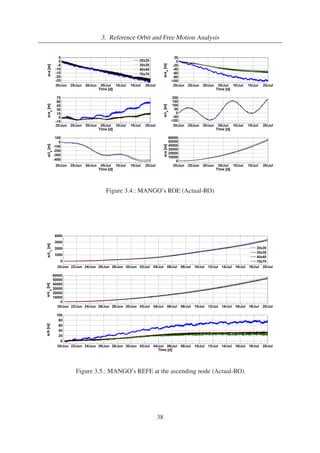
3.4. MANGO’s ROE (Actual-RO) . . . . . . . . . . . . . . . . . . . . . . . . . . . 38 
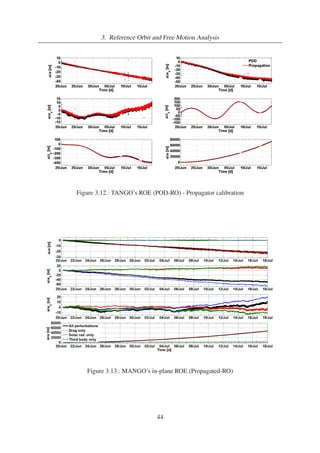
3.5. MANGO’s REFE at the ascending node (Actual-RO) . . . . . . . . . . . . . . 38 
3.6. MANGO’s δL at the ascending node (Actual-RO) - Details . . . . . . . . . . 39 
3.7. MANGO’s δL' at the ascending node (Actual-RO) - Details . . . . . . . . . . 39 
3.8. MANGO’s δh at the ascending node (Actual-RO) - Details . . . . . . . . . . . 40 
3.9. MANGO’s ROE (POD-RO) . . . . . . . . . . . . . . . . . . . . . . . . . . . 41 
3.10. MANGO’s REFE (POD-RO) . . . . . . . . . . . . . . . . . . . . . . . . . . . 41 
3.11. Free motion . . . . . . . . . . . . . . . . . . . . . . . . . . . . . . . . . . . . 42 
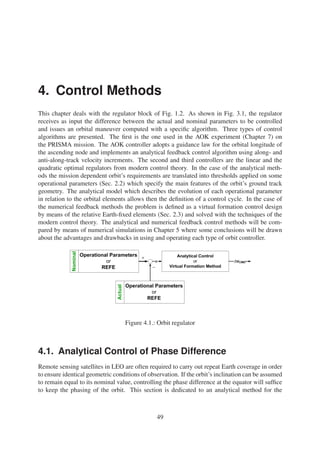
3.12. TANGO’s ROE (POD-RO) - Propagator calibration . . . . . . . . . . . . . . . 44 
3.13. MANGO’s in-plane ROE (Propagated-RO) . . . . . . . . . . . . . . . . . . . 44 
3.14. MANGO’s out-of-plane ROE (Propagated-RO) . . . . . . . . . . . . . . . . . 45 
3.15. MANGO’s REFE at the ascending node (Propagated-RO) . . . . . . . . . . . . 45 
3.16. TSX’s ROE (POD-RO) - Propagator calibration . . . . . . . . . . . . . . . . . 46 
3.17. TSX’s in-plane ROE (Propagated-RO) . . . . . . . . . . . . . . . . . . . . . . 47 
3.18. TSX’s out-of-plane ROE (Propagated-RO) . . . . . . . . . . . . . . . . . . . . 47 
3.19. TSX’s REFE at the ascending node (Propagated-RO) . . . . . . . . . . . . . . 48 
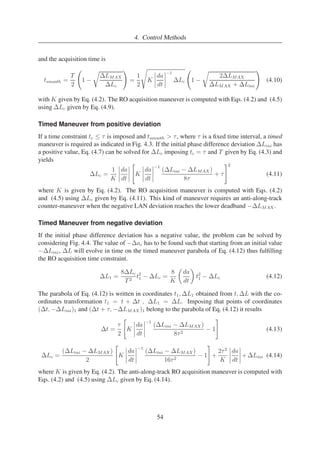
4.1. Orbit regulator . . . . . . . . . . . . . . . . . . . . . . . . . . . . . . . . . . 49 
4.2. Maneuver with estimated da/dt . . . . . . . . . . . . . . . . . . . . . . . . . 51 
4.3. Smooth and timed RO acquisition from positive LAN deviation values . . . . . 53 
4.4. Timed RO acquisition from negative LAN deviation values . . . . . . . . . . . 55 
4.5. On-board estimation process of da/dt . . . . . . . . . . . . . . . . . . . . . . 56 
4.6. TANGO’s real (POD) and propagated orbital elements with respect to the RO . 61 
vii
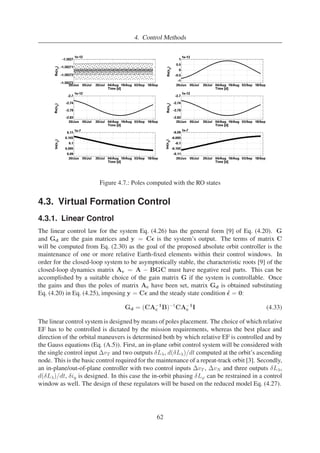
4.7. Poles computed with the RO states . . . . . . . . . . . . . . . . . . . . . . . . 62 
4.8. REFE computed in u(t) and at the ascending node . . . . . . . . . . . . . . . . 68 
4.9. Region of stability as mapped from the continuous to the discrete domain . . . 68 
5.1. ROE (in-plane control) . . . . . . . . . . . . . . . . . . . . . . . . . . . . . . 71 
5.2. REFE (in-plane control) . . . . . . . . . . . . . . . . . . . . . . . . . . . . . 72 
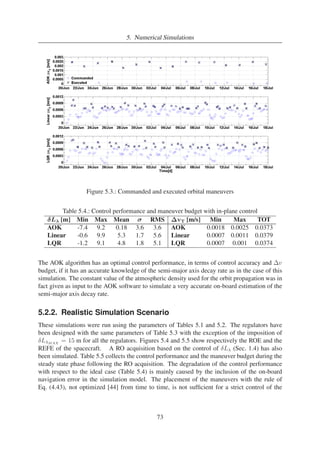
5.3. Commanded and executed orbital maneuvers . . . . . . . . . . . . . . . . . . 73 
5.4. ROE (in-plane control) . . . . . . . . . . . . . . . . . . . . . . . . . . . . . . 74 
5.5. REFE (in-plane control) . . . . . . . . . . . . . . . . . . . . . . . . . . . . . 74 
5.6. Commanded and executed orbital maneuvers . . . . . . . . . . . . . . . . . . 75 
5.7. Mapping of continuous to discrete poles with the Tustin discretization method . 76 
5.8. ROE (in-plane and out-of-plane control) . . . . . . . . . . . . . . . . . . . . . 77 
5.9. REFE (in-plane and out-of-plane control) . . . . . . . . . . . . . . . . . . . . 78 
5.10. Commanded and executed orbital maneuvers . . . . . . . . . . . . . . . . . . 78 
6.1. Internal structure of an application component [128] . . . . . . . . . . . . . . . 82 
6.2. Simplified scheme of the software architecture . . . . . . . . . . . . . . . . . . 84 
6.3. Simulink subsystems implementing the BSW, ORB and GNC application cores 85 
6.4. Inner structure of the ORB application core . . . . . . . . . . . . . . . . . . . 86 
6.5. Simplified scheme of the software architecture . . . . . . . . . . . . . . . . . . 89 
6.6. Simplified scheme of the software architecture . . . . . . . . . . . . . . . . . . 90 
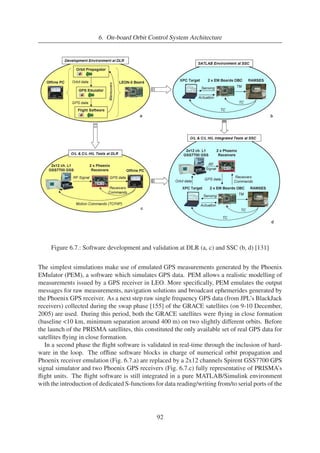
6.7. Software development and validation at DLR (a, c) and SSC (b, d) [131] . . . . 92 
6.8. Software development and validation environments at DLR and SSC . . . . . . 96 
6.9. Software development and validation environments at DLR and SSC . . . . . . 96 
6.10. Software development and validation environments at DLR and SSC . . . . . . 97 
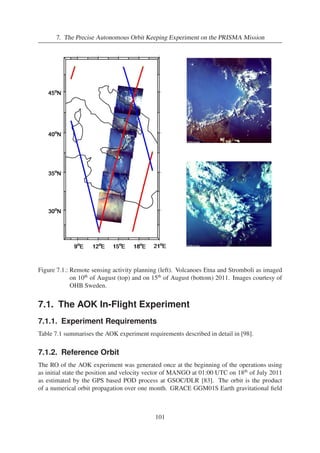
7.1. Remote sensing activity planning (left). Volcanoes Etna and Stromboli as im-aged 
on 10th of August (top) and on 15th of August (bottom) 2011. Images 
courtesy of OHB Sweden. . . . . . . . . . . . . . . . . . . . . . . . . . . . . 101 
7.2. AOK experiment sequence of events . . . . . . . . . . . . . . . . . . . . . . . 104 
7.3. Semi-major axis deviation (top), LAN deviation (middle), computed orbitalma-neuvers 
(bottom) . . . . . . . . . . . . . . . . . . . . . . . . . . . . . . . . . 106 
7.4. Semi-major axis deviation and on-board estimation accuracy (top). Orbital ma-neuvers 
(bottom) . . . . . . . . . . . . . . . . . . . . . . . . . . . . . . . . . 106 
7.5. Semi-major axis deviation (top), LAN deviation (middle), maneuvers (bottom) 108 
7.6. Semi-major axis deviation (top), LAN deviation (middle), maneuvers (bottom) 109 
7.7. Semi-major axis deviation (top), LAN deviation (middle), maneuvers (bottom) 110 
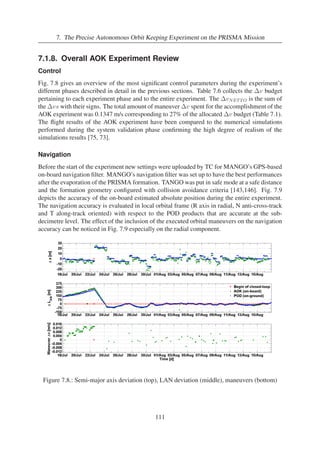
7.8. Semi-major axis deviation (top), LAN deviation (middle), maneuvers (bottom) 111 
7.9. Accuracy of the on-board estimated position in RTN . . . . . . . . . . . . . . 113 
7.10. Accuracy of the on-board estimation of the semi-major axis . . . . . . . . . . . 113 
8.1. Ground-based vs on-board orbit control systems cost . . . . . . . . . . . . . . 115 
B.1. Accuracy of the on-board estimated position in RTN . . . . . . . . . . . . . . 124 
B.2. Accuracy of the on-board estimated orbital elements . . . . . . . . . . . . . . 125 
viii
C.1. Relative orbital elements (AOK) . . . . . . . . . . . . . . . . . . . . . . . . . 128 
C.2. Relative Earth-fixed elements and executed orbital maneuvers - AOK . . . . . . 129 
C.3. Relative orbital elements AFC-AOK . . . . . . . . . . . . . . . . . . . . . . . 130 
C.4. Relative Earth-fixed elements AFC-AOK . . . . . . . . . . . . . . . . . . . . 130 
C.5. Executed formation control maneuvers AFC-AOK . . . . . . . . . . . . . . . . 131 
C.6. Earth-fixed baseline TSX-TDX . . . . . . . . . . . . . . . . . . . . . . . . . . 132 
C.7. Relative orbital elements - Linear regulator . . . . . . . . . . . . . . . . . . . 133 
C.8. Relative Earth-fixed elements and executed orbital maneuvers - Linear regulator 133 
C.9. Relative orbital elements SAFE-Linear . . . . . . . . . . . . . . . . . . . . . . 134 
C.10.Relative Earth-fixed elements AFC-Linear . . . . . . . . . . . . . . . . . . . . 134 
C.11.Executed formation control maneuvers AFC-Linear . . . . . . . . . . . . . . . 135 
D.1. Solar flux indices F10.7 and Kp from January 2000 to September 2011 . . . . . 137 
D.2. Solar flux indices F10.7 and Kp during the AOK experiment . . . . . . . . . . 137 
D.3. South Europe from 4th to 12th of August. Images courtesy of OHB Sweden. . . 138 
D.4. TANGO’s GPS antennas switch (top) and GOD measurement update status 
(bottom) . . . . . . . . . . . . . . . . . . . . . . . . . . . . . . . . . . . . . . 140 
D.5. Relative position MANGO - TANGO in the RTN orbital frame during the ac-quisition 
phase of the initial relative state for AOK experiment . . . . . . . . . 141 
D.6. Relative orbital elements MANGO - TANGO during the acquisition phase of 
the initial relative state for AOK experiment . . . . . . . . . . . . . . . . . . . 141 
D.7. Relative eccentricity and inclination vectors MANGO - TANGO during the ac-quisition 
phase of the initial relative state for AOK experiment . . . . . . . . . 142 
D.8. Relative positionMANGO - TANGO in the RTN orbital frame during the AOK 
experiment . . . . . . . . . . . . . . . . . . . . . . . . . . . . . . . . . . . . 142 
ix
List of Tables 
1.1. Overview of mission parameters for some remote sensing satellites . . . . . . . 1 
1.2. Costs Reduction . . . . . . . . . . . . . . . . . . . . . . . . . . . . . . . . . . 4 
1.3. Autonomous absolute orbit contol in-flight demonstrations . . . . . . . . . . . 5 
1.4. Enabled Mission Features . . . . . . . . . . . . . . . . . . . . . . . . . . . . . 8 
1.5. Comparison between ground-based and on-board orbit control systems . . . . . 9 
1.6. PRISMA GNC experiments . . . . . . . . . . . . . . . . . . . . . . . . . . . 12 
1.7. PRISMA sensor/actuator experiments . . . . . . . . . . . . . . . . . . . . . . 12 
3.1. Orbit specification in terms of nominal mean orbital elements . . . . . . . . . . 32 
3.2. Control specifications . . . . . . . . . . . . . . . . . . . . . . . . . . . . . . . 36 
3.3. PRISMA spacecraft physical properties . . . . . . . . . . . . . . . . . . . . . 36 
3.4. Propagation parameters . . . . . . . . . . . . . . . . . . . . . . . . . . . . . . 37 
3.5. Initial state - POD state on 20-06-2011 at 06:00:00 UTC . . . . . . . . . . . . 37 
3.6. On-board navigation error . . . . . . . . . . . . . . . . . . . . . . . . . . . . 40 
3.7. Influence of orbit perturbation forces on the orbital elements . . . . . . . . . . 43 
3.8. Physical properties of the TerraSAR-X spacecraft . . . . . . . . . . . . . . . . 46 
3.9. Propagation initial state . . . . . . . . . . . . . . . . . . . . . . . . . . . . . . 46 
4.1. Analytic expressions of the poles . . . . . . . . . . . . . . . . . . . . . . . . . 59 
4.2. Propagation parameters . . . . . . . . . . . . . . . . . . . . . . . . . . . . . . 60 
4.3. Poles computed in the initial state . . . . . . . . . . . . . . . . . . . . . . . . 61 
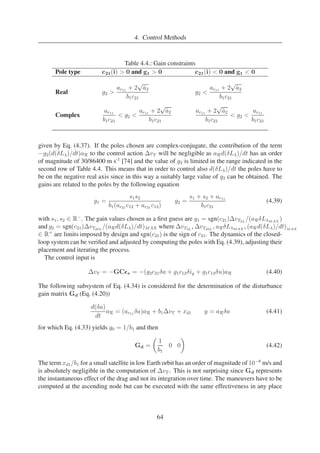
4.4. Gain constraints . . . . . . . . . . . . . . . . . . . . . . . . . . . . . . . . . . 64 
5.1. Propagation parameters . . . . . . . . . . . . . . . . . . . . . . . . . . . . . . 70 
5.2. Navigation and actuators accuracy . . . . . . . . . . . . . . . . . . . . . . . . 70 
5.3. Regulators design parameters . . . . . . . . . . . . . . . . . . . . . . . . . . . 72 
5.4. Control performance and maneuver budget with in-plane control . . . . . . . . 73 
5.5. Control performance and maneuver budget with in-plane control . . . . . . . . 75 
5.6. Poles . . . . . . . . . . . . . . . . . . . . . . . . . . . . . . . . . . . . . . . . 76 
5.7. Control performance and maneuver budget with in-plane and out-of-plane control 78 
6.1. Application components for GNC software . . . . . . . . . . . . . . . . . . . 83 
6.2. AOK software module input . . . . . . . . . . . . . . . . . . . . . . . . . . . 87 
6.3. AOK software module output . . . . . . . . . . . . . . . . . . . . . . . . . . . 87 
6.4. Structure of AOK status byte . . . . . . . . . . . . . . . . . . . . . . . . . . . 88 
6.5. AOK maneuvers computation . . . . . . . . . . . . . . . . . . . . . . . . . . . 91 
6.6. LEON3 board and host laptop PC features . . . . . . . . . . . . . . . . . . . . 94 
x
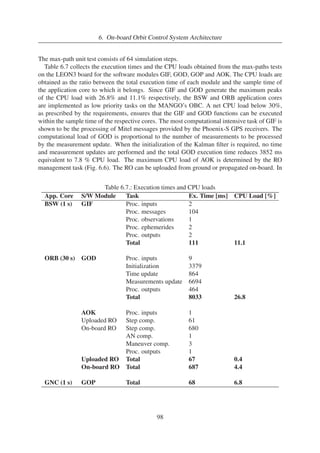
6.7. Execution times and CPU loads . . . . . . . . . . . . . . . . . . . . . . . . . 98 
7.1. AOK experiment requirements . . . . . . . . . . . . . . . . . . . . . . . . . . 102 
7.2. AOK experiment sequence of events . . . . . . . . . . . . . . . . . . . . . . . 103 
7.3. AOK controller settings during the fine control phase . . . . . . . . . . . . . . 108 
7.4. Most significant control statistics . . . . . . . . . . . . . . . . . . . . . . . . . 109 
7.5. Most significant control statistics . . . . . . . . . . . . . . . . . . . . . . . . . 110 
7.6. Maneuver v budget . . . . . . . . . . . . . . . . . . . . . . . . . . . . . . . 112 
B.1. Navigation error - Position and velocity in RTN . . . . . . . . . . . . . . . . . 124 
B.2. Navigation error - Orbital elements . . . . . . . . . . . . . . . . . . . . . . . . 125 
C.1. Control performance and maneuver budget of AOK control . . . . . . . . . . . 129 
C.2. Control performance and maneuver budget of AFC relative control . . . . . . . 131 
C.3. Control performance and maneuver budget of in-plane linear control . . . . . . 132 
C.4. Control performance and maneuver budget of AFC relative control . . . . . . . 135 
D.1. Requested and actual MANGO - TANGO relative initial state for the AOK ex-periment 
. . . . . . . . . . . . . . . . . . . . . . . . . . . . . . . . . . . . . . 140 
xi
to Paride, may he rest in peace 
Beethoven Op. 31 No. 2 
xii
Acknowledgments 
I would like to expressmy gratitude tomy supervisors Gianmarco Radice and Simone D’Amico. 
Gianmarco gave me the trust and freedom I needed to accomplish this research. Simone is 
the scientist who taught me the art of flight dynamics in which he is a real master. I owe 
special thanks also to Oliver Montenbruck from whom I learned the importance of realising 
concretely ideas conceived during research. Thanks to Jean-Sebastian and Gabriella for their 
invaluable support during the AOK experiment operations and to the PRISMA mission design 
and operations team in Sweden. 
Thanks to 
My parents and my sister for their constant support and patience 
My grandmother who guards my roots in Milano 
Giangi for the excellent dinners and Whisky 
Gianni and Paride who visited me in Glasgow and joined us in the Burns night 
Elisa, Ettore, Fabrizio, Giuseppe, Lorenzo, Luca, Marcel.la, Matteo, Michele, Miguel, Paola, 
Saika, Serena, Yago and Yamagen for everything in the daily life in München 
My theatre and athletics groups because they are also families 
Dieter, my athletics trainer, for telling me that rests are as important as trainings 
Claire, Filiep, Franz, Markus, Matthias, Paul and Stefan for the running trainings together 
Thomas for showing me new paths in music 
Carlo because the future is in space 
Claudia so far but so close 
Paola, Maura, Daniela and Fabio for their determined daily commitment 
Guido, Lamberto and Giovanni who are like brothers 
Eli for she exists 
Sergio De Florio 
xiii
Author’s Declaration 
I hereby declare that this submission is my own work and that, to the best of my knowledge and 
belief, it contains no material previously published or written by another person nor material 
which to a substantial extent has been accepted for the award of any other degree or diploma of 
the university or other institute of higher learning, except where due acknowledgment has been 
made in the text. 
Glasgow, Scotland, June 26, 2013, Sergio De Florio 
xiv
Nomenclature 
Symbols 
a = semi-major axis [m] 
aij = element ij of matrix A 
A = spacecraft reference area [m2] 
A = dynamic model matrix [s-1] 
bij = element ij of matrix B 
B = ballistic coefficient of the spacecraft [kg/m2] 
B = control matrix [-] 
c = cost [e] 
cij = element ij of matrix C 
C = output matrix [-] 
CD = drag coefficient [-] 
da/dt = decay rate of the semi-major axis [m/s] 
dt = time difference [s] 
e = eccentricity [-] 
e = eccentricity vector [-] 
ec = orbit control accuracy [m] 
ed = dynamic model uncertainties [m] 
ej = eccentricity vector component [-] 
eM = maneuvers error [m] 
eN = navigation error [m] 
F10.7 = solar radio flux index [sfu = 10-22 W m-2 Hz-1] 
gj = gain 
G = gain matrix 
Gd = disturbance gain matrix 
Kp = geomagnetic activity index [-] 
i = inclination [rad] 
ij = inclination vector component [rad] 
JA = Jacobian of matrix A 
J2 = geopotential second-order zonal coefficient [-] 
m = spacecraft mass [kg] 
M = mean anomaly [rad] 
n = mean motion [rad/s] 
nN = nodal frequency [1/s] 
xv
RE = Earth’s equatorial radius [m] 
sj = characteristic root 
t = time [s] 
tc = time required for reference orbit acquisition [s] 
te = exploitation time [s] 
tsmooth = time required for smooth reference orbit acquisition [s] 
T = maneuver cycle [s] 
T = coordinates transformation matrix [-] 
Tdu = maneuver duty cycle [d] 
TE = mean period of solar day [s] 
TN = nodal period [s] 
TSu = Sun period [s] 
u = argument of latitude [rad] 
u = constant value of argument of latitude [rad] 
v = spacecraft velocity [m/s] 
δa = relative semi-major axis [-] 
aAN = difference between real and reference semi-major axis at the ascending node [m] 
ac = maneuver semi-major axis increment [m] 
δe = relative eccentricity vector amplitude [-] 
δej = relative eccentricity vector component [-] 
δ̥ = relative Earth-fixed elements vector [-] 
δh = normalized altitude difference [-] 
h = altitude difference [m] 
δi = relative inclination vector amplitude [rad] 
δij = relative inclination vector component [rad] 
δκ = relative orbital elements vector 
δLj = phase difference vector component [m] 
L = phase difference [m] 
LAN = phase difference at the ascending node [m] 
LMAX = LAN control window [m] 
δr = normalized relative position vector [-] 
δrj = component of normalized relative position vector[-] 
δu = relative argument of latitude [rad] 
δv = normalized relative velocity vector [-] 
δvj = component of normalized relative velocity vector[-] 
vj = impulsive maneuver velocity increment component [m/s] 
vMAX = largest value allowed for a maneuver [m/s] 
R− = set of negative real numbers 
R+ = set of positive real numbers 
Z = set of integer numbers 
Z+ = set of positive integer numbers 
xvi
Greek Symbols 
ǫ = normalized relative orbital elements vector [m] 
η = normalized altitude [-] 
φ = relative perigee [rad] 
ϕ = latitude [rad] 
κ = mean orbital elements vector 
κo = osculating orbital elements vector 
λ = longitude [rad] 
μ = Earth’s gravitational coefficient [m3/s2] 
ω = argument of periapsis [rad] 
ωE = Earth rotation rate [rad/s] 

 = right ascension of the ascending node [rad] 
˙
 
= secular rotation of the line of nodes [rad/s] 
ρ = atmospheric density [kg/m3] 
τ = time constraint for reference orbit acquisitions [s] 
θ = relative ascending node [rad] 
ξ = thrusters execution error [%] 
Indices 
Subscripts 
c = closed-loop 
CMD = commanded 
d = disturbance 
D = discrete 
du = duty cycle 
E = Earth 
EXE = executed 
g = gravity 
i = implementation 
m = maneuver 
n = navigation 
N = cross-track 
onb = on-board 
ong = on-ground 
OPS = operations 
p = performance 
r = reduced 
R = reference orbit 
R = radial 
sy = Sun-synchronous 
xvii
sth = smoothed 
T = along-track 
TOT = total 
Superscripts 
T = vector transpose 
xviii
Acronyms 
ACC Accelerometer 
AFC Autonomous formation control 
AMS Asynchronous monotonic scheduler 
AOC Autonomous orbit control 
AOCS Attitude and orbit control system 
AOK Autonomous Orbit Keeping 
BSW Basic software 
CDTI Spanish Centre for the Development of Industrial Technology 
CNES French Space Agency 
COTS Commercial off the shelf 
CPU Central processing unit 
DEM Digital elevation model 
DLR German aerospace center 
DTU Technical University of Denmark 
DVS Digital video system 
ECI Earth-centred inertial 
EF Earth-fixed 
EGSE Electrical Ground Support Equipment 
EM Engineering model 
FDIR Failure detection isolation and recovery 
FF Formation flying 
FFRF Formation flying radio frequency sensors 
FM Flight model 
GIF GPS interface 
GNC Guidance, navigation and control 
GOD GPS-based Orbit Determination 
GOP GPS-based Orbit Prediction 
GS Ground station 
GSOC German space operations center 
IRF Institute of Space Physics 
ISL Inter-satellite-link 
LEO Low Earth Orbit 
LPO Longitudinal phase of the orbit 
MBD Model-based design 
MM Magnetometer 
OBC On-board computer 
OCK Orbit Control Kit 
ONB On-board 
PC Personal computer 
POD Precise Orbit Determination 
RAMSES Rocket And Multi Satellite EGSE System 
xix
REFE Relative Earth-Fixed elements 
RCC RTEMS cross-compilation 
RMS Root mean square 
RO Reference Orbit 
ROE Relative orbital elements 
RTEMS Real-time executive for multiprocessor systems 
RTOS Real time operating system 
RTU Remote terminal unit 
RTW Real time workshop 
SAFE Spaceborne autonomous formation flying experiment 
SAR Synthetic aperture radar 
SCA star camera 
SCET Spacecraft Elapsed Time 
S/C Spacecraft 
SEU Singular event upset 
SNSB Swedish National Space Board 
SRP Solar radiation pressure 
SS Sun sensor 
SSC Swedish space corporation 
SSP Sub-satellite point 
SSTL Surrey Satellite Technology Limited 
S/W Software 
TAFF TanDEM-X autonomous formation flying 
TAN Time at ascending node 
TBC To be confirmed 
TC Telecommand 
TDX TanDEM-X 
THR Thrusters 
TM Telemetry 
TSX TerraSAR-X 
TTTC Time-tagged-telecommand 
UV Ultra Violet 
VBS Vision based sensor 
xx
Publications 
Journal Papers 
• S. De Florio, S. D’Amico, G. Radice, The Virtual Formation Method for Precise Au-tonomous 
Absolute Orbit Control, Journal of Guidance, Control and Dynamics, Vol. 
37, No. 2, pp. 425-438, March-April 2014, doi:10.2514/1.61575. 
• S. De Florio, S. D’Amico, G. Radice, Flight Results of the Precise Autonomous Orbit 
Keeping Experiment on the Prisma Mission, Journal of Spacecraft and Rockets, Vol. 
50, No. 3, pp. 662-674, May 2013, doi:10.2514/1.A32347. 
• S. De Florio, S. D’Amico, The Precise Autonomous Orbit Keeping Experiment on the 
Prisma Mission, The Journal of the Astronautical Sciences, Vol. 56, No. 4, Oct.-Dec. 
2008, pp. 477-494. 
• S. D’Amico, J.-S. Ardaens, and S. De Florio, Autonomous Formation Flying based on 
GPS - PRISMA Flight Results, Acta Astronautica, Vol. 82, No. 1, pp. 69.79, Jan. 2013, 
doi:10.1016/j.actaastro.2012.04.033. 
Conference Papers 
• S. De Florio, S. D’Amico, G. Radice G., Combined Autonomous Absolute and Rel-ative 
Orbit Control in Low Earth Orbit, Proceedings of the 5th International Confer-ence 
on Spacecraft Formation Flying Missions and Technologies, No. 40096, 29-31May, 
2013, Munich, Germany. 
• S. D’Amico, J.-S. Ardaens, G. Gaias, and S. De Florio, Space Flight Technology Demon-strations 
of DLR within the PRISMA Mission, Proceedings of the 5th International 
Conference on Spacecraft Formation Flying Missions and Technologies, 29-31 May, 
2013, Munich, Germany. 
• S. De Florio, S. D’Amico, G. Radice G., Precise Autonomous Orbit Control in Low 
Earth Orbit, Proceedings of the AIAA/AAS Astrodynamics Specialist Conference, Min-neapolis, 
MN, USA, 13 - 16 August 2012. 
• S. De Florio, S. D’Amico, and G. Radice, Flight Results of the Precise Autonomous 
Orbit Keeping Experiment on the PRISMAMission, AAS 12-179, Proceedings of the 
22nd AAS/AIAA Space Flight Mechanics Meeting, 29 Jan. - 2 Feb. 2012, Charleston, SC, 
USA. 
xxi
• S. De Florio, S. D’Amico, G. Radice G., Operations Concept of the Precise Autonomous 
Orbit Keeping Experiment on the PRISMA Mission, Proceedings of the 8th IAA Sym-posium 
on Small Satellites for Earth Observation, 4-8 April 2011, Berlin. 
• S. De Florio, S. D’Amico and J.S. Ardaens, Autonomous Navigation and Control of 
Formation Fliyng Spacecraft on the PRISMA Mission, IAC-10.C1.5.12, Proceedings 
of the 61st International Astronautical Congress, 27 Sep - 1 Oct 2010, Prague, CZ. (2010). 
• S. D’Amico, J.S. Ardaens, S. De Florio, O. Montenbruck, S. Persson, R. Noteborn 
R., GPS-Based Spaceborne Autonomous Formation Flying Experiment (SAFE) on 
PRIS-MA: Initial Commissioning, Proceedings of the AIAA/AAS Astrodynamics Spe-cialist 
Conference, 2-5 August 2010, Toronto, Canada. 
• S. D’Amico, J.-S. Ardaens and S. De Florio, Autonomous Formation Flying based 
on GPS - PRISMA Flight Results, Proceedings of the 6th International Workshop on 
Satellite Constellations and Formation Flying, IWSCFF, November 1-3, 2010, Howard 
International House, Taipei, Taiwan 
• S. De Florio, S. D’Amico, Optimal Autonomous Orbit Control of Remote Sensing 
Spacecraft, Proceedings of the 19th AAS/AIAA Space Flight Mechanics Meeting, 8-12 
Feb 2009, Savannah, USA. 
• S. De Florio, E. Gill, S. D’Amico, Performance Comparison of Microprocessors for 
Space-based Navigation Applications, Proceedings of the 7th IAA Symposium on Small 
Satellite for Earth Observation, 4-8 May 2009, Berlin, Germany. 
• S. D’Amico, S. De Florio, R. Larsson, M. Nylund, Autonomous Formation Keeping 
and Reconfiguration for Remote Sensing Spacecraft, Proceedings of the 21st Interna-tional 
Symposium on Space Flight Dynamics, 28 Sep. - 2 Oct. 2009, Toulouse, France. 
• S. De Florio, S. D’Amico,M. Garcia-Fernandez, The Precise Autonomous Orbit Keep-ing 
Experiment on the PRISMA Formation Flying Mission, AAS 08-212, Proceed-ings 
of the 18th AAS/AIAA Space Flight Mechanics Meeting, 28-31 Jan. 2008, Galveston, 
Texas, USA. 
• S. De Florio, Reduction of the Response Time of Earth Observation Satellite Con-stellations 
using Inter-satellite Links, AIAA-2008-3281, Proceedings of the SpaceOps 
Conference, 12-16 May 2008, Heidelberg, Germany. 
• S. D’Amico, J.-S. Ardaens, S. De Florio, O. Montenbruck, Autonomous Formation 
Flying - TanDEM-X, PRISMA and Beyond, Proceedings of the 5th InternationalWork-shop 
on Satellite Constellations and Formation Flying, 2-4 July 08, Evpatoria, Crimea, 
Ukraine. 
• S. D’Amico, S. De Florio, J. S. Ardaens, T. Yamamoto, Offline and Hardware-in-the-loop 
Validation of the GPS-based Real-Time Navigation System for the PRISMA 
xxii
Formation Flying Mission, Proceedings of the 3rd International Symposium on Forma-tion 
Flying, Missions and Technology, 23-25 April 2008, ESA/ESTEC, Noordwijk, The 
Netherlands. 
Technical Documentation 
• S. De Florio, Flight Results of the Precise Autonomous Orbit Keeping Experiment on 
the PRISMA Mission, PRISMA-DLR-OPS-56, 2011, DLR/GSOC, Deutsches Zentrum 
für Luft und Raumfahrt, Oberpfaffenhofen, Germany. 
• S. De Florio, Operation Concept of the Precise Autonomous Orbit Keeping Experi-ment 
on the PRISMA Mission, PRISMA-DLR-OPS-55, 2011, DLR/GSOC, Deutsches 
Zentrum für Luft und Raumfahrt, Oberpfaffenhofen, Germany. 
• S. De Florio, S. D’Amico, Collision Risk Assessment for Co-orbiting Spacecraft, 
DEOS-DLR-TN-02, 2011, DLR/GSOC, Deutsches Zentrum für Luft und Raumfahrt, 
Oberpfaffenhofen, Germany. 
• S. De Florio, DLR’s Experiment Control Center for the PRISMA Mission Interface 
Control Document, PRISMA-DLR-OPS-52, DLR/GSOC, Deutsches Zentrum für Luft 
und Raumfahrt, Oberpfaffenhofen, Germany. 
• S. De Florio, S. D’Amico, Real-Time Satellite Laboratory Tests of DLR’s Flight 
Software: Third SATLAB Campaign (v. 6.2.0), PRISMA-DLR-TST-45, DLR/GSOC, 
Deutsches Zentrum für Luft und Raumfahrt, Oberpfaffenhofen, Germany. 
• S. De Florio, S. D’Amico, DLR’s Satellite Laboratory Test Results for the PRISMA 
Flight Software, PRISMA-DLR-TST-44, DLR/GSOC, Deutsches Zentrum für Luft und 
Raumfahrt, Oberpfaffenhofen, Germany. 
• S. De Florio, S. D’Amico, Comparison of Scalar and Vectorial Implementation of the 
Extended Kalman Filter, PRISMA-DLR-TN-19, DLR/GSOC, Deutsches Zentrum für 
Luft und Raumfahrt, Oberpfaffenhofen, Germany. 
• S. De Florio, S. D’Amico, Max-Path Unit Tests of the PRISMA Flight Software, 
PRISMA-DLR-TN-17, DLR/GSOC, Deutsches Zentrum für Luft und Raumfahrt, Oberp-faffenhofen, 
Germany. 
xxiii
1. Introduction 
1.1. Absolute Orbit Control 
In the last two decades the development and exploitation of very high resolution optical systems 
mounted on satellites in Low Earth Orbit (LEO) was a major driver for the commercialisation 
of Earth observation data. The global political security situation, environmental awareness and 
updated legislative frameworks are pushing for the realization of new high resolution remote 
sensing missions. The European Global Monitoring for Environment and Security (GMES) 
programme now renamed Copernicus is a major example of this trend. Fig. 1.1 [81] shows 
a list of significant Earth observation missions in orbit or planned for the near future. These 
kind of missions demand specialized orbits. Remote sensing satellites are generally placed on 
so-called sun-synchronous orbits where they cross the true of date Earth equator at the ascend-ing 
node at the same local time. This is necessary to ensure similar illumination conditions 
when making images of the same parts of the Earth’s surface with the exploitation of different 
orbits. In addition, orbits of remote sensing satellites are often designed to repeat their ground 
track after a certain number of days. These are the so called phased orbits. Finally, it may 
be useful to minimize or even avoid the secular motion of the argument of perigee of the or-bit. 
This is again achieved by a proper choice of the orbital parameters and the resulting orbit 
is called frozen. Orbits of remote sensing satellites are, in general, sun-synchronous, phased, 
and frozen simultaneously. A collection of typical orbital elements and of phasing parameters 
for remote sensing satellites is given in Table 1.1. The design of such orbits is based on the 
required characteristics of the motion of the spacecraft with respect to the Earth surface. The 
three-dimensional position of the spacecraft in an Earth-fixed (EF) frame is completely defined 
by its projection on the ground track and its altitude with respect to the Earth’s surface. The 
design of the orbit will thus define a nominal EF trajectory to be maintained during the entire 
mission lifetime. Specific orbit control requirements can be expressed by means of constraints 
Table 1.1.: Overview of mission parameters for some remote sensing satellites 
Mission ERS 1 SPOT 4 Envisat 1 TerraSAR Sentinel-1 
Agency ESA CNES ESA DLR ESA 
Launch date July 1991 March 1998 June 2001 June 2007 2013 (TBC) 
Mean altitude [km] 775 822 800 514 693 
a [km] 7153 7200 7178 6786 7064 
e [-] 0.001 0.001 0.025 0.0013 
i [deg] 98.5 98.7 98.6 97.4 98.2 
Phasing [days/orbits] 3/43 26/369 35/501 11/167 12/175 
1
1. Introduction 
Figure 1.1.: Major Earth observation satellites in orbit or in planning (from [81]) 
2
1. Introduction 
Figure 1.2.: Orbit control process 
on certain quantities, the operational parameters, which define the maximum allowed deviation 
of the real from the nominal ground track and altitude of the spacecraft. The orbit control is 
based on the maintenance of these operational parameters within prescribed limits which repre-sent 
the dead-bands for the orbit control. The operational parameters depend on the deviation of 
the orbital elements from their nominal values under the action of perturbing forces. Once the 
mission requirements have been translated into orbit control margins, it is necessary to compute 
the corrections to be applied to the orbital elements to keep the value of the operational param-eters 
within their control windows. Fig. 1.2 shows the basic block diagram of the orbit control 
process and in which chapters of this thesis the relevant topics are treated. The requirements 
which determine the reference orbit (RO) can change in some cases during the course of the 
mission. From the RO the nominal EF parameters to be controlled can be computed by means 
of a coordinates transformation represented by block Tin in Fig. 1.2. A similar transformation 
process Tout is used to obtain the actual EF parameters from the actual orbit of the spacecraft 
which varies under the actions of the natural forces determining the motion of the spacecraft. 
The difference between the nominal and the actual values of the EF parameters are the input 
to the orbit regulator. The control actions computed by the orbit regulator are then executed 
by the spacecraft’s thrusters. The feedback control scheme of Fig. 1.2 [76-80] is valid for a 
ground-based or on-board orbit control system the differences being in the single blocks and in 
the way in which the control process is operated. 
1.2. Precise Autonomous Absolute Orbit Control 
Autonomous on-board orbit control means the automatic maintenance by the spacecraft itself 
of different operational parameters within their control dead-bands. Increasing the autonomy 
of spacecraft is often considered an additional unnecessary risk conflicting with the optimal 
planning of the payload activities. Nevertheless the exploitation of an autonomous on-board 
3
1. Introduction 
orbit control system brings some fundamental advantages and enables some specific mission 
features. The principal roadblock to introducing the autonomous orbit control technology is 
simply tradition. Orbit control has always been done from the ground and new programs do not 
want to risk change for what is perceived as a marginal benefit for that flight. 
1.2.1. Potential Advantages and Costs Reduction 
Table 1.2 [62] resumes some advantages and costs reduction resulting by the use of an au-tonomous 
on-board orbit control system. The fulfilment of very strict control requirements on 
different orbit parameters can be achieved in real time and with a significant reduction of flight 
dynamics ground operations [62]. With a fine on-board orbit control system the spacecraft fol-lows 
a fully predictable RO pattern, such that the position of the spacecraft at all future times 
is known as far in advance as desirable and there is a longer planning horizon for all future 
activities. 
The scheduling and planning burden can thus be reduced. With a ground-based orbit control 
system, planning is done as far in advance as feasible in terms of future orbit propagation. If 
preliminary plans are done then an updated plan will be created several days in advance, and 
final updates will be made as close to the event as possible so that the predicted positions can 
be as accurate as possible. An autonomous on-board fine orbit control eliminates all of the 
replanning and rescheduling process and allows these activities to be done on a convenient 
business basis rather than dictated by the orbit prediction capability. Long-term planning can 
be done on a time lapse basis as convenient for the user group. These plans are updated as the 
needs of the users change and the detailed schedule of events is prepared in a manner convenient 
for operations and dissemination [65]. 
This technology provides a new and unique capability in that even very simple ground equip-ment 
that remains out of contact for extended periods can know where a satellite autonomously 
controlled is and when they will next be within contact. This reduces the cost and complexity 
of providing needed ephemeris information to the user community. 
A tighter control is generally associated with additional propellant usage. For LEO satellites 
the dominant in-track secular perturbation is the atmospheric drag. The requirement on the 
orbit control system is to put back what drag takes out. By timing the thruster burns correctly 
this negative velocity increment can be put back so as to maintain the in-track position with 
Table 1.2.: Costs Reduction 
Cost reduction Rationale 
Operations Eliminating the need for ground-based orbit maintenance 
Planning and scheduling 
By knowing the precise future positions of the spacecraft (or 
all of the spacecraft in a constellation) 
Ephemerides transmission 
The cost and complexity of transmitting spacecraft 
ephemerides to various users is eliminated 
Lower propellant usage The orbit is continuously maintained at its highest level 
4
1. Introduction 
no additional propellant usage over that required to overcome the drag force. Since the orbit is 
continuouslymaintained at its highest level rather than being allowed to decay and then brought 
back up, the effect of drag is minimized and the required propellant usage is also minimized 
[58]. By increasing the required control accuracy the number of smaller thruster firings will 
increase. This provides a much finer granularity of control and has the secondary advantage of 
minimizing the orbital maneuvers disturbance torque. Generally, the largest thruster firing for 
a fine orbit control is a few times the minimum impulse bit of the thrusters being used. This 
is, by definition, the smallest level of thrust the propulsion system can efficiently provide and, 
therefore, the smallest orbital maneuvers disturbance torque. In some cases it may even be 
possible to do the thruster firings while the payload is operating. 
1.2.2. In-flight Demonstrations 
In the last two decades different studies have been done for the autonomous orbit control of 
satellites in LEO [49-64]. Some of these theoretical works were validated in the in-flight demon-strations 
listed in Table 1.3. All these experiments have in common the GPS-based on-board 
navigation which is nowadays the only means to obtain a continuous accurate on-board orbit 
estimation and thus an accurate orbit control. The time at ascending node (TAN) and the longi-tude 
of ascending node (LAN) are the parameters controlled by means of along-track velocity 
increments whereas the longitudinal phase of the orbit (LPO) is controlled by means of cross-track 
maneuvers. The RO is propagated using only the Earth’s gravitational field model and 
this means that the orbit controller has to keep the gravitational perturbations and correct all 
the others which are no-conservative forces. Indeed the gravitational perturbations do not cause 
orbit decay and can be modeled precisely enough by numerical means to enable prediction of 
the satellite position far into the future. 
The Microcosm Inc. Orbit Control Kit (OCK) software [77] was flown the first time on the 
Surrey Satellite Technology Limited (SSTL) UoSAT-12 [65] spacecraft, where it co-resides on 
a customized 386 onboard computer, developed by SSTL, with their attitude determination and 
control system software. The inputs for OCK are generated by the SSTL-built 12-channel L1- 
code GPS receiver (SSTL model SGAR 20) with an output frequency of 1 Hz. Microcosm 
Table 1.3.: Autonomous absolute orbit contol in-flight demonstrations 
Year 1999 2005 2007 2011 
Mission UoSAT-12 Demeter TacSat-2 PRISMA 
Orbit 650 km sun-sync. 700 km sun-sync. 410 km sun-sync. 710 km sun-sync. 
Exp. duration [days] 29 150 15 30 
Ctrl type TAN/LPO/e LAN/TAN/e TAN LAN/TAN 
Ctrl accuracy [m] 930 100 750 10 
Total v [m/s] 0.0733 0.12 0.27 0.13 
Propulsion Cold gas Hydrazine Hall Effect Thruster Hydrazine 
Navigation GPS GPS GPS GPS 
Ctrl system developer Microcosm, Inc. CNES Microcosm, Inc. DLR/SSC 
Exp. = experiment, Ctrl = control, TAN = Time at Ascending Node, LAN = Longitude of Ascending Node 
5
1. Introduction 
demonstrated in flight two different high-accuracy in-track orbit controllers and one cross-track 
controller. In the implementation of the in-track controllers, the basic measurement to be con-trolled, 
by means of along-track velocity increments, is the TAN i.e. the deviation from the 
expected value in the crossing time from South to North of the Earth’s equator. The actual 
and reference crossing times are compared for the computation of the required maneuver [58]. 
On-board targeting of frozen orbit conditions is used to better control the orbit average perfor-mance. 
A proprietary method is used to continually move the orbit toward frozen conditions 
and, once achieved, hold it there. Orbit-averaged mean elements are also calculated on board. 
An analogous process to in-track control has been implemented for the cross track control. The 
cross-track error is determined by comparing the longitude measured at the ascending node to 
a pre-determined longitude. However, the LPO and not the inclination is controlled by means 
of cross-track maneuvers. This means that any secular drift in the placement of the orbit plane 
are removed over time until the desired longitudinal position and drift rate are maintained. An 
updated and enhanced version of OCK was validated in-flight on TacSat-2 [66] which carried 
the IGOR GPS receiver developed by Broad Reach Engineering. The goal of this experiment 
was controlling autonomously the TAN and validating new functionalities of OCK. A series of 
three short validation tests, lasting up to several days, were performed. These short duration 
tests were followed by a fourth extended test that lasted two weeks. Similar to the experiment 
on UoSat-12, OCK managed to maintain the in-track position with an accuracy of 750 m over 
an extended period of time on TacSat-2, in spite of a variety of off-nominal events. 
The main objective of the autonomous orbit control (AOC) experiment on Demeter [67- 
71] was to control, autonomously and securely in an operational context, the TAN, the LAN 
and the mean eccentricity vector of the satellite by means of along-track velocity increments. 
The control algorithms used are similar to those presented in Sec. 4.1.2. The on-board orbit 
determination for the experiment was based on a Thales Alenia Space TOPSTAR 3000 GPS 
receiver [67]. The AOC software was installed in the GPS receiver and used the time, position, 
velocity plus other indicators as supplied by the GPS receiver for its computations. Time slots 
for the orbital maneuvers were defined since one of the main constraints was that AOC could 
not interfere with the scientific mission operations. These time slots, consisting of one orbital 
period close to a ground station pass, were defined on-ground and uploaded regularly. Only 
one orbital maneuver per slot was allowed and the size of the velocity increments which could 
be executed autonomously was also bounded. The ground segment made use of a RO defined 
consistently with the reference parameters used by the AOC. One of the most interesting aspects 
of Demeter is that the AOC systemwas used routinely after its validation and its operations were 
coordinated with the scientific payload activities. 
The autonomous orbit keeping (AOK) experiment on the PRISMA mission [72-75] is de-scribed 
in detail in Chapter 7. The AOK experiment has demonstrated the nowadays most 
accurate absolute orbit control in full autonomy and with simple operational procedures. The 
guidance, navigation and control (GNC) architecture of PRISMA (Chapter 6) is structured with 
orbit control softwaremodules separated fromthe navigationmodules and installed in the space-craft’s 
on-board computer whereas in the Demeter satellite the control software is installed di-rectly 
in the GPS receiver [67,69]. The LAN (Chapter 2) and the TAN, as for Demeter, was 
controlled at the same time by means of along-track velocity increments 
6
1. Introduction 
These in-flight experiments represent milestones in demonstrating that this technology has 
now reached a sufficient level of maturity to be applied routinely in LEO missions. 
1.3. Ground-based vs Autonomous Orbit Control 
As explained in detail by the qualitative cost analysis of Sec. 8.1.1, by increasing the control 
accuracy requirements, thus reducing the maneuver cycle, the choice of using an autonomous 
orbit control system can be more convenient. The ratio between the maneuver cycle and the 
maximum time between two consecutive ground station contacts is one of the most important 
drivers in the choice for a ground-based or on-board orbit control system. There is indeed a 
minimum value of the maneuver cycle for which an autonomous orbit control system is the 
only feasible option as the latency between the ground station contacts is too large for the 
exploitation of a ground-based control. 
1.3.1. Mission Features Enabled by a Precise Orbit Control 
Table 1.4 [62] resumes some specific mission features which are enabled by a precise orbit 
control. With autonomous orbit keeping, planning and scheduling are done on a business basis, 
not as astrodynamics dictates. Thus a detailed plan can be put out well in advance to allow time 
for convenient distribution and potential coordination and input among the mission users. User 
terminals, such as remote weather stations or bookstore computers with daily receipts, can be 
delivered to the user with the entire spacecraft ephemeris already in memory. Consequently, 
data can be transmitted autonomously when the satellite is overhead. Similarly, worldwide 
science groups can do observation planning based on advance knowledge of where the satellite 
will be and the detailed lighting and viewing conditions then. All of this provides a new level 
of utility while substantially reducing the cost and complexity of providing needed ephemeris 
information to the user community. 
The fundamental problem with avoiding both collisions and RF interference is to know about 
it as far in advance as possible. This allows coordination with other system operators and, 
as discussed above, allows avoidance maneuvers to be done as fuel efficiently as possible. A 
system using autonomous orbit control may choose to make the future positions of its satellites 
public. This allows any other satellite users or potential users to calculate as far in advance 
as possible when potential collisions or interference could occur. This provides the maximum 
possible warning and permits advance coordination. 
For a satellite constellation [64-50] retaining the structure at minimum cost and risk is fun-damental. 
An autonomous orbit control system on-board each satellite can maintain the orbital 
period such that the mean period will be the same for all satellites in the constellation over its 
lifetime. This maintains all the satellites synchronized with each other and ensures that the con-stellation 
structure will be fully maintained over the lifetime of the satellites without periodic 
rephasing or readjustment. 
The combined use of new low-power electric propulsion technologies and autonomous guid-ance, 
navigation, and control techniques provides an effective way to reduce the costs of the 
orbit maintenance of a satellite in LEO. The use of a suitable electric propulsion system allows 
7
1. Introduction 
Table 1.4.: Enabled Mission Features 
Feature Rationale 
Mission scheduling in advance 
The customer of the mission can plan data-take far 
in advance and for long period of times 
Mission planning in advance 
The mission control team knows well in advance 
when and where the spacecraft will be 
Simple user terminals 
User terminals with very simple ground equip-ments 
for data reception have the entire spacecraft 
ephemeris in advance 
Collision avoidance 
Space situational awareness teams have an accu-rate 
information on the position of the autonomous 
spacecraft at any time 
Rendezvous 
Rendezvous operations are simplified by a tar-get 
autonomous spacecraft as its trajectory is well 
known 
Coverage analysis for constellations 
All users know where all of the satellites are all of 
the time with no comm link 
Eliminate constellation rephasing 
All satellites in the constellation are maintained in 
phase with each other at all times 
Use of electric propulsion in LEO 
The reduced size of the maneuvers allows the use 
of a low thrust propulsion system 
Use in planetary missions 
Costs are lowered due to the possibility of au-tomating 
data retrieval from the surface 
for significant savings on propellant mass and a consequent increase of the spacecraft lifetime 
[56]. 
The use of a satellite with an autonomous on-board orbit control system around a planet of 
the solar system to be explored (e.g. Mars) could lower the mission costs due to the possibility 
of automating data retrieval from the surface [51]. 
1.3.2. Systems Comparison 
The advantages brought by an autonomous orbit control system explained in Sec. 1.2.1 can 
be afforded indeed by a ground-based control system (except of course for the reduction of 
the on-ground operations costs) at the condition of a high control accuracy. A routine orbit 
maintenance with an accuracy of 250 m, at an altitude of 500 km, in the directions perpendicular 
to the reference ground track has been demonstrated by the TerraSAR-X mission [44,114]. 
Future missions like Sentinel-1 [118-121] are planned to have a control accuracy requirement 
of 50 m at an altitude of 700 km. It is necessary to track the main differences, advantages and 
disadvantages of the two options and identify in which cases one method is more convenient 
8
1. Introduction 
than the other. Fig. 1.2 shows which operations of the orbit control process can be executed 
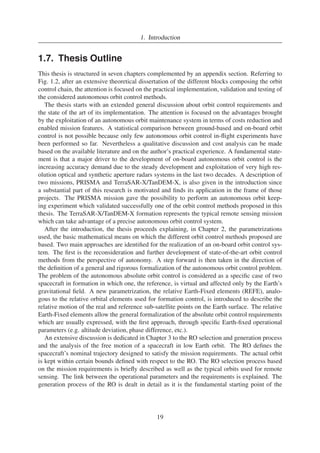
on-ground or on-board. Table 1.5 resumes schematically the points of confrontation between 
ground-based and on-board orbit control systems. 
If the orbit control system is ground-based, the only operation executed on-board is the 
thrusters activation by means of time-tagged-telecommands (TTTC) uploaded to the space-craft 
during a ground station contact and the complementary activities (e.g. attitude maneuvers, 
computation and correction of thruster activation times, etc.). The ground-based orbit deter-mination 
process needs eventually data downloaded from the spacecraft (e.g. GPS, attitude 
and maneuvers data). The value of the orbital maneuvers computed on-ground is typically the 
output of an optimization process which have the availability of space environment data col-lected 
on the long period, the most precise navigation data and practically no constraints on the 
computational resources. The ground station contacts with the spacecraft provide navigation 
and housekeeping data to the ground segment. These data are filtered and used for an orbit 
determination to get the best possible knowledge of the satellite status and motion. The oper-ational 
parameters are computed and handed over to the orbit control software. Inputs for the 
orbit determination and controller software are also external data, consisting of up-to-date solar 
flux data, Earth rotation parameters, eventual navigation payload (e.g. GPS) auxiliary data and 
propulsion system information. The controller compares the predicted operational parameters 
over a certain period of time with the control dead-bands and computes a time-tagged maneuver 
which is uploaded to the spacecraft in the next ground station contact. The main operational 
Table 1.5.: Comparison between ground-based and on-board orbit control systems 
Element On-ground On-board 
RO Best available 
Best available if uploaded or less accu-rate 
if generated on-board 
Navigation (GPS) POD 10 times less accurate 
Orbit perturbations Long period accurate data On-board estimation or uploaded 
Computing resources Virtually unlimited Limited 
Control software 
Optimization process with 
no hardware or time con-straints 
Designed considering CPU resources 
constraints 
Man. computation Optimized 
Including on-board navigation errors 
and limited information about space 
environment 
GS contacts Necessary for control Verification only 
Reaction time GS contacts latency time In real time 
Thrusters Thrusters performance limitations 
Attitude control Errors included in the computation of the maneuvers 
Man. = maneuver, GS = ground station 
9
1. Introduction 
constraint is related with the satellite visibility to the available network of ground stations. In 
fact a minimum lapse of time is required for the upload of the orbital maneuver instructions to 
the spacecraft and the verification that they have been correctly stored on-board. The ground 
station contacts are limited due to geographic position of the station and the costs for contact 
time. Only with a polar ground station a contact visibility is possible every orbit for LEO satel-lites 
whereas a ground station at middle latitudes allows typically two scheduled contact per day 
meaning that the satellite conditions can be checked with an interval of 12 hours. The reaction 
time of the orbit control system is then commensurate to the latency time of the ground station 
contacts. An adequate number of post-maneuver passes out of the normal mission schedule, 
and involving ground station not pertaining to the ground segment, may be required to verify 
that the maneuver has been executed correctly and that the desired effect on the operational 
parameters has been obtained. 
If the orbit control systemis on-board, one of the operations which can be optionally executed 
on-ground is the RO generation which can be uploaded to the spacecraft in form of TTTC 
during a ground station contact (Chapter 7). Other operations which are executed on-ground 
to support the on-board orbit control system are the calibration of the controller’s parameters 
and the atmospheric density modelling. The major limitation for the generation of the RO 
on-board is due to the available computational resources of the spacecraft’s on-board computer 
(OBC) which determines the quality of the orbit propagation model that can be used. The initial 
state of the RO on-board propagation can be a state of the precise orbit determination (POD) 
ephemerides generated on-ground or a state generated by the on-board navigation system. In the 
latter case the propagation of the on-board orbit estimation error has to be considered carefully 
(Sec. 3.2.2). Once the RO is available, all the operations of the control chain are executed on-board 
the spacecraft. The main advantage of an on-board with respect to ground-based control 
systemis that it reacts in real time to the deviations from the nominal trajectory of the spacecraft. 
The ground station contacts are included in the orbit control chain only to verify that the system 
is working properly and no additional contacts have to be scheduled. Some major limitations 
concerning the inputs and the software have to be considered in designing an autonomous on-board 
orbit maintenance system. The on-board navigation data will include an error which can 
be ten times that of a ground-based POD (for a GPS-based orbit estimation process) [73]. This 
error will impact on the accuracy of the computed orbital maneuver. The information about the 
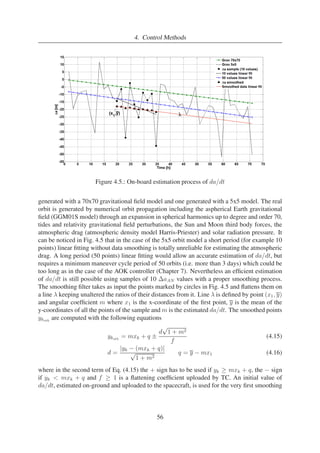
orbital environment is also very limited. An on-board estimation of the atmospheric drag, the 
main non-gravitational perturbation in LEO, required for the computation of the maneuvers can 
be done using the navigation data filtered and fitted (Sec. 4.1.4). The orbit environment data 
required by the on-board orbit propagation model can be eventually updated periodically by 
means of a data upload. The regulator software design has to be compliant with the constraints 
dictated by the computational and data storage resources of the spacecraft’s OBC. A long period 
optimization process is thus generally not available on-board. 
The satellite-bus constraints regarding both control systems, concern mainly the performance 
of the spacecraft’s attitude control and thrusters accuracy. The accuracy of the attitude control 
system and of the on-board thrusters influence the effectiveness of the orbital maneuvers. The 
location of the thrusters on-board the spacecraft determines the attitude maneuver profile re-quired 
before and after an orbit control maneuver. Besides, the correct operation of certain 
10
1. Introduction 
attitude sensors (e.g. star sensors) may impose time-slots during which the orbital maneuvers 
cannot be executed. Another important operational issue is that often the science payload can-not 
work during the orbital maneuvers and the orbit maintenance and payload schedules have 
to be integrated together. If the control chain is ground-based the scheduling of the payload 
and orbit maintenance operations can be optimized. If the orbit control system is on-board, the 
eventual orbital maneuvers are input as a constraint in the scheduling problem. 
1.4. The PRISMA Mission 
A substantial part of this research is motivated and finds its application in the frame of the 
PRISMA mission and was realized at the German Space Operations Center (GSOC) of the 
German Aerospace Center (DLR). PRISMA [82-109] is a micro-satellite formation mission 
created by the Swedish National Space Board (SNSB) and Swedish Space Corporation (SSC) 
[168], which serves as a platform for autonomous formation flying and rendezvous of space-craft. 
The formation comprises a fully maneuverable micro-satellite (MANGO) as well as a 
smaller satellite (TANGO) which were successfully launched aboard a Dnepr launcher from 
Yasny, Russia, on June 15th 2010 into a nominal dawn-dusk orbit at a mean altitude of 757 
km, 0.004 eccentricity and 98.28◦ inclination. The PRISMA mission primary objective is to 
demonstrate in-flight technology experiments related to autonomous formation flying, homing 
and rendezvous scenarios, precision close range 3D proximity operations, soft and smooth final 
approach and recede maneuvers, as well as to test instruments and unit developments related to 
formation flying. Key sensors and actuators comprise a GPS receiver system, two vision based 
sensors (VBS), two formation flying radio frequency sensors (FFRF), and a hydrazine mono-propellant 
thruster system (THR). These support and enable the demonstration of autonomous 
spacecraft formation flying, homing, and rendezvous scenarios, as well as close-range proxim-ity 
operations. The experiments can be divided in Guidance, Navigation and Control (GNC) 
experiments and sensor/actuator experiments. The GNC experiment sets consist of closed loop 
orbit control experiments conducted by SSC and the project partners which are the German 
Aerospace Center (DLR/GSOC), the French Space Agency (CNES) in partnership with the 
Spanish Centre for the Development of Industrial Technology (CDTI), the Technical University 
of Denmark (DTU), ECAPS (a subsidiary company to SSC), Nanospace (a subsidiary company 
to SSC), Techno Systems (TSD) and Institute of Space Physics (IRF) in Kiruna. Table 1.6 col-lects 
the GNC primary and secondary objectives and the involvement of the different project 
partners. Table 1.7 resumes the sensor/actuator primary and secondary experiments and the in-volvement 
of the different project partners. In addition to the GPS-based absolute and relative 
navigation system, which is the baseline navigation sensor for the on-board GNC functionali-ties, 
DLR contributes two dedicated orbit control experiments. The primary experiment, named 
Spaceborne Autonomous Formation Flying Experiment (SAFE) [92,143], was executed suc-cessfully 
in two parts, the first one in 2010 and the second one in 2011. SAFE implements 
autonomous formation keeping and reconfiguration for typical separations below 1 km based 
on GPS navigation. The secondary experiment of the DLR’s contributions to PRISMA is AOK 
which implements the autonomous absolute orbit keeping of a single spacecraft. The MANGO 
spacecraft (Fig. 1.3.a) has a wet mass of 150 kg and a size of 80 x 83 x 130 cm in launch config- 
11
1. Introduction 
Table 1.6.: PRISMA GNC experiments 
Primary GNC related tests 
Type of control Distance [m] Sensor Prime 
Autonomous formation flying 20-5000 GPS SSC 
Proximity operations [101] 5-100 VBS/GPS SSC 
Collision avoidance and autonomous rendezvous 10-100000 VBS/GPS SSC 
Autonomous formation control (SAFE) [92,143] 50-1000 GPS DLR 
RF-based FF and forced RF-based motion [100,109] 20-5000 FFRF CNES 
Secondary GNC related tests 
Autonomous Orbit Keeping (AOK) of a single spacecraft [72-75] GPS DLR 
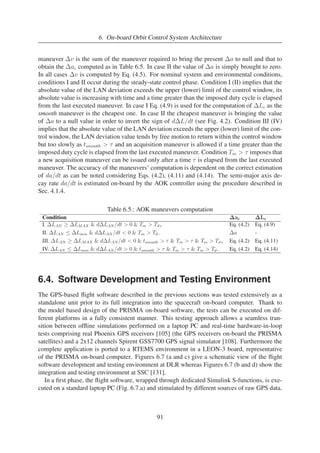
uration, has a three-axis, reaction-wheel based attitude control and three-axis delta-v capability. 
The GNC sensors equipment comprises two three-axes magnetometers, one pyramid sun acqui-sition 
sensors and five sun-presence sensors, five single-axis angular-rate sensors, five single-axis 
accelerometers, two star-tracker camera heads for inertial pointing, two GPS receivers, two 
vision-based sensors and two formation flying radio frequency sensors. Three magnetic torque 
rods, four reaction wheels and six thrusters are the actuators employed. Electrical power for the 
operation of the spacecraft bus and payload is provided by two deployable solar panels deliver-ing 
a maximum of 300 W. In contrast to the highly maneuverable MANGO satellite, TANGO 
(Fig. 1.3.b) is a passive and much simpler spacecraft, with a mass of 40 kg at a size of 80 x 80 x 
31 cm with a coarse three-axes attitude control based on magnetometers, sun sensors, and GPS 
receivers (similar toMANGO), with three magnetic torque rods as actuators and no orbit control 
capability. The nominal attitude profile for TANGO will be sun or zenith pointing. Required 
power is produced by one body-mounted solar panel providing a maximum of 90 W. The com-munication 
between the ground segment and the TANGO spacecraft is only provided through 
MANGO acting as a relay and making use of a MANGO-TANGO inter-satellite link (ISL) in 
the ultra-high-frequency band with a data rate of 19.2 kbps. DLR/GSOC, besides designing 
and conducting his own experiments, has assumed responsibility for providing the GPS-based 
Table 1.7.: PRISMA sensor/actuator experiments 
Primary Hardware Related Tests 
Experiment Prime 
Flight demo of GPS Phoenix receiver DLR 
Flight demo of HPGP motor [82] SSC 
Flight demo of micro-thrusters motor [99] Nanospace 
Validation of RF sensor (FFRF) CNES 
Validation of Vision Based Sensor (VBS) DTU 
Secondary hardware related tests 
Flight demo of a digital video system Techno System 
Flight demo of a MEMS-based particle mass spectrometer IRF 
12
1. Introduction 
Figure 1.3.: MANGO (a) and TANGO (b) spacecraft 
navigation functionality which comprises the provision of Phoenix GPS receivers [103-105], 
the GPS based on-board navigation system for absolute/relative orbit determination and the 
ground-based POD [83-85]. In fact the on-board navigation system includes two Phoenix-S 
GPS receivers and the real-time orbit estimation software with an absolute (relative) position 
accuracy capability of 2 (0.2) m (3D, RMS) in nominal conditions under the provision of suffi-cient 
GPS data. The ground-based POD provides absolute (relative) position accuracies better 
than 0.1 (0.05) m (3D, RMS). The GPS measurements collected on TANGO are transferred 
to MANGO via the ISL. The navigation system provides absolute position and velocity of the 
participating spacecraft to be used by the MANGO GNC system as well as the other PRISMA 
experiments. The GPS system provides also timing information for on-board synchronization. 
The physical architecture of the GPS system is identical on MANGO and TANGO. For redun-dancy, 
two Phoenix-S GPS receivers are available, which are connected to two GPS antennas 
via a coaxial switch. The dual antenna system provides increased flexibility for handling non-zenith 
pointing attitudes and antennas may be selected by ground command or autonomously 
on-board. Only one receiver will be active at any time. Continuous orbit information is im-portant 
for autonomous on-board GNC applications. As a consequence, orbit prediction is a 
mandatory function of the navigation system and provides continuous absolute and relative po-sition 
and velocity information of the co-orbiting satellites. Furthermore the navigation system 
provides an accuracy measure indicating the expected quality of the orbit results. 
13
1. Introduction 
1.4.1. The AOK Experiment 
The AOK experiment on the PRISMA mission was executed successfully from the 18th of July 
to the 16th of August 2011 and has demonstrated the capability of autonomous absolute or-bit 
control with an unprecedented accuracy. The main scientific goal of the experiment was 
to demonstrate the accuracy, robustness and reliability of an autonomous GPS-based on-board 
orbit control for its possible routine exploitation in future scientific missions. The main differ-ences 
with respect to similar experiments conducted in the past (Sec. 1.2.2) are the extremely 
tight requirements on control accuracy and the full autonomy also enhanced by the possibil-ity 
of on-board RO propagation. The AOK controller adopts a guidance law for the orbital 
Longitude of the Ascending Node (LAN) and implements the analytical feedback control algo-rithm 
presented in Sec. 4.1. Using GPS-based absolute navigation data, the on-board controller 
commanded thruster activations in the orbital frame to autonomously control the orbit within a 
predefined window. The main performance requirement of the experiment was a control accu-racy 
of the osculating ascending node of 10 m (1 σ standard deviation) with a maneuver velocity 
increment-decrement (v) available budget of 0.5 m/s. The AOK software was first developed 
and tested using the offline and hardware-in-the-loop test facilities at DLR (Chapter 6). After 
the integration in the PRISMA flight-software, AOK was thoroughly tested at OHB Sweden 
by means of the Real-Time Satellite Laboratory (SATLAB), a hardware-in-the-loop test facil-ity 
[87]. The experiment operations were executed at the DLR’s PRISMA experiment control 
centre while the mission was operated at DLR/GSOC. A commissioning phase of 4 days was 
required to verify that the control software was working properly in all its functionalities. Dur-ing 
this phase MANGO flew in free motion as the controller was in open-loop and the orbital 
maneuvers were computed on-board but not executed. The closed-loop phase of 26 days in-cluded 
RO acquisition, controller tuning and fine control phases. In the last four days of the 
experiment the possibility of exploiting a RO generated on-board the spacecraft was tested in 
closed-loop. The 10 m control accuracy requirement was fulfilled. The mean value of the lon-gitude 
of ascending node deviation was -3.6 m with a standard deviation of 9.5 m during the 
fine control phase. The on-board controller demonstrated also to be very accurate in computing 
and executing RO acquisitions. The total v spent during the entire experiment was 0.1347 
m/s corresponding to 27% of the allocated maneuvers budget. The mean maneuver cycle was 
11 hours with a standard deviation of 8.3 hours. The position accuracy available on-board was 
about 2 m (1 σ) during the entire experiment whereas the accuracy of the on-board estimation of 
the semi-major axis was 4 m (1 σ) as it comes from a combination of the accuracies of position 
and velocity. 
1.5. The TerraSAR-X/TanDEM-X Missions 
TerraSAR-X/TanDEM-X represents the typical remote sensing mission which could take ad-vantage 
of a precise autonomous orbit control system. TerraSAR-X (TSX) [110-117] is a Ger-man 
Earth-observation satellite realized in a public-private partnership between the German 
Federal Ministry of Education and Research (BMBF), DLR and EADS Astrium GmbH. The 
primary goal of the TSX mission (Fig. 1.4) is the provision of high-resolution Synthetic Aper- 
14
1. Introduction 
Figure 1.4.: TerraSAR-X 
ture Radar (SAR) data to both science and commercial users. Its primary payload is an X-band 
radar sensor with a range of different modes of operation, allowing it to record images with 
different swath widths, resolutions and polarisations. TSX thus offers space-based observation 
capabilities that were previously unavailable. The objective of the mission is to provide value-added 
SAR data in the X-band, for research and development purposes as well as scientific and 
commercial applications. The successful launch of TSX on 15th June 2007 from the Russian 
Baikonur Cosmodrome in Kazakhstan marked the start of a campaign to map the Earth at an 
unprecedented level of accuracy. The aim is to create new, high-quality radar images of the 
Earth’s surface. The satellite has a size of 4.88 x 2.4 m, a mass of 1230 kg and flies in a 514 
km sun-synchronous dusk-dawn orbit with an inclination of 97.4◦ and an 11 day repeat period. 
Using its active radar antenna, TSX it is able to produce image data with a resolution of down 
to 1 m, regardless of weather conditions, cloud cover or absence of daylight. TSX [171] has 
been fully operational since 7 January 2008. The radar beam can be electronically tilted within 
a range of 20 to 60 degrees perpendicular to the flight direction, without having to move the 
satellite itself. This allows the radar to zoom in on many more ground targets from the satel-lite’s 
orbit than would be possible using a non-steerable radar. In order to support the spacecraft 
AOCS and to enable high-precision orbit reconstruction the satellite bus is equipped with a sin-gle 
frequency GPS receiver and the secondary payload features a dual frequency GPS receiver. 
Due to the objectives of the interferometric campaigns the satellite has to comply to tight orbit 
control requirements, which are formulated in the form of a toroidal tube with a radius of 250 m 
around a pre-flight determined reference trajectory [32]. To minimize both the interruption of 
SAR data takes and the total amount of thruster firings, the maintenance of semi-major axis and 
eccentricity is simultaneously achieved by a single maneuver at an optimized location [44,110]. 
15
1. Introduction 
Figure 1.5.: TerraSAR-X and TanDEM-X in formation 
The orbit maintenance maneuvers are executed by the mono-propellant (Hydrazine) 4 x 1 N 
propulsion system. 
TanDEM-X (TDX) was built to form the first configurable SAR interferometer employing 
formation flying with TSX. The main objective of the common TerraSAR-X/TanDEM-X mis-sion 
(Fig. 1.5) is to generate a global digital elevation model (DEM) with unprecedented accu-racy 
as the basis for a wide range of scientific research as well as for commercial DEM produc-tion. 
TDX [172] was launched on 21th June 2010 and acquired an initial formation with 20 km 
along-track separation for commissioning purposes roughly one month later. The close forma-tion 
flight with separations of a few hundred meters was finally established in October 2010. 
TSX/TDX is the first operational mission requiring a post-facto baseline reconstruction with an 
accuracy of 1 mm. The TDX/TSX relative orbit control concept is based on the relative eccen-tricity/ 
inclination vector separation method [143,144]. TDX is equipped with an Autonomous 
Formation Flying (TAFF) system [111,112] developed at DLR/GSOC. The implementation of 
autonomous formation flying functionalities on the TDX spacecraft is considered to be a key 
driver for a more efficient use of the available on-board resources. The objective of TAFF is to 
enable a simple and robust formation control in order to ease the on-ground operations. TAFF 
16
1. Introduction 
is implemented as part as the attitude and orbit control system on-board TDX and is intended 
to take over the in-plane formation keeping activities throughout the mission, with a control 
accuracy of a few meters. A short closed-loop test campaign of TAFF, during which all the 
functionalities of the autonomous software could be successfully tested, was performed at the 
end of March 2011. 
1.6. Contributions of this Research 
The main research topic of this thesis is the autonomous orbit control of a single spacecraft. A 
fundamental achievement is the rigorous formalization of the absolute orbit control problem as 
a special case of formation keeping. For this reason this work can found its collocation in the 
research dedicated to the spacecraft formation flying [143]. The AOK and SAFE experiments 
on the PRISMA mission are two complementary in-flight realistic demonstrations of a complete 
GNC system respectively for autonomous absolute and relative orbit control in a LEO orbit. 
1.6.1. Theory 
The first step of this research is the reconsideration of state-of-the-art orbit control methods 
[3,42-48] from the perspective of autonomy. Starting from an analytical algorithm for the main-tenance 
of a repeat-track orbit, the control chain of Fig. 1.2 is developed and implemented under 
the assumption of the availability of a GPS-based on-board navigation. An algorithm is devel-oped 
for the on-board estimation, by means of navigation data, of the semi-major axis decay 
caused by the atmospheric drag. New analytical formulations for the RO acquisition under 
different constraints and requirements are developed. 
Particular emphasis is given to the analysis of the RO generation process which can be 
ground-based or on-board. The main achievement of this analysis is the definition of constraints 
on the minimal accuracy of the orbit model used and of the initial state for the propagation. An 
extensive study of the orbit perturbation environment in LEO is carried on. The results of this 
study have the added value, with respect to similar analyses performed in the past, of the avail-ability 
of a large amount of POD data from the missions PRISMA and TerraSAR-X which have 
near circular orbit at respectively 700 and 500 km. These POD data have an accuracy better 
than 10 cm (1 σ) and have also been used for the calibration of the orbit models used for all the 
numerical simulations performed during this research work. 
The state-of-the-art orbit control methods are based on a formalization of the problem which 
is dependent on the particular mission and its orbit maintenance requirements. A step forward 
is then taken in the direction of the definition of a general and rigorous formalization of the 
autonomous orbit control problem and the exploration of new control methods. The problem 
of the autonomous absolute orbit control is considered as a specific case of two spacecraft in 
formation in which one, the reference, is virtual and affected only by the Earth’s gravitational 
field. A new parametrization, the relative Earth-Fixed elements (REFE), analogous to the rela-tive 
orbital elements (ROE) [137,159], is introduced to describe the relative motion of the real 
and reference sub-satellite points on the Earth surface. The REFE allow the general formal-ization 
of the absolute orbit control requirements which are usually expressed through specific 
17
1. Introduction 
Earth-fixed operational parameters such as altitude deviation, phase difference, etc. [3]. A di-rect 
mapping between REFE and ROE enables the direct translation of absolute into relative 
orbit control requirements. By means of this new formalization, the deviation between the ac-tual 
and the reference nominal orbit [32] can be defined in an Earth-fixed coordinate system 
analogous to the orbital frame [4]. This approach allows moreover the straightforward use of 
modern control theory techniques for orbit control. A linear and a quadratic optimal regulators 
are designed and compared, by means of numerical simulations, with the analytical algorithms. 
The goal is to show a method rather than some specific simulation results. The particular abso-lute 
and relative orbit control problem with its requirements can be formalized using every time 
the same parametrization given by the REFE and the ROE. 
1.6.2. Transfer of Technologies from Ground to On-board 
Computer 
The innovation and originality of this thesis derives also from the design and practical imple-mentation 
of the control chain of Fig. 1.2 in the frame of the PRISMA mission. This research 
work has led to the full development, testing and validation of the autonomous absolute orbit 
control flight code embedded in the OBC of theMANGO spacecraft of the PRISMA technology 
demonstration. The design and validation of the GPS-based flight software throughout its com-plete 
development process, up to the spacecraft launch, is described. The innovative approach 
of model-based software design (MBD) is addressed. The MBD allows the implementation and 
execution of the GNC software on different platforms in a fully consistent manner. The GNC 
system was first tested as a standalone unit in a dedicated software development environment 
at DLR [170] and later validated after its full integration into the PRISMA spacecraft on-board 
computer. This allows first to develop the software simulations off-line on a PC and then to 
reproduce them consistently as real-time and hardware-in-the-loop tests during the validation 
phase. In the off-line tests, the flight software is stimulated through different sources of GPS 
data with an increasing level of realism. The complete application is then ported to a Real-Time 
Executive forMultiprocessor Systems (RTEMS) environment in the LEON3 PRISMA on-board 
computer by means of MATLAB/Simulink Real Time Workshop. Overall the test and valida-tion 
process shows the compliance of the navigation and control software to the challenging 
requirements of the PRISMA mission in terms of functionality, data interface, GNC accuracy, 
on-board memory and CPU load. 
The flight data of the AOK [72-75] experiment on the PRISMA mission [167] are displayed 
and commented. The main scientific goal of the experiment, successfully executed in the sum-mer 
of 2011, was to demonstrate the accuracy, robustness and reliability of an autonomous 
GPS-based on-board orbit control for its possible routine exploitation in future scientific mis-sions. 
Autonomous precise orbit maintenance, RO acquisition and on-board RO generation 
have been successfully demonstrated in orbit. 
18
1. Introduction 
1.7. Thesis Outline 
This thesis is structured in seven chapters complemented by an appendix section. Referring to 
Fig. 1.2, after an extensive theoretical dissertation of the different blocks composing the orbit 
control chain, the attention is focused on the practical implementation, validation and testing of 
the considered autonomous orbit control methods. 
The thesis starts with an extended general discussion about orbit control requirements and 
the state of the art of its implementation. The attention is focused on the advantages brought 
by the exploitation of an autonomous orbit maintenance system in terms of costs reduction and 
enabled mission features. A statistical comparison between ground-based and on-board orbit 
control is not possible because only few autonomous orbit control in-flight experiments have 
been performed so far. Nevertheless a qualitative discussion and cost analysis can be made 
based on the available literature and on the author’s practical experience. A fundamental state-ment 
is that a major driver to the development of on-board autonomous orbit control is the 
increasing accuracy demand due to the steady development and exploitation of very high res-olution 
optical and synthetic aperture radars systems in the last two decades. A description of 
two missions, PRISMA and TerraSAR-X/TanDEM-X, is also given in the introduction since 
a substantial part of this research is motivated and finds its application in the frame of those 
projects. The PRISMA mission gave the possibility to perform an autonomous orbit keep-ing 
experiment which validated successfully one of the orbit control methods proposed in this 
thesis. The TerraSAR-X/TanDEM-X formation represents the typical remote sensing mission 
which can take advantage of a precise autonomous orbit control system. 
After the introduction, the thesis proceeds explaining, in Chapter 2, the parametrizations 
used, the basic mathematical means on which the different orbit control methods proposed are 
based. Two main approaches are identified for the realization of an on-board orbit control sys-tem. 
The first is the reconsideration and further development of state-of-the-art orbit control 
methods from the perspective of autonomy. A step forward is then taken in the direction of 
the definition of a general and rigorous formalization of the autonomous orbit control problem. 
The problem of the autonomous absolute orbit control is considered as a specific case of two 
spacecraft in formation in which one, the reference, is virtual and affected only by the Earth’s 
gravitational field. A new parametrization, the relative Earth-Fixed elements (REFE), analo-gous 
to the relative orbital elements used for formation control, is introduced to describe the 
relative motion of the real and reference sub-satellite points on the Earth surface. The relative 
Earth-Fixed elements allow the general formalization of the absolute orbit control requirements 
which are usually expressed, with the first approach, through specific Earth-fixed operational 
parameters (e.g. altitude deviation, phase difference, etc.). 
An extensive discussion is dedicated in Chapter 3 to the RO selection and generation process 
and the analysis of the free motion of a spacecraft in low Earth orbit. The RO defines the 
spacecraft’s nominal trajectory designed to satisfy the mission requirements. The actual orbit 
is kept within certain bounds defined with respect to the RO. The RO selection process based 
on the mission requirements is briefly described as well as the typical orbits used for remote 
sensing. The link between the operational parameters and the requirements is explained. The 
generation process of the RO is dealt in detail as it is the fundamental starting point of the 
19
1. Introduction 
orbit control chain. The free motion analysis is essential to understand the orbit perturbation 
environment which causes the deviation of the actual from the nominal trajectory. The use 
of the precise orbit determination data of the missions PRISMA and TerraSAR-X guarantee 
the reliability of the results of this analysis and the understanding of the orbit’s perturbation 
environments at an altitude of 700 and 500 km. This study helps the definition of a proper 
control strategy. The conclusions drawn in this chapter about the RO generation process are also 
based on the experience gained with the realization of the AOK in-flight experiment described 
in Chapter 7. 
The control algorithms, explained in Chapter 4, can be divided into the two broad categories 
of analytical and numerical. An analytical algorithm for the maintenance of a repeat-track or-bit 
is developed from the state-of-the-art methods and implemented under the assumption of 
the availability of a GPS-based on-board navigation. A complementary algorithm for the on-board 
estimation of the semi-major axis decay caused by the atmospheric drag is developed. 
New analytical formulations for the RO acquisition under different constraints and require-ments 
are presented. The virtual formation method for the absolute orbit control is formalized 
by means of the relative Earth-fixed elements described previously in the chapter dedicated to 
the parametrization. The state-space representation is used for the mathematical formulation 
of the problem. The system to be controlled is described by means of a linear dynamic model 
including the J2 zonal coefficient of the Earth’s gravitational field and the atmospheric drag per-turbation 
force. A linear and a quadratic optimal regulators, based on this model, are designed 
for the in-plane and out-of-plane absolute orbit control. Among the control methods presented 
in this chapter, only the analytical algorithm was validated in-flight with the AOK experiment 
on the PRISMA mission because it had a most advanced implementation status at the moment 
of its selection. 
The entire Chapter 5 deals with the results of the numerical simulations performed for the 
validation of the control methods explained in Chapter 4. The high degree of realism of the 
simulations’ results is guaranteed by a calibration of the orbit propagator model by means of 
the comparison between the propagated and the actual orbit data given by the POD process of 
the PRISMA and TerraSAR-X missions. The mission parameters of these two formations are 
also used as simulation scenarios. The test platform includes a very accurate orbit propagator, 
the flight software and allows the simulation of actuators and navigation errors. The simulation 
results are evaluated from a performance and operational point of view in order to formulate a 
first conclusion about the advantages and disadvantages of the different control techniques. The 
main differences between the considered analytical and numerical control methods are outlined. 
Once the theory has been explained extensively, the practical implementation of a precise 
autonomous orbit control system for a spacecraft in low Earth orbit is described in detail in 
Chapter 6. The on-board guidance, navigation and control software development, implemen-tation 
and testing of the PRISMA mission, to which the author of this thesis contributed, is 
described. The attention is focused on the technological aspects implied by the realization of 
the autonomous orbit control system tested in-flight with the autonomous orbit keeping experi-ment 
on PRISMA. The development of the control system is driven by a compromise between 
control performance requirements, on-board computer resources limitation and mission opera-tional 
constraints. The model-based-design approach, used for the realization of the PRISMA 
20
1. Introduction 
flight software, is described as well as the basic layout of the on-board software architecture. 
Among the several innovative aspects of the flight software development, some space is dedi-cated 
to the advanced software validation and testing realized on the formation flying test-bed 
at DLR, the German Aerospace Center, which played a fundamental role in the realization of 
the PRISMA mission and its experiments. 
Finally, the flight results of the AOK experiment on the PRISMA mission, a fundamental 
milestone of this research work, are presented in Chapter 7. This experiment took place in the 
summer of 2011 and demonstrated the capability of autonomous precise absolute orbit control 
using the analytical control method explained in Sec. 4.1. The 30-day experiment is described 
in all its phases with the presentation of the control performance results and the operational 
issues. 
Chapter 8 provides a summary of the achieved results, draws the main conclusions and gives 
some recommendations for future study. 
Appendix A contains the linear dynamic model used in Sec. 4.2.1. Appendix B gives some 
further details about the numerical simulations. Appendix C contains the simulation results of 
a combined autonomous absolute and formation maintenance system. Appendix D points out 
some aspects of the AOK experiment. 
The Bibliography is structured in sub-sections each one grouping references dealing about 
the same argument and listed in alphabetical order of the authors’ surnames. 
21
2. Parametrizations 
2.1. Overview 
A parametrization is defined by the parameters which describe both the absolute motion of a 
spacecraft orbiting around the Earth and the relative motion with respect to a nominal orbit. The 
set of orbital elements chosen for the absolute state representation and shown in Eq. (2.1) are 
the semi-major axis a, the components of the eccentricity vector e, the orbital plane inclination 
i, the mean argument of latitude 
 sum of the argument of perigee ω and the mean anomalyM. 
κ = 
 
a 
ex 
ey 
i 

 
u 
 
 
 
= 
 
 
a 
e cos ω 
e sin ω 
i 

 
ω +M 
 
 
(2.1) 
The choice of this parametrization of the state is dictated by the fact that it does not lead to 
singular equations if the eccentricity value tends to zero. Nevertheless this set of orbital ele-ments 
leads to singular equations if the inclination angle tends to zero but this case is out of 
interest in this study. The components of vector κ are the mean orbital elements obtained from 
the osculating elements κo using Brouwer’s analytical transformation [12] 
κ = ξ(κo) (2.2) 
The mean orbital elements are indeed the most appropriate in the representation of the secular 
evolution of the motion subjected to perturbations. Indeed the orbital elements of a spacecraft 
deviate from their nominal values under the action of perturbing forces. The mission require-ments 
are translated into control margins to be applied to the orbital elements to keep the value 
of specific parameters, which define the maximum allowed deviation of the actual from the 
nominal trajectory of the spacecraft, within their control windows. Two different set of parame-ters, 
function of the difference between the actual and reference orbital elements, are introduced 
in this chapter for the description of the motion of a spacecraft with respect to its RO. 
First, specific mission requirements are expressed by means of operational parameters [3] 
which define the maximum allowed deviation of the real from the nominal trajectory of the 
spacecraft. Typical operational parameters as the altitude deviation and phase difference at 
a certain latitude, local time deviation, in-orbit phasing, specify the nominal position of the 
spacecraft’s sub-satellite point in relation to a reference ground track on the Earth’s surface 
[44]. The operational parameters are used by the algorithms developed for the state-of-the- 
22
2. Parametrizations 
art ground based orbit control systems. Secondly, a new parametrization, the relative Earth- 
Fixed elements (REFE), is derived by considering the problem of the autonomous absolute 
orbit control as a specific case of two spacecraft in formation in which one, the reference, is 
virtual and affected only by the Earth’s gravitational field. The REFE, analogous to the ROE 
[137,159] for the description of the in-orbit relative motion of two spacecraft, are introduced to 
describe the relative motion of the real and reference sub-satellite points on the Earth surface. 
This parametrization allows a more general and rigourous mathematical formalization of the 
absolute orbit control problem. 
2.2. Operational Parameters 
2.2.1. Phase Difference 
The phase difference L is the difference, measured along a parallel of latitude, between the 
actual ground track and the track pertaining to a RO. The phase difference at the ascending node 
LAN is most commonly used as operational parameter for maintenance of phased orbits. In 
fact if the inclination remains equal to its nominal value, the monitoring of the phasing at the 
equator will be sufficient to monitor the entire phasing grid formed by the network of reference 
tracks on Earth. LAN can be written in terms of relative orbital elements between the real 
satellite and a virtual satellite whose orbit is the RO. By assuming that the real and virtual 
satellites pass the equator respectively at times t and tR with in-orbit angular velocities u˙ and 
u˙R, and neglecting any differences in the eccentricity of the real and the RO, the differential of 
LAN is given by: 
1 
RE 
d(LAN) = 
1 
RE 
d(LAN
 + LANu) = (˙
 
− ˙ 
R)dt − d(|ωE − ˙ 
R|t) (2.3) 
where RE is the Earth’s equatorial radius, ˙
 
and ˙ 
R are the secular rotations of the real and 
reference line of nodes respectively , ωE = 7.292115 × 10⁻⁵ rad s−1 is the Earth rotation rate 
and t = t − tR. 
Eq. (2.3) expresses the fact that the difference of longitude of the two tracks at the equator is 
due to the superposition of two effects. The differential dLAN
 is due to the different time-change 
rates ˙
 
and ˙ 
R of the right ascension of ascending node during time interval dt. The 
term dLANu, positive if t is negative, is due to the fact that the real and reference satellites 
pass the equator at different times while the Earth is rotating. Since |ωE − ˙ 
R| is constant, 
d(|ωE − ˙ 
R|t) = |ωE − ˙ 
R|d(t). The differential d(t) can be written as 
d(t) = dt − dtR = 
du 
u˙ − 
du 
u˙R 
with u˙ = 
du 
dt 
and u˙R = 
duR 
dt 
= n (2.4) 
where n = 
p 
R is the mean motion (with μ = 3.9860064 × 10¹⁴ m3 s−2). As du = u˙dt, 
μ/a3 
from Eq. (2.4) it results 
d(t) = 
u˙R − u˙ 
u˙R 
dt (2.5) 
23
2. Parametrizations 
Using Eq. (2.5) in Eq. (2.3) 
1 
RE 
d(LAN) = (˙
 
− ˙ 
R)dt + |ωE − ˙ 
R| 
n 
(u˙ − u˙R)dt (2.6) 
The first derivative of 
 and u expanded as function of J2 [2,21] and of the mean orbital ele-ments 
in the first-order truncation of Brouwer’s analytical satellite solution [12] when the orbit 
is nearly circular (e ≈ 0) are ˙
 
= −3γn cos i and u˙ = n + 3γn(4 cos2 i − 1) [3]. The second 
derivatives d2
/dt2 and d2u/dt2 are then 
d2
 
dt2 = 3γn 
 
7 
2a 
cos i 
da 
dt 
+ sin i 
di 
dt 
 
d2
R 
dt2 = 0 (2.7) 
d2u 
dt2 = − 
3n 
2a 
 
1 + 7γ(4 cos2 i − 1) 
 da 
dt − 12γn sin 2i 
di 
dt 
d2uR 
dt2 = 0 (2.8) 
where γ = (J2/2)(RE/a)2 and the derivatives dγ/dt and dn/dt have been written as 
dγ 
dt 
= − 
2γ 
a 
da 
dt 
dn 
dt 
= − 
3n 
2a 
da 
dt 
(2.9) 
Using Eqs. (2.7)-(2.8) and substituting 3γn sin i = − ˙
 
tan i and 7γ cos i = −7˙ 
/(3n), the 
time derivative of Eq. (2.6) yields 
d2(LAN) 
dt2 = − 
3 
2|ωE − ˙ 
R| 
 
RE 
a 
 
1 + 
7 
3 
˙
 
|ωE − ˙ 
R| 
+ 7γ(4 cos2 i − 1) 
# 
da 
dt 
+ 
(2.10) 
−RE 
h 
˙
 
i di 
dt 
tan i + 12γ|ωE − ˙ 
R| sin 2i 
Imposing that the orbit is sun synchronous or near sun-synchronous with ˙
 
= ˙ 
R = ˙
 
sy, 
Eq. (2.10) becomes 
d2(LAN) 
dt2 ≈ − 
3π 
TE 
 
RE 
a 
 
(1 + ǫL) 
 
da 
dt − ξL 
di 
dt 
 
(2.11) 
where ǫL has been approximated as 
ǫL ≈ 
7 
3 
 
TE 
TSu 
 
+ 7γ(4 cos2 i − 1) (2.12) 
and 
ξL = − 
2 
3 
a 
 
TE 
TSu 
 
1 + ηL 
1 + ǫL 
 
tan i ηL = 24γ 
 
TSu 
TE 
 
cos2 i (2.13) 
and where TSu is the Sun period (1 year), TE is the mean period of solar day (86400 s) and 
ηL ≪ 1 and ǫL ≪1 for near polar orbits. 
24
2. Parametrizations 
The evolution of L, the phase difference at non-zero latitude, in terms of relative and abso-lute 
orbital elements is [3] 
L = LAN 
p 
1 − (sin u sin i)2 ± RE δix sin u 
 
(cos u sin i)2 
1 − (sin u sin i)2 
−1/2 
(2.14) 
where in the second term the + sign has to be used in ascending orbit and the − in descending 
orbit,LAN is given by Eq. (2.6), u is the argument of latitude and δix = i−iR is the difference 
between the real and the nominal inclination. 
2.2.2. Local Time Deviation 
The local time deviation LT is directly equivalent to the deviation of the right ascension of 
the ascending node 
 from its nominal value. 
LT = TE 

 
2π 
(2.15) 
where: 
 = 
 − 
R 
The general analytical expression for the evolution of LT with the orbital elements [3] is 
d2(LT) 
dt2 = − 
TE 
TSu 
 
tan i 
di 
dt 
+ 
7 
2a 
da 
dt 
 
(2.16) 
2.2.3. Altitude Deviation at Latitude 
The altitude deviation h is the difference between the actual and the nominal altitude at lati-tude 
θ. The general analytical expression for the evolution of h with the orbital elements [3] 
is 
h(u) = (1 + ǫh)a − a(cos uex + sin uey) + ηhi (2.17) 
with 
ǫh = 
J2 
6 
 
RE 
a 
2  
9 
 
1 − 
3 
2 
 
− sin2 i cos 2u 
sin2 i 
 
− e cos(u − ω) 
ηh = RE 
 
J2 
6 
RE 
a 
 
27 
2 
sin 2i + sin 2i cos 2u 
 
+ (u − ω) sin 2i sin2 u 
 
2.2.4. In Orbit Position Deviation 
The in orbit position deviation u is the difference between the argument of latitude of the real 
satellite and that of a virtual satellite moving on the RO affected only by the force model used 
to the generation of the reference trajectory. The general analytical expression for the evolution 
25
2. Parametrizations 
of u with the orbital elements [3] is 
d2(u) 
dt2 = − 
3 
2a 
n 
 
1 + 
7 
2 
J2 
 
RE 
a 
2 
(4 cos2 i − 1) 
# 
a − 6nJ2 
 
RE 
a 
2 
sin 2ii (2.18) 
2.3. Virtual Formation Parametrization 
The definition of the operational parameters in Sec. 2.2 is based on the description of the motion 
of a spacecraft with respect to a reference ground track specified by the nominal absolute orbital 
elements. The relative Earth-fixed elements are instead defined in this section formulating the 
absolute orbit control system design as a formation keeping problem of two spacecraft in which 
one is virtual and not affected by non-gravitational orbit perturbations. Both these parametriza-tions 
will be used in the development of this thesis for the realization of an autonomous orbit 
control system. The use of the operational parameters allows the straightforward reconsidera-tion 
of state-of-the-art orbit control methods from the perspective of autonomy. The on-board 
control system used for the AOK experiment (Chapter 7) is based on an analytical method to 
control the phase difference at the equator (Sec. 4.1). With this approach, the control perfor-mance 
of an on-board and ground-based system can be compared more easily. 
The use of the REFE parametrization is a step forward in the direction of the definition of a 
general and rigorous formalization of the autonomous orbit control problem and the exploration 
of new control methods or the exploitation of algorithm already developed for the formation 
keeping. Since this approach allows the straightforward use of modern control theory tech-niques 
for orbit control a linear and a quadratic optimum regulators are developed in Sec. 4.2 
and validated by means of numerical simulations Chapter 5. 
2.3.1. Relative Orbital Elements 
The most appropriate parametrization to represent the relative motion of the real spacecraft with 
respect to the reference is the set of ROE [92,150,159] shown in Eq. (2.19) (where the subscript 
R refers to the RO). 
δκ = 
 
δa 
δex 
δey 
δix 
δiy 
δu 
 
 
 
= 
 
 
(a − aR)/aR 
ex − exR 
ey − eyR 
i − iR 
(
 − 
R) sin i 
u − uR 
 
 
(2.19) 
These parameters are obtained as a non-linear combination of the mean orbital elements κ = 
(a, ex, ey, i,
, u) [12,22]. The relative orbit representation of Eq. (2.19) is based on the relative 
eccentricity and inclination vectors [144] defined in Cartesian and polar notations as 
δe = 
 
δex 
δey 
 
= δe 
 
cos φ 
sin φ 
 
δi = 
 
δix 
δiy 
 
= δi 
 
cos θ 
sin θ 
 
(2.20) 
26
2. Parametrizations 
The phases of the relative e/i vectors are termed relative perigee φ and relative ascending node 
θ because they characterize the relative geometry and determine the angular locations of the 
perigee and ascending node of the relative orbit. The normalized position δr = (δrR δrT δrN)T /aR 
and velocity δv = (δvR δvT δvN)T /(naR) vectors of the spacecraft relative to the RO in the 
RTN orbital frame (R pointing along the orbit’s radius, N pointing along the angular momen-tum 
vector and T = N × R pointing in the direction of motion for a circular orbit) can be 
described through the relative orbital elements [144] as 
 
δr 
δv 
 
= 
 
Tp 
Tv 
 
δκ = 
 
1 −cos u −sin u 0 0 0 
−(3/2)u 2 sin u −2 cos u 0 1/ tan i 1 
 
0 0 0 sin u −cos u 0 
0 sin u −cos u 0 0 0 
−(3/2) 2 cos u 2 sin u 0 0 0 
0 0 0 cos u sin u 0 
 
 
 
δa 
δex 
δey 
δix 
δiy 
δu 
 
 
 
(2.21) 
Eq. (2.21) represents the first order solution of the Clohessy-Wiltshire equations [142] expressed 
in terms of relative orbital elements. 
2.3.2. Relative Earth-fixed elements 
The constraints on the relative position of the sub-satellite points (SSPs) of the real and reference 
spacecraft and on the difference of their altitudes, determine the virtual formation’s geometry to 
be maintained in the RTN orbital frame. The SSP is here defined as the intersection between 
a sphere of radius a, centred in the Earth’s centre and tied to its rotation, and the line through 
the centre of the Earth and the satellite. Referring to Fig. 2.1 the (λϕη) reference frame has the 
origin in the SSP, the λ-axis tangent to the local circle of latitude and pointing eastward, the 
ϕ-axis tangent to the local meridian and pointing northward and the η-axis pointing along the 
orbit radius. The relative position of the real and reference SSPs is defined in the (λRϕRηR) 
frame of the reference spacecraft by the phase difference vector δL = (δL, δL')T and by 
δh = h/aR the altitude difference normalized to aR. Considering the actual spacecraft at the 
ascending pass over latitude ϕ, the REFE vector δ̥ = (δL δL' δh)T components are defined 
as 
δL = δλt=0 + δλt = (δλ − δϕ cot iR) − cos ϕ|ωE − ˙ 
R|δt (2.22) 
δL' = δϕ (2.23) 
δh = δη (2.24) 
where (δλ, δϕ, δη) = (λ−λR, ϕ−ϕR, η−ηR), iR is the RO inclination, ϕ is the real spacecraft’s 
latitude at time t, δt = t − tR and tR is the time at which the reference spacecraft passes 
at latitude ϕ. Fig. 2.1 depicts the case in which t  tR. The phase difference vector’s 
component δL = δL(ϕ, δλ, δϕ, δt) is the distance, normalized to aR, of the real and reference 
ground tracks measured along the λ-axis at latitude ϕ. δL is also function of δt because the 
real and reference spacecraft pass at latitude ϕ at different times and the coordinate systems 
(λRϕRηR) and (λϕη) move with the SSPs while the Earth is rotating. The quantity δλt=0 is the 
27
2. Parametrizations 
Figure 2.1.: Geometry of the relative Earth-fixed elements 
Figure 2.2.: Detail of Earth-fixed reference frame (a) and transformation from orbital to Earth-fixed 
reference frame (b,c) 
28
2. Parametrizations 
normalized distance, measured along the λ-axis, between the intersection points S and R1 of the 
real and RO projections with the circle of latitude ϕ at time t (Figures 2.1 and 2.2.a). Referring 
to Fig. 2.2.a, approximating the spherical triangles as planar, since in the plane (λRϕR) is 
R1 ≈ (δϕ cot(π−iR),−δϕ), and S = (−δλ,−δϕ), it results δλt=0 = R1−S ≈ δλ−δϕ cot iR. 
The quantity δλt is the normalized distance measured along the λ-axis between the intersection 
pointsR1 andR(tR) of the RO projection with the circle of latitude ϕ at times t and tR (Fig. 2.1). 
The minus sign in the second member of Eq. (2.22) is due to the convention that δλt is positive 
when δt is negative and vice-versa. The time difference δt can be written as δt = −δϕ n sin iR 
where n sin iR = v' is the ϕ-component of the velocity of the reference sub-satellite point 
moving on the Earth’s surface. Hence Eq. (2.22) can be written as 
δL = δλ + 
  
|ωE − ˙ 
R| cos ϕ 
n sin iR − cot iR 
! 
δϕ (2.25) 
As the absolute orbit control requirements are formulated in terms of REFE (Eqs. (2.22)-(2.24)) 
but the control is realized in terms of ROE (Eq. (2.19)), a direct mapping between the two 
systems is required. Referring to Figures 2.2.b and 2.2.c for the transformation from RTN to 
(λϕη) and using Eqs. (2.23), (2.24) and (2.25), the REFE vector δ̥ = (δL δL' δh)T can be 
mapped into RTN coordinates with the transformation 
δ̥ = TEFδr (2.26) 
TEF = 
 
0 |ωE − ˙ 
R| 
 
n 
cos ϕ 
  
|ωE − ˙ 
R| 
n 
cos ϕ cos iR − 1 
! 
1 
sin iR 
0 sin iR cos iR 
1 0 0 
 
 
(2.27) 
Eq. (2.25) is singular for iR = 0 + kπ (with k ∈ Z) as for those values of iR the orbital and 
equatorial planes are parallel. It is interesting to remark that the term δλt=0 of Eq. (2.22) can be 
written directly in the RTN coordinate system by imposing δϕ = δrT sin iR +δrN cos iR = 0, 
and substituting the solution δrT = −δrN cos iR/ sin iR, singular for iR = 0 + kπ, in equation 
δλ = δrT cos iR − δrN sin iR. Finally, from Eqs. (2.21) and (2.26) p and substituting cos ϕ = 
1 − (sin u sin i)2 (sin ϕ = sin u sin i from the sine formula of spherical trigonometry), vector 
δ̥ and its time derivative d(δ̥)/dt, evaluated fixing u = u, can be written in terms of relative 
orbital elements using the transformation matrix T = TEFTp (Tp defined in Eq. (2.21)): 
δ̥(u, δκ) = T(u)δκ (2.28) 
d(δ̥) 
d(δκ) 
= T(u) 
(2.29) 
dt 
dt 
T(u) = 
 
 
− 
3 
2 
u 2su −2cu 
su 
siR 
(ciR − 1) 
 
(1 − cu)ciR 
cu 
+ 1 
 
cu 
siR 
 
− 
3 
2 
usiR 2susiR −2cusiR suciR (1 − cu)ciR siR 
1 −cu −su 0 0 0 
 
 
(2.30) 
29
2. Parametrizations 
with τ = (|ωE − ˙ 
R|/n) 
p 
1 − (sin u sin i)2, su = sin u, cu = cos u, siR = sin iR and 
ciR = cos iR. Since u(t) is periodic, the vectorial function δ̥(u, δκ(t)) is obtained from 
function δ̥(u(t), δκ(t)) by considering only the subset (u, δκ(t)) of the function’s domain 
(u(t), δκ(t)). This is why the term (dT/dt)δκ = (dT/du)(du/dt)δκ = 0 does not compare 
in Eq. (2.29) (if the variation of i is considered negligible). This procedure is justified by the 
control design approach explained at the end of Sec. 4.2.1. Eqs. (2.28) and (2.29) are valid 
under the assumptions of near circular orbits and separations between the real and reference 
spacecraft small when compared to the RO radius (see Eq. (2.21)). The following equations 
show the form assumed by the relative Earth-fixed elements of Eq. (2.28) when evaluated at the 
ascending node (u = 0). 
δL = 
δiy 
sin iR 
+ |ωE − ˙ 
R| 
n 
(δu − 2δey) (2.31) 
δL' = (δu − 2δey) sin iR (2.32) 
δh = δa − δex (2.33) 
The phase difference vector component δL at the ascending node is commonly used as oper-ational 
parameter for the maintenance of phased orbits. If the inclination remains equal to its 
nominal value, the control of the phase difference at the equator will be the most effective way 
to monitor the displacement between real and reference ground tracks. It can also be noticed 
that the maintenance of the altitude deviation δh requires the control of the semi-major axis as 
well as the eccentricity vector. 
30
3. Reference Orbit and Free Motion 
Analysis 
As seen in Chapter 1 the nominal orbit specifications as well as the orbit keeping accuracy 
depend on the type of mission and payload considered. The specification of a target trajectory, 
a RO based on the nominal orbit parameters, is fundamental for the definition of the orbit control 
strategy. The orbit control is based on the maintenance of pre-defined operational parameters 
within prescribed limits which represent the dead-band for the orbit control. The real and RO 
are compared in order to quantify the error of the operational parameters. Thus the actual orbit 
will be kept within certain bounds defined with respect to the RO in order to fulfil the mission 
requirements. This chapter deals with the RO selection and generation and the orbit perturbation 
environment which causes the deviation of the actual from the nominal trajectory. 
3.1. Reference Orbit Selection 
Fig. 3.1 shows the detailed view of the subsystem of Fig. 1.2 representing the RO selection. 
A reference orbit is an orbit representing the mean nominal motion of the satellite over a long 
time interval. The RO design is based on the orbit’s specifications dictated by the mission re-quirements 
on the local altitude, local time, phasing an coverage. The requirements define the 
nominal value of the orbital elements (Eq. (2.1)). The RO’s propagation model has to be as 
complete as possible because the controlled spacecraft’s actual orbit has to be as close as pos-sible 
to the reference. On the other hand it should not include non-conservative perturbation 
Figure 3.1.: Reference orbit selection process 
31
3. Reference Orbit and Free Motion Analysis 
Table 3.1.: Orbit specification in terms of nominal mean orbital elements 
Orbit specification Related orbital elements 
Space fluctuations of altitude exR(aR), eyR(aR) 
Time fluctuations of altitude exR(aR, iR), eyR(aR, iR) 
Local time aR(iR) 
Phasing aR(iR) 
Coverage iR 
forces because usually the RO has to be completely periodic. Thus the reference orbit model 
should at least consider the non-spherical terms of the Earth gravitational potential so that the 
RO is an ideal orbit whose mean orbital elements are periodical functions with invariant max-imum 
and minimum amplitudes. The nominal value of the orbital elements, which meet the 
operational requirements, are obtained [3] by solving the orbital equations of motion including 
only secular perturbations (in the case of sun synchronicity, phasing and altitude) and long pe-riod 
perturbations (for the altitude) which are related to the geopotential. The result is a defined 
relationship, dependent on the requirements, between different orbital elements as shown in Ta-ble 
3.1. The level of accuracy of the nominal orbital elements’ numerical value is related to the 
gravitational field model and the number of terms used. Only the zonal harmonics of even value 
are considered for the secular variations and odd value for long-period variations. The elements 
a, ex, ey determine the size, shape and orientation of the orbit within its plane whereas i and 
 
characterize the orientation of the orbital plane. The value of the argument of latitude u does 
not require any absolute specification as it represents the time variable. Several specifications 
can be grouped for the design of a RO. 
3.1.1. Altitude Requirements 
The altitude variation constraints can be required in terms of space by minimizing the fluc-tuations 
in relation to latitude on a given orbit segment or in terms of time by restricting the 
fluctuations in time over a given point of the Earth surface and can be established through a 
proper choice of a, ex and ey (e and ω). 
Minimization of Spatial Fluctuations 
The variation of altitude as a function of u taking into account the variations of a, ex and ey 
must be examined to carry out the spatial minimization. Considering the expansion to the first 
order in e of the altitude h = h(u,e) and assuming a near circular orbit, there will be a maximum 
deviation hMAXe=0 relative to the mean hm at the equator and the extreme latitudes [3] 
h(u) = hm − eam cos(u − ω) − (hMAX,e≈0) cos 2u (3.1) 
hm = a 
 
1 − 
3 
2 
J2 
 
RE 
a 
2  
1 − 
3 
2 
# 
− RE 
sin2 i 
 
1 − 
f 
2 
 
sin2 i 
(3.2) 
32
3. Reference Orbit and Free Motion Analysis 
hMAX,e≈0 = RE 
 
f 
2 − 
J2 
6 
 
RE 
a 
 
sin2 i (3.3) 
where f = 1 − ap/ae is the flattening parameter of the Earth ellipsoid [8] if ae and ap are 
respectively its semi-major and semi-minor axes. 
The minimization of altitude variations in the orbital quadrants q = 1, 2, 3, 4 corresponding 
to u = [0, π/2], [π/2, π], [π, (3/2)π], [(3/2)π, 2π] leads to 
ω = 
3 
4 
π − (q − 1) 
π 
2 
, e ≈ 1.57 
hMAX,e≈0 
a 
(3.4) 
hMAX,q = 
 
1.57 
√2 − 1 
 
hMAX,e≈0 (3.5) 
Minimization of Time Fluctuations 
For the minimization of the altitude fluctuations in time, the variations of the mean orbital 
elements e and ω have to be cancelled out [3] 
de 
dt 
= f(a, e, ω, i) = 0 (3.6) 
dω 
dt 
= g(a, e, ω, i) = 0 (3.7) 
If the low frequency portion of the spectrum of perturbations of the geopotential is considered 
(periods much longer than the orbital period) then the long-period variations affecting e and ω 
are due to the odd number zonal terms of the geopotential whereas the secular variations affect 
only ω and are related to the even number zonal terms. Adding these two effects, the solution of 
Eq. (3.6) yields the frozen orbit conditions [23-28]. If only an expansion limited to J3 is used, 
the approximate solution of Eq. (3.6) is 
ω = ± 
π 
2 
(3.8) 
e ≈ − 
J3 
2J2 
RE 
a 
sin i (3.9) 
The majority of frozen orbits have ω = π/2. In both cases of ω = ±π/2 the altitude at a 
given latitude is the same in the ascending and descending orbits disregarding the influence of 
longitude via the tesseral terms of the potential. 
3.1.2. Local Time Requirements 
Sun synchronism is imposed through the relationship between a and i obtained by setting the 
secular angular rotation of the line of nodes, due to the non-sphericity of the Earth, equal to the 
known angular rotation of the meridian plane containing the mean Sun. The sun synchronism 
condition [29,30] is thus represented by Eq. (3.10) where the averaged variation of 
 due to the 
33
3. Reference Orbit and Free Motion Analysis 
first three zonal terms J2, J3 and J4 [21] is represented by Eq. (3.10). 
˙
 
= !sy (3.10) 
˙
 
= − 
3 
2 
nJ2 
 
RE 
p 
2 
cos i − 
3 
2 
nJ2 
2 
 
RE 
p 
4 
cos i 
 
9 
4 
+ 
3 
2 
p 
1 − e2 − sin2 i 
 
5 
2 
+ 
9 
4 
p 
1 − e2 
 
+ 
+ 
e2 
4 
 
1 + 
5 
4 
 
+ 
sin2 i 
e2 
8 
(7 − 15 sin2 i) cos 2! 
 
− 
3 
8 
nJ3 
 
RE 
p 
3 
(15 sin2 i − 4)e cot i sin !+ 
+ 
15 
16 
nJ4 
 
RE 
p 
4 
cos i 
 
(4 − 7 sin2 i) 
 
1 + 
3 
2 
e2 
 
− (3 − 7 sin2 i)e2 cos 2! 
 
(3.11) 
where ωsy = 1.99099299 × 10⁻⁷ rad s−1 is the mean apparent revolution speed of the Sun 
around the Earth, RE = 6378140mis the equatorial p 
radius of the terrestrial spheroid, p = a(1− e2) is the parameter of the orbit and n = 
μ/a3 is the mean motion (with μ = 3.9860064 × 
1014 m3 s−2). 
Eq. (3.10) imposes the constraints that the nominal drift of the line of nodes is frozen in 
relation to the Earth-Sun direction and thus provides one of the two orbital element (a, i) as 
function of the other. The semi-major axis of a sun-synchronous orbit has its upper boundary at 
12.35 · 106 m for an inclination which tends to 180 deg. The inclination of a sun synchronous 
orbit is always more than 90 deg 
3.1.3. Phasing Requirements 
A repeat-ground-track orbit [31-38] is obtained when there is a commensurability between the 
satellite’s nodal frequency and the Earth’s rotation rate i.e. the time required by the satellite to 
complete an integer number of orbits is equal to the total time required by the Earth to complete 
an integer number of rotations. If TR and nR = 2π/TR are respectively the nodal period and 
the nodal frequency, the condition for the ground track to repeat every k orbits in d days can be 
formulated as [31] 
ωE − ˙
 nR 
= 
d 
k 
(3.12) 
where ωE = 7.292115×10⁻⁵ rad s−1 is the Earth rotation rate, ˙
 
is the secular rotations of the 
line of nodes. 
If the zonal coefficients J2 and J4 of the geopotential are considered, the repeat-ground-track 
condition of Eq. (3.12) can be explicitly formulated as [31] 
N 
D 
= 
d 
k 
N = 
ωE 
nJ2 
 
a 
RE 
2 
+ 
3 
2 
cos i − 
15 
16 
J4 
J2 
 
RE 
a 
2 
cos i(4 − 7 sin2 i)+ 
+ 
3 
8 
J2 
 
RE 
a 
2 
cos i(11 − 20 sin2 i) 
34
3. Reference Orbit and Free Motion Analysis 
D = 1 + 3 − 
15 
4 
sin2 i − 
15 
16 
J4 
J2 
 
RE 
a 
2  
34 
5 − 25 sin2 i + 
77 
4 
 
+ 
sin4 i 
+ 
3 
16 
J2 
 
RE 
a 
2 
(14 + 17 sin2 i − 35 sin4 i) 
The phasing of the orbit then define a relationship between a and i. With a defined repeat-ground- 
track pattern and the operational inclination given, the corresponding mean semi-major 
axis a can be found by using any standard numerical method. 
3.1.4. Coverage Requirements 
The payload access to targets observation is a key requirement in the design of an orbit. The tar-get 
can be one location, specified by a latitude or longitude, or a region of interest on the Earth’s 
surface. To this end, the design of the orbit must satisfy performance metrics that are specified 
by the end user as the total time of coverage over a region, the access to daytime and nighttime 
coverage, or the time required to access a different region, among others. The requirement for 
coverage [39-41] of a terrestrial zone extending to a given latitude ϕ will determine, among 
other parameters, an acceptable range of values for the inclination i between ϕ and π − ϕ if the 
lateral field of view of the payload is not taken into account. 
3.2. Reference Orbit Generation 
Fig. 3.2 shows the detailed view of the block of Fig. 1.2 representing the RO generation process. 
The deviations of the real from the reference orbital elements are defined by means of the 
operational parameters (Sec. 2.2) or equivalently by means of the relative Earth-fixed elements 
(Sec. 2.3.2). Table 3.2 collects the relationship between the orbit specifications, the operational 
parameters, the REFE and the deviation of the real from the nominal orbital elements expressed 
by means of relative orbital elements. The dependence of h on δix ≡ δi (Eq. (2.17)) has 
not be considered as it is negligible on the short time scale. In Sections 3.2.1 and 3.2.2 the 
fundamental issues regarding the RO generation will be analysed in detail. As a case study 
the PRISMA mission (Sec. 1.4) is used since the analyses carried on in this section are strictly 
related to the design and implementation of the on-board orbit control system validated in-flight 
with the AOK experiment (Chap. 7). 
Figure 3.2.: Reference orbit generation process 
35
3. Reference Orbit and Free Motion Analysis 
Table 3.2.: Control specifications 
Orbit specification Op. Parameter Rel. EF Element Rel. Orbital Element 
Space fluctuations of altitude h δh δa, δex, δey 
Time fluctuations of altitude h δh δa, δex, δey 
Local time LT δL(0) - δL'(0)α* δiy 
Phasing LAN δL(0) δey, δiy, δu 
Coverage - - δix 
*α = |ωE − ˙ 
R|/(n sin iR) 
3.2.1. Reference Orbit Propagation Model 
As explained in Sec. 3.1, the RO is generated by an orbit propagator which includes in the forces 
model only the Earth gravitational field. The actual orbit of a spacecraft deviates from the RO 
under the action of non-conservative perturbing forces. The goal of this section is to quantify the 
contribution of the accuracy of the Earth’s gravitational field model used for the RO generation 
to the deviation of the actual from the reference values of the operational parameters controlled. 
To this end numerical simulations have been performed. In each simulation a propagated orbit 
representing the actual trajectory of the MANGO spacecraft in free motion, has been compared 
with a RO generated using a gravitational field model each time including a higher order and 
degree number of harmonics (20x20, 30x30, 40x40, 50x50, 60x60 and 70x70). Tables 3.3 and 
3.4 collect respectively the spacecraft physical properties and the force models used for the 
propagation of the simulated actual and reference trajectories. The initial state used for the 
orbit propagation is shown in Table 3.5 and the run time is one month (duration of the AOK 
experiment). The POD ephemerides of the spacecraft TANGO, the PRISMA formation’s target 
satellite which flies in free motion, have been exploited to calibrate the atmospheric density 
model used for the simulations in order to have a high degree of realism. Fig. 3.3 shows the 
difference between TANGO’s orbit as estimated by the POD process with an accuracy at the 
sub-decimetre level and an orbit propagated with the calibrated model of Table 5.1. Figures 3.4- 
3.8 show the comparison between the actual and the RO propagated with different models. In 
Fig. 3.4 the comparison is done by means of relative orbital elements, whereas in Figures 3.6- 
3.8 the evolution in time of the REFE is shown. It can be noted that in the RO generation 
process, the use of a gravitational field model including an order and degree of harmonics lower 
than 40x40 causes a propagation error. It can be stated therefore that a gravitational field model 
Table 3.3.: PRISMA spacecraft physical properties 
Spacecraft Physical Property MANGO TANGO 
Mass [kg] 155.12 38.45 
Drag area [m2] 0.5625 0.2183 
Drag coefficient [-] 2.5 2.5 
SRP effective area [-] 0.5625 0.2183 
SRP [4] coefficient [-] 5.5 3.13 
36
3. Reference Orbit and Free Motion Analysis 
Table 3.4.: Propagation parameters 
Orbit Propagation Model 
Earth gravitational field GRACE GGM01S 70x70 
Atmospheric density Harris-Priester 
Sun and Moon ephemerides Analytical formulas [4] 
Solid Earth, polar and ocean tides IERS 
Relativity effects First order effects 
Numerical integration method Dormand-Prince, fixed step 1 s 
RO Propagation Model 
Earth gravitational field GRACE GGM01S nxn 
Table 3.5.: Initial state - POD state on 20-06-2011 at 06:00:00 UTC 
ECI state rR[m] rT[m] rN[m] vR[m/s] vT[m/s] vN[m/s] 
-3967394.8566 -289822.105 5883191.2151 -6126.365 1487.7675 -4071.5062 
Mean orb. el. a[m] ex[−] ey[−] i[deg] 
[deg] u[deg] 
7130522.2961 -0.004058 0.002774 98.28 351.74 123.38 
including at least an harmonics order and degree of 40 should be used to avoid the inclusion of 
orbit’s model errors in the generation of the RO. If the RO is generated on-board, the quality 
of the gravitational field which can be used may be limited by the available computational 
resources (see Chapter 7) and the errors introduced by the RO propagation model has to be 
evaluated in relation to the control accuracy requirements. 
Figure 3.3.: Difference between TANGO’s actual (POD) and propagated orbital elements 
37
3. Reference Orbit and Free Motion Analysis 
Figure 3.4.: MANGO’s ROE (Actual-RO) 
Figure 3.5.: MANGO’s REFE at the ascending node (Actual-RO) 
38
3. Reference Orbit and Free Motion Analysis 
Figure 3.6.: MANGO’s δL at the ascending node (Actual-RO) - Details 
Figure 3.7.: MANGO’s δL' at the ascending node (Actual-RO) - Details 
39
3. Reference Orbit and Free Motion Analysis 
Figure 3.8.: MANGO’s δh at the ascending node (Actual-RO) - Details 
3.2.2. Accuracy Requirements of the Reference Orbit’s Initial State 
This section is dedicated to the evaluation of the propagation error introduced by a bias in the 
initial state used for the RO generation. The results of this analysis are relevant for the case 
in which the RO is generated on-board using an actual state of the spacecraft (see Chapter 7). 
The most accurate satellite state vectors available are those contained in the POD ephemerides 
which, for the PRISMA spacecraft, are accurate at the sub-decimetre level. An alternative 
source of absolute orbit information is the navigation filter integrated in the spacecraft on-board 
computer. The values collected in Table 3.6 are representative of the spacecraft state estimation 
errors on-board theMANGO spacecraft. Numerical simulations have been run to understand the 
impact of the errors of the initial state on the propagation of the RO. Figures 3.9 and 3.10 show 
the difference between the actual orbit and a RO propagated using initial states with different 
accuracies. The different initial states used for the propagation of the RO are obtained from that 
of Table 3.5 by adding the navigation error of Table 3.6 multiplied by 1, 2 and 3. All the orbits, 
the actual and the reference, have been propagated using a 70x70 gravitational field model in 
order to exclude oscillations due to different gravitational field harmonics modelling. From the 
results shown in Figures 3.9 and 3.10 it can be stated that if the RO is generated on-board using 
an actual state of the spacecraft, it is recommendable to use an uploaded POD state vector. 
Table 3.6.: On-board navigation error 
RTN_ECI state x[m] y[m] z[m] vx[m/s] vy[m/s] vz[m/s] 
-3.0 -2.5 -1.0 -0.005 0.006 -0.002 
40
3. Reference Orbit and Free Motion Analysis 
Figure 3.9.: MANGO’s ROE (POD-RO) 
Figure 3.10.: MANGO’s REFE (POD-RO) 
41
3. Reference Orbit and Free Motion Analysis 
3.3. Free Motion Analysis 
A study of the orbital variations induced by the natural forces only [12-21], a free motion 
analysis, shows that the real orbital elements will tend to diverge from their nominal values. 
This leads to a violation of the flight control requirements defined by means of the operational 
parameters (Table 3.2). Fig. 3.11 shows the detailed view of the subsystem of Fig. 1.2 repre-senting 
the dynamics of the system when the control input v is zero, i.e. when the system 
is in open-loop. From an analysis of the system in open-loop the evolution in time of mission 
characteristics may be predicted and an orbit control strategy defined. The main natural forces 
perturbing the ideal Keplerian spacecraft orbit are the non-spherical Earth gravitation field, the 
Luni-solar gravitation, the atmospheric drag and the solar radiation pressure. The Earth and 
Luni-solar gravitation are derived from a potential and may be treated analytically by means of 
the Lagrange equations [8] whereas the other perturbations have to be treated with the Gauss 
equations [5,2]. The evolution in time of each orbital element κi can be modelled [3] as 
κi(t) = κ0 + 
Xm 
1 
Aj sin 
 
2π 
t 
Tj 
+ φj 
 
+ 
Xn 
1 
Bi(t − t0)i (3.13) 
The first term of Eq. (3.13) represents the mean element associated with κi. The second term 
is the periodic evolution of the orbital element with its period Tj , amplitude Aj and phase φj . 
The third term represents the secular evolution of κi, which is an expansion in powers of the 
time difference. It expresses the long-term trend of the orbital element at the time at which 
the periodic effect becomes negligible in relation to the secular effect. The perturbations are 
Figure 3.11.: Free motion 
42
3. Reference Orbit and Free Motion Analysis 
classified in Table 3.7 according to the value of their period T. The natural evolution of the orbit 
causes the operational parameters or the REFE to diverge from their nominal value (Table 3.2). 
The free motion analyses carried on in the next sections, are based on the POD data of 
PRISMA (Sec. 1.4) and TerraSAR-X/TanDEM-X (Sec. 1.5) which are representative of mis-sions 
flying in LEO at respectively 700 and 500 km altitude. Main goal of these analyses is the 
study of the orbital perturbation forces environment which is fundamental for the design of an 
on-board orbit control system. 
Table 3.7.: Influence of orbit perturbation forces on the orbital elements 
Perturbation Short period Mean period Long period Secular 
Tj ≤ Torb Torb  Tj ≤ TE TE  Tj 
Geo-potential a, ex, ey, i, 
 a, ex, ey, i, 
 ex, ey ex, ey 
Atmospheric drag a, ex, ey a a, ex, ey 
Luni-solar i, 
 i, 
 
Solar radiation ex, ey, i ex, ey, i 
Torb = orbital period, TE = Earth rotation period 
3.3.1. Free Motion of the MANGO Satellite 
The first step of this analysis was the calibration (Sec. 3.2.1) of the propagator’s parameters 
in order to obtain a computed orbit as near as possible to the real one over a long simula-tion 
period. The POD ephemerides of the spacecraft TANGO of the PRISMA mission, the 
formation’s target satellite which flies in free motion, have been exploited to calibrate the at-mospheric 
density model used for the orbit propagations. Fig. 3.12 shows the evolution of the 
relative orbital elements between the POD ephemerides and the RO (generated with the param-eters 
of Tables 3.4-3.6) and between the propagated orbit and the RO. As one can see the orbit’s 
propagation obtained over one month is very representative of the reality considering that the 
PRISMA POD ephemerides [83-85] have an accuracy at the sub-decimetre level. Figures 3.13- 
3.15 highlight the contributions of each orbital perturbation force to the deviation of the real 
from the RO for the satellite MANGO flying in a near sun synchronous orbit at an altitude of 
about 700 km. The perturbation forces (Table 3.4) are the atmospheric drag, the solar radiation 
pressure and the luni-solar third body gravitational field. As shown in Figures 3.13 and 3.14 the 
atmospheric drag and the solar radiation pressure affect the in-plane (δa, δex, δey, δu) relative 
motion of the real from the RO and give a negligible contribution to the out-of-plane motion 
(δix, δiy). On the other hand the contribution of the third body perturbation is relevant in the 
out-of-plane relative motion and negligible in the in-plane. Considering the REFE computed 
at the orbit’s ascending node (Equations (2.28)-(2.29) and Equations (2.31)-(2.33)) the atmo-spheric 
drag has the major influence on the evolution in time of δL and δL' whereas the solar 
radiation pressure give the main contribution to the evolution of δh. 
43
3. Reference Orbit and Free Motion Analysis 
Figure 3.12.: TANGO’s ROE (POD-RO) - Propagator calibration 
Figure 3.13.: MANGO’s in-plane ROE (Propagated-RO) 
44
3. Reference Orbit and Free Motion Analysis 
Figure 3.14.: MANGO’s out-of-plane ROE (Propagated-RO) 
Figure 3.15.: MANGO’s REFE at the ascending node (Propagated-RO) 
3.3.2. Free Motion of the TerraSAR-X Satellite 
The calibration of the propagator’s parameters for the case of the TerraSAR-X satellite is 
shown in Fig. 3.16 which shows the evolution of the relative orbital elements between the POD 
45
3. Reference Orbit and Free Motion Analysis 
Table 3.8.: Physical properties of the TerraSAR-X spacecraft 
TSX Mass [kg] Drag and SRP area [m2] Drag coefficient [-] SRP coefficient [-] 
1341.17 3.2 3.0 3.0 
Table 3.9.: Propagation initial state 
RTN_ECI state rR[m] rT[m] rN[m] vR[m/s] vT[m/s] vN[m/s] 
4888898.0844 289059.4988 -4852522.5771 -5165.0722 -1691.6329 -5308.9558 
Mean orb. el. a[m] ex[−] ey[−] i[deg] 
[deg] u[deg] 
6883553.0003 0.000026 0.001251 97.43 190.82 225.11 
ephemerides and the RO and between the propagated orbit and the RO. In this case a free mo-tion 
orbit arc of 7 days has been used as this is the maneuver cycle of TSX. The modelled forces 
used for the propagation are the same of Table 3.4 whereas TSX’s physical propierties and the 
propagation initial state are collected respectively in Tables 3.8 and 3.9. The initial state is the 
POD state of TSX on 03-07-2011 at 06:00:00 UTC and the solar radiation pressure reference 
area is the same as the drag area. Figures 3.17-3.19 highlight the contributions of each orbital 
perturbation force to the evolution in time of the ROE and REFE. The same considerations of 
the previous section are valid here. Despite the fact that the mass of TSX (Table 3.9) is about 
ten times larger than the mass of MANGO (Table 3.4) the orbital decay rate of TSX is much 
larger. This is due to the fact that as TSX flies at an altitude 200 km lower than MANGO the 
atmospheric drag is stronger, and of course also to the larger drag area. 
Figure 3.16.: TSX’s ROE (POD-RO) - Propagator calibration 
46
3. Reference Orbit and Free Motion Analysis 
Figure 3.17.: TSX’s in-plane ROE (Propagated-RO) 
Figure 3.18.: TSX’s out-of-plane ROE (Propagated-RO) 
47
3. Reference Orbit and Free Motion Analysis 
Figure 3.19.: TSX’s REFE at the ascending node (Propagated-RO) 
48
4. Control Methods 
This chapter deals with the regulator block of Fig. 1.2. As shown in Fig. 3.1, the regulator 
receives as input the difference between the actual and nominal parameters to be controlled 
and issues an orbital maneuver computed with a specific algorithm. Three types of control 
algorithms are presented. The first is the one used in the AOK experiment (Chapter 7) on 
the PRISMA mission. The AOK controller adopts a guidance law for the orbital longitude of 
the ascending node and implements an analytical feedback control algorithm using along- and 
anti-along-track velocity increments. The second and third controllers are the linear and the 
quadratic optimal regulators from modern control theory. In the case of the analytical meth-ods 
the mission dependent orbit’s requirements are translated into thresholds applied on some 
operational parameters (Sec. 2.2) which specify the main features of the orbit’s ground track 
geometry. The analytical model which describes the evolution of each operational parameter 
in relation to the orbital elements allows then the definition of a control cycle. In the case of 
the numerical feedback methods the problem is defined as a virtual formation control design 
by means of the relative Earth-fixed elements (Sec. 2.3) and solved with the techniques of the 
modern control theory. The analytical and numerical feedback control methods will be com-pared 
by means of numerical simulations in Chapter 5 where some conclusions will be drawn 
about the advantages and drawbacks in using and operating each type of orbit controller. 
Figure 4.1.: Orbit regulator 
4.1. Analytical Control of Phase Difference 
Remote sensing satellites in LEO are often required to carry out repeat Earth coverage in order 
to ensure identical geometric conditions of observation. If the orbit’s inclination can be assumed 
to remain equal to its nominal value, controlling the phase difference at the equator will suffice 
to keep the phasing of the orbit. This section is dedicated to an analytical method for the 
49
4. Control Methods 
control of the phase difference. Among the control methods presented in this chapter, only this 
algorithm was validated in-flight with the AOK experiment on the PRISMA mission because it 
had a most advanced implementation status at the moment of its selection. 
4.1.1. Control Concept 
Specific mission requirements are expressed by means of operational parameters [3] functions 
of the orbital elements, which define the maximum allowed deviation of the actual from the 
nominal trajectory of the spacecraft. Typical operational parameters (Sec. 2.2) are the altitude 
deviation and phase difference at a certain latitude, local time deviation and in-orbit phasing 
which specify the nominal position of the sub-satellite point in relation to a reference ground 
track on the Earth’s surface [44]. The orbital elements of a spacecraft deviate from their nominal 
values under the action of perturbing forces. Once the mission requirements have been trans-lated 
into orbit control margins, it is necessary to compute the corrections to be applied to the 
orbital elements to keep the value of the operational parameters within their control windows. 
The following equations in the mean elements are the Gauss variational equations of motion 
adapted for near-circular, non-equatorial orbits [3] and provide the relationships between the 
velocity increments in the RTN orbital frame and the increments in the orbital elements. 
 
a 
ex 
ey 
i 

 
u 
 
 
 
= 
1 
v 
 
0 2a 0 
sin u 2 cos u 0 
−cos u 2 sin u 0 
 
 
 
0 0 cos u 
0 0 sin u/ sin i 
−2 0 −sin u/ tan i 
 
 
vR 
vT 
vN 
 
 (4.1) 
where v is the spacecraft’s velocity magnitude. The implementation of an orbit control strat-egy 
implies the specification not only of the magnitude of the corrective maneuvers but also 
the geometric and time characteristics which maximize their efficiency. The choice of the less 
expensive maneuvers’ in-orbit location depends on the operational parameter that has to be 
controlled. An out-of-plane maneuver vN to change the orbit’s inclination, for example, ac-cording 
to the Gauss equations (Eq. (4.1)) is most effective if placed at the node (u = 0) while 
at the orbit’s highest latitude (u = π/2) if 
 has to be changed. On the other hand, while the 
semi-major axis can be changed with an along-track maneuver vT with the same effectiveness 
anywhere along the orbit, the vT most effective [74] to control δL (Eqs. (2.31)-(2.33)) has to 
be computed at the equator (ascending or descending node) for reasons of symmetry. 
4.1.2. Basic Orbit Keeping Strategy 
Referring to Eq. (2.10) if da/dt and di/dt are taken as constants, LAN is found to have a near 
parabolic variation as its second derivative is constant. A positive LAN means that the ground 
track of the satellite at the equator lies eastwards with respect to the reference track. This means 
that if it is assumed that the semi-major axis has a linear decay under the influence of the atmo-spheric 
drag, the real orbit LAN will move parabolically eastwards of the reference LAN. Based 
50
4. Control Methods 
Figure 4.2.: Maneuver with estimated da/dt 
on this consideration a simple control cycle can be imposed [3]. When the deviation between 
the real and nominal LAN exceeds a pre-defined upper bound LMAX a correcting impulse in 
the along-track direction of the satellite’s orbit is applied as much as twice as would be neces-sary 
in order to return to the initial semi-major axis’ value. As a result, just after the impulse 
the satellite’s LAN begins to move westward, reaches the lower bound of the allowable band 
and drifts back to the upper limit where the next correction maneuver is made. The theoretical 
maneuver cycle T and the semi-major axis increments ac to be applied (Fig. 4.2) can thus be 
obtained from Eq. (2.10) assuming also that di/dt is negligible compared to da/dt [3]. 
ac = 
1 
2 
s 
K
da 
dt
Lc (4.2) 
51
4. Control Methods 
T = 
s 
K
da 
dt
−1 
Lc (4.3) 
K = 
16 
3π 
 
a 
RE 
 
TE (4.4) 
with Lc = LMAX in steady state phase (no RO acquisition). From the Gauss equations 
adapted for circular orbits, the velocity increment to be applied is 
v = 
 
ac 
2a 
 
v (4.5) 
where v is the satellite velocity. By considering Eqs. (4.2) and (4.5) it is straightforward to 
conclude that a correct and fine estimation of the maneuver is strictly connected to a correct 
estimation of da/dt which is mainly determined by the atmospheric drag. Fig. 4.2 shows the 
possible evolutions of the LAN deviation after a maneuver based on different estimated values 
of da/dt. It is evident that if da/dt has been underestimated the v applied results in a ac 
that is smaller than necessary to impose an optimal maneuver cycle period. On the other hand 
if da/dt has been overestimated the v applied results in a a that is too large and the negative 
LAN deviation exceeds the lower dead-band −LMAX resulting in requiring an anti-along-track 
maneuver to keep the LAN value within the control window. The better the estimation 
of da/dt, the closer the realized maneuver cycle will be to the ideal one thus minimizing the 
number of required maneuvers (Fig. 4.2). 
4.1.3. Reference Orbit Acquisition 
A fundamental requirement of an autonomous orbit control is to bring back the LAN devia-tion 
within the control window limits ±LMAX starting from an error which has a magnitude 
greater than the allowed threshold. This type of maneuver can be requested to be optimal in the 
sense that it minimizes the amount of fuel required and can be required to be performed within 
certain time constraints. If no time requirements are enforced, an optimal maneuver will impose 
aac that will let the LAN to drift in free motion, with respect to the reference, along a parabola 
whose vertex lays on the minimum threshold of the control window. Referring to Fig. 4.3 in 
general the maneuver’s ac for a RO acquisition is given by Eq. (4.2) where the proper Lc 
can be computed given an initial phase difference Lini and a time constraint. Imposing an 
initial semi-major axis displacement ac with an along-track maneuver, the evolution of the 
LAN error can be represented in the plane t − L by a parabola of equation 
L = 
8Lc 
T2 t2 − 
8Lc 
T 
t + Lini (4.6) 
with T given by Eq. (4.3). The time required for the return of the LAN error within the control 
window limits is then the intersection of parabola of Eq. (4.6) with line of equation L = 
52
4. Control Methods 
Figure 4.3.: Smooth and timed RO acquisition from positive LAN deviation values 
LMAX 
tc = 
T 
2 
 
1 − 
1 
2 
s 
4 + 
2(LMAX − Lini) 
Lc 
 
 (4.7) 
Imposing that tc ∈ ℜ and tc ≥ 0, the following conditions on Lc and Lini are obtained 
Lc ≥ 
Lini − LMAX 
2 
and Lini ≥ LMAX (4.8) 
Smooth Maneuver 
If the RO acquisition has to be performed with the only requirement ofminimizing themaneuver 
size with no time constraints, the vertex ordinate of the parabola of Eq. (4.6) will be imposed to 
be equal to −LMAX i.e. placed on the lower threshold of the control window. In the ideal case 
this kind of maneuver, indicated as smooth in Fig. 4.3, does not require any further correction 
to the initial v. The resulting Lc is then 
Lc = 
Lini + LMAX 
2 
(4.9) 
53
4. Control Methods 
and the acquisition time is 
tsmooth = 
T 
2 
  
1 − 
r 
LMAX 
Lc 
! 
= 
1 
2 
s 
K
da 
dt
−1 
Lc 
  
1 − 
r 
2LMAX 
LMAX + Lini 
! 
(4.10) 
with K given by Eq. (4.2). The RO acquisition maneuver is computed with Eqs. (4.2) and (4.5) 
using Lc given by Eq. (4.9). 
Timed Maneuver from positive deviation 
If a time constraint tc ≤ τ is imposed and tsmooth  τ , where τ is a fixed time interval, a timed 
maneuver is required as indicated in Fig. 4.3. If the initial phase difference deviation Lini has 
a positive value, Eq. (4.7) can be solved for Lc imposing tc = τ and T given by Eq. (4.3) and 
yields 
Lc = 
1 
K
da 
dt
K
da 
dt
−1 (Lini − LMAX) 
8τ 
+ τ 
#2 
(4.11) 
where K is given by Eq. (4.2). The RO acquisition maneuver is computed with Eqs. (4.2) 
and (4.5) using Lc given by Eq. (4.11). This kind of maneuver requires an anti-along-track 
counter-maneuver when the negative LAN deviation reaches the lower deadband −LMAX. 
Timed Maneuver from negative deviation 
If the initial phase difference deviation has a negative value, the problem can be solved by 
considering Fig. 4.4. The value of −ac has to be found such that starting from an initial value 
−Lini, L will evolve in time on the timed maneuver parabola of Eq. (4.12) thus fulfilling 
the RO acquisition time constraint. 
L1 = 
8Lc 
T2 t2 
1 − Lc = 
8 
K 
 
da 
dt 
 
t2 
1 − Lc (4.12) 
The parabola of Eq. (4.12) is written in coordinates t1,L1 obtained from t,L with the co-ordinates 
transformation t1 = t + t , L1 = L. Imposing that points of coordinates 
(t,−Lini)1 and (t + τ,−LMAX)1 belong to the parabola of Eq. (4.12) it results 
t = 
τ 
2 
 
K
da 
dt
−1 (Lini − LMAX) 
8τ 2 − 1 
# 
(4.13) 
Lc = 
(Lini − LMAX) 
2 
 
K
da 
dt
−1 (Lini − LMAX) 
16τ 2 − 1 
# 
+ 
2τ 2 
K
da 
dt
+Lini (4.14) 
where K is given by Eq. (4.2). The anti-along-track RO acquisition maneuver is computed with 
Eqs. (4.2) and (4.5) using Lc given by Eq. (4.14). 
54
4. Control Methods 
Figure 4.4.: Timed RO acquisition from negative LAN deviation values 
4.1.4. On-board Atmospheric Drag Estimation 
As atmospheric density has a remarkable variability over time mainly due to fluctuations in the 
solar flux (see Appendix D) an atmospheric model cannot provide the necessary accuracy for 
strict LAN control requirements. On the other hand, as in case of theMANGO satellite, it is not 
always possible to have on-board accelerometers accurate enough ( 10−5 m/s2) to extrapolate 
the drag acceleration from their measurements. Nevertheless da/dt can be estimated on-board 
using the actual orbit’s semi-major axis estimated by the navigation filter with an accuracy 
of 4 m 1σ (see Sec. 7.1.8) and the RO. The value of da/dt is then found with the following 
procedure explained with the help of Fig. 4.5. The actual and reference semi-major axis data 
are first filtered by taking their values at the ascending node and smoothed if required. The 
difference aAN between the actual and reference semi-major axis values is computed. The 
value of da/dt is finally found as the slope of the line representing the linear fit over the time 
of a sample of aAN data. A smoothing process of the on-board estimated values of aAN is 
required in the computation of da/dt in presence of noise due to short period harmonics not 
included in the gravitational field model used for the RO propagation or errors in the on-board 
estimation of aAN. Fig. 4.5 shows the comparison of the aAN curves obtained with a RO 
55
4. Control Methods 
Figure 4.5.: On-board estimation process of da/dt 
generated with a 70x70 gravitational field model and one generated with a 5x5 model. The real 
orbit is generated by numerical orbit propagation including the aspherical Earth gravitational 
field (GGM01S model) through an expansion in spherical harmonics up to degree and order 70, 
tides and relativity gravitational field perturbations, the Sun and Moon third body forces, the 
atmospheric drag (atmospheric density model Harris-Priester) and solar radiation pressure. It 
can be noticed in Fig. 4.5 that in the case of the 5x5 orbit model a short period (for example 10 
points) linear fitting without data smoothing is totally unreliable for estimating the atmospheric 
drag. A long period (50 points) linear fitting would allow an accurate estimation of da/dt, but 
requires a minimum maneuver cycle period of 50 orbits (i.e. more than 3 days) which could be 
too long as in the case of the AOK controller (Chapter 7). Nevertheless an efficient estimation 
of da/dt is still possible using samples of 10 aAN values with a proper smoothing process. 
The smoothing filter takes as input the points marked by circles in Fig. 4.5 and flattens them on 
a line λ keeping unaltered the ratios of their distances from it. Line λ is defined by point (x1, y) 
and angular coefficient m where x1 is the x-coordinate of the first point, y is the mean of the 
y-coordinates of all the points of the sample andm is the estimated da/dt. The smoothed points 
yksth are computed with the following equations 
yksth = mxk + q ± 
d√1 + m2 
f 
(4.15) 
d = |yk − (mxk + q) √ | 1 + m2 
q = y − mx1 (4.16) 
where in the second term of Eq. (4.15) the + sign has to be used if yk ≥ mxk + q, the − sign 
if yk  mxk + q and f ≥ 1 is a flattening coefficient uploaded by TC. An initial value of 
da/dt, estimated on-ground and uploaded to the spacecraft, is used for the very first smoothing 
56
4. Control Methods 
process. The output points yksth of the smooth filter are marked by triangles in Fig. 4.5. If the 
RO is generated with a 70x70 gravitational field model no data smoothing is required. 
The AOK controller uses a GRACE GGM01S 20x20 gravitational field model for the on-board 
RO generation (Sec. 7.1.2) and a sample buffer of 10 aAN’s which is renewed at each 
ascending node passage with a first-in-last-out logic so thus the last 10 orbits data are always 
stored in the buffer. The buffer is reset after each maneuver. In case no fitting is possible 
because there isn’t a sufficient number of samples in the buffer, the da/dt is estimated using the 
first of the Gauss equations (Eq. (4.1)) approximated for circular orbits [3] 
da 
dt 
= − 
ρ 
B 
√μa (4.17) 
where ρ is the atmospheric density from the Harris-Priester model, B = m/(ACD) is the 
ballistic coefficient of the satellite and μ = 3.9860064 × 10¹⁴ m3 s−2. 
4.2. Virtual Formation Model 
This section analyses the problem of the autonomous orbit control of a satellite in LEO using 
the linear and the quadratic optimal regulators from the classical control theory [9, 10]. For 
the implementation of the linear regulators the problem has been formulated as a specific case 
of two spacecraft in formation in which one, the reference, is virtual and affected only by the 
Earth’s gravitational field. The control action is realized by means of in-plane and out-of-plane 
velocity increments. The state-space representation approach is used here for the realization of 
the autonomous orbit control with techniques from modern control theory. In general, the linear 
model used has state-space representation form 
˙ ǫ = Aǫ + Bv + xd (4.18) 
y = Cǫ (4.19) 
v = −Gy −Gdxd (4.20) 
where ǫ is the state vector, A and B are respectively the dynamic model and control input 
matrix, xd is the modelled state perturbation, v is the impulsive velocity increment vector, 
and G and Gd are, respectively, the output and disturbance gain matrices. The output vector y 
is comprised of relative Earth-fixed elements introduced by Eq. (2.28). 
4.2.1. Linear Dynamic Model 
The state-space model of the orbital motion of the real and reference spacecraft is given by 
˙ κ = ˜A 
g(κ) + ˜A 
d(κ) (4.21) 
˙ κR = ˜A 
g(κR) (4.22) 
where κ = (a, ex, ey, i,
, u) is the mean orbital elements vector. 
57
4. Control Methods 
Vector functions ˜A 
g and ˜A 
d (Eqs. (A.1) and (A.3) in Appendix A) describe the behaviour of 
the mean orbital elements κ under the influence of the J2 gravitational perturbation and atmo-spheric 
drag [5,21]. The mean orbital elements κR of the reference spacecraft are affected only 
by the Earth’s gravitational field as they define the nominal trajectory [3,32]. The linearization 
around κR of the difference between Eqs. (4.21) and (4.22) yields 
d(δκ) 
dt 
= ˜A 
(κR)δκ + ˜A 
d(κR) (4.23) 
where 
˜A 
(κR) = 
∂[˜A 
g(κ) + ˜A 
d(κ)] 
∂κ
R 
(4.24) 
is the Jacobian evaluated at κR of the vectors sum ˜A 
g(κ)+˜A 
d(κ), and δκ is the relative orbital 
elements vector. Making the proper modifications to matrix ˜A 
(κR) for the normalization in aR 
and the introduction of δiy (Eq. (2.19)), and adding the control term B(κ)v: 
˙ ǫ = A(κR)ǫ + xd + B(κ)v (4.25) 
where A(κR) = Ag(κR) + Ad(κR) (Eqs. (A.2) and (A.4)), ǫ = aRδκ is the relative or-bital 
elements vector (Eq. (2.19)) normalized to the semi-major axis, xd results from the direct 
(dyadic) vectors product (˜A 
d(κR))(1, aR, aR, 1, 1, 1)T and v = (vR,vT ,vN)T is the 
vector of impulsive velocity increments in the RTN orbital frame. 
Matrix B(κ) (Eq. (A.5)) represents the Gauss variational equations of motion adapted for 
near-circular non-equatorial orbits [3]. The elements of matrix B(κ) are computed with good 
approximation [5] using the mean orbital elements. The Gauss equations provide the rela-tionships 
between the impulsive velocity increments vs in the RTN orbital frame and the 
increments of the orbital elements. Eq. (4.25) can be written in the general form 
 
˙ ǫ 
˙xd 
 
= 
 
A I 
0 A0 
 
ǫ 
xd 
 
+ 
 
B 
0 
 
v (4.26) 
Eq. (4.26) is the representation of a tracking system [9] in which the atmospheric drag pertur-bation 
vector xd is represented as an additional state variable, the disturbance input, which is 
assumed to satisfy the model ˙xd = A0xd and I is the 6x6 identity matrix. If the feedback 
controller is designed to compute the control inputs vj always in the same place of the orbit 
(u = u), xd can be assumed as constant (Eq. (A.3)) i.e. A0 ≡ 0. This design approach stems 
from the consideration that the implementation of an orbit control strategy implies the specifica-tion 
not only of the magnitude of the corrective maneuvers but also the in-orbit location which 
maximizes their efficiency (Sec. 4.1.1). 
4.2.2. Reduced Model 
In case no eccentricity or inclination are to be actively controlled, the model can be reduced by 
considering only the states δa, δiy and δu. The elements aij = agij+adij are given by Eqs. (A.2) 
58
4. Control Methods 
and (A.4). The use of this model allows the design of a linear controller for the relative Earth-fixed 
elements δL and δL'. The passive control of δh can be achieved by a proper in-orbit 
placement of the along-track maneuvers as explained in the next section. 
Ar = 
3 
4 
 
a 
RE 
2 nJ2 
(1 − e2)2 
 
 
a11 0 0 
a51 0 0 
a61 0 0 
 
 ǫr = aR 
 
 
δa 
δiy 
δu 
 
 
(4.27) 
Br = 
1 
n 
 
 
 
 xdr = − 
0 2 0 
0 0 sin u 
−2 0 −sin u/ tan i 
A 
m 
CDρ 
 
 
 
 
√μa 
0 
0 
If the reduced model of Eq. (4.27) is used, Eqs. (2.28)-(2.30) can be written, considering only 
the states δa, δiy and δu, as 
δ̥(u, ǫr)aR = Tr(u)ǫr 
d(δ̥) 
dt 
aR = Tr(u)Arǫr (4.28) 
Tr(u) = 
 
 
− 
3 
2 
uτ 
 
τ (1 − cu)ciR 
cu 
+ 1 
 
cu 
siR 
τ 
− 
3 
2 
usiR (1 − cu)ciR siR 
1 0 0 
 
 
(4.29) 
4.2.3. Characteristic Polynomial 
The characteristic polynomial of matrix A of Eq. (4.25) has the form 
|sI − A| = s2(s − a11)(s3 + bs2 + cs + d) (4.30) 
b = −(a22 + a33) c = a22a33 − a26a62 − a36a63 − a23a32 (4.31) 
d = a26(a62a33 − a63a32) + a36(a63a22 − a23a62) (4.32) 
and the elements aij of matrix A are given by the summation of Eqs. (A.2) and (A.4). 
Table 4.1.: Analytic expressions of the poles 
Case s1 s2 s3 s4 s5 s6 
I. 0 0 a11 v + z − 
b 
3 − 
1 
2 
(v + z) − 
b 
3 
+ 
√3 
2 
(v − z)j − 
1 
2 
(v + z) − 
b 
3 − 
√3 
2 
(v − z)j 
II. 0 0 0 a11 −α 
r 
μ 
a − β(5 cos2 i − 1)j −α 
r 
μ 
a 
+ β(5 cos2 i − 1)j 
III. 0 0 0 0 −β(5 cos2 i − 1) 
r 
3e2 + 1 
e2 − 1 
j β(5 cos2 i − 1) 
r 
3e2 + 1 
e2 − 1 
j 
I. A = Ag + Ad II. A = Ag + Ad and e = 0 III. A = Ag 
59
4. Control Methods 
Table 4.1 collects the analytic expressions of the roots of Eq. (4.30), the poles of the system 
[9], in the general case with non-zero (I) and zero (II) eccentricity and in the case in which 
A ≡ Ag (III) (no drag), with 
α = 
A 
m 
CD β = 
3 
4 
 
RE 
a 
2 
nJ2 
v = 
s 
3 
r 
2 
+ 
r 
q3 
27 
+ 
r2 
4 
z = 
s 
3 
r 
2 − 
r 
q3 
27 
+ 
r2 
4 
q = 
3c − b2 
9 
r = 
9bc − 27d − 2b3 
54 
and b, c and d given by Eqs. (4.31)-(4.32). 
The poles in the origin have multiplicity 2 in case I, multiplicity 3 in case II and 4 in case III. 
Thus, in every case the system is not stable in the sense that at least one initial state ǫ(0) exists 
for which ǫ will diverge over time. It is worthwhile to point out that in case III, the poles are 
representative of the solutions of the system dynamics unforced by external non-conservative 
forces. In cases I and II the system is in fact rendered non-homogeneous by the atmospheric 
drag perturbation force ( ˙ ǫ = Aǫ + ˜A 
d). In case III where the Earth’s gravity is the only force 
modelled, the unique initial condition for which the system is stable is ǫ(0) = 0. In case III 
with an initial condition ǫ(0)6= 0, δa will remain constant, δu will diverge and all the other 
states, the components of the eccentricity and inclination vectors, will be affected by long period 
perturbations due to the Earth’s gravitational field zonal coefficient J2. The poles of the reduced 
system of Eq. (4.27) are s1 = 0, s2 = 0 and s3 = a11. 
4.2.4. Model Validation 
The POD ephemerides [83,85] of the spacecraft TANGO [92], the target spacecraft of the 
PRISMA formation, have been used for the validation of the linear dynamicmodels of Eqs. (4.25) 
and (4.27). TANGO is in free motion not having any orbit control capability and has an orbit 
almost identical toMANGO’s. The POD positions of TANGO provide a picture of the real orbit 
perturbation forces environment. In Fig. 4.6 the lines noted as POD are the evolution over 3 
days of the difference between TANGO’s orbital elements and a RO. The RO [73, 74] has been 
generated using a gravitational field model (GRACE GGM01S, 70x70 degree-order) as the only 
modelled force. The initial state of the RO is the first state of the POD ephemerides considered 
and is given in Table 4.2. The propagated relative elements with respect to the RO are obtained 
Table 4.2.: Propagation parameters 
ECI state rR[m] rT[m] rN[m] vR[m/s] vT[m/s] vN[m/s] 
-3967394.8566 -289822.105 5883191.2151 -6126.365 1487.7675 -4071.5062 
Mean orb. el. a[m] ex[−] ey[−] i[deg] 
[deg] u[deg] 
7130522.2961 -0.004058 0.002774 98.28 351.74 123.38 
60
4. Control Methods 
Figure 4.6.: TANGO’s real (POD) and propagated orbital elements with respect to the RO 
from the dynamic models of Eqs. (4.25) (full) and (4.27) (reduced) with a null initial error. The 
spacecraft’s physical properties are collected in Table 3.3 and the initial state, in Earth centred 
inertial coordinates (ECI), shown by Table 4.2. The propagation is over 12 hours, a reasonable 
duration for the validation of such a linear rough model. The two linear dynamic models give 
identical results in the propagation. This means that if only the control variables δa, δiy and δu 
are used for the design of the orbit control system, the reduced model of Eq. (4.27) can be used 
without any loss of accuracy with respect to the full model. The comparison of the propagation 
with the POD data highlights the lack of accuracy of the model in the out-of-plane (δix, δiy) 
motion prediction as the gravitational field is modelled only by the J2 zonal coefficient and 
neither the third body gravitational perturbation nor the solar radiation pressure are included 
in the model. Table 4.3 collects the values of the poles of system Eq. (4.25) computed in the 
state of Table 4.2. Fig. 4.7 shows the non-zero real and imaginary parts of the poles computed 
at the ascending nodes of the RO. The poles have been computed from the entries of matrix A 
(Eq. (4.25)) after converting each state in orbital elements. Considering the order of magnitude 
of the real and imaginary parts of the poles displayed in Table 4.3 it can be concluded that on 
the short period the dynamic of the system is mainly determined by the zonal coefficient J2 only 
(case III). 
Table 4.3.: Poles computed in the initial state 
Case s1 s2 s3 s4 s5 s6 
I. 0 0 -1.38·10−12 -7.95·10−14 -2.73·10−12 + 6.106·10−7j -2.73·10−12 - 6.106·10−7j 
II. 0 0 -1.38·10−12 0 -2.73·10−12 + 6.106·10−7j -2.73·10−12 - 6.106·10−7j 
III. 0 0 0 0 6.106·10−7j -6.106·10−7j 
I. A = Ag + Ad II. A = Ag + Ad and e = 0 III. A = Ag 
61
4. Control Methods 
Figure 4.7.: Poles computed with the RO states 
4.3. Virtual Formation Control 
4.3.1. Linear Control 
The linear control law for the system Eq. (4.26) has the general form [9] of Eq. (4.20). G 
and Gd are the gain matrices and y = Cǫ is the system’s output. The terms of matrix C 
will be computed from Eq. (2.30) as the goal of the proposed absolute orbit controller is the 
maintenance of one or more relative Earth-fixed elements within their control windows. In 
order for the closed-loop system to be asymptotically stable, the characteristic roots [9] of the 
closed-loop dynamics matrix Ac = A − BGC must have negative real parts. This can be 
accomplished by a suitable choice of the gain matrix G if the system is controllable. Once 
the gains and thus the poles of matrix Ac have been set, matrix Gd is obtained substituting 
Eq. (4.20) in Eq. (4.25), imposing y = Cǫ and the steady state condition ˙ ǫ = 0: 
c B)−1CA−1 
c I (4.33) 
Gd = (CA−1 
The linear control systemis designed bymeans of poles placement. The choice of which relative 
EF has to be controlled is dictated by the mission requirements, whereas the best place and 
direction of the orbital maneuvers is determined both by which relative EF is controlled and by 
the Gauss equations (Eq. (A.5)). First, an in-plane orbit control system will be considered with 
the single control input vT and two outputs δL, d(δL)/dt computed at the orbit’s ascending 
node. This is the basic control required for the maintenance of a repeat-track orbit [3]. Secondly, 
an in-plane/out-of-plane controller with two control inputs vT , vN and three outputs δL, 
d(δL)/dt, δiy is designed. In this case the in-orbit phasing δL' can be restrained in a control 
window as well. The design of these regulators will be based on the reduced model Eq. (4.27). 
62
4. Control Methods 
In-plane control with one input (vT) and two outputs (δL, d(δL)/dt) 
In this case, the design of the feedback system is finalized to control δL and d(δL)/dt, com-puted 
at the ascending node (Eqs. (2.31)-(2.33)), by means of along-track velocity increments. 
This means that the orbit controller is designed to work only once per orbit at most. The system 
components are 
Ar = 
 
 
 
 ǫr = aR 
ar11 0 0 
ar21 0 0 
ar31 0 0 
 
 
δa 
δiy 
δu 
 
 Br = 
 
 
b1 
0 
0 
 
 
(4.34) 
G = 
 
g1 g2 
 
Gd = 
 
g0 0 0 
 
xdr = 
 
 
xd1 
0 
0 
 
 
with ar11 , ar21 , ar31 , b1 = 2/n, xd1 given by Eq. (4.27) and g1, g2 ∈ R. The output y = Cǫr is 
aR 
  
δL 
d(δL) 
dt 
! 
= aR 
 
0 c12 c13 
c21 0 0 
 
 
δa 
δiy 
δu 
 
 (4.35) 
where the terms c12 = 1/ sin iR, c13 = |ωE − ˙ 
R|/n and c21 = ar21/ sin iR + ar31 |ωE − ˙ 
R|/n 
are obtained from Eqs. (4.28)-(4.29) imposing u = 0. 
The control input is given by vT = −(g1δL + g2d(δL)/dt)aR. The objective here is 
to find the gains g1 and g2 which place the poles of the closed-loop dynamic matrix Ac = 
Ar − BrGC at the locations desired. The characteristic polynomial of Ac is 
|sI − Ac| = s[s2 + (b1c21g2 − ar11)s + b1(ar21c12 + ar31c13)g1] = s[s2 + ˆa1s + ˆa2] (4.36) 
ˆa1(g2) = b1c21g2 − ar11 ˆa2(g1) = b1(ar21c12 + ar31c13)g1 (4.37) 
One of the three poles of Ac is placed in the origin regardless of the value of the gains. This is 
due to the fact that the part of the system depending on δiy is not controllable by vT . Indeed 
the controllability test matrix 
Qctr = 
 
B ArBr A2 
rBr 
 
= 
 
 
b1 ar11b1 a2 
r11b1 
0 ar21b1 ar11ar21b1 
0 ar31b1 ar11ar31b1 
 
 (4.38) 
has rank 2, smaller than the maximum rank 3. Nevertheless at the ascending node δL = 
k1δiy +k2δe+k3δu ((Eqs. (2.31)-(2.33))) can be controlled by means of variations p 
of δu which 
compensate the variations of δiy and δe. The closed-loop poles s = (−a1 ˆ± 
ˆa2 
1 − 4ˆa2)/2 of 
Eq. (4.36) are real (complex-conjugate) if |ˆa1| = 2√ˆa2 (|ˆa1|  2√ˆa2) and ˆa2 = b1c21g1  
0. If ˆa1  0 the poles are placed on the left of the imaginary axis of the complex plane 
and the closed-loop system is stable. If If ˆa1  0 the system is not stable. These stability 
conditions impose constraints on the value of the gains as resumed by Table 4.4 where ˆa2 is 
63
4. Control Methods 
Table 4.4.: Gain constraints 
Pole type c21(i)  0 and g1  0 c21(i)  0 and g1  0 
Real g2  
ar11 + 2√ˆa2 
b1c21 
g2  
ar11 + 2√ˆa2 
b1c21 
Complex 
ar11 
b1c21 
 g2  
ar11 + 2√ˆa2 
b1c21 
ar11 + 2√ˆa2 
b1c21 
 g2  
ar11 
b1c21 
given by Eq. (4.37). If the poles chosen are complex-conjugate, the contribution of the term 
−g2(d(δL)/dt)aR to the control action vT will be negligible as aRd(δL)/dt has an order 
of magnitude of 30/86400 m s-1 [74] and the value of g2 is limited in the range indicated in the 
second row of Table 4.4. This means that in order to control also d(δL)/dt the poles have to 
be on the negative real axis since in this way a suitably large value of g2 can be obtained. The 
gains are related to the poles by the following equation 
g1 = 
s1s2 
b1(ar21c12 + ar31c13) 
g2 = 
s1 + s2 + ar11 
b1c21 
(4.39) 
with s1, s2 ∈ R−. The gain values chosen as a first guess are g1 = sgn(c21)vTL/(aRδLMAX ) 
and g2 = sgn(c21)vTdL/(aRd(δL)/dt)MAX wherevTL,vTdL, aRδLMAX, (aRd(δL)/dt)MAX 
∈ R+ are limits imposed by design and sgn(c21) is the sign of c21. The dynamics of the closed-loop 
system can be verified and adjusted by computing the poles with Eq. (4.39), adjusting their 
placement and iterating the process. 
The control input is 
vT = −GCǫr = −(g2c21δa + g1c12δiy + g1c13δu)aR (4.40) 
The following subsystem of Eq. (4.34) is considered for the determination of the disturbance 
gain matrix Gd (Eq. (4.20)) 
d(δa) 
dt 
aR = (ar11δa)aR + b1vT + xd1 y = aRδa (4.41) 
for which Eq. (4.33) yields g0 = 1/b1 and then 
Gd = 
 
1 
b1 
0 0 
 
(4.42) 
The termxd1/b1 for a small satellite in low Earth orbit has an order ofmagnitude of 10−8 m/s and 
is absolutely negligible in the computation of vT . This is not surprising since Gd represents 
the instantaneous effect of the drag and not its integration over time. The maneuvers have to be 
computed at the ascending node but can be executed with the same effectiveness in any place 
64
4. Control Methods 
along the orbit as they have to change δu by means of semi-major axis increments (first row of 
Eq. (A.5)). Nevertheless the along-track maneuvers can be located [92] in order to be the most 
effective on the control of the relative eccentricity vector components δex and δey. Solving the 
second and third of the Gauss equations ˙ ǫ = B(κ)v in u and imposing that the effect of the 
velocity increment vT is decreasing the magnitude of δex and δey, the eccentricity vector can 
be passively controlled with a proper in-orbit location [44] of the along-track maneuver: 
uM = arctan 
 
δey 
δex 
 
+ kπ (4.43) 
k = 0 if (δexvT )  0 (4.44) 
k = 1 if (δexvT )  0 (4.45) 
In-plane/out-of-plane control with two inputs (vT, vN) and three outputs 
(δL, d(δL)/dt, δiy) 
In this case, the design of the system is finalized to control the relative Earth-fixed elements δL 
and δL' at the ascending node by means of along-track and cross-track velocity increments. At 
the ascending node δL and δL' are related each other by equation δL = k1δiy+k2δL' where 
k1 and k2 are the values displayed in Eqs. (2.31)-(2.33). The only chance of controlling at the 
same time δL and δL' is thus selecting δiy as one of the controlled outputs. The velocity 
increment vN to control δiy has to be placed at the orbit’s highest latitude (u = π/2) in order 
to maximize its effectiveness (fifth row of Eq. (A.5)). The execution of vT will be placed with 
the rule of Eq. (4.43). The system components are Ar and ǫr from Eq. (4.34) and 
Br = 
 
 
b1 0 
0 b2 
0 0 
 
 G = 
 
g1 g2 0 
0 0 gN 
 
(4.46) 
where b1 = 2/n, b2 = sin u/n are given by the first and fifth rows of matrix B (Eq. (A.5)) and 
the term of Br relating vN and δu has been omitted by design. The output y = Cǫr is 
aR 
 
 
δL 
d(δL) 
dt 
δiy 
 
 
= aR 
 
 
0 c12 c13 
c21 0 0 
0 1 0 
 
 
 
 
δa 
δiy 
δu 
 
 (4.47) 
where c12, c13 and c21 are the same as in Eq. (4.35). The system is controllable as the rank of 
the controllability matrix is 3. The characteristic polynomial of Ac = Ar − BrGC is 
|sI − Ac| = s3 + (b1g2c21 + b2gN − ar11)s2 + [b1g1(ar21c12 + ar31c13) + b2gN(b1g2c21 − ar11)]s 
+ar31c13b1b2g1gN = s3 + ˆa1s2 + ˆa2s + ˆa3 (4.48) 
ˆa1(g2, gN) = b1g2c21 + b2gN − ar11 (4.49) 
ˆa2(g1, g2, gN) = b1g1(ar21c12 + ar31c13) + b2gN(b1g2c21 − ar11 ) (4.50) 
ˆa3(g1, gN) = ar31c13b1b2g1gN (4.51) 
65
4. Control Methods 
The proper control gains can be found by splitting the problem in two distinct sub-problems. 
The first-guess values of g1, g2 are the same found solving the problem of the previous section. 
The cross-track maneuver gain is found with the relation gN = aRδiyMAX/vNMAX where 
δiyMAX,vNMAX ∈ R+ are imposed by design. The placement of the closed-loop poles and 
the dynamic response of the system can then be verified by finding the roots of Eq. (4.48). The 
control input is 
vT = [−g2c21δa − g1(c12δiy + c13δu)]aR vN = −gNδiyaR (4.52) 
4.3.2. LQR Control 
The linear quadratic optimal regulator (LQR) [9] is best suited for a multiple-input/multiple-output 
system like that here considered. Here, instead of seeking a gain matrix to achieve 
specified closed-loop locations of the poles, a gain is sought to minimize a specified cost func-tion 
 expressed as the integral of a quadratic form in the state ǫ plus a second quadratic from 
in the control v 
 = 
Z T 
t 
 
ǫT (τ )CTQyCǫ(τ ) + vT (τ )Rv(τ ) 
 
dτ (4.53) 
where Q = CT (τ )Qy(τ )C is the 6 × 6 state weighting symmetric matrix, Qy is weighting 
matrix of the output y = Cǫ and R is the 3 × 3 control weighting symmetric matrix. The 
optimal steady-state (T = ∞ in Eq. (4.53)) gain matrix G for system Eq. (4.26) is 
G = −R−1BT ¯M 
(4.54) 
where ¯M 
is the steady-state solution to the Riccati equation 
− ˙¯M 
= ¯MA + AT ¯M 
− ¯MBR−1BT ¯M 
+ Q = 0 (4.55) 
The disturbance gain matrix Gd for the case of Eq. (4.26) in which xd is constant, is given by 
Gd = −R−1BT (Ac 
T )−1 ¯MI (4.56) 
where Ac = A − BG is the closed-loop dynamics matrix, ¯M 
is given by Eq. (4.55) and I is 
the identity matrix. As already remarked in Sec. 4.3.1, the term Gdxd can be neglected. In the 
performance function defined by Eqs. (4.53) the quadratic form yTQy represents a penalty on 
the deviation of the real from the RO and the weighting matrix Q specifies the importance of 
the various components of the state vector relative to each other. The term vTRv is instead 
included to limit themagnitude of the control signalv and to prevent saturation of the actuator. 
Overall the gain matrices choice is a trade-off between control action cost (i.e., small gains to 
limit propellant consumption and avoid thruster saturation phenomena) and control accuracy 
(i.e. large gains to limit the excursion of the state from its reference value). The choice of the 
weighting matrices is done here with the maximum size technique [10]. The aim of this method 
is to confine the individual states and control actions within prescribed maximum limits given 
66
4. Control Methods 
respectively by yiMAX and viMAX . The terms of Qy and R will be thus chosen with the rule 
imposed by the following equations. 
Qyii = 
ki 
y2 
iMAX 
, Qyij = 
kij 
2yiMAXyjMAX 
, kij ∈ R for i = 1, 2, 3 and j = 1, 2, 3 (4.57) 
Rii = 
hi 
v2 
iMAX 
, Rij = 
hij 
2viMAXvjMAX 
, hij ∈ R for i = R, T,N and j = R, T,N (4.58) 
The choice of diagonal Qy and R matrices is usually a good starting point in a trial-and-error 
design procedure aimed at obtaining the desired properties of the controller. 
4.3.3. Discrete Control 
The absolute orbit control problem has been solved in Sections 4.3.1-4.3.2 in the continuous 
time domain. Nevertheless if the regulator has to control the value of the REFE computed in 
one specific point of the orbit (e.g. at the ascending node), the problem is defined in the discrete 
domain. Fig. 4.8 helps to visualize this important concept, showing the variation with time of 
the REFE of the MANGO satellite flying in free motion (Sec. 3.3.1). The REFE are computed 
(Eqs. (2.28)-(2.30)) in u = u(t) (continuous time domain) and once per orbit in u = 0 (discrete 
time domain). The linear regulators can be design in the continuous domain, as done in the 
previous sections, as long as the relation between the stability condition in the continuous and 
discrete domains is provided. Each closed-loop pole si in the continuous domain, root of the 
characteristic polynomial |sI − Ac|, can be mapped into a pole siD in the discrete domain in a 
different way, depending on the discretization method used, using one of the following relations 
siD = 1 + Tdusi Euler (4.59) 
siD = 
1 
1 − Tdusi 
Euler backward (4.60) 
siD = 
1 + Tdusi/2 
1 − Tdusi/2 
Tustin (4.61) 
where the control duty cycle Tdu = pTN, with p ∈ Z+, is also the discretization step multiple 
of the nodal period TN. The asymptotic stability condition in the discrete domain is |siD|  1. 
Fig. 4.9 shows the stability region as mapped from the continuous into the discrete domain when 
the discretization methods of Eqs. (4.59)-(4.61) are used. Eulers’s method maps part of the left 
half of the complex plane into points placed out of the unitary circle in the discrete domain. This 
means that, depending on the discretization step Tdu, stable poles in the continuous domain 
may be mapped into unstable poles in the discrete domain. For this reason Euler’s method 
is generally not used. Euler’s backward method maps the stability region in the continuous 
domain into a subset of the discrete stability region. Finally Tustin’s method maps exactly 
the continuous into the discrete stability region. The linear regulator can be designed in the 
continuous domain with a proper choice of the poles si and duty cycle Tdu, provided that the 
stability condition |siD|  1 in the discrete domain is verified by means of Eqs. (4.59)-(4.61). 
67
4. Control Methods 
Figure 4.8.: REFE computed in u(t) and at the ascending node 
Figure 4.9.: Region of stability as mapped from the continuous to the discrete domain 
68
5. Numerical Simulations 
In Chapter 4 the problem of the autonomous absolute orbit control has been formalized using 
the operational parameters and the relative Earth-fixed parametrization presented respectively 
in Sections 2.2 and 2.3. The REFE parametrization has been used for the design of a linear and 
a quadratic optimal regulators for orbit maintenance. The state-space representation has been 
used for the mathematical formulation of the problem. The system to be controlled has been 
described by means of a linear dynamic model including the J2 zonal coefficient of the Earth’s 
gravitational field and the atmospheric drag perturbation force. An analytical algorithm based 
on the control of the phase difference (Sec. 2.2.1) at the equator has been developed for the RO 
acquisition and maintenance and validated with the AOK experiment on the PRISMA mission 
(Chapter 7). 
This chapter is dedicated to the presentation of numerical simulations in which the different 
types of orbit control presented in Chapter 4 are compared. Two types of numerical simulations 
are carried on. A first set of simulations is based on an orbit propagation model including the 
gravitational field and a constant atmospheric drag as the only orbit’s perturbation force. By 
means of these ideal simulations the performance of the different controllers can be compared 
in theoretical design conditions. A second set of simulations are run to compare the behaviour of 
the controllers in a realistic orbit environment. As a case study the PRISMA mission (Sec. 1.4) 
is used. The simulation results are evaluated from a performance and operational point of 
view in order to formulate a first conclusion about the advantages and disadvantages of the 
different control techniques. The DLR/GSOC simulation platform (Sec. 6.4) is used to make 
the analyses. This test platform includes a very accurate orbit propagator, the control software 
and allows the simulation of actuators and navigation errors. 
5.1. Simulation Parameters 
Two types of numerical simulations were run in order to validate and compare the control meth-ods 
explained in the previous sections. A first set of simulations was based on an orbit prop-agation 
model with the gravitational field and a constant atmospheric drag as the only orbit’s 
perturbation force. This is also the perturbation model on which the analytical algorithm of the 
AOK controller (Sec. 4.1) is based. By means of these ideal simulations the performance of 
the different controllers could be compared in theoretical design conditions. A second set of 
simulations was run to compare the behaviour of the controllers in a realistic orbit environment. 
Tables 5.1 and 5.2 collect respectively the orbit propagation parameters and the sensor, actua-tors 
and navigation models used for the simulations. The physical parameters of the MANGO 
spacecraft are shown in Table 3.3. The propulsion system is characterized by a Minimum Im-pulse 
Value (MIV) and a Minimum Impulse Bit (MIB). Consequently the thrusters can only 
69
5. Numerical Simulations 
Table 5.1.: Propagation parameters 
Orbit Propagation Model 
Earth gravitational field GRACE GGM01S 40x40 
Atmospheric density Harris-Priester 
Sun and Moon ephemerides Analytical formulas [4] 
Solid Earth, polar and ocean tides IERS 
Relativity effects First order effects 
Numerical integration method Dormand-Prince 
RO Propagation Model 
Earth gravitational field GRACE GGM01S 30x30 
realize vs which are larger than MIV and integer multiples of MIB. Furthermore, the execu-tion 
error of the thrusters is quantified by the relation ξ = |(Vreal − Vcmd)/Vcmd| · 100 
where vcmd is the velocity increment commanded by the on-board controller and vreal is 
the actual velocity increment executed by the propulsion system. Finally the attitude control 
error, which causes thrusters misalignment, is treated as Gaussian noise with zero bias and a 
0.2◦ standard deviation in the three spacecraft’s body axes. The values of the navigation ac-curacy 
refer to the magnitude of the absolute position and velocity vectors in the RTN frame 
and are typical of an on-board GPS based navigation system [83]. For further details about 
the navigation accuracy in the simulations see Appendix B. The initial state used for the orbit 
propagation is the same shown in Table 4.2 and the run time is one month. The RO is assumed 
to be generated on-ground and uploaded to the satellite. The RO has been propagated using the 
GRACE GGM01S 30x30 gravitational field (different than the model used for the actual orbit 
propagation) to simulate the inaccuracies which also the best available model has with respect 
to the actual Earth’s gravitational field. The atmospheric density and solar radiation pressure 
models have been calibrated (see Sections 3.3.1 and 3.3.2) in order to have a high degree of 
realism. 
Table 5.2.: Navigation and actuators accuracy 
Propulsion System Accuracy Value 
MIV 7 · 10−4 [m/s] 
MIB 7 · 10−5 [m/s] 
ξ 5 [%] 
Attitude Control Accuracy Value 
Mean 0 [deg] 
σ 0.2 [deg] 
Absolute Navigation Accuracy Value 
Mean 3.4 [m] 
σ 1.6 [m] 
70
5. Numerical Simulations 
5.2. In-Plane Orbit Control 
5.2.1. Ideal Simulation Scenario 
In these simulations a constant atmospheric drag is the only perturbation force included in the 
orbit propagation model and no thruster, attitude and navigation errors are included. The gravi-tational 
field model used for the orbit propagation is the GRACE GGM01S 40x40 whereas that 
used for the RO generation is the GRACE GGM01S 30x30. Figures 5.1 and 5.2 show respec-tively 
the ROE and the REFE of the spacecraft in case the orbit control system is designed with 
the analytical algorithms of the AOK experiment, Eq. (4.40) (linear) and Eq. (4.54) (LQR). The 
REFE are computed at the ascending node (u = 0). In Fig. 5.1 only the orbital elements influ-enced 
by vT are shown. Table 5.3 collects the parameters used for the design of the linear reg-ulators 
(Eqs. (4.39), (4.57) and (4.58)). The maneuver duty cycle imposed in all the simulations 
was two orbital periods i.e. the controllers could compute and command maneuvers once every 
third orbit. The execution of the maneuvers takes place at the ascending node for the analytical 
controller and is placed with the rule of Eq. (4.43) for the linear regulators. Figures 5.1 and 5.2 
show how the phase difference vector component δL is maintained in its control window by 
means of along-track maneuvers which change the value of the orbit’s semi-major axis. The 
guided time evolution of δa determines that of δu and thus the timing of the real with respect to 
the virtual spacecraft in passing at the ascending node (Eq. (2.22)). The different time evolution 
of δu with respect to that in free motion can be observed comparing Figures 3.13 and 5.1. The 
drift of the phase difference vector component δL' is actually used to compensate the drift of 
δiy in the control of δL (Eqs. (2.31)-(2.33)). The correct placement of the maneuvers allows 
Figure 5.1.: ROE (in-plane control) 
71
5. Numerical Simulations 
Figure 5.2.: REFE (in-plane control) 
the control of the eccentricity vector (and thus δh) by the linear regulators whereas the analyti-cal 
controller has no eccentricity vector control capability as it executes the maneuvers only at 
the orbit’s ascending node. Fig. 5.3 shows the orbital maneuvers commanded by the on-board 
controllers and executed by the spacecraft thrusters. Table 5.4 collects the control performance 
and the maneuver budget. The goal of controlling δL by means of along- and anti-along-track 
velocity increments is achieved by the three controllers with very similar performances. The 
main difference between the AOK analytical controller and the numerical regulators is that the 
AOK’s maneuvers computation is based on a long term prediction of δa highly dependent on 
the correct estimation of the semi-major axis decay rate da/dt. On the other hand, the linear 
regulators compute the orbital maneuvers with a pure feedback logic based on the values of the 
control gains. This fundamental difference between the two control strategies is demonstrated 
by examining Fig. 5.3. The linear and LQR regulators command groups of equal sized consec-utive 
maneuvers (≈ 8 · 10−4 m/s) at non-regular time intervals whereas the AOK control system 
commands larger maneuvers (≈ 2.5 · 10−3 m/s) at a deterministic maneuvers cycle of two days. 
Table 5.3.: Regulators design parameters 
AOK Linear LQR 
δLMAX [m] 5 10 10 
(dδL/dt)MAX [m/s] - 100/86400 200/86400 
vRMAX [m/s] - - 10−6 
vTMAX [m/s] - 10−3 10−3 
vNMAX [m/s] - - 10−6 
72
5. Numerical Simulations 
Figure 5.3.: Commanded and executed orbital maneuvers 
Table 5.4.: Control performance and maneuver budget with in-plane control 
δL [m] Min Max Mean σ RMS vT [m/s] Min Max TOT 
AOK -7.4 9.2 0.18 3.6 3.6 AOK 0.0018 0.0025 0.0373 
Linear -0.6 9.9 5.3 1.7 5.6 Linear 0.0007 0.0011 0.0379 
LQR -1.2 9.1 4.8 1.8 5.1 LQR 0.0007 0.001 0.0374 
The AOK algorithm has an optimal control performance, in terms of control accuracy and v 
budget, if it has an accurate knowledge of the semi-major axis decay rate as in the case of this 
simulation. The constant value of the atmospheric density used for the orbit propagation was in 
fact given as input to the AOK software to simulate a very accurate on-board estimation of the 
semi-major axis decay rate. 
5.2.2. Realistic Simulation Scenario 
These simulations were run using the parameters of Tables 5.1 and 5.2. The regulators have 
been designed with the same parameters of Table 5.3 with the exception of the imposition of 
δLMAX = 15 m for all the regulators. Figures 5.4 and 5.5 show respectively the ROE and the 
REFE of the spacecraft. A RO acquisition based on the control of δL (Sec. 1.4) has also 
been simulated. Table 5.5 collects the control performance and the maneuver budget during the 
steady state phase following the RO acquisition. The degradation of the control performance 
with respect to the ideal case (Table 5.4) is mainly caused by the inclusion of the on-board 
navigation error in the simulation model. The placement of the maneuvers with the rule of 
Eq. (4.43), not optimized [44] from time to time, is not sufficient for a strict control of the 
73
5. Numerical Simulations 
Figure 5.4.: ROE (in-plane control) 
Figure 5.5.: REFE (in-plane control) 
relative eccentricity vector as the solar radiation pressure perturbing force is this time included 
in the orbit’s perturbation forces and the orbit is not at frozen eccentricity. The AOK controller 
has in this case the additional disadvantage of inaccuracies in the on-board estimation of the 
atmospheric drag [72,74] and for this reason has a control accuracy performance slightly worse 
74
5. Numerical Simulations 
Table 5.5.: Control performance and maneuver budget with in-plane control 
δL [m] Min Max Mean σ RMS vT [m/s] Min Max TOT 
AOK -37.2 23.3 -9.8 13.5 16.7 AOK -0.0078 0.0107 0.0942 
Linear -15.4 24.0 6.5 7.8 10.2 Linear -0.0044 0.0112 0.0946 
LQR -13.3 24.5 3.9 7.5 8.4 LQR -0.0049 0.0114 0.1228 
than the linear regulators. The reliance of the AOK analytical controller on a correct on-board 
estimation of the atmospheric drag can be noticed comparing Figures 5.3 and 5.6. The loss 
of accuracy in the on-board estimation of da/dt [74] entails the loss of determinism in the 
maneuver cycle. Table 5.6 offers an overview of the different pole placements in open- and 
closed-loop. The LQR is able to find an optimal placement for all the poles while the linear 
in-plane regulator can instead place two poles only. Nevertheless poles s5 and s6 by which 
depend the control of δL and d(δL)/dt using along-track velocity increment are placed in a 
similar way by both methods. Fig. 5.7 shows the mapping of the poles from the continuous to 
the discrete domain when the Tustin discretization method (Eq. (4.61)) is used. The values of 
the poles used for the design of the regulators in the continuous domain guarantee the system 
stability also in the discrete domain. The stability in the discrete domain would not be kept with 
the use of the Euler discretization method. 
Figure 5.6.: Commanded and executed orbital maneuvers 
75
5. Numerical Simulations 
Table 5.6.: Poles 
Open loop Linear in-plane LQR in-plane In/out-of-plane 
s1 0 - -8.77·10−10-8.78·10−10j - 
s2 0 - -8.77·10−10+8.78·10−10j - 
s3 -2.38·10−12 - -3.16·10−12 - 6.11·10−7j - 
s4 -5.71·10−7 0 -3.16·10−12 + 6.11·10−7j -3.56·10−1 
s5 -1.94·10−5 + 4.35j -1.61·10−1 -2.87·10−1 -1.61·10−1 
s6 -1.94·10−5 - 4.35j -7.72·10−5 -1.93·10−4 -1.15·10−4 
Figure 5.7.: Mapping of continuous to discrete poles with the Tustin discretization method 
76
5. Numerical Simulations 
5.3. In-Plane/Out-of-Plane Orbit Control 
Figures 5.8 and 5.9 show respectively the ROE and the REFE of the spacecraft in case of in-plane/ 
out-of-plane orbit control realized with the linear controller of Eq. (4.52) and in a realistic 
simulation scenario (Table 5.1). The gains were computed imposing the limits δLMAX = 10 m, 
(dδL/dt)MAX = 100/86400 m/s and δiyMAX = 40 m on the outputs and vTMAX = 1 · 10−3 
and vNMAX = 1.5 · 10−2 m/s on the inputs. The value of δiyMAX was chosen to keep δL' in a 
control window of 1500 m. The duty cycle imposed for the in-plane maneuver at the ascending 
node was 4 orbital periods (6 hours) and 8 (12 hours) for the out-of-plane maneuvers placed 
at u = π/2. Unlike the case of the previous section, all the three states δa, δiy and δu are 
controlled as all the poles are placed on the left of the imaginary axis (Table 5.6). As expected 
the out-of-plane velocity increments allow the control of δL'. The same considerations of the 
previous section regarding the in-plane control are valid here. In Fig. 5.8 one can also observe 
that δix is not influenced at all by vN as the out-of-plane maneuvers are executed only when 
u = π/2 (Eq. (A.5)). Fig. 5.10 shows the orbital maneuvers commanded by the on-board 
controller and executed by the spacecraft thrusters. A regular maneuver cycle of the in-plane 
and out-of-plane maneuvers cannot be detected. 
Table 5.7 collects the control performance and the maneuver budget. The in-plane control 
accuracy and cost is very similar to that of the simple linear controller of the previous section 
(Table 5.5). The out-of-plane v spent is 0.51 m/s, rather expensive compared to the in-plane 
maneuver budget. These simulations results confirm that the in-plane and out-of-plane control 
problems can be treated separately in the design of the regulator. 
Figure 5.8.: ROE (in-plane and out-of-plane control) 
77
5. Numerical Simulations 
Figure 5.9.: REFE (in-plane and out-of-plane control) 
Figure 5.10.: Commanded and executed orbital maneuvers 
Table 5.7.: Control performance and maneuver budget with in-plane and out-of-plane control 
δL [m] Min Max Mean σ RMS v [m/s] Min Max TOT 
δL -17.5 26.3 2.4 6.7 7.1 vT -0.0021 0.0032 0.094 
δL' -153.9 1269.2 403.4 293.1 498.6 vN -0.0044 0.0312 0.51 
78
5. Numerical Simulations 
5.4. Discussion 
The control methods presented in Chapter 4 have been validated and compared by means of 
numerical simulations. The linear and quadratic regulator have a performance similar to the an-alytical 
(AOK) controller. Despite the fact that the linear regulators here considered can place 
two to three poles only on the left of the imaginary axis, their performance is comparable and 
in some cases better than the LQR regulator. In a realistic simulation scenario the degradation 
of the control performance with respect to the ideal case is mainly caused by the on-board nav-igation 
error. The AOK controller has in this case the additional disadvantage of inaccuracies 
in the on-board estimation of the semi-major axis decay and for this reason has a performance 
slightly worse than the numerical regulators. The main difference between these methods is 
that the maneuvers’ computation by the analytical controller is based on a long term orbit pre-diction 
whereas the linear regulators compute the control actions with a pure feedback logic 
based on the values of the control gains. The accuracy of the orbit model plays therefore a 
critical role in the implementation of the analytical controller. For the implementation of the 
numerical feedback regulators, the critical issue is not the prediction accuracy of the model but 
its reliability in defining the stability conditions of the closed-loop system in the determina-tion 
of the gains. The PRISMA analytical controller has demonstrated in-flight to be robust, 
cost-effective and capable of very good control accuracies. With the on-board availability of an 
accurate orbit model, this type of analytical controller has an optimal control performance in 
terms of accuracy and costs, and a deterministic maneuvers cycle whose duration depends on 
the size of the control window. On the other hand, the numerical regulators have a simpler flight 
software implementation and an enhanced flexibility given by the possibility of varying the type 
of on-board controller simply by uploading to the spacecraft different gain configurations. The 
type of control of these feedback systems is in fact entirely determined by the type and value of 
the gains. 
79
6. On-board Orbit Control System 
Architecture 
The practical implementation of an on-board autonomous orbit control system implies the so-lution 
of problems concerned with the software development, validation and testing and its 
integration in the overall spacecraft flight-software. The development of the control system 
is driven by a compromise between control performance requirements, on-board computer re-sources 
limitation andmission operational constraints. This chapter deals with the development, 
testing and on-board integration of the absolute autonomous orbit control system on-board the 
spacecraft MANGO of the PRISMA mission (Sec. 1.4). Though this is a mission specific im-plementation 
it stems from a general approach that can be applied in any other mission in LEO. 
After a general description of the model-based design approach and the system architecture, the 
attention is focused on the PRISMA/DLR flight software development and testing to which the 
author of this thesis has given a fundamental contribution. The technological aspects implied by 
the realization of the autonomous orbit control system tested in-flight with the AOK experiment 
are explained. 
6.1. Software Design 
6.1.1. Model-based Design Approach 
Model-Based Design (MBD) is a mathematical and visualmethod for the realization of complex 
engineering systems and it is also applied in designing embedded software. TheMBD approach 
[122-129] is considerably different from traditional design methodology. In this method, com-plicated 
systems can be created by using mathematical models representing system components 
and their interactions with their surrounding environment. Rather than using complex structures 
and extensive software code, blocks with advanced functional characteristics are defined. These 
blocks, assembled in a complex system model and used with simulation tools, can lead to rapid 
prototyping, software testing, and verification. This approach raises the abstraction level for 
the development in order to allow an efficient handling of ever more complex systems. En-gineers 
can continuously test the design as it evolves, checking it against requirements and 
finding mistakes earlier in development when they are easier and less costly to correct. In ad-dition, 
model-based design automates code generation for the embedded system by eliminating 
the need to hand-code the guidance, navigation and control algorithms. By introduction of ad-vanced, 
automated code-generation technology these models can also be used as the input to an 
automatic code generation tool for embedded systems. Hardware-in-the-loop simulations are 
80
6. On-board Orbit Control System Architecture 
also enhanced by this approach and the testing of dynamic effects on the system can be done 
more quickly and efficiently than with traditional design methodology. 
The MBD process consists of four main steps. The first phase involves the definition and 
design of the objective system and the identification of system components. The next step 
is the implementation part in which the system components are mathematically modelled and 
a suitable software code in a selected language is generated to implement the system. For 
embedded systems, the preferred programming language is C/C++. After the code development, 
the next step is validation and testing by means of simulations. If the tests show that there are 
mistakes in the system design, then system designer should revise his design and pass it to code 
developers to implement the revised system. Finally when the implemented system has been 
validated and extensively tested the production of embedded code generation can start. 
A model-based design method is used for the complete on-board application software of the 
PRISMA mission. To this end, the on-board software is implemented in MATLAB/Simulink 
blocks which are then auto-coded with Real Time Workshop and executed under the operating 
system Real-Time Executive for Multiprocessor Systems (RTEMS) on the on-board LEON3 
processor [129,135]. 
6.1.2. Design Strategy 
The PRISMA on-board software main development and simulation environment was realized 
with MATLAB/Simulink by Mathworks. All high-level application software is implemented as 
Simulink models. Furthermore, the data acquisition and handling, the telemetry and telecom-mand 
interface as well as the application tasks scheduling is incorporated within Simulink mod-els. 
Basic software, consisting of device drivers, interrupt handler etc. and other platform de-pendent 
software is programmed in handwritten C/C++ [123,128]. For the basic software, the 
Gaisler Research RTEMS Cross Compiling System [126] is used for development and debug-ging. 
All the hardware interfaces work via the basic software. The Application Software is 
as far as possible platform independent, i.e. easily ported to another hardware platform and/or 
using another real time operating system (RTOS). Criteria as functionality, code efficiency, pre-dictability, 
verifiability and simplicity have been employed in the development strategy for the 
on-board software system architecture. The simplicity criterion has received special attention 
in the development of the PRISMA on-board software architecture. 
6.1.3. System Architecture 
The on-board software (OBS) architecture is structured in two main layers consisting in a Ba-sic 
Software (BSW) level and an Application Software (ASW) level communicating with each 
other through dedicated message queues. The BSW includes basic system applications, device 
drivers and I/O-utilities. The ASWincludes all the top-level applications like spacecraft control 
and telecommand (TC) and telemetry (TM). The ASWconsists of a number of application com-ponents 
each one encapsulating a logically-grouped functionality. Each application component, 
with its uniform internal structure and interface, is executed via an Asynchronous Monotonic 
Scheduler (AMS) with a specified sample time and priority. The external data stores provide 
81
6. On-board Orbit Control System Architecture 
Figure 6.1.: Internal structure of an application component [128] 
access to the Remote Terminal Unit (RTU) components. The internal data store is used for 
communication between the application components. Fig. 6.1 shows the internal structure of an 
application core. The input section includes the processing of incoming TCs, the external data 
e.g. from sensors, and internal data from other application components. The application core 
contains most of the components’ algorithms. The output section stores the external output vec-tor 
and holds a component which invalidates already exploited sensor data. The worker sends 
actuator commands, housekeeping data and provides other application core’s services. Finally, 
the supervisor implements the failure detection isolation and recovery (FDIR) functions. 
6.1.4. Guidance, Navigation and Control Application Cores 
An application core is implemented as an input/output function. The function retrieves the input 
vector, executes its algorithms and delivers an output vector. Each application core runs with 
a basic sample time. The execution time of each algorithm in the application core has to be 
smaller than the basic sample time. For this reason the algorithms with a considerable com-putational 
demand cannot be executed in application cores with small sample times. Most of 
the guidance, navigation and control (GNC) algorithms being dedicated to sensor data process-ing 
and filtering, have limited computational requirements and can therefore be grouped into 
a GNC application component which runs at a rate of 1 Hz. The navigation task of absolute 
and relative on-board orbit determination based on GPS data is instead computationally very 
82
6. On-board Orbit Control System Architecture 
Table 6.1.: Application components for GNC software 
Component Sample time [s] Features 
BSW 1 Direct interface with the GPS hardware 
ORB 30 Absolute and relative on-board orbit determination 
GNC 1 Majority of GNC algorithms 
demanding and may thus not be integrated into the GNC application component. The ORB 
application component which runs with a sample time of 30 s (1/30 Hz) has been therefore 
defined. The ORB allows a proper separation of computational intensive GNC algorithms from 
less demanding ones. The software functions which interface directly the GPS hardware are 
located in the BSW application component which runs at a rate of 1 Hz. The software archi-tecture 
for navigation, guidance and control must thus take into account the specific application 
components for PRISMA and associate functional tasks with the appropriate application com-ponents. 
Table 6.1 resumes the main features of the application components of the GPS-based 
flight software. 
6.2. Guidance, Navigation and Control Software 
Architecture 
6.2.1. Top-level Architectural Design 
Fig. 6.2 shows the top-level architectural design of the DLR’s GPS-based flight software on the 
MANGO and TANGO spacecraft [94,143]. The application cores BSW, ORB and GNC are 
implemented as tasks with different priority with sample times respectively of 1, 30 and 1 s. 
The software is structured into the subsystems GPS interface (GIF), GPS-based Orbit Deter-mination 
(GOD), Autonomous Orbit Keeping (AOK), GPS-based Orbit Prediction (GOP) and 
Autonomous Formation Control (AFC), according to their functional objectives. The depicted 
architectural design emphasizes the flow of information which is directed from bottom to top. 
The sensors and actuators involved in the GPS-based GNC functionalities are represented in 
Fig. 6.2 by the boxes GPS, SCA (star camera), ACC (accelerometer), MM (magnetometer), 
SS (sun sensor) and THR (thrusters). Solid lines indicate data variables which are directly 
exchanged between application cores, while dashed lines represent variables which are condi-tioned 
and filtered by auxiliary on-board software modules (not indicated). 
GIF is located within the BSW application core and receives the messages from the opera-tional 
Phoenix-S receivers [105] on MANGO and TANGO. GIF performs message validation, 
editing, and extraction and stores the extracted raw GPS data for access by the orbit determi-nation 
function. GIF provides to the OBS the GPS time for on-board time synchronization and 
writes GPS data and internal status parameters to a data buffer for further download as house-keeping 
data. GPS raw measurements are read as internal data by GOD which is part of the 
ORB application core. GOD implements an extended Kalman filter to process GRAPHIC ob-servables 
as well as single difference carrier phase measurements from MANGO and TANGO. 
83
6. On-board Orbit Control System Architecture 
Figure 6.2.: Simplified scheme of the software architecture 
Attitude data from both spacecraft are applied to correct for the GPS receivers antenna offset 
with respect to the spacecraft center of mass. Furthermore, a history of maneuver data is pro-vided 
to GOD and taken into account in the orbit determination task. GOD performs a numerical 
orbit propagation which is invoked after the measurement update and provides orbit coefficients 
for interpolation to GOP for both spacecraft. As a result, GOD outputs MANGO and TANGO 
orbit parameters which are also stored internally. These parameters are then accessed by GOD 
in the next execution step to compute position/velocity at the successive measurement times 
and by the orbit prediction function located in the GNC core. The GOP subsystem retrieves the 
on-board time, or Spacecraft Elapsed Time (SCET), and the orbit coefficients which have been 
generated by GOD. These parameters are used to compute 1 Hz updates of the MANGO and 
TANGO spacecraft position and velocity at the SCET. In the case that orbit maneuvers have 
been executed in the past interval, GOP generates a new set of orbit coefficients which is used 
internally until a new set is provided by GOD. Auxiliary information provided by GOD is ap-plied 
by GOP to derive accuracy related information on the MANGO and TANGO states. Due 
to the different data rates of the GPS-based navigation modules, orbit maneuvers data have to 
be taken into account in both GOD and GOP. In particular at each GNC core step, the GOP task 
accounts for maneuvers which have not been considered by GOD in the last orbit determina-tion/ 
prediction process. 
Among the users of the GPS-based navigation data the AFC and AOK modules are located 
in the GNC and ORB cores respectively. AOK is dedicated to the precise autonomous absolute 
control of MANGO’s orbit whereas AFC controls the two spacecraft relative motion. The 
required velocity increments computed by these two modules, which are activated only when 
84
6. On-board Orbit Control System Architecture 
the spacecraft is put in AOK or AFC mode [89], are provided to the on-board flight software for 
the execution. 
6.2.2. Subsystems Implementation 
Fig. 6.3 shows the BSW, ORB and GNC application cores as they are implemented in MAT-LAB/ 
Simulink. At the lowest level, the subsystems GIF, GOD, GOP, AOK and AFC, which 
form the inner structure of the cores as depicted in Fig. 6.2, consist of S-functions provid-ing 
a C/C++ interface to the application software [127]. These S-functions are hand-coded 
in C/C++ and are based on the libraries of Montenbruck and Gill [4]. In particular, C++ low 
level routines, which are interfaced with MATLAB/Simulink high level structures, represents 
the computational layer of the software system including for example numerical integrations, 
data filtering, etc. MATLAB/Simulink provides instead the communication layer, including in-put/ 
output interfaces, complex logics, time synchronization. The prototyping of the software 
as well as the related analysis and simulations are performed first on a host standard laptop 
PC in a MATLAB/Simulink environment. All the functions can then be auto-coded using the 
MATLAB tool Real Time Workshop and executed under the operating system RTEMS on the 
target LEON3 processor. The full consistency of the flight software generation chain can thus 
been verified by comparing relevant outputs generated by the software running on the host and 
target computer. 
Figure 6.3.: Simulink subsystems implementing the BSW, ORB and GNC application cores 
85
6. On-board Orbit Control System Architecture 
6.3. Autonomous Orbit Keeping Software Module 
6.3.1. Top-level Architectural Design 
Fig. 6.4 shows the inner structure of the ORB core which includes the software module GOD 
and AOK. The AOKmodule is dedicated to the autonomous orbit control of spacecraftMANGO 
and implement the analytical algorithm presented in Sec. 4.1. When the spacecraft MANGO 
is put in AOK mode (Chapter 7), the GOD is put in solo navigation mode and only the GPS 
data of MANGO are considered by the on-board orbit estimation process. AOK receives the 
navigation data from GOD and at each ascending node pass computes the actual value of the 
LAN and compares it with the reference value. If the difference between the real and reference 
LAN has exceeded the imposed limit, an along-track maneuver is commanded. The inputs and 
outputs of AOK are listed in Tables 6.2 and 6.3. The AOK’s inputs consist of navigation data 
and TCs. The TCs include parameters for the controller configuration and a 3.2 days segment 
of the RO to be stored on-board the spacecraft. The outputs include the time and value of 
the eventual commanded orbital maneuver, the telemetry parameters for the monitoring of the 
AOK module and an error diagnostics status byte. AOK, as every DLR’s flight software mod- 
Figure 6.4.: Inner structure of the ORB application core 
86
6. On-board Orbit Control System Architecture 
Table 6.2.: AOK software module input 
Input variable Type(size) Description 
enableFunction_DLR_AOK boolean(1) Flag for AOK activation 
DLR_GNC_SCET uint32(2) 
GPS integer and fractional seconds since 
initial epoch GPS 
DLR_MAIN_stateEME double(8) 
MANGO position and velocity in ECI 
frame 
DLR_GPS_UTC double(1) Leap seconds 
ORB_GOD_aux double(11) 
MANGO’s ballistic coefficient and esti-mated 
position components vector stan-dard 
deviation 
ORB_GOD_status uint8(1) GOD status byte 
TC_DLR_AOK double(121) AOK telecommands 
ule, outputs a status bytes indicating anomalies detected during the execution of the software 
instructions. This functionality provides also input to specific Fault Detection Isolation and 
Recovery (FDIR) algorithms implemented into the on-board software. The objective of this 
measure is to improve robustness and continuity of the system operations, independent from 
ground contacts. Table 6.4 shows the structure of the AOK status byte. If AOK is put in idle 
mode, the execution of the software breaks and the code is run normally at the next call. If a 
reset occurs, the execution of the software breaks, the value of some internal variables is put to 
zero and the code is run at the next call. If the input navigation data are not valid AOK is put in 
idle mode (bits 0 and 1). If one of the check on the inputs results negative, AOK is automati-cally 
put in reset or idle mode (bits 2 and 5) and recovered once the value of the inputs results 
valid. Illegal operations (e.g. divisions by zero or square roots of negative numbers) detected 
by means of checks on the variables included in a computation, can also trigger the reset or idle 
states. Bit 3 is set when an orbital maneuver has been issued successfully whereas bit 4 is set 
if the maneuver size is larger than a predefined threshold. Bit 6 indicates that the RO uploaded 
from ground has been correctly stored on-board. Bit 7 indicates that the RO stored on-board 
is expired. In this case AOK is put in idle mode until a new RO segment is uploaded to the 
spacecraft or the on-board RO generation is switched-on if this option is active. 
Table 6.3.: AOK software module output 
Output variable Type(size) Description 
AOK_dv double(3) Size of commanded orbital maneuvers in RTN frame 
AOK_dv_time uint32(2) Time of commanded maneuvers (start of thrust pulse) 
DLR_TM_AOK double(36) AOK telemetry parameters 
DLR_AOK_status uint8(1) AOK status byte 
87
6. On-board Orbit Control System Architecture 
Table 6.4.: Structure of AOK status byte 
Position 
in byte 
Value 
[hex] 
Description AOK FDIR 
0 0x01 Max. navigation error exceeded Put AOK in idle mode 
1 0x02 Invalid navigation input Put AOK in idle mode 
2 0x04 AOK reset - 
3 0x05 Maneuver successfully issued - 
4 0x10 Maneuver size is too large Reset AOK 
5 0x20 AOK in idle mode - 
6 0x40 RO uploaded and stored on-board - 
7 0x80 Stored RO is expired 
Switch to on-board RO 
or AOK in idle mode 
6.3.2. Basic Logic of the AOK Controller 
Top-level Logic 
The flowchart of Fig. 6.5 shows the top level logic of the AOK module of the MANGO space-craft. 
AOK, which runs with a sample time of 30 s, receives current navigation data directly 
from the GOD module. The orbit controller is activated only once per orbit at the ascending 
node. A fundamental process run at each AOK call is the RO management. As depicted in 
Fig. 6.6 this process is dedicated to extract the RO data required by the controller at the next 
AN pass and check their validity. The RO can be generated on-board or on-ground and then 
uploaded to the spacecraft. In case of on-ground generation, it is stored on-board in a buffer 
which contains 50 reference longitude and semi-major axis values at the ascending node and 
their GPS times, corresponding to a RO segment of 3.2 days. Once a new RO segment is up-loaded 
the buffer’s index is locked in the position corresponding to the next AN. In case the RO 
stored on-board is expired and not replaced the AOK module can go in idle mode or switch to 
on-board RO generation if this option has been activated by means of a dedicated TC. The RO 
is propagated on-board using a GRACE GGM01S 20x20 gravitational field model and an initial 
state given by the on-board navigation 
Maneuvers computation 
Table 6.5 collects the conditions by which a maneuver is computed and commanded by AOK 
and how the maneuver’s v is computed for each condition. LAN is the LAN deviation, 
Lmin and LMAX are respectively the lower and upper limits of the control window, Tm is 
the time elapsed from the last executed maneuver, tsmooth and τ have the same meaning as in 
the previous section, Td− and Td+ are the duty cycles imposed respectively for anti-along-track 
and along-track maneuvers. The need for a maneuver and its computation and execution is per-formed 
only at the ascending node. For the rest of the orbit the AOK controller performs routine 
state and telecommands validity checks, RO management operations if required and evaluates 
the satellite’s position with respect to the ascending node. In cases I, III and IV of Table 6.5 the 
88
6. On-board Orbit Control System Architecture 
Figure 6.5.: Simplified scheme of the software architecture 
89
6. On-board Orbit Control System Architecture 
Figure 6.6.: Simplified scheme of the software architecture 
90

PhD_main

  • 1.
    Precise Autonomous OrbitControl in Low Earth Orbit: from Design to Flight Validation Sergio De Florio Submitted in the fulfillment of the requirements for the Degree of Doctor of Philosophy Division of Aerospace Sciences School of Engineering University of Glasgow c Sergio De Florio, May 2013
  • 2.
    Abstract The mainpurpose of this research is the analysis, development and implementation of a precise autonomous orbit control system for a spacecraft in low Earth orbit. This thesis work represents a step forward in the theoretical formalization and implementation of an on-board orbit main-tenance system. Two main approaches are identified for the realization of an on-board orbit control system. The first is the reconsideration and further development of state-of-the-art orbit control methods from the perspective of autonomy. A step forward is then taken in the direc-tion of the definition of a general and rigorous formalization of the autonomous orbit control problem. The problem of the autonomous absolute orbit control is considered as a specific case of two spacecraft in formation in which one, the reference, is virtual and affected only by the Earth’s gravitational field. A new parametrization, the relative Earth-Fixed elements, analogous to the relative orbital elements used for formation control, is introduced to describe the relative motion of the real and reference sub-satellite points on the Earth surface. An extensive discussion is dedicated to the reference orbit selection and generation process and the analysis of the free motion of a spacecraft in low Earth orbit. The reference orbit defines the spacecraft’s nominal trajectory designed to satisfy the mission requirements. The actual orbit is kept within certain bounds defined with respect to the reference orbit. The generation process of the reference orbit is dealt in detail as it is the fundamental starting point of the orbit control chain. The free motion analysis is essential to understand the orbit perturbation environment which causes the deviation of the actual from the nominal trajectory. The use of the precise orbit determination data of the missions PRISMA and TerraSAR-X guarantee the reliability of the results of this analysis and the understanding of the orbit’s perturbation environments at an altitude of 700 and 500 km. This study helps the definition of a proper control strategy. The control algorithms developed in the thesis can be divided into the two broad categories of analytical and numerical. An analytical algorithm for the maintenance of a repeat-track orbit is developed from the state-of-the-art methods and new analytical formulations for the reference orbit acquisition under different constraints and requirements are presented. The virtual for-mation method for the absolute orbit control is formalized by means of the relative Earth-fixed elements described previously. The state-space representation is used for the mathematical for-mulation of the problem. A linear and a quadratic optimal regulators, based on this model, are designed for the in-plane and out-of-plane absolute orbit control. Numerical simulations are performed for the validation of the control methods. The test platform includes a very accurate orbit propagator, the flight software and allows the simulation of actuators and navigation errors. The simulation results are evaluated from a performance and operational point of view in order to formulate a first conclusion about the advantages and disadvantages of the different control techniques. The main differences between the considered i
  • 3.
    analytical and numericalcontrol methods are outlined. The practical implementation of a precise autonomous orbit control system for a spacecraft in low Earth orbit is then described in detail. The on-board guidance, navigation and control soft-ware development, implementation and testing of the PRISMA mission, to which the author of this thesis contributed, is described. The attention is focused on the technological aspects implied by the realization of the autonomous orbit control system tested in-flight with the au-tonomous orbit keeping experiment on PRISMA. Among the several innovative aspects of the flight software development, some space is dedicated to the advanced software validation and testing realized on the formation flying test-bed at DLR, the German Aerospace Center, which played a fundamental role in the realization of the PRISMA mission and its experiments. Finally, the flight results of the autonomous orbit keeping experiment on the PRISMA mis-sion, a fundamental milestone of this research work, are presented. This in-flight experiment took place in the summer of 2011 and demonstrated the capability of autonomous precise abso-lute orbit control using the analytical control method developed in this thesis. ii
  • 4.
    Contents Abstract i Acknowledgments xiii Author’s Declaration xiv Nomenclature xv Symbols . . . . . . . . . . . . . . . . . . . . . . . . . . . . . . . . . . . . . . . . . xv Greek Symbols . . . . . . . . . . . . . . . . . . . . . . . . . . . . . . . . . . . . . xvii Indices . . . . . . . . . . . . . . . . . . . . . . . . . . . . . . . . . . . . . . . . . . xvii Acronyms . . . . . . . . . . . . . . . . . . . . . . . . . . . . . . . . . . . . . . . . xix Publications xxi Journal Papers . . . . . . . . . . . . . . . . . . . . . . . . . . . . . . . . . . . . . . xxi Conference Papers . . . . . . . . . . . . . . . . . . . . . . . . . . . . . . . . . . . xxi Technical Documentation . . . . . . . . . . . . . . . . . . . . . . . . . . . . . . . . xxiii 1. Introduction 1 1.1. Absolute Orbit Control . . . . . . . . . . . . . . . . . . . . . . . . . . . . . . 1 1.2. Precise Autonomous Absolute Orbit Control . . . . . . . . . . . . . . . . . . . 3 1.2.1. Potential Advantages and Costs Reduction . . . . . . . . . . . . . . . 4 1.2.2. In-flight Demonstrations . . . . . . . . . . . . . . . . . . . . . . . . . 5 1.3. Ground-based vs Autonomous Orbit Control . . . . . . . . . . . . . . . . . . . 7 1.3.1. Mission Features Enabled by a Precise Orbit Control . . . . . . . . . . 7 1.3.2. Systems Comparison . . . . . . . . . . . . . . . . . . . . . . . . . . . 8 1.4. The PRISMA Mission . . . . . . . . . . . . . . . . . . . . . . . . . . . . . . 11 1.4.1. The AOK Experiment . . . . . . . . . . . . . . . . . . . . . . . . . . 14 1.5. The TerraSAR-X/TanDEM-X Missions . . . . . . . . . . . . . . . . . . . . . 14 1.6. Contributions of this Research . . . . . . . . . . . . . . . . . . . . . . . . . . 17 1.6.1. Theory . . . . . . . . . . . . . . . . . . . . . . . . . . . . . . . . . . 17 1.6.2. Transfer of Technologies from Ground to On-board Computer . . . . . 18 1.7. Thesis Outline . . . . . . . . . . . . . . . . . . . . . . . . . . . . . . . . . . . 19 2. Parametrizations 22 2.1. Overview . . . . . . . . . . . . . . . . . . . . . . . . . . . . . . . . . . . . . 22 iii
  • 5.
    2.2. Operational Parameters. . . . . . . . . . . . . . . . . . . . . . . . . . . . . . 23 2.2.1. Phase Difference . . . . . . . . . . . . . . . . . . . . . . . . . . . . . 23 2.2.2. Local Time Deviation . . . . . . . . . . . . . . . . . . . . . . . . . . 25 2.2.3. Altitude Deviation at Latitude . . . . . . . . . . . . . . . . . . . . . . 25 2.2.4. In Orbit Position Deviation . . . . . . . . . . . . . . . . . . . . . . . . 25 2.3. Virtual Formation Parametrization . . . . . . . . . . . . . . . . . . . . . . . . 26 2.3.1. Relative Orbital Elements . . . . . . . . . . . . . . . . . . . . . . . . 26 2.3.2. Relative Earth-fixed elements . . . . . . . . . . . . . . . . . . . . . . 27 3. Reference Orbit and Free Motion Analysis 31 3.1. Reference Orbit Selection . . . . . . . . . . . . . . . . . . . . . . . . . . . . . 31 3.1.1. Altitude Requirements . . . . . . . . . . . . . . . . . . . . . . . . . . 32 3.1.2. Local Time Requirements . . . . . . . . . . . . . . . . . . . . . . . . 33 3.1.3. Phasing Requirements . . . . . . . . . . . . . . . . . . . . . . . . . . 34 3.1.4. Coverage Requirements . . . . . . . . . . . . . . . . . . . . . . . . . 35 3.2. Reference Orbit Generation . . . . . . . . . . . . . . . . . . . . . . . . . . . . 35 3.2.1. Reference Orbit Propagation Model . . . . . . . . . . . . . . . . . . . 36 3.2.2. Accuracy Requirements of the Reference Orbit’s Initial State . . . . . . 40 3.3. Free Motion Analysis . . . . . . . . . . . . . . . . . . . . . . . . . . . . . . . 42 3.3.1. Free Motion of the MANGO Satellite . . . . . . . . . . . . . . . . . . 43 3.3.2. Free Motion of the TerraSAR-X Satellite . . . . . . . . . . . . . . . . 45 4. Control Methods 49 4.1. Analytical Control of Phase Difference . . . . . . . . . . . . . . . . . . . . . . 49 4.1.1. Control Concept . . . . . . . . . . . . . . . . . . . . . . . . . . . . . 50 4.1.2. Basic Orbit Keeping Strategy . . . . . . . . . . . . . . . . . . . . . . 50 4.1.3. Reference Orbit Acquisition . . . . . . . . . . . . . . . . . . . . . . . 52 4.1.4. On-board Atmospheric Drag Estimation . . . . . . . . . . . . . . . . . 55 4.2. Virtual Formation Model . . . . . . . . . . . . . . . . . . . . . . . . . . . . . 57 4.2.1. Linear Dynamic Model . . . . . . . . . . . . . . . . . . . . . . . . . . 57 4.2.2. Reduced Model . . . . . . . . . . . . . . . . . . . . . . . . . . . . . . 58 4.2.3. Characteristic Polynomial . . . . . . . . . . . . . . . . . . . . . . . . 59 4.2.4. Model Validation . . . . . . . . . . . . . . . . . . . . . . . . . . . . . 60 4.3. Virtual Formation Control . . . . . . . . . . . . . . . . . . . . . . . . . . . . 62 4.3.1. Linear Control . . . . . . . . . . . . . . . . . . . . . . . . . . . . . . 62 4.3.2. LQR Control . . . . . . . . . . . . . . . . . . . . . . . . . . . . . . . 66 4.3.3. Discrete Control . . . . . . . . . . . . . . . . . . . . . . . . . . . . . 67 5. Numerical Simulations 69 5.1. Simulation Parameters . . . . . . . . . . . . . . . . . . . . . . . . . . . . . . 69 5.2. In-Plane Orbit Control . . . . . . . . . . . . . . . . . . . . . . . . . . . . . . 71 5.2.1. Ideal Simulation Scenario . . . . . . . . . . . . . . . . . . . . . . . . 71 5.2.2. Realistic Simulation Scenario . . . . . . . . . . . . . . . . . . . . . . 73 5.3. In-Plane/Out-of-Plane Orbit Control . . . . . . . . . . . . . . . . . . . . . . . 77 iv
  • 6.
    5.4. Discussion .. . . . . . . . . . . . . . . . . . . . . . . . . . . . . . . . . . . . 79 6. On-board Orbit Control System Architecture 80 6.1. Software Design . . . . . . . . . . . . . . . . . . . . . . . . . . . . . . . . . . 80 6.1.1. Model-based Design Approach . . . . . . . . . . . . . . . . . . . . . . 80 6.1.2. Design Strategy . . . . . . . . . . . . . . . . . . . . . . . . . . . . . . 81 6.1.3. System Architecture . . . . . . . . . . . . . . . . . . . . . . . . . . . 81 6.1.4. Guidance, Navigation and Control Application Cores . . . . . . . . . . 82 6.2. Guidance, Navigation and Control Software Architecture . . . . . . . . . . . . 83 6.2.1. Top-level Architectural Design . . . . . . . . . . . . . . . . . . . . . . 83 6.2.2. Subsystems Implementation . . . . . . . . . . . . . . . . . . . . . . . 85 6.3. Autonomous Orbit Keeping Software Module . . . . . . . . . . . . . . . . . . 86 6.3.1. Top-level Architectural Design . . . . . . . . . . . . . . . . . . . . . . 86 6.3.2. Basic Logic of the AOK Controller . . . . . . . . . . . . . . . . . . . 88 6.4. Software Development and Testing Environment . . . . . . . . . . . . . . . . 91 6.4.1. Software Tests . . . . . . . . . . . . . . . . . . . . . . . . . . . . . . 93 6.4.2. Heap and Stack Tests . . . . . . . . . . . . . . . . . . . . . . . . . . . 95 6.4.3. Max-Path Tests . . . . . . . . . . . . . . . . . . . . . . . . . . . . . . 95 7. The Precise Autonomous Orbit Keeping Experiment on the PRISMA Mis-sion 100 7.1. The AOK In-Flight Experiment . . . . . . . . . . . . . . . . . . . . . . . . . . 101 7.1.1. Experiment Requirements . . . . . . . . . . . . . . . . . . . . . . . . 101 7.1.2. Reference Orbit . . . . . . . . . . . . . . . . . . . . . . . . . . . . . . 101 7.1.3. Sequence of Events . . . . . . . . . . . . . . . . . . . . . . . . . . . . 103 7.1.4. Commissioning and RO Acquisition Phases . . . . . . . . . . . . . . . 105 7.1.5. Control Tuning Phase . . . . . . . . . . . . . . . . . . . . . . . . . . . 107 7.1.6. Fine Control Phase - On-ground Generated Reference Orbit . . . . . . 108 7.1.7. Fine Control Phase - On-board Generated Reference Orbit . . . . . . . 110 7.1.8. Overall AOK Experiment Review . . . . . . . . . . . . . . . . . . . . 111 8. Conclusions 114 8.1. Discussion . . . . . . . . . . . . . . . . . . . . . . . . . . . . . . . . . . . . . 114 8.1.1. A Qualitative Cost Analysis . . . . . . . . . . . . . . . . . . . . . . . 114 8.1.2. Achievements of this Research . . . . . . . . . . . . . . . . . . . . . . 116 8.2. Future Work . . . . . . . . . . . . . . . . . . . . . . . . . . . . . . . . . . . . 118 A. Linearized Orbit Model 120 A.1. Model Matrices . . . . . . . . . . . . . . . . . . . . . . . . . . . . . . . . . . 120 A.1.1. Gravity Field . . . . . . . . . . . . . . . . . . . . . . . . . . . . . . . 120 A.1.2. Atmospheric Drag . . . . . . . . . . . . . . . . . . . . . . . . . . . . 121 A.1.3. Control Matrix . . . . . . . . . . . . . . . . . . . . . . . . . . . . . . 121 A.2. Characteristic Polynomial . . . . . . . . . . . . . . . . . . . . . . . . . . . . . 122 A.2.1. Near Circular Orbits . . . . . . . . . . . . . . . . . . . . . . . . . . . 122 v
  • 7.
    A.2.2. Near CircularOrbits and no Drag . . . . . . . . . . . . . . . . . . . . 122 A.3. Transfer Function . . . . . . . . . . . . . . . . . . . . . . . . . . . . . . . . . 122 B. Navigation Accuracy in Numerical Simulations 124 C. Numerical Simulations of Combined Autonomous Absolute and Relative Orbit Control 126 C.1. SAFE Closed-Form Analytical Control . . . . . . . . . . . . . . . . . . . . . . 127 C.2. Combination of the AOK and SAFE Analytical Controllers . . . . . . . . . . . 128 C.2.1. AOK Absolute Orbit Control . . . . . . . . . . . . . . . . . . . . . . . 128 C.2.2. SAFE Relative Control . . . . . . . . . . . . . . . . . . . . . . . . . . 129 C.3. Combination of Linear and SAFE Controllers . . . . . . . . . . . . . . . . . . 132 C.3.1. Linear Absolute Orbit Control . . . . . . . . . . . . . . . . . . . . . . 132 C.3.2. SAFE Relative Control . . . . . . . . . . . . . . . . . . . . . . . . . . 133 D. AOK Experiment Appendix 136 D.1. Orbit Perturbation Forces Environment . . . . . . . . . . . . . . . . . . . . . . 136 D.2. DVS Camera Activities . . . . . . . . . . . . . . . . . . . . . . . . . . . . . . 136 D.3. The PRISMA Formation During the AOK Experiment . . . . . . . . . . . . . 139 D.3.1. TANGO’s Navigation . . . . . . . . . . . . . . . . . . . . . . . . . . . 139 D.3.2. MANGO - TANGO Relative Motion . . . . . . . . . . . . . . . . . . 140 Bibliography 144 vi
  • 8.
    List of Figures 1.1. Major Earth observation satellites in orbit or in planning (from [81]) . . . . . . 2 1.2. Orbit control process . . . . . . . . . . . . . . . . . . . . . . . . . . . . . . . 3 1.3. MANGO (a) and TANGO (b) spacecraft . . . . . . . . . . . . . . . . . . . . . 13 1.4. TerraSAR-X . . . . . . . . . . . . . . . . . . . . . . . . . . . . . . . . . . . . 15 1.5. TerraSAR-X and TanDEM-X in formation . . . . . . . . . . . . . . . . . . . . 16 2.1. Geometry of the relative Earth-fixed elements . . . . . . . . . . . . . . . . . . 28 2.2. Detail of Earth-fixed reference frame (a) and transformation from orbital to Earth-fixed reference frame (b,c) . . . . . . . . . . . . . . . . . . . . . . . . . 28 3.1. Reference orbit selection process . . . . . . . . . . . . . . . . . . . . . . . . . 31 3.2. Reference orbit generation process . . . . . . . . . . . . . . . . . . . . . . . . 35 3.3. Difference between TANGO’s actual (POD) and propagated orbital elements . 37 3.4. MANGO’s ROE (Actual-RO) . . . . . . . . . . . . . . . . . . . . . . . . . . . 38 3.5. MANGO’s REFE at the ascending node (Actual-RO) . . . . . . . . . . . . . . 38 3.6. MANGO’s δL at the ascending node (Actual-RO) - Details . . . . . . . . . . 39 3.7. MANGO’s δL' at the ascending node (Actual-RO) - Details . . . . . . . . . . 39 3.8. MANGO’s δh at the ascending node (Actual-RO) - Details . . . . . . . . . . . 40 3.9. MANGO’s ROE (POD-RO) . . . . . . . . . . . . . . . . . . . . . . . . . . . 41 3.10. MANGO’s REFE (POD-RO) . . . . . . . . . . . . . . . . . . . . . . . . . . . 41 3.11. Free motion . . . . . . . . . . . . . . . . . . . . . . . . . . . . . . . . . . . . 42 3.12. TANGO’s ROE (POD-RO) - Propagator calibration . . . . . . . . . . . . . . . 44 3.13. MANGO’s in-plane ROE (Propagated-RO) . . . . . . . . . . . . . . . . . . . 44 3.14. MANGO’s out-of-plane ROE (Propagated-RO) . . . . . . . . . . . . . . . . . 45 3.15. MANGO’s REFE at the ascending node (Propagated-RO) . . . . . . . . . . . . 45 3.16. TSX’s ROE (POD-RO) - Propagator calibration . . . . . . . . . . . . . . . . . 46 3.17. TSX’s in-plane ROE (Propagated-RO) . . . . . . . . . . . . . . . . . . . . . . 47 3.18. TSX’s out-of-plane ROE (Propagated-RO) . . . . . . . . . . . . . . . . . . . . 47 3.19. TSX’s REFE at the ascending node (Propagated-RO) . . . . . . . . . . . . . . 48 4.1. Orbit regulator . . . . . . . . . . . . . . . . . . . . . . . . . . . . . . . . . . 49 4.2. Maneuver with estimated da/dt . . . . . . . . . . . . . . . . . . . . . . . . . 51 4.3. Smooth and timed RO acquisition from positive LAN deviation values . . . . . 53 4.4. Timed RO acquisition from negative LAN deviation values . . . . . . . . . . . 55 4.5. On-board estimation process of da/dt . . . . . . . . . . . . . . . . . . . . . . 56 4.6. TANGO’s real (POD) and propagated orbital elements with respect to the RO . 61 vii
  • 9.
    4.7. Poles computedwith the RO states . . . . . . . . . . . . . . . . . . . . . . . . 62 4.8. REFE computed in u(t) and at the ascending node . . . . . . . . . . . . . . . . 68 4.9. Region of stability as mapped from the continuous to the discrete domain . . . 68 5.1. ROE (in-plane control) . . . . . . . . . . . . . . . . . . . . . . . . . . . . . . 71 5.2. REFE (in-plane control) . . . . . . . . . . . . . . . . . . . . . . . . . . . . . 72 5.3. Commanded and executed orbital maneuvers . . . . . . . . . . . . . . . . . . 73 5.4. ROE (in-plane control) . . . . . . . . . . . . . . . . . . . . . . . . . . . . . . 74 5.5. REFE (in-plane control) . . . . . . . . . . . . . . . . . . . . . . . . . . . . . 74 5.6. Commanded and executed orbital maneuvers . . . . . . . . . . . . . . . . . . 75 5.7. Mapping of continuous to discrete poles with the Tustin discretization method . 76 5.8. ROE (in-plane and out-of-plane control) . . . . . . . . . . . . . . . . . . . . . 77 5.9. REFE (in-plane and out-of-plane control) . . . . . . . . . . . . . . . . . . . . 78 5.10. Commanded and executed orbital maneuvers . . . . . . . . . . . . . . . . . . 78 6.1. Internal structure of an application component [128] . . . . . . . . . . . . . . . 82 6.2. Simplified scheme of the software architecture . . . . . . . . . . . . . . . . . . 84 6.3. Simulink subsystems implementing the BSW, ORB and GNC application cores 85 6.4. Inner structure of the ORB application core . . . . . . . . . . . . . . . . . . . 86 6.5. Simplified scheme of the software architecture . . . . . . . . . . . . . . . . . . 89 6.6. Simplified scheme of the software architecture . . . . . . . . . . . . . . . . . . 90 6.7. Software development and validation at DLR (a, c) and SSC (b, d) [131] . . . . 92 6.8. Software development and validation environments at DLR and SSC . . . . . . 96 6.9. Software development and validation environments at DLR and SSC . . . . . . 96 6.10. Software development and validation environments at DLR and SSC . . . . . . 97 7.1. Remote sensing activity planning (left). Volcanoes Etna and Stromboli as im-aged on 10th of August (top) and on 15th of August (bottom) 2011. Images courtesy of OHB Sweden. . . . . . . . . . . . . . . . . . . . . . . . . . . . . 101 7.2. AOK experiment sequence of events . . . . . . . . . . . . . . . . . . . . . . . 104 7.3. Semi-major axis deviation (top), LAN deviation (middle), computed orbitalma-neuvers (bottom) . . . . . . . . . . . . . . . . . . . . . . . . . . . . . . . . . 106 7.4. Semi-major axis deviation and on-board estimation accuracy (top). Orbital ma-neuvers (bottom) . . . . . . . . . . . . . . . . . . . . . . . . . . . . . . . . . 106 7.5. Semi-major axis deviation (top), LAN deviation (middle), maneuvers (bottom) 108 7.6. Semi-major axis deviation (top), LAN deviation (middle), maneuvers (bottom) 109 7.7. Semi-major axis deviation (top), LAN deviation (middle), maneuvers (bottom) 110 7.8. Semi-major axis deviation (top), LAN deviation (middle), maneuvers (bottom) 111 7.9. Accuracy of the on-board estimated position in RTN . . . . . . . . . . . . . . 113 7.10. Accuracy of the on-board estimation of the semi-major axis . . . . . . . . . . . 113 8.1. Ground-based vs on-board orbit control systems cost . . . . . . . . . . . . . . 115 B.1. Accuracy of the on-board estimated position in RTN . . . . . . . . . . . . . . 124 B.2. Accuracy of the on-board estimated orbital elements . . . . . . . . . . . . . . 125 viii
  • 10.
    C.1. Relative orbitalelements (AOK) . . . . . . . . . . . . . . . . . . . . . . . . . 128 C.2. Relative Earth-fixed elements and executed orbital maneuvers - AOK . . . . . . 129 C.3. Relative orbital elements AFC-AOK . . . . . . . . . . . . . . . . . . . . . . . 130 C.4. Relative Earth-fixed elements AFC-AOK . . . . . . . . . . . . . . . . . . . . 130 C.5. Executed formation control maneuvers AFC-AOK . . . . . . . . . . . . . . . . 131 C.6. Earth-fixed baseline TSX-TDX . . . . . . . . . . . . . . . . . . . . . . . . . . 132 C.7. Relative orbital elements - Linear regulator . . . . . . . . . . . . . . . . . . . 133 C.8. Relative Earth-fixed elements and executed orbital maneuvers - Linear regulator 133 C.9. Relative orbital elements SAFE-Linear . . . . . . . . . . . . . . . . . . . . . . 134 C.10.Relative Earth-fixed elements AFC-Linear . . . . . . . . . . . . . . . . . . . . 134 C.11.Executed formation control maneuvers AFC-Linear . . . . . . . . . . . . . . . 135 D.1. Solar flux indices F10.7 and Kp from January 2000 to September 2011 . . . . . 137 D.2. Solar flux indices F10.7 and Kp during the AOK experiment . . . . . . . . . . 137 D.3. South Europe from 4th to 12th of August. Images courtesy of OHB Sweden. . . 138 D.4. TANGO’s GPS antennas switch (top) and GOD measurement update status (bottom) . . . . . . . . . . . . . . . . . . . . . . . . . . . . . . . . . . . . . . 140 D.5. Relative position MANGO - TANGO in the RTN orbital frame during the ac-quisition phase of the initial relative state for AOK experiment . . . . . . . . . 141 D.6. Relative orbital elements MANGO - TANGO during the acquisition phase of the initial relative state for AOK experiment . . . . . . . . . . . . . . . . . . . 141 D.7. Relative eccentricity and inclination vectors MANGO - TANGO during the ac-quisition phase of the initial relative state for AOK experiment . . . . . . . . . 142 D.8. Relative positionMANGO - TANGO in the RTN orbital frame during the AOK experiment . . . . . . . . . . . . . . . . . . . . . . . . . . . . . . . . . . . . 142 ix
  • 11.
    List of Tables 1.1. Overview of mission parameters for some remote sensing satellites . . . . . . . 1 1.2. Costs Reduction . . . . . . . . . . . . . . . . . . . . . . . . . . . . . . . . . . 4 1.3. Autonomous absolute orbit contol in-flight demonstrations . . . . . . . . . . . 5 1.4. Enabled Mission Features . . . . . . . . . . . . . . . . . . . . . . . . . . . . . 8 1.5. Comparison between ground-based and on-board orbit control systems . . . . . 9 1.6. PRISMA GNC experiments . . . . . . . . . . . . . . . . . . . . . . . . . . . 12 1.7. PRISMA sensor/actuator experiments . . . . . . . . . . . . . . . . . . . . . . 12 3.1. Orbit specification in terms of nominal mean orbital elements . . . . . . . . . . 32 3.2. Control specifications . . . . . . . . . . . . . . . . . . . . . . . . . . . . . . . 36 3.3. PRISMA spacecraft physical properties . . . . . . . . . . . . . . . . . . . . . 36 3.4. Propagation parameters . . . . . . . . . . . . . . . . . . . . . . . . . . . . . . 37 3.5. Initial state - POD state on 20-06-2011 at 06:00:00 UTC . . . . . . . . . . . . 37 3.6. On-board navigation error . . . . . . . . . . . . . . . . . . . . . . . . . . . . 40 3.7. Influence of orbit perturbation forces on the orbital elements . . . . . . . . . . 43 3.8. Physical properties of the TerraSAR-X spacecraft . . . . . . . . . . . . . . . . 46 3.9. Propagation initial state . . . . . . . . . . . . . . . . . . . . . . . . . . . . . . 46 4.1. Analytic expressions of the poles . . . . . . . . . . . . . . . . . . . . . . . . . 59 4.2. Propagation parameters . . . . . . . . . . . . . . . . . . . . . . . . . . . . . . 60 4.3. Poles computed in the initial state . . . . . . . . . . . . . . . . . . . . . . . . 61 4.4. Gain constraints . . . . . . . . . . . . . . . . . . . . . . . . . . . . . . . . . . 64 5.1. Propagation parameters . . . . . . . . . . . . . . . . . . . . . . . . . . . . . . 70 5.2. Navigation and actuators accuracy . . . . . . . . . . . . . . . . . . . . . . . . 70 5.3. Regulators design parameters . . . . . . . . . . . . . . . . . . . . . . . . . . . 72 5.4. Control performance and maneuver budget with in-plane control . . . . . . . . 73 5.5. Control performance and maneuver budget with in-plane control . . . . . . . . 75 5.6. Poles . . . . . . . . . . . . . . . . . . . . . . . . . . . . . . . . . . . . . . . . 76 5.7. Control performance and maneuver budget with in-plane and out-of-plane control 78 6.1. Application components for GNC software . . . . . . . . . . . . . . . . . . . 83 6.2. AOK software module input . . . . . . . . . . . . . . . . . . . . . . . . . . . 87 6.3. AOK software module output . . . . . . . . . . . . . . . . . . . . . . . . . . . 87 6.4. Structure of AOK status byte . . . . . . . . . . . . . . . . . . . . . . . . . . . 88 6.5. AOK maneuvers computation . . . . . . . . . . . . . . . . . . . . . . . . . . . 91 6.6. LEON3 board and host laptop PC features . . . . . . . . . . . . . . . . . . . . 94 x
  • 12.
    6.7. Execution timesand CPU loads . . . . . . . . . . . . . . . . . . . . . . . . . 98 7.1. AOK experiment requirements . . . . . . . . . . . . . . . . . . . . . . . . . . 102 7.2. AOK experiment sequence of events . . . . . . . . . . . . . . . . . . . . . . . 103 7.3. AOK controller settings during the fine control phase . . . . . . . . . . . . . . 108 7.4. Most significant control statistics . . . . . . . . . . . . . . . . . . . . . . . . . 109 7.5. Most significant control statistics . . . . . . . . . . . . . . . . . . . . . . . . . 110 7.6. Maneuver v budget . . . . . . . . . . . . . . . . . . . . . . . . . . . . . . . 112 B.1. Navigation error - Position and velocity in RTN . . . . . . . . . . . . . . . . . 124 B.2. Navigation error - Orbital elements . . . . . . . . . . . . . . . . . . . . . . . . 125 C.1. Control performance and maneuver budget of AOK control . . . . . . . . . . . 129 C.2. Control performance and maneuver budget of AFC relative control . . . . . . . 131 C.3. Control performance and maneuver budget of in-plane linear control . . . . . . 132 C.4. Control performance and maneuver budget of AFC relative control . . . . . . . 135 D.1. Requested and actual MANGO - TANGO relative initial state for the AOK ex-periment . . . . . . . . . . . . . . . . . . . . . . . . . . . . . . . . . . . . . . 140 xi
  • 13.
    to Paride, mayhe rest in peace Beethoven Op. 31 No. 2 xii
  • 14.
    Acknowledgments I wouldlike to expressmy gratitude tomy supervisors Gianmarco Radice and Simone D’Amico. Gianmarco gave me the trust and freedom I needed to accomplish this research. Simone is the scientist who taught me the art of flight dynamics in which he is a real master. I owe special thanks also to Oliver Montenbruck from whom I learned the importance of realising concretely ideas conceived during research. Thanks to Jean-Sebastian and Gabriella for their invaluable support during the AOK experiment operations and to the PRISMA mission design and operations team in Sweden. Thanks to My parents and my sister for their constant support and patience My grandmother who guards my roots in Milano Giangi for the excellent dinners and Whisky Gianni and Paride who visited me in Glasgow and joined us in the Burns night Elisa, Ettore, Fabrizio, Giuseppe, Lorenzo, Luca, Marcel.la, Matteo, Michele, Miguel, Paola, Saika, Serena, Yago and Yamagen for everything in the daily life in München My theatre and athletics groups because they are also families Dieter, my athletics trainer, for telling me that rests are as important as trainings Claire, Filiep, Franz, Markus, Matthias, Paul and Stefan for the running trainings together Thomas for showing me new paths in music Carlo because the future is in space Claudia so far but so close Paola, Maura, Daniela and Fabio for their determined daily commitment Guido, Lamberto and Giovanni who are like brothers Eli for she exists Sergio De Florio xiii
  • 15.
    Author’s Declaration Ihereby declare that this submission is my own work and that, to the best of my knowledge and belief, it contains no material previously published or written by another person nor material which to a substantial extent has been accepted for the award of any other degree or diploma of the university or other institute of higher learning, except where due acknowledgment has been made in the text. Glasgow, Scotland, June 26, 2013, Sergio De Florio xiv
  • 16.
    Nomenclature Symbols a= semi-major axis [m] aij = element ij of matrix A A = spacecraft reference area [m2] A = dynamic model matrix [s-1] bij = element ij of matrix B B = ballistic coefficient of the spacecraft [kg/m2] B = control matrix [-] c = cost [e] cij = element ij of matrix C C = output matrix [-] CD = drag coefficient [-] da/dt = decay rate of the semi-major axis [m/s] dt = time difference [s] e = eccentricity [-] e = eccentricity vector [-] ec = orbit control accuracy [m] ed = dynamic model uncertainties [m] ej = eccentricity vector component [-] eM = maneuvers error [m] eN = navigation error [m] F10.7 = solar radio flux index [sfu = 10-22 W m-2 Hz-1] gj = gain G = gain matrix Gd = disturbance gain matrix Kp = geomagnetic activity index [-] i = inclination [rad] ij = inclination vector component [rad] JA = Jacobian of matrix A J2 = geopotential second-order zonal coefficient [-] m = spacecraft mass [kg] M = mean anomaly [rad] n = mean motion [rad/s] nN = nodal frequency [1/s] xv
  • 17.
    RE = Earth’sequatorial radius [m] sj = characteristic root t = time [s] tc = time required for reference orbit acquisition [s] te = exploitation time [s] tsmooth = time required for smooth reference orbit acquisition [s] T = maneuver cycle [s] T = coordinates transformation matrix [-] Tdu = maneuver duty cycle [d] TE = mean period of solar day [s] TN = nodal period [s] TSu = Sun period [s] u = argument of latitude [rad] u = constant value of argument of latitude [rad] v = spacecraft velocity [m/s] δa = relative semi-major axis [-] aAN = difference between real and reference semi-major axis at the ascending node [m] ac = maneuver semi-major axis increment [m] δe = relative eccentricity vector amplitude [-] δej = relative eccentricity vector component [-] δ̥ = relative Earth-fixed elements vector [-] δh = normalized altitude difference [-] h = altitude difference [m] δi = relative inclination vector amplitude [rad] δij = relative inclination vector component [rad] δκ = relative orbital elements vector δLj = phase difference vector component [m] L = phase difference [m] LAN = phase difference at the ascending node [m] LMAX = LAN control window [m] δr = normalized relative position vector [-] δrj = component of normalized relative position vector[-] δu = relative argument of latitude [rad] δv = normalized relative velocity vector [-] δvj = component of normalized relative velocity vector[-] vj = impulsive maneuver velocity increment component [m/s] vMAX = largest value allowed for a maneuver [m/s] R− = set of negative real numbers R+ = set of positive real numbers Z = set of integer numbers Z+ = set of positive integer numbers xvi
  • 18.
    Greek Symbols ǫ= normalized relative orbital elements vector [m] η = normalized altitude [-] φ = relative perigee [rad] ϕ = latitude [rad] κ = mean orbital elements vector κo = osculating orbital elements vector λ = longitude [rad] μ = Earth’s gravitational coefficient [m3/s2] ω = argument of periapsis [rad] ωE = Earth rotation rate [rad/s] = right ascension of the ascending node [rad] ˙ = secular rotation of the line of nodes [rad/s] ρ = atmospheric density [kg/m3] τ = time constraint for reference orbit acquisitions [s] θ = relative ascending node [rad] ξ = thrusters execution error [%] Indices Subscripts c = closed-loop CMD = commanded d = disturbance D = discrete du = duty cycle E = Earth EXE = executed g = gravity i = implementation m = maneuver n = navigation N = cross-track onb = on-board ong = on-ground OPS = operations p = performance r = reduced R = reference orbit R = radial sy = Sun-synchronous xvii
  • 19.
    sth = smoothed T = along-track TOT = total Superscripts T = vector transpose xviii
  • 20.
    Acronyms ACC Accelerometer AFC Autonomous formation control AMS Asynchronous monotonic scheduler AOC Autonomous orbit control AOCS Attitude and orbit control system AOK Autonomous Orbit Keeping BSW Basic software CDTI Spanish Centre for the Development of Industrial Technology CNES French Space Agency COTS Commercial off the shelf CPU Central processing unit DEM Digital elevation model DLR German aerospace center DTU Technical University of Denmark DVS Digital video system ECI Earth-centred inertial EF Earth-fixed EGSE Electrical Ground Support Equipment EM Engineering model FDIR Failure detection isolation and recovery FF Formation flying FFRF Formation flying radio frequency sensors FM Flight model GIF GPS interface GNC Guidance, navigation and control GOD GPS-based Orbit Determination GOP GPS-based Orbit Prediction GS Ground station GSOC German space operations center IRF Institute of Space Physics ISL Inter-satellite-link LEO Low Earth Orbit LPO Longitudinal phase of the orbit MBD Model-based design MM Magnetometer OBC On-board computer OCK Orbit Control Kit ONB On-board PC Personal computer POD Precise Orbit Determination RAMSES Rocket And Multi Satellite EGSE System xix
  • 21.
    REFE Relative Earth-Fixedelements RCC RTEMS cross-compilation RMS Root mean square RO Reference Orbit ROE Relative orbital elements RTEMS Real-time executive for multiprocessor systems RTOS Real time operating system RTU Remote terminal unit RTW Real time workshop SAFE Spaceborne autonomous formation flying experiment SAR Synthetic aperture radar SCA star camera SCET Spacecraft Elapsed Time S/C Spacecraft SEU Singular event upset SNSB Swedish National Space Board SRP Solar radiation pressure SS Sun sensor SSC Swedish space corporation SSP Sub-satellite point SSTL Surrey Satellite Technology Limited S/W Software TAFF TanDEM-X autonomous formation flying TAN Time at ascending node TBC To be confirmed TC Telecommand TDX TanDEM-X THR Thrusters TM Telemetry TSX TerraSAR-X TTTC Time-tagged-telecommand UV Ultra Violet VBS Vision based sensor xx
  • 22.
    Publications Journal Papers • S. De Florio, S. D’Amico, G. Radice, The Virtual Formation Method for Precise Au-tonomous Absolute Orbit Control, Journal of Guidance, Control and Dynamics, Vol. 37, No. 2, pp. 425-438, March-April 2014, doi:10.2514/1.61575. • S. De Florio, S. D’Amico, G. Radice, Flight Results of the Precise Autonomous Orbit Keeping Experiment on the Prisma Mission, Journal of Spacecraft and Rockets, Vol. 50, No. 3, pp. 662-674, May 2013, doi:10.2514/1.A32347. • S. De Florio, S. D’Amico, The Precise Autonomous Orbit Keeping Experiment on the Prisma Mission, The Journal of the Astronautical Sciences, Vol. 56, No. 4, Oct.-Dec. 2008, pp. 477-494. • S. D’Amico, J.-S. Ardaens, and S. De Florio, Autonomous Formation Flying based on GPS - PRISMA Flight Results, Acta Astronautica, Vol. 82, No. 1, pp. 69.79, Jan. 2013, doi:10.1016/j.actaastro.2012.04.033. Conference Papers • S. De Florio, S. D’Amico, G. Radice G., Combined Autonomous Absolute and Rel-ative Orbit Control in Low Earth Orbit, Proceedings of the 5th International Confer-ence on Spacecraft Formation Flying Missions and Technologies, No. 40096, 29-31May, 2013, Munich, Germany. • S. D’Amico, J.-S. Ardaens, G. Gaias, and S. De Florio, Space Flight Technology Demon-strations of DLR within the PRISMA Mission, Proceedings of the 5th International Conference on Spacecraft Formation Flying Missions and Technologies, 29-31 May, 2013, Munich, Germany. • S. De Florio, S. D’Amico, G. Radice G., Precise Autonomous Orbit Control in Low Earth Orbit, Proceedings of the AIAA/AAS Astrodynamics Specialist Conference, Min-neapolis, MN, USA, 13 - 16 August 2012. • S. De Florio, S. D’Amico, and G. Radice, Flight Results of the Precise Autonomous Orbit Keeping Experiment on the PRISMAMission, AAS 12-179, Proceedings of the 22nd AAS/AIAA Space Flight Mechanics Meeting, 29 Jan. - 2 Feb. 2012, Charleston, SC, USA. xxi
  • 23.
    • S. DeFlorio, S. D’Amico, G. Radice G., Operations Concept of the Precise Autonomous Orbit Keeping Experiment on the PRISMA Mission, Proceedings of the 8th IAA Sym-posium on Small Satellites for Earth Observation, 4-8 April 2011, Berlin. • S. De Florio, S. D’Amico and J.S. Ardaens, Autonomous Navigation and Control of Formation Fliyng Spacecraft on the PRISMA Mission, IAC-10.C1.5.12, Proceedings of the 61st International Astronautical Congress, 27 Sep - 1 Oct 2010, Prague, CZ. (2010). • S. D’Amico, J.S. Ardaens, S. De Florio, O. Montenbruck, S. Persson, R. Noteborn R., GPS-Based Spaceborne Autonomous Formation Flying Experiment (SAFE) on PRIS-MA: Initial Commissioning, Proceedings of the AIAA/AAS Astrodynamics Spe-cialist Conference, 2-5 August 2010, Toronto, Canada. • S. D’Amico, J.-S. Ardaens and S. De Florio, Autonomous Formation Flying based on GPS - PRISMA Flight Results, Proceedings of the 6th International Workshop on Satellite Constellations and Formation Flying, IWSCFF, November 1-3, 2010, Howard International House, Taipei, Taiwan • S. De Florio, S. D’Amico, Optimal Autonomous Orbit Control of Remote Sensing Spacecraft, Proceedings of the 19th AAS/AIAA Space Flight Mechanics Meeting, 8-12 Feb 2009, Savannah, USA. • S. De Florio, E. Gill, S. D’Amico, Performance Comparison of Microprocessors for Space-based Navigation Applications, Proceedings of the 7th IAA Symposium on Small Satellite for Earth Observation, 4-8 May 2009, Berlin, Germany. • S. D’Amico, S. De Florio, R. Larsson, M. Nylund, Autonomous Formation Keeping and Reconfiguration for Remote Sensing Spacecraft, Proceedings of the 21st Interna-tional Symposium on Space Flight Dynamics, 28 Sep. - 2 Oct. 2009, Toulouse, France. • S. De Florio, S. D’Amico,M. Garcia-Fernandez, The Precise Autonomous Orbit Keep-ing Experiment on the PRISMA Formation Flying Mission, AAS 08-212, Proceed-ings of the 18th AAS/AIAA Space Flight Mechanics Meeting, 28-31 Jan. 2008, Galveston, Texas, USA. • S. De Florio, Reduction of the Response Time of Earth Observation Satellite Con-stellations using Inter-satellite Links, AIAA-2008-3281, Proceedings of the SpaceOps Conference, 12-16 May 2008, Heidelberg, Germany. • S. D’Amico, J.-S. Ardaens, S. De Florio, O. Montenbruck, Autonomous Formation Flying - TanDEM-X, PRISMA and Beyond, Proceedings of the 5th InternationalWork-shop on Satellite Constellations and Formation Flying, 2-4 July 08, Evpatoria, Crimea, Ukraine. • S. D’Amico, S. De Florio, J. S. Ardaens, T. Yamamoto, Offline and Hardware-in-the-loop Validation of the GPS-based Real-Time Navigation System for the PRISMA xxii
  • 24.
    Formation Flying Mission,Proceedings of the 3rd International Symposium on Forma-tion Flying, Missions and Technology, 23-25 April 2008, ESA/ESTEC, Noordwijk, The Netherlands. Technical Documentation • S. De Florio, Flight Results of the Precise Autonomous Orbit Keeping Experiment on the PRISMA Mission, PRISMA-DLR-OPS-56, 2011, DLR/GSOC, Deutsches Zentrum für Luft und Raumfahrt, Oberpfaffenhofen, Germany. • S. De Florio, Operation Concept of the Precise Autonomous Orbit Keeping Experi-ment on the PRISMA Mission, PRISMA-DLR-OPS-55, 2011, DLR/GSOC, Deutsches Zentrum für Luft und Raumfahrt, Oberpfaffenhofen, Germany. • S. De Florio, S. D’Amico, Collision Risk Assessment for Co-orbiting Spacecraft, DEOS-DLR-TN-02, 2011, DLR/GSOC, Deutsches Zentrum für Luft und Raumfahrt, Oberpfaffenhofen, Germany. • S. De Florio, DLR’s Experiment Control Center for the PRISMA Mission Interface Control Document, PRISMA-DLR-OPS-52, DLR/GSOC, Deutsches Zentrum für Luft und Raumfahrt, Oberpfaffenhofen, Germany. • S. De Florio, S. D’Amico, Real-Time Satellite Laboratory Tests of DLR’s Flight Software: Third SATLAB Campaign (v. 6.2.0), PRISMA-DLR-TST-45, DLR/GSOC, Deutsches Zentrum für Luft und Raumfahrt, Oberpfaffenhofen, Germany. • S. De Florio, S. D’Amico, DLR’s Satellite Laboratory Test Results for the PRISMA Flight Software, PRISMA-DLR-TST-44, DLR/GSOC, Deutsches Zentrum für Luft und Raumfahrt, Oberpfaffenhofen, Germany. • S. De Florio, S. D’Amico, Comparison of Scalar and Vectorial Implementation of the Extended Kalman Filter, PRISMA-DLR-TN-19, DLR/GSOC, Deutsches Zentrum für Luft und Raumfahrt, Oberpfaffenhofen, Germany. • S. De Florio, S. D’Amico, Max-Path Unit Tests of the PRISMA Flight Software, PRISMA-DLR-TN-17, DLR/GSOC, Deutsches Zentrum für Luft und Raumfahrt, Oberp-faffenhofen, Germany. xxiii
  • 25.
    1. Introduction 1.1.Absolute Orbit Control In the last two decades the development and exploitation of very high resolution optical systems mounted on satellites in Low Earth Orbit (LEO) was a major driver for the commercialisation of Earth observation data. The global political security situation, environmental awareness and updated legislative frameworks are pushing for the realization of new high resolution remote sensing missions. The European Global Monitoring for Environment and Security (GMES) programme now renamed Copernicus is a major example of this trend. Fig. 1.1 [81] shows a list of significant Earth observation missions in orbit or planned for the near future. These kind of missions demand specialized orbits. Remote sensing satellites are generally placed on so-called sun-synchronous orbits where they cross the true of date Earth equator at the ascend-ing node at the same local time. This is necessary to ensure similar illumination conditions when making images of the same parts of the Earth’s surface with the exploitation of different orbits. In addition, orbits of remote sensing satellites are often designed to repeat their ground track after a certain number of days. These are the so called phased orbits. Finally, it may be useful to minimize or even avoid the secular motion of the argument of perigee of the or-bit. This is again achieved by a proper choice of the orbital parameters and the resulting orbit is called frozen. Orbits of remote sensing satellites are, in general, sun-synchronous, phased, and frozen simultaneously. A collection of typical orbital elements and of phasing parameters for remote sensing satellites is given in Table 1.1. The design of such orbits is based on the required characteristics of the motion of the spacecraft with respect to the Earth surface. The three-dimensional position of the spacecraft in an Earth-fixed (EF) frame is completely defined by its projection on the ground track and its altitude with respect to the Earth’s surface. The design of the orbit will thus define a nominal EF trajectory to be maintained during the entire mission lifetime. Specific orbit control requirements can be expressed by means of constraints Table 1.1.: Overview of mission parameters for some remote sensing satellites Mission ERS 1 SPOT 4 Envisat 1 TerraSAR Sentinel-1 Agency ESA CNES ESA DLR ESA Launch date July 1991 March 1998 June 2001 June 2007 2013 (TBC) Mean altitude [km] 775 822 800 514 693 a [km] 7153 7200 7178 6786 7064 e [-] 0.001 0.001 0.025 0.0013 i [deg] 98.5 98.7 98.6 97.4 98.2 Phasing [days/orbits] 3/43 26/369 35/501 11/167 12/175 1
  • 26.
    1. Introduction Figure1.1.: Major Earth observation satellites in orbit or in planning (from [81]) 2
  • 27.
    1. Introduction Figure1.2.: Orbit control process on certain quantities, the operational parameters, which define the maximum allowed deviation of the real from the nominal ground track and altitude of the spacecraft. The orbit control is based on the maintenance of these operational parameters within prescribed limits which repre-sent the dead-bands for the orbit control. The operational parameters depend on the deviation of the orbital elements from their nominal values under the action of perturbing forces. Once the mission requirements have been translated into orbit control margins, it is necessary to compute the corrections to be applied to the orbital elements to keep the value of the operational param-eters within their control windows. Fig. 1.2 shows the basic block diagram of the orbit control process and in which chapters of this thesis the relevant topics are treated. The requirements which determine the reference orbit (RO) can change in some cases during the course of the mission. From the RO the nominal EF parameters to be controlled can be computed by means of a coordinates transformation represented by block Tin in Fig. 1.2. A similar transformation process Tout is used to obtain the actual EF parameters from the actual orbit of the spacecraft which varies under the actions of the natural forces determining the motion of the spacecraft. The difference between the nominal and the actual values of the EF parameters are the input to the orbit regulator. The control actions computed by the orbit regulator are then executed by the spacecraft’s thrusters. The feedback control scheme of Fig. 1.2 [76-80] is valid for a ground-based or on-board orbit control system the differences being in the single blocks and in the way in which the control process is operated. 1.2. Precise Autonomous Absolute Orbit Control Autonomous on-board orbit control means the automatic maintenance by the spacecraft itself of different operational parameters within their control dead-bands. Increasing the autonomy of spacecraft is often considered an additional unnecessary risk conflicting with the optimal planning of the payload activities. Nevertheless the exploitation of an autonomous on-board 3
  • 28.
    1. Introduction orbitcontrol system brings some fundamental advantages and enables some specific mission features. The principal roadblock to introducing the autonomous orbit control technology is simply tradition. Orbit control has always been done from the ground and new programs do not want to risk change for what is perceived as a marginal benefit for that flight. 1.2.1. Potential Advantages and Costs Reduction Table 1.2 [62] resumes some advantages and costs reduction resulting by the use of an au-tonomous on-board orbit control system. The fulfilment of very strict control requirements on different orbit parameters can be achieved in real time and with a significant reduction of flight dynamics ground operations [62]. With a fine on-board orbit control system the spacecraft fol-lows a fully predictable RO pattern, such that the position of the spacecraft at all future times is known as far in advance as desirable and there is a longer planning horizon for all future activities. The scheduling and planning burden can thus be reduced. With a ground-based orbit control system, planning is done as far in advance as feasible in terms of future orbit propagation. If preliminary plans are done then an updated plan will be created several days in advance, and final updates will be made as close to the event as possible so that the predicted positions can be as accurate as possible. An autonomous on-board fine orbit control eliminates all of the replanning and rescheduling process and allows these activities to be done on a convenient business basis rather than dictated by the orbit prediction capability. Long-term planning can be done on a time lapse basis as convenient for the user group. These plans are updated as the needs of the users change and the detailed schedule of events is prepared in a manner convenient for operations and dissemination [65]. This technology provides a new and unique capability in that even very simple ground equip-ment that remains out of contact for extended periods can know where a satellite autonomously controlled is and when they will next be within contact. This reduces the cost and complexity of providing needed ephemeris information to the user community. A tighter control is generally associated with additional propellant usage. For LEO satellites the dominant in-track secular perturbation is the atmospheric drag. The requirement on the orbit control system is to put back what drag takes out. By timing the thruster burns correctly this negative velocity increment can be put back so as to maintain the in-track position with Table 1.2.: Costs Reduction Cost reduction Rationale Operations Eliminating the need for ground-based orbit maintenance Planning and scheduling By knowing the precise future positions of the spacecraft (or all of the spacecraft in a constellation) Ephemerides transmission The cost and complexity of transmitting spacecraft ephemerides to various users is eliminated Lower propellant usage The orbit is continuously maintained at its highest level 4
  • 29.
    1. Introduction noadditional propellant usage over that required to overcome the drag force. Since the orbit is continuouslymaintained at its highest level rather than being allowed to decay and then brought back up, the effect of drag is minimized and the required propellant usage is also minimized [58]. By increasing the required control accuracy the number of smaller thruster firings will increase. This provides a much finer granularity of control and has the secondary advantage of minimizing the orbital maneuvers disturbance torque. Generally, the largest thruster firing for a fine orbit control is a few times the minimum impulse bit of the thrusters being used. This is, by definition, the smallest level of thrust the propulsion system can efficiently provide and, therefore, the smallest orbital maneuvers disturbance torque. In some cases it may even be possible to do the thruster firings while the payload is operating. 1.2.2. In-flight Demonstrations In the last two decades different studies have been done for the autonomous orbit control of satellites in LEO [49-64]. Some of these theoretical works were validated in the in-flight demon-strations listed in Table 1.3. All these experiments have in common the GPS-based on-board navigation which is nowadays the only means to obtain a continuous accurate on-board orbit estimation and thus an accurate orbit control. The time at ascending node (TAN) and the longi-tude of ascending node (LAN) are the parameters controlled by means of along-track velocity increments whereas the longitudinal phase of the orbit (LPO) is controlled by means of cross-track maneuvers. The RO is propagated using only the Earth’s gravitational field model and this means that the orbit controller has to keep the gravitational perturbations and correct all the others which are no-conservative forces. Indeed the gravitational perturbations do not cause orbit decay and can be modeled precisely enough by numerical means to enable prediction of the satellite position far into the future. The Microcosm Inc. Orbit Control Kit (OCK) software [77] was flown the first time on the Surrey Satellite Technology Limited (SSTL) UoSAT-12 [65] spacecraft, where it co-resides on a customized 386 onboard computer, developed by SSTL, with their attitude determination and control system software. The inputs for OCK are generated by the SSTL-built 12-channel L1- code GPS receiver (SSTL model SGAR 20) with an output frequency of 1 Hz. Microcosm Table 1.3.: Autonomous absolute orbit contol in-flight demonstrations Year 1999 2005 2007 2011 Mission UoSAT-12 Demeter TacSat-2 PRISMA Orbit 650 km sun-sync. 700 km sun-sync. 410 km sun-sync. 710 km sun-sync. Exp. duration [days] 29 150 15 30 Ctrl type TAN/LPO/e LAN/TAN/e TAN LAN/TAN Ctrl accuracy [m] 930 100 750 10 Total v [m/s] 0.0733 0.12 0.27 0.13 Propulsion Cold gas Hydrazine Hall Effect Thruster Hydrazine Navigation GPS GPS GPS GPS Ctrl system developer Microcosm, Inc. CNES Microcosm, Inc. DLR/SSC Exp. = experiment, Ctrl = control, TAN = Time at Ascending Node, LAN = Longitude of Ascending Node 5
  • 30.
    1. Introduction demonstratedin flight two different high-accuracy in-track orbit controllers and one cross-track controller. In the implementation of the in-track controllers, the basic measurement to be con-trolled, by means of along-track velocity increments, is the TAN i.e. the deviation from the expected value in the crossing time from South to North of the Earth’s equator. The actual and reference crossing times are compared for the computation of the required maneuver [58]. On-board targeting of frozen orbit conditions is used to better control the orbit average perfor-mance. A proprietary method is used to continually move the orbit toward frozen conditions and, once achieved, hold it there. Orbit-averaged mean elements are also calculated on board. An analogous process to in-track control has been implemented for the cross track control. The cross-track error is determined by comparing the longitude measured at the ascending node to a pre-determined longitude. However, the LPO and not the inclination is controlled by means of cross-track maneuvers. This means that any secular drift in the placement of the orbit plane are removed over time until the desired longitudinal position and drift rate are maintained. An updated and enhanced version of OCK was validated in-flight on TacSat-2 [66] which carried the IGOR GPS receiver developed by Broad Reach Engineering. The goal of this experiment was controlling autonomously the TAN and validating new functionalities of OCK. A series of three short validation tests, lasting up to several days, were performed. These short duration tests were followed by a fourth extended test that lasted two weeks. Similar to the experiment on UoSat-12, OCK managed to maintain the in-track position with an accuracy of 750 m over an extended period of time on TacSat-2, in spite of a variety of off-nominal events. The main objective of the autonomous orbit control (AOC) experiment on Demeter [67- 71] was to control, autonomously and securely in an operational context, the TAN, the LAN and the mean eccentricity vector of the satellite by means of along-track velocity increments. The control algorithms used are similar to those presented in Sec. 4.1.2. The on-board orbit determination for the experiment was based on a Thales Alenia Space TOPSTAR 3000 GPS receiver [67]. The AOC software was installed in the GPS receiver and used the time, position, velocity plus other indicators as supplied by the GPS receiver for its computations. Time slots for the orbital maneuvers were defined since one of the main constraints was that AOC could not interfere with the scientific mission operations. These time slots, consisting of one orbital period close to a ground station pass, were defined on-ground and uploaded regularly. Only one orbital maneuver per slot was allowed and the size of the velocity increments which could be executed autonomously was also bounded. The ground segment made use of a RO defined consistently with the reference parameters used by the AOC. One of the most interesting aspects of Demeter is that the AOC systemwas used routinely after its validation and its operations were coordinated with the scientific payload activities. The autonomous orbit keeping (AOK) experiment on the PRISMA mission [72-75] is de-scribed in detail in Chapter 7. The AOK experiment has demonstrated the nowadays most accurate absolute orbit control in full autonomy and with simple operational procedures. The guidance, navigation and control (GNC) architecture of PRISMA (Chapter 6) is structured with orbit control softwaremodules separated fromthe navigationmodules and installed in the space-craft’s on-board computer whereas in the Demeter satellite the control software is installed di-rectly in the GPS receiver [67,69]. The LAN (Chapter 2) and the TAN, as for Demeter, was controlled at the same time by means of along-track velocity increments 6
  • 31.
    1. Introduction Thesein-flight experiments represent milestones in demonstrating that this technology has now reached a sufficient level of maturity to be applied routinely in LEO missions. 1.3. Ground-based vs Autonomous Orbit Control As explained in detail by the qualitative cost analysis of Sec. 8.1.1, by increasing the control accuracy requirements, thus reducing the maneuver cycle, the choice of using an autonomous orbit control system can be more convenient. The ratio between the maneuver cycle and the maximum time between two consecutive ground station contacts is one of the most important drivers in the choice for a ground-based or on-board orbit control system. There is indeed a minimum value of the maneuver cycle for which an autonomous orbit control system is the only feasible option as the latency between the ground station contacts is too large for the exploitation of a ground-based control. 1.3.1. Mission Features Enabled by a Precise Orbit Control Table 1.4 [62] resumes some specific mission features which are enabled by a precise orbit control. With autonomous orbit keeping, planning and scheduling are done on a business basis, not as astrodynamics dictates. Thus a detailed plan can be put out well in advance to allow time for convenient distribution and potential coordination and input among the mission users. User terminals, such as remote weather stations or bookstore computers with daily receipts, can be delivered to the user with the entire spacecraft ephemeris already in memory. Consequently, data can be transmitted autonomously when the satellite is overhead. Similarly, worldwide science groups can do observation planning based on advance knowledge of where the satellite will be and the detailed lighting and viewing conditions then. All of this provides a new level of utility while substantially reducing the cost and complexity of providing needed ephemeris information to the user community. The fundamental problem with avoiding both collisions and RF interference is to know about it as far in advance as possible. This allows coordination with other system operators and, as discussed above, allows avoidance maneuvers to be done as fuel efficiently as possible. A system using autonomous orbit control may choose to make the future positions of its satellites public. This allows any other satellite users or potential users to calculate as far in advance as possible when potential collisions or interference could occur. This provides the maximum possible warning and permits advance coordination. For a satellite constellation [64-50] retaining the structure at minimum cost and risk is fun-damental. An autonomous orbit control system on-board each satellite can maintain the orbital period such that the mean period will be the same for all satellites in the constellation over its lifetime. This maintains all the satellites synchronized with each other and ensures that the con-stellation structure will be fully maintained over the lifetime of the satellites without periodic rephasing or readjustment. The combined use of new low-power electric propulsion technologies and autonomous guid-ance, navigation, and control techniques provides an effective way to reduce the costs of the orbit maintenance of a satellite in LEO. The use of a suitable electric propulsion system allows 7
  • 32.
    1. Introduction Table1.4.: Enabled Mission Features Feature Rationale Mission scheduling in advance The customer of the mission can plan data-take far in advance and for long period of times Mission planning in advance The mission control team knows well in advance when and where the spacecraft will be Simple user terminals User terminals with very simple ground equip-ments for data reception have the entire spacecraft ephemeris in advance Collision avoidance Space situational awareness teams have an accu-rate information on the position of the autonomous spacecraft at any time Rendezvous Rendezvous operations are simplified by a tar-get autonomous spacecraft as its trajectory is well known Coverage analysis for constellations All users know where all of the satellites are all of the time with no comm link Eliminate constellation rephasing All satellites in the constellation are maintained in phase with each other at all times Use of electric propulsion in LEO The reduced size of the maneuvers allows the use of a low thrust propulsion system Use in planetary missions Costs are lowered due to the possibility of au-tomating data retrieval from the surface for significant savings on propellant mass and a consequent increase of the spacecraft lifetime [56]. The use of a satellite with an autonomous on-board orbit control system around a planet of the solar system to be explored (e.g. Mars) could lower the mission costs due to the possibility of automating data retrieval from the surface [51]. 1.3.2. Systems Comparison The advantages brought by an autonomous orbit control system explained in Sec. 1.2.1 can be afforded indeed by a ground-based control system (except of course for the reduction of the on-ground operations costs) at the condition of a high control accuracy. A routine orbit maintenance with an accuracy of 250 m, at an altitude of 500 km, in the directions perpendicular to the reference ground track has been demonstrated by the TerraSAR-X mission [44,114]. Future missions like Sentinel-1 [118-121] are planned to have a control accuracy requirement of 50 m at an altitude of 700 km. It is necessary to track the main differences, advantages and disadvantages of the two options and identify in which cases one method is more convenient 8
  • 33.
    1. Introduction thanthe other. Fig. 1.2 shows which operations of the orbit control process can be executed on-ground or on-board. Table 1.5 resumes schematically the points of confrontation between ground-based and on-board orbit control systems. If the orbit control system is ground-based, the only operation executed on-board is the thrusters activation by means of time-tagged-telecommands (TTTC) uploaded to the space-craft during a ground station contact and the complementary activities (e.g. attitude maneuvers, computation and correction of thruster activation times, etc.). The ground-based orbit deter-mination process needs eventually data downloaded from the spacecraft (e.g. GPS, attitude and maneuvers data). The value of the orbital maneuvers computed on-ground is typically the output of an optimization process which have the availability of space environment data col-lected on the long period, the most precise navigation data and practically no constraints on the computational resources. The ground station contacts with the spacecraft provide navigation and housekeeping data to the ground segment. These data are filtered and used for an orbit determination to get the best possible knowledge of the satellite status and motion. The oper-ational parameters are computed and handed over to the orbit control software. Inputs for the orbit determination and controller software are also external data, consisting of up-to-date solar flux data, Earth rotation parameters, eventual navigation payload (e.g. GPS) auxiliary data and propulsion system information. The controller compares the predicted operational parameters over a certain period of time with the control dead-bands and computes a time-tagged maneuver which is uploaded to the spacecraft in the next ground station contact. The main operational Table 1.5.: Comparison between ground-based and on-board orbit control systems Element On-ground On-board RO Best available Best available if uploaded or less accu-rate if generated on-board Navigation (GPS) POD 10 times less accurate Orbit perturbations Long period accurate data On-board estimation or uploaded Computing resources Virtually unlimited Limited Control software Optimization process with no hardware or time con-straints Designed considering CPU resources constraints Man. computation Optimized Including on-board navigation errors and limited information about space environment GS contacts Necessary for control Verification only Reaction time GS contacts latency time In real time Thrusters Thrusters performance limitations Attitude control Errors included in the computation of the maneuvers Man. = maneuver, GS = ground station 9
  • 34.
    1. Introduction constraintis related with the satellite visibility to the available network of ground stations. In fact a minimum lapse of time is required for the upload of the orbital maneuver instructions to the spacecraft and the verification that they have been correctly stored on-board. The ground station contacts are limited due to geographic position of the station and the costs for contact time. Only with a polar ground station a contact visibility is possible every orbit for LEO satel-lites whereas a ground station at middle latitudes allows typically two scheduled contact per day meaning that the satellite conditions can be checked with an interval of 12 hours. The reaction time of the orbit control system is then commensurate to the latency time of the ground station contacts. An adequate number of post-maneuver passes out of the normal mission schedule, and involving ground station not pertaining to the ground segment, may be required to verify that the maneuver has been executed correctly and that the desired effect on the operational parameters has been obtained. If the orbit control systemis on-board, one of the operations which can be optionally executed on-ground is the RO generation which can be uploaded to the spacecraft in form of TTTC during a ground station contact (Chapter 7). Other operations which are executed on-ground to support the on-board orbit control system are the calibration of the controller’s parameters and the atmospheric density modelling. The major limitation for the generation of the RO on-board is due to the available computational resources of the spacecraft’s on-board computer (OBC) which determines the quality of the orbit propagation model that can be used. The initial state of the RO on-board propagation can be a state of the precise orbit determination (POD) ephemerides generated on-ground or a state generated by the on-board navigation system. In the latter case the propagation of the on-board orbit estimation error has to be considered carefully (Sec. 3.2.2). Once the RO is available, all the operations of the control chain are executed on-board the spacecraft. The main advantage of an on-board with respect to ground-based control systemis that it reacts in real time to the deviations from the nominal trajectory of the spacecraft. The ground station contacts are included in the orbit control chain only to verify that the system is working properly and no additional contacts have to be scheduled. Some major limitations concerning the inputs and the software have to be considered in designing an autonomous on-board orbit maintenance system. The on-board navigation data will include an error which can be ten times that of a ground-based POD (for a GPS-based orbit estimation process) [73]. This error will impact on the accuracy of the computed orbital maneuver. The information about the orbital environment is also very limited. An on-board estimation of the atmospheric drag, the main non-gravitational perturbation in LEO, required for the computation of the maneuvers can be done using the navigation data filtered and fitted (Sec. 4.1.4). The orbit environment data required by the on-board orbit propagation model can be eventually updated periodically by means of a data upload. The regulator software design has to be compliant with the constraints dictated by the computational and data storage resources of the spacecraft’s OBC. A long period optimization process is thus generally not available on-board. The satellite-bus constraints regarding both control systems, concern mainly the performance of the spacecraft’s attitude control and thrusters accuracy. The accuracy of the attitude control system and of the on-board thrusters influence the effectiveness of the orbital maneuvers. The location of the thrusters on-board the spacecraft determines the attitude maneuver profile re-quired before and after an orbit control maneuver. Besides, the correct operation of certain 10
  • 35.
    1. Introduction attitudesensors (e.g. star sensors) may impose time-slots during which the orbital maneuvers cannot be executed. Another important operational issue is that often the science payload can-not work during the orbital maneuvers and the orbit maintenance and payload schedules have to be integrated together. If the control chain is ground-based the scheduling of the payload and orbit maintenance operations can be optimized. If the orbit control system is on-board, the eventual orbital maneuvers are input as a constraint in the scheduling problem. 1.4. The PRISMA Mission A substantial part of this research is motivated and finds its application in the frame of the PRISMA mission and was realized at the German Space Operations Center (GSOC) of the German Aerospace Center (DLR). PRISMA [82-109] is a micro-satellite formation mission created by the Swedish National Space Board (SNSB) and Swedish Space Corporation (SSC) [168], which serves as a platform for autonomous formation flying and rendezvous of space-craft. The formation comprises a fully maneuverable micro-satellite (MANGO) as well as a smaller satellite (TANGO) which were successfully launched aboard a Dnepr launcher from Yasny, Russia, on June 15th 2010 into a nominal dawn-dusk orbit at a mean altitude of 757 km, 0.004 eccentricity and 98.28◦ inclination. The PRISMA mission primary objective is to demonstrate in-flight technology experiments related to autonomous formation flying, homing and rendezvous scenarios, precision close range 3D proximity operations, soft and smooth final approach and recede maneuvers, as well as to test instruments and unit developments related to formation flying. Key sensors and actuators comprise a GPS receiver system, two vision based sensors (VBS), two formation flying radio frequency sensors (FFRF), and a hydrazine mono-propellant thruster system (THR). These support and enable the demonstration of autonomous spacecraft formation flying, homing, and rendezvous scenarios, as well as close-range proxim-ity operations. The experiments can be divided in Guidance, Navigation and Control (GNC) experiments and sensor/actuator experiments. The GNC experiment sets consist of closed loop orbit control experiments conducted by SSC and the project partners which are the German Aerospace Center (DLR/GSOC), the French Space Agency (CNES) in partnership with the Spanish Centre for the Development of Industrial Technology (CDTI), the Technical University of Denmark (DTU), ECAPS (a subsidiary company to SSC), Nanospace (a subsidiary company to SSC), Techno Systems (TSD) and Institute of Space Physics (IRF) in Kiruna. Table 1.6 col-lects the GNC primary and secondary objectives and the involvement of the different project partners. Table 1.7 resumes the sensor/actuator primary and secondary experiments and the in-volvement of the different project partners. In addition to the GPS-based absolute and relative navigation system, which is the baseline navigation sensor for the on-board GNC functionali-ties, DLR contributes two dedicated orbit control experiments. The primary experiment, named Spaceborne Autonomous Formation Flying Experiment (SAFE) [92,143], was executed suc-cessfully in two parts, the first one in 2010 and the second one in 2011. SAFE implements autonomous formation keeping and reconfiguration for typical separations below 1 km based on GPS navigation. The secondary experiment of the DLR’s contributions to PRISMA is AOK which implements the autonomous absolute orbit keeping of a single spacecraft. The MANGO spacecraft (Fig. 1.3.a) has a wet mass of 150 kg and a size of 80 x 83 x 130 cm in launch config- 11
  • 36.
    1. Introduction Table1.6.: PRISMA GNC experiments Primary GNC related tests Type of control Distance [m] Sensor Prime Autonomous formation flying 20-5000 GPS SSC Proximity operations [101] 5-100 VBS/GPS SSC Collision avoidance and autonomous rendezvous 10-100000 VBS/GPS SSC Autonomous formation control (SAFE) [92,143] 50-1000 GPS DLR RF-based FF and forced RF-based motion [100,109] 20-5000 FFRF CNES Secondary GNC related tests Autonomous Orbit Keeping (AOK) of a single spacecraft [72-75] GPS DLR uration, has a three-axis, reaction-wheel based attitude control and three-axis delta-v capability. The GNC sensors equipment comprises two three-axes magnetometers, one pyramid sun acqui-sition sensors and five sun-presence sensors, five single-axis angular-rate sensors, five single-axis accelerometers, two star-tracker camera heads for inertial pointing, two GPS receivers, two vision-based sensors and two formation flying radio frequency sensors. Three magnetic torque rods, four reaction wheels and six thrusters are the actuators employed. Electrical power for the operation of the spacecraft bus and payload is provided by two deployable solar panels deliver-ing a maximum of 300 W. In contrast to the highly maneuverable MANGO satellite, TANGO (Fig. 1.3.b) is a passive and much simpler spacecraft, with a mass of 40 kg at a size of 80 x 80 x 31 cm with a coarse three-axes attitude control based on magnetometers, sun sensors, and GPS receivers (similar toMANGO), with three magnetic torque rods as actuators and no orbit control capability. The nominal attitude profile for TANGO will be sun or zenith pointing. Required power is produced by one body-mounted solar panel providing a maximum of 90 W. The com-munication between the ground segment and the TANGO spacecraft is only provided through MANGO acting as a relay and making use of a MANGO-TANGO inter-satellite link (ISL) in the ultra-high-frequency band with a data rate of 19.2 kbps. DLR/GSOC, besides designing and conducting his own experiments, has assumed responsibility for providing the GPS-based Table 1.7.: PRISMA sensor/actuator experiments Primary Hardware Related Tests Experiment Prime Flight demo of GPS Phoenix receiver DLR Flight demo of HPGP motor [82] SSC Flight demo of micro-thrusters motor [99] Nanospace Validation of RF sensor (FFRF) CNES Validation of Vision Based Sensor (VBS) DTU Secondary hardware related tests Flight demo of a digital video system Techno System Flight demo of a MEMS-based particle mass spectrometer IRF 12
  • 37.
    1. Introduction Figure1.3.: MANGO (a) and TANGO (b) spacecraft navigation functionality which comprises the provision of Phoenix GPS receivers [103-105], the GPS based on-board navigation system for absolute/relative orbit determination and the ground-based POD [83-85]. In fact the on-board navigation system includes two Phoenix-S GPS receivers and the real-time orbit estimation software with an absolute (relative) position accuracy capability of 2 (0.2) m (3D, RMS) in nominal conditions under the provision of suffi-cient GPS data. The ground-based POD provides absolute (relative) position accuracies better than 0.1 (0.05) m (3D, RMS). The GPS measurements collected on TANGO are transferred to MANGO via the ISL. The navigation system provides absolute position and velocity of the participating spacecraft to be used by the MANGO GNC system as well as the other PRISMA experiments. The GPS system provides also timing information for on-board synchronization. The physical architecture of the GPS system is identical on MANGO and TANGO. For redun-dancy, two Phoenix-S GPS receivers are available, which are connected to two GPS antennas via a coaxial switch. The dual antenna system provides increased flexibility for handling non-zenith pointing attitudes and antennas may be selected by ground command or autonomously on-board. Only one receiver will be active at any time. Continuous orbit information is im-portant for autonomous on-board GNC applications. As a consequence, orbit prediction is a mandatory function of the navigation system and provides continuous absolute and relative po-sition and velocity information of the co-orbiting satellites. Furthermore the navigation system provides an accuracy measure indicating the expected quality of the orbit results. 13
  • 38.
    1. Introduction 1.4.1.The AOK Experiment The AOK experiment on the PRISMA mission was executed successfully from the 18th of July to the 16th of August 2011 and has demonstrated the capability of autonomous absolute or-bit control with an unprecedented accuracy. The main scientific goal of the experiment was to demonstrate the accuracy, robustness and reliability of an autonomous GPS-based on-board orbit control for its possible routine exploitation in future scientific missions. The main differ-ences with respect to similar experiments conducted in the past (Sec. 1.2.2) are the extremely tight requirements on control accuracy and the full autonomy also enhanced by the possibil-ity of on-board RO propagation. The AOK controller adopts a guidance law for the orbital Longitude of the Ascending Node (LAN) and implements the analytical feedback control algo-rithm presented in Sec. 4.1. Using GPS-based absolute navigation data, the on-board controller commanded thruster activations in the orbital frame to autonomously control the orbit within a predefined window. The main performance requirement of the experiment was a control accu-racy of the osculating ascending node of 10 m (1 σ standard deviation) with a maneuver velocity increment-decrement (v) available budget of 0.5 m/s. The AOK software was first developed and tested using the offline and hardware-in-the-loop test facilities at DLR (Chapter 6). After the integration in the PRISMA flight-software, AOK was thoroughly tested at OHB Sweden by means of the Real-Time Satellite Laboratory (SATLAB), a hardware-in-the-loop test facil-ity [87]. The experiment operations were executed at the DLR’s PRISMA experiment control centre while the mission was operated at DLR/GSOC. A commissioning phase of 4 days was required to verify that the control software was working properly in all its functionalities. Dur-ing this phase MANGO flew in free motion as the controller was in open-loop and the orbital maneuvers were computed on-board but not executed. The closed-loop phase of 26 days in-cluded RO acquisition, controller tuning and fine control phases. In the last four days of the experiment the possibility of exploiting a RO generated on-board the spacecraft was tested in closed-loop. The 10 m control accuracy requirement was fulfilled. The mean value of the lon-gitude of ascending node deviation was -3.6 m with a standard deviation of 9.5 m during the fine control phase. The on-board controller demonstrated also to be very accurate in computing and executing RO acquisitions. The total v spent during the entire experiment was 0.1347 m/s corresponding to 27% of the allocated maneuvers budget. The mean maneuver cycle was 11 hours with a standard deviation of 8.3 hours. The position accuracy available on-board was about 2 m (1 σ) during the entire experiment whereas the accuracy of the on-board estimation of the semi-major axis was 4 m (1 σ) as it comes from a combination of the accuracies of position and velocity. 1.5. The TerraSAR-X/TanDEM-X Missions TerraSAR-X/TanDEM-X represents the typical remote sensing mission which could take ad-vantage of a precise autonomous orbit control system. TerraSAR-X (TSX) [110-117] is a Ger-man Earth-observation satellite realized in a public-private partnership between the German Federal Ministry of Education and Research (BMBF), DLR and EADS Astrium GmbH. The primary goal of the TSX mission (Fig. 1.4) is the provision of high-resolution Synthetic Aper- 14
  • 39.
    1. Introduction Figure1.4.: TerraSAR-X ture Radar (SAR) data to both science and commercial users. Its primary payload is an X-band radar sensor with a range of different modes of operation, allowing it to record images with different swath widths, resolutions and polarisations. TSX thus offers space-based observation capabilities that were previously unavailable. The objective of the mission is to provide value-added SAR data in the X-band, for research and development purposes as well as scientific and commercial applications. The successful launch of TSX on 15th June 2007 from the Russian Baikonur Cosmodrome in Kazakhstan marked the start of a campaign to map the Earth at an unprecedented level of accuracy. The aim is to create new, high-quality radar images of the Earth’s surface. The satellite has a size of 4.88 x 2.4 m, a mass of 1230 kg and flies in a 514 km sun-synchronous dusk-dawn orbit with an inclination of 97.4◦ and an 11 day repeat period. Using its active radar antenna, TSX it is able to produce image data with a resolution of down to 1 m, regardless of weather conditions, cloud cover or absence of daylight. TSX [171] has been fully operational since 7 January 2008. The radar beam can be electronically tilted within a range of 20 to 60 degrees perpendicular to the flight direction, without having to move the satellite itself. This allows the radar to zoom in on many more ground targets from the satel-lite’s orbit than would be possible using a non-steerable radar. In order to support the spacecraft AOCS and to enable high-precision orbit reconstruction the satellite bus is equipped with a sin-gle frequency GPS receiver and the secondary payload features a dual frequency GPS receiver. Due to the objectives of the interferometric campaigns the satellite has to comply to tight orbit control requirements, which are formulated in the form of a toroidal tube with a radius of 250 m around a pre-flight determined reference trajectory [32]. To minimize both the interruption of SAR data takes and the total amount of thruster firings, the maintenance of semi-major axis and eccentricity is simultaneously achieved by a single maneuver at an optimized location [44,110]. 15
  • 40.
    1. Introduction Figure1.5.: TerraSAR-X and TanDEM-X in formation The orbit maintenance maneuvers are executed by the mono-propellant (Hydrazine) 4 x 1 N propulsion system. TanDEM-X (TDX) was built to form the first configurable SAR interferometer employing formation flying with TSX. The main objective of the common TerraSAR-X/TanDEM-X mis-sion (Fig. 1.5) is to generate a global digital elevation model (DEM) with unprecedented accu-racy as the basis for a wide range of scientific research as well as for commercial DEM produc-tion. TDX [172] was launched on 21th June 2010 and acquired an initial formation with 20 km along-track separation for commissioning purposes roughly one month later. The close forma-tion flight with separations of a few hundred meters was finally established in October 2010. TSX/TDX is the first operational mission requiring a post-facto baseline reconstruction with an accuracy of 1 mm. The TDX/TSX relative orbit control concept is based on the relative eccen-tricity/ inclination vector separation method [143,144]. TDX is equipped with an Autonomous Formation Flying (TAFF) system [111,112] developed at DLR/GSOC. The implementation of autonomous formation flying functionalities on the TDX spacecraft is considered to be a key driver for a more efficient use of the available on-board resources. The objective of TAFF is to enable a simple and robust formation control in order to ease the on-ground operations. TAFF 16
  • 41.
    1. Introduction isimplemented as part as the attitude and orbit control system on-board TDX and is intended to take over the in-plane formation keeping activities throughout the mission, with a control accuracy of a few meters. A short closed-loop test campaign of TAFF, during which all the functionalities of the autonomous software could be successfully tested, was performed at the end of March 2011. 1.6. Contributions of this Research The main research topic of this thesis is the autonomous orbit control of a single spacecraft. A fundamental achievement is the rigorous formalization of the absolute orbit control problem as a special case of formation keeping. For this reason this work can found its collocation in the research dedicated to the spacecraft formation flying [143]. The AOK and SAFE experiments on the PRISMA mission are two complementary in-flight realistic demonstrations of a complete GNC system respectively for autonomous absolute and relative orbit control in a LEO orbit. 1.6.1. Theory The first step of this research is the reconsideration of state-of-the-art orbit control methods [3,42-48] from the perspective of autonomy. Starting from an analytical algorithm for the main-tenance of a repeat-track orbit, the control chain of Fig. 1.2 is developed and implemented under the assumption of the availability of a GPS-based on-board navigation. An algorithm is devel-oped for the on-board estimation, by means of navigation data, of the semi-major axis decay caused by the atmospheric drag. New analytical formulations for the RO acquisition under different constraints and requirements are developed. Particular emphasis is given to the analysis of the RO generation process which can be ground-based or on-board. The main achievement of this analysis is the definition of constraints on the minimal accuracy of the orbit model used and of the initial state for the propagation. An extensive study of the orbit perturbation environment in LEO is carried on. The results of this study have the added value, with respect to similar analyses performed in the past, of the avail-ability of a large amount of POD data from the missions PRISMA and TerraSAR-X which have near circular orbit at respectively 700 and 500 km. These POD data have an accuracy better than 10 cm (1 σ) and have also been used for the calibration of the orbit models used for all the numerical simulations performed during this research work. The state-of-the-art orbit control methods are based on a formalization of the problem which is dependent on the particular mission and its orbit maintenance requirements. A step forward is then taken in the direction of the definition of a general and rigorous formalization of the autonomous orbit control problem and the exploration of new control methods. The problem of the autonomous absolute orbit control is considered as a specific case of two spacecraft in formation in which one, the reference, is virtual and affected only by the Earth’s gravitational field. A new parametrization, the relative Earth-Fixed elements (REFE), analogous to the rela-tive orbital elements (ROE) [137,159], is introduced to describe the relative motion of the real and reference sub-satellite points on the Earth surface. The REFE allow the general formal-ization of the absolute orbit control requirements which are usually expressed through specific 17
  • 42.
    1. Introduction Earth-fixedoperational parameters such as altitude deviation, phase difference, etc. [3]. A di-rect mapping between REFE and ROE enables the direct translation of absolute into relative orbit control requirements. By means of this new formalization, the deviation between the ac-tual and the reference nominal orbit [32] can be defined in an Earth-fixed coordinate system analogous to the orbital frame [4]. This approach allows moreover the straightforward use of modern control theory techniques for orbit control. A linear and a quadratic optimal regulators are designed and compared, by means of numerical simulations, with the analytical algorithms. The goal is to show a method rather than some specific simulation results. The particular abso-lute and relative orbit control problem with its requirements can be formalized using every time the same parametrization given by the REFE and the ROE. 1.6.2. Transfer of Technologies from Ground to On-board Computer The innovation and originality of this thesis derives also from the design and practical imple-mentation of the control chain of Fig. 1.2 in the frame of the PRISMA mission. This research work has led to the full development, testing and validation of the autonomous absolute orbit control flight code embedded in the OBC of theMANGO spacecraft of the PRISMA technology demonstration. The design and validation of the GPS-based flight software throughout its com-plete development process, up to the spacecraft launch, is described. The innovative approach of model-based software design (MBD) is addressed. The MBD allows the implementation and execution of the GNC software on different platforms in a fully consistent manner. The GNC system was first tested as a standalone unit in a dedicated software development environment at DLR [170] and later validated after its full integration into the PRISMA spacecraft on-board computer. This allows first to develop the software simulations off-line on a PC and then to reproduce them consistently as real-time and hardware-in-the-loop tests during the validation phase. In the off-line tests, the flight software is stimulated through different sources of GPS data with an increasing level of realism. The complete application is then ported to a Real-Time Executive forMultiprocessor Systems (RTEMS) environment in the LEON3 PRISMA on-board computer by means of MATLAB/Simulink Real Time Workshop. Overall the test and valida-tion process shows the compliance of the navigation and control software to the challenging requirements of the PRISMA mission in terms of functionality, data interface, GNC accuracy, on-board memory and CPU load. The flight data of the AOK [72-75] experiment on the PRISMA mission [167] are displayed and commented. The main scientific goal of the experiment, successfully executed in the sum-mer of 2011, was to demonstrate the accuracy, robustness and reliability of an autonomous GPS-based on-board orbit control for its possible routine exploitation in future scientific mis-sions. Autonomous precise orbit maintenance, RO acquisition and on-board RO generation have been successfully demonstrated in orbit. 18
  • 43.
    1. Introduction 1.7.Thesis Outline This thesis is structured in seven chapters complemented by an appendix section. Referring to Fig. 1.2, after an extensive theoretical dissertation of the different blocks composing the orbit control chain, the attention is focused on the practical implementation, validation and testing of the considered autonomous orbit control methods. The thesis starts with an extended general discussion about orbit control requirements and the state of the art of its implementation. The attention is focused on the advantages brought by the exploitation of an autonomous orbit maintenance system in terms of costs reduction and enabled mission features. A statistical comparison between ground-based and on-board orbit control is not possible because only few autonomous orbit control in-flight experiments have been performed so far. Nevertheless a qualitative discussion and cost analysis can be made based on the available literature and on the author’s practical experience. A fundamental state-ment is that a major driver to the development of on-board autonomous orbit control is the increasing accuracy demand due to the steady development and exploitation of very high res-olution optical and synthetic aperture radars systems in the last two decades. A description of two missions, PRISMA and TerraSAR-X/TanDEM-X, is also given in the introduction since a substantial part of this research is motivated and finds its application in the frame of those projects. The PRISMA mission gave the possibility to perform an autonomous orbit keep-ing experiment which validated successfully one of the orbit control methods proposed in this thesis. The TerraSAR-X/TanDEM-X formation represents the typical remote sensing mission which can take advantage of a precise autonomous orbit control system. After the introduction, the thesis proceeds explaining, in Chapter 2, the parametrizations used, the basic mathematical means on which the different orbit control methods proposed are based. Two main approaches are identified for the realization of an on-board orbit control sys-tem. The first is the reconsideration and further development of state-of-the-art orbit control methods from the perspective of autonomy. A step forward is then taken in the direction of the definition of a general and rigorous formalization of the autonomous orbit control problem. The problem of the autonomous absolute orbit control is considered as a specific case of two spacecraft in formation in which one, the reference, is virtual and affected only by the Earth’s gravitational field. A new parametrization, the relative Earth-Fixed elements (REFE), analo-gous to the relative orbital elements used for formation control, is introduced to describe the relative motion of the real and reference sub-satellite points on the Earth surface. The relative Earth-Fixed elements allow the general formalization of the absolute orbit control requirements which are usually expressed, with the first approach, through specific Earth-fixed operational parameters (e.g. altitude deviation, phase difference, etc.). An extensive discussion is dedicated in Chapter 3 to the RO selection and generation process and the analysis of the free motion of a spacecraft in low Earth orbit. The RO defines the spacecraft’s nominal trajectory designed to satisfy the mission requirements. The actual orbit is kept within certain bounds defined with respect to the RO. The RO selection process based on the mission requirements is briefly described as well as the typical orbits used for remote sensing. The link between the operational parameters and the requirements is explained. The generation process of the RO is dealt in detail as it is the fundamental starting point of the 19
  • 44.
    1. Introduction orbitcontrol chain. The free motion analysis is essential to understand the orbit perturbation environment which causes the deviation of the actual from the nominal trajectory. The use of the precise orbit determination data of the missions PRISMA and TerraSAR-X guarantee the reliability of the results of this analysis and the understanding of the orbit’s perturbation environments at an altitude of 700 and 500 km. This study helps the definition of a proper control strategy. The conclusions drawn in this chapter about the RO generation process are also based on the experience gained with the realization of the AOK in-flight experiment described in Chapter 7. The control algorithms, explained in Chapter 4, can be divided into the two broad categories of analytical and numerical. An analytical algorithm for the maintenance of a repeat-track or-bit is developed from the state-of-the-art methods and implemented under the assumption of the availability of a GPS-based on-board navigation. A complementary algorithm for the on-board estimation of the semi-major axis decay caused by the atmospheric drag is developed. New analytical formulations for the RO acquisition under different constraints and require-ments are presented. The virtual formation method for the absolute orbit control is formalized by means of the relative Earth-fixed elements described previously in the chapter dedicated to the parametrization. The state-space representation is used for the mathematical formulation of the problem. The system to be controlled is described by means of a linear dynamic model including the J2 zonal coefficient of the Earth’s gravitational field and the atmospheric drag per-turbation force. A linear and a quadratic optimal regulators, based on this model, are designed for the in-plane and out-of-plane absolute orbit control. Among the control methods presented in this chapter, only the analytical algorithm was validated in-flight with the AOK experiment on the PRISMA mission because it had a most advanced implementation status at the moment of its selection. The entire Chapter 5 deals with the results of the numerical simulations performed for the validation of the control methods explained in Chapter 4. The high degree of realism of the simulations’ results is guaranteed by a calibration of the orbit propagator model by means of the comparison between the propagated and the actual orbit data given by the POD process of the PRISMA and TerraSAR-X missions. The mission parameters of these two formations are also used as simulation scenarios. The test platform includes a very accurate orbit propagator, the flight software and allows the simulation of actuators and navigation errors. The simulation results are evaluated from a performance and operational point of view in order to formulate a first conclusion about the advantages and disadvantages of the different control techniques. The main differences between the considered analytical and numerical control methods are outlined. Once the theory has been explained extensively, the practical implementation of a precise autonomous orbit control system for a spacecraft in low Earth orbit is described in detail in Chapter 6. The on-board guidance, navigation and control software development, implemen-tation and testing of the PRISMA mission, to which the author of this thesis contributed, is described. The attention is focused on the technological aspects implied by the realization of the autonomous orbit control system tested in-flight with the autonomous orbit keeping experi-ment on PRISMA. The development of the control system is driven by a compromise between control performance requirements, on-board computer resources limitation and mission opera-tional constraints. The model-based-design approach, used for the realization of the PRISMA 20
  • 45.
    1. Introduction flightsoftware, is described as well as the basic layout of the on-board software architecture. Among the several innovative aspects of the flight software development, some space is dedi-cated to the advanced software validation and testing realized on the formation flying test-bed at DLR, the German Aerospace Center, which played a fundamental role in the realization of the PRISMA mission and its experiments. Finally, the flight results of the AOK experiment on the PRISMA mission, a fundamental milestone of this research work, are presented in Chapter 7. This experiment took place in the summer of 2011 and demonstrated the capability of autonomous precise absolute orbit control using the analytical control method explained in Sec. 4.1. The 30-day experiment is described in all its phases with the presentation of the control performance results and the operational issues. Chapter 8 provides a summary of the achieved results, draws the main conclusions and gives some recommendations for future study. Appendix A contains the linear dynamic model used in Sec. 4.2.1. Appendix B gives some further details about the numerical simulations. Appendix C contains the simulation results of a combined autonomous absolute and formation maintenance system. Appendix D points out some aspects of the AOK experiment. The Bibliography is structured in sub-sections each one grouping references dealing about the same argument and listed in alphabetical order of the authors’ surnames. 21
  • 46.
    2. Parametrizations 2.1.Overview A parametrization is defined by the parameters which describe both the absolute motion of a spacecraft orbiting around the Earth and the relative motion with respect to a nominal orbit. The set of orbital elements chosen for the absolute state representation and shown in Eq. (2.1) are the semi-major axis a, the components of the eccentricity vector e, the orbital plane inclination i, the mean argument of latitude sum of the argument of perigee ω and the mean anomalyM. κ =  a ex ey i u    =   a e cos ω e sin ω i ω +M   (2.1) The choice of this parametrization of the state is dictated by the fact that it does not lead to singular equations if the eccentricity value tends to zero. Nevertheless this set of orbital ele-ments leads to singular equations if the inclination angle tends to zero but this case is out of interest in this study. The components of vector κ are the mean orbital elements obtained from the osculating elements κo using Brouwer’s analytical transformation [12] κ = ξ(κo) (2.2) The mean orbital elements are indeed the most appropriate in the representation of the secular evolution of the motion subjected to perturbations. Indeed the orbital elements of a spacecraft deviate from their nominal values under the action of perturbing forces. The mission require-ments are translated into control margins to be applied to the orbital elements to keep the value of specific parameters, which define the maximum allowed deviation of the actual from the nominal trajectory of the spacecraft, within their control windows. Two different set of parame-ters, function of the difference between the actual and reference orbital elements, are introduced in this chapter for the description of the motion of a spacecraft with respect to its RO. First, specific mission requirements are expressed by means of operational parameters [3] which define the maximum allowed deviation of the real from the nominal trajectory of the spacecraft. Typical operational parameters as the altitude deviation and phase difference at a certain latitude, local time deviation, in-orbit phasing, specify the nominal position of the spacecraft’s sub-satellite point in relation to a reference ground track on the Earth’s surface [44]. The operational parameters are used by the algorithms developed for the state-of-the- 22
  • 47.
    2. Parametrizations artground based orbit control systems. Secondly, a new parametrization, the relative Earth- Fixed elements (REFE), is derived by considering the problem of the autonomous absolute orbit control as a specific case of two spacecraft in formation in which one, the reference, is virtual and affected only by the Earth’s gravitational field. The REFE, analogous to the ROE [137,159] for the description of the in-orbit relative motion of two spacecraft, are introduced to describe the relative motion of the real and reference sub-satellite points on the Earth surface. This parametrization allows a more general and rigourous mathematical formalization of the absolute orbit control problem. 2.2. Operational Parameters 2.2.1. Phase Difference The phase difference L is the difference, measured along a parallel of latitude, between the actual ground track and the track pertaining to a RO. The phase difference at the ascending node LAN is most commonly used as operational parameter for maintenance of phased orbits. In fact if the inclination remains equal to its nominal value, the monitoring of the phasing at the equator will be sufficient to monitor the entire phasing grid formed by the network of reference tracks on Earth. LAN can be written in terms of relative orbital elements between the real satellite and a virtual satellite whose orbit is the RO. By assuming that the real and virtual satellites pass the equator respectively at times t and tR with in-orbit angular velocities u˙ and u˙R, and neglecting any differences in the eccentricity of the real and the RO, the differential of LAN is given by: 1 RE d(LAN) = 1 RE d(LAN + LANu) = (˙ − ˙ R)dt − d(|ωE − ˙ R|t) (2.3) where RE is the Earth’s equatorial radius, ˙ and ˙ R are the secular rotations of the real and reference line of nodes respectively , ωE = 7.292115 × 10⁻⁵ rad s−1 is the Earth rotation rate and t = t − tR. Eq. (2.3) expresses the fact that the difference of longitude of the two tracks at the equator is due to the superposition of two effects. The differential dLAN is due to the different time-change rates ˙ and ˙ R of the right ascension of ascending node during time interval dt. The term dLANu, positive if t is negative, is due to the fact that the real and reference satellites pass the equator at different times while the Earth is rotating. Since |ωE − ˙ R| is constant, d(|ωE − ˙ R|t) = |ωE − ˙ R|d(t). The differential d(t) can be written as d(t) = dt − dtR = du u˙ − du u˙R with u˙ = du dt and u˙R = duR dt = n (2.4) where n = p R is the mean motion (with μ = 3.9860064 × 10¹⁴ m3 s−2). As du = u˙dt, μ/a3 from Eq. (2.4) it results d(t) = u˙R − u˙ u˙R dt (2.5) 23
  • 48.
    2. Parametrizations UsingEq. (2.5) in Eq. (2.3) 1 RE d(LAN) = (˙ − ˙ R)dt + |ωE − ˙ R| n (u˙ − u˙R)dt (2.6) The first derivative of and u expanded as function of J2 [2,21] and of the mean orbital ele-ments in the first-order truncation of Brouwer’s analytical satellite solution [12] when the orbit is nearly circular (e ≈ 0) are ˙ = −3γn cos i and u˙ = n + 3γn(4 cos2 i − 1) [3]. The second derivatives d2 /dt2 and d2u/dt2 are then d2 dt2 = 3γn 7 2a cos i da dt + sin i di dt d2 R dt2 = 0 (2.7) d2u dt2 = − 3n 2a 1 + 7γ(4 cos2 i − 1) da dt − 12γn sin 2i di dt d2uR dt2 = 0 (2.8) where γ = (J2/2)(RE/a)2 and the derivatives dγ/dt and dn/dt have been written as dγ dt = − 2γ a da dt dn dt = − 3n 2a da dt (2.9) Using Eqs. (2.7)-(2.8) and substituting 3γn sin i = − ˙ tan i and 7γ cos i = −7˙ /(3n), the time derivative of Eq. (2.6) yields d2(LAN) dt2 = − 3 2|ωE − ˙ R| RE a 1 + 7 3 ˙ |ωE − ˙ R| + 7γ(4 cos2 i − 1) # da dt + (2.10) −RE h ˙ i di dt tan i + 12γ|ωE − ˙ R| sin 2i Imposing that the orbit is sun synchronous or near sun-synchronous with ˙ = ˙ R = ˙ sy, Eq. (2.10) becomes d2(LAN) dt2 ≈ − 3π TE RE a (1 + ǫL) da dt − ξL di dt (2.11) where ǫL has been approximated as ǫL ≈ 7 3 TE TSu + 7γ(4 cos2 i − 1) (2.12) and ξL = − 2 3 a TE TSu 1 + ηL 1 + ǫL tan i ηL = 24γ TSu TE cos2 i (2.13) and where TSu is the Sun period (1 year), TE is the mean period of solar day (86400 s) and ηL ≪ 1 and ǫL ≪1 for near polar orbits. 24
  • 49.
    2. Parametrizations Theevolution of L, the phase difference at non-zero latitude, in terms of relative and abso-lute orbital elements is [3] L = LAN p 1 − (sin u sin i)2 ± RE δix sin u (cos u sin i)2 1 − (sin u sin i)2 −1/2 (2.14) where in the second term the + sign has to be used in ascending orbit and the − in descending orbit,LAN is given by Eq. (2.6), u is the argument of latitude and δix = i−iR is the difference between the real and the nominal inclination. 2.2.2. Local Time Deviation The local time deviation LT is directly equivalent to the deviation of the right ascension of the ascending node from its nominal value. LT = TE 2π (2.15) where: = − R The general analytical expression for the evolution of LT with the orbital elements [3] is d2(LT) dt2 = − TE TSu tan i di dt + 7 2a da dt (2.16) 2.2.3. Altitude Deviation at Latitude The altitude deviation h is the difference between the actual and the nominal altitude at lati-tude θ. The general analytical expression for the evolution of h with the orbital elements [3] is h(u) = (1 + ǫh)a − a(cos uex + sin uey) + ηhi (2.17) with ǫh = J2 6 RE a 2 9 1 − 3 2 − sin2 i cos 2u sin2 i − e cos(u − ω) ηh = RE J2 6 RE a 27 2 sin 2i + sin 2i cos 2u + (u − ω) sin 2i sin2 u 2.2.4. In Orbit Position Deviation The in orbit position deviation u is the difference between the argument of latitude of the real satellite and that of a virtual satellite moving on the RO affected only by the force model used to the generation of the reference trajectory. The general analytical expression for the evolution 25
  • 50.
    2. Parametrizations ofu with the orbital elements [3] is d2(u) dt2 = − 3 2a n 1 + 7 2 J2 RE a 2 (4 cos2 i − 1) # a − 6nJ2 RE a 2 sin 2ii (2.18) 2.3. Virtual Formation Parametrization The definition of the operational parameters in Sec. 2.2 is based on the description of the motion of a spacecraft with respect to a reference ground track specified by the nominal absolute orbital elements. The relative Earth-fixed elements are instead defined in this section formulating the absolute orbit control system design as a formation keeping problem of two spacecraft in which one is virtual and not affected by non-gravitational orbit perturbations. Both these parametriza-tions will be used in the development of this thesis for the realization of an autonomous orbit control system. The use of the operational parameters allows the straightforward reconsidera-tion of state-of-the-art orbit control methods from the perspective of autonomy. The on-board control system used for the AOK experiment (Chapter 7) is based on an analytical method to control the phase difference at the equator (Sec. 4.1). With this approach, the control perfor-mance of an on-board and ground-based system can be compared more easily. The use of the REFE parametrization is a step forward in the direction of the definition of a general and rigorous formalization of the autonomous orbit control problem and the exploration of new control methods or the exploitation of algorithm already developed for the formation keeping. Since this approach allows the straightforward use of modern control theory tech-niques for orbit control a linear and a quadratic optimum regulators are developed in Sec. 4.2 and validated by means of numerical simulations Chapter 5. 2.3.1. Relative Orbital Elements The most appropriate parametrization to represent the relative motion of the real spacecraft with respect to the reference is the set of ROE [92,150,159] shown in Eq. (2.19) (where the subscript R refers to the RO). δκ =  δa δex δey δix δiy δu    =   (a − aR)/aR ex − exR ey − eyR i − iR ( − R) sin i u − uR   (2.19) These parameters are obtained as a non-linear combination of the mean orbital elements κ = (a, ex, ey, i, , u) [12,22]. The relative orbit representation of Eq. (2.19) is based on the relative eccentricity and inclination vectors [144] defined in Cartesian and polar notations as δe = δex δey = δe cos φ sin φ δi = δix δiy = δi cos θ sin θ (2.20) 26
  • 51.
    2. Parametrizations Thephases of the relative e/i vectors are termed relative perigee φ and relative ascending node θ because they characterize the relative geometry and determine the angular locations of the perigee and ascending node of the relative orbit. The normalized position δr = (δrR δrT δrN)T /aR and velocity δv = (δvR δvT δvN)T /(naR) vectors of the spacecraft relative to the RO in the RTN orbital frame (R pointing along the orbit’s radius, N pointing along the angular momen-tum vector and T = N × R pointing in the direction of motion for a circular orbit) can be described through the relative orbital elements [144] as δr δv = Tp Tv δκ =  1 −cos u −sin u 0 0 0 −(3/2)u 2 sin u −2 cos u 0 1/ tan i 1  0 0 0 sin u −cos u 0 0 sin u −cos u 0 0 0 −(3/2) 2 cos u 2 sin u 0 0 0 0 0 0 cos u sin u 0    δa δex δey δix δiy δu    (2.21) Eq. (2.21) represents the first order solution of the Clohessy-Wiltshire equations [142] expressed in terms of relative orbital elements. 2.3.2. Relative Earth-fixed elements The constraints on the relative position of the sub-satellite points (SSPs) of the real and reference spacecraft and on the difference of their altitudes, determine the virtual formation’s geometry to be maintained in the RTN orbital frame. The SSP is here defined as the intersection between a sphere of radius a, centred in the Earth’s centre and tied to its rotation, and the line through the centre of the Earth and the satellite. Referring to Fig. 2.1 the (λϕη) reference frame has the origin in the SSP, the λ-axis tangent to the local circle of latitude and pointing eastward, the ϕ-axis tangent to the local meridian and pointing northward and the η-axis pointing along the orbit radius. The relative position of the real and reference SSPs is defined in the (λRϕRηR) frame of the reference spacecraft by the phase difference vector δL = (δL, δL')T and by δh = h/aR the altitude difference normalized to aR. Considering the actual spacecraft at the ascending pass over latitude ϕ, the REFE vector δ̥ = (δL δL' δh)T components are defined as δL = δλt=0 + δλt = (δλ − δϕ cot iR) − cos ϕ|ωE − ˙ R|δt (2.22) δL' = δϕ (2.23) δh = δη (2.24) where (δλ, δϕ, δη) = (λ−λR, ϕ−ϕR, η−ηR), iR is the RO inclination, ϕ is the real spacecraft’s latitude at time t, δt = t − tR and tR is the time at which the reference spacecraft passes at latitude ϕ. Fig. 2.1 depicts the case in which t tR. The phase difference vector’s component δL = δL(ϕ, δλ, δϕ, δt) is the distance, normalized to aR, of the real and reference ground tracks measured along the λ-axis at latitude ϕ. δL is also function of δt because the real and reference spacecraft pass at latitude ϕ at different times and the coordinate systems (λRϕRηR) and (λϕη) move with the SSPs while the Earth is rotating. The quantity δλt=0 is the 27
  • 52.
    2. Parametrizations Figure2.1.: Geometry of the relative Earth-fixed elements Figure 2.2.: Detail of Earth-fixed reference frame (a) and transformation from orbital to Earth-fixed reference frame (b,c) 28
  • 53.
    2. Parametrizations normalizeddistance, measured along the λ-axis, between the intersection points S and R1 of the real and RO projections with the circle of latitude ϕ at time t (Figures 2.1 and 2.2.a). Referring to Fig. 2.2.a, approximating the spherical triangles as planar, since in the plane (λRϕR) is R1 ≈ (δϕ cot(π−iR),−δϕ), and S = (−δλ,−δϕ), it results δλt=0 = R1−S ≈ δλ−δϕ cot iR. The quantity δλt is the normalized distance measured along the λ-axis between the intersection pointsR1 andR(tR) of the RO projection with the circle of latitude ϕ at times t and tR (Fig. 2.1). The minus sign in the second member of Eq. (2.22) is due to the convention that δλt is positive when δt is negative and vice-versa. The time difference δt can be written as δt = −δϕ n sin iR where n sin iR = v' is the ϕ-component of the velocity of the reference sub-satellite point moving on the Earth’s surface. Hence Eq. (2.22) can be written as δL = δλ + |ωE − ˙ R| cos ϕ n sin iR − cot iR ! δϕ (2.25) As the absolute orbit control requirements are formulated in terms of REFE (Eqs. (2.22)-(2.24)) but the control is realized in terms of ROE (Eq. (2.19)), a direct mapping between the two systems is required. Referring to Figures 2.2.b and 2.2.c for the transformation from RTN to (λϕη) and using Eqs. (2.23), (2.24) and (2.25), the REFE vector δ̥ = (δL δL' δh)T can be mapped into RTN coordinates with the transformation δ̥ = TEFδr (2.26) TEF =  0 |ωE − ˙ R|  n cos ϕ |ωE − ˙ R| n cos ϕ cos iR − 1 ! 1 sin iR 0 sin iR cos iR 1 0 0   (2.27) Eq. (2.25) is singular for iR = 0 + kπ (with k ∈ Z) as for those values of iR the orbital and equatorial planes are parallel. It is interesting to remark that the term δλt=0 of Eq. (2.22) can be written directly in the RTN coordinate system by imposing δϕ = δrT sin iR +δrN cos iR = 0, and substituting the solution δrT = −δrN cos iR/ sin iR, singular for iR = 0 + kπ, in equation δλ = δrT cos iR − δrN sin iR. Finally, from Eqs. (2.21) and (2.26) p and substituting cos ϕ = 1 − (sin u sin i)2 (sin ϕ = sin u sin i from the sine formula of spherical trigonometry), vector δ̥ and its time derivative d(δ̥)/dt, evaluated fixing u = u, can be written in terms of relative orbital elements using the transformation matrix T = TEFTp (Tp defined in Eq. (2.21)): δ̥(u, δκ) = T(u)δκ (2.28) d(δ̥) d(δκ) = T(u) (2.29) dt dt T(u) =   − 3 2 u 2su −2cu su siR (ciR − 1) (1 − cu)ciR cu + 1 cu siR − 3 2 usiR 2susiR −2cusiR suciR (1 − cu)ciR siR 1 −cu −su 0 0 0   (2.30) 29
  • 54.
    2. Parametrizations withτ = (|ωE − ˙ R|/n) p 1 − (sin u sin i)2, su = sin u, cu = cos u, siR = sin iR and ciR = cos iR. Since u(t) is periodic, the vectorial function δ̥(u, δκ(t)) is obtained from function δ̥(u(t), δκ(t)) by considering only the subset (u, δκ(t)) of the function’s domain (u(t), δκ(t)). This is why the term (dT/dt)δκ = (dT/du)(du/dt)δκ = 0 does not compare in Eq. (2.29) (if the variation of i is considered negligible). This procedure is justified by the control design approach explained at the end of Sec. 4.2.1. Eqs. (2.28) and (2.29) are valid under the assumptions of near circular orbits and separations between the real and reference spacecraft small when compared to the RO radius (see Eq. (2.21)). The following equations show the form assumed by the relative Earth-fixed elements of Eq. (2.28) when evaluated at the ascending node (u = 0). δL = δiy sin iR + |ωE − ˙ R| n (δu − 2δey) (2.31) δL' = (δu − 2δey) sin iR (2.32) δh = δa − δex (2.33) The phase difference vector component δL at the ascending node is commonly used as oper-ational parameter for the maintenance of phased orbits. If the inclination remains equal to its nominal value, the control of the phase difference at the equator will be the most effective way to monitor the displacement between real and reference ground tracks. It can also be noticed that the maintenance of the altitude deviation δh requires the control of the semi-major axis as well as the eccentricity vector. 30
  • 55.
    3. Reference Orbitand Free Motion Analysis As seen in Chapter 1 the nominal orbit specifications as well as the orbit keeping accuracy depend on the type of mission and payload considered. The specification of a target trajectory, a RO based on the nominal orbit parameters, is fundamental for the definition of the orbit control strategy. The orbit control is based on the maintenance of pre-defined operational parameters within prescribed limits which represent the dead-band for the orbit control. The real and RO are compared in order to quantify the error of the operational parameters. Thus the actual orbit will be kept within certain bounds defined with respect to the RO in order to fulfil the mission requirements. This chapter deals with the RO selection and generation and the orbit perturbation environment which causes the deviation of the actual from the nominal trajectory. 3.1. Reference Orbit Selection Fig. 3.1 shows the detailed view of the subsystem of Fig. 1.2 representing the RO selection. A reference orbit is an orbit representing the mean nominal motion of the satellite over a long time interval. The RO design is based on the orbit’s specifications dictated by the mission re-quirements on the local altitude, local time, phasing an coverage. The requirements define the nominal value of the orbital elements (Eq. (2.1)). The RO’s propagation model has to be as complete as possible because the controlled spacecraft’s actual orbit has to be as close as pos-sible to the reference. On the other hand it should not include non-conservative perturbation Figure 3.1.: Reference orbit selection process 31
  • 56.
    3. Reference Orbitand Free Motion Analysis Table 3.1.: Orbit specification in terms of nominal mean orbital elements Orbit specification Related orbital elements Space fluctuations of altitude exR(aR), eyR(aR) Time fluctuations of altitude exR(aR, iR), eyR(aR, iR) Local time aR(iR) Phasing aR(iR) Coverage iR forces because usually the RO has to be completely periodic. Thus the reference orbit model should at least consider the non-spherical terms of the Earth gravitational potential so that the RO is an ideal orbit whose mean orbital elements are periodical functions with invariant max-imum and minimum amplitudes. The nominal value of the orbital elements, which meet the operational requirements, are obtained [3] by solving the orbital equations of motion including only secular perturbations (in the case of sun synchronicity, phasing and altitude) and long pe-riod perturbations (for the altitude) which are related to the geopotential. The result is a defined relationship, dependent on the requirements, between different orbital elements as shown in Ta-ble 3.1. The level of accuracy of the nominal orbital elements’ numerical value is related to the gravitational field model and the number of terms used. Only the zonal harmonics of even value are considered for the secular variations and odd value for long-period variations. The elements a, ex, ey determine the size, shape and orientation of the orbit within its plane whereas i and characterize the orientation of the orbital plane. The value of the argument of latitude u does not require any absolute specification as it represents the time variable. Several specifications can be grouped for the design of a RO. 3.1.1. Altitude Requirements The altitude variation constraints can be required in terms of space by minimizing the fluc-tuations in relation to latitude on a given orbit segment or in terms of time by restricting the fluctuations in time over a given point of the Earth surface and can be established through a proper choice of a, ex and ey (e and ω). Minimization of Spatial Fluctuations The variation of altitude as a function of u taking into account the variations of a, ex and ey must be examined to carry out the spatial minimization. Considering the expansion to the first order in e of the altitude h = h(u,e) and assuming a near circular orbit, there will be a maximum deviation hMAXe=0 relative to the mean hm at the equator and the extreme latitudes [3] h(u) = hm − eam cos(u − ω) − (hMAX,e≈0) cos 2u (3.1) hm = a 1 − 3 2 J2 RE a 2 1 − 3 2 # − RE sin2 i 1 − f 2 sin2 i (3.2) 32
  • 57.
    3. Reference Orbitand Free Motion Analysis hMAX,e≈0 = RE f 2 − J2 6 RE a sin2 i (3.3) where f = 1 − ap/ae is the flattening parameter of the Earth ellipsoid [8] if ae and ap are respectively its semi-major and semi-minor axes. The minimization of altitude variations in the orbital quadrants q = 1, 2, 3, 4 corresponding to u = [0, π/2], [π/2, π], [π, (3/2)π], [(3/2)π, 2π] leads to ω = 3 4 π − (q − 1) π 2 , e ≈ 1.57 hMAX,e≈0 a (3.4) hMAX,q = 1.57 √2 − 1 hMAX,e≈0 (3.5) Minimization of Time Fluctuations For the minimization of the altitude fluctuations in time, the variations of the mean orbital elements e and ω have to be cancelled out [3] de dt = f(a, e, ω, i) = 0 (3.6) dω dt = g(a, e, ω, i) = 0 (3.7) If the low frequency portion of the spectrum of perturbations of the geopotential is considered (periods much longer than the orbital period) then the long-period variations affecting e and ω are due to the odd number zonal terms of the geopotential whereas the secular variations affect only ω and are related to the even number zonal terms. Adding these two effects, the solution of Eq. (3.6) yields the frozen orbit conditions [23-28]. If only an expansion limited to J3 is used, the approximate solution of Eq. (3.6) is ω = ± π 2 (3.8) e ≈ − J3 2J2 RE a sin i (3.9) The majority of frozen orbits have ω = π/2. In both cases of ω = ±π/2 the altitude at a given latitude is the same in the ascending and descending orbits disregarding the influence of longitude via the tesseral terms of the potential. 3.1.2. Local Time Requirements Sun synchronism is imposed through the relationship between a and i obtained by setting the secular angular rotation of the line of nodes, due to the non-sphericity of the Earth, equal to the known angular rotation of the meridian plane containing the mean Sun. The sun synchronism condition [29,30] is thus represented by Eq. (3.10) where the averaged variation of due to the 33
  • 58.
    3. Reference Orbitand Free Motion Analysis first three zonal terms J2, J3 and J4 [21] is represented by Eq. (3.10). ˙ = !sy (3.10) ˙ = − 3 2 nJ2 RE p 2 cos i − 3 2 nJ2 2 RE p 4 cos i 9 4 + 3 2 p 1 − e2 − sin2 i 5 2 + 9 4 p 1 − e2 + + e2 4 1 + 5 4 + sin2 i e2 8 (7 − 15 sin2 i) cos 2! − 3 8 nJ3 RE p 3 (15 sin2 i − 4)e cot i sin !+ + 15 16 nJ4 RE p 4 cos i (4 − 7 sin2 i) 1 + 3 2 e2 − (3 − 7 sin2 i)e2 cos 2! (3.11) where ωsy = 1.99099299 × 10⁻⁷ rad s−1 is the mean apparent revolution speed of the Sun around the Earth, RE = 6378140mis the equatorial p radius of the terrestrial spheroid, p = a(1− e2) is the parameter of the orbit and n = μ/a3 is the mean motion (with μ = 3.9860064 × 10¹⁴ m3 s−2). Eq. (3.10) imposes the constraints that the nominal drift of the line of nodes is frozen in relation to the Earth-Sun direction and thus provides one of the two orbital element (a, i) as function of the other. The semi-major axis of a sun-synchronous orbit has its upper boundary at 12.35 · 106 m for an inclination which tends to 180 deg. The inclination of a sun synchronous orbit is always more than 90 deg 3.1.3. Phasing Requirements A repeat-ground-track orbit [31-38] is obtained when there is a commensurability between the satellite’s nodal frequency and the Earth’s rotation rate i.e. the time required by the satellite to complete an integer number of orbits is equal to the total time required by the Earth to complete an integer number of rotations. If TR and nR = 2π/TR are respectively the nodal period and the nodal frequency, the condition for the ground track to repeat every k orbits in d days can be formulated as [31] ωE − ˙ nR = d k (3.12) where ωE = 7.292115×10⁻⁵ rad s−1 is the Earth rotation rate, ˙ is the secular rotations of the line of nodes. If the zonal coefficients J2 and J4 of the geopotential are considered, the repeat-ground-track condition of Eq. (3.12) can be explicitly formulated as [31] N D = d k N = ωE nJ2 a RE 2 + 3 2 cos i − 15 16 J4 J2 RE a 2 cos i(4 − 7 sin2 i)+ + 3 8 J2 RE a 2 cos i(11 − 20 sin2 i) 34
  • 59.
    3. Reference Orbitand Free Motion Analysis D = 1 + 3 − 15 4 sin2 i − 15 16 J4 J2 RE a 2 34 5 − 25 sin2 i + 77 4 + sin4 i + 3 16 J2 RE a 2 (14 + 17 sin2 i − 35 sin4 i) The phasing of the orbit then define a relationship between a and i. With a defined repeat-ground- track pattern and the operational inclination given, the corresponding mean semi-major axis a can be found by using any standard numerical method. 3.1.4. Coverage Requirements The payload access to targets observation is a key requirement in the design of an orbit. The tar-get can be one location, specified by a latitude or longitude, or a region of interest on the Earth’s surface. To this end, the design of the orbit must satisfy performance metrics that are specified by the end user as the total time of coverage over a region, the access to daytime and nighttime coverage, or the time required to access a different region, among others. The requirement for coverage [39-41] of a terrestrial zone extending to a given latitude ϕ will determine, among other parameters, an acceptable range of values for the inclination i between ϕ and π − ϕ if the lateral field of view of the payload is not taken into account. 3.2. Reference Orbit Generation Fig. 3.2 shows the detailed view of the block of Fig. 1.2 representing the RO generation process. The deviations of the real from the reference orbital elements are defined by means of the operational parameters (Sec. 2.2) or equivalently by means of the relative Earth-fixed elements (Sec. 2.3.2). Table 3.2 collects the relationship between the orbit specifications, the operational parameters, the REFE and the deviation of the real from the nominal orbital elements expressed by means of relative orbital elements. The dependence of h on δix ≡ δi (Eq. (2.17)) has not be considered as it is negligible on the short time scale. In Sections 3.2.1 and 3.2.2 the fundamental issues regarding the RO generation will be analysed in detail. As a case study the PRISMA mission (Sec. 1.4) is used since the analyses carried on in this section are strictly related to the design and implementation of the on-board orbit control system validated in-flight with the AOK experiment (Chap. 7). Figure 3.2.: Reference orbit generation process 35
  • 60.
    3. Reference Orbitand Free Motion Analysis Table 3.2.: Control specifications Orbit specification Op. Parameter Rel. EF Element Rel. Orbital Element Space fluctuations of altitude h δh δa, δex, δey Time fluctuations of altitude h δh δa, δex, δey Local time LT δL(0) - δL'(0)α* δiy Phasing LAN δL(0) δey, δiy, δu Coverage - - δix *α = |ωE − ˙ R|/(n sin iR) 3.2.1. Reference Orbit Propagation Model As explained in Sec. 3.1, the RO is generated by an orbit propagator which includes in the forces model only the Earth gravitational field. The actual orbit of a spacecraft deviates from the RO under the action of non-conservative perturbing forces. The goal of this section is to quantify the contribution of the accuracy of the Earth’s gravitational field model used for the RO generation to the deviation of the actual from the reference values of the operational parameters controlled. To this end numerical simulations have been performed. In each simulation a propagated orbit representing the actual trajectory of the MANGO spacecraft in free motion, has been compared with a RO generated using a gravitational field model each time including a higher order and degree number of harmonics (20x20, 30x30, 40x40, 50x50, 60x60 and 70x70). Tables 3.3 and 3.4 collect respectively the spacecraft physical properties and the force models used for the propagation of the simulated actual and reference trajectories. The initial state used for the orbit propagation is shown in Table 3.5 and the run time is one month (duration of the AOK experiment). The POD ephemerides of the spacecraft TANGO, the PRISMA formation’s target satellite which flies in free motion, have been exploited to calibrate the atmospheric density model used for the simulations in order to have a high degree of realism. Fig. 3.3 shows the difference between TANGO’s orbit as estimated by the POD process with an accuracy at the sub-decimetre level and an orbit propagated with the calibrated model of Table 5.1. Figures 3.4- 3.8 show the comparison between the actual and the RO propagated with different models. In Fig. 3.4 the comparison is done by means of relative orbital elements, whereas in Figures 3.6- 3.8 the evolution in time of the REFE is shown. It can be noted that in the RO generation process, the use of a gravitational field model including an order and degree of harmonics lower than 40x40 causes a propagation error. It can be stated therefore that a gravitational field model Table 3.3.: PRISMA spacecraft physical properties Spacecraft Physical Property MANGO TANGO Mass [kg] 155.12 38.45 Drag area [m2] 0.5625 0.2183 Drag coefficient [-] 2.5 2.5 SRP effective area [-] 0.5625 0.2183 SRP [4] coefficient [-] 5.5 3.13 36
  • 61.
    3. Reference Orbitand Free Motion Analysis Table 3.4.: Propagation parameters Orbit Propagation Model Earth gravitational field GRACE GGM01S 70x70 Atmospheric density Harris-Priester Sun and Moon ephemerides Analytical formulas [4] Solid Earth, polar and ocean tides IERS Relativity effects First order effects Numerical integration method Dormand-Prince, fixed step 1 s RO Propagation Model Earth gravitational field GRACE GGM01S nxn Table 3.5.: Initial state - POD state on 20-06-2011 at 06:00:00 UTC ECI state rR[m] rT[m] rN[m] vR[m/s] vT[m/s] vN[m/s] -3967394.8566 -289822.105 5883191.2151 -6126.365 1487.7675 -4071.5062 Mean orb. el. a[m] ex[−] ey[−] i[deg] [deg] u[deg] 7130522.2961 -0.004058 0.002774 98.28 351.74 123.38 including at least an harmonics order and degree of 40 should be used to avoid the inclusion of orbit’s model errors in the generation of the RO. If the RO is generated on-board, the quality of the gravitational field which can be used may be limited by the available computational resources (see Chapter 7) and the errors introduced by the RO propagation model has to be evaluated in relation to the control accuracy requirements. Figure 3.3.: Difference between TANGO’s actual (POD) and propagated orbital elements 37
  • 62.
    3. Reference Orbitand Free Motion Analysis Figure 3.4.: MANGO’s ROE (Actual-RO) Figure 3.5.: MANGO’s REFE at the ascending node (Actual-RO) 38
  • 63.
    3. Reference Orbitand Free Motion Analysis Figure 3.6.: MANGO’s δL at the ascending node (Actual-RO) - Details Figure 3.7.: MANGO’s δL' at the ascending node (Actual-RO) - Details 39
  • 64.
    3. Reference Orbitand Free Motion Analysis Figure 3.8.: MANGO’s δh at the ascending node (Actual-RO) - Details 3.2.2. Accuracy Requirements of the Reference Orbit’s Initial State This section is dedicated to the evaluation of the propagation error introduced by a bias in the initial state used for the RO generation. The results of this analysis are relevant for the case in which the RO is generated on-board using an actual state of the spacecraft (see Chapter 7). The most accurate satellite state vectors available are those contained in the POD ephemerides which, for the PRISMA spacecraft, are accurate at the sub-decimetre level. An alternative source of absolute orbit information is the navigation filter integrated in the spacecraft on-board computer. The values collected in Table 3.6 are representative of the spacecraft state estimation errors on-board theMANGO spacecraft. Numerical simulations have been run to understand the impact of the errors of the initial state on the propagation of the RO. Figures 3.9 and 3.10 show the difference between the actual orbit and a RO propagated using initial states with different accuracies. The different initial states used for the propagation of the RO are obtained from that of Table 3.5 by adding the navigation error of Table 3.6 multiplied by 1, 2 and 3. All the orbits, the actual and the reference, have been propagated using a 70x70 gravitational field model in order to exclude oscillations due to different gravitational field harmonics modelling. From the results shown in Figures 3.9 and 3.10 it can be stated that if the RO is generated on-board using an actual state of the spacecraft, it is recommendable to use an uploaded POD state vector. Table 3.6.: On-board navigation error RTN_ECI state x[m] y[m] z[m] vx[m/s] vy[m/s] vz[m/s] -3.0 -2.5 -1.0 -0.005 0.006 -0.002 40
  • 65.
    3. Reference Orbitand Free Motion Analysis Figure 3.9.: MANGO’s ROE (POD-RO) Figure 3.10.: MANGO’s REFE (POD-RO) 41
  • 66.
    3. Reference Orbitand Free Motion Analysis 3.3. Free Motion Analysis A study of the orbital variations induced by the natural forces only [12-21], a free motion analysis, shows that the real orbital elements will tend to diverge from their nominal values. This leads to a violation of the flight control requirements defined by means of the operational parameters (Table 3.2). Fig. 3.11 shows the detailed view of the subsystem of Fig. 1.2 repre-senting the dynamics of the system when the control input v is zero, i.e. when the system is in open-loop. From an analysis of the system in open-loop the evolution in time of mission characteristics may be predicted and an orbit control strategy defined. The main natural forces perturbing the ideal Keplerian spacecraft orbit are the non-spherical Earth gravitation field, the Luni-solar gravitation, the atmospheric drag and the solar radiation pressure. The Earth and Luni-solar gravitation are derived from a potential and may be treated analytically by means of the Lagrange equations [8] whereas the other perturbations have to be treated with the Gauss equations [5,2]. The evolution in time of each orbital element κi can be modelled [3] as κi(t) = κ0 + Xm 1 Aj sin 2π t Tj + φj + Xn 1 Bi(t − t0)i (3.13) The first term of Eq. (3.13) represents the mean element associated with κi. The second term is the periodic evolution of the orbital element with its period Tj , amplitude Aj and phase φj . The third term represents the secular evolution of κi, which is an expansion in powers of the time difference. It expresses the long-term trend of the orbital element at the time at which the periodic effect becomes negligible in relation to the secular effect. The perturbations are Figure 3.11.: Free motion 42
  • 67.
    3. Reference Orbitand Free Motion Analysis classified in Table 3.7 according to the value of their period T. The natural evolution of the orbit causes the operational parameters or the REFE to diverge from their nominal value (Table 3.2). The free motion analyses carried on in the next sections, are based on the POD data of PRISMA (Sec. 1.4) and TerraSAR-X/TanDEM-X (Sec. 1.5) which are representative of mis-sions flying in LEO at respectively 700 and 500 km altitude. Main goal of these analyses is the study of the orbital perturbation forces environment which is fundamental for the design of an on-board orbit control system. Table 3.7.: Influence of orbit perturbation forces on the orbital elements Perturbation Short period Mean period Long period Secular Tj ≤ Torb Torb Tj ≤ TE TE Tj Geo-potential a, ex, ey, i, a, ex, ey, i, ex, ey ex, ey Atmospheric drag a, ex, ey a a, ex, ey Luni-solar i, i, Solar radiation ex, ey, i ex, ey, i Torb = orbital period, TE = Earth rotation period 3.3.1. Free Motion of the MANGO Satellite The first step of this analysis was the calibration (Sec. 3.2.1) of the propagator’s parameters in order to obtain a computed orbit as near as possible to the real one over a long simula-tion period. The POD ephemerides of the spacecraft TANGO of the PRISMA mission, the formation’s target satellite which flies in free motion, have been exploited to calibrate the at-mospheric density model used for the orbit propagations. Fig. 3.12 shows the evolution of the relative orbital elements between the POD ephemerides and the RO (generated with the param-eters of Tables 3.4-3.6) and between the propagated orbit and the RO. As one can see the orbit’s propagation obtained over one month is very representative of the reality considering that the PRISMA POD ephemerides [83-85] have an accuracy at the sub-decimetre level. Figures 3.13- 3.15 highlight the contributions of each orbital perturbation force to the deviation of the real from the RO for the satellite MANGO flying in a near sun synchronous orbit at an altitude of about 700 km. The perturbation forces (Table 3.4) are the atmospheric drag, the solar radiation pressure and the luni-solar third body gravitational field. As shown in Figures 3.13 and 3.14 the atmospheric drag and the solar radiation pressure affect the in-plane (δa, δex, δey, δu) relative motion of the real from the RO and give a negligible contribution to the out-of-plane motion (δix, δiy). On the other hand the contribution of the third body perturbation is relevant in the out-of-plane relative motion and negligible in the in-plane. Considering the REFE computed at the orbit’s ascending node (Equations (2.28)-(2.29) and Equations (2.31)-(2.33)) the atmo-spheric drag has the major influence on the evolution in time of δL and δL' whereas the solar radiation pressure give the main contribution to the evolution of δh. 43
  • 68.
    3. Reference Orbitand Free Motion Analysis Figure 3.12.: TANGO’s ROE (POD-RO) - Propagator calibration Figure 3.13.: MANGO’s in-plane ROE (Propagated-RO) 44
  • 69.
    3. Reference Orbitand Free Motion Analysis Figure 3.14.: MANGO’s out-of-plane ROE (Propagated-RO) Figure 3.15.: MANGO’s REFE at the ascending node (Propagated-RO) 3.3.2. Free Motion of the TerraSAR-X Satellite The calibration of the propagator’s parameters for the case of the TerraSAR-X satellite is shown in Fig. 3.16 which shows the evolution of the relative orbital elements between the POD 45
  • 70.
    3. Reference Orbitand Free Motion Analysis Table 3.8.: Physical properties of the TerraSAR-X spacecraft TSX Mass [kg] Drag and SRP area [m2] Drag coefficient [-] SRP coefficient [-] 1341.17 3.2 3.0 3.0 Table 3.9.: Propagation initial state RTN_ECI state rR[m] rT[m] rN[m] vR[m/s] vT[m/s] vN[m/s] 4888898.0844 289059.4988 -4852522.5771 -5165.0722 -1691.6329 -5308.9558 Mean orb. el. a[m] ex[−] ey[−] i[deg] [deg] u[deg] 6883553.0003 0.000026 0.001251 97.43 190.82 225.11 ephemerides and the RO and between the propagated orbit and the RO. In this case a free mo-tion orbit arc of 7 days has been used as this is the maneuver cycle of TSX. The modelled forces used for the propagation are the same of Table 3.4 whereas TSX’s physical propierties and the propagation initial state are collected respectively in Tables 3.8 and 3.9. The initial state is the POD state of TSX on 03-07-2011 at 06:00:00 UTC and the solar radiation pressure reference area is the same as the drag area. Figures 3.17-3.19 highlight the contributions of each orbital perturbation force to the evolution in time of the ROE and REFE. The same considerations of the previous section are valid here. Despite the fact that the mass of TSX (Table 3.9) is about ten times larger than the mass of MANGO (Table 3.4) the orbital decay rate of TSX is much larger. This is due to the fact that as TSX flies at an altitude 200 km lower than MANGO the atmospheric drag is stronger, and of course also to the larger drag area. Figure 3.16.: TSX’s ROE (POD-RO) - Propagator calibration 46
  • 71.
    3. Reference Orbitand Free Motion Analysis Figure 3.17.: TSX’s in-plane ROE (Propagated-RO) Figure 3.18.: TSX’s out-of-plane ROE (Propagated-RO) 47
  • 72.
    3. Reference Orbitand Free Motion Analysis Figure 3.19.: TSX’s REFE at the ascending node (Propagated-RO) 48
  • 73.
    4. Control Methods This chapter deals with the regulator block of Fig. 1.2. As shown in Fig. 3.1, the regulator receives as input the difference between the actual and nominal parameters to be controlled and issues an orbital maneuver computed with a specific algorithm. Three types of control algorithms are presented. The first is the one used in the AOK experiment (Chapter 7) on the PRISMA mission. The AOK controller adopts a guidance law for the orbital longitude of the ascending node and implements an analytical feedback control algorithm using along- and anti-along-track velocity increments. The second and third controllers are the linear and the quadratic optimal regulators from modern control theory. In the case of the analytical meth-ods the mission dependent orbit’s requirements are translated into thresholds applied on some operational parameters (Sec. 2.2) which specify the main features of the orbit’s ground track geometry. The analytical model which describes the evolution of each operational parameter in relation to the orbital elements allows then the definition of a control cycle. In the case of the numerical feedback methods the problem is defined as a virtual formation control design by means of the relative Earth-fixed elements (Sec. 2.3) and solved with the techniques of the modern control theory. The analytical and numerical feedback control methods will be com-pared by means of numerical simulations in Chapter 5 where some conclusions will be drawn about the advantages and drawbacks in using and operating each type of orbit controller. Figure 4.1.: Orbit regulator 4.1. Analytical Control of Phase Difference Remote sensing satellites in LEO are often required to carry out repeat Earth coverage in order to ensure identical geometric conditions of observation. If the orbit’s inclination can be assumed to remain equal to its nominal value, controlling the phase difference at the equator will suffice to keep the phasing of the orbit. This section is dedicated to an analytical method for the 49
  • 74.
    4. Control Methods control of the phase difference. Among the control methods presented in this chapter, only this algorithm was validated in-flight with the AOK experiment on the PRISMA mission because it had a most advanced implementation status at the moment of its selection. 4.1.1. Control Concept Specific mission requirements are expressed by means of operational parameters [3] functions of the orbital elements, which define the maximum allowed deviation of the actual from the nominal trajectory of the spacecraft. Typical operational parameters (Sec. 2.2) are the altitude deviation and phase difference at a certain latitude, local time deviation and in-orbit phasing which specify the nominal position of the sub-satellite point in relation to a reference ground track on the Earth’s surface [44]. The orbital elements of a spacecraft deviate from their nominal values under the action of perturbing forces. Once the mission requirements have been trans-lated into orbit control margins, it is necessary to compute the corrections to be applied to the orbital elements to keep the value of the operational parameters within their control windows. The following equations in the mean elements are the Gauss variational equations of motion adapted for near-circular, non-equatorial orbits [3] and provide the relationships between the velocity increments in the RTN orbital frame and the increments in the orbital elements.  a ex ey i u    = 1 v  0 2a 0 sin u 2 cos u 0 −cos u 2 sin u 0    0 0 cos u 0 0 sin u/ sin i −2 0 −sin u/ tan i   vR vT vN   (4.1) where v is the spacecraft’s velocity magnitude. The implementation of an orbit control strat-egy implies the specification not only of the magnitude of the corrective maneuvers but also the geometric and time characteristics which maximize their efficiency. The choice of the less expensive maneuvers’ in-orbit location depends on the operational parameter that has to be controlled. An out-of-plane maneuver vN to change the orbit’s inclination, for example, ac-cording to the Gauss equations (Eq. (4.1)) is most effective if placed at the node (u = 0) while at the orbit’s highest latitude (u = π/2) if has to be changed. On the other hand, while the semi-major axis can be changed with an along-track maneuver vT with the same effectiveness anywhere along the orbit, the vT most effective [74] to control δL (Eqs. (2.31)-(2.33)) has to be computed at the equator (ascending or descending node) for reasons of symmetry. 4.1.2. Basic Orbit Keeping Strategy Referring to Eq. (2.10) if da/dt and di/dt are taken as constants, LAN is found to have a near parabolic variation as its second derivative is constant. A positive LAN means that the ground track of the satellite at the equator lies eastwards with respect to the reference track. This means that if it is assumed that the semi-major axis has a linear decay under the influence of the atmo-spheric drag, the real orbit LAN will move parabolically eastwards of the reference LAN. Based 50
  • 75.
    4. Control Methods Figure 4.2.: Maneuver with estimated da/dt on this consideration a simple control cycle can be imposed [3]. When the deviation between the real and nominal LAN exceeds a pre-defined upper bound LMAX a correcting impulse in the along-track direction of the satellite’s orbit is applied as much as twice as would be neces-sary in order to return to the initial semi-major axis’ value. As a result, just after the impulse the satellite’s LAN begins to move westward, reaches the lower bound of the allowable band and drifts back to the upper limit where the next correction maneuver is made. The theoretical maneuver cycle T and the semi-major axis increments ac to be applied (Fig. 4.2) can thus be obtained from Eq. (2.10) assuming also that di/dt is negligible compared to da/dt [3]. ac = 1 2 s K
  • 79.
  • 83.
  • 84.
  • 88.
  • 92.
    −1 Lc (4.3) K = 16 3π a RE TE (4.4) with Lc = LMAX in steady state phase (no RO acquisition). From the Gauss equations adapted for circular orbits, the velocity increment to be applied is v = ac 2a v (4.5) where v is the satellite velocity. By considering Eqs. (4.2) and (4.5) it is straightforward to conclude that a correct and fine estimation of the maneuver is strictly connected to a correct estimation of da/dt which is mainly determined by the atmospheric drag. Fig. 4.2 shows the possible evolutions of the LAN deviation after a maneuver based on different estimated values of da/dt. It is evident that if da/dt has been underestimated the v applied results in a ac that is smaller than necessary to impose an optimal maneuver cycle period. On the other hand if da/dt has been overestimated the v applied results in a a that is too large and the negative LAN deviation exceeds the lower dead-band −LMAX resulting in requiring an anti-along-track maneuver to keep the LAN value within the control window. The better the estimation of da/dt, the closer the realized maneuver cycle will be to the ideal one thus minimizing the number of required maneuvers (Fig. 4.2). 4.1.3. Reference Orbit Acquisition A fundamental requirement of an autonomous orbit control is to bring back the LAN devia-tion within the control window limits ±LMAX starting from an error which has a magnitude greater than the allowed threshold. This type of maneuver can be requested to be optimal in the sense that it minimizes the amount of fuel required and can be required to be performed within certain time constraints. If no time requirements are enforced, an optimal maneuver will impose aac that will let the LAN to drift in free motion, with respect to the reference, along a parabola whose vertex lays on the minimum threshold of the control window. Referring to Fig. 4.3 in general the maneuver’s ac for a RO acquisition is given by Eq. (4.2) where the proper Lc can be computed given an initial phase difference Lini and a time constraint. Imposing an initial semi-major axis displacement ac with an along-track maneuver, the evolution of the LAN error can be represented in the plane t − L by a parabola of equation L = 8Lc T2 t2 − 8Lc T t + Lini (4.6) with T given by Eq. (4.3). The time required for the return of the LAN error within the control window limits is then the intersection of parabola of Eq. (4.6) with line of equation L = 52
  • 93.
    4. Control Methods Figure 4.3.: Smooth and timed RO acquisition from positive LAN deviation values LMAX tc = T 2  1 − 1 2 s 4 + 2(LMAX − Lini) Lc   (4.7) Imposing that tc ∈ ℜ and tc ≥ 0, the following conditions on Lc and Lini are obtained Lc ≥ Lini − LMAX 2 and Lini ≥ LMAX (4.8) Smooth Maneuver If the RO acquisition has to be performed with the only requirement ofminimizing themaneuver size with no time constraints, the vertex ordinate of the parabola of Eq. (4.6) will be imposed to be equal to −LMAX i.e. placed on the lower threshold of the control window. In the ideal case this kind of maneuver, indicated as smooth in Fig. 4.3, does not require any further correction to the initial v. The resulting Lc is then Lc = Lini + LMAX 2 (4.9) 53
  • 94.
    4. Control Methods and the acquisition time is tsmooth = T 2 1 − r LMAX Lc ! = 1 2 s K
  • 98.
  • 102.
    −1 Lc 1 − r 2LMAX LMAX + Lini ! (4.10) with K given by Eq. (4.2). The RO acquisition maneuver is computed with Eqs. (4.2) and (4.5) using Lc given by Eq. (4.9). Timed Maneuver from positive deviation If a time constraint tc ≤ τ is imposed and tsmooth τ , where τ is a fixed time interval, a timed maneuver is required as indicated in Fig. 4.3. If the initial phase difference deviation Lini has a positive value, Eq. (4.7) can be solved for Lc imposing tc = τ and T given by Eq. (4.3) and yields Lc = 1 K
  • 106.
  • 110.
  • 114.
  • 118.
    −1 (Lini −LMAX) 8τ + τ #2 (4.11) where K is given by Eq. (4.2). The RO acquisition maneuver is computed with Eqs. (4.2) and (4.5) using Lc given by Eq. (4.11). This kind of maneuver requires an anti-along-track counter-maneuver when the negative LAN deviation reaches the lower deadband −LMAX. Timed Maneuver from negative deviation If the initial phase difference deviation has a negative value, the problem can be solved by considering Fig. 4.4. The value of −ac has to be found such that starting from an initial value −Lini, L will evolve in time on the timed maneuver parabola of Eq. (4.12) thus fulfilling the RO acquisition time constraint. L1 = 8Lc T2 t2 1 − Lc = 8 K da dt t2 1 − Lc (4.12) The parabola of Eq. (4.12) is written in coordinates t1,L1 obtained from t,L with the co-ordinates transformation t1 = t + t , L1 = L. Imposing that points of coordinates (t,−Lini)1 and (t + τ,−LMAX)1 belong to the parabola of Eq. (4.12) it results t = τ 2 K
  • 122.
  • 126.
    −1 (Lini −LMAX) 8τ 2 − 1 # (4.13) Lc = (Lini − LMAX) 2 K
  • 130.
  • 134.
    −1 (Lini −LMAX) 16τ 2 − 1 # + 2τ 2 K
  • 138.
  • 142.
    +Lini (4.14) whereK is given by Eq. (4.2). The anti-along-track RO acquisition maneuver is computed with Eqs. (4.2) and (4.5) using Lc given by Eq. (4.14). 54
  • 143.
    4. Control Methods Figure 4.4.: Timed RO acquisition from negative LAN deviation values 4.1.4. On-board Atmospheric Drag Estimation As atmospheric density has a remarkable variability over time mainly due to fluctuations in the solar flux (see Appendix D) an atmospheric model cannot provide the necessary accuracy for strict LAN control requirements. On the other hand, as in case of theMANGO satellite, it is not always possible to have on-board accelerometers accurate enough ( 10−5 m/s2) to extrapolate the drag acceleration from their measurements. Nevertheless da/dt can be estimated on-board using the actual orbit’s semi-major axis estimated by the navigation filter with an accuracy of 4 m 1σ (see Sec. 7.1.8) and the RO. The value of da/dt is then found with the following procedure explained with the help of Fig. 4.5. The actual and reference semi-major axis data are first filtered by taking their values at the ascending node and smoothed if required. The difference aAN between the actual and reference semi-major axis values is computed. The value of da/dt is finally found as the slope of the line representing the linear fit over the time of a sample of aAN data. A smoothing process of the on-board estimated values of aAN is required in the computation of da/dt in presence of noise due to short period harmonics not included in the gravitational field model used for the RO propagation or errors in the on-board estimation of aAN. Fig. 4.5 shows the comparison of the aAN curves obtained with a RO 55
  • 144.
    4. Control Methods Figure 4.5.: On-board estimation process of da/dt generated with a 70x70 gravitational field model and one generated with a 5x5 model. The real orbit is generated by numerical orbit propagation including the aspherical Earth gravitational field (GGM01S model) through an expansion in spherical harmonics up to degree and order 70, tides and relativity gravitational field perturbations, the Sun and Moon third body forces, the atmospheric drag (atmospheric density model Harris-Priester) and solar radiation pressure. It can be noticed in Fig. 4.5 that in the case of the 5x5 orbit model a short period (for example 10 points) linear fitting without data smoothing is totally unreliable for estimating the atmospheric drag. A long period (50 points) linear fitting would allow an accurate estimation of da/dt, but requires a minimum maneuver cycle period of 50 orbits (i.e. more than 3 days) which could be too long as in the case of the AOK controller (Chapter 7). Nevertheless an efficient estimation of da/dt is still possible using samples of 10 aAN values with a proper smoothing process. The smoothing filter takes as input the points marked by circles in Fig. 4.5 and flattens them on a line λ keeping unaltered the ratios of their distances from it. Line λ is defined by point (x1, y) and angular coefficient m where x1 is the x-coordinate of the first point, y is the mean of the y-coordinates of all the points of the sample andm is the estimated da/dt. The smoothed points yksth are computed with the following equations yksth = mxk + q ± d√1 + m2 f (4.15) d = |yk − (mxk + q) √ | 1 + m2 q = y − mx1 (4.16) where in the second term of Eq. (4.15) the + sign has to be used if yk ≥ mxk + q, the − sign if yk mxk + q and f ≥ 1 is a flattening coefficient uploaded by TC. An initial value of da/dt, estimated on-ground and uploaded to the spacecraft, is used for the very first smoothing 56
  • 145.
    4. Control Methods process. The output points yksth of the smooth filter are marked by triangles in Fig. 4.5. If the RO is generated with a 70x70 gravitational field model no data smoothing is required. The AOK controller uses a GRACE GGM01S 20x20 gravitational field model for the on-board RO generation (Sec. 7.1.2) and a sample buffer of 10 aAN’s which is renewed at each ascending node passage with a first-in-last-out logic so thus the last 10 orbits data are always stored in the buffer. The buffer is reset after each maneuver. In case no fitting is possible because there isn’t a sufficient number of samples in the buffer, the da/dt is estimated using the first of the Gauss equations (Eq. (4.1)) approximated for circular orbits [3] da dt = − ρ B √μa (4.17) where ρ is the atmospheric density from the Harris-Priester model, B = m/(ACD) is the ballistic coefficient of the satellite and μ = 3.9860064 × 10¹⁴ m3 s−2. 4.2. Virtual Formation Model This section analyses the problem of the autonomous orbit control of a satellite in LEO using the linear and the quadratic optimal regulators from the classical control theory [9, 10]. For the implementation of the linear regulators the problem has been formulated as a specific case of two spacecraft in formation in which one, the reference, is virtual and affected only by the Earth’s gravitational field. The control action is realized by means of in-plane and out-of-plane velocity increments. The state-space representation approach is used here for the realization of the autonomous orbit control with techniques from modern control theory. In general, the linear model used has state-space representation form ˙ ǫ = Aǫ + Bv + xd (4.18) y = Cǫ (4.19) v = −Gy −Gdxd (4.20) where ǫ is the state vector, A and B are respectively the dynamic model and control input matrix, xd is the modelled state perturbation, v is the impulsive velocity increment vector, and G and Gd are, respectively, the output and disturbance gain matrices. The output vector y is comprised of relative Earth-fixed elements introduced by Eq. (2.28). 4.2.1. Linear Dynamic Model The state-space model of the orbital motion of the real and reference spacecraft is given by ˙ κ = ˜A g(κ) + ˜A d(κ) (4.21) ˙ κR = ˜A g(κR) (4.22) where κ = (a, ex, ey, i, , u) is the mean orbital elements vector. 57
  • 146.
    4. Control Methods Vector functions ˜A g and ˜A d (Eqs. (A.1) and (A.3) in Appendix A) describe the behaviour of the mean orbital elements κ under the influence of the J2 gravitational perturbation and atmo-spheric drag [5,21]. The mean orbital elements κR of the reference spacecraft are affected only by the Earth’s gravitational field as they define the nominal trajectory [3,32]. The linearization around κR of the difference between Eqs. (4.21) and (4.22) yields d(δκ) dt = ˜A (κR)δκ + ˜A d(κR) (4.23) where ˜A (κR) = ∂[˜A g(κ) + ˜A d(κ)] ∂κ
  • 151.
    R (4.24) isthe Jacobian evaluated at κR of the vectors sum ˜A g(κ)+˜A d(κ), and δκ is the relative orbital elements vector. Making the proper modifications to matrix ˜A (κR) for the normalization in aR and the introduction of δiy (Eq. (2.19)), and adding the control term B(κ)v: ˙ ǫ = A(κR)ǫ + xd + B(κ)v (4.25) where A(κR) = Ag(κR) + Ad(κR) (Eqs. (A.2) and (A.4)), ǫ = aRδκ is the relative or-bital elements vector (Eq. (2.19)) normalized to the semi-major axis, xd results from the direct (dyadic) vectors product (˜A d(κR))(1, aR, aR, 1, 1, 1)T and v = (vR,vT ,vN)T is the vector of impulsive velocity increments in the RTN orbital frame. Matrix B(κ) (Eq. (A.5)) represents the Gauss variational equations of motion adapted for near-circular non-equatorial orbits [3]. The elements of matrix B(κ) are computed with good approximation [5] using the mean orbital elements. The Gauss equations provide the rela-tionships between the impulsive velocity increments vs in the RTN orbital frame and the increments of the orbital elements. Eq. (4.25) can be written in the general form ˙ ǫ ˙xd = A I 0 A0 ǫ xd + B 0 v (4.26) Eq. (4.26) is the representation of a tracking system [9] in which the atmospheric drag pertur-bation vector xd is represented as an additional state variable, the disturbance input, which is assumed to satisfy the model ˙xd = A0xd and I is the 6x6 identity matrix. If the feedback controller is designed to compute the control inputs vj always in the same place of the orbit (u = u), xd can be assumed as constant (Eq. (A.3)) i.e. A0 ≡ 0. This design approach stems from the consideration that the implementation of an orbit control strategy implies the specifica-tion not only of the magnitude of the corrective maneuvers but also the in-orbit location which maximizes their efficiency (Sec. 4.1.1). 4.2.2. Reduced Model In case no eccentricity or inclination are to be actively controlled, the model can be reduced by considering only the states δa, δiy and δu. The elements aij = agij+adij are given by Eqs. (A.2) 58
  • 152.
    4. Control Methods and (A.4). The use of this model allows the design of a linear controller for the relative Earth-fixed elements δL and δL'. The passive control of δh can be achieved by a proper in-orbit placement of the along-track maneuvers as explained in the next section. Ar = 3 4 a RE 2 nJ2 (1 − e2)2   a11 0 0 a51 0 0 a61 0 0   ǫr = aR   δa δiy δu   (4.27) Br = 1 n     xdr = − 0 2 0 0 0 sin u −2 0 −sin u/ tan i A m CDρ     √μa 0 0 If the reduced model of Eq. (4.27) is used, Eqs. (2.28)-(2.30) can be written, considering only the states δa, δiy and δu, as δ̥(u, ǫr)aR = Tr(u)ǫr d(δ̥) dt aR = Tr(u)Arǫr (4.28) Tr(u) =   − 3 2 uτ τ (1 − cu)ciR cu + 1 cu siR τ − 3 2 usiR (1 − cu)ciR siR 1 0 0   (4.29) 4.2.3. Characteristic Polynomial The characteristic polynomial of matrix A of Eq. (4.25) has the form |sI − A| = s2(s − a11)(s3 + bs2 + cs + d) (4.30) b = −(a22 + a33) c = a22a33 − a26a62 − a36a63 − a23a32 (4.31) d = a26(a62a33 − a63a32) + a36(a63a22 − a23a62) (4.32) and the elements aij of matrix A are given by the summation of Eqs. (A.2) and (A.4). Table 4.1.: Analytic expressions of the poles Case s1 s2 s3 s4 s5 s6 I. 0 0 a11 v + z − b 3 − 1 2 (v + z) − b 3 + √3 2 (v − z)j − 1 2 (v + z) − b 3 − √3 2 (v − z)j II. 0 0 0 a11 −α r μ a − β(5 cos2 i − 1)j −α r μ a + β(5 cos2 i − 1)j III. 0 0 0 0 −β(5 cos2 i − 1) r 3e2 + 1 e2 − 1 j β(5 cos2 i − 1) r 3e2 + 1 e2 − 1 j I. A = Ag + Ad II. A = Ag + Ad and e = 0 III. A = Ag 59
  • 153.
    4. Control Methods Table 4.1 collects the analytic expressions of the roots of Eq. (4.30), the poles of the system [9], in the general case with non-zero (I) and zero (II) eccentricity and in the case in which A ≡ Ag (III) (no drag), with α = A m CD β = 3 4 RE a 2 nJ2 v = s 3 r 2 + r q3 27 + r2 4 z = s 3 r 2 − r q3 27 + r2 4 q = 3c − b2 9 r = 9bc − 27d − 2b3 54 and b, c and d given by Eqs. (4.31)-(4.32). The poles in the origin have multiplicity 2 in case I, multiplicity 3 in case II and 4 in case III. Thus, in every case the system is not stable in the sense that at least one initial state ǫ(0) exists for which ǫ will diverge over time. It is worthwhile to point out that in case III, the poles are representative of the solutions of the system dynamics unforced by external non-conservative forces. In cases I and II the system is in fact rendered non-homogeneous by the atmospheric drag perturbation force ( ˙ ǫ = Aǫ + ˜A d). In case III where the Earth’s gravity is the only force modelled, the unique initial condition for which the system is stable is ǫ(0) = 0. In case III with an initial condition ǫ(0)6= 0, δa will remain constant, δu will diverge and all the other states, the components of the eccentricity and inclination vectors, will be affected by long period perturbations due to the Earth’s gravitational field zonal coefficient J2. The poles of the reduced system of Eq. (4.27) are s1 = 0, s2 = 0 and s3 = a11. 4.2.4. Model Validation The POD ephemerides [83,85] of the spacecraft TANGO [92], the target spacecraft of the PRISMA formation, have been used for the validation of the linear dynamicmodels of Eqs. (4.25) and (4.27). TANGO is in free motion not having any orbit control capability and has an orbit almost identical toMANGO’s. The POD positions of TANGO provide a picture of the real orbit perturbation forces environment. In Fig. 4.6 the lines noted as POD are the evolution over 3 days of the difference between TANGO’s orbital elements and a RO. The RO [73, 74] has been generated using a gravitational field model (GRACE GGM01S, 70x70 degree-order) as the only modelled force. The initial state of the RO is the first state of the POD ephemerides considered and is given in Table 4.2. The propagated relative elements with respect to the RO are obtained Table 4.2.: Propagation parameters ECI state rR[m] rT[m] rN[m] vR[m/s] vT[m/s] vN[m/s] -3967394.8566 -289822.105 5883191.2151 -6126.365 1487.7675 -4071.5062 Mean orb. el. a[m] ex[−] ey[−] i[deg] [deg] u[deg] 7130522.2961 -0.004058 0.002774 98.28 351.74 123.38 60
  • 154.
    4. Control Methods Figure 4.6.: TANGO’s real (POD) and propagated orbital elements with respect to the RO from the dynamic models of Eqs. (4.25) (full) and (4.27) (reduced) with a null initial error. The spacecraft’s physical properties are collected in Table 3.3 and the initial state, in Earth centred inertial coordinates (ECI), shown by Table 4.2. The propagation is over 12 hours, a reasonable duration for the validation of such a linear rough model. The two linear dynamic models give identical results in the propagation. This means that if only the control variables δa, δiy and δu are used for the design of the orbit control system, the reduced model of Eq. (4.27) can be used without any loss of accuracy with respect to the full model. The comparison of the propagation with the POD data highlights the lack of accuracy of the model in the out-of-plane (δix, δiy) motion prediction as the gravitational field is modelled only by the J2 zonal coefficient and neither the third body gravitational perturbation nor the solar radiation pressure are included in the model. Table 4.3 collects the values of the poles of system Eq. (4.25) computed in the state of Table 4.2. Fig. 4.7 shows the non-zero real and imaginary parts of the poles computed at the ascending nodes of the RO. The poles have been computed from the entries of matrix A (Eq. (4.25)) after converting each state in orbital elements. Considering the order of magnitude of the real and imaginary parts of the poles displayed in Table 4.3 it can be concluded that on the short period the dynamic of the system is mainly determined by the zonal coefficient J2 only (case III). Table 4.3.: Poles computed in the initial state Case s1 s2 s3 s4 s5 s6 I. 0 0 -1.38·10−12 -7.95·10−14 -2.73·10−12 + 6.106·10−7j -2.73·10−12 - 6.106·10−7j II. 0 0 -1.38·10−12 0 -2.73·10−12 + 6.106·10−7j -2.73·10−12 - 6.106·10−7j III. 0 0 0 0 6.106·10−7j -6.106·10−7j I. A = Ag + Ad II. A = Ag + Ad and e = 0 III. A = Ag 61
  • 155.
    4. Control Methods Figure 4.7.: Poles computed with the RO states 4.3. Virtual Formation Control 4.3.1. Linear Control The linear control law for the system Eq. (4.26) has the general form [9] of Eq. (4.20). G and Gd are the gain matrices and y = Cǫ is the system’s output. The terms of matrix C will be computed from Eq. (2.30) as the goal of the proposed absolute orbit controller is the maintenance of one or more relative Earth-fixed elements within their control windows. In order for the closed-loop system to be asymptotically stable, the characteristic roots [9] of the closed-loop dynamics matrix Ac = A − BGC must have negative real parts. This can be accomplished by a suitable choice of the gain matrix G if the system is controllable. Once the gains and thus the poles of matrix Ac have been set, matrix Gd is obtained substituting Eq. (4.20) in Eq. (4.25), imposing y = Cǫ and the steady state condition ˙ ǫ = 0: c B)−1CA−1 c I (4.33) Gd = (CA−1 The linear control systemis designed bymeans of poles placement. The choice of which relative EF has to be controlled is dictated by the mission requirements, whereas the best place and direction of the orbital maneuvers is determined both by which relative EF is controlled and by the Gauss equations (Eq. (A.5)). First, an in-plane orbit control system will be considered with the single control input vT and two outputs δL, d(δL)/dt computed at the orbit’s ascending node. This is the basic control required for the maintenance of a repeat-track orbit [3]. Secondly, an in-plane/out-of-plane controller with two control inputs vT , vN and three outputs δL, d(δL)/dt, δiy is designed. In this case the in-orbit phasing δL' can be restrained in a control window as well. The design of these regulators will be based on the reduced model Eq. (4.27). 62
  • 156.
    4. Control Methods In-plane control with one input (vT) and two outputs (δL, d(δL)/dt) In this case, the design of the feedback system is finalized to control δL and d(δL)/dt, com-puted at the ascending node (Eqs. (2.31)-(2.33)), by means of along-track velocity increments. This means that the orbit controller is designed to work only once per orbit at most. The system components are Ar =     ǫr = aR ar11 0 0 ar21 0 0 ar31 0 0   δa δiy δu   Br =   b1 0 0   (4.34) G = g1 g2 Gd = g0 0 0 xdr =   xd1 0 0   with ar11 , ar21 , ar31 , b1 = 2/n, xd1 given by Eq. (4.27) and g1, g2 ∈ R. The output y = Cǫr is aR δL d(δL) dt ! = aR 0 c12 c13 c21 0 0   δa δiy δu   (4.35) where the terms c12 = 1/ sin iR, c13 = |ωE − ˙ R|/n and c21 = ar21/ sin iR + ar31 |ωE − ˙ R|/n are obtained from Eqs. (4.28)-(4.29) imposing u = 0. The control input is given by vT = −(g1δL + g2d(δL)/dt)aR. The objective here is to find the gains g1 and g2 which place the poles of the closed-loop dynamic matrix Ac = Ar − BrGC at the locations desired. The characteristic polynomial of Ac is |sI − Ac| = s[s2 + (b1c21g2 − ar11)s + b1(ar21c12 + ar31c13)g1] = s[s2 + ˆa1s + ˆa2] (4.36) ˆa1(g2) = b1c21g2 − ar11 ˆa2(g1) = b1(ar21c12 + ar31c13)g1 (4.37) One of the three poles of Ac is placed in the origin regardless of the value of the gains. This is due to the fact that the part of the system depending on δiy is not controllable by vT . Indeed the controllability test matrix Qctr = B ArBr A2 rBr =   b1 ar11b1 a2 r11b1 0 ar21b1 ar11ar21b1 0 ar31b1 ar11ar31b1   (4.38) has rank 2, smaller than the maximum rank 3. Nevertheless at the ascending node δL = k1δiy +k2δe+k3δu ((Eqs. (2.31)-(2.33))) can be controlled by means of variations p of δu which compensate the variations of δiy and δe. The closed-loop poles s = (−a1 ˆ± ˆa2 1 − 4ˆa2)/2 of Eq. (4.36) are real (complex-conjugate) if |ˆa1| = 2√ˆa2 (|ˆa1| 2√ˆa2) and ˆa2 = b1c21g1 0. If ˆa1 0 the poles are placed on the left of the imaginary axis of the complex plane and the closed-loop system is stable. If If ˆa1 0 the system is not stable. These stability conditions impose constraints on the value of the gains as resumed by Table 4.4 where ˆa2 is 63
  • 157.
    4. Control Methods Table 4.4.: Gain constraints Pole type c21(i) 0 and g1 0 c21(i) 0 and g1 0 Real g2 ar11 + 2√ˆa2 b1c21 g2 ar11 + 2√ˆa2 b1c21 Complex ar11 b1c21 g2 ar11 + 2√ˆa2 b1c21 ar11 + 2√ˆa2 b1c21 g2 ar11 b1c21 given by Eq. (4.37). If the poles chosen are complex-conjugate, the contribution of the term −g2(d(δL)/dt)aR to the control action vT will be negligible as aRd(δL)/dt has an order of magnitude of 30/86400 m s-1 [74] and the value of g2 is limited in the range indicated in the second row of Table 4.4. This means that in order to control also d(δL)/dt the poles have to be on the negative real axis since in this way a suitably large value of g2 can be obtained. The gains are related to the poles by the following equation g1 = s1s2 b1(ar21c12 + ar31c13) g2 = s1 + s2 + ar11 b1c21 (4.39) with s1, s2 ∈ R−. The gain values chosen as a first guess are g1 = sgn(c21)vTL/(aRδLMAX ) and g2 = sgn(c21)vTdL/(aRd(δL)/dt)MAX wherevTL,vTdL, aRδLMAX, (aRd(δL)/dt)MAX ∈ R+ are limits imposed by design and sgn(c21) is the sign of c21. The dynamics of the closed-loop system can be verified and adjusted by computing the poles with Eq. (4.39), adjusting their placement and iterating the process. The control input is vT = −GCǫr = −(g2c21δa + g1c12δiy + g1c13δu)aR (4.40) The following subsystem of Eq. (4.34) is considered for the determination of the disturbance gain matrix Gd (Eq. (4.20)) d(δa) dt aR = (ar11δa)aR + b1vT + xd1 y = aRδa (4.41) for which Eq. (4.33) yields g0 = 1/b1 and then Gd = 1 b1 0 0 (4.42) The termxd1/b1 for a small satellite in low Earth orbit has an order ofmagnitude of 10−8 m/s and is absolutely negligible in the computation of vT . This is not surprising since Gd represents the instantaneous effect of the drag and not its integration over time. The maneuvers have to be computed at the ascending node but can be executed with the same effectiveness in any place 64
  • 158.
    4. Control Methods along the orbit as they have to change δu by means of semi-major axis increments (first row of Eq. (A.5)). Nevertheless the along-track maneuvers can be located [92] in order to be the most effective on the control of the relative eccentricity vector components δex and δey. Solving the second and third of the Gauss equations ˙ ǫ = B(κ)v in u and imposing that the effect of the velocity increment vT is decreasing the magnitude of δex and δey, the eccentricity vector can be passively controlled with a proper in-orbit location [44] of the along-track maneuver: uM = arctan δey δex + kπ (4.43) k = 0 if (δexvT ) 0 (4.44) k = 1 if (δexvT ) 0 (4.45) In-plane/out-of-plane control with two inputs (vT, vN) and three outputs (δL, d(δL)/dt, δiy) In this case, the design of the system is finalized to control the relative Earth-fixed elements δL and δL' at the ascending node by means of along-track and cross-track velocity increments. At the ascending node δL and δL' are related each other by equation δL = k1δiy+k2δL' where k1 and k2 are the values displayed in Eqs. (2.31)-(2.33). The only chance of controlling at the same time δL and δL' is thus selecting δiy as one of the controlled outputs. The velocity increment vN to control δiy has to be placed at the orbit’s highest latitude (u = π/2) in order to maximize its effectiveness (fifth row of Eq. (A.5)). The execution of vT will be placed with the rule of Eq. (4.43). The system components are Ar and ǫr from Eq. (4.34) and Br =   b1 0 0 b2 0 0   G = g1 g2 0 0 0 gN (4.46) where b1 = 2/n, b2 = sin u/n are given by the first and fifth rows of matrix B (Eq. (A.5)) and the term of Br relating vN and δu has been omitted by design. The output y = Cǫr is aR   δL d(δL) dt δiy   = aR   0 c12 c13 c21 0 0 0 1 0     δa δiy δu   (4.47) where c12, c13 and c21 are the same as in Eq. (4.35). The system is controllable as the rank of the controllability matrix is 3. The characteristic polynomial of Ac = Ar − BrGC is |sI − Ac| = s3 + (b1g2c21 + b2gN − ar11)s2 + [b1g1(ar21c12 + ar31c13) + b2gN(b1g2c21 − ar11)]s +ar31c13b1b2g1gN = s3 + ˆa1s2 + ˆa2s + ˆa3 (4.48) ˆa1(g2, gN) = b1g2c21 + b2gN − ar11 (4.49) ˆa2(g1, g2, gN) = b1g1(ar21c12 + ar31c13) + b2gN(b1g2c21 − ar11 ) (4.50) ˆa3(g1, gN) = ar31c13b1b2g1gN (4.51) 65
  • 159.
    4. Control Methods The proper control gains can be found by splitting the problem in two distinct sub-problems. The first-guess values of g1, g2 are the same found solving the problem of the previous section. The cross-track maneuver gain is found with the relation gN = aRδiyMAX/vNMAX where δiyMAX,vNMAX ∈ R+ are imposed by design. The placement of the closed-loop poles and the dynamic response of the system can then be verified by finding the roots of Eq. (4.48). The control input is vT = [−g2c21δa − g1(c12δiy + c13δu)]aR vN = −gNδiyaR (4.52) 4.3.2. LQR Control The linear quadratic optimal regulator (LQR) [9] is best suited for a multiple-input/multiple-output system like that here considered. Here, instead of seeking a gain matrix to achieve specified closed-loop locations of the poles, a gain is sought to minimize a specified cost func-tion expressed as the integral of a quadratic form in the state ǫ plus a second quadratic from in the control v = Z T t ǫT (τ )CTQyCǫ(τ ) + vT (τ )Rv(τ ) dτ (4.53) where Q = CT (τ )Qy(τ )C is the 6 × 6 state weighting symmetric matrix, Qy is weighting matrix of the output y = Cǫ and R is the 3 × 3 control weighting symmetric matrix. The optimal steady-state (T = ∞ in Eq. (4.53)) gain matrix G for system Eq. (4.26) is G = −R−1BT ¯M (4.54) where ¯M is the steady-state solution to the Riccati equation − ˙¯M = ¯MA + AT ¯M − ¯MBR−1BT ¯M + Q = 0 (4.55) The disturbance gain matrix Gd for the case of Eq. (4.26) in which xd is constant, is given by Gd = −R−1BT (Ac T )−1 ¯MI (4.56) where Ac = A − BG is the closed-loop dynamics matrix, ¯M is given by Eq. (4.55) and I is the identity matrix. As already remarked in Sec. 4.3.1, the term Gdxd can be neglected. In the performance function defined by Eqs. (4.53) the quadratic form yTQy represents a penalty on the deviation of the real from the RO and the weighting matrix Q specifies the importance of the various components of the state vector relative to each other. The term vTRv is instead included to limit themagnitude of the control signalv and to prevent saturation of the actuator. Overall the gain matrices choice is a trade-off between control action cost (i.e., small gains to limit propellant consumption and avoid thruster saturation phenomena) and control accuracy (i.e. large gains to limit the excursion of the state from its reference value). The choice of the weighting matrices is done here with the maximum size technique [10]. The aim of this method is to confine the individual states and control actions within prescribed maximum limits given 66
  • 160.
    4. Control Methods respectively by yiMAX and viMAX . The terms of Qy and R will be thus chosen with the rule imposed by the following equations. Qyii = ki y2 iMAX , Qyij = kij 2yiMAXyjMAX , kij ∈ R for i = 1, 2, 3 and j = 1, 2, 3 (4.57) Rii = hi v2 iMAX , Rij = hij 2viMAXvjMAX , hij ∈ R for i = R, T,N and j = R, T,N (4.58) The choice of diagonal Qy and R matrices is usually a good starting point in a trial-and-error design procedure aimed at obtaining the desired properties of the controller. 4.3.3. Discrete Control The absolute orbit control problem has been solved in Sections 4.3.1-4.3.2 in the continuous time domain. Nevertheless if the regulator has to control the value of the REFE computed in one specific point of the orbit (e.g. at the ascending node), the problem is defined in the discrete domain. Fig. 4.8 helps to visualize this important concept, showing the variation with time of the REFE of the MANGO satellite flying in free motion (Sec. 3.3.1). The REFE are computed (Eqs. (2.28)-(2.30)) in u = u(t) (continuous time domain) and once per orbit in u = 0 (discrete time domain). The linear regulators can be design in the continuous domain, as done in the previous sections, as long as the relation between the stability condition in the continuous and discrete domains is provided. Each closed-loop pole si in the continuous domain, root of the characteristic polynomial |sI − Ac|, can be mapped into a pole siD in the discrete domain in a different way, depending on the discretization method used, using one of the following relations siD = 1 + Tdusi Euler (4.59) siD = 1 1 − Tdusi Euler backward (4.60) siD = 1 + Tdusi/2 1 − Tdusi/2 Tustin (4.61) where the control duty cycle Tdu = pTN, with p ∈ Z+, is also the discretization step multiple of the nodal period TN. The asymptotic stability condition in the discrete domain is |siD| 1. Fig. 4.9 shows the stability region as mapped from the continuous into the discrete domain when the discretization methods of Eqs. (4.59)-(4.61) are used. Eulers’s method maps part of the left half of the complex plane into points placed out of the unitary circle in the discrete domain. This means that, depending on the discretization step Tdu, stable poles in the continuous domain may be mapped into unstable poles in the discrete domain. For this reason Euler’s method is generally not used. Euler’s backward method maps the stability region in the continuous domain into a subset of the discrete stability region. Finally Tustin’s method maps exactly the continuous into the discrete stability region. The linear regulator can be designed in the continuous domain with a proper choice of the poles si and duty cycle Tdu, provided that the stability condition |siD| 1 in the discrete domain is verified by means of Eqs. (4.59)-(4.61). 67
  • 161.
    4. Control Methods Figure 4.8.: REFE computed in u(t) and at the ascending node Figure 4.9.: Region of stability as mapped from the continuous to the discrete domain 68
  • 162.
    5. Numerical Simulations In Chapter 4 the problem of the autonomous absolute orbit control has been formalized using the operational parameters and the relative Earth-fixed parametrization presented respectively in Sections 2.2 and 2.3. The REFE parametrization has been used for the design of a linear and a quadratic optimal regulators for orbit maintenance. The state-space representation has been used for the mathematical formulation of the problem. The system to be controlled has been described by means of a linear dynamic model including the J2 zonal coefficient of the Earth’s gravitational field and the atmospheric drag perturbation force. An analytical algorithm based on the control of the phase difference (Sec. 2.2.1) at the equator has been developed for the RO acquisition and maintenance and validated with the AOK experiment on the PRISMA mission (Chapter 7). This chapter is dedicated to the presentation of numerical simulations in which the different types of orbit control presented in Chapter 4 are compared. Two types of numerical simulations are carried on. A first set of simulations is based on an orbit propagation model including the gravitational field and a constant atmospheric drag as the only orbit’s perturbation force. By means of these ideal simulations the performance of the different controllers can be compared in theoretical design conditions. A second set of simulations are run to compare the behaviour of the controllers in a realistic orbit environment. As a case study the PRISMA mission (Sec. 1.4) is used. The simulation results are evaluated from a performance and operational point of view in order to formulate a first conclusion about the advantages and disadvantages of the different control techniques. The DLR/GSOC simulation platform (Sec. 6.4) is used to make the analyses. This test platform includes a very accurate orbit propagator, the control software and allows the simulation of actuators and navigation errors. 5.1. Simulation Parameters Two types of numerical simulations were run in order to validate and compare the control meth-ods explained in the previous sections. A first set of simulations was based on an orbit prop-agation model with the gravitational field and a constant atmospheric drag as the only orbit’s perturbation force. This is also the perturbation model on which the analytical algorithm of the AOK controller (Sec. 4.1) is based. By means of these ideal simulations the performance of the different controllers could be compared in theoretical design conditions. A second set of simulations was run to compare the behaviour of the controllers in a realistic orbit environment. Tables 5.1 and 5.2 collect respectively the orbit propagation parameters and the sensor, actua-tors and navigation models used for the simulations. The physical parameters of the MANGO spacecraft are shown in Table 3.3. The propulsion system is characterized by a Minimum Im-pulse Value (MIV) and a Minimum Impulse Bit (MIB). Consequently the thrusters can only 69
  • 163.
    5. Numerical Simulations Table 5.1.: Propagation parameters Orbit Propagation Model Earth gravitational field GRACE GGM01S 40x40 Atmospheric density Harris-Priester Sun and Moon ephemerides Analytical formulas [4] Solid Earth, polar and ocean tides IERS Relativity effects First order effects Numerical integration method Dormand-Prince RO Propagation Model Earth gravitational field GRACE GGM01S 30x30 realize vs which are larger than MIV and integer multiples of MIB. Furthermore, the execu-tion error of the thrusters is quantified by the relation ξ = |(Vreal − Vcmd)/Vcmd| · 100 where vcmd is the velocity increment commanded by the on-board controller and vreal is the actual velocity increment executed by the propulsion system. Finally the attitude control error, which causes thrusters misalignment, is treated as Gaussian noise with zero bias and a 0.2◦ standard deviation in the three spacecraft’s body axes. The values of the navigation ac-curacy refer to the magnitude of the absolute position and velocity vectors in the RTN frame and are typical of an on-board GPS based navigation system [83]. For further details about the navigation accuracy in the simulations see Appendix B. The initial state used for the orbit propagation is the same shown in Table 4.2 and the run time is one month. The RO is assumed to be generated on-ground and uploaded to the satellite. The RO has been propagated using the GRACE GGM01S 30x30 gravitational field (different than the model used for the actual orbit propagation) to simulate the inaccuracies which also the best available model has with respect to the actual Earth’s gravitational field. The atmospheric density and solar radiation pressure models have been calibrated (see Sections 3.3.1 and 3.3.2) in order to have a high degree of realism. Table 5.2.: Navigation and actuators accuracy Propulsion System Accuracy Value MIV 7 · 10−4 [m/s] MIB 7 · 10−5 [m/s] ξ 5 [%] Attitude Control Accuracy Value Mean 0 [deg] σ 0.2 [deg] Absolute Navigation Accuracy Value Mean 3.4 [m] σ 1.6 [m] 70
  • 164.
    5. Numerical Simulations 5.2. In-Plane Orbit Control 5.2.1. Ideal Simulation Scenario In these simulations a constant atmospheric drag is the only perturbation force included in the orbit propagation model and no thruster, attitude and navigation errors are included. The gravi-tational field model used for the orbit propagation is the GRACE GGM01S 40x40 whereas that used for the RO generation is the GRACE GGM01S 30x30. Figures 5.1 and 5.2 show respec-tively the ROE and the REFE of the spacecraft in case the orbit control system is designed with the analytical algorithms of the AOK experiment, Eq. (4.40) (linear) and Eq. (4.54) (LQR). The REFE are computed at the ascending node (u = 0). In Fig. 5.1 only the orbital elements influ-enced by vT are shown. Table 5.3 collects the parameters used for the design of the linear reg-ulators (Eqs. (4.39), (4.57) and (4.58)). The maneuver duty cycle imposed in all the simulations was two orbital periods i.e. the controllers could compute and command maneuvers once every third orbit. The execution of the maneuvers takes place at the ascending node for the analytical controller and is placed with the rule of Eq. (4.43) for the linear regulators. Figures 5.1 and 5.2 show how the phase difference vector component δL is maintained in its control window by means of along-track maneuvers which change the value of the orbit’s semi-major axis. The guided time evolution of δa determines that of δu and thus the timing of the real with respect to the virtual spacecraft in passing at the ascending node (Eq. (2.22)). The different time evolution of δu with respect to that in free motion can be observed comparing Figures 3.13 and 5.1. The drift of the phase difference vector component δL' is actually used to compensate the drift of δiy in the control of δL (Eqs. (2.31)-(2.33)). The correct placement of the maneuvers allows Figure 5.1.: ROE (in-plane control) 71
  • 165.
    5. Numerical Simulations Figure 5.2.: REFE (in-plane control) the control of the eccentricity vector (and thus δh) by the linear regulators whereas the analyti-cal controller has no eccentricity vector control capability as it executes the maneuvers only at the orbit’s ascending node. Fig. 5.3 shows the orbital maneuvers commanded by the on-board controllers and executed by the spacecraft thrusters. Table 5.4 collects the control performance and the maneuver budget. The goal of controlling δL by means of along- and anti-along-track velocity increments is achieved by the three controllers with very similar performances. The main difference between the AOK analytical controller and the numerical regulators is that the AOK’s maneuvers computation is based on a long term prediction of δa highly dependent on the correct estimation of the semi-major axis decay rate da/dt. On the other hand, the linear regulators compute the orbital maneuvers with a pure feedback logic based on the values of the control gains. This fundamental difference between the two control strategies is demonstrated by examining Fig. 5.3. The linear and LQR regulators command groups of equal sized consec-utive maneuvers (≈ 8 · 10−4 m/s) at non-regular time intervals whereas the AOK control system commands larger maneuvers (≈ 2.5 · 10−3 m/s) at a deterministic maneuvers cycle of two days. Table 5.3.: Regulators design parameters AOK Linear LQR δLMAX [m] 5 10 10 (dδL/dt)MAX [m/s] - 100/86400 200/86400 vRMAX [m/s] - - 10−6 vTMAX [m/s] - 10−3 10−3 vNMAX [m/s] - - 10−6 72
  • 166.
    5. Numerical Simulations Figure 5.3.: Commanded and executed orbital maneuvers Table 5.4.: Control performance and maneuver budget with in-plane control δL [m] Min Max Mean σ RMS vT [m/s] Min Max TOT AOK -7.4 9.2 0.18 3.6 3.6 AOK 0.0018 0.0025 0.0373 Linear -0.6 9.9 5.3 1.7 5.6 Linear 0.0007 0.0011 0.0379 LQR -1.2 9.1 4.8 1.8 5.1 LQR 0.0007 0.001 0.0374 The AOK algorithm has an optimal control performance, in terms of control accuracy and v budget, if it has an accurate knowledge of the semi-major axis decay rate as in the case of this simulation. The constant value of the atmospheric density used for the orbit propagation was in fact given as input to the AOK software to simulate a very accurate on-board estimation of the semi-major axis decay rate. 5.2.2. Realistic Simulation Scenario These simulations were run using the parameters of Tables 5.1 and 5.2. The regulators have been designed with the same parameters of Table 5.3 with the exception of the imposition of δLMAX = 15 m for all the regulators. Figures 5.4 and 5.5 show respectively the ROE and the REFE of the spacecraft. A RO acquisition based on the control of δL (Sec. 1.4) has also been simulated. Table 5.5 collects the control performance and the maneuver budget during the steady state phase following the RO acquisition. The degradation of the control performance with respect to the ideal case (Table 5.4) is mainly caused by the inclusion of the on-board navigation error in the simulation model. The placement of the maneuvers with the rule of Eq. (4.43), not optimized [44] from time to time, is not sufficient for a strict control of the 73
  • 167.
    5. Numerical Simulations Figure 5.4.: ROE (in-plane control) Figure 5.5.: REFE (in-plane control) relative eccentricity vector as the solar radiation pressure perturbing force is this time included in the orbit’s perturbation forces and the orbit is not at frozen eccentricity. The AOK controller has in this case the additional disadvantage of inaccuracies in the on-board estimation of the atmospheric drag [72,74] and for this reason has a control accuracy performance slightly worse 74
  • 168.
    5. Numerical Simulations Table 5.5.: Control performance and maneuver budget with in-plane control δL [m] Min Max Mean σ RMS vT [m/s] Min Max TOT AOK -37.2 23.3 -9.8 13.5 16.7 AOK -0.0078 0.0107 0.0942 Linear -15.4 24.0 6.5 7.8 10.2 Linear -0.0044 0.0112 0.0946 LQR -13.3 24.5 3.9 7.5 8.4 LQR -0.0049 0.0114 0.1228 than the linear regulators. The reliance of the AOK analytical controller on a correct on-board estimation of the atmospheric drag can be noticed comparing Figures 5.3 and 5.6. The loss of accuracy in the on-board estimation of da/dt [74] entails the loss of determinism in the maneuver cycle. Table 5.6 offers an overview of the different pole placements in open- and closed-loop. The LQR is able to find an optimal placement for all the poles while the linear in-plane regulator can instead place two poles only. Nevertheless poles s5 and s6 by which depend the control of δL and d(δL)/dt using along-track velocity increment are placed in a similar way by both methods. Fig. 5.7 shows the mapping of the poles from the continuous to the discrete domain when the Tustin discretization method (Eq. (4.61)) is used. The values of the poles used for the design of the regulators in the continuous domain guarantee the system stability also in the discrete domain. The stability in the discrete domain would not be kept with the use of the Euler discretization method. Figure 5.6.: Commanded and executed orbital maneuvers 75
  • 169.
    5. Numerical Simulations Table 5.6.: Poles Open loop Linear in-plane LQR in-plane In/out-of-plane s1 0 - -8.77·10−10-8.78·10−10j - s2 0 - -8.77·10−10+8.78·10−10j - s3 -2.38·10−12 - -3.16·10−12 - 6.11·10−7j - s4 -5.71·10−7 0 -3.16·10−12 + 6.11·10−7j -3.56·10−1 s5 -1.94·10−5 + 4.35j -1.61·10−1 -2.87·10−1 -1.61·10−1 s6 -1.94·10−5 - 4.35j -7.72·10−5 -1.93·10−4 -1.15·10−4 Figure 5.7.: Mapping of continuous to discrete poles with the Tustin discretization method 76
  • 170.
    5. Numerical Simulations 5.3. In-Plane/Out-of-Plane Orbit Control Figures 5.8 and 5.9 show respectively the ROE and the REFE of the spacecraft in case of in-plane/ out-of-plane orbit control realized with the linear controller of Eq. (4.52) and in a realistic simulation scenario (Table 5.1). The gains were computed imposing the limits δLMAX = 10 m, (dδL/dt)MAX = 100/86400 m/s and δiyMAX = 40 m on the outputs and vTMAX = 1 · 10−3 and vNMAX = 1.5 · 10−2 m/s on the inputs. The value of δiyMAX was chosen to keep δL' in a control window of 1500 m. The duty cycle imposed for the in-plane maneuver at the ascending node was 4 orbital periods (6 hours) and 8 (12 hours) for the out-of-plane maneuvers placed at u = π/2. Unlike the case of the previous section, all the three states δa, δiy and δu are controlled as all the poles are placed on the left of the imaginary axis (Table 5.6). As expected the out-of-plane velocity increments allow the control of δL'. The same considerations of the previous section regarding the in-plane control are valid here. In Fig. 5.8 one can also observe that δix is not influenced at all by vN as the out-of-plane maneuvers are executed only when u = π/2 (Eq. (A.5)). Fig. 5.10 shows the orbital maneuvers commanded by the on-board controller and executed by the spacecraft thrusters. A regular maneuver cycle of the in-plane and out-of-plane maneuvers cannot be detected. Table 5.7 collects the control performance and the maneuver budget. The in-plane control accuracy and cost is very similar to that of the simple linear controller of the previous section (Table 5.5). The out-of-plane v spent is 0.51 m/s, rather expensive compared to the in-plane maneuver budget. These simulations results confirm that the in-plane and out-of-plane control problems can be treated separately in the design of the regulator. Figure 5.8.: ROE (in-plane and out-of-plane control) 77
  • 171.
    5. Numerical Simulations Figure 5.9.: REFE (in-plane and out-of-plane control) Figure 5.10.: Commanded and executed orbital maneuvers Table 5.7.: Control performance and maneuver budget with in-plane and out-of-plane control δL [m] Min Max Mean σ RMS v [m/s] Min Max TOT δL -17.5 26.3 2.4 6.7 7.1 vT -0.0021 0.0032 0.094 δL' -153.9 1269.2 403.4 293.1 498.6 vN -0.0044 0.0312 0.51 78
  • 172.
    5. Numerical Simulations 5.4. Discussion The control methods presented in Chapter 4 have been validated and compared by means of numerical simulations. The linear and quadratic regulator have a performance similar to the an-alytical (AOK) controller. Despite the fact that the linear regulators here considered can place two to three poles only on the left of the imaginary axis, their performance is comparable and in some cases better than the LQR regulator. In a realistic simulation scenario the degradation of the control performance with respect to the ideal case is mainly caused by the on-board nav-igation error. The AOK controller has in this case the additional disadvantage of inaccuracies in the on-board estimation of the semi-major axis decay and for this reason has a performance slightly worse than the numerical regulators. The main difference between these methods is that the maneuvers’ computation by the analytical controller is based on a long term orbit pre-diction whereas the linear regulators compute the control actions with a pure feedback logic based on the values of the control gains. The accuracy of the orbit model plays therefore a critical role in the implementation of the analytical controller. For the implementation of the numerical feedback regulators, the critical issue is not the prediction accuracy of the model but its reliability in defining the stability conditions of the closed-loop system in the determina-tion of the gains. The PRISMA analytical controller has demonstrated in-flight to be robust, cost-effective and capable of very good control accuracies. With the on-board availability of an accurate orbit model, this type of analytical controller has an optimal control performance in terms of accuracy and costs, and a deterministic maneuvers cycle whose duration depends on the size of the control window. On the other hand, the numerical regulators have a simpler flight software implementation and an enhanced flexibility given by the possibility of varying the type of on-board controller simply by uploading to the spacecraft different gain configurations. The type of control of these feedback systems is in fact entirely determined by the type and value of the gains. 79
  • 173.
    6. On-board OrbitControl System Architecture The practical implementation of an on-board autonomous orbit control system implies the so-lution of problems concerned with the software development, validation and testing and its integration in the overall spacecraft flight-software. The development of the control system is driven by a compromise between control performance requirements, on-board computer re-sources limitation andmission operational constraints. This chapter deals with the development, testing and on-board integration of the absolute autonomous orbit control system on-board the spacecraft MANGO of the PRISMA mission (Sec. 1.4). Though this is a mission specific im-plementation it stems from a general approach that can be applied in any other mission in LEO. After a general description of the model-based design approach and the system architecture, the attention is focused on the PRISMA/DLR flight software development and testing to which the author of this thesis has given a fundamental contribution. The technological aspects implied by the realization of the autonomous orbit control system tested in-flight with the AOK experiment are explained. 6.1. Software Design 6.1.1. Model-based Design Approach Model-Based Design (MBD) is a mathematical and visualmethod for the realization of complex engineering systems and it is also applied in designing embedded software. TheMBD approach [122-129] is considerably different from traditional design methodology. In this method, com-plicated systems can be created by using mathematical models representing system components and their interactions with their surrounding environment. Rather than using complex structures and extensive software code, blocks with advanced functional characteristics are defined. These blocks, assembled in a complex system model and used with simulation tools, can lead to rapid prototyping, software testing, and verification. This approach raises the abstraction level for the development in order to allow an efficient handling of ever more complex systems. En-gineers can continuously test the design as it evolves, checking it against requirements and finding mistakes earlier in development when they are easier and less costly to correct. In ad-dition, model-based design automates code generation for the embedded system by eliminating the need to hand-code the guidance, navigation and control algorithms. By introduction of ad-vanced, automated code-generation technology these models can also be used as the input to an automatic code generation tool for embedded systems. Hardware-in-the-loop simulations are 80
  • 174.
    6. On-board OrbitControl System Architecture also enhanced by this approach and the testing of dynamic effects on the system can be done more quickly and efficiently than with traditional design methodology. The MBD process consists of four main steps. The first phase involves the definition and design of the objective system and the identification of system components. The next step is the implementation part in which the system components are mathematically modelled and a suitable software code in a selected language is generated to implement the system. For embedded systems, the preferred programming language is C/C++. After the code development, the next step is validation and testing by means of simulations. If the tests show that there are mistakes in the system design, then system designer should revise his design and pass it to code developers to implement the revised system. Finally when the implemented system has been validated and extensively tested the production of embedded code generation can start. A model-based design method is used for the complete on-board application software of the PRISMA mission. To this end, the on-board software is implemented in MATLAB/Simulink blocks which are then auto-coded with Real Time Workshop and executed under the operating system Real-Time Executive for Multiprocessor Systems (RTEMS) on the on-board LEON3 processor [129,135]. 6.1.2. Design Strategy The PRISMA on-board software main development and simulation environment was realized with MATLAB/Simulink by Mathworks. All high-level application software is implemented as Simulink models. Furthermore, the data acquisition and handling, the telemetry and telecom-mand interface as well as the application tasks scheduling is incorporated within Simulink mod-els. Basic software, consisting of device drivers, interrupt handler etc. and other platform de-pendent software is programmed in handwritten C/C++ [123,128]. For the basic software, the Gaisler Research RTEMS Cross Compiling System [126] is used for development and debug-ging. All the hardware interfaces work via the basic software. The Application Software is as far as possible platform independent, i.e. easily ported to another hardware platform and/or using another real time operating system (RTOS). Criteria as functionality, code efficiency, pre-dictability, verifiability and simplicity have been employed in the development strategy for the on-board software system architecture. The simplicity criterion has received special attention in the development of the PRISMA on-board software architecture. 6.1.3. System Architecture The on-board software (OBS) architecture is structured in two main layers consisting in a Ba-sic Software (BSW) level and an Application Software (ASW) level communicating with each other through dedicated message queues. The BSW includes basic system applications, device drivers and I/O-utilities. The ASWincludes all the top-level applications like spacecraft control and telecommand (TC) and telemetry (TM). The ASWconsists of a number of application com-ponents each one encapsulating a logically-grouped functionality. Each application component, with its uniform internal structure and interface, is executed via an Asynchronous Monotonic Scheduler (AMS) with a specified sample time and priority. The external data stores provide 81
  • 175.
    6. On-board OrbitControl System Architecture Figure 6.1.: Internal structure of an application component [128] access to the Remote Terminal Unit (RTU) components. The internal data store is used for communication between the application components. Fig. 6.1 shows the internal structure of an application core. The input section includes the processing of incoming TCs, the external data e.g. from sensors, and internal data from other application components. The application core contains most of the components’ algorithms. The output section stores the external output vec-tor and holds a component which invalidates already exploited sensor data. The worker sends actuator commands, housekeeping data and provides other application core’s services. Finally, the supervisor implements the failure detection isolation and recovery (FDIR) functions. 6.1.4. Guidance, Navigation and Control Application Cores An application core is implemented as an input/output function. The function retrieves the input vector, executes its algorithms and delivers an output vector. Each application core runs with a basic sample time. The execution time of each algorithm in the application core has to be smaller than the basic sample time. For this reason the algorithms with a considerable com-putational demand cannot be executed in application cores with small sample times. Most of the guidance, navigation and control (GNC) algorithms being dedicated to sensor data process-ing and filtering, have limited computational requirements and can therefore be grouped into a GNC application component which runs at a rate of 1 Hz. The navigation task of absolute and relative on-board orbit determination based on GPS data is instead computationally very 82
  • 176.
    6. On-board OrbitControl System Architecture Table 6.1.: Application components for GNC software Component Sample time [s] Features BSW 1 Direct interface with the GPS hardware ORB 30 Absolute and relative on-board orbit determination GNC 1 Majority of GNC algorithms demanding and may thus not be integrated into the GNC application component. The ORB application component which runs with a sample time of 30 s (1/30 Hz) has been therefore defined. The ORB allows a proper separation of computational intensive GNC algorithms from less demanding ones. The software functions which interface directly the GPS hardware are located in the BSW application component which runs at a rate of 1 Hz. The software archi-tecture for navigation, guidance and control must thus take into account the specific application components for PRISMA and associate functional tasks with the appropriate application com-ponents. Table 6.1 resumes the main features of the application components of the GPS-based flight software. 6.2. Guidance, Navigation and Control Software Architecture 6.2.1. Top-level Architectural Design Fig. 6.2 shows the top-level architectural design of the DLR’s GPS-based flight software on the MANGO and TANGO spacecraft [94,143]. The application cores BSW, ORB and GNC are implemented as tasks with different priority with sample times respectively of 1, 30 and 1 s. The software is structured into the subsystems GPS interface (GIF), GPS-based Orbit Deter-mination (GOD), Autonomous Orbit Keeping (AOK), GPS-based Orbit Prediction (GOP) and Autonomous Formation Control (AFC), according to their functional objectives. The depicted architectural design emphasizes the flow of information which is directed from bottom to top. The sensors and actuators involved in the GPS-based GNC functionalities are represented in Fig. 6.2 by the boxes GPS, SCA (star camera), ACC (accelerometer), MM (magnetometer), SS (sun sensor) and THR (thrusters). Solid lines indicate data variables which are directly exchanged between application cores, while dashed lines represent variables which are condi-tioned and filtered by auxiliary on-board software modules (not indicated). GIF is located within the BSW application core and receives the messages from the opera-tional Phoenix-S receivers [105] on MANGO and TANGO. GIF performs message validation, editing, and extraction and stores the extracted raw GPS data for access by the orbit determi-nation function. GIF provides to the OBS the GPS time for on-board time synchronization and writes GPS data and internal status parameters to a data buffer for further download as house-keeping data. GPS raw measurements are read as internal data by GOD which is part of the ORB application core. GOD implements an extended Kalman filter to process GRAPHIC ob-servables as well as single difference carrier phase measurements from MANGO and TANGO. 83
  • 177.
    6. On-board OrbitControl System Architecture Figure 6.2.: Simplified scheme of the software architecture Attitude data from both spacecraft are applied to correct for the GPS receivers antenna offset with respect to the spacecraft center of mass. Furthermore, a history of maneuver data is pro-vided to GOD and taken into account in the orbit determination task. GOD performs a numerical orbit propagation which is invoked after the measurement update and provides orbit coefficients for interpolation to GOP for both spacecraft. As a result, GOD outputs MANGO and TANGO orbit parameters which are also stored internally. These parameters are then accessed by GOD in the next execution step to compute position/velocity at the successive measurement times and by the orbit prediction function located in the GNC core. The GOP subsystem retrieves the on-board time, or Spacecraft Elapsed Time (SCET), and the orbit coefficients which have been generated by GOD. These parameters are used to compute 1 Hz updates of the MANGO and TANGO spacecraft position and velocity at the SCET. In the case that orbit maneuvers have been executed in the past interval, GOP generates a new set of orbit coefficients which is used internally until a new set is provided by GOD. Auxiliary information provided by GOD is ap-plied by GOP to derive accuracy related information on the MANGO and TANGO states. Due to the different data rates of the GPS-based navigation modules, orbit maneuvers data have to be taken into account in both GOD and GOP. In particular at each GNC core step, the GOP task accounts for maneuvers which have not been considered by GOD in the last orbit determina-tion/ prediction process. Among the users of the GPS-based navigation data the AFC and AOK modules are located in the GNC and ORB cores respectively. AOK is dedicated to the precise autonomous absolute control of MANGO’s orbit whereas AFC controls the two spacecraft relative motion. The required velocity increments computed by these two modules, which are activated only when 84
  • 178.
    6. On-board OrbitControl System Architecture the spacecraft is put in AOK or AFC mode [89], are provided to the on-board flight software for the execution. 6.2.2. Subsystems Implementation Fig. 6.3 shows the BSW, ORB and GNC application cores as they are implemented in MAT-LAB/ Simulink. At the lowest level, the subsystems GIF, GOD, GOP, AOK and AFC, which form the inner structure of the cores as depicted in Fig. 6.2, consist of S-functions provid-ing a C/C++ interface to the application software [127]. These S-functions are hand-coded in C/C++ and are based on the libraries of Montenbruck and Gill [4]. In particular, C++ low level routines, which are interfaced with MATLAB/Simulink high level structures, represents the computational layer of the software system including for example numerical integrations, data filtering, etc. MATLAB/Simulink provides instead the communication layer, including in-put/ output interfaces, complex logics, time synchronization. The prototyping of the software as well as the related analysis and simulations are performed first on a host standard laptop PC in a MATLAB/Simulink environment. All the functions can then be auto-coded using the MATLAB tool Real Time Workshop and executed under the operating system RTEMS on the target LEON3 processor. The full consistency of the flight software generation chain can thus been verified by comparing relevant outputs generated by the software running on the host and target computer. Figure 6.3.: Simulink subsystems implementing the BSW, ORB and GNC application cores 85
  • 179.
    6. On-board OrbitControl System Architecture 6.3. Autonomous Orbit Keeping Software Module 6.3.1. Top-level Architectural Design Fig. 6.4 shows the inner structure of the ORB core which includes the software module GOD and AOK. The AOKmodule is dedicated to the autonomous orbit control of spacecraftMANGO and implement the analytical algorithm presented in Sec. 4.1. When the spacecraft MANGO is put in AOK mode (Chapter 7), the GOD is put in solo navigation mode and only the GPS data of MANGO are considered by the on-board orbit estimation process. AOK receives the navigation data from GOD and at each ascending node pass computes the actual value of the LAN and compares it with the reference value. If the difference between the real and reference LAN has exceeded the imposed limit, an along-track maneuver is commanded. The inputs and outputs of AOK are listed in Tables 6.2 and 6.3. The AOK’s inputs consist of navigation data and TCs. The TCs include parameters for the controller configuration and a 3.2 days segment of the RO to be stored on-board the spacecraft. The outputs include the time and value of the eventual commanded orbital maneuver, the telemetry parameters for the monitoring of the AOK module and an error diagnostics status byte. AOK, as every DLR’s flight software mod- Figure 6.4.: Inner structure of the ORB application core 86
  • 180.
    6. On-board OrbitControl System Architecture Table 6.2.: AOK software module input Input variable Type(size) Description enableFunction_DLR_AOK boolean(1) Flag for AOK activation DLR_GNC_SCET uint32(2) GPS integer and fractional seconds since initial epoch GPS DLR_MAIN_stateEME double(8) MANGO position and velocity in ECI frame DLR_GPS_UTC double(1) Leap seconds ORB_GOD_aux double(11) MANGO’s ballistic coefficient and esti-mated position components vector stan-dard deviation ORB_GOD_status uint8(1) GOD status byte TC_DLR_AOK double(121) AOK telecommands ule, outputs a status bytes indicating anomalies detected during the execution of the software instructions. This functionality provides also input to specific Fault Detection Isolation and Recovery (FDIR) algorithms implemented into the on-board software. The objective of this measure is to improve robustness and continuity of the system operations, independent from ground contacts. Table 6.4 shows the structure of the AOK status byte. If AOK is put in idle mode, the execution of the software breaks and the code is run normally at the next call. If a reset occurs, the execution of the software breaks, the value of some internal variables is put to zero and the code is run at the next call. If the input navigation data are not valid AOK is put in idle mode (bits 0 and 1). If one of the check on the inputs results negative, AOK is automati-cally put in reset or idle mode (bits 2 and 5) and recovered once the value of the inputs results valid. Illegal operations (e.g. divisions by zero or square roots of negative numbers) detected by means of checks on the variables included in a computation, can also trigger the reset or idle states. Bit 3 is set when an orbital maneuver has been issued successfully whereas bit 4 is set if the maneuver size is larger than a predefined threshold. Bit 6 indicates that the RO uploaded from ground has been correctly stored on-board. Bit 7 indicates that the RO stored on-board is expired. In this case AOK is put in idle mode until a new RO segment is uploaded to the spacecraft or the on-board RO generation is switched-on if this option is active. Table 6.3.: AOK software module output Output variable Type(size) Description AOK_dv double(3) Size of commanded orbital maneuvers in RTN frame AOK_dv_time uint32(2) Time of commanded maneuvers (start of thrust pulse) DLR_TM_AOK double(36) AOK telemetry parameters DLR_AOK_status uint8(1) AOK status byte 87
  • 181.
    6. On-board OrbitControl System Architecture Table 6.4.: Structure of AOK status byte Position in byte Value [hex] Description AOK FDIR 0 0x01 Max. navigation error exceeded Put AOK in idle mode 1 0x02 Invalid navigation input Put AOK in idle mode 2 0x04 AOK reset - 3 0x05 Maneuver successfully issued - 4 0x10 Maneuver size is too large Reset AOK 5 0x20 AOK in idle mode - 6 0x40 RO uploaded and stored on-board - 7 0x80 Stored RO is expired Switch to on-board RO or AOK in idle mode 6.3.2. Basic Logic of the AOK Controller Top-level Logic The flowchart of Fig. 6.5 shows the top level logic of the AOK module of the MANGO space-craft. AOK, which runs with a sample time of 30 s, receives current navigation data directly from the GOD module. The orbit controller is activated only once per orbit at the ascending node. A fundamental process run at each AOK call is the RO management. As depicted in Fig. 6.6 this process is dedicated to extract the RO data required by the controller at the next AN pass and check their validity. The RO can be generated on-board or on-ground and then uploaded to the spacecraft. In case of on-ground generation, it is stored on-board in a buffer which contains 50 reference longitude and semi-major axis values at the ascending node and their GPS times, corresponding to a RO segment of 3.2 days. Once a new RO segment is up-loaded the buffer’s index is locked in the position corresponding to the next AN. In case the RO stored on-board is expired and not replaced the AOK module can go in idle mode or switch to on-board RO generation if this option has been activated by means of a dedicated TC. The RO is propagated on-board using a GRACE GGM01S 20x20 gravitational field model and an initial state given by the on-board navigation Maneuvers computation Table 6.5 collects the conditions by which a maneuver is computed and commanded by AOK and how the maneuver’s v is computed for each condition. LAN is the LAN deviation, Lmin and LMAX are respectively the lower and upper limits of the control window, Tm is the time elapsed from the last executed maneuver, tsmooth and τ have the same meaning as in the previous section, Td− and Td+ are the duty cycles imposed respectively for anti-along-track and along-track maneuvers. The need for a maneuver and its computation and execution is per-formed only at the ascending node. For the rest of the orbit the AOK controller performs routine state and telecommands validity checks, RO management operations if required and evaluates the satellite’s position with respect to the ascending node. In cases I, III and IV of Table 6.5 the 88
  • 182.
    6. On-board OrbitControl System Architecture Figure 6.5.: Simplified scheme of the software architecture 89
  • 183.
    6. On-board OrbitControl System Architecture Figure 6.6.: Simplified scheme of the software architecture 90