Model based control of a
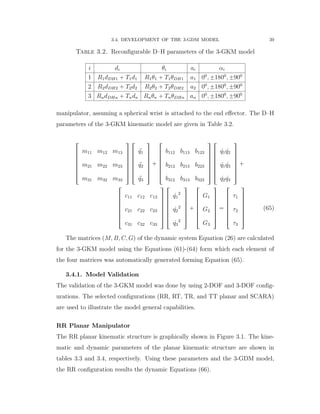
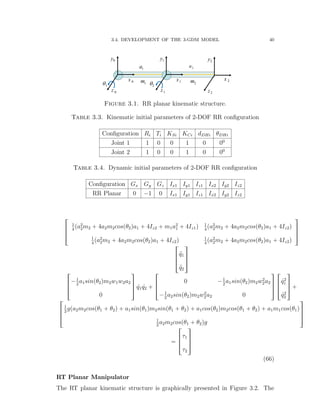
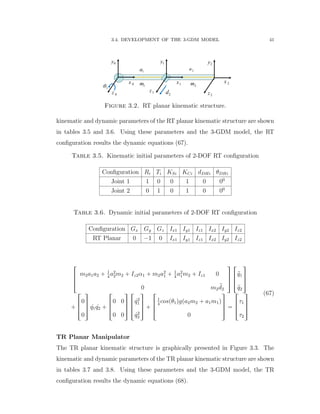
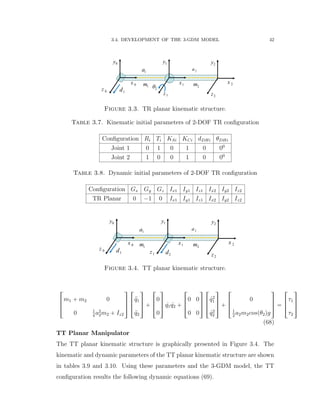
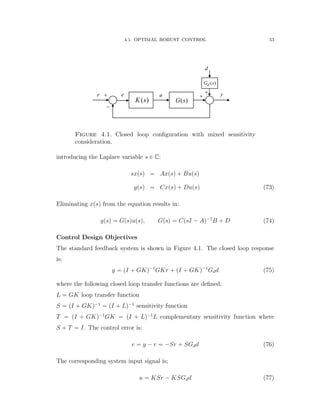
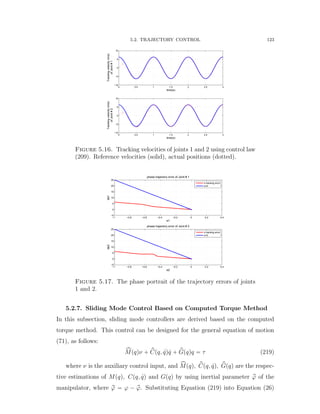
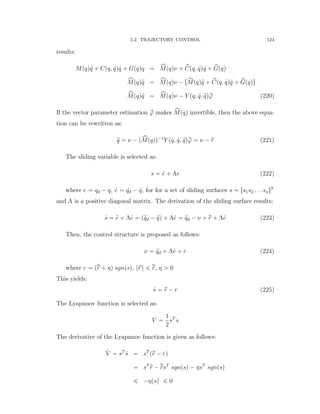
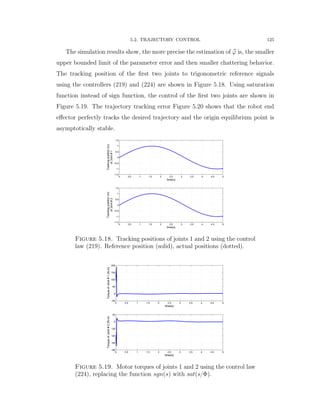
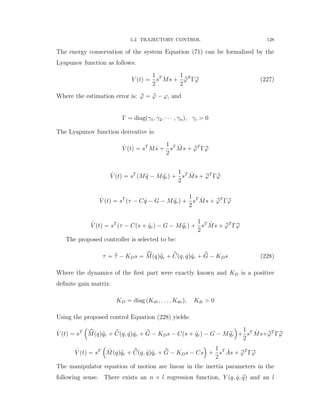
reconfigurable robot
by
Riyadh Al Saidi
A Dissertation
Submitted to the Faculty of Graduate Studies
through Mechanical, Automotive & Materials Engineering
in Partial Fulfillment of the Requirements for
the Degree of Doctor of Philosiphy at the
University of Windsor
Windsor, Ontario, Canada
2015
© 2015 R. Al Saidi
Model based control of a reconfigurable robot
by
R. Al Saidi
APPROVED BY:
—————————————————————–
L. Rolland, External Examiner
Department of Mechanical Engineering, Memorial University
—————————————————————–
X. Chen, External Reader
Electrical & Computer Engineering
—————————————————————–
N. Zamani, Department Reader
Mechanical, Automotive & Materials Engineering
—————————————————————–
J. Johrendt, Department Reader
Mechanical, Automotive & Materials Engineering
—————————————————————–
B. Minaker, Supervisor
Mechanical, Automotive & Materials Engineering
July 8th
, 2015
iii
Author’s Declaration of Originality
I hereby certify that I am the sole author of this thesis and that no part of this
thesis has been published or submitted for publication.
I certify, to the best of my knowledge, that my thesis does not infringe upon
anyone’s copyright or violate any proprietary rights and that any ideas, tech-
niques, quotations, or any other materials from the work of other people included
in my thesis, published or otherwise, are fully acknowledged in accordance with the
standard referencing practices. Furthermore, to the extent that I have included
copyrighted materials that surpasses the bounds of fair dealing within the meaning
of the Canada Copyright Act, I certify that I have obtained a written permission
of the copyright owner(s) to include such materials in my thesis and have included
copies of such copyright clearances to my appendix.
I declare that this is a true copy of my thesis, including any final revisions, as
approved by committee and the Graduate Studies Office, and that this thesis has
not been submitted for a higher degree to any other University or Institution.
iv
Abstract
Robots with predefined kinematic structures are successfully applied to ac-
complish tasks between the robot and the environment. For more sophisticated
and future applications, it is necessary to extend the capabilities of robots, and
employ them in more complex applications, which generally require accurate and
more changeable structural properties during the interaction with the environment.
The central focus of this research was to propose a robot with new properties to
address the reconfigurability problem, including its feasible solutions using model
based control strategies. First, these reconfigurable robots have to combine as
many properties of different open kinematic structures as possible and can be
used for a variety of applications. The kinematic design parameters, i.e., their
Denavit-Hartenberg (D–H) parameters, were modeled to be variable to satisfy any
configuration required to meet a specific task. By varying the joint twist angle
parameter (a configuration parameter), the presented model is reconfigurable to
any desired open kinematic structure, such as Fanuc, ABB and SCARA robots.
The joint angle and the offset distance of the D–H parameters are also modeled
as variable parameters (a reconfigurable joint). The resulting reconfigurable ro-
bot hence encompasses different kinematic structures and has a reconfigurable
joint to accommodate any required application in medical technology, space ex-
ploration and future manufacturing systems, for example. Second, a methodology
was developed to automate model generation for n-DOF Global Kinematic Model
(n-GKM). Then, advanced model based control strategies were employed to in-
crease performance as compared to less structured approaches. An algorithm was
developed to select a relevant kinematic structural robot configuration for any pre-
defined geometric task. The main contribution of this research is that it combines
a kinematic structural design with control design methods to optimize robot capa-
bility and performance. This combination has been established by developing an
algorithm to select the optimal kinematic structure and the most applicable control
approach to perform a predefined geometric task with high tracking performance.
v
Acknowledgements
I would like to express my immense gratitude to Dr. Bruce Minaker for his
supervision and encouragement. His enthusiasm and brilliance greatly motivated
me throughout this pursuit. His support and compassion have helped me overcome
the challenging obstacles along the way.
I would also like to thank the faculty and staff in the department of Mechanical
Engineering for providing interesting courses and a supportive learning environ-
ment.
I am very grateful to the the members of my defense committee. In particular,
I would like to thank Dr. X. Chen for agreeing to evaluate my work as the external
reader, and Drs. N. Zamani and J. Johrendt. The committee members provided
invaluable feedback on earlier drafts of this work. I would also like to thank Dr. Luc
Rolland for agreeing to serve as external examiner.
Ms. Angela Haskell has been an incredible source of support and I am deeply
indebted to her.
Finally, I would like to thank my ever supportive wife for standing by my side
and sharing this journey with me.
Contents
Author’s Declaration of Originality iii
Abstract iv
Acknowledgments v
List of Figures x
List of Tables xvii
Nomenclature xviii
Chapter 1. Introduction and Preliminaries 1
1.1. Introduction to Robot Kinematics 1
1.2. Introduction to Reconfigurability Theory 2
1.3. Robot Control 5
1.4. Problem Statement 10
1.4.1. General Problem Statement 10
1.4.2. Research Approach 10
Chapter 2. Development of a Reconfigurable Robot Kinematics 12
2.1. Modeling of a Reconfigurable Joint 12
2.2. Modeling of Reconfigurable Open Kinematic Robots 15
2.2.1. Spherical Wrist 16
2.2.2. Assumption 17
2.3. Reconfigurable Jacobian Matrix 17
2.3.1. Decoupling of Singularities 19
2.4. Manipulability and Singularity 20
2.4.1. Manipulability 20
2.5. Jacobian Condition and Manipulability 24
vi
CONTENTS vii
2.5.1. Joint-Space and Cartesian Trajectories 26
2.5.2. Motion Through a Singularity 27
Chapter 3. Reconfigurable Robot Dynamics 31
3.1. Reconfigurable Global Dynamic Model 31
3.2. Forward Computation for Reconfigurable Robot 32
3.3. Backward Computation of Forces and Moments 34
3.4. Development of the 3-GDM Model 38
3.4.1. Model Validation 39
3.5. Parameter Properties of a Reconfigurable Robot 45
3.5.1. Gravity Load Term 46
3.5.2. Inertia Matrix Term 47
3.5.3. Coriolis Matrix Term 49
3.5.4. Effect of Payload Term 51
Chapter 4. Linear Control 52
4.1. Optimal Robust Control 52
4.2. Mixed Sensitivity H8 Control 54
4.3. H8 Control Design 56
4.4. µ-Optimal Control 61
4.5. H8 Gain Scheduled Control 63
4.5.1. Analysis of LPV Polytopic Systems and Controllers 63
4.5.2. Synthesis of LPV Polytopic Controllers 66
4.5.3. Analysis of LPV Systems with LFT System Description 68
4.6. Linear Control Applications (Simulation Results) 70
4.6.1. Application of Mixed Sensitivity H8 Control (Simulation and
Results) 70
4.6.2. Application of H8 Control (Simulation and Results) 72
4.6.3. Application of µ-Synthesis Control and DK Iterations
(Simulation and Results) 80
4.6.4. Comparison of H8 and µ-Controllers 87
4.6.5. Order Reduction of µ Control 90
4.6.6. Application of LPV Control (Simulation and Results) 93
CONTENTS viii
Chapter 5. Nonlinear Control 97
5.1. Position Control 98
5.1.1. Link Dynamics 98
5.1.2. PD-Gravity Control 99
5.1.3. A Reconfigurable Robot with PD-Gravity Control 103
5.1.4. Three-Axis Robot Structure with PD-Gravity Control 104
5.2. Trajectory Control 108
5.2.1. Feedback Linearization Control 108
5.2.2. Input-Output Linearization 109
5.2.3. Sliding Mode Control (SMC) 112
5.2.4. Sliding Mode Control Based on Estimated Model 114
5.2.5. Simulation of 3-DOF Reconfigurable Manipulator 117
5.2.6. Sliding Mode Control Based on Bounded Model 120
5.2.7. Sliding Mode Control Based on Computed Torque Method 123
5.2.8. Adaptive Control 126
5.2.9. Derivation of Adaptive Sliding Mode Control 127
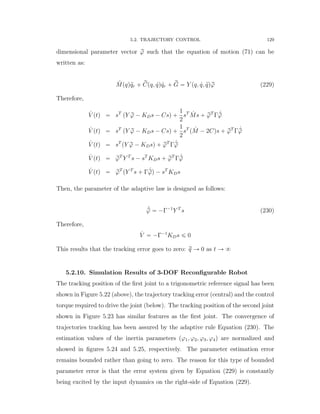
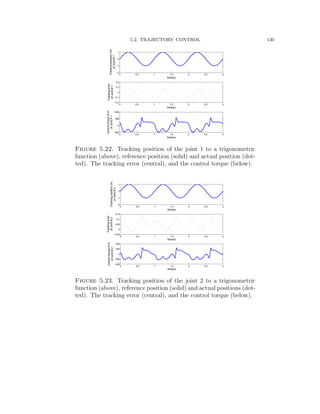
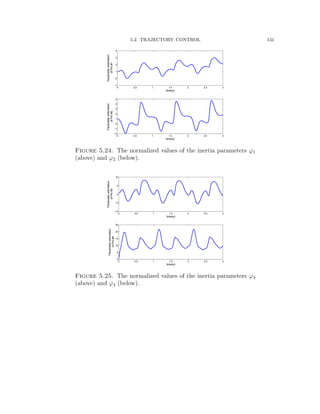
5.2.10. Simulation Results of 3-DOF Reconfigurable Robot 129
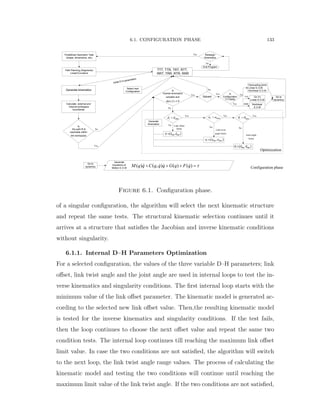
Chapter 6. Kinematic and Control Selection Algorithm 132
6.1. Configuration Phase 132
6.1.1. Internal D–H Parameters Optimization 133
6.2. Control Phase 134
6.2.1. Dynamic Parameter Properties 136
6.2.2. The Reconfigurable Control Algorithm 136
6.3. Algorithm Implementation (Simulations and Results) 141
6.3.1. Trajectory of Two Circles in Joint Space Motion 141
6.3.2. Straight Line Trajectory in Joint Space 144
6.3.3. Position (Linear) and Trajectory (Nonlinear) Control Method
Selection 148
6.4. Comparison between Linear and Nonlinear Control Approaches 156
6.5. Summary 157
Chapter 7. Conclusions and Recommendations 159
CONTENTS ix
7.1. Conclusions 159
7.2. Recommendations 162
Appendix A: Bosch Scara Model 164
Appendix B: Bosch Scara Model 166
Appendix C: Kinematic Calculations 168
References 169
Vita Auctoris 175
List of Figures
1.1 Definition of standard Denavit and Hartenberg (D–H) parameters.
Source; Manseur, [63]............................................................................ 2
1.2 Set of design variables of the 3-DOF configuration modular robots,
this set is a commercial product of AMTEC GmbH Company. Source;
I.M. Chen, [22]...................................................................................... 4
1.3 Mechanical set up of a modular and reconfigurable robot (left). The
ICT power cube Mechatronical component (right). Source; Strasser,
[84]........................................................................................................ 5
1.4 Robotic system with motion control system, inner and outer loop
controllers.............................................................................................. 6
1.5 Standard robust control problem. ......................................................... 9
2.1 Kinematic structures of the ABB and Stanford robots, D–H param-
eters are from sources; Dawson, [57] and Spong, [80]........................... 15
2.2 The spherical wrist, joint axes 4, 5 and 6. ............................................ 16
2.3 All possible configuration models of a reconfigurable hybrid joint........ 18
2.4 Workspace of RRR Configuration with four different twist angle val-
ues π{16, π{8, π{4, and π{2. ................................................................. 21
2.5 Workspace of RRT Configuration with different link lengths 0.15, 0.3
and 0.45 m. ........................................................................................... 22
2.6 3D profile of the manipulability index measure of RRR configuration. 23
2.7 3D profile of the manipulability index measure of RRT configuration.. 24
2.8 Cartesian velocity ellipsoid of RRR configuration with different twist
angle values of pπ{16, π{6, π{2q degrees................................................. 26
2.9 Cartesian velocity ellipsoid of RRT configuration with different pris-
matic lengths of 0.1, 0.2 and 0.3 m. ...................................................... 27
x
LIST OF FIGURES xi
2.10 Joint angles during joint-space motion (left). Cartesian coordinates
of the end-effector in x, y and z directions (right)................................ 28
2.11 Cartesian position locus in the xy-plane (left). Euler angles roll-
pitch-yaw versus time (right). ............................................................... 28
2.12 Joint angles during Cartesian motion (left). Cartesian coordinates of
the end-effector in x, y and z directions (right).................................... 28
2.13 Cartesian position locus in the xy-plane (left). Euler angles roll-
pitch-yaw versus time (right). ............................................................... 29
2.14 Joint angles follow Cartesian path through a wrist singularity (left),
joint angles follows joint-space path (right). ......................................... 29
2.15 Manipulability measure of Cartesian and joint-space paths.................. 30
3.1 RR planar kinematic structure.............................................................. 40
3.2 RT planar kinematic structure.............................................................. 41
3.3 TR planar kinematic structure.............................................................. 42
3.4 TT planar kinematic structure.............................................................. 42
3.5 Scara kinematic structure. .................................................................... 44
3.6 The workspace of a predefined kinematic structure of the PUMA 560. 46
3.7 The workspace of a reconfigurable manipulator.................................... 47
3.8 Gravity load variation with a reconfigurable manipulator pose (shoul-
der gravity load).................................................................................... 48
3.9 Gravity load variation with a reconfigurable manipulator pose (Elbow
gravity load).......................................................................................... 48
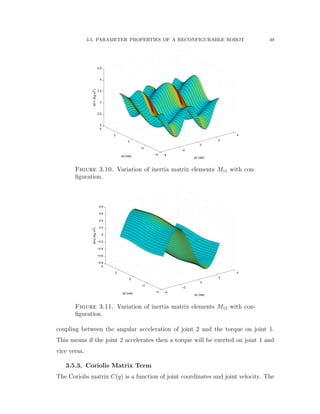
3.10 Variation of inertia matrix elements M11 with configuration................ 49
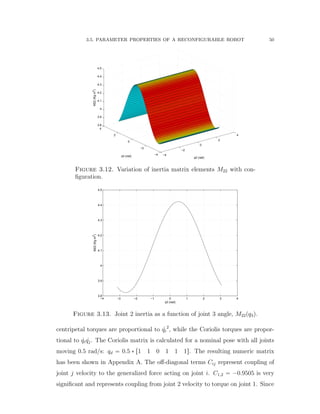
3.11 Variation of inertia matrix elements M12 with configuration................ 49
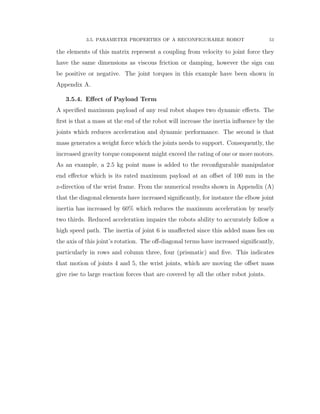
3.12 Variation of inertia matrix elements M22 with configuration................ 50
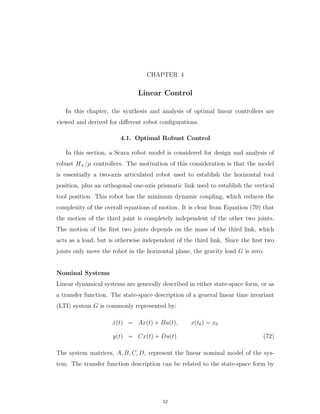
3.13 Joint 2 inertia as a function of joint 3 angle, M22pq3q........................... 50
4.1 Closed loop configuration with mixed sensitivity consideration............ 53
4.2 General H8 control configuration. ........................................................ 55
4.3 S/SK mixed sensitivity optimization in regulation form (left), S/SK
mixed sensitivity minimization in tracking form (right). ...................... 57
4.4 Uncertain system representation........................................................... 57
LIST OF FIGURES xii
4.5 Standard H8{µ control structure (left), A control structure for closed
system analysis (right). ......................................................................... 58
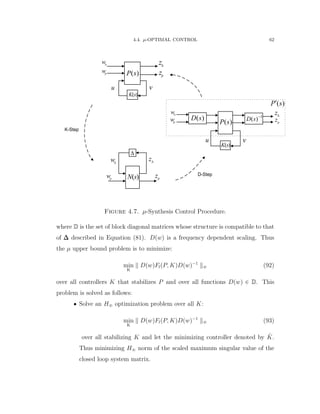
4.6 A control configuration with extended uncertainty structure. .............. 61
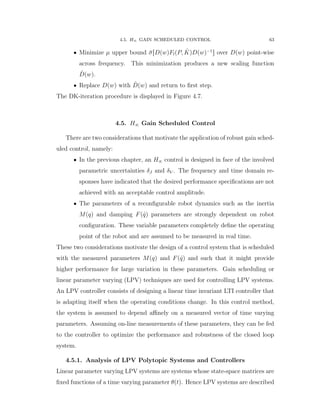
4.7 µ-Synthesis Control Procedure.............................................................. 62
4.8 The structure of the LPV system and control using Linear Fractional
Transformation (LFT) description system. ........................................... 68
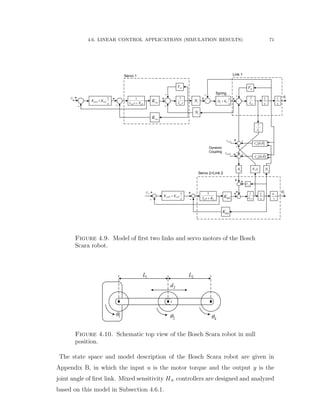
4.9 Model of first two links and servo motors of the Bosch Scara robot..... 71
4.10 Schematic top view of the Bosch Scara robot in null position. ............. 71
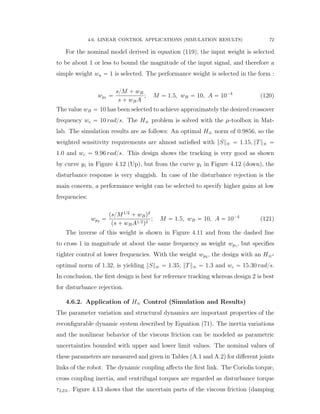
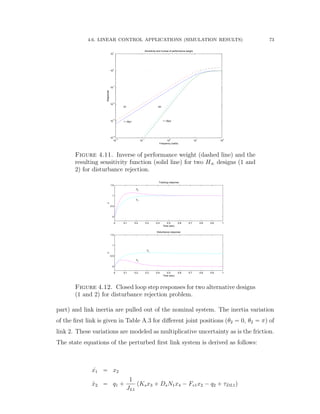
4.11 Inverse of performance weight (dashed line) and the resulting sensi-
tivity function (solid line) for two H8 designs (1 and 2) for distur-
bance rejection. ..................................................................................... 73
4.12 Closed loop step responses for two alternative designs (1 and 2) for
disturbance rejection problem. .............................................................. 73
4.13 Derived block diagram of the first link of the Bosch Scara robot. ........ 74
4.14 LFT representation of the perturbed Bosch Scara model ..................... 75
4.15 Perturbed (set of family) open loop systems......................................... 75
4.16 Singular value of the closed loop with H8 controller............................ 76
4.17 H8 control structure............................................................................. 77
4.18 Sensitivity and performance weighting function with H8 controller..... 78
4.19 Robust stability analysis with H8 control. ........................................... 78
4.20 Nominal and robust performance with H8 control............................... 79
4.21 Perturbed (set of family) of closed loop systems with different uncer-
tainty values.......................................................................................... 80
4.22 Transient response to reference input with H8 control......................... 80
4.23 Transient response to disturbance input with H8 control. ................... 81
4.24 Sensitivity and weighting functions of Mu-Control............................... 83
4.25 Robust stability of Mu-control.............................................................. 83
4.26 Nominal and robust performance of Mu-Control. ................................. 83
4.27 Sensitivity functions of perturbed systems with Mu-Control................ 84
4.28 Performance of perturbed systems with Mu-Control. ........................... 84
4.29 Frequency responses of perturbed closed loop systems with Mu-Control. 85
4.30 Transient response to step reference input with Mu-Control. ............... 86
LIST OF FIGURES xiii
4.31 Transient response to disturbance input with Mu-Control. .................. 86
4.32 Transient responses of perturbed closed loop with Mu-Control............ 86
4.33 Frequency responses of H8 and µ-controllers. ...................................... 87
4.34 Frequency responses of closed loop systems.......................................... 88
4.35 Comparison of robust stability of H8 and µ-controllers. ...................... 88
4.36 Comparison of nominal performance of H8 and µ-controllers.............. 89
4.37 Comparison of robust performance of H8 and µ-controllers................. 89
4.38 Performance degradation of H8 and µ-controllers................................ 90
4.39 Frequency responses of full and reduced order controllers. ................... 92
4.40 Transient response for reduced order controller. ................................... 93
4.41 LPV control structure includes the LPV system Ppθptqq, performance
weighting functions Wp, robustness function Wu, and LPV polytopic
controllers (K1pθptqq, ¨ ¨ ¨ , K3pθptqq and input filter Wf ......................... 94
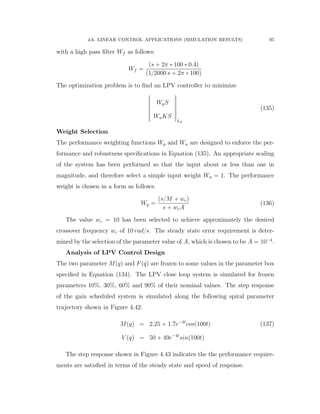
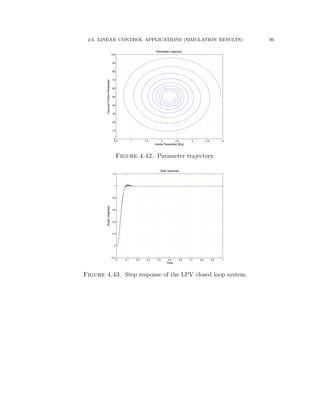
4.42 Parameter trajectory. ............................................................................ 96
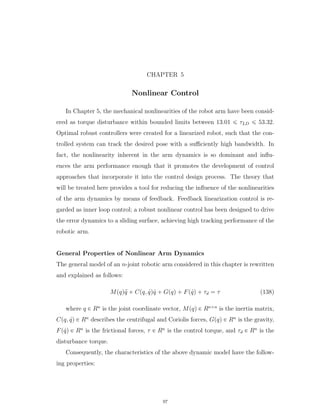
4.43 Step response of the LPV closed loop system. ...................................... 96
5.1 Performance of PD-gravity controller, RR configuration; tracking
step position of joint 1 (left), motor torque (right)............................... 104
5.2 Performance of PD-gravity controller, RR configuration; tracking
step position of joint 2 (left), motor torque (right)............................... 105
5.3 Performance of PD-gravity controller, RR configuration; tracking
step position error joint 1 (left), tracking position error joint 2 (right).105
5.4 Performance of PD-gravity controller, RT configuration; tracking po-
sition of prismatic joint 2 (left), motor torque (right)........................... 106
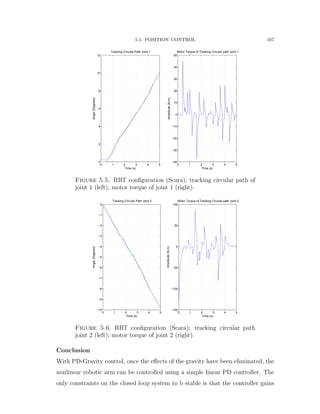
5.5 RRT configuration (Scara); tracking circular path of joint 1 (left),
motor torque of joint 1 (right). ............................................................. 107
5.6 RRT configuration (Scara); tracking circular path joint 2 (left), motor
torque of joint 2 (right)......................................................................... 107
5.7 RRT configuration (Scara); tracking circular path error joint 1 (left),
tracking circular path error joint 2 (right). ........................................... 108
5.8 Motor torques of joints 1 and 2 using control law (211); the chattering
is due to the sign function..................................................................... 118
LIST OF FIGURES xiv
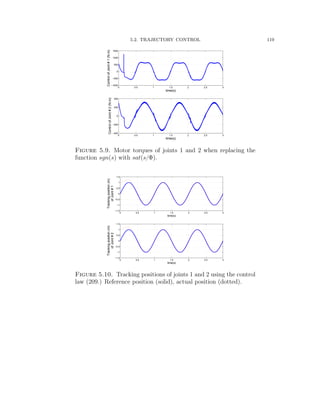
5.9 Motor torques of joints 1 and 2 when replacing the function sgnpsq
with satps{Φq. ....................................................................................... 119
5.10 Tracking positions of joints 1 and 2 using the control law (209.) Ref-
erence position (solid), actual position (dotted).................................... 119
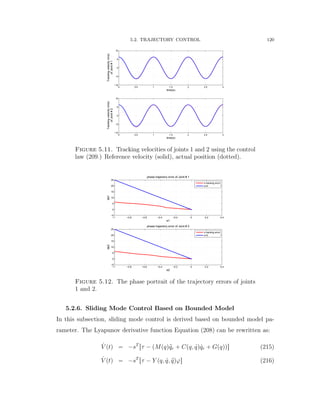
5.11 Tracking velocities of joints 1 and 2 using the control law (209.)
Reference velocity (solid), actual position (dotted)............................... 120
5.12 The phase portrait of the trajectory errors of joints 1 and 2................ 120
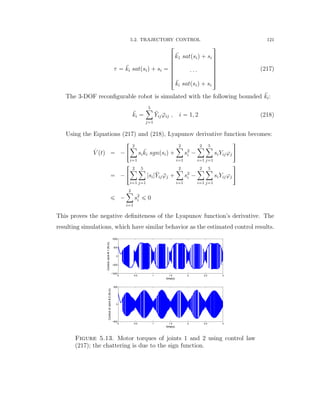
5.13 Motor torques of joints 1 and 2 using control law (217); the chattering
is due to the sign function..................................................................... 121
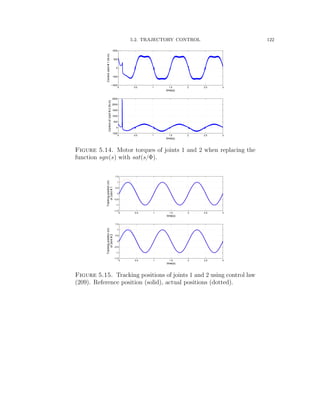
5.14 Motor torques of joints 1 and 2 when replacing the function sgnpsq
with satps{Φq. ....................................................................................... 122
5.15 Tracking positions of joints 1 and 2 using control law (209). Reference
position (solid), actual positions (dotted). ............................................ 122
5.16 Tracking velocities of joints 1 and 2 using control law (209). Reference
velocities (solid), actual positions (dotted). .......................................... 123
5.17 The phase portrait of the trajectory errors of joints 1 and 2................ 123
5.18 Tracking positions of joints 1 and 2 using the control law (219). Ref-
erence position (solid), actual positions (dotted). ................................. 125
5.19 Motor torques of joints 1 and 2 using the control law (224), replacing
the function sgnpsq with satps{Φq......................................................... 125
5.20 Trajectory errors of joints 1 and 2. ....................................................... 126
5.21 Control structure diagram of the adaptive control................................ 127
5.22 Tracking position of the joint 1 to a trigonometric function (above),
reference position (solid) and actual position (dotted). The tracking
error (central), and the control torque (below). .................................... 130
5.23 Tracking position of the joint 2 to a trigonometric function (above),
reference position (solid) and actual positions (dotted). The tracking
error (central), and the control torque (below). .................................... 130
5.24 The normalized values of the inertia parameters ϕ1 (above) and ϕ2
(below). ................................................................................................. 131
5.25 The normalized values of the inertia parameters ϕ3 (above) and ϕ4
(below). ................................................................................................. 131
LIST OF FIGURES xv
6.1 Configuration phase. ............................................................................. 133
6.2 Control phase. ....................................................................................... 135
6.3 A comprehensive algorithm for configuration and control of a recon-
figurable robot....................................................................................... 140
6.4 A reconfigurable robot follows a trajectory motion (lower and upper
circles)................................................................................................... 142
6.5 The joint coordinates of a reconfigurable robot during the joint space
path....................................................................................................... 143
6.6 Cartesian position (x,y,z) of the end effector during the joint space
trajectory............................................................................................... 143
6.7 The Euler angles (roll, pitch, yaw) of the end effector.......................... 144
6.8 Manipulability of the reconfigurable robot following a joint space
trajectory............................................................................................... 144
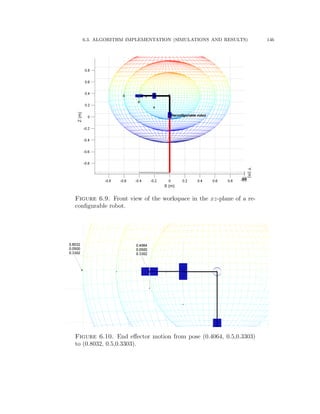
6.9 Front view of the workspace in the xz-plane of a reconfigurable robot. 146
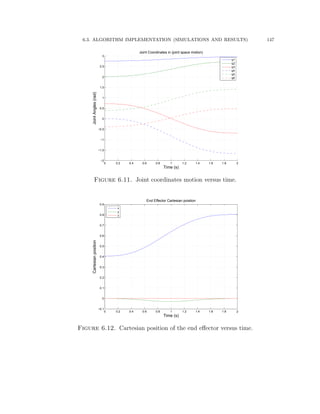
6.10 End effector motion from pose (0.4064, 0.5,0.3303) to (0.8032, 0.5,0.3303).146
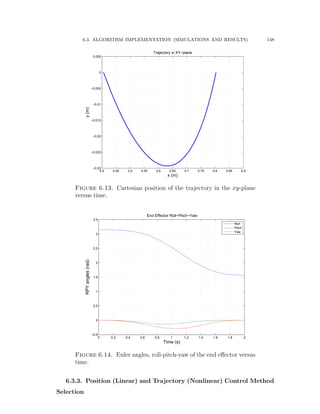
6.11 Joint coordinates motion versus time.................................................... 147
6.12 Cartesian position of the end effector versus time. ............................... 147
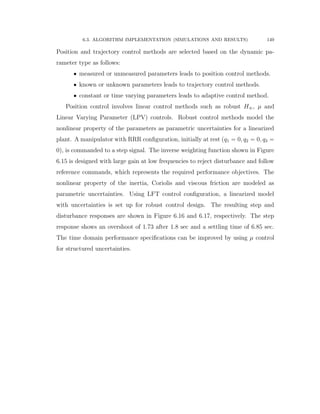
6.13 Cartesian position of the trajectory in the xy-plane versus time.......... 148
6.14 Euler angles, roll-pitch-yaw of the end effector versus time. ................. 148
6.15 Performance weighting function of the sensitivity function S “ 1
p1`GKq
150
6.16 Step response of H8-control.................................................................. 150
6.17 Disturbance response using H8-control. ............................................... 151
6.18 Frequency response of a weighted sensitivity function S “ 1
p1`GKq
....... 152
6.19 Step response of 20 frozen parameters using gain-scheduled controller. 152
6.20 Gain-scheduled control amplitude......................................................... 153
6.21 Tracking error using gain-scheduled control.......................................... 153
6.22 Trajectory tracking for a trigonometric reference command using
SMC method......................................................................................... 154
6.23 Tracking error for unknown parameters using SMC method. ............... 155
6.24 Trajectory tracking for a trigonometric function using the adaptive
control method...................................................................................... 155
LIST OF FIGURES xvi
6.25 Tracking error for time varying dynamic parameters using adaptive
control method...................................................................................... 156
List of Tables
2.1 D–H parameters of the n-GKM model.................................................. 12
2.2 D–H of a spherical wrist, source; Spong, [80]. ...................................... 17
2.3 D–H parameters of the ABB manipulator robot, source; Spong, [80]. . 21
2.4 D–H parameters of the Stanford manipulator robot, source; Spong,
[80]........................................................................................................ 23
3.1 Reconfiguration parameters values........................................................ 37
3.2 Reconfigurable D–H parameters of the 3-GKM model.......................... 39
3.3 Kinematic initial parameters of 2-DOF RR configuration .................... 40
3.4 Dynamic initial parameters of 2-DOF RR configuration ...................... 40
3.5 Kinematic initial parameters of 2-DOF RT configuration..................... 41
3.6 Dynamic initial parameters of 2-DOF RT configuration....................... 41
3.7 Kinematic initial parameters of 2-DOF TR configuration .................... 42
3.8 Dynamic initial parameters of 2-DOF TR configuration ...................... 42
3.9 Kinematic initial parameters of 2-DOF TT configuration .................... 43
3.10 Dynamic initial parameters of 2-DOF TT configuration....................... 43
3.11 Kinematic initial parameters of 3-DOF SCARA configuration............. 43
3.12 Dynamic initial parameters of 3-DOF SCARA configuration ............... 44
3.13 D–H parameters of the PUMA 560 Manipulator, source; Fu, [41]........ 46
6.1 Dynamic parameter properties of a reconfigurable robot...................... 136
A.1 Nominal parameter values of the Bosch Scara robot arm ..................... 166
A.2 Nominal parameter values of the Bosch Scara robot arm ..................... 166
A.3 Different values for inertias and damping for different joint position
of link 2 (left). Estimated parameter values for stiction and Coulomb
friction (right). ...................................................................................... 167
xvii
Nomenclature
Lmi Inductance of motor coil of joint i rHs
Li Size of the Link i rHs
Rmi Impedance of motor armature, included wires of joint i rΩs
Kmi Servo motor constant of joint i rN m{As
Jmi Inertia of servo motor of joint i rkgm2
s
JLi Inertia of the Link i rkgm2
s
Ji Total inertia of Link i rkgm2
s
Jc Cross-coupling inertia between joints rkgm2
s
Fvi Viscous friction of joint i rN ms{rads
FvL Viscous friction in mechanical link 1 rN ms{rads
Fvm Viscous friction in Servo motor of joint 1 rN ms{rads
Fci Coulomb friction of joint i rN ms
Fsi Static friction (Stiction) of joint i rN ms
KP i1 Proportional constant of tacho controller in Servo Amplifier i r1s
KIi1 Integration constant of tacho controller in Servo Amplifier i rs´1
s
KPi2 Proportional constant of current controller in Servo Amplifier i rV {As
KIi2 Integration constant of current controller in Servo Amplifier i rV {Ass
Ti Time constant of Tacho controller in Servo Amplifier i rs´1
s
ml Load mass rkgs
KS Spring constant rN m{rads
DS Damper constant rN ms{rads
xviii
NOMENCLATURE xix
θmi Position of motor axis of joint i rrads
θi Position of joint axis i rrads
9θmi Velocity of motor axis of joint i rrad{ss
9θi Velocity of joint axis i rrad{ss
:θi Acceleration of joint axis i rrad{s2
s
C1 Cospθ1q
S1 Sinpθ1q
C12 Cospθ1 ` θ2q
S12 Sinspθ1 ` θ2q
N1 Gear ratio r1s
τLD,i Disturbance torques on joint i rN ms
δADi Quantization error of sensor joint i rrads
δDA Resolution of DA-converter rV s
δF Perturbation in friction rN ms{rads
δ1{J Perturbation in inertia r1{kgm2
s
δθ Tracking error rrad{ss
p1 Interconnection output to inertia error rN ms
p2 Interconnection output to friction error rrad{ss
q1 Interconnection input to inertia error rN{kgms
q2 Interconnection input to friction error rN ms
US Input voltage to Servo motor [V ]
USA Input voltage to Tacho controller of Amplifier System rV s
ISA Input current to Current controller of Amplifier System rAs
h Sample time [s]
W∆ Scaling function for perturbation matrix
NOMENCLATURE xx
WP Weighing function of tracking error (Performance Spec)
Wθ Scaling function for velocity set point
Wτ Scaling function for disturbance torque
WDA Scaling function for Amplifier set point
WF Scaling of Friction perturbation
WJ Scaling of inertia perturbation
K Controller
B Set of all normed perturbation matrices with σmaxp∆q ď 1
M Closed-loop interconnection matrix
M1
Open-loop interconnection matrix
∆ Noise-block, built of ∆1 and ∆P
∆1 Perturbation transfer matrix (structured)
∆P Block structure appended to ∆ for robust performance calculations
d Input signals
e Tracking error
c Controller signal
w Input of perturbation matrix 1 into the interconnection matrix
z Output of the interconnection matrix to the perturbation matrix 1
CHAPTER 1
Introduction and Preliminaries
1.1. Introduction to Robot Kinematics
A serial-link manipulator comprises a set of bodies called links connected in a
chain by joints. Each joint has one degree of freedom, either translational (sliding
or prismatic joint) or rotational (revolute joint). To describe the rotational and
translational relationships between adjacent links, Denavit and Hartenberg pro-
posed a matrix method of systematically establishing a coordinate frame to each
link of an articulated chain. The Denavit-Hartenberg (D–H) representation [35]
results a 4ˆ4 homogeneous transformation matrix representing each link’s coordi-
nate frame at the joint with respect to the previous link’s coordinate frame. To
analyze the motion of robot manipulator, coordinate frames are attached to each
link starting from frame F0, attached to the base of the manipulator link, all the
way to the frame Fn, attached to the robot end-effector as shown in Figure 1.1.
Every coordinate frame is determined and established on the basis of three rules:
(1) The zi´1 axis lie along the axis of motion of the ith joint.
(2) The xi axis is normal to the zi´1 axis.
(3) The yi axis completes the right-handed coordinate system as required.
As the frames have been attached to the links, the following definitions of the
link (D–H) parameters are valid:
‚ Joint angle θi is the angle around zi´1 that the common perpendicular
makes with vector xi´1.
‚ Link offset di is the distance along axis zi´1 to the point where the common
perpendicular to axis zi is located.
‚ Link length ai is the length of the common perpendicular to axes zi´1 and
zi.
‚ Link twist αi is the angle around xi that vector zi makes with vector zi´1.
1
1.2. INTRODUCTION TO RECONFIGURABILITY THEORY 2
Figure 1.1. Definition of standard Denavit and Hartenberg (D–H)
parameters. Source; Manseur, [63].
For a rotary joint, di, ai, and αi are the joint parameters and remain constant
for a robot, while θi is the joint variable that changes when link i rotates with
respect to link i ´ 1. For a prismatic joint, θi, ai, and αi are the joint parameters
and remain constant for a robot, while di is the joint variable.
1.2. Introduction to Reconfigurability Theory
Robotics technology has been recently exploited in a variety of areas and var-
ious robots have been developed to accomplish sophisticated tasks in different
fields and applications such as in space exploration, future manufacturing sys-
tems, medical technology, etc. In space, robots are expected to complete different
tasks, such as capturing a target, constructing a large structure and autonomously
maintaining in-orbit systems. In these missions, one fundamental task with the
robot would be the tracking of changing paths, the grasping and the positioning
of a target in Cartesian space. To satisfy such varying environments, a robot with
changeable configuration (kinematic structure) is necessary to cope with these
requirements and tasks. Another field of technology is the new manufacturing en-
vironment, which is characterized by frequent and unpredictable market changes.
A manufacturing paradigm called Reconfigurable Manufacturing Systems (RMS)
was introduced to address the new production challenges [52]. RMS is designed
for rapid adjustments of production capacity and functionality in response to new
1.2. INTRODUCTION TO RECONFIGURABILITY THEORY 3
circumstances, by rearrangement or change of its components and machines. Such
new systems provide exactly the capacity and functionality that is needed, when
it is needed [39]. The rapid changes and adjustments of the RMS structure must
happen in a relatively short time ranging between minutes and hours and not days
or weeks. These systems’ reconfigurability calls for their components, such as ma-
chines and robots to be rapidly and efficiently modifiable to varying demands [48].
Robot manipulators working in extreme or hazardous environments (biological,
chemical, nuclear,..., etc.) often need to change their configuration and kinematic
structures to meet the demands of specific tasks. It is desirable and cost effective
to employ a single versatile robot capable of performing tasks such inspection,
contact operations, assembly (insertion or removal parts), and carrying objects
(pick and place). Robots with maximum manipulability are well conditioned for
dexterous contact tasks [16, 61] and configurations that maximize the robot links
and distance from the environment are suitable for payload handling [56]. The
optimization of a robot workspace over its link lengths, as the design parameters,
is reported in [55, 47], while optimization of kinematic parameters and criteria
for fault tolerance are discussed in [50].
In the literature, modular robotic structures are presented as a solution to cope
with reconfigurable structure of robots. A modular reconfigurable robot consists
of a collection of individual link and joint components that can be arbitrarily as-
sembled into a number of different geometries. Such a system can provide agility
to the user to cope with a wide spectrum of tasks through proper selection and
reconfiguration of a large inventory of functional components. Several prototyping
systems have been demonstrated in various research institutions, [87], [42], [67]
and [13]. An automated generation of D–H parameters methodology has devel-
oped for the modular manipulators [22]. The authors derived the kinematic and
dynamic models of reconfigurable robots using D–H parameters for different sets of
joints, links and gripper modules as shown in Figure 1.2. Furthermore, a library of
modules is formed from which any module can be called with its associated kine-
matic and dynamic models. In [58], a modular and reconfigurable robot design
is introduced with modular joints and links. The proposed design introduces zero
1.2. INTRODUCTION TO RECONFIGURABILITY THEORY 4
Figure 1.2. Set of design variables of the 3-DOF configuration
modular robots, this set is a commercial product of AMTEC GmbH
Company. Source; I.M. Chen, [22].
link offsets to increase the robot’s dexterity and maximize its reachability. A mod-
ular and reconfigurable robot (MRR) with multiple working modes was designed
[59]. In the proposed MRR design, each joint module can independently work
in active modes with position or torque control, or passive modes with friction
compensation. With the MRR, the joint module was designed as a hybrid joint
in working modes and not in the sense of mechanical motion. A reconfigurable
robot was proposed [5] and achieves the reconfigurability by utilizing passive and
active joints. In [21], an automated approach was presented to build kinematic
and dynamic models for assembled modular components of robots. The developed
method is applicable to any robotic configuration with a serial, parallel or hybrid
structure. Reconfigurable plug and play robot kinematic and dynamic modeling
algorithms are developed [22]. These algorithms are the basis for the control and
simulation of reconfigurable modular robots. The reconfigurable robot (RRS) was
regarded as a modular system [20]. A task-based configuration optimization based
on a generic algorithm was used to solve a predefined set of joint modules for spe-
cific kinematic configuration. A modular and reconfigurable robot for industrial
1.3. ROBOT CONTROL 5
Figure 1.3. Mechanical set up of a modular and reconfigurable
robot (left). The ICT power cube Mechatronical component (right).
Source; Strasser, [84].
purposes has been introduced [84]. The PROFACTOR GmbH has presented a
modular and reconfigurable robot with power cube (Mechatronical Components)
modules depicted in Figure 1.3. These modules were designed to be identical and
self-contained with actuation, memory, and mechanical, electrical and embedded
programming. A reconfigurable robot has been introduced by [36] that unifies the
kinematic structure of industrial robots. In that unification process, eight mod-
ules were reconfigured by changing configuration parameters. These parameters
represent the trigonometric functions of the robot twist angles.
The main drawbacks of the modular robots proposed in the literature are the
high initial investment necessary in modules that remain idle during many activi-
ties, and the significant lead time for replacement, attachment and detachment of
the components prior to performing a specific task.
1.3. Robot Control
The use of advanced robot control laws may contribute significantly to improve
the robot functions and properties. The improvement of the robot design itself
can also contribute substantially to the desired increase in performance and capa-
bilities. The combination of the controller with proper sensors can provide some
1.3. ROBOT CONTROL 6
sense and awareness of the environment, and improve its accuracy and speed as
well.
Robotic
Arm
Actuator
DC Motor
Outer Loop
Controllers
PD, PID
/H 
,q q
, ,d d dq q q 
Trajectory
Generation
,q qu
Robotic SystemMotion Control System
Host
Inner Loop
Feedback
Linearization
Controller
Figure 1.4. Robotic system with motion control system, inner and
outer loop controllers.
The former and current problems in the robotics application fields has affected
the research of robot control in a number of fundamental topics: modeling, position
control, robust control and motion planning. This has motives research in robot
modeling, simulation and control design. Therefore, position and trajectory control
is an important research field in robotics control. The position/motion control
problem has received a great deal of interest in robotics. Therefore, a survey that
covers the important control strategies is given with examples and applications.
PD and PID Control
The PD (Proportional-Derivative) and PID (Proportional-Derivative-Integral) con-
trollers are the most applied in industry, which is also true for robotics. Some
references propose a high gain PD controller to ensure global stabilization of the
robot [68, 69, 71], which is unsuited for practical applications due to excitation
of unavoidable higher dynamics and excessive noise amplification. PID controllers
are more suitable to eliminate the steady state error of the final position response.
These controllers introduce an integration action to the resulting closed loop im-
proving the performance tracking requirements.
Feedback Linearization Control
The application of feedback linearization theory to solve robotics control prob-
lems has led to the computed torque approach. Feedback linearization control
1.3. ROBOT CONTROL 7
methods are inner-outer loop control methods: the inner loop must linearize the
plant, whereas the outer loop must achieve the desired closed loop requirements.
Figure 1.4 shows the control motion structure (inner and outer control loops) of a
robot driven by a DC motor. The term Computed Torque Control (CTC) is the
application of PD control at the outer loop to a linearized system by the feedback
linearization control. In robotics, CTC is used to apply PD controllers at the outer
loop independently (every joint controlled separately) [53]. There are two impor-
tant features of the feedback linearization method that require attention: model
error and the outer loop controller design. Feedback linearization is based on the
exact model of the system. Therefore, the controller may be sensitive to modeling
errors such as parameter errors and unmodeled dynamics. Parameter uncertainty
is commonly addressed by either robust control methods or by the derivation of
adaptive controllers [66, 77]. In particular, when a restricted amount of parame-
ters must be estimated (in case of an unknown load), adaptive controllers can be a
suitable approach. The feedback linearization control actively linearized the plant,
such that the resulting system can be considered as a linear system. Therefore,
it is possible to apply one of many linear control methods to close the loop and
achieve the required performance. As a result, a large number of controllers for
the outer loop control are proposed: the standard PD loop of CTC, linear optimal
control [83, 78], sliding mode control, and H8{µ robust optimal controllers.
Lyapunov Based Control
An important tool for control of rigid body systems is Lyapunov stability theory,
which based on the strict dissipation of a suitable energy function [76]. Although
this theory is not constructive to design a controller, a simple structure of the equa-
tions of motion with some relevant assumptions allow a derivation of stabilizing
controllers. These assumptions may include bounded disturbances and bounded
parameter variations. The passivity based control approach attempts to reshape
the robot energy function, rather than imposing a completely different behavior
as with the CTC approach [14, 19]. Experiments have shown and indicated the
1.3. ROBOT CONTROL 8
passivity controllers are more robust than CTC. Another result of Lyapunov sta-
bility theory is the sliding mode control (SMC), which is considered to be a robust
control approach.
Robust Control
To ensure a suitable behavior of the closed loop robot, even in the presence of
modeling errors and disturbances, it is desired to design controllers that are ro-
bust with respect to these errors and disturbances. Modeling errors are generally
separated into parameter errors and unmodeled dynamics, which may have differ-
ent affect on the closed loop system. The standard control framework, adopted in
many textbooks on modern control [23, 60, 88], is shown in Figure 1.5. A con-
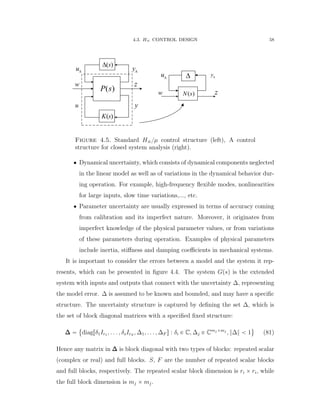
troller Kpsq is provided with measurement signals y and has to stabilize a plant
Ppsq with input signals u such that the cost variables z are minimal in some sense,
despite the disturbance signals w and the parametric and dynamic uncertainties
represented in ∆psq. The plant Ppsq is often called the generalized plant or stan-
dard plant since it usually does not only consist of the plant to be controlled, but
can also contain weightings, e.g., parametric and dynamic uncertainty weighting,
input signal thresholds, and the robot dynamic model to be simulated. Also the
other entities can be viewed in a generalized way, e.g., reference signals can be
incorporated as disturbances w and additional feedback paths can be taken in
case of a robust control problem to describe a set of systems, i.e., uncertainty.
A survey can be found covering a number of robust robot position controller de-
sign methods: passivity control, sliding mode control and linear robust control by
factorization approach in [82]. The most popular robust control design method
in robotics literature is the sliding mode control (SMC), also known as Variable
Structure Switching (VSS) control. Sliding mode control is commonly used to ad-
dress parameter uncertainty and bounded disturbances [76, 86]. As mentioned,
SMC is based on upon Lyapunov stability theory, and basically tries to determine
the nominal feedback control law and a corrective control action that steers the
controlled system to the desired behavior, defined as the ‘sliding surface’.
1.3. ROBOT CONTROL 9
yu
w z
( )K s
( )P s
( )s
yu
Figure 1.5. Standard robust control problem.
Optimal Control
Apart from the application of linear outer loop control applied to the feedback
linearized robot, there have been some attempts made to apply optimal control
directly to the rigid body dynamics. The main problem with these approaches
is the amount of assumptions and choices that have to be made to allow for a
solution. For example in [30], an optimal quadratic control is considered with a
special choice optimization criterion, which results in a nonlinear PID controller.
Another example in [44], where an H8-optimal control problem is considered,
results in a nonlinear static state feedback PD controller. Following these methods
to construct a nonlinear controller does not allow the versatility required for a
controller design method needed to solve real-world problems.
The reason is that currently the nonlinear control theory cannot provide a
general robust controller design methodology, due to high complexity of both the
robot model and the involved design specifications. General cases addressed with
optimal control infrequently allow a closed solution, and one has to resort to com-
putationally intensive numerical methods. In the case of special properties of the
uncertainty, e.g., signal roundedness, there do exist applicable controller design
methods, e.g., sliding mode control. These control methods have restricted appli-
cabilities as they cannot exploit structural knowledge of the uncertainty. Linear
control theory does have that capability e.g. H8{µ controller design methods have
limited means of specifying the desired properties of the closed loop system. Linear
control theory also has its limits, but offers a larger variety of specifications.
1.4. PROBLEM STATEMENT 10
1.4. Problem Statement
Current robot structures have physical limitations with respect to their configu-
rations and capabilities. They are preconfigured to do specific tasks. For example:
a robot structure with 5-DOF (3R-2T) would have three revolute (rotational mo-
tion) and two prismatic (translational motion) joints with fixed coordinate frames
that cannot be automatically changed to any other configuration. The structure
of most robots can be changed only by physically replacing their joints or links
(modules). These limitations are reflected on the robot’s path, workspace, inertia,
torque, power concept,..., etc., making them unsuitable for future RMS.
1.4.1. General Problem Statement
The aforementioned leads to the following problem statement for this research:
Propose a robot with new properties to address the reconfigurabil-
ity problem, including its feasible solutions using model based control
strategies.
1.4.2. Research Approach
Structural robot design and control methods are combined to solve the reconfig-
urability problem. A rotational/translational reconfigurable joint is investigated
to add new properties necessary to extend the robot capabilities in performing
more sophisticated tasks. The D–H parameters of a reconfigurable robot will be
regarded as variable to describe all possible kinematic configurations. A Global
Kinematic Model (GKM) is developed based on specific reconfigurable parameters
to automate generation models for any robot configuration. Then, an automatic
generation of dynamic equations using the Global Dynamic Model (GDM) is con-
structed to auto-generate the equations of motion of any specified configuration.
The recursive Newton-Euler algorithm is employed to generate the dynamic ele-
ments: the inertia matrix, Coriolis torque matrix, centrifugal torque matrix, and
the gravity torque vector. The parameters of a reconfigurable robot are often
unknown, nonlinear or uncertain. Moreover, most of these parameters are time
varying, position and orientation (pose) dependent. Consequently, the following
control strategies were explored and analyzed thoroughly:
1.4. PROBLEM STATEMENT 11
‚ Nonlinear PD-Gravity control.
‚ Optimal robust control such as H8{µ controllers.
‚ Gain Scheduling control.
‚ Sliding Mode Control (SMC).
‚ Adaptive control.
Based on the dynamic parameter types, a reconfigurable control algorithm is devel-
oped, which leads to optimize the control method selection for a specific kinematic
structure.
CHAPTER 2
Development of a Reconfigurable Robot Kinematics
A development of the general n-DOF Global Kinematic Model (n-GKM) is
necessary for supporting any open kinematic robotic arm, and possible redundant
kinematic structures that are intended to support more than 6-DOF. The n-GKM
model is generated by the D–H parameters, given in Table 2.1 and as proposed by
Djuric, Al Saidi, and ElMaraghy [37]. All D–H parameters presented in the Table
2.1 are not fixed values; they are modeled as variables to satisfy the properties of
all possible open kinematic structures of a robotic arm. The twist angle variable
αi is limited to five different values, (00
, ˘900
, ˘1800
), to maintain perpendicular-
ity between joints’ coordinate frames. Consequently, each joint has six different
positive directions of rotations and/or translations.
Table 2.1. D–H parameters of the n-GKM model.
i di θi ai αi
1 R1dDH1 ` T1d1 R1θ1 ` T1θDH1 a1 00
, ˘1800
, ˘900
2 R2dDH2 ` T2d2 R2θ2 ` T2θDH2 a2 00
, ˘1800
, ˘900
. . . . . . . . . . . . . . .
3 RndDHn ` Tndn Rnθn ` TnθDHn an 00
, ˘1800
, ˘900
The subscript DHn implies that the di or θi parameter is constant.
2.1. Modeling of a Reconfigurable Joint
The reconfigurable joint is a hybrid joint that can be configured to be a revolute
or a prismatic type of motion, according to the required task. For the n-GKM
model, a given joint’s vector zi´1 can be placed in the positive or negative directions
of the x, y, and z axis in the Cartesian coordinate frame. This is expressed in
Equations (1)-(2):
12
2.1. MODELING OF A RECONFIGURABLE JOINT 13
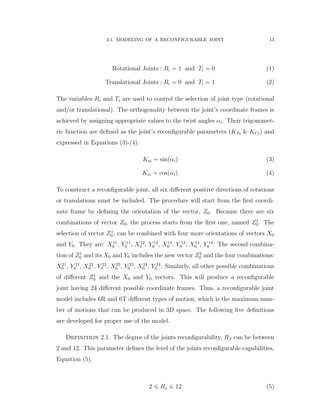
Rotational Joints : Ri “ 1 and Ti “ 0 (1)
Translational Joints : Ri “ 0 and Ti “ 1 (2)
The variables Ri and Ti are used to control the selection of joint type (rotational
and/or translational). The orthogonality between the joint’s coordinate frames is
achieved by assigning appropriate values to the twist angles αi. Their trigonomet-
ric function are defined as the joint’s reconfigurable parameters (KSi & KCi) and
expressed in Equations (3)-(4):
Ksi “ sinpαiq (3)
Kci “ cospαiq (4)
To construct a reconfigurable joint, all six different positive directions of rotations
or translations must be included. The procedure will start from the first coordi-
nate frame by defining the orientation of the vector, Z0. Because there are six
combinations of vector Z0, the process starts from the first one, named Z1
0 . The
selection of vector Z1
0 , can be combined with four more orientations of vectors X0
and Y0. They are: X11
0 , Y 11
0 , X12
0 , Y 12
0 , X13
0 , Y 13
0 , X14
0 , Y 14
0 . The second combina-
tion of Z1
0 and its X0 and Y0 includes the new vector Z2
0 and the four combinations:
X21
0 , Y 21
0 , X22
0 , Y 22
0 , X23
0 , Y 23
0 , X24
0 , Y 24
0 . Similarly, all other possible combinations
of different Z1
0 and the X0 and Y0 vectors. This will produce a reconfigurable
joint having 24 different possible coordinate frames. Thus, a reconfigurable joint
model includes 6R and 6T different types of motion, which is the maximum num-
ber of motions that can be produced in 3D space. The following five definitions
are developed for proper use of the model.
Definition 2.1. The degree of the joints reconfigurability, RJ can be between
2 and 12. This parameter defines the level of the joints reconfigurable capabilities,
Equation (5).
2 ď Rj ď 12 (5)
2.1. MODELING OF A RECONFIGURABLE JOINT 14
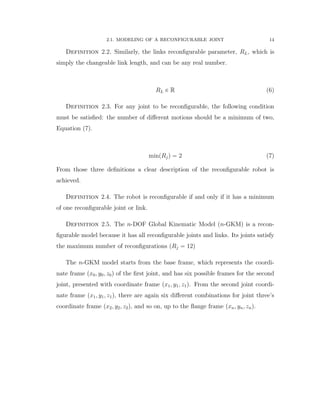
Definition 2.2. Similarly, the links reconfigurable parameter, RL, which is
simply the changeable link length, and can be any real number.
RL P R (6)
Definition 2.3. For any joint to be reconfigurable, the following condition
must be satisfied: the number of different motions should be a minimum of two,
Equation (7).
minpRjq “ 2 (7)
From those three definitions a clear description of the reconfigurable robot is
achieved.
Definition 2.4. The robot is reconfigurable if and only if it has a minimum
of one reconfigurable joint or link.
Definition 2.5. The n-DOF Global Kinematic Model (n-GKM) is a recon-
figurable model because it has all reconfigurable joints and links. Its joints satisfy
the maximum number of reconfigurations pRj “ 12q
The n-GKM model starts from the base frame, which represents the coordi-
nate frame px0, y0, z0q of the first joint, and has six possible frames for the second
joint, presented with coordinate frame px1, y1, z1q. From the second joint coordi-
nate frame px1, y1, z1q, there are again six different combinations for joint three’s
coordinate frame px2, y2, z2q, and so on, up to the flange frame pxn, yn, znq.
2.2. MODELING OF RECONFIGURABLE OPEN KINEMATIC ROBOTS 15
N-DOF Reconfigurable Kinematic
Model (RKM) with
Variable D-H Parameters
PUMA, ...
Kinematic
Structure
1
2
3
4
5
6
1d
4d
6d
2a
1a
0z
0y
0x
1x
2x
3x
4x 5x
nx 6
4y
1y
2y
3y
5y
sy 6
az 6
1z
2z
3z
4z
5z
Kinematic Structure
of the ABB Robot
1
2
4
5
6
1d
4 5 0d d 
6d
0z
0y
0x
1x 2x
3x
4x
5x
nx 6
4y
1y
2y
3y
5y
sy 6
az 6
1z 2z
3z
4z
5z
Kinematic Structure
of the Stanford Robot
2d3d
Wrist Centre
Coincide
i
Figure 2.1. Kinematic structures of the ABB and Stanford robots,
D–H parameters are from sources; Dawson, [57] and Spong, [80].
2.2. Modeling of Reconfigurable Open Kinematic Robots
The reconfigurability of a robotic arm is modeled based on the variable D–H
parameters and especially, the variable twist angle between adjacent links. Defin-
ing the varying twist angle as the configuration parameter allows the model to
achieve any kinematic structure by configuring the parameter accordingly. Figure
2.1 shows diverse industrial robots such as ABB and Stanford achieved as special
2.2. MODELING OF RECONFIGURABLE OPEN KINEMATIC ROBOTS 16
4x
4z
1y
5z
3z
5
4
6
6d3 5,z x
6n x
6a z
6s y
c
Figure 2.2. The spherical wrist, joint axes 4, 5 and 6.
cases by changes to the configuration parameter. The kinematics of the n-GKM
model can be calculated using the multiplication of the all homogeneous matrices
from the base to the flange frame. The homogeneous transformation matrix of the
n-DOF Global Kinematic Model (GKM) is given by the following equation:
i´1
Ai “
»
—
—
—
—
—
—
—
—
–
cospφiq ´Kcisinpφiq Ksisinpφiq aicospφiq
sinpφiq Kcipφiq ´Ksicospφiq aisinpφiq
0 Ksi Kci φi
0 0 0 1
fi
ffi
ffi
ffi
ffi
ffi
ffi
ffi
ffi
fl
(8)
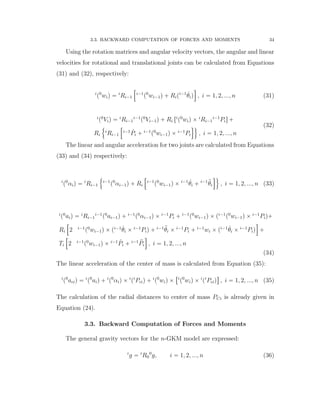
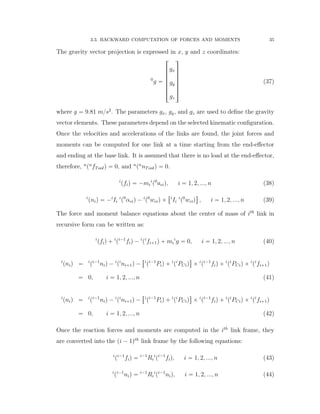
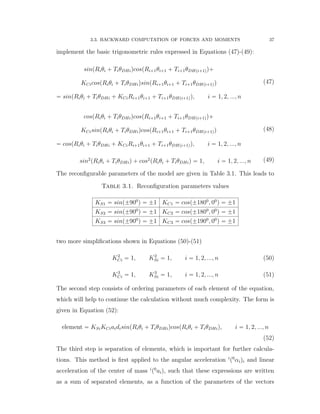
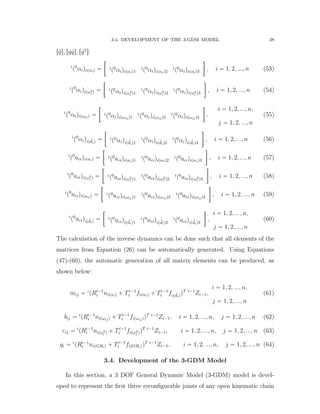
where φi “ Riθi `TiθDHi. Using this transformation matrix, models of different
open kinematic structures can be automatically generated which characterizes the
new reconfigurable robot.
2.2.1. Spherical Wrist
The spherical wrist, shown in Figure 2.2, is a three joint wrist mechanism for which
the joints axes z3, z4 and z5 intersect at the center c. The D–H parameters of the
mechanism are shown in Table 2.2. A spherical wrist satisfies Piper’s condition
[45] when a4 “ 0, a5 “ 0 and d5 “ 0. The end effector coordinate frame is: n is
the normal vector, s is the sliding vector and a is the approach vector.
2.3. RECONFIGURABLE JACOBIAN MATRIX 17
Table 2.2. D–H of a spherical wrist, source; Spong, [80].
Link θi di ai αi
4 θ4 0 0 ´900
5 θ5 0 0 900
6 θ6 d6 0 00
2.2.2. Assumption
Assuming a spherical wrist is attached to the end effectors, the kinematic struc-
tures of the common industrial robots are determined by only the first three joints
and links. This assumption also defines the external and internal workspace bound-
aries. A spherical wrist that satisfies Piper’s condition only serves to orient the
end-effector within the workspace. A hybrid joint (revolute/prismatic) motion and
its selection parameters are mathematically expressed in the following Equation:
qi “ Riθi ` Tidi (9)
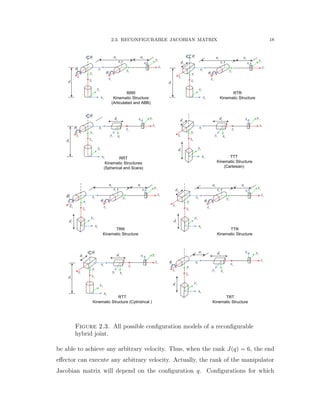
For a reconfigurable three links and joints (3-DOF), the resulting possible kine-
matic structure combinations are 23
“ 8: Articulated (RRR), Cylindrical (RTR),
Spherical (RRT), SCARA (RRT), Cartesian (TTT), TRR, TTR, RTT and TRT.
These kinematic structures are shown in Figure 2.3.
2.3. Reconfigurable Jacobian Matrix
The Jacobian matrix J P Rnˆm
is a linear transformation that maps an n-
dimensional velocity vector 9qi into an m-dimensional velocity vector 9Vi:
9Vi “
»
—
–
v
w
fi
ffi
fl “ Jpqq 9qi (10)
where the vector rvT
, wT
s are the end effector velocities and 9qi is the joint
velocities. For robot manipulators, the Jacobian is defined as the coefficient matrix
of any set of equations that relate the velocity state of the tool coordinate described
in the Cartesian space to the actuated joint rates of the joint velocity space. It is
necessary that Jpqq have six linearly independent columns for the end effector to
2.3. RECONFIGURABLE JACOBIAN MATRIX 18
RRR
Kinematic Structure
(Articulated and ABB)
RTR
Kinematic Structure0
x
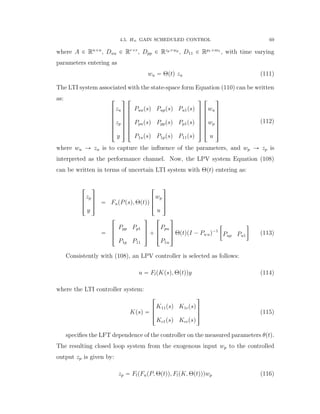
0
y
0
z
1
z 1
y
1
x
2
x
2
y
2
z
3
z
2

3

1

3
y
3
x
1
d
3
a2
a
0
x
0
y
0
z
1
z 1
y
1
x
2
x
2
y
2
z
3
z
3

1

3
y
3
x2
d
3
a2
a
1
d
TRR
Kinematic Structure
TTR
Kinematic Structure
0
x
0
y
0
z1
z
1
y
1
x
2
x
2
y
2
z
3
z
2

3

3
y
3
x
3
a2
a
1
d
0
x
0
y
0
z
1
z 1
y
1
x
2
x
2
y
2
z
3
z
3

3
y
3
x2
d
3
a2
a
1
d
RTT
Kinematic Structure (Cylindrical )
TRT
Kinematic Structure
0
x
0
y
0
z
1
z 1
y
1
x
1

1
d
2
d
2
x2
y
2
z
3
z
3
y3
x3
d
0
x
0
y
0
z
1
z 1
y
1
x
2
x2
y
2
z
3
z
3
y3
x
3
d
1
d
2

2
a
RRT
Kinematic Structures
(Spherical and Scara)
TTT
Kinematic Structure
(Cartesian)
0
x
0
y
0
z
1
z 1
y
1
x2

1

1
d
2
x2
y
2
z
3
z
3
y3
x3
d
0
x
0
y
0
z
1
z 1
y
1
x
2
x2
y
2
z
3
z
3
y3
x
2
d 3
d
1
d
Figure 2.3. All possible configuration models of a reconfigurable
hybrid joint.
be able to achieve any arbitrary velocity. Thus, when the rank Jpqq “ 6, the end
effector can execute any arbitrary velocity. Actually, the rank of the manipulator
Jacobian matrix will depend on the configuration q. Configurations for which
2.3. RECONFIGURABLE JACOBIAN MATRIX 19
the rank Jpqq is less than its maximum value are called singular configuration.
Identifying manipulator singularities is important for several reasons:
‚ Singularities represent configurations from which certain directions of mo-
tion may not be achievable.
‚ Singularities correspond to points of maximum reach on the boundary of
the manipulator workspace.
‚ At singularities, bounded end effector velocities may correspond to un-
bounded joint velocities.
2.3.1. Decoupling of Singularities
In general, it is difficult to solve the nonlinear equation det Jpqq “ 0. Therefore,
decoupling the singularities and division of singular configurations into arm and
wrist singularities are considered [80]. The first step is to determine the singular-
ities resulting from motion of the arm, and the second is to determine the wrist
singularities resulting from motion of spherical wrist. For a manipulator of n “ 6
consisting of a 3-DOF arm and 3-DOF spherical wrist the Jacobian is a 6 ˆ 6
matrix and a configuration q is singular if and only if:
detpJpqqq “ 0 (11)
where the Jacobian Jpqq is partitioned into 3 ˆ 3 blocks as:
Jpqq “ rJP JOs “
»
—
–
J11 J12
J21 J22
fi
ffi
fl (12)
Since the final three joints are always revolute and intersect at a common point
c, Figure 2.2, then JO becomes:
JO “
»
—
–
0 0 0
z3 z4 z5
fi
ffi
fl (13)
In this case the Jacobian matrix has the block triangle form:
2.4. MANIPULABILITY AND SINGULARITY 20
Jpqq “
»
—
–
J11 0
J21 J22
fi
ffi
fl (14)
with determinant:
detJpqq “ detJ11detJ22 (15)
As a result, the set of singular configurations of the manipulator is the union of the
set of arm configurations satisfying detJ11 “ 0 and the set of wrist configurations
satisfying detJ22 “ 0.
2.4. Manipulability and Singularity
The workspace of a reconfigurable manipulator defines a variable volume de-
pending on the variable D–H parameters of joint twist angle, link offset and link
length. A variable workspace of a 3-DOF reconfigurable manipulator with an RRR
configuration is shown in Figure 2.4. The variable workspace is calculated with
twist angle change values of π{16, π{8, π{4, and π{2. The resulting workspace is
a union set of spherical and elliptical volumes around the first manipulator joint.
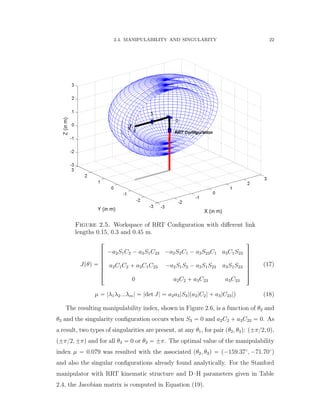
In a similar fashion, Figure 2.5 shows a variable workspace of a reconfigurable
RRT configuration with different third link lengths of 0.15, 0.3 and 0.45 m. The
workspace layers are spherical with increasing volume radially from the center of
the first joint. To compute the results, the Matlab Robotic Toolbox was used [34].
2.4.1. Manipulability
A manipulability index was introduced by Yoshikawa [89] to measure the distance
to singular configurations. The approach is based on evaluating the manipulability
ellipsoid that is spanned by the singular values of a manipulator Jacobian. The
manipulability index is given as:
µ “
a
detpJpθqJT pθqq “ σ1σ2...σm (16)
Manipulability can be used to determine the manipulator singularity and optimal
configurations in which to perform certain tasks. In some cases, it is desirable to
2.4. MANIPULABILITY AND SINGULARITY 21
Figure 2.4. Workspace of RRR Configuration with four different
twist angle values π{16, π{8, π{4, and π{2.
perform a task in a configuration for which the end effector has maximum ma-
nipulability. For the ABB manipulator robot with RRR kinematic structure and
D–H parameters given in Table 2.3, the Jacobian matrix is calculated in Equation
(17), where S23 “ sinpθ2 ` θ3q. Then, the manipulability index is calculated and
given in Equation (18).
Table 2.3. D–H parameters of the ABB manipulator robot, source;
Spong, [80].
Link θi di ai αi
1 θ1 d1 0 π/2
2 θ2 0 a2 00
3 θ3 0 a3 00
2.4. MANIPULABILITY AND SINGULARITY 22
Figure 2.5. Workspace of RRT Configuration with different link
lengths 0.15, 0.3 and 0.45 m.
Jpθq “
»
—
—
—
—
—
–
´a2S1C2 ´ a3S1C23 ´a2S2C1 ´ a3S23C1 a3C1S23
a2C1C2 ` a3C1C23 ´a2S1S2 ´ a3S1S23 a3S1S23
0 a2C2 ` a3C23 a3C23
fi
ffi
ffi
ffi
ffi
ffi
fl
(17)
µ “ |λ1λ2...λm| “ |det J| “ a2a3|S3|pa2|C2| ` a3|C23|q (18)
The resulting manipulability index, shown in Figure 2.6, is a function of θ2 and
θ3 and the singularity configuration occurs when S3 “ 0 and a2C2 ` a3C23 “ 0. As
a result, two types of singularities are present, at any θ1, for pair pθ2, θ3q: p˘π{2, 0q,
p˘π{2, ˘πq and for all θ3 “ 0 or θ3 “ ˘π. The optimal value of the manipulability
index µ “ 0.079 was resulted with the associated pθ2, θ3q “ p´159.37˝
, ´71.70˝
q
and also the singular configurations already found analytically. For the Stanford
manipulator with RRT kinematic structure and D–H parameters given in Table
2.4, the Jacobian matrix is computed in Equation (19).
2.4. MANIPULABILITY AND SINGULARITY 23
Table 2.4. D–H parameters of the Stanford manipulator robot,
source; Spong, [80].
Link θi di ai αi
1 θ1 0 0 -π/2
2 θ2 d2 0 π/2
3 0 d3 0 00
−4
−2
0
2
4
−4
−2
0
2
4
−0.08
−0.06
−0.04
−0.02
0
0.02
0.04
0.06
0.08
Theta 2 (rad)Theta 3 (rad)
sqrt(detJ11))
Figure 2.6. 3D profile of the manipulability index measure of RRR
configuration.
Jpθq “
»
—
—
—
—
—
–
´d2C1 ´ d3S1S2 d3C1C2 C1S2
´d2S1 ` d3C1S2 d3S1C2 S1S2
0 d3S2 C3
fi
ffi
ffi
ffi
ffi
ffi
fl
(19)
The manipulability index is calculated as:
µ “ |detJpθq| “ ´d2d3C1|S1| ´ d2
3|S3
2| ´ d2
3|S2|C2
2 ` d2d3|S1|C1 (20)
As a result, the singularity is present, at any θ1, for pθ2 “ 0, ˘πq. Figure 2.7 shows
the singularity and optimal manipulability index µ “ 0.999 with configuration
pθ2, θ3q “ p´71.7˝
, ´92.33˝
q. A reconfigurable robot manipulator spans the union
of at least two configurations RRR and RRT and hence it has the ability to perform
2.5. JACOBIAN CONDITION AND MANIPULABILITY 24
−4
−2
0
2
4
−4
−2
0
2
4
−1
−0.5
0
0.5
1
Theta 1 (rad)Theta 2 (rad)
sqrt(det(J11))
Figure 2.7. 3D profile of the manipulability index measure of RRT
configuration.
a wider range of tasks within the workspace by avoiding the singular configurations.
2.5. Jacobian Condition and Manipulability
The Jacobian linear system v “ Jpqq 9q maps the joint velocities to end-effector
Cartesian velocity. The Jacobian is regarded as scaling the input q to yield the
output. In a multidimensional case, the equivalent concept is to characterize the
output in terms of an input that has unit norm as follows [80]:
9q “ 9q2
1 ` 9q2
2 ` . . . ` 9q2
n ď 1 (21)
If the input (joint velocity) vector has unit norm, then the output (end-effector
velocity) will be positioned within an ellipsoid and defined :
9q 2
“ 9qT
9q
“ pJ`
vqT
J`
v
“ vT
pJJT
q´1
v (22)
where J`
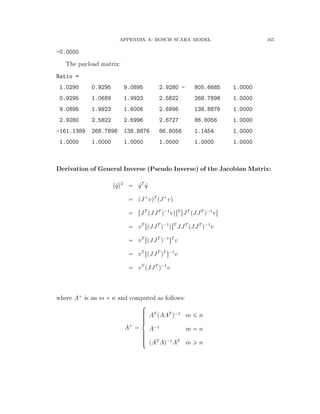
is the Jacobian pseudo inverse and the derivation of Equation (22)
in Appendix (A). In particular, if the manipulator Jacobian is full rank, then
2.5. JACOBIAN CONDITION AND MANIPULABILITY 25
Equation (22) defines m-dimensional ellipsoid known as the manipulability ellipsoid
. Replacing the Jacobian by its Singular Value Decomposition (SVD), J “ UΣV T
vT
pJJT
q´1
v “ vT
“
pUΣV T
qpUΣV T
qT
‰´1
v
vT
pJJT
q´1
v “ vT
“
UΣ2
UT
‰´1
v
vT
pJJT
q´1
v “ pvT
UqΣ´2
pUT
vq
where U P Rmˆm
and V P Rnˆn
are orthogonal matrices and the singular value
Σ P Rmˆn
is given as follows:
Σ´2
m “
»
—
—
—
—
—
—
—
—
–
σ´2
1
σ´2
2
...
σ´2
m
fi
ffi
ffi
ffi
ffi
ffi
ffi
ffi
ffi
fl
Substitute: w “ UT
v, yields:
wT
Σ´2
m w “ Σ
w2
i
σ2
i
ď 1 (23)
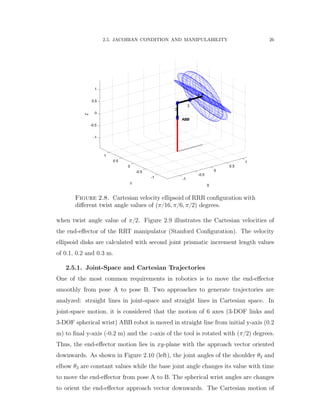
Equation (23) represents a surface of 3-dimensional ellipsoid of the end-effector
Cartesian velocity space. If this ellipsoid is close to spherical, its radii are of the
same order value, the end-effector can achieve arbitrary Cartesian velocity. But
when one or more radii are very small this indicates that the end-effector cannot
achieve velocity in the directions corresponding to those small radii. Figure 2.8
shows the RRR manipulator (Elbow Configuration) with three different twist an-
gle values pπ{16, π{6, π{2q of the second joint. End effector linear velocities with
twist angle π{2 were represented by an ellipsoid of almost equal radii in the y
and z directions. This indicates that the end-effector can achieve higher Cartesian
velocities in the y and z-directions than in the x-direction. While Cartesian ve-
locities with twist angle (π{6 and π{16) were represented with ellipses indicating
limited velocities in the y and z directions. This result shows that the optimal
configuration to obtain maximum Cartesian velocities in the y and z directions is
2.5. JACOBIAN CONDITION AND MANIPULABILITY 26
Figure 2.8. Cartesian velocity ellipsoid of RRR configuration with
different twist angle values of pπ{16, π{6, π{2q degrees.
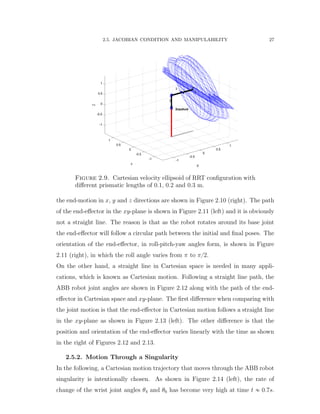
when twist angle value of π{2. Figure 2.9 illustrates the Cartesian velocities of
the end-effector of the RRT manipulator (Stanford Configuration). The velocity
ellipsoid disks are calculated with second joint prismatic increment length values
of 0.1, 0.2 and 0.3 m.
2.5.1. Joint-Space and Cartesian Trajectories
One of the most common requirements in robotics is to move the end-effector
smoothly from pose A to pose B. Two approaches to generate trajectories are
analyzed: straight lines in joint-space and straight lines in Cartesian space. In
joint-space motion, it is considered that the motion of 6 axes (3-DOF links and
3-DOF spherical wrist) ABB robot is moved in straight line from initial y-axis (0.2
m) to final y-axis (-0.2 m) and the z-axis of the tool is rotated with pπ{2q degrees.
Thus, the end-effector motion lies in xy-plane with the approach vector oriented
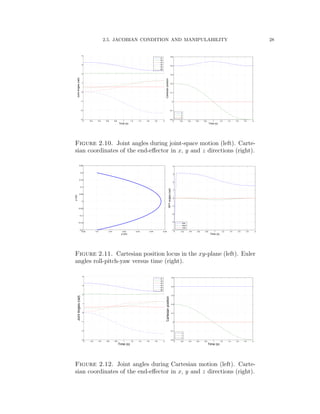
downwards. As shown in Figure 2.10 (left), the joint angles of the shoulder θ2 and
elbow θ3 are constant values while the base joint angle changes its value with time
to move the end-effector from pose A to B. The spherical wrist angles are changes
to orient the end-effector approach vector downwards. The Cartesian motion of
2.5. JACOBIAN CONDITION AND MANIPULABILITY 27
Figure 2.9. Cartesian velocity ellipsoid of RRT configuration with
different prismatic lengths of 0.1, 0.2 and 0.3 m.
the end-motion in x, y and z directions are shown in Figure 2.10 (right). The path
of the end-effector in the xy-plane is shown in Figure 2.11 (left) and it is obviously
not a straight line. The reason is that as the robot rotates around its base joint
the end-effector will follow a circular path between the initial and final poses. The
orientation of the end-effector, in roll-pitch-yaw angles form, is shown in Figure
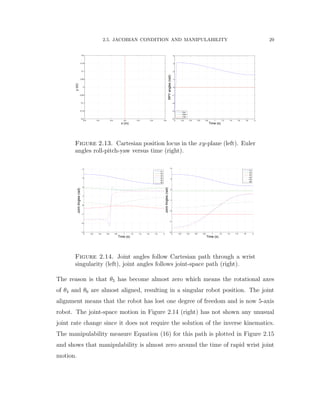
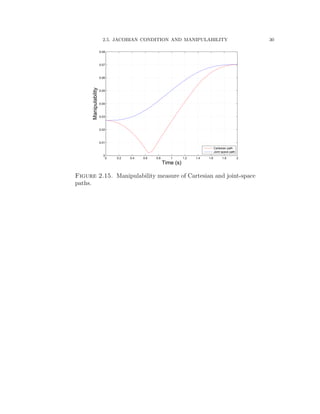
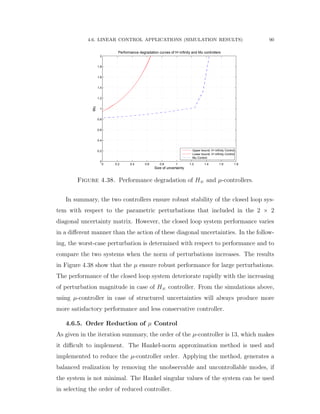
2.11 (right), in which the roll angle varies from π to π{2.
On the other hand, a straight line in Cartesian space is needed in many appli-
cations, which is known as Cartesian motion. Following a straight line path, the
ABB robot joint angles are shown in Figure 2.12 along with the path of the end-
effector in Cartesian space and xy-plane. The first difference when comparing with
the joint motion is that the end-effector in Cartesian motion follows a straight line
in the xy-plane as shown in Figure 2.13 (left). The other difference is that the
position and orientation of the end-effector varies linearly with the time as shown
in the right of Figures 2.12 and 2.13.
2.5.2. Motion Through a Singularity
In the following, a Cartesian motion trajectory that moves through the ABB robot
singularity is intentionally chosen. As shown in Figure 2.14 (left), the rate of
change of the wrist joint angles θ4 and θ6 has become very high at time t « 0.7s.
2.5. JACOBIAN CONDITION AND MANIPULABILITY 28
0 0.2 0.4 0.6 0.8 1 1.2 1.4 1.6 1.8 2
−3
−2
−1
0
1
2
3
4
Time (s)
JointAngles(rad)
q1
q2
q3
q4
q5
q6
0 0.2 0.4 0.6 0.8 1 1.2 1.4 1.6 1.8 2
−0.2
−0.1
0
0.1
0.2
0.3
0.4
0.5
Time (s)
Cartesianposition
x
y
z
Figure 2.10. Joint angles during joint-space motion (left). Carte-
sian coordinates of the end-effector in x, y and z directions (right).
0.39 0.4 0.41 0.42 0.43 0.44 0.45
−0.2
−0.15
−0.1
−0.05
0
0.05
0.1
0.15
0.2
0.25
x (m)
y(m)
0 0.2 0.4 0.6 0.8 1 1.2 1.4 1.6 1.8 2
−4
−3
−2
−1
0
1
2
3
4
Time (s)
RPYangles(rad)
Roll
Pitch
Yaw
Figure 2.11. Cartesian position locus in the xy-plane (left). Euler
angles roll-pitch-yaw versus time (right).
0 0.2 0.4 0.6 0.8 1 1.2 1.4 1.6 1.8 2
−3
−2
−1
0
1
2
3
4
Time (s)
JointAngles(rad)
q1
q2
q3
q4
q5
q6
0 0.2 0.4 0.6 0.8 1 1.2 1.4 1.6 1.8 2
−0.2
−0.1
0
0.1
0.2
0.3
0.4
0.5
Time (s)
Cartesianposition
x
y
z
Figure 2.12. Joint angles during Cartesian motion (left). Carte-
sian coordinates of the end-effector in x, y and z directions (right).
2.5. JACOBIAN CONDITION AND MANIPULABILITY 29
0.4 0.4 0.4 0.4 0.4 0.4 0.4
−0.2
−0.15
−0.1
−0.05
0
0.05
0.1
0.15
0.2
x (m)
y(m)
0 0.2 0.4 0.6 0.8 1 1.2 1.4 1.6 1.8 2
−4
−3
−2
−1
0
1
2
3
4
Time (s)
RPYangles(rad)
Roll
Pitch
Yaw
Figure 2.13. Cartesian position locus in the xy-plane (left). Euler
angles roll-pitch-yaw versus time (right).
0 0.2 0.4 0.6 0.8 1 1.2 1.4 1.6 1.8 2
−3
−2
−1
0
1
2
3
4
Time (s)
JointAngles(rad)
q1
q2
q3
q4
q5
q6
0 0.2 0.4 0.6 0.8 1 1.2 1.4 1.6 1.8 2
−2
−1
0
1
2
3
4
Time (s)
JointAngles(rad)
q1
q2
q3
q4
q5
q6
Figure 2.14. Joint angles follow Cartesian path through a wrist
singularity (left), joint angles follows joint-space path (right).
The reason is that θ5 has become almost zero which means the rotational axes
of θ4 and θ6 are almost aligned, resulting in a singular robot position. The joint
alignment means that the robot has lost one degree of freedom and is now 5-axis
robot. The joint-space motion in Figure 2.14 (right) has not shown any unusual
joint rate change since it does not require the solution of the inverse kinematics.
The manipulability measure Equation (16) for this path is plotted in Figure 2.15
and shows that manipulability is almost zero around the time of rapid wrist joint
motion.
2.5. JACOBIAN CONDITION AND MANIPULABILITY 30
0 0.2 0.4 0.6 0.8 1 1.2 1.4 1.6 1.8 2
0
0.01
0.02
0.03
0.04
0.05
0.06
0.07
0.08
Time (s)
Manipulability
Cartesian path
Joint space path
Figure 2.15. Manipulability measure of Cartesian and joint-space
paths.
CHAPTER 3
Reconfigurable Robot Dynamics
In this chapter, the dynamics of a reconfigurable open kinematic robot is devel-
oped and analyzed following the method given by Djuric, Al Saidi and ElMaraghy
[38]. The motor that actuates the jth
hybrid joint exerts a torque that causes the
outward link, j, to accelerate and also exerts a reaction on the inwards link j ´ 1.
Gravity acting on the outward links j to n exert a weight force, and rotating links
also exert gyroscopic forces on each other. The resulting inertia from the motor
exertion is a function of the configuration of the outward links.
3.1. Reconfigurable Global Dynamic Model
The Global Dynamic Model (n-GDM) includes the link’s masses, m1, m2, . . . , mn
and center of masses, PC1, PC2, . . . , PCn. The center of mass PC1 is between joint
1 and joint 2, PC2 is between joint 2 and joint 3,..., etc., up to the last link. The
coordinates of any center of mass PCi is defined relative to the joint i ` 1 frame:
(xi`1, yi`1, zi`1). For the n-GDM model, which includes n reconfigurable joints,
the center of mass can be in 24 different places between any two successive joints.
This means that for each selection of the zi`1 coordinate frames, there are four
possible centers of mass: P1
Ci, P2
Ci, P3
Ci, P4
Ci. To find the center of mass of each
link for the n-GDM model, all possible coordinate frames are included and for all
joints. The analysis was done for the center of mass between joint 1 and joint 2.
The same procedure can be applied to the other n ´ 1 center of mass. A selection
of the z1
0 axis can support four different x-axis: x11
0 , x12
0 , x13
0 , x14
0 . For joint 2,
there are four different combinations of x1: x11
1 , x12
1 , x13
1 , x14
1 . Each of the four
x-combinations has four more combinations of the joint 2 coordinate frame. In
total there are sixteen different combinations of the first coordinate frame. By ob-
serving the coordinates of each center of mass, P1
C1, P2
C1, P3
C1, and P4
C1, relative to
31
3.2. FORWARD COMPUTATION FOR RECONFIGURABLE ROBOT 32
all sixteen possible combinations, the general unified solution has been developed
and presented in Equation (24):
PCi “
»
—
—
—
—
—
–
´cospθDHiqai
2
KCisinpθDHiqai
2
´ KSi
dDHi
2
´KCisinpθDHiqai
2
´ KCi
dDHi
2
fi
ffi
ffi
ffi
ffi
ffi
fl
, i “ 1, 2, . . . , n (24)
The moment of inertia about the center of mass for each link is related to
its shape and dimension. The inertia tensor matrix of the n-GDM is shown in
Equation (25):
Ii “
»
—
—
—
—
—
–
Ixi 0 0
0 Iyi 0
0 0 Izi
fi
ffi
ffi
ffi
ffi
ffi
fl
, i “ 1, 2, . . . , n (25)
The n-GDM model is derived and presented in state space form using the
aforementioned information. The equations of motion for an n-DOF manipulator
are given as follows:
Mpqq:q ` Bpqqr 9q 9qs ` Cp 9qqr 9q2
s ` Gpqq “ τ (26)
Matrix M is the n ˆ n symmetric positive definite inertia matrix. B is the n ˆ
řn´1
i“1 pn´iq, Coriolis torque matrix. C is the nˆn centrifugal torque matrix and G
is the n ˆ 1 gravity torque vector. The vectors 9q, :q are the vectors of joint velocity
and acceleration, respectively. The velocity product vector r 9q 9qs is given as r 9q 9qs “
r 9q1 9q2 9q1 9q3 . . . 9q1 9qn . . . 9qn´1 9qns and r 9q2
s “ r 9q2
1 9q2
2 . . . 9q2
ns is the vector of squared
velocity. The n-GDM model is calculated using the RNE (Recursive Newton-
Euler) algorithm which is developed and can be applied for any reconfigurable
open kinematic manipulator.
3.2. Forward Computation for Reconfigurable Robot
Using D–H parameters in Table 2.1, the general homogeneous transformation
matrix is expressed in Equation (8). The upper 3ˆ3 sub-matrices of the each
3.2. FORWARD COMPUTATION FOR RECONFIGURABLE ROBOT 33
homogeneous transformation matrix represent the rotational matrix for each joint,
and they are presented as follows:
i´1
Ri “
»
—
—
—
—
—
–
cospRiθi ` TiθDHiq ´Kci sinpRiθi ` TiθDHiq Ksi sinpRiθi ` TiθDHiq
sinpRiθi ` TiθDHiq Kci cospRiθi ` TiθDHiq ´Ksi cospRiθi ` TiθDHiq
0 Ksi Kci
fi
ffi
ffi
ffi
ffi
ffi
fl
,
i “ 1, 2, ..., n
(27)
The next step is to find the transpose of all rotational matrices pi´1
RiqT
, as
shown in Equation (28):
p0
R1qT
“
»
—
—
—
—
—
–
cospR1θ1 ` T1θDH1q sinpR1θ1 ` T1θDH1q 0
´Kc1 sinpR1θ1 ` T1θDH1q Kc1 cospR1θ1 ` T1θDH1q Ks1
Ks1 sinpR1θ1 ` T1θDH1q ´Ks1 cospR1θ1 ` T1θDH1q Kc1
fi
ffi
ffi
ffi
ffi
ffi
fl
,
i “ 1, 2, ..., n
(28)
The upper right 3ˆ1 sub-matrix for each homogeneous transformation matrix
represent the position vectors for each joint and are stated in Equation (29):
i´1
Pi “
»
—
—
—
—
—
–
aicospRiθi ` TiθDHiq
aisinpRiθi ` TiθDHiq
RidDHi ` Tidi
fi
ffi
ffi
ffi
ffi
ffi
fl
, i “ 1, 2, ..., n (29)
The linear and angular velocity vectors and acceleration vectors for n joints
are presented in Equation (30):
i´1 9Pi “
»
—
—
—
—
—
–
0
0
9di
fi
ffi
ffi
ffi
ffi
ffi
fl
, i´1 9θi “
»
—
—
—
—
—
–
0
0
9θi
fi
ffi
ffi
ffi
ffi
ffi
fl
, i´1 :Pi “
»
—
—
—
—
—
–
0
0
:di
fi
ffi
ffi
ffi
ffi
ffi
fl
, i´1 :θi “
»
—
—
—
—
—
–
0
0
:θi
fi
ffi
ffi
ffi
ffi
ffi
fl
, i “ 1, 2, ..., n (30)
3.3. BACKWARD COMPUTATION OF FORCES AND MOMENTS 34
Using the rotation matrices and angular velocity vectors, the angular and linear
velocities for rotational and translational joints can be calculated from Equations
(31) and (32), respectively:
i
p0
wiq “ i
Ri´1
”
i´1
p0
wi´1q ` Ripi´1 9θiq
ı
, i “ 1, 2, ..., n (31)
i
p0
Viq “ i
Ri´1
i´1
p0
Vi´1q ` Ri ri
p0
wiq ˆ i
Ri´1
i´1
Pis `
Ri
!
i
Ri´1
”
i´1 9Pi ` i´1
p0
wi´1q ˆ i´1
Pi
ı)
, i “ 1, 2, ..., n
(32)
The linear and angular acceleration for two joints are calculated from Equations
(33) and (34) respectively:
i
p0
αiq “ i
Ri´1
!
i´1
p0
αi´1q ` Ri
”
i´1
p0
wi´1q ˆ i´1 9θi ` i´1 :θi
ı)
, i “ 1, 2, ..., n (33)
i
p0
aiq “ i
Ri´1
i´1
p0
ai´1q ` i´1
p0
αi´1q ˆ i´1
Pi ` i´1
p0
wi´1q ˆ pi´1
p0
wi´1q ˆ i´1
Piq`
Ri
”
2 i´1
p0
wi´1q ˆ pi´1 9θi ˆ i´1
Piq ` i´1 :θi ˆ i´1
Pi ` i´1
wi ˆ pi´1 9θi ˆ i´1
Piq
ı
`
Ti
”
2 i´1
p0
wi´1q ˆ i´1 9Pi ` i´1 :Pi
ı
, i “ 1, 2, ..., n
(34)
The linear acceleration of the center of mass is calculated from Equation (35):
i
p0
aciq “ i
p0
aiq ` i
p0
αiq ˆ i
pi
Pciq ` i
p0
wiq ˆ
“i
p0
wiq ˆ i
pi
Pciq
‰
, i “ 1, 2, ..., n (35)
The calculation of the radial distances to center of mass PCi is already given in
Equation (24).
3.3. Backward Computation of Forces and Moments
The general gravity vectors for the n-GKM model are expressed:
i
g “ i
R0
0
g, i “ 1, 2, ..., n (36)
3.3. BACKWARD COMPUTATION OF FORCES AND MOMENTS 35
The gravity vector projection is expressed in x, y and z coordinates:
0
g “
»
—
—
—
—
—
–
gx
gy
gz
fi
ffi
ffi
ffi
ffi
ffi
fl
(37)
where g “ 9.81 m{s2
. The parameters gx, gy, and gz are used to define the gravity
vector elements. These parameters depend on the selected kinematic configuration.
Once the velocities and accelerations of the links are found, the joint forces and
moments can be computed for one link at a time starting from the end-effector
and ending at the base link. It is assumed that there is no load at the end-effector,
therefore, n
pn
fToolq “ 0, and n
pn
nToolq “ 0.
i
pfiq “ ´mi
i
p0
aciq, i “ 1, 2, ..., n (38)
i
pniq “ ´i
Ii
i
p0
αciq ´ i
p0
wciq ˆ
“i
Ii
i
p0
wciq
‰
, i “ 1, 2, ..., n (39)
The force and moment balance equations about the center of mass of ith
link in
recursive form can be written as:
i
pfiq ` i
pi´1
fiq ´ i
pi
fi`1q ` mi
i
g “ 0, i “ 1, 2, ..., n (40)
i
pniq “ i
pi´1
niq ´ i
pi
ni`1q ´
“i
pi´1
Piq ` i
pi
PCiq
‰
ˆ i
pi´1
fiq ` i
pi
PCiq ˆ i
pi
fi`1q
“ 0, i “ 1, 2, ..., n (41)
i
pniq “ i
pi´1
niq ´ i
pi
ni`1q ´
“i
pi´1
Piq ` i
pi
PCiq
‰
ˆ i
pi´1
fiq ` i
pi
PCiq ˆ i
pi
fi`1q
“ 0, i “ 1, 2, ..., n (42)
Once the reaction forces and moments are computed in the ith
link frame, they
are converted into the pi ´ 1qth
link frame by the following equations:
i
pi´1
fiq “ i´1
Ri
i
pi´1
fiq, i “ 1, 2, ..., n (43)
i
pi´1
niq “ i´1
Ri
i
pi´1
niq, i “ 1, 2, ..., n (44)
3.3. BACKWARD COMPUTATION OF FORCES AND MOMENTS 36
Torques τi and forces fi are obtained by projecting the moments and forces onto
their corresponding joint axes respectively:
τi “ i
pi´1
niqT i´1
Zi´1, i “ 1, 2, ..., n (45)
fi “ i
pi´1
fiqT i´1
Zi´1, i “ 1, 2, ..., n (46)
The RNE procedure produced the final n expressions of the actuators’ torques and
forces τi, i “ 1, 2, . . . , n. Each of these n equations contains the sum of products
of the matrices’ elements M, B, C, G, and trigonometric terms. To be able to get
a dynamic equation in the form of Equation (26), each matrix was generated i.e.
M, B, C, and G, and their elements were calculated:
m11, m12, . . . , m1n, . . . , mnn, b112, b113, . . . , b1pn´1qn, . . . , bnpn´1qn,
c11, c12, . . . , c1n, . . . , cnn, g1, g2, . . . , gn.
To avoid complications when factoring out each element in each expression, the
Automatic Separation Method (ASM) is used, which produces an automatic gen-
eration of matrix elements [38]. Using the Newton-Euler recursive method for
calculating the forces and/or torques of the links for any open kinematic chain will
result n-equations. Each equation is a solution for force and/or torque of the link,
which includes four elements: the first one is related to inertia force/torque vector,
the second one is related to Coriolis force/torque vector, the third one is related
to centrifugal force/torque vector and the fourth one to gravity force/torque vec-
tor. These results will be coupled with the dynamics of different motors to form
a block diagram for control purposes. The elements of the matrices of the inertia
matrix, Coriolis matrix, centrifugal matrix and the gravity vector were calculated
to construct a complete block diagram of a robot. For these calculation, the ASM
method was used by starting the calculation of angular acceleration elements re-
lated the inertia, Coriolis centrifugal and gravity elements, Equations (53)-(60).
This procedure has three steps. The first step is to simplify and organize the an-
gular and linear velocity equations. To overcome these problems it is necessary to
3.3. BACKWARD COMPUTATION OF FORCES AND MOMENTS 37
implement the basic trigonometric rules expressed in Equations (47)-(49):
sinpRiθi ` TiθDHiqcospRi`1θi`1 ` Ti`1θDHpi`1qq`
KCicospRiθi ` TiθDHiqsinpRi`1θi`1 ` Ti`1θDHpi`1qq
“ sinpRiθi ` TiθDHi ` KCiRi`1θi`1 ` Ti`1θDHpi`1qq, i “ 1, 2, ..., n
(47)
cospRiθi ` TiθDHiqcospRi`1θi`1 ` Ti`1θDHpi`1qq`
KCisinpRiθi ` TiθDHiqcospRi`1θi`1 ` Ti`1θDHpi`1qq
“ cospRiθi ` TiθDHi ` KCiRi`1θi`1 ` Ti`1θDHpi`1qq, i “ 1, 2, ..., n
(48)
sin2
pRiθi ` TiθDHiq ` cos2
pRiθi ` TiθDHiq “ 1, i “ 1, 2, ..., n (49)
The reconfigurable parameters of the model are given in Table 3.1. This leads to
Table 3.1. Reconfiguration parameters values
KS1 “ sinp˘900
q “ ˘1 KC1 “ cosp˘1800
, 00
q “ ˘1
KS2 “ sinp˘900
q “ ˘1 KC2 “ cosp˘1800
, 00
q “ ˘1
KS3 “ sinp˘900
q “ ˘1 KC3 “ cosp˘1900
, 00
q “ ˘1
two more simplifications shown in Equations (50)-(51)
K2
Ci “ 1, K2
Si “ 1, i “ 1, 2, ..., n (50)
K3
Ci “ 1, K3
Si “ 1, i “ 1, 2, ..., n (51)
The second step consists of ordering parameters of each element of the equation,
which will help to continue the calculation without much complexity. The form is
given in Equation (52):
element “ KSiKCiaidisinpRiθi ` TiθDHiqcospRiθi ` TiθDHiq, i “ 1, 2, ..., n
(52)
The third step is separation of elements, which is important for further calcula-
tions. This method is first applied to the angular acceleration i
p0
αiqi and linear
acceleration of the center of mass i
p0
aiq, such that these expressions are written
as a sum of separated elements, as a function of the parameters of the vectors
3.4. DEVELOPMENT OF THE 3-GDM MODEL 38
r:qs, r 9q 9qs, r 9q2
s:
i
p0
αiqipαiq “
„
i
p0
αiqipαiq1
i
p0
αiqipαiq2
i
p0
αiqipαiq3

, i “ 1, 2, ..., n (53)
i
p0
αiqipω2
i q “
„
i
p0
αiqipω2
i q1
i
p0
αiqipω2
i q2
i
p0
αiqipω2
i q3

, i “ 1, 2, ..., n (54)
i
p0
αiqipωijq “
„
i
p0
αiqipωijq1
i
p0
αiqipωijq2
i
p0
αiqipωijq3

,
i “ 1, 2, ..., n,
j “ 1, 2, ..., n
(55)
i
p0
αiqip :diq “
„
i
p0
αiqip :diq1
i
p0
αiqip :diq2
i
p0
αiqip :diq3

, i “ 1, 2, ..., n (56)
i
p0
aciqipαiq “
„
i
p0
aciqipαiq1
i
p0
aciqipαiq2
i
p0
aciqipαiq3

, i “ 1, 2, ..., n (57)
i
p0
aciqipω2
i q “
„
i
p0
aciqipω2
i q1
i
p0
aciqipω2
i q2
i
p0
aciqipω2
i q3

, i “ 1, 2, ..., n (58)
i
p0
aciqipωijq “
„
i
p0
aciqipωijq1
i
p0
aciqipωijq2
i
p0
aciqipωijq3

, i “ 1, 2, ..., n (59)
i
p0
aciqip :diq “
„
i
p0
aciqip :diq1
i
p0
aciqip :diq2
i
p0
aciqip :diq3

,
i “ 1, 2, ..., n,
j “ 1, 2, ..., n
(60)
The calculation of the inverse dynamics can be done such that all elements of the
matrices from Equation (26) can be automatically generated. Using Equations
(47)-(60), the automatic generation of all matrix elements can be produced, as
shown below:
mij “ i
pRi´1
i nipαiq ` Ti´1
i fipαiq ` Ti´1
i fip :diqqT i´1
Zi´1,
i “ 1, 2, ..., n,
j “ 1, 2, ..., n
(61)
bij “ i
pRi´1
i nipωijq ` Ti´1
i fipωijqqT i´1
Zi´1, i “ 1, 2, ..., n, j “ 1, 2, ..., n (62)
cij “ i
pRi´1
i nipω2
i q ` Ti´1
i fipω2
i qqT i´1
Zi´1, i “ 1, 2, ..., n, j “ 1, 2, ..., n (63)
gi “ i
pRi´1
i nipGRiq ` Ti´1
i fipGRiqqT i´1
Zi´1, i “ 1, 2, ..., n, j “ 1, 2, ..., n (64)
3.4. Development of the 3-GDM Model
In this section, a 3 DOF General Dynamic Model (3-GDM) model is devel-
oped to represent the first three reconfigurable joints of any open kinematic chain
3.4. DEVELOPMENT OF THE 3-GDM MODEL 39
Table 3.2. Reconfigurable D–H parameters of the 3-GKM model
i di θi ai αi
1 R1dDH1 ` T1d1 R1θ1 ` T1θDH1 a1 00
, ˘1800
, ˘900
2 R2dDH2 ` T2d2 R2θ2 ` T2θDH2 a2 00
, ˘1800
, ˘900
3 RndDHn ` Tndn Rnθn ` TnθDHn an 00
, ˘1800
, ˘900
manipulator, assuming a spherical wrist is attached to the end effector. The D–H
parameters of the 3-GKM kinematic model are given in Table 3.2.
»
—
—
—
—
—
–
m11 m12 m13
m21 m22 m23
m31 m32 m33
fi
ffi
ffi
ffi
ffi
ffi
fl
»
—
—
—
—
—
–
:q1
:q2
:q3
fi
ffi
ffi
ffi
ffi
ffi
fl
`
»
—
—
—
—
—
–
b112 b113 b123
b212 b213 b223
b312 b313 b323
fi
ffi
ffi
ffi
ffi
ffi
fl
»
—
—
—
—
—
–
9q1 9q2
9q1 9q3
9q2 9q3
fi
ffi
ffi
ffi
ffi
ffi
fl
`
»
—
—
—
—
—
–
c11 c12 c13
c21 c22 c23
c31 c32 c33
fi
ffi
ffi
ffi
ffi
ffi
fl
»
—
—
—
—
—
–
9q1
2
9q2
2
9q3
2
fi
ffi
ffi
ffi
ffi
ffi
fl
`
»
—
—
—
—
—
–
G1
G2
G3
fi
ffi
ffi
ffi
ffi
ffi
fl
“
»
—
—
—
—
—
–
τ1
τ2
τ3
fi
ffi
ffi
ffi
ffi
ffi
fl
(65)
The matrices (M, B, C, G) of the dynamic system Equation (26) are calculated
for the 3-GKM model using the Equations (61)-(64) form which each element of
the four matrices was automatically generated forming Equation (65).
3.4.1. Model Validation
The validation of the 3-GKM model was done by using 2-DOF and 3-DOF config-
urations. The selected configurations (RR, RT, TR, and TT planar and SCARA)
are used to illustrate the model general capabilities.
RR Planar Manipulator
The RR planar kinematic structure is graphically shown in Figure 3.1. The kine-
matic and dynamic parameters of the planar kinematic structure are shown in
tables 3.3 and 3.4, respectively. Using these parameters and the 3-GDM model,
the RR configuration results the dynamic Equations (66).
3.4. DEVELOPMENT OF THE 3-GDM MODEL 40
 
Figure 5: RR planar kinematic structure
2z1z
0x
0y
2 1x
1y
2x
2y
1a 2a
1m 2m
0z
1
Figure 3.1. RR planar kinematic structure.
Table 3.3. Kinematic initial parameters of 2-DOF RR configuration
Configuration Ri Ti KSi KCi dDHi θDHi
Joint 1 1 0 0 1 0 00
Joint 2 1 0 0 1 0 00
Table 3.4. Dynamic initial parameters of 2-DOF RR configuration
Configuration Gx Gy Gz Ix1 Iy1 Iz1 Ix2 Iy2 Iz2
RR Planar 0 ´1 0 Ix1 Iy1 Iz1 Ix2 Iy2 Iz2
»
—
–
1
4
pa2
2m2 ` 4a2m2cospθ2qa1 ` 4Iz2 ` m1a2
1 ` 4Iz1q 1
4
pa2
2m2 ` 4a2m2cospθ2qa1 ` 4Iz2q
1
4
pa2
2m2 ` 4a2m2cospθ2qa1 ` 4Iz2q 1
4
pa2
2m2 ` 4a2m2cospθ2qa1 ` 4Iz2q
fi
ffi
fl
»
—
–
:q1
:q2
fi
ffi
fl
»
—
–
´1
2
a1sinpθ2qm2w1w2a2
0
fi
ffi
fl 9q1 9q2 `
»
—
–
0 ´1
2
a1sinpθ2qm2w2
2a2
´1
2
a2sinpθ2qm2w2
2a2 0
fi
ffi
fl
»
—
–
9q2
1
9q2
2
fi
ffi
fl `
»
—
–
1
2
gpa2m2cospθ1 ` θ2q ` a1sinpθ1qm2sinpθ1 ` θ2q ` a1cospθ2qm2cospθ1 ` θ2q ` a1m1cospθ1q
1
2
a2m2cospθ1 ` θ2qg
fi
ffi
fl
“
»
—
–
τ1
τ2
fi
ffi
fl
(66)
RT Planar Manipulator
The RT planar kinematic structure is graphically presented in Figure 3.2. The
3.4. DEVELOPMENT OF THE 3-GDM MODEL 41 
 
 
Figure 6: RT planar kinematic structure
 
 
2z1z
0x
0y
2d
1x
1y
2x
2y
1a 2a
1m 2m
0z
1
Figure 3.2. RT planar kinematic structure.
kinematic and dynamic parameters of the RT planar kinematic structure are shown
in tables 3.5 and 3.6. Using these parameters and the 3-GDM model, the RT
configuration results the dynamic equations (67).
Table 3.5. Kinematic initial parameters of 2-DOF RT configuration
Configuration Ri Ti KSi KCi dDHi θDHi
Joint 1 1 0 0 1 0 00
Joint 2 0 1 0 1 0 00
Table 3.6. Dynamic initial parameters of 2-DOF RT configuration
Configuration Gx Gy Gz Ix1 Iy1 Iz1 Ix2 Iy2 Iz2
RT Planar 0 ´1 0 Ix1 Iy1 Iz1 Ix2 Iy2 Iz2
»
—
–
m2a1a2 ` 1
4
a2
2m2 ` Iz2α1 ` m2a2
1 ` 1
4
a2
1m2 ` Iz1 0
0 m2
:d2
fi
ffi
fl
»
—
–
:q1
:q2
fi
ffi
fl
`
»
—
–
0
0
fi
ffi
fl 9q1 9q2 `
»
—
–
0 0
0 0
fi
ffi
fl
»
—
–
9q2
1
9q2
2
fi
ffi
fl `
»
—
–
1
4
cospθ1qgpa2m2 ` a1m1q
0
fi
ffi
fl “
»
—
–
τ1
τ2
fi
ffi
fl
(67)
TR Planar Manipulator
The TR planar kinematic structure is graphically presented in Figure 3.3. The
kinematic and dynamic parameters of the TR planar kinematic structure are shown
in tables 3.7 and 3.8. Using these parameters and the 3-GDM model, the TR
configuration results the dynamic equations (68).
3.4. DEVELOPMENT OF THE 3-GDM MODEL 42 
 
 
Figure 7: TR planar kinematic structure
 
 
2z1z
0x
0y
2 1x
1y
2x
2y
1a 2a
1m 2m
0z 1d
Figure 3.3. TR planar kinematic structure.
Table 3.7. Kinematic initial parameters of 2-DOF TR configuration
Configuration Ri Ti KSi KCi dDHi θDHi
Joint 1 0 1 0 1 0 00
Joint 2 1 0 0 1 0 00
Table 3.8. Dynamic initial parameters of 2-DOF TR configuration
Configuration Gx Gy Gz Ix1 Iy1 Iz1 Ix2 Iy2 Iz2
TR Planar 0 ´1 0 Ix1 Iy1 Iz1 Ix2 Iy2 Iz2
 
Figure 8: TT planar kinematic structure


2z1z
0x
0y
2d
1x
1y
2x
2y
1a 2a
1m 2m
0z
1d
Figure 3.4. TT planar kinematic structure.
»
—
–
m1 ` m2 0
0 1
4
a2
2m2 ` Iz2
fi
ffi
fl
»
—
–
:q1
:q2
fi
ffi
fl `
»
—
–
0
0
fi
ffi
fl 9q1 9q2 `
»
—
–
0 0
0 0
fi
ffi
fl
»
—
–
9q2
1
9q2
2
fi
ffi
fl `
»
—
–
0
1
2
a2m2cospθ2qg
fi
ffi
fl “
»
—
–
τ1
τ2
fi
ffi
fl
(68)
TT Planar Manipulator
The TT planar kinematic structure is graphically presented in Figure 3.4. The
kinematic and dynamic parameters of the TT planar kinematic structure are shown
in tables 3.9 and 3.10. Using these parameters and the 3-GDM model, the TT
configuration results the following dynamic equations (69).
3.4. DEVELOPMENT OF THE 3-GDM MODEL 43
Table 3.9. Kinematic initial parameters of 2-DOF TT configuration
Configuration Ri Ti KSi KCi dDHi θDHi
Joint 1 0 1 0 1 0 00
Joint 2 0 1 0 1 0 00
Table 3.10. Dynamic initial parameters of 2-DOF TT configuration
Configuration Gx Gy Gz Ix1 Iy1 Iz1 Ix2 Iy2 Iz2
TT Planar 0 ´1 0 Ix1 Iy1 Iz1 Ix2 Iy2 Iz2
Table 3.11. Kinematic initial parameters of 3-DOF SCARA con-
figuration
Configuration Ri Ti KSi KCi dDHi θDHi
Joint 1 1 0 0 1 dDH1 00
Joint 2 1 0 0 -1 0 00
Joint 3 0 1 0 1 d3 00
»
—
–
m1 ` m2 m2
m2 m2
fi
ffi
fl
»
—
–
:q1
:q2
fi
ffi
fl `
»
—
–
0
0
fi
ffi
fl 9q1 9q2 `
»
—
–
0 0
0 0
fi
ffi
fl
»
—
–
9q2
1
9q2
2
fi
ffi
fl `
»
—
–
0
0
fi
ffi
fl “
»
—
–
τ1
τ2
fi
ffi
fl (69)
3-DOF Scara Kinematic Structure Manipulator
The validation of 3-GDM model is done using SCARA kinematic structure which
is graphically shown in Figure 3.5. The kinematic and dynamic parameters of the
SCARA kinematic structure are presented in tables 3.11 and 3.12. Using these
parameters and the 3-GDM model, the Scara configuration results the dynamic
equations (70). The dynamic model for the three-axis Scara robot in Equations
(70) is only slightly more complex than the dynamic model for two-axis planar
articulated robot. This is because a Scara robot is essentially a two-axis articulated
robot used to establish the horizontal tool position, plus an orthogonal one-axis
prismatic link used to establish vertical tool position.
3.4. DEVELOPMENT OF THE 3-GDM MODEL 44
0z
0x 0y
1
1d
1z
1y
2
1a 2a
1x
2z
2y
2x
3d
3z
3y 3x
1m 2m
3m
g
Figure 3.5. Scara kinematic structure.
Table 3.12. Dynamic initial parameters of 3-DOF SCARA config-
uration
Conf. Gx Gy Gz Ix1 Iy1 Iz1 Ix2 Iy2 Iz2 Ix3 Iy3 Iz3
Scara 0 0 ´1 0 1
12
m1a2
1
1
12
m1a2
1 0 1
12
m2a2
2
1
12
m2a2
2
1
12
m3d2
3
1
12
m3d2
3 0
»
—
—
—
—
—
–
`m1
3
` m2 ` m3
˘
a2
1 ` pm2 ` m3qcospθ2qa1a2 ` pm2
3
` m3qa2
2
pm3 ` m2
3
qa2
2 ` pm3 ` m2
2
qcospθ2qa1a2
0
pm3 ` m2
3
qa2
2 ` pm3 ` m2
2
qcospθ2qa1a2 0
pm3 ` m2
3
qa2
2 0
0 m3
:d3
fi
ffi
ffi
ffi
ffi
ffi
fl
»
—
—
—
—
—
–
:q1
:q2
:q3
fi
ffi
ffi
ffi
ffi
ffi
fl
`
»
—
—
—
—
—
–
´2pm3 ` m2
2
qsinpθ2qa1a2 0 0
0 0 0
0 0 0
fi
ffi
ffi
ffi
ffi
ffi
fl
»
—
—
—
—
—
–
9q1 9q2
9q1 9q3
9q2 9q3
fi
ffi
ffi
ffi
ffi
ffi
fl
`
»
—
—
—
—
—
–
0 ´pm3 ` m2
2
qsinpθ2qa1a2 0
pm3 ` m2
2
qsinpθ2qa1a2 0 0
0 0 0
fi
ffi
ffi
ffi
ffi
ffi
fl
»
—
—
—
—
—
–
9q2
1
9q2
2
9q2
3
fi
ffi
ffi
ffi
ffi
ffi
fl
`
»
—
—
—
—
—
–
0
0
´m3g
fi
ffi
ffi
ffi
ffi
ffi
fl
“
»
—
—
—
—
—
–
τ1
τ2
τ3
fi
ffi
ffi
ffi
ffi
ffi
fl
(70)
It is clear from (70) that the motion of the third joint is completely independent
of the other two joints. The motion of the first two joints depends on the mass
3.5. PARAMETER PROPERTIES OF A RECONFIGURABLE ROBOT 45
of the third link, which as acts as a load, but otherwise independent of the third
joint.
3.5. Parameter Properties of a Reconfigurable Robot
The equations of motion (E.O.M) of various manipulators derived in the previ-
ous sections, can be described with a set of coupled differential equations in matrix
form:
τ “ Mpqq:q ` Cpq, 9qq ` F 9q ` Gpqq (71)
where q, 9q and :q are respectively the vector of generalized joint coordinates, ve-
locities and accelerations. M is the joint-space inertia matrix, C is the Coriolis
and centripetal coupling matrix, F is the friction force, G is the gravity loading,
and τ is the vector of generalized actuator torques associated with the generalized
coordinates q. This equation describes the manipulator rigid-body dynamics and
is known as the inverse dynamics, given the pose, velocity and acceleration it com-
putes the required joint forces and torques. In the previous sections, An efficient
reconfigurable recursive Newton-Euler algorithm was developed to compute the
Equation (71) for any open kinematic chain manipulator. This algorithm starts at
the base and working outwards adds the velocity and acceleration of each joint in
order to determine the velocity and acceleration of each link. Then working from
the tool back to the base, it computes the forces and moments acting on each link
and thus the joint torques.
In this section, the effect of varying configurations on dynamic parameters such
as the inertia and gravity load terms of a reconfigurable manipulator is analyzed
and investigated thoroughly. The D–H parameters of a predefined kinematic struc-
ture (PUMA 560) are given in Table 3.13 by Corke [33]. Using these parameters,
the workspace of the first three revolute joints and links is calculated and shown
in Figure 3.6. The workspace of a reconfigurable robot manipulator with simi-
lar kinematic structure to the PUMA 560 is also calculated and shown in Figure
3.7. The resulting variable workspace shows a union of three layers that indicates
the workspace variability property of any reconfigurable manipulator. The three
workspace layers are calculated based on turning the third joint into a prismatic
3.5. PARAMETER PROPERTIES OF A RECONFIGURABLE ROBOT 46
Table 3.13. D–H parameters of the PUMA 560 Manipulator,
source; Fu, [41].
Joint j θj dj aj αj Joint range
1 θ1 0.3302 0 -π{2 -160 to +160
2 θ2 0 0.2032 0 -225 to 45
3 θ3 -0.05 0 π{2 -45 to 225
4 θ4 0.2032 0 -π{2 -110 to 170
5 θ5 0 0 π{2 -100 to 100
6 θ6 0 0 0 -226 to 266
Figure 3.6. The workspace of a predefined kinematic structure of
the PUMA 560.
one (translational motion). This variable workspace was generated when the third
joint has translated with 0.1, 0.2, 0.3 m.
3.5.1. Gravity Load Term
Gravity load term in Equation (71) is generally a dominant term and present
even when the manipulator is stationary or moving slowly. The torque on a joint
due to gravity acting on the robot depends strongly on the robot’s pose. The
torque on the shoulder joint 2 is much greater when the robot is stretched out
horizontally as shown in Figure 3.8. The gravity torque on the elbow is high when
the pose changes due to joint reconfiguration from revolute to prismatic as the
3.5. PARAMETER PROPERTIES OF A RECONFIGURABLE ROBOT 47
Figure 3.7. The workspace of a reconfigurable manipulator.
results are shown in Figure 3.9. From the analysis of the gravity load variations,
the gravity torque on joint 2 varies between ˘18Nm and for joint 3 varies between
˘18Nm. This analysis is important to determine the required torque capacity for
the motors.
3.5.2. Inertia Matrix Term
The inertia matrix is a positive definite symmetric matrix in which the matrix
elements are functions of the manipulator pose. Locking the joint 4 into prismatic
type, the inertia tensor matrix of the reconfigurable manipulator is calculated for
nominal configuration qn “ r0, π{4, ´π, 0, π{4, 0s in Appendix A.
The inertia matrix is symmetric and the diagonal elements Mij describe the
inertia exerting the joint j by torque Qj “ Mijqj. The first two diagonal elements,
corresponding to the robot’s waist and shoulder joints, are large since motion of
3.5. PARAMETER PROPERTIES OF A RECONFIGURABLE ROBOT 48
−4
−2
0
2
4
−4
−2
0
2
4
−30
−20
−10
0
10
20
30
q2 (rad)
q3 (rad)
g2(Nm)
Figure 3.8. Gravity load variation with a reconfigurable manipu-
lator pose (shoulder gravity load).
−4
−2
0
2
4
−4
−2
0
2
4
−8
−6
−4
−2
0
2
4
6
8
q2 (rad)
q3 (rad)
g3(Nm)
Figure 3.9. Gravity load variation with a reconfigurable manipu-
lator pose (Elbow gravity load).
these joints involves rotation of the heavy upper- and lower-arm links. The off-
diagonal terms Mij “ Mji, i ‰ j represent coupling of acceleration from joint j
to the torques and forces on joint j ´ 1. The variation of the inertia elements as
a function of robot configurations are shown in Figures 3.10-3.11 and 3.12. The
results indicate a significant variation in the value of M11 which changes by a factor
of: max(M11(:)) / min(M11(:)) = 1.7683. The off-diagonal term M12 represents
3.5. PARAMETER PROPERTIES OF A RECONFIGURABLE ROBOT 49
−4
−2
0
2
4
−4
−2
0
2
4
2
2.5
3
3.5
4
4.5
q2 (rad)
q3 (rad)
M11(Kgm
2
)
Figure 3.10. Variation of inertia matrix elements M11 with con-
figuration.
−4
−2
0
2
4
−4
−2
0
2
4
−0.8
−0.6
−0.4
−0.2
0
0.2
0.4
0.6
0.8
q2 (rad)
q3 (rad)
M12(Kgm
2
)
Figure 3.11. Variation of inertia matrix elements M12 with con-
figuration.
coupling between the angular acceleration of joint 2 and the torque on joint 1.
This means if the joint 2 accelerates then a torque will be exerted on joint 1 and
vice versa.
3.5.3. Coriolis Matrix Term
The Coriolis matrix Cpqq is a function of joint coordinates and joint velocity. The
3.5. PARAMETER PROPERTIES OF A RECONFIGURABLE ROBOT 50
−4
−2
0
2
4
−4
−2
0
2
4
3.8
3.9
4
4.1
4.2
4.3
4.4
4.5
q2 (rad)
q3 (rad)
M22(Kgm
2
)
Figure 3.12. Variation of inertia matrix elements M22 with con-
figuration.
−4 −3 −2 −1 0 1 2 3 4
3.8
3.9
4
4.1
4.2
4.3
4.4
4.5
q3 (rad)
M22(Kgm
2
)
Figure 3.13. Joint 2 inertia as a function of joint 3 angle, M22pq3q.
centripetal torques are proportional to 9qi
2
, while the Coriolis torques are propor-
tional to 9qi 9qj. The Coriolis matrix is calculated for a nominal pose with all joints
moving 0.5 rad/s: qd “ 0.5 ˚ r1 1 0 1 1 1s. The resulting numeric matrix
has been shown in Appendix A. The off-diagonal terms Cij represent coupling of
joint j velocity to the generalized force acting on joint i. C1,2 “ ´0.9505 is very
significant and represents coupling from joint 2 velocity to torque on joint 1. Since
3.5. PARAMETER PROPERTIES OF A RECONFIGURABLE ROBOT 51
the elements of this matrix represent a coupling from velocity to joint force they
have the same dimensions as viscous friction or damping, however the sign can
be positive or negative. The joint torques in this example have been shown in
Appendix A.
3.5.4. Effect of Payload Term
A specified maximum payload of any real robot shapes two dynamic effects. The
first is that a mass at the end of the robot will increase the inertia influence by the
joints which reduces acceleration and dynamic performance. The second is that
mass generates a weight force which the joints needs to support. Consequently, the
increased gravity torque component might exceed the rating of one or more motors.
As an example, a 2.5 kg point mass is added to the reconfigurable manipulator
end effector which is its rated maximum payload at an offset of 100 mm in the
z-direction of the wrist frame. From the numerical results shown in Appendix (A)
that the diagonal elements have increased significantly, for instance the elbow joint
inertia has increased by 60% which reduces the maximum acceleration by nearly
two thirds. Reduced acceleration impairs the robots ability to accurately follow a
high speed path. The inertia of joint 6 is unaffected since this added mass lies on
the axis of this joint’s rotation. The off-diagonal terms have increased significantly,
particularly in rows and column three, four (prismatic) and five. This indicates
that motion of joints 4 and 5, the wrist joints, which are moving the offset mass
give rise to large reaction forces that are covered by all the other robot joints.
CHAPTER 4
Linear Control
In this chapter, the synthesis and analysis of optimal linear controllers are
viewed and derived for different robot configurations.
4.1. Optimal Robust Control
In this section, a Scara robot model is considered for design and analysis of
robust H8{µ controllers. The motivation of this consideration is that the model
is essentially a two-axis articulated robot used to establish the horizontal tool
position, plus an orthogonal one-axis prismatic link used to establish the vertical
tool position. This robot has the minimum dynamic coupling, which reduces the
complexity of the overall equations of motion. It is clear from Equation (70) that
the motion of the third joint is completely independent of the other two joints.
The motion of the first two joints depends on the mass of the third link, which
acts as a load, but is otherwise independent of the third link. Since the first two
joints only move the robot in the horizontal plane, the gravity load G is zero.
Nominal Systems
Linear dynamical systems are generally described in either state-space form, or as
a transfer function. The state-space description of a general linear time invariant
(LTI) system G is commonly represented by:
9xptq “ Axptq ` Buptq, xpt0q “ x0
yptq “ Cxptq ` Duptq (72)
The system matrices, A, B, C, D, represent the linear nominal model of the sys-
tem. The transfer function description can be related to the state-space form by
52
4.1. OPTIMAL ROBUST CONTROL 53
e u yr


( )G s
( )dG s
d


( )K s
Figure 4.1. Closed loop configuration with mixed sensitivity
consideration.
introducing the Laplace variable s P C:
sxpsq “ Axpsq ` Bupsq
ypsq “ Cxpsq ` Dupsq (73)
Eliminating xpsq from the equation results in:
ypsq “ Gpsqupsq, Gpsq “ CpsI ´ Aq´1
B ` D (74)
Control Design Objectives
The standard feedback system is shown in Figure 4.1. The closed loop response
is:
y “ pI ` GKq´1
GKr ` pI ` GKq´1
Gdd (75)
where the following closed loop transfer functions are defined:
L “ GK loop transfer function
S “ pI ` GKq´1
“ pI ` Lq´1
sensitivity function
T “ pI ` GKq´1
GK “ pI ` Lq´1
L complementary sensitivity function where
S ` T “ I. The control error is:
e “ y ´ r “ ´Sr ` SGdd (76)
The corresponding system input signal is;
u “ KSr ´ KSGdd (77)
4.2. MIXED SENSITIVITY H8 CONTROL 54
The control design objectives in feedback control are:
(1) Performance, good disturbance rejection: need large controller gains
L large.
(2) Performance, good command following: L large.
(3) Stabilization of unstable system: L large.
(4) Small magnitude of input signals: K small and L small.
The disturbance rejection and command tracking are obtained with S « 0, or
equivalently, T « I in the low frequency range. The weighted sensitivity function
S is an indicator of closed loop performance. The design performance specifications
in terms of S include:
(1) Minimum bandwidth frequency wB (defined as the frequency where }Spjwq})
crosses 0.707 (« ´3dB).
(2) Maximum tracking error at selected frequencies.
(3) System type, or maximum steady state tracking error.
(4) Maximum peak magnitude of S, Spjwq ď M.
These specifications can be captured by an upper bound, }1{wP }, on the magnitude
S, where wP is a weight selected by the designer. The performance requirements
become:
|Spjwq| ă 1{|1{wP pjwq|, @w
ô }wP S} ă 1, @w ô }wP S}8 ă 1 (78)
4.2. Mixed Sensitivity H8 Control
A control system is robust if it remains stable and achieves certain performance
criteria in the presence of parametric (Inertia and viscous friction)and dynamic
(structural unmodeled high frequency) uncertainties. H8 control design uses a
combination of cost functions to achieve good tracking and simultaneously limit
the control signal energy. The mixed sensitivity S{KS control problem for a
4.2. MIXED SENSITIVITY H8 CONTROL 55
reconfigurable robot is to find a stabilizing controller K that minimizes [75]:
min
Kstabilizing
›
›
›
›
›
›
›
pI ` GKq´1
KpI ` GKq´1
›
›
›
›
›
›
›
8
(79)
where the sensitivity function S “ pI ` GKq´1
is shaped along with the closed
loop function transfer function KS. This cost function can be interpreted as the
design objectives of nominal performance (without Uncertainties), good tracking
or disturbance rejection, and robust stabilizing with additive uncertainties. The
sensitivity function S is the transfer function between the disturbance d and the
output y as shown in Figure 4.1. The KS is the transfer function between d and
control signal u. The KS function is regarded as a mechanism for limiting the
gain and bandwidth of the controller, and hence the control energy used. A scalar
high pass (weighting) filter is designed with a crossover frequency approximately
equal to that of the desired closed loop system. The disturbance d is usually a low
frequency signal, and therefore it will be rejected if the maximum singular value of
S is made small over the same low frequencies. A scalar low pass filter (weighting)
function wp is selected with a bandwidth equal to that of the disturbance frequency.
yu
w z
( )K s
( )P s
Figure 4.2. General H8 control configuration.
By combining these two objectives in one cost function Equation (79), the
problem is to find a stabilizing control that minimizes this cost function while
achieving the required performance. In order to implement a unified solution
procedure, the above cost function is recast into a standard H8 configuration
shown in Figure 4.2. The solution can be obtained by using the LFT (Linear
Fractional Transform) technique, in which the signals are classified into sets of
external inputs, outputs, input to the controller and output from the controller.
4.3. H8 CONTROL DESIGN 56
The external inputs (reference and disturbance) are denoted by w, the output
signals to be minimized which includes both performance and robustness measures,
y is the vector of measurements available to the controller K and u the vector of
control signals. Ppsq is called the generalized plant or interconnected system. The
objective is to find a stabilizing controller K to minimize the output z over all w
with energy less than or equal to 1. This is equivalent to minimizing the H8-norm
of the transfer function from w to z. The mixed sensitivity problem [75] shown in
Figure 4.3 (left) is formulated to reject the disturbance when w “ d. The output
error signal is defined as z “
»
—
–
z1
z2
fi
ffi
fl, where z1 “ wpy and z2 “ ´wuu. It is also
calculated that z1 “ wpSw and z2 “ wuKSw and the elements of the generalized
plant P are:
»
—
—
—
—
—
–
z1
z2
v
fi
ffi
ffi
ffi
ffi
ffi
fl
“
»
—
—
—
—
—
–
wp wpG
0 ´wu
´I ´G
fi
ffi
ffi
ffi
ffi
ffi
fl
»
—
–
w
u
fi
ffi
fl
Then:
z “ FlpP, Kqw “ rP11 ` P12KpI ´ P22Kq´1
P21sw
where the FlpP, Kq is the lower linear fractional transformation of P and K:
FlpP, Kq “
»
—
–
wpS
wuKS
fi
ffi
fl (80)
Another formulation of the S{KS mixed sensitivity optimization is in the stan-
dard tracking control form as shown in Figure 4.3 (right). This is a tracking prob-
lem in which the input signal is the reference command r and the error signals are
z1 “ ´wpe “ wppr ´ yq and z2 “ wuu. The results of the tracking problem is to
minimize z1 “ wpSr and z2 “ wuKSr.
4.3. H8 Control Design
This section is mainly concerned with the design of an H8 feedback control to
stabilize the closed loop of a linear reconfigurable robot in the presence of uncertain
4.3. H8 CONTROL DESIGN 57
u
w r 1z


G
K
2z
e r y 
P
pw
uw
w d
u
1z

 

G
K
2z
0r 
e r y 
P
uw
pw
y
v e v e
Figure 4.3. S/SK mixed sensitivity optimization in regulation
form (left), S/SK mixed sensitivity minimization in tracking form
(right).
u y( )G s
( )s
yu
Figure 4.4. Uncertain system representation.
parameters. The robust stability of the resulting closed loop has been analyzed
based on the structured singular value µ approach [75]. The nominal and robust
performance were also analyzed based on the minimizing of performance criteria
functions such the sensitivity and limiting control functions.
Uncertain Systems
For control design purposes, the possibly complex behavior of dynamical systems
must be approximated by models of relatively low complexity. The difference be-
tween such models and the actual physical system is called the model uncertainty.
Another cause of uncertainty is the imperfect knowledge of some components of
the system, or the change of their behavior due to changes in operating condi-
tions. Uncertainty also originates from physical parameters whose value is only
approximately known or varies in time. There are two major classes of uncertainty:
4.3. H8 CONTROL DESIGN 58
( )N s
 yu
w z
yu
( )s
( )K s
w z
y
u
( )P s
Figure 4.5. Standard H8{µ control structure (left), A control
structure for closed system analysis (right).
‚ Dynamical uncertainty, which consists of dynamical components neglected
in the linear model as well as of variations in the dynamical behavior dur-
ing operation. For example, high-frequency flexible modes, nonlinearities
for large inputs, slow time variations,..., etc.
‚ Parameter uncertainty are usually expressed in terms of accuracy coming
from calibration and its imperfect nature. Moreover, it originates from
imperfect knowledge of the physical parameter values, or from variations
of these parameters during operation. Examples of physical parameters
include inertia, stiffness and damping coefficients in mechanical systems.
It is important to consider the errors between a model and the system it rep-
resents, which can be presented in figure 4.4. The system Gpsq is the extended
system with inputs and outputs that connect with the uncertainty ∆, representing
the model error. ∆ is assumed to be known and bounded, and may have a specific
structure. The uncertainty structure is captured by defining the set ∆, which is
the set of block diagonal matrices with a specified fixed structure:
∆∆∆ “ diagrδ1Ir1 , . . . , δsIrS
, ∆1, . . . , ∆F s : δi P C, ∆j P Cmjˆmj
, }∆} ă 1
(
(81)
Hence any matrix in ∆∆∆ is block diagonal with two types of blocks: repeated scalar
(complex or real) and full blocks. S, F are the number of repeated scalar blocks
and full blocks, respectively. The repeated scalar block dimension is ri ˆ ri, while
the full block dimension is mj ˆ mj.
4.3. H8 CONTROL DESIGN 59
System Interconnections
The standard control structure of the H8{µ controller design is shown in Figure
4.5 (left), representing the control design problem: the ’generalized plant Ppsq’
contains the nominal system model as well as the system weighting functions
representing the design specifications, disturbance spectra, uncertainty and input
weightings, etc. The uncertainty ∆psq represents the uncertainty model which is
assumed to be normalized. Finally, the controller Kpsq has to be designed so that
the influence of w on z is small. Here w includes external signals that excite the
system, such as disturbance, noise and reference signals. The output z contains
signals which are to be kept small, such as error and control signals. To illustrate
the main idea of design and analysis of a perturbed system, it is useful to define
the lower and upper linear fractional transformation (LFT) denoted by Fl and Fu,
respectively. The closed loop transfer function matrix N between error signals and
external inputs, shown in Figure 4.5 (right), is related to P and K by a lower LFT:
N “ FlpP, Kq “ P11 ` P12KpI ´ P22Kq´1
P21 (82)
The closed loop N can be partitioned as follow:
N “ FlpP, Kq “
»
—
–
N11 N12
N21 N22
fi
ffi
fl (83)
Similarly, the uncertain closed loop transfer function from w to z is related to N
and ∆ by an upper LFT:
F “ FupN, ∆q “ N22 ` N21KpI ´ N11Kq´1
N12 (84)
To analyze robust stability and performance of F, the perturbed close loop
system is rearranged with structured uncertainties as shown in Figure 4.6 (right).
Now, two important measures will be introduced that are used as performance
measure for the H8{µ control configurations.
4.3. H8 CONTROL DESIGN 60
H8-Norm
A measure for the gain of a stable system N is the H8 norm, defined as:
}N}8 “ sup
}u}2ą0
}Nu}2
}u}2
(85)
which can be viewed as the largest possible amplification that N will induce, given
the worst-case input signal uptq. It is shown by Qu [69], that:
}N}8 “ sup
wPR
¯σpNpjwqq (86)
where ¯σ denotes the largest singular value. If N22 represents a nominal closed loop
system, then }N22}8 ď 1 indicates that the performance requirements have been
met (Nominal Performance).
µ-Norm
An important question is whether a nominal stable transfer function N, as defined
in Equation (82) remains stable for all ∆ P ∆ and if not, what the smallest size is
of a perturbation that can destabilize N. This is defined by the structured singular
value µ:
µ∆pN11q´1
“ min
∆
t¯σp∆q|detpI ´ N11∆q “ 0 for structured ∆ : ¯σp∆q ď 1u (87)
An uncertain closed loop system has been shown in Figure 4.6 where the input
w is to describe the disturbance and reference signals, z is the output to describe
the error signal. Robust stability, nominal performance and robust performance
are analyzed as follows:
‚ Robust stability (RS) is achieved if µ∆pN11pjwqq ď 1, @w.
‚ Nominal performance (NP) is achieved if }N22pjwq} ď 1, @w.
‚ Robust performance (RP) is achieved if µ∆e pNpjwqq ď 1, @w
where ∆e “
$
’&
’%
¨
˚
˝
∆ 0
0 ∆p
˛
‹
‚ ∆ P ∆∆∆, }∆p} ă 1,
,
/.
/-
.
where the performance complex uncertainty ∆p has the performance channel di-
mension of pdim r ` dim dq ˆ pdim e ` dim uq.
4.4. µ-OPTIMAL CONTROL 61
w z
y
u
0
0 p
 
   
( )N s( )N s
 yu
w z
Figure 4.6. A control configuration with extended uncertainty
structure.
H8-Optimal Control
Based on the definition of the H8 norm it is straightforward to define the H8-
optimal control problem. Assume there is no uncertainty present, see Figure 4.2,
such that the control problem can be viewed as:
K “ min
K
}FlpP, Kq}8 (88)
for stabilizing K. There are two problems associated with this definition. First,
the controller K that minimizes the H8 norm is not unique. Secondly, it is not
directly solvable. However, it is possible to construct a controller K that satisfies:
}FlpP, Kq}8 ă γ (89)
for a feasible γ, where γ is the lower bound on the H8 norm.
4.4. µ-Optimal Control
The next step is to include the uncertainty model into the control design prob-
lem and solve:
K “ min
K
}FlpP, Kq}µ (90)
The solution of this problem is iterative and referred to as DK-iteration. It starts
with the µ upper bound problem by minimizing the scaled singular value of the
closed loop matrix FlpP, Kq:
µ∆pFlpP, Kqq ď inf
DpwqPD
¯σpDpwqFlpP, KqDpwqq´1
(91)
4.4. µ-OPTIMAL CONTROL 62
K-Step
D-Step
( )P s
u
p
zp
w

w 
z
( )P s
v
1
( )D s 
( )D s

p
zp
w

w 
z
( )N s
( )K s
( )P s
( )K s
u
p
zp
w

w 
z
v
Figure 4.7. µ-Synthesis Control Procedure.
where D is the set of block diagonal matrices whose structure is compatible to that
of ∆∆∆ described in Equation (81). Dpwq is a frequency dependent scaling. Thus
the µ upper bound problem is to minimize:
min
K
DpwqFlpP, KqDpwq´1
8 (92)
over all controllers K that stabilizes P and over all functions Dpwq P D. This
problem is solved as follows:
‚ Solve an H8 optimization problem over all K:
min
K
DpwqFlpP, KqDpwq´1
8 (93)
over all stabilizing K and let the minimizing controller denoted by ˆK.
Thus minimizing H8 norm of the scaled maximum singular value of the
closed loop system matrix.
4.5. H8 GAIN SCHEDULED CONTROL 63
‚ Minimize µ upper bound ¯σrDpwqFlpP, ˆKqDpwq´1
s over Dpwq point-wise
across frequency. This minimization produces a new scaling function
ˆDpwq.
‚ Replace Dpwq with ˆDpwq and return to first step.
The DK-iteration procedure is displayed in Figure 4.7.
4.5. H8 Gain Scheduled Control
There are two considerations that motivate the application of robust gain sched-
uled control, namely:
‚ In the previous chapter, an H8 control is designed in face of the involved
parametric uncertainties δJ and δV . The frequency and time domain re-
sponses have indicated that the desired performance specifications are not
achieved with an acceptable control amplitude.
‚ The parameters of a reconfigurable robot dynamics such as the inertia
Mpqq and damping Fp 9qq parameters are strongly dependent on robot
configuration. These variable parameters completely define the operating
point of the robot and are assumed to be measured in real time.
These two considerations motivate the design of a control system that is scheduled
with the measured parameters Mpqq and Fp 9qq and such that it might provide
higher performance for large variation in these parameters. Gain scheduling or
linear parameter varying (LPV) techniques are used for controlling LPV systems.
An LPV controller consists of designing a linear time invariant LTI controller that
is adapting itself when the operating conditions change. In this control method,
the system is assumed to depend affinely on a measured vector of time varying
parameters. Assuming on-line measurements of these parameters, they can be fed
to the controller to optimize the performance and robustness of the closed loop
system.
4.5.1. Analysis of LPV Polytopic Systems and Controllers
Linear parameter varying LPV systems are systems whose state-space matrices are
fixed functions of a time varying parameter θptq. Hence LPV systems are described
4.5. H8 GAIN SCHEDULED CONTROL 64
by state-space equations of the form:
9x “ Apθptqqxptq ` Bpθptqqu
y “ Cpθptqqxptq ` Dpθptqqu (94)
where
θptq “ pθ1ptq, ¨ ¨ ¨ , θnptqq, a ď θiptq ď b (95)
is a time varying vector θptq. The state-space matrices of Equation (94) are con-
sidered to be affinely dependent on the time varying real parameters vector θptq
of Equation (95). LPV systems can be interpreted as follows:
‚ They can be viewed as linear time invariant LTI systems subject to time
varying parameter uncertainty θptq.
‚ They can be models of linear time varying systems or result from the lin-
earization of a non-linear system along trajectories of the vector parameter
θptq.
The first class of LPV systems falls within the scope of robust controller synthesis.
For the second class of LPV systems, the parameter θiptq is no longer uncertain
and can be on-line measured during the system operation. Consequently, LPV
controllers can exploit the available measurements of θiptq to improve the resulting
performance. It is assumed that the designing controller has the same parameter
dependence as the system:
9xk “ Akpθptqqxk ` Bkpθptqqy
u “ Ckpθptqqxk ` Dkpθptqqy (96)
where y denotes the vector of measurements and u the control input. By incor-
porating the parameter measurements, the controller Equation (96) adjusts to the
variations in the system dynamics in order to maintain stability and high perfor-
mance along all parameter trajectories θptq. LPV control synthesis is related to
the quadratic H8 performance, in which the controller seeks a single quadratic
Lyapunov function to ensure H8 performance for all possible trajectories of the
LPV system. Such an approach remains conservative in the face of slowly varying
4.5. H8 GAIN SCHEDULED CONTROL 65
parameters, since quadratic Lyapunov techniques allow for arbitrarily fast param-
eter variations. The underlying concepts (polytopic systems and quadratic H8
performance) of the LPV control synthesis are briefly introduced.
Polytopic Systems
An LPV system is called polytopic when it can be represented by state-space
matrices Apθptqq, Bpθptqq, Cpθptqq and Dpθptqq, where the parameter vector θptq
ranges over a fixed polytope and the dependence of Ap.q, Bp.q, Cp.q and Dp.q on θ
is affine. The describing matrices of the LPV system Equation (94) are collected
into a system matrix:
Spθptqq “
¨
˚
˝
Apθptqq Bpθptqq
Cpθptqq Dpθptqq
˛
‹
‚ (97)
and the parameter vector θptq ranges within a box as given by Equation (95).
LPV system Equation (97) is called a polytopic system matrix if it ranges within
a convex hull of a finite number of vertex systems Si with fixed dimension matrix:
Spθptqq P CotS1, . . . , Sru “
#
rÿ
i“1
αiSi, αi ě 0,
rÿ
i“1
αi “ 1
+
(98)
where S1, . . . , Sr are the vertex (frozen) systems.
Quadratic H8-Control Performance
The performance of an LPV system is assessed by using the energy gain (L2-
induced norm) as:
}z}L2
ă γ }w}L2
(99)
This H8 performance condition can be rewritten as:
ż 8
0
}zptq}2
dt ď γ2
ż 8
0
}wptq}2
dt (100)
4.5. H8 GAIN SCHEDULED CONTROL 66
An LPV system has a quadratic H8 performance γ if and only if there exists a
single positive definite matrix X ą 0 such that:
¨
˚
˚
˚
˚
˚
˝
ApθptqqT
X ` XApθptqq XBpθptqq CpθptqqT
BpθptqqT
X ´γI DpθptqqT
Cpθptqq Dpθptqq ´γI
˛
‹
‹
‹
‹
‹
‚
ă 0 (101)
for all admissible values of the parameter vector θptq. Then the single quadratic
Lyapunov function V pxq “ xT
Xx establishes global asymptotic stability, and the
L2-gain of the LPV system is bounded by γ along all possible parameter trajec-
tories θptq. The bounded real lemma Equation (101) imposes an infinite number
of constraints that are difficult to solve. Using the convexity property of poly-
topic systems Equation (98), this condition can be reduced to a finite set of LMIs
constraints given as:
¨
˚
˚
˚
˚
˚
˝
AT
i X ` XAi XBi CT
i
BT
i X ´γI DT
i
Ci Di ´γI
˛
‹
‹
‹
‹
‹
‚
ă 0, X ą 0, for i “ 1, ¨ ¨ ¨ , r (102)
4.5.2. Synthesis of LPV Polytopic Controllers
LPV control is applicable to time varying and non-linear systems whose linearized
dynamics are approximated by an affine parameter dependent system in the form
of:
9x “ Apθptqqx ` B1pθptqqw ` B2pθptqqu
z “ C1pθptqqx ` D11pθptqqw ` D12pθptqqu
y “ C2pθptqqx ` D21pθptqqw ` D22pθptqqu (103)
where the time varying parameter vector θptq ranges within a known interval.
w Ñ z is the channel to describe the performance specifications. The system
4.5. H8 GAIN SCHEDULED CONTROL 67
Equation (103) is further assumed to be polytopic:
¨
˚
˚
˚
˚
˚
˝
Apθptqq B1pθptqq B2pθptqq
C1pθptqq D11pθptqq D12pθptqq
C2pθptqq D21pθptqq D22pθptqq
˛
‹
‹
‹
‹
‹
‚
P Co
$
’’’’’&
’’’’’%
¨
˚
˚
˚
˚
˚
˝
Ai B1i B2i
C1i D11i D12i
C2i D21i D22i
˛
‹
‹
‹
‹
‹
‚
, i “ 1, 2, ¨ ¨ ¨ , r
,
/////.
/////-
(104)
where Ai, B1i, ¨ ¨ ¨ , denote the values of Apθptqq, B1pθptqq, ¨ ¨ ¨ , at the polytope ver-
tices. The system matrix dimensions are given by:
Apθptqq P Rnˆn
, D11pθptqq P Rp1ˆm1
, D22pθptqq P Rp2ˆm2
(105)
Then an LPV polytopic controller of the form Equation (96) can be employed to
assure the quadratic H8 performance γ of the resulting closed loop system:
9xcl “ Aclpθptqqx ` Bclpθptqqw
z “ Cclpθptqqx ` Dclpθptqqw (106)
where
Aclpθptqq “
»
—
–
Apθptqq ` B2pθptqqDkpθptqqC2pθptqq B2pθptqqCkpθptqq
BkpθptqqC2pθptqq Akpθptqq
fi
ffi
fl
Bclpθptqq “
»
—
–
B1pθptqq ` B2pθptqqDkpθptqqD21pθptqq
BkpθptqqD21pθptqq
fi
ffi
fl
Cclpθptqq “ rC1pθptqq ` D12pθptqqDkpθptqqC2pθptqq D12pθptqqCkpθptqqs
Dclpθptqq “ D11pθptqq ` D12pθptqqDkpθptqqD21pθptqq (107)
Synthesis of an LPV control is to ensure the following:
‚ The resulting polytopic closed loop system Equation (106) is enforced to
be stable over the entire parameter polytope and for arbitrary parameter
variations.
‚ The L2-induced norm of the performance channel w Ñ z is bounded by
γ for all possible trajectories within the parameter vector θptq.
4.5. H8 GAIN SCHEDULED CONTROL 68
4.5.3. Analysis of LPV Systems with LFT System Description
In this section, the analysis of LPV systems based on the linear fractional trans-
formation LFT systems description will be introduced. The LPV system (103) can
be represented by the upper LFT interconnection as:
»
—
–
z
y
fi
ffi
fl “ FupPpsq, Θptqq
»
—
–
w
u
fi
ffi
fl (108)
where Ppsq is an LTI system and Θptq is a block diagonal time varying matrix
with the block-diagonal structure:
Θptq “ diagpθ1ptqIr1 , ¨ ¨ ¨ , θkptqIrk
q (109)
u
( )t
( )P s
( )K s
( )t
pz
y
pw
uw uz
cw cz
LPV System
LPV Control
Figure 4.8. The structure of the LPV system and control using
Linear Fractional Transformation (LFT) description system.
The LPV system structure with LFT interconnection is shown in Figure 4.8.
In this control structure, the LTI system Ppsq can be written in state-space form
as:
»
—
—
—
—
—
—
—
—
–
9x
zu
zp
y
fi
ffi
ffi
ffi
ffi
ffi
ffi
ffi
ffi
fl
“
»
—
—
—
—
—
—
—
—
–
A Bu Bp B1
Cu Duu Dup Du1
Cp Dpu Dpp Dp1
C1 D1u D1p D11
fi
ffi
ffi
ffi
ffi
ffi
ffi
ffi
ffi
fl
»
—
—
—
—
—
—
—
—
–
x
wu
wp
u
fi
ffi
ffi
ffi
ffi
ffi
ffi
ffi
ffi
fl
(110)
4.5. H8 GAIN SCHEDULED CONTROL 69
where A P Rnˆn
, Duu P Rrˆr
, Dpp P Rzpˆwp
, D11 P Rp1ˆm1
, with time varying
parameters entering as
wu “ Θptq zu (111)
The LTI system associated with the state-space form Equation (110) can be written
as: »
—
—
—
—
—
–
zu
zp
y
fi
ffi
ffi
ffi
ffi
ffi
fl
»
—
—
—
—
—
–
Puupsq Puppsq Pu1psq
Ppupsq Ppppsq Pp1psq
P1upsq P1ppsq P11psq
fi
ffi
ffi
ffi
ffi
ffi
fl
»
—
—
—
—
—
–
wu
wp
u
fi
ffi
ffi
ffi
ffi
ffi
fl
(112)
where wu Ñ zu is to capture the influence of the parameters, and wp Ñ zp is
interpreted as the performance channel. Now, the LPV system Equation (108)
can be written in terms of uncertain LTI system with Θptq entering as:
»
—
–
zp
y
fi
ffi
fl “ FupPpsq, Θptqq
»
—
–
wp
u
fi
ffi
fl
“
»
—
–
Ppp Pp1
P1p P11
fi
ffi
fl `
»
—
–
Ppu
P1u
fi
ffi
fl ΘptqpI ´ Pu uq´1
„
Pup Pu1

(113)
Consistently with (108), an LPV controller is selected as follows:
u “ FlpKpsq, Θptqqy (114)
where the LTI controller system:
Kpsq “
»
—
–
K11psq K1cpsq
Kc1psq Kccpsq
fi
ffi
fl (115)
specifies the LFT dependence of the controller on the measured parameters θptq.
The resulting closed loop system from the exogenous input wp to the controlled
output zp is given by:
zp “ FlpFupP, Θptqq, FlpK, Θptqqqwp (116)
4.6. LINEAR CONTROL APPLICATIONS (SIMULATION RESULTS) 70
4.6. Linear Control Applications (Simulation Results)
4.6.1. Application of Mixed Sensitivity H8 Control (Simulation and
Results)
The Bosch Scara robot with RRT kinematic structure is considered based on the
experimental setup published in [73]. The first two joints and links are shown in
Figure 4.9 and the third joint is considered to be mechanically decoupled from the
motions of the other joints. The inertia and Coriolis matrices are given as follows:
Mpθq “
»
—
–
I1 ` 2I2 cospθ2q I3 ` I2 cospθ2q
I3 ` I2 cospθ2q I3
fi
ffi
fl (117)
Cpθ, 9θq “
»
—
–
´2I2 sinpθ2q 9θ1
9θ2 ´ I2 sinpθ2q 9θ2
1
I2 sinpθ2q 9θ2
1
fi
ffi
fl (118)
The complete system of the first two links is shown in Figure 4.9, including
servo motors with gearboxes, and the dynamic cross-coupling torques (Coriolis
effects). A spring-damper is introduced to model the torsion stiffness of the robot
shaft between each DC motor and the link. The dynamic coupling appears in the
joint systems as torques on the joint axes and is considered as an independent
disturbance torque. The nominal values of the robot parameters are estimated at
the null position of the first two joints shown in Figure 4.10 and given in Table
A.1. The state equations of the first link is derived as follows:
9x1 “ x2
9x2 “
1
JL1
pKsx3 ` DsN1x4 ´ Fv1x2 ` τDLq
9x3 “ N1x4 ´ x2
9x4 “
1
Jm1
pKm1x5 ´ N1k5x3 ´ Fv1x4q
9x5 “
1
Lm1
p´Rm1x5 ´ Km1x4 ` x6 ` Kp12u ´ Kp12x5q
9x6 “ ´ki12x5 ` ki12u
y “ x1 (119)
4.6. LINEAR CONTROL APPLICATIONS (SIMULATION RESULTS) 71
1m
K
1
1
m
J s1m
K 1
N 1
s sD K
s

1
1
LJ
1
s
1
s
vLF
12 12
1
p iK K
s

1 1
1
m mL s R
1vF
1
N
1-
+
--
---
++++1U
1
s
2
+
-
+2U +
1LD
+
Link 1Servo 1
1
CJ
 1 ,C  
 2 ,C  
2
N2
N 2 C
N J
22 22
1
p iK K
s

2mK
2mK
2vF
2
1
LJ
2 2
1
L s R-
+ 2N
s
2LD
+
Servo 2+Link 2
Spring
Dynamic
Coupling
+
+ -
-
-
-
Figure 4.9. Model of first two links and servo motors of the Bosch
Scara robot.
21
4
1L 2L
2d
Figure 4.10. Schematic top view of the Bosch Scara robot in null
position.
The state space and model description of the Bosch Scara robot are given in
Appendix B, in which the input u is the motor torque and the output y is the
joint angle of first link. Mixed sensitivity H8 controllers are designed and analyzed
based on this model in Subsection 4.6.1.
4.6. LINEAR CONTROL APPLICATIONS (SIMULATION RESULTS) 72
For the nominal model derived in equation (119), the input weight is selected
to be about 1 or less to bound the magnitude of the input signal, and therefore a
simple weight wu “ 1 is selected. The performance weight is selected in the form :
wp1 “
s{M ` wB
s ` wBA
; M “ 1.5, wB “ 10, A “ 10´4
(120)
The value wB “ 10 has been selected to achieve approximately the desired crossover
frequency wc “ 10 rad{s. The H8 problem is solved with the µ-toolbox in Mat-
lab. The simulation results are as follows: An optimal H8 norm of 0.9856, so the
weighted sensitivity requirements are almost satisfied with }S}8 “ 1.15, }T}8 “
1.0 and wc “ 9.96 rad{s. This design shows the tracking is very good as shown
by curve y1 in Figure 4.12 (Up), but from the curve y1 in Figure 4.12 (down), the
disturbance response is very sluggish. In case of the disturbance rejection is the
main concern, a performance weight can be selected to specify higher gains at low
frequencies:
wp2 “
ps{M1{2
` wBq2
ps ` wBA1{2q2
; M “ 1.5, wB “ 10, A “ 10´4
(121)
The inverse of this weight is shown in Figure 4.11 and from the dashed line
to cross 1 in magnitude at about the same frequency as weight wp1 , but specifies
tighter control at lower frequencies. With the weight wp2 , the design with an H8-
optimal norm of 1.32, is yielding }S}8 “ 1.35, }T}8 “ 1.3 and wc “ 15.30 rad{s.
In conclusion, the first design is best for reference tracking whereas design 2 is best
for disturbance rejection.
4.6.2. Application of H8 Control (Simulation and Results)
The parameter variation and structural dynamics are important properties of the
reconfigurable dynamic system described by Equation (71). The inertia variations
and the nonlinear behavior of the viscous friction can be modeled as parametric
uncertainties bounded with upper and lower limit values. The nominal values of
these parameters are measured and given in Tables (A.1 and A.2) for different joints
links of the robot. The dynamic coupling affects the first link. The Coriolis torque,
cross coupling inertia, and centrifugal torques are regarded as disturbance torque
τLD1. Figure 4.13 shows that the uncertain parts of the viscous friction (damping
4.6. LINEAR CONTROL APPLICATIONS (SIMULATION RESULTS) 73
10
−2
10
−1
10
0
10
1
10
2
10
−4
10
−3
10
−2
10
−1
10
0
10
1
Frequency (rad/s)
Magnitude
Sensitivity and Inverse of performance weight
1 / Wp1 1 / Wp2
S1 S2
Figure 4.11. Inverse of performance weight (dashed line) and the
resulting sensitivity function (solid line) for two H8 designs (1 and
2) for disturbance rejection.
0 0.1 0.2 0.3 0.4 0.5 0.6 0.7 0.8 0.9 1
0
0.5
1
1.5
Time (sec)
y
y2
y1
Tracking response
0 0.1 0.2 0.3 0.4 0.5 0.6 0.7 0.8 0.9 1
0
0.5
1
1.5
Time (sec)
y
Disturbance response
y2
y
1
Figure 4.12. Closed loop step responses for two alternative designs
(1 and 2) for disturbance rejection problem.
part) and link inertia are pulled out of the nominal system. The inertia variation
of the first link is given in Table A.3 for different joint positions (θ2 “ 0, θ2 “ π) of
link 2. These variations are modeled as multiplicative uncertainty as is the friction.
The state equations of the perturbed first link system is derived as follows:
9x1 “ x2
9x2 “ q1 `
1
JL1
pKsx3 ` DsN1x4 ´ Fv1x2 ´ q2 ` τDL1q
4.6. LINEAR CONTROL APPLICATIONS (SIMULATION RESULTS) 74
1m
K
1m
K
1
1
LJ
1
s
1
s
vLF1vF
1-
+
--
--
+++1U
11/ LJ
1F
12i
K 1
s
12p
K
+
-
1m
R
1
1L
1
s
-
1
1
m
J
1
s 1
N
1
N
1
s sK
sD
+ +
+
++
1LD
+
+
1p
2p
1q
2q
5x6x 4x 3x
2x
6x 5x 4x 3x 2x
Figure 4.13. Derived block diagram of the first link of the Bosch
Scara robot.
9x3 “ N1x4 ´ x2
9x4 “
1
Jm1
pKm1x5 ´ N1k5x3 ´ Fv1x4q
9x5 “
1
Lm1
p´Rm1x5 ´ Km1x4 ` x6 ` Kp12u ´ Kp12x5q
9x6 “ ´ki12x5 ` ki12u (122)
The outputs of the perturbed system are:
y “ x1
p1 “ q1 `
1
JL1
pKsx3 ` DsN1x4 ´ Fv1x2 ´ q2 ` τDLq
p2 “ x2 (123)
Then, the state space representation is cast as follows:
»
—
—
—
—
—
–
9x
y∆
y
fi
ffi
ffi
ffi
ffi
ffi
fl
“
»
—
—
—
—
—
–
A B1 B2
C1 D11 D12
C2 D21 D22
fi
ffi
ffi
ffi
ffi
ffi
fl
»
—
—
—
—
—
–
x
u∆
u
fi
ffi
ffi
ffi
ffi
ffi
fl
(124)
The system Gpsq includes all nominal parameter values of the model with diagonal
uncertainty matrix ∆ “ diagpδJ , δV q as shown in Figure 4.14. The matrix ∆ is
unknown and called the uncertainty matrix and has a fixed diagonal structure. The
frequency response of the perturbed open loop system is computed for different
values of the perturbed parameters for ´1 ď δJ , δV ď 1 as shown in Figure 4.15.
4.6. LINEAR CONTROL APPLICATIONS (SIMULATION RESULTS) 75
u y

u 
y0
0
J
V


( )G s
Figure 4.14. LFT representation of the perturbed Bosch Scara model
10
−1
10
0
10
1
10
2
10
3
10
−1
10
0
10
1
10
2
10
3
LogMagnitude
Frequency (radians/sec)
Bode plots of perturbed plants
10
−1
10
0
10
1
10
2
10
3
−120
−100
−80
−60
−40
−20
0
Phase(degrees)
Frequency (radians/sec)
Figure 4.15. Perturbed (set of family) open loop systems.
Design Requirements of Closed Loop System
The design objective is for a linear system Gpsq to find a feedback control upsq “
Kpsqypsq which ensures the following properties of the closed loop system.
Nominal Stability and Performance
The controller design should make the closed loop system internally stable and the
required performance should be achieved for the nominal system Gpsq by minimiz-
ing the following objective criterion:
›
›
›
›
›
›
›
WppI ` GKq´1
WuKpI ` GKq´1
›
›
›
›
›
›
›
8
ă 1 (125)
where S “ pI ` GKq´1
is the sensitivity function of the nominal system, and
Wp, Wu are wighting functions chosen to represent the frequency characteristics
4.6. LINEAR CONTROL APPLICATIONS (SIMULATION RESULTS) 76
10
−2
10
−1
10
0
10
1
10
2
10
3
10
4
0.95
0.95
0.95
0.95
0.95
0.95
0.95
Singular Value Plot of closed loop system
Frequency (rad/sec)
Magnitude
Figure 4.16. Singular value of the closed loop with H8 controller.
of the disturbance d and the input control level. The simulation results shown
in Figure 4.16 indicate that the norm inequality has been satisfied and the closed
loop system has reduced the effect of the disturbance τLD1 achieving the required
performance.
Selection of Weighting Functions
The weighting functions wp and wu are used to reflect the relative significance
of the performance requirements over the frequency ranges. Finding appropriate
weighting function is a crucial step in robust controller design and needs a few
trials. The selected performance weighting function is a scalar function as:
Wppsq “ 0.95
s2
` 1.8s ` 10
s2 ` 8s ` 0.01
(126)
which ensures for disturbance rejection and good transient response (settling time
less than 10 and overshoot less that 20% for the nominal system). The control
weighting function Wu is chosen as scalar Wu “ 10´2
.
H8-Controller Design
An H8 controller is designed using the system connection shown in Figure 4.17.
The generalized plant Ppsq includes the performance and uncertainty weightings.
The inputs to the plant are u∆, d, r, u and the outputs are y∆, ep, eu, y. The con-
troller minimizes the norm of FlpP, Kq over all stabilizing controllers, where the
4.6. LINEAR CONTROL APPLICATIONS (SIMULATION RESULTS) 77
u y
( )G s ue

u
pe

y
pw
J

V

( )K s
uw
r
d
( )P s
Figure 4.17. H8 control structure.
transfer function matrix FlpP, Kq is:
»
—
–
d
r
fi
ffi
fl “ FlpP, Kq
»
—
–
ep
eu
fi
ffi
fl (127)
To achieve the desired performance of disturbance rejection (or tracking reference),
it is necessary to satisfy the inequality }WppI ` GKq´1
}8 ă 1. Since Wp is a
scalar function, the singular values of the sensitivity function pI ` GKq´1
over the
frequency range must lie below that of 1
wp
. This indicates }WppI ` GKq´1
}8 ă 1
if and only if for all frequencies σrpI ` GKq´1
pjwqs ă |1{Wppjwq|. Figure 4.18
shows that the sensitivity function is below the performance weighting function
for all frequencies.
Analysis of Closed Loop System with H8-Controller
The robust stability has been analyzed based on the perturbed closed loop transfer
function matrix FlpP, Kq. Since the uncertainty considered is structured, verifica-
tion of the robust stability and robust performance needs the frequency response
in terms of µ values. To achieve robust stability it is necessary that the transfer
function matrix pI ´ N11Kq´1
Equation (84) is not singular. This implies that
the µpN11q must be less than one over the frequency range and that the closed
4.6. LINEAR CONTROL APPLICATIONS (SIMULATION RESULTS) 78
10
−4
10
−3
10
−2
10
−1
10
0
10
1
10
2
10
−3
10
−2
10
−1
10
0
10
1
Closed−loop sensitivity function
Frequency (rad/sec)
Magnitude
Figure 4.18. Sensitivity and performance weighting function with
H8 controller.
10
−1
10
0
10
1
10
2
10
−2
10
−1
10
0
Frequency (rad/s)
Mu
Robust stability
Figure 4.19. Robust stability analysis with H8 control.
loop system with H8 control achieves robust stability as shown in Figure 4.19.
The maximum value of µ is 0.90675 which implies that the structured perturba-
tions with norm less than 1
0.90675
are allowable, i.e. the stability maintains for
}∆}8 ă 1
0.90675
. The nominal performance of the closed loop system is analyzed
by means of the frequency response of the pN22q Equation (84). The nominal sta-
bility is achieved if and only if µpN22q ă 1 for all frequency range. The robust
performance of the closed loop system with H8 control is also tested by means of
mu-analysis. The block uncertainty structure includes 2ˆ2 diagonal parametric
uncertainty block and 1ˆ2 performance block as follows:
4.6. LINEAR CONTROL APPLICATIONS (SIMULATION RESULTS) 79
10
−1
10
0
10
1
10
2
0.9
1
1.1
1.2
1.3
1.4
1.5
1.6
1.7
1.8
Nominal performance (solid) and robust performance (dashed)
Frequency (rad/s)
Amplitude
Figure 4.20. Nominal and robust performance with H8 control.
r∆ “
$
’&
’%
»
—
–
∆ 0
0 ∆p
fi
ffi
fl : ∆ P R2ˆ2
, ∆p P C1ˆ2
,
/.
/-
(128)
The robust performance of the closed loop system is achieved if and only if is
less than one for each frequency. The frequency responses showing the nominal
and robust performance are plotted in Figure 4.20. The frequency responses indi-
cate that the system achieves the nominal performance with µpN22q ă 1 but fails
to satisfy the robust performance criterion. From the calculations, the nominal
performance has maximum of 0.94998 while the µ curve (blue dotted line is the
µ value and the red dotted line is the maximum singular value) for the robust
performance has a maximum of 1.7584. With respect to the robust performance,
the size of perturbation matrix ∆ must be limited to }∆}8 ď 1
1.7584
to ensure the
perturbed performance function satisfying:
µr∆pNq ă 1, @pw, r∆q
The frequency responses of the perturbed closed loop systems are shown in Figure
4.21. The step and disturbance responses are shown in Figures 4.22 and 4.23,
respectively. In both cases, the overshoot does not exceed 20% which demonstrates
satisfactory performance in the presence of parametric perturbations.
4.6. LINEAR CONTROL APPLICATIONS (SIMULATION RESULTS) 80
10
−1
10
0
10
1
10
2
10
−0.6
10
−0.3
10
0
LogMagnitude
Frequency (radians/sec)
Bode plots of perturbed closed−loop systems
10
−1
10
0
10
1
10
2
−400
−300
−200
−100
0
Phase(degrees)
Frequency (radians/sec)
Figure 4.21. Perturbed (set of family) of closed loop systems with
different uncertainty values.
0 10 20 30 40 50 60
−1
−0.5
0
0.5
1
1.5
2
Closed−loop transient response
Time (secs)
y(m)
Figure 4.22. Transient response to reference input with H8 control.
4.6.3. Application of µ-Synthesis Control and DK Iterations (Simu-
lation and Results)
The uncertainty block ∆ given in Equation (128) is diagonal and corresponding to
the inertia and viscous damping uncertainties of the robot link. The block ∆p is
an uncertainty block that is introduced to represent the performance requirements
in the control structure of the µ-approach. The following optimization problem
4.6. LINEAR CONTROL APPLICATIONS (SIMULATION RESULTS) 81
0 10 20 30 40 50 60
−2
−1.5
−1
−0.5
0
0.5
1
1.5
2
Transient response to the disturbance
Time (secs)
y(m)
Figure 4.23. Transient response to disturbance input with H8 control.
is formed to minimize the upper bound of µ values which in turn reduced the
maximum value of µ.
min
K
min
Dlpsq,Drpsq
DlpsqFlpP, KqD´1
r 8 (129)
where
Dlpsq “
»
—
—
—
—
—
–
d1psq 0 0
0 d2psq 0
0 0 d3psqI2
fi
ffi
ffi
ffi
ffi
ffi
fl
(130)
and
Drpsq “
»
—
—
—
—
—
–
d1psq 0 0
0 d2psq 0
0 0 d3psqI2
fi
ffi
ffi
ffi
ffi
ffi
fl
(131)
where d1psq, d2psq and d3psq are scaling transfer functions. Then, µ-synthesis is
to find a minimum value of the cost function and construction of a stabilizing
controller K such that for each frequency w P r0, 8s the structured singular value
satisfy the condition:
µ˜∆rFlpP, Kqpjwqs ă 1 (132)
Satisfying the above condition ensures robust performance of the resulting closed
loop.
4.6. LINEAR CONTROL APPLICATIONS (SIMULATION RESULTS) 82
Robust Stability and Performance of µ-Control
µ-Control has been employed to achieve robust stability and performance against
structured uncertainties. From the iteration summary, it is seen that the value of
γ decreases to 0.97, which means that the robust performance has been achieved.
Iteration Summary
----------------------------------------------------------------
Iteration # 9 10 11 12 13
Controller Order 17 15 15 13 13
Total D-Scale Order 12 10 10 8 8
Gamma Achieved 1.020 1.013 1.016 1.013 1.01
Peak mu-Value 1.021 1.012 1.007 1.000 0.97
MU iteration number: 14
The nonlinear properties of the inertia and viscous parameters are modeled as
parametric uncertainties in addition to full block representing the performance
channels. Figure 4.24 shows the sensitivity function of the closed loop system
with the 13th-order controller. The sensitivity function is below the inverse of
the performance weighting function, which implies that the nominal performance
is achieved. The robust stability of the closed loop system is analyzed by the
magnitude of the upper and lower bounds of µ as shown in Figure 4.25. The
robust stability of the closed loop system is achieved since the maximum value of
µ is equal to 0.49734. i.e. the system stability is preserved for ||∆||8 ă 1
0.49734
. The
frequency responses of the nominal and robust performance criteria are obtained
as shown in Figure 4.26.
The maximum value of µ in the robust performance analysis is 0.97512. This
means that the closed loop system with µ-controller achieves robust performance
since: ›
›
›
›
›
›
›
WppI ` GKq´1
WuKpI ` GKq´1
›
›
›
›
›
›
›
8
ă 1 (133)
4.6. LINEAR CONTROL APPLICATIONS (SIMULATION RESULTS) 83
10
−4
10
−3
10
−2
10
−1
10
0
10
1
10
2
10
−4
10
−3
10
−2
10
−1
10
0
10
1
Closed−loop sensitivity function
Frequency (rad/sec)
Magnitude
Inverse weighting function
Nominal sensitivity function
Figure 4.24. Sensitivity and weighting functions of Mu-Control.
10
−1
10
0
10
1
10
2
10
−4
10
−3
10
−2
10
−1
10
0
Frequency (rad/s)
Mu
Robust stability with Mu control
Mu upper bound
Mu lower bound
Figure 4.25. Robust stability of Mu-control
10
−1
10
0
10
1
10
2
0.4
0.5
0.6
0.7
0.8
0.9
1
Nominal performance (solid) and robust performance (dashed)
Frequency (rad/s)
Amplitude
Robust performnace
Nominal performnace
Figure 4.26. Nominal and robust performance of Mu-Control.
4.6. LINEAR CONTROL APPLICATIONS (SIMULATION RESULTS) 84
for every diagonal ∆ with ||∆||8 ă 1. The frequency response of the sensitivity
functions of the perturbed closed loop systems Figure 4.27, shows the robust prop-
erties of system with the µ-controller. These responses remain below the frequency
response of the inverse of the performance weighting function. The magnitude re-
sponse of the wighted mixed sensitivity function Equation (133) are shown in
Figure 4.28.
10
−4
10
−3
10
−2
10
−1
10
0
10
1
10
2
10
−4
10
−3
10
−2
10
−1
10
0
10
1
Perturbed sensitivity functions
Frequency (rad/s)
Magnitude
Inverse weighting function
Perturbed sensitivity functions
Figure 4.27. Sensitivity functions of perturbed systems with Mu-
Control.
10
−2
10
−1
10
0
10
1
10
2
10
−0.4
10
−0.3
10
−0.2
10
−0.1
Perturbed performance (solid) and robust performance (dashed)
Frequency (rad/s)
Figure 4.28. Performance of perturbed systems with Mu-Control.
4.6. LINEAR CONTROL APPLICATIONS (SIMULATION RESULTS) 85
10
−1
10
0
10
1
10
2
10
0
LogMagnitude
Frequency (radians/sec)
Bode plots of perturbed closed−loop systems
10
−1
10
0
10
1
10
2
−40
−20
0
20
40
60
Phase(degrees)
Frequency (radians/sec)
Figure 4.29. Frequency responses of perturbed closed loop sys-
tems with Mu-Control.
The robust performance has been satisfied for all perturbed systems, because
the magnitudes over frequency range are below 1. The frequency responses of
the perturbed closed loop systems are shown in Figure 4.29. We see from the
figure that the closed loop perturbed systems maintain their magnitude over a
wider frequency bandwidth. This would expect faster responses with the designed
closed loop system. Figures 4.30 and 4.31 show the transient responses of the
closed loop system to reference and disturbance inputs, respectively. Comparing
with th responses Figures 4.22 and 4.23, we see that the µ-controller ensures smaller
overshoot (10 %) while maintaining the similar settling time. Figure 4.32 shows
the transient responses (to input reference) of a family of perturbed closed loop
systems with µ-controller. In all cases the overshoot does not exceed 20 % which
demonstrates satisfactory performance in the presence of parametric perturbations.
4.6. LINEAR CONTROL APPLICATIONS (SIMULATION RESULTS) 86
0 10 20 30 40 50 60
−0.2
0
0.2
0.4
0.6
0.8
1
1.2
Closed−loop transient response
Time (sec)
y(m)
Figure 4.30. Transient response to step reference input with Mu-
Control.
0 10 20 30 40 50 60
−1.5
−1
−0.5
0
0.5
1
1.5
Transient response to disturbance
Time (sec)
y(m)
Figure 4.31. Transient response to disturbance input with Mu-Control.
0 10 20 30 40 50 60
−0.5
0
0.5
1
1.5
Transient responses of perturbed systems
Time (sec)
y(m)
Figure 4.32. Transient responses of perturbed closed loop with
Mu-Control.
4.6. LINEAR CONTROL APPLICATIONS (SIMULATION RESULTS) 87
4.6.4. Comparison of H8 and µ-Controllers
In this subsection, a comparison between H8 and µ controller are given based on
criteria such as robust stability, nominal and robust performance. The compari-
son of the designed systems with H8 and µ controller begins with the frequency
responses of these controllers. µ-control is characterized by larger gains in the
frequency range above 10 rad/s compared with the H8 control as shown in Figure
4.33. The phase response are close to each other uo to 3 rad/s and after that
frequency the µ controller continues to introduce a larger phase delay. The closed
loop system with the H8 and µ controllers are characterized by larger bandwidth
that leads to faster dynamics in response to reference inputs as shown in Figure
4.34.
10
−2
10
−1
10
0
10
1
10
2
10
3
10
−3
10
−2
10
−1
10
0
LogMagnitude
Frequency (radians/sec)
Bode plots of H−infinity and Mu controllers
10
−2
10
−1
10
0
10
1
10
2
10
3
−350
−300
−250
−200
−150
−100
−50
Phase(degrees)
Frequency (radians/sec)
H−infinity Control
Mu−Control
Figure 4.33. Frequency responses of H8 and µ-controllers.
4.6. LINEAR CONTROL APPLICATIONS (SIMULATION RESULTS) 88
10
−2
10
−1
10
0
10
1
10
2
10
−2
10
−1
10
0
10
1
LogMagnitude
Frequency (radians/sec)
Bode plots of closed−loop systems
10
−2
10
−1
10
0
10
1
10
2
−400
−300
−200
−100
0
Phase(degrees)
Frequency (radians/sec)
H−infinity Control
Mu−Control
Figure 4.34. Frequency responses of closed loop systems.
10
−1
10
0
10
1
10
2
10
−2
10
−1
10
0
Robust stability using H−infinity and Mu controllers
Frequency (rad/s)
UpperboundofMu
H−infinity Control
Mu−Control
Figure 4.35. Comparison of robust stability of H8 and µ-controllers.
The comparison of robust stability is shown in Figure 4.35. The frequency
response of µ curve shows lower amplitude that the H8 control. Therefore, the
system with the µ controller allows larger norm of perturbations and maintaining
the robust stability. Figure 4.36 shows the nominal performance amplitude using µ
controller is less the H8 curve, resulting better performance. The µ values over the
4.6. LINEAR CONTROL APPLICATIONS (SIMULATION RESULTS) 89
frequency for the two controller are plotted in Figure 4.37. The curves confirm that
the system with H8 controller does not achieve the robust performance criteria.
The µ curve is less than one which indicates that the robust performance has been
achieved against the specified structured uncertainties.
10
−2
10
−1
10
0
10
1
10
2
0.4
0.5
0.6
0.7
0.8
0.9
1
Nominal performance: H−infinity and Mu controllers
Frequency (rad/sec)
Mu
H−infinity Control
Mu−Control
Figure 4.36. Comparison of nominal performance of H8 and µ-
controllers.
10
−2
10
−1
10
0
10
1
10
2
0.4
0.6
0.8
1
1.2
1.4
1.6
1.8
2
Robust performance: H−infinity and Mu controllers
Frequency (rad/sec)
Mu
Upper bound H−infinity Control
Lower bound H−infinity Control
Mu bounds
Figure 4.37. Comparison of robust performance of H8 and µ-
controllers.
4.6. LINEAR CONTROL APPLICATIONS (SIMULATION RESULTS) 90
0 0.2 0.4 0.6 0.8 1 1.2 1.4 1.6 1.8
0
0.2
0.4
0.6
0.8
1
1.2
1.4
1.6
1.8
2
Performance degradation curves of H−infinity and Mu controllers
Size of uncertainty
Mu
Upper bound: H−infinity Control
Lower bound: H−infinity Control
Mu Control
Figure 4.38. Performance degradation of H8 and µ-controllers.
In summary, the two controllers ensure robust stability of the closed loop sys-
tem with respect to the parametric perturbations that included in the 2 ˆ 2
diagonal uncertainty matrix. However, the closed loop system performance varies
in a different manner than the action of these diagonal uncertainties. In the follow-
ing, the worst-case perturbation is determined with respect to performance and to
compare the two systems when the norm of perturbations increases. The results
in Figure 4.38 show that the µ ensure robust performance for large perturbations.
The performance of the closed loop system deteriorate rapidly with the increasing
of perturbation magnitude in case of H8 controller. From the simulations above,
using µ-controller in case of structured uncertainties will always produce more
more satisfactory performance and less conservative controller.
4.6.5. Order Reduction of µ Control
As given in the iteration summary, the order of the µ-controller is 13, which makes
it difficult to implement. The Hankel-norm approximation method is used and
implemented to reduce the µ-controller order. Applying the method, generates a
balanced realization by removing the unobservable and uncontrollable modes, if
the system is not minimal. The Hankel singular values of the system can be used
in selecting the order of reduced controller.
4.6. LINEAR CONTROL APPLICATIONS (SIMULATION RESULTS) 91
SVD(H) =
2.869862534849350
0.286015061736286
0.173452442893747
0.119289861739874
0.006086495977984
0.000706061440223
0.000259732952475
0.000067884568817
0.000066859740534
0.000025222140549
0.000024129302080
0.000003363897582
0.000002670567341
0.000000242490855
0.000000022118556
0.000000003521916
0.000000002664316
some of these values are very small, which implies that the controller (13th-
order) can be greatly reduced. A 4th-order reduced controller is tested and plotted
with full order one in Figure 4.39. Actually, a 3rd-order controller has been tried as
well, but a noticeable differences in th frequency responses in the range 10´1
´101
rad/s. The system matrices of this fourth order controller are:
Ak =
1.0e+007 *
-1.10885243042 -0.20413296615 -0.00661216668 0.00001181105
0 -0.01072683827 -0.00000616026 0.00000087279
0 0 -0.00008493253 0.00000009118
0 0 0 -0.00000000012
Bk =
4.6. LINEAR CONTROL APPLICATIONS (SIMULATION RESULTS) 92
1.0e+003 *
2.523918720864480
0.173155981648059
0.016190561288115
-0.000084889826165
Ck =
1.0e+003 *
2.51310707644 0.29103575422 -0.00129673347 -0.00008032023
Dk =
0.00567015468
The frequency responses coincide with each other for low frequencies which
implies that the same closed loop performance for both controllers. The transient
responses of the closed loop systems with full and reduced order are indistinguish-
ably comparing the Figure 4.39 with Figure 4.30. Obviously, the implementation
of the 4th order controller is much easier compared to the 13th order one.
10
−2
10
−1
10
0
10
1
10
2
10
3
10
4
10
−3
10
−2
10
−1
10
0
LogMagnitude
Frequency (radians/sec)
Bode plots of full− and reduced−order controllers
10
−2
10
−1
10
0
10
1
10
2
10
3
10
4
−400
−350
−300
−250
−200
−150
−100
−50
Phase(degrees)
Frequency (radians/sec)
Full order controller
Reduced order controller
Figure 4.39. Frequency responses of full and reduced order controllers.
4.6. LINEAR CONTROL APPLICATIONS (SIMULATION RESULTS) 93
0 10 20 30 40 50 60
−0.2
0
0.2
0.4
0.6
0.8
1
1.2
Closed−loop transient response
Time (sec)
y(m)
Figure 4.40. Transient response for reduced order controller.
4.6.6. Application of LPV Control (Simulation and Results)
In this subsection, an LPV polytopic control is designed for the LPV linear system
given in Equation (119) with two parameters configuration dependent Mpqq and
Fp 9qq. These two coefficients, given in Table A.3, satisfy Mpqq P rMmin, Mmaxs
and Fp 9qq P rFmin, Fmaxs. Assuming that Mpqq and Fp 9qq are on-line measurable
parameters, the controller is allowed to incorporate these measurements in the
same fashion as the system. The resulting LPV controller exploits all the avail-
able measurements of Mpqq and Fp 9qq to provide a smooth and automatic gain
scheduling. The LPV control design procedure is similar to the H8 loop shaping
approach except that the closed loop functions are now parameter dependent. The
LPV control structure displayed in Figure 4.41 consists of the LPV linear system
Ppθptqq and three LPV polytopic controllers. The reference velocity 9qd and posi-
tion qd are fed directly to the LPV feedforward controllers K1pθptqq and K2pθptqq,
respectively, while the robot configuration position q is fed back to the LPV feed-
back controller K3pθptqq. The LTI performance function Wp is chosen to weight
the resulting error e between the reference position qd and measured joint angle
position q. The function K3pθptqqSpθptqq is weighted using an LTI input weighting
function Wu to ensure robustness against unmodeled dynamics. The LPV control
objectives are as follows:
(1) To get internal stability of the closed loop system.
4.6. LINEAR CONTROL APPLICATIONS (SIMULATION RESULTS) 94
1
3
K
K
( ( ))P t
pW
,q q
dq
dq

 e
u
e
LPV SystemLPV Control
uˆu
uW
fW
Input Filter LPV Feedback
Linearized Syetem
Figure 4.41. LPV control structure includes the LPV system
Ppθptqq, performance weighting functions Wp, robustness function
Wu, and LPV polytopic controllers (K1pθptqq, ¨ ¨ ¨ , K3pθptqq and in-
put filter Wf .
(2) To enforce the performance and robustness requirements by minimizing
the L2-gain of the closed loop performance channel.
These objectives should be satisfied for the time varying trajectories Mpqq and
Fp 9qq. The design procedure is performed with describing the LPV system Ppθptqq
Equation (119) by two affine parameter-dependent models. Using the LPV loop
shaping procedure, the resulting LPV polytopic system is placed within a polytope
convex hull of four vertex systems CotPi, i “ 1, ¨ ¨ ¨ , 4u. The vertices Pi are the
values of Ppθptqq at the four vertices (the four corners P1, ¨ ¨ ¨ , P4q of the following
parameter box:
p1 “
»
—
–
Mmax
Fmax
fi
ffi
fl , p2 “
»
—
–
Mmin
Fmax
fi
ffi
fl
p3 “
»
—
–
Mmax
Fmin
fi
ffi
fl , p4 “
»
—
–
Mmin
Fmin
fi
ffi
fl (134)
The LPV synthesis problem illustrated in Figure 4.41 is solved using the Mat-
lab/LMI control toolbox. To solve this problem, the input should be parameter
independent [43]. This condition is satisfied by prefiltering the control input u
4.6. LINEAR CONTROL APPLICATIONS (SIMULATION RESULTS) 95
with a high pass filter Wf as follows:
Wf “
ps ` 2π ˚ 100 ˚ 0.4q
p1{2000 s ` 2π ˚ 100q
The optimization problem is to find an LPV controller to minimize
›
›
›
›
›
›
›
WpS
WuKS
›
›
›
›
›
›
›
L2
(135)
Weight Selection
The performance weighting functions Wp and Wu are designed to enforce the per-
formance and robustness specifications in Equation (135). An appropriate scaling
of the system has been performed so that the input about or less than one in
magnitude, and therefore select a simple input weight Wu “ 1. The performance
weight is chosen in a form as follows:
Wp “
ps{M ` wcq
s ` wcA
(136)
The value wc “ 10 has been selected to achieve approximately the desired
crossover frequency wc of 10 rad{s. The steady state error requirement is deter-
mined by the selection of the parameter value of A, which is chosen to be A “ 10´4
.
Analysis of LPV Control Design
The two parameter Mpqq and Fp 9qq are frozen to some values in the parameter box
specified in Equation (134). The LPV close loop system is simulated for frozen
parameters 10%, 30%, 60% and 90% of their nominal values. The step response
of the gain scheduled system is simulated along the following spiral parameter
trajectory shown in Figure 4.42:
Mpqq “ 2.25 ` 1.7e´4t
cosp100tq (137)
V pqq “ 50 ` 49e´4t
sinp100tq
The step response shown in Figure 4.43 indicates the the performance require-
ments are satisfied in terms of the steady state and speed of response.
4.6. LINEAR CONTROL APPLICATIONS (SIMULATION RESULTS) 96
0.5 1 1.5 2 2.5 3 3.5 4
0
10
20
30
40
50
60
70
80
90
100
Inertia Parameter M(q)
ViscousFrictionParameter
Parameter trajectory
Figure 4.42. Parameter trajectory.
0 0.1 0.2 0.3 0.4 0.5 0.6 0.7 0.8 0.9 1
−0.2
0
0.2
0.4
0.6
0.8
1
1.2
Step response
Time
Angle(degrees)
Figure 4.43. Step response of the LPV closed loop system.
CHAPTER 5
Nonlinear Control
In Chapter 5, the mechanical nonlinearities of the robot arm have been consid-
ered as torque disturbance within bounded limits between 13.01 ď τLD ď 53.32.
Optimal robust controllers were created for a linearized robot, such that the con-
trolled system can track the desired pose with a sufficiently high bandwidth. In
fact, the nonlinearity inherent in the arm dynamics is so dominant and influ-
ences the arm performance enough that it promotes the development of control
approaches that incorporate it into the control design process. The theory that
will be treated here provides a tool for reducing the influence of the nonlinearities
of the arm dynamics by means of feedback. Feedback linearization control is re-
garded as inner loop control; a robust nonlinear control has been designed to drive
the error dynamics to a sliding surface, achieving high tracking performance of the
robotic arm.
General Properties of Nonlinear Arm Dynamics
The general model of an n-joint robotic arm considered in this chapter is rewritten
and explained as follows:
Mpqq:q ` Cpq, 9qq 9q ` Gpqq ` Fp 9qq ` τd “ τ (138)
where q P Rn
is the joint coordinate vector, Mpqq P Rnˆn
is the inertia matrix,
Cpq, 9qq P Rn
describes the centrifugal and Coriolis forces, Gpqq P Rn
is the gravity,
Fp 9qq P Rn
is the frictional forces, τ P Rn
is the control torque, and τd P Rn
is the
disturbance torque.
Consequently, the characteristics of the above dynamic model have the follow-
ing properties:
97
5.1. POSITION CONTROL 98
‚ Highly nonlinear: each element of (138) contains nonlinear factors such
as trigonometric functions, and other mathematical models such as satu-
ration, square functions,..., etc.
‚ High degree of coupling between the dynamics of adjacent joints and links.
‚ Model uncertainty and time-variance: the load will vary when the robot
moves the objects or when the joint friction torque changes over time.
The mathematical formation of these characteristics are:
‚ The inertia matrix Mpqq is a positive definite, symmetric and bounded
matrix, i.e. there exists positive constants m1 and m2 such that m1I ď
Mpqq ď m2I.
‚ The centrifugal and Coriolis matrix Cpq, 9qq is bounded, i.e., there exits a
known cbpqq such that |Cpq, 9qq 9q| ď cbpqq} 9q}.
‚ The matrix 9M ´ 2C is a skew-symmetric matrix, i.e., xT
p 9M ´ 2Cqx “ 0,
where x is a vector.
‚ The known disturbance is satisfied with }τd} ď τM , where τM is a known
positive constant.
5.1. Position Control
The position control problem is considered by designing a PD-Gravity control
based on a Lyapunov function [74]. The resulting control compensates the gravity
element and assures step tracking, and linear and curvature trajectories satisfying
the required performance specifications. In Section 5.1.1, the dynamics of a servo
DC motor is combined with the link dynamics to form a compact servo mechanism
description. The derivation of the position control is given in Section 6.20 and the
simulation results have been presented in Subsections 5.1.3 and 5.1.4.
5.1.1. Link Dynamics. Let qi denote the generalized coordinate variable of
the hybrid joint and τi is the actuator torques vector of the n-axes of an open
kinematic structure robot. The general equation of motion can be rewritten as:
nÿ
j“1
Mijpqq :qj `
˜
nÿ
k“1
ÿ
j‰k
ckjpqq 9qk 9qj `
nÿ
k“1
ckkpqq 9q2
k
¸
` gipqq ` bip 9qq “ τi i “ 1...n
(139)
5.1. POSITION CONTROL 99
Equation (139) can be recast in a compact form as follows:
Mpqq:q ` cpq, 9qq 9q ` gpqq ` bp 9qq “ τ (140)
Here Mpqq is the inertia tensor matrix, the matrix cpq, 9qq defines the generalized
Coriolis and centrifugal forces. The matrices gpqq and bp 9qq are the gravity and
frictional generalized forces, respectively. To facilitate control of the arm, it is
useful to reformulate the nonlinear dynamic model as a first-order system of 2n
equations called state equations. The key to transforming to the state-space form
is isolation of the acceleration vector :q in Equation (140). This can be easily done
because the manipulator inertia tensor Mpqq is symmetric and positive-definite
and therefore nonsingular. The state equations of a robotic manipulator are given
in the following form:
9q “ v
9v “ M´1
pqq rτ ´ cpq, vq ´ gpqq ´ bpvqs (141)
5.1.2. PD-Gravity Control
For a reconfigurable robotic arm system, an n-axis proportional-derivative (PD)
control is developed such that the generalized joint position qptq of the closed loop
system closely tracks a constant reference input rptq “ a for t ě 0. This is called
the regulator problem or set-point control problem. The nonlinear controller PD
with an explicit gravity compensation term is given as:
e “ r ´ q
τ “ Ke ` L9e ` gpqq (142)
Here K and L are n ˆ n symmetric positive definite matrices called the position
and velocity gain matrices, respectively. Notice that torque τ consists of terms
proportional to the error and the derivate of the error plus a nonlinear gravity
term, gpqq. The controller Equation (142) is substituted in Equation (141), and
this yields the following state closed loop equations of motion:
9q “ v
5.1. POSITION CONTROL 100
9v “ M´1
pqq rKpr ´ qq ` Lp9r ´ vq ´ cpq, vq ´ bpvqs (143)
Assume rptq “ a for t ě 0, for some set point a. To analyze the resulting equilib-
rium points of the closed loop system, the right hand side of the Equation (143)
is set to zero and solved for q and v. This yields:
v “ 0
M´1
pqq rKpa ´ qq ´ cpq, 0q ´ bp0qs “ 0 (144)
The Coriolis cpq, 0q “ 0 and bp0q “ 0, as they are functions of velocity with a
zero value at v “ 0. Thus, Kpa ´ qq “ 0 and the closed loop system has a single
equilibrium point:
pxT
“ raT
, 0T
s (145)
Then, the resulting equilibrium point at pxT
“
“
aT
, 0T
‰
of the closed loop system
represents the desired steady state solution of the nonlinear system when the
reference input is rptq. To satisfy the required performance of the closed loop
using the PD controller (142), it is sufficient to prove that the equilibrium point
pxT
is asymptotically stable and its domain of attraction encompasses the entire
state space [46].
Theorem: Let pxT
“
“
qT
, vT
‰
be the solution of the robotic arm described in
(141), assuming that τ is computed using the control law in (142). If rptq “ a for
t ě 0, then the equilibrium point pxT
“
“
aT
, 0T
‰
is asymptotically stable and the
domain of attraction is Ω “ R2n
. This means, for each xp0q P R2n
:
xptq Ñ px as t Ñ 8
Proof: the equilibrium point is first moved to the origin by letting, z “ q ´ a.
Then, the closed loop equations in (143) can be written in terms of z and v as:
9q “ 9v
9v “ ´M´1
pz ` aq rKz ` Lv ` cpz ` a, vq ` bpvqs (146)
Since cpz ` a, 0q “ 0 and bp0q “ 0, it follows that pz, vq “ p0, 0q is an equilibrium
point of the transform system (146). The Lyapunov function candidate (energy
5.1. POSITION CONTROL 101
function) is:
V pz, vq “
1
2
zT
Kz `
1
2
vT
Mpz ` aqv (147)
Since the inertia tensor Mpqq is a continuously differentiable positive definite ma-
trix and the position gain matrix K is also a positive definite matrix, it follows that
Equation (147) is a valid Lyapunov function, [51]. It is shown that the evaluation
of the function 9V pzptq, vptqq decreases along the solutions of the state Equation
(146) as follows:
9V pz, vq “
d
dt
ˆ
zT
Kz ` vT
Mpz ` aqv
2
˙
9V pz, vq “ zT
K 9z ` vT
Mpz ` aq9v `
vT 9Mpz ` aqv
2
9V pz, vq “ zT
Kv ´ vT
rKz ` Lv ` cpz ` a, vq ` bpvqs `
vT 9Mpz ` aqv
2
9V pz, vq “ pzT
KvqT
´ vT
rKz ` Lv ` cpz ` a, vq ` bpvqs `
vT 9Mpz ` aqv
2
9V pz, vq “ vT
KT
z ´ vT
rKz ` Lv ` cpz ` a, vq ` bpvqs `
vT 9Mpz ` aqv
2
9V pz, vq “ vT
Kz ´ vT
rKz ` Lv ` cpz ` a, vq ` bpvqs `
vT 9Mpz ` aqv
2
9V pz, vq “
vT 9Mpz ` aqv
2
´ vT
rLv ` cpz ` a, vq ` bpvqs
9V pz, vq “ vT
«
9Mpz ` aqv
2
´ cpz ` a, vq
ff
´ vT
rLv ` bpvqs (148)
The Coriolis and centrifugal torque term cpz ` a, vq can be expressed in terms
of 9Mpqq and a skew-symmetric matrix Npq, vq, yielding:
cpz ` a, vq “
1
2
r 9Mpz ` a, vq ´ Npz ` a, vqsv (149)
Substituting Equation (149) in Equation (148) yields:
9V pz, vq “
1
2
vT
Npz ` a, vqv ´ vT
rLv ` bpvqs (150)
The first term does not contribute to 9V pz ` a, vq because it is a skew matrix:
NT
pq, vq “ ´Npq, vq, which is given as follows:
vT
Npz ` a, vqv “
1
2
vT
Npz ` a, vqv `
1
2
vT
Npz ` a, vqv
5.1. POSITION CONTROL 102
vT
Npz ` a, vqv “
1
2
vT
Npz ` a, vqv `
1
2
rvT
Npz ` a, vqvsT
vT
Npz ` a, vqv “
1
2
vT
Npz ` a, vqv `
1
2
vT
NT
pz ` a, vqv
vT
Npz ` a, vqv “
1
2
vT
Npz ` a, vqv ´
1
2
vT
Npz ` a, vqv
vT
Npz ` a, vqv “ 0 (151)
Combining equations (150) and (151), the expression for 9V pz, vq along the
solution of the closed loop state equation in (143) reduces into:
9V pz, vq “ ´vT
rLv ` bpvqs (152)
9V pz, vq “ ´rvT
Lv ` vT
bpvqs (153)
Since L is positive definite and the friction coefficient is nonnegative, then
9V pz, vq ď 0 along the solution of closed loop system (143). From Equation (153),
the following yields:
9V pz, vq ” 0 ñ vptq ” 0
ñ 9vptq ” 0
ñ M´1
pzptq ` a, 0qKzptq ” 0
ñ zptq ” 0 (154)
Consequently, the equilibrium point pz, vq “ p0, 0q is asymptotically stable.
The domain of attraction is the set Ω where:
Ω “ tpz, vq : V pz, vq ă ρu
Ω “
"
pz, vq :
zT
Kz ` vT
Mpz ` aqv
2
ă ρ
*
(155)
Here, V pz, vq is a Lyapunov function and the asymptotic stability conditions
[51] are satisfied on Ωp for every ρ ą 0. Since K and Mpz ` a, vq are positive
definite matrices, V pz, vq Ñ 8 as }z} ` }v} Ñ 8. Thus, the domain of attraction
is the entire state space Ω “ R2n
. This implies, the equilibrium point pq, vq “ pa, 0q
is asymptotically stable.
5.1. POSITION CONTROL 103
5.1.3. A Reconfigurable Robot with PD-Gravity Control
As an application of a PD-Gravity control, a two-axis reconfigurable robot is con-
sidered with RR and RT configurations. In the case of an RR configuration, i.e.
both joints are revolute (rotational motion), the manipulator represents a two-
axis planar articulated robot shown in Figure (3.1). The dynamic model of this
planar robot was developed in Equation (66). Positive definite gain matrices are
ensured by using Equation (142) to be diagonal matrices with positive diagonal
gain elements:
K “ diagtk1, k2, . . . , knu (156)
L “ diagtl1, l2, . . . , lnu (157)
The implementation of the PD-Gravity control in Equation (142) is given as fol-
lows:
e “ r ´ q (158)
τ1 “ k1e1 ` l1 9e1 ` g
„´m1
2
` m2
¯
a1cospθ1q `
1
2
m2a2cospθ1 ` θ2q

(159)
τ2 “ k2e2 ` l2 9e2 `
1
2
gm2a2cospθ1 ` θ2q (160)
In general, K and L can be any real symmetric matrices with positive values.
By varying the values of the components of K and L, the position and speed
can be controlled with which the two joints are driven to the desired set point.
With some experimentation and control gain tuning, the gains k1 “ 80 and l1 “
50 are found to work well to track a step function generated from second order
differential shown in Figure 5.1 (step function is the blue line and step response
is the green line). The motor torque needed to drive the first link is shown in
Figure 5.1. The position tracking of the second link of the RR configuration is
presented in Figure 5.2, with PD-Gravity gains k2 “ 310 and l2 “ 30. The motor
torque shows that higher torque in Figure 5.2 due to the static coupling with
the first link. The tracking performance of the applied PD-Gravity is satisfied
as the tracking errors of both revolute joints shown in Figures 5.3 are very low.
For the two-axis reconfigurable robot, the RT configuration shown in Figure 3.6
5.1. POSITION CONTROL 104
0 1 2 3 4 5
−0.1
0
0.1
0.2
0.3
0.4
0.5
0.6
Tracking Position Joint 1
Time (s)
Angle(Degrees)
0 1 2 3 4 5
−150
−100
−50
0
50
100
150
Motor Torque Joint 1
Time (s)
Amplitude(N.m)
Figure 5.1. Performance of PD-gravity controller, RR configura-
tion; tracking step position of joint 1 (left), motor torque (right).
is simulated using the same reference step function. The simulation result of the
revolute link has similar tracking properties as the RR configuration. But with
the RT configuration, the second joint turns to be prismatic and consequently the
second link translates to follow the step function. The dynamic model was given in
Equation (67) in which the gravity term of the second link is zero. The calculation
of the PD-Gravity control is given as follows:
e “ r ´ q (161)
τ1 “ k1e1 ` l1 9q1 `
´a1m1 ` a2m2
4
¯
gcospθ1q (162)
F2 “ k2e2 ` l2 9q2 (163)
Figure 5.4 (left) shows that the reference position is well tracked by the second
link using controller gains K2 “ 245 and l2 “ 55. The control force needed to
drive the prismatic link is shown in Figure 5.4 (right).
5.1.4. Three-Axis Robot Structure with PD-Gravity Control
As a second example of a PD-Gravity controller, a three-axis Scara structure
robot shown in Figure 3.5 is considered for control application. The selection of
the Scara robot because of the robot kinematic structure RRT (two revolute and
5.1. POSITION CONTROL 105
0 1 2 3 4 5
−0.1
0
0.1
0.2
0.3
0.4
0.5
0.6
Tracking Position Joint 2
Time (s)
Angle(Degrees)
0 1 2 3 4 5
−600
−400
−200
0
200
400
600
Motor Torque Joint 2
Time (s)
Amplitude(N.m)
Figure 5.2. Performance of PD-gravity controller, RR configura-
tion; tracking step position of joint 2 (left), motor torque (right).
0 1 2 3 4 5
−0.04
−0.03
−0.02
−0.01
0
0.01
0.02
0.03
Tracking Position Error Joint 1
Time (s)
Angle(Degrees)
0 1 2 3 4 5
−0.08
−0.06
−0.04
−0.02
0
0.02
0.04
0.06
Tracking Position Error Joint 2
Time (s)
Angle(Degrees)
Figure 5.3. Performance of PD-gravity controller, RR configura-
tion; tracking step position error joint 1 (left), tracking position error
joint 2 (right).
one prismatic). The intent is to provide a thorough analysis in designing a PD-
Gravity control to an industrial robot. The diagonal gains K and L are selected,
as in Equation (156). Because of the kinematic structure and geometry of the
Scara robot, there is no gravity load on the first two revolute joints. From the
5.1. POSITION CONTROL 106
0 1 2 3 4 5
−0.1
0
0.1
0.2
0.3
0.4
0.5
0.6
Tracking Position Joint 2
Time (s)
Amplitude(m)
0 1 2 3 4 5
−600
−400
−200
0
200
400
600
Motor Torque Joint 2
Time (s)
ForceAmplitude(N)
Figure 5.4. Performance of PD-gravity controller, RT configu-
ration; tracking position of prismatic joint 2 (left), motor torque
(right).
derived dynamic model in Equation (70), the gravity loading on the prismatic
joint is Gpqq “ m3g. Thus, the PD-Gravity controller given in Equation (142) is
formulated as follows:
e “ r ´ q (164)
τ1 “ k1e1 ` l1 9e1 (165)
τ2 “ k2e2 ` l2 9e2 (166)
F3 “ k3e3 ` l3 9e3 ` m3g (167)
In the simulation, the joints of the Scara robot follow a numerical path de-
scribed in degrees. The circular path is well tracked by the first joint of the robot
as shown in Figure 5.5 (left). The motor torque needed to drive the first joint is
plotted in Figure 5.5 (right). The tracking trajectory and the control torque of the
second joint are shown in Figure 5.6. For the first two joints, the tracking error
Figure 5.7 to the circular path shows very low values, which indicates suitable
controller gain selection and well satisfied performance error requirements.
5.1. POSITION CONTROL 107
0 1 2 3 4 5
0
2
4
6
8
10
12
Tracking Circular Path Joint 1
Time (s)
Angle(Degrees)
0 1 2 3 4 5
−40
−30
−20
−10
0
10
20
30
40
50
Motor Torque of Tracking Circular path Joint 1
Time (s)Amplitude(N.m)
Figure 5.5. RRT configuration (Scara); tracking circular path of
joint 1 (left), motor torque of joint 1 (right).
0 1 2 3 4 5
−10
−9
−8
−7
−6
−5
−4
−3
−2
−1
0
Tracking Circular Path Joint 2
Time (s)
Angle(Degrees)
0 1 2 3 4 5
−150
−100
−50
0
50
100
Motor Torque of Tracking Circular path Joint 2
Time (s)
Amplitude(N.m)
Figure 5.6. RRT configuration (Scara); tracking circular path
joint 2 (left), motor torque of joint 2 (right).
Conclusion
With PD-Gravity control, once the effects of the gravity have been eliminated, the
nonlinear robotic arm can be controlled using a simple linear PD controller. The
only constraints on the closed loop system to b stable is that the controller gains
5.2. TRAJECTORY CONTROL 108
0 1 2 3 4 5
−0.05
0
0.05
0.1
0.15
0.2
0.25
0.3
Error of Tracking Circular Path Joint 1
Time (s)
Angle(Degrees)
0 1 2 3 4 5
−5
−4
−3
−2
−1
0
1
x 10
−3 Error Joint 2
Time (s)
Angle(Degrees)
Figure 5.7. RRT configuration (Scara); tracking circular path
error joint 1 (left), tracking circular path error joint 2 (right).
K and L be symmetric positive definite matrices. The practical significance of the
PD-gravity control Equation (142) lies that it requires no detailed knowledge of
the manipulator inertia tensor Mpqq, the Coriolis and centrifugal coupling vector
cpq, vq, or the friction vector bvpq but it does require knowledge of the gravity
loading vector hpqq.
5.2. Trajectory Control
5.2.1. Feedback Linearization Control
One of the results of differential geometric nonlinear control theory [49, 62] con-
cerns the equivalence of nonlinear systems with linear systems, in case of feedback.
The (input-output) feedback linearization utilizes the feedback transforms (invert-
ibility of the system) to render linear input-output dynamics.
Mathematical Preliminaries Some mathematical preliminaries will be in-
troduced related to the differential geometry [4]: Suppose that h : Rn
Ñ R1
is a
smooth scalar function and f : Rn
Ñ Rn
, g : Rn
Ñ Rn
are vector fields, then:
5.2. TRAJECTORY CONTROL 109
Bh
Bx
“
„
Bh
Bx1
, . . . ,
Bh
Bxn

L0
f h “ h
L1
f h “
nÿ
i“1
Bh
Bxi
fipxq “
Bh
Bx
fpxq
...
Lk
f hpxq “ Lf pLk´1
f hpxqq “
BL
pk´1q
f h
Bx
fpxq for k “ 0, 1, . . . ,
LgLk
f hpxq “ LgpLk
f hpxqq “
BLk
f h
Bx
gpxq
Bh
Bx
is called the gradient of hpxq and Lk
f hpxq is called the Lie derivative of
Lk´1
f hpxq along the vector field (f).
5.2.2. Input-Output Linearization
Consider an n-dimensional single-input single-output nonlinear system of the form:
»
—
—
—
—
—
–
9x1
...
9xn
fi
ffi
ffi
ffi
ffi
ffi
fl
“
»
—
—
—
—
—
–
f1px1ptq, . . . , xnptqq
...
f1px1ptq, . . . , xnptqq
fi
ffi
ffi
ffi
ffi
ffi
fl
xptq `
»
—
—
—
—
—
–
g1px1ptq, . . . , xnptqq
...
g1px1ptq, . . . , xnptqq
fi
ffi
ffi
ffi
ffi
ffi
fl
uptq (168)
where uptq is the one-dimensional input, yptq is the one-dimensional output, fi :
Rn
Ñ R1
, gi : Rn
Ñ R1
, i “ 1, . . . , n, and h : Rn
Ñ R1
are smooth functions with
f1p0, . . . , 0q “ . . . “ fnp0, . . . , 0q “ hp0, . . . , 0q “ 0. Equation (168) can be written
into the following compact form:
9x “ fpxptqq ` gpxptqquptq
y “ hpxptqq (169)
where the fpxq, gpxq and hpxq are n-dimensional vector-valued smooth functions
defined on Rn
called vector fields in Rn
. The goal is now to find an integer ρ and
a state feedback control law:
u “ αpxq ` βpxqv (170)
5.2. TRAJECTORY CONTROL 110
where αp.q and βp.q are smooth functions defined in a neighborhood of some point
(equilibrium point) x0 P Rn
and βpx0q such that the resulting system has the
property that the ρth-order derivative of the output is given by:
ypρq
ptq “ vptq, t P Γ (171)
where Γ is an open interval containing t “ 0. The vector fields αpxq and βpxq
can be found by differentiating the output y until the input u appears explicitly.
Differentiating y results in:
y1
ptq “ Lf hpxptqq
. . .
ypρ´1q
ptq “ L
pρ´1q
f hpxptqq
ypρq
ptq “ Lρ
f hpxptqq ` LgL
pρ´1q
f hpxptqquptq
ypρq
ptq “ αpxq ` βpxquptq (172)
with
LgL
pρ´1q
f hpx0q ‰ 0
Then the control law (170) yields:
u “
´Lρ
f hpxptqq ` vptq
LgLρ´1
f hpxptqq
(173)
The new system (171) may not be fully observable, if ρ ă n. Hence, it is important
that the zero-dynamics of:
9x “ fpxptqq ` gpxptqqαpxptqq ` gpxptqqβpxptqqvptq
y “ hpxptqq (174)
is stable. The zero dynamics is defined to be the part of the system dynamics that
complies to y ” 0, which can be true for some nontrivial pairs of xptq, uptqq. If
the zero dynamics are asymptotically stable, the system is called an asymptotically
5.2. TRAJECTORY CONTROL 111
minimum phase system.
Asymptotic Tracking
The resulting system (174) has a special structure, where the input v directly
governs the motion of the output. Therefore, the design of an inversion model
controller for various objectives such as asymptotic tracking problem is addressed
to design a control law such that the output yptq asymptotically tracks a given
trajectory rptq. The desired tracking can be achieved by requiring that the error
eptq “ yptq ´ rptq satisfies:
epρq
ptq ` αpρ´1qepρ´1q
` ¨ ¨ ¨ ` α1ep1q
ptq ` α0eptq “ 0 (175)
where α0, . . . , αρ´1 are such that:
λρ
` αpρ´1qλpρ´1q
` ¨ ¨ ¨ ` α1λ ` α0
is a Hurwitz polynomial, then:
eptq “ yptq ´ rptq
ep1q
ptq “ yp1q
ptq ´ rp1q
ptq
. . .
eρ
“ yρ
´ rρ
ptq
eρ
“ vptq ´ rρ
ptq (176)
solving for vptq yields:
vptq “ rpρq
ptq ´ pαpρ´1qepρ´1q
` ¨ ¨ ¨ ` α1ep1q
ptq ´ α0eptqq (177)
The composition of Equation (173) and (177) leads to form the following control
law:
uptq “
´Lρ
f hpxptqq ` rpρq
ptq ´
řρ´1
k“0 αkepkq
ptq
LgLρ´1
f hpxptqq
(178)
which achieves asymptotic tracking for the system (169).
5.2. TRAJECTORY CONTROL 112
5.2.3. Sliding Mode Control (SMC)
One approach to robust control design is called sliding mode control (SMC) method-
ology, which is also a type of variable structure control system (VSCS) [76]. The
most significant feature of SMC is the complete insensitivity to parametric uncer-
tainty and external disturbances during the sliding mode. The VSCS uses a high
speed switching control law to achieve two objectives. Firstly, it drives the nonlin-
ear system’s state trajectory along a specified and user chosen surface in the state
space which is called the sliding or switching surface. This surface is named the
switching surface because a control path has one gain if the state trajectory of the
system is above the surface and a different gain if the trajectory drops below the
surface. Secondly, it maintains the system’s state trajectory on this surface for all
subsequent times. During the process, the control system’s structure varies from
one to another and therefore it grants the name variable structure control. The
feedback linearization control law (178) achieves asymptotic tracking by satisfying
the error equation (175). Next, a sliding surface in Rn
is defined as follows:
sptq “ epρ´1q
ptq ` αpρ´1qepρ´2q
` ¨ ¨ ¨ ` α1eptq ` α0
ż
eptqdt “ 0 (179)
where αρ´1, . . . , α0 are such that:
λρ
` αpρ´1qλpρ´1q
` ¨ ¨ ¨ ` α1λ ` α0
is a Hurwitz polynomial. The derivative of the sliding surface sptq is given by:
9sptq “ epρq
ptq ` αpρ´1qepρ´1q
ptq ` ¨ ¨ ¨ ` α1ep1q
ptq ` α0eptq (180)
To satisfy the asymptotic tracking objective, the requirement is:
9sptq “ 0 (181)
Now, instead of satisfying the tracking error equation (175), a sliding condition is
described as follows:
Sliding Condition. There exists a positive number µ such that
1
2
ds2
dt
ď ´µ|s| (182)
5.2. TRAJECTORY CONTROL 113
The sliding condition can be written in the following equivalent form:
9s ď ´µ, sptq ą 0
9s ě µ, sptq ă 0
(183)
Using the conditions of Equation (183), the surface becomes locally attractive in
the sense that trajectories nearby the surface will be attracted to the surface de-
fined by sptq “ 0 in a finite time. Furthermore, since 9sptq is a stable differential
equation in e, satisfaction of 9spt0q “ 0 for some t0 implies:
lim
tÑ8
eptq “ 0 (184)
which leads to the asymptotic tracking. It is also possible to solve for u, given an
exogenous input v such that:
9s “ v (185)
Equation (180) can be rewritten as:
9sptq “ pypρq
ptq ´ rpρq
ptqq ` αpρ´1qepρ´1q
ptq ` ¨ ¨ ¨ ` αp1qep1q
ptq ` α0eptq
“ apxq ` bpxqu ´ rpρq
ptq ` αpρ´1qepρ´1q
ptq ` ¨ ¨ ¨ ` αp1qep1q
ptq ` α0eptq
(186)
Therefore, the control law u is calculated as:
u “
v ´ apxq ` rpρq
ptq ` αpρ´1qepρ´1q
ptq ` ¨ ¨ ¨ ` αp1qep1q
ptq ` α0eptq
bpxq
(187)
By letting:
v “ ´k sgnpsq (188)
where k ą µ and the sign function is:
sgnpsq “ 1, s ą 0
sgnpsq “ ´1, s ă 0 (189)
Substituting Equation (188) into Equation (187) gives the overall control law as
follows:
u “
´k sgnpsq ´ apxq ` rpρq
ptq ` αpρ´1qepρ´1q
ptq ` ¨ ¨ ¨ ` αp1qep1q
ptq ` α0eptq
bpxq
(190)
5.2. TRAJECTORY CONTROL 114
From Equation (190), the tracking control law (178) can be viewed as a special case
of the sliding mode control by letting k “ 0 in Equation (190). The discontinuity
of the sign function will cause chattering in the closed loop system. In practice,
the sign function is often replaced by a saturation function sat(s{ ), where sat(.)
is defined as follows:
satpxq “ x, if |x| ď 1
satpxq “ sgnpxq, if |x| ą 1 (191)
Using this replacement will introduce tracking error. Trade-offs between the track-
ing error and control bandwidth can be made by suitably selecting the boundary
layer.
5.2.3.1. Linearity in Parameters
The dynamic parameters of a reconfigurable robot are not constant and function
of the robot configuration. The robot dynamics (71) can be written in the form
[80]:
Mpqq:q ` Cpq, 9qq 9q ` Gpqq “ Y pq, 9q, :qqϕ (192)
where Y pq, 9q, :qq is an nˆr matrix of known time functions and ϕ is an rˆ1 vector
of unknown constant parameters. This property is formulated by Graig [46] in
that it shows the separation of unknown parameters and known time functions.
The reason that the robot dynamics can be separated in this form is that the
robot dynamics are linear in the parameters expressed in the vector form ϕ. This
separation of unknown parameters and known time functions will be used in the
formulation of the adaptive update rule.
5.2.4. Sliding Mode Control Based on Estimated Model
In this subsection, sliding mode controllers are derived based on estimated models
and a 3-DOF reconfigurable robot is simulated to track a trigonometric reference
signal. For the desired trajectory as qdptq, the tracking error is defined as follows:
e “ qd ´ q
5.2. TRAJECTORY CONTROL 115
Define the reference velocity [76]:
9qr “ 9qd ` Λpqd ´ qq (193)
Where Λ is a positive diagonal matrix. Define a parameter vector error to be
˜ϕ “ pϕ ´ ϕ, where pϕ is the estimated vector of ϕ. According to the parametric
linear property, the robotic dynamic equation is now formulated as:
Mpqq:qr ` Cpq, 9qq 9qr ` Gpqq “ Y pq, 9q, :qqϕ (194)
And the dynamic error equation is:
˜Mpqq:qr ` ˜Cpq, 9qq 9qr ` ˜Gpqq “ Y pq, 9q, :qq ˜ϕ (195)
Where ˜Mpqq “ Mpqq ´ xMpqq, ˜Cpqq “ Cpqq ´ pCpqq and ˜Gpqq “ Gpqq ´ pGpqq.
Define the sliding surface s as:
s “ 9e ` Λe (196)
Select the Lyapunov function as:
V ptq “
1
2
sT
Mpqqs (197)
The Lyapunov function derivative is:
9V ptq “
1
2
”
sT
Mpqq9s ` sT 9Mpqq ` 9sT
Mpqqs
ı
(198)
Using the symmetric property of matrices:
9V ptq “
1
2
”
2sT
Mpqq9s ` sT 9Mpqqs
ı
(199)
9V ptq “ sT
Mpqq9s `
1
2
sT 9Mpqqs (200)
Since s “ 9q ´ 9qr and 9s “ :q ´ :qr, then:
9V ptq “ sT
pMpqq:q ´ Mpqq:qrq `
1
2
sT 9Mpqqs (201)
5.2. TRAJECTORY CONTROL 116
From the equation of motion:
Mpqq:q ` Cpq, 9qq 9q ` Gpqq “ τ (202)
The following yields:
Mpqq:q “ τ ´ Cpq, 9qq 9q ´ Gpqq (203)
9V ptq “ sT
rτ ´ Cpq, 9qq 9q ´ Gpqq ´ Mpqq:qrs `
1
2
sT 9Mpqqs (204)
9V ptq “ sT
rτ ´ Mpqq:qr ´ Cpq, 9qqps ` 9qrq ´ Gpqqs `
1
2
sT 9Mpqqs (205)
9V ptq “ sT
rτ ´ Mpqq:qr ´ Cpq, 9qq 9qr ´ Gpqqs ´ sT
Cpq, 9qqs `
1
2
sT 9Mpqqs (206)
Using the skew-symmetric property:
Npq, 9qq “
1
2
sT
´
9Mpqq ´ 2Cpq, 9qq
¯
s “ 0 (207)
The following yields:
9V ptq “ sT
rMpqqp:qr ´ :qq ` Cpq, 9qqp 9qr ´ 9qqs
9V ptq “ sT
rMpqq:qr ` Cpq, 9qq 9qr ` Gpqq ´ τs (208)
The Lyapunov derivative is negative by designing the controller as:
τ “ xMpqq:qr ` pCpq, 9qq 9qr ` pGpqqq ` τs (209)
Where τs is the robustness element to be designed to compensate for the para-
metric uncertainty. From equations (208) and (209), the following yields:
9V ptq “ sT
rMpqq:qr ` Cpq, 9qq 9qr ` Gpqq ´ xMpqq:qr ´ pCpq, 9qq 9qr ´ pGpqqq ´ τss
9V ptq “ sT
r ˜Mpqq:qr ` ˜Cpq, 9qq 9qr ` ˜Gpqq ´ τss
9V ptq “ sT
rY pq, 9q, :qq ˜ϕ ´ τss (210)
5.2. TRAJECTORY CONTROL 117
The robustness factor can be selected as:
τs “ ki sgnpsiq ` si “
»
—
—
—
—
—
–
k1 sgnps1q ` s1
. . .
ki sgnpsiq ` si
fi
ffi
ffi
ffi
ffi
ffi
fl
(211)
or select a saturation function as:
τsat “ ki satpsiq ` si “
»
—
—
—
—
—
–
k1 satps1q ` s1
. . .
ki satpsiq ` si
fi
ffi
ffi
ffi
ffi
ffi
fl
(212)
5.2.5. Simulation of 3-DOF Reconfigurable Manipulator
A 3-DOF reconfigurable robot is considered with reconfigurable D–H parameters
as given in tables 3.2 and 3.1. The parameter linearized matrix Y pq, 9q, :qq and the
unknown parameter vector ϕ are calculated and shown in Appendix D. The matrix
and vector are reformulated as follows:
rϕ “
„
rϕ1 rϕ2 rϕ3 rϕ4 rϕ5
T
, |rϕi| ď ¯˜ϕi , i “ 1, 2, 3, 4, 5
where ¯˜ϕi is the upper bound limit of the error parameter ˜ϕi.
Y pq, 9q, :qq “ rYijs, |Yij| ď ¯Yij, i “ 1, 2, j “ 1, 2, 3, 4, 5 (213)
where Yij is a matrix element with dimension i ˆ j, then:
ki “
5ÿ
j“1
¯Yij
¯˜ϕj , i “ 1, 2 (214)
The parameters given in Equations (213) and (214) are substituted in Lyapunov
derivative Equation (210) to proof that Lyapunov derivative is negative:
9V ptq “
2ÿ
i“1
5ÿ
j“1
siYij ˜ϕj ´
2ÿ
i“1
siki sgnpsiq ´
2ÿ
i“1
s2
i
“
2ÿ
i“1
5ÿ
j“1
siYij ˜ϕj ´
2ÿ
i“1
|si|¯Yij
¯˜ϕj ´
2ÿ
i“1
s2
i
5.2. TRAJECTORY CONTROL 118
ď ´
2ÿ
i“1
s2
i ď 0
This proves the negative definiteness of the Lyapunov function’s derivative. The
reconfigurable robot is simulated with desired trajectories qd1 “ sinp2πtq, qd2 “
sinp2πtq and qd3 “ sinp2πtq. The tracking error parameter Λ of the sliding surface
is selected Λ “ diagp5q. Using the controller Equation (209), the bounded value
of the error parameter between the estimated and constant parameter is chosen:
¯rϕi “ | rϕi|`0.05. For both joints, the robust element values of the switching control
(211) are chosen: ki “ 2. The sliding mode control with switching robust control
is shown in Figure 5.8. To eliminate the chattering that the controller may cause,
a saturation control with boundary layer thickness is Φi “ 0.05 is implemented.
Figure 5.9 shows that the sliding mode control that refined within the selected
boundary layers. Figures 5.10 shows the tracking position to a trigonometric
reference signal for both joints. It initially exhibits small tracking errors at the
start of motion, but then converges to follow the trajectory with zero errors. The
joint velocity response shown in Figure 5.11 has similar behavior as the position
and for the both joints. The trajectory tracking errors shown in Figure 5.12 are due
to the initial conditions and the nonlinear coupling of links and joints influencing
the joint motion.
0 0.5 1 1.5 2 2.5 3
−1000
−500
0
500
1000
time(s)
ControlofJoint#1(N.m)
0 0.5 1 1.5 2 2.5 3
−600
−400
−200
0
200
400
time(s)
ControlofJoint#2(N.m)
Figure 5.8. Motor torques of joints 1 and 2 using control law (211);
the chattering is due to the sign function.
5.2. TRAJECTORY CONTROL 119
0 0.5 1 1.5 2 2.5 3
−1000
−500
0
500
1000
1500
time(s)
ControlofJoint#1(N.m)
0 0.5 1 1.5 2 2.5 3
−400
−200
0
200
400
time(s)
ControlofJoint#2(N.m)
Figure 5.9. Motor torques of joints 1 and 2 when replacing the
function sgnpsq with satps{Φq.
0 0.5 1 1.5 2 2.5 3
−1.5
−1
−0.5
0
0.5
1
1.5
time(s)
Trackingposition(m)
ofJoint#1
0 0.5 1 1.5 2 2.5 3
−1.5
−1
−0.5
0
0.5
1
1.5
time(s)
Trackingposition(m)
ofJoint#2
Figure 5.10. Tracking positions of joints 1 and 2 using the control
law (209.) Reference position (solid), actual position (dotted).
5.2. TRAJECTORY CONTROL 120
0 0.5 1 1.5 2 2.5 3
−10
−5
0
5
10
time(s)
Trackingvelocity(m/s)
ofJoint#1
0 0.5 1 1.5 2 2.5 3
−10
−5
0
5
10
time(s)
Trackingvelocity(m/s)
ofJoint#2
Figure 5.11. Tracking velocities of joints 1 and 2 using the control
law (209.) Reference velocity (solid), actual position (dotted).
−1 −0.8 −0.6 −0.4 −0.2 0 0.2 0.4
−5
0
5
10
15
20
25
e1
de1
phase trajectory error of Joint # 1
s tracking error
s=0
−1 −0.8 −0.6 −0.4 −0.2 0 0.2 0.4
−5
0
5
10
15
20
25
e2
de2
phase trajectory error of Joint # 2
s tracking error
s=0
Figure 5.12. The phase portrait of the trajectory errors of joints
1 and 2.
5.2.6. Sliding Mode Control Based on Bounded Model
In this subsection, sliding mode control is derived based on bounded model pa-
rameter. The Lyapunov derivative function Equation (208) can be rewritten as:
9V ptq “ ´sT
rτ ´ pMpqq:qr ` Cpq, 9qq 9qr ` Gpqqqs (215)
9V ptq “ ´sT
rτ ´ Y pq, 9q, :qqϕs (216)
5.2. TRAJECTORY CONTROL 121
τ “ ¯ki satpsiq ` si “
»
—
—
—
—
—
–
¯k1 satpsiq ` si
. . .
¯ki satpsiq ` si
fi
ffi
ffi
ffi
ffi
ffi
fl
(217)
The 3-DOF reconfigurable robot is simulated with the following bounded ¯ki:
¯ki “
5ÿ
j“1
¯Yij ¯ϕij , i “ 1, 2 (218)
Using the Equations (217) and (218), Lyapunov derivative function becomes:
9V ptq “ ´
«
2ÿ
i“1
si
¯ki sgnpsiq `
2ÿ
i“1
s2
i ´
2ÿ
i“1
5ÿ
j“1
siYijϕj
ff
“ ´
«
2ÿ
i“1
5ÿ
j“1
|si|¯Yij ¯ϕj `
2ÿ
i“1
s2
i ´
2ÿ
i“1
5ÿ
j“1
siYijϕj
ff
ď ´
2ÿ
i“1
s2
i ď 0
This proves the negative definiteness of the Lyapunov function’s derivative. The
resulting simulations, which have similar behavior as the estimated control results.
0 0.5 1 1.5 2 2.5 3
−1000
−500
0
500
1000
time(s)
ControlJoint#1(N.m)
0 0.5 1 1.5 2 2.5 3
−500
0
500
time(s)
ControlofJoint#2(N.m)
Figure 5.13. Motor torques of joints 1 and 2 using control law
(217); the chattering is due to the sign function.
5.2. TRAJECTORY CONTROL 122
0 0.5 1 1.5 2 2.5 3
−1000
−500
0
500
1000
time(s)
ControlJoint#1(N.m)
0 0.5 1 1.5 2 2.5 3
−500
0
500
1000
1500
2000
2500
time(s)
ControlofJoint#2(N.m)
Figure 5.14. Motor torques of joints 1 and 2 when replacing the
function sgnpsq with satps{Φq.
0 0.5 1 1.5 2 2.5 3
−1.5
−1
−0.5
0
0.5
1
1.5
time(s)
Trackingposition(m)
ofJoint#1
0 0.5 1 1.5 2 2.5 3
−1.5
−1
−0.5
0
0.5
1
1.5
time(s)
Trackingposition(m)
ofJoint#2
Figure 5.15. Tracking positions of joints 1 and 2 using control law
(209). Reference position (solid), actual positions (dotted).
5.2. TRAJECTORY CONTROL 123
0 0.5 1 1.5 2 2.5 3
−10
−5
0
5
10
time(s)
Trackingvelocity(m/s)
ofJoint#1
0 0.5 1 1.5 2 2.5 3
−10
−5
0
5
10
time(s)
Trackingvelocity(m/s)
ofJoint#2
Figure 5.16. Tracking velocities of joints 1 and 2 using control law
(209). Reference velocities (solid), actual positions (dotted).
−1 −0.8 −0.6 −0.4 −0.2 0 0.2 0.4
−5
0
5
10
15
20
25
e1
de1
phase trajectory error of Joint # 1
s tracking error
s=0
−1 −0.8 −0.6 −0.4 −0.2 0 0.2 0.4
−5
0
5
10
15
20
25
e2
de2
phase trajectory error of Joint # 2
s tracking error
s=0
Figure 5.17. The phase portrait of the trajectory errors of joints
1 and 2.
5.2.7. Sliding Mode Control Based on Computed Torque Method
In this subsection, sliding mode controllers are derived based on the computed
torque method. This control can be designed for the general equation of motion
(71), as follows:
xMpqqν ` pCpq, 9qq 9q ` pGpqqq “ τ (219)
where ν is the auxiliary control input, and xMpqq, pCpq, 9qq, pGpqq are the respec-
tive estimations of Mpqq, Cpq, 9qq and Gpqq by using inertial parameter pϕ of the
manipulator, where rϕ “ ϕ ´ pϕ. Substituting Equation (219) into Equation (26)
5.2. TRAJECTORY CONTROL 124
results:
Mpqq:q ` Cpq, 9qq 9q ` Gpqqq “ xMpqqν ` pCpq, 9qq 9q ` pGpqq
xMpqq:q “ xMpqqν ´ rĂMpqq:q ` rCpq, 9qq 9q ` rGpqqs
xMpqq:q “ xMpqqν ´ Y pq, 9q, :qqrϕ (220)
If the vector parameter estimation pϕ makes xMpqq invertible, then the above equa-
tion can be rewritten as:
:q “ ν ´ pxMpqqq´1
Y pq, 9q, :qqrϕ “ ν ´ rr (221)
The sliding variable is selected as:
s “ 9e ` Λe (222)
where e “ qd ´ q, 9e “ 9qd ´ 9q, for for a set of sliding surfaces s “ rs1s2 . . . snsT
and Λ is a positive diagonal matrix. The derivation of the sliding surface results:
9s “ :e ` Λ9e “ p:qd ´ :qq ` Λ9e “ :qd ´ ν ` rr ` Λ9e (223)
Then, the control structure is proposed as follows:
ν “ :qd ` Λ9e ` r (224)
where r “ prr ` ηq sgnpsq, }rr} ď rr, η ą 0
This yields:
9s “ rr ´ r (225)
The Lyapunov function is selected as:
V “
1
2
sT
s
The derivative of the Lyapunov function is given as follows:
9V “ sT
9s “ sT
prr ´ rq
“ sT
rr ´ rrsT
sgnpsq ´ ηsT
sgnpsq
ď ´η}s} ď 0
5.2. TRAJECTORY CONTROL 125
The simulation results show, the more precise the estimation of pϕ is, the smaller
upper bounded limit of the parameter error and then smaller chattering behavior.
The tracking position of the first two joints to trigonometric reference signals
using the controllers (219) and (224) are shown in Figure 5.18. Using saturation
function instead of sign function, the control of the first two joints are shown in
Figure 5.19. The trajectory tracking error Figure 5.20 shows that the robot end
effector perfectly tracks the desired trajectory and the origin equilibrium point is
asymptotically stable.
0 0.5 1 1.5 2 2.5 3 3.5 4 4.5 5
−1.5
−1
−0.5
0
0.5
1
1.5
time(s)
Trackingposition(m)
ofJoint#1
0 0.5 1 1.5 2 2.5 3 3.5 4 4.5 5
−1.5
−1
−0.5
0
0.5
1
1.5
time(s)
Trackingposition(m)
ofJoint#2
Figure 5.18. Tracking positions of joints 1 and 2 using the control
law (219). Reference position (solid), actual positions (dotted).
0 0.5 1 1.5 2 2.5 3 3.5 4 4.5 5
−50
0
50
100
150
200
time(s)
TorqueofJoint#1(N.m)
0 0.5 1 1.5 2 2.5 3 3.5 4 4.5 5
−80
−60
−40
−20
0
20
time(s)
TorqueofJoint#2(N.m)
Figure 5.19. Motor torques of joints 1 and 2 using the control law
(224), replacing the function sgnpsq with satps{Φq.
5.2. TRAJECTORY CONTROL 126
−2 0 2 4 6 8 10 12 14
x 10
−3
−0.4
−0.2
0
0.2
0.4
0.6
0.8
1
e1
de1
s tracking error
s=0
−2 0 2 4 6 8 10 12 14
x 10
−3
−0.4
−0.2
0
0.2
0.4
0.6
0.8
1
e2
de2
s tracking error
s=0
Figure 5.20. Trajectory errors of joints 1 and 2.
5.2.8. Adaptive Control.
Adaptive control is an approach to control systems, which have constant or slowly-
varying uncertain parameters [76]. The basic theory in adaptive control is to esti-
mate the uncertain system parameters on-line based on measured system signals,
and exploit the estimated parameters in the control input computation. Thus, an
adaptive control can be regarded as a control with on-line parameters estimations
which maintain consistent performance of a system in the presence of uncertainty
or unknown variation in system parameters. The resulting dynamic parameters
of a reconfigurable manipulator are uncertain and time varying due to the con-
figuration change and joint pose dependency. This leads to consider the adaptive
control approach as a way of automatically adjusting the controller parameters in
the face of changing robot dynamic parameters. An adaptive control system is de-
picted schematically in Figure 5.21. It is composed of three parts: a reconfigurable
robot with unknown parameters, a feedback control law containing adjustable pa-
rameters, and an adaptation mechanism for updating the adjustable parameters.
The operation of the adaptive controller is as follows: at each time instant, the
estimator sends to the controller a set of estimated system parameters pϕ, which
was calculated based on the system input τ and output q, 9q. The controller finds
its corresponding parameters and then computes a control input τ based on the
controller parameters and measured signals. The control input τ causes a new
5.2. TRAJECTORY CONTROL 127
Reconfigurable
Robot

ˆ


ˆ ˆˆ
r rMq Cq G 
DKs e e  
ˆ T
Y s  
, ,d d dq q q 
,q q
Adaptation Law
Controller
ˆ
Figure 5.21. Control structure diagram of the adaptive control.
system output to be generated and whole cycle of parameter estimation and input
updates is repeated.
5.2.9. Derivation of Adaptive Sliding Mode Control
An adaptive controller is derived and developed for a 3-DOF reconfigurable ro-
bot described in tables 3.2 and 3.1. The trajectory control problem is solved by
developing a robust controller for the actuator joints, and an estimation law for
the unknown parameters, such that the manipulator output qptq closely tracks the
desired trajectory qdptq. The tracking error is defined as in Equation (196). Define
the reference velocity [76]:
9qr “ 9qd ` Λpqd ´ qq (226)
Where Λ is a positive diagonal matrix:
Λ “ diag pλ1, λ2, ¨ ¨ ¨ , λnq, λi ą 0
The sliding variable is defined as:
s “ 9e ` Λe
5.2. TRAJECTORY CONTROL 128
The energy conservation of the system Equation (71) can be formalized by the
Lyapunov function as follows:
V ptq “
1
2
sT
Ms `
1
2
rϕT
Γrϕ (227)
Where the estimation error is: rϕ “ pϕ ´ ϕ, and
Γ “ diagpγ1, γ2, ¨ ¨ ¨ , γnq, γi ą 0
The Lyapunov function derivative is:
9V ptq “ sT
M 9s `
1
2
sT 9Ms ` rϕT
Γrϕ
9V ptq “ sT
pM :q ´ M :qrq `
1
2
sT 9Ms ` rϕT
Γrϕ
9V ptq “ sT
pτ ´ C 9q ´ G ´ M :qrq `
1
2
sT 9Ms ` rϕT
Γrϕ
9V ptq “ sT
pτ ´ Cps ` 9qrq ´ G ´ M :qrq `
1
2
sT 9Ms ` rϕT
Γrϕ
The proposed controller is selected to be:
τ “ pτ ´ KDs “ xMpqq:qr ` pCpq, 9qq 9qr ` pG ´ KDs (228)
Where the dynamics of the first part were exactly known and KD is a positive
definite gain matrix:
KD “ diag pKd1, . . . , Kdnq, Kdi ą 0
Using the proposed control Equation (228) yields:
9V ptq “ sT
´
xMpqq:qr ` pCpq, 9qq 9qr ` pG ´ KDs ´ Cps ` 9qrq ´ G ´ M :qr
¯
`
1
2
sT 9Ms`rϕT
Γrϕ
9V ptq “ sT
´
˜Mpqq:qr ` rCpq, 9qq 9qr ` rG ´ KDs ´ Cs
¯
`
1
2
sT 9As ` rϕT
Γrϕ
The manipulator equation of motion are linear in the inertia parameters in the
following sense. There exists an n ˆ l regression function, Y pq, 9q, :qq and an l
5.2. TRAJECTORY CONTROL 129
dimensional parameter vector rϕ such that the equation of motion (71) can be
written as:
˜Mpqq:qr ` rCpq, 9qq 9qr ` rG “ Y pq, 9q, :qqrϕ (229)
Therefore,
9V ptq “ sT
pY rϕ ´ KDs ´ Csq `
1
2
sT 9Ms ` rϕT
Γ 9rϕ
9V ptq “ sT
pY rϕ ´ KDs ´ Csq `
1
2
sT
p 9M ´ 2Cqs ` rϕT
Γ 9rϕ
9V ptq “ sT
pY rϕ ´ KDsq ` rϕT
Γ 9rϕ
9V ptq “ rϕT
Y T
s ´ sT
KDs ` rϕT
Γ 9rϕ
9V ptq “ rϕT
pY T
s ` Γ 9rϕq ´ sT
KDs
Then, the parameter of the adaptive law is designed as follows:
9pϕ “ ´Γ´1
Y T
s (230)
Therefore,
9V “ ´Γ´1
KDs ď 0
This results that the tracking error goes to zero: rq Ñ 0 as t Ñ 8
5.2.10. Simulation Results of 3-DOF Reconfigurable Robot
The tracking position of the first joint to a trigonometric reference signal has been
shown in Figure 5.22 (above), the trajectory tracking error (central) and the control
torque required to drive the joint (below). The tracking position of the second joint
shown in Figure 5.23 has similar features as the first joint. The convergence of
trajectories tracking has been assured by the adaptive rule Equation (230). The
estimation values of the inertia parameters pϕ1, ϕ2, ϕ3, ϕ4q are normalized and
showed in figures 5.24 and 5.25, respectively. The parameter estimation error
remains bounded rather than going to zero. The reason for this type of bounded
parameter error is that the error system given by Equation (229) is constantly
being excited by the input dynamics on the right-side of Equation (229).
5.2. TRAJECTORY CONTROL 130
0 0.5 1 1.5 2 2.5 3
−2
−1
0
1
time(s)
Trackingposition(m)
ofJoint#1
0 0.5 1 1.5 2 2.5 3
−0.2
−0.1
0
0.1
0.2
time(s)Trackingerror
ofJoint#1
0 0.5 1 1.5 2 2.5 3
−500
0
500
1000
time(s)
ControltorqueN.m
ofJoint#1
Figure 5.22. Tracking position of the joint 1 to a trigonometric
function (above), reference position (solid) and actual position (dot-
ted). The tracking error (central), and the control torque (below).
0 0.5 1 1.5 2 2.5 3
−2
−1
0
1
time(s)
Trackingposition(m)
ofJoint#2
0 0.5 1 1.5 2 2.5 3
−0.05
0
0.05
0.1
0.15
time(s)
Trackingerror
ofJoint#2
0 0.5 1 1.5 2 2.5 3
−400
−200
0
200
400
time(s)
ControltorqueN.m
ofJoint#2
Figure 5.23. Tracking position of the joint 2 to a trigonometric
function (above), reference position (solid) and actual positions (dot-
ted). The tracking error (central), and the control torque (below).
5.2. TRAJECTORY CONTROL 131
0 0.5 1 1.5 2 2.5 3
−1
0
1
2
3
4
time(s)
Parameterestimation
ofPhi#1
0 0.5 1 1.5 2 2.5 3
−2
−1
0
1
2
3
4
5
time(s)
Parameterestimation
ofPhi#2
Figure 5.24. The normalized values of the inertia parameters ϕ1
(above) and ϕ2 (below).
0 0.5 1 1.5 2 2.5 3
−10
−5
0
5
10
time(s)
Parameterestimation
ofPhi#3
0 0.5 1 1.5 2 2.5 3
0
5
10
15
20
25
time(s)
Parameterestimation
ofPhi#4
Figure 5.25. The normalized values of the inertia parameters ϕ3
(above) and ϕ4 (below).
CHAPTER 6
Kinematic and Control Selection Algorithm
To realize a reconfigurable robot, an algorithm has been developed that com-
bines the selection of an applicable kinematic structural robot configuration with
control design methods to optimize robot capability and performance. Assuming
a spherical wrist attached to the end effector, the kinematic structures of common
industrial robots are determined by the first three links and joints, which also
define the external and internal workspace boundaries. A spherical wrist; which
satisfies Piper’s condition [45] when a4 “ 0, a5 “ 0 and d5 “ 0; only serves to
orient the end effector within the workspace. The resulting reconfigurable robot
includes eight kinematic structures: Cartesian TTT, Cylindrical RTT, TTR, TRT,
Articulated RRR, Spherical/Scara RRT, TRR, and RTR.
In this chapter, an algorithm with configuration and control phases is developed
to select an optimal kinematic configuration structure with the most applicable
control approach to perform a specified trajectory with high tracking performance.
6.1. Configuration Phase
The configuration algorithm shown in Figure 6.1 starts by defining the geo-
metric task in terms of its shape, dimensions, etc. To build the entire trajectory
sequentially, the task is divided into segments according to trajectory shape (lin-
ear/curvature). To perform the first segment, the algorithm begins with the TTT
kinematic structure. The kinematic model for this structure can be automatically
generated using the generic kinematic algorithm developed in Chapter 2. The
workspace of the kinematic structure is calculated from the Cartesian coordinates
of the position vector partitioned from the homogeneous matrix transformation.
Then, the workspace singularity of the configuration is evaluated by calculating the
determinant of the Jacobian. The reachability property of the segment within the
workspace is tested by calculating the inverse kinematics of the structure. In case
132
6.1. CONFIGURATION PHASE 133
Predefined Geometric Task
(shape, dimensions, etc)
Path Planning (Segments)
Linear/Curvature
TTT, TTR, TRT, RTT,
RRT, TRR, RTR, RRR
Generate kinematics
No
Yes
( ) ( , ) ( ) ( )M q q C q q q G q F q     Configuration phase
Yes
Yes Yes
No
Calculate external and
Internal workspace
boundaries
Generate
Equations of
Motion E.O.M
Redesign
Kinematics
End Program
No
No
No
Yes
Yes
No
Initial D-H parameters
Is
the path fit &
reachable within
the workspace
det ( ) 0J 
Is
Inverse kinematics
solvable and Go to
dynamics
Go to
dynamics
Solved
maxid d maxi  maxi 
 min max,id d d
 min max,i  
 min max,i  
Yes
No
Optimization
Is
Configuration
TTT/RRR
Go To
Linear E.O.M
Nonlinear
E.O.M
Decoupling joints
Linear E.O.M
Nonlinear E.O.M
TTT
RRR
NoYes
Joint angle
limits
Link twist
angle limits
Link offset
limits
Generate
kinematics
Select next
Configuration
Figure 6.1. Configuration phase.
of a singular configuration, the algorithm will select the next kinematic structure
and repeat the same tests. The structural kinematic selection continues until it
arrives at a structure that satisfies the Jacobian and inverse kinematic conditions
without singularity.
6.1.1. Internal D–H Parameters Optimization
For a selected configuration, the values of the three variable D–H parameters; link
offset, link twist angle and the joint angle are used in internal loops to test the in-
verse kinematics and singularity conditions. The first internal loop starts with the
minimum value of the link offset parameter. The kinematic model is generated ac-
cording to the selected new link offset value. Then,the resulting kinematic model
is tested for the inverse kinematics and singularity conditions. If the test fails,
then the loop continues to choose the next offset value and repeat the same two
condition tests. The internal loop continues till reaching the maximum link offset
limit value. In case the two conditions are not satisfied, the algorithm will switch
to the next loop, the link twist angle range values. The process of calculating the
kinematic model and testing the two conditions will continue until reaching the
maximum limit value of the link twist angle. If the two conditions are not satisfied,
6.2. CONTROL PHASE 134
the loop will switch to the joint angle internal loop, and the same process will be
repeated as the previous loops till reaching the maximum joint angle value. If
the inverse kinematics and Jacobian singularity are not satisfied using the three
internal loops, then the algorithm will select the next kinematic structure and the
entire process will be repeated again. The structural kinematic selection continues
until it arrives at a structure that satisfies the inverse kinematic and Jacobian
without singularity. A manipulability index (explained in details in Chapter 2)
can be used here to determine the optimal configuration and its singularity. If
the algorithm has called all the eight kinematic structures and the conditions are
not satisfied, then the geometric task is out of the robot design and the kinematic
specifications should be changed to adapt to the required geometry task. The
algorithm calculate the dynamics whenever the two conditions are satisfied gener-
ating the required equations of motion automatically. If the configuration is TTT,
then linear equations of motion would have to generate for control purposes. If
the resulting configuration is RRR, then the generated equations of motion are
nonlinear due to the dynamic coupling of revolute joints. In case the kinematic
structure has revolute-translational joints, such as the Scara kinematic structure,
the equations of motion can be decoupled into linear and nonlinear subsets.
6.2. Control Phase
Having generated the dynamic equations for a specific kinematic configuration,
a reconfigurable control methodology shown in Figure 6.2 is developed to select a
control approach depending on the parameters type. This control methodology is
constructed to find an appropriate control approach that minimizes conservatism
and maximizes obtained performance specifications. Selecting a control approach
is not easy to perform as different methods are formulated in different time and
frequency domains. It is difficult, if not impossible, to reformulate the reconfig-
urability problem in one domain without losing design insights and introducing
conservatism.
6.2. CONTROL PHASE 135
( ) ( , ) ( ) ( )M q q C q q q G q F q    
Generate
Equations of
Motion E.O.M
Go to
dynamics
Is it
TTT
Configuration
Is it
RRR
Configuration
Yes
( ) 0G q 
( ) Cons.M q 
No
Variable ( )M q
Variable ( )G q
( , ) 0C q q 
No
Yes
Yes
Yes
No
No
No
Variable ( , )C q q
Partially Decoupling
Dynamics of
TTR, TRT, RTT,
RRT, TRR, RTR
No
0sse 
Linear E.O.M
Linear Control
PD, PID
Next Path
Segment
End Program
Nonlinear E.O.M
Linearized E.O.M
Uncertainty model
End Program
Next Path
Segment
Structured
uncertainties
Next Path
Segment
End Program
Yes
1
p
t
u
w S
w T
w u 

0ss
d
e
q q


ControlH
LPV Control
Next Path
Segment
End Program
No
Yes
Yes
No
No
Yes
Yes
No
No
Feedback
Linearization Control
PD Control
Known
Parameters
0ss
d
e
q q


Plant Parameters
Estimation
Estimation Rule
Adaptive Control
Next Path
Segment
End Program
Next Path
Segment
End Program
Yes
Yes
Yes
Yes
No
No
Sign/Saturation
function
Next Path
Segment
End Program
Feedback
Linearization
Control
No
Yes
Yes
No
Unknown-time
varying parameters
Linearized Model
Linear E.O.M
Optimal Control 
Computed
Torque
Control
Sliding
Mode
Control
Yes
Yes
Yes
No
YesYes
No No
Path Planning (Segments)
Linear/Curvature
No
No
Yes
No
Control phase
Reconfigurable Control
Selection of most
applicable
Control Approach
Immeasurable
Parameters
Measurable
Parameters
Yes Yes
No
Performance Evaluation
based on:
1- Time domain requirements.
2- Frequency domain requirements
Unknown
Parameters
0ss
d
e
q q


0ss
d
e
q q


0ss
d
e
q q


0ss
d
e
q q


Go to
Robust Control
Go to
LPV Control
Go to
SMC Control
Go to
Adaptive Control
Go to
Robust
Control
Go to
LPV
Control
Go to
SMC
Control
Go to
Adaptive
Control
Next Path Segment
Figure 6.2. Control phase.
In this phase, the most applicable control approach is selected to achieve high
tracking performance for the optimal kinematic structure. The general time and
frequency performance requirements are given as follows:
Time Domain Performance Requirements
‚ Steady state error (ess).
‚ Speed of response (Time constant).
6.2. CONTROL PHASE 136
‚ Rise time and settling time.
‚ Relative stability.
Frequency Domain Performance Requirements
‚ At low frequency bandwidth: disturbance rejection and reference tracking
of low frequency commands can be achieved by shaping the sensitivity
function given in Equation (78).
‚ At high frequency bandwidth: trajectory tracking and noise attenuation
can be achieved by shaping the complementary function T “ I ´ S.
6.2.1. Dynamic Parameter Properties
The dynamic equations of motion of a reconfigurable robot are fully characterize
by the type of its parameters. In case of translational motion, these equations
are linear with constant mass, gravity and Coriolis parameters. For rotational
motion, the inertia, gravity and Coriolis parameters are variable and nonlinear
due to inertial coupling, kinematic coupling, gravity load, friction term saturation,
and transcendental functions. The properties of the dynamic parameters of a
reconfigurable robot are presented in Table 6.1.
Table 6.1. Dynamic parameter properties of a reconfigurable robot
Parameter
Configuration
dependent
Nonlinear
Bounded
value
Structured
uncertainty
Inertia ˆ ˆ ˆ ˆ
Coriolis
Centrifugal
ˆ ˆ ˆ
Gravity ˆ ˆ ˆ
Viscous
friction
ˆ ˆ
The inertial, Coriolis and gravity parameters are nonlinear and their values are
configuration dependent as calculated and showed in Figures 3.8 and 3.10.
6.2.2. The Reconfigurable Control Algorithm
In general, the reconfigurable control algorithm is classified into linear, nonlinear
and robust control methods. This classification depends on the parameter proper-
ties of the equations of motion. The algorithm shown in Figure 6.2 starts when the
6.2. CONTROL PHASE 137
equations of motion are linear (TTT configuration), a linear control, such as PD
or PID, is selected to track a reference trajectory achieving the required perfor-
mance. For an Elbow manipulator (RRR configuration) and partially decoupled
dynamics (TTR, TRT, RTT, RRT, TRR, RTR), the physical dynamic parameters
are variable, uncertain and nonlinear. The types of these dynamic parameters can
be specified as follows:
‚ Immeasurable parameters (nonlinearity feature).
‚ Measurable parameters (configuration dependent) parameters.
‚ Known parameters (exact parameter knowledge).
‚ Unknown parameters (constant mass change in case of pick and place).
‚ Unknown and time varying parameters (variable mass change.
When the uncertain dynamic parameters are not measurable, the algorithm selects
the robust control approaches. With this approach, the nonlinear property of the
dynamic parameters is modeled as parametric uncertainties for a linearized model.
By applying a µ controller, the resulting performance can be improved in case of
structured parametric and dynamic uncertainties. With robust control methods
such as H8 and µ controllers, the immeasurable parameters are can be modeled
as uncertainties into the following types:
‚ Dynamic uncertainty (structural modes).
‚ Parametric uncertainty (parameter variations).
‚ Time invariant (constant) uncertainty.
‚ Time varying uncertainty.
In case of parameter dependent configuration (on-line measurable parameters), a
robust Linear Varying Parameter (LPV) controller is selected to obtained the spec-
ified performance requirements. In this approach, the measured and time varying
parameters such the inertial and viscous friction are fed back to the controller to
obtain high tracking performance specifications. If the dynamic parameters are
exactly know, a feedback controller can be applied as an inner loop with linear PD
or PID controllers in the outer loop control. Sliding mode control can be applied in
case of unknown parameters which have the a robust component (sign/saturation
function) in the outer loop control. In case the equations of motion are nonlinear,
then a control approach is selected as follows:
6.2. CONTROL PHASE 138
‚ If the robot has variable and immeasurable parameters: the nonlinear
equations of motion have to be linearized and the variations would be
modeled as bounded uncertainties within known limits. An LFT (Lin-
ear Fractional Transformation) control problem is composed and an H8-
optimal control is designed to ensure the maximum norm of a stacked
performance cost function is less than one. The resulting control con-
trol design is conservative in allowing less sizable uncertainties to ensure
Nyquist stability of the system. Therefore, for structured uncertainties, µ-
optimal controllers can be designed, which allows more sizable parameter
variations and improves the robust performance.
‚ Variable and measurable parameters: if the parameters are measurable,
then for a linearized system, a linear parameter varying (LPV) control can
be designed, which results in high tracking performance in the presence
of disturbances. Gain scheduling or linear parameter varying (LPV) tech-
niques are used for controlling LPV systems. An LPV controller consists
of designing a linear time invariant LTI controller that is adapting itself
when the operating conditions change. In this control method, the sys-
tem is assumed to depend affinely on a measured vector of time varying
parameters. Assuming on-line measurements of these parameters, they
can be fed to the controller to optimize the performance and robustness
of the closed loop system.
‚ Known parameters of the nonlinear equations of motion: a feedback lin-
earization can be designed to cancel the known parameters of the robot.
This control inversion model step is regarded as an inner loop control to
decouple the system dynamics and renders double integrators. Then, PD
controllers can be designed in the outer loop control to drive the error
system to zero exponentially.
‚ Unknown and uncertain parameters: a sliding mode control (SMC) (feed-
back linearization control plus robust component) can be designed to
achieve stability and high tracking performance in the presence of para-
metric and unmodeled dynamic uncertainties. The most significant fea-
ture of the sliding mode control is the complete insensitivity to parametric
6.2. CONTROL PHASE 139
uncertainty and external disturbances during the sliding mode. The SMC
uses a high speed switching control law to achieve two objectives. Firstly,
it drives the nonlinear system’s state trajectory along a specified and user
chosen surface in the state space, which is called the sliding or switch-
ing surface. This surface is named the switching surface because a control
path has one gain if the state trajectory of the system is above the surface
and a different gain if the trajectory drops below the surface. Secondly, it
maintains the system’s state trajectory on this surface for all subsequent
times.
‚ Constant or slowly time varying parameters: an adaptive control with
adaptation rule can be designed to achieve stability and satisfy the track-
ing performance requirements. Adaptive control is an approach to con-
trol systems that have constant or slowly-varying uncertain parameters.
The basic theory in adaptive control is to estimate the uncertain system
parameters on-line based on measured system signals, and exploit the es-
timated parameters in the control input computation. Thus, an adaptive
control can be regarded as a control with on-line parameters estimations
which maintain consistence performance of a system in the presence of
uncertainty or unknown variation in system parameters. This leads one
to consider the adaptive control approach as a way of automatically ad-
justing the controller parameters in the face of changing robot dynamic
parameters.
The algorithm shown in Figure 6.2 performs the selection (as per the criteria
above) of the applicable kinematic configuration and control method for each seg-
ment sequentially, returning to the path planning node after completion of each
segment to start the process for the next one. Thus, the reconfigurable control
scheme shown solves the control design problem from a pragmatic perspective,
rather than seeking an exact treatment of the performance problem.
6.2. CONTROL PHASE 140
Predefined Geometric Task
(shape, dimensions, etc)
Path Planning (Segments)
Linear/Curvature
TTT, TTR, TRT, RTT,
RRT, TRR, RTR, RRR
Generate kinematics
No
Yes
( ) ( , ) ( ) ( )M q q C q q q G q F q     Configuration phase
Yes
Yes Yes
No
Calculate external and
Internal workspace
boundaries
Generate
Equations of
Motion E.O.M
Redesign
Kinematics
End Program
No
No
No
Yes
Yes
No
Initial D-H parameters
Is
the path fit &
reachable within
the workspace
det ( ) 0J 
Is
Inverse kinematics
solvable and Go to
dynamics
Go to
dynamics
Solved
maxid d maxi  maxi 
 min max,id d d
 min max,i  
 min max,i  
Yes
No
Optimization
Is
Configuration
TTT/RRR
Go To
Linear E.O.M
Nonlinear
E.O.M
Decoupling joints
Linear E.O.M
Nonlinear E.O.M
TTT
RRR
NoYes
Joint angle
limits
Link twist
angle limits
Link offset
limits
Generate
kinematics
Select next
Configuration
Control phase
Reconfigurable Control
Is it
TTT
Configuration
Is it
RRR
Configuration
Yes
( ) 0G q 
( ) Cons.M q 
No
Variable ( )M q
Variable ( )G q
( , ) 0C q q 
No
Yes
Yes
Yes
No
No
No
Variable ( , )C q q
Partially Decoupling
Dynamics of
TTR, TRT, RTT,
RRT, TRR, RTR
No
0sse 
Linear E.O.M
Linear Control
PD, PID
Next Path
Segment
End Program
Nonlinear E.O.M
Linearized E.O.M
Uncertainty model
End Program
Next Path
Segment
Structured
uncertainties
Next Path
Segment
End Program
Yes
1
p
t
u
w S
w T
w u 

0ss
d
e
q q


ControlH 
LPV Control
Next Path
Segment
End Program
No
Yes
Yes
No
No
Yes
Yes
No
No
Feedback
Linearization Control
PD Control
Known
Parameters
0ss
d
e
q q


Plant Parameters
Estimation
Estimation Rule
Adaptive Control
Next Path
Segment
End Program
Next Path
Segment
End Program
Yes
Yes
Yes
Yes
No
No
Sign/Saturation
function
Next Path
Segment
End Program
Feedback
Linearization
Control
No
Yes
Yes
No
Unknown-time
varying parameters
Linearized Model
Linear E.O.M
Optimal Control 
Computed
Torque
Control
Sliding
Mode
Control
Yes
Yes
Yes
No
YesYes
No No
Path Planning (Segments)
Linear/Curvature
No
No
Yes
No
Selection of most
applicable
Control Approach
Immeasurable
Parameters
Measurable
Parameters
Yes Yes
No
Performance Evaluation
based on:
1- Time domain requirements.
2- Frequency domain requirements
Unknown
Parameters
0ss
d
e
q q


0ss
d
e
q q


0ss
d
e
q q


0ss
d
e
q q


Go to
Robust Control
Go to
LPV Control
Go to
SMC Control
Go to
Adaptive Control
Go to
Robust
Control
Go to
LPV
Control
Go to
SMC
Control
Go to
Adaptive
Control
Next Path Segment
Yes
Figure 6.3. A comprehensive algorithm for configuration and con-
trol of a reconfigurable robot
6.3. ALGORITHM IMPLEMENTATION (SIMULATIONS AND RESULTS) 141
6.3. Algorithm Implementation (Simulations and Results)
Based on the singularity conditions of the inverse kinematic and Jacobian of
the given trajectory segments, two reconfigurable robots with certain kinematic
structures are selected. For a specified segment, the singularity conditions are
verified for each kinematic structure starting with the TTT, TTR, TRT, RTT,
RRT,TRR, RTR, and RRR configurations. The kinematic structure with the
smallest condition number of the Jacobian matrix is chosen. Two reconfigurable
robots with specified kinematic structures are simulated and viewed to follow two
different trajectories. Position and trajectory control methods are employed to
achieve the specified performance specifications.
6.3.1. Trajectory of Two Circles in Joint Space Motion
Two sheet cylinders are manufactured with radius 0.10 m and centered at (-0.25,
0.25, -0.5) and (-0.25, 0.25, 0) meters, as shown in Figure 6.4. The Jacobian sin-
gularity condition of the eight kinematic structures is determined for each of the
following poses: The center point (-0.25,0.25,-0.5) of the lower cylinder and for the
other vertices (-0.35,0.25,-0.5), (-0.25,0.15,-0.5), (-0.15,0.25,-0.5), and (-0.25,0.35,-
0.5). The RRR kinematic structure has the smallest value of the Jacobian con-
dition number, which indicates that the cylinders are reachable within the RRR
workspace and without singularity compared to the other configurations. The D–
H parameters of the RRR reconfigurable manipulator are given in Table 3.13. The
motion of the end effector starts at the lower circle executes a circular motion in
the xy planes of radius 0.20 m around the manufactured cylinder. Then it follows
a line in vertical motion to execute the upper circle. The joint coordinates of the
lower circle are depicted in Figure 6.5 which show a change in the fourth joint
angle from π to ´π. This change occurs in a very short number of samples which
indicates the flip of the end effector. The Cartesian motion of the end effector is
shown in Figure 6.6 and it is clear that the motion was executed in the xy-plane.
Euler angles of the end effector shown in Figure 6.7 indicate a change of the roll
angle from ´π{2 to π{2 and a high frequency oscillation of the yaw angle to main-
tain a circular motion in the xy-plane. The manipulability index is calculated for
the circular motion and shown in Figure 6.8. The index value approaches zero
6.3. ALGORITHM IMPLEMENTATION (SIMULATIONS AND RESULTS) 142
when the fourth joint angle of the end effector flips its direction with almost 180
degrees to execute the required circle path.
Figure 6.4. A reconfigurable robot follows a trajectory motion
(lower and upper circles)
6.3. ALGORITHM IMPLEMENTATION (SIMULATIONS AND RESULTS) 143
20 40 60 80 100 120 140 160 180 200
−4
−3
−2
−1
0
1
2
3
4
Number of samples (N)
JointCoordinates(q)
Joint Coordinates in (joint space motion)
q1
q2
q3
q4
q5
q6
Figure 6.5. The joint coordinates of a reconfigurable robot during
the joint space path.
0 20 40 60 80 100 120 140 160 180 200
−0.5
−0.4
−0.3
−0.2
−0.1
0
0.1
0.2
0.3
0.4
0.5
Number of samples (N)
Cartesianpostion(x,y,z)
End Effector Cartesian poistion
x
y
z
Figure 6.6. Cartesian position (x,y,z) of the end effector during
the joint space trajectory.
6.3. ALGORITHM IMPLEMENTATION (SIMULATIONS AND RESULTS) 144
0 20 40 60 80 100 120 140 160 180 200
−4
−3
−2
−1
0
1
2
3
4
Number of samples (N)
RPYangles
End Effector Roll−Pitch−Yaw
R
P
Y
Figure 6.7. The Euler angles (roll, pitch, yaw) of the end effector.
0 20 40 60 80 100 120 140 160 180 200
0
0.01
0.02
0.03
0.04
0.05
0.06
0.07
0.08
Number of samples
Manipulability
Figure 6.8. Manipulability of the reconfigurable robot following a
joint space trajectory.
6.3.2. Straight Line Trajectory in Joint Space
Given the start (0.4064, 0.5, 0.3303) and final (0.8032, 0.5, 0.3302) poses of a
straight line trajectory, the condition number of the Jacobian matrix is deter-
mined for each of the eight configurations. The RRT kinematic structure has the
6.3. ALGORITHM IMPLEMENTATION (SIMULATIONS AND RESULTS) 145
smallest value of the Jacobian condition number compared to the other configu-
rations. Therefore, a reconfigurable manipulator with RRT kinematic structure is
selected and its workspace with three envelopes is generated and shown in Figure
6.9. The first envelope is generated when the joints of the robot are set up in a
revolute structure. The second and third envelope are created when the reconfig-
urable joint moves translational to the next envelope. It is considered that the end
effector is moving from pose (0.4064, 0.5, 0.3303) with end effector orientation of
180 degrees to the pose (0.8032, 0.5, 0.3302) with changing orientation to 90 de-
grees. This motion lies in the xy-plane with the end effector orientated downward.
The required trajectory lies within the workspace envelope of the reconfigurable
manipulator by calculating the Jacobian singularity at the start and end trajecto-
ries. Using the geometric inverse kinematics, the reachability condition of the final
pose is validated and satisfied. The initial and final joint coordinates associated
with the two poses are shown in Figure 6.10. The joint coordinates trajectories are
moving smoothly in the joint space motion between the two poses as shown in Fig-
ure 6.11. The Cartesian motion of the end effector is shown in Figure 6.12 where
the x-coordinate shows a smooth transition along x-coordinate from the location
0.4064 to 0.8032. The figure also shows a slight deviation in the y-axis due to the
joint space motion of the manipulator. The Cartesian locus of the end effector in
the xy-plane shown in Figure 6.13 indicates that the trajectory is not a straight
line. This is expected since only the Cartesian coordinates of the end poses were
specified. As the robot rotates about its waist joint during the motion, the end
effector will follow a circular arc. The orientation of end effector in roll-pitch-yaw
angles form are plotted in Figure 6.14 against time. The roll angle varies from π
to π{2 as specified in the initial and final poses.
6.3. ALGORITHM IMPLEMENTATION (SIMULATIONS AND RESULTS) 146
Figure 6.9. Front view of the workspace in the xz-plane of a re-
configurable robot.
Figure 6.10. End effector motion from pose (0.4064, 0.5,0.3303)
to (0.8032, 0.5,0.3303).
6.3. ALGORITHM IMPLEMENTATION (SIMULATIONS AND RESULTS) 147
0 0.2 0.4 0.6 0.8 1 1.2 1.4 1.6 1.8 2
−2
−1.5
−1
−0.5
0
0.5
1
1.5
2
2.5
3
Time (s)
JointAngles(rad)
Joint Coordinates in (joint space motion)
q1
q2
q3
q4
q5
q6
Figure 6.11. Joint coordinates motion versus time.
0 0.2 0.4 0.6 0.8 1 1.2 1.4 1.6 1.8 2
−0.1
0
0.1
0.2
0.3
0.4
0.5
0.6
0.7
0.8
0.9
Time (s)
Cartesianposition
End Effector Cartesian poistion
x
y
z
Figure 6.12. Cartesian position of the end effector versus time.
6.3. ALGORITHM IMPLEMENTATION (SIMULATIONS AND RESULTS) 148
0.4 0.45 0.5 0.55 0.6 0.65 0.7 0.75 0.8 0.85 0.9
−0.03
−0.025
−0.02
−0.015
−0.01
−0.005
0
0.005
x (m)
y(m)
Trajectory in XY−plane
Figure 6.13. Cartesian position of the trajectory in the xy-plane
versus time.
0 0.2 0.4 0.6 0.8 1 1.2 1.4 1.6 1.8 2
−0.5
0
0.5
1
1.5
2
2.5
3
3.5
Time (s)
RPYangles(rad)
End Effector Roll−Pitch−Yaw
Roll
Pitch
Yaw
Figure 6.14. Euler angles, roll-pitch-yaw of the end effector versus
time.
6.3.3. Position (Linear) and Trajectory (Nonlinear) Control Method
Selection
6.3. ALGORITHM IMPLEMENTATION (SIMULATIONS AND RESULTS) 149
Position and trajectory control methods are selected based on the dynamic pa-
rameter type as follows:
‚ measured or unmeasured parameters leads to position control methods.
‚ known or unknown parameters leads to trajectory control methods.
‚ constant or time varying parameters leads to adaptive control method.
Position control involves linear control methods such as robust H8, µ and
Linear Varying Parameter (LPV) controls. Robust control methods model the
nonlinear property of the parameters as parametric uncertainties for a linearized
plant. A manipulator with RRR configuration, initially at rest (q1 “ 0, q2 “ 0, q3 “
0), is commanded to a step signal. The inverse weighting function shown in Figure
6.15 is designed with large gain at low frequencies to reject disturbance and follow
reference commands, which represents the required performance objectives. The
nonlinear property of the inertia, Coriolis and viscous friction are modeled as
parametric uncertainties. Using LFT control configuration, a linearized model
with uncertainties is set up for robust control design. The resulting step and
disturbance responses are shown in Figure 6.16 and 6.17, respectively. The step
response shows an overshoot of 1.73 after 1.8 sec and a settling time of 6.85 sec.
The time domain performance specifications can be improved by using µ control
for structured uncertainties.
6.3. ALGORITHM IMPLEMENTATION (SIMULATIONS AND RESULTS) 150
10
−4
10
−3
10
−2
10
−1
10
0
10
1
10
2
10
3
10
4
10
−3
10
−2
10
−1
10
0
10
1
Inverse of performance weighting function
Frequency (rad/sec)
Magnitude
Figure 6.15. Performance weighting function of the sensitivity
function S “ 1
p1`GKq
0 10 20 30 40 50 60
−1
−0.5
0
0.5
1
1.5
2
Closed−loop transient response
Time (sec)
y(m)
Figure 6.16. Step response of H8-control.
6.3. ALGORITHM IMPLEMENTATION (SIMULATIONS AND RESULTS) 151
0 10 20 30 40 50 60
−2
−1.5
−1
−0.5
0
0.5
1
1.5
2
Transient response to disturbance
Time (sec)
y(m)
Figure 6.17. Disturbance response using H8-control.
Selecting the LPV control method, the inertia and viscous friction are con-
sidered to be configuration dependent parameters and measured on-line. The
performance weighting function shown in Figure 6.18 is designed to have high gain
at low frequencies to satisfy the performance requirements in disturbance rejection
and tracking reference command. The resulting step response for 20 frozen pa-
rameters shown in Figure 6.19 indicates the high speed of response, 1% overshoot
and 1.56 sec settling time. The control amplitude (joint torque) shown in Figure
6.20 implies the torque needed is mostly high at the start time to move the first
joint from its initial to final position. The steady state error keeps low value after
for the simulated frozen parameters as shown in Figure 6.21.
6.3. ALGORITHM IMPLEMENTATION (SIMULATIONS AND RESULTS) 152
−60
−50
−40
−30
−20
−10
0
10
20
Magnitude(dB)
10
−2
10
−1
10
0
10
1
10
2
10
3
−90
−45
0
Phase(deg)
Performance weighting function of S=1/(1+GK)
Frequency (rad/sec)
Figure 6.18. Frequency response of a weighted sensitivity function
S “ 1
p1`GKq
0 0.1 0.2 0.3 0.4 0.5 0.6 0.7 0.8 0.9 1
0
0.2
0.4
0.6
0.8
1
1.2
1.4
Step response
Time
Angle(degrees)
Figure 6.19. Step response of 20 frozen parameters using gain-
scheduled controller.
6.3. ALGORITHM IMPLEMENTATION (SIMULATIONS AND RESULTS) 153
0 0.1 0.2 0.3 0.4 0.5 0.6 0.7 0.8 0.9 1
0
0.2
0.4
0.6
0.8
1
1.2
1.4
Control input (Motor Torque)
Time
Amplitude(N.m)
Figure 6.20. Gain-scheduled control amplitude.
0 0.1 0.2 0.3 0.4 0.5 0.6 0.7 0.8 0.9 1
−0.2
0
0.2
0.4
0.6
0.8
1
1.2
time (s)
Amplitude(m)
Tracking error
Figure 6.21. Tracking error using gain-scheduled control.
The algorithm leads to the SMC control method when the dynamic parameters
are unknown. The feedback linearization control (inner loop control) cancels the
nominal values of the parameters where the variation is compensated by a robust
control component at the outer loop. The trajectory tracking of the first joint of
the RRR configuration manipulator is shown in Figure 6.22. The tracking error
6.3. ALGORITHM IMPLEMENTATION (SIMULATIONS AND RESULTS) 154
shown in Figure 6.23 points out that the tracking error goes to zero, achieving
the performance requirements. In the case of time varying parameters (varying
payload mass) the algorithm leads to employ the adaptive control method. The
trajectory tracking of the first joint is shown in Figure 6.24. The tracking error
shown in Figure 6.25 goes to the origin satisfying the performance requirements
in disturbance rejection and following the reference command.
0 0.5 1 1.5 2 2.5 3
−1.5
−1
−0.5
0
0.5
1
1.5
Time (s)
Amplitude(m)
Tracking position of Joint # 1
Reference position signal
Actual position signal
Figure 6.22. Trajectory tracking for a trigonometric reference
command using SMC method.
6.3. ALGORITHM IMPLEMENTATION (SIMULATIONS AND RESULTS) 155
−1 −0.8 −0.6 −0.4 −0.2 0 0.2 0.4
−5
0
5
10
15
20
25
e1
de1
phase trajectory error of Joint # 1
s tracking error
s=0
Figure 6.23. Tracking error for unknown parameters using SMC
method.
0 0.5 1 1.5 2 2.5 3
−1.5
−1
−0.5
0
0.5
1
time (s)
Amplitude(m)
Tracking position of Joint # 1
Reference position signal
Actual position signal
Figure 6.24. Trajectory tracking for a trigonometric function us-
ing the adaptive control method
6.4. COMPARISON BETWEEN LINEAR AND NONLINEAR CONTROL APPROACHES 156
0 0.5 1 1.5 2 2.5 3
−0.15
−0.1
−0.05
0
0.05
0.1
time (s)
Amplitude(m)
Tracking error of Joint # 1
Figure 6.25. Tracking error for time varying dynamic parameters
using adaptive control method
6.4. Comparison between Linear and Nonlinear Control Approaches
Based on the dynamic parameter type, two main control approaches (linear ro-
bust and nonlinear controllers) have been employed to achieve the required tracking
performance for the most applicable kinematic configuration. The properties of
the two control methods are viewed and compared as follows:
‚ A robust control is capable of accounting for unmodeled dynamics, param-
eter variations, disturbance rejection, and command tracking. It is conser-
vative against nonlinearities or large parameter variations. The adaptive
control approach, such as parametric adaptive control, represents a design
methodology which enhances system design response, especially against
unpredicted variations.
‚ Gain scheduling controllers can be applied for systems with a high rate of
parameter variation. The application of gain scheduling controllers in case
of a system with highly varying dynamics is assumed to be beneficial in
terms of the closed loop performance. The application of gain scheduling
instead of robust control should be considered when the parameter is
measurable.
6.5. SUMMARY 157
‚ The major drawback of classical gain scheduling involves the lack of guar-
anteed global robustness, performance and stability. Only in the case of
slowly varying parameters can these designs guarantee stability.
‚ Adaptive control is superior to robust control in dealing with uncertainties
in constant or slowly-varying parameters. The basic reason lies in the
learning behavior of adaptive control systems. An adaptive controller
improves its performance as adaptation goes on, while a robust controller
simply attempts to keep consistent performance. Another reason is that
an adaptive controller requires little or no a priori information about the
unknown parameters, while a robust controller usually requires a priori
estimates of the parameter bounds.
‚ Conversely, robust control has some desirable features that adaptive con-
trol does not have, such as its ability to deal with disturbances, quickly
varying parameters, and unmodeled dynamics.
‚ Adaptive control for nonlinear systems requires linear parametrization of
the system dynamics. Full parametrization and thus adaptive control
cannot be achieved in case of parametric uncertainty.
6.5. Summary
In this chapter, a methodology is developed to combine the design of a recon-
figurable robot with control design methods as shown in Figure 6.3. The purpose
of this combination is to extend the capability and properties of a reconfigurable
robot to perform any required task. In comparison to predefined fixed kinematic
structure robots, the D–H design parameters are modeled to be variable, which
are the main constraints to improve any robot abilities. Using a reconfigurable
robot will go beyond the control design constraints in performance improvement
by changing the kinematic structure of the robot instantaneously as needed when
it is needed. The methodology has been divided into the configuration phase and
control phase.
In the configuration phase, a task defined by its shape and dimensions is par-
titioned into trajectory segments. To perform a segment, the algorithm selects
a kinematic structure and test it for the reachability and Jacobian singularities.
6.5. SUMMARY 158
In case of these two conditions are not satisfied, the algorithm run three inter-
nal loops. These loops can change the parameters; link offset, link twist angle
and joint angle; within their range limits. Kinematic models were calculated for
each parameter value and tested against the two mentioned singularity conditions.
Then, equations of motion are generated automatically to represent the selected
configuration.
In the control phase, a specific control design method is selected based on the
parameter types. H8{µ controllers are selected for immeasurable parameters with
linearized system. A Linear Parameter Varying (LPV) parameter is selected when
the parameters are measured and can be fed back to the controller. A Computed
Torque Control (CTC) is designed for known parameter that canceled by the
control parameters. These parameter cancellation by the feedback linearization
control represents the inner loop control. At the outer loop, PD or PID linear
controllers can be designed to achieve high tracking performance. A Variable
Structure Control (VSC) is designed for systems with unknown and uncertain
parameters. The structure of this control includes a feedback linearization control
and a robust element to drive the system state towards the sliding surface achieving
the global stability. An adaptive control can be applied to systems with constant
or slowly varying parameters to obtain high tracking performance.
CHAPTER 7
Conclusions and Recommendations
7.1. Conclusions
A reconfigurable robot has been investigated with features such as variable link
twist angles, length links and (translational/rotational) joint types. The kinematic
design parameters, i.e., the D–H parameters, were modeled to be variable and
can generate any required kinematic structure to facilitate a specific application.
The joint angle and the offset distance of the D–H parameters were also modeled
as variable parameters (reconfigurable joint). The resulting reconfigurable robot
hence encompasses different kinematic structures and has a reconfigurable joint to
accommodate any required application in medical technology, space exploration
and future manufacturing systems, among others. The reconfigurability problem
was proven to be feasible and solved using model based control strategies.
First, a global kinematic model has been developed to automatically generate
any kinematic configuration of three links and joints robot manipulator. In the
next step, the recursive Euler-Newton algorithm was extended to automatically
generate each element of the inertia matrix, Coriolis torque matrix, centrifugal
torque matrix, and the gravity torque vector. Then, the following advanced model
based control strategies were employed as follows:
‚ PD-Gravity control.
The practical significance of this control law lies in the fact that it requires
no detailed knowledge of the manipulator parameters: inertia tensor ma-
trix Mpqq, the Coriolis and centrifugal coupling matrix Cpq, 9qq, or the
friction vector Fp 9qq. It does require knowledge of the gravity loading vec-
tor Gpqq, but this is relatively easy to determine in comparison to other
elements of the dynamic equations of motion. Using Lyapunov’s second
method, a nonlinear control with gravity compensation was proved to
satisfy the closed loop stability and performance requirements.
159
7.1. CONCLUSIONS 160
‚ H8{µ optimal controllers.
With a reconfigurable robot, the dynamic parameters (the inertia, Corio-
lis, centrifugal and gravity) components were uncertain due to their depen-
dency on the robot configuration. The parameter variations were modeled
as bounded parametric uncertainties and an H8-optimal control was de-
signed to achieve the performance specifications in the presence of these
uncertainties. The resulting closed loop system was analyzed using the
singular structured value (µ) approach.
‚ Sliding mode controller (SMC) controller.
Sliding mode controllers were designed for a 3-DOF reconfigurable robot.
The developed SMC controllers were based on estimated, bounded models
and on the computed torque method. The resulting closed loop system
was completely insensitive to the parametric uncertainties and external
disturbances during sliding mode.
‚ Adaptive control.
The nonlinear dynamic equations of a 3-DOF reconfigurable robot were
linearized using the regressor function property in which the dynamics are
separated into a known matrix of time functions and an unknown constant
parameter vector. This separation of the robot dynamics was used in the
formulation of an adaptive update rule and also in the stability analysis
of the tracking error system.
‚ Gain scheduled or linear parameter varying (LPV) controller.
In this control approach, the link inertia and joint viscous parameters were
considered to be time varying and on-line measured parameters. Here the
state-space matrices of the feedback linearized system are assumed to de-
pend affinely on the two time varying parameters. These parameters are
fed to the controller to optimize the performance and robustness require-
ments of the closed loop system. The resulting closed loop system was
shown to perfectly fulfill the performance specifications along the param-
eter trajectories. The LPV control scheme employed here suffers from
conservatism in the face of slowly varying parameters, since the employed
7.1. CONCLUSIONS 161
quadratic Lyapunov functions allow for arbitrarily fast parameter varia-
tions.
An algorithm was developed to select a relevant kinematic structural robot
configuration for any predefined geometric task. Assuming a spherical wrist at-
tached to the end effector, the kinematic structures of common industrial robots
are determined by the first three links and joints, which also define the external
and internal workspace boundaries. A spherical wrist, which satisfies Piper’s con-
dition only serves to orient the end effector within the workspace. The resulting
reconfigurable robot includes eight kinematic structures: Cartesian TTT, Cylin-
drical RTT, TTR, TRT, Articulated RRR, Spherical/Scara RRT, TRR, and RTR.
The algorithm starts by defining the path planning (linear/curvature) and test-
ing the workspace singularity and manipulability index of the selected kinematic
structure. In case of a singular configuration, the algorithm will select the next
kinematic structure and test its workspace singularity. The structural kinematic
selection continues until it arrives at a structure that satisfies the reachability con-
dition without singularity. Then, equations of motion are automatically generated
with elements that describe the involved dynamics of the selected structure. If
the equations of motion are linear, a linear control, such as PD or PID, is se-
lected to satisfy the performance requirements. In case the equations of motion
are nonlinear, then a control approach is selected based on the parameter types as
follows:
‚ Variable and immeasurable parameters: the nonlinear equations of motion
have to be linearized and the variation would be modeled as bounded un-
certainties within known limits. An LFT (Linear Fractional Transforma-
tion) control problem is composed and a H8-optimal control is designed
to satisfy the maximum norm of a stacked performance cost function.
If the resulting control design is conservative and the uncertainties can
be modeled as structured uncertainties, an µ-optimal control can be de-
signed, which allows more sizable parameter variations and improves the
robust performance.
‚ Variable and measurable parameters: if the parameters are measurable,
then for a linearized system, a linear parameter varying (LPV) control can
7.2. RECOMMENDATIONS 162
be designed, which results in a high tracking performance in the presence
of disturbances.
‚ Known parameters of the nonlinear equations of motion: a feedback lin-
earization with PD control can be designed to satisfy the performance
requirements.
‚ Unknown and uncertain parameters: a sliding mode control (feedback
linearization control plus robust component) can be designed to achieve
stability and high tracking performance in the presence of parametric and
unmodeled dynamic uncertainties.
‚ Slowly time varying parameters: an adaptive control with adaptation rule
can be designed to achieve stability and satisfy the tracking performance
requirements.
The predefined trajectory of the given task can be partitioned into segments
according to their geometry (linear, circular, etc.). The algorithm performs the
selection (as per the criteria above) of the applicable kinematic configuration and
control method for each segment sequentially, returning to the path planning node
after completion of each segment to start the process for the next one.
7.2. Recommendations
This research systematically went through a full design process for a recon-
figurable robot by applying the most effective control approach for a kinematic
structure. Yet, it still leaves many points of research open for more thorough in-
vestigation, some at the abstract level of modeling and simulation, and some at
the lower level of detail in practice.
‚ Some applications require not only reaching a point in 3D space, but also
with the desired orientation at that point. Therefore, wrist singularities
should be investigated for a reconfigurable robot.
‚ Determination of the optimal reconfigurable configuration to perform a
task using the maximum manipulability index.
7.2. RECOMMENDATIONS 163
‚ Integrating CAD drawing information in a manner that allows the top
level control system to specify a geometric task and would turning a re-
configurable robot into a self-reconfigurable one.
‚ Develop and design a reconfigurable joint, an electro-mechanical design
concept that can be perform dual rotational/linear motions.
‚ Dynamics, not taken into account by the model based controller and still
occurring in practice should be considered in control design strategies.
The most important part is the flexible deformations of the links and the
friction (static/dynamic) components. Including these elements would
lead to improve the tracking performance of the robot.
Appendix A: Bosch Scara Model
This Appendix includes the simulation results calculated and explained in
Chapter 3: inertia tensor matrix, Coriolis matrix, joint torques vector and payload
matrix.
The inertia matrix:
M =
2.9074 -0.4458 0.0574 -0.1294 0.0000 0.0000
-0.4458 4.1243 0.8523 -1.2755 0.0446 -0.0000
0.0574 0.8523 1.8197 -2.0192 0.0805 -0.0000
-0.1294 -1.2755 -2.0192 3.8508 -0.1768 0.0000
0.0000 0.0446 0.0805 -0.1768 0.1963 0.0000
0.0000 -0.0000 -0.0000 0.0000 0.0000 0.1941
The Coriolis matrix:
C =
0.0000 -0.9505 -0.2611 0.4278 0.0062 -0.0000
0.3601 -0.0000 -0.0355 -0.1612 0.0351 0.0000
0.1688 0.0178 0.0000 -0.1612 0.0530 0.0000
-0.2786 0.0806 0.1612 0.0000 -0.0884 0.0000
-0.0000 -0.0351 -0.1061 0.1768 0.0000 -0.0000
0.0000 -0.0000 -0.0000 0.0000 0.0000 0.0000
The joint torques vector is:
Torque =
-0.2582
0.1170
0.0392
-0.1432
0.0708
164
APPENDIX A: BOSCH SCARA MODEL 165
-0.0000
The payload matrix:
Ratio =
1.0290 0.9295 9.0895 2.9280 - 805.6685 1.0000
0.9295 1.0689 1.9923 2.5822 268.7898 1.0000
9.0895 1.9923 1.6006 2.6996 138.8876 1.0000
2.9280 2.5822 2.6996 2.6727 86.8056 1.0000
-161.1389 268.7898 138.8876 86.8056 1.1454 1.0000
1.0000 1.0000 1.0000 1.0000 1.0000 1.0000
Derivation of General Inverse (Pseudo Inverse) of the Jacobian Matrix:
} 9q}2
“ 9qT
9q
“ pJ`
vqT
pJ`
vq
“ rJT
pJJT
q´1
vqsT
rJT
pJJT
q´1
vs
“ vT
rpJJT
q´1
qsT
JJT
pJJT
q´1
v
“ vT
rpJJT
q´1
sT
v
“ vT
rpJJT
qT
s´1
v
“ vT
pJJT
q´1
v
where A`
is an m ˆ n and computed as follows:
A`
“
$
’’’’’&
’’’’’%
AT
pAAT
q´1
m ď n
A´1
m “ n
pAT
Aq´1
AT
m ě n
Appendix B: Bosch Scara Model
In this Appendix, the parameters of the Bosch Scara robot are given with
the state space representation of the linearized model. Table A.1 includes the
parameter values of the first two links and joints. The parameters of the first two
DC motors are given in Table A.2.
Table A.1. Nominal parameter values of the Bosch Scara robot arm
Servo/ Link 1 Value Units
Fv1 0.001 Nms/rad
FvL
90 Nms/rad
Km1 0.24 Nm/A
Rm1 1.45 Ω
Jm1 1.075 10´2
kgm2
Lm1 ď 1.5 10´3
H
N1 129´1
[1]
L1 0.445 m
Servo/ Link 2 Value Units
Fv2 0.005 Nms/rad
Km2 0.099 Nm/A
Rm2 1.87 Ω
Jm2 4.2 10´4
kgm2
Lm2 ď 1.0 10´4
H
N2 101´1
[1]
L2 0.355 m
Table A.2. Nominal parameter values of the Bosch Scara robot arm
Amplifier 1 Value Units
KP11 27.9 [1]
KI11 646.5 sec´1
τ1 8 10´5
sec´1
KP12 1.42 V/A
KI12 227 V/As
Amplifier 1 Value Units
KP21 28 [1]
KI21 413.3 sec´1
τ2 8 10´5
sec´1
KP22 2.67 V/A
KI22 280 V/As
166
APPENDIX B: BOSCH SCARA MODEL 167
Table A.3. Different values for inertias and damping for different
joint position of link 2 (left). Estimated parameter values for stiction
and Coulomb friction (right).
Parameter θ2 “ 0 θ2 “ 1
2
π Units
M “ JL1 10.9 7.46 kgm2
Jc 8.2 104
7.6 104
Nm/rad
Torque joint 1 joint 2
F “ FsrN ms 17.92 11
FcrN ms 14.1 9
»
—
—
—
—
—
—
—
—
—
—
—
—
—
—
—
—
–
9x1
9x2
9x3
9x4
9x5
9x6
fi
ffi
ffi
ffi
ffi
ffi
ffi
ffi
ffi
ffi
ffi
ffi
ffi
ffi
ffi
ffi
ffi
fl
“
»
—
—
—
—
—
—
—
—
—
—
—
—
—
—
—
—
–
0 1 0 0 0 0
0 ´FV L
JL1
Ks
JL1
´DsN1
JL1
0 0
0 ´1 0 N1 0 0
0 0 ´N1Ks
Jm1
´FV 1
Jm1
Km1
Jm1
0
0 0 0 ´Km1
Lm1
´Rm1´Kp12
Lm1
1
0 1 0 0 ´Ki12 0
fi
ffi
ffi
ffi
ffi
ffi
ffi
ffi
ffi
ffi
ffi
ffi
ffi
ffi
ffi
ffi
ffi
fl
»
—
—
—
—
—
—
—
—
—
—
—
—
—
—
—
—
–
x1
x2
x3
x4
x5
x6
fi
ffi
ffi
ffi
ffi
ffi
ffi
ffi
ffi
ffi
ffi
ffi
ffi
ffi
ffi
ffi
ffi
fl
`
»
—
—
—
—
—
—
—
—
—
—
—
—
—
—
—
—
–
0
0
0
0
0
Ki12
fi
ffi
ffi
ffi
ffi
ffi
ffi
ffi
ffi
ffi
ffi
ffi
ffi
ffi
ffi
ffi
ffi
fl
u `
»
—
—
—
—
—
—
—
—
—
—
—
—
—
—
—
—
–
0
1
JL1
0
0
0
Ki12
fi
ffi
ffi
ffi
ffi
ffi
ffi
ffi
ffi
ffi
ffi
ffi
ffi
ffi
ffi
ffi
ffi
fl
τLD
y “
„
1 0 0 0 0 0 0

»
—
—
—
—
—
—
—
—
—
—
—
—
—
—
—
—
–
x1
x2
x3
x4
x5
x6
fi
ffi
ffi
ffi
ffi
ffi
ffi
ffi
ffi
ffi
ffi
ffi
ffi
ffi
ffi
ffi
ffi
fl
` r0sD (231)
The notations of state space parameters are given in the Nomenclature.
Appendix C: Kinematic Calculations
The linear parameter matrix for a 3-DOF kinematic structure is calculated as
follows:
Y pq, 9q, :qq “
»
—
–
:q1 cospq2qp2:q1 ` :q2q ´ sinpq2qp2 9q1 9q2 ` 9q2
2q :q2 g cospq1q g cospq1 ` q2q
0 cospq2q:q1 ` sinpq2q 9q2
1 :q1 ` :q2 0 g cospq1 ` q2q
fi
ffi
fl
(232)
And the parameter vector is given as follows:
ϕ “
»
—
—
—
—
—
—
—
—
—
—
—
—
–
ϕ1
ϕ2
ϕ3
ϕ4
ϕ5
fi
ffi
ffi
ffi
ffi
ffi
ffi
ffi
ffi
ffi
ffi
ffi
ffi
fl
“
»
—
—
—
—
—
—
—
—
—
—
—
—
–
m1a2
c1 ` m2pa2
1 ` a2
c2q ` I1 ` I2
m2a1ac2
m2a2
c2 ` I2
m1ac1 ` m2a1
m2ac2
fi
ffi
ffi
ffi
ffi
ffi
ffi
ffi
ffi
ffi
ffi
ffi
ffi
fl
The linear parameter matrix for a 2-DOF kinematic structure is calculated as
follows:
Y pq, 9q, :qq “
»
—
—
—
—
—
–
:q1 cospq2qp:q1 ´ 2:q2q ´ sinpq2qp2 9q1 9q2 ´ 9q2
2q :q1 ` :q2 0
0 ´2cospq2qp:q1 ` 2sinpq2q 9q2
1 :q1 ` :q2 0
0 0 0 :d3
fi
ffi
ffi
ffi
ffi
ffi
fl
(233)
And the parameter vector is given as follows:
ϕ “
»
—
—
—
—
—
—
—
—
–
ϕ1
ϕ2
ϕ3
ϕ4
fi
ffi
ffi
ffi
ffi
ffi
ffi
ffi
ffi
fl
“
»
—
—
—
—
—
—
—
—
–
pm2
3
` m2 ` m3qa2
1
pm2 ` 2m3qa1a2
pm2
3
` m3qa2
2
m3
fi
ffi
ffi
ffi
ffi
ffi
ffi
ffi
ffi
fl
168
References
[1] C. Abdallah, D. Dawson, P. Dorato, and M. Jamshidi, Survey of robust control for rigid
robots, IEEE Control Systems Magazine, 11 (1991), 24-29.
[2] C. Abdallah, D. Dawson, P. Dorato, and M. Jamshidi, Survey of robust control of robots,
Proceedings of American Control Conference, (1990), 718-721.
[3] K. Abdel-Malik, H. J. Yeh, Analytical Boundary of the Workspace for General 3-DOF Mech-
anism, The International Journal of Robotics Research, 16 (1997), 198-213.
[4] R. Abraham and J.E. Marsden, Foundation of Mechanics (2nd edition), The Benjamin
Cummings Publishing Company, 1978.
[5] F. Aghili and K. Parsa, A Reconfigurable Robot with Lockable Cylindrical Joints, IEEE
Transactions on Robotics 25 (2009), 785-797.
[6] P. Apkarian, P. Gahinet, A convex characterization of gain-scheduled H8 controllers, IEEE
Trans. Automat. Control. (1995), 853-864.
[7] R. Al Saidi and B. Minaker, Analysis of Generic kinematic for self-reconfigurable open
kinematic machinery systems, Proc. 24th
Canadian Congress of Applied Mechanics, (2013).
[8] R. Al Saidi and B. Minaker, Analysis and development of self-reconfigurable open kinematic
machinery systems, Proc. IEEE International Conference on Automation Science and En-
gineering, (2013), 966-971.
[9] R. Al Saidi and B. Minaker, Development and control of self-reconfigurable open kinematic
chain robot arms, Proc. IEEE International Symposium on Robotic and Sensors Environ-
ments, (2013).
[10] R. Al Saidi and B. Minaker, An adaptive sliding mode control for trajectory tracking of a
self-reconfigurable robotic system, Robot Intelligence Technology and Applications 2: Results
from the 2nd
International Conference on Robotic Intelligence Technology and Applications,
Ed. J–H Kim, E. T. Matson, H. Myung, P. Xu and F. Karray, Springer, (2013), 381-391.
[11] R. Al Saidi and B. Minaker, Kinematic properties and control for a reconfigurable robotic
system, Proc. IEEE International Conference on Systems, Man and Cybernetics, (2014),
2827-2832.
[12] R. Al Saidi and B. Minaker, Analysis and control of a reconfigurable robotic arm, J. Au-
tonomous Robots, (2014), Submitted.
[13] R. O. Ambrose, Interactive Robot Joint Design, Analysis and Prototyping, IEEE Interna-
tional Conference on Robotics and Automation, (1995), 2119-2124.
169
REFERENCES 170
[14] R. J. Anderson and J.B. Moore, Passive computed torque algorithms for robots, Proceedings
of the IEEE Conference on Decision and Control, (1989), 1638-1644.
[15] J. Angeles, Fundamentals of Robotic Mechanical Systems: Theory, Methods, and Algorithms,
3rd ed. New York: Springer-Verlag, 2007.
[16] J. Angeles, A methodology for the optimum dimensioning of robotic manipulators, Univ.
Autonoma de San Luis Potos, San Luis Potos, Mexico, Memoria del 5o. Congreso Mexicano
de Robotica, (2003), 190203.
[17] S. Arimoto. Control theory of non-linear mechanical systems: a passivity-based circuit the-
oretic approach, Clarendon-Press, Oxford, 1996.
[18] B. Benhabib, G. Zak, and M. G. Lipton, A Generalized Kinematic Modeling Method for
Modular Robots, J. Robotics Systems 6 (1989), 545-571.
[19] H. Berghuis, Model based robot control: from theory to practice, PhD thesis, University of
Twente, The Netherlands, 1993.
[20] Z. M. Bi, W. A. Gruver and S. Y. T. Lang, Analysis and Synthesis of Reconfigurable Robotic
Systems, Robotics and Computer-Integrated Manufacturing 12 (2010), 553-562.
[21] Z. M. Bi, W. A. Gruver, W.J. Zhang, A.Y.T. Lang, Automated modeling of modular robotic
configurations, Robotics and Autonomous Systems 54 (2006), 1015-1025.
[22] Z. M. Bi, W. J. Zhang, I-M. Chen and S. Y. T. Lang, Automated Generation of the D–H
Parameters for Configuration Design of Modular Manipulators, Robotics and Computer-
Integrated Manufacturing 23 (2007), 553-562.
[23] S.P. Boyd and C.H. Barrat, Linear controller design; limits of performance, Prentice-Hall,
1991.
[24] C. Canudas de Wit, B. Siciliano, and G. Bastin. Theory of Robot Control, Springer, 1996.
[25] M. Ceccarelli, A Formulation for the Workspace Boundary of General n-Revolute Manipu-
lators, Mechanism and Machine Theory 31 (1996), 637-646.
[26] M. Ceccarelli and A., Vinciguerra, On the Workspace of 4R manipulators, The International
Journal of Robotics Research 14 (1995) 152-160.
[27] I-M. Chen, Theory and Applications of Modular Reconfigurable Robotic Systems, PhD thesis,
California Institute of Technology, USA, 1994.
[28] I-M. Chen and J. W. Brudick, Rapid response manufacturing through a rapidly reconfigurable
robotic work cell, Robotics and Computer-Integrated Manufacturing 3 (2001), 199-213.
[29] I-M. Chen and J. W. Burdick, Enumerating the Non-Isomorphic Assembly Configurations of
Modular Robotic Systems, Proceedings of IEEE/RSJ International Conference on Intelligent
Robots and Systems (IROS), (1993), 1985-1992.
[30] B. S. Chen, T. S. Lee, and J. H. Feng, A nonlinear H8 control design in robotic systems
under parameter perturbation and external disturbance, International Journal of Control 59
(1994), 439-461.
REFERENCES 171
[31] I-M. Chen and G. Yang, Configuration Independent Kinematics for Modular Robots, IEEE
International Conference on Robotics and Automation, (1996) 1440-1445.
[32] R. Cohen, M. G. Lipton, M. Q. Dai and B. Benhabib, Conceptual Design of a Modular
Robot, ASME Journal of Mechanical Design 114, (1992), 117-125.
[33] P. Corke and B. Armstrong-Helouvry, A search for consensus among model parameters
reported for PUMA 560, Proc. IEEE Int. Conf. Robotics and Automation, (1994), 1608-
1613.
[34] Corke. P, Robotic toolbox, (2002).
[35] J. Denavit, R.S. Hartenberg, A kinematic notation for lower-pair mechanisms based on
matrices, Journal of Applied Mechanics, (1955) 215-221.
[36] A. Djuric, Reconfigurable kinematics, dynamics and control process for industrial robots,
PhD dissertation, University of Windsor, (2007)
[37] A. Djuric, R. Al Saidi and W. ElMaraghy, Global Kinematic Model Generation of n-DOF
Reconfigurable Machinery Structure, Proc. IEEE International Conference on Automation
Science and Engineering, (2010), 804-809.
[38] A. Djuric, R. Al Saidi and W. ElMaraghy, Dynamics solution of n-DOF global machinery
model, Robotics and Computer-Integrated Manufacturing 28, (2012), 621-630.
[39] H. A. ElMaraghy, Changeable and Reconfigurable Manufacturing systems, Springer Verlag.,
New York, 2009.
[40] B. Friedland, Control System Design, MacGraw Hill, 1986.
[41] K. S. FU, R. C. Gonzalez, C. S. G. Lee, Robotics Control, Sensing, Vision, and Intelligence,
MacGraw Hill, 1987.
[42] T. Fukuda and S. Nakagawa, Dynamically Reconfigurable Robotic System, IEEE Interna-
tional Conference on Robotics and Automation, (1988), 1581-1586.
[43] P. Gahinet, P. Apkarian, Self-scheduled H8 control of linear parameter varying systems,
Proc. Amer. Control. Conference. (1994), 856-860.
[44] M. T. Grabbe and D. M. Dawson, An application op optimal control theory to the trajectory
of rigid robot manipulator, Optimal Control Application & Methods 15 (1994), 237-249.
[45] J. Graig, Introduction to Robotics, Mechanics and Control, Addison-Wesley, 1989.
[46] J. Graig, Adaptive Control of Mechanical Manipulators, Englewood Cliffs, NJ: Prentice Hall,
1989.
[47] K. C. Gupta and B. Roth, Design consideration for manipulator workspace, ASME J. Mech.
Design, 104, (1982), 704712.
[48] M. Hedelind and M. Jackson, The need for Reconfigurable Robotic Systems, Proc. Of the
2nd Int. Conf. on Changeable, Agile, Reconfigurable and Virtual Production, CARV (2007).
[49] A. Isidori, Nonlinear Control Systems: An Introduction, Lecture notes in Control and In-
formation Science, 72, (1985) Springer Verlag.
REFERENCES 172
[50] Z. Jing and J. Yi, Dimensional synthesis based on fault tolerant performance for redundant
robots, Procedings 13th Int. Conf. Adv. Robot., (2007), 10231028.
[51] H. K. Khalil, Nonlinear systems, 3rd Edition, Prentice Hall, N.J., 2002.
[52] Koren Y., Heisel U., Jovane F., Moriwaki T., Pritschow G., Ulsoy G., van Brussel H.,
Reconfigurable Manufacturing Systems. Annals of the CIRP, 48/2, (1999), 527540.
[53] K. Kreutz. On manipulator control by exact linearization, IEEE Transactions on Automatic
Control 34 (1989), 763767.
[54] M. Krstic, I. Kanellakopoulos, and P. Kokotovic. Nonlinear and Adaptive Control Design,
Wiley, 1995.
[55] A. Kumar and K. J. Waldron, The workspace of a mechanical manipulator, ASME J. Mech.
Design 103, (1981), 665672.
[56] S. J. Kwon, W. K. Chung, Y. Youm, and M. S. Kim, Self-collision avoidance for n-link
redundant manipulators, Proceedings of the IEEE Systems, Man, Cybern., Decision Aiding
Complex System., Charlottesville, VA, Oct. (1991), 937942.
[57] F. Lewis, C. Abdallah, and D. Dawson. Control of Robot Manipulators, Macmillan, 1993.
[58] Z. Li, W. Melek, and C. M. Clark, Development and Characterization of a Modular and
Reconfigurable Robot, Proceedings of the International Conference on Changeable, Agile,
Reconfigurable and Virtual Production, CARV (2007).
[59] G. Liu, Development of modular and reconfigurable with multiple working modes Proceedings
of IEEE Int. Conf. Robotics and Automation, (2008).
[60] J. M. Maciejowski, Multivariable Feedback Design, Addison-Wesley, 1989.
[61] J.-P. Merlet, Parallel Robots, 2nd ed. New York: Springer-Verlag, 2006.
[62] H. Nijmeijer and A. J. van der Schaft, Nonlinear Dynamical Control Systems, (1990)
Springer Verlag.
[63] R. Manseur, Robot Modeling and Kinematics, De Vinci Engineering Press, 2006.
[64] R. Manseur and K. L. Doty, Structural Kinematics of 6-Revolute-Axis Robot Manipulators.
Mechanism and Machine Theory 31 (1996), 647-657.
[65] R. M. Murray, Z. Li, and S. S. Sastry. A Mathematical Introduction to Robotic Manipulation,
CRC, 1994.
[66] R. Ortega and R. Spong, Adaptive motion control of rigid robots, Proceedings of the IEEE
Conference on Decision and Control, (1988), 1575-1584.
[67] C. J. J. Paredis, H. B. Brown, R. W. Casciola, J. E. Moody and P. K. Khosla, A Rapidly De-
ployable Manipulator System, International Workshop on Some Critical Issues in Robotics,
(1995), 175-185.
[68] Z. Qu, Global stability of trajectory tracking of robot under PD control, Proceedings of IEEE
Conference of Control Applications, (1992), 8-12.
REFERENCES 173
[69] Z. Qu, Global stabilization of nonlinear systems with a class of unmatched uncertainties,
Proceedings of IEEE Conference of Control Applications, (1992), 498-503.
[70] Z. Qu and D. M. Dawson. Robust Tracking Control of Robot Manipulators. IEEE-Press,
1996.
[71] Z. Qu and J. Dorsey, Robust tracking control of robots by a linear feedback law, IEEE Trans-
actions on Automatic Control 36 (1992), 1081-1084.
[72] M. C. Readman, Flexible Joint Robots, CRC, 1994.
[73] Theodorus A, Robot Trajectory Planning, PhD thesis, Delft University of Technology, 1992.
[74] R. J. Schilling, Fundamentals of robotics, Prentice Hall, 1990
[75] S. Skogestad, I. Postlethwait, Multivariable Feedback Control, Analysis and Control, John
Wiley & Sons, 1997.
[76] J. E. Slotine and W. Li, Applied Nonlinear Control, Prentice Hall, N.J., 1991
[77] J. J. E. Slotine and J. J. Craig, Adaptive trajectory control of manipulators, The Robotics
Review 1 (1989), 369-377.
[78] Y. D. Song, A. T. Alouani and J. N. Anderson, Robust path tracking control of industrial
robots: an H8 approach, Proceedings of the IEEE Conference on Control Applications,
(1992), 25-30.
[79] M. W. Spong, Modeling and control of elastic joint robots, ASME Journal on Dyn., Sys.,
Measurement and Control 109 (1987), 310319.
[80] M. W. Spong, S. Hutchinson, M. Vidyasagar, Robot Modeling and Control, John Wiley &
Sons, 2006.
[81] M. Spong and M. Vidyasagar. Robot Dynamics and Control, Wiley, 1989.
[82] M. Spong and M. Vidyasagar, Robust linear compensator design for nonlinear robotic control,
IEEE Transactions on Robotics and Automation, (1985), 954-959.
[83] W. L. Stout and M. E.Swan, Application of H8 theory to robot manipulator control, Pro-
ceedings of the IEEE Conference on Control Applications, (1992) 148-153.
[84] T. Strasser, M. N. Rooker and G. Ebenhofer,Distributed Control Concept for a 6-DOF
Reconfigurable Robot Arm, Innovation production machines and systems: Fourth I*Proms
Virtual International Conference, (2008).
[85] S. Tabandeh, C. Clarck, and W. Melek, Task-based Configuration Optimization of Modular
and Reconfigurable Robots using a Multi-Solution Inverse Kinematics Solver, International
Conference on Changeable, Agile, Reconfigurable and Virtual Production. CARV (2007).
[86] V. I. Utkin, Sliding modes and their application in variable structure systems (English trans-
lation), MIR publications, 1978.
[87] K. H. Wurst, The Conception and Construction of a Modular Robot System, 16th Int. Sym.
Industrial Robotics (ISIR), (1986) 37-44.
[88] K. Zhou, J. Doyle, and K. Glover, Robust and Optimal Control, Prentice-Hall, 1996.
REFERENCES 174
[89] T. Yoshikawa, Manipulability of robotic mechanisms, The Journal of Robotics Research, 4,
(1985), 39.
Vita Auctoris
Riyadh Al Saidi was born in Al-Shamiya, Iraq in 1962. He completed a Bach-
elors of Engineering at the University of Mosul in 1984 and earned a Masters in
Mechanical Engineering from the prestigious Delft University of Technology in the
Netherlands in 1999. In addition to his academic contributions, Riyadh has been
very active in industry and has practiced engineering design and applied work in
a variety of settings.
175

Final

  • 1.
    Model based controlof a reconfigurable robot by Riyadh Al Saidi A Dissertation Submitted to the Faculty of Graduate Studies through Mechanical, Automotive & Materials Engineering in Partial Fulfillment of the Requirements for the Degree of Doctor of Philosiphy at the University of Windsor Windsor, Ontario, Canada 2015 © 2015 R. Al Saidi
  • 2.
    Model based controlof a reconfigurable robot by R. Al Saidi APPROVED BY: —————————————————————– L. Rolland, External Examiner Department of Mechanical Engineering, Memorial University —————————————————————– X. Chen, External Reader Electrical & Computer Engineering —————————————————————– N. Zamani, Department Reader Mechanical, Automotive & Materials Engineering —————————————————————– J. Johrendt, Department Reader Mechanical, Automotive & Materials Engineering —————————————————————– B. Minaker, Supervisor Mechanical, Automotive & Materials Engineering July 8th , 2015
  • 3.
    iii Author’s Declaration ofOriginality I hereby certify that I am the sole author of this thesis and that no part of this thesis has been published or submitted for publication. I certify, to the best of my knowledge, that my thesis does not infringe upon anyone’s copyright or violate any proprietary rights and that any ideas, tech- niques, quotations, or any other materials from the work of other people included in my thesis, published or otherwise, are fully acknowledged in accordance with the standard referencing practices. Furthermore, to the extent that I have included copyrighted materials that surpasses the bounds of fair dealing within the meaning of the Canada Copyright Act, I certify that I have obtained a written permission of the copyright owner(s) to include such materials in my thesis and have included copies of such copyright clearances to my appendix. I declare that this is a true copy of my thesis, including any final revisions, as approved by committee and the Graduate Studies Office, and that this thesis has not been submitted for a higher degree to any other University or Institution.
  • 4.
    iv Abstract Robots with predefinedkinematic structures are successfully applied to ac- complish tasks between the robot and the environment. For more sophisticated and future applications, it is necessary to extend the capabilities of robots, and employ them in more complex applications, which generally require accurate and more changeable structural properties during the interaction with the environment. The central focus of this research was to propose a robot with new properties to address the reconfigurability problem, including its feasible solutions using model based control strategies. First, these reconfigurable robots have to combine as many properties of different open kinematic structures as possible and can be used for a variety of applications. The kinematic design parameters, i.e., their Denavit-Hartenberg (D–H) parameters, were modeled to be variable to satisfy any configuration required to meet a specific task. By varying the joint twist angle parameter (a configuration parameter), the presented model is reconfigurable to any desired open kinematic structure, such as Fanuc, ABB and SCARA robots. The joint angle and the offset distance of the D–H parameters are also modeled as variable parameters (a reconfigurable joint). The resulting reconfigurable ro- bot hence encompasses different kinematic structures and has a reconfigurable joint to accommodate any required application in medical technology, space ex- ploration and future manufacturing systems, for example. Second, a methodology was developed to automate model generation for n-DOF Global Kinematic Model (n-GKM). Then, advanced model based control strategies were employed to in- crease performance as compared to less structured approaches. An algorithm was developed to select a relevant kinematic structural robot configuration for any pre- defined geometric task. The main contribution of this research is that it combines a kinematic structural design with control design methods to optimize robot capa- bility and performance. This combination has been established by developing an algorithm to select the optimal kinematic structure and the most applicable control approach to perform a predefined geometric task with high tracking performance.
  • 5.
    v Acknowledgements I would liketo express my immense gratitude to Dr. Bruce Minaker for his supervision and encouragement. His enthusiasm and brilliance greatly motivated me throughout this pursuit. His support and compassion have helped me overcome the challenging obstacles along the way. I would also like to thank the faculty and staff in the department of Mechanical Engineering for providing interesting courses and a supportive learning environ- ment. I am very grateful to the the members of my defense committee. In particular, I would like to thank Dr. X. Chen for agreeing to evaluate my work as the external reader, and Drs. N. Zamani and J. Johrendt. The committee members provided invaluable feedback on earlier drafts of this work. I would also like to thank Dr. Luc Rolland for agreeing to serve as external examiner. Ms. Angela Haskell has been an incredible source of support and I am deeply indebted to her. Finally, I would like to thank my ever supportive wife for standing by my side and sharing this journey with me.
  • 6.
    Contents Author’s Declaration ofOriginality iii Abstract iv Acknowledgments v List of Figures x List of Tables xvii Nomenclature xviii Chapter 1. Introduction and Preliminaries 1 1.1. Introduction to Robot Kinematics 1 1.2. Introduction to Reconfigurability Theory 2 1.3. Robot Control 5 1.4. Problem Statement 10 1.4.1. General Problem Statement 10 1.4.2. Research Approach 10 Chapter 2. Development of a Reconfigurable Robot Kinematics 12 2.1. Modeling of a Reconfigurable Joint 12 2.2. Modeling of Reconfigurable Open Kinematic Robots 15 2.2.1. Spherical Wrist 16 2.2.2. Assumption 17 2.3. Reconfigurable Jacobian Matrix 17 2.3.1. Decoupling of Singularities 19 2.4. Manipulability and Singularity 20 2.4.1. Manipulability 20 2.5. Jacobian Condition and Manipulability 24 vi
  • 7.
    CONTENTS vii 2.5.1. Joint-Spaceand Cartesian Trajectories 26 2.5.2. Motion Through a Singularity 27 Chapter 3. Reconfigurable Robot Dynamics 31 3.1. Reconfigurable Global Dynamic Model 31 3.2. Forward Computation for Reconfigurable Robot 32 3.3. Backward Computation of Forces and Moments 34 3.4. Development of the 3-GDM Model 38 3.4.1. Model Validation 39 3.5. Parameter Properties of a Reconfigurable Robot 45 3.5.1. Gravity Load Term 46 3.5.2. Inertia Matrix Term 47 3.5.3. Coriolis Matrix Term 49 3.5.4. Effect of Payload Term 51 Chapter 4. Linear Control 52 4.1. Optimal Robust Control 52 4.2. Mixed Sensitivity H8 Control 54 4.3. H8 Control Design 56 4.4. µ-Optimal Control 61 4.5. H8 Gain Scheduled Control 63 4.5.1. Analysis of LPV Polytopic Systems and Controllers 63 4.5.2. Synthesis of LPV Polytopic Controllers 66 4.5.3. Analysis of LPV Systems with LFT System Description 68 4.6. Linear Control Applications (Simulation Results) 70 4.6.1. Application of Mixed Sensitivity H8 Control (Simulation and Results) 70 4.6.2. Application of H8 Control (Simulation and Results) 72 4.6.3. Application of µ-Synthesis Control and DK Iterations (Simulation and Results) 80 4.6.4. Comparison of H8 and µ-Controllers 87 4.6.5. Order Reduction of µ Control 90 4.6.6. Application of LPV Control (Simulation and Results) 93
  • 8.
    CONTENTS viii Chapter 5.Nonlinear Control 97 5.1. Position Control 98 5.1.1. Link Dynamics 98 5.1.2. PD-Gravity Control 99 5.1.3. A Reconfigurable Robot with PD-Gravity Control 103 5.1.4. Three-Axis Robot Structure with PD-Gravity Control 104 5.2. Trajectory Control 108 5.2.1. Feedback Linearization Control 108 5.2.2. Input-Output Linearization 109 5.2.3. Sliding Mode Control (SMC) 112 5.2.4. Sliding Mode Control Based on Estimated Model 114 5.2.5. Simulation of 3-DOF Reconfigurable Manipulator 117 5.2.6. Sliding Mode Control Based on Bounded Model 120 5.2.7. Sliding Mode Control Based on Computed Torque Method 123 5.2.8. Adaptive Control 126 5.2.9. Derivation of Adaptive Sliding Mode Control 127 5.2.10. Simulation Results of 3-DOF Reconfigurable Robot 129 Chapter 6. Kinematic and Control Selection Algorithm 132 6.1. Configuration Phase 132 6.1.1. Internal D–H Parameters Optimization 133 6.2. Control Phase 134 6.2.1. Dynamic Parameter Properties 136 6.2.2. The Reconfigurable Control Algorithm 136 6.3. Algorithm Implementation (Simulations and Results) 141 6.3.1. Trajectory of Two Circles in Joint Space Motion 141 6.3.2. Straight Line Trajectory in Joint Space 144 6.3.3. Position (Linear) and Trajectory (Nonlinear) Control Method Selection 148 6.4. Comparison between Linear and Nonlinear Control Approaches 156 6.5. Summary 157 Chapter 7. Conclusions and Recommendations 159
  • 9.
    CONTENTS ix 7.1. Conclusions159 7.2. Recommendations 162 Appendix A: Bosch Scara Model 164 Appendix B: Bosch Scara Model 166 Appendix C: Kinematic Calculations 168 References 169 Vita Auctoris 175
  • 10.
    List of Figures 1.1Definition of standard Denavit and Hartenberg (D–H) parameters. Source; Manseur, [63]............................................................................ 2 1.2 Set of design variables of the 3-DOF configuration modular robots, this set is a commercial product of AMTEC GmbH Company. Source; I.M. Chen, [22]...................................................................................... 4 1.3 Mechanical set up of a modular and reconfigurable robot (left). The ICT power cube Mechatronical component (right). Source; Strasser, [84]........................................................................................................ 5 1.4 Robotic system with motion control system, inner and outer loop controllers.............................................................................................. 6 1.5 Standard robust control problem. ......................................................... 9 2.1 Kinematic structures of the ABB and Stanford robots, D–H param- eters are from sources; Dawson, [57] and Spong, [80]........................... 15 2.2 The spherical wrist, joint axes 4, 5 and 6. ............................................ 16 2.3 All possible configuration models of a reconfigurable hybrid joint........ 18 2.4 Workspace of RRR Configuration with four different twist angle val- ues π{16, π{8, π{4, and π{2. ................................................................. 21 2.5 Workspace of RRT Configuration with different link lengths 0.15, 0.3 and 0.45 m. ........................................................................................... 22 2.6 3D profile of the manipulability index measure of RRR configuration. 23 2.7 3D profile of the manipulability index measure of RRT configuration.. 24 2.8 Cartesian velocity ellipsoid of RRR configuration with different twist angle values of pπ{16, π{6, π{2q degrees................................................. 26 2.9 Cartesian velocity ellipsoid of RRT configuration with different pris- matic lengths of 0.1, 0.2 and 0.3 m. ...................................................... 27 x
  • 11.
    LIST OF FIGURESxi 2.10 Joint angles during joint-space motion (left). Cartesian coordinates of the end-effector in x, y and z directions (right)................................ 28 2.11 Cartesian position locus in the xy-plane (left). Euler angles roll- pitch-yaw versus time (right). ............................................................... 28 2.12 Joint angles during Cartesian motion (left). Cartesian coordinates of the end-effector in x, y and z directions (right).................................... 28 2.13 Cartesian position locus in the xy-plane (left). Euler angles roll- pitch-yaw versus time (right). ............................................................... 29 2.14 Joint angles follow Cartesian path through a wrist singularity (left), joint angles follows joint-space path (right). ......................................... 29 2.15 Manipulability measure of Cartesian and joint-space paths.................. 30 3.1 RR planar kinematic structure.............................................................. 40 3.2 RT planar kinematic structure.............................................................. 41 3.3 TR planar kinematic structure.............................................................. 42 3.4 TT planar kinematic structure.............................................................. 42 3.5 Scara kinematic structure. .................................................................... 44 3.6 The workspace of a predefined kinematic structure of the PUMA 560. 46 3.7 The workspace of a reconfigurable manipulator.................................... 47 3.8 Gravity load variation with a reconfigurable manipulator pose (shoul- der gravity load).................................................................................... 48 3.9 Gravity load variation with a reconfigurable manipulator pose (Elbow gravity load).......................................................................................... 48 3.10 Variation of inertia matrix elements M11 with configuration................ 49 3.11 Variation of inertia matrix elements M12 with configuration................ 49 3.12 Variation of inertia matrix elements M22 with configuration................ 50 3.13 Joint 2 inertia as a function of joint 3 angle, M22pq3q........................... 50 4.1 Closed loop configuration with mixed sensitivity consideration............ 53 4.2 General H8 control configuration. ........................................................ 55 4.3 S/SK mixed sensitivity optimization in regulation form (left), S/SK mixed sensitivity minimization in tracking form (right). ...................... 57 4.4 Uncertain system representation........................................................... 57
  • 12.
    LIST OF FIGURESxii 4.5 Standard H8{µ control structure (left), A control structure for closed system analysis (right). ......................................................................... 58 4.6 A control configuration with extended uncertainty structure. .............. 61 4.7 µ-Synthesis Control Procedure.............................................................. 62 4.8 The structure of the LPV system and control using Linear Fractional Transformation (LFT) description system. ........................................... 68 4.9 Model of first two links and servo motors of the Bosch Scara robot..... 71 4.10 Schematic top view of the Bosch Scara robot in null position. ............. 71 4.11 Inverse of performance weight (dashed line) and the resulting sensi- tivity function (solid line) for two H8 designs (1 and 2) for distur- bance rejection. ..................................................................................... 73 4.12 Closed loop step responses for two alternative designs (1 and 2) for disturbance rejection problem. .............................................................. 73 4.13 Derived block diagram of the first link of the Bosch Scara robot. ........ 74 4.14 LFT representation of the perturbed Bosch Scara model ..................... 75 4.15 Perturbed (set of family) open loop systems......................................... 75 4.16 Singular value of the closed loop with H8 controller............................ 76 4.17 H8 control structure............................................................................. 77 4.18 Sensitivity and performance weighting function with H8 controller..... 78 4.19 Robust stability analysis with H8 control. ........................................... 78 4.20 Nominal and robust performance with H8 control............................... 79 4.21 Perturbed (set of family) of closed loop systems with different uncer- tainty values.......................................................................................... 80 4.22 Transient response to reference input with H8 control......................... 80 4.23 Transient response to disturbance input with H8 control. ................... 81 4.24 Sensitivity and weighting functions of Mu-Control............................... 83 4.25 Robust stability of Mu-control.............................................................. 83 4.26 Nominal and robust performance of Mu-Control. ................................. 83 4.27 Sensitivity functions of perturbed systems with Mu-Control................ 84 4.28 Performance of perturbed systems with Mu-Control. ........................... 84 4.29 Frequency responses of perturbed closed loop systems with Mu-Control. 85 4.30 Transient response to step reference input with Mu-Control. ............... 86
  • 13.
    LIST OF FIGURESxiii 4.31 Transient response to disturbance input with Mu-Control. .................. 86 4.32 Transient responses of perturbed closed loop with Mu-Control............ 86 4.33 Frequency responses of H8 and µ-controllers. ...................................... 87 4.34 Frequency responses of closed loop systems.......................................... 88 4.35 Comparison of robust stability of H8 and µ-controllers. ...................... 88 4.36 Comparison of nominal performance of H8 and µ-controllers.............. 89 4.37 Comparison of robust performance of H8 and µ-controllers................. 89 4.38 Performance degradation of H8 and µ-controllers................................ 90 4.39 Frequency responses of full and reduced order controllers. ................... 92 4.40 Transient response for reduced order controller. ................................... 93 4.41 LPV control structure includes the LPV system Ppθptqq, performance weighting functions Wp, robustness function Wu, and LPV polytopic controllers (K1pθptqq, ¨ ¨ ¨ , K3pθptqq and input filter Wf ......................... 94 4.42 Parameter trajectory. ............................................................................ 96 4.43 Step response of the LPV closed loop system. ...................................... 96 5.1 Performance of PD-gravity controller, RR configuration; tracking step position of joint 1 (left), motor torque (right)............................... 104 5.2 Performance of PD-gravity controller, RR configuration; tracking step position of joint 2 (left), motor torque (right)............................... 105 5.3 Performance of PD-gravity controller, RR configuration; tracking step position error joint 1 (left), tracking position error joint 2 (right).105 5.4 Performance of PD-gravity controller, RT configuration; tracking po- sition of prismatic joint 2 (left), motor torque (right)........................... 106 5.5 RRT configuration (Scara); tracking circular path of joint 1 (left), motor torque of joint 1 (right). ............................................................. 107 5.6 RRT configuration (Scara); tracking circular path joint 2 (left), motor torque of joint 2 (right)......................................................................... 107 5.7 RRT configuration (Scara); tracking circular path error joint 1 (left), tracking circular path error joint 2 (right). ........................................... 108 5.8 Motor torques of joints 1 and 2 using control law (211); the chattering is due to the sign function..................................................................... 118
  • 14.
    LIST OF FIGURESxiv 5.9 Motor torques of joints 1 and 2 when replacing the function sgnpsq with satps{Φq. ....................................................................................... 119 5.10 Tracking positions of joints 1 and 2 using the control law (209.) Ref- erence position (solid), actual position (dotted).................................... 119 5.11 Tracking velocities of joints 1 and 2 using the control law (209.) Reference velocity (solid), actual position (dotted)............................... 120 5.12 The phase portrait of the trajectory errors of joints 1 and 2................ 120 5.13 Motor torques of joints 1 and 2 using control law (217); the chattering is due to the sign function..................................................................... 121 5.14 Motor torques of joints 1 and 2 when replacing the function sgnpsq with satps{Φq. ....................................................................................... 122 5.15 Tracking positions of joints 1 and 2 using control law (209). Reference position (solid), actual positions (dotted). ............................................ 122 5.16 Tracking velocities of joints 1 and 2 using control law (209). Reference velocities (solid), actual positions (dotted). .......................................... 123 5.17 The phase portrait of the trajectory errors of joints 1 and 2................ 123 5.18 Tracking positions of joints 1 and 2 using the control law (219). Ref- erence position (solid), actual positions (dotted). ................................. 125 5.19 Motor torques of joints 1 and 2 using the control law (224), replacing the function sgnpsq with satps{Φq......................................................... 125 5.20 Trajectory errors of joints 1 and 2. ....................................................... 126 5.21 Control structure diagram of the adaptive control................................ 127 5.22 Tracking position of the joint 1 to a trigonometric function (above), reference position (solid) and actual position (dotted). The tracking error (central), and the control torque (below). .................................... 130 5.23 Tracking position of the joint 2 to a trigonometric function (above), reference position (solid) and actual positions (dotted). The tracking error (central), and the control torque (below). .................................... 130 5.24 The normalized values of the inertia parameters ϕ1 (above) and ϕ2 (below). ................................................................................................. 131 5.25 The normalized values of the inertia parameters ϕ3 (above) and ϕ4 (below). ................................................................................................. 131
  • 15.
    LIST OF FIGURESxv 6.1 Configuration phase. ............................................................................. 133 6.2 Control phase. ....................................................................................... 135 6.3 A comprehensive algorithm for configuration and control of a recon- figurable robot....................................................................................... 140 6.4 A reconfigurable robot follows a trajectory motion (lower and upper circles)................................................................................................... 142 6.5 The joint coordinates of a reconfigurable robot during the joint space path....................................................................................................... 143 6.6 Cartesian position (x,y,z) of the end effector during the joint space trajectory............................................................................................... 143 6.7 The Euler angles (roll, pitch, yaw) of the end effector.......................... 144 6.8 Manipulability of the reconfigurable robot following a joint space trajectory............................................................................................... 144 6.9 Front view of the workspace in the xz-plane of a reconfigurable robot. 146 6.10 End effector motion from pose (0.4064, 0.5,0.3303) to (0.8032, 0.5,0.3303).146 6.11 Joint coordinates motion versus time.................................................... 147 6.12 Cartesian position of the end effector versus time. ............................... 147 6.13 Cartesian position of the trajectory in the xy-plane versus time.......... 148 6.14 Euler angles, roll-pitch-yaw of the end effector versus time. ................. 148 6.15 Performance weighting function of the sensitivity function S “ 1 p1`GKq 150 6.16 Step response of H8-control.................................................................. 150 6.17 Disturbance response using H8-control. ............................................... 151 6.18 Frequency response of a weighted sensitivity function S “ 1 p1`GKq ....... 152 6.19 Step response of 20 frozen parameters using gain-scheduled controller. 152 6.20 Gain-scheduled control amplitude......................................................... 153 6.21 Tracking error using gain-scheduled control.......................................... 153 6.22 Trajectory tracking for a trigonometric reference command using SMC method......................................................................................... 154 6.23 Tracking error for unknown parameters using SMC method. ............... 155 6.24 Trajectory tracking for a trigonometric function using the adaptive control method...................................................................................... 155
  • 16.
    LIST OF FIGURESxvi 6.25 Tracking error for time varying dynamic parameters using adaptive control method...................................................................................... 156
  • 17.
    List of Tables 2.1D–H parameters of the n-GKM model.................................................. 12 2.2 D–H of a spherical wrist, source; Spong, [80]. ...................................... 17 2.3 D–H parameters of the ABB manipulator robot, source; Spong, [80]. . 21 2.4 D–H parameters of the Stanford manipulator robot, source; Spong, [80]........................................................................................................ 23 3.1 Reconfiguration parameters values........................................................ 37 3.2 Reconfigurable D–H parameters of the 3-GKM model.......................... 39 3.3 Kinematic initial parameters of 2-DOF RR configuration .................... 40 3.4 Dynamic initial parameters of 2-DOF RR configuration ...................... 40 3.5 Kinematic initial parameters of 2-DOF RT configuration..................... 41 3.6 Dynamic initial parameters of 2-DOF RT configuration....................... 41 3.7 Kinematic initial parameters of 2-DOF TR configuration .................... 42 3.8 Dynamic initial parameters of 2-DOF TR configuration ...................... 42 3.9 Kinematic initial parameters of 2-DOF TT configuration .................... 43 3.10 Dynamic initial parameters of 2-DOF TT configuration....................... 43 3.11 Kinematic initial parameters of 3-DOF SCARA configuration............. 43 3.12 Dynamic initial parameters of 3-DOF SCARA configuration ............... 44 3.13 D–H parameters of the PUMA 560 Manipulator, source; Fu, [41]........ 46 6.1 Dynamic parameter properties of a reconfigurable robot...................... 136 A.1 Nominal parameter values of the Bosch Scara robot arm ..................... 166 A.2 Nominal parameter values of the Bosch Scara robot arm ..................... 166 A.3 Different values for inertias and damping for different joint position of link 2 (left). Estimated parameter values for stiction and Coulomb friction (right). ...................................................................................... 167 xvii
  • 18.
    Nomenclature Lmi Inductance ofmotor coil of joint i rHs Li Size of the Link i rHs Rmi Impedance of motor armature, included wires of joint i rΩs Kmi Servo motor constant of joint i rN m{As Jmi Inertia of servo motor of joint i rkgm2 s JLi Inertia of the Link i rkgm2 s Ji Total inertia of Link i rkgm2 s Jc Cross-coupling inertia between joints rkgm2 s Fvi Viscous friction of joint i rN ms{rads FvL Viscous friction in mechanical link 1 rN ms{rads Fvm Viscous friction in Servo motor of joint 1 rN ms{rads Fci Coulomb friction of joint i rN ms Fsi Static friction (Stiction) of joint i rN ms KP i1 Proportional constant of tacho controller in Servo Amplifier i r1s KIi1 Integration constant of tacho controller in Servo Amplifier i rs´1 s KPi2 Proportional constant of current controller in Servo Amplifier i rV {As KIi2 Integration constant of current controller in Servo Amplifier i rV {Ass Ti Time constant of Tacho controller in Servo Amplifier i rs´1 s ml Load mass rkgs KS Spring constant rN m{rads DS Damper constant rN ms{rads xviii
  • 19.
    NOMENCLATURE xix θmi Positionof motor axis of joint i rrads θi Position of joint axis i rrads 9θmi Velocity of motor axis of joint i rrad{ss 9θi Velocity of joint axis i rrad{ss :θi Acceleration of joint axis i rrad{s2 s C1 Cospθ1q S1 Sinpθ1q C12 Cospθ1 ` θ2q S12 Sinspθ1 ` θ2q N1 Gear ratio r1s τLD,i Disturbance torques on joint i rN ms δADi Quantization error of sensor joint i rrads δDA Resolution of DA-converter rV s δF Perturbation in friction rN ms{rads δ1{J Perturbation in inertia r1{kgm2 s δθ Tracking error rrad{ss p1 Interconnection output to inertia error rN ms p2 Interconnection output to friction error rrad{ss q1 Interconnection input to inertia error rN{kgms q2 Interconnection input to friction error rN ms US Input voltage to Servo motor [V ] USA Input voltage to Tacho controller of Amplifier System rV s ISA Input current to Current controller of Amplifier System rAs h Sample time [s] W∆ Scaling function for perturbation matrix
  • 20.
    NOMENCLATURE xx WP Weighingfunction of tracking error (Performance Spec) Wθ Scaling function for velocity set point Wτ Scaling function for disturbance torque WDA Scaling function for Amplifier set point WF Scaling of Friction perturbation WJ Scaling of inertia perturbation K Controller B Set of all normed perturbation matrices with σmaxp∆q ď 1 M Closed-loop interconnection matrix M1 Open-loop interconnection matrix ∆ Noise-block, built of ∆1 and ∆P ∆1 Perturbation transfer matrix (structured) ∆P Block structure appended to ∆ for robust performance calculations d Input signals e Tracking error c Controller signal w Input of perturbation matrix 1 into the interconnection matrix z Output of the interconnection matrix to the perturbation matrix 1
  • 21.
    CHAPTER 1 Introduction andPreliminaries 1.1. Introduction to Robot Kinematics A serial-link manipulator comprises a set of bodies called links connected in a chain by joints. Each joint has one degree of freedom, either translational (sliding or prismatic joint) or rotational (revolute joint). To describe the rotational and translational relationships between adjacent links, Denavit and Hartenberg pro- posed a matrix method of systematically establishing a coordinate frame to each link of an articulated chain. The Denavit-Hartenberg (D–H) representation [35] results a 4ˆ4 homogeneous transformation matrix representing each link’s coordi- nate frame at the joint with respect to the previous link’s coordinate frame. To analyze the motion of robot manipulator, coordinate frames are attached to each link starting from frame F0, attached to the base of the manipulator link, all the way to the frame Fn, attached to the robot end-effector as shown in Figure 1.1. Every coordinate frame is determined and established on the basis of three rules: (1) The zi´1 axis lie along the axis of motion of the ith joint. (2) The xi axis is normal to the zi´1 axis. (3) The yi axis completes the right-handed coordinate system as required. As the frames have been attached to the links, the following definitions of the link (D–H) parameters are valid: ‚ Joint angle θi is the angle around zi´1 that the common perpendicular makes with vector xi´1. ‚ Link offset di is the distance along axis zi´1 to the point where the common perpendicular to axis zi is located. ‚ Link length ai is the length of the common perpendicular to axes zi´1 and zi. ‚ Link twist αi is the angle around xi that vector zi makes with vector zi´1. 1
  • 22.
    1.2. INTRODUCTION TORECONFIGURABILITY THEORY 2 Figure 1.1. Definition of standard Denavit and Hartenberg (D–H) parameters. Source; Manseur, [63]. For a rotary joint, di, ai, and αi are the joint parameters and remain constant for a robot, while θi is the joint variable that changes when link i rotates with respect to link i ´ 1. For a prismatic joint, θi, ai, and αi are the joint parameters and remain constant for a robot, while di is the joint variable. 1.2. Introduction to Reconfigurability Theory Robotics technology has been recently exploited in a variety of areas and var- ious robots have been developed to accomplish sophisticated tasks in different fields and applications such as in space exploration, future manufacturing sys- tems, medical technology, etc. In space, robots are expected to complete different tasks, such as capturing a target, constructing a large structure and autonomously maintaining in-orbit systems. In these missions, one fundamental task with the robot would be the tracking of changing paths, the grasping and the positioning of a target in Cartesian space. To satisfy such varying environments, a robot with changeable configuration (kinematic structure) is necessary to cope with these requirements and tasks. Another field of technology is the new manufacturing en- vironment, which is characterized by frequent and unpredictable market changes. A manufacturing paradigm called Reconfigurable Manufacturing Systems (RMS) was introduced to address the new production challenges [52]. RMS is designed for rapid adjustments of production capacity and functionality in response to new
  • 23.
    1.2. INTRODUCTION TORECONFIGURABILITY THEORY 3 circumstances, by rearrangement or change of its components and machines. Such new systems provide exactly the capacity and functionality that is needed, when it is needed [39]. The rapid changes and adjustments of the RMS structure must happen in a relatively short time ranging between minutes and hours and not days or weeks. These systems’ reconfigurability calls for their components, such as ma- chines and robots to be rapidly and efficiently modifiable to varying demands [48]. Robot manipulators working in extreme or hazardous environments (biological, chemical, nuclear,..., etc.) often need to change their configuration and kinematic structures to meet the demands of specific tasks. It is desirable and cost effective to employ a single versatile robot capable of performing tasks such inspection, contact operations, assembly (insertion or removal parts), and carrying objects (pick and place). Robots with maximum manipulability are well conditioned for dexterous contact tasks [16, 61] and configurations that maximize the robot links and distance from the environment are suitable for payload handling [56]. The optimization of a robot workspace over its link lengths, as the design parameters, is reported in [55, 47], while optimization of kinematic parameters and criteria for fault tolerance are discussed in [50]. In the literature, modular robotic structures are presented as a solution to cope with reconfigurable structure of robots. A modular reconfigurable robot consists of a collection of individual link and joint components that can be arbitrarily as- sembled into a number of different geometries. Such a system can provide agility to the user to cope with a wide spectrum of tasks through proper selection and reconfiguration of a large inventory of functional components. Several prototyping systems have been demonstrated in various research institutions, [87], [42], [67] and [13]. An automated generation of D–H parameters methodology has devel- oped for the modular manipulators [22]. The authors derived the kinematic and dynamic models of reconfigurable robots using D–H parameters for different sets of joints, links and gripper modules as shown in Figure 1.2. Furthermore, a library of modules is formed from which any module can be called with its associated kine- matic and dynamic models. In [58], a modular and reconfigurable robot design is introduced with modular joints and links. The proposed design introduces zero
  • 24.
    1.2. INTRODUCTION TORECONFIGURABILITY THEORY 4 Figure 1.2. Set of design variables of the 3-DOF configuration modular robots, this set is a commercial product of AMTEC GmbH Company. Source; I.M. Chen, [22]. link offsets to increase the robot’s dexterity and maximize its reachability. A mod- ular and reconfigurable robot (MRR) with multiple working modes was designed [59]. In the proposed MRR design, each joint module can independently work in active modes with position or torque control, or passive modes with friction compensation. With the MRR, the joint module was designed as a hybrid joint in working modes and not in the sense of mechanical motion. A reconfigurable robot was proposed [5] and achieves the reconfigurability by utilizing passive and active joints. In [21], an automated approach was presented to build kinematic and dynamic models for assembled modular components of robots. The developed method is applicable to any robotic configuration with a serial, parallel or hybrid structure. Reconfigurable plug and play robot kinematic and dynamic modeling algorithms are developed [22]. These algorithms are the basis for the control and simulation of reconfigurable modular robots. The reconfigurable robot (RRS) was regarded as a modular system [20]. A task-based configuration optimization based on a generic algorithm was used to solve a predefined set of joint modules for spe- cific kinematic configuration. A modular and reconfigurable robot for industrial
  • 25.
    1.3. ROBOT CONTROL5 Figure 1.3. Mechanical set up of a modular and reconfigurable robot (left). The ICT power cube Mechatronical component (right). Source; Strasser, [84]. purposes has been introduced [84]. The PROFACTOR GmbH has presented a modular and reconfigurable robot with power cube (Mechatronical Components) modules depicted in Figure 1.3. These modules were designed to be identical and self-contained with actuation, memory, and mechanical, electrical and embedded programming. A reconfigurable robot has been introduced by [36] that unifies the kinematic structure of industrial robots. In that unification process, eight mod- ules were reconfigured by changing configuration parameters. These parameters represent the trigonometric functions of the robot twist angles. The main drawbacks of the modular robots proposed in the literature are the high initial investment necessary in modules that remain idle during many activi- ties, and the significant lead time for replacement, attachment and detachment of the components prior to performing a specific task. 1.3. Robot Control The use of advanced robot control laws may contribute significantly to improve the robot functions and properties. The improvement of the robot design itself can also contribute substantially to the desired increase in performance and capa- bilities. The combination of the controller with proper sensors can provide some
  • 26.
    1.3. ROBOT CONTROL6 sense and awareness of the environment, and improve its accuracy and speed as well. Robotic Arm Actuator DC Motor Outer Loop Controllers PD, PID /H  ,q q , ,d d dq q q  Trajectory Generation ,q qu Robotic SystemMotion Control System Host Inner Loop Feedback Linearization Controller Figure 1.4. Robotic system with motion control system, inner and outer loop controllers. The former and current problems in the robotics application fields has affected the research of robot control in a number of fundamental topics: modeling, position control, robust control and motion planning. This has motives research in robot modeling, simulation and control design. Therefore, position and trajectory control is an important research field in robotics control. The position/motion control problem has received a great deal of interest in robotics. Therefore, a survey that covers the important control strategies is given with examples and applications. PD and PID Control The PD (Proportional-Derivative) and PID (Proportional-Derivative-Integral) con- trollers are the most applied in industry, which is also true for robotics. Some references propose a high gain PD controller to ensure global stabilization of the robot [68, 69, 71], which is unsuited for practical applications due to excitation of unavoidable higher dynamics and excessive noise amplification. PID controllers are more suitable to eliminate the steady state error of the final position response. These controllers introduce an integration action to the resulting closed loop im- proving the performance tracking requirements. Feedback Linearization Control The application of feedback linearization theory to solve robotics control prob- lems has led to the computed torque approach. Feedback linearization control
  • 27.
    1.3. ROBOT CONTROL7 methods are inner-outer loop control methods: the inner loop must linearize the plant, whereas the outer loop must achieve the desired closed loop requirements. Figure 1.4 shows the control motion structure (inner and outer control loops) of a robot driven by a DC motor. The term Computed Torque Control (CTC) is the application of PD control at the outer loop to a linearized system by the feedback linearization control. In robotics, CTC is used to apply PD controllers at the outer loop independently (every joint controlled separately) [53]. There are two impor- tant features of the feedback linearization method that require attention: model error and the outer loop controller design. Feedback linearization is based on the exact model of the system. Therefore, the controller may be sensitive to modeling errors such as parameter errors and unmodeled dynamics. Parameter uncertainty is commonly addressed by either robust control methods or by the derivation of adaptive controllers [66, 77]. In particular, when a restricted amount of parame- ters must be estimated (in case of an unknown load), adaptive controllers can be a suitable approach. The feedback linearization control actively linearized the plant, such that the resulting system can be considered as a linear system. Therefore, it is possible to apply one of many linear control methods to close the loop and achieve the required performance. As a result, a large number of controllers for the outer loop control are proposed: the standard PD loop of CTC, linear optimal control [83, 78], sliding mode control, and H8{µ robust optimal controllers. Lyapunov Based Control An important tool for control of rigid body systems is Lyapunov stability theory, which based on the strict dissipation of a suitable energy function [76]. Although this theory is not constructive to design a controller, a simple structure of the equa- tions of motion with some relevant assumptions allow a derivation of stabilizing controllers. These assumptions may include bounded disturbances and bounded parameter variations. The passivity based control approach attempts to reshape the robot energy function, rather than imposing a completely different behavior as with the CTC approach [14, 19]. Experiments have shown and indicated the
  • 28.
    1.3. ROBOT CONTROL8 passivity controllers are more robust than CTC. Another result of Lyapunov sta- bility theory is the sliding mode control (SMC), which is considered to be a robust control approach. Robust Control To ensure a suitable behavior of the closed loop robot, even in the presence of modeling errors and disturbances, it is desired to design controllers that are ro- bust with respect to these errors and disturbances. Modeling errors are generally separated into parameter errors and unmodeled dynamics, which may have differ- ent affect on the closed loop system. The standard control framework, adopted in many textbooks on modern control [23, 60, 88], is shown in Figure 1.5. A con- troller Kpsq is provided with measurement signals y and has to stabilize a plant Ppsq with input signals u such that the cost variables z are minimal in some sense, despite the disturbance signals w and the parametric and dynamic uncertainties represented in ∆psq. The plant Ppsq is often called the generalized plant or stan- dard plant since it usually does not only consist of the plant to be controlled, but can also contain weightings, e.g., parametric and dynamic uncertainty weighting, input signal thresholds, and the robot dynamic model to be simulated. Also the other entities can be viewed in a generalized way, e.g., reference signals can be incorporated as disturbances w and additional feedback paths can be taken in case of a robust control problem to describe a set of systems, i.e., uncertainty. A survey can be found covering a number of robust robot position controller de- sign methods: passivity control, sliding mode control and linear robust control by factorization approach in [82]. The most popular robust control design method in robotics literature is the sliding mode control (SMC), also known as Variable Structure Switching (VSS) control. Sliding mode control is commonly used to ad- dress parameter uncertainty and bounded disturbances [76, 86]. As mentioned, SMC is based on upon Lyapunov stability theory, and basically tries to determine the nominal feedback control law and a corrective control action that steers the controlled system to the desired behavior, defined as the ‘sliding surface’.
  • 29.
    1.3. ROBOT CONTROL9 yu w z ( )K s ( )P s ( )s yu Figure 1.5. Standard robust control problem. Optimal Control Apart from the application of linear outer loop control applied to the feedback linearized robot, there have been some attempts made to apply optimal control directly to the rigid body dynamics. The main problem with these approaches is the amount of assumptions and choices that have to be made to allow for a solution. For example in [30], an optimal quadratic control is considered with a special choice optimization criterion, which results in a nonlinear PID controller. Another example in [44], where an H8-optimal control problem is considered, results in a nonlinear static state feedback PD controller. Following these methods to construct a nonlinear controller does not allow the versatility required for a controller design method needed to solve real-world problems. The reason is that currently the nonlinear control theory cannot provide a general robust controller design methodology, due to high complexity of both the robot model and the involved design specifications. General cases addressed with optimal control infrequently allow a closed solution, and one has to resort to com- putationally intensive numerical methods. In the case of special properties of the uncertainty, e.g., signal roundedness, there do exist applicable controller design methods, e.g., sliding mode control. These control methods have restricted appli- cabilities as they cannot exploit structural knowledge of the uncertainty. Linear control theory does have that capability e.g. H8{µ controller design methods have limited means of specifying the desired properties of the closed loop system. Linear control theory also has its limits, but offers a larger variety of specifications.
  • 30.
    1.4. PROBLEM STATEMENT10 1.4. Problem Statement Current robot structures have physical limitations with respect to their configu- rations and capabilities. They are preconfigured to do specific tasks. For example: a robot structure with 5-DOF (3R-2T) would have three revolute (rotational mo- tion) and two prismatic (translational motion) joints with fixed coordinate frames that cannot be automatically changed to any other configuration. The structure of most robots can be changed only by physically replacing their joints or links (modules). These limitations are reflected on the robot’s path, workspace, inertia, torque, power concept,..., etc., making them unsuitable for future RMS. 1.4.1. General Problem Statement The aforementioned leads to the following problem statement for this research: Propose a robot with new properties to address the reconfigurabil- ity problem, including its feasible solutions using model based control strategies. 1.4.2. Research Approach Structural robot design and control methods are combined to solve the reconfig- urability problem. A rotational/translational reconfigurable joint is investigated to add new properties necessary to extend the robot capabilities in performing more sophisticated tasks. The D–H parameters of a reconfigurable robot will be regarded as variable to describe all possible kinematic configurations. A Global Kinematic Model (GKM) is developed based on specific reconfigurable parameters to automate generation models for any robot configuration. Then, an automatic generation of dynamic equations using the Global Dynamic Model (GDM) is con- structed to auto-generate the equations of motion of any specified configuration. The recursive Newton-Euler algorithm is employed to generate the dynamic ele- ments: the inertia matrix, Coriolis torque matrix, centrifugal torque matrix, and the gravity torque vector. The parameters of a reconfigurable robot are often unknown, nonlinear or uncertain. Moreover, most of these parameters are time varying, position and orientation (pose) dependent. Consequently, the following control strategies were explored and analyzed thoroughly:
  • 31.
    1.4. PROBLEM STATEMENT11 ‚ Nonlinear PD-Gravity control. ‚ Optimal robust control such as H8{µ controllers. ‚ Gain Scheduling control. ‚ Sliding Mode Control (SMC). ‚ Adaptive control. Based on the dynamic parameter types, a reconfigurable control algorithm is devel- oped, which leads to optimize the control method selection for a specific kinematic structure.
  • 32.
    CHAPTER 2 Development ofa Reconfigurable Robot Kinematics A development of the general n-DOF Global Kinematic Model (n-GKM) is necessary for supporting any open kinematic robotic arm, and possible redundant kinematic structures that are intended to support more than 6-DOF. The n-GKM model is generated by the D–H parameters, given in Table 2.1 and as proposed by Djuric, Al Saidi, and ElMaraghy [37]. All D–H parameters presented in the Table 2.1 are not fixed values; they are modeled as variables to satisfy the properties of all possible open kinematic structures of a robotic arm. The twist angle variable αi is limited to five different values, (00 , ˘900 , ˘1800 ), to maintain perpendicular- ity between joints’ coordinate frames. Consequently, each joint has six different positive directions of rotations and/or translations. Table 2.1. D–H parameters of the n-GKM model. i di θi ai αi 1 R1dDH1 ` T1d1 R1θ1 ` T1θDH1 a1 00 , ˘1800 , ˘900 2 R2dDH2 ` T2d2 R2θ2 ` T2θDH2 a2 00 , ˘1800 , ˘900 . . . . . . . . . . . . . . . 3 RndDHn ` Tndn Rnθn ` TnθDHn an 00 , ˘1800 , ˘900 The subscript DHn implies that the di or θi parameter is constant. 2.1. Modeling of a Reconfigurable Joint The reconfigurable joint is a hybrid joint that can be configured to be a revolute or a prismatic type of motion, according to the required task. For the n-GKM model, a given joint’s vector zi´1 can be placed in the positive or negative directions of the x, y, and z axis in the Cartesian coordinate frame. This is expressed in Equations (1)-(2): 12
  • 33.
    2.1. MODELING OFA RECONFIGURABLE JOINT 13 Rotational Joints : Ri “ 1 and Ti “ 0 (1) Translational Joints : Ri “ 0 and Ti “ 1 (2) The variables Ri and Ti are used to control the selection of joint type (rotational and/or translational). The orthogonality between the joint’s coordinate frames is achieved by assigning appropriate values to the twist angles αi. Their trigonomet- ric function are defined as the joint’s reconfigurable parameters (KSi & KCi) and expressed in Equations (3)-(4): Ksi “ sinpαiq (3) Kci “ cospαiq (4) To construct a reconfigurable joint, all six different positive directions of rotations or translations must be included. The procedure will start from the first coordi- nate frame by defining the orientation of the vector, Z0. Because there are six combinations of vector Z0, the process starts from the first one, named Z1 0 . The selection of vector Z1 0 , can be combined with four more orientations of vectors X0 and Y0. They are: X11 0 , Y 11 0 , X12 0 , Y 12 0 , X13 0 , Y 13 0 , X14 0 , Y 14 0 . The second combina- tion of Z1 0 and its X0 and Y0 includes the new vector Z2 0 and the four combinations: X21 0 , Y 21 0 , X22 0 , Y 22 0 , X23 0 , Y 23 0 , X24 0 , Y 24 0 . Similarly, all other possible combinations of different Z1 0 and the X0 and Y0 vectors. This will produce a reconfigurable joint having 24 different possible coordinate frames. Thus, a reconfigurable joint model includes 6R and 6T different types of motion, which is the maximum num- ber of motions that can be produced in 3D space. The following five definitions are developed for proper use of the model. Definition 2.1. The degree of the joints reconfigurability, RJ can be between 2 and 12. This parameter defines the level of the joints reconfigurable capabilities, Equation (5). 2 ď Rj ď 12 (5)
  • 34.
    2.1. MODELING OFA RECONFIGURABLE JOINT 14 Definition 2.2. Similarly, the links reconfigurable parameter, RL, which is simply the changeable link length, and can be any real number. RL P R (6) Definition 2.3. For any joint to be reconfigurable, the following condition must be satisfied: the number of different motions should be a minimum of two, Equation (7). minpRjq “ 2 (7) From those three definitions a clear description of the reconfigurable robot is achieved. Definition 2.4. The robot is reconfigurable if and only if it has a minimum of one reconfigurable joint or link. Definition 2.5. The n-DOF Global Kinematic Model (n-GKM) is a recon- figurable model because it has all reconfigurable joints and links. Its joints satisfy the maximum number of reconfigurations pRj “ 12q The n-GKM model starts from the base frame, which represents the coordi- nate frame px0, y0, z0q of the first joint, and has six possible frames for the second joint, presented with coordinate frame px1, y1, z1q. From the second joint coordi- nate frame px1, y1, z1q, there are again six different combinations for joint three’s coordinate frame px2, y2, z2q, and so on, up to the flange frame pxn, yn, znq.
  • 35.
    2.2. MODELING OFRECONFIGURABLE OPEN KINEMATIC ROBOTS 15 N-DOF Reconfigurable Kinematic Model (RKM) with Variable D-H Parameters PUMA, ... Kinematic Structure 1 2 3 4 5 6 1d 4d 6d 2a 1a 0z 0y 0x 1x 2x 3x 4x 5x nx 6 4y 1y 2y 3y 5y sy 6 az 6 1z 2z 3z 4z 5z Kinematic Structure of the ABB Robot 1 2 4 5 6 1d 4 5 0d d  6d 0z 0y 0x 1x 2x 3x 4x 5x nx 6 4y 1y 2y 3y 5y sy 6 az 6 1z 2z 3z 4z 5z Kinematic Structure of the Stanford Robot 2d3d Wrist Centre Coincide i Figure 2.1. Kinematic structures of the ABB and Stanford robots, D–H parameters are from sources; Dawson, [57] and Spong, [80]. 2.2. Modeling of Reconfigurable Open Kinematic Robots The reconfigurability of a robotic arm is modeled based on the variable D–H parameters and especially, the variable twist angle between adjacent links. Defin- ing the varying twist angle as the configuration parameter allows the model to achieve any kinematic structure by configuring the parameter accordingly. Figure 2.1 shows diverse industrial robots such as ABB and Stanford achieved as special
  • 36.
    2.2. MODELING OFRECONFIGURABLE OPEN KINEMATIC ROBOTS 16 4x 4z 1y 5z 3z 5 4 6 6d3 5,z x 6n x 6a z 6s y c Figure 2.2. The spherical wrist, joint axes 4, 5 and 6. cases by changes to the configuration parameter. The kinematics of the n-GKM model can be calculated using the multiplication of the all homogeneous matrices from the base to the flange frame. The homogeneous transformation matrix of the n-DOF Global Kinematic Model (GKM) is given by the following equation: i´1 Ai “ » — — — — — — — — – cospφiq ´Kcisinpφiq Ksisinpφiq aicospφiq sinpφiq Kcipφiq ´Ksicospφiq aisinpφiq 0 Ksi Kci φi 0 0 0 1 fi ffi ffi ffi ffi ffi ffi ffi ffi fl (8) where φi “ Riθi `TiθDHi. Using this transformation matrix, models of different open kinematic structures can be automatically generated which characterizes the new reconfigurable robot. 2.2.1. Spherical Wrist The spherical wrist, shown in Figure 2.2, is a three joint wrist mechanism for which the joints axes z3, z4 and z5 intersect at the center c. The D–H parameters of the mechanism are shown in Table 2.2. A spherical wrist satisfies Piper’s condition [45] when a4 “ 0, a5 “ 0 and d5 “ 0. The end effector coordinate frame is: n is the normal vector, s is the sliding vector and a is the approach vector.
  • 37.
    2.3. RECONFIGURABLE JACOBIANMATRIX 17 Table 2.2. D–H of a spherical wrist, source; Spong, [80]. Link θi di ai αi 4 θ4 0 0 ´900 5 θ5 0 0 900 6 θ6 d6 0 00 2.2.2. Assumption Assuming a spherical wrist is attached to the end effectors, the kinematic struc- tures of the common industrial robots are determined by only the first three joints and links. This assumption also defines the external and internal workspace bound- aries. A spherical wrist that satisfies Piper’s condition only serves to orient the end-effector within the workspace. A hybrid joint (revolute/prismatic) motion and its selection parameters are mathematically expressed in the following Equation: qi “ Riθi ` Tidi (9) For a reconfigurable three links and joints (3-DOF), the resulting possible kine- matic structure combinations are 23 “ 8: Articulated (RRR), Cylindrical (RTR), Spherical (RRT), SCARA (RRT), Cartesian (TTT), TRR, TTR, RTT and TRT. These kinematic structures are shown in Figure 2.3. 2.3. Reconfigurable Jacobian Matrix The Jacobian matrix J P Rnˆm is a linear transformation that maps an n- dimensional velocity vector 9qi into an m-dimensional velocity vector 9Vi: 9Vi “ » — – v w fi ffi fl “ Jpqq 9qi (10) where the vector rvT , wT s are the end effector velocities and 9qi is the joint velocities. For robot manipulators, the Jacobian is defined as the coefficient matrix of any set of equations that relate the velocity state of the tool coordinate described in the Cartesian space to the actuated joint rates of the joint velocity space. It is necessary that Jpqq have six linearly independent columns for the end effector to
  • 38.
    2.3. RECONFIGURABLE JACOBIANMATRIX 18 RRR Kinematic Structure (Articulated and ABB) RTR Kinematic Structure0 x 0 y 0 z 1 z 1 y 1 x 2 x 2 y 2 z 3 z 2  3  1  3 y 3 x 1 d 3 a2 a 0 x 0 y 0 z 1 z 1 y 1 x 2 x 2 y 2 z 3 z 3  1  3 y 3 x2 d 3 a2 a 1 d TRR Kinematic Structure TTR Kinematic Structure 0 x 0 y 0 z1 z 1 y 1 x 2 x 2 y 2 z 3 z 2  3  3 y 3 x 3 a2 a 1 d 0 x 0 y 0 z 1 z 1 y 1 x 2 x 2 y 2 z 3 z 3  3 y 3 x2 d 3 a2 a 1 d RTT Kinematic Structure (Cylindrical ) TRT Kinematic Structure 0 x 0 y 0 z 1 z 1 y 1 x 1  1 d 2 d 2 x2 y 2 z 3 z 3 y3 x3 d 0 x 0 y 0 z 1 z 1 y 1 x 2 x2 y 2 z 3 z 3 y3 x 3 d 1 d 2  2 a RRT Kinematic Structures (Spherical and Scara) TTT Kinematic Structure (Cartesian) 0 x 0 y 0 z 1 z 1 y 1 x2  1  1 d 2 x2 y 2 z 3 z 3 y3 x3 d 0 x 0 y 0 z 1 z 1 y 1 x 2 x2 y 2 z 3 z 3 y3 x 2 d 3 d 1 d Figure 2.3. All possible configuration models of a reconfigurable hybrid joint. be able to achieve any arbitrary velocity. Thus, when the rank Jpqq “ 6, the end effector can execute any arbitrary velocity. Actually, the rank of the manipulator Jacobian matrix will depend on the configuration q. Configurations for which
  • 39.
    2.3. RECONFIGURABLE JACOBIANMATRIX 19 the rank Jpqq is less than its maximum value are called singular configuration. Identifying manipulator singularities is important for several reasons: ‚ Singularities represent configurations from which certain directions of mo- tion may not be achievable. ‚ Singularities correspond to points of maximum reach on the boundary of the manipulator workspace. ‚ At singularities, bounded end effector velocities may correspond to un- bounded joint velocities. 2.3.1. Decoupling of Singularities In general, it is difficult to solve the nonlinear equation det Jpqq “ 0. Therefore, decoupling the singularities and division of singular configurations into arm and wrist singularities are considered [80]. The first step is to determine the singular- ities resulting from motion of the arm, and the second is to determine the wrist singularities resulting from motion of spherical wrist. For a manipulator of n “ 6 consisting of a 3-DOF arm and 3-DOF spherical wrist the Jacobian is a 6 ˆ 6 matrix and a configuration q is singular if and only if: detpJpqqq “ 0 (11) where the Jacobian Jpqq is partitioned into 3 ˆ 3 blocks as: Jpqq “ rJP JOs “ » — – J11 J12 J21 J22 fi ffi fl (12) Since the final three joints are always revolute and intersect at a common point c, Figure 2.2, then JO becomes: JO “ » — – 0 0 0 z3 z4 z5 fi ffi fl (13) In this case the Jacobian matrix has the block triangle form:
  • 40.
    2.4. MANIPULABILITY ANDSINGULARITY 20 Jpqq “ » — – J11 0 J21 J22 fi ffi fl (14) with determinant: detJpqq “ detJ11detJ22 (15) As a result, the set of singular configurations of the manipulator is the union of the set of arm configurations satisfying detJ11 “ 0 and the set of wrist configurations satisfying detJ22 “ 0. 2.4. Manipulability and Singularity The workspace of a reconfigurable manipulator defines a variable volume de- pending on the variable D–H parameters of joint twist angle, link offset and link length. A variable workspace of a 3-DOF reconfigurable manipulator with an RRR configuration is shown in Figure 2.4. The variable workspace is calculated with twist angle change values of π{16, π{8, π{4, and π{2. The resulting workspace is a union set of spherical and elliptical volumes around the first manipulator joint. In a similar fashion, Figure 2.5 shows a variable workspace of a reconfigurable RRT configuration with different third link lengths of 0.15, 0.3 and 0.45 m. The workspace layers are spherical with increasing volume radially from the center of the first joint. To compute the results, the Matlab Robotic Toolbox was used [34]. 2.4.1. Manipulability A manipulability index was introduced by Yoshikawa [89] to measure the distance to singular configurations. The approach is based on evaluating the manipulability ellipsoid that is spanned by the singular values of a manipulator Jacobian. The manipulability index is given as: µ “ a detpJpθqJT pθqq “ σ1σ2...σm (16) Manipulability can be used to determine the manipulator singularity and optimal configurations in which to perform certain tasks. In some cases, it is desirable to
  • 41.
    2.4. MANIPULABILITY ANDSINGULARITY 21 Figure 2.4. Workspace of RRR Configuration with four different twist angle values π{16, π{8, π{4, and π{2. perform a task in a configuration for which the end effector has maximum ma- nipulability. For the ABB manipulator robot with RRR kinematic structure and D–H parameters given in Table 2.3, the Jacobian matrix is calculated in Equation (17), where S23 “ sinpθ2 ` θ3q. Then, the manipulability index is calculated and given in Equation (18). Table 2.3. D–H parameters of the ABB manipulator robot, source; Spong, [80]. Link θi di ai αi 1 θ1 d1 0 π/2 2 θ2 0 a2 00 3 θ3 0 a3 00
  • 42.
    2.4. MANIPULABILITY ANDSINGULARITY 22 Figure 2.5. Workspace of RRT Configuration with different link lengths 0.15, 0.3 and 0.45 m. Jpθq “ » — — — — — – ´a2S1C2 ´ a3S1C23 ´a2S2C1 ´ a3S23C1 a3C1S23 a2C1C2 ` a3C1C23 ´a2S1S2 ´ a3S1S23 a3S1S23 0 a2C2 ` a3C23 a3C23 fi ffi ffi ffi ffi ffi fl (17) µ “ |λ1λ2...λm| “ |det J| “ a2a3|S3|pa2|C2| ` a3|C23|q (18) The resulting manipulability index, shown in Figure 2.6, is a function of θ2 and θ3 and the singularity configuration occurs when S3 “ 0 and a2C2 ` a3C23 “ 0. As a result, two types of singularities are present, at any θ1, for pair pθ2, θ3q: p˘π{2, 0q, p˘π{2, ˘πq and for all θ3 “ 0 or θ3 “ ˘π. The optimal value of the manipulability index µ “ 0.079 was resulted with the associated pθ2, θ3q “ p´159.37˝ , ´71.70˝ q and also the singular configurations already found analytically. For the Stanford manipulator with RRT kinematic structure and D–H parameters given in Table 2.4, the Jacobian matrix is computed in Equation (19).
  • 43.
    2.4. MANIPULABILITY ANDSINGULARITY 23 Table 2.4. D–H parameters of the Stanford manipulator robot, source; Spong, [80]. Link θi di ai αi 1 θ1 0 0 -π/2 2 θ2 d2 0 π/2 3 0 d3 0 00 −4 −2 0 2 4 −4 −2 0 2 4 −0.08 −0.06 −0.04 −0.02 0 0.02 0.04 0.06 0.08 Theta 2 (rad)Theta 3 (rad) sqrt(detJ11)) Figure 2.6. 3D profile of the manipulability index measure of RRR configuration. Jpθq “ » — — — — — – ´d2C1 ´ d3S1S2 d3C1C2 C1S2 ´d2S1 ` d3C1S2 d3S1C2 S1S2 0 d3S2 C3 fi ffi ffi ffi ffi ffi fl (19) The manipulability index is calculated as: µ “ |detJpθq| “ ´d2d3C1|S1| ´ d2 3|S3 2| ´ d2 3|S2|C2 2 ` d2d3|S1|C1 (20) As a result, the singularity is present, at any θ1, for pθ2 “ 0, ˘πq. Figure 2.7 shows the singularity and optimal manipulability index µ “ 0.999 with configuration pθ2, θ3q “ p´71.7˝ , ´92.33˝ q. A reconfigurable robot manipulator spans the union of at least two configurations RRR and RRT and hence it has the ability to perform
  • 44.
    2.5. JACOBIAN CONDITIONAND MANIPULABILITY 24 −4 −2 0 2 4 −4 −2 0 2 4 −1 −0.5 0 0.5 1 Theta 1 (rad)Theta 2 (rad) sqrt(det(J11)) Figure 2.7. 3D profile of the manipulability index measure of RRT configuration. a wider range of tasks within the workspace by avoiding the singular configurations. 2.5. Jacobian Condition and Manipulability The Jacobian linear system v “ Jpqq 9q maps the joint velocities to end-effector Cartesian velocity. The Jacobian is regarded as scaling the input q to yield the output. In a multidimensional case, the equivalent concept is to characterize the output in terms of an input that has unit norm as follows [80]: 9q “ 9q2 1 ` 9q2 2 ` . . . ` 9q2 n ď 1 (21) If the input (joint velocity) vector has unit norm, then the output (end-effector velocity) will be positioned within an ellipsoid and defined : 9q 2 “ 9qT 9q “ pJ` vqT J` v “ vT pJJT q´1 v (22) where J` is the Jacobian pseudo inverse and the derivation of Equation (22) in Appendix (A). In particular, if the manipulator Jacobian is full rank, then
  • 45.
    2.5. JACOBIAN CONDITIONAND MANIPULABILITY 25 Equation (22) defines m-dimensional ellipsoid known as the manipulability ellipsoid . Replacing the Jacobian by its Singular Value Decomposition (SVD), J “ UΣV T vT pJJT q´1 v “ vT “ pUΣV T qpUΣV T qT ‰´1 v vT pJJT q´1 v “ vT “ UΣ2 UT ‰´1 v vT pJJT q´1 v “ pvT UqΣ´2 pUT vq where U P Rmˆm and V P Rnˆn are orthogonal matrices and the singular value Σ P Rmˆn is given as follows: Σ´2 m “ » — — — — — — — — – σ´2 1 σ´2 2 ... σ´2 m fi ffi ffi ffi ffi ffi ffi ffi ffi fl Substitute: w “ UT v, yields: wT Σ´2 m w “ Σ w2 i σ2 i ď 1 (23) Equation (23) represents a surface of 3-dimensional ellipsoid of the end-effector Cartesian velocity space. If this ellipsoid is close to spherical, its radii are of the same order value, the end-effector can achieve arbitrary Cartesian velocity. But when one or more radii are very small this indicates that the end-effector cannot achieve velocity in the directions corresponding to those small radii. Figure 2.8 shows the RRR manipulator (Elbow Configuration) with three different twist an- gle values pπ{16, π{6, π{2q of the second joint. End effector linear velocities with twist angle π{2 were represented by an ellipsoid of almost equal radii in the y and z directions. This indicates that the end-effector can achieve higher Cartesian velocities in the y and z-directions than in the x-direction. While Cartesian ve- locities with twist angle (π{6 and π{16) were represented with ellipses indicating limited velocities in the y and z directions. This result shows that the optimal configuration to obtain maximum Cartesian velocities in the y and z directions is
  • 46.
    2.5. JACOBIAN CONDITIONAND MANIPULABILITY 26 Figure 2.8. Cartesian velocity ellipsoid of RRR configuration with different twist angle values of pπ{16, π{6, π{2q degrees. when twist angle value of π{2. Figure 2.9 illustrates the Cartesian velocities of the end-effector of the RRT manipulator (Stanford Configuration). The velocity ellipsoid disks are calculated with second joint prismatic increment length values of 0.1, 0.2 and 0.3 m. 2.5.1. Joint-Space and Cartesian Trajectories One of the most common requirements in robotics is to move the end-effector smoothly from pose A to pose B. Two approaches to generate trajectories are analyzed: straight lines in joint-space and straight lines in Cartesian space. In joint-space motion, it is considered that the motion of 6 axes (3-DOF links and 3-DOF spherical wrist) ABB robot is moved in straight line from initial y-axis (0.2 m) to final y-axis (-0.2 m) and the z-axis of the tool is rotated with pπ{2q degrees. Thus, the end-effector motion lies in xy-plane with the approach vector oriented downwards. As shown in Figure 2.10 (left), the joint angles of the shoulder θ2 and elbow θ3 are constant values while the base joint angle changes its value with time to move the end-effector from pose A to B. The spherical wrist angles are changes to orient the end-effector approach vector downwards. The Cartesian motion of
  • 47.
    2.5. JACOBIAN CONDITIONAND MANIPULABILITY 27 Figure 2.9. Cartesian velocity ellipsoid of RRT configuration with different prismatic lengths of 0.1, 0.2 and 0.3 m. the end-motion in x, y and z directions are shown in Figure 2.10 (right). The path of the end-effector in the xy-plane is shown in Figure 2.11 (left) and it is obviously not a straight line. The reason is that as the robot rotates around its base joint the end-effector will follow a circular path between the initial and final poses. The orientation of the end-effector, in roll-pitch-yaw angles form, is shown in Figure 2.11 (right), in which the roll angle varies from π to π{2. On the other hand, a straight line in Cartesian space is needed in many appli- cations, which is known as Cartesian motion. Following a straight line path, the ABB robot joint angles are shown in Figure 2.12 along with the path of the end- effector in Cartesian space and xy-plane. The first difference when comparing with the joint motion is that the end-effector in Cartesian motion follows a straight line in the xy-plane as shown in Figure 2.13 (left). The other difference is that the position and orientation of the end-effector varies linearly with the time as shown in the right of Figures 2.12 and 2.13. 2.5.2. Motion Through a Singularity In the following, a Cartesian motion trajectory that moves through the ABB robot singularity is intentionally chosen. As shown in Figure 2.14 (left), the rate of change of the wrist joint angles θ4 and θ6 has become very high at time t « 0.7s.
  • 48.
    2.5. JACOBIAN CONDITIONAND MANIPULABILITY 28 0 0.2 0.4 0.6 0.8 1 1.2 1.4 1.6 1.8 2 −3 −2 −1 0 1 2 3 4 Time (s) JointAngles(rad) q1 q2 q3 q4 q5 q6 0 0.2 0.4 0.6 0.8 1 1.2 1.4 1.6 1.8 2 −0.2 −0.1 0 0.1 0.2 0.3 0.4 0.5 Time (s) Cartesianposition x y z Figure 2.10. Joint angles during joint-space motion (left). Carte- sian coordinates of the end-effector in x, y and z directions (right). 0.39 0.4 0.41 0.42 0.43 0.44 0.45 −0.2 −0.15 −0.1 −0.05 0 0.05 0.1 0.15 0.2 0.25 x (m) y(m) 0 0.2 0.4 0.6 0.8 1 1.2 1.4 1.6 1.8 2 −4 −3 −2 −1 0 1 2 3 4 Time (s) RPYangles(rad) Roll Pitch Yaw Figure 2.11. Cartesian position locus in the xy-plane (left). Euler angles roll-pitch-yaw versus time (right). 0 0.2 0.4 0.6 0.8 1 1.2 1.4 1.6 1.8 2 −3 −2 −1 0 1 2 3 4 Time (s) JointAngles(rad) q1 q2 q3 q4 q5 q6 0 0.2 0.4 0.6 0.8 1 1.2 1.4 1.6 1.8 2 −0.2 −0.1 0 0.1 0.2 0.3 0.4 0.5 Time (s) Cartesianposition x y z Figure 2.12. Joint angles during Cartesian motion (left). Carte- sian coordinates of the end-effector in x, y and z directions (right).
  • 49.
    2.5. JACOBIAN CONDITIONAND MANIPULABILITY 29 0.4 0.4 0.4 0.4 0.4 0.4 0.4 −0.2 −0.15 −0.1 −0.05 0 0.05 0.1 0.15 0.2 x (m) y(m) 0 0.2 0.4 0.6 0.8 1 1.2 1.4 1.6 1.8 2 −4 −3 −2 −1 0 1 2 3 4 Time (s) RPYangles(rad) Roll Pitch Yaw Figure 2.13. Cartesian position locus in the xy-plane (left). Euler angles roll-pitch-yaw versus time (right). 0 0.2 0.4 0.6 0.8 1 1.2 1.4 1.6 1.8 2 −3 −2 −1 0 1 2 3 4 Time (s) JointAngles(rad) q1 q2 q3 q4 q5 q6 0 0.2 0.4 0.6 0.8 1 1.2 1.4 1.6 1.8 2 −2 −1 0 1 2 3 4 Time (s) JointAngles(rad) q1 q2 q3 q4 q5 q6 Figure 2.14. Joint angles follow Cartesian path through a wrist singularity (left), joint angles follows joint-space path (right). The reason is that θ5 has become almost zero which means the rotational axes of θ4 and θ6 are almost aligned, resulting in a singular robot position. The joint alignment means that the robot has lost one degree of freedom and is now 5-axis robot. The joint-space motion in Figure 2.14 (right) has not shown any unusual joint rate change since it does not require the solution of the inverse kinematics. The manipulability measure Equation (16) for this path is plotted in Figure 2.15 and shows that manipulability is almost zero around the time of rapid wrist joint motion.
  • 50.
    2.5. JACOBIAN CONDITIONAND MANIPULABILITY 30 0 0.2 0.4 0.6 0.8 1 1.2 1.4 1.6 1.8 2 0 0.01 0.02 0.03 0.04 0.05 0.06 0.07 0.08 Time (s) Manipulability Cartesian path Joint space path Figure 2.15. Manipulability measure of Cartesian and joint-space paths.
  • 51.
    CHAPTER 3 Reconfigurable RobotDynamics In this chapter, the dynamics of a reconfigurable open kinematic robot is devel- oped and analyzed following the method given by Djuric, Al Saidi and ElMaraghy [38]. The motor that actuates the jth hybrid joint exerts a torque that causes the outward link, j, to accelerate and also exerts a reaction on the inwards link j ´ 1. Gravity acting on the outward links j to n exert a weight force, and rotating links also exert gyroscopic forces on each other. The resulting inertia from the motor exertion is a function of the configuration of the outward links. 3.1. Reconfigurable Global Dynamic Model The Global Dynamic Model (n-GDM) includes the link’s masses, m1, m2, . . . , mn and center of masses, PC1, PC2, . . . , PCn. The center of mass PC1 is between joint 1 and joint 2, PC2 is between joint 2 and joint 3,..., etc., up to the last link. The coordinates of any center of mass PCi is defined relative to the joint i ` 1 frame: (xi`1, yi`1, zi`1). For the n-GDM model, which includes n reconfigurable joints, the center of mass can be in 24 different places between any two successive joints. This means that for each selection of the zi`1 coordinate frames, there are four possible centers of mass: P1 Ci, P2 Ci, P3 Ci, P4 Ci. To find the center of mass of each link for the n-GDM model, all possible coordinate frames are included and for all joints. The analysis was done for the center of mass between joint 1 and joint 2. The same procedure can be applied to the other n ´ 1 center of mass. A selection of the z1 0 axis can support four different x-axis: x11 0 , x12 0 , x13 0 , x14 0 . For joint 2, there are four different combinations of x1: x11 1 , x12 1 , x13 1 , x14 1 . Each of the four x-combinations has four more combinations of the joint 2 coordinate frame. In total there are sixteen different combinations of the first coordinate frame. By ob- serving the coordinates of each center of mass, P1 C1, P2 C1, P3 C1, and P4 C1, relative to 31
  • 52.
    3.2. FORWARD COMPUTATIONFOR RECONFIGURABLE ROBOT 32 all sixteen possible combinations, the general unified solution has been developed and presented in Equation (24): PCi “ » — — — — — – ´cospθDHiqai 2 KCisinpθDHiqai 2 ´ KSi dDHi 2 ´KCisinpθDHiqai 2 ´ KCi dDHi 2 fi ffi ffi ffi ffi ffi fl , i “ 1, 2, . . . , n (24) The moment of inertia about the center of mass for each link is related to its shape and dimension. The inertia tensor matrix of the n-GDM is shown in Equation (25): Ii “ » — — — — — – Ixi 0 0 0 Iyi 0 0 0 Izi fi ffi ffi ffi ffi ffi fl , i “ 1, 2, . . . , n (25) The n-GDM model is derived and presented in state space form using the aforementioned information. The equations of motion for an n-DOF manipulator are given as follows: Mpqq:q ` Bpqqr 9q 9qs ` Cp 9qqr 9q2 s ` Gpqq “ τ (26) Matrix M is the n ˆ n symmetric positive definite inertia matrix. B is the n ˆ řn´1 i“1 pn´iq, Coriolis torque matrix. C is the nˆn centrifugal torque matrix and G is the n ˆ 1 gravity torque vector. The vectors 9q, :q are the vectors of joint velocity and acceleration, respectively. The velocity product vector r 9q 9qs is given as r 9q 9qs “ r 9q1 9q2 9q1 9q3 . . . 9q1 9qn . . . 9qn´1 9qns and r 9q2 s “ r 9q2 1 9q2 2 . . . 9q2 ns is the vector of squared velocity. The n-GDM model is calculated using the RNE (Recursive Newton- Euler) algorithm which is developed and can be applied for any reconfigurable open kinematic manipulator. 3.2. Forward Computation for Reconfigurable Robot Using D–H parameters in Table 2.1, the general homogeneous transformation matrix is expressed in Equation (8). The upper 3ˆ3 sub-matrices of the each
  • 53.
    3.2. FORWARD COMPUTATIONFOR RECONFIGURABLE ROBOT 33 homogeneous transformation matrix represent the rotational matrix for each joint, and they are presented as follows: i´1 Ri “ » — — — — — – cospRiθi ` TiθDHiq ´Kci sinpRiθi ` TiθDHiq Ksi sinpRiθi ` TiθDHiq sinpRiθi ` TiθDHiq Kci cospRiθi ` TiθDHiq ´Ksi cospRiθi ` TiθDHiq 0 Ksi Kci fi ffi ffi ffi ffi ffi fl , i “ 1, 2, ..., n (27) The next step is to find the transpose of all rotational matrices pi´1 RiqT , as shown in Equation (28): p0 R1qT “ » — — — — — – cospR1θ1 ` T1θDH1q sinpR1θ1 ` T1θDH1q 0 ´Kc1 sinpR1θ1 ` T1θDH1q Kc1 cospR1θ1 ` T1θDH1q Ks1 Ks1 sinpR1θ1 ` T1θDH1q ´Ks1 cospR1θ1 ` T1θDH1q Kc1 fi ffi ffi ffi ffi ffi fl , i “ 1, 2, ..., n (28) The upper right 3ˆ1 sub-matrix for each homogeneous transformation matrix represent the position vectors for each joint and are stated in Equation (29): i´1 Pi “ » — — — — — – aicospRiθi ` TiθDHiq aisinpRiθi ` TiθDHiq RidDHi ` Tidi fi ffi ffi ffi ffi ffi fl , i “ 1, 2, ..., n (29) The linear and angular velocity vectors and acceleration vectors for n joints are presented in Equation (30): i´1 9Pi “ » — — — — — – 0 0 9di fi ffi ffi ffi ffi ffi fl , i´1 9θi “ » — — — — — – 0 0 9θi fi ffi ffi ffi ffi ffi fl , i´1 :Pi “ » — — — — — – 0 0 :di fi ffi ffi ffi ffi ffi fl , i´1 :θi “ » — — — — — – 0 0 :θi fi ffi ffi ffi ffi ffi fl , i “ 1, 2, ..., n (30)
  • 54.
    3.3. BACKWARD COMPUTATIONOF FORCES AND MOMENTS 34 Using the rotation matrices and angular velocity vectors, the angular and linear velocities for rotational and translational joints can be calculated from Equations (31) and (32), respectively: i p0 wiq “ i Ri´1 ” i´1 p0 wi´1q ` Ripi´1 9θiq ı , i “ 1, 2, ..., n (31) i p0 Viq “ i Ri´1 i´1 p0 Vi´1q ` Ri ri p0 wiq ˆ i Ri´1 i´1 Pis ` Ri ! i Ri´1 ” i´1 9Pi ` i´1 p0 wi´1q ˆ i´1 Pi ı) , i “ 1, 2, ..., n (32) The linear and angular acceleration for two joints are calculated from Equations (33) and (34) respectively: i p0 αiq “ i Ri´1 ! i´1 p0 αi´1q ` Ri ” i´1 p0 wi´1q ˆ i´1 9θi ` i´1 :θi ı) , i “ 1, 2, ..., n (33) i p0 aiq “ i Ri´1 i´1 p0 ai´1q ` i´1 p0 αi´1q ˆ i´1 Pi ` i´1 p0 wi´1q ˆ pi´1 p0 wi´1q ˆ i´1 Piq` Ri ” 2 i´1 p0 wi´1q ˆ pi´1 9θi ˆ i´1 Piq ` i´1 :θi ˆ i´1 Pi ` i´1 wi ˆ pi´1 9θi ˆ i´1 Piq ı ` Ti ” 2 i´1 p0 wi´1q ˆ i´1 9Pi ` i´1 :Pi ı , i “ 1, 2, ..., n (34) The linear acceleration of the center of mass is calculated from Equation (35): i p0 aciq “ i p0 aiq ` i p0 αiq ˆ i pi Pciq ` i p0 wiq ˆ “i p0 wiq ˆ i pi Pciq ‰ , i “ 1, 2, ..., n (35) The calculation of the radial distances to center of mass PCi is already given in Equation (24). 3.3. Backward Computation of Forces and Moments The general gravity vectors for the n-GKM model are expressed: i g “ i R0 0 g, i “ 1, 2, ..., n (36)
  • 55.
    3.3. BACKWARD COMPUTATIONOF FORCES AND MOMENTS 35 The gravity vector projection is expressed in x, y and z coordinates: 0 g “ » — — — — — – gx gy gz fi ffi ffi ffi ffi ffi fl (37) where g “ 9.81 m{s2 . The parameters gx, gy, and gz are used to define the gravity vector elements. These parameters depend on the selected kinematic configuration. Once the velocities and accelerations of the links are found, the joint forces and moments can be computed for one link at a time starting from the end-effector and ending at the base link. It is assumed that there is no load at the end-effector, therefore, n pn fToolq “ 0, and n pn nToolq “ 0. i pfiq “ ´mi i p0 aciq, i “ 1, 2, ..., n (38) i pniq “ ´i Ii i p0 αciq ´ i p0 wciq ˆ “i Ii i p0 wciq ‰ , i “ 1, 2, ..., n (39) The force and moment balance equations about the center of mass of ith link in recursive form can be written as: i pfiq ` i pi´1 fiq ´ i pi fi`1q ` mi i g “ 0, i “ 1, 2, ..., n (40) i pniq “ i pi´1 niq ´ i pi ni`1q ´ “i pi´1 Piq ` i pi PCiq ‰ ˆ i pi´1 fiq ` i pi PCiq ˆ i pi fi`1q “ 0, i “ 1, 2, ..., n (41) i pniq “ i pi´1 niq ´ i pi ni`1q ´ “i pi´1 Piq ` i pi PCiq ‰ ˆ i pi´1 fiq ` i pi PCiq ˆ i pi fi`1q “ 0, i “ 1, 2, ..., n (42) Once the reaction forces and moments are computed in the ith link frame, they are converted into the pi ´ 1qth link frame by the following equations: i pi´1 fiq “ i´1 Ri i pi´1 fiq, i “ 1, 2, ..., n (43) i pi´1 niq “ i´1 Ri i pi´1 niq, i “ 1, 2, ..., n (44)
  • 56.
    3.3. BACKWARD COMPUTATIONOF FORCES AND MOMENTS 36 Torques τi and forces fi are obtained by projecting the moments and forces onto their corresponding joint axes respectively: τi “ i pi´1 niqT i´1 Zi´1, i “ 1, 2, ..., n (45) fi “ i pi´1 fiqT i´1 Zi´1, i “ 1, 2, ..., n (46) The RNE procedure produced the final n expressions of the actuators’ torques and forces τi, i “ 1, 2, . . . , n. Each of these n equations contains the sum of products of the matrices’ elements M, B, C, G, and trigonometric terms. To be able to get a dynamic equation in the form of Equation (26), each matrix was generated i.e. M, B, C, and G, and their elements were calculated: m11, m12, . . . , m1n, . . . , mnn, b112, b113, . . . , b1pn´1qn, . . . , bnpn´1qn, c11, c12, . . . , c1n, . . . , cnn, g1, g2, . . . , gn. To avoid complications when factoring out each element in each expression, the Automatic Separation Method (ASM) is used, which produces an automatic gen- eration of matrix elements [38]. Using the Newton-Euler recursive method for calculating the forces and/or torques of the links for any open kinematic chain will result n-equations. Each equation is a solution for force and/or torque of the link, which includes four elements: the first one is related to inertia force/torque vector, the second one is related to Coriolis force/torque vector, the third one is related to centrifugal force/torque vector and the fourth one to gravity force/torque vec- tor. These results will be coupled with the dynamics of different motors to form a block diagram for control purposes. The elements of the matrices of the inertia matrix, Coriolis matrix, centrifugal matrix and the gravity vector were calculated to construct a complete block diagram of a robot. For these calculation, the ASM method was used by starting the calculation of angular acceleration elements re- lated the inertia, Coriolis centrifugal and gravity elements, Equations (53)-(60). This procedure has three steps. The first step is to simplify and organize the an- gular and linear velocity equations. To overcome these problems it is necessary to
  • 57.
    3.3. BACKWARD COMPUTATIONOF FORCES AND MOMENTS 37 implement the basic trigonometric rules expressed in Equations (47)-(49): sinpRiθi ` TiθDHiqcospRi`1θi`1 ` Ti`1θDHpi`1qq` KCicospRiθi ` TiθDHiqsinpRi`1θi`1 ` Ti`1θDHpi`1qq “ sinpRiθi ` TiθDHi ` KCiRi`1θi`1 ` Ti`1θDHpi`1qq, i “ 1, 2, ..., n (47) cospRiθi ` TiθDHiqcospRi`1θi`1 ` Ti`1θDHpi`1qq` KCisinpRiθi ` TiθDHiqcospRi`1θi`1 ` Ti`1θDHpi`1qq “ cospRiθi ` TiθDHi ` KCiRi`1θi`1 ` Ti`1θDHpi`1qq, i “ 1, 2, ..., n (48) sin2 pRiθi ` TiθDHiq ` cos2 pRiθi ` TiθDHiq “ 1, i “ 1, 2, ..., n (49) The reconfigurable parameters of the model are given in Table 3.1. This leads to Table 3.1. Reconfiguration parameters values KS1 “ sinp˘900 q “ ˘1 KC1 “ cosp˘1800 , 00 q “ ˘1 KS2 “ sinp˘900 q “ ˘1 KC2 “ cosp˘1800 , 00 q “ ˘1 KS3 “ sinp˘900 q “ ˘1 KC3 “ cosp˘1900 , 00 q “ ˘1 two more simplifications shown in Equations (50)-(51) K2 Ci “ 1, K2 Si “ 1, i “ 1, 2, ..., n (50) K3 Ci “ 1, K3 Si “ 1, i “ 1, 2, ..., n (51) The second step consists of ordering parameters of each element of the equation, which will help to continue the calculation without much complexity. The form is given in Equation (52): element “ KSiKCiaidisinpRiθi ` TiθDHiqcospRiθi ` TiθDHiq, i “ 1, 2, ..., n (52) The third step is separation of elements, which is important for further calcula- tions. This method is first applied to the angular acceleration i p0 αiqi and linear acceleration of the center of mass i p0 aiq, such that these expressions are written as a sum of separated elements, as a function of the parameters of the vectors
  • 58.
    3.4. DEVELOPMENT OFTHE 3-GDM MODEL 38 r:qs, r 9q 9qs, r 9q2 s: i p0 αiqipαiq “ „ i p0 αiqipαiq1 i p0 αiqipαiq2 i p0 αiqipαiq3  , i “ 1, 2, ..., n (53) i p0 αiqipω2 i q “ „ i p0 αiqipω2 i q1 i p0 αiqipω2 i q2 i p0 αiqipω2 i q3  , i “ 1, 2, ..., n (54) i p0 αiqipωijq “ „ i p0 αiqipωijq1 i p0 αiqipωijq2 i p0 αiqipωijq3  , i “ 1, 2, ..., n, j “ 1, 2, ..., n (55) i p0 αiqip :diq “ „ i p0 αiqip :diq1 i p0 αiqip :diq2 i p0 αiqip :diq3  , i “ 1, 2, ..., n (56) i p0 aciqipαiq “ „ i p0 aciqipαiq1 i p0 aciqipαiq2 i p0 aciqipαiq3  , i “ 1, 2, ..., n (57) i p0 aciqipω2 i q “ „ i p0 aciqipω2 i q1 i p0 aciqipω2 i q2 i p0 aciqipω2 i q3  , i “ 1, 2, ..., n (58) i p0 aciqipωijq “ „ i p0 aciqipωijq1 i p0 aciqipωijq2 i p0 aciqipωijq3  , i “ 1, 2, ..., n (59) i p0 aciqip :diq “ „ i p0 aciqip :diq1 i p0 aciqip :diq2 i p0 aciqip :diq3  , i “ 1, 2, ..., n, j “ 1, 2, ..., n (60) The calculation of the inverse dynamics can be done such that all elements of the matrices from Equation (26) can be automatically generated. Using Equations (47)-(60), the automatic generation of all matrix elements can be produced, as shown below: mij “ i pRi´1 i nipαiq ` Ti´1 i fipαiq ` Ti´1 i fip :diqqT i´1 Zi´1, i “ 1, 2, ..., n, j “ 1, 2, ..., n (61) bij “ i pRi´1 i nipωijq ` Ti´1 i fipωijqqT i´1 Zi´1, i “ 1, 2, ..., n, j “ 1, 2, ..., n (62) cij “ i pRi´1 i nipω2 i q ` Ti´1 i fipω2 i qqT i´1 Zi´1, i “ 1, 2, ..., n, j “ 1, 2, ..., n (63) gi “ i pRi´1 i nipGRiq ` Ti´1 i fipGRiqqT i´1 Zi´1, i “ 1, 2, ..., n, j “ 1, 2, ..., n (64) 3.4. Development of the 3-GDM Model In this section, a 3 DOF General Dynamic Model (3-GDM) model is devel- oped to represent the first three reconfigurable joints of any open kinematic chain
  • 59.
    3.4. DEVELOPMENT OFTHE 3-GDM MODEL 39 Table 3.2. Reconfigurable D–H parameters of the 3-GKM model i di θi ai αi 1 R1dDH1 ` T1d1 R1θ1 ` T1θDH1 a1 00 , ˘1800 , ˘900 2 R2dDH2 ` T2d2 R2θ2 ` T2θDH2 a2 00 , ˘1800 , ˘900 3 RndDHn ` Tndn Rnθn ` TnθDHn an 00 , ˘1800 , ˘900 manipulator, assuming a spherical wrist is attached to the end effector. The D–H parameters of the 3-GKM kinematic model are given in Table 3.2. » — — — — — – m11 m12 m13 m21 m22 m23 m31 m32 m33 fi ffi ffi ffi ffi ffi fl » — — — — — – :q1 :q2 :q3 fi ffi ffi ffi ffi ffi fl ` » — — — — — – b112 b113 b123 b212 b213 b223 b312 b313 b323 fi ffi ffi ffi ffi ffi fl » — — — — — – 9q1 9q2 9q1 9q3 9q2 9q3 fi ffi ffi ffi ffi ffi fl ` » — — — — — – c11 c12 c13 c21 c22 c23 c31 c32 c33 fi ffi ffi ffi ffi ffi fl » — — — — — – 9q1 2 9q2 2 9q3 2 fi ffi ffi ffi ffi ffi fl ` » — — — — — – G1 G2 G3 fi ffi ffi ffi ffi ffi fl “ » — — — — — – τ1 τ2 τ3 fi ffi ffi ffi ffi ffi fl (65) The matrices (M, B, C, G) of the dynamic system Equation (26) are calculated for the 3-GKM model using the Equations (61)-(64) form which each element of the four matrices was automatically generated forming Equation (65). 3.4.1. Model Validation The validation of the 3-GKM model was done by using 2-DOF and 3-DOF config- urations. The selected configurations (RR, RT, TR, and TT planar and SCARA) are used to illustrate the model general capabilities. RR Planar Manipulator The RR planar kinematic structure is graphically shown in Figure 3.1. The kine- matic and dynamic parameters of the planar kinematic structure are shown in tables 3.3 and 3.4, respectively. Using these parameters and the 3-GDM model, the RR configuration results the dynamic Equations (66).
  • 60.
    3.4. DEVELOPMENT OFTHE 3-GDM MODEL 40   Figure 5: RR planar kinematic structure 2z1z 0x 0y 2 1x 1y 2x 2y 1a 2a 1m 2m 0z 1 Figure 3.1. RR planar kinematic structure. Table 3.3. Kinematic initial parameters of 2-DOF RR configuration Configuration Ri Ti KSi KCi dDHi θDHi Joint 1 1 0 0 1 0 00 Joint 2 1 0 0 1 0 00 Table 3.4. Dynamic initial parameters of 2-DOF RR configuration Configuration Gx Gy Gz Ix1 Iy1 Iz1 Ix2 Iy2 Iz2 RR Planar 0 ´1 0 Ix1 Iy1 Iz1 Ix2 Iy2 Iz2 » — – 1 4 pa2 2m2 ` 4a2m2cospθ2qa1 ` 4Iz2 ` m1a2 1 ` 4Iz1q 1 4 pa2 2m2 ` 4a2m2cospθ2qa1 ` 4Iz2q 1 4 pa2 2m2 ` 4a2m2cospθ2qa1 ` 4Iz2q 1 4 pa2 2m2 ` 4a2m2cospθ2qa1 ` 4Iz2q fi ffi fl » — – :q1 :q2 fi ffi fl » — – ´1 2 a1sinpθ2qm2w1w2a2 0 fi ffi fl 9q1 9q2 ` » — – 0 ´1 2 a1sinpθ2qm2w2 2a2 ´1 2 a2sinpθ2qm2w2 2a2 0 fi ffi fl » — – 9q2 1 9q2 2 fi ffi fl ` » — – 1 2 gpa2m2cospθ1 ` θ2q ` a1sinpθ1qm2sinpθ1 ` θ2q ` a1cospθ2qm2cospθ1 ` θ2q ` a1m1cospθ1q 1 2 a2m2cospθ1 ` θ2qg fi ffi fl “ » — – τ1 τ2 fi ffi fl (66) RT Planar Manipulator The RT planar kinematic structure is graphically presented in Figure 3.2. The
  • 61.
    3.4. DEVELOPMENT OFTHE 3-GDM MODEL 41      Figure 6: RT planar kinematic structure     2z1z 0x 0y 2d 1x 1y 2x 2y 1a 2a 1m 2m 0z 1 Figure 3.2. RT planar kinematic structure. kinematic and dynamic parameters of the RT planar kinematic structure are shown in tables 3.5 and 3.6. Using these parameters and the 3-GDM model, the RT configuration results the dynamic equations (67). Table 3.5. Kinematic initial parameters of 2-DOF RT configuration Configuration Ri Ti KSi KCi dDHi θDHi Joint 1 1 0 0 1 0 00 Joint 2 0 1 0 1 0 00 Table 3.6. Dynamic initial parameters of 2-DOF RT configuration Configuration Gx Gy Gz Ix1 Iy1 Iz1 Ix2 Iy2 Iz2 RT Planar 0 ´1 0 Ix1 Iy1 Iz1 Ix2 Iy2 Iz2 » — – m2a1a2 ` 1 4 a2 2m2 ` Iz2α1 ` m2a2 1 ` 1 4 a2 1m2 ` Iz1 0 0 m2 :d2 fi ffi fl » — – :q1 :q2 fi ffi fl ` » — – 0 0 fi ffi fl 9q1 9q2 ` » — – 0 0 0 0 fi ffi fl » — – 9q2 1 9q2 2 fi ffi fl ` » — – 1 4 cospθ1qgpa2m2 ` a1m1q 0 fi ffi fl “ » — – τ1 τ2 fi ffi fl (67) TR Planar Manipulator The TR planar kinematic structure is graphically presented in Figure 3.3. The kinematic and dynamic parameters of the TR planar kinematic structure are shown in tables 3.7 and 3.8. Using these parameters and the 3-GDM model, the TR configuration results the dynamic equations (68).
  • 62.
    3.4. DEVELOPMENT OFTHE 3-GDM MODEL 42      Figure 7: TR planar kinematic structure     2z1z 0x 0y 2 1x 1y 2x 2y 1a 2a 1m 2m 0z 1d Figure 3.3. TR planar kinematic structure. Table 3.7. Kinematic initial parameters of 2-DOF TR configuration Configuration Ri Ti KSi KCi dDHi θDHi Joint 1 0 1 0 1 0 00 Joint 2 1 0 0 1 0 00 Table 3.8. Dynamic initial parameters of 2-DOF TR configuration Configuration Gx Gy Gz Ix1 Iy1 Iz1 Ix2 Iy2 Iz2 TR Planar 0 ´1 0 Ix1 Iy1 Iz1 Ix2 Iy2 Iz2   Figure 8: TT planar kinematic structure       2z1z 0x 0y 2d 1x 1y 2x 2y 1a 2a 1m 2m 0z 1d Figure 3.4. TT planar kinematic structure. » — – m1 ` m2 0 0 1 4 a2 2m2 ` Iz2 fi ffi fl » — – :q1 :q2 fi ffi fl ` » — – 0 0 fi ffi fl 9q1 9q2 ` » — – 0 0 0 0 fi ffi fl » — – 9q2 1 9q2 2 fi ffi fl ` » — – 0 1 2 a2m2cospθ2qg fi ffi fl “ » — – τ1 τ2 fi ffi fl (68) TT Planar Manipulator The TT planar kinematic structure is graphically presented in Figure 3.4. The kinematic and dynamic parameters of the TT planar kinematic structure are shown in tables 3.9 and 3.10. Using these parameters and the 3-GDM model, the TT configuration results the following dynamic equations (69).
  • 63.
    3.4. DEVELOPMENT OFTHE 3-GDM MODEL 43 Table 3.9. Kinematic initial parameters of 2-DOF TT configuration Configuration Ri Ti KSi KCi dDHi θDHi Joint 1 0 1 0 1 0 00 Joint 2 0 1 0 1 0 00 Table 3.10. Dynamic initial parameters of 2-DOF TT configuration Configuration Gx Gy Gz Ix1 Iy1 Iz1 Ix2 Iy2 Iz2 TT Planar 0 ´1 0 Ix1 Iy1 Iz1 Ix2 Iy2 Iz2 Table 3.11. Kinematic initial parameters of 3-DOF SCARA con- figuration Configuration Ri Ti KSi KCi dDHi θDHi Joint 1 1 0 0 1 dDH1 00 Joint 2 1 0 0 -1 0 00 Joint 3 0 1 0 1 d3 00 » — – m1 ` m2 m2 m2 m2 fi ffi fl » — – :q1 :q2 fi ffi fl ` » — – 0 0 fi ffi fl 9q1 9q2 ` » — – 0 0 0 0 fi ffi fl » — – 9q2 1 9q2 2 fi ffi fl ` » — – 0 0 fi ffi fl “ » — – τ1 τ2 fi ffi fl (69) 3-DOF Scara Kinematic Structure Manipulator The validation of 3-GDM model is done using SCARA kinematic structure which is graphically shown in Figure 3.5. The kinematic and dynamic parameters of the SCARA kinematic structure are presented in tables 3.11 and 3.12. Using these parameters and the 3-GDM model, the Scara configuration results the dynamic equations (70). The dynamic model for the three-axis Scara robot in Equations (70) is only slightly more complex than the dynamic model for two-axis planar articulated robot. This is because a Scara robot is essentially a two-axis articulated robot used to establish the horizontal tool position, plus an orthogonal one-axis prismatic link used to establish vertical tool position.
  • 64.
    3.4. DEVELOPMENT OFTHE 3-GDM MODEL 44 0z 0x 0y 1 1d 1z 1y 2 1a 2a 1x 2z 2y 2x 3d 3z 3y 3x 1m 2m 3m g Figure 3.5. Scara kinematic structure. Table 3.12. Dynamic initial parameters of 3-DOF SCARA config- uration Conf. Gx Gy Gz Ix1 Iy1 Iz1 Ix2 Iy2 Iz2 Ix3 Iy3 Iz3 Scara 0 0 ´1 0 1 12 m1a2 1 1 12 m1a2 1 0 1 12 m2a2 2 1 12 m2a2 2 1 12 m3d2 3 1 12 m3d2 3 0 » — — — — — – `m1 3 ` m2 ` m3 ˘ a2 1 ` pm2 ` m3qcospθ2qa1a2 ` pm2 3 ` m3qa2 2 pm3 ` m2 3 qa2 2 ` pm3 ` m2 2 qcospθ2qa1a2 0 pm3 ` m2 3 qa2 2 ` pm3 ` m2 2 qcospθ2qa1a2 0 pm3 ` m2 3 qa2 2 0 0 m3 :d3 fi ffi ffi ffi ffi ffi fl » — — — — — – :q1 :q2 :q3 fi ffi ffi ffi ffi ffi fl ` » — — — — — – ´2pm3 ` m2 2 qsinpθ2qa1a2 0 0 0 0 0 0 0 0 fi ffi ffi ffi ffi ffi fl » — — — — — – 9q1 9q2 9q1 9q3 9q2 9q3 fi ffi ffi ffi ffi ffi fl ` » — — — — — – 0 ´pm3 ` m2 2 qsinpθ2qa1a2 0 pm3 ` m2 2 qsinpθ2qa1a2 0 0 0 0 0 fi ffi ffi ffi ffi ffi fl » — — — — — – 9q2 1 9q2 2 9q2 3 fi ffi ffi ffi ffi ffi fl ` » — — — — — – 0 0 ´m3g fi ffi ffi ffi ffi ffi fl “ » — — — — — – τ1 τ2 τ3 fi ffi ffi ffi ffi ffi fl (70) It is clear from (70) that the motion of the third joint is completely independent of the other two joints. The motion of the first two joints depends on the mass
  • 65.
    3.5. PARAMETER PROPERTIESOF A RECONFIGURABLE ROBOT 45 of the third link, which as acts as a load, but otherwise independent of the third joint. 3.5. Parameter Properties of a Reconfigurable Robot The equations of motion (E.O.M) of various manipulators derived in the previ- ous sections, can be described with a set of coupled differential equations in matrix form: τ “ Mpqq:q ` Cpq, 9qq ` F 9q ` Gpqq (71) where q, 9q and :q are respectively the vector of generalized joint coordinates, ve- locities and accelerations. M is the joint-space inertia matrix, C is the Coriolis and centripetal coupling matrix, F is the friction force, G is the gravity loading, and τ is the vector of generalized actuator torques associated with the generalized coordinates q. This equation describes the manipulator rigid-body dynamics and is known as the inverse dynamics, given the pose, velocity and acceleration it com- putes the required joint forces and torques. In the previous sections, An efficient reconfigurable recursive Newton-Euler algorithm was developed to compute the Equation (71) for any open kinematic chain manipulator. This algorithm starts at the base and working outwards adds the velocity and acceleration of each joint in order to determine the velocity and acceleration of each link. Then working from the tool back to the base, it computes the forces and moments acting on each link and thus the joint torques. In this section, the effect of varying configurations on dynamic parameters such as the inertia and gravity load terms of a reconfigurable manipulator is analyzed and investigated thoroughly. The D–H parameters of a predefined kinematic struc- ture (PUMA 560) are given in Table 3.13 by Corke [33]. Using these parameters, the workspace of the first three revolute joints and links is calculated and shown in Figure 3.6. The workspace of a reconfigurable robot manipulator with simi- lar kinematic structure to the PUMA 560 is also calculated and shown in Figure 3.7. The resulting variable workspace shows a union of three layers that indicates the workspace variability property of any reconfigurable manipulator. The three workspace layers are calculated based on turning the third joint into a prismatic
  • 66.
    3.5. PARAMETER PROPERTIESOF A RECONFIGURABLE ROBOT 46 Table 3.13. D–H parameters of the PUMA 560 Manipulator, source; Fu, [41]. Joint j θj dj aj αj Joint range 1 θ1 0.3302 0 -π{2 -160 to +160 2 θ2 0 0.2032 0 -225 to 45 3 θ3 -0.05 0 π{2 -45 to 225 4 θ4 0.2032 0 -π{2 -110 to 170 5 θ5 0 0 π{2 -100 to 100 6 θ6 0 0 0 -226 to 266 Figure 3.6. The workspace of a predefined kinematic structure of the PUMA 560. one (translational motion). This variable workspace was generated when the third joint has translated with 0.1, 0.2, 0.3 m. 3.5.1. Gravity Load Term Gravity load term in Equation (71) is generally a dominant term and present even when the manipulator is stationary or moving slowly. The torque on a joint due to gravity acting on the robot depends strongly on the robot’s pose. The torque on the shoulder joint 2 is much greater when the robot is stretched out horizontally as shown in Figure 3.8. The gravity torque on the elbow is high when the pose changes due to joint reconfiguration from revolute to prismatic as the
  • 67.
    3.5. PARAMETER PROPERTIESOF A RECONFIGURABLE ROBOT 47 Figure 3.7. The workspace of a reconfigurable manipulator. results are shown in Figure 3.9. From the analysis of the gravity load variations, the gravity torque on joint 2 varies between ˘18Nm and for joint 3 varies between ˘18Nm. This analysis is important to determine the required torque capacity for the motors. 3.5.2. Inertia Matrix Term The inertia matrix is a positive definite symmetric matrix in which the matrix elements are functions of the manipulator pose. Locking the joint 4 into prismatic type, the inertia tensor matrix of the reconfigurable manipulator is calculated for nominal configuration qn “ r0, π{4, ´π, 0, π{4, 0s in Appendix A. The inertia matrix is symmetric and the diagonal elements Mij describe the inertia exerting the joint j by torque Qj “ Mijqj. The first two diagonal elements, corresponding to the robot’s waist and shoulder joints, are large since motion of
  • 68.
    3.5. PARAMETER PROPERTIESOF A RECONFIGURABLE ROBOT 48 −4 −2 0 2 4 −4 −2 0 2 4 −30 −20 −10 0 10 20 30 q2 (rad) q3 (rad) g2(Nm) Figure 3.8. Gravity load variation with a reconfigurable manipu- lator pose (shoulder gravity load). −4 −2 0 2 4 −4 −2 0 2 4 −8 −6 −4 −2 0 2 4 6 8 q2 (rad) q3 (rad) g3(Nm) Figure 3.9. Gravity load variation with a reconfigurable manipu- lator pose (Elbow gravity load). these joints involves rotation of the heavy upper- and lower-arm links. The off- diagonal terms Mij “ Mji, i ‰ j represent coupling of acceleration from joint j to the torques and forces on joint j ´ 1. The variation of the inertia elements as a function of robot configurations are shown in Figures 3.10-3.11 and 3.12. The results indicate a significant variation in the value of M11 which changes by a factor of: max(M11(:)) / min(M11(:)) = 1.7683. The off-diagonal term M12 represents
  • 69.
    3.5. PARAMETER PROPERTIESOF A RECONFIGURABLE ROBOT 49 −4 −2 0 2 4 −4 −2 0 2 4 2 2.5 3 3.5 4 4.5 q2 (rad) q3 (rad) M11(Kgm 2 ) Figure 3.10. Variation of inertia matrix elements M11 with con- figuration. −4 −2 0 2 4 −4 −2 0 2 4 −0.8 −0.6 −0.4 −0.2 0 0.2 0.4 0.6 0.8 q2 (rad) q3 (rad) M12(Kgm 2 ) Figure 3.11. Variation of inertia matrix elements M12 with con- figuration. coupling between the angular acceleration of joint 2 and the torque on joint 1. This means if the joint 2 accelerates then a torque will be exerted on joint 1 and vice versa. 3.5.3. Coriolis Matrix Term The Coriolis matrix Cpqq is a function of joint coordinates and joint velocity. The
  • 70.
    3.5. PARAMETER PROPERTIESOF A RECONFIGURABLE ROBOT 50 −4 −2 0 2 4 −4 −2 0 2 4 3.8 3.9 4 4.1 4.2 4.3 4.4 4.5 q2 (rad) q3 (rad) M22(Kgm 2 ) Figure 3.12. Variation of inertia matrix elements M22 with con- figuration. −4 −3 −2 −1 0 1 2 3 4 3.8 3.9 4 4.1 4.2 4.3 4.4 4.5 q3 (rad) M22(Kgm 2 ) Figure 3.13. Joint 2 inertia as a function of joint 3 angle, M22pq3q. centripetal torques are proportional to 9qi 2 , while the Coriolis torques are propor- tional to 9qi 9qj. The Coriolis matrix is calculated for a nominal pose with all joints moving 0.5 rad/s: qd “ 0.5 ˚ r1 1 0 1 1 1s. The resulting numeric matrix has been shown in Appendix A. The off-diagonal terms Cij represent coupling of joint j velocity to the generalized force acting on joint i. C1,2 “ ´0.9505 is very significant and represents coupling from joint 2 velocity to torque on joint 1. Since
  • 71.
    3.5. PARAMETER PROPERTIESOF A RECONFIGURABLE ROBOT 51 the elements of this matrix represent a coupling from velocity to joint force they have the same dimensions as viscous friction or damping, however the sign can be positive or negative. The joint torques in this example have been shown in Appendix A. 3.5.4. Effect of Payload Term A specified maximum payload of any real robot shapes two dynamic effects. The first is that a mass at the end of the robot will increase the inertia influence by the joints which reduces acceleration and dynamic performance. The second is that mass generates a weight force which the joints needs to support. Consequently, the increased gravity torque component might exceed the rating of one or more motors. As an example, a 2.5 kg point mass is added to the reconfigurable manipulator end effector which is its rated maximum payload at an offset of 100 mm in the z-direction of the wrist frame. From the numerical results shown in Appendix (A) that the diagonal elements have increased significantly, for instance the elbow joint inertia has increased by 60% which reduces the maximum acceleration by nearly two thirds. Reduced acceleration impairs the robots ability to accurately follow a high speed path. The inertia of joint 6 is unaffected since this added mass lies on the axis of this joint’s rotation. The off-diagonal terms have increased significantly, particularly in rows and column three, four (prismatic) and five. This indicates that motion of joints 4 and 5, the wrist joints, which are moving the offset mass give rise to large reaction forces that are covered by all the other robot joints.
  • 72.
    CHAPTER 4 Linear Control Inthis chapter, the synthesis and analysis of optimal linear controllers are viewed and derived for different robot configurations. 4.1. Optimal Robust Control In this section, a Scara robot model is considered for design and analysis of robust H8{µ controllers. The motivation of this consideration is that the model is essentially a two-axis articulated robot used to establish the horizontal tool position, plus an orthogonal one-axis prismatic link used to establish the vertical tool position. This robot has the minimum dynamic coupling, which reduces the complexity of the overall equations of motion. It is clear from Equation (70) that the motion of the third joint is completely independent of the other two joints. The motion of the first two joints depends on the mass of the third link, which acts as a load, but is otherwise independent of the third link. Since the first two joints only move the robot in the horizontal plane, the gravity load G is zero. Nominal Systems Linear dynamical systems are generally described in either state-space form, or as a transfer function. The state-space description of a general linear time invariant (LTI) system G is commonly represented by: 9xptq “ Axptq ` Buptq, xpt0q “ x0 yptq “ Cxptq ` Duptq (72) The system matrices, A, B, C, D, represent the linear nominal model of the sys- tem. The transfer function description can be related to the state-space form by 52
  • 73.
    4.1. OPTIMAL ROBUSTCONTROL 53 e u yr   ( )G s ( )dG s d   ( )K s Figure 4.1. Closed loop configuration with mixed sensitivity consideration. introducing the Laplace variable s P C: sxpsq “ Axpsq ` Bupsq ypsq “ Cxpsq ` Dupsq (73) Eliminating xpsq from the equation results in: ypsq “ Gpsqupsq, Gpsq “ CpsI ´ Aq´1 B ` D (74) Control Design Objectives The standard feedback system is shown in Figure 4.1. The closed loop response is: y “ pI ` GKq´1 GKr ` pI ` GKq´1 Gdd (75) where the following closed loop transfer functions are defined: L “ GK loop transfer function S “ pI ` GKq´1 “ pI ` Lq´1 sensitivity function T “ pI ` GKq´1 GK “ pI ` Lq´1 L complementary sensitivity function where S ` T “ I. The control error is: e “ y ´ r “ ´Sr ` SGdd (76) The corresponding system input signal is; u “ KSr ´ KSGdd (77)
  • 74.
    4.2. MIXED SENSITIVITYH8 CONTROL 54 The control design objectives in feedback control are: (1) Performance, good disturbance rejection: need large controller gains L large. (2) Performance, good command following: L large. (3) Stabilization of unstable system: L large. (4) Small magnitude of input signals: K small and L small. The disturbance rejection and command tracking are obtained with S « 0, or equivalently, T « I in the low frequency range. The weighted sensitivity function S is an indicator of closed loop performance. The design performance specifications in terms of S include: (1) Minimum bandwidth frequency wB (defined as the frequency where }Spjwq}) crosses 0.707 (« ´3dB). (2) Maximum tracking error at selected frequencies. (3) System type, or maximum steady state tracking error. (4) Maximum peak magnitude of S, Spjwq ď M. These specifications can be captured by an upper bound, }1{wP }, on the magnitude S, where wP is a weight selected by the designer. The performance requirements become: |Spjwq| ă 1{|1{wP pjwq|, @w ô }wP S} ă 1, @w ô }wP S}8 ă 1 (78) 4.2. Mixed Sensitivity H8 Control A control system is robust if it remains stable and achieves certain performance criteria in the presence of parametric (Inertia and viscous friction)and dynamic (structural unmodeled high frequency) uncertainties. H8 control design uses a combination of cost functions to achieve good tracking and simultaneously limit the control signal energy. The mixed sensitivity S{KS control problem for a
  • 75.
    4.2. MIXED SENSITIVITYH8 CONTROL 55 reconfigurable robot is to find a stabilizing controller K that minimizes [75]: min Kstabilizing › › › › › › › pI ` GKq´1 KpI ` GKq´1 › › › › › › › 8 (79) where the sensitivity function S “ pI ` GKq´1 is shaped along with the closed loop function transfer function KS. This cost function can be interpreted as the design objectives of nominal performance (without Uncertainties), good tracking or disturbance rejection, and robust stabilizing with additive uncertainties. The sensitivity function S is the transfer function between the disturbance d and the output y as shown in Figure 4.1. The KS is the transfer function between d and control signal u. The KS function is regarded as a mechanism for limiting the gain and bandwidth of the controller, and hence the control energy used. A scalar high pass (weighting) filter is designed with a crossover frequency approximately equal to that of the desired closed loop system. The disturbance d is usually a low frequency signal, and therefore it will be rejected if the maximum singular value of S is made small over the same low frequencies. A scalar low pass filter (weighting) function wp is selected with a bandwidth equal to that of the disturbance frequency. yu w z ( )K s ( )P s Figure 4.2. General H8 control configuration. By combining these two objectives in one cost function Equation (79), the problem is to find a stabilizing control that minimizes this cost function while achieving the required performance. In order to implement a unified solution procedure, the above cost function is recast into a standard H8 configuration shown in Figure 4.2. The solution can be obtained by using the LFT (Linear Fractional Transform) technique, in which the signals are classified into sets of external inputs, outputs, input to the controller and output from the controller.
  • 76.
    4.3. H8 CONTROLDESIGN 56 The external inputs (reference and disturbance) are denoted by w, the output signals to be minimized which includes both performance and robustness measures, y is the vector of measurements available to the controller K and u the vector of control signals. Ppsq is called the generalized plant or interconnected system. The objective is to find a stabilizing controller K to minimize the output z over all w with energy less than or equal to 1. This is equivalent to minimizing the H8-norm of the transfer function from w to z. The mixed sensitivity problem [75] shown in Figure 4.3 (left) is formulated to reject the disturbance when w “ d. The output error signal is defined as z “ » — – z1 z2 fi ffi fl, where z1 “ wpy and z2 “ ´wuu. It is also calculated that z1 “ wpSw and z2 “ wuKSw and the elements of the generalized plant P are: » — — — — — – z1 z2 v fi ffi ffi ffi ffi ffi fl “ » — — — — — – wp wpG 0 ´wu ´I ´G fi ffi ffi ffi ffi ffi fl » — – w u fi ffi fl Then: z “ FlpP, Kqw “ rP11 ` P12KpI ´ P22Kq´1 P21sw where the FlpP, Kq is the lower linear fractional transformation of P and K: FlpP, Kq “ » — – wpS wuKS fi ffi fl (80) Another formulation of the S{KS mixed sensitivity optimization is in the stan- dard tracking control form as shown in Figure 4.3 (right). This is a tracking prob- lem in which the input signal is the reference command r and the error signals are z1 “ ´wpe “ wppr ´ yq and z2 “ wuu. The results of the tracking problem is to minimize z1 “ wpSr and z2 “ wuKSr. 4.3. H8 Control Design This section is mainly concerned with the design of an H8 feedback control to stabilize the closed loop of a linear reconfigurable robot in the presence of uncertain
  • 77.
    4.3. H8 CONTROLDESIGN 57 u w r 1z   G K 2z e r y  P pw uw w d u 1z     G K 2z 0r  e r y  P uw pw y v e v e Figure 4.3. S/SK mixed sensitivity optimization in regulation form (left), S/SK mixed sensitivity minimization in tracking form (right). u y( )G s ( )s yu Figure 4.4. Uncertain system representation. parameters. The robust stability of the resulting closed loop has been analyzed based on the structured singular value µ approach [75]. The nominal and robust performance were also analyzed based on the minimizing of performance criteria functions such the sensitivity and limiting control functions. Uncertain Systems For control design purposes, the possibly complex behavior of dynamical systems must be approximated by models of relatively low complexity. The difference be- tween such models and the actual physical system is called the model uncertainty. Another cause of uncertainty is the imperfect knowledge of some components of the system, or the change of their behavior due to changes in operating condi- tions. Uncertainty also originates from physical parameters whose value is only approximately known or varies in time. There are two major classes of uncertainty:
  • 78.
    4.3. H8 CONTROLDESIGN 58 ( )N s  yu w z yu ( )s ( )K s w z y u ( )P s Figure 4.5. Standard H8{µ control structure (left), A control structure for closed system analysis (right). ‚ Dynamical uncertainty, which consists of dynamical components neglected in the linear model as well as of variations in the dynamical behavior dur- ing operation. For example, high-frequency flexible modes, nonlinearities for large inputs, slow time variations,..., etc. ‚ Parameter uncertainty are usually expressed in terms of accuracy coming from calibration and its imperfect nature. Moreover, it originates from imperfect knowledge of the physical parameter values, or from variations of these parameters during operation. Examples of physical parameters include inertia, stiffness and damping coefficients in mechanical systems. It is important to consider the errors between a model and the system it rep- resents, which can be presented in figure 4.4. The system Gpsq is the extended system with inputs and outputs that connect with the uncertainty ∆, representing the model error. ∆ is assumed to be known and bounded, and may have a specific structure. The uncertainty structure is captured by defining the set ∆, which is the set of block diagonal matrices with a specified fixed structure: ∆∆∆ “ diagrδ1Ir1 , . . . , δsIrS , ∆1, . . . , ∆F s : δi P C, ∆j P Cmjˆmj , }∆} ă 1 ( (81) Hence any matrix in ∆∆∆ is block diagonal with two types of blocks: repeated scalar (complex or real) and full blocks. S, F are the number of repeated scalar blocks and full blocks, respectively. The repeated scalar block dimension is ri ˆ ri, while the full block dimension is mj ˆ mj.
  • 79.
    4.3. H8 CONTROLDESIGN 59 System Interconnections The standard control structure of the H8{µ controller design is shown in Figure 4.5 (left), representing the control design problem: the ’generalized plant Ppsq’ contains the nominal system model as well as the system weighting functions representing the design specifications, disturbance spectra, uncertainty and input weightings, etc. The uncertainty ∆psq represents the uncertainty model which is assumed to be normalized. Finally, the controller Kpsq has to be designed so that the influence of w on z is small. Here w includes external signals that excite the system, such as disturbance, noise and reference signals. The output z contains signals which are to be kept small, such as error and control signals. To illustrate the main idea of design and analysis of a perturbed system, it is useful to define the lower and upper linear fractional transformation (LFT) denoted by Fl and Fu, respectively. The closed loop transfer function matrix N between error signals and external inputs, shown in Figure 4.5 (right), is related to P and K by a lower LFT: N “ FlpP, Kq “ P11 ` P12KpI ´ P22Kq´1 P21 (82) The closed loop N can be partitioned as follow: N “ FlpP, Kq “ » — – N11 N12 N21 N22 fi ffi fl (83) Similarly, the uncertain closed loop transfer function from w to z is related to N and ∆ by an upper LFT: F “ FupN, ∆q “ N22 ` N21KpI ´ N11Kq´1 N12 (84) To analyze robust stability and performance of F, the perturbed close loop system is rearranged with structured uncertainties as shown in Figure 4.6 (right). Now, two important measures will be introduced that are used as performance measure for the H8{µ control configurations.
  • 80.
    4.3. H8 CONTROLDESIGN 60 H8-Norm A measure for the gain of a stable system N is the H8 norm, defined as: }N}8 “ sup }u}2ą0 }Nu}2 }u}2 (85) which can be viewed as the largest possible amplification that N will induce, given the worst-case input signal uptq. It is shown by Qu [69], that: }N}8 “ sup wPR ¯σpNpjwqq (86) where ¯σ denotes the largest singular value. If N22 represents a nominal closed loop system, then }N22}8 ď 1 indicates that the performance requirements have been met (Nominal Performance). µ-Norm An important question is whether a nominal stable transfer function N, as defined in Equation (82) remains stable for all ∆ P ∆ and if not, what the smallest size is of a perturbation that can destabilize N. This is defined by the structured singular value µ: µ∆pN11q´1 “ min ∆ t¯σp∆q|detpI ´ N11∆q “ 0 for structured ∆ : ¯σp∆q ď 1u (87) An uncertain closed loop system has been shown in Figure 4.6 where the input w is to describe the disturbance and reference signals, z is the output to describe the error signal. Robust stability, nominal performance and robust performance are analyzed as follows: ‚ Robust stability (RS) is achieved if µ∆pN11pjwqq ď 1, @w. ‚ Nominal performance (NP) is achieved if }N22pjwq} ď 1, @w. ‚ Robust performance (RP) is achieved if µ∆e pNpjwqq ď 1, @w where ∆e “ $ ’& ’% ¨ ˚ ˝ ∆ 0 0 ∆p ˛ ‹ ‚ ∆ P ∆∆∆, }∆p} ă 1, , /. /- . where the performance complex uncertainty ∆p has the performance channel di- mension of pdim r ` dim dq ˆ pdim e ` dim uq.
  • 81.
    4.4. µ-OPTIMAL CONTROL61 w z y u 0 0 p       ( )N s( )N s  yu w z Figure 4.6. A control configuration with extended uncertainty structure. H8-Optimal Control Based on the definition of the H8 norm it is straightforward to define the H8- optimal control problem. Assume there is no uncertainty present, see Figure 4.2, such that the control problem can be viewed as: K “ min K }FlpP, Kq}8 (88) for stabilizing K. There are two problems associated with this definition. First, the controller K that minimizes the H8 norm is not unique. Secondly, it is not directly solvable. However, it is possible to construct a controller K that satisfies: }FlpP, Kq}8 ă γ (89) for a feasible γ, where γ is the lower bound on the H8 norm. 4.4. µ-Optimal Control The next step is to include the uncertainty model into the control design prob- lem and solve: K “ min K }FlpP, Kq}µ (90) The solution of this problem is iterative and referred to as DK-iteration. It starts with the µ upper bound problem by minimizing the scaled singular value of the closed loop matrix FlpP, Kq: µ∆pFlpP, Kqq ď inf DpwqPD ¯σpDpwqFlpP, KqDpwqq´1 (91)
  • 82.
    4.4. µ-OPTIMAL CONTROL62 K-Step D-Step ( )P s u p zp w  w  z ( )P s v 1 ( )D s  ( )D s  p zp w  w  z ( )N s ( )K s ( )P s ( )K s u p zp w  w  z v Figure 4.7. µ-Synthesis Control Procedure. where D is the set of block diagonal matrices whose structure is compatible to that of ∆∆∆ described in Equation (81). Dpwq is a frequency dependent scaling. Thus the µ upper bound problem is to minimize: min K DpwqFlpP, KqDpwq´1 8 (92) over all controllers K that stabilizes P and over all functions Dpwq P D. This problem is solved as follows: ‚ Solve an H8 optimization problem over all K: min K DpwqFlpP, KqDpwq´1 8 (93) over all stabilizing K and let the minimizing controller denoted by ˆK. Thus minimizing H8 norm of the scaled maximum singular value of the closed loop system matrix.
  • 83.
    4.5. H8 GAINSCHEDULED CONTROL 63 ‚ Minimize µ upper bound ¯σrDpwqFlpP, ˆKqDpwq´1 s over Dpwq point-wise across frequency. This minimization produces a new scaling function ˆDpwq. ‚ Replace Dpwq with ˆDpwq and return to first step. The DK-iteration procedure is displayed in Figure 4.7. 4.5. H8 Gain Scheduled Control There are two considerations that motivate the application of robust gain sched- uled control, namely: ‚ In the previous chapter, an H8 control is designed in face of the involved parametric uncertainties δJ and δV . The frequency and time domain re- sponses have indicated that the desired performance specifications are not achieved with an acceptable control amplitude. ‚ The parameters of a reconfigurable robot dynamics such as the inertia Mpqq and damping Fp 9qq parameters are strongly dependent on robot configuration. These variable parameters completely define the operating point of the robot and are assumed to be measured in real time. These two considerations motivate the design of a control system that is scheduled with the measured parameters Mpqq and Fp 9qq and such that it might provide higher performance for large variation in these parameters. Gain scheduling or linear parameter varying (LPV) techniques are used for controlling LPV systems. An LPV controller consists of designing a linear time invariant LTI controller that is adapting itself when the operating conditions change. In this control method, the system is assumed to depend affinely on a measured vector of time varying parameters. Assuming on-line measurements of these parameters, they can be fed to the controller to optimize the performance and robustness of the closed loop system. 4.5.1. Analysis of LPV Polytopic Systems and Controllers Linear parameter varying LPV systems are systems whose state-space matrices are fixed functions of a time varying parameter θptq. Hence LPV systems are described
  • 84.
    4.5. H8 GAINSCHEDULED CONTROL 64 by state-space equations of the form: 9x “ Apθptqqxptq ` Bpθptqqu y “ Cpθptqqxptq ` Dpθptqqu (94) where θptq “ pθ1ptq, ¨ ¨ ¨ , θnptqq, a ď θiptq ď b (95) is a time varying vector θptq. The state-space matrices of Equation (94) are con- sidered to be affinely dependent on the time varying real parameters vector θptq of Equation (95). LPV systems can be interpreted as follows: ‚ They can be viewed as linear time invariant LTI systems subject to time varying parameter uncertainty θptq. ‚ They can be models of linear time varying systems or result from the lin- earization of a non-linear system along trajectories of the vector parameter θptq. The first class of LPV systems falls within the scope of robust controller synthesis. For the second class of LPV systems, the parameter θiptq is no longer uncertain and can be on-line measured during the system operation. Consequently, LPV controllers can exploit the available measurements of θiptq to improve the resulting performance. It is assumed that the designing controller has the same parameter dependence as the system: 9xk “ Akpθptqqxk ` Bkpθptqqy u “ Ckpθptqqxk ` Dkpθptqqy (96) where y denotes the vector of measurements and u the control input. By incor- porating the parameter measurements, the controller Equation (96) adjusts to the variations in the system dynamics in order to maintain stability and high perfor- mance along all parameter trajectories θptq. LPV control synthesis is related to the quadratic H8 performance, in which the controller seeks a single quadratic Lyapunov function to ensure H8 performance for all possible trajectories of the LPV system. Such an approach remains conservative in the face of slowly varying
  • 85.
    4.5. H8 GAINSCHEDULED CONTROL 65 parameters, since quadratic Lyapunov techniques allow for arbitrarily fast param- eter variations. The underlying concepts (polytopic systems and quadratic H8 performance) of the LPV control synthesis are briefly introduced. Polytopic Systems An LPV system is called polytopic when it can be represented by state-space matrices Apθptqq, Bpθptqq, Cpθptqq and Dpθptqq, where the parameter vector θptq ranges over a fixed polytope and the dependence of Ap.q, Bp.q, Cp.q and Dp.q on θ is affine. The describing matrices of the LPV system Equation (94) are collected into a system matrix: Spθptqq “ ¨ ˚ ˝ Apθptqq Bpθptqq Cpθptqq Dpθptqq ˛ ‹ ‚ (97) and the parameter vector θptq ranges within a box as given by Equation (95). LPV system Equation (97) is called a polytopic system matrix if it ranges within a convex hull of a finite number of vertex systems Si with fixed dimension matrix: Spθptqq P CotS1, . . . , Sru “ # rÿ i“1 αiSi, αi ě 0, rÿ i“1 αi “ 1 + (98) where S1, . . . , Sr are the vertex (frozen) systems. Quadratic H8-Control Performance The performance of an LPV system is assessed by using the energy gain (L2- induced norm) as: }z}L2 ă γ }w}L2 (99) This H8 performance condition can be rewritten as: ż 8 0 }zptq}2 dt ď γ2 ż 8 0 }wptq}2 dt (100)
  • 86.
    4.5. H8 GAINSCHEDULED CONTROL 66 An LPV system has a quadratic H8 performance γ if and only if there exists a single positive definite matrix X ą 0 such that: ¨ ˚ ˚ ˚ ˚ ˚ ˝ ApθptqqT X ` XApθptqq XBpθptqq CpθptqqT BpθptqqT X ´γI DpθptqqT Cpθptqq Dpθptqq ´γI ˛ ‹ ‹ ‹ ‹ ‹ ‚ ă 0 (101) for all admissible values of the parameter vector θptq. Then the single quadratic Lyapunov function V pxq “ xT Xx establishes global asymptotic stability, and the L2-gain of the LPV system is bounded by γ along all possible parameter trajec- tories θptq. The bounded real lemma Equation (101) imposes an infinite number of constraints that are difficult to solve. Using the convexity property of poly- topic systems Equation (98), this condition can be reduced to a finite set of LMIs constraints given as: ¨ ˚ ˚ ˚ ˚ ˚ ˝ AT i X ` XAi XBi CT i BT i X ´γI DT i Ci Di ´γI ˛ ‹ ‹ ‹ ‹ ‹ ‚ ă 0, X ą 0, for i “ 1, ¨ ¨ ¨ , r (102) 4.5.2. Synthesis of LPV Polytopic Controllers LPV control is applicable to time varying and non-linear systems whose linearized dynamics are approximated by an affine parameter dependent system in the form of: 9x “ Apθptqqx ` B1pθptqqw ` B2pθptqqu z “ C1pθptqqx ` D11pθptqqw ` D12pθptqqu y “ C2pθptqqx ` D21pθptqqw ` D22pθptqqu (103) where the time varying parameter vector θptq ranges within a known interval. w Ñ z is the channel to describe the performance specifications. The system
  • 87.
    4.5. H8 GAINSCHEDULED CONTROL 67 Equation (103) is further assumed to be polytopic: ¨ ˚ ˚ ˚ ˚ ˚ ˝ Apθptqq B1pθptqq B2pθptqq C1pθptqq D11pθptqq D12pθptqq C2pθptqq D21pθptqq D22pθptqq ˛ ‹ ‹ ‹ ‹ ‹ ‚ P Co $ ’’’’’& ’’’’’% ¨ ˚ ˚ ˚ ˚ ˚ ˝ Ai B1i B2i C1i D11i D12i C2i D21i D22i ˛ ‹ ‹ ‹ ‹ ‹ ‚ , i “ 1, 2, ¨ ¨ ¨ , r , /////. /////- (104) where Ai, B1i, ¨ ¨ ¨ , denote the values of Apθptqq, B1pθptqq, ¨ ¨ ¨ , at the polytope ver- tices. The system matrix dimensions are given by: Apθptqq P Rnˆn , D11pθptqq P Rp1ˆm1 , D22pθptqq P Rp2ˆm2 (105) Then an LPV polytopic controller of the form Equation (96) can be employed to assure the quadratic H8 performance γ of the resulting closed loop system: 9xcl “ Aclpθptqqx ` Bclpθptqqw z “ Cclpθptqqx ` Dclpθptqqw (106) where Aclpθptqq “ » — – Apθptqq ` B2pθptqqDkpθptqqC2pθptqq B2pθptqqCkpθptqq BkpθptqqC2pθptqq Akpθptqq fi ffi fl Bclpθptqq “ » — – B1pθptqq ` B2pθptqqDkpθptqqD21pθptqq BkpθptqqD21pθptqq fi ffi fl Cclpθptqq “ rC1pθptqq ` D12pθptqqDkpθptqqC2pθptqq D12pθptqqCkpθptqqs Dclpθptqq “ D11pθptqq ` D12pθptqqDkpθptqqD21pθptqq (107) Synthesis of an LPV control is to ensure the following: ‚ The resulting polytopic closed loop system Equation (106) is enforced to be stable over the entire parameter polytope and for arbitrary parameter variations. ‚ The L2-induced norm of the performance channel w Ñ z is bounded by γ for all possible trajectories within the parameter vector θptq.
  • 88.
    4.5. H8 GAINSCHEDULED CONTROL 68 4.5.3. Analysis of LPV Systems with LFT System Description In this section, the analysis of LPV systems based on the linear fractional trans- formation LFT systems description will be introduced. The LPV system (103) can be represented by the upper LFT interconnection as: » — – z y fi ffi fl “ FupPpsq, Θptqq » — – w u fi ffi fl (108) where Ppsq is an LTI system and Θptq is a block diagonal time varying matrix with the block-diagonal structure: Θptq “ diagpθ1ptqIr1 , ¨ ¨ ¨ , θkptqIrk q (109) u ( )t ( )P s ( )K s ( )t pz y pw uw uz cw cz LPV System LPV Control Figure 4.8. The structure of the LPV system and control using Linear Fractional Transformation (LFT) description system. The LPV system structure with LFT interconnection is shown in Figure 4.8. In this control structure, the LTI system Ppsq can be written in state-space form as: » — — — — — — — — – 9x zu zp y fi ffi ffi ffi ffi ffi ffi ffi ffi fl “ » — — — — — — — — – A Bu Bp B1 Cu Duu Dup Du1 Cp Dpu Dpp Dp1 C1 D1u D1p D11 fi ffi ffi ffi ffi ffi ffi ffi ffi fl » — — — — — — — — – x wu wp u fi ffi ffi ffi ffi ffi ffi ffi ffi fl (110)
  • 89.
    4.5. H8 GAINSCHEDULED CONTROL 69 where A P Rnˆn , Duu P Rrˆr , Dpp P Rzpˆwp , D11 P Rp1ˆm1 , with time varying parameters entering as wu “ Θptq zu (111) The LTI system associated with the state-space form Equation (110) can be written as: » — — — — — – zu zp y fi ffi ffi ffi ffi ffi fl » — — — — — – Puupsq Puppsq Pu1psq Ppupsq Ppppsq Pp1psq P1upsq P1ppsq P11psq fi ffi ffi ffi ffi ffi fl » — — — — — – wu wp u fi ffi ffi ffi ffi ffi fl (112) where wu Ñ zu is to capture the influence of the parameters, and wp Ñ zp is interpreted as the performance channel. Now, the LPV system Equation (108) can be written in terms of uncertain LTI system with Θptq entering as: » — – zp y fi ffi fl “ FupPpsq, Θptqq » — – wp u fi ffi fl “ » — – Ppp Pp1 P1p P11 fi ffi fl ` » — – Ppu P1u fi ffi fl ΘptqpI ´ Pu uq´1 „ Pup Pu1  (113) Consistently with (108), an LPV controller is selected as follows: u “ FlpKpsq, Θptqqy (114) where the LTI controller system: Kpsq “ » — – K11psq K1cpsq Kc1psq Kccpsq fi ffi fl (115) specifies the LFT dependence of the controller on the measured parameters θptq. The resulting closed loop system from the exogenous input wp to the controlled output zp is given by: zp “ FlpFupP, Θptqq, FlpK, Θptqqqwp (116)
  • 90.
    4.6. LINEAR CONTROLAPPLICATIONS (SIMULATION RESULTS) 70 4.6. Linear Control Applications (Simulation Results) 4.6.1. Application of Mixed Sensitivity H8 Control (Simulation and Results) The Bosch Scara robot with RRT kinematic structure is considered based on the experimental setup published in [73]. The first two joints and links are shown in Figure 4.9 and the third joint is considered to be mechanically decoupled from the motions of the other joints. The inertia and Coriolis matrices are given as follows: Mpθq “ » — – I1 ` 2I2 cospθ2q I3 ` I2 cospθ2q I3 ` I2 cospθ2q I3 fi ffi fl (117) Cpθ, 9θq “ » — – ´2I2 sinpθ2q 9θ1 9θ2 ´ I2 sinpθ2q 9θ2 1 I2 sinpθ2q 9θ2 1 fi ffi fl (118) The complete system of the first two links is shown in Figure 4.9, including servo motors with gearboxes, and the dynamic cross-coupling torques (Coriolis effects). A spring-damper is introduced to model the torsion stiffness of the robot shaft between each DC motor and the link. The dynamic coupling appears in the joint systems as torques on the joint axes and is considered as an independent disturbance torque. The nominal values of the robot parameters are estimated at the null position of the first two joints shown in Figure 4.10 and given in Table A.1. The state equations of the first link is derived as follows: 9x1 “ x2 9x2 “ 1 JL1 pKsx3 ` DsN1x4 ´ Fv1x2 ` τDLq 9x3 “ N1x4 ´ x2 9x4 “ 1 Jm1 pKm1x5 ´ N1k5x3 ´ Fv1x4q 9x5 “ 1 Lm1 p´Rm1x5 ´ Km1x4 ` x6 ` Kp12u ´ Kp12x5q 9x6 “ ´ki12x5 ` ki12u y “ x1 (119)
  • 91.
    4.6. LINEAR CONTROLAPPLICATIONS (SIMULATION RESULTS) 71 1m K 1 1 m J s1m K 1 N 1 s sD K s  1 1 LJ 1 s 1 s vLF 12 12 1 p iK K s  1 1 1 m mL s R 1vF 1 N 1- + -- --- ++++1U 1 s 2 + - +2U + 1LD + Link 1Servo 1 1 CJ  1 ,C    2 ,C   2 N2 N 2 C N J 22 22 1 p iK K s  2mK 2mK 2vF 2 1 LJ 2 2 1 L s R- + 2N s 2LD + Servo 2+Link 2 Spring Dynamic Coupling + + - - - - Figure 4.9. Model of first two links and servo motors of the Bosch Scara robot. 21 4 1L 2L 2d Figure 4.10. Schematic top view of the Bosch Scara robot in null position. The state space and model description of the Bosch Scara robot are given in Appendix B, in which the input u is the motor torque and the output y is the joint angle of first link. Mixed sensitivity H8 controllers are designed and analyzed based on this model in Subsection 4.6.1.
  • 92.
    4.6. LINEAR CONTROLAPPLICATIONS (SIMULATION RESULTS) 72 For the nominal model derived in equation (119), the input weight is selected to be about 1 or less to bound the magnitude of the input signal, and therefore a simple weight wu “ 1 is selected. The performance weight is selected in the form : wp1 “ s{M ` wB s ` wBA ; M “ 1.5, wB “ 10, A “ 10´4 (120) The value wB “ 10 has been selected to achieve approximately the desired crossover frequency wc “ 10 rad{s. The H8 problem is solved with the µ-toolbox in Mat- lab. The simulation results are as follows: An optimal H8 norm of 0.9856, so the weighted sensitivity requirements are almost satisfied with }S}8 “ 1.15, }T}8 “ 1.0 and wc “ 9.96 rad{s. This design shows the tracking is very good as shown by curve y1 in Figure 4.12 (Up), but from the curve y1 in Figure 4.12 (down), the disturbance response is very sluggish. In case of the disturbance rejection is the main concern, a performance weight can be selected to specify higher gains at low frequencies: wp2 “ ps{M1{2 ` wBq2 ps ` wBA1{2q2 ; M “ 1.5, wB “ 10, A “ 10´4 (121) The inverse of this weight is shown in Figure 4.11 and from the dashed line to cross 1 in magnitude at about the same frequency as weight wp1 , but specifies tighter control at lower frequencies. With the weight wp2 , the design with an H8- optimal norm of 1.32, is yielding }S}8 “ 1.35, }T}8 “ 1.3 and wc “ 15.30 rad{s. In conclusion, the first design is best for reference tracking whereas design 2 is best for disturbance rejection. 4.6.2. Application of H8 Control (Simulation and Results) The parameter variation and structural dynamics are important properties of the reconfigurable dynamic system described by Equation (71). The inertia variations and the nonlinear behavior of the viscous friction can be modeled as parametric uncertainties bounded with upper and lower limit values. The nominal values of these parameters are measured and given in Tables (A.1 and A.2) for different joints links of the robot. The dynamic coupling affects the first link. The Coriolis torque, cross coupling inertia, and centrifugal torques are regarded as disturbance torque τLD1. Figure 4.13 shows that the uncertain parts of the viscous friction (damping
  • 93.
    4.6. LINEAR CONTROLAPPLICATIONS (SIMULATION RESULTS) 73 10 −2 10 −1 10 0 10 1 10 2 10 −4 10 −3 10 −2 10 −1 10 0 10 1 Frequency (rad/s) Magnitude Sensitivity and Inverse of performance weight 1 / Wp1 1 / Wp2 S1 S2 Figure 4.11. Inverse of performance weight (dashed line) and the resulting sensitivity function (solid line) for two H8 designs (1 and 2) for disturbance rejection. 0 0.1 0.2 0.3 0.4 0.5 0.6 0.7 0.8 0.9 1 0 0.5 1 1.5 Time (sec) y y2 y1 Tracking response 0 0.1 0.2 0.3 0.4 0.5 0.6 0.7 0.8 0.9 1 0 0.5 1 1.5 Time (sec) y Disturbance response y2 y 1 Figure 4.12. Closed loop step responses for two alternative designs (1 and 2) for disturbance rejection problem. part) and link inertia are pulled out of the nominal system. The inertia variation of the first link is given in Table A.3 for different joint positions (θ2 “ 0, θ2 “ π) of link 2. These variations are modeled as multiplicative uncertainty as is the friction. The state equations of the perturbed first link system is derived as follows: 9x1 “ x2 9x2 “ q1 ` 1 JL1 pKsx3 ` DsN1x4 ´ Fv1x2 ´ q2 ` τDL1q
  • 94.
    4.6. LINEAR CONTROLAPPLICATIONS (SIMULATION RESULTS) 74 1m K 1m K 1 1 LJ 1 s 1 s vLF1vF 1- + -- -- +++1U 11/ LJ 1F 12i K 1 s 12p K + - 1m R 1 1L 1 s - 1 1 m J 1 s 1 N 1 N 1 s sK sD + + + ++ 1LD + + 1p 2p 1q 2q 5x6x 4x 3x 2x 6x 5x 4x 3x 2x Figure 4.13. Derived block diagram of the first link of the Bosch Scara robot. 9x3 “ N1x4 ´ x2 9x4 “ 1 Jm1 pKm1x5 ´ N1k5x3 ´ Fv1x4q 9x5 “ 1 Lm1 p´Rm1x5 ´ Km1x4 ` x6 ` Kp12u ´ Kp12x5q 9x6 “ ´ki12x5 ` ki12u (122) The outputs of the perturbed system are: y “ x1 p1 “ q1 ` 1 JL1 pKsx3 ` DsN1x4 ´ Fv1x2 ´ q2 ` τDLq p2 “ x2 (123) Then, the state space representation is cast as follows: » — — — — — – 9x y∆ y fi ffi ffi ffi ffi ffi fl “ » — — — — — – A B1 B2 C1 D11 D12 C2 D21 D22 fi ffi ffi ffi ffi ffi fl » — — — — — – x u∆ u fi ffi ffi ffi ffi ffi fl (124) The system Gpsq includes all nominal parameter values of the model with diagonal uncertainty matrix ∆ “ diagpδJ , δV q as shown in Figure 4.14. The matrix ∆ is unknown and called the uncertainty matrix and has a fixed diagonal structure. The frequency response of the perturbed open loop system is computed for different values of the perturbed parameters for ´1 ď δJ , δV ď 1 as shown in Figure 4.15.
  • 95.
    4.6. LINEAR CONTROLAPPLICATIONS (SIMULATION RESULTS) 75 u y  u  y0 0 J V   ( )G s Figure 4.14. LFT representation of the perturbed Bosch Scara model 10 −1 10 0 10 1 10 2 10 3 10 −1 10 0 10 1 10 2 10 3 LogMagnitude Frequency (radians/sec) Bode plots of perturbed plants 10 −1 10 0 10 1 10 2 10 3 −120 −100 −80 −60 −40 −20 0 Phase(degrees) Frequency (radians/sec) Figure 4.15. Perturbed (set of family) open loop systems. Design Requirements of Closed Loop System The design objective is for a linear system Gpsq to find a feedback control upsq “ Kpsqypsq which ensures the following properties of the closed loop system. Nominal Stability and Performance The controller design should make the closed loop system internally stable and the required performance should be achieved for the nominal system Gpsq by minimiz- ing the following objective criterion: › › › › › › › WppI ` GKq´1 WuKpI ` GKq´1 › › › › › › › 8 ă 1 (125) where S “ pI ` GKq´1 is the sensitivity function of the nominal system, and Wp, Wu are wighting functions chosen to represent the frequency characteristics
  • 96.
    4.6. LINEAR CONTROLAPPLICATIONS (SIMULATION RESULTS) 76 10 −2 10 −1 10 0 10 1 10 2 10 3 10 4 0.95 0.95 0.95 0.95 0.95 0.95 0.95 Singular Value Plot of closed loop system Frequency (rad/sec) Magnitude Figure 4.16. Singular value of the closed loop with H8 controller. of the disturbance d and the input control level. The simulation results shown in Figure 4.16 indicate that the norm inequality has been satisfied and the closed loop system has reduced the effect of the disturbance τLD1 achieving the required performance. Selection of Weighting Functions The weighting functions wp and wu are used to reflect the relative significance of the performance requirements over the frequency ranges. Finding appropriate weighting function is a crucial step in robust controller design and needs a few trials. The selected performance weighting function is a scalar function as: Wppsq “ 0.95 s2 ` 1.8s ` 10 s2 ` 8s ` 0.01 (126) which ensures for disturbance rejection and good transient response (settling time less than 10 and overshoot less that 20% for the nominal system). The control weighting function Wu is chosen as scalar Wu “ 10´2 . H8-Controller Design An H8 controller is designed using the system connection shown in Figure 4.17. The generalized plant Ppsq includes the performance and uncertainty weightings. The inputs to the plant are u∆, d, r, u and the outputs are y∆, ep, eu, y. The con- troller minimizes the norm of FlpP, Kq over all stabilizing controllers, where the
  • 97.
    4.6. LINEAR CONTROLAPPLICATIONS (SIMULATION RESULTS) 77 u y ( )G s ue  u pe  y pw J  V  ( )K s uw r d ( )P s Figure 4.17. H8 control structure. transfer function matrix FlpP, Kq is: » — – d r fi ffi fl “ FlpP, Kq » — – ep eu fi ffi fl (127) To achieve the desired performance of disturbance rejection (or tracking reference), it is necessary to satisfy the inequality }WppI ` GKq´1 }8 ă 1. Since Wp is a scalar function, the singular values of the sensitivity function pI ` GKq´1 over the frequency range must lie below that of 1 wp . This indicates }WppI ` GKq´1 }8 ă 1 if and only if for all frequencies σrpI ` GKq´1 pjwqs ă |1{Wppjwq|. Figure 4.18 shows that the sensitivity function is below the performance weighting function for all frequencies. Analysis of Closed Loop System with H8-Controller The robust stability has been analyzed based on the perturbed closed loop transfer function matrix FlpP, Kq. Since the uncertainty considered is structured, verifica- tion of the robust stability and robust performance needs the frequency response in terms of µ values. To achieve robust stability it is necessary that the transfer function matrix pI ´ N11Kq´1 Equation (84) is not singular. This implies that the µpN11q must be less than one over the frequency range and that the closed
  • 98.
    4.6. LINEAR CONTROLAPPLICATIONS (SIMULATION RESULTS) 78 10 −4 10 −3 10 −2 10 −1 10 0 10 1 10 2 10 −3 10 −2 10 −1 10 0 10 1 Closed−loop sensitivity function Frequency (rad/sec) Magnitude Figure 4.18. Sensitivity and performance weighting function with H8 controller. 10 −1 10 0 10 1 10 2 10 −2 10 −1 10 0 Frequency (rad/s) Mu Robust stability Figure 4.19. Robust stability analysis with H8 control. loop system with H8 control achieves robust stability as shown in Figure 4.19. The maximum value of µ is 0.90675 which implies that the structured perturba- tions with norm less than 1 0.90675 are allowable, i.e. the stability maintains for }∆}8 ă 1 0.90675 . The nominal performance of the closed loop system is analyzed by means of the frequency response of the pN22q Equation (84). The nominal sta- bility is achieved if and only if µpN22q ă 1 for all frequency range. The robust performance of the closed loop system with H8 control is also tested by means of mu-analysis. The block uncertainty structure includes 2ˆ2 diagonal parametric uncertainty block and 1ˆ2 performance block as follows:
  • 99.
    4.6. LINEAR CONTROLAPPLICATIONS (SIMULATION RESULTS) 79 10 −1 10 0 10 1 10 2 0.9 1 1.1 1.2 1.3 1.4 1.5 1.6 1.7 1.8 Nominal performance (solid) and robust performance (dashed) Frequency (rad/s) Amplitude Figure 4.20. Nominal and robust performance with H8 control. r∆ “ $ ’& ’% » — – ∆ 0 0 ∆p fi ffi fl : ∆ P R2ˆ2 , ∆p P C1ˆ2 , /. /- (128) The robust performance of the closed loop system is achieved if and only if is less than one for each frequency. The frequency responses showing the nominal and robust performance are plotted in Figure 4.20. The frequency responses indi- cate that the system achieves the nominal performance with µpN22q ă 1 but fails to satisfy the robust performance criterion. From the calculations, the nominal performance has maximum of 0.94998 while the µ curve (blue dotted line is the µ value and the red dotted line is the maximum singular value) for the robust performance has a maximum of 1.7584. With respect to the robust performance, the size of perturbation matrix ∆ must be limited to }∆}8 ď 1 1.7584 to ensure the perturbed performance function satisfying: µr∆pNq ă 1, @pw, r∆q The frequency responses of the perturbed closed loop systems are shown in Figure 4.21. The step and disturbance responses are shown in Figures 4.22 and 4.23, respectively. In both cases, the overshoot does not exceed 20% which demonstrates satisfactory performance in the presence of parametric perturbations.
  • 100.
    4.6. LINEAR CONTROLAPPLICATIONS (SIMULATION RESULTS) 80 10 −1 10 0 10 1 10 2 10 −0.6 10 −0.3 10 0 LogMagnitude Frequency (radians/sec) Bode plots of perturbed closed−loop systems 10 −1 10 0 10 1 10 2 −400 −300 −200 −100 0 Phase(degrees) Frequency (radians/sec) Figure 4.21. Perturbed (set of family) of closed loop systems with different uncertainty values. 0 10 20 30 40 50 60 −1 −0.5 0 0.5 1 1.5 2 Closed−loop transient response Time (secs) y(m) Figure 4.22. Transient response to reference input with H8 control. 4.6.3. Application of µ-Synthesis Control and DK Iterations (Simu- lation and Results) The uncertainty block ∆ given in Equation (128) is diagonal and corresponding to the inertia and viscous damping uncertainties of the robot link. The block ∆p is an uncertainty block that is introduced to represent the performance requirements in the control structure of the µ-approach. The following optimization problem
  • 101.
    4.6. LINEAR CONTROLAPPLICATIONS (SIMULATION RESULTS) 81 0 10 20 30 40 50 60 −2 −1.5 −1 −0.5 0 0.5 1 1.5 2 Transient response to the disturbance Time (secs) y(m) Figure 4.23. Transient response to disturbance input with H8 control. is formed to minimize the upper bound of µ values which in turn reduced the maximum value of µ. min K min Dlpsq,Drpsq DlpsqFlpP, KqD´1 r 8 (129) where Dlpsq “ » — — — — — – d1psq 0 0 0 d2psq 0 0 0 d3psqI2 fi ffi ffi ffi ffi ffi fl (130) and Drpsq “ » — — — — — – d1psq 0 0 0 d2psq 0 0 0 d3psqI2 fi ffi ffi ffi ffi ffi fl (131) where d1psq, d2psq and d3psq are scaling transfer functions. Then, µ-synthesis is to find a minimum value of the cost function and construction of a stabilizing controller K such that for each frequency w P r0, 8s the structured singular value satisfy the condition: µ˜∆rFlpP, Kqpjwqs ă 1 (132) Satisfying the above condition ensures robust performance of the resulting closed loop.
  • 102.
    4.6. LINEAR CONTROLAPPLICATIONS (SIMULATION RESULTS) 82 Robust Stability and Performance of µ-Control µ-Control has been employed to achieve robust stability and performance against structured uncertainties. From the iteration summary, it is seen that the value of γ decreases to 0.97, which means that the robust performance has been achieved. Iteration Summary ---------------------------------------------------------------- Iteration # 9 10 11 12 13 Controller Order 17 15 15 13 13 Total D-Scale Order 12 10 10 8 8 Gamma Achieved 1.020 1.013 1.016 1.013 1.01 Peak mu-Value 1.021 1.012 1.007 1.000 0.97 MU iteration number: 14 The nonlinear properties of the inertia and viscous parameters are modeled as parametric uncertainties in addition to full block representing the performance channels. Figure 4.24 shows the sensitivity function of the closed loop system with the 13th-order controller. The sensitivity function is below the inverse of the performance weighting function, which implies that the nominal performance is achieved. The robust stability of the closed loop system is analyzed by the magnitude of the upper and lower bounds of µ as shown in Figure 4.25. The robust stability of the closed loop system is achieved since the maximum value of µ is equal to 0.49734. i.e. the system stability is preserved for ||∆||8 ă 1 0.49734 . The frequency responses of the nominal and robust performance criteria are obtained as shown in Figure 4.26. The maximum value of µ in the robust performance analysis is 0.97512. This means that the closed loop system with µ-controller achieves robust performance since: › › › › › › › WppI ` GKq´1 WuKpI ` GKq´1 › › › › › › › 8 ă 1 (133)
  • 103.
    4.6. LINEAR CONTROLAPPLICATIONS (SIMULATION RESULTS) 83 10 −4 10 −3 10 −2 10 −1 10 0 10 1 10 2 10 −4 10 −3 10 −2 10 −1 10 0 10 1 Closed−loop sensitivity function Frequency (rad/sec) Magnitude Inverse weighting function Nominal sensitivity function Figure 4.24. Sensitivity and weighting functions of Mu-Control. 10 −1 10 0 10 1 10 2 10 −4 10 −3 10 −2 10 −1 10 0 Frequency (rad/s) Mu Robust stability with Mu control Mu upper bound Mu lower bound Figure 4.25. Robust stability of Mu-control 10 −1 10 0 10 1 10 2 0.4 0.5 0.6 0.7 0.8 0.9 1 Nominal performance (solid) and robust performance (dashed) Frequency (rad/s) Amplitude Robust performnace Nominal performnace Figure 4.26. Nominal and robust performance of Mu-Control.
  • 104.
    4.6. LINEAR CONTROLAPPLICATIONS (SIMULATION RESULTS) 84 for every diagonal ∆ with ||∆||8 ă 1. The frequency response of the sensitivity functions of the perturbed closed loop systems Figure 4.27, shows the robust prop- erties of system with the µ-controller. These responses remain below the frequency response of the inverse of the performance weighting function. The magnitude re- sponse of the wighted mixed sensitivity function Equation (133) are shown in Figure 4.28. 10 −4 10 −3 10 −2 10 −1 10 0 10 1 10 2 10 −4 10 −3 10 −2 10 −1 10 0 10 1 Perturbed sensitivity functions Frequency (rad/s) Magnitude Inverse weighting function Perturbed sensitivity functions Figure 4.27. Sensitivity functions of perturbed systems with Mu- Control. 10 −2 10 −1 10 0 10 1 10 2 10 −0.4 10 −0.3 10 −0.2 10 −0.1 Perturbed performance (solid) and robust performance (dashed) Frequency (rad/s) Figure 4.28. Performance of perturbed systems with Mu-Control.
  • 105.
    4.6. LINEAR CONTROLAPPLICATIONS (SIMULATION RESULTS) 85 10 −1 10 0 10 1 10 2 10 0 LogMagnitude Frequency (radians/sec) Bode plots of perturbed closed−loop systems 10 −1 10 0 10 1 10 2 −40 −20 0 20 40 60 Phase(degrees) Frequency (radians/sec) Figure 4.29. Frequency responses of perturbed closed loop sys- tems with Mu-Control. The robust performance has been satisfied for all perturbed systems, because the magnitudes over frequency range are below 1. The frequency responses of the perturbed closed loop systems are shown in Figure 4.29. We see from the figure that the closed loop perturbed systems maintain their magnitude over a wider frequency bandwidth. This would expect faster responses with the designed closed loop system. Figures 4.30 and 4.31 show the transient responses of the closed loop system to reference and disturbance inputs, respectively. Comparing with th responses Figures 4.22 and 4.23, we see that the µ-controller ensures smaller overshoot (10 %) while maintaining the similar settling time. Figure 4.32 shows the transient responses (to input reference) of a family of perturbed closed loop systems with µ-controller. In all cases the overshoot does not exceed 20 % which demonstrates satisfactory performance in the presence of parametric perturbations.
  • 106.
    4.6. LINEAR CONTROLAPPLICATIONS (SIMULATION RESULTS) 86 0 10 20 30 40 50 60 −0.2 0 0.2 0.4 0.6 0.8 1 1.2 Closed−loop transient response Time (sec) y(m) Figure 4.30. Transient response to step reference input with Mu- Control. 0 10 20 30 40 50 60 −1.5 −1 −0.5 0 0.5 1 1.5 Transient response to disturbance Time (sec) y(m) Figure 4.31. Transient response to disturbance input with Mu-Control. 0 10 20 30 40 50 60 −0.5 0 0.5 1 1.5 Transient responses of perturbed systems Time (sec) y(m) Figure 4.32. Transient responses of perturbed closed loop with Mu-Control.
  • 107.
    4.6. LINEAR CONTROLAPPLICATIONS (SIMULATION RESULTS) 87 4.6.4. Comparison of H8 and µ-Controllers In this subsection, a comparison between H8 and µ controller are given based on criteria such as robust stability, nominal and robust performance. The compari- son of the designed systems with H8 and µ controller begins with the frequency responses of these controllers. µ-control is characterized by larger gains in the frequency range above 10 rad/s compared with the H8 control as shown in Figure 4.33. The phase response are close to each other uo to 3 rad/s and after that frequency the µ controller continues to introduce a larger phase delay. The closed loop system with the H8 and µ controllers are characterized by larger bandwidth that leads to faster dynamics in response to reference inputs as shown in Figure 4.34. 10 −2 10 −1 10 0 10 1 10 2 10 3 10 −3 10 −2 10 −1 10 0 LogMagnitude Frequency (radians/sec) Bode plots of H−infinity and Mu controllers 10 −2 10 −1 10 0 10 1 10 2 10 3 −350 −300 −250 −200 −150 −100 −50 Phase(degrees) Frequency (radians/sec) H−infinity Control Mu−Control Figure 4.33. Frequency responses of H8 and µ-controllers.
  • 108.
    4.6. LINEAR CONTROLAPPLICATIONS (SIMULATION RESULTS) 88 10 −2 10 −1 10 0 10 1 10 2 10 −2 10 −1 10 0 10 1 LogMagnitude Frequency (radians/sec) Bode plots of closed−loop systems 10 −2 10 −1 10 0 10 1 10 2 −400 −300 −200 −100 0 Phase(degrees) Frequency (radians/sec) H−infinity Control Mu−Control Figure 4.34. Frequency responses of closed loop systems. 10 −1 10 0 10 1 10 2 10 −2 10 −1 10 0 Robust stability using H−infinity and Mu controllers Frequency (rad/s) UpperboundofMu H−infinity Control Mu−Control Figure 4.35. Comparison of robust stability of H8 and µ-controllers. The comparison of robust stability is shown in Figure 4.35. The frequency response of µ curve shows lower amplitude that the H8 control. Therefore, the system with the µ controller allows larger norm of perturbations and maintaining the robust stability. Figure 4.36 shows the nominal performance amplitude using µ controller is less the H8 curve, resulting better performance. The µ values over the
  • 109.
    4.6. LINEAR CONTROLAPPLICATIONS (SIMULATION RESULTS) 89 frequency for the two controller are plotted in Figure 4.37. The curves confirm that the system with H8 controller does not achieve the robust performance criteria. The µ curve is less than one which indicates that the robust performance has been achieved against the specified structured uncertainties. 10 −2 10 −1 10 0 10 1 10 2 0.4 0.5 0.6 0.7 0.8 0.9 1 Nominal performance: H−infinity and Mu controllers Frequency (rad/sec) Mu H−infinity Control Mu−Control Figure 4.36. Comparison of nominal performance of H8 and µ- controllers. 10 −2 10 −1 10 0 10 1 10 2 0.4 0.6 0.8 1 1.2 1.4 1.6 1.8 2 Robust performance: H−infinity and Mu controllers Frequency (rad/sec) Mu Upper bound H−infinity Control Lower bound H−infinity Control Mu bounds Figure 4.37. Comparison of robust performance of H8 and µ- controllers.
  • 110.
    4.6. LINEAR CONTROLAPPLICATIONS (SIMULATION RESULTS) 90 0 0.2 0.4 0.6 0.8 1 1.2 1.4 1.6 1.8 0 0.2 0.4 0.6 0.8 1 1.2 1.4 1.6 1.8 2 Performance degradation curves of H−infinity and Mu controllers Size of uncertainty Mu Upper bound: H−infinity Control Lower bound: H−infinity Control Mu Control Figure 4.38. Performance degradation of H8 and µ-controllers. In summary, the two controllers ensure robust stability of the closed loop sys- tem with respect to the parametric perturbations that included in the 2 ˆ 2 diagonal uncertainty matrix. However, the closed loop system performance varies in a different manner than the action of these diagonal uncertainties. In the follow- ing, the worst-case perturbation is determined with respect to performance and to compare the two systems when the norm of perturbations increases. The results in Figure 4.38 show that the µ ensure robust performance for large perturbations. The performance of the closed loop system deteriorate rapidly with the increasing of perturbation magnitude in case of H8 controller. From the simulations above, using µ-controller in case of structured uncertainties will always produce more more satisfactory performance and less conservative controller. 4.6.5. Order Reduction of µ Control As given in the iteration summary, the order of the µ-controller is 13, which makes it difficult to implement. The Hankel-norm approximation method is used and implemented to reduce the µ-controller order. Applying the method, generates a balanced realization by removing the unobservable and uncontrollable modes, if the system is not minimal. The Hankel singular values of the system can be used in selecting the order of reduced controller.
  • 111.
    4.6. LINEAR CONTROLAPPLICATIONS (SIMULATION RESULTS) 91 SVD(H) = 2.869862534849350 0.286015061736286 0.173452442893747 0.119289861739874 0.006086495977984 0.000706061440223 0.000259732952475 0.000067884568817 0.000066859740534 0.000025222140549 0.000024129302080 0.000003363897582 0.000002670567341 0.000000242490855 0.000000022118556 0.000000003521916 0.000000002664316 some of these values are very small, which implies that the controller (13th- order) can be greatly reduced. A 4th-order reduced controller is tested and plotted with full order one in Figure 4.39. Actually, a 3rd-order controller has been tried as well, but a noticeable differences in th frequency responses in the range 10´1 ´101 rad/s. The system matrices of this fourth order controller are: Ak = 1.0e+007 * -1.10885243042 -0.20413296615 -0.00661216668 0.00001181105 0 -0.01072683827 -0.00000616026 0.00000087279 0 0 -0.00008493253 0.00000009118 0 0 0 -0.00000000012 Bk =
  • 112.
    4.6. LINEAR CONTROLAPPLICATIONS (SIMULATION RESULTS) 92 1.0e+003 * 2.523918720864480 0.173155981648059 0.016190561288115 -0.000084889826165 Ck = 1.0e+003 * 2.51310707644 0.29103575422 -0.00129673347 -0.00008032023 Dk = 0.00567015468 The frequency responses coincide with each other for low frequencies which implies that the same closed loop performance for both controllers. The transient responses of the closed loop systems with full and reduced order are indistinguish- ably comparing the Figure 4.39 with Figure 4.30. Obviously, the implementation of the 4th order controller is much easier compared to the 13th order one. 10 −2 10 −1 10 0 10 1 10 2 10 3 10 4 10 −3 10 −2 10 −1 10 0 LogMagnitude Frequency (radians/sec) Bode plots of full− and reduced−order controllers 10 −2 10 −1 10 0 10 1 10 2 10 3 10 4 −400 −350 −300 −250 −200 −150 −100 −50 Phase(degrees) Frequency (radians/sec) Full order controller Reduced order controller Figure 4.39. Frequency responses of full and reduced order controllers.
  • 113.
    4.6. LINEAR CONTROLAPPLICATIONS (SIMULATION RESULTS) 93 0 10 20 30 40 50 60 −0.2 0 0.2 0.4 0.6 0.8 1 1.2 Closed−loop transient response Time (sec) y(m) Figure 4.40. Transient response for reduced order controller. 4.6.6. Application of LPV Control (Simulation and Results) In this subsection, an LPV polytopic control is designed for the LPV linear system given in Equation (119) with two parameters configuration dependent Mpqq and Fp 9qq. These two coefficients, given in Table A.3, satisfy Mpqq P rMmin, Mmaxs and Fp 9qq P rFmin, Fmaxs. Assuming that Mpqq and Fp 9qq are on-line measurable parameters, the controller is allowed to incorporate these measurements in the same fashion as the system. The resulting LPV controller exploits all the avail- able measurements of Mpqq and Fp 9qq to provide a smooth and automatic gain scheduling. The LPV control design procedure is similar to the H8 loop shaping approach except that the closed loop functions are now parameter dependent. The LPV control structure displayed in Figure 4.41 consists of the LPV linear system Ppθptqq and three LPV polytopic controllers. The reference velocity 9qd and posi- tion qd are fed directly to the LPV feedforward controllers K1pθptqq and K2pθptqq, respectively, while the robot configuration position q is fed back to the LPV feed- back controller K3pθptqq. The LTI performance function Wp is chosen to weight the resulting error e between the reference position qd and measured joint angle position q. The function K3pθptqqSpθptqq is weighted using an LTI input weighting function Wu to ensure robustness against unmodeled dynamics. The LPV control objectives are as follows: (1) To get internal stability of the closed loop system.
  • 114.
    4.6. LINEAR CONTROLAPPLICATIONS (SIMULATION RESULTS) 94 1 3 K K ( ( ))P t pW ,q q dq dq   e u e LPV SystemLPV Control uˆu uW fW Input Filter LPV Feedback Linearized Syetem Figure 4.41. LPV control structure includes the LPV system Ppθptqq, performance weighting functions Wp, robustness function Wu, and LPV polytopic controllers (K1pθptqq, ¨ ¨ ¨ , K3pθptqq and in- put filter Wf . (2) To enforce the performance and robustness requirements by minimizing the L2-gain of the closed loop performance channel. These objectives should be satisfied for the time varying trajectories Mpqq and Fp 9qq. The design procedure is performed with describing the LPV system Ppθptqq Equation (119) by two affine parameter-dependent models. Using the LPV loop shaping procedure, the resulting LPV polytopic system is placed within a polytope convex hull of four vertex systems CotPi, i “ 1, ¨ ¨ ¨ , 4u. The vertices Pi are the values of Ppθptqq at the four vertices (the four corners P1, ¨ ¨ ¨ , P4q of the following parameter box: p1 “ » — – Mmax Fmax fi ffi fl , p2 “ » — – Mmin Fmax fi ffi fl p3 “ » — – Mmax Fmin fi ffi fl , p4 “ » — – Mmin Fmin fi ffi fl (134) The LPV synthesis problem illustrated in Figure 4.41 is solved using the Mat- lab/LMI control toolbox. To solve this problem, the input should be parameter independent [43]. This condition is satisfied by prefiltering the control input u
  • 115.
    4.6. LINEAR CONTROLAPPLICATIONS (SIMULATION RESULTS) 95 with a high pass filter Wf as follows: Wf “ ps ` 2π ˚ 100 ˚ 0.4q p1{2000 s ` 2π ˚ 100q The optimization problem is to find an LPV controller to minimize › › › › › › › WpS WuKS › › › › › › › L2 (135) Weight Selection The performance weighting functions Wp and Wu are designed to enforce the per- formance and robustness specifications in Equation (135). An appropriate scaling of the system has been performed so that the input about or less than one in magnitude, and therefore select a simple input weight Wu “ 1. The performance weight is chosen in a form as follows: Wp “ ps{M ` wcq s ` wcA (136) The value wc “ 10 has been selected to achieve approximately the desired crossover frequency wc of 10 rad{s. The steady state error requirement is deter- mined by the selection of the parameter value of A, which is chosen to be A “ 10´4 . Analysis of LPV Control Design The two parameter Mpqq and Fp 9qq are frozen to some values in the parameter box specified in Equation (134). The LPV close loop system is simulated for frozen parameters 10%, 30%, 60% and 90% of their nominal values. The step response of the gain scheduled system is simulated along the following spiral parameter trajectory shown in Figure 4.42: Mpqq “ 2.25 ` 1.7e´4t cosp100tq (137) V pqq “ 50 ` 49e´4t sinp100tq The step response shown in Figure 4.43 indicates the the performance require- ments are satisfied in terms of the steady state and speed of response.
  • 116.
    4.6. LINEAR CONTROLAPPLICATIONS (SIMULATION RESULTS) 96 0.5 1 1.5 2 2.5 3 3.5 4 0 10 20 30 40 50 60 70 80 90 100 Inertia Parameter M(q) ViscousFrictionParameter Parameter trajectory Figure 4.42. Parameter trajectory. 0 0.1 0.2 0.3 0.4 0.5 0.6 0.7 0.8 0.9 1 −0.2 0 0.2 0.4 0.6 0.8 1 1.2 Step response Time Angle(degrees) Figure 4.43. Step response of the LPV closed loop system.
  • 117.
    CHAPTER 5 Nonlinear Control InChapter 5, the mechanical nonlinearities of the robot arm have been consid- ered as torque disturbance within bounded limits between 13.01 ď τLD ď 53.32. Optimal robust controllers were created for a linearized robot, such that the con- trolled system can track the desired pose with a sufficiently high bandwidth. In fact, the nonlinearity inherent in the arm dynamics is so dominant and influ- ences the arm performance enough that it promotes the development of control approaches that incorporate it into the control design process. The theory that will be treated here provides a tool for reducing the influence of the nonlinearities of the arm dynamics by means of feedback. Feedback linearization control is re- garded as inner loop control; a robust nonlinear control has been designed to drive the error dynamics to a sliding surface, achieving high tracking performance of the robotic arm. General Properties of Nonlinear Arm Dynamics The general model of an n-joint robotic arm considered in this chapter is rewritten and explained as follows: Mpqq:q ` Cpq, 9qq 9q ` Gpqq ` Fp 9qq ` τd “ τ (138) where q P Rn is the joint coordinate vector, Mpqq P Rnˆn is the inertia matrix, Cpq, 9qq P Rn describes the centrifugal and Coriolis forces, Gpqq P Rn is the gravity, Fp 9qq P Rn is the frictional forces, τ P Rn is the control torque, and τd P Rn is the disturbance torque. Consequently, the characteristics of the above dynamic model have the follow- ing properties: 97
  • 118.
    5.1. POSITION CONTROL98 ‚ Highly nonlinear: each element of (138) contains nonlinear factors such as trigonometric functions, and other mathematical models such as satu- ration, square functions,..., etc. ‚ High degree of coupling between the dynamics of adjacent joints and links. ‚ Model uncertainty and time-variance: the load will vary when the robot moves the objects or when the joint friction torque changes over time. The mathematical formation of these characteristics are: ‚ The inertia matrix Mpqq is a positive definite, symmetric and bounded matrix, i.e. there exists positive constants m1 and m2 such that m1I ď Mpqq ď m2I. ‚ The centrifugal and Coriolis matrix Cpq, 9qq is bounded, i.e., there exits a known cbpqq such that |Cpq, 9qq 9q| ď cbpqq} 9q}. ‚ The matrix 9M ´ 2C is a skew-symmetric matrix, i.e., xT p 9M ´ 2Cqx “ 0, where x is a vector. ‚ The known disturbance is satisfied with }τd} ď τM , where τM is a known positive constant. 5.1. Position Control The position control problem is considered by designing a PD-Gravity control based on a Lyapunov function [74]. The resulting control compensates the gravity element and assures step tracking, and linear and curvature trajectories satisfying the required performance specifications. In Section 5.1.1, the dynamics of a servo DC motor is combined with the link dynamics to form a compact servo mechanism description. The derivation of the position control is given in Section 6.20 and the simulation results have been presented in Subsections 5.1.3 and 5.1.4. 5.1.1. Link Dynamics. Let qi denote the generalized coordinate variable of the hybrid joint and τi is the actuator torques vector of the n-axes of an open kinematic structure robot. The general equation of motion can be rewritten as: nÿ j“1 Mijpqq :qj ` ˜ nÿ k“1 ÿ j‰k ckjpqq 9qk 9qj ` nÿ k“1 ckkpqq 9q2 k ¸ ` gipqq ` bip 9qq “ τi i “ 1...n (139)
  • 119.
    5.1. POSITION CONTROL99 Equation (139) can be recast in a compact form as follows: Mpqq:q ` cpq, 9qq 9q ` gpqq ` bp 9qq “ τ (140) Here Mpqq is the inertia tensor matrix, the matrix cpq, 9qq defines the generalized Coriolis and centrifugal forces. The matrices gpqq and bp 9qq are the gravity and frictional generalized forces, respectively. To facilitate control of the arm, it is useful to reformulate the nonlinear dynamic model as a first-order system of 2n equations called state equations. The key to transforming to the state-space form is isolation of the acceleration vector :q in Equation (140). This can be easily done because the manipulator inertia tensor Mpqq is symmetric and positive-definite and therefore nonsingular. The state equations of a robotic manipulator are given in the following form: 9q “ v 9v “ M´1 pqq rτ ´ cpq, vq ´ gpqq ´ bpvqs (141) 5.1.2. PD-Gravity Control For a reconfigurable robotic arm system, an n-axis proportional-derivative (PD) control is developed such that the generalized joint position qptq of the closed loop system closely tracks a constant reference input rptq “ a for t ě 0. This is called the regulator problem or set-point control problem. The nonlinear controller PD with an explicit gravity compensation term is given as: e “ r ´ q τ “ Ke ` L9e ` gpqq (142) Here K and L are n ˆ n symmetric positive definite matrices called the position and velocity gain matrices, respectively. Notice that torque τ consists of terms proportional to the error and the derivate of the error plus a nonlinear gravity term, gpqq. The controller Equation (142) is substituted in Equation (141), and this yields the following state closed loop equations of motion: 9q “ v
  • 120.
    5.1. POSITION CONTROL100 9v “ M´1 pqq rKpr ´ qq ` Lp9r ´ vq ´ cpq, vq ´ bpvqs (143) Assume rptq “ a for t ě 0, for some set point a. To analyze the resulting equilib- rium points of the closed loop system, the right hand side of the Equation (143) is set to zero and solved for q and v. This yields: v “ 0 M´1 pqq rKpa ´ qq ´ cpq, 0q ´ bp0qs “ 0 (144) The Coriolis cpq, 0q “ 0 and bp0q “ 0, as they are functions of velocity with a zero value at v “ 0. Thus, Kpa ´ qq “ 0 and the closed loop system has a single equilibrium point: pxT “ raT , 0T s (145) Then, the resulting equilibrium point at pxT “ “ aT , 0T ‰ of the closed loop system represents the desired steady state solution of the nonlinear system when the reference input is rptq. To satisfy the required performance of the closed loop using the PD controller (142), it is sufficient to prove that the equilibrium point pxT is asymptotically stable and its domain of attraction encompasses the entire state space [46]. Theorem: Let pxT “ “ qT , vT ‰ be the solution of the robotic arm described in (141), assuming that τ is computed using the control law in (142). If rptq “ a for t ě 0, then the equilibrium point pxT “ “ aT , 0T ‰ is asymptotically stable and the domain of attraction is Ω “ R2n . This means, for each xp0q P R2n : xptq Ñ px as t Ñ 8 Proof: the equilibrium point is first moved to the origin by letting, z “ q ´ a. Then, the closed loop equations in (143) can be written in terms of z and v as: 9q “ 9v 9v “ ´M´1 pz ` aq rKz ` Lv ` cpz ` a, vq ` bpvqs (146) Since cpz ` a, 0q “ 0 and bp0q “ 0, it follows that pz, vq “ p0, 0q is an equilibrium point of the transform system (146). The Lyapunov function candidate (energy
  • 121.
    5.1. POSITION CONTROL101 function) is: V pz, vq “ 1 2 zT Kz ` 1 2 vT Mpz ` aqv (147) Since the inertia tensor Mpqq is a continuously differentiable positive definite ma- trix and the position gain matrix K is also a positive definite matrix, it follows that Equation (147) is a valid Lyapunov function, [51]. It is shown that the evaluation of the function 9V pzptq, vptqq decreases along the solutions of the state Equation (146) as follows: 9V pz, vq “ d dt ˆ zT Kz ` vT Mpz ` aqv 2 ˙ 9V pz, vq “ zT K 9z ` vT Mpz ` aq9v ` vT 9Mpz ` aqv 2 9V pz, vq “ zT Kv ´ vT rKz ` Lv ` cpz ` a, vq ` bpvqs ` vT 9Mpz ` aqv 2 9V pz, vq “ pzT KvqT ´ vT rKz ` Lv ` cpz ` a, vq ` bpvqs ` vT 9Mpz ` aqv 2 9V pz, vq “ vT KT z ´ vT rKz ` Lv ` cpz ` a, vq ` bpvqs ` vT 9Mpz ` aqv 2 9V pz, vq “ vT Kz ´ vT rKz ` Lv ` cpz ` a, vq ` bpvqs ` vT 9Mpz ` aqv 2 9V pz, vq “ vT 9Mpz ` aqv 2 ´ vT rLv ` cpz ` a, vq ` bpvqs 9V pz, vq “ vT « 9Mpz ` aqv 2 ´ cpz ` a, vq ff ´ vT rLv ` bpvqs (148) The Coriolis and centrifugal torque term cpz ` a, vq can be expressed in terms of 9Mpqq and a skew-symmetric matrix Npq, vq, yielding: cpz ` a, vq “ 1 2 r 9Mpz ` a, vq ´ Npz ` a, vqsv (149) Substituting Equation (149) in Equation (148) yields: 9V pz, vq “ 1 2 vT Npz ` a, vqv ´ vT rLv ` bpvqs (150) The first term does not contribute to 9V pz ` a, vq because it is a skew matrix: NT pq, vq “ ´Npq, vq, which is given as follows: vT Npz ` a, vqv “ 1 2 vT Npz ` a, vqv ` 1 2 vT Npz ` a, vqv
  • 122.
    5.1. POSITION CONTROL102 vT Npz ` a, vqv “ 1 2 vT Npz ` a, vqv ` 1 2 rvT Npz ` a, vqvsT vT Npz ` a, vqv “ 1 2 vT Npz ` a, vqv ` 1 2 vT NT pz ` a, vqv vT Npz ` a, vqv “ 1 2 vT Npz ` a, vqv ´ 1 2 vT Npz ` a, vqv vT Npz ` a, vqv “ 0 (151) Combining equations (150) and (151), the expression for 9V pz, vq along the solution of the closed loop state equation in (143) reduces into: 9V pz, vq “ ´vT rLv ` bpvqs (152) 9V pz, vq “ ´rvT Lv ` vT bpvqs (153) Since L is positive definite and the friction coefficient is nonnegative, then 9V pz, vq ď 0 along the solution of closed loop system (143). From Equation (153), the following yields: 9V pz, vq ” 0 ñ vptq ” 0 ñ 9vptq ” 0 ñ M´1 pzptq ` a, 0qKzptq ” 0 ñ zptq ” 0 (154) Consequently, the equilibrium point pz, vq “ p0, 0q is asymptotically stable. The domain of attraction is the set Ω where: Ω “ tpz, vq : V pz, vq ă ρu Ω “ " pz, vq : zT Kz ` vT Mpz ` aqv 2 ă ρ * (155) Here, V pz, vq is a Lyapunov function and the asymptotic stability conditions [51] are satisfied on Ωp for every ρ ą 0. Since K and Mpz ` a, vq are positive definite matrices, V pz, vq Ñ 8 as }z} ` }v} Ñ 8. Thus, the domain of attraction is the entire state space Ω “ R2n . This implies, the equilibrium point pq, vq “ pa, 0q is asymptotically stable.
  • 123.
    5.1. POSITION CONTROL103 5.1.3. A Reconfigurable Robot with PD-Gravity Control As an application of a PD-Gravity control, a two-axis reconfigurable robot is con- sidered with RR and RT configurations. In the case of an RR configuration, i.e. both joints are revolute (rotational motion), the manipulator represents a two- axis planar articulated robot shown in Figure (3.1). The dynamic model of this planar robot was developed in Equation (66). Positive definite gain matrices are ensured by using Equation (142) to be diagonal matrices with positive diagonal gain elements: K “ diagtk1, k2, . . . , knu (156) L “ diagtl1, l2, . . . , lnu (157) The implementation of the PD-Gravity control in Equation (142) is given as fol- lows: e “ r ´ q (158) τ1 “ k1e1 ` l1 9e1 ` g „´m1 2 ` m2 ¯ a1cospθ1q ` 1 2 m2a2cospθ1 ` θ2q  (159) τ2 “ k2e2 ` l2 9e2 ` 1 2 gm2a2cospθ1 ` θ2q (160) In general, K and L can be any real symmetric matrices with positive values. By varying the values of the components of K and L, the position and speed can be controlled with which the two joints are driven to the desired set point. With some experimentation and control gain tuning, the gains k1 “ 80 and l1 “ 50 are found to work well to track a step function generated from second order differential shown in Figure 5.1 (step function is the blue line and step response is the green line). The motor torque needed to drive the first link is shown in Figure 5.1. The position tracking of the second link of the RR configuration is presented in Figure 5.2, with PD-Gravity gains k2 “ 310 and l2 “ 30. The motor torque shows that higher torque in Figure 5.2 due to the static coupling with the first link. The tracking performance of the applied PD-Gravity is satisfied as the tracking errors of both revolute joints shown in Figures 5.3 are very low. For the two-axis reconfigurable robot, the RT configuration shown in Figure 3.6
  • 124.
    5.1. POSITION CONTROL104 0 1 2 3 4 5 −0.1 0 0.1 0.2 0.3 0.4 0.5 0.6 Tracking Position Joint 1 Time (s) Angle(Degrees) 0 1 2 3 4 5 −150 −100 −50 0 50 100 150 Motor Torque Joint 1 Time (s) Amplitude(N.m) Figure 5.1. Performance of PD-gravity controller, RR configura- tion; tracking step position of joint 1 (left), motor torque (right). is simulated using the same reference step function. The simulation result of the revolute link has similar tracking properties as the RR configuration. But with the RT configuration, the second joint turns to be prismatic and consequently the second link translates to follow the step function. The dynamic model was given in Equation (67) in which the gravity term of the second link is zero. The calculation of the PD-Gravity control is given as follows: e “ r ´ q (161) τ1 “ k1e1 ` l1 9q1 ` ´a1m1 ` a2m2 4 ¯ gcospθ1q (162) F2 “ k2e2 ` l2 9q2 (163) Figure 5.4 (left) shows that the reference position is well tracked by the second link using controller gains K2 “ 245 and l2 “ 55. The control force needed to drive the prismatic link is shown in Figure 5.4 (right). 5.1.4. Three-Axis Robot Structure with PD-Gravity Control As a second example of a PD-Gravity controller, a three-axis Scara structure robot shown in Figure 3.5 is considered for control application. The selection of the Scara robot because of the robot kinematic structure RRT (two revolute and
  • 125.
    5.1. POSITION CONTROL105 0 1 2 3 4 5 −0.1 0 0.1 0.2 0.3 0.4 0.5 0.6 Tracking Position Joint 2 Time (s) Angle(Degrees) 0 1 2 3 4 5 −600 −400 −200 0 200 400 600 Motor Torque Joint 2 Time (s) Amplitude(N.m) Figure 5.2. Performance of PD-gravity controller, RR configura- tion; tracking step position of joint 2 (left), motor torque (right). 0 1 2 3 4 5 −0.04 −0.03 −0.02 −0.01 0 0.01 0.02 0.03 Tracking Position Error Joint 1 Time (s) Angle(Degrees) 0 1 2 3 4 5 −0.08 −0.06 −0.04 −0.02 0 0.02 0.04 0.06 Tracking Position Error Joint 2 Time (s) Angle(Degrees) Figure 5.3. Performance of PD-gravity controller, RR configura- tion; tracking step position error joint 1 (left), tracking position error joint 2 (right). one prismatic). The intent is to provide a thorough analysis in designing a PD- Gravity control to an industrial robot. The diagonal gains K and L are selected, as in Equation (156). Because of the kinematic structure and geometry of the Scara robot, there is no gravity load on the first two revolute joints. From the
  • 126.
    5.1. POSITION CONTROL106 0 1 2 3 4 5 −0.1 0 0.1 0.2 0.3 0.4 0.5 0.6 Tracking Position Joint 2 Time (s) Amplitude(m) 0 1 2 3 4 5 −600 −400 −200 0 200 400 600 Motor Torque Joint 2 Time (s) ForceAmplitude(N) Figure 5.4. Performance of PD-gravity controller, RT configu- ration; tracking position of prismatic joint 2 (left), motor torque (right). derived dynamic model in Equation (70), the gravity loading on the prismatic joint is Gpqq “ m3g. Thus, the PD-Gravity controller given in Equation (142) is formulated as follows: e “ r ´ q (164) τ1 “ k1e1 ` l1 9e1 (165) τ2 “ k2e2 ` l2 9e2 (166) F3 “ k3e3 ` l3 9e3 ` m3g (167) In the simulation, the joints of the Scara robot follow a numerical path de- scribed in degrees. The circular path is well tracked by the first joint of the robot as shown in Figure 5.5 (left). The motor torque needed to drive the first joint is plotted in Figure 5.5 (right). The tracking trajectory and the control torque of the second joint are shown in Figure 5.6. For the first two joints, the tracking error Figure 5.7 to the circular path shows very low values, which indicates suitable controller gain selection and well satisfied performance error requirements.
  • 127.
    5.1. POSITION CONTROL107 0 1 2 3 4 5 0 2 4 6 8 10 12 Tracking Circular Path Joint 1 Time (s) Angle(Degrees) 0 1 2 3 4 5 −40 −30 −20 −10 0 10 20 30 40 50 Motor Torque of Tracking Circular path Joint 1 Time (s)Amplitude(N.m) Figure 5.5. RRT configuration (Scara); tracking circular path of joint 1 (left), motor torque of joint 1 (right). 0 1 2 3 4 5 −10 −9 −8 −7 −6 −5 −4 −3 −2 −1 0 Tracking Circular Path Joint 2 Time (s) Angle(Degrees) 0 1 2 3 4 5 −150 −100 −50 0 50 100 Motor Torque of Tracking Circular path Joint 2 Time (s) Amplitude(N.m) Figure 5.6. RRT configuration (Scara); tracking circular path joint 2 (left), motor torque of joint 2 (right). Conclusion With PD-Gravity control, once the effects of the gravity have been eliminated, the nonlinear robotic arm can be controlled using a simple linear PD controller. The only constraints on the closed loop system to b stable is that the controller gains
  • 128.
    5.2. TRAJECTORY CONTROL108 0 1 2 3 4 5 −0.05 0 0.05 0.1 0.15 0.2 0.25 0.3 Error of Tracking Circular Path Joint 1 Time (s) Angle(Degrees) 0 1 2 3 4 5 −5 −4 −3 −2 −1 0 1 x 10 −3 Error Joint 2 Time (s) Angle(Degrees) Figure 5.7. RRT configuration (Scara); tracking circular path error joint 1 (left), tracking circular path error joint 2 (right). K and L be symmetric positive definite matrices. The practical significance of the PD-gravity control Equation (142) lies that it requires no detailed knowledge of the manipulator inertia tensor Mpqq, the Coriolis and centrifugal coupling vector cpq, vq, or the friction vector bvpq but it does require knowledge of the gravity loading vector hpqq. 5.2. Trajectory Control 5.2.1. Feedback Linearization Control One of the results of differential geometric nonlinear control theory [49, 62] con- cerns the equivalence of nonlinear systems with linear systems, in case of feedback. The (input-output) feedback linearization utilizes the feedback transforms (invert- ibility of the system) to render linear input-output dynamics. Mathematical Preliminaries Some mathematical preliminaries will be in- troduced related to the differential geometry [4]: Suppose that h : Rn Ñ R1 is a smooth scalar function and f : Rn Ñ Rn , g : Rn Ñ Rn are vector fields, then:
  • 129.
    5.2. TRAJECTORY CONTROL109 Bh Bx “ „ Bh Bx1 , . . . , Bh Bxn  L0 f h “ h L1 f h “ nÿ i“1 Bh Bxi fipxq “ Bh Bx fpxq ... Lk f hpxq “ Lf pLk´1 f hpxqq “ BL pk´1q f h Bx fpxq for k “ 0, 1, . . . , LgLk f hpxq “ LgpLk f hpxqq “ BLk f h Bx gpxq Bh Bx is called the gradient of hpxq and Lk f hpxq is called the Lie derivative of Lk´1 f hpxq along the vector field (f). 5.2.2. Input-Output Linearization Consider an n-dimensional single-input single-output nonlinear system of the form: » — — — — — – 9x1 ... 9xn fi ffi ffi ffi ffi ffi fl “ » — — — — — – f1px1ptq, . . . , xnptqq ... f1px1ptq, . . . , xnptqq fi ffi ffi ffi ffi ffi fl xptq ` » — — — — — – g1px1ptq, . . . , xnptqq ... g1px1ptq, . . . , xnptqq fi ffi ffi ffi ffi ffi fl uptq (168) where uptq is the one-dimensional input, yptq is the one-dimensional output, fi : Rn Ñ R1 , gi : Rn Ñ R1 , i “ 1, . . . , n, and h : Rn Ñ R1 are smooth functions with f1p0, . . . , 0q “ . . . “ fnp0, . . . , 0q “ hp0, . . . , 0q “ 0. Equation (168) can be written into the following compact form: 9x “ fpxptqq ` gpxptqquptq y “ hpxptqq (169) where the fpxq, gpxq and hpxq are n-dimensional vector-valued smooth functions defined on Rn called vector fields in Rn . The goal is now to find an integer ρ and a state feedback control law: u “ αpxq ` βpxqv (170)
  • 130.
    5.2. TRAJECTORY CONTROL110 where αp.q and βp.q are smooth functions defined in a neighborhood of some point (equilibrium point) x0 P Rn and βpx0q such that the resulting system has the property that the ρth-order derivative of the output is given by: ypρq ptq “ vptq, t P Γ (171) where Γ is an open interval containing t “ 0. The vector fields αpxq and βpxq can be found by differentiating the output y until the input u appears explicitly. Differentiating y results in: y1 ptq “ Lf hpxptqq . . . ypρ´1q ptq “ L pρ´1q f hpxptqq ypρq ptq “ Lρ f hpxptqq ` LgL pρ´1q f hpxptqquptq ypρq ptq “ αpxq ` βpxquptq (172) with LgL pρ´1q f hpx0q ‰ 0 Then the control law (170) yields: u “ ´Lρ f hpxptqq ` vptq LgLρ´1 f hpxptqq (173) The new system (171) may not be fully observable, if ρ ă n. Hence, it is important that the zero-dynamics of: 9x “ fpxptqq ` gpxptqqαpxptqq ` gpxptqqβpxptqqvptq y “ hpxptqq (174) is stable. The zero dynamics is defined to be the part of the system dynamics that complies to y ” 0, which can be true for some nontrivial pairs of xptq, uptqq. If the zero dynamics are asymptotically stable, the system is called an asymptotically
  • 131.
    5.2. TRAJECTORY CONTROL111 minimum phase system. Asymptotic Tracking The resulting system (174) has a special structure, where the input v directly governs the motion of the output. Therefore, the design of an inversion model controller for various objectives such as asymptotic tracking problem is addressed to design a control law such that the output yptq asymptotically tracks a given trajectory rptq. The desired tracking can be achieved by requiring that the error eptq “ yptq ´ rptq satisfies: epρq ptq ` αpρ´1qepρ´1q ` ¨ ¨ ¨ ` α1ep1q ptq ` α0eptq “ 0 (175) where α0, . . . , αρ´1 are such that: λρ ` αpρ´1qλpρ´1q ` ¨ ¨ ¨ ` α1λ ` α0 is a Hurwitz polynomial, then: eptq “ yptq ´ rptq ep1q ptq “ yp1q ptq ´ rp1q ptq . . . eρ “ yρ ´ rρ ptq eρ “ vptq ´ rρ ptq (176) solving for vptq yields: vptq “ rpρq ptq ´ pαpρ´1qepρ´1q ` ¨ ¨ ¨ ` α1ep1q ptq ´ α0eptqq (177) The composition of Equation (173) and (177) leads to form the following control law: uptq “ ´Lρ f hpxptqq ` rpρq ptq ´ řρ´1 k“0 αkepkq ptq LgLρ´1 f hpxptqq (178) which achieves asymptotic tracking for the system (169).
  • 132.
    5.2. TRAJECTORY CONTROL112 5.2.3. Sliding Mode Control (SMC) One approach to robust control design is called sliding mode control (SMC) method- ology, which is also a type of variable structure control system (VSCS) [76]. The most significant feature of SMC is the complete insensitivity to parametric uncer- tainty and external disturbances during the sliding mode. The VSCS uses a high speed switching control law to achieve two objectives. Firstly, it drives the nonlin- ear system’s state trajectory along a specified and user chosen surface in the state space which is called the sliding or switching surface. This surface is named the switching surface because a control path has one gain if the state trajectory of the system is above the surface and a different gain if the trajectory drops below the surface. Secondly, it maintains the system’s state trajectory on this surface for all subsequent times. During the process, the control system’s structure varies from one to another and therefore it grants the name variable structure control. The feedback linearization control law (178) achieves asymptotic tracking by satisfying the error equation (175). Next, a sliding surface in Rn is defined as follows: sptq “ epρ´1q ptq ` αpρ´1qepρ´2q ` ¨ ¨ ¨ ` α1eptq ` α0 ż eptqdt “ 0 (179) where αρ´1, . . . , α0 are such that: λρ ` αpρ´1qλpρ´1q ` ¨ ¨ ¨ ` α1λ ` α0 is a Hurwitz polynomial. The derivative of the sliding surface sptq is given by: 9sptq “ epρq ptq ` αpρ´1qepρ´1q ptq ` ¨ ¨ ¨ ` α1ep1q ptq ` α0eptq (180) To satisfy the asymptotic tracking objective, the requirement is: 9sptq “ 0 (181) Now, instead of satisfying the tracking error equation (175), a sliding condition is described as follows: Sliding Condition. There exists a positive number µ such that 1 2 ds2 dt ď ´µ|s| (182)
  • 133.
    5.2. TRAJECTORY CONTROL113 The sliding condition can be written in the following equivalent form: 9s ď ´µ, sptq ą 0 9s ě µ, sptq ă 0 (183) Using the conditions of Equation (183), the surface becomes locally attractive in the sense that trajectories nearby the surface will be attracted to the surface de- fined by sptq “ 0 in a finite time. Furthermore, since 9sptq is a stable differential equation in e, satisfaction of 9spt0q “ 0 for some t0 implies: lim tÑ8 eptq “ 0 (184) which leads to the asymptotic tracking. It is also possible to solve for u, given an exogenous input v such that: 9s “ v (185) Equation (180) can be rewritten as: 9sptq “ pypρq ptq ´ rpρq ptqq ` αpρ´1qepρ´1q ptq ` ¨ ¨ ¨ ` αp1qep1q ptq ` α0eptq “ apxq ` bpxqu ´ rpρq ptq ` αpρ´1qepρ´1q ptq ` ¨ ¨ ¨ ` αp1qep1q ptq ` α0eptq (186) Therefore, the control law u is calculated as: u “ v ´ apxq ` rpρq ptq ` αpρ´1qepρ´1q ptq ` ¨ ¨ ¨ ` αp1qep1q ptq ` α0eptq bpxq (187) By letting: v “ ´k sgnpsq (188) where k ą µ and the sign function is: sgnpsq “ 1, s ą 0 sgnpsq “ ´1, s ă 0 (189) Substituting Equation (188) into Equation (187) gives the overall control law as follows: u “ ´k sgnpsq ´ apxq ` rpρq ptq ` αpρ´1qepρ´1q ptq ` ¨ ¨ ¨ ` αp1qep1q ptq ` α0eptq bpxq (190)
  • 134.
    5.2. TRAJECTORY CONTROL114 From Equation (190), the tracking control law (178) can be viewed as a special case of the sliding mode control by letting k “ 0 in Equation (190). The discontinuity of the sign function will cause chattering in the closed loop system. In practice, the sign function is often replaced by a saturation function sat(s{ ), where sat(.) is defined as follows: satpxq “ x, if |x| ď 1 satpxq “ sgnpxq, if |x| ą 1 (191) Using this replacement will introduce tracking error. Trade-offs between the track- ing error and control bandwidth can be made by suitably selecting the boundary layer. 5.2.3.1. Linearity in Parameters The dynamic parameters of a reconfigurable robot are not constant and function of the robot configuration. The robot dynamics (71) can be written in the form [80]: Mpqq:q ` Cpq, 9qq 9q ` Gpqq “ Y pq, 9q, :qqϕ (192) where Y pq, 9q, :qq is an nˆr matrix of known time functions and ϕ is an rˆ1 vector of unknown constant parameters. This property is formulated by Graig [46] in that it shows the separation of unknown parameters and known time functions. The reason that the robot dynamics can be separated in this form is that the robot dynamics are linear in the parameters expressed in the vector form ϕ. This separation of unknown parameters and known time functions will be used in the formulation of the adaptive update rule. 5.2.4. Sliding Mode Control Based on Estimated Model In this subsection, sliding mode controllers are derived based on estimated models and a 3-DOF reconfigurable robot is simulated to track a trigonometric reference signal. For the desired trajectory as qdptq, the tracking error is defined as follows: e “ qd ´ q
  • 135.
    5.2. TRAJECTORY CONTROL115 Define the reference velocity [76]: 9qr “ 9qd ` Λpqd ´ qq (193) Where Λ is a positive diagonal matrix. Define a parameter vector error to be ˜ϕ “ pϕ ´ ϕ, where pϕ is the estimated vector of ϕ. According to the parametric linear property, the robotic dynamic equation is now formulated as: Mpqq:qr ` Cpq, 9qq 9qr ` Gpqq “ Y pq, 9q, :qqϕ (194) And the dynamic error equation is: ˜Mpqq:qr ` ˜Cpq, 9qq 9qr ` ˜Gpqq “ Y pq, 9q, :qq ˜ϕ (195) Where ˜Mpqq “ Mpqq ´ xMpqq, ˜Cpqq “ Cpqq ´ pCpqq and ˜Gpqq “ Gpqq ´ pGpqq. Define the sliding surface s as: s “ 9e ` Λe (196) Select the Lyapunov function as: V ptq “ 1 2 sT Mpqqs (197) The Lyapunov function derivative is: 9V ptq “ 1 2 ” sT Mpqq9s ` sT 9Mpqq ` 9sT Mpqqs ı (198) Using the symmetric property of matrices: 9V ptq “ 1 2 ” 2sT Mpqq9s ` sT 9Mpqqs ı (199) 9V ptq “ sT Mpqq9s ` 1 2 sT 9Mpqqs (200) Since s “ 9q ´ 9qr and 9s “ :q ´ :qr, then: 9V ptq “ sT pMpqq:q ´ Mpqq:qrq ` 1 2 sT 9Mpqqs (201)
  • 136.
    5.2. TRAJECTORY CONTROL116 From the equation of motion: Mpqq:q ` Cpq, 9qq 9q ` Gpqq “ τ (202) The following yields: Mpqq:q “ τ ´ Cpq, 9qq 9q ´ Gpqq (203) 9V ptq “ sT rτ ´ Cpq, 9qq 9q ´ Gpqq ´ Mpqq:qrs ` 1 2 sT 9Mpqqs (204) 9V ptq “ sT rτ ´ Mpqq:qr ´ Cpq, 9qqps ` 9qrq ´ Gpqqs ` 1 2 sT 9Mpqqs (205) 9V ptq “ sT rτ ´ Mpqq:qr ´ Cpq, 9qq 9qr ´ Gpqqs ´ sT Cpq, 9qqs ` 1 2 sT 9Mpqqs (206) Using the skew-symmetric property: Npq, 9qq “ 1 2 sT ´ 9Mpqq ´ 2Cpq, 9qq ¯ s “ 0 (207) The following yields: 9V ptq “ sT rMpqqp:qr ´ :qq ` Cpq, 9qqp 9qr ´ 9qqs 9V ptq “ sT rMpqq:qr ` Cpq, 9qq 9qr ` Gpqq ´ τs (208) The Lyapunov derivative is negative by designing the controller as: τ “ xMpqq:qr ` pCpq, 9qq 9qr ` pGpqqq ` τs (209) Where τs is the robustness element to be designed to compensate for the para- metric uncertainty. From equations (208) and (209), the following yields: 9V ptq “ sT rMpqq:qr ` Cpq, 9qq 9qr ` Gpqq ´ xMpqq:qr ´ pCpq, 9qq 9qr ´ pGpqqq ´ τss 9V ptq “ sT r ˜Mpqq:qr ` ˜Cpq, 9qq 9qr ` ˜Gpqq ´ τss 9V ptq “ sT rY pq, 9q, :qq ˜ϕ ´ τss (210)
  • 137.
    5.2. TRAJECTORY CONTROL117 The robustness factor can be selected as: τs “ ki sgnpsiq ` si “ » — — — — — – k1 sgnps1q ` s1 . . . ki sgnpsiq ` si fi ffi ffi ffi ffi ffi fl (211) or select a saturation function as: τsat “ ki satpsiq ` si “ » — — — — — – k1 satps1q ` s1 . . . ki satpsiq ` si fi ffi ffi ffi ffi ffi fl (212) 5.2.5. Simulation of 3-DOF Reconfigurable Manipulator A 3-DOF reconfigurable robot is considered with reconfigurable D–H parameters as given in tables 3.2 and 3.1. The parameter linearized matrix Y pq, 9q, :qq and the unknown parameter vector ϕ are calculated and shown in Appendix D. The matrix and vector are reformulated as follows: rϕ “ „ rϕ1 rϕ2 rϕ3 rϕ4 rϕ5 T , |rϕi| ď ¯˜ϕi , i “ 1, 2, 3, 4, 5 where ¯˜ϕi is the upper bound limit of the error parameter ˜ϕi. Y pq, 9q, :qq “ rYijs, |Yij| ď ¯Yij, i “ 1, 2, j “ 1, 2, 3, 4, 5 (213) where Yij is a matrix element with dimension i ˆ j, then: ki “ 5ÿ j“1 ¯Yij ¯˜ϕj , i “ 1, 2 (214) The parameters given in Equations (213) and (214) are substituted in Lyapunov derivative Equation (210) to proof that Lyapunov derivative is negative: 9V ptq “ 2ÿ i“1 5ÿ j“1 siYij ˜ϕj ´ 2ÿ i“1 siki sgnpsiq ´ 2ÿ i“1 s2 i “ 2ÿ i“1 5ÿ j“1 siYij ˜ϕj ´ 2ÿ i“1 |si|¯Yij ¯˜ϕj ´ 2ÿ i“1 s2 i
  • 138.
    5.2. TRAJECTORY CONTROL118 ď ´ 2ÿ i“1 s2 i ď 0 This proves the negative definiteness of the Lyapunov function’s derivative. The reconfigurable robot is simulated with desired trajectories qd1 “ sinp2πtq, qd2 “ sinp2πtq and qd3 “ sinp2πtq. The tracking error parameter Λ of the sliding surface is selected Λ “ diagp5q. Using the controller Equation (209), the bounded value of the error parameter between the estimated and constant parameter is chosen: ¯rϕi “ | rϕi|`0.05. For both joints, the robust element values of the switching control (211) are chosen: ki “ 2. The sliding mode control with switching robust control is shown in Figure 5.8. To eliminate the chattering that the controller may cause, a saturation control with boundary layer thickness is Φi “ 0.05 is implemented. Figure 5.9 shows that the sliding mode control that refined within the selected boundary layers. Figures 5.10 shows the tracking position to a trigonometric reference signal for both joints. It initially exhibits small tracking errors at the start of motion, but then converges to follow the trajectory with zero errors. The joint velocity response shown in Figure 5.11 has similar behavior as the position and for the both joints. The trajectory tracking errors shown in Figure 5.12 are due to the initial conditions and the nonlinear coupling of links and joints influencing the joint motion. 0 0.5 1 1.5 2 2.5 3 −1000 −500 0 500 1000 time(s) ControlofJoint#1(N.m) 0 0.5 1 1.5 2 2.5 3 −600 −400 −200 0 200 400 time(s) ControlofJoint#2(N.m) Figure 5.8. Motor torques of joints 1 and 2 using control law (211); the chattering is due to the sign function.
  • 139.
    5.2. TRAJECTORY CONTROL119 0 0.5 1 1.5 2 2.5 3 −1000 −500 0 500 1000 1500 time(s) ControlofJoint#1(N.m) 0 0.5 1 1.5 2 2.5 3 −400 −200 0 200 400 time(s) ControlofJoint#2(N.m) Figure 5.9. Motor torques of joints 1 and 2 when replacing the function sgnpsq with satps{Φq. 0 0.5 1 1.5 2 2.5 3 −1.5 −1 −0.5 0 0.5 1 1.5 time(s) Trackingposition(m) ofJoint#1 0 0.5 1 1.5 2 2.5 3 −1.5 −1 −0.5 0 0.5 1 1.5 time(s) Trackingposition(m) ofJoint#2 Figure 5.10. Tracking positions of joints 1 and 2 using the control law (209.) Reference position (solid), actual position (dotted).
  • 140.
    5.2. TRAJECTORY CONTROL120 0 0.5 1 1.5 2 2.5 3 −10 −5 0 5 10 time(s) Trackingvelocity(m/s) ofJoint#1 0 0.5 1 1.5 2 2.5 3 −10 −5 0 5 10 time(s) Trackingvelocity(m/s) ofJoint#2 Figure 5.11. Tracking velocities of joints 1 and 2 using the control law (209.) Reference velocity (solid), actual position (dotted). −1 −0.8 −0.6 −0.4 −0.2 0 0.2 0.4 −5 0 5 10 15 20 25 e1 de1 phase trajectory error of Joint # 1 s tracking error s=0 −1 −0.8 −0.6 −0.4 −0.2 0 0.2 0.4 −5 0 5 10 15 20 25 e2 de2 phase trajectory error of Joint # 2 s tracking error s=0 Figure 5.12. The phase portrait of the trajectory errors of joints 1 and 2. 5.2.6. Sliding Mode Control Based on Bounded Model In this subsection, sliding mode control is derived based on bounded model pa- rameter. The Lyapunov derivative function Equation (208) can be rewritten as: 9V ptq “ ´sT rτ ´ pMpqq:qr ` Cpq, 9qq 9qr ` Gpqqqs (215) 9V ptq “ ´sT rτ ´ Y pq, 9q, :qqϕs (216)
  • 141.
    5.2. TRAJECTORY CONTROL121 τ “ ¯ki satpsiq ` si “ » — — — — — – ¯k1 satpsiq ` si . . . ¯ki satpsiq ` si fi ffi ffi ffi ffi ffi fl (217) The 3-DOF reconfigurable robot is simulated with the following bounded ¯ki: ¯ki “ 5ÿ j“1 ¯Yij ¯ϕij , i “ 1, 2 (218) Using the Equations (217) and (218), Lyapunov derivative function becomes: 9V ptq “ ´ « 2ÿ i“1 si ¯ki sgnpsiq ` 2ÿ i“1 s2 i ´ 2ÿ i“1 5ÿ j“1 siYijϕj ff “ ´ « 2ÿ i“1 5ÿ j“1 |si|¯Yij ¯ϕj ` 2ÿ i“1 s2 i ´ 2ÿ i“1 5ÿ j“1 siYijϕj ff ď ´ 2ÿ i“1 s2 i ď 0 This proves the negative definiteness of the Lyapunov function’s derivative. The resulting simulations, which have similar behavior as the estimated control results. 0 0.5 1 1.5 2 2.5 3 −1000 −500 0 500 1000 time(s) ControlJoint#1(N.m) 0 0.5 1 1.5 2 2.5 3 −500 0 500 time(s) ControlofJoint#2(N.m) Figure 5.13. Motor torques of joints 1 and 2 using control law (217); the chattering is due to the sign function.
  • 142.
    5.2. TRAJECTORY CONTROL122 0 0.5 1 1.5 2 2.5 3 −1000 −500 0 500 1000 time(s) ControlJoint#1(N.m) 0 0.5 1 1.5 2 2.5 3 −500 0 500 1000 1500 2000 2500 time(s) ControlofJoint#2(N.m) Figure 5.14. Motor torques of joints 1 and 2 when replacing the function sgnpsq with satps{Φq. 0 0.5 1 1.5 2 2.5 3 −1.5 −1 −0.5 0 0.5 1 1.5 time(s) Trackingposition(m) ofJoint#1 0 0.5 1 1.5 2 2.5 3 −1.5 −1 −0.5 0 0.5 1 1.5 time(s) Trackingposition(m) ofJoint#2 Figure 5.15. Tracking positions of joints 1 and 2 using control law (209). Reference position (solid), actual positions (dotted).
  • 143.
    5.2. TRAJECTORY CONTROL123 0 0.5 1 1.5 2 2.5 3 −10 −5 0 5 10 time(s) Trackingvelocity(m/s) ofJoint#1 0 0.5 1 1.5 2 2.5 3 −10 −5 0 5 10 time(s) Trackingvelocity(m/s) ofJoint#2 Figure 5.16. Tracking velocities of joints 1 and 2 using control law (209). Reference velocities (solid), actual positions (dotted). −1 −0.8 −0.6 −0.4 −0.2 0 0.2 0.4 −5 0 5 10 15 20 25 e1 de1 phase trajectory error of Joint # 1 s tracking error s=0 −1 −0.8 −0.6 −0.4 −0.2 0 0.2 0.4 −5 0 5 10 15 20 25 e2 de2 phase trajectory error of Joint # 2 s tracking error s=0 Figure 5.17. The phase portrait of the trajectory errors of joints 1 and 2. 5.2.7. Sliding Mode Control Based on Computed Torque Method In this subsection, sliding mode controllers are derived based on the computed torque method. This control can be designed for the general equation of motion (71), as follows: xMpqqν ` pCpq, 9qq 9q ` pGpqqq “ τ (219) where ν is the auxiliary control input, and xMpqq, pCpq, 9qq, pGpqq are the respec- tive estimations of Mpqq, Cpq, 9qq and Gpqq by using inertial parameter pϕ of the manipulator, where rϕ “ ϕ ´ pϕ. Substituting Equation (219) into Equation (26)
  • 144.
    5.2. TRAJECTORY CONTROL124 results: Mpqq:q ` Cpq, 9qq 9q ` Gpqqq “ xMpqqν ` pCpq, 9qq 9q ` pGpqq xMpqq:q “ xMpqqν ´ rĂMpqq:q ` rCpq, 9qq 9q ` rGpqqs xMpqq:q “ xMpqqν ´ Y pq, 9q, :qqrϕ (220) If the vector parameter estimation pϕ makes xMpqq invertible, then the above equa- tion can be rewritten as: :q “ ν ´ pxMpqqq´1 Y pq, 9q, :qqrϕ “ ν ´ rr (221) The sliding variable is selected as: s “ 9e ` Λe (222) where e “ qd ´ q, 9e “ 9qd ´ 9q, for for a set of sliding surfaces s “ rs1s2 . . . snsT and Λ is a positive diagonal matrix. The derivation of the sliding surface results: 9s “ :e ` Λ9e “ p:qd ´ :qq ` Λ9e “ :qd ´ ν ` rr ` Λ9e (223) Then, the control structure is proposed as follows: ν “ :qd ` Λ9e ` r (224) where r “ prr ` ηq sgnpsq, }rr} ď rr, η ą 0 This yields: 9s “ rr ´ r (225) The Lyapunov function is selected as: V “ 1 2 sT s The derivative of the Lyapunov function is given as follows: 9V “ sT 9s “ sT prr ´ rq “ sT rr ´ rrsT sgnpsq ´ ηsT sgnpsq ď ´η}s} ď 0
  • 145.
    5.2. TRAJECTORY CONTROL125 The simulation results show, the more precise the estimation of pϕ is, the smaller upper bounded limit of the parameter error and then smaller chattering behavior. The tracking position of the first two joints to trigonometric reference signals using the controllers (219) and (224) are shown in Figure 5.18. Using saturation function instead of sign function, the control of the first two joints are shown in Figure 5.19. The trajectory tracking error Figure 5.20 shows that the robot end effector perfectly tracks the desired trajectory and the origin equilibrium point is asymptotically stable. 0 0.5 1 1.5 2 2.5 3 3.5 4 4.5 5 −1.5 −1 −0.5 0 0.5 1 1.5 time(s) Trackingposition(m) ofJoint#1 0 0.5 1 1.5 2 2.5 3 3.5 4 4.5 5 −1.5 −1 −0.5 0 0.5 1 1.5 time(s) Trackingposition(m) ofJoint#2 Figure 5.18. Tracking positions of joints 1 and 2 using the control law (219). Reference position (solid), actual positions (dotted). 0 0.5 1 1.5 2 2.5 3 3.5 4 4.5 5 −50 0 50 100 150 200 time(s) TorqueofJoint#1(N.m) 0 0.5 1 1.5 2 2.5 3 3.5 4 4.5 5 −80 −60 −40 −20 0 20 time(s) TorqueofJoint#2(N.m) Figure 5.19. Motor torques of joints 1 and 2 using the control law (224), replacing the function sgnpsq with satps{Φq.
  • 146.
    5.2. TRAJECTORY CONTROL126 −2 0 2 4 6 8 10 12 14 x 10 −3 −0.4 −0.2 0 0.2 0.4 0.6 0.8 1 e1 de1 s tracking error s=0 −2 0 2 4 6 8 10 12 14 x 10 −3 −0.4 −0.2 0 0.2 0.4 0.6 0.8 1 e2 de2 s tracking error s=0 Figure 5.20. Trajectory errors of joints 1 and 2. 5.2.8. Adaptive Control. Adaptive control is an approach to control systems, which have constant or slowly- varying uncertain parameters [76]. The basic theory in adaptive control is to esti- mate the uncertain system parameters on-line based on measured system signals, and exploit the estimated parameters in the control input computation. Thus, an adaptive control can be regarded as a control with on-line parameters estimations which maintain consistent performance of a system in the presence of uncertainty or unknown variation in system parameters. The resulting dynamic parameters of a reconfigurable manipulator are uncertain and time varying due to the con- figuration change and joint pose dependency. This leads to consider the adaptive control approach as a way of automatically adjusting the controller parameters in the face of changing robot dynamic parameters. An adaptive control system is de- picted schematically in Figure 5.21. It is composed of three parts: a reconfigurable robot with unknown parameters, a feedback control law containing adjustable pa- rameters, and an adaptation mechanism for updating the adjustable parameters. The operation of the adaptive controller is as follows: at each time instant, the estimator sends to the controller a set of estimated system parameters pϕ, which was calculated based on the system input τ and output q, 9q. The controller finds its corresponding parameters and then computes a control input τ based on the controller parameters and measured signals. The control input τ causes a new
  • 147.
    5.2. TRAJECTORY CONTROL127 Reconfigurable Robot  ˆ   ˆ ˆˆ r rMq Cq G  DKs e e   ˆ T Y s   , ,d d dq q q  ,q q Adaptation Law Controller ˆ Figure 5.21. Control structure diagram of the adaptive control. system output to be generated and whole cycle of parameter estimation and input updates is repeated. 5.2.9. Derivation of Adaptive Sliding Mode Control An adaptive controller is derived and developed for a 3-DOF reconfigurable ro- bot described in tables 3.2 and 3.1. The trajectory control problem is solved by developing a robust controller for the actuator joints, and an estimation law for the unknown parameters, such that the manipulator output qptq closely tracks the desired trajectory qdptq. The tracking error is defined as in Equation (196). Define the reference velocity [76]: 9qr “ 9qd ` Λpqd ´ qq (226) Where Λ is a positive diagonal matrix: Λ “ diag pλ1, λ2, ¨ ¨ ¨ , λnq, λi ą 0 The sliding variable is defined as: s “ 9e ` Λe
  • 148.
    5.2. TRAJECTORY CONTROL128 The energy conservation of the system Equation (71) can be formalized by the Lyapunov function as follows: V ptq “ 1 2 sT Ms ` 1 2 rϕT Γrϕ (227) Where the estimation error is: rϕ “ pϕ ´ ϕ, and Γ “ diagpγ1, γ2, ¨ ¨ ¨ , γnq, γi ą 0 The Lyapunov function derivative is: 9V ptq “ sT M 9s ` 1 2 sT 9Ms ` rϕT Γrϕ 9V ptq “ sT pM :q ´ M :qrq ` 1 2 sT 9Ms ` rϕT Γrϕ 9V ptq “ sT pτ ´ C 9q ´ G ´ M :qrq ` 1 2 sT 9Ms ` rϕT Γrϕ 9V ptq “ sT pτ ´ Cps ` 9qrq ´ G ´ M :qrq ` 1 2 sT 9Ms ` rϕT Γrϕ The proposed controller is selected to be: τ “ pτ ´ KDs “ xMpqq:qr ` pCpq, 9qq 9qr ` pG ´ KDs (228) Where the dynamics of the first part were exactly known and KD is a positive definite gain matrix: KD “ diag pKd1, . . . , Kdnq, Kdi ą 0 Using the proposed control Equation (228) yields: 9V ptq “ sT ´ xMpqq:qr ` pCpq, 9qq 9qr ` pG ´ KDs ´ Cps ` 9qrq ´ G ´ M :qr ¯ ` 1 2 sT 9Ms`rϕT Γrϕ 9V ptq “ sT ´ ˜Mpqq:qr ` rCpq, 9qq 9qr ` rG ´ KDs ´ Cs ¯ ` 1 2 sT 9As ` rϕT Γrϕ The manipulator equation of motion are linear in the inertia parameters in the following sense. There exists an n ˆ l regression function, Y pq, 9q, :qq and an l
  • 149.
    5.2. TRAJECTORY CONTROL129 dimensional parameter vector rϕ such that the equation of motion (71) can be written as: ˜Mpqq:qr ` rCpq, 9qq 9qr ` rG “ Y pq, 9q, :qqrϕ (229) Therefore, 9V ptq “ sT pY rϕ ´ KDs ´ Csq ` 1 2 sT 9Ms ` rϕT Γ 9rϕ 9V ptq “ sT pY rϕ ´ KDs ´ Csq ` 1 2 sT p 9M ´ 2Cqs ` rϕT Γ 9rϕ 9V ptq “ sT pY rϕ ´ KDsq ` rϕT Γ 9rϕ 9V ptq “ rϕT Y T s ´ sT KDs ` rϕT Γ 9rϕ 9V ptq “ rϕT pY T s ` Γ 9rϕq ´ sT KDs Then, the parameter of the adaptive law is designed as follows: 9pϕ “ ´Γ´1 Y T s (230) Therefore, 9V “ ´Γ´1 KDs ď 0 This results that the tracking error goes to zero: rq Ñ 0 as t Ñ 8 5.2.10. Simulation Results of 3-DOF Reconfigurable Robot The tracking position of the first joint to a trigonometric reference signal has been shown in Figure 5.22 (above), the trajectory tracking error (central) and the control torque required to drive the joint (below). The tracking position of the second joint shown in Figure 5.23 has similar features as the first joint. The convergence of trajectories tracking has been assured by the adaptive rule Equation (230). The estimation values of the inertia parameters pϕ1, ϕ2, ϕ3, ϕ4q are normalized and showed in figures 5.24 and 5.25, respectively. The parameter estimation error remains bounded rather than going to zero. The reason for this type of bounded parameter error is that the error system given by Equation (229) is constantly being excited by the input dynamics on the right-side of Equation (229).
  • 150.
    5.2. TRAJECTORY CONTROL130 0 0.5 1 1.5 2 2.5 3 −2 −1 0 1 time(s) Trackingposition(m) ofJoint#1 0 0.5 1 1.5 2 2.5 3 −0.2 −0.1 0 0.1 0.2 time(s)Trackingerror ofJoint#1 0 0.5 1 1.5 2 2.5 3 −500 0 500 1000 time(s) ControltorqueN.m ofJoint#1 Figure 5.22. Tracking position of the joint 1 to a trigonometric function (above), reference position (solid) and actual position (dot- ted). The tracking error (central), and the control torque (below). 0 0.5 1 1.5 2 2.5 3 −2 −1 0 1 time(s) Trackingposition(m) ofJoint#2 0 0.5 1 1.5 2 2.5 3 −0.05 0 0.05 0.1 0.15 time(s) Trackingerror ofJoint#2 0 0.5 1 1.5 2 2.5 3 −400 −200 0 200 400 time(s) ControltorqueN.m ofJoint#2 Figure 5.23. Tracking position of the joint 2 to a trigonometric function (above), reference position (solid) and actual positions (dot- ted). The tracking error (central), and the control torque (below).
  • 151.
    5.2. TRAJECTORY CONTROL131 0 0.5 1 1.5 2 2.5 3 −1 0 1 2 3 4 time(s) Parameterestimation ofPhi#1 0 0.5 1 1.5 2 2.5 3 −2 −1 0 1 2 3 4 5 time(s) Parameterestimation ofPhi#2 Figure 5.24. The normalized values of the inertia parameters ϕ1 (above) and ϕ2 (below). 0 0.5 1 1.5 2 2.5 3 −10 −5 0 5 10 time(s) Parameterestimation ofPhi#3 0 0.5 1 1.5 2 2.5 3 0 5 10 15 20 25 time(s) Parameterestimation ofPhi#4 Figure 5.25. The normalized values of the inertia parameters ϕ3 (above) and ϕ4 (below).
  • 152.
    CHAPTER 6 Kinematic andControl Selection Algorithm To realize a reconfigurable robot, an algorithm has been developed that com- bines the selection of an applicable kinematic structural robot configuration with control design methods to optimize robot capability and performance. Assuming a spherical wrist attached to the end effector, the kinematic structures of common industrial robots are determined by the first three links and joints, which also define the external and internal workspace boundaries. A spherical wrist; which satisfies Piper’s condition [45] when a4 “ 0, a5 “ 0 and d5 “ 0; only serves to orient the end effector within the workspace. The resulting reconfigurable robot includes eight kinematic structures: Cartesian TTT, Cylindrical RTT, TTR, TRT, Articulated RRR, Spherical/Scara RRT, TRR, and RTR. In this chapter, an algorithm with configuration and control phases is developed to select an optimal kinematic configuration structure with the most applicable control approach to perform a specified trajectory with high tracking performance. 6.1. Configuration Phase The configuration algorithm shown in Figure 6.1 starts by defining the geo- metric task in terms of its shape, dimensions, etc. To build the entire trajectory sequentially, the task is divided into segments according to trajectory shape (lin- ear/curvature). To perform the first segment, the algorithm begins with the TTT kinematic structure. The kinematic model for this structure can be automatically generated using the generic kinematic algorithm developed in Chapter 2. The workspace of the kinematic structure is calculated from the Cartesian coordinates of the position vector partitioned from the homogeneous matrix transformation. Then, the workspace singularity of the configuration is evaluated by calculating the determinant of the Jacobian. The reachability property of the segment within the workspace is tested by calculating the inverse kinematics of the structure. In case 132
  • 153.
    6.1. CONFIGURATION PHASE133 Predefined Geometric Task (shape, dimensions, etc) Path Planning (Segments) Linear/Curvature TTT, TTR, TRT, RTT, RRT, TRR, RTR, RRR Generate kinematics No Yes ( ) ( , ) ( ) ( )M q q C q q q G q F q     Configuration phase Yes Yes Yes No Calculate external and Internal workspace boundaries Generate Equations of Motion E.O.M Redesign Kinematics End Program No No No Yes Yes No Initial D-H parameters Is the path fit & reachable within the workspace det ( ) 0J  Is Inverse kinematics solvable and Go to dynamics Go to dynamics Solved maxid d maxi  maxi   min max,id d d  min max,i    min max,i   Yes No Optimization Is Configuration TTT/RRR Go To Linear E.O.M Nonlinear E.O.M Decoupling joints Linear E.O.M Nonlinear E.O.M TTT RRR NoYes Joint angle limits Link twist angle limits Link offset limits Generate kinematics Select next Configuration Figure 6.1. Configuration phase. of a singular configuration, the algorithm will select the next kinematic structure and repeat the same tests. The structural kinematic selection continues until it arrives at a structure that satisfies the Jacobian and inverse kinematic conditions without singularity. 6.1.1. Internal D–H Parameters Optimization For a selected configuration, the values of the three variable D–H parameters; link offset, link twist angle and the joint angle are used in internal loops to test the in- verse kinematics and singularity conditions. The first internal loop starts with the minimum value of the link offset parameter. The kinematic model is generated ac- cording to the selected new link offset value. Then,the resulting kinematic model is tested for the inverse kinematics and singularity conditions. If the test fails, then the loop continues to choose the next offset value and repeat the same two condition tests. The internal loop continues till reaching the maximum link offset limit value. In case the two conditions are not satisfied, the algorithm will switch to the next loop, the link twist angle range values. The process of calculating the kinematic model and testing the two conditions will continue until reaching the maximum limit value of the link twist angle. If the two conditions are not satisfied,
  • 154.
    6.2. CONTROL PHASE134 the loop will switch to the joint angle internal loop, and the same process will be repeated as the previous loops till reaching the maximum joint angle value. If the inverse kinematics and Jacobian singularity are not satisfied using the three internal loops, then the algorithm will select the next kinematic structure and the entire process will be repeated again. The structural kinematic selection continues until it arrives at a structure that satisfies the inverse kinematic and Jacobian without singularity. A manipulability index (explained in details in Chapter 2) can be used here to determine the optimal configuration and its singularity. If the algorithm has called all the eight kinematic structures and the conditions are not satisfied, then the geometric task is out of the robot design and the kinematic specifications should be changed to adapt to the required geometry task. The algorithm calculate the dynamics whenever the two conditions are satisfied gener- ating the required equations of motion automatically. If the configuration is TTT, then linear equations of motion would have to generate for control purposes. If the resulting configuration is RRR, then the generated equations of motion are nonlinear due to the dynamic coupling of revolute joints. In case the kinematic structure has revolute-translational joints, such as the Scara kinematic structure, the equations of motion can be decoupled into linear and nonlinear subsets. 6.2. Control Phase Having generated the dynamic equations for a specific kinematic configuration, a reconfigurable control methodology shown in Figure 6.2 is developed to select a control approach depending on the parameters type. This control methodology is constructed to find an appropriate control approach that minimizes conservatism and maximizes obtained performance specifications. Selecting a control approach is not easy to perform as different methods are formulated in different time and frequency domains. It is difficult, if not impossible, to reformulate the reconfig- urability problem in one domain without losing design insights and introducing conservatism.
  • 155.
    6.2. CONTROL PHASE135 ( ) ( , ) ( ) ( )M q q C q q q G q F q     Generate Equations of Motion E.O.M Go to dynamics Is it TTT Configuration Is it RRR Configuration Yes ( ) 0G q  ( ) Cons.M q  No Variable ( )M q Variable ( )G q ( , ) 0C q q  No Yes Yes Yes No No No Variable ( , )C q q Partially Decoupling Dynamics of TTR, TRT, RTT, RRT, TRR, RTR No 0sse  Linear E.O.M Linear Control PD, PID Next Path Segment End Program Nonlinear E.O.M Linearized E.O.M Uncertainty model End Program Next Path Segment Structured uncertainties Next Path Segment End Program Yes 1 p t u w S w T w u   0ss d e q q   ControlH LPV Control Next Path Segment End Program No Yes Yes No No Yes Yes No No Feedback Linearization Control PD Control Known Parameters 0ss d e q q   Plant Parameters Estimation Estimation Rule Adaptive Control Next Path Segment End Program Next Path Segment End Program Yes Yes Yes Yes No No Sign/Saturation function Next Path Segment End Program Feedback Linearization Control No Yes Yes No Unknown-time varying parameters Linearized Model Linear E.O.M Optimal Control  Computed Torque Control Sliding Mode Control Yes Yes Yes No YesYes No No Path Planning (Segments) Linear/Curvature No No Yes No Control phase Reconfigurable Control Selection of most applicable Control Approach Immeasurable Parameters Measurable Parameters Yes Yes No Performance Evaluation based on: 1- Time domain requirements. 2- Frequency domain requirements Unknown Parameters 0ss d e q q   0ss d e q q   0ss d e q q   0ss d e q q   Go to Robust Control Go to LPV Control Go to SMC Control Go to Adaptive Control Go to Robust Control Go to LPV Control Go to SMC Control Go to Adaptive Control Next Path Segment Figure 6.2. Control phase. In this phase, the most applicable control approach is selected to achieve high tracking performance for the optimal kinematic structure. The general time and frequency performance requirements are given as follows: Time Domain Performance Requirements ‚ Steady state error (ess). ‚ Speed of response (Time constant).
  • 156.
    6.2. CONTROL PHASE136 ‚ Rise time and settling time. ‚ Relative stability. Frequency Domain Performance Requirements ‚ At low frequency bandwidth: disturbance rejection and reference tracking of low frequency commands can be achieved by shaping the sensitivity function given in Equation (78). ‚ At high frequency bandwidth: trajectory tracking and noise attenuation can be achieved by shaping the complementary function T “ I ´ S. 6.2.1. Dynamic Parameter Properties The dynamic equations of motion of a reconfigurable robot are fully characterize by the type of its parameters. In case of translational motion, these equations are linear with constant mass, gravity and Coriolis parameters. For rotational motion, the inertia, gravity and Coriolis parameters are variable and nonlinear due to inertial coupling, kinematic coupling, gravity load, friction term saturation, and transcendental functions. The properties of the dynamic parameters of a reconfigurable robot are presented in Table 6.1. Table 6.1. Dynamic parameter properties of a reconfigurable robot Parameter Configuration dependent Nonlinear Bounded value Structured uncertainty Inertia ˆ ˆ ˆ ˆ Coriolis Centrifugal ˆ ˆ ˆ Gravity ˆ ˆ ˆ Viscous friction ˆ ˆ The inertial, Coriolis and gravity parameters are nonlinear and their values are configuration dependent as calculated and showed in Figures 3.8 and 3.10. 6.2.2. The Reconfigurable Control Algorithm In general, the reconfigurable control algorithm is classified into linear, nonlinear and robust control methods. This classification depends on the parameter proper- ties of the equations of motion. The algorithm shown in Figure 6.2 starts when the
  • 157.
    6.2. CONTROL PHASE137 equations of motion are linear (TTT configuration), a linear control, such as PD or PID, is selected to track a reference trajectory achieving the required perfor- mance. For an Elbow manipulator (RRR configuration) and partially decoupled dynamics (TTR, TRT, RTT, RRT, TRR, RTR), the physical dynamic parameters are variable, uncertain and nonlinear. The types of these dynamic parameters can be specified as follows: ‚ Immeasurable parameters (nonlinearity feature). ‚ Measurable parameters (configuration dependent) parameters. ‚ Known parameters (exact parameter knowledge). ‚ Unknown parameters (constant mass change in case of pick and place). ‚ Unknown and time varying parameters (variable mass change. When the uncertain dynamic parameters are not measurable, the algorithm selects the robust control approaches. With this approach, the nonlinear property of the dynamic parameters is modeled as parametric uncertainties for a linearized model. By applying a µ controller, the resulting performance can be improved in case of structured parametric and dynamic uncertainties. With robust control methods such as H8 and µ controllers, the immeasurable parameters are can be modeled as uncertainties into the following types: ‚ Dynamic uncertainty (structural modes). ‚ Parametric uncertainty (parameter variations). ‚ Time invariant (constant) uncertainty. ‚ Time varying uncertainty. In case of parameter dependent configuration (on-line measurable parameters), a robust Linear Varying Parameter (LPV) controller is selected to obtained the spec- ified performance requirements. In this approach, the measured and time varying parameters such the inertial and viscous friction are fed back to the controller to obtain high tracking performance specifications. If the dynamic parameters are exactly know, a feedback controller can be applied as an inner loop with linear PD or PID controllers in the outer loop control. Sliding mode control can be applied in case of unknown parameters which have the a robust component (sign/saturation function) in the outer loop control. In case the equations of motion are nonlinear, then a control approach is selected as follows:
  • 158.
    6.2. CONTROL PHASE138 ‚ If the robot has variable and immeasurable parameters: the nonlinear equations of motion have to be linearized and the variations would be modeled as bounded uncertainties within known limits. An LFT (Lin- ear Fractional Transformation) control problem is composed and an H8- optimal control is designed to ensure the maximum norm of a stacked performance cost function is less than one. The resulting control con- trol design is conservative in allowing less sizable uncertainties to ensure Nyquist stability of the system. Therefore, for structured uncertainties, µ- optimal controllers can be designed, which allows more sizable parameter variations and improves the robust performance. ‚ Variable and measurable parameters: if the parameters are measurable, then for a linearized system, a linear parameter varying (LPV) control can be designed, which results in high tracking performance in the presence of disturbances. Gain scheduling or linear parameter varying (LPV) tech- niques are used for controlling LPV systems. An LPV controller consists of designing a linear time invariant LTI controller that is adapting itself when the operating conditions change. In this control method, the sys- tem is assumed to depend affinely on a measured vector of time varying parameters. Assuming on-line measurements of these parameters, they can be fed to the controller to optimize the performance and robustness of the closed loop system. ‚ Known parameters of the nonlinear equations of motion: a feedback lin- earization can be designed to cancel the known parameters of the robot. This control inversion model step is regarded as an inner loop control to decouple the system dynamics and renders double integrators. Then, PD controllers can be designed in the outer loop control to drive the error system to zero exponentially. ‚ Unknown and uncertain parameters: a sliding mode control (SMC) (feed- back linearization control plus robust component) can be designed to achieve stability and high tracking performance in the presence of para- metric and unmodeled dynamic uncertainties. The most significant fea- ture of the sliding mode control is the complete insensitivity to parametric
  • 159.
    6.2. CONTROL PHASE139 uncertainty and external disturbances during the sliding mode. The SMC uses a high speed switching control law to achieve two objectives. Firstly, it drives the nonlinear system’s state trajectory along a specified and user chosen surface in the state space, which is called the sliding or switch- ing surface. This surface is named the switching surface because a control path has one gain if the state trajectory of the system is above the surface and a different gain if the trajectory drops below the surface. Secondly, it maintains the system’s state trajectory on this surface for all subsequent times. ‚ Constant or slowly time varying parameters: an adaptive control with adaptation rule can be designed to achieve stability and satisfy the track- ing performance requirements. Adaptive control is an approach to con- trol systems that have constant or slowly-varying uncertain parameters. The basic theory in adaptive control is to estimate the uncertain system parameters on-line based on measured system signals, and exploit the es- timated parameters in the control input computation. Thus, an adaptive control can be regarded as a control with on-line parameters estimations which maintain consistence performance of a system in the presence of uncertainty or unknown variation in system parameters. This leads one to consider the adaptive control approach as a way of automatically ad- justing the controller parameters in the face of changing robot dynamic parameters. The algorithm shown in Figure 6.2 performs the selection (as per the criteria above) of the applicable kinematic configuration and control method for each seg- ment sequentially, returning to the path planning node after completion of each segment to start the process for the next one. Thus, the reconfigurable control scheme shown solves the control design problem from a pragmatic perspective, rather than seeking an exact treatment of the performance problem.
  • 160.
    6.2. CONTROL PHASE140 Predefined Geometric Task (shape, dimensions, etc) Path Planning (Segments) Linear/Curvature TTT, TTR, TRT, RTT, RRT, TRR, RTR, RRR Generate kinematics No Yes ( ) ( , ) ( ) ( )M q q C q q q G q F q     Configuration phase Yes Yes Yes No Calculate external and Internal workspace boundaries Generate Equations of Motion E.O.M Redesign Kinematics End Program No No No Yes Yes No Initial D-H parameters Is the path fit & reachable within the workspace det ( ) 0J  Is Inverse kinematics solvable and Go to dynamics Go to dynamics Solved maxid d maxi  maxi   min max,id d d  min max,i    min max,i   Yes No Optimization Is Configuration TTT/RRR Go To Linear E.O.M Nonlinear E.O.M Decoupling joints Linear E.O.M Nonlinear E.O.M TTT RRR NoYes Joint angle limits Link twist angle limits Link offset limits Generate kinematics Select next Configuration Control phase Reconfigurable Control Is it TTT Configuration Is it RRR Configuration Yes ( ) 0G q  ( ) Cons.M q  No Variable ( )M q Variable ( )G q ( , ) 0C q q  No Yes Yes Yes No No No Variable ( , )C q q Partially Decoupling Dynamics of TTR, TRT, RTT, RRT, TRR, RTR No 0sse  Linear E.O.M Linear Control PD, PID Next Path Segment End Program Nonlinear E.O.M Linearized E.O.M Uncertainty model End Program Next Path Segment Structured uncertainties Next Path Segment End Program Yes 1 p t u w S w T w u   0ss d e q q   ControlH  LPV Control Next Path Segment End Program No Yes Yes No No Yes Yes No No Feedback Linearization Control PD Control Known Parameters 0ss d e q q   Plant Parameters Estimation Estimation Rule Adaptive Control Next Path Segment End Program Next Path Segment End Program Yes Yes Yes Yes No No Sign/Saturation function Next Path Segment End Program Feedback Linearization Control No Yes Yes No Unknown-time varying parameters Linearized Model Linear E.O.M Optimal Control  Computed Torque Control Sliding Mode Control Yes Yes Yes No YesYes No No Path Planning (Segments) Linear/Curvature No No Yes No Selection of most applicable Control Approach Immeasurable Parameters Measurable Parameters Yes Yes No Performance Evaluation based on: 1- Time domain requirements. 2- Frequency domain requirements Unknown Parameters 0ss d e q q   0ss d e q q   0ss d e q q   0ss d e q q   Go to Robust Control Go to LPV Control Go to SMC Control Go to Adaptive Control Go to Robust Control Go to LPV Control Go to SMC Control Go to Adaptive Control Next Path Segment Yes Figure 6.3. A comprehensive algorithm for configuration and con- trol of a reconfigurable robot
  • 161.
    6.3. ALGORITHM IMPLEMENTATION(SIMULATIONS AND RESULTS) 141 6.3. Algorithm Implementation (Simulations and Results) Based on the singularity conditions of the inverse kinematic and Jacobian of the given trajectory segments, two reconfigurable robots with certain kinematic structures are selected. For a specified segment, the singularity conditions are verified for each kinematic structure starting with the TTT, TTR, TRT, RTT, RRT,TRR, RTR, and RRR configurations. The kinematic structure with the smallest condition number of the Jacobian matrix is chosen. Two reconfigurable robots with specified kinematic structures are simulated and viewed to follow two different trajectories. Position and trajectory control methods are employed to achieve the specified performance specifications. 6.3.1. Trajectory of Two Circles in Joint Space Motion Two sheet cylinders are manufactured with radius 0.10 m and centered at (-0.25, 0.25, -0.5) and (-0.25, 0.25, 0) meters, as shown in Figure 6.4. The Jacobian sin- gularity condition of the eight kinematic structures is determined for each of the following poses: The center point (-0.25,0.25,-0.5) of the lower cylinder and for the other vertices (-0.35,0.25,-0.5), (-0.25,0.15,-0.5), (-0.15,0.25,-0.5), and (-0.25,0.35,- 0.5). The RRR kinematic structure has the smallest value of the Jacobian con- dition number, which indicates that the cylinders are reachable within the RRR workspace and without singularity compared to the other configurations. The D– H parameters of the RRR reconfigurable manipulator are given in Table 3.13. The motion of the end effector starts at the lower circle executes a circular motion in the xy planes of radius 0.20 m around the manufactured cylinder. Then it follows a line in vertical motion to execute the upper circle. The joint coordinates of the lower circle are depicted in Figure 6.5 which show a change in the fourth joint angle from π to ´π. This change occurs in a very short number of samples which indicates the flip of the end effector. The Cartesian motion of the end effector is shown in Figure 6.6 and it is clear that the motion was executed in the xy-plane. Euler angles of the end effector shown in Figure 6.7 indicate a change of the roll angle from ´π{2 to π{2 and a high frequency oscillation of the yaw angle to main- tain a circular motion in the xy-plane. The manipulability index is calculated for the circular motion and shown in Figure 6.8. The index value approaches zero
  • 162.
    6.3. ALGORITHM IMPLEMENTATION(SIMULATIONS AND RESULTS) 142 when the fourth joint angle of the end effector flips its direction with almost 180 degrees to execute the required circle path. Figure 6.4. A reconfigurable robot follows a trajectory motion (lower and upper circles)
  • 163.
    6.3. ALGORITHM IMPLEMENTATION(SIMULATIONS AND RESULTS) 143 20 40 60 80 100 120 140 160 180 200 −4 −3 −2 −1 0 1 2 3 4 Number of samples (N) JointCoordinates(q) Joint Coordinates in (joint space motion) q1 q2 q3 q4 q5 q6 Figure 6.5. The joint coordinates of a reconfigurable robot during the joint space path. 0 20 40 60 80 100 120 140 160 180 200 −0.5 −0.4 −0.3 −0.2 −0.1 0 0.1 0.2 0.3 0.4 0.5 Number of samples (N) Cartesianpostion(x,y,z) End Effector Cartesian poistion x y z Figure 6.6. Cartesian position (x,y,z) of the end effector during the joint space trajectory.
  • 164.
    6.3. ALGORITHM IMPLEMENTATION(SIMULATIONS AND RESULTS) 144 0 20 40 60 80 100 120 140 160 180 200 −4 −3 −2 −1 0 1 2 3 4 Number of samples (N) RPYangles End Effector Roll−Pitch−Yaw R P Y Figure 6.7. The Euler angles (roll, pitch, yaw) of the end effector. 0 20 40 60 80 100 120 140 160 180 200 0 0.01 0.02 0.03 0.04 0.05 0.06 0.07 0.08 Number of samples Manipulability Figure 6.8. Manipulability of the reconfigurable robot following a joint space trajectory. 6.3.2. Straight Line Trajectory in Joint Space Given the start (0.4064, 0.5, 0.3303) and final (0.8032, 0.5, 0.3302) poses of a straight line trajectory, the condition number of the Jacobian matrix is deter- mined for each of the eight configurations. The RRT kinematic structure has the
  • 165.
    6.3. ALGORITHM IMPLEMENTATION(SIMULATIONS AND RESULTS) 145 smallest value of the Jacobian condition number compared to the other configu- rations. Therefore, a reconfigurable manipulator with RRT kinematic structure is selected and its workspace with three envelopes is generated and shown in Figure 6.9. The first envelope is generated when the joints of the robot are set up in a revolute structure. The second and third envelope are created when the reconfig- urable joint moves translational to the next envelope. It is considered that the end effector is moving from pose (0.4064, 0.5, 0.3303) with end effector orientation of 180 degrees to the pose (0.8032, 0.5, 0.3302) with changing orientation to 90 de- grees. This motion lies in the xy-plane with the end effector orientated downward. The required trajectory lies within the workspace envelope of the reconfigurable manipulator by calculating the Jacobian singularity at the start and end trajecto- ries. Using the geometric inverse kinematics, the reachability condition of the final pose is validated and satisfied. The initial and final joint coordinates associated with the two poses are shown in Figure 6.10. The joint coordinates trajectories are moving smoothly in the joint space motion between the two poses as shown in Fig- ure 6.11. The Cartesian motion of the end effector is shown in Figure 6.12 where the x-coordinate shows a smooth transition along x-coordinate from the location 0.4064 to 0.8032. The figure also shows a slight deviation in the y-axis due to the joint space motion of the manipulator. The Cartesian locus of the end effector in the xy-plane shown in Figure 6.13 indicates that the trajectory is not a straight line. This is expected since only the Cartesian coordinates of the end poses were specified. As the robot rotates about its waist joint during the motion, the end effector will follow a circular arc. The orientation of end effector in roll-pitch-yaw angles form are plotted in Figure 6.14 against time. The roll angle varies from π to π{2 as specified in the initial and final poses.
  • 166.
    6.3. ALGORITHM IMPLEMENTATION(SIMULATIONS AND RESULTS) 146 Figure 6.9. Front view of the workspace in the xz-plane of a re- configurable robot. Figure 6.10. End effector motion from pose (0.4064, 0.5,0.3303) to (0.8032, 0.5,0.3303).
  • 167.
    6.3. ALGORITHM IMPLEMENTATION(SIMULATIONS AND RESULTS) 147 0 0.2 0.4 0.6 0.8 1 1.2 1.4 1.6 1.8 2 −2 −1.5 −1 −0.5 0 0.5 1 1.5 2 2.5 3 Time (s) JointAngles(rad) Joint Coordinates in (joint space motion) q1 q2 q3 q4 q5 q6 Figure 6.11. Joint coordinates motion versus time. 0 0.2 0.4 0.6 0.8 1 1.2 1.4 1.6 1.8 2 −0.1 0 0.1 0.2 0.3 0.4 0.5 0.6 0.7 0.8 0.9 Time (s) Cartesianposition End Effector Cartesian poistion x y z Figure 6.12. Cartesian position of the end effector versus time.
  • 168.
    6.3. ALGORITHM IMPLEMENTATION(SIMULATIONS AND RESULTS) 148 0.4 0.45 0.5 0.55 0.6 0.65 0.7 0.75 0.8 0.85 0.9 −0.03 −0.025 −0.02 −0.015 −0.01 −0.005 0 0.005 x (m) y(m) Trajectory in XY−plane Figure 6.13. Cartesian position of the trajectory in the xy-plane versus time. 0 0.2 0.4 0.6 0.8 1 1.2 1.4 1.6 1.8 2 −0.5 0 0.5 1 1.5 2 2.5 3 3.5 Time (s) RPYangles(rad) End Effector Roll−Pitch−Yaw Roll Pitch Yaw Figure 6.14. Euler angles, roll-pitch-yaw of the end effector versus time. 6.3.3. Position (Linear) and Trajectory (Nonlinear) Control Method Selection
  • 169.
    6.3. ALGORITHM IMPLEMENTATION(SIMULATIONS AND RESULTS) 149 Position and trajectory control methods are selected based on the dynamic pa- rameter type as follows: ‚ measured or unmeasured parameters leads to position control methods. ‚ known or unknown parameters leads to trajectory control methods. ‚ constant or time varying parameters leads to adaptive control method. Position control involves linear control methods such as robust H8, µ and Linear Varying Parameter (LPV) controls. Robust control methods model the nonlinear property of the parameters as parametric uncertainties for a linearized plant. A manipulator with RRR configuration, initially at rest (q1 “ 0, q2 “ 0, q3 “ 0), is commanded to a step signal. The inverse weighting function shown in Figure 6.15 is designed with large gain at low frequencies to reject disturbance and follow reference commands, which represents the required performance objectives. The nonlinear property of the inertia, Coriolis and viscous friction are modeled as parametric uncertainties. Using LFT control configuration, a linearized model with uncertainties is set up for robust control design. The resulting step and disturbance responses are shown in Figure 6.16 and 6.17, respectively. The step response shows an overshoot of 1.73 after 1.8 sec and a settling time of 6.85 sec. The time domain performance specifications can be improved by using µ control for structured uncertainties.
  • 170.
    6.3. ALGORITHM IMPLEMENTATION(SIMULATIONS AND RESULTS) 150 10 −4 10 −3 10 −2 10 −1 10 0 10 1 10 2 10 3 10 4 10 −3 10 −2 10 −1 10 0 10 1 Inverse of performance weighting function Frequency (rad/sec) Magnitude Figure 6.15. Performance weighting function of the sensitivity function S “ 1 p1`GKq 0 10 20 30 40 50 60 −1 −0.5 0 0.5 1 1.5 2 Closed−loop transient response Time (sec) y(m) Figure 6.16. Step response of H8-control.
  • 171.
    6.3. ALGORITHM IMPLEMENTATION(SIMULATIONS AND RESULTS) 151 0 10 20 30 40 50 60 −2 −1.5 −1 −0.5 0 0.5 1 1.5 2 Transient response to disturbance Time (sec) y(m) Figure 6.17. Disturbance response using H8-control. Selecting the LPV control method, the inertia and viscous friction are con- sidered to be configuration dependent parameters and measured on-line. The performance weighting function shown in Figure 6.18 is designed to have high gain at low frequencies to satisfy the performance requirements in disturbance rejection and tracking reference command. The resulting step response for 20 frozen pa- rameters shown in Figure 6.19 indicates the high speed of response, 1% overshoot and 1.56 sec settling time. The control amplitude (joint torque) shown in Figure 6.20 implies the torque needed is mostly high at the start time to move the first joint from its initial to final position. The steady state error keeps low value after for the simulated frozen parameters as shown in Figure 6.21.
  • 172.
    6.3. ALGORITHM IMPLEMENTATION(SIMULATIONS AND RESULTS) 152 −60 −50 −40 −30 −20 −10 0 10 20 Magnitude(dB) 10 −2 10 −1 10 0 10 1 10 2 10 3 −90 −45 0 Phase(deg) Performance weighting function of S=1/(1+GK) Frequency (rad/sec) Figure 6.18. Frequency response of a weighted sensitivity function S “ 1 p1`GKq 0 0.1 0.2 0.3 0.4 0.5 0.6 0.7 0.8 0.9 1 0 0.2 0.4 0.6 0.8 1 1.2 1.4 Step response Time Angle(degrees) Figure 6.19. Step response of 20 frozen parameters using gain- scheduled controller.
  • 173.
    6.3. ALGORITHM IMPLEMENTATION(SIMULATIONS AND RESULTS) 153 0 0.1 0.2 0.3 0.4 0.5 0.6 0.7 0.8 0.9 1 0 0.2 0.4 0.6 0.8 1 1.2 1.4 Control input (Motor Torque) Time Amplitude(N.m) Figure 6.20. Gain-scheduled control amplitude. 0 0.1 0.2 0.3 0.4 0.5 0.6 0.7 0.8 0.9 1 −0.2 0 0.2 0.4 0.6 0.8 1 1.2 time (s) Amplitude(m) Tracking error Figure 6.21. Tracking error using gain-scheduled control. The algorithm leads to the SMC control method when the dynamic parameters are unknown. The feedback linearization control (inner loop control) cancels the nominal values of the parameters where the variation is compensated by a robust control component at the outer loop. The trajectory tracking of the first joint of the RRR configuration manipulator is shown in Figure 6.22. The tracking error
  • 174.
    6.3. ALGORITHM IMPLEMENTATION(SIMULATIONS AND RESULTS) 154 shown in Figure 6.23 points out that the tracking error goes to zero, achieving the performance requirements. In the case of time varying parameters (varying payload mass) the algorithm leads to employ the adaptive control method. The trajectory tracking of the first joint is shown in Figure 6.24. The tracking error shown in Figure 6.25 goes to the origin satisfying the performance requirements in disturbance rejection and following the reference command. 0 0.5 1 1.5 2 2.5 3 −1.5 −1 −0.5 0 0.5 1 1.5 Time (s) Amplitude(m) Tracking position of Joint # 1 Reference position signal Actual position signal Figure 6.22. Trajectory tracking for a trigonometric reference command using SMC method.
  • 175.
    6.3. ALGORITHM IMPLEMENTATION(SIMULATIONS AND RESULTS) 155 −1 −0.8 −0.6 −0.4 −0.2 0 0.2 0.4 −5 0 5 10 15 20 25 e1 de1 phase trajectory error of Joint # 1 s tracking error s=0 Figure 6.23. Tracking error for unknown parameters using SMC method. 0 0.5 1 1.5 2 2.5 3 −1.5 −1 −0.5 0 0.5 1 time (s) Amplitude(m) Tracking position of Joint # 1 Reference position signal Actual position signal Figure 6.24. Trajectory tracking for a trigonometric function us- ing the adaptive control method
  • 176.
    6.4. COMPARISON BETWEENLINEAR AND NONLINEAR CONTROL APPROACHES 156 0 0.5 1 1.5 2 2.5 3 −0.15 −0.1 −0.05 0 0.05 0.1 time (s) Amplitude(m) Tracking error of Joint # 1 Figure 6.25. Tracking error for time varying dynamic parameters using adaptive control method 6.4. Comparison between Linear and Nonlinear Control Approaches Based on the dynamic parameter type, two main control approaches (linear ro- bust and nonlinear controllers) have been employed to achieve the required tracking performance for the most applicable kinematic configuration. The properties of the two control methods are viewed and compared as follows: ‚ A robust control is capable of accounting for unmodeled dynamics, param- eter variations, disturbance rejection, and command tracking. It is conser- vative against nonlinearities or large parameter variations. The adaptive control approach, such as parametric adaptive control, represents a design methodology which enhances system design response, especially against unpredicted variations. ‚ Gain scheduling controllers can be applied for systems with a high rate of parameter variation. The application of gain scheduling controllers in case of a system with highly varying dynamics is assumed to be beneficial in terms of the closed loop performance. The application of gain scheduling instead of robust control should be considered when the parameter is measurable.
  • 177.
    6.5. SUMMARY 157 ‚The major drawback of classical gain scheduling involves the lack of guar- anteed global robustness, performance and stability. Only in the case of slowly varying parameters can these designs guarantee stability. ‚ Adaptive control is superior to robust control in dealing with uncertainties in constant or slowly-varying parameters. The basic reason lies in the learning behavior of adaptive control systems. An adaptive controller improves its performance as adaptation goes on, while a robust controller simply attempts to keep consistent performance. Another reason is that an adaptive controller requires little or no a priori information about the unknown parameters, while a robust controller usually requires a priori estimates of the parameter bounds. ‚ Conversely, robust control has some desirable features that adaptive con- trol does not have, such as its ability to deal with disturbances, quickly varying parameters, and unmodeled dynamics. ‚ Adaptive control for nonlinear systems requires linear parametrization of the system dynamics. Full parametrization and thus adaptive control cannot be achieved in case of parametric uncertainty. 6.5. Summary In this chapter, a methodology is developed to combine the design of a recon- figurable robot with control design methods as shown in Figure 6.3. The purpose of this combination is to extend the capability and properties of a reconfigurable robot to perform any required task. In comparison to predefined fixed kinematic structure robots, the D–H design parameters are modeled to be variable, which are the main constraints to improve any robot abilities. Using a reconfigurable robot will go beyond the control design constraints in performance improvement by changing the kinematic structure of the robot instantaneously as needed when it is needed. The methodology has been divided into the configuration phase and control phase. In the configuration phase, a task defined by its shape and dimensions is par- titioned into trajectory segments. To perform a segment, the algorithm selects a kinematic structure and test it for the reachability and Jacobian singularities.
  • 178.
    6.5. SUMMARY 158 Incase of these two conditions are not satisfied, the algorithm run three inter- nal loops. These loops can change the parameters; link offset, link twist angle and joint angle; within their range limits. Kinematic models were calculated for each parameter value and tested against the two mentioned singularity conditions. Then, equations of motion are generated automatically to represent the selected configuration. In the control phase, a specific control design method is selected based on the parameter types. H8{µ controllers are selected for immeasurable parameters with linearized system. A Linear Parameter Varying (LPV) parameter is selected when the parameters are measured and can be fed back to the controller. A Computed Torque Control (CTC) is designed for known parameter that canceled by the control parameters. These parameter cancellation by the feedback linearization control represents the inner loop control. At the outer loop, PD or PID linear controllers can be designed to achieve high tracking performance. A Variable Structure Control (VSC) is designed for systems with unknown and uncertain parameters. The structure of this control includes a feedback linearization control and a robust element to drive the system state towards the sliding surface achieving the global stability. An adaptive control can be applied to systems with constant or slowly varying parameters to obtain high tracking performance.
  • 179.
    CHAPTER 7 Conclusions andRecommendations 7.1. Conclusions A reconfigurable robot has been investigated with features such as variable link twist angles, length links and (translational/rotational) joint types. The kinematic design parameters, i.e., the D–H parameters, were modeled to be variable and can generate any required kinematic structure to facilitate a specific application. The joint angle and the offset distance of the D–H parameters were also modeled as variable parameters (reconfigurable joint). The resulting reconfigurable robot hence encompasses different kinematic structures and has a reconfigurable joint to accommodate any required application in medical technology, space exploration and future manufacturing systems, among others. The reconfigurability problem was proven to be feasible and solved using model based control strategies. First, a global kinematic model has been developed to automatically generate any kinematic configuration of three links and joints robot manipulator. In the next step, the recursive Euler-Newton algorithm was extended to automatically generate each element of the inertia matrix, Coriolis torque matrix, centrifugal torque matrix, and the gravity torque vector. Then, the following advanced model based control strategies were employed as follows: ‚ PD-Gravity control. The practical significance of this control law lies in the fact that it requires no detailed knowledge of the manipulator parameters: inertia tensor ma- trix Mpqq, the Coriolis and centrifugal coupling matrix Cpq, 9qq, or the friction vector Fp 9qq. It does require knowledge of the gravity loading vec- tor Gpqq, but this is relatively easy to determine in comparison to other elements of the dynamic equations of motion. Using Lyapunov’s second method, a nonlinear control with gravity compensation was proved to satisfy the closed loop stability and performance requirements. 159
  • 180.
    7.1. CONCLUSIONS 160 ‚H8{µ optimal controllers. With a reconfigurable robot, the dynamic parameters (the inertia, Corio- lis, centrifugal and gravity) components were uncertain due to their depen- dency on the robot configuration. The parameter variations were modeled as bounded parametric uncertainties and an H8-optimal control was de- signed to achieve the performance specifications in the presence of these uncertainties. The resulting closed loop system was analyzed using the singular structured value (µ) approach. ‚ Sliding mode controller (SMC) controller. Sliding mode controllers were designed for a 3-DOF reconfigurable robot. The developed SMC controllers were based on estimated, bounded models and on the computed torque method. The resulting closed loop system was completely insensitive to the parametric uncertainties and external disturbances during sliding mode. ‚ Adaptive control. The nonlinear dynamic equations of a 3-DOF reconfigurable robot were linearized using the regressor function property in which the dynamics are separated into a known matrix of time functions and an unknown constant parameter vector. This separation of the robot dynamics was used in the formulation of an adaptive update rule and also in the stability analysis of the tracking error system. ‚ Gain scheduled or linear parameter varying (LPV) controller. In this control approach, the link inertia and joint viscous parameters were considered to be time varying and on-line measured parameters. Here the state-space matrices of the feedback linearized system are assumed to de- pend affinely on the two time varying parameters. These parameters are fed to the controller to optimize the performance and robustness require- ments of the closed loop system. The resulting closed loop system was shown to perfectly fulfill the performance specifications along the param- eter trajectories. The LPV control scheme employed here suffers from conservatism in the face of slowly varying parameters, since the employed
  • 181.
    7.1. CONCLUSIONS 161 quadraticLyapunov functions allow for arbitrarily fast parameter varia- tions. An algorithm was developed to select a relevant kinematic structural robot configuration for any predefined geometric task. Assuming a spherical wrist at- tached to the end effector, the kinematic structures of common industrial robots are determined by the first three links and joints, which also define the external and internal workspace boundaries. A spherical wrist, which satisfies Piper’s con- dition only serves to orient the end effector within the workspace. The resulting reconfigurable robot includes eight kinematic structures: Cartesian TTT, Cylin- drical RTT, TTR, TRT, Articulated RRR, Spherical/Scara RRT, TRR, and RTR. The algorithm starts by defining the path planning (linear/curvature) and test- ing the workspace singularity and manipulability index of the selected kinematic structure. In case of a singular configuration, the algorithm will select the next kinematic structure and test its workspace singularity. The structural kinematic selection continues until it arrives at a structure that satisfies the reachability con- dition without singularity. Then, equations of motion are automatically generated with elements that describe the involved dynamics of the selected structure. If the equations of motion are linear, a linear control, such as PD or PID, is se- lected to satisfy the performance requirements. In case the equations of motion are nonlinear, then a control approach is selected based on the parameter types as follows: ‚ Variable and immeasurable parameters: the nonlinear equations of motion have to be linearized and the variation would be modeled as bounded un- certainties within known limits. An LFT (Linear Fractional Transforma- tion) control problem is composed and a H8-optimal control is designed to satisfy the maximum norm of a stacked performance cost function. If the resulting control design is conservative and the uncertainties can be modeled as structured uncertainties, an µ-optimal control can be de- signed, which allows more sizable parameter variations and improves the robust performance. ‚ Variable and measurable parameters: if the parameters are measurable, then for a linearized system, a linear parameter varying (LPV) control can
  • 182.
    7.2. RECOMMENDATIONS 162 bedesigned, which results in a high tracking performance in the presence of disturbances. ‚ Known parameters of the nonlinear equations of motion: a feedback lin- earization with PD control can be designed to satisfy the performance requirements. ‚ Unknown and uncertain parameters: a sliding mode control (feedback linearization control plus robust component) can be designed to achieve stability and high tracking performance in the presence of parametric and unmodeled dynamic uncertainties. ‚ Slowly time varying parameters: an adaptive control with adaptation rule can be designed to achieve stability and satisfy the tracking performance requirements. The predefined trajectory of the given task can be partitioned into segments according to their geometry (linear, circular, etc.). The algorithm performs the selection (as per the criteria above) of the applicable kinematic configuration and control method for each segment sequentially, returning to the path planning node after completion of each segment to start the process for the next one. 7.2. Recommendations This research systematically went through a full design process for a recon- figurable robot by applying the most effective control approach for a kinematic structure. Yet, it still leaves many points of research open for more thorough in- vestigation, some at the abstract level of modeling and simulation, and some at the lower level of detail in practice. ‚ Some applications require not only reaching a point in 3D space, but also with the desired orientation at that point. Therefore, wrist singularities should be investigated for a reconfigurable robot. ‚ Determination of the optimal reconfigurable configuration to perform a task using the maximum manipulability index.
  • 183.
    7.2. RECOMMENDATIONS 163 ‚Integrating CAD drawing information in a manner that allows the top level control system to specify a geometric task and would turning a re- configurable robot into a self-reconfigurable one. ‚ Develop and design a reconfigurable joint, an electro-mechanical design concept that can be perform dual rotational/linear motions. ‚ Dynamics, not taken into account by the model based controller and still occurring in practice should be considered in control design strategies. The most important part is the flexible deformations of the links and the friction (static/dynamic) components. Including these elements would lead to improve the tracking performance of the robot.
  • 184.
    Appendix A: BoschScara Model This Appendix includes the simulation results calculated and explained in Chapter 3: inertia tensor matrix, Coriolis matrix, joint torques vector and payload matrix. The inertia matrix: M = 2.9074 -0.4458 0.0574 -0.1294 0.0000 0.0000 -0.4458 4.1243 0.8523 -1.2755 0.0446 -0.0000 0.0574 0.8523 1.8197 -2.0192 0.0805 -0.0000 -0.1294 -1.2755 -2.0192 3.8508 -0.1768 0.0000 0.0000 0.0446 0.0805 -0.1768 0.1963 0.0000 0.0000 -0.0000 -0.0000 0.0000 0.0000 0.1941 The Coriolis matrix: C = 0.0000 -0.9505 -0.2611 0.4278 0.0062 -0.0000 0.3601 -0.0000 -0.0355 -0.1612 0.0351 0.0000 0.1688 0.0178 0.0000 -0.1612 0.0530 0.0000 -0.2786 0.0806 0.1612 0.0000 -0.0884 0.0000 -0.0000 -0.0351 -0.1061 0.1768 0.0000 -0.0000 0.0000 -0.0000 -0.0000 0.0000 0.0000 0.0000 The joint torques vector is: Torque = -0.2582 0.1170 0.0392 -0.1432 0.0708 164
  • 185.
    APPENDIX A: BOSCHSCARA MODEL 165 -0.0000 The payload matrix: Ratio = 1.0290 0.9295 9.0895 2.9280 - 805.6685 1.0000 0.9295 1.0689 1.9923 2.5822 268.7898 1.0000 9.0895 1.9923 1.6006 2.6996 138.8876 1.0000 2.9280 2.5822 2.6996 2.6727 86.8056 1.0000 -161.1389 268.7898 138.8876 86.8056 1.1454 1.0000 1.0000 1.0000 1.0000 1.0000 1.0000 1.0000 Derivation of General Inverse (Pseudo Inverse) of the Jacobian Matrix: } 9q}2 “ 9qT 9q “ pJ` vqT pJ` vq “ rJT pJJT q´1 vqsT rJT pJJT q´1 vs “ vT rpJJT q´1 qsT JJT pJJT q´1 v “ vT rpJJT q´1 sT v “ vT rpJJT qT s´1 v “ vT pJJT q´1 v where A` is an m ˆ n and computed as follows: A` “ $ ’’’’’& ’’’’’% AT pAAT q´1 m ď n A´1 m “ n pAT Aq´1 AT m ě n
  • 186.
    Appendix B: BoschScara Model In this Appendix, the parameters of the Bosch Scara robot are given with the state space representation of the linearized model. Table A.1 includes the parameter values of the first two links and joints. The parameters of the first two DC motors are given in Table A.2. Table A.1. Nominal parameter values of the Bosch Scara robot arm Servo/ Link 1 Value Units Fv1 0.001 Nms/rad FvL 90 Nms/rad Km1 0.24 Nm/A Rm1 1.45 Ω Jm1 1.075 10´2 kgm2 Lm1 ď 1.5 10´3 H N1 129´1 [1] L1 0.445 m Servo/ Link 2 Value Units Fv2 0.005 Nms/rad Km2 0.099 Nm/A Rm2 1.87 Ω Jm2 4.2 10´4 kgm2 Lm2 ď 1.0 10´4 H N2 101´1 [1] L2 0.355 m Table A.2. Nominal parameter values of the Bosch Scara robot arm Amplifier 1 Value Units KP11 27.9 [1] KI11 646.5 sec´1 τ1 8 10´5 sec´1 KP12 1.42 V/A KI12 227 V/As Amplifier 1 Value Units KP21 28 [1] KI21 413.3 sec´1 τ2 8 10´5 sec´1 KP22 2.67 V/A KI22 280 V/As 166
  • 187.
    APPENDIX B: BOSCHSCARA MODEL 167 Table A.3. Different values for inertias and damping for different joint position of link 2 (left). Estimated parameter values for stiction and Coulomb friction (right). Parameter θ2 “ 0 θ2 “ 1 2 π Units M “ JL1 10.9 7.46 kgm2 Jc 8.2 104 7.6 104 Nm/rad Torque joint 1 joint 2 F “ FsrN ms 17.92 11 FcrN ms 14.1 9 » — — — — — — — — — — — — — — — — – 9x1 9x2 9x3 9x4 9x5 9x6 fi ffi ffi ffi ffi ffi ffi ffi ffi ffi ffi ffi ffi ffi ffi ffi ffi fl “ » — — — — — — — — — — — — — — — — – 0 1 0 0 0 0 0 ´FV L JL1 Ks JL1 ´DsN1 JL1 0 0 0 ´1 0 N1 0 0 0 0 ´N1Ks Jm1 ´FV 1 Jm1 Km1 Jm1 0 0 0 0 ´Km1 Lm1 ´Rm1´Kp12 Lm1 1 0 1 0 0 ´Ki12 0 fi ffi ffi ffi ffi ffi ffi ffi ffi ffi ffi ffi ffi ffi ffi ffi ffi fl » — — — — — — — — — — — — — — — — – x1 x2 x3 x4 x5 x6 fi ffi ffi ffi ffi ffi ffi ffi ffi ffi ffi ffi ffi ffi ffi ffi ffi fl ` » — — — — — — — — — — — — — — — — – 0 0 0 0 0 Ki12 fi ffi ffi ffi ffi ffi ffi ffi ffi ffi ffi ffi ffi ffi ffi ffi ffi fl u ` » — — — — — — — — — — — — — — — — – 0 1 JL1 0 0 0 Ki12 fi ffi ffi ffi ffi ffi ffi ffi ffi ffi ffi ffi ffi ffi ffi ffi ffi fl τLD y “ „ 1 0 0 0 0 0 0  » — — — — — — — — — — — — — — — — – x1 x2 x3 x4 x5 x6 fi ffi ffi ffi ffi ffi ffi ffi ffi ffi ffi ffi ffi ffi ffi ffi ffi fl ` r0sD (231) The notations of state space parameters are given in the Nomenclature.
  • 188.
    Appendix C: KinematicCalculations The linear parameter matrix for a 3-DOF kinematic structure is calculated as follows: Y pq, 9q, :qq “ » — – :q1 cospq2qp2:q1 ` :q2q ´ sinpq2qp2 9q1 9q2 ` 9q2 2q :q2 g cospq1q g cospq1 ` q2q 0 cospq2q:q1 ` sinpq2q 9q2 1 :q1 ` :q2 0 g cospq1 ` q2q fi ffi fl (232) And the parameter vector is given as follows: ϕ “ » — — — — — — — — — — — — – ϕ1 ϕ2 ϕ3 ϕ4 ϕ5 fi ffi ffi ffi ffi ffi ffi ffi ffi ffi ffi ffi ffi fl “ » — — — — — — — — — — — — – m1a2 c1 ` m2pa2 1 ` a2 c2q ` I1 ` I2 m2a1ac2 m2a2 c2 ` I2 m1ac1 ` m2a1 m2ac2 fi ffi ffi ffi ffi ffi ffi ffi ffi ffi ffi ffi ffi fl The linear parameter matrix for a 2-DOF kinematic structure is calculated as follows: Y pq, 9q, :qq “ » — — — — — – :q1 cospq2qp:q1 ´ 2:q2q ´ sinpq2qp2 9q1 9q2 ´ 9q2 2q :q1 ` :q2 0 0 ´2cospq2qp:q1 ` 2sinpq2q 9q2 1 :q1 ` :q2 0 0 0 0 :d3 fi ffi ffi ffi ffi ffi fl (233) And the parameter vector is given as follows: ϕ “ » — — — — — — — — – ϕ1 ϕ2 ϕ3 ϕ4 fi ffi ffi ffi ffi ffi ffi ffi ffi fl “ » — — — — — — — — – pm2 3 ` m2 ` m3qa2 1 pm2 ` 2m3qa1a2 pm2 3 ` m3qa2 2 m3 fi ffi ffi ffi ffi ffi ffi ffi ffi fl 168
  • 189.
    References [1] C. Abdallah,D. Dawson, P. Dorato, and M. Jamshidi, Survey of robust control for rigid robots, IEEE Control Systems Magazine, 11 (1991), 24-29. [2] C. Abdallah, D. Dawson, P. Dorato, and M. Jamshidi, Survey of robust control of robots, Proceedings of American Control Conference, (1990), 718-721. [3] K. Abdel-Malik, H. J. Yeh, Analytical Boundary of the Workspace for General 3-DOF Mech- anism, The International Journal of Robotics Research, 16 (1997), 198-213. [4] R. Abraham and J.E. Marsden, Foundation of Mechanics (2nd edition), The Benjamin Cummings Publishing Company, 1978. [5] F. Aghili and K. Parsa, A Reconfigurable Robot with Lockable Cylindrical Joints, IEEE Transactions on Robotics 25 (2009), 785-797. [6] P. Apkarian, P. Gahinet, A convex characterization of gain-scheduled H8 controllers, IEEE Trans. Automat. Control. (1995), 853-864. [7] R. Al Saidi and B. Minaker, Analysis of Generic kinematic for self-reconfigurable open kinematic machinery systems, Proc. 24th Canadian Congress of Applied Mechanics, (2013). [8] R. Al Saidi and B. Minaker, Analysis and development of self-reconfigurable open kinematic machinery systems, Proc. IEEE International Conference on Automation Science and En- gineering, (2013), 966-971. [9] R. Al Saidi and B. Minaker, Development and control of self-reconfigurable open kinematic chain robot arms, Proc. IEEE International Symposium on Robotic and Sensors Environ- ments, (2013). [10] R. Al Saidi and B. Minaker, An adaptive sliding mode control for trajectory tracking of a self-reconfigurable robotic system, Robot Intelligence Technology and Applications 2: Results from the 2nd International Conference on Robotic Intelligence Technology and Applications, Ed. J–H Kim, E. T. Matson, H. Myung, P. Xu and F. Karray, Springer, (2013), 381-391. [11] R. Al Saidi and B. Minaker, Kinematic properties and control for a reconfigurable robotic system, Proc. IEEE International Conference on Systems, Man and Cybernetics, (2014), 2827-2832. [12] R. Al Saidi and B. Minaker, Analysis and control of a reconfigurable robotic arm, J. Au- tonomous Robots, (2014), Submitted. [13] R. O. Ambrose, Interactive Robot Joint Design, Analysis and Prototyping, IEEE Interna- tional Conference on Robotics and Automation, (1995), 2119-2124. 169
  • 190.
    REFERENCES 170 [14] R.J. Anderson and J.B. Moore, Passive computed torque algorithms for robots, Proceedings of the IEEE Conference on Decision and Control, (1989), 1638-1644. [15] J. Angeles, Fundamentals of Robotic Mechanical Systems: Theory, Methods, and Algorithms, 3rd ed. New York: Springer-Verlag, 2007. [16] J. Angeles, A methodology for the optimum dimensioning of robotic manipulators, Univ. Autonoma de San Luis Potos, San Luis Potos, Mexico, Memoria del 5o. Congreso Mexicano de Robotica, (2003), 190203. [17] S. Arimoto. Control theory of non-linear mechanical systems: a passivity-based circuit the- oretic approach, Clarendon-Press, Oxford, 1996. [18] B. Benhabib, G. Zak, and M. G. Lipton, A Generalized Kinematic Modeling Method for Modular Robots, J. Robotics Systems 6 (1989), 545-571. [19] H. Berghuis, Model based robot control: from theory to practice, PhD thesis, University of Twente, The Netherlands, 1993. [20] Z. M. Bi, W. A. Gruver and S. Y. T. Lang, Analysis and Synthesis of Reconfigurable Robotic Systems, Robotics and Computer-Integrated Manufacturing 12 (2010), 553-562. [21] Z. M. Bi, W. A. Gruver, W.J. Zhang, A.Y.T. Lang, Automated modeling of modular robotic configurations, Robotics and Autonomous Systems 54 (2006), 1015-1025. [22] Z. M. Bi, W. J. Zhang, I-M. Chen and S. Y. T. Lang, Automated Generation of the D–H Parameters for Configuration Design of Modular Manipulators, Robotics and Computer- Integrated Manufacturing 23 (2007), 553-562. [23] S.P. Boyd and C.H. Barrat, Linear controller design; limits of performance, Prentice-Hall, 1991. [24] C. Canudas de Wit, B. Siciliano, and G. Bastin. Theory of Robot Control, Springer, 1996. [25] M. Ceccarelli, A Formulation for the Workspace Boundary of General n-Revolute Manipu- lators, Mechanism and Machine Theory 31 (1996), 637-646. [26] M. Ceccarelli and A., Vinciguerra, On the Workspace of 4R manipulators, The International Journal of Robotics Research 14 (1995) 152-160. [27] I-M. Chen, Theory and Applications of Modular Reconfigurable Robotic Systems, PhD thesis, California Institute of Technology, USA, 1994. [28] I-M. Chen and J. W. Brudick, Rapid response manufacturing through a rapidly reconfigurable robotic work cell, Robotics and Computer-Integrated Manufacturing 3 (2001), 199-213. [29] I-M. Chen and J. W. Burdick, Enumerating the Non-Isomorphic Assembly Configurations of Modular Robotic Systems, Proceedings of IEEE/RSJ International Conference on Intelligent Robots and Systems (IROS), (1993), 1985-1992. [30] B. S. Chen, T. S. Lee, and J. H. Feng, A nonlinear H8 control design in robotic systems under parameter perturbation and external disturbance, International Journal of Control 59 (1994), 439-461.
  • 191.
    REFERENCES 171 [31] I-M.Chen and G. Yang, Configuration Independent Kinematics for Modular Robots, IEEE International Conference on Robotics and Automation, (1996) 1440-1445. [32] R. Cohen, M. G. Lipton, M. Q. Dai and B. Benhabib, Conceptual Design of a Modular Robot, ASME Journal of Mechanical Design 114, (1992), 117-125. [33] P. Corke and B. Armstrong-Helouvry, A search for consensus among model parameters reported for PUMA 560, Proc. IEEE Int. Conf. Robotics and Automation, (1994), 1608- 1613. [34] Corke. P, Robotic toolbox, (2002). [35] J. Denavit, R.S. Hartenberg, A kinematic notation for lower-pair mechanisms based on matrices, Journal of Applied Mechanics, (1955) 215-221. [36] A. Djuric, Reconfigurable kinematics, dynamics and control process for industrial robots, PhD dissertation, University of Windsor, (2007) [37] A. Djuric, R. Al Saidi and W. ElMaraghy, Global Kinematic Model Generation of n-DOF Reconfigurable Machinery Structure, Proc. IEEE International Conference on Automation Science and Engineering, (2010), 804-809. [38] A. Djuric, R. Al Saidi and W. ElMaraghy, Dynamics solution of n-DOF global machinery model, Robotics and Computer-Integrated Manufacturing 28, (2012), 621-630. [39] H. A. ElMaraghy, Changeable and Reconfigurable Manufacturing systems, Springer Verlag., New York, 2009. [40] B. Friedland, Control System Design, MacGraw Hill, 1986. [41] K. S. FU, R. C. Gonzalez, C. S. G. Lee, Robotics Control, Sensing, Vision, and Intelligence, MacGraw Hill, 1987. [42] T. Fukuda and S. Nakagawa, Dynamically Reconfigurable Robotic System, IEEE Interna- tional Conference on Robotics and Automation, (1988), 1581-1586. [43] P. Gahinet, P. Apkarian, Self-scheduled H8 control of linear parameter varying systems, Proc. Amer. Control. Conference. (1994), 856-860. [44] M. T. Grabbe and D. M. Dawson, An application op optimal control theory to the trajectory of rigid robot manipulator, Optimal Control Application & Methods 15 (1994), 237-249. [45] J. Graig, Introduction to Robotics, Mechanics and Control, Addison-Wesley, 1989. [46] J. Graig, Adaptive Control of Mechanical Manipulators, Englewood Cliffs, NJ: Prentice Hall, 1989. [47] K. C. Gupta and B. Roth, Design consideration for manipulator workspace, ASME J. Mech. Design, 104, (1982), 704712. [48] M. Hedelind and M. Jackson, The need for Reconfigurable Robotic Systems, Proc. Of the 2nd Int. Conf. on Changeable, Agile, Reconfigurable and Virtual Production, CARV (2007). [49] A. Isidori, Nonlinear Control Systems: An Introduction, Lecture notes in Control and In- formation Science, 72, (1985) Springer Verlag.
  • 192.
    REFERENCES 172 [50] Z.Jing and J. Yi, Dimensional synthesis based on fault tolerant performance for redundant robots, Procedings 13th Int. Conf. Adv. Robot., (2007), 10231028. [51] H. K. Khalil, Nonlinear systems, 3rd Edition, Prentice Hall, N.J., 2002. [52] Koren Y., Heisel U., Jovane F., Moriwaki T., Pritschow G., Ulsoy G., van Brussel H., Reconfigurable Manufacturing Systems. Annals of the CIRP, 48/2, (1999), 527540. [53] K. Kreutz. On manipulator control by exact linearization, IEEE Transactions on Automatic Control 34 (1989), 763767. [54] M. Krstic, I. Kanellakopoulos, and P. Kokotovic. Nonlinear and Adaptive Control Design, Wiley, 1995. [55] A. Kumar and K. J. Waldron, The workspace of a mechanical manipulator, ASME J. Mech. Design 103, (1981), 665672. [56] S. J. Kwon, W. K. Chung, Y. Youm, and M. S. Kim, Self-collision avoidance for n-link redundant manipulators, Proceedings of the IEEE Systems, Man, Cybern., Decision Aiding Complex System., Charlottesville, VA, Oct. (1991), 937942. [57] F. Lewis, C. Abdallah, and D. Dawson. Control of Robot Manipulators, Macmillan, 1993. [58] Z. Li, W. Melek, and C. M. Clark, Development and Characterization of a Modular and Reconfigurable Robot, Proceedings of the International Conference on Changeable, Agile, Reconfigurable and Virtual Production, CARV (2007). [59] G. Liu, Development of modular and reconfigurable with multiple working modes Proceedings of IEEE Int. Conf. Robotics and Automation, (2008). [60] J. M. Maciejowski, Multivariable Feedback Design, Addison-Wesley, 1989. [61] J.-P. Merlet, Parallel Robots, 2nd ed. New York: Springer-Verlag, 2006. [62] H. Nijmeijer and A. J. van der Schaft, Nonlinear Dynamical Control Systems, (1990) Springer Verlag. [63] R. Manseur, Robot Modeling and Kinematics, De Vinci Engineering Press, 2006. [64] R. Manseur and K. L. Doty, Structural Kinematics of 6-Revolute-Axis Robot Manipulators. Mechanism and Machine Theory 31 (1996), 647-657. [65] R. M. Murray, Z. Li, and S. S. Sastry. A Mathematical Introduction to Robotic Manipulation, CRC, 1994. [66] R. Ortega and R. Spong, Adaptive motion control of rigid robots, Proceedings of the IEEE Conference on Decision and Control, (1988), 1575-1584. [67] C. J. J. Paredis, H. B. Brown, R. W. Casciola, J. E. Moody and P. K. Khosla, A Rapidly De- ployable Manipulator System, International Workshop on Some Critical Issues in Robotics, (1995), 175-185. [68] Z. Qu, Global stability of trajectory tracking of robot under PD control, Proceedings of IEEE Conference of Control Applications, (1992), 8-12.
  • 193.
    REFERENCES 173 [69] Z.Qu, Global stabilization of nonlinear systems with a class of unmatched uncertainties, Proceedings of IEEE Conference of Control Applications, (1992), 498-503. [70] Z. Qu and D. M. Dawson. Robust Tracking Control of Robot Manipulators. IEEE-Press, 1996. [71] Z. Qu and J. Dorsey, Robust tracking control of robots by a linear feedback law, IEEE Trans- actions on Automatic Control 36 (1992), 1081-1084. [72] M. C. Readman, Flexible Joint Robots, CRC, 1994. [73] Theodorus A, Robot Trajectory Planning, PhD thesis, Delft University of Technology, 1992. [74] R. J. Schilling, Fundamentals of robotics, Prentice Hall, 1990 [75] S. Skogestad, I. Postlethwait, Multivariable Feedback Control, Analysis and Control, John Wiley & Sons, 1997. [76] J. E. Slotine and W. Li, Applied Nonlinear Control, Prentice Hall, N.J., 1991 [77] J. J. E. Slotine and J. J. Craig, Adaptive trajectory control of manipulators, The Robotics Review 1 (1989), 369-377. [78] Y. D. Song, A. T. Alouani and J. N. Anderson, Robust path tracking control of industrial robots: an H8 approach, Proceedings of the IEEE Conference on Control Applications, (1992), 25-30. [79] M. W. Spong, Modeling and control of elastic joint robots, ASME Journal on Dyn., Sys., Measurement and Control 109 (1987), 310319. [80] M. W. Spong, S. Hutchinson, M. Vidyasagar, Robot Modeling and Control, John Wiley & Sons, 2006. [81] M. Spong and M. Vidyasagar. Robot Dynamics and Control, Wiley, 1989. [82] M. Spong and M. Vidyasagar, Robust linear compensator design for nonlinear robotic control, IEEE Transactions on Robotics and Automation, (1985), 954-959. [83] W. L. Stout and M. E.Swan, Application of H8 theory to robot manipulator control, Pro- ceedings of the IEEE Conference on Control Applications, (1992) 148-153. [84] T. Strasser, M. N. Rooker and G. Ebenhofer,Distributed Control Concept for a 6-DOF Reconfigurable Robot Arm, Innovation production machines and systems: Fourth I*Proms Virtual International Conference, (2008). [85] S. Tabandeh, C. Clarck, and W. Melek, Task-based Configuration Optimization of Modular and Reconfigurable Robots using a Multi-Solution Inverse Kinematics Solver, International Conference on Changeable, Agile, Reconfigurable and Virtual Production. CARV (2007). [86] V. I. Utkin, Sliding modes and their application in variable structure systems (English trans- lation), MIR publications, 1978. [87] K. H. Wurst, The Conception and Construction of a Modular Robot System, 16th Int. Sym. Industrial Robotics (ISIR), (1986) 37-44. [88] K. Zhou, J. Doyle, and K. Glover, Robust and Optimal Control, Prentice-Hall, 1996.
  • 194.
    REFERENCES 174 [89] T.Yoshikawa, Manipulability of robotic mechanisms, The Journal of Robotics Research, 4, (1985), 39.
  • 195.
    Vita Auctoris Riyadh AlSaidi was born in Al-Shamiya, Iraq in 1962. He completed a Bach- elors of Engineering at the University of Mosul in 1984 and earned a Masters in Mechanical Engineering from the prestigious Delft University of Technology in the Netherlands in 1999. In addition to his academic contributions, Riyadh has been very active in industry and has practiced engineering design and applied work in a variety of settings. 175