Complementary and
Alternative Medicine for
Obesity
Dr. P.Naina Mohamed PhD
Pharmacologist
Introduction
 The therapies which could be combined with conventional
medicine is termed “Complementary Medicine”.
 “Alternative Medicine” includes therapies that are used in
place of conventional medicine.
 “Complementary and Alternative Medicine” (CAM)
refers to a wide range of clinical therapies outside the
conventional medicine.
 “Conventional Medicine” is a type of medicine practiced
by medical doctors and by allied health professionals, such
as physical therapists, psychologists, and registered nurses. It
is also called Western or Allopathic medicine.
 “Integrative Medicine” represents a combination of
conventional medicine, CAM, and evidence-based medicine.
CAM Use
 An US study reported that the Complementary and Alternative
Medicine (CAM) use is high and continues to increase.
 The most important reason cited by patients for the
supplemental CAM use is the perception that CAM is harmless.
 CAM use is highest in patients include
 Female
 Nonsmokers
 Physically active
 Having normal body mass index (BMI)
 Eating low-fat diets with a high fruit and vegetable content
 Individuals aged 35 to 54 years with a high level of education.
Types of CAM Practices
 Mind and Body Practices
 Traditional Medical Systems
 "Modern" Medical Systems
Mind and Body
Practices
  
 Acupuncture and Acupressure
 Yoga
 Hypnosis
 Massage
 Meditation
 Reflexology Alexander technique
 Tai chi
 Spinal manipulation
 Therapeutic touch
 Guided imagery
 Rolfing/structural integration
Traditional Medical Systems
  
• Ayurvedic medicine
• Siddha medicine
• Unani medicine
• Native American medicine
• Tibetan medicine
• Traditional Chinese medicine
• Curanderismo
"Modern" Medical Systems
  
•Homeopathy
•Naturopathy
•Osteopathy
•Chiropractic
•Anthroposophic medicine
Obesity
 The imbalance between caloric intake and expenditure might result
in to Overweight or Obesity.
 Obesity has become one of the most important avoidable risk
factors for morbidity and mortality.
 Obesity can increase the risk of Type 2 diabetes, Cardiovascular
diseases, Chronic kidney disease, Sleep apnea, Arthritis, Lung
disease, and several forms of Cancer.
 Obese or Overweight individuals might be benefited from
 Increased physical activity
 Caloric restriction
 Behavioral therapy
CAM used to treat Obesity
 Dietary Supplements
 Ephedra (Ma Huang)
 Green Tea
 Bitter Orange
 Hoodia (Kalahari cactus)
 Acai (Amazonian palm berry)
 Chitosan
 Chromium Picolinate
 Garcinia cambogia
 Glucomannan
 Guar gum
 Pyruvate
 Yohimbe (Yohimbine)
 Acupuncture/Acupressure
 Yoga
 Naturopathy
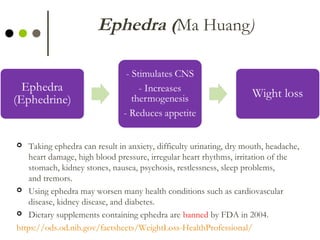
Ephedra (Ma Huang)
 Taking ephedra can result in anxiety, difficulty urinating, dry mouth, headache,
heart damage, high blood pressure, irregular heart rhythms, irritation of the
stomach, kidney stones, nausea, psychosis, restlessness, sleep problems,
and tremors.
 Using ephedra may worsen many health conditions such as cardiovascular
disease, kidney disease, and diabetes.
 Dietary supplements containing ephedra are banned by FDA in 2004.
https://ods.od.nih.gov/factsheets/WeightLoss-HealthProfessional/
Green Tea
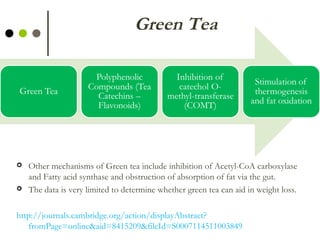
 Other mechanisms of Green tea include inhibition of Acetyl-CoA carboxylase
and Fatty acid synthase and obstruction of absorption of fat via the gut.
 The data is very limited to determine whether green tea can aid in weight loss.
http://journals.cambridge.org/action/displayAbstract?
fromPage=online&aid=8415209&fileId=S0007114511003849
Bitter Orange
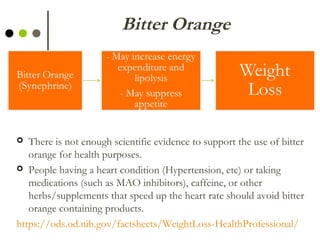
 There is not enough scientific evidence to support the use of bitter
orange for health purposes.
 People having a heart condition (Hypertension, etc) or taking
medications (such as MAO inhibitors), caffeine, or other
herbs/supplements that speed up the heart rate should avoid bitter
orange containing products.
https://ods.od.nih.gov/factsheets/WeightLoss-HealthProfessional/
Hoodia (Kalahari cactus)
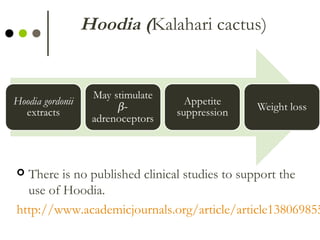
 There is no published clinical studies to support the
use of Hoodia.
http://www.academicjournals.org/article/article138069855
Acai (Amazonian palm berry)
 There is no definitive scientific evidence to support
the efficacy of Acai berry products which have been
marketed as folk or traditional remedies for weight-
loss and anti-aging purposes.
 Researchers found no body weight changes in rats
given acai-fortified juice compared to controls.
https://nccih.nih.gov/health/providers/digest/weightloss-
Chitosan
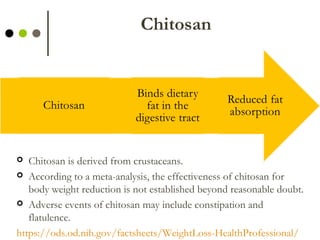
 Chitosan is derived from crustaceans.
 According to a meta-analysis, the effectiveness of chitosan for
body weight reduction is not established beyond reasonable doubt.
 Adverse events of chitosan may include constipation and
flatulence.
https://ods.od.nih.gov/factsheets/WeightLoss-HealthProfessional/
Chromium Picolinate
 Chromium is a cofactor to insulin and it can increase the lean body
mass, decrease percentage body fat and increase the basal
metabolic rate.
 Chromium supplementation also boosts glucose metabolism, body
composition, and insulin sensitivity, to a modest extent.
http://www.ncbi.nlm.nih.gov/pmc/articles/PMC4386228/
Garcinia cambogia
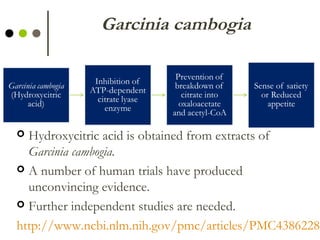
 Hydroxycitric acid is obtained from extracts of
Garcinia cambogia.
 A number of human trials have produced
unconvincing evidence.
 Further independent studies are needed.
http://www.ncbi.nlm.nih.gov/pmc/articles/PMC4386228/
Glucomannan
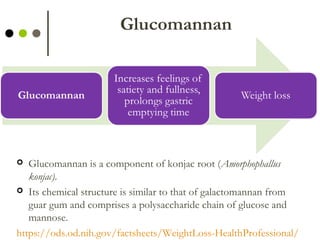
 Glucomannan is a component of konjac root (Amorphophallus
konjac).
 Its chemical structure is similar to that of galactomannan from
guar gum and comprises a polysaccharide chain of glucose and
mannose.
https://ods.od.nih.gov/factsheets/WeightLoss-HealthProfessional/
Guar gum
 Guar gum is a dietary fibre derived from Cyamopsis
tetragonolobus.
https://ods.od.nih.gov/factsheets/WeightLoss-HealthP
Pyruvate
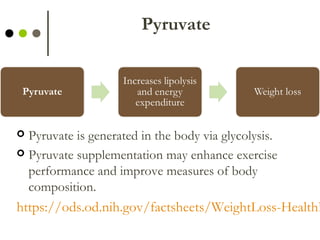
 Pyruvate is generated in the body via glycolysis.
 Pyruvate supplementation may enhance exercise
performance and improve measures of body
composition.
https://ods.od.nih.gov/factsheets/WeightLoss-HealthP
Yohimbe (Yohimbine)
 Yohimbine, an alpha-2 receptor antagonist is the main active
constituent of the ground bark of Pausinystalia yohimbe (yohimbe).
 At present, it is unclear whether yohimbine is effective for
reducing body weight.
https://ods.od.nih.gov/factsheets/WeightLoss-HealthProfessional/
Hydroxy methylbutyrate
 Hydroxy methylbutyrate is a metabolite of leucine and is available
as a dietary supplement.
 It is primarily used by bodybuilders as a supportive measure to
induce body composition changes.
http://www.nature.com/ijo/journal/v29/n9/full/0803008a.html
Plantago psyllium
 Psyllium is a water-soluble fibre derived from the ripe
seeds of Plantago psyllium.
 According to one double-blind RCT, there were no
significant changes in body weight in either the
treatment group or the placebo group.
http://www.nature.com/ijo/journal/v29/n9/full/0803008
Cynanchum Auriculatum
 According to Chinese traditional medicine, the roots of
C. auriculatum enhance immunity and espouse longevity.
 Pregnane glycosides and baishouwubenzophenone have
been found to exist in C. auriculatum.
 The efficacy and safety of pregnane glycosides need to be
further investigated.
http://www.ncbi.nlm.nih.gov/pmc/articles/PMC4386228/
Acupuncture
 Insertion of needles into certain points (Acupoints) on
the skin, is known as Acupuncture.
 Acupuncture was found to reduce more body weight
than conventional medication in a systematic review and
meta-analysis including 29 randomized controlled trials.
 Due to poor methodological quality of the trials
reviewed, the reviewers suggested to conduct more
organized and long-term studies to determine the efficacy
of acupuncture in treating obesity.
http://www.ncbi.nlm.nih.gov/pmc/articles/PMC4386228/
Possible Mechanisms of
Acupuncture
Naturopathy
 Naturopathy identifies and treats root cause rather than symptoms.
Causes of obesity include lack of awareness, emotional triggers,
hormone imbalance, stress, neurotransmitter imbalance, and
toxicity. Naturopathy focuses on attaining overall health (e.g.,
regaining insulin sensitivity and reversing insulin resistance;
optimal digestion; psychological well-being; decreasing stress) not
on “weight loss”.
 Serotonin and the catecholamines (Dopamine and
Norepinephrine) are important in the regulation of appetite and
satiety. Naturopathy uses amino acid precursors (5HTP for
serotonin, L-tyrosine and Mucuna pruriens for dopamine and
norepinephrine synthesis) as supplements, rather than using
medications such as SSRIs and phentermine.
http://www.ncbi.nlm.nih.gov/pmc/articles/PMC2791327/
Yoga
 Yoga may be most beneficial in the treatment of
overweight and obesity before an individual begins a
diet and exercise program.
http://ajl.sagepub.com/content/early/2013/06/24/155982
Mindfulness
 Mindfulness programs are used to treat a variety of
health related issues.
 Forms of mindfulness include…
 Mindfulness-Based Stress Reduction (MBSR)
 Mindfulness-Based Cognitive Therapy (MBCT)
 Dialectical Behavior Therapy (DBT)
 Mindfulness programs have recently gained popularity
for obesity related eating behaviors such as binge
eating, emotional eating, and external eating.
http://www.ncbi.nlm.nih.gov/pmc/articles/PMC4046117/
Non Invasive Body
Contouring
 Non invasive Body Contouring methods include…
 High Intensity Focused Ultrasound (HIFU)
 Low Level Laser Therapy (LLLT)
 Cryolipolysis
 Radiofrequency
 Only 2 to 4 cm in limb or waist circumference
could be reduced by Non invasive body contouring
techniques.
High Intensity Focused
Ultrasound (HIFU)
 Subcutaneous fat could be removed by using High
Intensity Focused Ultrasound (HIFU) technique.
 Available evidence suggests patients with a BMI lower
than 30 kg/m2
show the optimal results to HIFU.
http://www.ncbi.nlm.nih.gov/pmc/articles/PMC4386228/
Low Level Laser Therapy
 Low Level Laser Therapy (LLLT) has yielded successful
results in fat reduction of localized areas, such as the hips,
waist, thighs, and upper arms.
 Further research into LLLT is required to understand the
safety and effectiveness.
http://www.ncbi.nlm.nih.gov/pmc/articles/PMC4386228/
Cryolipolysis
 Cryolipolysis targets fat selectively through controlled
cooling.
 According to a study, cryolipolysis managed to remove
fat from abdomen, back and flank areas most
effectively.
 The conclusion of a 2009 review of four clinical
studies suggested that there was sufficient evidence to
support the efficacy and safety of cryolipolysis.
http://www.ncbi.nlm.nih.gov/pmc/articles/PMC438622
8/
Radiofrequency
 At present, Radiofrequency based devices are used most
commonly as a non-invasive technique.
http://www.ncbi.nlm.nih.gov/pmc/articles/PMC4386228/
Facts about Weight loss
Supplements
 Most of the dietary supplements marketed for weight loss
or appetite suppression haven’t been proven safe or
effective.
 There is no definitive scientific evidence to support the
use of acai berry, bitter orange, and green tea
supplements for weight loss.
 Ephedra can increase the risk of heart problems and
stroke and in 2004, the FDA banned the U.S. sale of
dietary supplements containing ephedra.
 Further research is needed to improve the understanding
of the role of CAM in the treatment of obesity.
TIPS on choosing CAM for
Weight loss
 Be cautious of the products marketed with exaggerated or
unrealistic phrases like “Quick and Effective” or “Totally safe.”
 Be skeptical about information from personal “Testimonials”
about the product’s benefits.
 The U.S. Food and Drug Administration (FDA) has found weight
loss products sold as dietary supplements that contain hidden
ingredients which can cause serious harm to consumers.
 Consider a mind and body approach such as mindfulness
meditation or yoga. There is some emerging evidence suggesting
that some mind and body approaches are generally safe and may
be useful as complements to other weight-loss interventions.   
 Overweight and obese individuals should make lifestyle changes
like healthy eating plan and regular physical activity for safe
weight loss.
References
 Textbook of Complementary and Alternative
Medicine
Chun-Su Yuan, Eric J. Bieber
 Evidence Based Guide to Complementary and
Alternative Medicine
Bradly P. Jacobs, Katherine Gundling
 Obesity Prevention and Treatment
James M. Rippe, Theodore J. Angelopoulos
References
 https://nccih.nih.gov/health/integrative-health?
nav=govd
 http://www.ncbi.nlm.nih.gov/pmc/articles/PMC4
386228/
 http://www.nature.com/ijo/journal/v29/n9/full/0
803008a.html
 http://onlinelibrary.wiley.com/doi/10.1038/oby.20
08.239/full
 http://www.ncbi.nlm.nih.gov/pmc/articles/PMC2
791327/
 https://nccih.nih.gov/health/providers/digest/wei
ghtloss-science

Complementary and alternative therapies for obesity

  • 1.
    Complementary and Alternative Medicinefor Obesity Dr. P.Naina Mohamed PhD Pharmacologist
  • 2.
    Introduction  The therapieswhich could be combined with conventional medicine is termed “Complementary Medicine”.  “Alternative Medicine” includes therapies that are used in place of conventional medicine.  “Complementary and Alternative Medicine” (CAM) refers to a wide range of clinical therapies outside the conventional medicine.  “Conventional Medicine” is a type of medicine practiced by medical doctors and by allied health professionals, such as physical therapists, psychologists, and registered nurses. It is also called Western or Allopathic medicine.  “Integrative Medicine” represents a combination of conventional medicine, CAM, and evidence-based medicine.
  • 3.
    CAM Use  AnUS study reported that the Complementary and Alternative Medicine (CAM) use is high and continues to increase.  The most important reason cited by patients for the supplemental CAM use is the perception that CAM is harmless.  CAM use is highest in patients include  Female  Nonsmokers  Physically active  Having normal body mass index (BMI)  Eating low-fat diets with a high fruit and vegetable content  Individuals aged 35 to 54 years with a high level of education.
  • 4.
    Types of CAMPractices  Mind and Body Practices  Traditional Medical Systems  "Modern" Medical Systems
  • 5.
    Mind and Body Practices    Acupuncture and Acupressure  Yoga  Hypnosis  Massage  Meditation  Reflexology Alexander technique  Tai chi  Spinal manipulation  Therapeutic touch  Guided imagery  Rolfing/structural integration
  • 6.
    Traditional Medical Systems   • Ayurvedic medicine • Siddha medicine • Unani medicine • Native American medicine • Tibetan medicine • Traditional Chinese medicine • Curanderismo
  • 7.
    "Modern" Medical Systems   •Homeopathy •Naturopathy •Osteopathy •Chiropractic •Anthroposophic medicine
  • 8.
    Obesity  The imbalancebetween caloric intake and expenditure might result in to Overweight or Obesity.  Obesity has become one of the most important avoidable risk factors for morbidity and mortality.  Obesity can increase the risk of Type 2 diabetes, Cardiovascular diseases, Chronic kidney disease, Sleep apnea, Arthritis, Lung disease, and several forms of Cancer.  Obese or Overweight individuals might be benefited from  Increased physical activity  Caloric restriction  Behavioral therapy
  • 9.
    CAM used totreat Obesity  Dietary Supplements  Ephedra (Ma Huang)  Green Tea  Bitter Orange  Hoodia (Kalahari cactus)  Acai (Amazonian palm berry)  Chitosan  Chromium Picolinate  Garcinia cambogia  Glucomannan  Guar gum  Pyruvate  Yohimbe (Yohimbine)  Acupuncture/Acupressure  Yoga  Naturopathy
  • 10.
    Ephedra (Ma Huang)  Takingephedra can result in anxiety, difficulty urinating, dry mouth, headache, heart damage, high blood pressure, irregular heart rhythms, irritation of the stomach, kidney stones, nausea, psychosis, restlessness, sleep problems, and tremors.  Using ephedra may worsen many health conditions such as cardiovascular disease, kidney disease, and diabetes.  Dietary supplements containing ephedra are banned by FDA in 2004. https://ods.od.nih.gov/factsheets/WeightLoss-HealthProfessional/
  • 11.
    Green Tea  Othermechanisms of Green tea include inhibition of Acetyl-CoA carboxylase and Fatty acid synthase and obstruction of absorption of fat via the gut.  The data is very limited to determine whether green tea can aid in weight loss. http://journals.cambridge.org/action/displayAbstract? fromPage=online&aid=8415209&fileId=S0007114511003849
  • 12.
    Bitter Orange  Thereis not enough scientific evidence to support the use of bitter orange for health purposes.  People having a heart condition (Hypertension, etc) or taking medications (such as MAO inhibitors), caffeine, or other herbs/supplements that speed up the heart rate should avoid bitter orange containing products. https://ods.od.nih.gov/factsheets/WeightLoss-HealthProfessional/
  • 13.
    Hoodia (Kalahari cactus) There is no published clinical studies to support the use of Hoodia. http://www.academicjournals.org/article/article138069855
  • 14.
    Acai (Amazonian palm berry) There is no definitive scientific evidence to support the efficacy of Acai berry products which have been marketed as folk or traditional remedies for weight- loss and anti-aging purposes.  Researchers found no body weight changes in rats given acai-fortified juice compared to controls. https://nccih.nih.gov/health/providers/digest/weightloss-
  • 15.
    Chitosan  Chitosan isderived from crustaceans.  According to a meta-analysis, the effectiveness of chitosan for body weight reduction is not established beyond reasonable doubt.  Adverse events of chitosan may include constipation and flatulence. https://ods.od.nih.gov/factsheets/WeightLoss-HealthProfessional/
  • 16.
    Chromium Picolinate  Chromiumis a cofactor to insulin and it can increase the lean body mass, decrease percentage body fat and increase the basal metabolic rate.  Chromium supplementation also boosts glucose metabolism, body composition, and insulin sensitivity, to a modest extent. http://www.ncbi.nlm.nih.gov/pmc/articles/PMC4386228/
  • 17.
    Garcinia cambogia  Hydroxycitricacid is obtained from extracts of Garcinia cambogia.  A number of human trials have produced unconvincing evidence.  Further independent studies are needed. http://www.ncbi.nlm.nih.gov/pmc/articles/PMC4386228/
  • 18.
    Glucomannan  Glucomannan isa component of konjac root (Amorphophallus konjac).  Its chemical structure is similar to that of galactomannan from guar gum and comprises a polysaccharide chain of glucose and mannose. https://ods.od.nih.gov/factsheets/WeightLoss-HealthProfessional/
  • 19.
    Guar gum  Guargum is a dietary fibre derived from Cyamopsis tetragonolobus. https://ods.od.nih.gov/factsheets/WeightLoss-HealthP
  • 20.
    Pyruvate  Pyruvate isgenerated in the body via glycolysis.  Pyruvate supplementation may enhance exercise performance and improve measures of body composition. https://ods.od.nih.gov/factsheets/WeightLoss-HealthP
  • 21.
    Yohimbe (Yohimbine)  Yohimbine,an alpha-2 receptor antagonist is the main active constituent of the ground bark of Pausinystalia yohimbe (yohimbe).  At present, it is unclear whether yohimbine is effective for reducing body weight. https://ods.od.nih.gov/factsheets/WeightLoss-HealthProfessional/
  • 22.
    Hydroxy methylbutyrate  Hydroxymethylbutyrate is a metabolite of leucine and is available as a dietary supplement.  It is primarily used by bodybuilders as a supportive measure to induce body composition changes. http://www.nature.com/ijo/journal/v29/n9/full/0803008a.html
  • 23.
    Plantago psyllium  Psylliumis a water-soluble fibre derived from the ripe seeds of Plantago psyllium.  According to one double-blind RCT, there were no significant changes in body weight in either the treatment group or the placebo group. http://www.nature.com/ijo/journal/v29/n9/full/0803008
  • 24.
    Cynanchum Auriculatum  Accordingto Chinese traditional medicine, the roots of C. auriculatum enhance immunity and espouse longevity.  Pregnane glycosides and baishouwubenzophenone have been found to exist in C. auriculatum.  The efficacy and safety of pregnane glycosides need to be further investigated. http://www.ncbi.nlm.nih.gov/pmc/articles/PMC4386228/
  • 25.
    Acupuncture  Insertion ofneedles into certain points (Acupoints) on the skin, is known as Acupuncture.  Acupuncture was found to reduce more body weight than conventional medication in a systematic review and meta-analysis including 29 randomized controlled trials.  Due to poor methodological quality of the trials reviewed, the reviewers suggested to conduct more organized and long-term studies to determine the efficacy of acupuncture in treating obesity. http://www.ncbi.nlm.nih.gov/pmc/articles/PMC4386228/
  • 26.
  • 27.
    Naturopathy  Naturopathy identifiesand treats root cause rather than symptoms. Causes of obesity include lack of awareness, emotional triggers, hormone imbalance, stress, neurotransmitter imbalance, and toxicity. Naturopathy focuses on attaining overall health (e.g., regaining insulin sensitivity and reversing insulin resistance; optimal digestion; psychological well-being; decreasing stress) not on “weight loss”.  Serotonin and the catecholamines (Dopamine and Norepinephrine) are important in the regulation of appetite and satiety. Naturopathy uses amino acid precursors (5HTP for serotonin, L-tyrosine and Mucuna pruriens for dopamine and norepinephrine synthesis) as supplements, rather than using medications such as SSRIs and phentermine. http://www.ncbi.nlm.nih.gov/pmc/articles/PMC2791327/
  • 28.
    Yoga  Yoga maybe most beneficial in the treatment of overweight and obesity before an individual begins a diet and exercise program. http://ajl.sagepub.com/content/early/2013/06/24/155982
  • 29.
    Mindfulness  Mindfulness programsare used to treat a variety of health related issues.  Forms of mindfulness include…  Mindfulness-Based Stress Reduction (MBSR)  Mindfulness-Based Cognitive Therapy (MBCT)  Dialectical Behavior Therapy (DBT)  Mindfulness programs have recently gained popularity for obesity related eating behaviors such as binge eating, emotional eating, and external eating. http://www.ncbi.nlm.nih.gov/pmc/articles/PMC4046117/
  • 30.
    Non Invasive Body Contouring Non invasive Body Contouring methods include…  High Intensity Focused Ultrasound (HIFU)  Low Level Laser Therapy (LLLT)  Cryolipolysis  Radiofrequency  Only 2 to 4 cm in limb or waist circumference could be reduced by Non invasive body contouring techniques.
  • 31.
    High Intensity Focused Ultrasound(HIFU)  Subcutaneous fat could be removed by using High Intensity Focused Ultrasound (HIFU) technique.  Available evidence suggests patients with a BMI lower than 30 kg/m2 show the optimal results to HIFU. http://www.ncbi.nlm.nih.gov/pmc/articles/PMC4386228/
  • 32.
    Low Level LaserTherapy  Low Level Laser Therapy (LLLT) has yielded successful results in fat reduction of localized areas, such as the hips, waist, thighs, and upper arms.  Further research into LLLT is required to understand the safety and effectiveness. http://www.ncbi.nlm.nih.gov/pmc/articles/PMC4386228/
  • 33.
    Cryolipolysis  Cryolipolysis targetsfat selectively through controlled cooling.  According to a study, cryolipolysis managed to remove fat from abdomen, back and flank areas most effectively.  The conclusion of a 2009 review of four clinical studies suggested that there was sufficient evidence to support the efficacy and safety of cryolipolysis. http://www.ncbi.nlm.nih.gov/pmc/articles/PMC438622 8/
  • 34.
    Radiofrequency  At present,Radiofrequency based devices are used most commonly as a non-invasive technique. http://www.ncbi.nlm.nih.gov/pmc/articles/PMC4386228/
  • 35.
    Facts about Weightloss Supplements  Most of the dietary supplements marketed for weight loss or appetite suppression haven’t been proven safe or effective.  There is no definitive scientific evidence to support the use of acai berry, bitter orange, and green tea supplements for weight loss.  Ephedra can increase the risk of heart problems and stroke and in 2004, the FDA banned the U.S. sale of dietary supplements containing ephedra.  Further research is needed to improve the understanding of the role of CAM in the treatment of obesity.
  • 36.
    TIPS on choosingCAM for Weight loss  Be cautious of the products marketed with exaggerated or unrealistic phrases like “Quick and Effective” or “Totally safe.”  Be skeptical about information from personal “Testimonials” about the product’s benefits.  The U.S. Food and Drug Administration (FDA) has found weight loss products sold as dietary supplements that contain hidden ingredients which can cause serious harm to consumers.  Consider a mind and body approach such as mindfulness meditation or yoga. There is some emerging evidence suggesting that some mind and body approaches are generally safe and may be useful as complements to other weight-loss interventions.     Overweight and obese individuals should make lifestyle changes like healthy eating plan and regular physical activity for safe weight loss.
  • 37.
    References  Textbook ofComplementary and Alternative Medicine Chun-Su Yuan, Eric J. Bieber  Evidence Based Guide to Complementary and Alternative Medicine Bradly P. Jacobs, Katherine Gundling  Obesity Prevention and Treatment James M. Rippe, Theodore J. Angelopoulos
  • 38.
    References  https://nccih.nih.gov/health/integrative-health? nav=govd  http://www.ncbi.nlm.nih.gov/pmc/articles/PMC4 386228/ http://www.nature.com/ijo/journal/v29/n9/full/0 803008a.html  http://onlinelibrary.wiley.com/doi/10.1038/oby.20 08.239/full  http://www.ncbi.nlm.nih.gov/pmc/articles/PMC2 791327/  https://nccih.nih.gov/health/providers/digest/wei ghtloss-science