Hospice
Dr D.Ramu
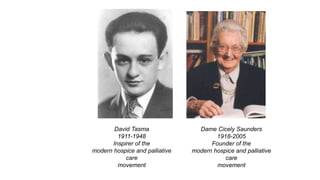
Dame Cicely Saunders
1918-2005
Founder of the
modern hospice and palliative
care
movement
David Tasma
1911-1948
Inspirer of the
modern hospice and palliative
care
movement
The Hospice โ€œwill try to fill the gap that exists in both research and
teaching concerning the care of patients dying of cancer and those
needing skilled relief in other long-term illnesses and their relatives.โ€
Saunders, 1967
OVERVIEW ON HOSPICE
What is Hospice?
๏ƒผFrom the word โ€œ Hospesโ€
๏ƒผOriginally, referred to shelter or way station for weary
travelers.
๏ƒผToday, means a concept of care that provides comfort
and quality of life to clients, and their significant
others, who are facing lifeโ€™s final journey associated
with terminal illness.
OVERVIEW ON HOSPICE
What is Hospice?
๏ƒผA type of care and a philosophy of care
which focuses on palliation of terminally
ill patientโ€™s symptoms.
a. Physical
b. Emotional
c. Spiritual
d. Social
The primary goals of hospice care are to:
1. Provide comfort.
2. Relieve physical, emotional, and spiritual suffering,
3. promote the dignity of terminally ill persons.
๏ƒผ Hospice care neither prolongs nor hastens the
dying process.
Is It a Place?
๏ƒผHospice care is a philosophy or approach to care
rather than a place.
๏ƒผCare may be provided in a personโ€™s home, nursing
home, hospital, or independent facility devoted to
end-of-life care.
Hospice isโ€ฆ
โ€ข(Not necessarily) a place
โ€ขA philosophy of care
โ€ขA structure for care
โ€ขWhat Kind of Treatment Is Provided Through Hospice
Care?
โ€ข Hospice care is holistic:
โ€ข The health care team attends to practical needs, and
assistance in addition to emotional and spiritual needs and
fear of dying.
โ€ข Care is provided by an interdisciplinary team.
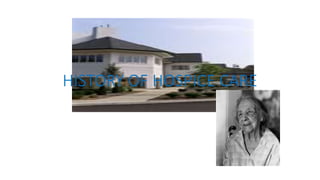
HISTORY OF HOSPICE CARE
โ€ข 11th century, around 1065= the 1st hospice care are believed to have originated when the first incurably ill
were permitted into places dedicated to treatment by Crusaders.
โ€ข 14th century- Order of Knights Hospitaller of St.John of Jerusalem opened the 1st hospice in Rhodes
โ€ข 17th century- Hospices were revived in France by the Daughters of Charity of Saint Vincent de Paul.
โ€ข 19th Century- established also in UK where attention was drawn to the needs of the terminally ill.
โ€ข 1902-1905- hospice care spread to other nations.( Australia, North America, Japan, China, Russia)
โ€ข Cecily Saunders introduced the idea of specialized care for the dying to the United States during a 1963
visit with Yale University. Her lecture, given to medical students, nurses, social workers, and chaplains
about the concept of holistic hospice care, included photos of terminally ill cancer patients and their
families, showing the dramatic differences before and after the symptom control care.
โ€ข 1965: Florence Wald, then Dean of the Yale School of Nursing, invites Saunders to become a visiting faculty
member of the school for the spring term.
The Modern Hospice Movement
โ€ขIn the 1950s, as medical technology developed, most people died in
hospitals. The medical profession increasingly saw death as a failure.
โ€ขPhysical pain associated with terminal illness was not a target of
treatment.
โ€ขDame Cicely Saunders, MD, founded St. Christopherโ€™s Hospice in London
in the 1960s, in an effort to discover practical solutions to alleviating
human suffering.
โ€ขShe introduced hospice in the U.S. in a lecture at Yale in 1963. This contact
set off a chain of events which resulted in the development of hospice
care as we know it today.
HISTORY OF HOSPICE CARE
โ€ข 1972: Kubler-Ross testifies at the first national hearings on the subject of
death with dignity, which are conducted by the U.S. Senate Special
Committee on Aging. In her testimony, Kubler-Ross states, โ€œWe live in a
very particular death-denying society. We isolate both the dying and the
old, and it serves a purpose. They are reminders of our own
mortality. We should not institutionalize people. We can give families
more help with home care and visiting nurses, giving the families and the
patients the spiritual, emotional, and financial help in order to facilitate
the final care at home.โ€
โ€ข 1996: Major grant-makers pour money into funding for research, program
initiatives, public forums, and conferences to transform the culture of
dying and improve care at the end of life.
Myths of Hospice
โ€ขA place.
โ€ขOnly for people with cancer.
โ€ขOnly for old people.
โ€ขOnly for dying people.
โ€ขCan help only when family members are able to provide
care.
โ€ขFor people who donโ€™t need a high level of care.
โ€ขOnly for people who can accept death.
โ€ขExpensive.
โ€ขNot covered by managed care.
โ€ขFor when there is no hope.
Realities of Hospice
1. About 80% of hospice care takes place in the home.
2. Hospices are increasingly serving people with the
end-stages of chronic diseases.
3. Hospices serve people of all ages.
4. Hospice focuses as much on the grieving family as
on the dying patients.
5. Alternative locations or resources
may be available.
Realities of Hospice
6. Hospice is serious medicine, offering state-of-the-art
palliative care.
7. Hospices gently help people find their way at their
own speed.
8. Hospice can be far less expensive than other end-of-
life care. Most people who use hospice are over 65
and entitled to the Medicare Hospice Benefit,
which covers virtually all hospice services.
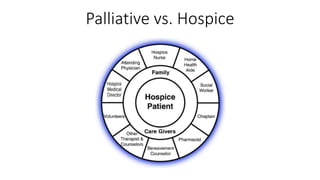
Members of the Hospice Team
1. Primary Physician
๏ƒ˜Provides the hospice team with medical history.
๏ƒ˜ Oversees medical care through regular communication with
the hospice team.
๏ƒ˜Provides orders for medications and tests, signs death
certificate, etc.
๏ƒ˜Determines his or her level of involvement on a case-by-case
basis with the hospice medical director.
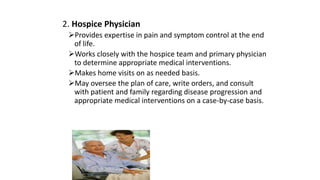
2. Hospice Physician
๏ƒ˜Provides expertise in pain and symptom control at the end
of life.
๏ƒ˜Works closely with the hospice team and primary physician
to determine appropriate medical interventions.
๏ƒ˜Makes home visits on as needed basis.
๏ƒ˜May oversee the plan of care, write orders, and consult
with patient and family regarding disease progression and
appropriate medical interventions on a case-by-case basis.
3. Nurse
๏ƒ˜Visits patient and family in the home or nursing
home on regular basis.
๏ƒ˜May provide on-call services.
๏ƒ˜Assesses pain, symptoms, nutritional status,
bowel functions, safety, and psychosocial-
spiritual concerns.
๏ƒ˜Educates patient and family.
๏ƒ˜Educates and supervises nursing assistants.
๏ƒ˜Provides emotional and spiritual support to
patient and family.
4. Home Health Aide
๏ƒ˜Assists patient with activities of daily living.
๏ƒ˜Provides a variety of other services depending on assessment of need.
5. Social Worker
๏ƒ˜Attends to both practical needs and counseling needs of patient and
family.
๏ƒ˜Arranges for durable medical equipment, discharge planning,
funeral/burial arrangements
๏ƒ˜Serves as liaison with community agencies.
๏ƒ˜Assist family in finding services to address financial needs and legal
matters.
๏ƒ˜Provides counseling.
๏ƒ˜Assesses patient and family anxiety, depression, role changes, caregiver
stress.
๏ƒ˜Provides general grief counseling.
Chaplain
๏ƒ˜Provides patient and family with spiritual
counseling.
๏ƒ˜Assists patient and family in sustaining their
religious practice and in drawing upon
religious/spiritual beliefs.
๏ƒ˜Ensures that patient and family religious or
spiritual beliefs and practices are respected by
the hospice team.
๏ƒ˜serves as a liaison with the patient/family faith,
community and clergy.
๏ƒ˜May conduct funeral and memorial services.
๏ƒ˜Provides hospice staff with spiritual care and
counseling.
Volunteer
๏ƒ˜Provides respite care to family members
๏ƒ˜May assist with light housekeeping or
grocery shopping.
๏ƒ˜Helps patients stay connected with
community groups and activities.
๏ƒ˜Facilitates special projects.
๏ƒ˜ provide community education and
outreach.
๏ƒ˜May assist with office work.
LEVELS OF CARE
โ€ขROUTINE HOME CARE-
-most common level of care provided.
-interdisciplinary team members supply a variety
of services during routine home care, including
offering necessary supplies. ( diapers, bed pads,
gloves, & skin protectants)
โ€ขCONTINUOUS CARE
- Is a service provided in the patientโ€™s
home.
- Intended for pts. who are experiencing
severe symptoms & need temporary extra
support.
- Provides services in the home a
minimum of 8 hours a day.
โ€ขGENERAL INPATIENT CARE
-Is an intensive level of care which may be
provided in a nursing home.
-intended for pts. who are experiencing severe
symptoms which require daily interventions
from the hospice team to manage.
-Often, patients on this level of care have begun
the โ€œ active phaseโ€ of dying.
โ€ข RESPITE CARE-( referred as respite inpatient)
- Is a brief & periodic level of care a patient may
receive.
- A unique benefit in that the care is provided for the
needs of the family, not the patient.
- Is provided for a maximum of 5 days every benefit
period.
OVERVIEW ON HOSPICE and PALLIATIVE CARE
Is Hospice the Same as Home Health Nursing?
Two primary differences between hospice care and home health nursing:
1. Any patient with a skilled medical care need is qualified to receive
home health nursing care. Hospice care, on the other hand, is limited to
persons with a terminal illness, with a life expectancy of six months or less, and
with a focus on palliation not cure.
2. Patients in home health care receive visits
primarily from a nurse while patients in hospice
care receive the services of an entire interdisciplinary
team
whose area of expertise is end-of-life care.
What Services Does Hospice Offer?
For the Patientโ€ฆ.
1.Providing care to the patient.
2. Medical care to relieve pain and other symptoms arising from a
life-limiting illness.
3. Basic needs of daily living.
4. Counseling.
5. Assisting the patient with unfinished legal or financial business
and in making funeral arrangements.
6. Religious care.
What Services Does Hospice Offer?
For Caregivers/Family Membersโ€ฆ
1.Counseling services..
2.Respite care.
3. Health Education.
4.Practical assistance.
5.Assistance with cremation/burial
arrangements and with funeral/memorial services.
6.Bereavement care.
Principles Underlying Hospice (SAUNDERS-founder St.
Christopherโ€™s Hospice in London,1996)
1.Death must be accepted.
2. The patientโ€™s total care is best managed by an
interdisciplinary team whose members
communicate regularly with each other.
3. Pain and other symptoms of terminal illness must be
managed.
4. The patient and the family should be viewed
as a single unit of care.
5. Home care of the dying is necessary.
6. Bereavement care must be provided to family members.
7. Research and education should be ongoing.
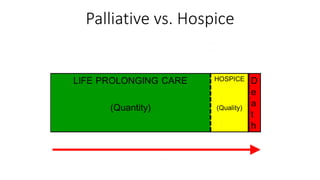
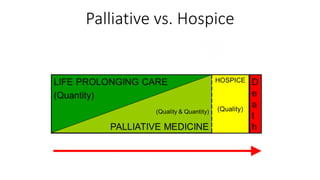
Palliative vs. Hospice
โ€ข Both focus on improved qualify of life
โ€ข Both are delivered by specialists
โ€ข Both have been shown to improve
survival
Palliative vs. Hospice
โ€ข Both tend to be delivered by a team of
individuals with knowledge of complex
symptom management
โ€ข Both work with the patientโ€™s other
clinicians to provide an additional layer
of patient care
Palliative vs. Hospice
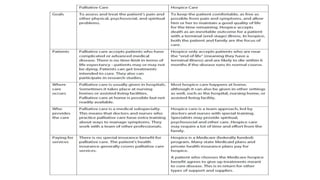
โ€ข Hospice is a medical insurance benefit,
with its own set of regulations
โ€ข Hospice care is typically provided in the
home, whereas palliative tends to be
hospital or clinic based
Palliative vs. Hospice
โ€ข Hospice specifically cares for patients
with terminal conditions where survival
is typically <6 months
โ€ข Palliative medicine is delivered
irrespective of prognosis
โ€ข Both are provided regardless of
diagnosis
Palliative vs. Hospice
โ€ข Shanti Avedna Sadan in Mumbai, a hospice, in 1986 . Over the next
five years, it established two more branches, one in Delhi and one in
Goa;
โ€ข Guwahati Pain and Palliative Care Society in Assam
โ€ข the Jivodaya Hospice in Chennai,
โ€ข Cansupport in Delhi
โ€ข Lakshmi Palliative Care Trust in Chennai
โ€ข Karunasraya Hospice in Bangalore

Hospice

  • 1.
  • 2.
    Dame Cicely Saunders 1918-2005 Founderof the modern hospice and palliative care movement David Tasma 1911-1948 Inspirer of the modern hospice and palliative care movement
  • 3.
    The Hospice โ€œwilltry to fill the gap that exists in both research and teaching concerning the care of patients dying of cancer and those needing skilled relief in other long-term illnesses and their relatives.โ€ Saunders, 1967
  • 4.
    OVERVIEW ON HOSPICE Whatis Hospice? ๏ƒผFrom the word โ€œ Hospesโ€ ๏ƒผOriginally, referred to shelter or way station for weary travelers. ๏ƒผToday, means a concept of care that provides comfort and quality of life to clients, and their significant others, who are facing lifeโ€™s final journey associated with terminal illness.
  • 5.
    OVERVIEW ON HOSPICE Whatis Hospice? ๏ƒผA type of care and a philosophy of care which focuses on palliation of terminally ill patientโ€™s symptoms. a. Physical b. Emotional c. Spiritual d. Social
  • 6.
    The primary goalsof hospice care are to: 1. Provide comfort. 2. Relieve physical, emotional, and spiritual suffering, 3. promote the dignity of terminally ill persons. ๏ƒผ Hospice care neither prolongs nor hastens the dying process.
  • 7.
    Is It aPlace? ๏ƒผHospice care is a philosophy or approach to care rather than a place. ๏ƒผCare may be provided in a personโ€™s home, nursing home, hospital, or independent facility devoted to end-of-life care.
  • 8.
    Hospice isโ€ฆ โ€ข(Not necessarily)a place โ€ขA philosophy of care โ€ขA structure for care
  • 9.
    โ€ขWhat Kind ofTreatment Is Provided Through Hospice Care? โ€ข Hospice care is holistic: โ€ข The health care team attends to practical needs, and assistance in addition to emotional and spiritual needs and fear of dying. โ€ข Care is provided by an interdisciplinary team.
  • 10.
  • 11.
    HISTORY OF HOSPICECARE โ€ข 11th century, around 1065= the 1st hospice care are believed to have originated when the first incurably ill were permitted into places dedicated to treatment by Crusaders. โ€ข 14th century- Order of Knights Hospitaller of St.John of Jerusalem opened the 1st hospice in Rhodes โ€ข 17th century- Hospices were revived in France by the Daughters of Charity of Saint Vincent de Paul. โ€ข 19th Century- established also in UK where attention was drawn to the needs of the terminally ill. โ€ข 1902-1905- hospice care spread to other nations.( Australia, North America, Japan, China, Russia) โ€ข Cecily Saunders introduced the idea of specialized care for the dying to the United States during a 1963 visit with Yale University. Her lecture, given to medical students, nurses, social workers, and chaplains about the concept of holistic hospice care, included photos of terminally ill cancer patients and their families, showing the dramatic differences before and after the symptom control care. โ€ข 1965: Florence Wald, then Dean of the Yale School of Nursing, invites Saunders to become a visiting faculty member of the school for the spring term.
  • 12.
    The Modern HospiceMovement โ€ขIn the 1950s, as medical technology developed, most people died in hospitals. The medical profession increasingly saw death as a failure. โ€ขPhysical pain associated with terminal illness was not a target of treatment. โ€ขDame Cicely Saunders, MD, founded St. Christopherโ€™s Hospice in London in the 1960s, in an effort to discover practical solutions to alleviating human suffering. โ€ขShe introduced hospice in the U.S. in a lecture at Yale in 1963. This contact set off a chain of events which resulted in the development of hospice care as we know it today.
  • 13.
    HISTORY OF HOSPICECARE โ€ข 1972: Kubler-Ross testifies at the first national hearings on the subject of death with dignity, which are conducted by the U.S. Senate Special Committee on Aging. In her testimony, Kubler-Ross states, โ€œWe live in a very particular death-denying society. We isolate both the dying and the old, and it serves a purpose. They are reminders of our own mortality. We should not institutionalize people. We can give families more help with home care and visiting nurses, giving the families and the patients the spiritual, emotional, and financial help in order to facilitate the final care at home.โ€ โ€ข 1996: Major grant-makers pour money into funding for research, program initiatives, public forums, and conferences to transform the culture of dying and improve care at the end of life.
  • 14.
    Myths of Hospice โ€ขAplace. โ€ขOnly for people with cancer. โ€ขOnly for old people. โ€ขOnly for dying people. โ€ขCan help only when family members are able to provide care. โ€ขFor people who donโ€™t need a high level of care. โ€ขOnly for people who can accept death. โ€ขExpensive. โ€ขNot covered by managed care. โ€ขFor when there is no hope.
  • 15.
    Realities of Hospice 1.About 80% of hospice care takes place in the home. 2. Hospices are increasingly serving people with the end-stages of chronic diseases. 3. Hospices serve people of all ages. 4. Hospice focuses as much on the grieving family as on the dying patients. 5. Alternative locations or resources may be available.
  • 16.
    Realities of Hospice 6.Hospice is serious medicine, offering state-of-the-art palliative care. 7. Hospices gently help people find their way at their own speed. 8. Hospice can be far less expensive than other end-of- life care. Most people who use hospice are over 65 and entitled to the Medicare Hospice Benefit, which covers virtually all hospice services.
  • 17.
    Members of theHospice Team 1. Primary Physician ๏ƒ˜Provides the hospice team with medical history. ๏ƒ˜ Oversees medical care through regular communication with the hospice team. ๏ƒ˜Provides orders for medications and tests, signs death certificate, etc. ๏ƒ˜Determines his or her level of involvement on a case-by-case basis with the hospice medical director.
  • 18.
    2. Hospice Physician ๏ƒ˜Providesexpertise in pain and symptom control at the end of life. ๏ƒ˜Works closely with the hospice team and primary physician to determine appropriate medical interventions. ๏ƒ˜Makes home visits on as needed basis. ๏ƒ˜May oversee the plan of care, write orders, and consult with patient and family regarding disease progression and appropriate medical interventions on a case-by-case basis.
  • 19.
    3. Nurse ๏ƒ˜Visits patientand family in the home or nursing home on regular basis. ๏ƒ˜May provide on-call services. ๏ƒ˜Assesses pain, symptoms, nutritional status, bowel functions, safety, and psychosocial- spiritual concerns. ๏ƒ˜Educates patient and family. ๏ƒ˜Educates and supervises nursing assistants. ๏ƒ˜Provides emotional and spiritual support to patient and family.
  • 20.
    4. Home HealthAide ๏ƒ˜Assists patient with activities of daily living. ๏ƒ˜Provides a variety of other services depending on assessment of need. 5. Social Worker ๏ƒ˜Attends to both practical needs and counseling needs of patient and family. ๏ƒ˜Arranges for durable medical equipment, discharge planning, funeral/burial arrangements ๏ƒ˜Serves as liaison with community agencies. ๏ƒ˜Assist family in finding services to address financial needs and legal matters. ๏ƒ˜Provides counseling. ๏ƒ˜Assesses patient and family anxiety, depression, role changes, caregiver stress. ๏ƒ˜Provides general grief counseling.
  • 21.
    Chaplain ๏ƒ˜Provides patient andfamily with spiritual counseling. ๏ƒ˜Assists patient and family in sustaining their religious practice and in drawing upon religious/spiritual beliefs. ๏ƒ˜Ensures that patient and family religious or spiritual beliefs and practices are respected by the hospice team. ๏ƒ˜serves as a liaison with the patient/family faith, community and clergy. ๏ƒ˜May conduct funeral and memorial services. ๏ƒ˜Provides hospice staff with spiritual care and counseling.
  • 22.
    Volunteer ๏ƒ˜Provides respite careto family members ๏ƒ˜May assist with light housekeeping or grocery shopping. ๏ƒ˜Helps patients stay connected with community groups and activities. ๏ƒ˜Facilitates special projects. ๏ƒ˜ provide community education and outreach. ๏ƒ˜May assist with office work.
  • 23.
    LEVELS OF CARE โ€ขROUTINEHOME CARE- -most common level of care provided. -interdisciplinary team members supply a variety of services during routine home care, including offering necessary supplies. ( diapers, bed pads, gloves, & skin protectants)
  • 24.
    โ€ขCONTINUOUS CARE - Isa service provided in the patientโ€™s home. - Intended for pts. who are experiencing severe symptoms & need temporary extra support. - Provides services in the home a minimum of 8 hours a day.
  • 25.
    โ€ขGENERAL INPATIENT CARE -Isan intensive level of care which may be provided in a nursing home. -intended for pts. who are experiencing severe symptoms which require daily interventions from the hospice team to manage. -Often, patients on this level of care have begun the โ€œ active phaseโ€ of dying.
  • 26.
    โ€ข RESPITE CARE-(referred as respite inpatient) - Is a brief & periodic level of care a patient may receive. - A unique benefit in that the care is provided for the needs of the family, not the patient. - Is provided for a maximum of 5 days every benefit period.
  • 27.
    OVERVIEW ON HOSPICEand PALLIATIVE CARE Is Hospice the Same as Home Health Nursing? Two primary differences between hospice care and home health nursing: 1. Any patient with a skilled medical care need is qualified to receive home health nursing care. Hospice care, on the other hand, is limited to persons with a terminal illness, with a life expectancy of six months or less, and with a focus on palliation not cure. 2. Patients in home health care receive visits primarily from a nurse while patients in hospice care receive the services of an entire interdisciplinary team whose area of expertise is end-of-life care.
  • 28.
    What Services DoesHospice Offer? For the Patientโ€ฆ. 1.Providing care to the patient. 2. Medical care to relieve pain and other symptoms arising from a life-limiting illness. 3. Basic needs of daily living. 4. Counseling. 5. Assisting the patient with unfinished legal or financial business and in making funeral arrangements. 6. Religious care.
  • 29.
    What Services DoesHospice Offer? For Caregivers/Family Membersโ€ฆ 1.Counseling services.. 2.Respite care. 3. Health Education. 4.Practical assistance. 5.Assistance with cremation/burial arrangements and with funeral/memorial services. 6.Bereavement care.
  • 30.
    Principles Underlying Hospice(SAUNDERS-founder St. Christopherโ€™s Hospice in London,1996) 1.Death must be accepted. 2. The patientโ€™s total care is best managed by an interdisciplinary team whose members communicate regularly with each other. 3. Pain and other symptoms of terminal illness must be managed. 4. The patient and the family should be viewed as a single unit of care. 5. Home care of the dying is necessary. 6. Bereavement care must be provided to family members. 7. Research and education should be ongoing.
  • 31.
    Palliative vs. Hospice โ€ขBoth focus on improved qualify of life โ€ข Both are delivered by specialists โ€ข Both have been shown to improve survival
  • 32.
    Palliative vs. Hospice โ€ขBoth tend to be delivered by a team of individuals with knowledge of complex symptom management โ€ข Both work with the patientโ€™s other clinicians to provide an additional layer of patient care
  • 33.
    Palliative vs. Hospice โ€ขHospice is a medical insurance benefit, with its own set of regulations โ€ข Hospice care is typically provided in the home, whereas palliative tends to be hospital or clinic based
  • 34.
    Palliative vs. Hospice โ€ขHospice specifically cares for patients with terminal conditions where survival is typically <6 months โ€ข Palliative medicine is delivered irrespective of prognosis โ€ข Both are provided regardless of diagnosis
  • 35.
  • 36.
  • 37.
  • 39.
    โ€ข Shanti AvednaSadan in Mumbai, a hospice, in 1986 . Over the next five years, it established two more branches, one in Delhi and one in Goa; โ€ข Guwahati Pain and Palliative Care Society in Assam โ€ข the Jivodaya Hospice in Chennai, โ€ข Cansupport in Delhi โ€ข Lakshmi Palliative Care Trust in Chennai โ€ข Karunasraya Hospice in Bangalore