The
complement
Saleh Bahaj
Prof. of Medical
Microbiology/Immunology
Lecture 9
Objectives
By the end of this lecture the students should be
able to:-
I) Definition
III) Activation
V) Regulation
VI) Test your self
IV) Function
II) Properties
Complement
I) Definition
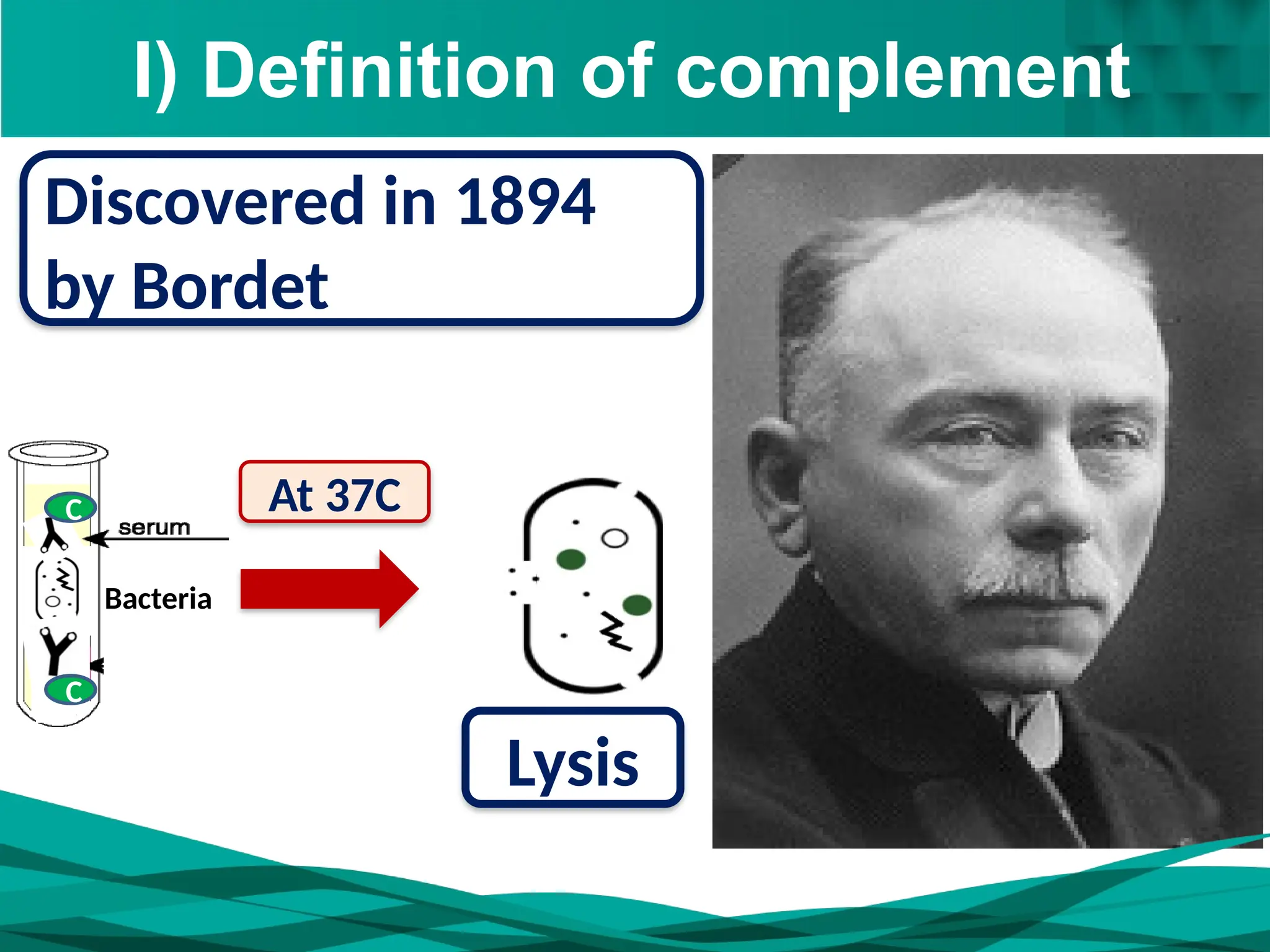
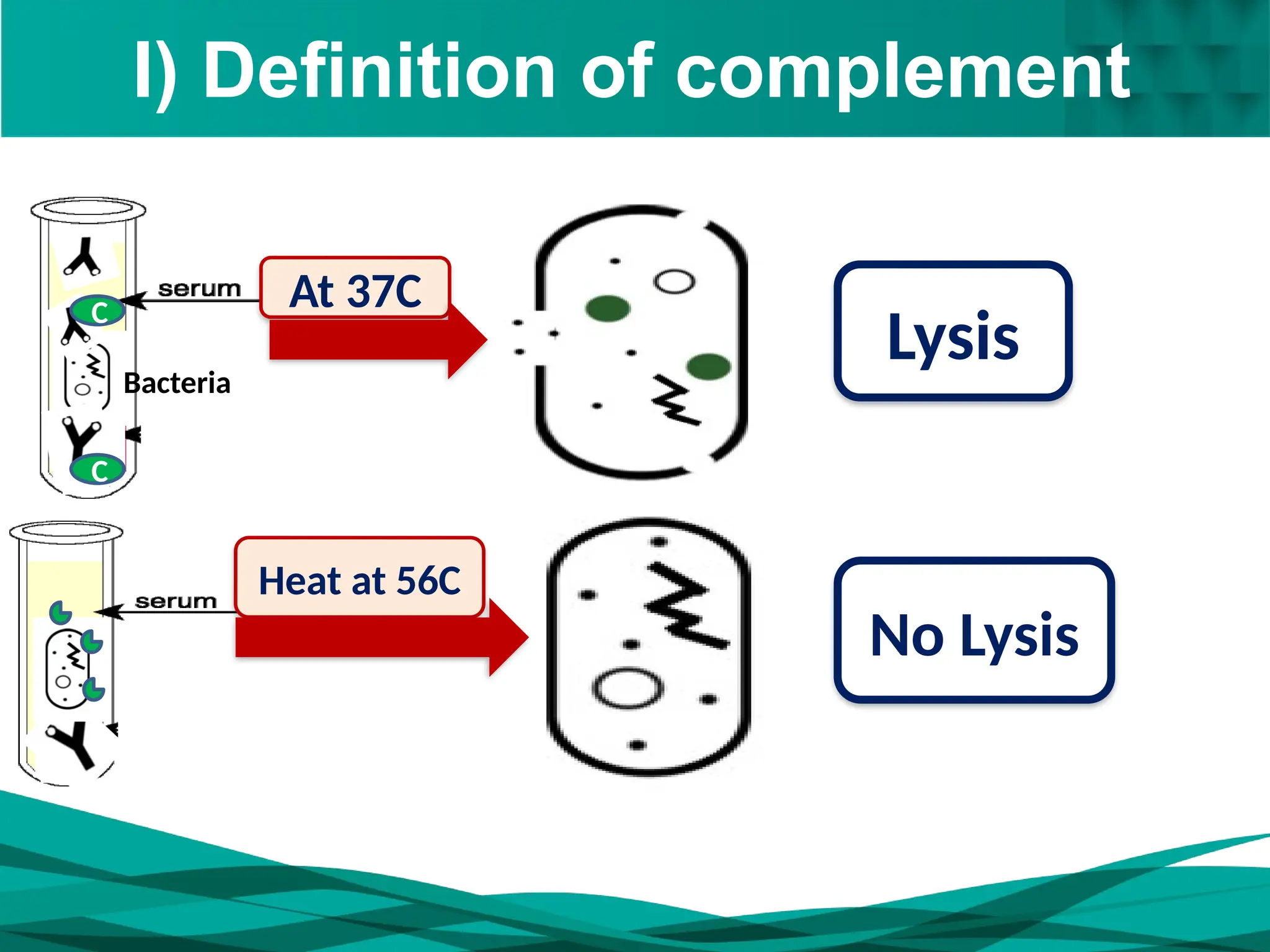
I) Definition of complement
Discovered in 1894
by Bordet
At 37C
C
C
Bacteria
Lysis
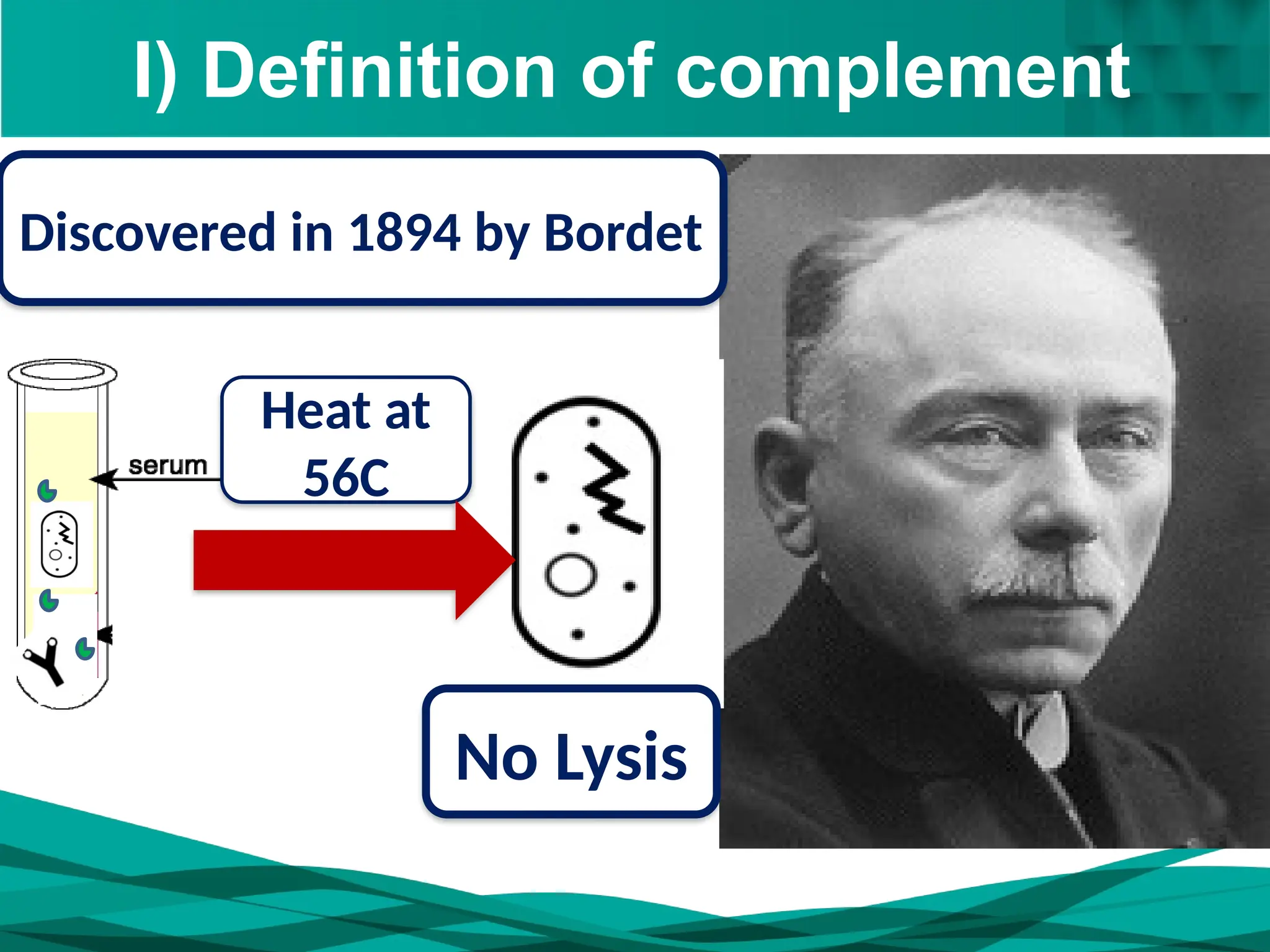
I) Definition of complement
Discovered in 1894 by Bordet
No Lysis
Heat at
56C
I) Definition of complement
Lysis
At 37C
Heat at 56C
No Lysis
C
C
Bacteria
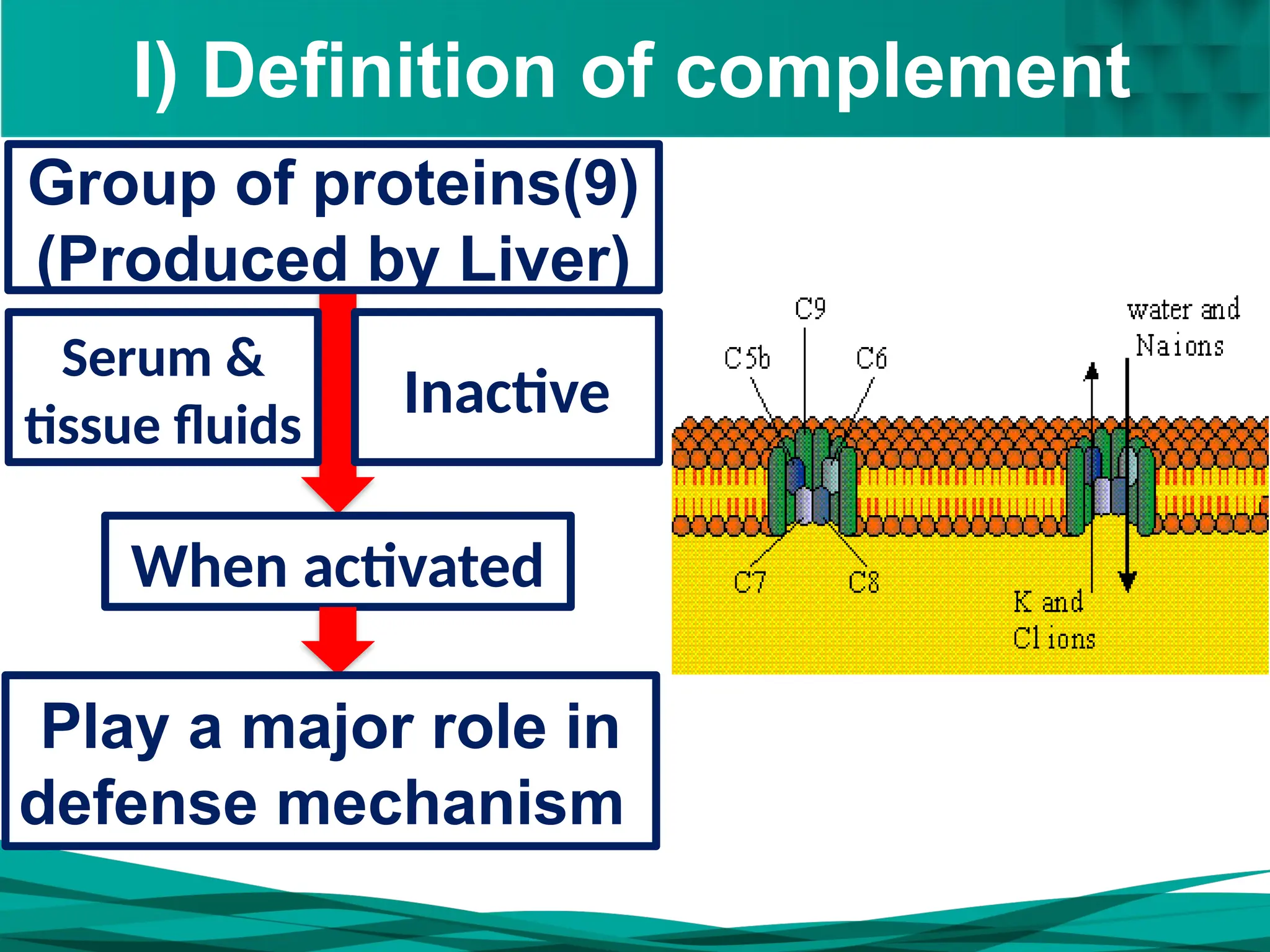
I) Definition of complement
Inactive
When activated
Group of proteins(9)
(Produced by Liver)
Serum &
tissue fluids
Play a major role in
defense mechanism
Exercise 1
From the above definition, determine the
properties of complement
Complement
II) Properties
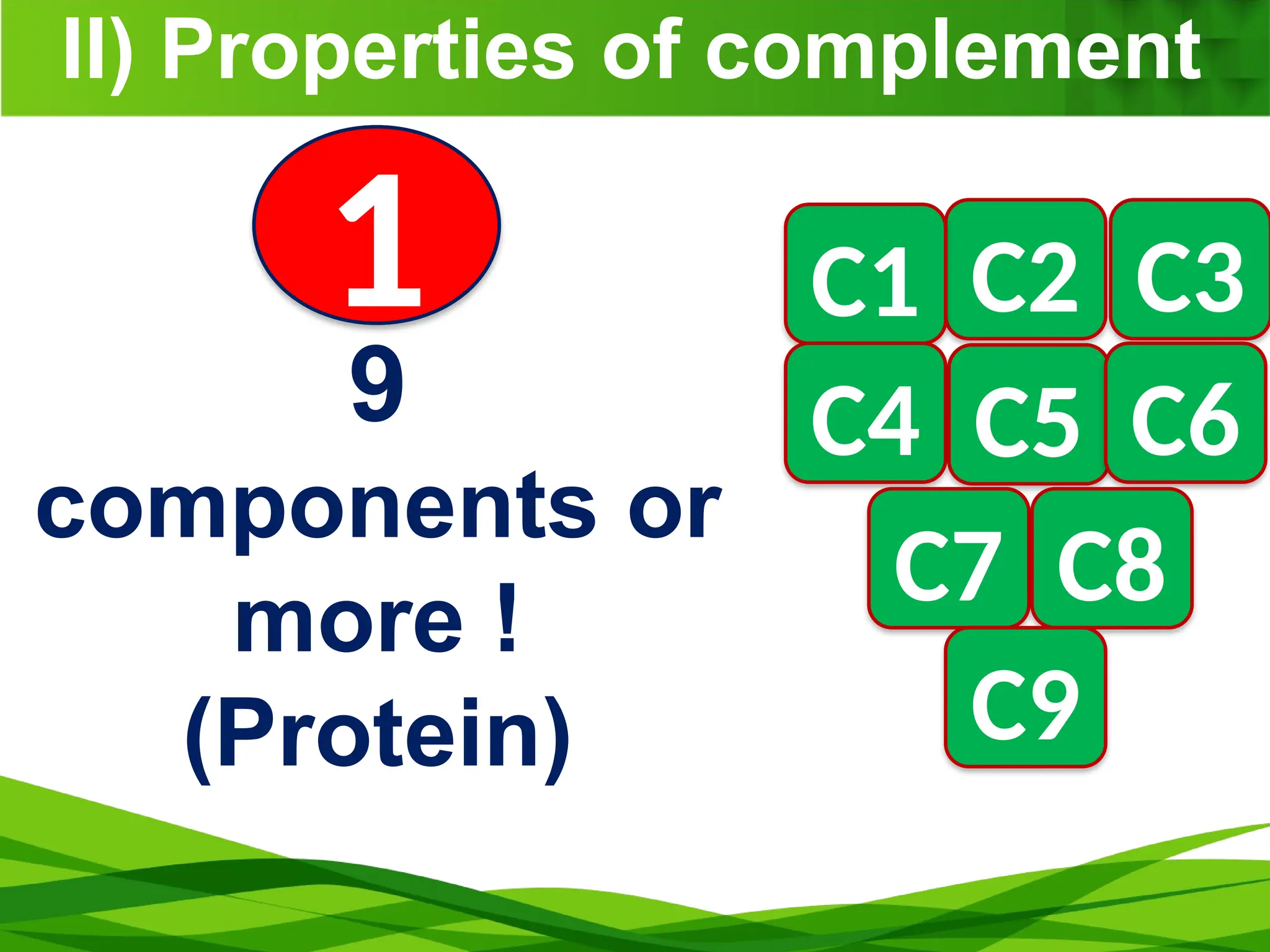
II) Properties of complement
C2 C3
C1
C4 C5 C6
C7 C8
C9
9
components or
more !
(Protein)
1
II) Properties of complement
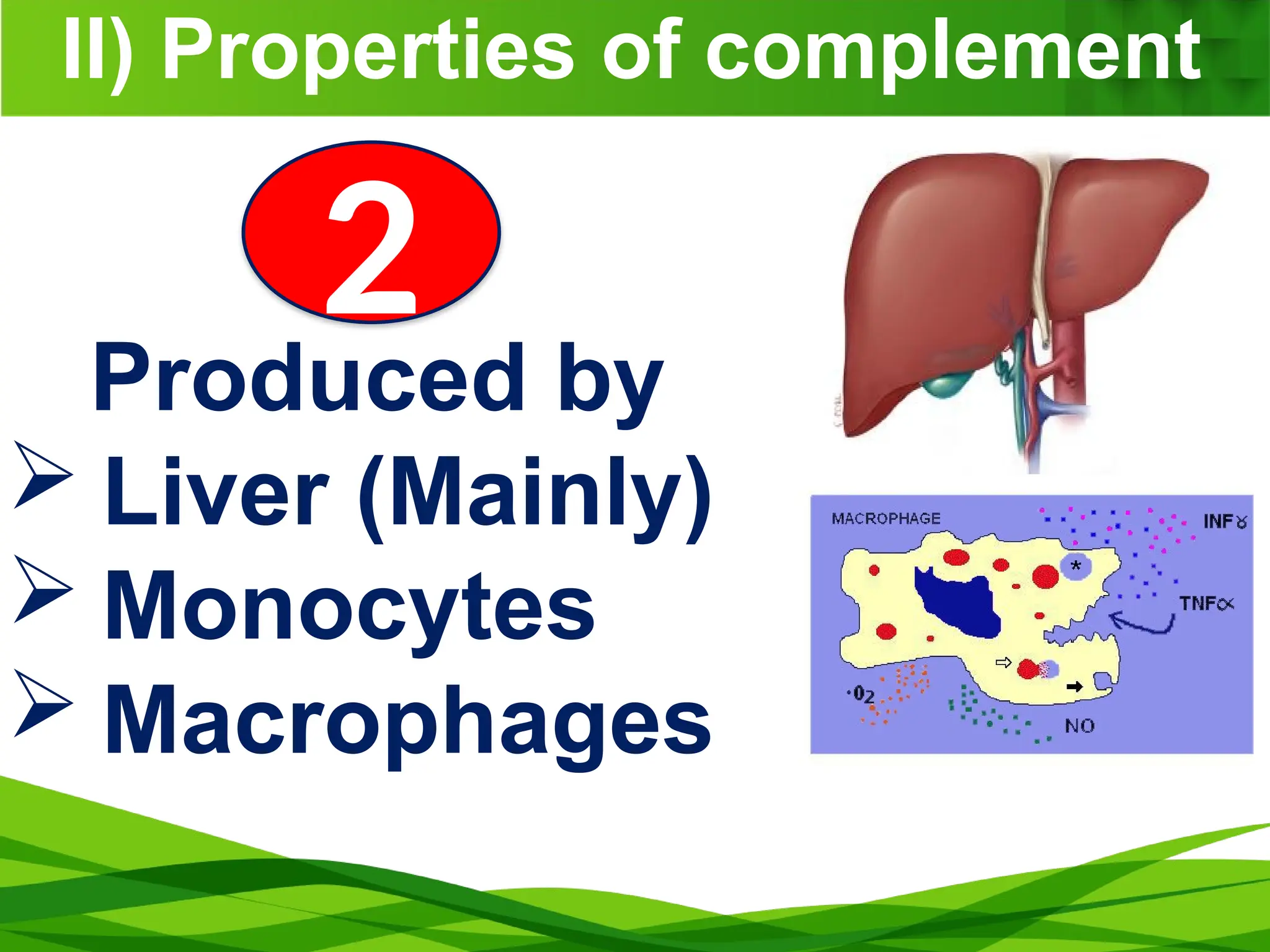
Produced by
 Liver (Mainly)
 Monocytes
 Macrophages
2
II) Properties of complement
present in an
inactive form
3
II) Properties of complement
When it activated,
leading to
destruction of
invading organism
4
II) Properties of complement
4
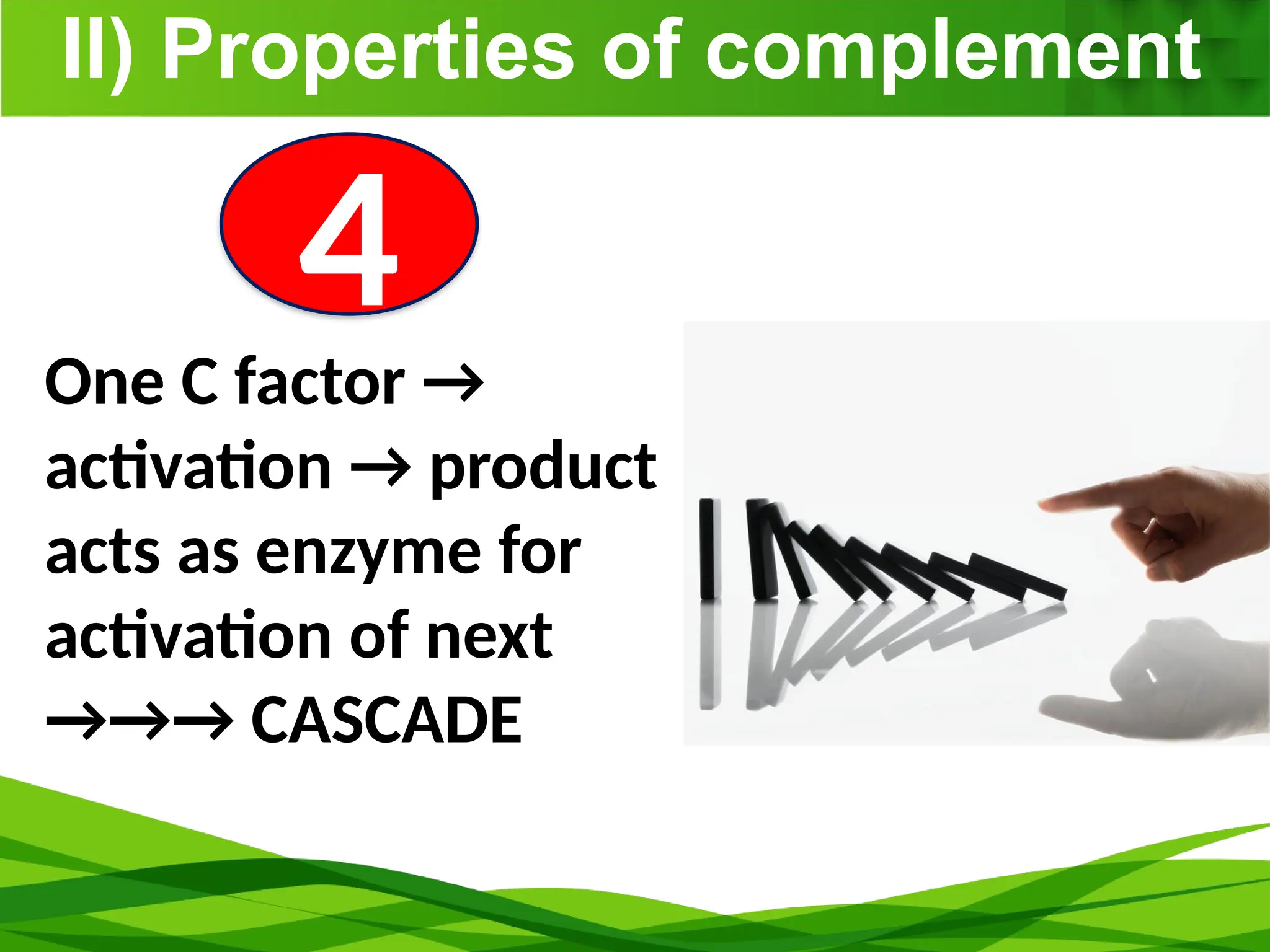
One C factor →
activation → product
acts as enzyme for
activation of next
→→→ CASCADE
II) Properties of complement
4
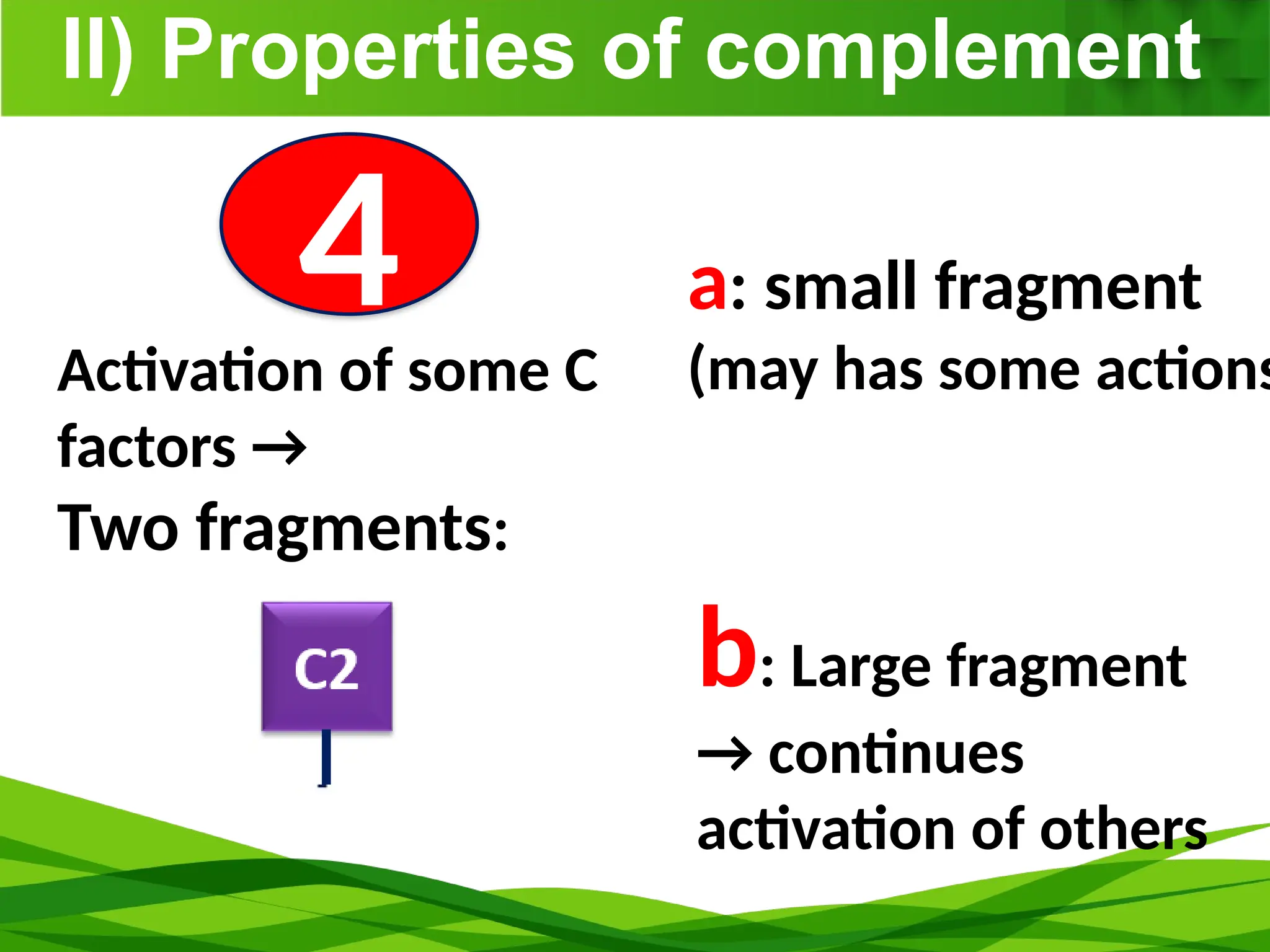
Activation of some C
factors →
Two fragments:
C2a
a: small fragment
(may has some actions
b: Large fragment
→ continues
activation of others
II) Properties of complement
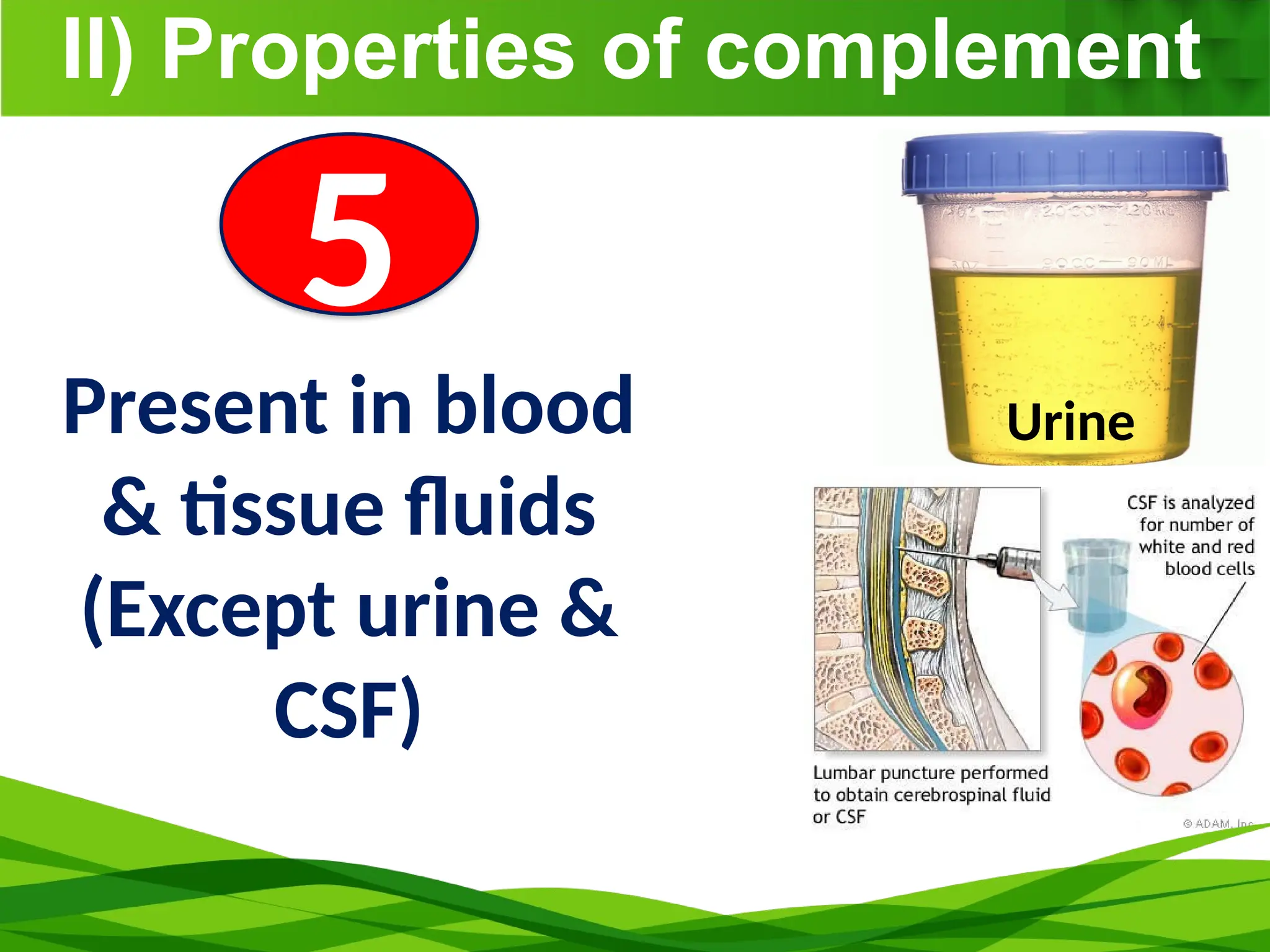
5
Present in blood
& tissue fluids
(Except urine &
CSF)
Urine
II) Properties of complement
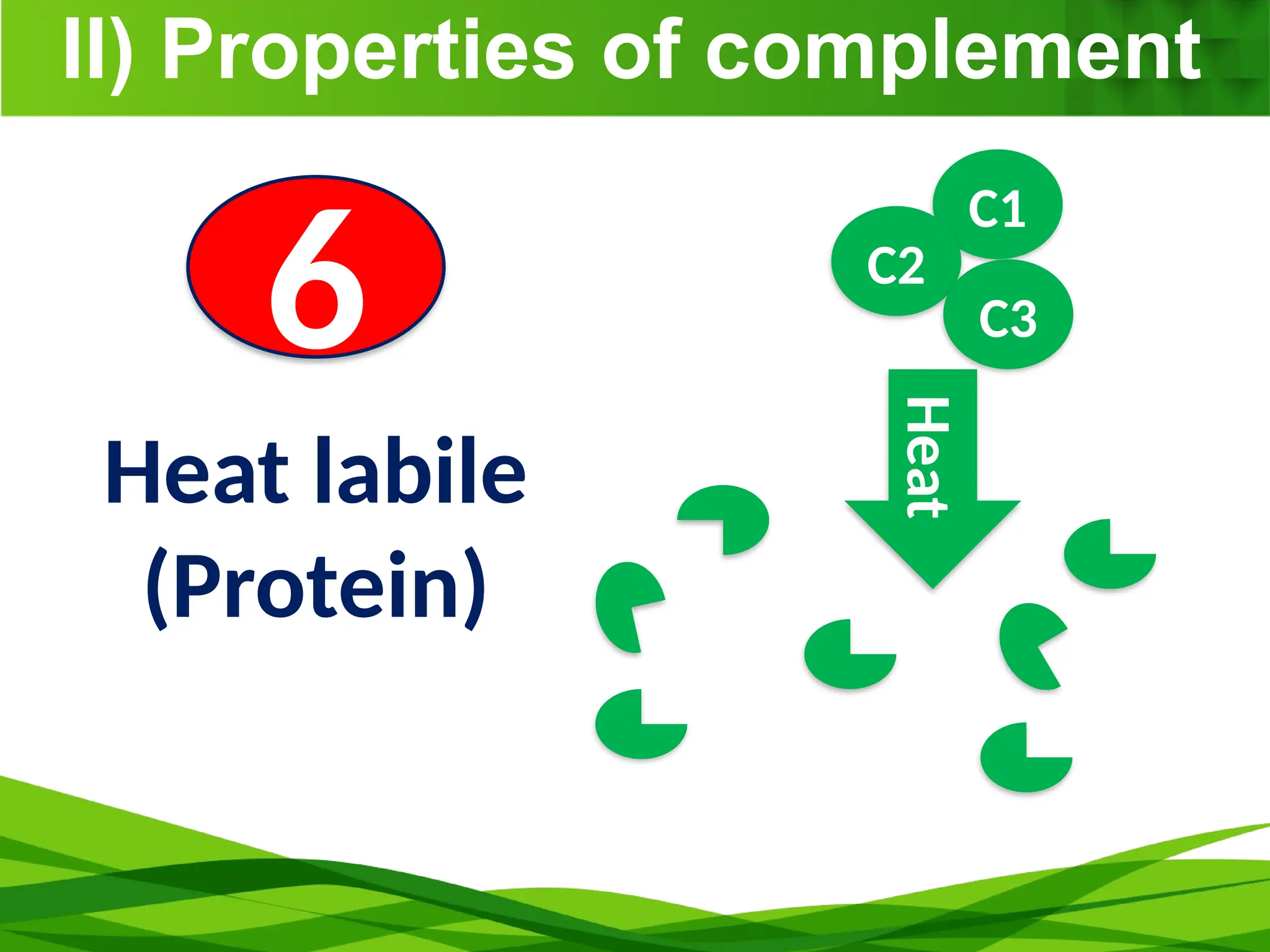
6
Heat labile
(Protein)
C1
C2
C3
Heat
Complement
III) Activation
A) Classical pathway
B) Lectin pathway
C) Alternative pathway
Exercises 2&3
Read the following paragraph and create a
diagram to clarify the Classic and lectin pathway
activations
A) Classical pathway
Activation
(Answer of exercise-2)
1) Activation of C1
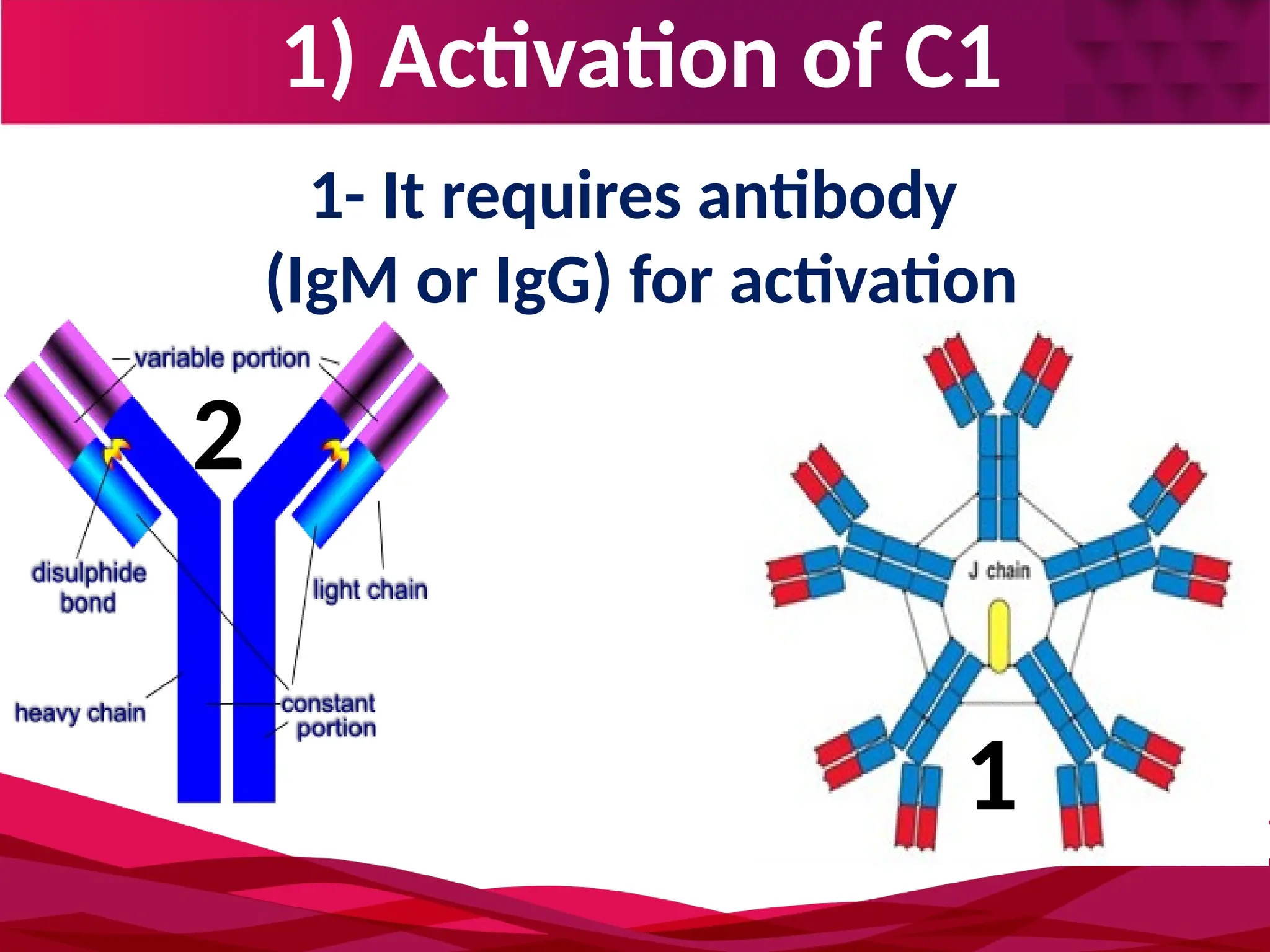
1- It requires antibody
(IgM or IgG) for activation
2
1
1) Activation of C1
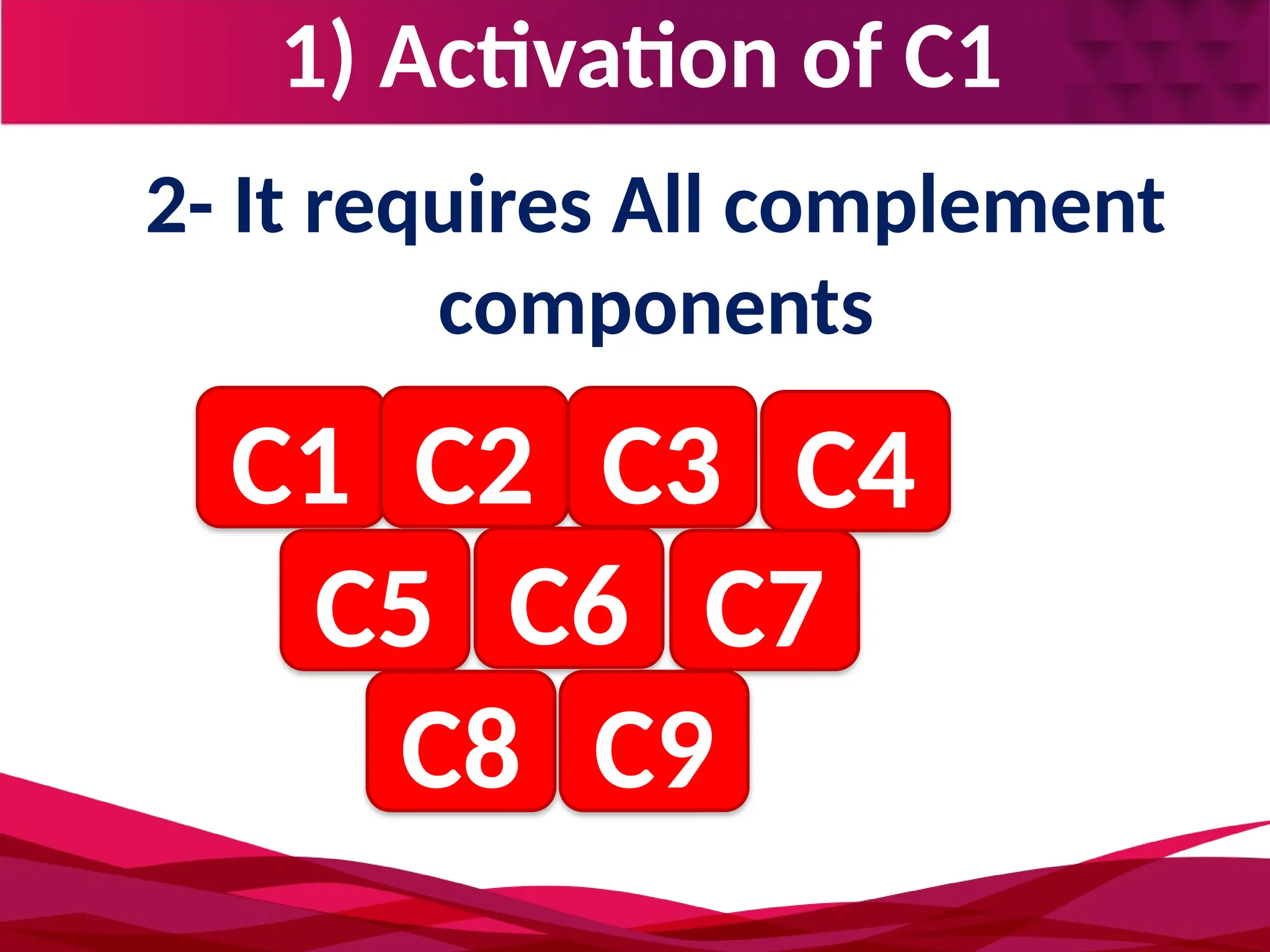
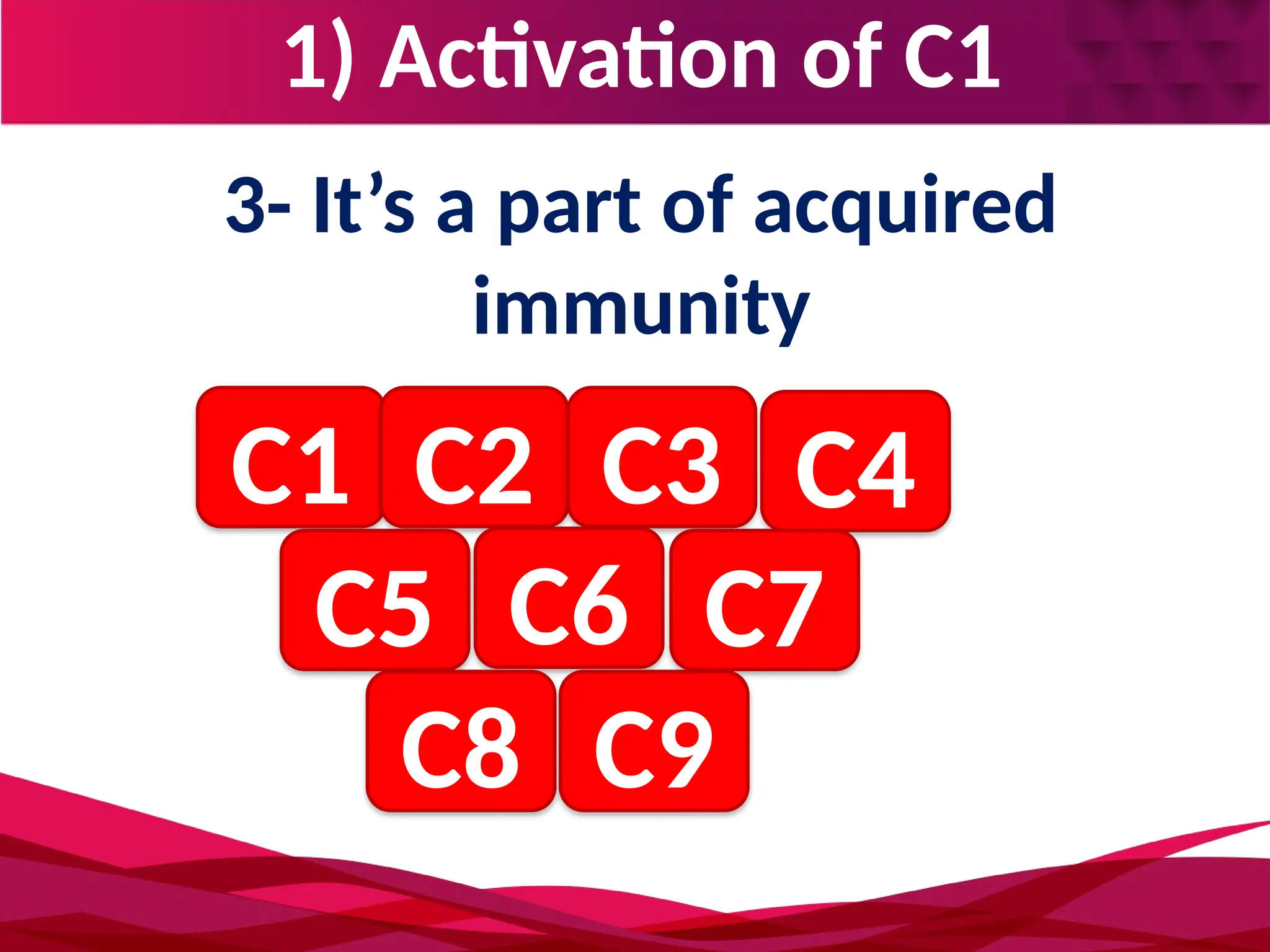
2- It requires All complement
components
C1 C2 C3 C4
C5 C6 C7
C8 C9
1) Activation of C1
3- It’s a part of acquired
immunity
C1 C2 C3 C4
C5 C6 C7
C8 C9
A) Classical pathway Activation
1- Activation of C1
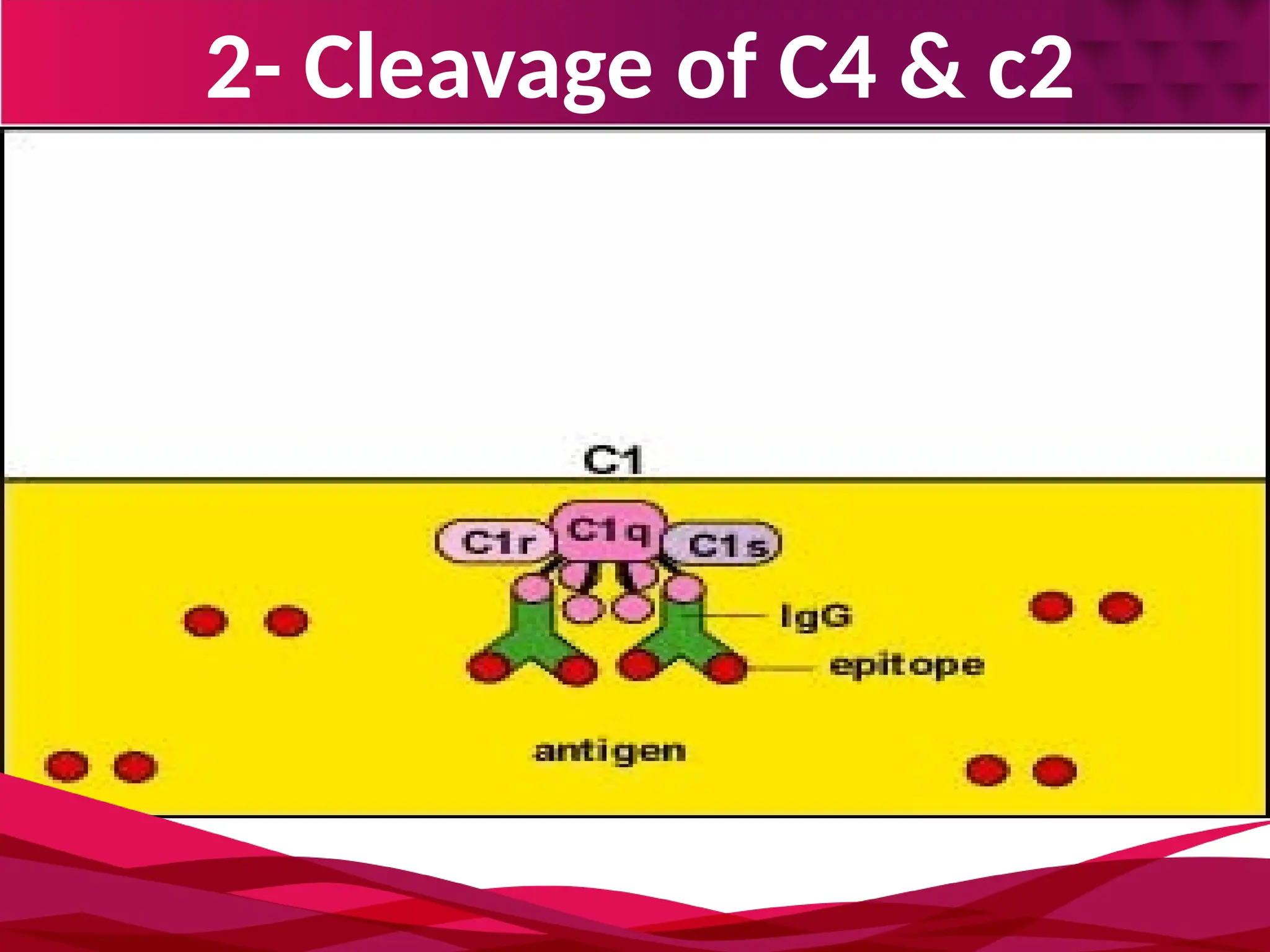
2- Cleavage of C4 & C2
3- Cleavage of C3
4- MAC formation
A) Classical pathway Activation
1- Activation of C1
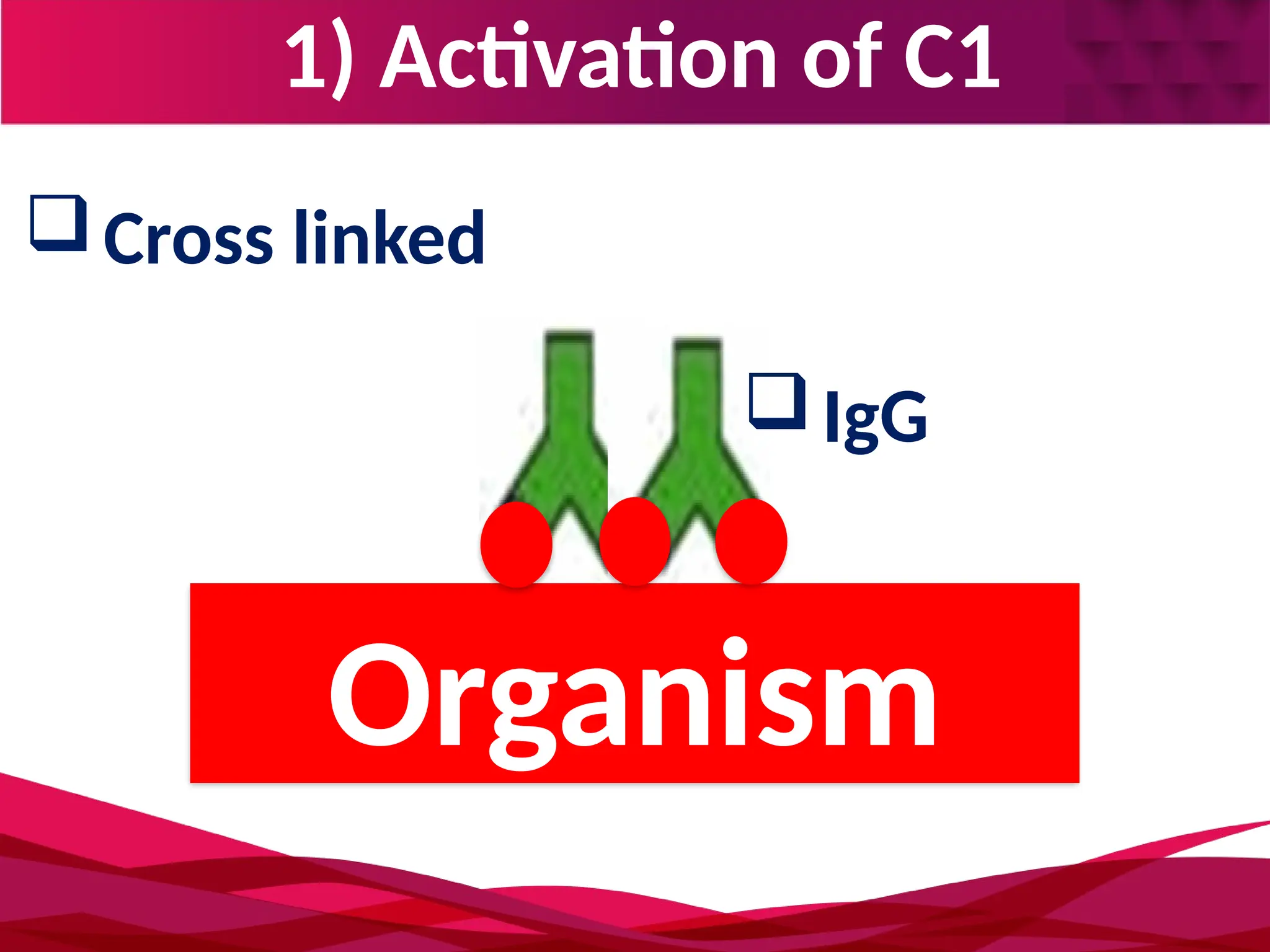
1) Activation of C1
Organism
Cross linked
IgG
1) Activation of C1
Organism
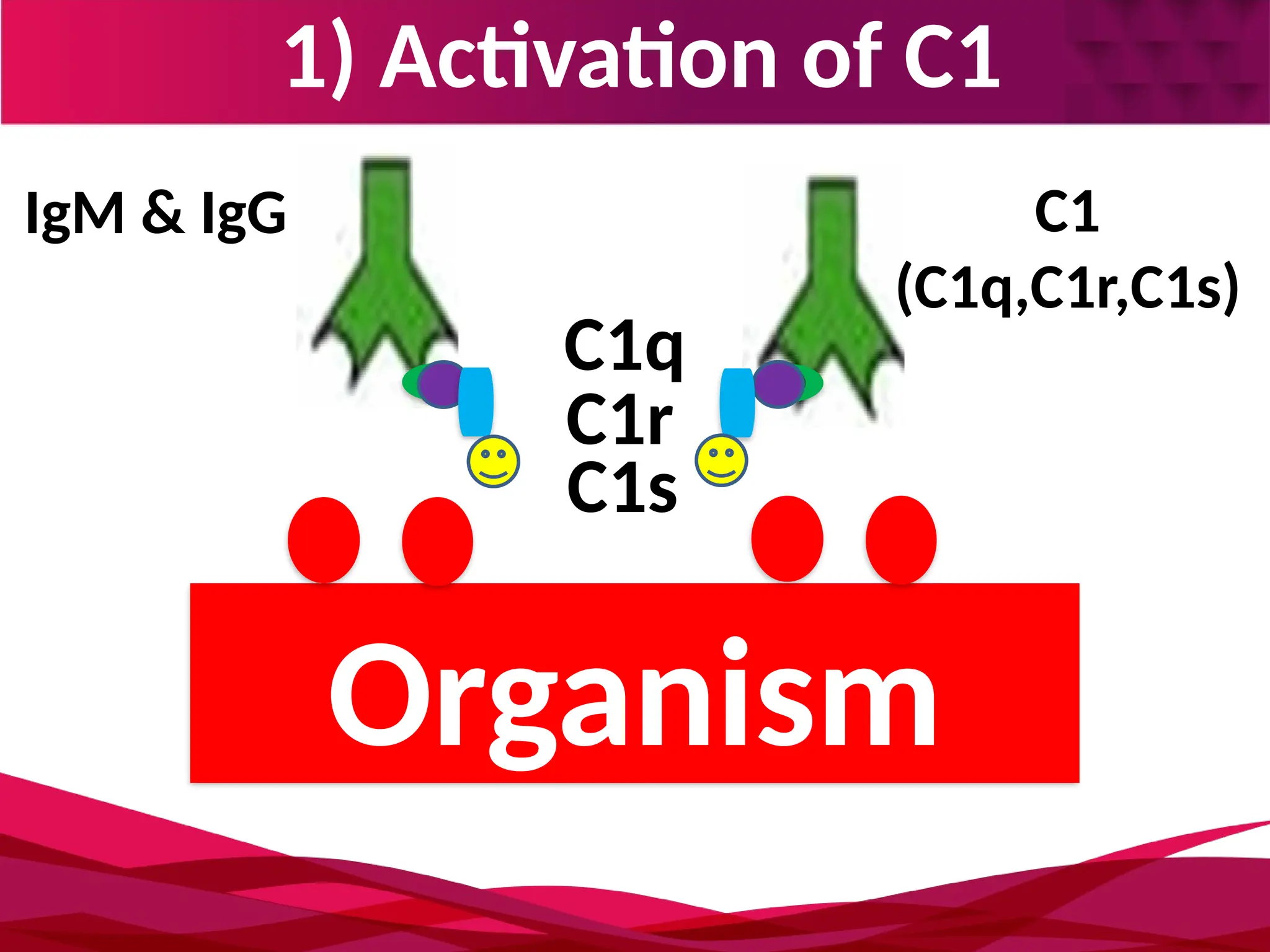
C1q
C1r
C1s
IgM & IgG C1
(C1q,C1r,C1s)
1) Activation of C1
A) Classical pathway Activation
2- Cleavage of C4 & C2
2- Cleavage of C4 & c2
Organism
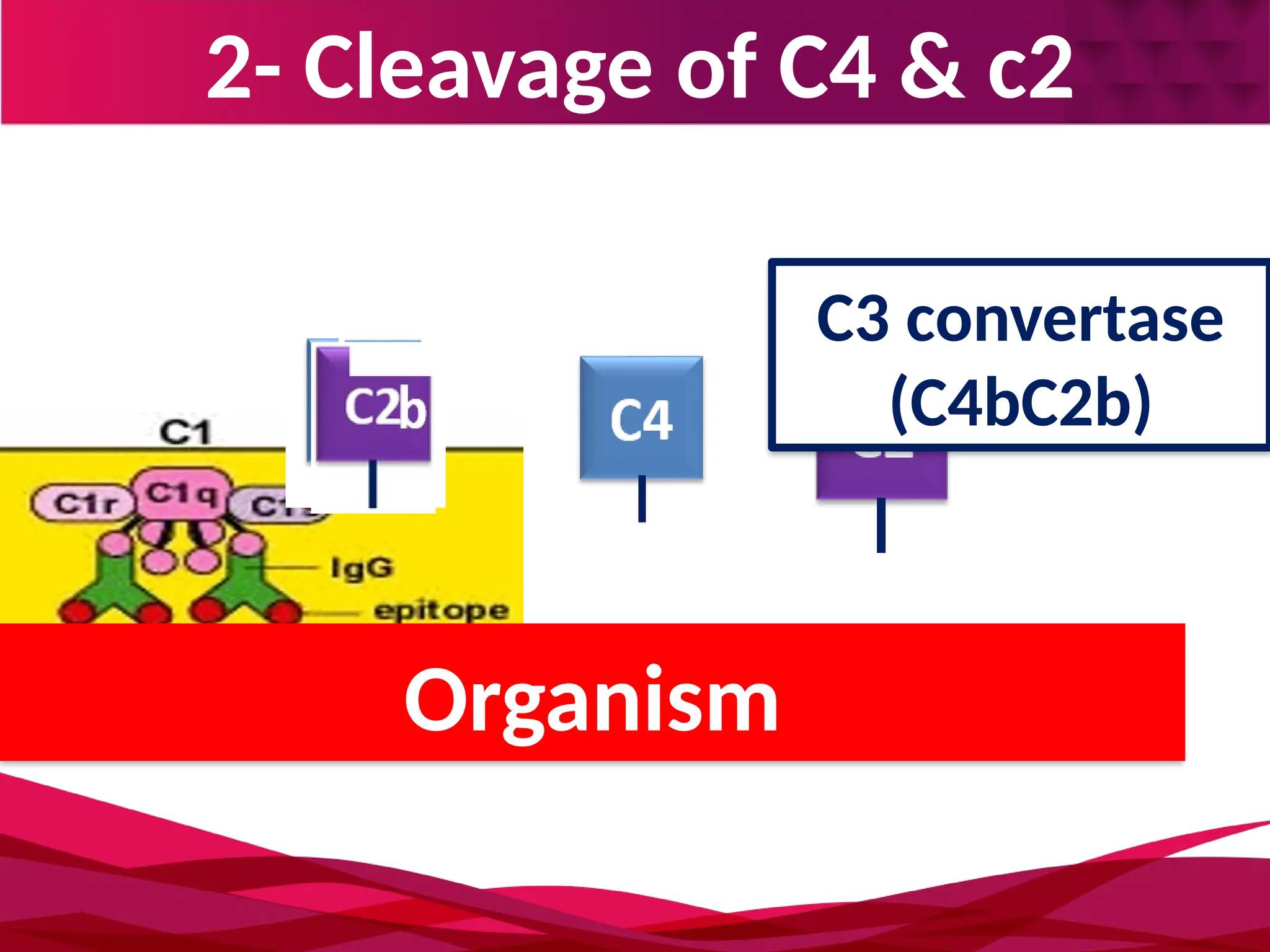
C3 convertase
(C4bC2b)
2- Cleavage of C4 & c2
A) Classical pathway Activation
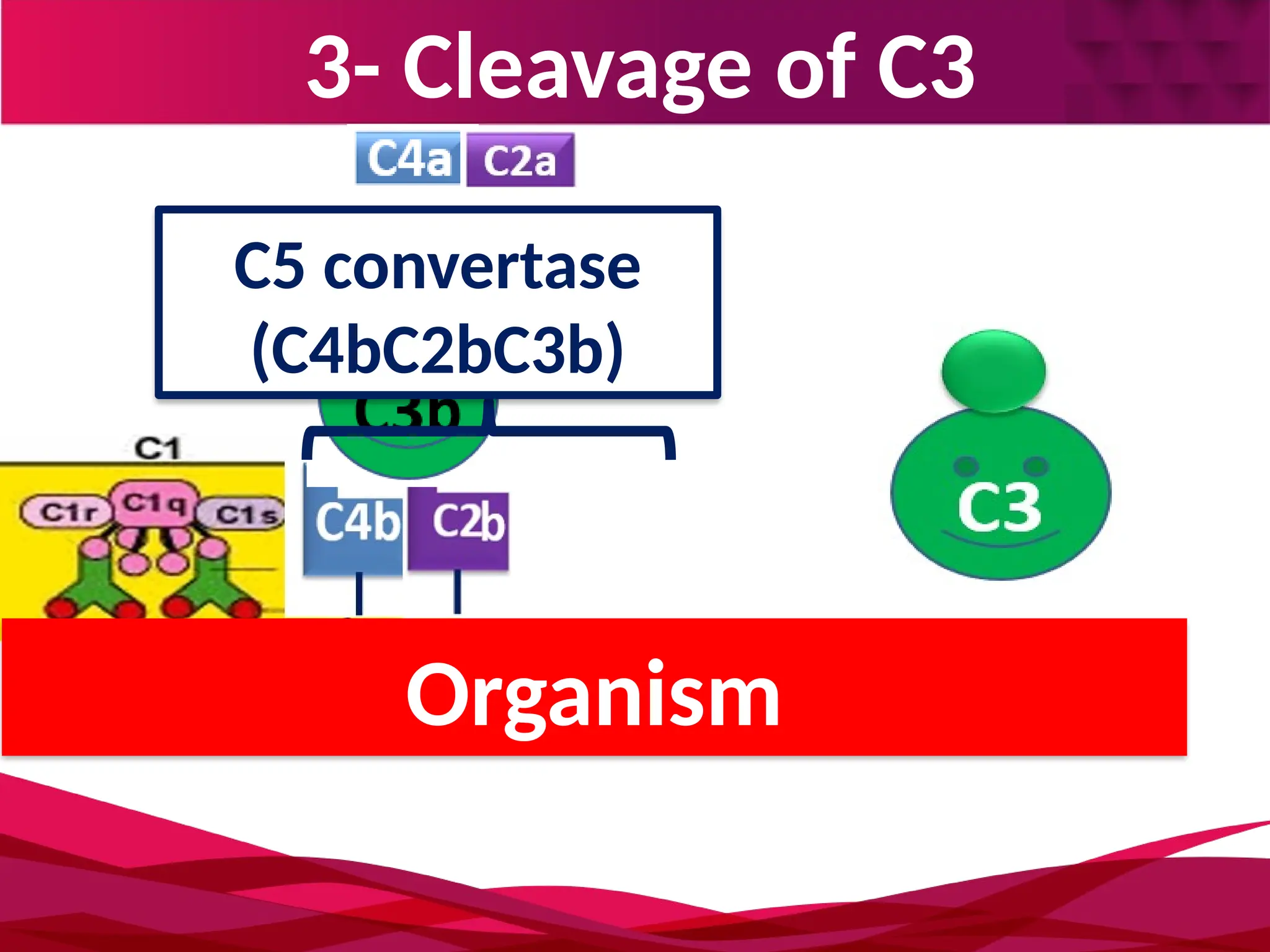
3- Cleavage of C3
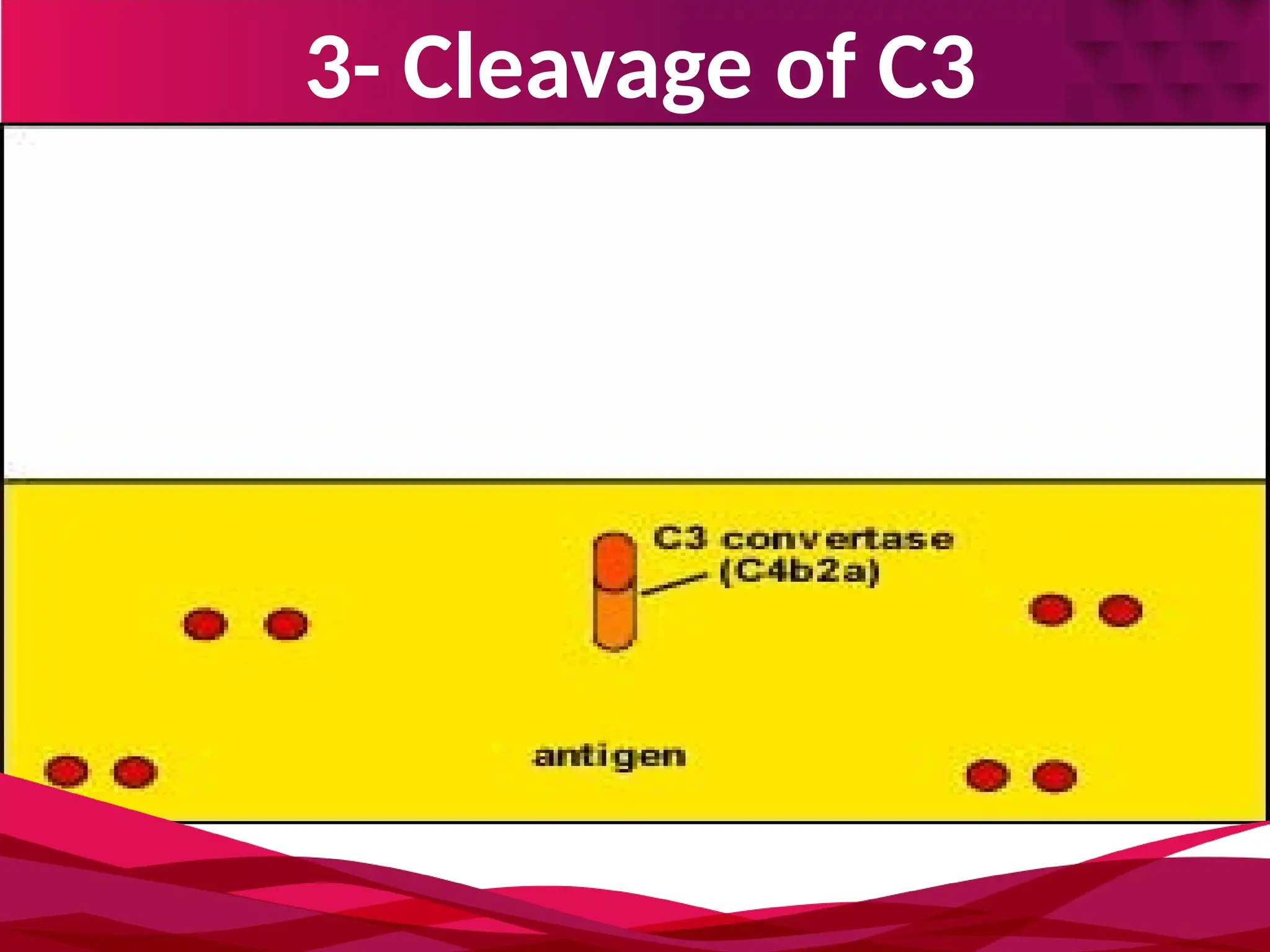
3- Cleavage of C3
Organism
C5 convertase
(C4bC2bC3b)
3- Cleavage of C3
A) Classical pathway Activation
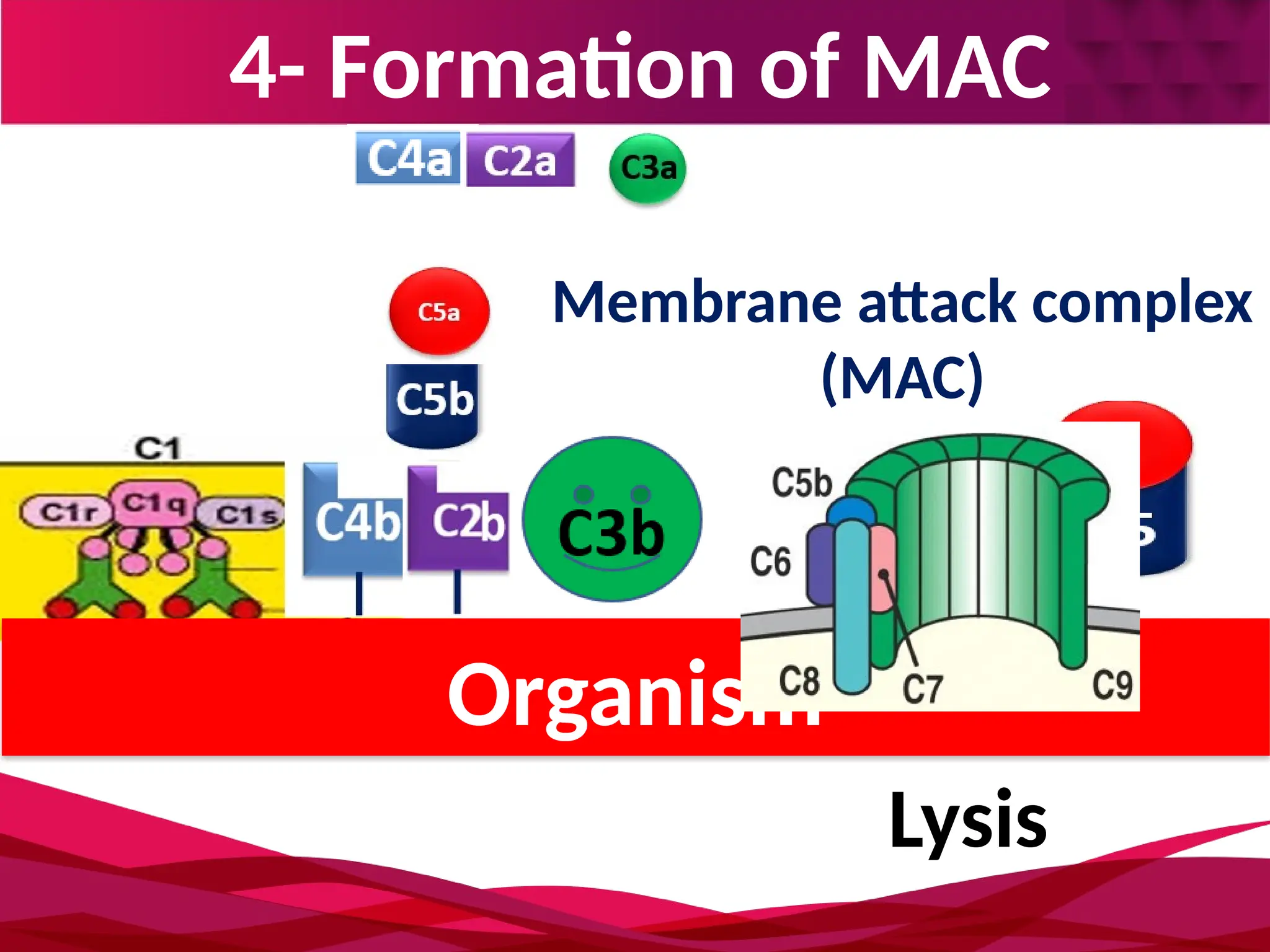
4- MAC formation
4- Formation of MAC
Organism
Membrane attack complex
(MAC)
Lysis
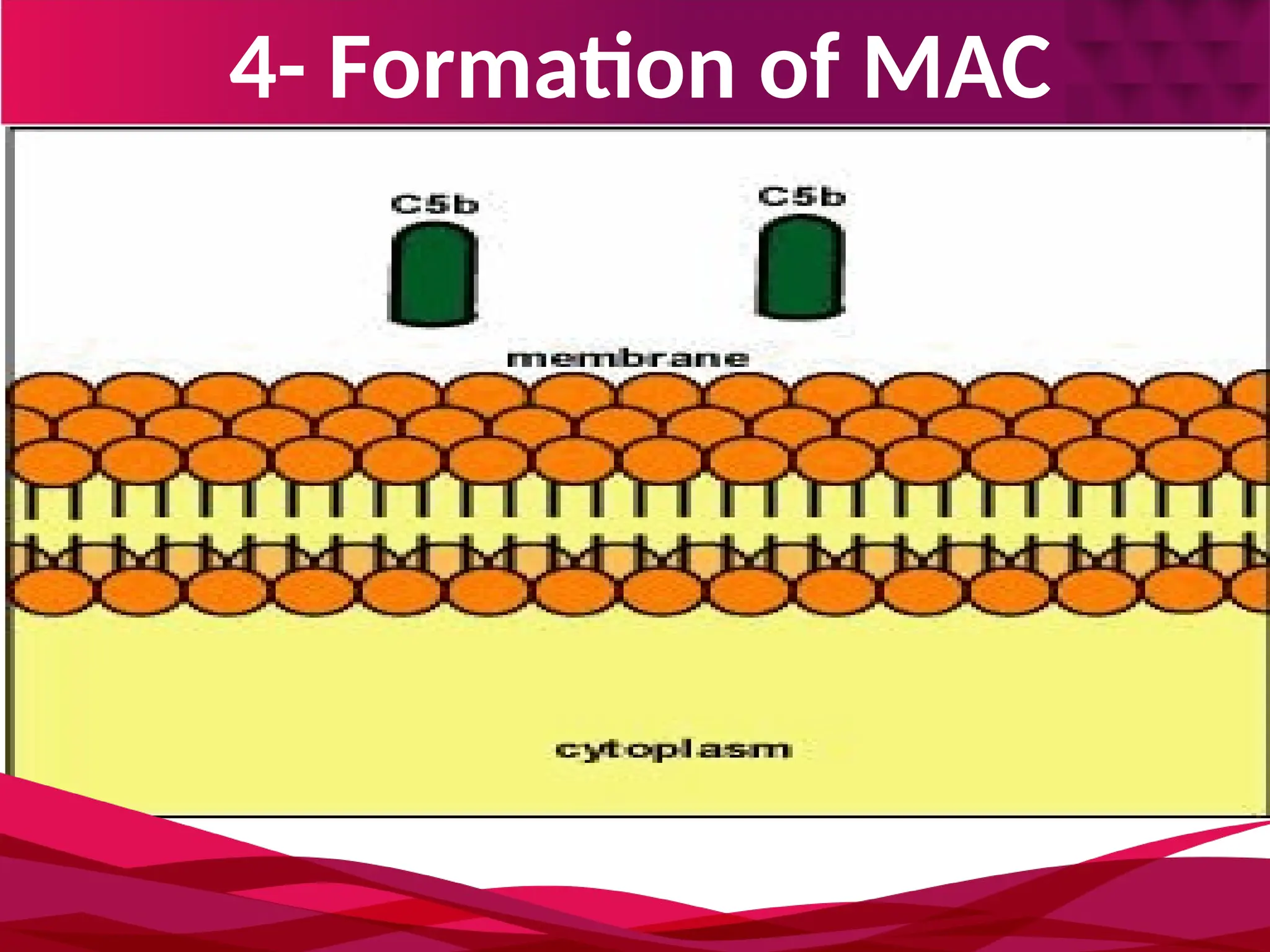
4- Formation of MAC
B) Lectin Pathway Activation
(Answer of exercise-3)
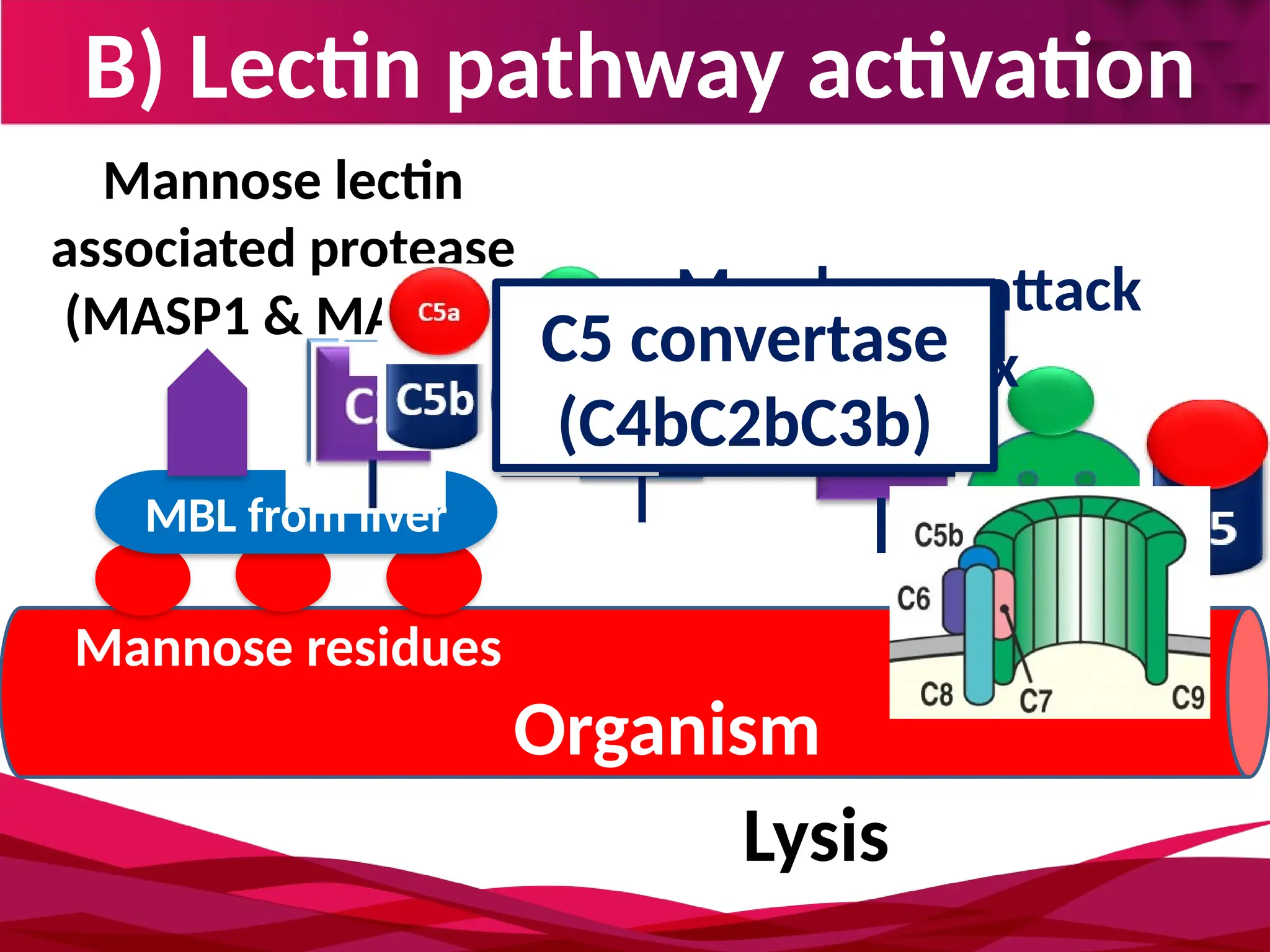
B) Lectin pathway activation
Mannose residues
Organism
MBL from liver
Mannose lectin
associated protease
(MASP1 & MASP2)
C3 convertase
(C4bC2b)
Membrane attack
complex
(MAC)
C5 convertase
(C4bC2bC3b)
Lysis
C) Alternative Pathway
Activation
C) Alternative pathway activation
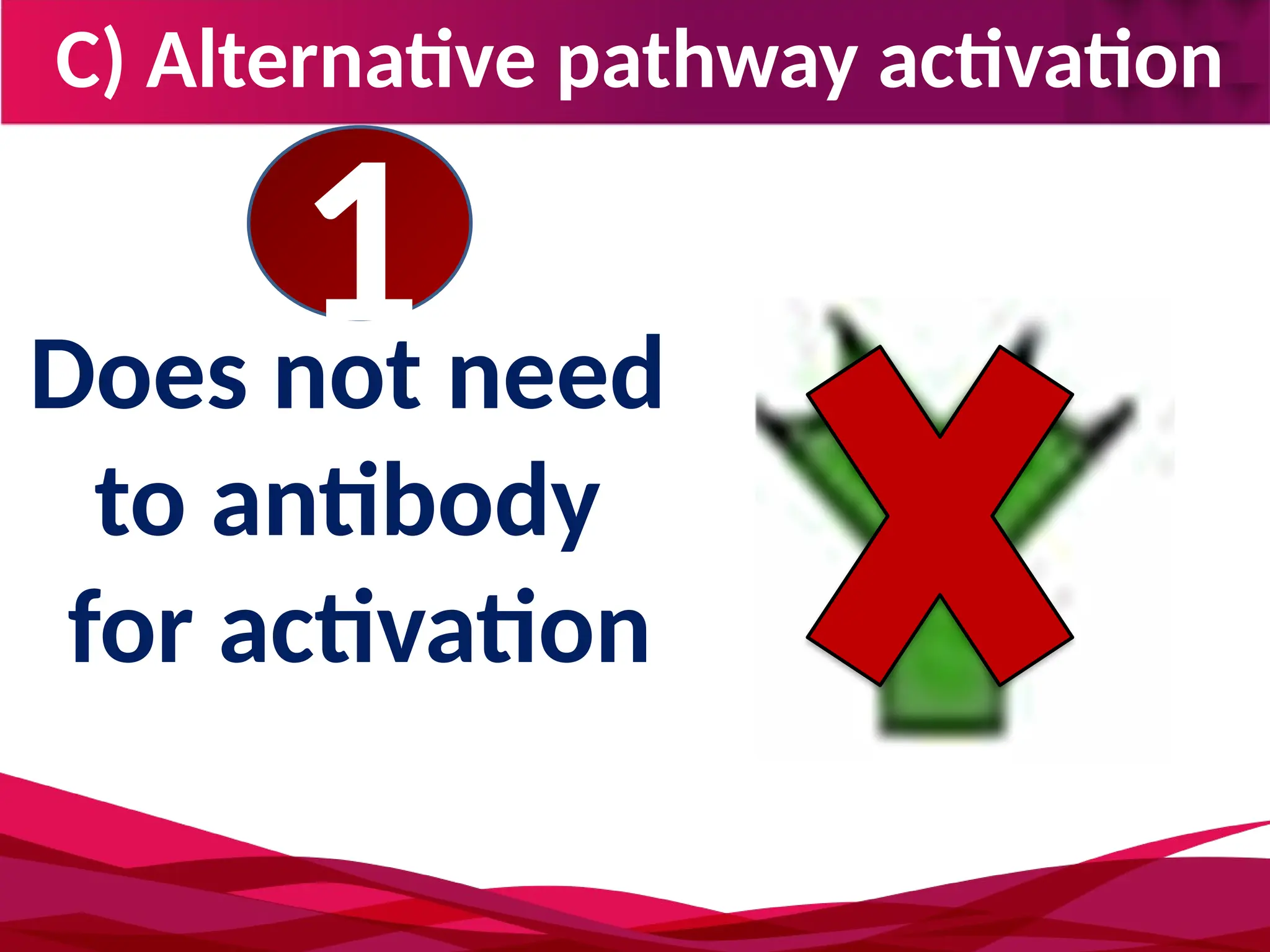
Does not need
to antibody
for activation
1
C) Alternative pathway activation
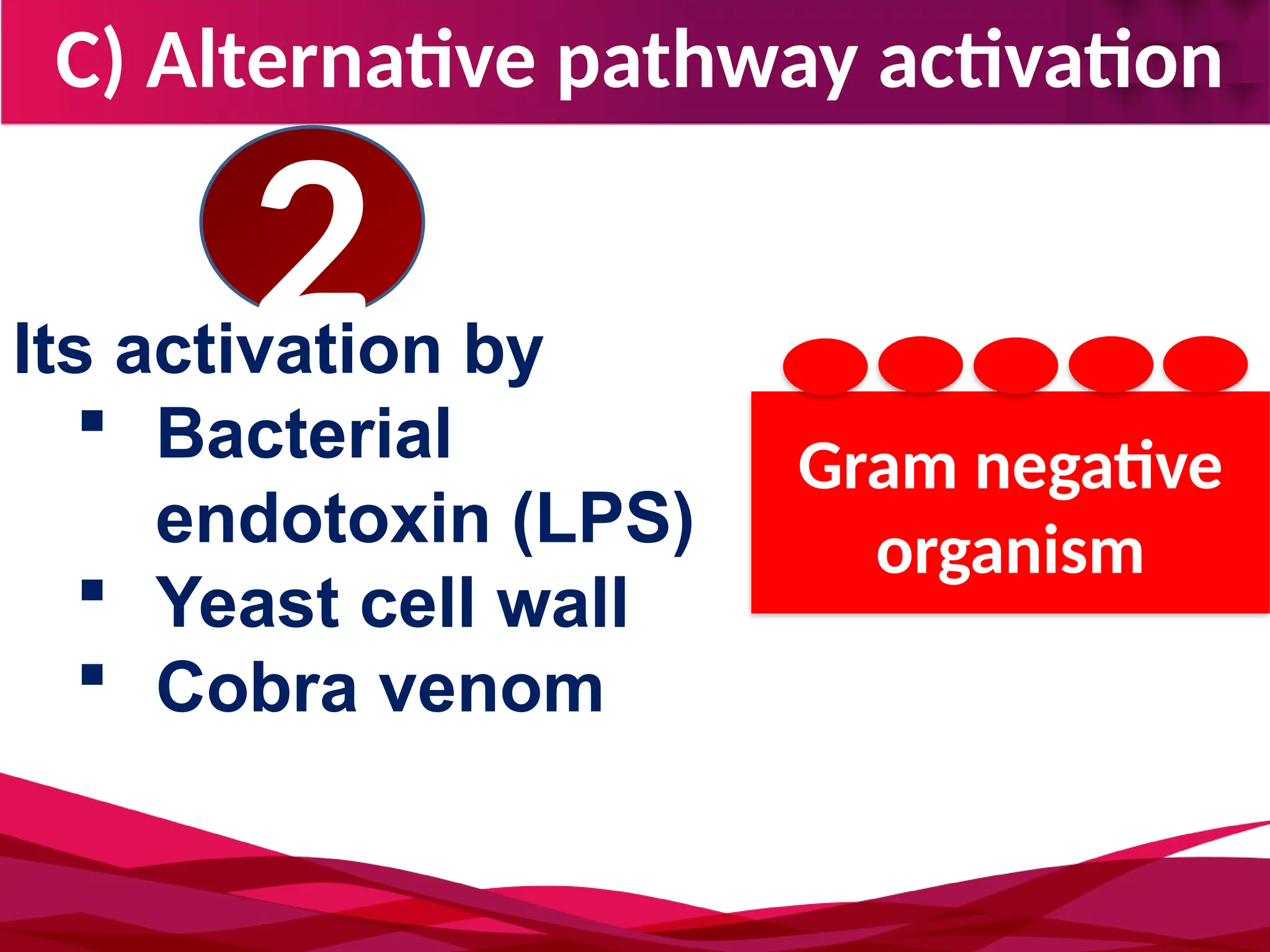
Its activation by
 Bacterial
endotoxin (LPS)
 Yeast cell wall
 Cobra venom
2
Gram negative
organism
C) Alternative pathway activation
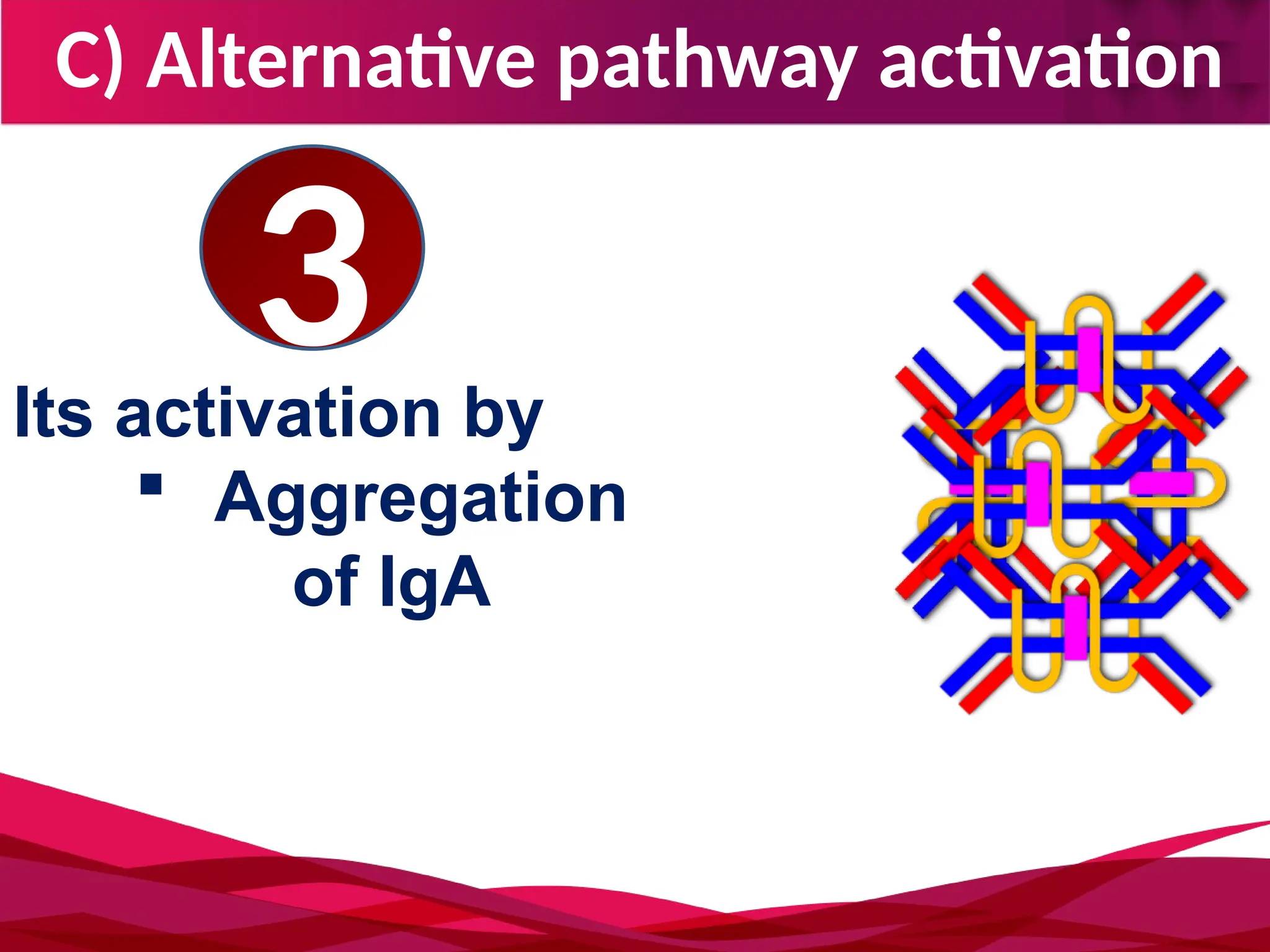
Its activation by
 Aggregation
of IgA
3
C) Alternative pathway activation
4
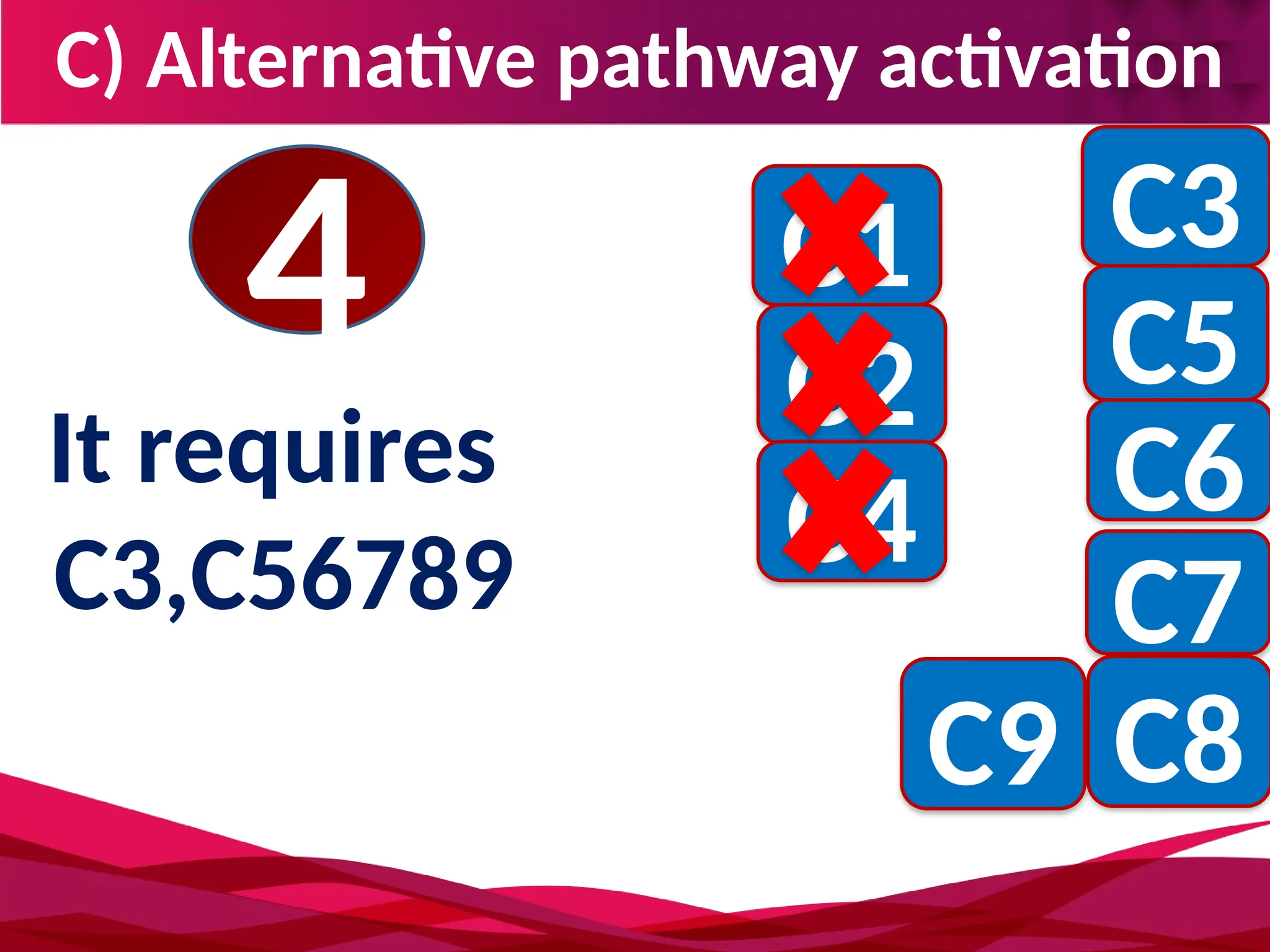
It requires
C3,C56789
C3
C5
C6
C7
C8
C9
C1
C2
C4
C) Alternative pathway activation
5
It requires
Factor B
FB
C) Alternative pathway activation
6
It requires
Factor D
C) Alternative pathway activation
7
It requires
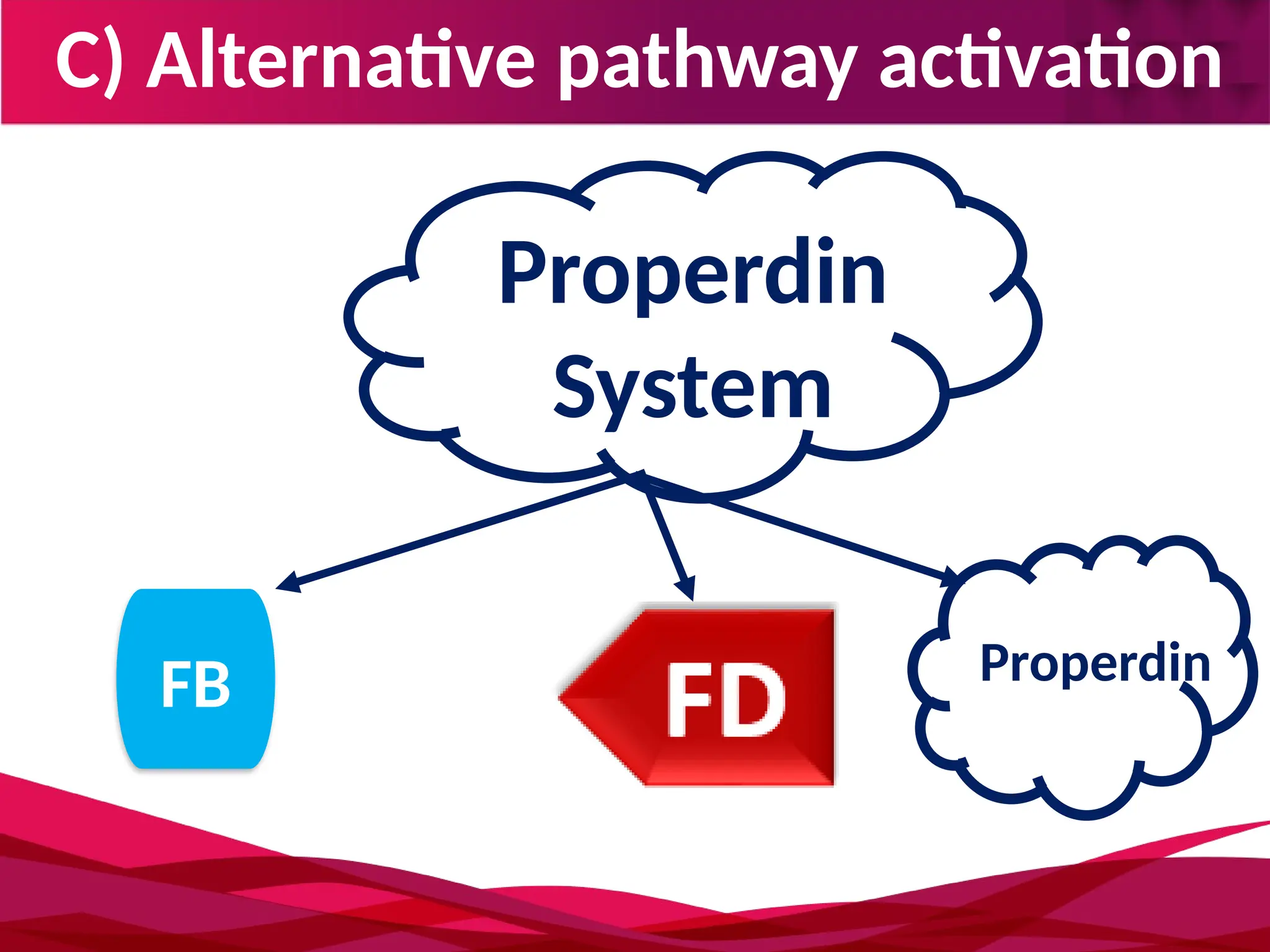
Properdin
Properdin
C) Alternative pathway activation
Properdin
System
FB Properdin
C) Alternative pathway activation
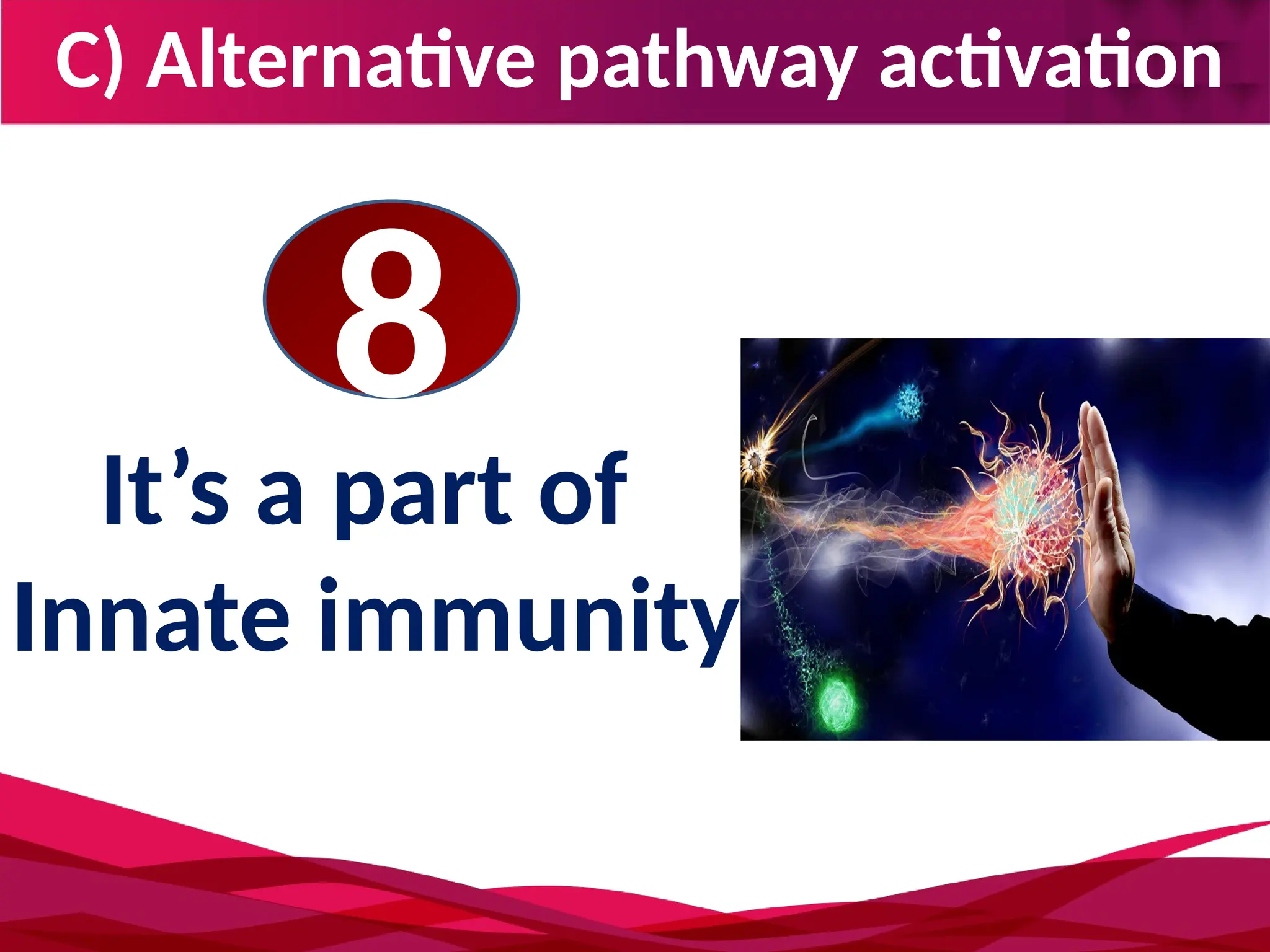
8
It’s a part of
Innate immunity
C) Alternative Pathway Activation
1) Activation of C3
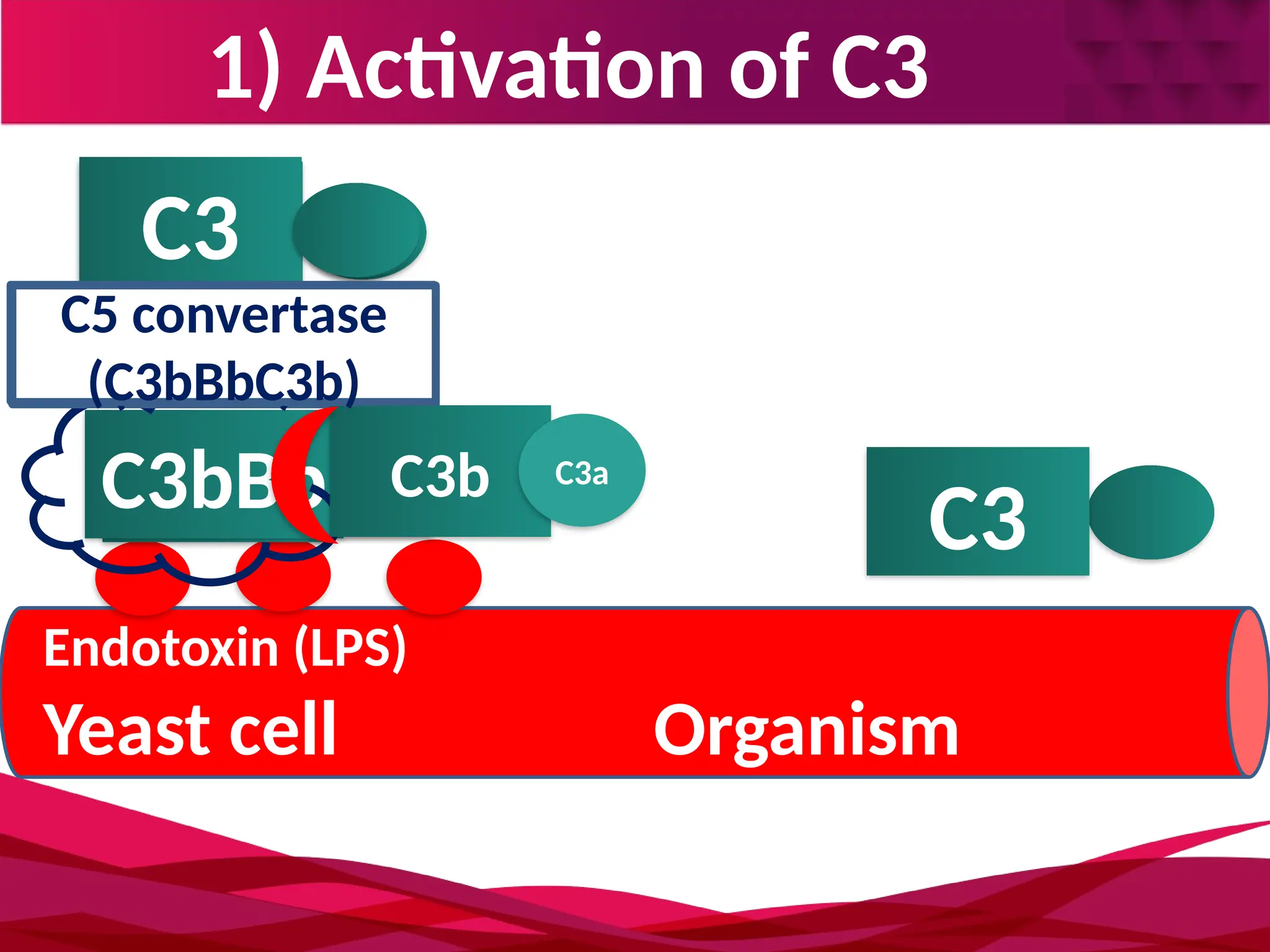
1) Activation of C3
Endotoxin (LPS)
Yeast cell Organism
C3b
C3 C3a
C3bB
C3bBb C3a
C3 convertase
unstable
Properdin
C3 convertase
(C3bBb) P
C3
C3b C3a
C5 convertase
(C3bBbC3b)
C) Alternative Pathway Activation
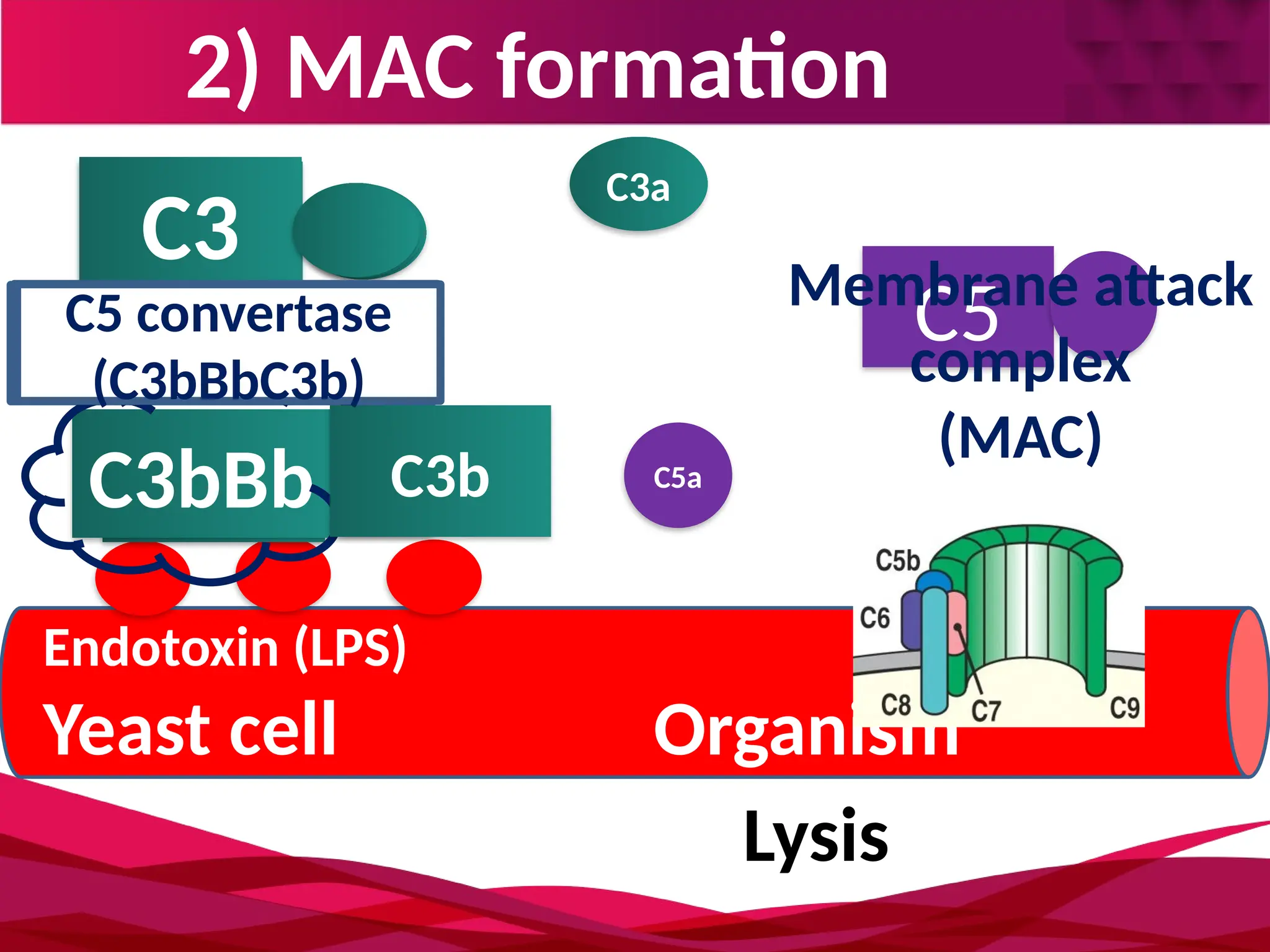
2) MAC formation
2) MAC formation
Endotoxin (LPS)
Yeast cell Organism
C3b
C3 C3a
C3bB
C3bBb C3a
C3 convertase
unstable
C3 convertase
(C3bBb) P
C3b
C5 convertase
(C3bBbC3b)
C5
C5a
Membrane attack
complex
(MAC)
Lysis
C3a
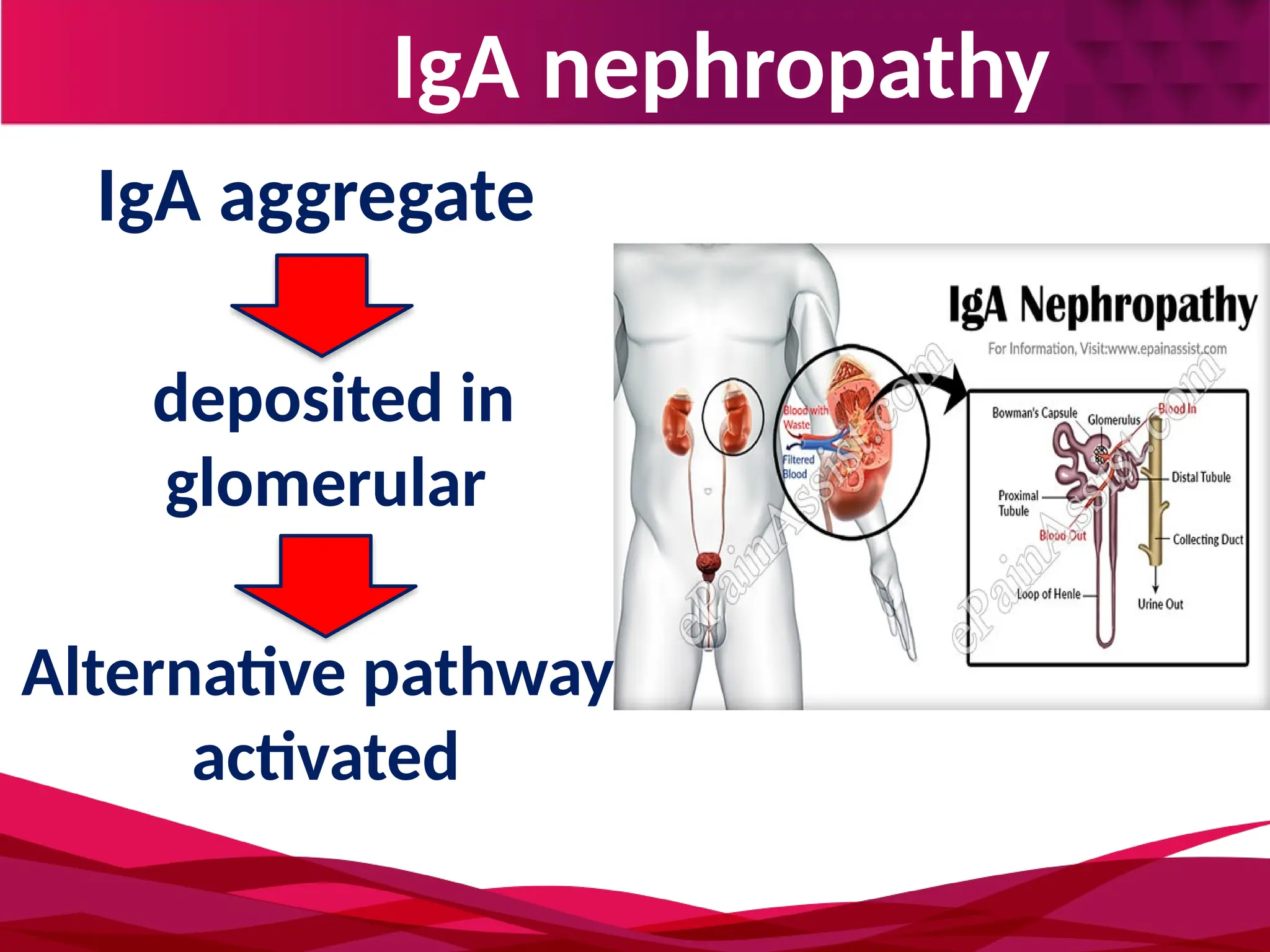
IgA nephropathy
deposited in
glomerular
IgA aggregate
Alternative pathway
activated
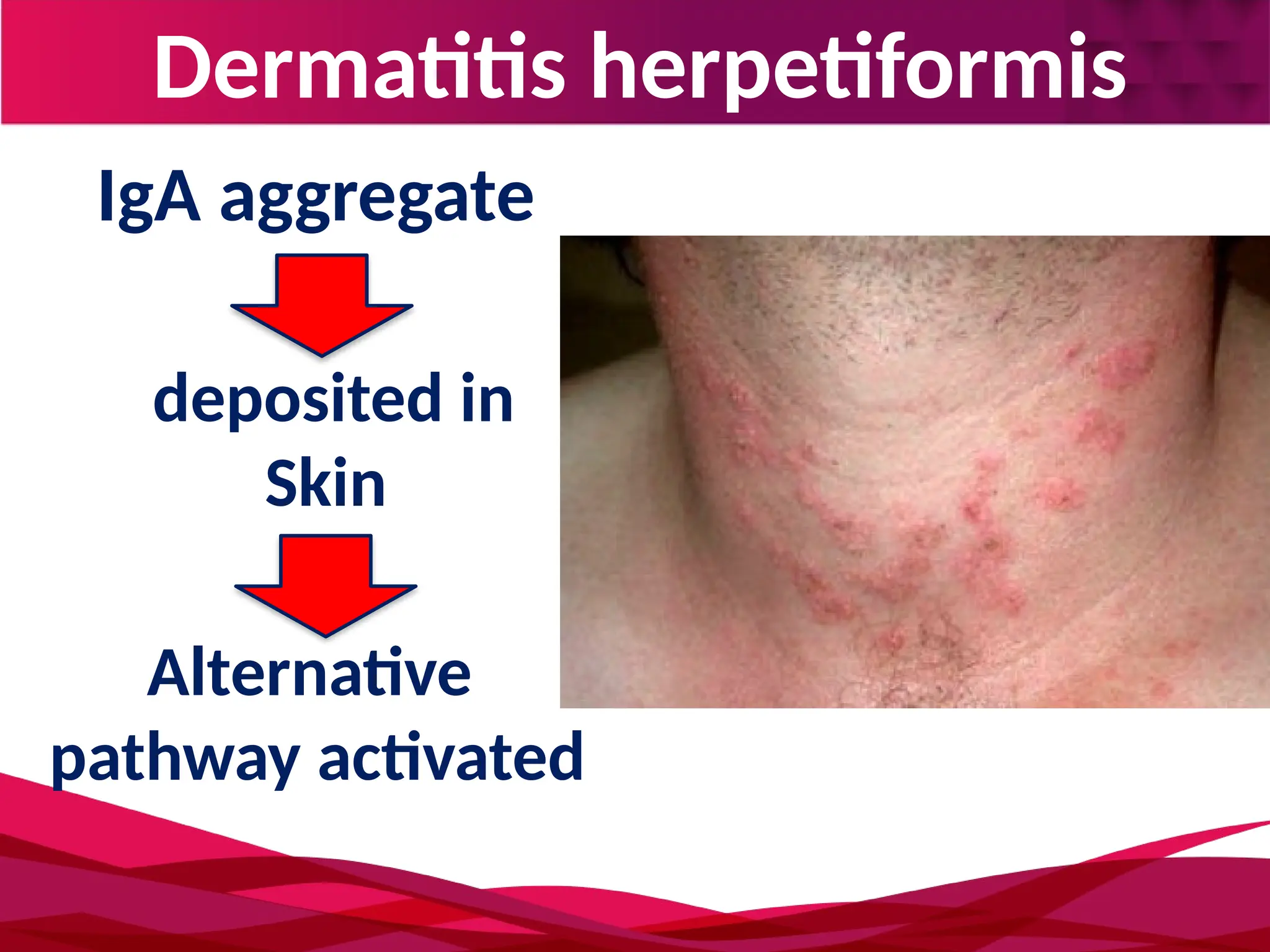
Dermatitis herpetiformis
deposited in
Skin
IgA aggregate
Alternative
pathway activated
Exercise 4
Compare between Classical, Lectin &
Alternative pathway (clarify the sharing & the
difference points)
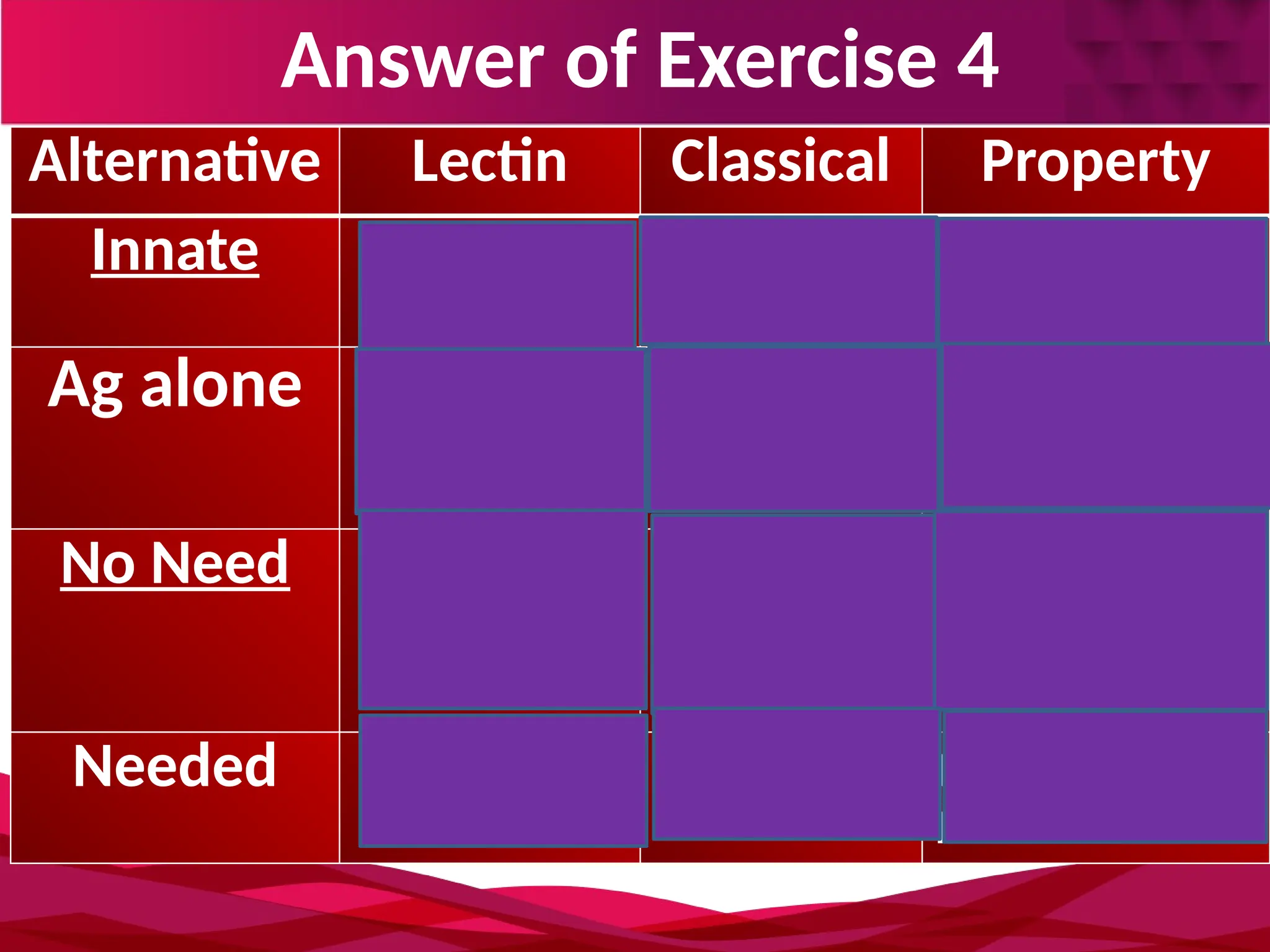
Answer of Exercise 4
Alternative Lectin Classical Property
Innate Innate Adaptive 1
)
Type of
immunity
Ag alone Mannose
-MBL
Ag-Aby
reaction
2
)
Initiation
No Need No Need Antibody
needed
3
)
Role of
antibodies
Needed No need No need 4
)
Role of
properdin
Answer of Exercise 4
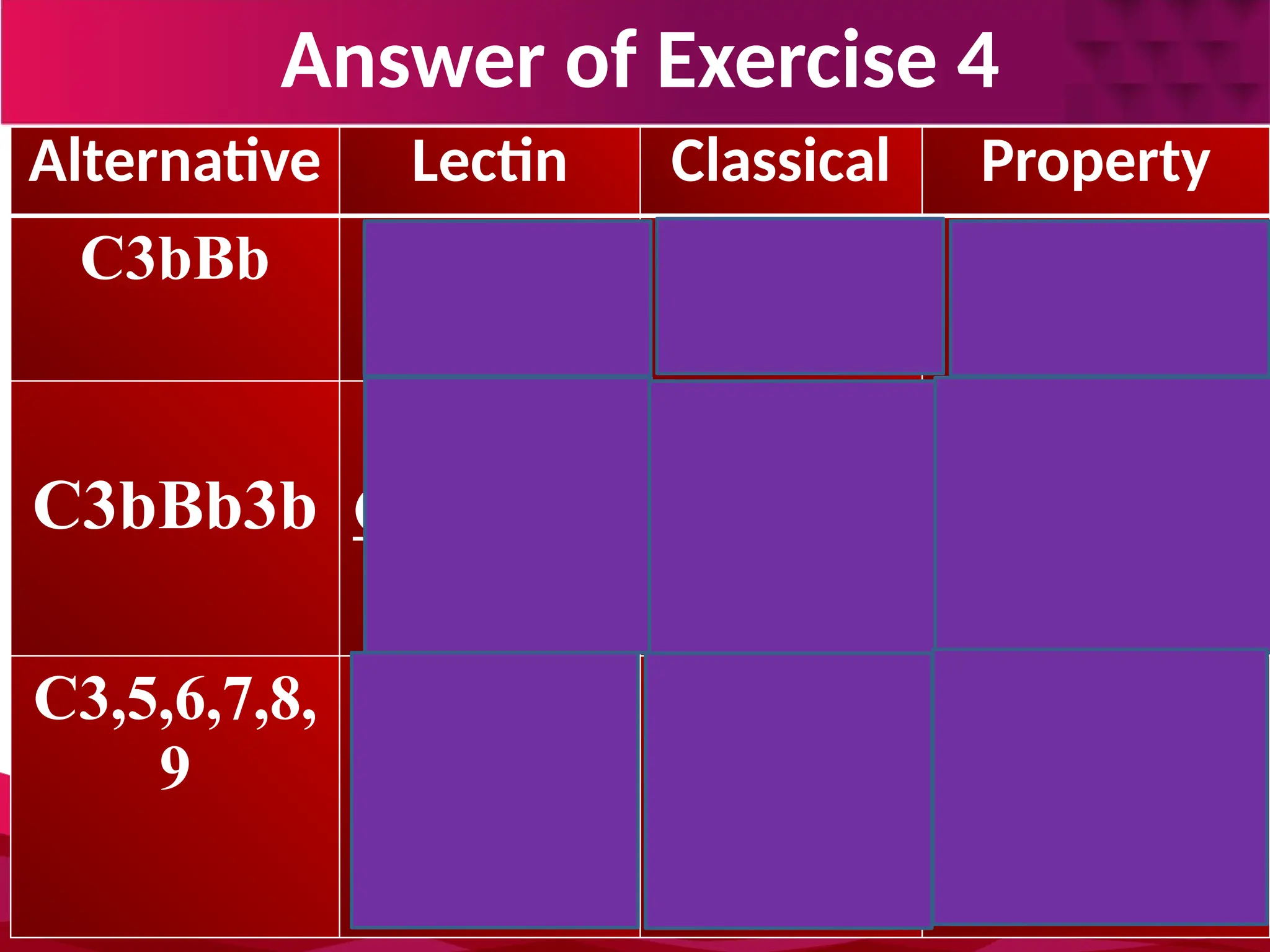
Alternative Lectin Classical Property
C3bBb C4b2b C4b2b 5)C3
convertase
C3bBb3b C4b2b3b C4b2b3b
6
)
C5
convertase
C3,5,6,7,8,
9
2,3,4,5,6
,7,8,9
C1,2,3,4,5,6
,7,8,9
7
)
included
complement
factors
Answer of Exercise 4
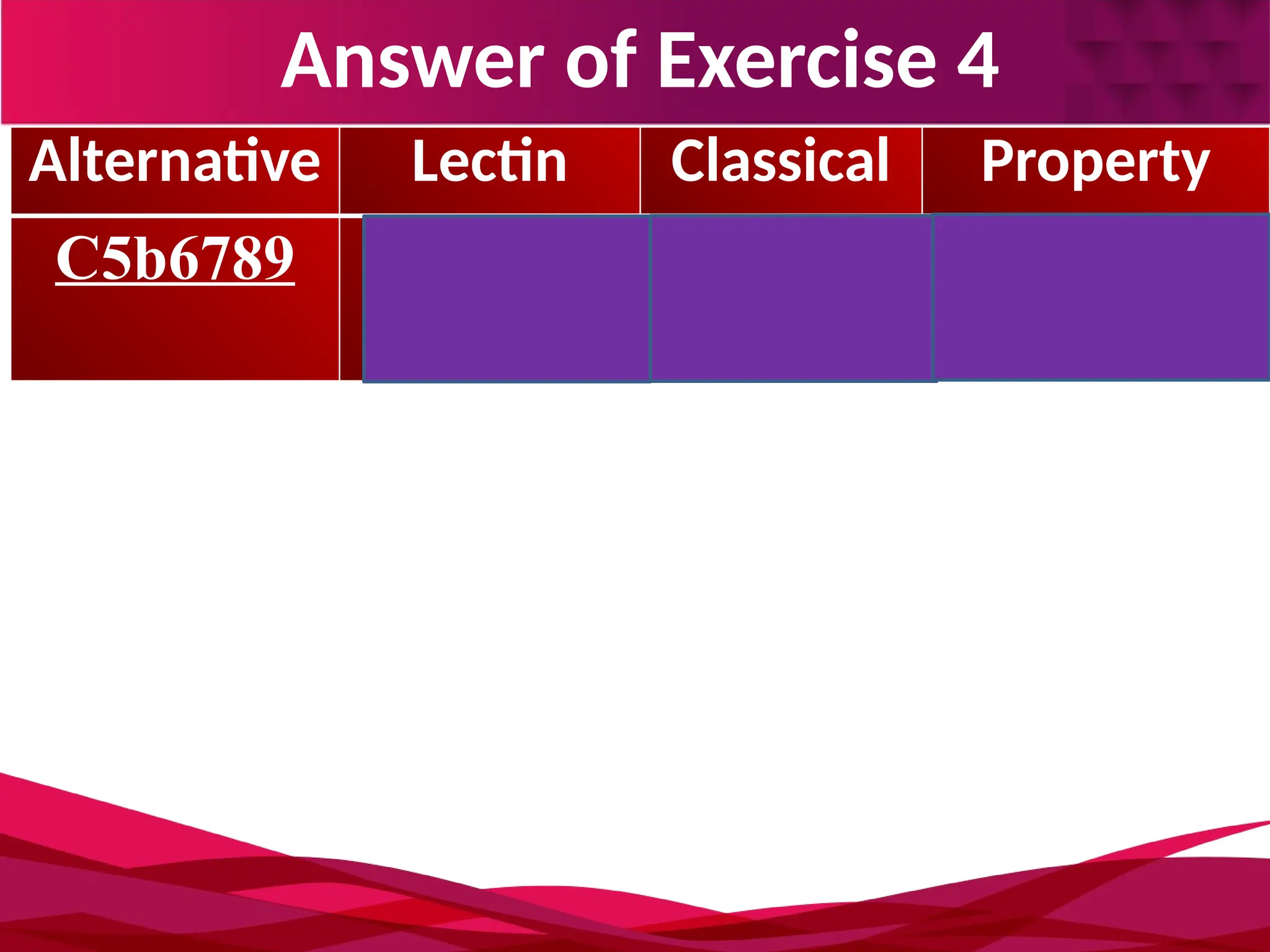
Alternative Lectin Classical Property
C5b6789 C5b6789 C5b6789 8) MAC
formation
IV) Function of
complement
1- Lysis of organism
MAC
Exercise 5
Predict
What are the functions of
the complements?
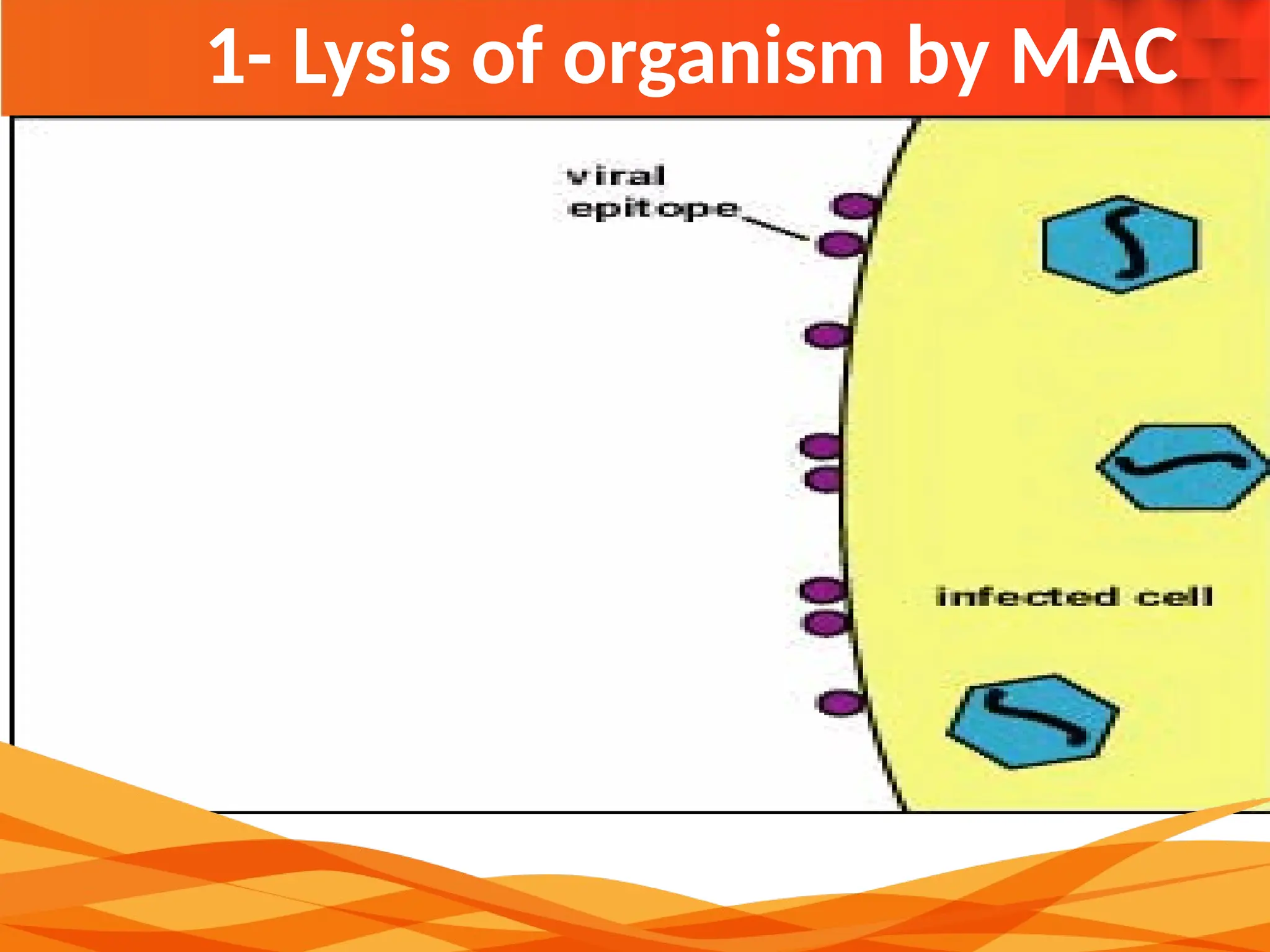
1- Lysis of organism by MAC
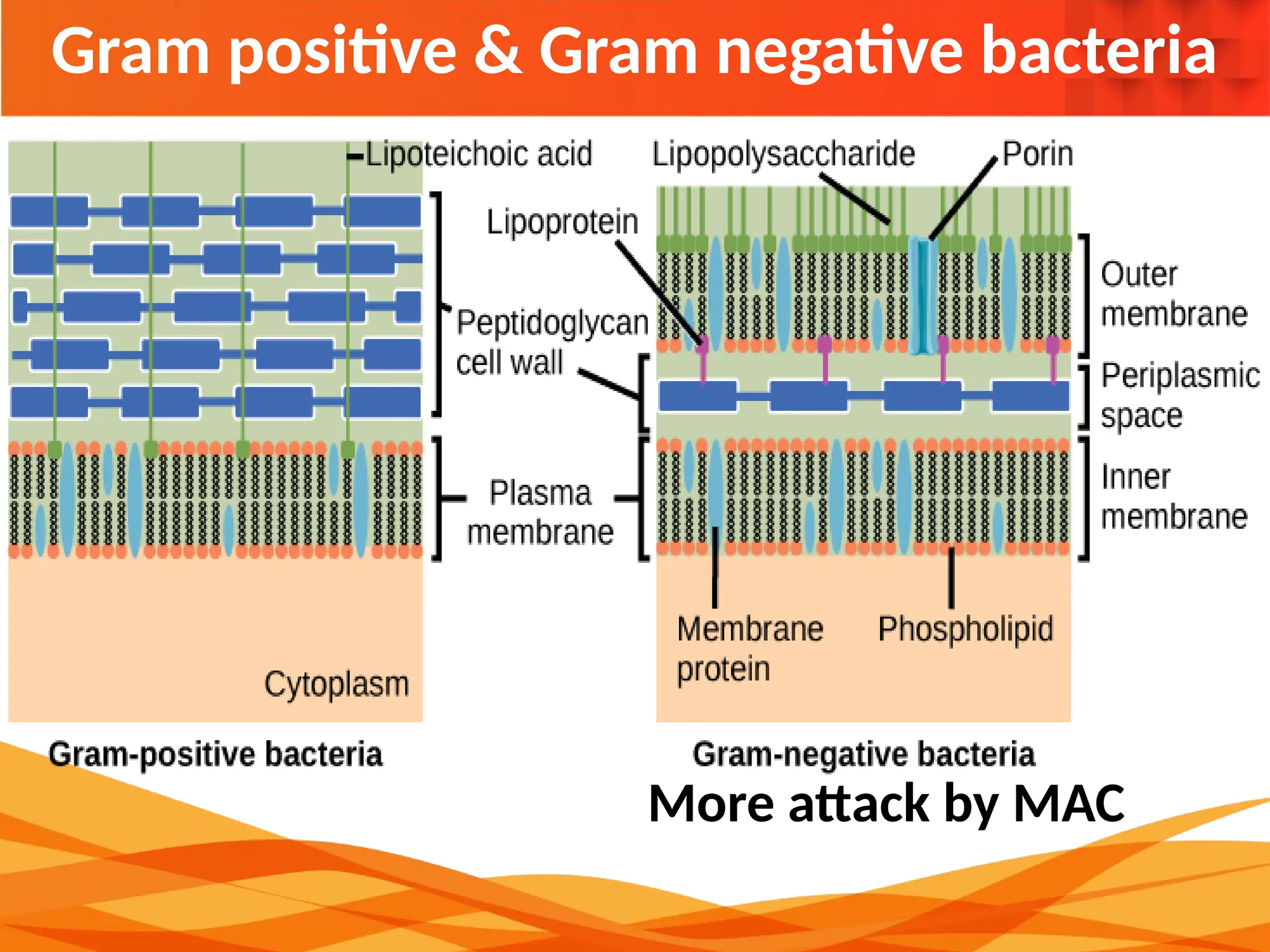
Gram positive & Gram negative bacteria
More attack by MAC
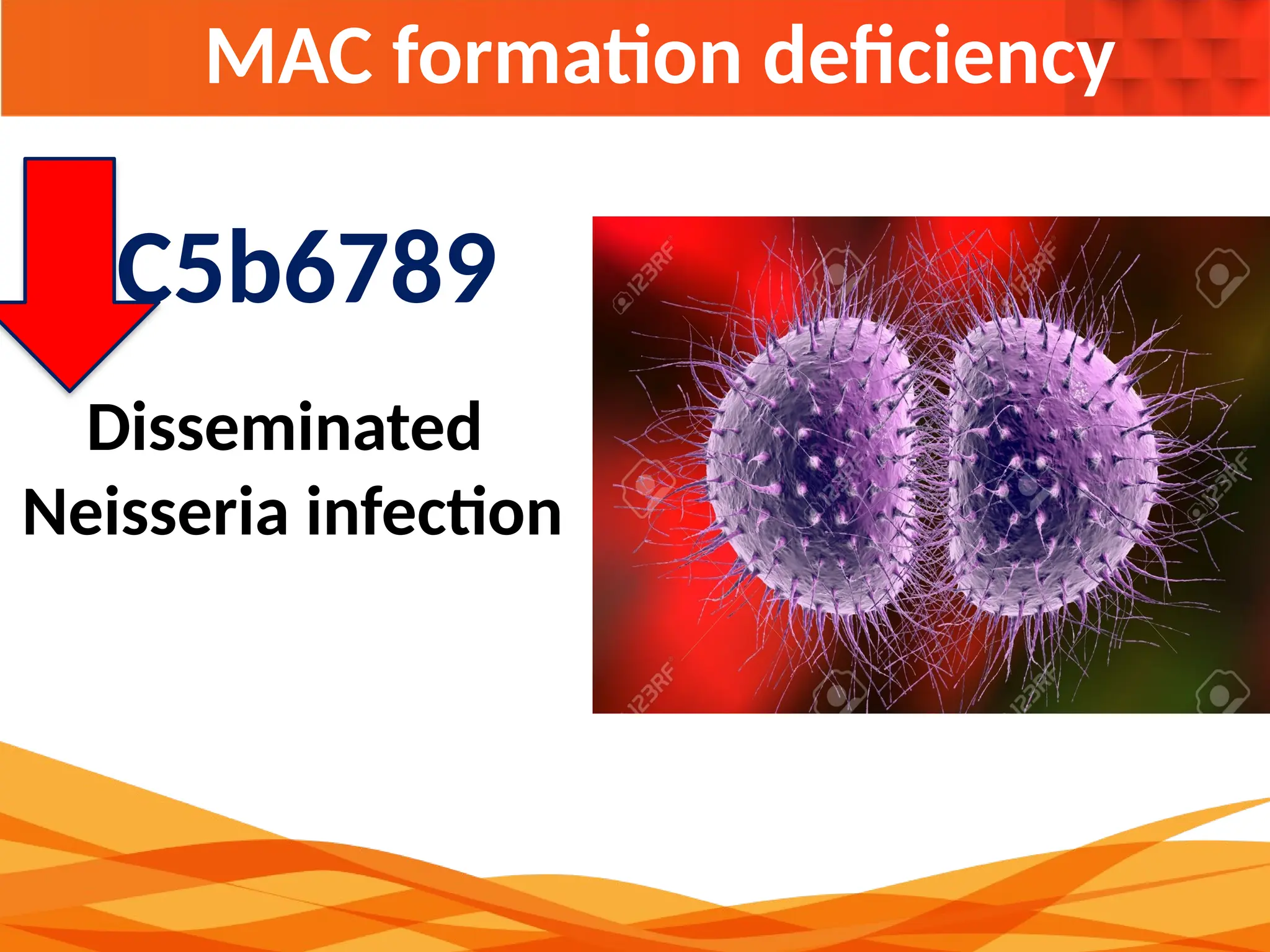
MAC formation deficiency
Disseminated
Neisseria infection
C5b6789
IV) Function of
complement
2) Opsonization by
C3b & antibodies
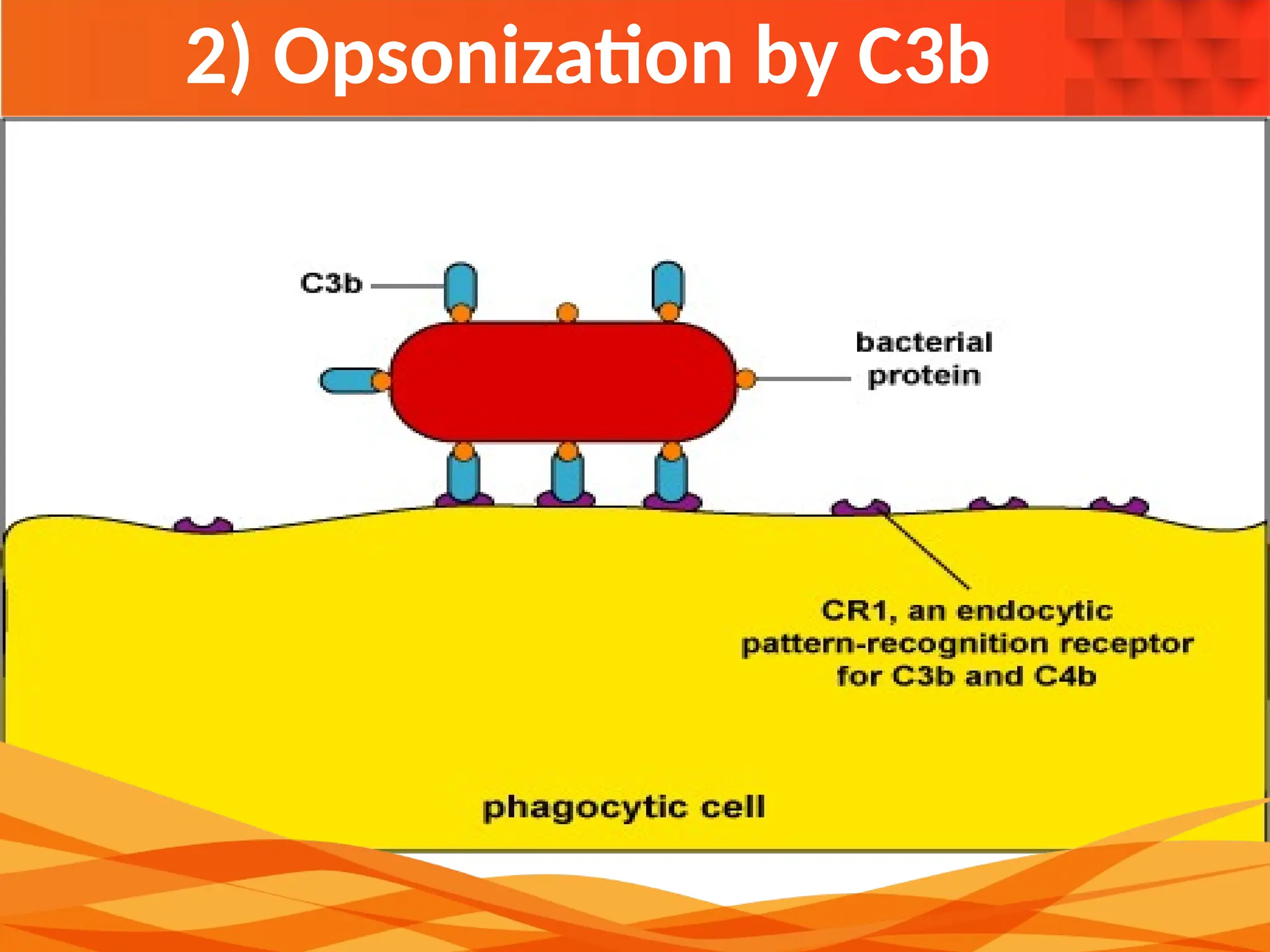
2) Opsonization by C3b
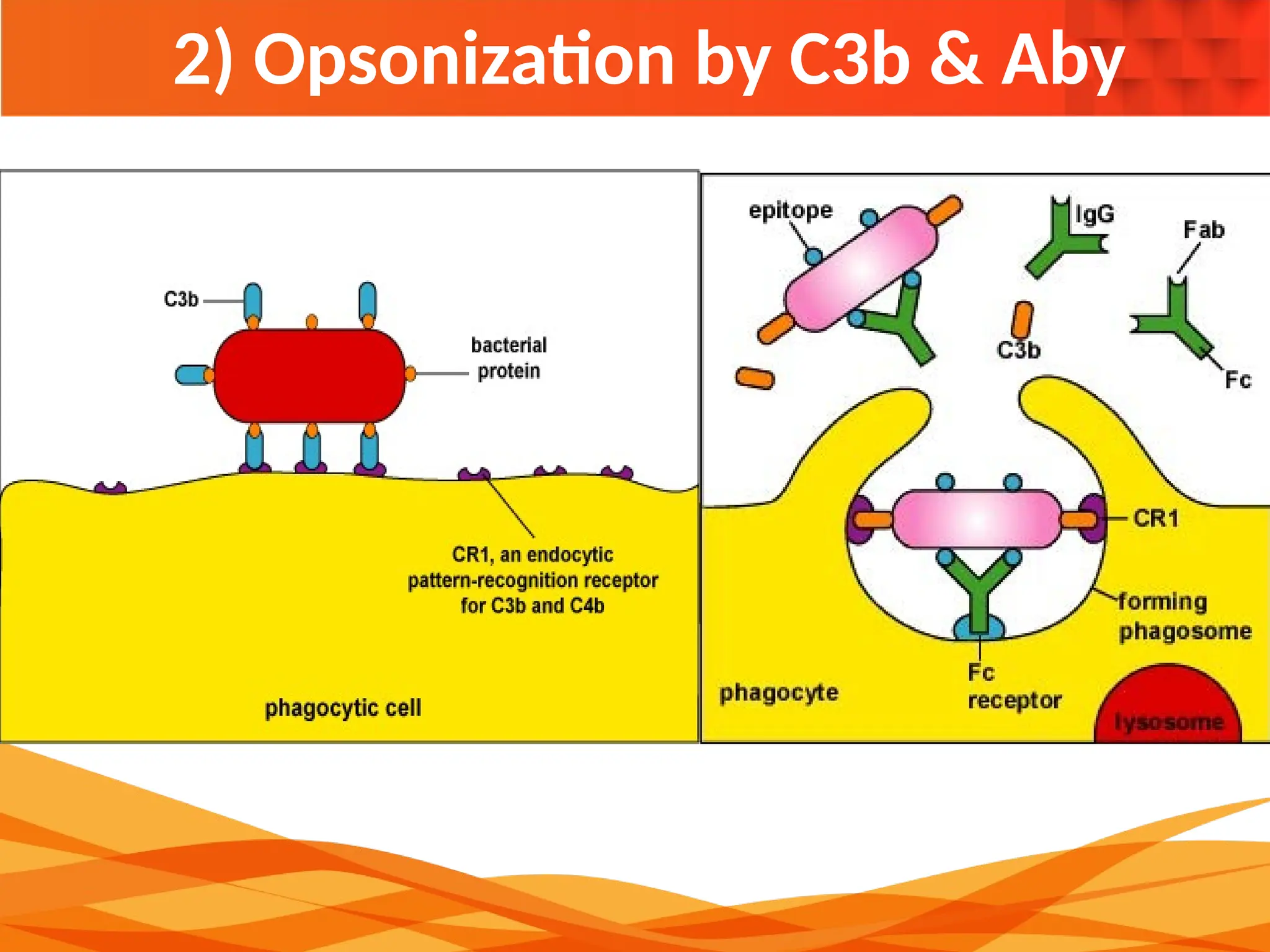
2) Opsonization by C3b & Aby
IV) Function of
complement
3- Chemotaxis by C5a
C5a attracts
phagocytic cells
into the site of
activation
IV) Function of
complement
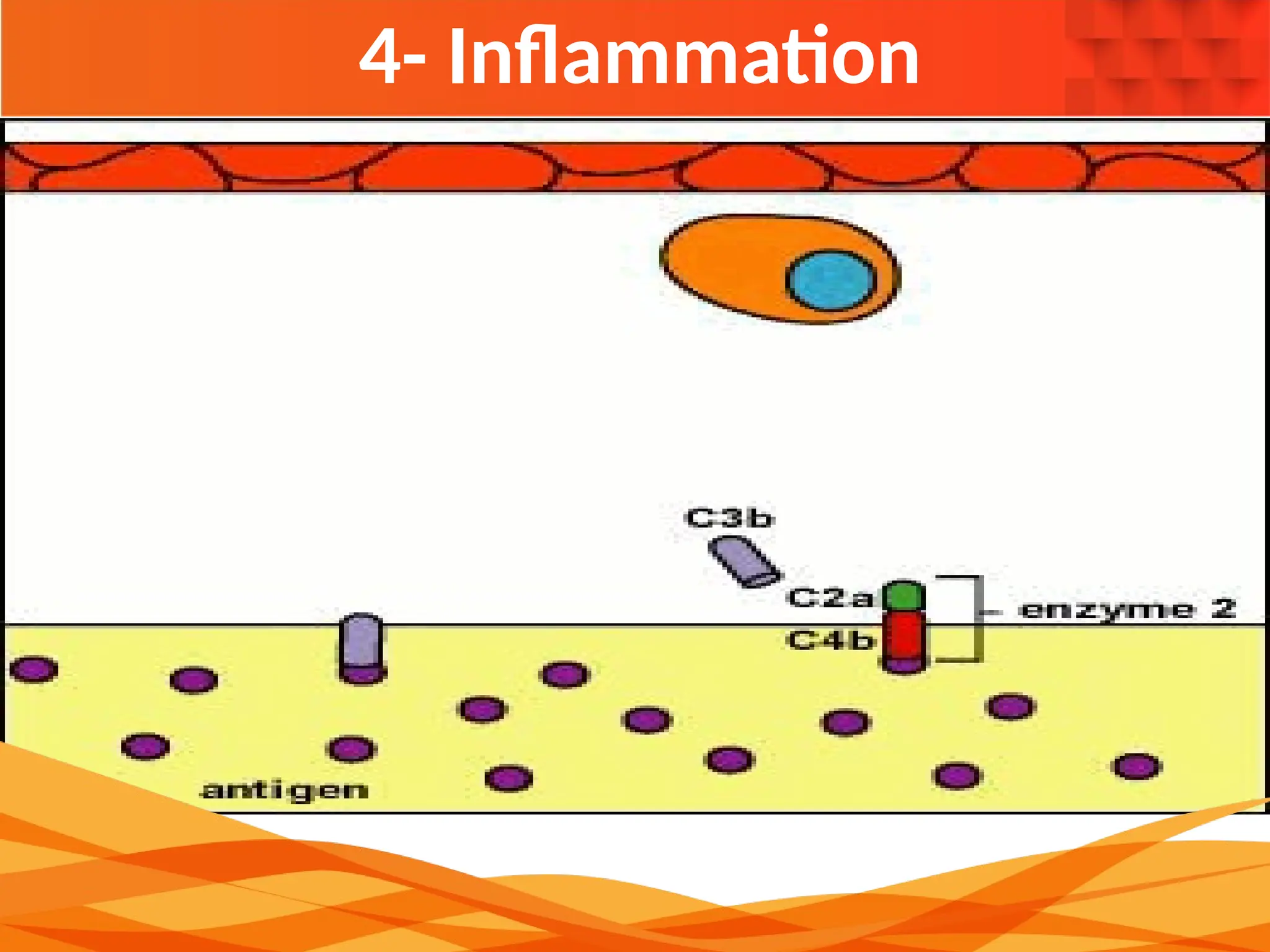
4- Inflammatory
response
4- Inflammatory response
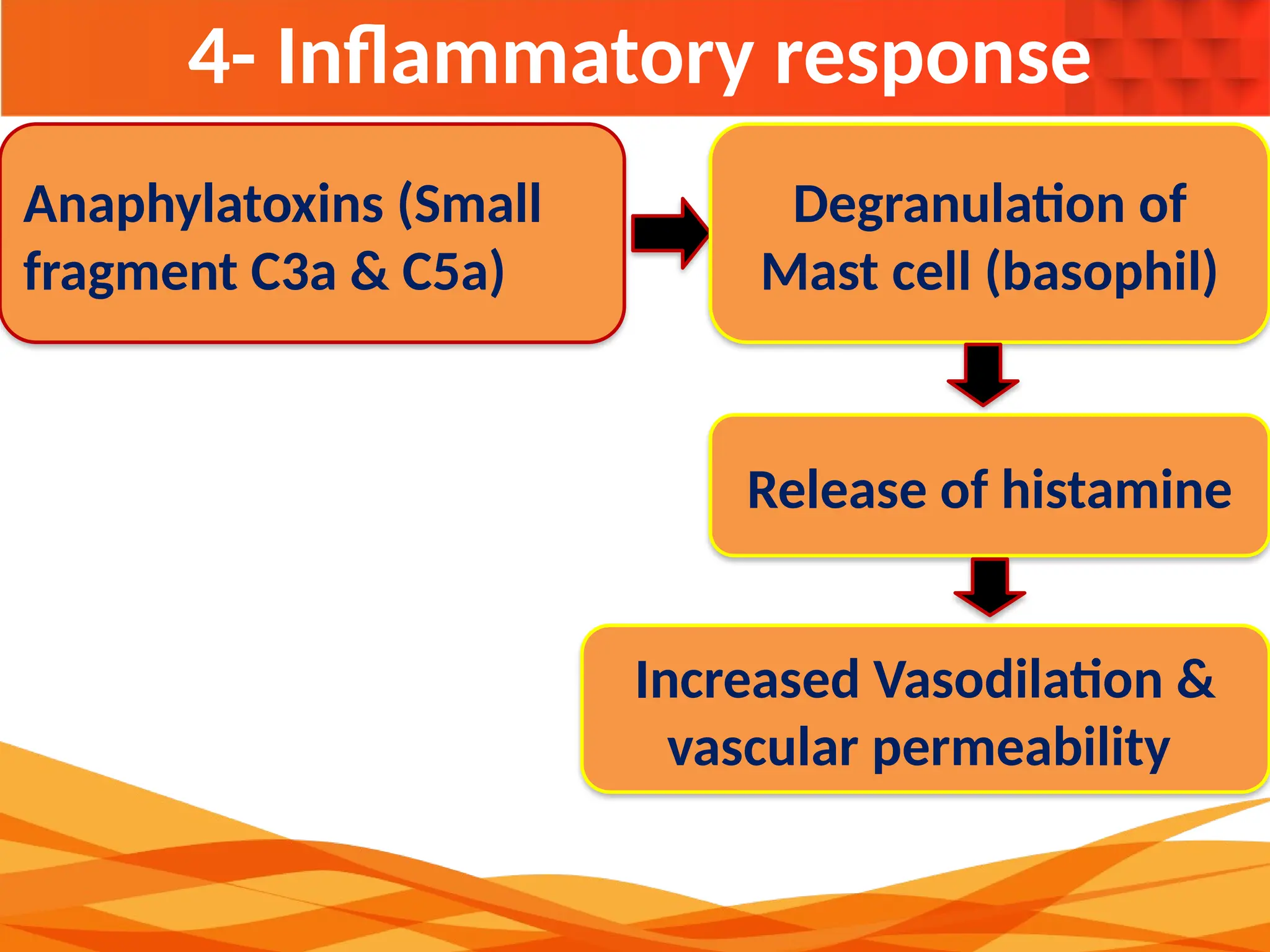
Anaphylatoxins (Small
fragment C3a & C5a)
Degranulation of
Mast cell (basophil)
Release of histamine
Increased Vasodilation &
vascular permeability
4- Inflammation
IV) Function of
complement
5- Clearance of the
immune complexes
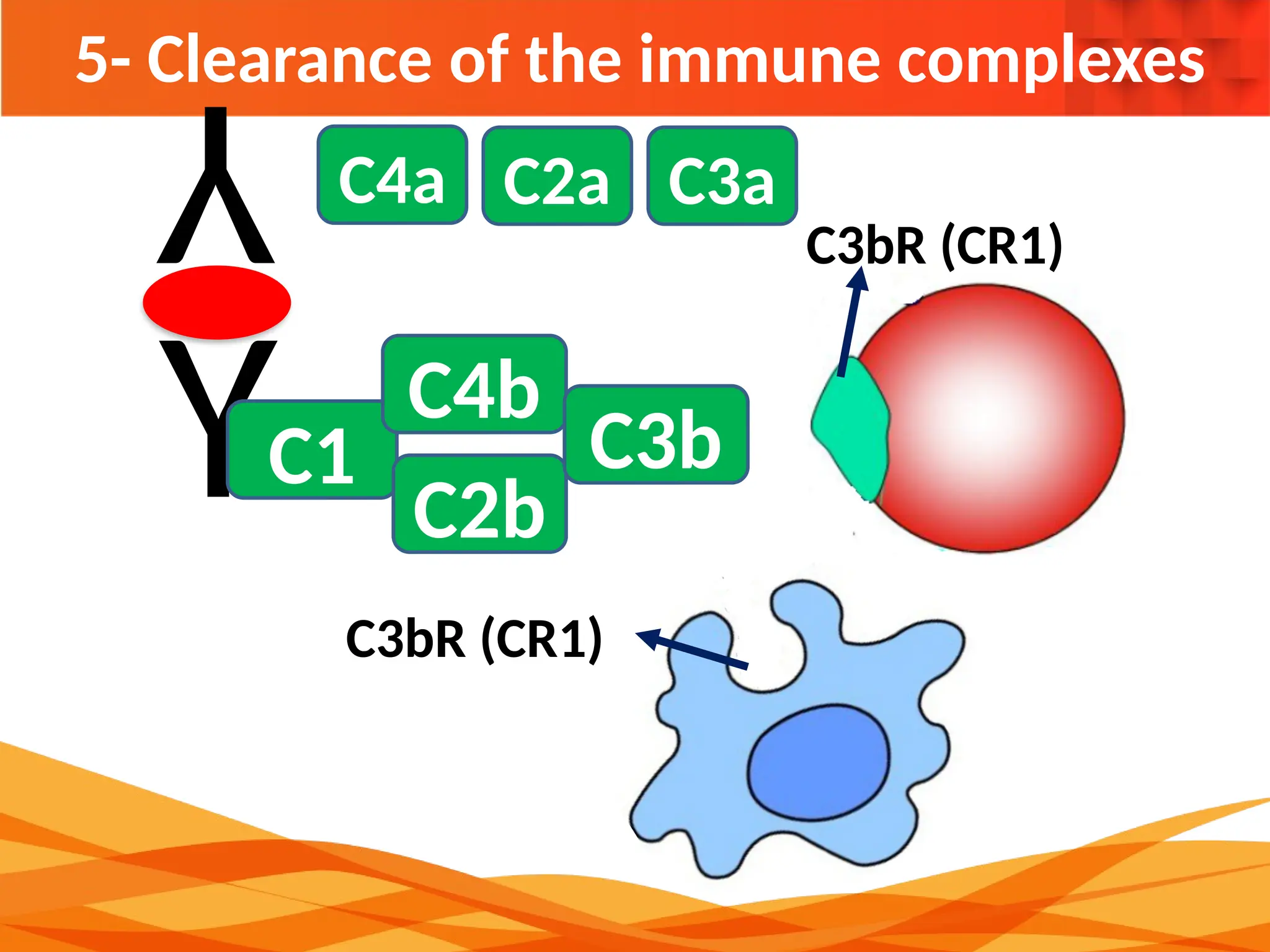
5- Clearance of the immune complexes
Y
Y
C1
C4b
C2b
C3b
C3a
C2a
C4a
C3bR (CR1)
C3bR (CR1)
5- Clearance of the immune complexes
Exercise 6
Predict what will happen if C2 & C4 are
deficient?
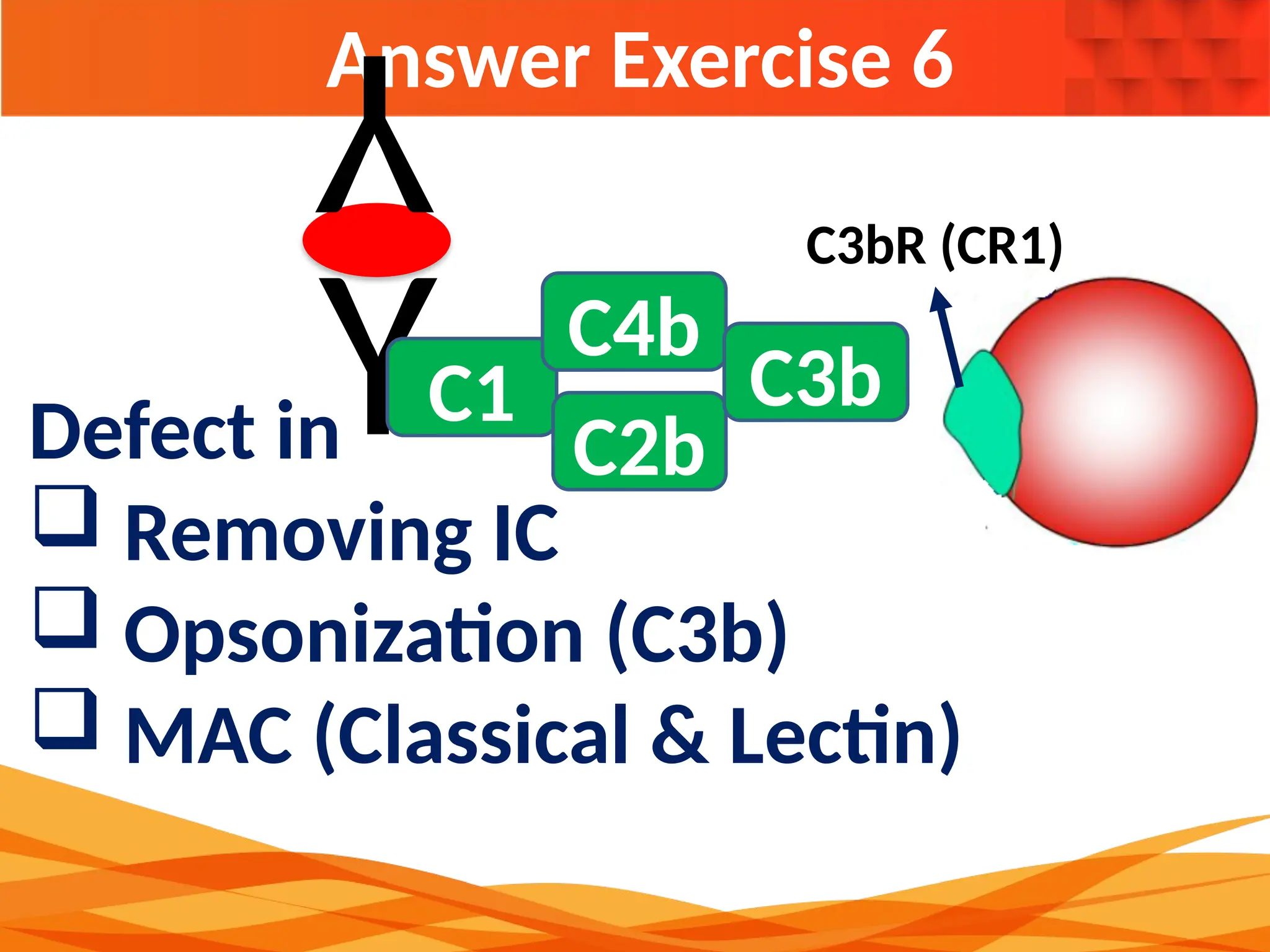
Answer Exercise 6
YC1
C4b
C2b
C3b
C3bR (CR1)
Y
Defect in
 Removing IC
 Opsonization (C3b)
 MAC (Classical & Lectin)
Exercise 7
From your understanding the complement
Give your comment to each picture?
Exercise 7
Y
Y
Y
Y
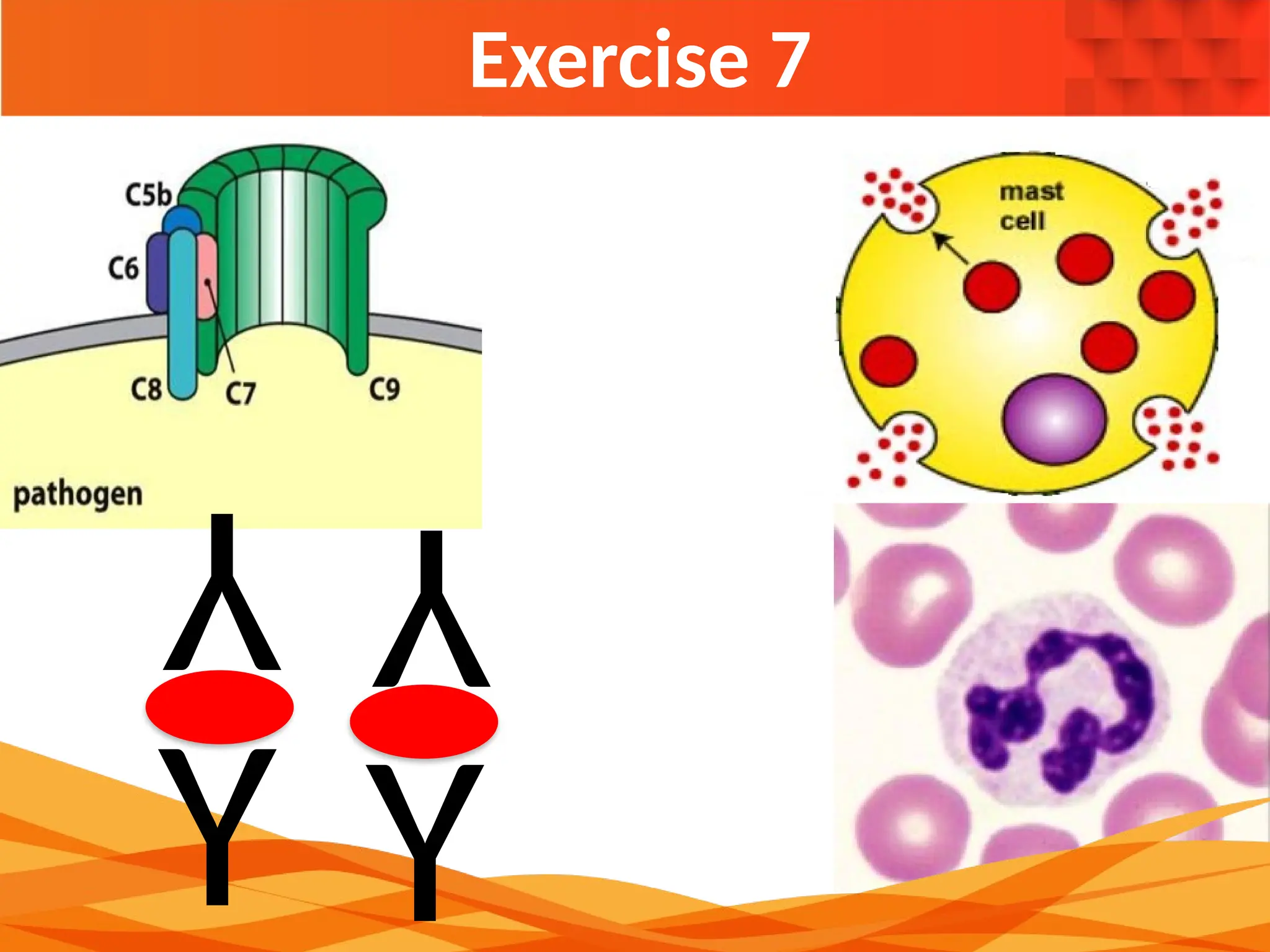
Answer of Exercise7
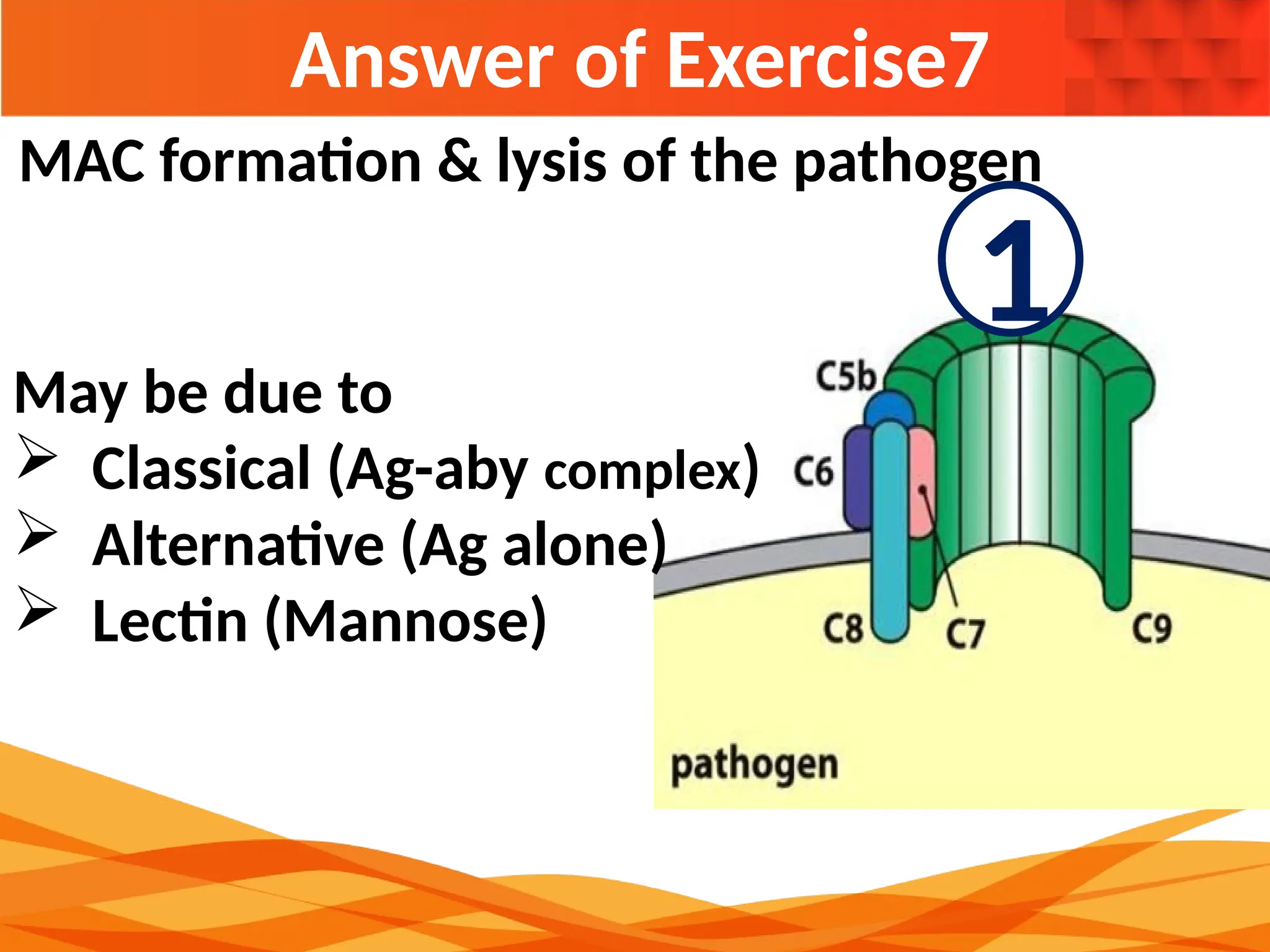
May be due to
 Classical (Ag-aby complex)
 Alternative (Ag alone)
 Lectin (Mannose)
MAC formation & lysis of the pathogen
1
Answer of Exercise 7
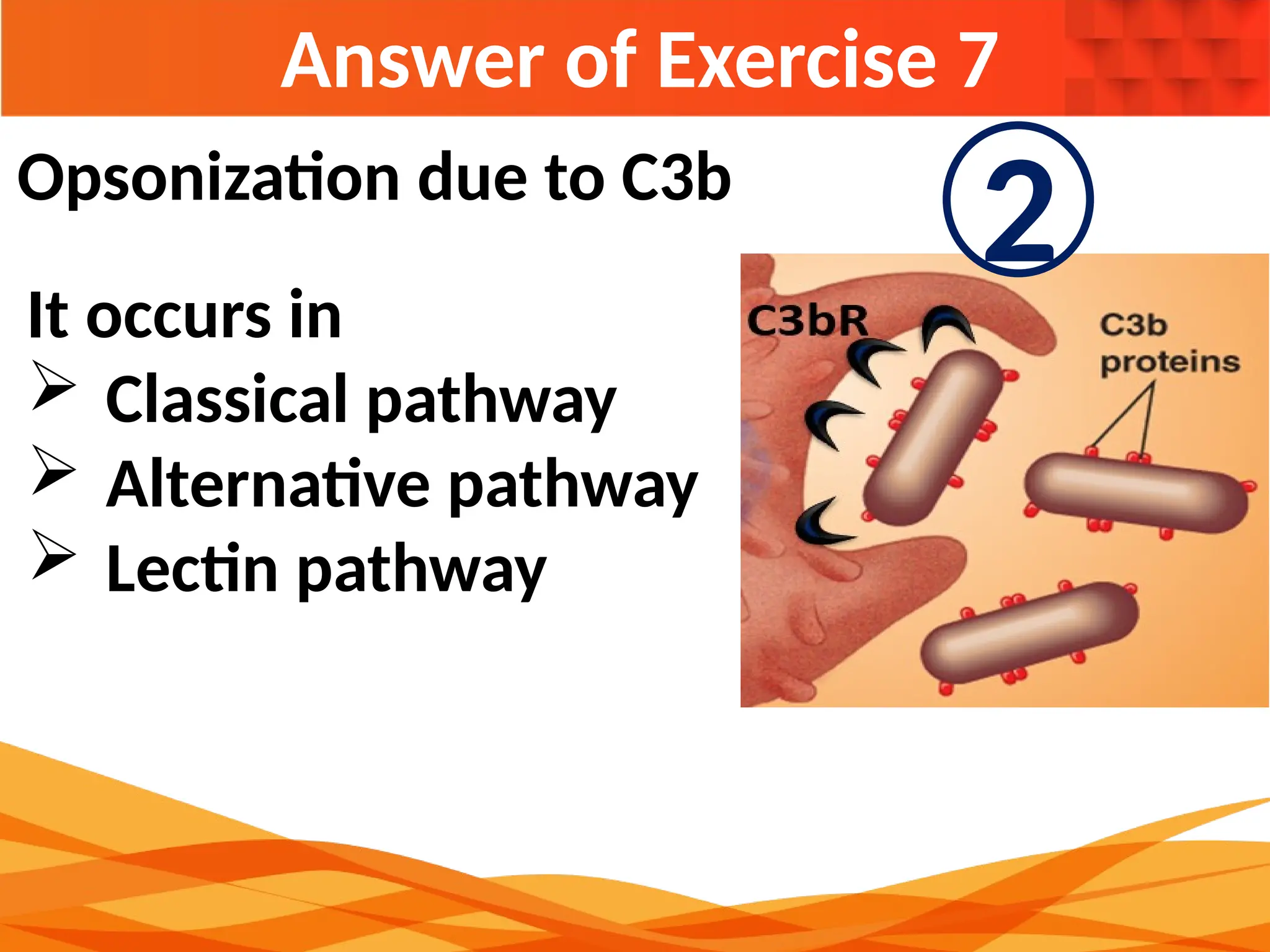
It occurs in
 Classical pathway
 Alternative pathway
 Lectin pathway
Opsonization due to C3b
2
Answer of Exercise 7
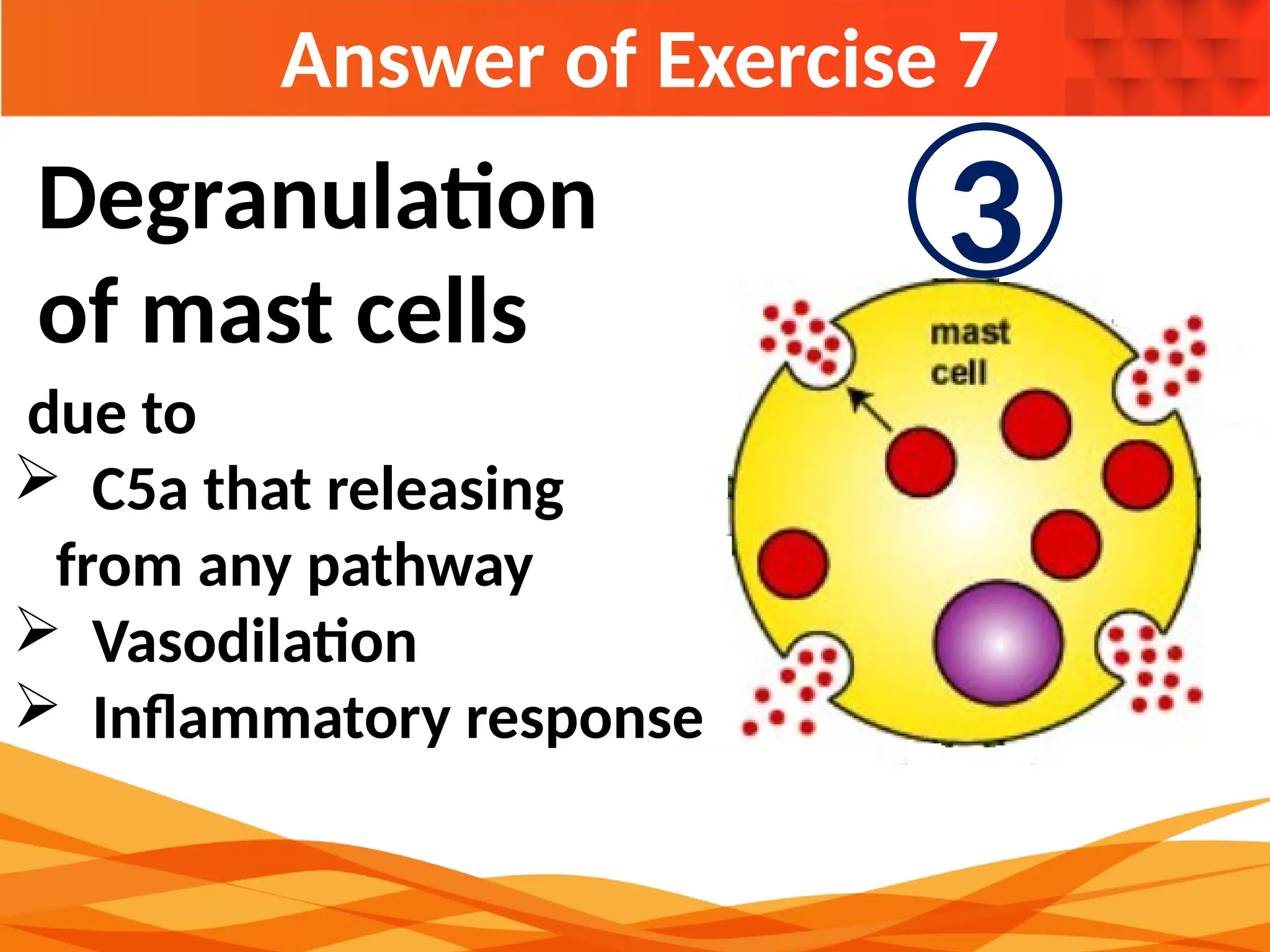
Degranulation
of mast cells
due to
 C5a that releasing
from any pathway
 Vasodilation
 Inflammatory response
3
Answer of Exercise 7
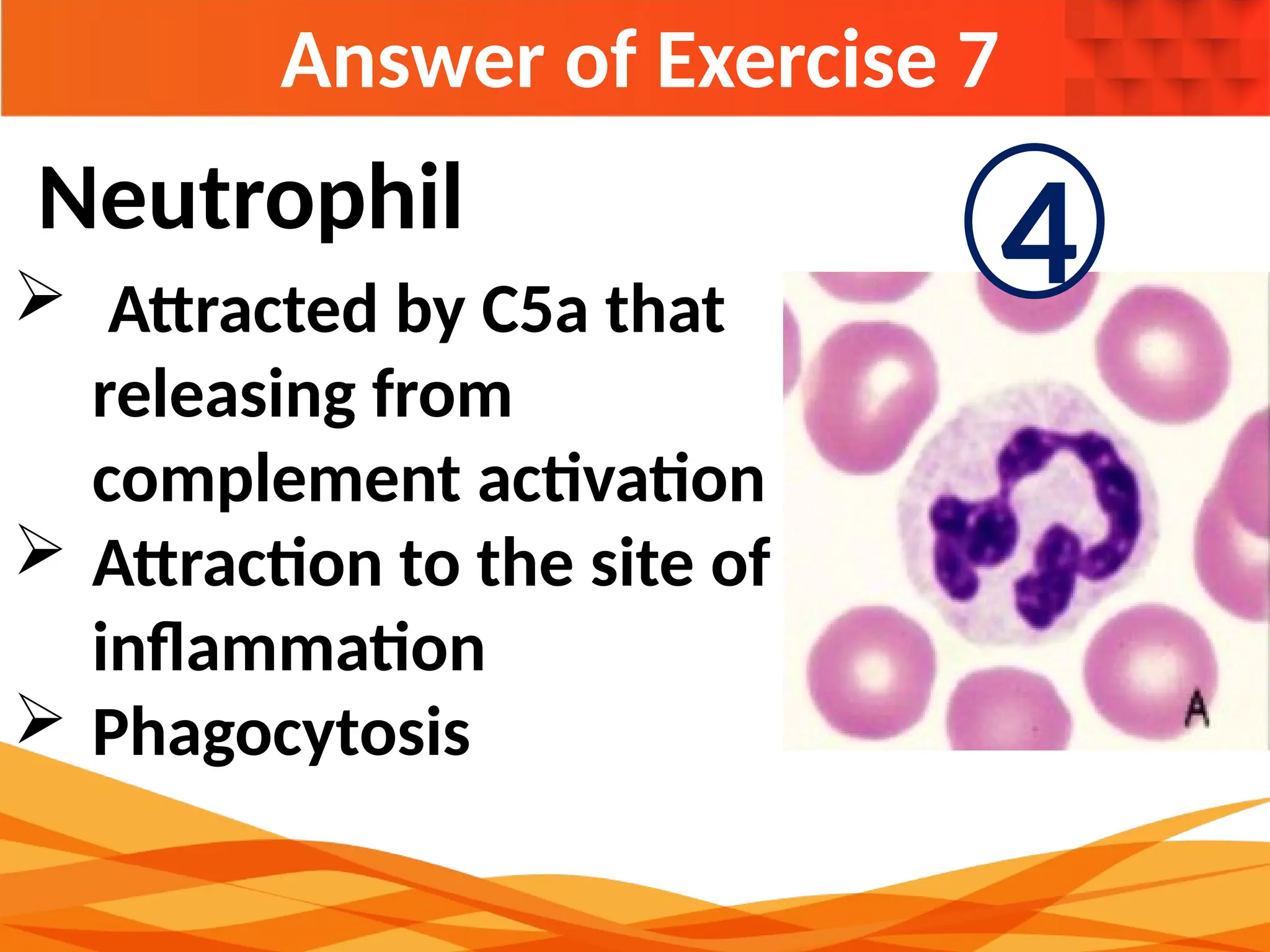
Neutrophil
 Attracted by C5a that
releasing from
complement activation
 Attraction to the site of
inflammation
 Phagocytosis
4
Answer of Exercise 7
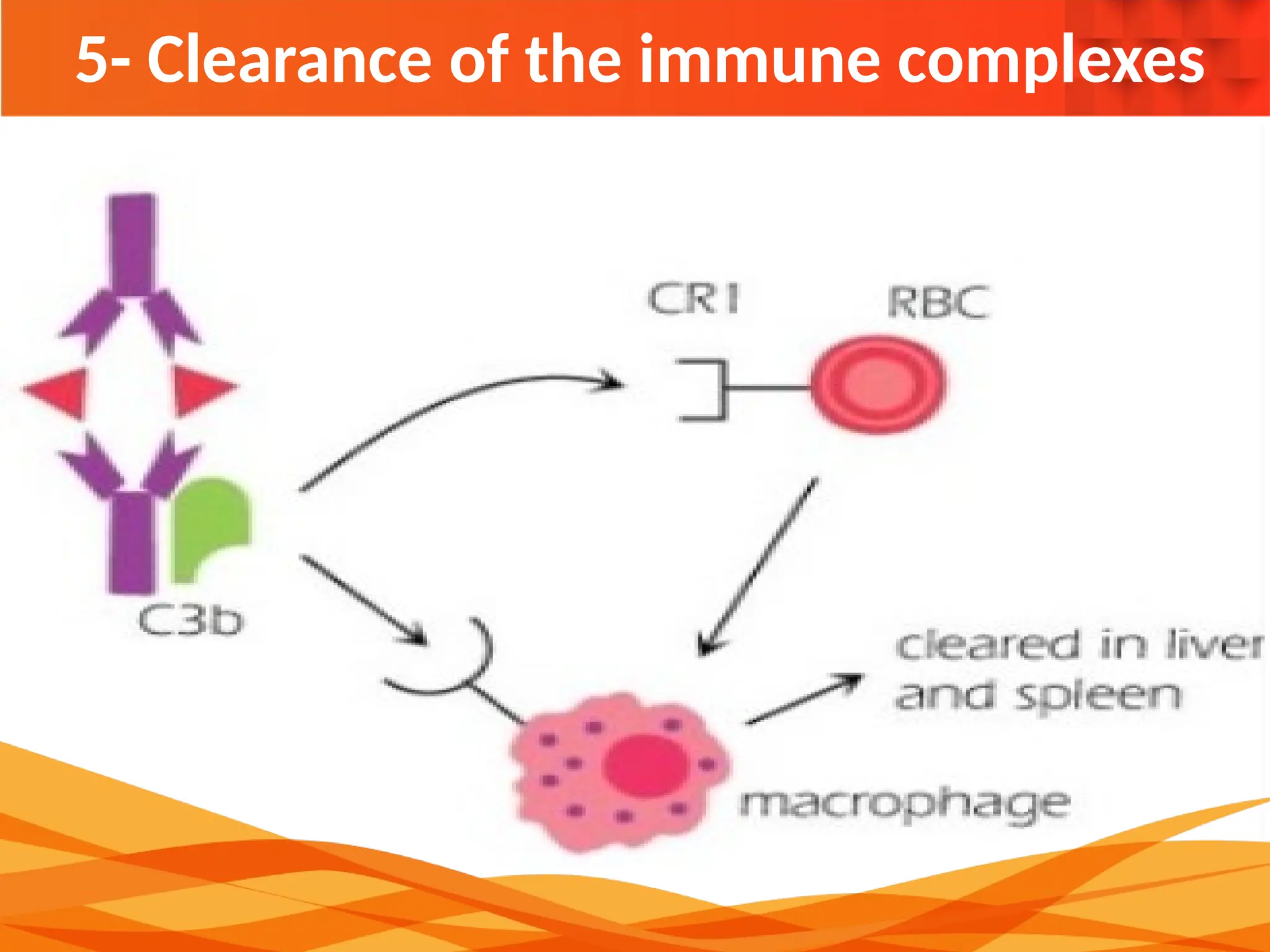
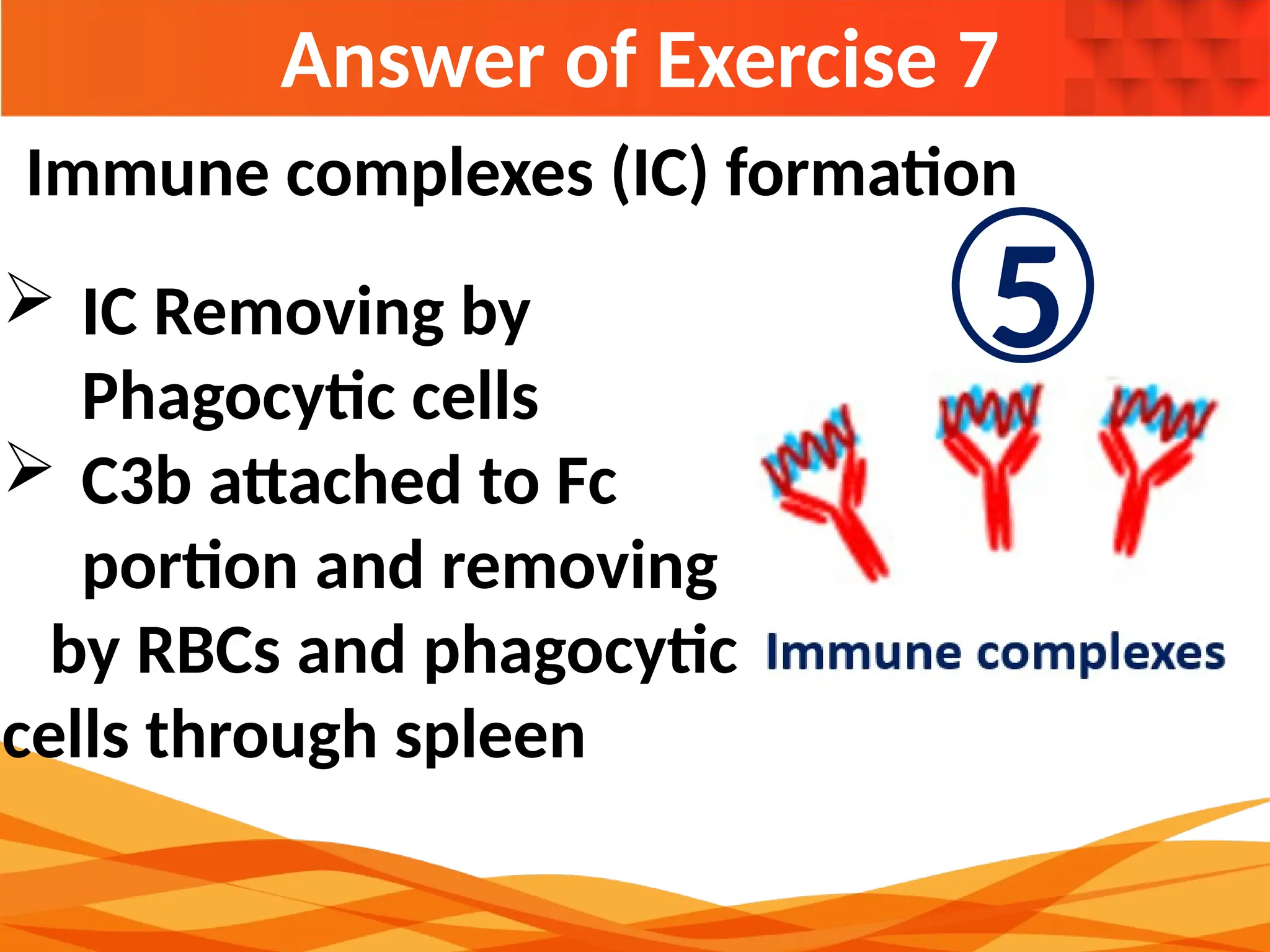
 IC Removing by
Phagocytic cells
 C3b attached to Fc
portion and removing
by RBCs and phagocytic
cells through spleen
Immune complexes (IC) formation
5
V) Regulation of
complement
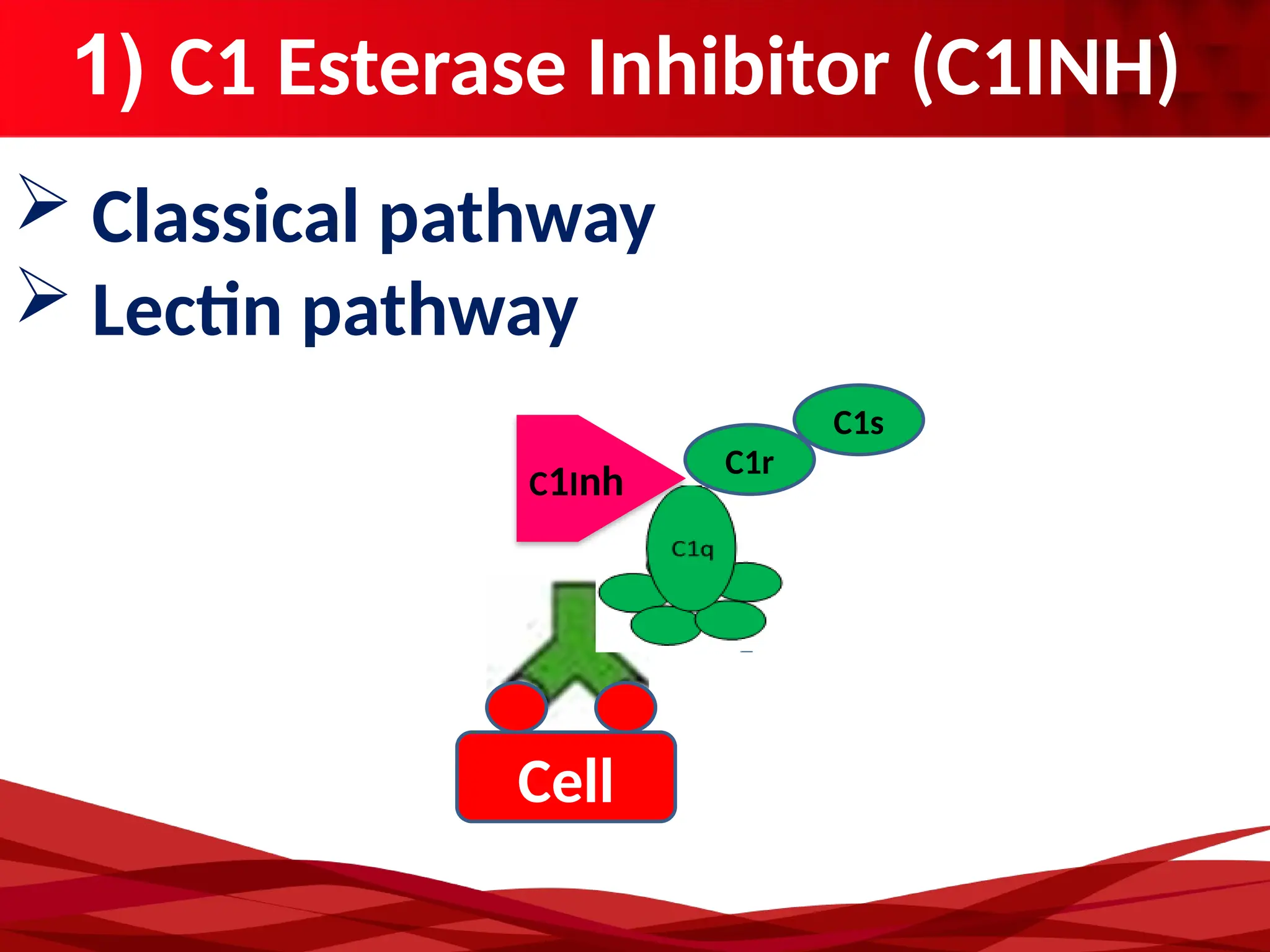
1) C1 Esterase Inhibitor (C1INH)
Cell
C1r
C1s
C1Inh
 Classical pathway
 Lectin pathway
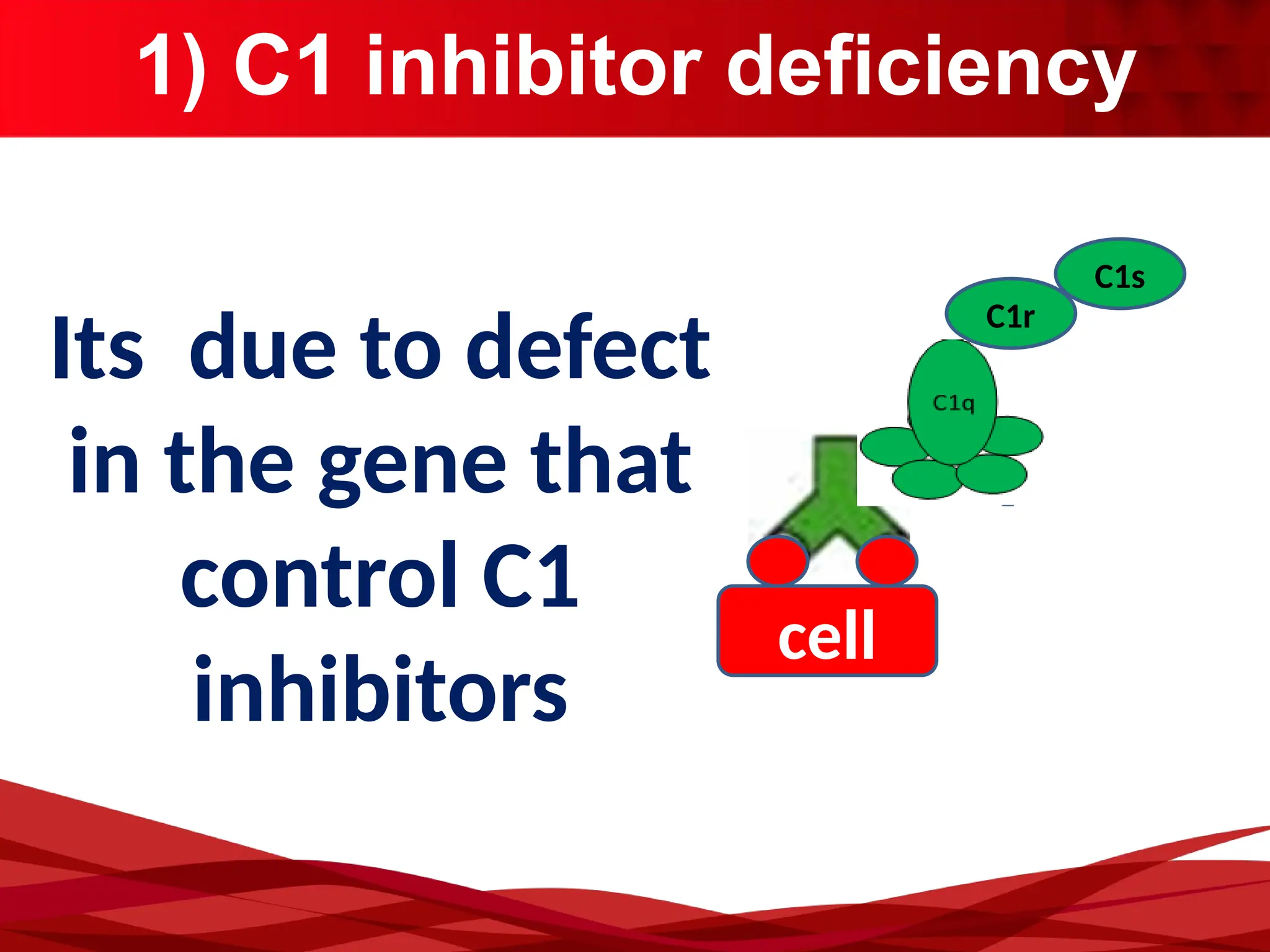
1) C1 inhibitor deficiency
Its due to defect
in the gene that
control C1
inhibitors
cell
C1r
C1s
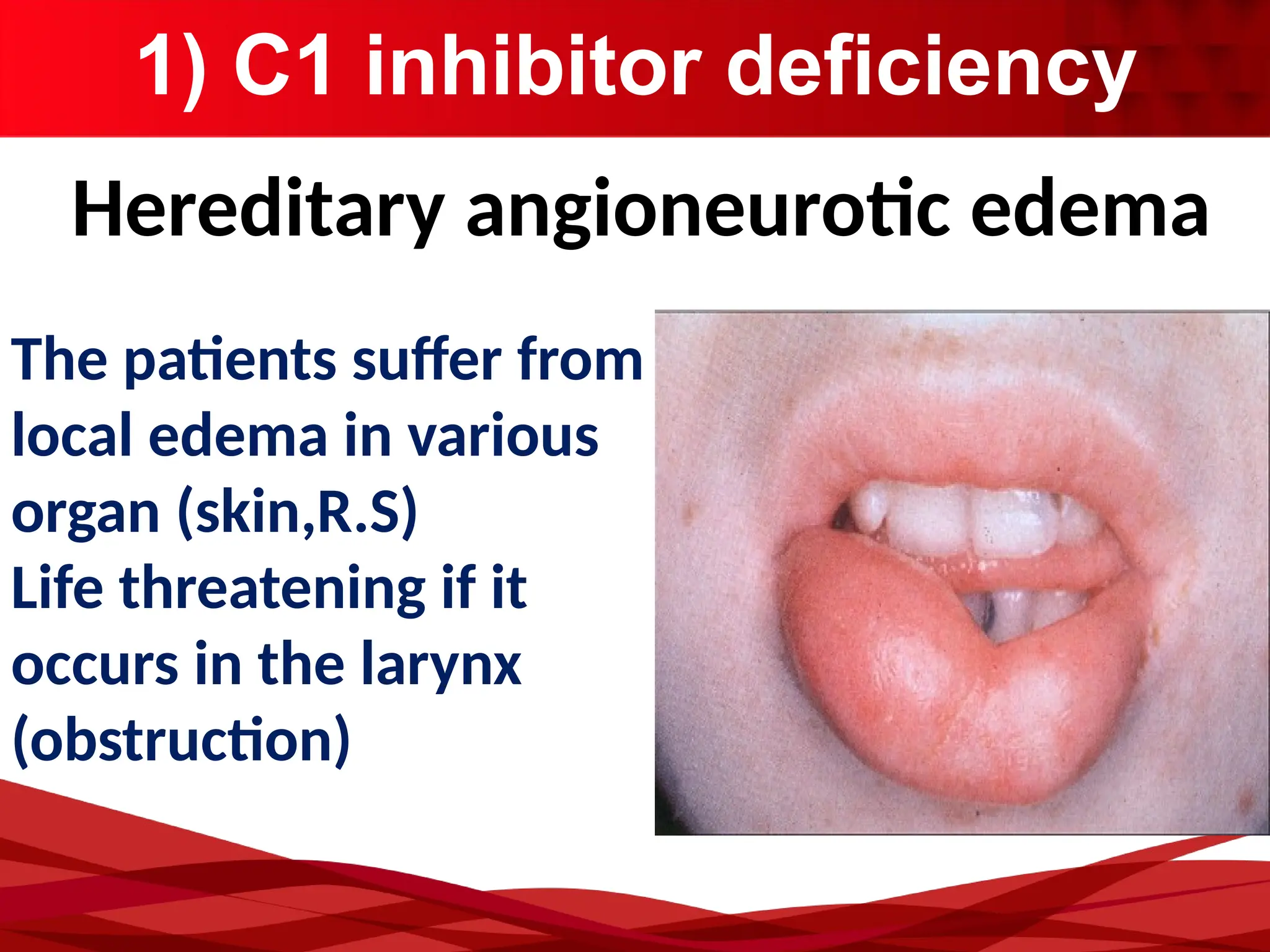
1) C1 inhibitor deficiency
Hereditary angioneurotic edema
The patients suffer from
local edema in various
organ (skin,R.S)
Life threatening if it
occurs in the larynx
(obstruction)
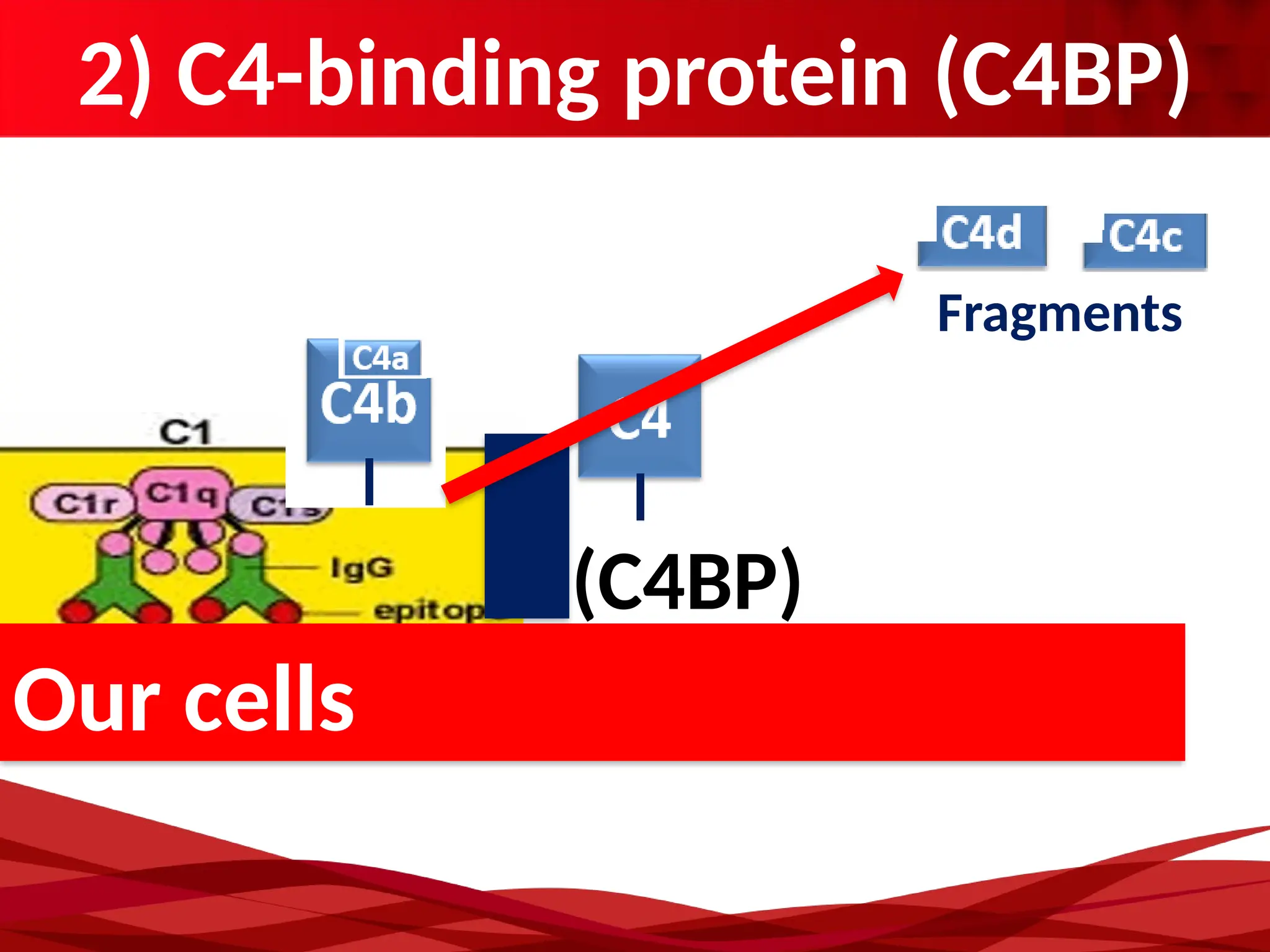
2) C4-binding protein (C4BP)
Our cells
(C4BP)
Fragments
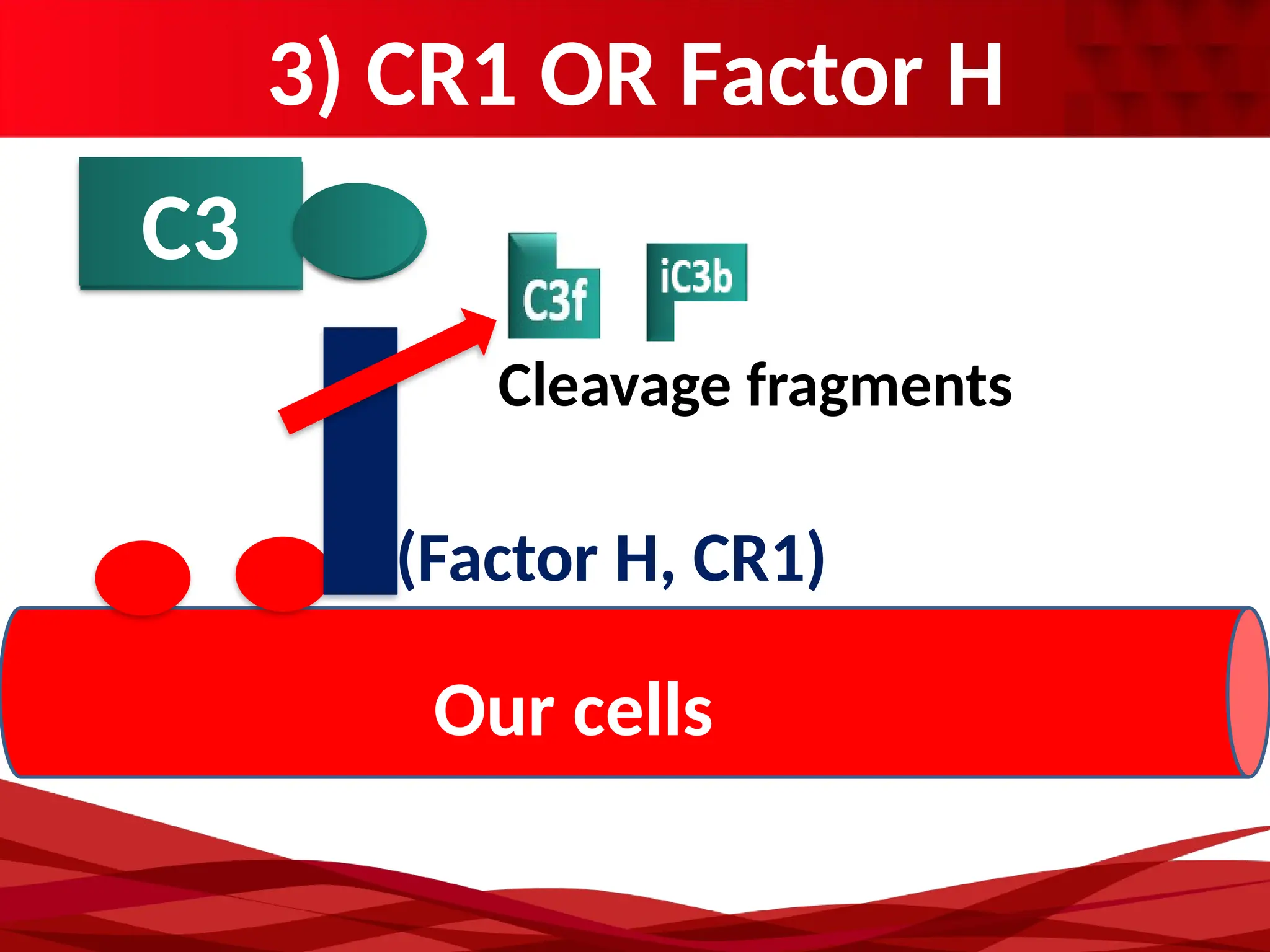
3) CR1 OR Factor H
Our cells
C3b
C3 C3a
(Factor H, CR1)
Cleavage fragments
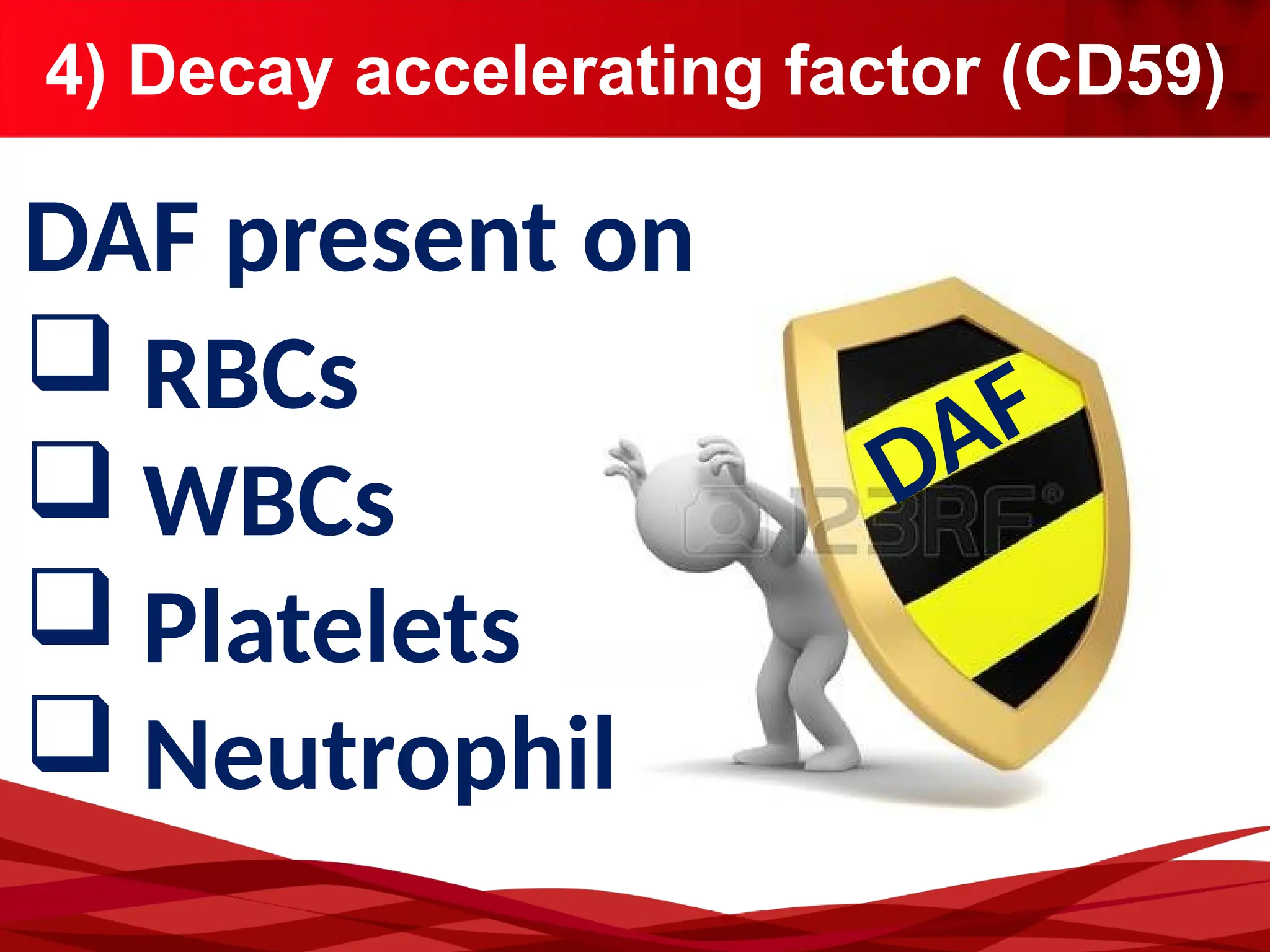
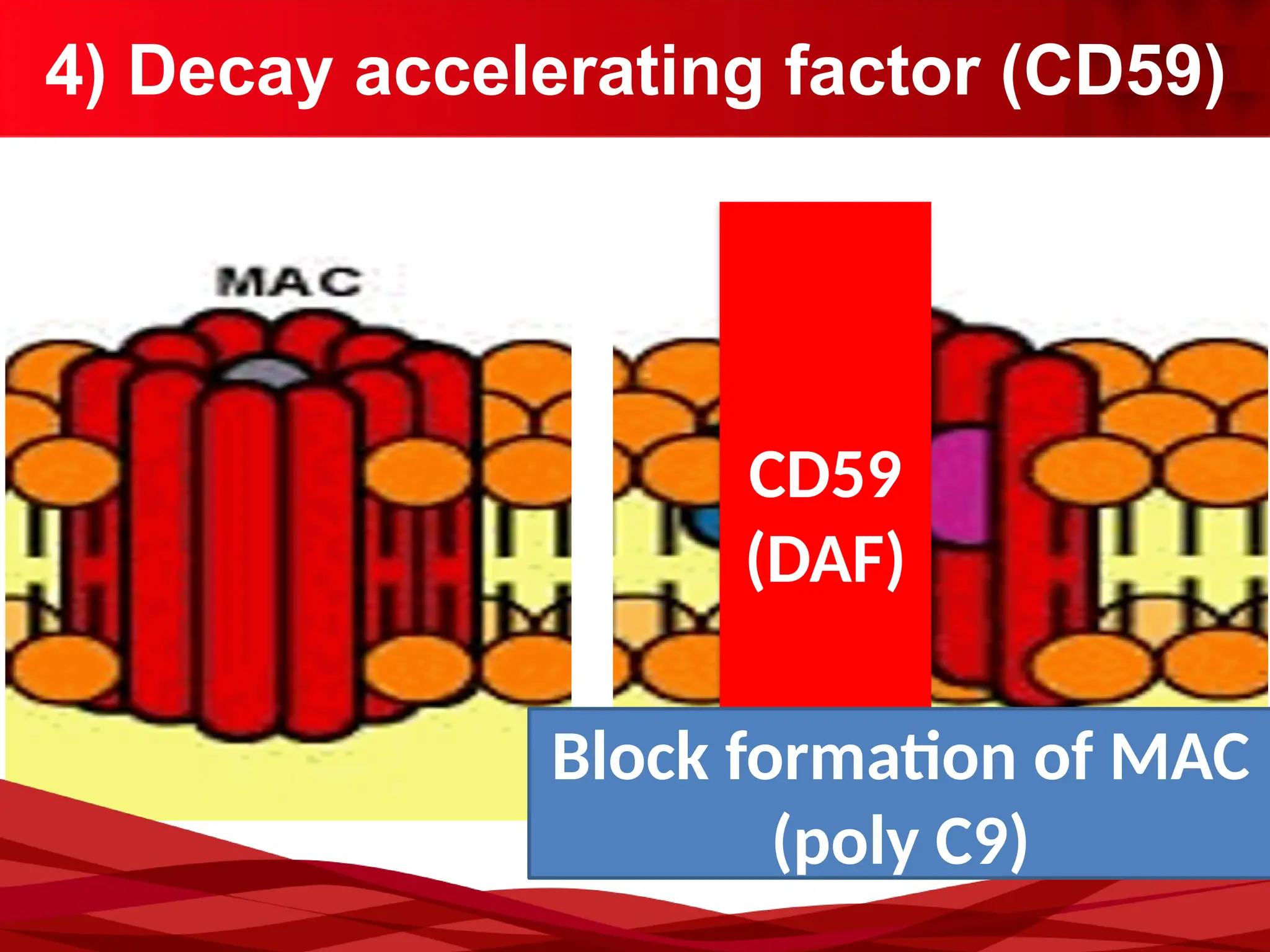
4) Decay accelerating factor (CD59)
DAF present on
 RBCs
 WBCs
 Platelets
 Neutrophil
DAF
4) Decay accelerating factor (CD59)
CD59
(DAF)
Block formation of MAC
(poly C9)
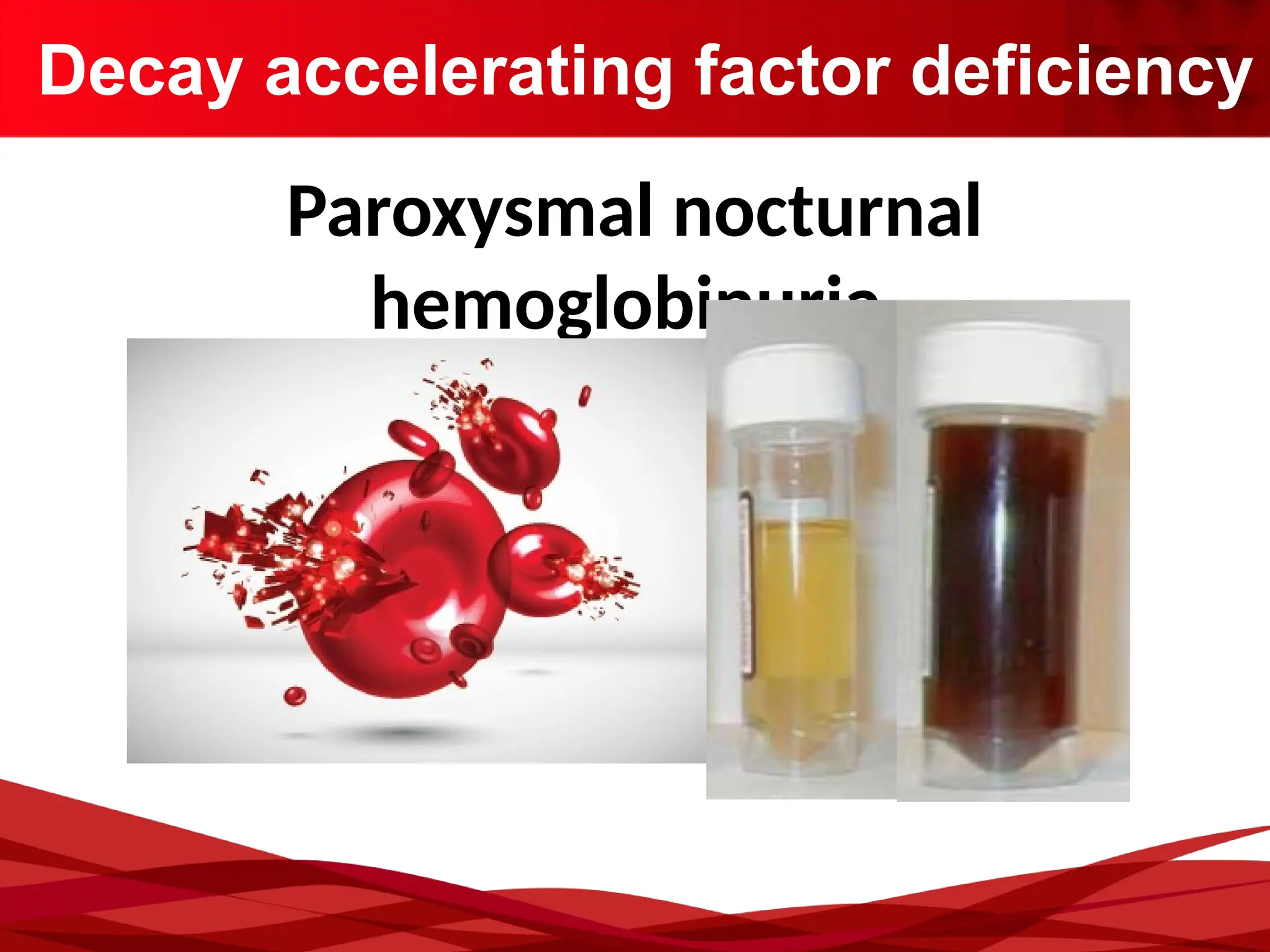
Decay accelerating factor deficiency
Paroxysmal nocturnal
hemoglobinuria
Exercise 8
Complement
game
VI) Test yourself
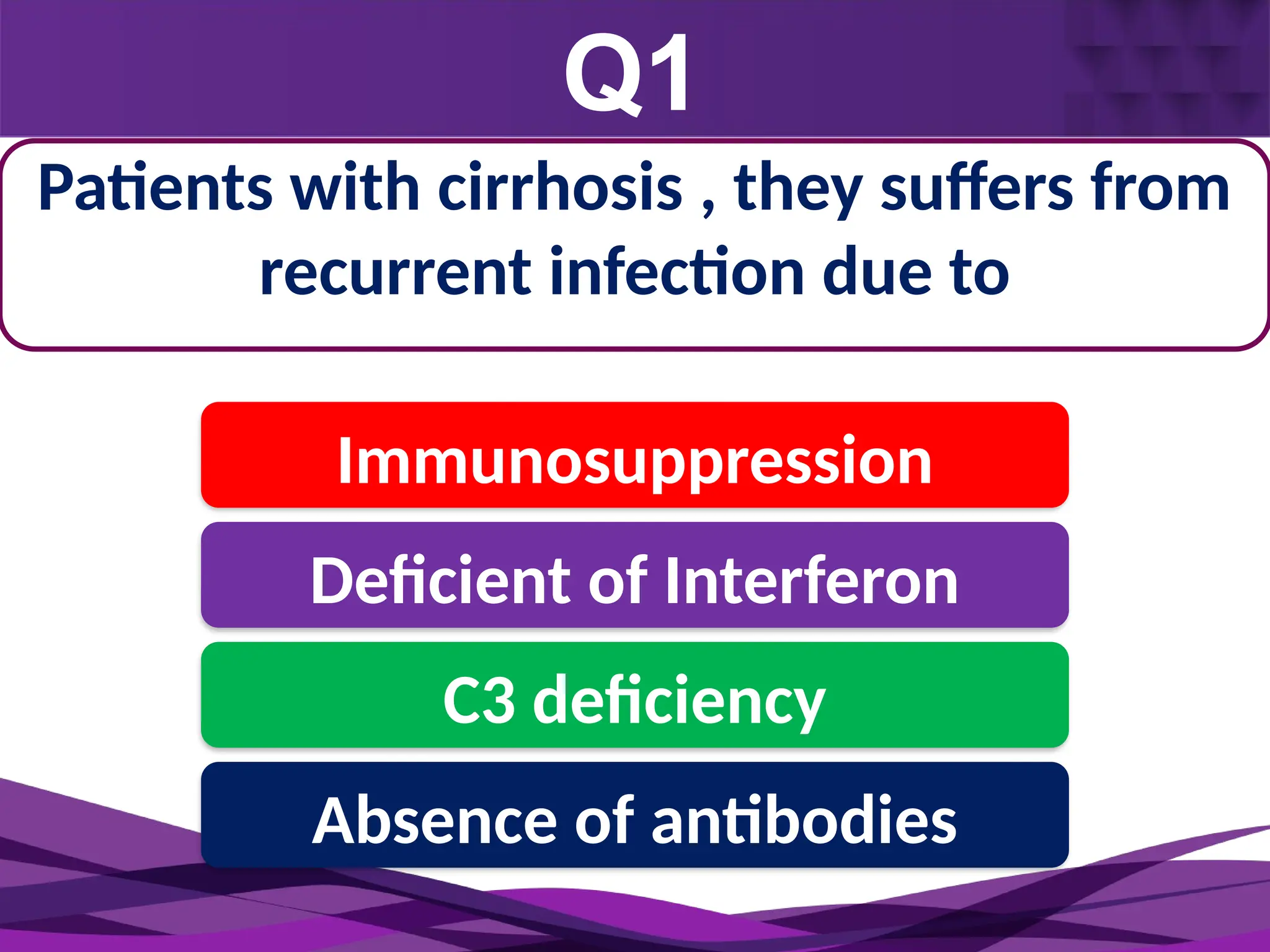
Q1
Patients with cirrhosis , they suffers from
recurrent infection due to
Monocyte
2-3 days
Monocyte
2-3 days
Immunosuppression
Deficient of Interferon
C3 deficiency
Absence of antibodies
Q2
Monocyte
2-3 days
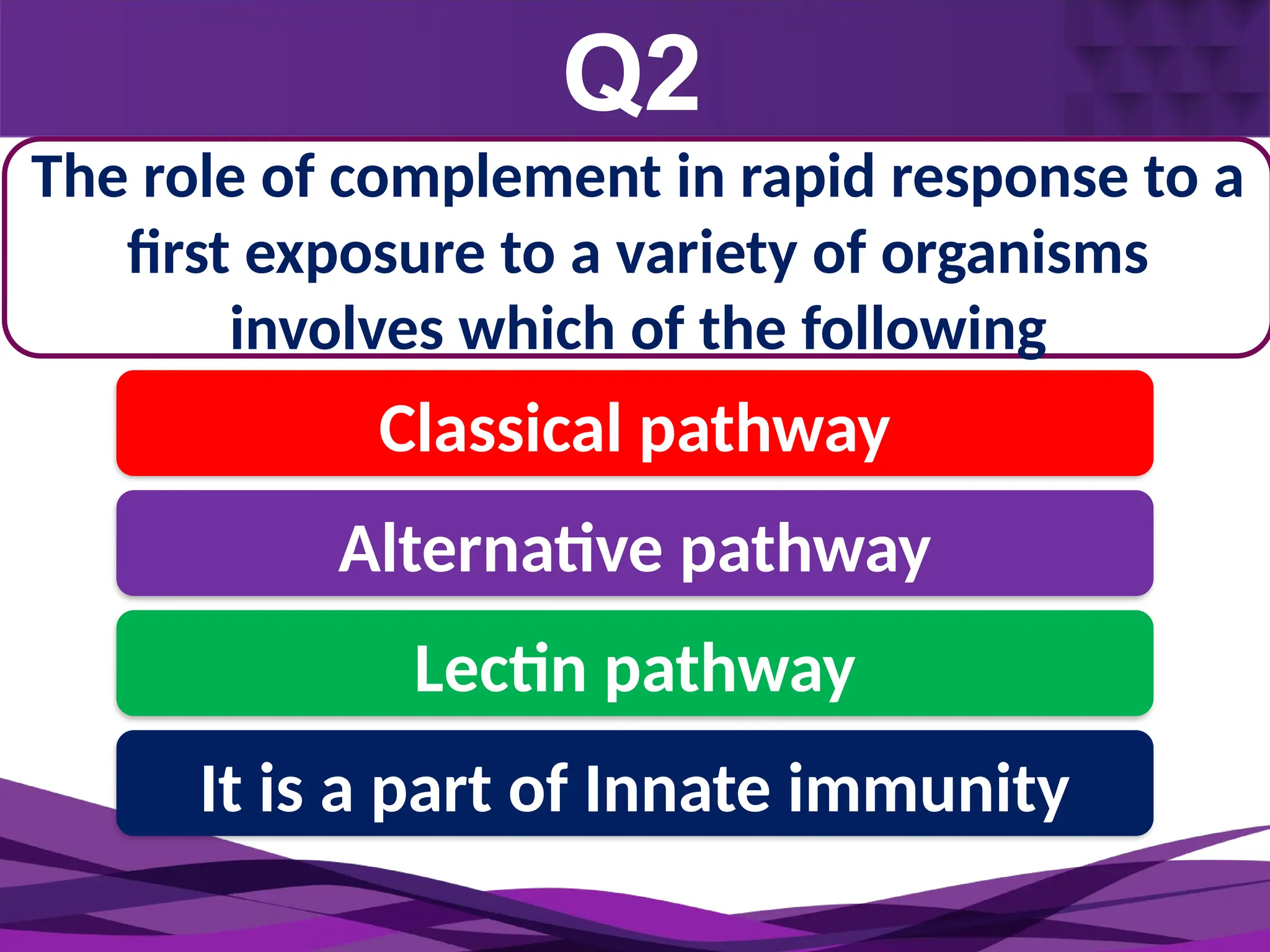
The role of complement in rapid response to a
first exposure to a variety of organisms
involves which of the following
Monocyte
2-3 days
Classical pathway
Alternative pathway
Lectin pathway
It is a part of Innate immunity
Q3
Monocyte
2-3 days
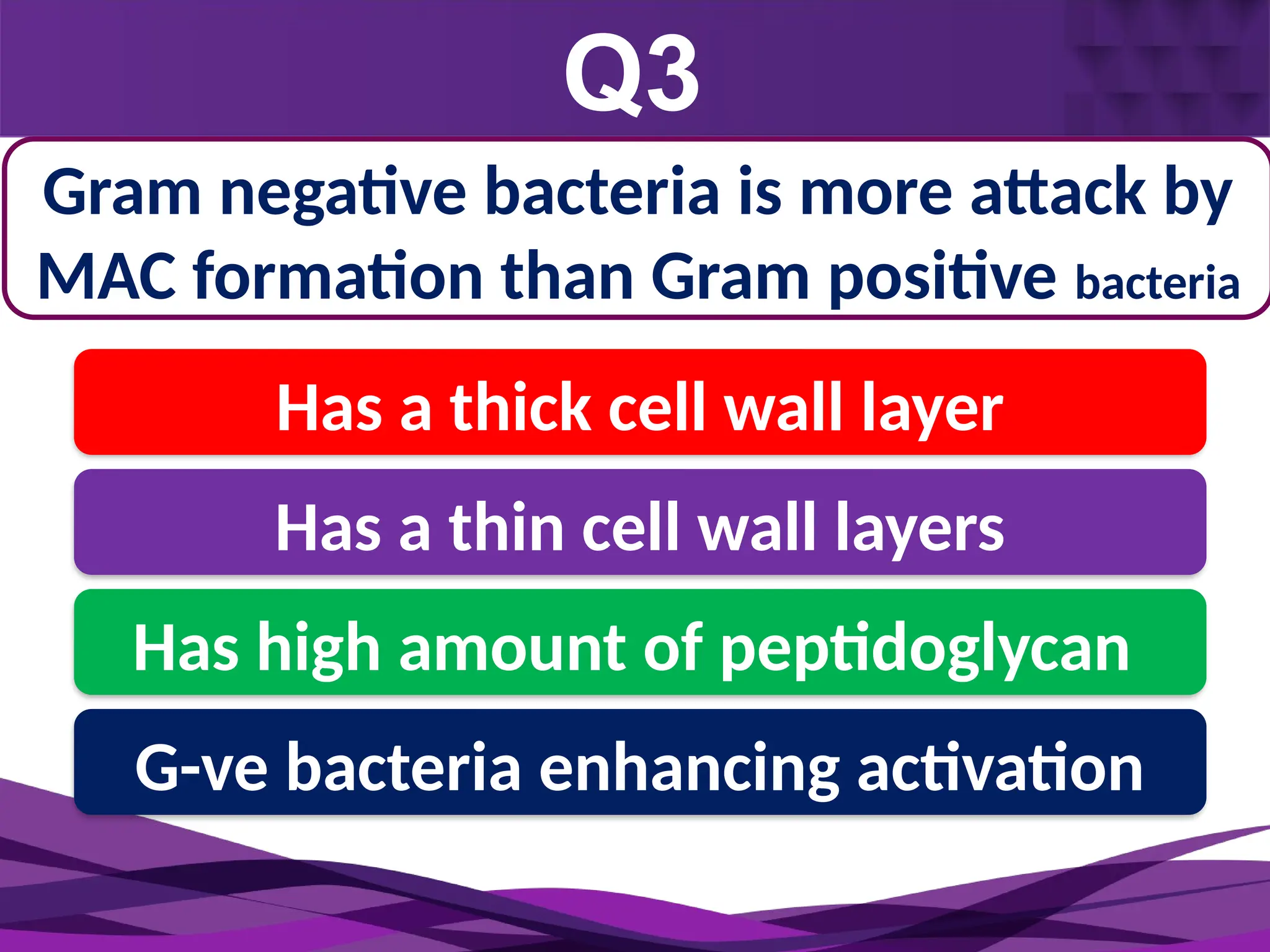
Gram negative bacteria is more attack by
MAC formation than Gram positive bacteria
Monocyte
2-3 days
Monocyte
2-3 days
Has a thick cell wall layer
Has a thin cell wall layers
Has high amount of peptidoglycan
G-ve bacteria enhancing activation
Q4
Monocyte
2-3 days
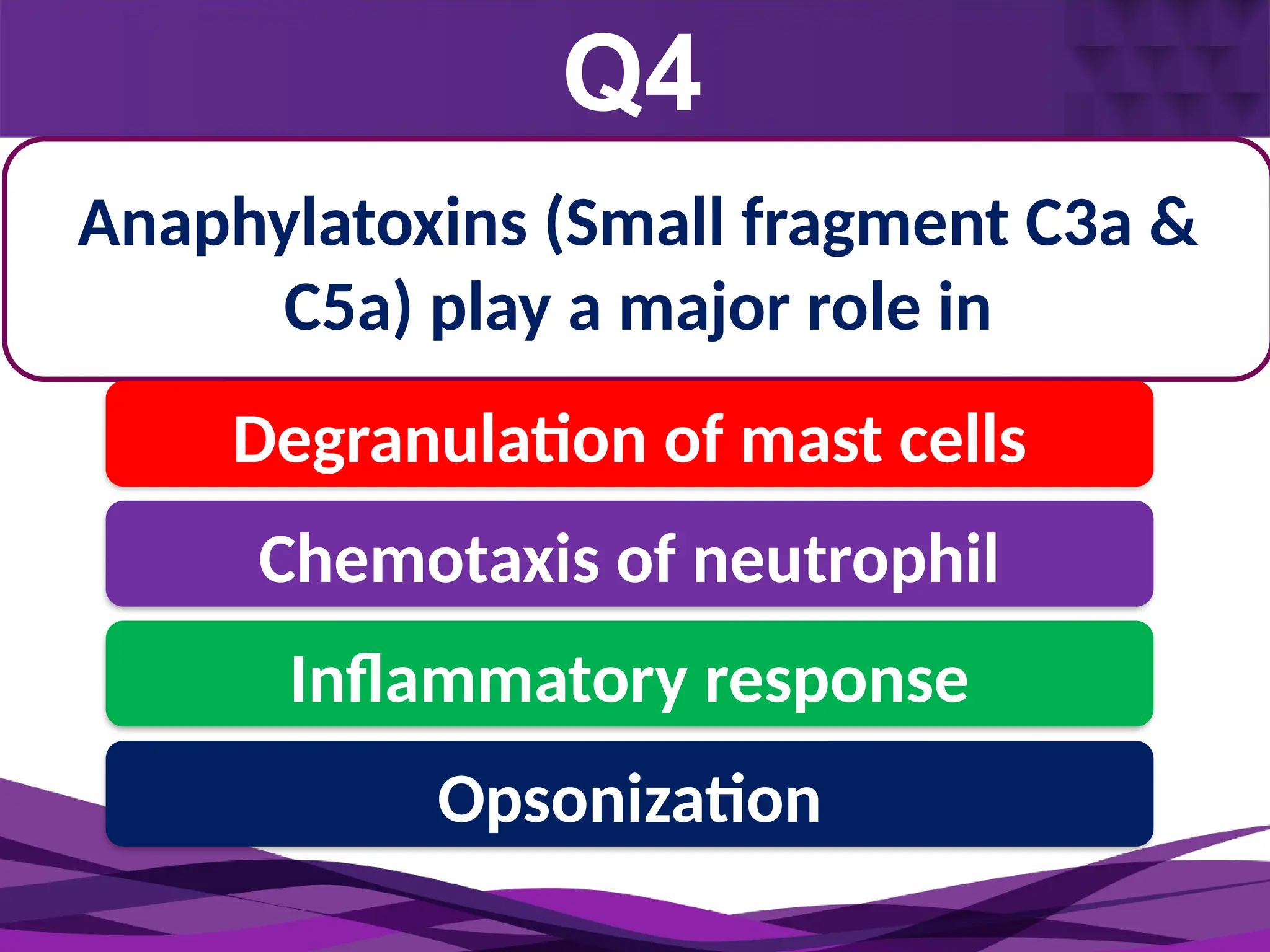
Anaphylatoxins (Small fragment C3a &
C5a) play a major role in
Degranulation of mast cells
Chemotaxis of neutrophil
Inflammatory response
Opsonization
Q5
Monocyte
2-3 days
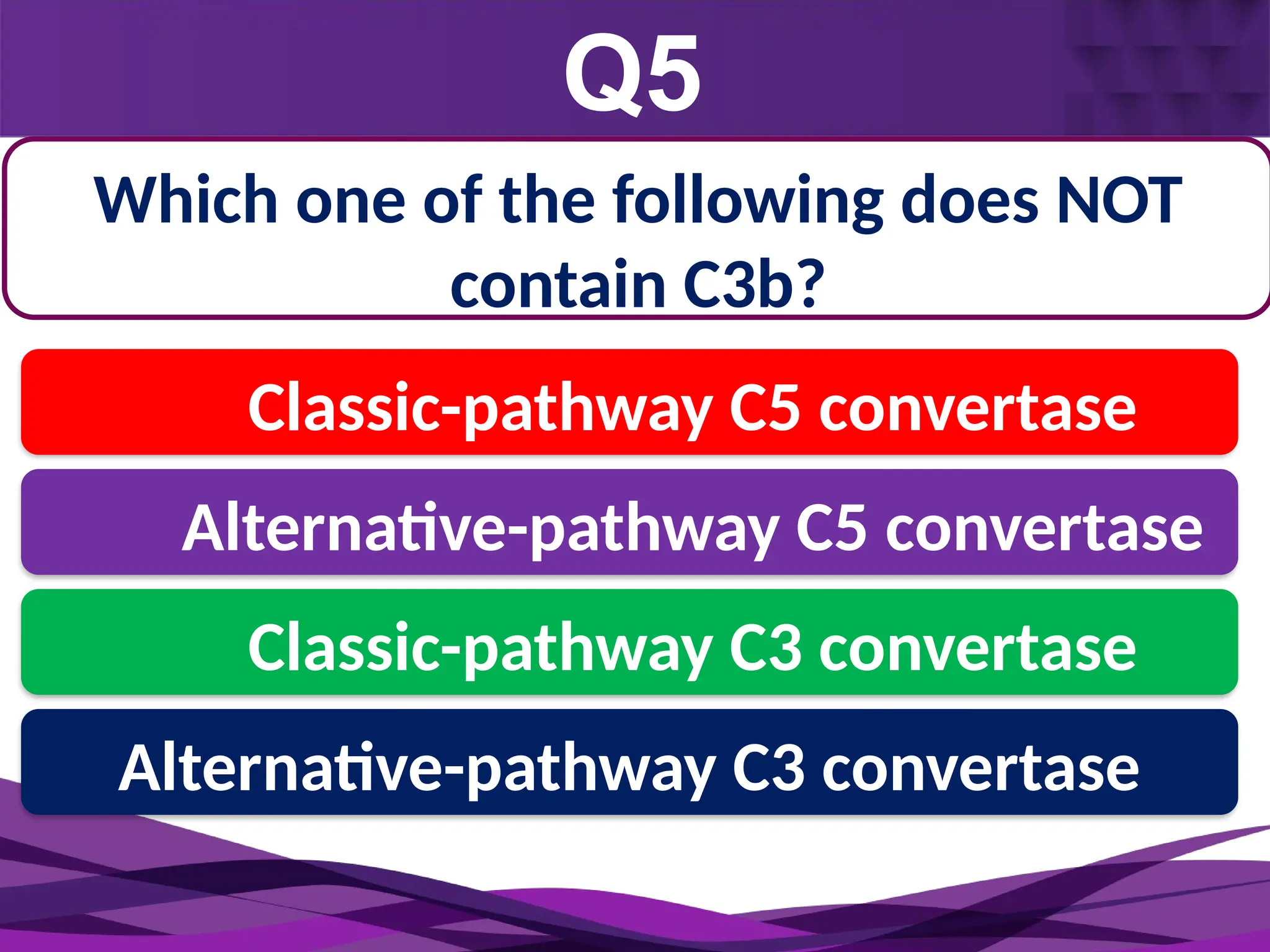
Which one of the following does NOT
contain C3b?
Classic-pathway C5 convertase
Alternative-pathway C5 convertase
Classic-pathway C3 convertase
Alternative-pathway C3 convertase
Q6
Monocyte
2-3 days
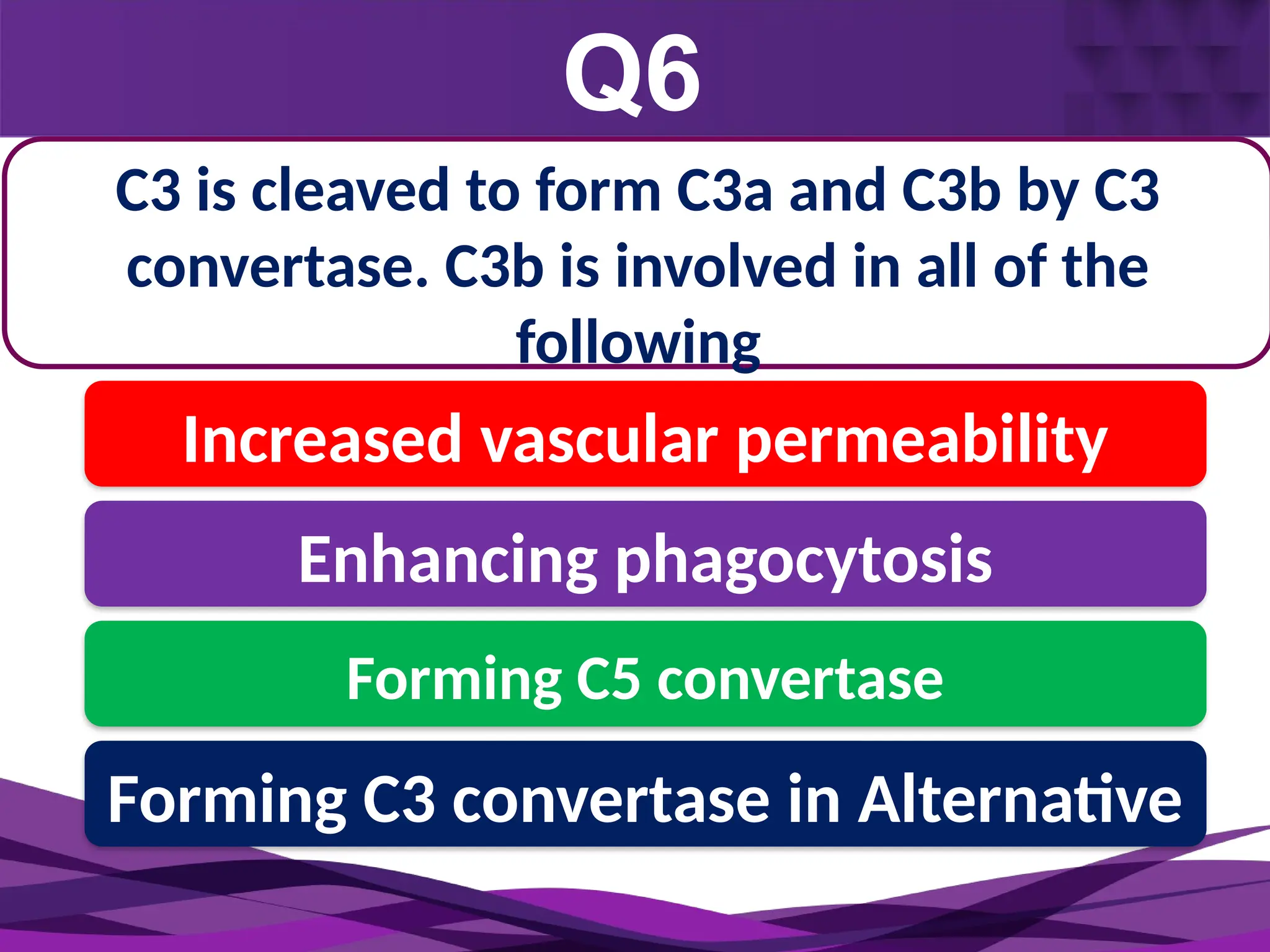
C3 is cleaved to form C3a and C3b by C3
convertase. C3b is involved in all of the
following
Increased vascular permeability
Enhancing phagocytosis
Forming C5 convertase
Forming C3 convertase in Alternative
Q7
Monocyte
2-3 days
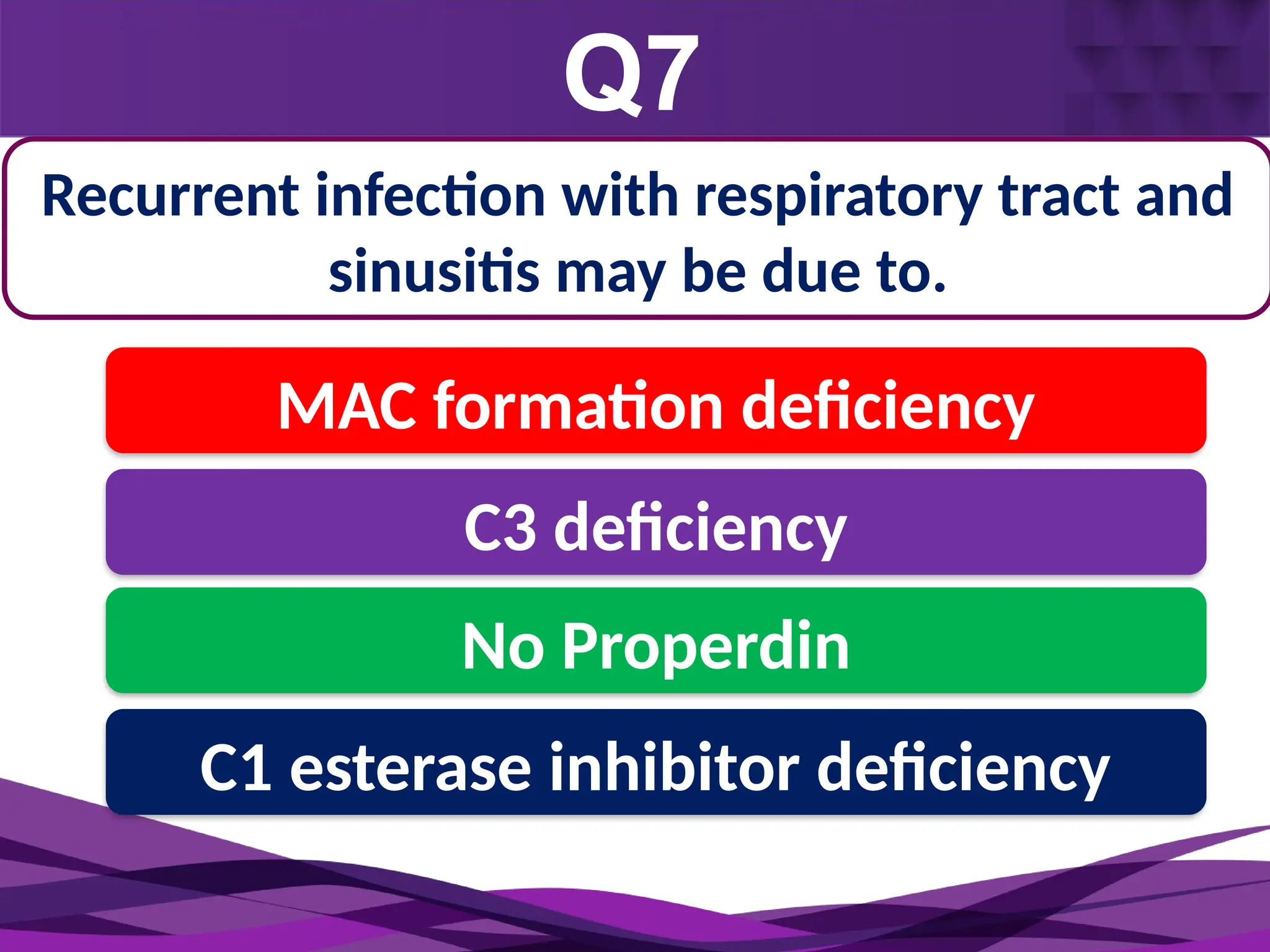
Recurrent infection with respiratory tract and
sinusitis may be due to.
MAC formation deficiency
C3 deficiency
No Properdin
C1 esterase inhibitor deficiency
Q8
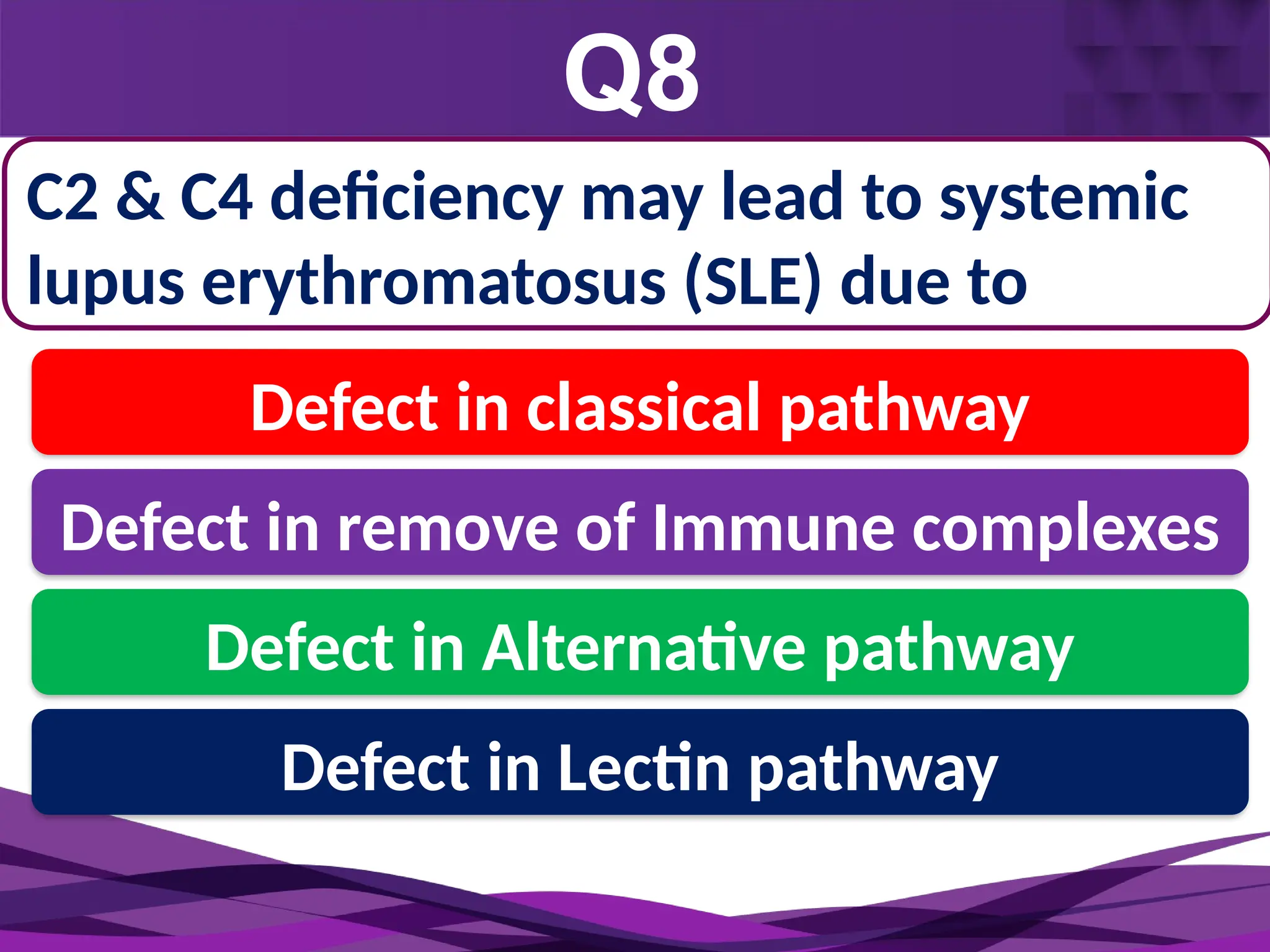
C2 & C4 deficiency may lead to systemic
lupus erythromatosus (SLE) due to
Monocyte
2-3 days
Defect in classical pathway
Defect in remove of Immune complexes
Defect in Alternative pathway
Defect in Lectin pathway
Q9
Monocyte
2-3 days
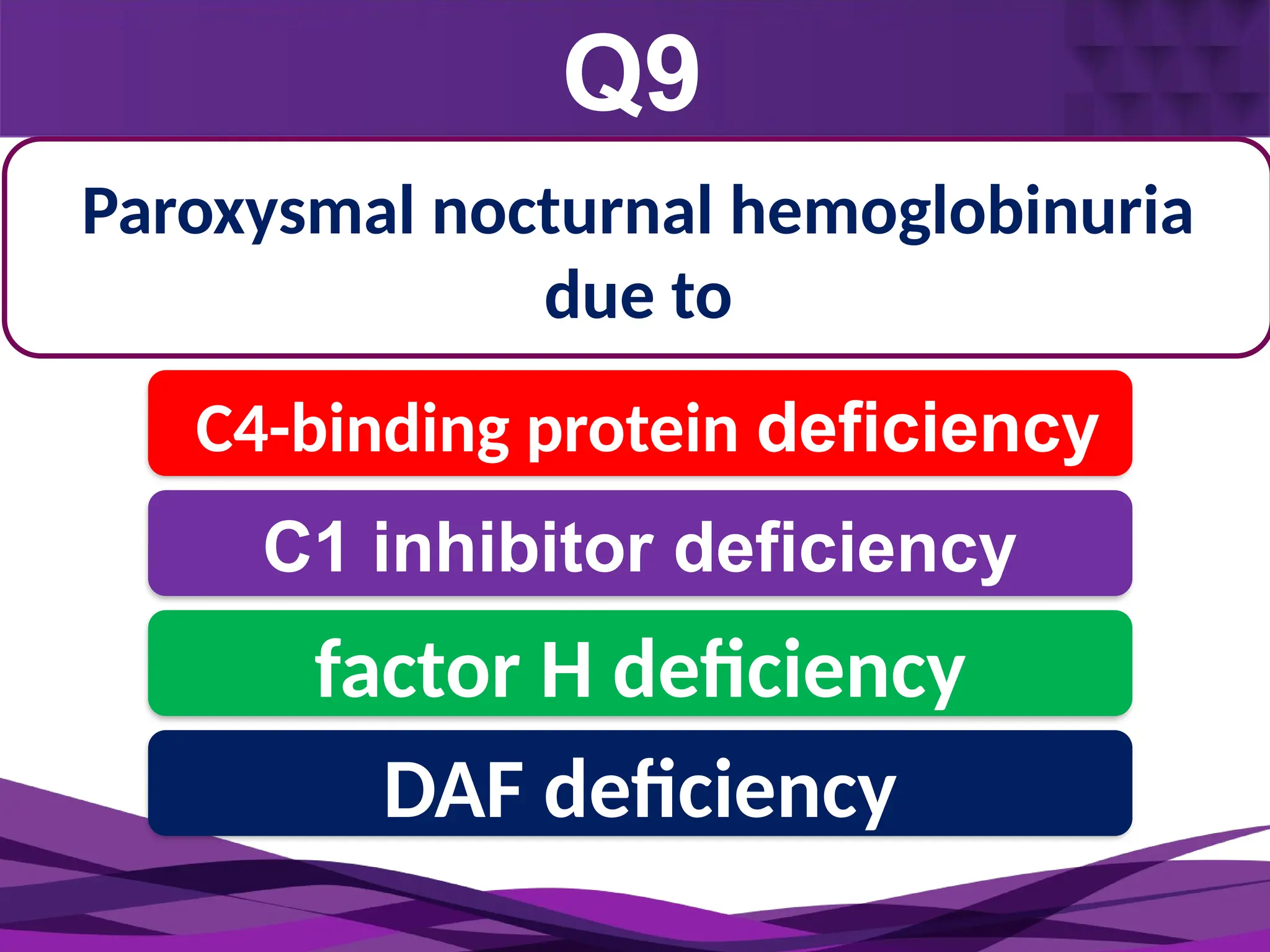
Paroxysmal nocturnal hemoglobinuria
due to
C4-binding protein deficiency
C1 inhibitor deficiency
factor H deficiency
DAF deficiency
Q10
Monocyte
2-3 days
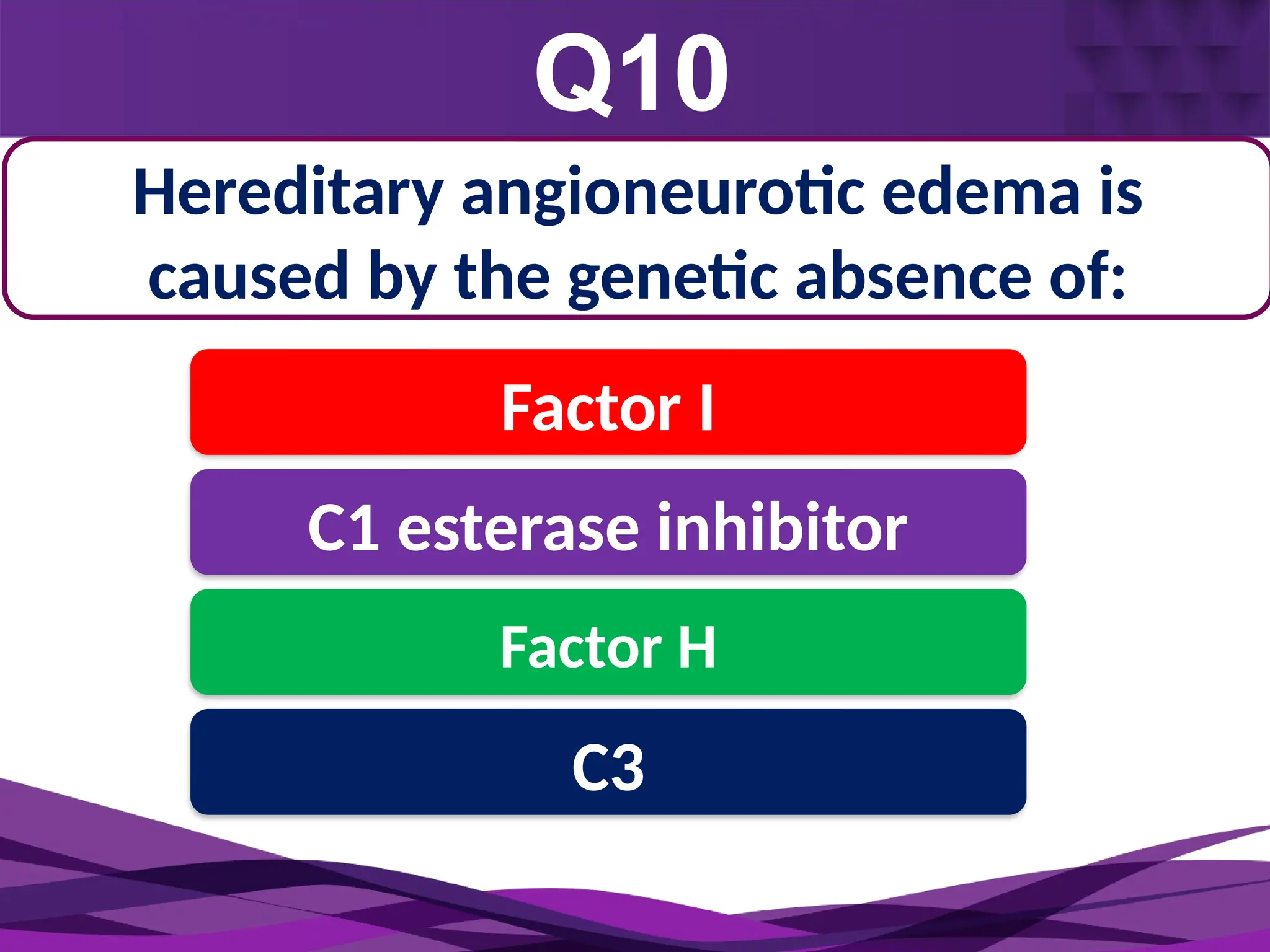
Hereditary angioneurotic edema is
caused by the genetic absence of:
Factor I
C1 esterase inhibitor
Factor H
C3
Thank
you

‏‏LecturehHahHhabaha 9 The complement.pptx

Editor's Notes

  • #40 When MBL binds to polysaccharides on surface of microbes it undergoes a conformational change leading to activation of two associated enzymes, mannose binding lectin associated protease MASP1 &MASP2