BY DR.NASEER
 Complement system consist of 20 proteins in
normal human serum. Complements refers to
ability of these proteins to complements the effects
of other components of immune system(antibody).
 It is an important component of innate host
defense.
 Main effects of complements are :
 1) Lysis of cells(bacteria and other cells)
 2) Generation of mediators
 3) Opsonisation
 Complements are proenzyme must be cleaved to form
active enzyme.
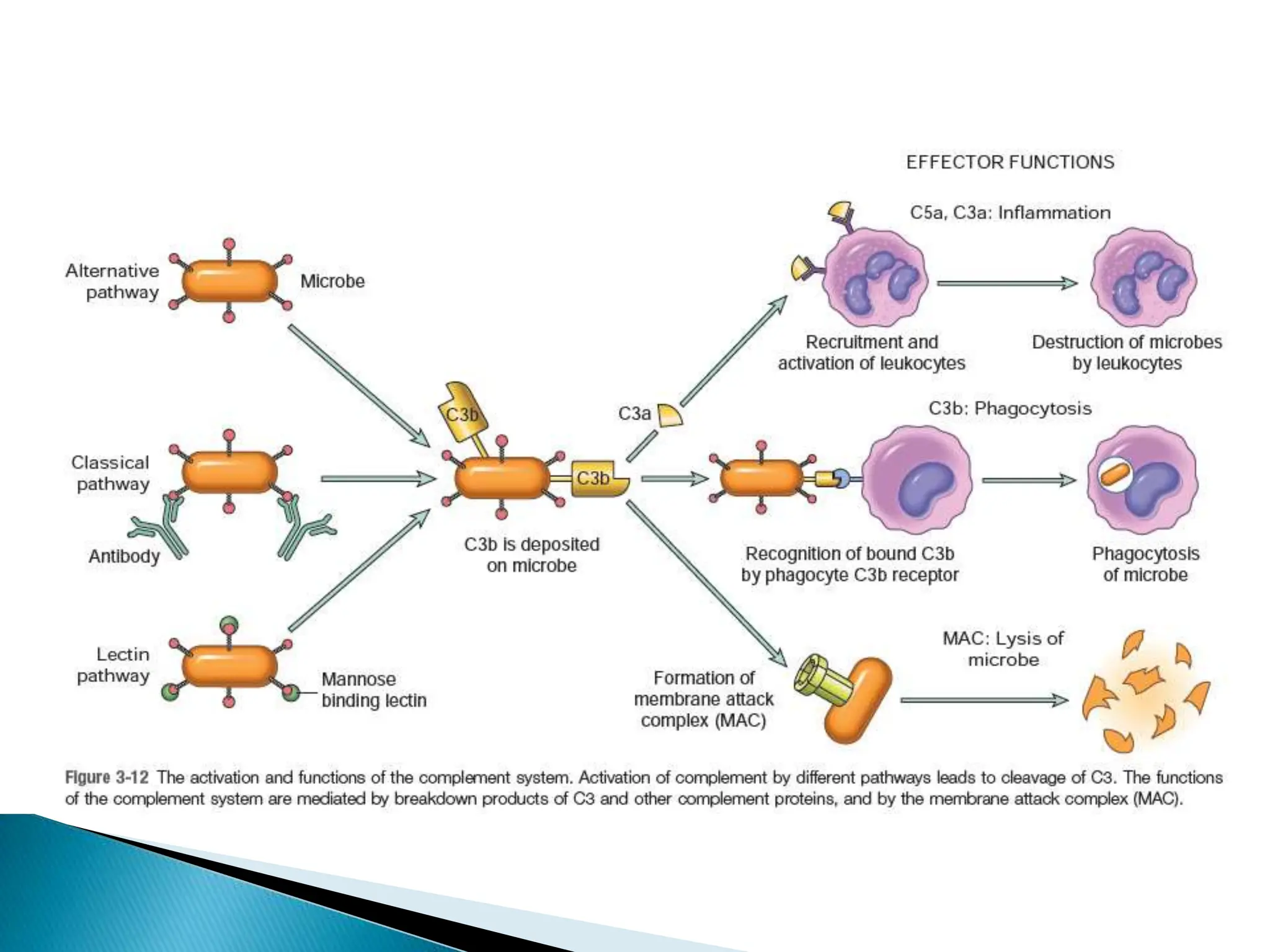
 Complements are activated through three pathways:
 1) Classic pathway
 2) Lectin pathway
 3) Alternative pathway
 In lectin and alternative pathways are more important, as
the antibody required to trigger the classic pathway is not
present.
 Lectin pathway and alternative pathways are participants,
initiate arm of immune system.
 All three pathways lead to production of C3b which is the
central molecule of complement system.
 C3b has two important functions:
 1) It combines with other complement components to
generate C5 convertase that leads to cleave complement
5 into 5a and 5b. 5b combines with rest of component to
form 5b to 9 called membrane attack complex(MAC).
 2) It opsonizes bacteria and make it attractive for
phagocytization by macrophages and neutrophils.
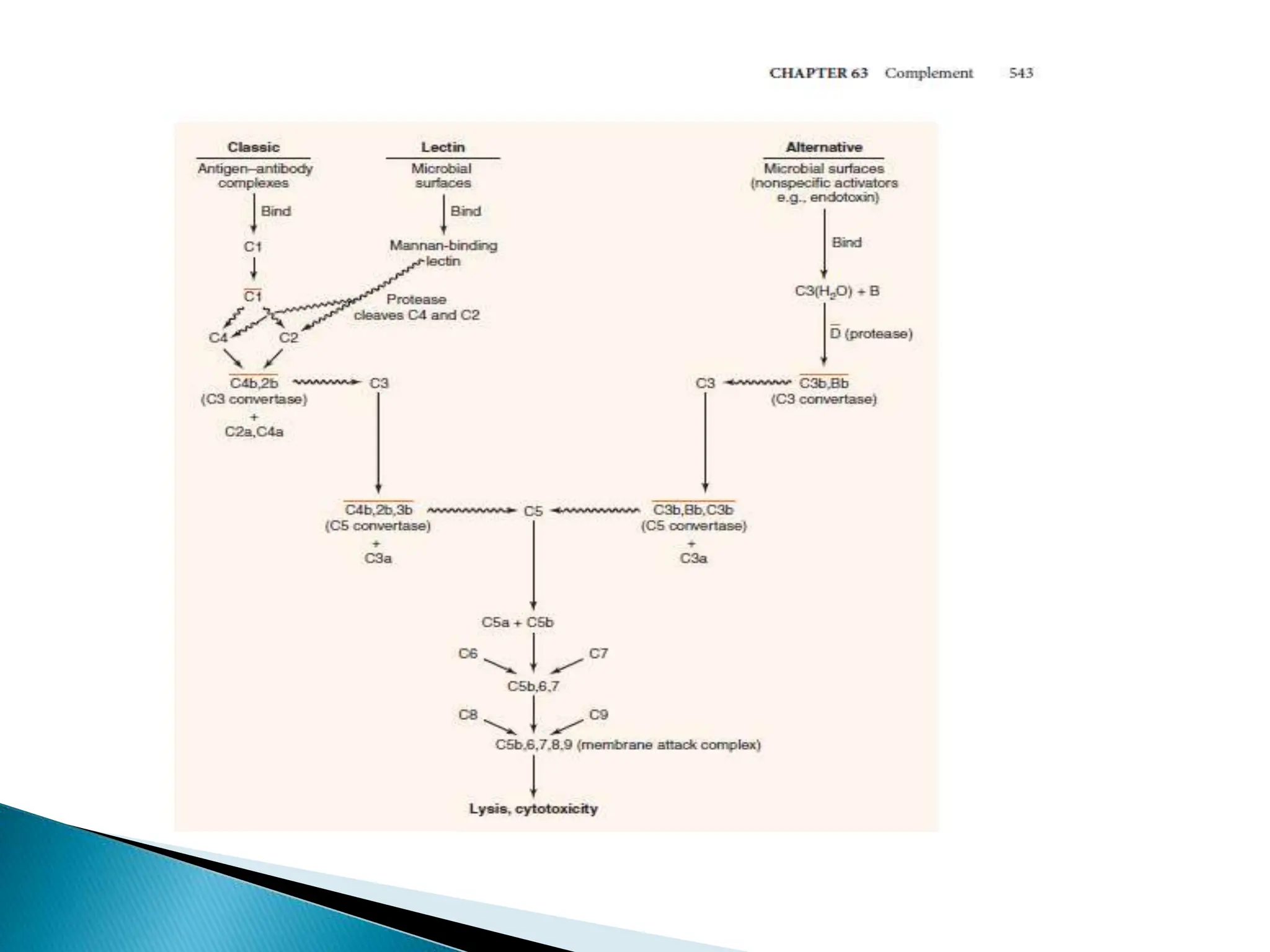
 First formation of antigen-antibody complexes which
activate C1 to form proteases to cleave C2 and C4 to
form C4b,2b (which is C3 convertase) which cleave C3
molecule into 3a and 3b.
 3a is anaphylatoxin.
 3b forms a complex with C4b, 2b producing C5
convertase ( C4b,2b,3b) which cleaves C5 to form C5a
and C5b.
 C5a is anaphylatoxin and chemotactic factor.
 C5b binds to C6 and C7 to form complex that interact
with C8 and C9 to produce (C5b,6,7,8,9) membrane
attack complex, which causes cytolysis.
 Note:- “b” fragment continues in the main pathway
whereas “a” fragment is split off and has other activities.
 Mann binding lectin (MBL), aslo known as Manmose
binding protein binds to surfaces of microbes bearing
Mann
( polymer of sugar mannose).
 This activate proteases that cleave C2 and C4
components of complements and classic pathway.
 Note:- This process by pass the antibody requiring step,
so this is protective early in infection before antibody is
formed.
 Many unrelated cell surface substances e.g bacterial
polysaccharide, endotoxin, fungal cell wall and viral
envelops can initiate the process by binding C3H2O and
factor B.
 The complex is cleaved by protease factor “D” produces
C3bBb , this acts as C3 convertase to generate more 3b.
 First regulatory step in classic pathway is at the level of
antibody, when antigen binds to antibody a
confirmational shift occur and the C1 component can
bind and initiate the cascade.
 Several proteins regulate the complement system.
 1) C1 inhibitor is an important regulator of classic
pathway, it inactivate the protease activity of C1
(activation of classic pathway by generation of sufficient
C1 to overwhelm the inhibitor).
 2) Regulation of alternative pathway is mediated by
binding of Factor H to 3b and cleavage of this, by
Factor 1a proteases, this reduces amount of C5
convertase available .
 The alternative pathway can proceed past this
regulatory point if sufficient 3b attaches to cell
membrane.
 Attachment of 3b to cell membrane protect it from
degradation by Factor H and I .
 Another component that enhance the activation of
alternative pathway is propodine which protects 3b
and stabilize the C3 convertase.
 3) Protection of human cells from lysis by membrane
attack complex of complement is mediated by “Decay
Accelerating Factor” (DAF, CD55) a glycoprotein located
on the surface of human cells.
 DAF acts by binding to C3b and C4b and limiting the
formation of C3 convertase and C5 convertase. This
prevents the formation of membrane attack complex.
 OPSONISATION: Bacteria and viruses are phagocytized
much better in the presence of 3b. There are 3b receptors
on the surface of phagocytes(Macrophages and
neutrophil polys).
 CHEMOTAXIS: C5a and C567 complex attract
neutrophils, they migrate specially towards C5a. C5a also
enhances the adhesiveness of neutrophils to
endothelium.
 In addition C5a activate the lipoxygenase pathway of
Arachadonic acid metabolism in neutrophils and
monocytes causing for the release of inflammatory
mediators.
ANAPHYLATOXIN:
 C3a, C4a, C5a – cause degranulation of mast cells
and release of histamine leading to increased
vascular permeability and smooth muscles
contraction of bronchioles leading to bronchospasm.
 Anaphylatoxin can also bind directly to smooth
muscle cells of bronchioles and cause
bronchospasm.
 C5a is the most potent of these anaphylatoxin.
 Anaphylaxis caused by these complement component
is less common than Anaphylaxis caused by Type 1 (
Ig E mediated hypersensitivity)
 CYTOLYSIS:
 Insertion of C5b,6,7,8,9 complex into cell membrane
leads to killing or lysis of many types of cells including
erythrocytes - bacteria and tumour cells.
 Cytolysis occurs not through enzymes it occurs by
insertion of MAC, which results in disruption of
membrane and the entry of water and electrolytes into
cell.
ENHANCEMENT OF ANTIBODY PRODUCTION:
 The binding of C3b to its receptor on the surface of
activated B cell greatly enhances antibody production
than the B cells activated by antigen alone.
 Clinical Importance:
 The patient who are deficient in 3b produce significantly
less antibody.
 So low concentration of antibody and amount of 3b
significantly impairs host defence resulting in multiple
severe pyogenic infection.
 Clinical aspects of Complement:
 1. Inherited deficiency of some complement components
especially C5-8 greatly enhance the deficiency of MBL
(Mannon binding lectin) – Predispose to severe NEISSERIA
INFECTION.
 Deficiency of C3 leads to severe recurrent pyogenic sinus
and respiratory tract infection.
 2) Inherited deficiency of C1 inhibitors results in hereditary
angioedema.
 When C1 inhibitor is reduced there is over production of C1
esterase leads to increase in anaphylatoxin which causes
increase capillary permeability and oedema.
4) Transfusion mismatches:
 When Type A blood is given by mistake to a person of type
B blood:
 1) Antibody to “A” antigen in recipient binds to the “A”
antigen on donor red cells.
 2) Complement is activated.
 3) and large amount of anaphylatoxin and MAC are
generated.
 4) Anaphylatoxin cause shock and MAC cause red cell
hemolysis.
 Decay accelerating factor (DAF) and CD59 are linked to
plasma membrane by glycophospholidyl inositol (GPI)
anchor.
 DAF prevent formation of C3 convertase and CD59
inhibits formation of MAC.
 An acquired deficiency of the enzyme DAF x CD59
leads to excessive compliment activation and lysis
of red cells in the disease called paroxysmal
nocturnal haemoglobinurea(PNH).
Immune complexes binds complements:
 Complements levels are low in immune complex
diseases (e.g acute glomerulonephritis, systemic
lupus erythematosis).
 Binding complement attracts polymorphnuclear
leucocytes which release enzymes that damage
tissue.
 Complement Factor H is circulating glycoprotein that
inhibits the alternative pathway of complement activation
by promoting the cleavage and destruction of 3b and
turnover of the C3 convertase.
 Inherited defect in Factor ”H” and other regulatory
proteins that interact with Factor H cause “Hemolytic
uremic syndrome” , in which complements deposits in
glomerular vessels leading to endothelial damage and
formation of platelet rich thrombi.
 Polymorphism in Factor H gene also been linked to age
related molecular degeneration.
COMPLEMENTS system by dr naseeruddin .pptx

COMPLEMENTS system by dr naseeruddin .pptx

  • 1.
  • 2.
     Complement systemconsist of 20 proteins in normal human serum. Complements refers to ability of these proteins to complements the effects of other components of immune system(antibody).  It is an important component of innate host defense.  Main effects of complements are :  1) Lysis of cells(bacteria and other cells)  2) Generation of mediators  3) Opsonisation
  • 3.
     Complements areproenzyme must be cleaved to form active enzyme.  Complements are activated through three pathways:  1) Classic pathway  2) Lectin pathway  3) Alternative pathway  In lectin and alternative pathways are more important, as the antibody required to trigger the classic pathway is not present.
  • 4.
     Lectin pathwayand alternative pathways are participants, initiate arm of immune system.  All three pathways lead to production of C3b which is the central molecule of complement system.  C3b has two important functions:  1) It combines with other complement components to generate C5 convertase that leads to cleave complement 5 into 5a and 5b. 5b combines with rest of component to form 5b to 9 called membrane attack complex(MAC).  2) It opsonizes bacteria and make it attractive for phagocytization by macrophages and neutrophils.
  • 6.
     First formationof antigen-antibody complexes which activate C1 to form proteases to cleave C2 and C4 to form C4b,2b (which is C3 convertase) which cleave C3 molecule into 3a and 3b.  3a is anaphylatoxin.  3b forms a complex with C4b, 2b producing C5 convertase ( C4b,2b,3b) which cleaves C5 to form C5a and C5b.
  • 7.
     C5a isanaphylatoxin and chemotactic factor.  C5b binds to C6 and C7 to form complex that interact with C8 and C9 to produce (C5b,6,7,8,9) membrane attack complex, which causes cytolysis.  Note:- “b” fragment continues in the main pathway whereas “a” fragment is split off and has other activities.
  • 8.
     Mann bindinglectin (MBL), aslo known as Manmose binding protein binds to surfaces of microbes bearing Mann ( polymer of sugar mannose).  This activate proteases that cleave C2 and C4 components of complements and classic pathway.  Note:- This process by pass the antibody requiring step, so this is protective early in infection before antibody is formed.
  • 9.
     Many unrelatedcell surface substances e.g bacterial polysaccharide, endotoxin, fungal cell wall and viral envelops can initiate the process by binding C3H2O and factor B.  The complex is cleaved by protease factor “D” produces C3bBb , this acts as C3 convertase to generate more 3b.
  • 11.
     First regulatorystep in classic pathway is at the level of antibody, when antigen binds to antibody a confirmational shift occur and the C1 component can bind and initiate the cascade.  Several proteins regulate the complement system.  1) C1 inhibitor is an important regulator of classic pathway, it inactivate the protease activity of C1 (activation of classic pathway by generation of sufficient C1 to overwhelm the inhibitor).
  • 12.
     2) Regulationof alternative pathway is mediated by binding of Factor H to 3b and cleavage of this, by Factor 1a proteases, this reduces amount of C5 convertase available .  The alternative pathway can proceed past this regulatory point if sufficient 3b attaches to cell membrane.  Attachment of 3b to cell membrane protect it from degradation by Factor H and I .  Another component that enhance the activation of alternative pathway is propodine which protects 3b and stabilize the C3 convertase.
  • 13.
     3) Protectionof human cells from lysis by membrane attack complex of complement is mediated by “Decay Accelerating Factor” (DAF, CD55) a glycoprotein located on the surface of human cells.  DAF acts by binding to C3b and C4b and limiting the formation of C3 convertase and C5 convertase. This prevents the formation of membrane attack complex.
  • 14.
     OPSONISATION: Bacteriaand viruses are phagocytized much better in the presence of 3b. There are 3b receptors on the surface of phagocytes(Macrophages and neutrophil polys).  CHEMOTAXIS: C5a and C567 complex attract neutrophils, they migrate specially towards C5a. C5a also enhances the adhesiveness of neutrophils to endothelium.  In addition C5a activate the lipoxygenase pathway of Arachadonic acid metabolism in neutrophils and monocytes causing for the release of inflammatory mediators.
  • 15.
    ANAPHYLATOXIN:  C3a, C4a,C5a – cause degranulation of mast cells and release of histamine leading to increased vascular permeability and smooth muscles contraction of bronchioles leading to bronchospasm.  Anaphylatoxin can also bind directly to smooth muscle cells of bronchioles and cause bronchospasm.  C5a is the most potent of these anaphylatoxin.  Anaphylaxis caused by these complement component is less common than Anaphylaxis caused by Type 1 ( Ig E mediated hypersensitivity)
  • 16.
     CYTOLYSIS:  Insertionof C5b,6,7,8,9 complex into cell membrane leads to killing or lysis of many types of cells including erythrocytes - bacteria and tumour cells.  Cytolysis occurs not through enzymes it occurs by insertion of MAC, which results in disruption of membrane and the entry of water and electrolytes into cell. ENHANCEMENT OF ANTIBODY PRODUCTION:  The binding of C3b to its receptor on the surface of activated B cell greatly enhances antibody production than the B cells activated by antigen alone.
  • 17.
     Clinical Importance: The patient who are deficient in 3b produce significantly less antibody.  So low concentration of antibody and amount of 3b significantly impairs host defence resulting in multiple severe pyogenic infection.  Clinical aspects of Complement:  1. Inherited deficiency of some complement components especially C5-8 greatly enhance the deficiency of MBL (Mannon binding lectin) – Predispose to severe NEISSERIA INFECTION.
  • 18.
     Deficiency ofC3 leads to severe recurrent pyogenic sinus and respiratory tract infection.  2) Inherited deficiency of C1 inhibitors results in hereditary angioedema.  When C1 inhibitor is reduced there is over production of C1 esterase leads to increase in anaphylatoxin which causes increase capillary permeability and oedema. 4) Transfusion mismatches:  When Type A blood is given by mistake to a person of type B blood:  1) Antibody to “A” antigen in recipient binds to the “A” antigen on donor red cells.
  • 19.
     2) Complementis activated.  3) and large amount of anaphylatoxin and MAC are generated.  4) Anaphylatoxin cause shock and MAC cause red cell hemolysis.  Decay accelerating factor (DAF) and CD59 are linked to plasma membrane by glycophospholidyl inositol (GPI) anchor.  DAF prevent formation of C3 convertase and CD59 inhibits formation of MAC.
  • 20.
     An acquireddeficiency of the enzyme DAF x CD59 leads to excessive compliment activation and lysis of red cells in the disease called paroxysmal nocturnal haemoglobinurea(PNH). Immune complexes binds complements:  Complements levels are low in immune complex diseases (e.g acute glomerulonephritis, systemic lupus erythematosis).  Binding complement attracts polymorphnuclear leucocytes which release enzymes that damage tissue.
  • 21.
     Complement FactorH is circulating glycoprotein that inhibits the alternative pathway of complement activation by promoting the cleavage and destruction of 3b and turnover of the C3 convertase.  Inherited defect in Factor ”H” and other regulatory proteins that interact with Factor H cause “Hemolytic uremic syndrome” , in which complements deposits in glomerular vessels leading to endothelial damage and formation of platelet rich thrombi.  Polymorphism in Factor H gene also been linked to age related molecular degeneration.