
Building Competitive Destinations
by Enabling the Local Tourism Sector
Randi Alampay, Ph.D.
LED Program Manager
ralampay@lgsp-led.ph
Building Competitive Tourist Destinations
by Enabling the Local Tourism Sector
• Focus on the destination for local economic
development
• Destination development = local tourism
industry development
• Destination competitiveness
All tourism is local.
Subic Kota Kinabalu
Paris Phuket
Boracay
Bali
Chinatown
Osaka
DGT
Allah Valley
MNL
SIN
TYO
The interaction between visitors and
hosts happens at the local level.
The real benefits of tourism are felt at the local level...
The costs of tourism are also experienced at the local level.
The demand for tourism services is derived
from the demand for the locality.
That is why our approach to economic development through
tourism is based on building competitive tourist destinations
We can define our destinations
as tourism circuits
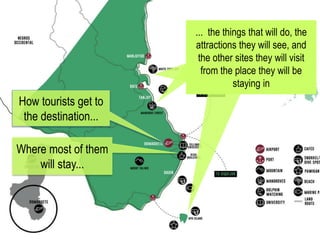
The tourism circuit explains the destination in terms of how
tourists experience (could experience) the place.
Where most of them
will stay...
How tourists get to
the destination...
... the things that will do, the
attractions they will see, and
the other sites they will visit
from the place they will be
staying in
The circuit’s
transportation
gateways and their
links to other
destinations help
define where the
SOURCE
MARKETS for our
LGUs can come
from
The circuit’s tourist attractions
and products help define which
ACTIVITY-BASED SEGMENTS
the LGUs can target and
position for.
LGSP-LED: What we do.
Local Governance Support Program for
Local Economic Development (LGSP-LED)
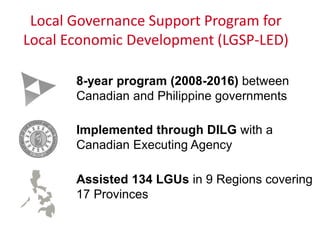
8-year program (2008-2016) between
Canadian and Philippine governments
Implemented through DILG with a
Canadian Executing Agency
Assisted 134 LGUs in 9 Regions covering
17 Provinces
Our Current
Projects
Palawan
Albay - Sorsogon
Negros Occidental
Iloilo
Aklan-Antique
Negros Occidental
Negros Oriental
Siquijor
Cebu
Davao del Norte
3 Batches of Local
Projects since 2009.
Currently working in
9 TDAs involving 11
Provinces
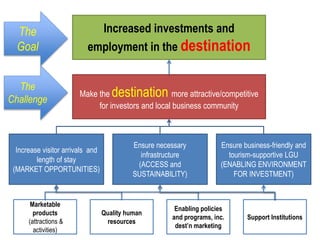
Increased investments and
employment in the destination
Make the destination more attractive/competitive
for investors and local business community
Increase visitor arrivals and
length of stay
(MARKET OPPORTUNITIES)
Ensure necessary
infrastructure
(ACCESS and
SUSTAINABILITY)
Ensure business-friendly and
tourism-supportive LGU
(ENABLING ENVIRONMENT
FOR INVESTMENT)
Marketable
products
(attractions &
activities)
Quality human
resources
Enabling policies
and programs, inc.
dest’n marketing
Support Institutions
The
Goal
The
Challenge
Need to strengthen the private sector and market-
orientation of our LED model, to better achieve these
investment and employment goals.
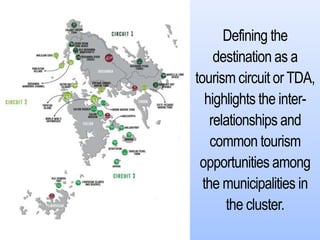
Defining the
destination as a
tourism circuit or TDA,
highlights the inter-
relationships and
common tourism
opportunities among
the municipalities in
the cluster.
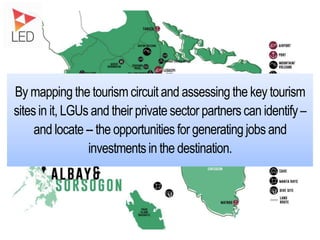
By mapping the tourism circuit and assessing the key tourism
sites in it, LGUs and their private sector partners can identify–
and locate-- the opportunities for generating jobs and
investments in the destination.
The tourism circuit helps
identify how the LGUs in
a destinationare linked
together as a tourism
value chain. LGUs can
be host communities for
tourists and/or supplier
communities for the
tourism industry in this
value chain.
Where are the poor in
relation to the
employment, livelihood,
and income
opportunities in and
around the tourism
sites?
The tourism circuit
approach to destination
planning allows for more
inclusion and protection
of vulnerable groups.
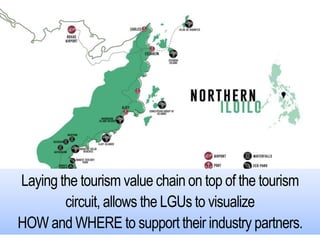
Laying the tourism value chain on top of the tourism
circuit, allows the LGUs to visualize
HOW and WHERE to support their industry partners.
The challenge of tourism circuitdevelopment for LGUs is to enable and
supportthe growth and expansion of the tourism industry aroundthe
natural and cultural sites (places)of the destination.
Local Tourism Planning to
Enable Destination Competitiveness.
What should LGUs focus on?
The Travel and Tourism Competitiveness Index*
Enabling
Environment
Business Environment
Safety and Security
Health and Hygiene
Human Resources and
Labour Market
ICT Readiness
T&T Policy and
Enabling Conditions
Prioritization of Travel
& Tourism
International
Openness
Price Competitiveness
Environmental
Sustainability
Infrastructure
Air Transport
Infrastructure
Ground and Port
Infrastructure
Tourist Service
Infrastructure
Natural and Cultural
Resources
Natural Resources
Cultural Resources
and Business Travel
* - the set of factors and policies that enable the
sustainable development of the Travel & Tourism
sector, which in turn, contributes to the
development and competitiveness of a country.
** PH is #74 out of 141
The Travel and Tourism Competitiveness Index*
Enabling Environment
Local Enabling Implications
Business-friendly LGU
Ensuring availability of quality
human resources through
workforce development
Public or PPP investments in
clean water supply, sanitation,
electricity supply, and
broadband Internet
Business Environment
Safety and Security
Health and Hygiene
Human Resources and
Labour Market
ICT Readiness
T&T Policy and Enabling Conditions
Local Enabling Implications
Prioritization of tourism as a sector
– LGU tourism office
– Destination marketing
– Tourism development plan
– Etc.
Public or PPP investments in
wastewater treatment and other
infrastructure to protect tourism
sites and resources
Policies and programs for the
protection of threatened species
Prioritization of
Travel & Tourism
International Openness
Price Competitiveness
Environmental Sustainability
Infrastructure
Local Enabling Implications
Public or PPP investments in
transportation infrastructure and
transport services, and other visitor
utilities
– Airports and no. of operating airlines
– Roads/railroad infrastructure
– Port facilities
– Ground transportation network
Promotion of investments in tourist
infrastructure
– Hotel rooms
– Car rental companies
– ATMs accepting credit cards
Air Transport Infrastructure
Ground and Port
Infrastructure
Tourist Service Infrastructure
Natural and Cultural Resources
Local Enabling Implications
Support for development and
enhancement of natural/cultural attraction
sites and associated tourist activities
Online marketing “buzz” and tourism
branding
Investments in attraction site
infrastructure (e.g. renewable energy
sources, water, and other utilities)
Local policies for the protection of natural
and cultural heritage
Investment promotion for MICE facilities
Natural Resources
Cultural Resources and
Business Travel
LED-ENABLING POLICIES, PROGRAMS, STRUCTURES,
and LGU MANAGEMENT SYSTEMS
DEVELOPMENT AND ENHANCEMENT OF THE
DESTINATION’S TOURISM PRODUCT to create
competitive enterprises (e.g. attractions, activities,
accommodations, and visitor amenities) and
encourage business investments in and around the key
sites of the destination/circuit.
INFRASTRUCTURE INVESTMENTS to improve access and
promote sustainable site development
DESTINATION
MARKETING to
increase visitor
arrivals and
encourage
longer stays
along the
tourism circuits.
LGU Tourism Planning for Destination Competitiveness
POINTS TO PONDER
Holistic approach to destination development.
Don’t forget the software.
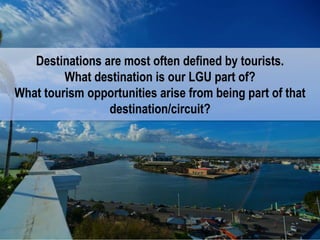
Destinations are most often defined by tourists.
What destination is our LGU part of?
What tourism opportunities arise from being part of that
destination/circuit?
Build destinations. Not just sites.
Enable the private sector to strengthen and
extend the tourism value chain.
Four Pillars of Destination Competitiveness:
1) Business-friendly LGU environment,
2) Support for tourism sector,
3) Infrastructure,
4) Sustainable development of quality tourism product
Thank you very much

Competitive tourism destinations

  • 1.
    Building Competitive Destinations byEnabling the Local Tourism Sector Randi Alampay, Ph.D. LED Program Manager ralampay@lgsp-led.ph
  • 2.
    Building Competitive TouristDestinations by Enabling the Local Tourism Sector • Focus on the destination for local economic development • Destination development = local tourism industry development • Destination competitiveness
  • 3.
    All tourism islocal. Subic Kota Kinabalu Paris Phuket Boracay Bali Chinatown Osaka DGT Allah Valley MNL SIN TYO
  • 4.
    The interaction betweenvisitors and hosts happens at the local level.
  • 5.
    The real benefitsof tourism are felt at the local level...
  • 6.
    The costs oftourism are also experienced at the local level.
  • 7.
    The demand fortourism services is derived from the demand for the locality.
  • 8.
    That is whyour approach to economic development through tourism is based on building competitive tourist destinations
  • 9.
    We can defineour destinations as tourism circuits
  • 10.
    The tourism circuitexplains the destination in terms of how tourists experience (could experience) the place.
  • 11.
    Where most ofthem will stay... How tourists get to the destination... ... the things that will do, the attractions they will see, and the other sites they will visit from the place they will be staying in
  • 12.
    The circuit’s transportation gateways andtheir links to other destinations help define where the SOURCE MARKETS for our LGUs can come from The circuit’s tourist attractions and products help define which ACTIVITY-BASED SEGMENTS the LGUs can target and position for.
  • 13.
  • 14.
    Local Governance SupportProgram for Local Economic Development (LGSP-LED) 8-year program (2008-2016) between Canadian and Philippine governments Implemented through DILG with a Canadian Executing Agency Assisted 134 LGUs in 9 Regions covering 17 Provinces
  • 15.
    Our Current Projects Palawan Albay -Sorsogon Negros Occidental Iloilo Aklan-Antique Negros Occidental Negros Oriental Siquijor Cebu Davao del Norte 3 Batches of Local Projects since 2009. Currently working in 9 TDAs involving 11 Provinces
  • 16.
    Increased investments and employmentin the destination Make the destination more attractive/competitive for investors and local business community Increase visitor arrivals and length of stay (MARKET OPPORTUNITIES) Ensure necessary infrastructure (ACCESS and SUSTAINABILITY) Ensure business-friendly and tourism-supportive LGU (ENABLING ENVIRONMENT FOR INVESTMENT) Marketable products (attractions & activities) Quality human resources Enabling policies and programs, inc. dest’n marketing Support Institutions The Goal The Challenge
  • 17.
    Need to strengthenthe private sector and market- orientation of our LED model, to better achieve these investment and employment goals.
  • 18.
    Defining the destination asa tourism circuit or TDA, highlights the inter- relationships and common tourism opportunities among the municipalities in the cluster.
  • 19.
    By mapping thetourism circuit and assessing the key tourism sites in it, LGUs and their private sector partners can identify– and locate-- the opportunities for generating jobs and investments in the destination.
  • 20.
    The tourism circuithelps identify how the LGUs in a destinationare linked together as a tourism value chain. LGUs can be host communities for tourists and/or supplier communities for the tourism industry in this value chain.
  • 21.
    Where are thepoor in relation to the employment, livelihood, and income opportunities in and around the tourism sites? The tourism circuit approach to destination planning allows for more inclusion and protection of vulnerable groups.
  • 22.
    Laying the tourismvalue chain on top of the tourism circuit, allows the LGUs to visualize HOW and WHERE to support their industry partners.
  • 23.
    The challenge oftourism circuitdevelopment for LGUs is to enable and supportthe growth and expansion of the tourism industry aroundthe natural and cultural sites (places)of the destination.
  • 24.
    Local Tourism Planningto Enable Destination Competitiveness. What should LGUs focus on?
  • 25.
    The Travel andTourism Competitiveness Index* Enabling Environment Business Environment Safety and Security Health and Hygiene Human Resources and Labour Market ICT Readiness T&T Policy and Enabling Conditions Prioritization of Travel & Tourism International Openness Price Competitiveness Environmental Sustainability Infrastructure Air Transport Infrastructure Ground and Port Infrastructure Tourist Service Infrastructure Natural and Cultural Resources Natural Resources Cultural Resources and Business Travel * - the set of factors and policies that enable the sustainable development of the Travel & Tourism sector, which in turn, contributes to the development and competitiveness of a country. ** PH is #74 out of 141
  • 26.
    The Travel andTourism Competitiveness Index*
  • 27.
    Enabling Environment Local EnablingImplications Business-friendly LGU Ensuring availability of quality human resources through workforce development Public or PPP investments in clean water supply, sanitation, electricity supply, and broadband Internet Business Environment Safety and Security Health and Hygiene Human Resources and Labour Market ICT Readiness
  • 28.
    T&T Policy andEnabling Conditions Local Enabling Implications Prioritization of tourism as a sector – LGU tourism office – Destination marketing – Tourism development plan – Etc. Public or PPP investments in wastewater treatment and other infrastructure to protect tourism sites and resources Policies and programs for the protection of threatened species Prioritization of Travel & Tourism International Openness Price Competitiveness Environmental Sustainability
  • 29.
    Infrastructure Local Enabling Implications Publicor PPP investments in transportation infrastructure and transport services, and other visitor utilities – Airports and no. of operating airlines – Roads/railroad infrastructure – Port facilities – Ground transportation network Promotion of investments in tourist infrastructure – Hotel rooms – Car rental companies – ATMs accepting credit cards Air Transport Infrastructure Ground and Port Infrastructure Tourist Service Infrastructure
  • 30.
    Natural and CulturalResources Local Enabling Implications Support for development and enhancement of natural/cultural attraction sites and associated tourist activities Online marketing “buzz” and tourism branding Investments in attraction site infrastructure (e.g. renewable energy sources, water, and other utilities) Local policies for the protection of natural and cultural heritage Investment promotion for MICE facilities Natural Resources Cultural Resources and Business Travel
  • 31.
    LED-ENABLING POLICIES, PROGRAMS,STRUCTURES, and LGU MANAGEMENT SYSTEMS DEVELOPMENT AND ENHANCEMENT OF THE DESTINATION’S TOURISM PRODUCT to create competitive enterprises (e.g. attractions, activities, accommodations, and visitor amenities) and encourage business investments in and around the key sites of the destination/circuit. INFRASTRUCTURE INVESTMENTS to improve access and promote sustainable site development DESTINATION MARKETING to increase visitor arrivals and encourage longer stays along the tourism circuits. LGU Tourism Planning for Destination Competitiveness
  • 32.
  • 33.
    Holistic approach todestination development. Don’t forget the software. Destinations are most often defined by tourists. What destination is our LGU part of? What tourism opportunities arise from being part of that destination/circuit?
  • 34.
    Build destinations. Notjust sites. Enable the private sector to strengthen and extend the tourism value chain.
  • 35.
    Four Pillars ofDestination Competitiveness: 1) Business-friendly LGU environment, 2) Support for tourism sector, 3) Infrastructure, 4) Sustainable development of quality tourism product
  • 36.

Editor's Notes

  • #4 It’s more fun in the Philippines. Malaysia, truly Asia. Amazing Thailand. We tend to think of tourism in terms of competition among countries. Our media also tends to focus on tourism development from a country perspective, often comparing how many international visitors the Philippines got compared to other ASEAN countries. Institutions like the UNWTO and World Economic Forum encourage such thinking by focusing most of their attention on country level statistics and measures. But that is not how tourists think. Singapore is one of the few exceptions. But in general, when tourists say that they are going to another country, they really mean that they are going to one or more destinations within that country. When I plan for a trip to the United States, I am really planning a trip to New York, or California, or some combination of destination within the states. When I take a trip, I plan to travel somewhere, where I will engage in some activities. Those activities will take place in a specific location. In a specific destination or community. This is our focus today. To understand that economic development from tourism – at least, that which is tangible to our people – happens at the local destination level. Not at the central or national level.
  • #5 When tourists recall their visit to the Philippines, they will remember the hotel that they stayed in, the fire jugglers on the beach, the driver who picked them up at the airport, the guide who made their tour more enjoyable and meaningful at the same time. They will tell stories of people they met on the road, in the shops, at the sites, and in the communities. It is that interaction between the visiting tourists and the workers and residents in the host destinations that is the heart of the tourist experience.
  • #6 Presyo (prices). Trabaho (Jobs). Kita (Income). These are the economic benefits that tourism development can bring. Benefits that are tangible on the local level. Tourists spend their money in the locality where their activities happen. They pay for services of tourism establishments based in specific cities and provinces. These establishments create jobs for residents from specific communities.
  • #7 However, it is also at the local level where the ugly side of tourism and economic development can be seen most clearly. Garbage, sewage problems, disrespect for natural and cultural heritage, etc. can all be exacerbated by increased tourism activity. And if (or when) these happen, it will be the local communities who suffer. Similarly, it will be the residents – especially women, children, and indigenous people – who may be at real risk from the unsavory social activities that tourism may bring to their communities.
  • #8 This is Rizal Boulevard in Dumaguete City. Hotels, restaurants, and other tourism establishments are concentrated (and continue to grow in number) along the Boulevard, radiating from Dumaguete Port and leading into the City’s commercial and educational center. How do we estimate the market demand for hotel and other tourism services in Dumaguete, and specifically along Rizal Boulevard? If total foreign visitor arrivals to the Philippines increases by 25% a year, can we expect that demand for hotel rooms in Dumaguete City will increase by the same amount? NO. Let’s say the Philippines gets to 10 million foreign visitor arrivals in one year. The potential market for Rizal Boulevard hotels will only come from that portion of the 10 million that chooses or wants to go to Dumaguete. Thus, for hotels and restaurants in the Boulevard, the more relevant question for them is whether visitor arrivals to Negros Oriental, and specifically Dumaguete City, is increasing – for both foreign and domestic tourists. Another example, we are holding this workshop in the Crowne Plaza, which is a hotel that belongs to the Intercontinental Hotels Group., or IHG. Aside from this hotel, IHG also has the Holiday Inn Galleria, which is next door. The Intercon in Makati. Plus, another Holiday Inn in Clark. Let’s say demand for all three hotels in Metro Manila increases – all IHG properties report occupancy rates of 90% with higher average room rates. That does not mean that the demand for rooms in the Holiday Inn Clark will increase as well. That is because the market opportunities for the HI in Clark are less dependent on the Holiday Inn or Intercontinental coroporate brand. For them, the more relevant issue will be whether demand for business hotels in Clark is growing as fast as that for Metro Manila. Thus, we describe the demand for tourism services as a “derived demand”. It is derived from the broader, initial motivation of the tourists to travel to the specific destination in which their business is located.
  • #9 Tourism Sites are the specific places which tourists come to see and experience. Two kinds of tourism sites: attraction sites and tourism service centers. An attraction site may be an existing natural attraction (volcano); an area of natural scenic beauty (national park); or man-made attraction (heritage structure, beach/golf resort). There can also be areas within or near a natural attraction where hotels and resorts tend to concentrate. These are the tourism service centers. More tourist revenue will be generated from the concentration of tourism establishments in these tourism service centers. The tourism sites are linked together by road and water connections into a tourism circuit. Each circuit has at least one local gateway which can be linked by air, sea, or land to the international gateway(s) of the region. Tourism Development Area (TDA) – two or more tourism sites that can be grouped together for development and/or marketing purposes because of their geographical proximity or similar product type. These TDAs, identified in the NTDP, provide the starting point for defining the Destinations that tourists will consider. Tourism Cluster Destination (TCD) – two or more TDAs grouped together for their regional proximity and access to a common regional gateway. Gateway to Tourism Cluster - Regional Airport that serves as the international air transportation hub into a TCD.
  • #12 The tourist experience at a destination involves a whole chain of events, activities, and transactions that start from their travel into the destination and their various activities as they continue travelling around the destination.
  • #13 LGUs can recognize that the tourism circuit creates mutual market opportunities among the cities and municipalities that are part of the same destination. As with the establishments, the demand for tourism in the different LGUs is derived from the tourist demand associated with the gateway to the destination. The places to which the gateway is linked by transportation services represent source markets for them. In this example, Dumaguete City Airport is the gateway to the whole circuit. Commercial air services connect Dumaguete to major domestic markets in Manila and Cebu. In turn, these air gateways are connected to outbound gateways in other countries. Those domestic and international markets that are connected to our gateway with convenient, affordable and reliable transportation services should be the leading candidates to be target markets. If we know where our visitors are likely to come from, we can also find out what segments – based on the kinds of things they like to do when they travel – within these source markets will be a good match for the kinds of experiences our destination can offer. In this example, Negros Oriental might see opportunities for developing tourist products for sun-and-beach, diving, or MICE groups from their target domestic and foreign markets.
  • #15 The Local Governance Support Program for Local Economic Development (LGSP-LED) is an eight-year (2008-2016) cooperation program of the Governments of Canada and the Philippines. It is implemented by a consortium of the Canadian Urban Institute (CUI) and the Colleges and Institutes Canada as Canadian Executing Agency (CEA). The CEA is working in partnership with the Philippine Department of the Interior and Local Government (DILG). LGSP-LED is supporting to DILG to improve the country’s policy and programming framework for local economic development, enabling LGUs to work collaboratively with the private sector and communities to grow local economies in sustainable ways. The program is achieving this through three components: 1. National environment for LED – strengthening DILG as an enabler of local economic development 2. LGU environment for LED – building business-friendly and competitive LGUs in various pilot sites 3. LED initiatives – creating more competitive sectors and micro, small and medium enterprises (MSMEs) through targeted initiatives with private sector actors. Since 2008, LGSP-LED has assisted 134 LGUs, covering 17 Provinces from 9 regions of the country, in planning and implementing Local Projects in agribusiness and/or tourism.
  • #16 Currently, LGSP-LED is working with its third Batch of LGU partners – a total of 11 Provincial Governments -- on Local Projects focused on 9 Tourism Development Areas (TDA) identified in the National Tourism Development Plan. : Palawan -- Northern Palawan, or the Calamianes Islands Albay-Sorsogon – Legazpi City and Mayon environs to Donsol area Province of Iloilo – Northern Iloilo Aklan-Antique – Northern Panay Island Negros Occidental – Bacolod-Talisay-Silay Heritage Corridor Negros Oriental – Dumaguete City to Dauin (Apo Island) and to Tanjay, Bais, Manjuyod Province of Siquijor Cebu – Northern Cebu including Bantayan Island and Malapascua Davao del Norte – Island Garden City of Samal, particularly Talikud Island.
  • #23 The tourism circuit: Provides tour operators with the basis for developing tour packages, or bundles of tourist services (e.g. lodging, transportation, guides, activities, etc. marketed as an integrated product for tourists to experience the destination. Can be used to guide private investors on the sites within the destination where there is likely demand for hotels, restaurants, souvenir shops, convention facilities, etc. and other tourist enterprises. Allows the industry value chain to be mapped out and show the current and potential locations of various tourism enterprises in the area. In turn, this helps in identifying the human resource development needs and priorities of the sector. Directs LGUs and National Government agencies to specific sites, communities and routes where their programs and services are most needed – and can be most effective. Allows stakeholders to identify and map out the opportunities and constraints on women and the poor to participate in tourism employment, entrepreneurship, and governance. Helps guide local land-use and infrastructure planning to identify development priorities for ensuring that the local industry has the necessary roads, ports, power, water, and other infrastructure requirements. The tourism circuit facilitates the identification of tourism sites that are vulnerable to disaster and climate change.
  • #26 The Travel and Tourism Competitiveness Index of the World Economic Forum tries to measure the competitiveness of a country’s travel and tourism sector. The index measures 14 sets of indicators classified into four main pillars of competitiveness: Enabling Environment, Policy and Enabling Conditions specific to Travel & Tourism, Infrastructure, and Natural and Cultural Resources. Out of 141 countries included in the survey, the Philippines was ranked 74th in terms of overall T&T competitiveness.
  • #27 Of the four pillars, the Philippines fares best in terms of Travel & Tourism Policy and Enabling Conditions. This largely reflects the national government prioritization and support for tourism. The current ratings also suggest that the Philippines has the potential to develop comparative advantages from its tourist attractions (reflected in the Natural and Cultural Resources pillar) where we are ranked close to the upper third of all countries surveyed. Our overall competitiveness ratings are brought down by the ratings for infrastructure (particularly ground and port infrastructure), environmental sustainability, safety and security, and health and hygiene. However, it should be stressed that these are aggregate ratings for the Philippines as a whole. As it is currently constructed, the T&T Index does not tell us how Bohol compares to Bali, Indonesia, or Boracay to Phuket, Thailand. How could a destination like Cebu City identify what areas it should focus on to compete against Penang, Malaysia and similar cities in Southeast Asia. An examination of the indicators used by WEF to measure national competitiveness may give us clues about local or destination-level competitiveness in travel and tourism. (Please refer now to the handouts given with this presentation. The last few pages give definitions for the specific indicators of the index. ) The following slides indicate the suggested aspects of travel and tourism competitiveness where LGUs can focus their enabling efforts for the sector. Thus the local plans for the overall circuit or destination, as well as for the individual cities or municipalities in the circuit, can be directed towards addressing these competitiveness concerns.
  • #28 This pillar deals primarily with broad enabling policies and programs for the business sector, in general. These include LED-enabling policies and programs that any business-friendly LGU should have regardless of their priority economic sector. These include the current focal areas of DILG’s Business-friendly and Competitive LGUs program: Streamlining and computerization (when ready) of LGU transactions, starting with business-permit and licensing systems (BPLS) Enactment of Local Investment and Incentives Codes (LIIC) Designation of LGU Local Economic and Investment Promotions Officers (LEIPO) as well as establishment of LED and Investment Promotion Centers or Offices Workforce Development programs and services, including establishment of local Skills Registry Systems. National and local government infrastructure investments in public utilities and services such as water, power, telecommunications, etc. are key considerations for investors (in any sector). The presence or absence of these essential infrastructure will have a significant impact on cost of doing business in the destination and the LGUs. The destination or circuit approach also helps identify common infrastructure needs that can serve multiple LGUs in a cluster.
  • #29 This pillar deals primarily with local enabling policies and programs specific to the travel and tourism sector. The presence of these tourism-enabling elements are indicators of the importance that the LGUs have given to the sector. For investors, LGU prioritization of tourism will also indicate the degree to which they can expect the LGU to support or even partner with them on their initiatives for tourism. The LGU enabling policies, programs, and services that reflect the LGU responsibilities identified in the National Tourism Law (RA 9593) include: Designation of LGU Tourism Officers as well as establishment of full-time LGU Tourism Offices or Centers. Local tourism statistics and information systems institutionalized in the LGU or in partnership with local academe/private sector. Local tourism development plan integrated into the LGU Comprehensive Development Plan (CDP) and Comprehensive Land-Use Plan (CLUP) This also covers investments by the LGU, the local private sector, and/or local communities to ensure the protection of
  • #30 The WEF Travel and Tourism Index defines this pillar in terms of infrastructure specific to the needs of the sector. In this regard, there are two main types of infrastructure that are most directly related to the tourist experience. First is transportation infrastructure (with the associated transport services). These are usually installed using public funds or through public-private partnership arrangements. The second major class of T&T-related infrastructure are the tourist service infrastructure – primarily in terms of accommodation and MICE facilities. The Travel and Tourism Index does have a Western, or developed country bias. Thus, some of the indicators may not be appropriate to many developing countries. However, the need for major car rental companies implies the importance of convenient tourist transportation (not just public transportation) in competitive destinations. Similarly, the WEF requirement for “ATMS accepting credit cards” is about ensuring that foreign visitors will have access to essential services like banking, communication, etc. wherever they travel.
  • #31 This is the pillar that is directly related to the destination’s tourism product. The measures of the WEF’s T&T Index have relatively high standards, e.g. # of Natural and Cultural World Heritage sites. To translate this to the local destination level, we should understand that the main element being measured has to do with the number, variety, and quality of natural as well as cultural sites around which the tourism experience can be built. But according to the Index, it is not just a question of having these attractions or resources in the destination. Competitiveness also has to do with HOW these sites are developed and enhanced. More importantly, it also asks whether these developments are being done in a sustainable manner. The final point about the Natural and Cultural Resources pillar is that it also includes an indicator of the growing popularity of these sites, through the number of online searches for key search terms associated with these priority sites.
  • #32 Putting the plan together. It starts with the tourism sites – the attraction sites and the tourism service centers – where the tourism establishments will provide activities, services, and facilities that visitors will need. Destination Marketing is necessary to builds up the demand for the tourism circuit as a whole. In doing so, demand is created for the tourism services, facilities, and activities in the destination. Access infrastructure (ports and roads) are essential enabling elements to tourism. If people cannot get to the destination and travel around the sites in the circuit, no tourism can take place. Similarly, infrastructure in the tourism sites such as solid waste management, sewage, lighting, sidewalks, trails, etc. LGU policies, programs, plans, and systems must be put in place to support existing businesses and new investors in building a stronger local tourism sector. At the same time, these LGU policies should provide the incentives as well as controls for ensuring that the kind of development that results from tourism expansion is sustainable, inclusive, and in keeping with the community’s vision for their culture and home.