IBM Global CEO Study: The Enterprise of the Future  Consumer Products & Retail Industry Perspective October, 2008
The Enterprise of the Future is… Global CEO Study 2008  |  CP & Retail Perspective  |  October 2008  1 Hungry for change 2 Innovative beyond customer imagination 3 Globally integrated 4 Disruptive by nature 5 Genuine, not just generous
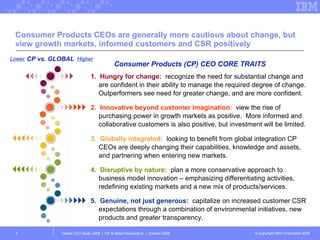
Consumer Products CEOs are generally more cautious about change, but view growth markets, informed customers and CSR positively Global CEO Study 2008  |  CP & Retail Perspective  |  October 2008  Consumer Products (CP) CEO CORE TRAITS 1.  Hungry for change:   recognize the need for substantial change and are confident in their ability to manage the required degree of change.  Outperformers see need for greater change, and are more confident. 2.  Innovative beyond customer imagination:   view the rise of purchasing power in growth markets as positive.  More informed and collaborative customers is also positive, but investment will be limited. 3.  Globally integrated:  looking to benefit from global integration CP CEOs are deeply changing their capabilities, knowledge and assets, and partnering when entering new markets. 4.  Disruptive by nature:   plan a more conservative approach to business model innovation – emphasizing differentiating activities, redefining existing markets and a new mix of products/services.  5.  Genuine, not just generous:   capitalize on increased customer CSR expectations through a combination of environmental initiatives, new products and greater transparency. Higher Lower CP vs. GLOBAL
The Enterprise of the Future is… Hungry for Change
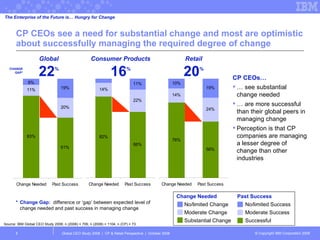
CP CEOs see a need for substantial change and most are optimistic about successfully managing the required degree of change Global CEO Study 2008  |  CP & Retail Perspective  |  October 2008  Consumer Products Source: IBM Global CEO Study 2008; n (2006) = 709, n (2008) = 1104, n (CP) = 73 Change Needed No/limited Change  Moderate Change Substantial Change No/limited Success Moderate Success Successful Past Success 16 % Global 22 % CHANGE GAP* CP CEOs… …  see substantial change needed  …  are more successful than their global peers in managing change Perception is that CP companies are managing a lesser degree of change than other industries The Enterprise of the Future is… Hungry for Change * Change Gap:   difference or ‘gap’ between expected level of change needed and past success in managing change Retail 20 %
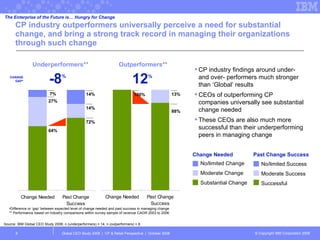
CP industry outperformers universally perceive a need for substantial change, and bring a strong track record in managing their organizations through such change Global CEO Study 2008  |  CP & Retail Perspective  |  October 2008  Difference or ‘gap’ between expected level of change needed and past success in managing change ** Performance based on industry comparisons within survey sample of revenue CAGR 2003 to 2006 Outperformers** Underperformers** 100% 13% 88% 7% 27% 64% 14% 14% 72% The Enterprise of the Future is… Hungry for Change Change Needed No/limited Change  Moderate Change Substantial Change No/limited Success Moderate Success Successful Past Change Success Source: IBM Global CEO Study 2008; n (underperformers) = 14, n (outperformers) = 8 CP industry findings around under- and over- performers much stronger than ‘Global’ results CEOs of outperforming CP companies universally see substantial change needed  These CEOs are also much more successful than their underperforming peers in managing change  CHANGE GAP* 12 % -8 %
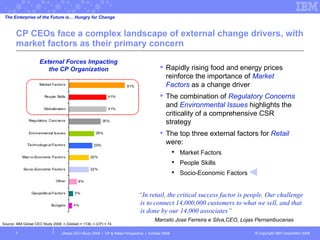
CP CEOs face a complex landscape of external change drivers, with market factors as their primary concern Global CEO Study 2008  |  CP & Retail Perspective  |  October 2008  External Forces Impacting the CP Organization Source: IBM Global CEO Study 2008; n (Global) = 1130; n (CP) = 74 Rapidly rising food and energy prices reinforce the importance of  Market Factors  as a change driver The combination of  Regulatory Concerns  and  Environmental Issues  highlights the criticality of a comprehensive CSR strategy The top three external factors for  Retail  were: Market Factors People Skills Socio-Economic Factors The Enterprise of the Future is… Hungry for Change “ In retail, the critical success factor is people. Our challenge is to connect 14,000,000 customers to what we sell, and that is done by our 14,000 associates”  Marcelo Jose Ferreira e Silva,CEO,  Lojas Pernambucanas   61%
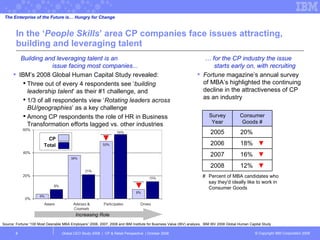
In the ‘ People Skills ’ area CP companies face issues attracting, building and leveraging talent Global CEO Study 2008  |  CP & Retail Perspective  | October 2008  Source: Fortune “100 Most Desirable MBA Employers” 2006, 2007, 2008 and IBM Institute for Business Value (IBV) analysis,  IBM IBV 2008 Global Human Capital Study Building and leveraging talent is an  issue facing most companies... IBM’s 2008 Global Human Capital Study revealed: Three out of every 4 respondents see ‘ building leadership talent ’ as their #1 challenge, and 1/3 of all respondents view ‘ Rotating leaders across BU/geographies ’ as a key challenge Among CP respondents the role of HR in Business Transformation efforts lagged vs. other industries CP Total #  Percent of MBA candidates who say they'd ideally like to work in Consumer Goods …  for the CP industry the issue  starts early on, with recruiting Fortune  magazine’s annual survey of MBA’s highlighted the continuing decline in the attractiveness of CP as an industry Increasing Role The Enterprise of the Future is… Hungry for Change Survey Year Consumer Goods # 2005 20%  ▼ 2006 18%  ▼ 2007 16%  ▼ 2008 12%  ▼
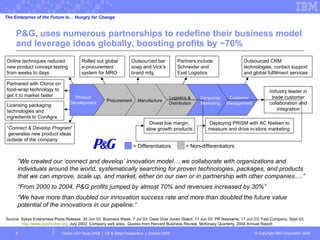
P&G, uses numerous partnerships to redefine their business model and leverage ideas globally, boosting profits by ~70% Global CEO Study 2008  |  CP & Retail Perspective  |  October 2008  Industry leader in trade customer collaboration and integration “ We created our ‘connect and develop’ innovation model….we collaborate with organizations and individuals around the world, systematically searching for proven technologies, packages, and products that we can improve, scale up, and market, either on our own or in partnership with other companies….”  “ From 2000 to 2004, P&G profits jumped by almost 70% and revenues increased by 30%” “ We have more than doubled our innovation success rate and more than doubled the future value potential of the innovations in our pipeline.” Source: Sykes Enterprises Press Release, 30 Jun 03; Business Week, 7 Jul 03; Oster Dow Jones Select, 17 Jun 03; PR Newswire, 17 Jun 03; Fast Company, Sept 03;  http://www.ecom-ohio.org , July 2002; Company web sites.  Quotes from Harvard Business Review, McKinsey Quarterly, 2004 Annual Report  Outsourced bar soap and Vick’s brand mfg. Outsourced CRM technologies, contact support and global fulfillment services “ Connect & Develop Program ”  generates new product ideas outside of the company Partnered with Clorox on food-wrap technology to get it to market faster Online techniques reduced new product concept testing from weeks to days Rolled out global e-procurement system for MRO Partners include Schneider and Exel Logistics = Differentiators = Non-differentiators Divest low margin, slow growth products Procurement Manufacture Logistics & Distribution Consumer Marketing Customer Management Product Development Deploying PRISM with AC Nielsen to measure and drive in-store marketing  Licensing packaging technologies and ingredients to ConAgra The Enterprise of the Future is… Hungry for Change
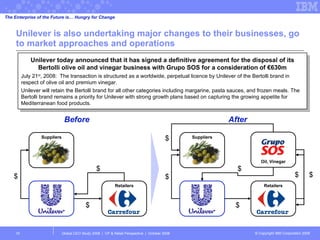
Unilever is also undertaking major changes to their businesses, go to market approaches and operations Global CEO Study 2008  |  CP & Retail Perspective  |  October 2008  Before After Unilever today announced that it has signed a definitive agreement for the disposal of its Bertolli olive oil and vinegar business with Grupo SOS for a consideration of €630m July 21 st , 2008:  The transaction is structured as a worldwide, perpetual licence by Unilever of the Bertolli brand in respect of olive oil and premium vinegar. Unilever will retain the Bertolli brand for all other categories including margarine, pasta sauces, and frozen meals. The Bertolli brand remains a priority for Unilever with strong growth plans based on capturing the growing appetite for Mediterranean food products. Unilever All Categories Retailers Suppliers Unilever Spreads, Sauces, Frozen Retailers Oil, Vinegar Suppliers $ $ $ $ $ $ $ $ $ $ The Enterprise of the Future is… Hungry for Change
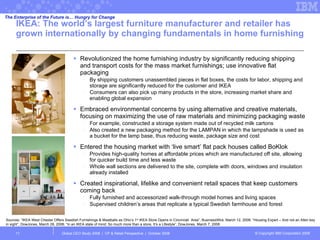
IKEA:  The world’s largest furniture manufacturer and retailer has grown internationally by changing fundamentals in home furnishing  Revolutionized the home furnishing industry by significantly reducing shipping and transport costs for the mass market furnishings; use innovative flat packaging By shipping customers unassembled pieces in flat boxes, the costs for labor, shipping and storage are significantly reduced for the customer and IKEA Consumers can also pick up many products in the store, increasing market share and enabling global expansion Embraced environmental concerns by using alternative and creative materials, focusing on maximizing the use of raw materials and minimizing packaging waste  For example, constructed a storage system made out of recycled milk cartons Also created a new packaging method for the LAMPAN in which the lampshade is used as a bucket for the lamp base, thus reducing waste, package size and cost Entered the housing market with ‘live smart’ flat pack houses called BoKlok  Provides high-quality homes at affordable prices which are manufactured off site, allowing for quicker build time and less waste Whole wall sections are delivered to the site, complete with doors, windows and insulation already installed Created inspirational, lifelike and convenient retail spaces that keep customers coming back Fully furnished and accessorized walk-through model homes and living spaces Supervised children’s areas that replicate a typical Swedish farmhouse and forest Global CEO Study 2008  |  CP & Retail Perspective  |  October 2008  Sources: “IKEA West Chester Offers Swedish Furnishings & Meatballs as Ohio’s 1 st  IKEA Store Opens in Cincinnati  Area”, BusinessWire, March 12, 2008; “Housing Expert – And not an Allen key in sight”, DowJones, March 28, 2008; “In an IKEA state of mind; So much more than a store, It’s a Lifestyle”, DowJones, March 7, 2008 The Enterprise of the Future is… Hungry for Change
The Enterprise of the Future is… Innovative Beyond Customer Imagination
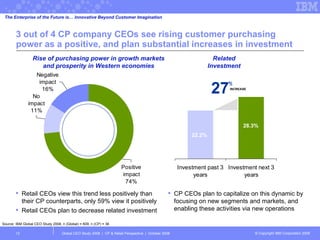
3 out of 4 CP company CEOs see rising customer purchasing power as a positive, and plan substantial increases in investment Global CEO Study 2008  |  CP & Retail Perspective  |  October 2008  Source: IBM Global CEO Study 2008, n (Global) = 609; n (CP) = 38 22.2% 28.3% The Enterprise of the Future is… Innovative Beyond Customer Imagination Rise of purchasing power in growth markets and prosperity in Western economies Related Investment CP CEOs plan to capitalize on this dynamic by focusing on new segments and markets, and enabling these activities via new operations  Retail CEOs view this trend less positively than their CP counterparts, only 59% view it positively Retail CEOs plan to decrease related investment 27 % INCREASE
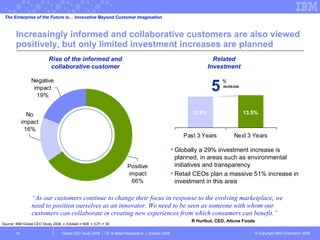
Increasingly informed and collaborative customers are also viewed positively, but only limited investment increases are planned Global CEO Study 2008  |  CP & Retail Perspective  |  October 2008  Rise of the informed and collaborative customer Source: IBM Global CEO Study 2008, n (Global) = 609; n (CP) = 38 5 % INCREASE 12.9% 13.5% The Enterprise of the Future is… Innovative Beyond Customer Imagination Globally a 29% investment increase is planned, in areas such as environmental initiatives and transparency Retail CEOs plan a massive 51% increase in investment in this area Related Investment “ As our customers continue to change their focus in response to the evolving marketplace, we need to position ourselves as an innovator. We need to be seen as someone with whom our customers can collaborate in creating new experiences from which consumers can benefit.” R Hurlbut, CEO, Attune Foods
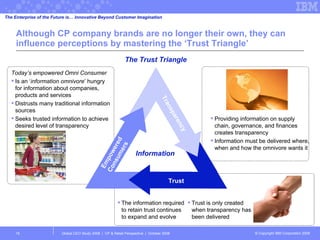
Although CP company brands are no longer their own, they can influence perceptions by mastering the ‘Trust Triangle’ Global CEO Study 2008  |  CP & Retail Perspective  |  October 2008  Today’s empowered Omni Consumer Is an ‘ information omnivore ’ hungry for information about companies, products and services Distrusts many traditional information sources Seeks trusted information to achieve desired level of transparency Providing information on supply chain, governance, and finances creates transparency Information must be delivered where, when and how the omnivore wants it The information required to retain trust continues to expand and evolve Trust is only created when transparency has been delivered The Trust Triangle The Enterprise of the Future is… Innovative Beyond Customer Imagination Trust Empowered Consumers Transparency Information
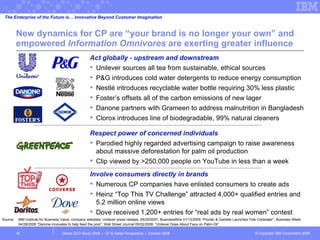
New dynamics for CP are “your brand is no longer your own” and empowered  Information Omnivores  are exerting   greater influence Global CEO Study 2008  |  CP & Retail Perspective  |  October 2008  Involve consumers directly in brands Numerous CP companies have enlisted consumers to create ads Heinz “Top This TV Challenge” attracted 4,000+ qualified entries and 5.2 million online views Dove received 1,200+ entries for “real ads by real women” contest Respect power of concerned individuals Parodied highly regarded advertising campaign to raise awareness about massive deforestation for palm oil production Clip viewed by >250,000 people on YouTube in less than a week Act globally - upstream and downstream  Unilever sources all tea from sustainable, ethical sources  P&G introduces cold water detergents to reduce energy consumption Nestlé introduces recyclable water bottle requiring 30% less plastic Foster’s offsets all of the carbon emissions of new lager Danone partners with Grameen to address malnutrition in Bangladesh Clorox introduces line of biodegradable, 99% natural cleaners The Enterprise of the Future is… Innovative Beyond Customer Imagination Source:  IBM Institute for Business Value, company websites, Unilever press release, 05/25/2007, BusinessWire 01/13/2005 “Procter & Gamble Launches Tide Coldwater”, Business Week 04/28/2008 “Danone innovates to help feed the poor”, Wall Street Journal 05/02/2008: “Unilever Does About Face on Palm-Oil”
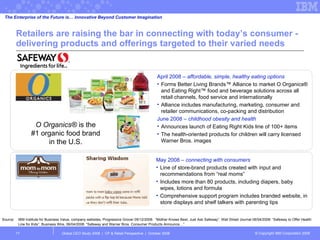
Retailers are raising the bar in connecting with today’s consumer -  delivering products and offerings targeted to their varied needs Global CEO Study 2008  |  CP & Retail Perspective  |  October 2008  The Enterprise of the Future is… Innovative Beyond Customer Imagination Source:  IBM Institute for Business Value, company websites, Progressive Grocer 05/12/2008:  “Mother Knows Best, Just Ask Safeway”, Wall Street Journal 06/04/2008: “Safeway to Offer Health Line for Kids”, Business Wire, 06/04/2008: “Safeway and Warner Bros. Consumer Products Announce…” May 2008 –  connecting with consumers Line of store-brand products created with input and recommendations from “real moms” Includes more than 80 products, including diapers, baby wipes, lotions and formula Comprehensive support program includes branded website, in store displays and shelf talkers with parenting tips April 2008 –  affordable, simple, healthy eating options Forms Better Living Brands™ Alliance to market O Organics® and Eating Right™ food and beverage solutions across all retail channels, food service and internationally Alliance includes manufacturing, marketing, consumer and retailer communications, co-packing and distribution June 2008 –  childhood obesity and health Announces launch of Eating Right Kids line of 100+ items The health-oriented products for children will carry licensed Warner Bros. images O Organics®  is the #1 organic food brand in the U.S.
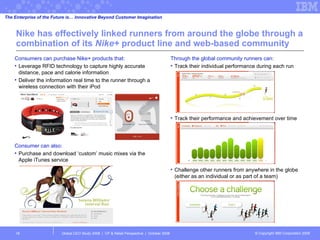
Nike has effectively linked runners from around the globe through a combination of its  Nike+  product line and web-based community Global CEO Study 2008  |  CP & Retail Perspective  |  October 2008  Consumers can purchase Nike+ products that: Leverage RFID technology to capture highly accurate distance, pace and calorie information Deliver the information real time to the runner through a wireless connection with their iPod Consumer can also: Purchase and download ‘custom’ music mixes via the Apple iTunes service The Enterprise of the Future is… Innovative Beyond Customer Imagination Through the global community runners can: Track their individual performance during each run Track their performance and achievement over time Challenge other runners from anywhere in the globe (either as an individual or as part of a team)
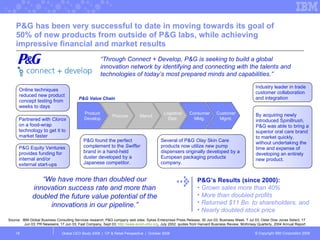
P&G has been very successful to date in moving towards its goal of 50% of new products from outside of P&G labs, while achieving  impressive financial and market results Global CEO Study 2008  |  CP & Retail Perspective  |  October 2008  Source:  IBM Global Business Consulting Services research; P&G company web sites; Sykes Enterprises Press Release, 30 Jun 03; Business Week, 7 Jul 03; Oster Dow Jones Select, 17 Jun 03; PR Newswire, 17 Jun 03; Fast Company, Sept 03;  http://www.ecom-ohio.org , July 2002; quotes from Harvard Business Review, McKinsey Quarterly, 2004 Annual Report  Partnered with  Clorox  on a food-wrap technology to get it to market faster Online techniques reduced new product concept testing from weeks to days Product Develop Procure Manuf. Logistics/ Distr. Consumer Mktg. Customer Mgmt. Industry leader in trade customer collaboration and integration P&G’s Results (since 2000): •  Grown sales more than 40% More than doubled profits Returned $11 Bn. to shareholders, and Nearly doubled stock price P&G Equity Ventures provides funding for internal and/or external start-ups “ Through Connect + Develop, P&G is seeking to build a global innovation network by identifying and connecting with the talents and technologies of today’s most prepared minds and capabilities.” P&G found the perfect complement to the  Swiffer  brand in a hand-held duster developed by a Japanese competitor. Several of P&G  Olay  Skin Care products now utilize new pump dispensers originally developed by a European packaging products company. By acquiring newly introduced S pinBrush , P&G was able to bring a superior oral care brand to market quickly, without undertaking the time and expense of developing an entirely new product. “ We have more than doubled our innovation success rate and more than doubled the future value potential of the innovations in our pipeline.” P&G Value Chain
The Enterprise of the Future is… Globally Integrated
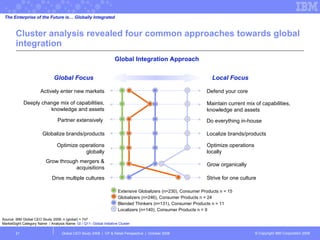
Cluster analysis revealed four common approaches towards global integration Global CEO Study 2008  |  CP & Retail Perspective  |  October 2008  Source: IBM Global CEO Study 2008; n (global) = 747 MarketSight Category Name  / Analysis Name:  GI / Q11- Global Initiative Cluster Global Integration Approach Deeply change mix of capabilities, knowledge and assets Maintain current mix of capabilities, knowledge and assets Global Focus Local Focus The Enterprise of the Future is… Globally Integrated Drive multiple cultures Grow organically Strive for one culture Localize brands/products Do everything in-house Defend your core Partner extensively  Globalize brands/products Optimize operations globally Grow through mergers & acquisitions Optimize operations locally Actively enter new markets Extensive Globalizers (n=230), Consumer Products n = 15 Globalizers (n=246), Consumer Products n = 24 Blended Thinkers (n=131), Consumer Products n = 11 Localizers (n=140), Consumer Products n = 9
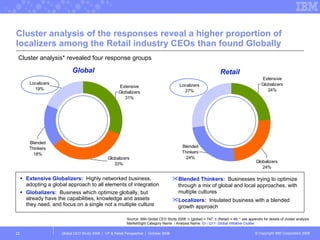
Extensive Globalizers:   Highly networked business, adopting a global approach to all elements of integration Globalizers:   Business which optimize globally, but already have the capabilities, knowledge and assets they need, and focus on a single not a multiple culture Cluster analysis of the responses reveal a higher proportion of localizers among the Retail industry CEOs than found Globally Global CEO Study 2008  |  CP & Retail Perspective  |  October 2008  Source: IBM Global CEO Study 2008; n (global) = 747; n (Retail) = 49; * see appendix for details of cluster analysis MarketSight Category Name  / Analysis Name:  GI / Q11- Global Initiative Cluster Cluster analysis* revealed four response groups Global CP Blended Thinkers:   Businesses trying to optimize through a mix of global and local approaches, with multiple cultures Localizers:   Insulated business with a blended growth approach Retail
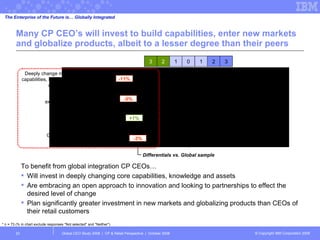
Many CP CEO’s will invest to build capabilities, enter new markets and globalize products, albeit to a lesser degree than their peers  Global CEO Study 2008  |  CP & Retail Perspective  |  October 2008  * n = 73 (% in chart exclude responses "Not selected" and "Neither") Partner extensively  Globalize brands/products Deeply change mix of capabilities, knowledge and assets Do everything in-house Localize brands/products Defend your core Actively enter new markets Maintain current mix of capabilities, knowledge and assets The Enterprise of the Future is… Globally Integrated To benefit from global integration CP CEOs… Will invest in deeply changing core capabilities, knowledge and assets Are embracing an open approach to innovation and looking to partnerships to effect the desired level of change Plan significantly greater investment in new markets and globalizing products than CEOs of their retail customers -11% -5% +1% -3% Differentials vs. Global sample 3 2 1 0 1 2 3
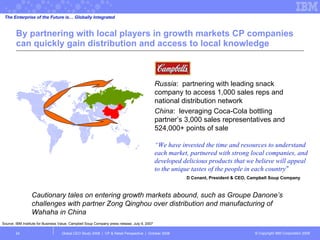
By partnering with local players in growth markets CP companies can quickly gain distribution and access to local knowledge Global CEO Study 2008  |  CP & Retail Perspective  |  October 2008  “ We have invested the time and resources to understand each market, partnered with strong local companies, and developed delicious products that we believe will appeal to the unique tastes of the people in each country ” D Conant, President & CEO, Campbell Soup Company Russia :  partnering with leading snack company to access 1,000 sales reps and national distribution network  China :  leveraging Coca-Cola bottling partner’s 3,000 sales representatives and 524,000+ points of sale The Enterprise of the Future is… Globally Integrated Cautionary tales on entering growth markets abound, such as Groupe Danone’s challenges with partner Zong Qinghou over distribution and manufacturing of Wahaha in China  Source: IBM Institute for Business Value, Campbell Soup Company press release, July 9, 2007
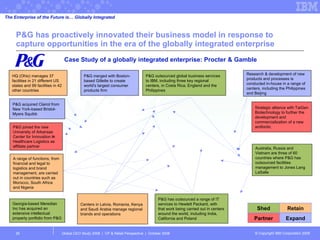
P&G has proactively innovated their business model in response to capture opportunities in the era of the globally integrated enterprise Global CEO Study 2008  |  CP & Retail Perspective  |  October 2008  Case Study of a globally integrated enterprise: Procter & Gamble P&G merged with Boston-based Gillette to create world's largest consumer products firm P&G outsourced global business services to IBM, including three key regional centers, in Costa Rica, England and the Philippines P&G has outsourced a range of IT services to Hewlett Packard, with that work being carried out in centers around the world, including India, California and Poland Research & development of new products and processes is conducted in-house in a range of centers, including the Philippines and Beijing Strategic alliance with TaiGen Biotechnology to further the development and commercialization of a new antibiotic Partner Expand Shed Retain Centers in Latvia, Romania, Kenya and Saudi Arabia manage regional brands and operations Australia, Russia and Vietnam are three of 60 countries where P&G has outsourced facilities management to Jones Lang LaSalle HQ (Ohio) manages 37 facilities in 21 different US states and 99 facilities in 42 other countries P&G acquired Clairol from New York-based Bristol-Myers Squibb P&G joined the new University of Arkansas Center for Innovation in Healthcare Logistics as affiliate partner Georgia-based Meredian Inc has acquired an extensive intellectual property portfolio from P&G A range of functions, from financial and legal to logistics and brand management, are carried out in countries such as Morocco, South Africa and Nigeria The Enterprise of the Future is… Globally Integrated
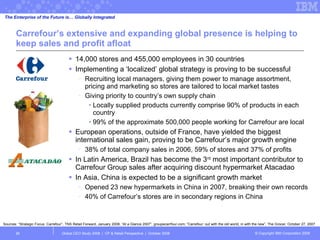
Carrefour’s extensive and expanding global presence is helping to keep sales and profit afloat 14,000 stores and 455,000 employees in 30 countries Implementing a ‘localized’ global strategy is proving to be successful Recruiting local managers, giving them power to manage assortment, pricing and marketing so stores are tailored to local market tastes Giving priority to country’s own supply chain Locally supplied products currently comprise 90% of products in each country 99% of the approximate 500,000 people working for Carrefour are local European operations, outside of France, have yielded the biggest international sales gain, proving to be Carrefour’s major growth engine 38% of total company sales in 2006, 59% of stores and 37% of profits In Latin America, Brazil has become the 3 rd  most important contributor to Carrefour Group sales after acquiring discount hypermarket Atacadao In Asia, China is expected to be a significant growth market Opened 23 new hypermarkets in China in 2007, breaking their own records  40% of Carrefour’s stores are in secondary regions in China Global CEO Study 2008  |  CP & Retail Perspective  |  October 2008  Sources: “Strategic Focus: Carrefour”, TNS Retail Forward, January 2008; “At a Glance 2007”, groupecarrfour.com; “Carrefour: out with the old world, in with the new”, The Grocer, October 27, 2007 The Enterprise of the Future is… Globally Integrated
The Enterprise of the Future is… Disruptive by Nature
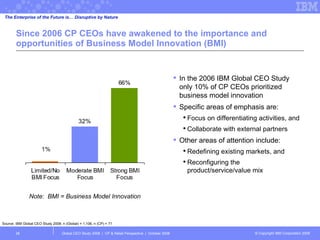
Since 2006 CP CEOs have awakened to the importance and opportunities of Business Model Innovation (BMI) Global CEO Study 2008  |  CP & Retail Perspective  |  October 2008  Source: IBM Global CEO Study 2008; n (Global) = 1,106, n (CP) = 71 The Enterprise of the Future is… Disruptive by Nature In the 2006 IBM Global CEO Study only 10% of CP CEOs prioritized business model innovation Specific areas of emphasis are: Focus on differentiating activities, and Collaborate with external partners Other areas of attention include: Redefining existing markets, and Reconfiguring the product/service/value mix Note:  BMI = Business Model Innovation
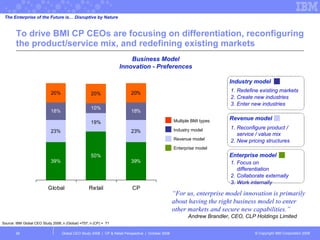
To drive BMI CP CEOs are focusing on differentiation, reconfiguring the product/service mix, and redefining existing markets  Global CEO Study 2008  |  CP & Retail Perspective  |  October 2008  Business Model Innovation - Preferences Source: IBM Global CEO Study 2008;  n (Global) =757; n (CP) =  71 Focus on differentiation Collaborate externally Work internally The Enterprise of the Future is… Disruptive by Nature Enterprise model Revenue model Industry model Multiple BMI types Reconfigure product / service / value mix New pricing structures Redefine existing markets Create new industries Enter new industries Enterprise model Revenue model Industry model “ For us, enterprise model innovation is primarily about having the right business model to enter other markets and secure new capabilities.” Andrew Brandler, CEO, CLP Holdings Limited
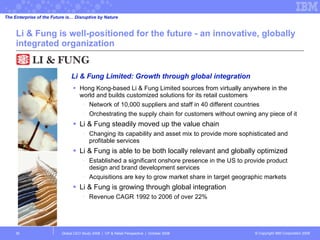
Li & Fung is well-positioned for the future - an innovative, globally integrated organization Hong Kong-based Li & Fung Limited sources from virtually anywhere in the world and builds customized solutions for its retail customers Network of 10,000 suppliers and staff in 40 different countries Orchestrating the supply chain for customers without owning any piece of it Li & Fung steadily moved up the value chain Changing its capability and asset mix to provide more sophisticated and profitable services Li & Fung is able to be both locally relevant and globally optimized Established a significant onshore presence in the US to provide product design and brand development services Acquisitions are key to grow market share in target geographic markets Li & Fung is growing through global integration Revenue CAGR 1992 to 2006 of over 22% Global CEO Study 2008  |  CP & Retail Perspective  |  October 2008  Li & Fung Limited: Growth through global integration The Enterprise of the Future is… Disruptive by Nature
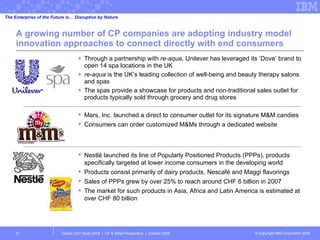
A growing number of CP companies are adopting industry model innovation approaches to connect directly with end consumers Through a partnership with  re-aqua , Unilever has leveraged its ‘Dove’ brand to open 14 spa locations in the UK re-aqua  is the UK’s leading collection of well-being and beauty therapy salons and spas The spas provide a showcase for products and non-traditional sales outlet for products typically sold through grocery and drug stores Global CEO Study 2008  |  CP & Retail Perspective  |  October 2008  Mars, Inc. launched a direct to consumer outlet for its signature M&M candies Consumers can order customized M&Ms through a dedicated website Nestlé launched its line of Popularly Positioned Products (PPPs), products specifically targeted at lower income consumers in the developing world  Products consist primarily of dairy products, Nescafé and Maggi flavorings Sales of PPPs grew by over 25% to reach around CHF 6 billion in 2007 The market for such products in Asia, Africa and Latin America is estimated at over CHF 80 billion The Enterprise of the Future is… Disruptive by Nature
The Enterprise of the Future is… Genuine, Not Just Generous
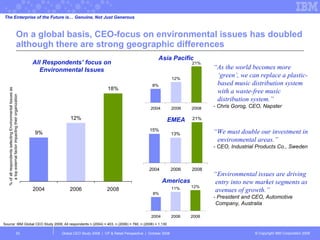
On a global basis, CEO-focus on environmental issues has doubled although there are strong geographic differences Global CEO Study 2008  |  CP & Retail Perspective  |  October 2008  The Enterprise of the Future is… Genuine, Not Just Generous Americas EMEA Asia Pacific All Respondents’  focus on Environmental Issues “ As the world becomes more ‘green’, we can replace a plastic-based music distribution system with a waste-free music distribution system .” - Chris Gorog, CEO, Napster “ We must double our investment in environmental areas.” - CEO, Industrial Products Co., Sweden “ Environmental issues are driving entry into new market segments as avenues of growth.” - President and CEO, Automotive Company, Australia Source: IBM Global CEO Study 2008; All respondents  n (2004) = 403, n (2006) = 760, n (2008) = 1,130 % of all respondents selecting Environmental Issues as a top external factor impacting their organization
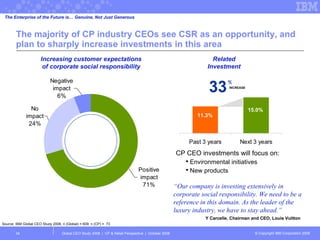
The majority of CP industry CEOs see CSR as an opportunity, and plan to sharply increase investments in this area Global CEO Study 2008  |  CP & Retail Perspective  |  October 2008  Source: IBM Global CEO Study 2008,  n (Global) = 609; n (CP) =  73 33 % INCREASE 20% 11.3% 15.0% The Enterprise of the Future is… Genuine, Not Just Generous “ Our company is investing extensively in corporate social responsibility. We need to be a reference in this domain. As the leader of the luxury industry, we have to stay ahead.” Y Carcelle, Chairman and CEO, Louis Vuitton Increasing customer expectations of corporate social responsibility CP CEO investments will focus on: Environmental initiatives New products Related Investment
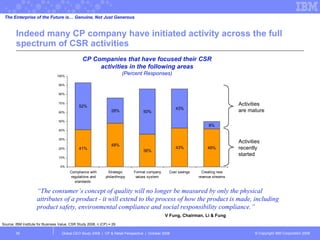
Indeed many CP company have initiated activity across the full spectrum of CSR activities Global CEO Study 2008  |  CP & Retail Perspective  |  October 2008  Source: IBM Institute for Business Value, CSR Study 2008, n (CP) = 29 Activities recently started Activities are mature The Enterprise of the Future is… Genuine, Not Just Generous CP Companies that have focused their CSR activities in the following areas (Percent Responses) “ The consumer’s concept of quality will no longer be measured by only the physical attributes of a product - it will extend to the process of how the product is made, including product safety, environmental compliance and social responsibility compliance.” V Fung, Chairman, Li & Fung
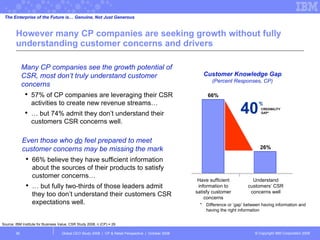
However many CP companies are seeking growth without fully understanding customer concerns and drivers Global CEO Study 2008  |  CP & Retail Perspective  |  October 2008  Many CP companies see the growth potential of CSR, most don’t truly understand customer concerns 57% of CP companies are leveraging their CSR activities to create new revenue streams…  …  but 74% admit they don’t understand their customers CSR concerns well. Have sufficient information to satisfy customer concerns Understand customers’ CSR concerns well 66% 26% Even those who  do  feel prepared to meet customer concerns may be missing the mark 66% believe they have sufficient information about the sources of their products to satisfy customer concerns… …  but fully two-thirds of those leaders admit they too don’t understand their customers CSR expectations well. The Enterprise of the Future is… Genuine, Not Just Generous Source: IBM Institute for Business Value, CSR Study 2008, n (CP) = 29 Customer Knowledge Gap (Percent Responses, CP) 40 % CREDIBILITY GAP* *  Difference or ‘gap’ between having information and having the right information
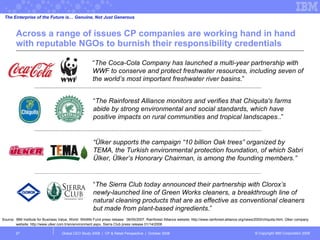
Across a range of issues CP companies are working hand in hand with reputable NGOs to burnish their responsibility credentials  Global CEO Study 2008  |  CP & Retail Perspective  |  October 2008  “ The Coca-Cola Company has launched a multi-year partnership with WWF to conserve and protect freshwater resources, including seven of the world’s most important freshwater river basins .” The Enterprise of the Future is… Genuine, Not Just Generous “ The Rainforest Alliance monitors and verifies that Chiquita's farms abide by strong environmental and social standards, which have positive impacts on rural communities and tropical landscapes. .” “ The Sierra Club today announced their partnership with Clorox’s newly-launched line of Green Works cleaners, a breakthrough line of natural cleaning products that are as effective as conventional cleaners but made from plant-based ingredients .” “ Ülker supports the campaign “10 billion Oak trees” organized by TEMA, the Turkish environmental protection foundation, of which Sabri Ülker, Ülker’s Honorary Chairman, is among the founding members.” Source: IBM Institute for Business Value, World  Wildlife Fund press release:  06/05/2007, Rainforest Alliance website: http://www.rainforest-alliance.org/news/2000/chiquita.html, Ülker company website: http://www.ulker.com.tr/en/environment.aspx, Sierra Club press release 01/14/2008
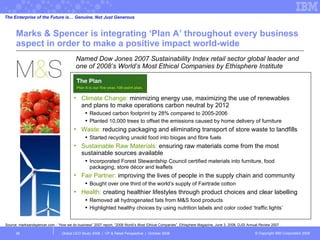
Marks & Spencer is integrating ‘Plan A’ throughout every business aspect in order to make a positive impact world-wide Named Dow Jones 2007 Sustainability Index retail sector global leader  and  one of 2008’s World’s Most Ethical Companies by Ethisphere Institute  Global CEO Study 2008  |  CP & Retail Perspective  |  October 2008  The Enterprise of the Future is… Genuine, Not Just Generous Source: marksandspencer.com - “How we do business” 2007 report; “2008 World’s Most Ethical Companies”, Ethisphere Magazine, June 3, 2008; DJSI Annual Review 2007  Climate Change:  minimizing energy use, maximizing the use of renewables and plans to make operations carbon neutral by 2012  Reduced carbon footprint by 28% compared to 2005-2006 Planted 10,000 trees to offset the emissions caused by home delivery of furniture Waste:  reducing packaging and eliminating transport of store waste to landfills Started recycling unsold food into biogas and fibre fuels  Sustainable Raw Materials:  ensuring raw materials come from the most sustainable sources available Incorporated Forest Stewardship Council certified materials into furniture, food packaging, store décor and leaflets Fair Partner:  improving the lives of people in the supply chain and community Bought over one third of the world’s supply of Fairtrade cotton  Health:  creating healthier lifestyles through product choices and clear labelling Removed all hydrogenated fats from M&S food products Highlighted healthy choices by using nutrition labels and color coded ‘traffic lights’
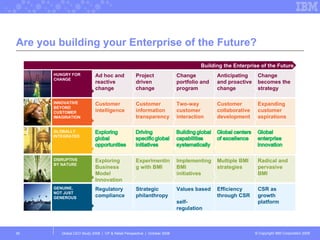
Are you building your Enterprise of the Future?  Global CEO Study 2008  |  CP & Retail Perspective  |  October 2008  Building the Enterprise of the Future Ad hoc and reactive change Project driven change Change portfolio and program Anticipating  and proactive change Change becomes the strategy HUNGRY FOR CHANGE Regulatory compliance Strategic philanthropy Values based  self-regulation Efficiency through CSR CSR as growth  platform GENUINE,  NOT JUST  GENEROUS Exploring Business Model Innovation  Experimenting with BMI Implementing BMI initiatives Multiple BMI strategies Radical and pervasive BMI DISRUPTIVE  BY NATURE GLOBALLY INTEGRATED Customer intelligence Customer information transparency Two-way customer interaction Customer collaborative development Expanding customer aspirations INNOVATIVE  BEYOND CUSTOMER IMAGINATION

Competing in a changing world patrick medley (ibm consulting

  • 1.
    IBM Global CEOStudy: The Enterprise of the Future Consumer Products & Retail Industry Perspective October, 2008
  • 2.
    The Enterprise ofthe Future is… Global CEO Study 2008 | CP & Retail Perspective | October 2008 1 Hungry for change 2 Innovative beyond customer imagination 3 Globally integrated 4 Disruptive by nature 5 Genuine, not just generous
  • 3.
    Consumer Products CEOsare generally more cautious about change, but view growth markets, informed customers and CSR positively Global CEO Study 2008 | CP & Retail Perspective | October 2008 Consumer Products (CP) CEO CORE TRAITS 1. Hungry for change: recognize the need for substantial change and are confident in their ability to manage the required degree of change. Outperformers see need for greater change, and are more confident. 2. Innovative beyond customer imagination: view the rise of purchasing power in growth markets as positive. More informed and collaborative customers is also positive, but investment will be limited. 3. Globally integrated: looking to benefit from global integration CP CEOs are deeply changing their capabilities, knowledge and assets, and partnering when entering new markets. 4. Disruptive by nature: plan a more conservative approach to business model innovation – emphasizing differentiating activities, redefining existing markets and a new mix of products/services. 5. Genuine, not just generous: capitalize on increased customer CSR expectations through a combination of environmental initiatives, new products and greater transparency. Higher Lower CP vs. GLOBAL
  • 4.
    The Enterprise ofthe Future is… Hungry for Change
  • 5.
    CP CEOs seea need for substantial change and most are optimistic about successfully managing the required degree of change Global CEO Study 2008 | CP & Retail Perspective | October 2008 Consumer Products Source: IBM Global CEO Study 2008; n (2006) = 709, n (2008) = 1104, n (CP) = 73 Change Needed No/limited Change Moderate Change Substantial Change No/limited Success Moderate Success Successful Past Success 16 % Global 22 % CHANGE GAP* CP CEOs… … see substantial change needed … are more successful than their global peers in managing change Perception is that CP companies are managing a lesser degree of change than other industries The Enterprise of the Future is… Hungry for Change * Change Gap: difference or ‘gap’ between expected level of change needed and past success in managing change Retail 20 %
  • 6.
    CP industry outperformersuniversally perceive a need for substantial change, and bring a strong track record in managing their organizations through such change Global CEO Study 2008 | CP & Retail Perspective | October 2008 Difference or ‘gap’ between expected level of change needed and past success in managing change ** Performance based on industry comparisons within survey sample of revenue CAGR 2003 to 2006 Outperformers** Underperformers** 100% 13% 88% 7% 27% 64% 14% 14% 72% The Enterprise of the Future is… Hungry for Change Change Needed No/limited Change Moderate Change Substantial Change No/limited Success Moderate Success Successful Past Change Success Source: IBM Global CEO Study 2008; n (underperformers) = 14, n (outperformers) = 8 CP industry findings around under- and over- performers much stronger than ‘Global’ results CEOs of outperforming CP companies universally see substantial change needed These CEOs are also much more successful than their underperforming peers in managing change CHANGE GAP* 12 % -8 %
  • 7.
    CP CEOs facea complex landscape of external change drivers, with market factors as their primary concern Global CEO Study 2008 | CP & Retail Perspective | October 2008 External Forces Impacting the CP Organization Source: IBM Global CEO Study 2008; n (Global) = 1130; n (CP) = 74 Rapidly rising food and energy prices reinforce the importance of Market Factors as a change driver The combination of Regulatory Concerns and Environmental Issues highlights the criticality of a comprehensive CSR strategy The top three external factors for Retail were: Market Factors People Skills Socio-Economic Factors The Enterprise of the Future is… Hungry for Change “ In retail, the critical success factor is people. Our challenge is to connect 14,000,000 customers to what we sell, and that is done by our 14,000 associates” Marcelo Jose Ferreira e Silva,CEO, Lojas Pernambucanas 61%
  • 8.
    In the ‘People Skills ’ area CP companies face issues attracting, building and leveraging talent Global CEO Study 2008 | CP & Retail Perspective | October 2008 Source: Fortune “100 Most Desirable MBA Employers” 2006, 2007, 2008 and IBM Institute for Business Value (IBV) analysis, IBM IBV 2008 Global Human Capital Study Building and leveraging talent is an issue facing most companies... IBM’s 2008 Global Human Capital Study revealed: Three out of every 4 respondents see ‘ building leadership talent ’ as their #1 challenge, and 1/3 of all respondents view ‘ Rotating leaders across BU/geographies ’ as a key challenge Among CP respondents the role of HR in Business Transformation efforts lagged vs. other industries CP Total # Percent of MBA candidates who say they'd ideally like to work in Consumer Goods … for the CP industry the issue starts early on, with recruiting Fortune magazine’s annual survey of MBA’s highlighted the continuing decline in the attractiveness of CP as an industry Increasing Role The Enterprise of the Future is… Hungry for Change Survey Year Consumer Goods # 2005 20% ▼ 2006 18% ▼ 2007 16% ▼ 2008 12% ▼
  • 9.
    P&G, uses numerouspartnerships to redefine their business model and leverage ideas globally, boosting profits by ~70% Global CEO Study 2008 | CP & Retail Perspective | October 2008 Industry leader in trade customer collaboration and integration “ We created our ‘connect and develop’ innovation model….we collaborate with organizations and individuals around the world, systematically searching for proven technologies, packages, and products that we can improve, scale up, and market, either on our own or in partnership with other companies….” “ From 2000 to 2004, P&G profits jumped by almost 70% and revenues increased by 30%” “ We have more than doubled our innovation success rate and more than doubled the future value potential of the innovations in our pipeline.” Source: Sykes Enterprises Press Release, 30 Jun 03; Business Week, 7 Jul 03; Oster Dow Jones Select, 17 Jun 03; PR Newswire, 17 Jun 03; Fast Company, Sept 03; http://www.ecom-ohio.org , July 2002; Company web sites. Quotes from Harvard Business Review, McKinsey Quarterly, 2004 Annual Report Outsourced bar soap and Vick’s brand mfg. Outsourced CRM technologies, contact support and global fulfillment services “ Connect & Develop Program ” generates new product ideas outside of the company Partnered with Clorox on food-wrap technology to get it to market faster Online techniques reduced new product concept testing from weeks to days Rolled out global e-procurement system for MRO Partners include Schneider and Exel Logistics = Differentiators = Non-differentiators Divest low margin, slow growth products Procurement Manufacture Logistics & Distribution Consumer Marketing Customer Management Product Development Deploying PRISM with AC Nielsen to measure and drive in-store marketing Licensing packaging technologies and ingredients to ConAgra The Enterprise of the Future is… Hungry for Change
  • 10.
    Unilever is alsoundertaking major changes to their businesses, go to market approaches and operations Global CEO Study 2008 | CP & Retail Perspective | October 2008 Before After Unilever today announced that it has signed a definitive agreement for the disposal of its Bertolli olive oil and vinegar business with Grupo SOS for a consideration of €630m July 21 st , 2008: The transaction is structured as a worldwide, perpetual licence by Unilever of the Bertolli brand in respect of olive oil and premium vinegar. Unilever will retain the Bertolli brand for all other categories including margarine, pasta sauces, and frozen meals. The Bertolli brand remains a priority for Unilever with strong growth plans based on capturing the growing appetite for Mediterranean food products. Unilever All Categories Retailers Suppliers Unilever Spreads, Sauces, Frozen Retailers Oil, Vinegar Suppliers $ $ $ $ $ $ $ $ $ $ The Enterprise of the Future is… Hungry for Change
  • 11.
    IKEA: Theworld’s largest furniture manufacturer and retailer has grown internationally by changing fundamentals in home furnishing Revolutionized the home furnishing industry by significantly reducing shipping and transport costs for the mass market furnishings; use innovative flat packaging By shipping customers unassembled pieces in flat boxes, the costs for labor, shipping and storage are significantly reduced for the customer and IKEA Consumers can also pick up many products in the store, increasing market share and enabling global expansion Embraced environmental concerns by using alternative and creative materials, focusing on maximizing the use of raw materials and minimizing packaging waste For example, constructed a storage system made out of recycled milk cartons Also created a new packaging method for the LAMPAN in which the lampshade is used as a bucket for the lamp base, thus reducing waste, package size and cost Entered the housing market with ‘live smart’ flat pack houses called BoKlok Provides high-quality homes at affordable prices which are manufactured off site, allowing for quicker build time and less waste Whole wall sections are delivered to the site, complete with doors, windows and insulation already installed Created inspirational, lifelike and convenient retail spaces that keep customers coming back Fully furnished and accessorized walk-through model homes and living spaces Supervised children’s areas that replicate a typical Swedish farmhouse and forest Global CEO Study 2008 | CP & Retail Perspective | October 2008 Sources: “IKEA West Chester Offers Swedish Furnishings & Meatballs as Ohio’s 1 st IKEA Store Opens in Cincinnati Area”, BusinessWire, March 12, 2008; “Housing Expert – And not an Allen key in sight”, DowJones, March 28, 2008; “In an IKEA state of mind; So much more than a store, It’s a Lifestyle”, DowJones, March 7, 2008 The Enterprise of the Future is… Hungry for Change
  • 12.
    The Enterprise ofthe Future is… Innovative Beyond Customer Imagination
  • 13.
    3 out of4 CP company CEOs see rising customer purchasing power as a positive, and plan substantial increases in investment Global CEO Study 2008 | CP & Retail Perspective | October 2008 Source: IBM Global CEO Study 2008, n (Global) = 609; n (CP) = 38 22.2% 28.3% The Enterprise of the Future is… Innovative Beyond Customer Imagination Rise of purchasing power in growth markets and prosperity in Western economies Related Investment CP CEOs plan to capitalize on this dynamic by focusing on new segments and markets, and enabling these activities via new operations Retail CEOs view this trend less positively than their CP counterparts, only 59% view it positively Retail CEOs plan to decrease related investment 27 % INCREASE
  • 14.
    Increasingly informed andcollaborative customers are also viewed positively, but only limited investment increases are planned Global CEO Study 2008 | CP & Retail Perspective | October 2008 Rise of the informed and collaborative customer Source: IBM Global CEO Study 2008, n (Global) = 609; n (CP) = 38 5 % INCREASE 12.9% 13.5% The Enterprise of the Future is… Innovative Beyond Customer Imagination Globally a 29% investment increase is planned, in areas such as environmental initiatives and transparency Retail CEOs plan a massive 51% increase in investment in this area Related Investment “ As our customers continue to change their focus in response to the evolving marketplace, we need to position ourselves as an innovator. We need to be seen as someone with whom our customers can collaborate in creating new experiences from which consumers can benefit.” R Hurlbut, CEO, Attune Foods
  • 15.
    Although CP companybrands are no longer their own, they can influence perceptions by mastering the ‘Trust Triangle’ Global CEO Study 2008 | CP & Retail Perspective | October 2008 Today’s empowered Omni Consumer Is an ‘ information omnivore ’ hungry for information about companies, products and services Distrusts many traditional information sources Seeks trusted information to achieve desired level of transparency Providing information on supply chain, governance, and finances creates transparency Information must be delivered where, when and how the omnivore wants it The information required to retain trust continues to expand and evolve Trust is only created when transparency has been delivered The Trust Triangle The Enterprise of the Future is… Innovative Beyond Customer Imagination Trust Empowered Consumers Transparency Information
  • 16.
    New dynamics forCP are “your brand is no longer your own” and empowered Information Omnivores are exerting greater influence Global CEO Study 2008 | CP & Retail Perspective | October 2008 Involve consumers directly in brands Numerous CP companies have enlisted consumers to create ads Heinz “Top This TV Challenge” attracted 4,000+ qualified entries and 5.2 million online views Dove received 1,200+ entries for “real ads by real women” contest Respect power of concerned individuals Parodied highly regarded advertising campaign to raise awareness about massive deforestation for palm oil production Clip viewed by >250,000 people on YouTube in less than a week Act globally - upstream and downstream Unilever sources all tea from sustainable, ethical sources P&G introduces cold water detergents to reduce energy consumption Nestlé introduces recyclable water bottle requiring 30% less plastic Foster’s offsets all of the carbon emissions of new lager Danone partners with Grameen to address malnutrition in Bangladesh Clorox introduces line of biodegradable, 99% natural cleaners The Enterprise of the Future is… Innovative Beyond Customer Imagination Source: IBM Institute for Business Value, company websites, Unilever press release, 05/25/2007, BusinessWire 01/13/2005 “Procter & Gamble Launches Tide Coldwater”, Business Week 04/28/2008 “Danone innovates to help feed the poor”, Wall Street Journal 05/02/2008: “Unilever Does About Face on Palm-Oil”
  • 17.
    Retailers are raisingthe bar in connecting with today’s consumer - delivering products and offerings targeted to their varied needs Global CEO Study 2008 | CP & Retail Perspective | October 2008 The Enterprise of the Future is… Innovative Beyond Customer Imagination Source: IBM Institute for Business Value, company websites, Progressive Grocer 05/12/2008: “Mother Knows Best, Just Ask Safeway”, Wall Street Journal 06/04/2008: “Safeway to Offer Health Line for Kids”, Business Wire, 06/04/2008: “Safeway and Warner Bros. Consumer Products Announce…” May 2008 – connecting with consumers Line of store-brand products created with input and recommendations from “real moms” Includes more than 80 products, including diapers, baby wipes, lotions and formula Comprehensive support program includes branded website, in store displays and shelf talkers with parenting tips April 2008 – affordable, simple, healthy eating options Forms Better Living Brands™ Alliance to market O Organics® and Eating Right™ food and beverage solutions across all retail channels, food service and internationally Alliance includes manufacturing, marketing, consumer and retailer communications, co-packing and distribution June 2008 – childhood obesity and health Announces launch of Eating Right Kids line of 100+ items The health-oriented products for children will carry licensed Warner Bros. images O Organics® is the #1 organic food brand in the U.S.
  • 18.
    Nike has effectivelylinked runners from around the globe through a combination of its Nike+ product line and web-based community Global CEO Study 2008 | CP & Retail Perspective | October 2008 Consumers can purchase Nike+ products that: Leverage RFID technology to capture highly accurate distance, pace and calorie information Deliver the information real time to the runner through a wireless connection with their iPod Consumer can also: Purchase and download ‘custom’ music mixes via the Apple iTunes service The Enterprise of the Future is… Innovative Beyond Customer Imagination Through the global community runners can: Track their individual performance during each run Track their performance and achievement over time Challenge other runners from anywhere in the globe (either as an individual or as part of a team)
  • 19.
    P&G has beenvery successful to date in moving towards its goal of 50% of new products from outside of P&G labs, while achieving impressive financial and market results Global CEO Study 2008 | CP & Retail Perspective | October 2008 Source: IBM Global Business Consulting Services research; P&G company web sites; Sykes Enterprises Press Release, 30 Jun 03; Business Week, 7 Jul 03; Oster Dow Jones Select, 17 Jun 03; PR Newswire, 17 Jun 03; Fast Company, Sept 03; http://www.ecom-ohio.org , July 2002; quotes from Harvard Business Review, McKinsey Quarterly, 2004 Annual Report Partnered with Clorox on a food-wrap technology to get it to market faster Online techniques reduced new product concept testing from weeks to days Product Develop Procure Manuf. Logistics/ Distr. Consumer Mktg. Customer Mgmt. Industry leader in trade customer collaboration and integration P&G’s Results (since 2000): • Grown sales more than 40% More than doubled profits Returned $11 Bn. to shareholders, and Nearly doubled stock price P&G Equity Ventures provides funding for internal and/or external start-ups “ Through Connect + Develop, P&G is seeking to build a global innovation network by identifying and connecting with the talents and technologies of today’s most prepared minds and capabilities.” P&G found the perfect complement to the Swiffer brand in a hand-held duster developed by a Japanese competitor. Several of P&G Olay Skin Care products now utilize new pump dispensers originally developed by a European packaging products company. By acquiring newly introduced S pinBrush , P&G was able to bring a superior oral care brand to market quickly, without undertaking the time and expense of developing an entirely new product. “ We have more than doubled our innovation success rate and more than doubled the future value potential of the innovations in our pipeline.” P&G Value Chain
  • 20.
    The Enterprise ofthe Future is… Globally Integrated
  • 21.
    Cluster analysis revealedfour common approaches towards global integration Global CEO Study 2008 | CP & Retail Perspective | October 2008 Source: IBM Global CEO Study 2008; n (global) = 747 MarketSight Category Name / Analysis Name: GI / Q11- Global Initiative Cluster Global Integration Approach Deeply change mix of capabilities, knowledge and assets Maintain current mix of capabilities, knowledge and assets Global Focus Local Focus The Enterprise of the Future is… Globally Integrated Drive multiple cultures Grow organically Strive for one culture Localize brands/products Do everything in-house Defend your core Partner extensively Globalize brands/products Optimize operations globally Grow through mergers & acquisitions Optimize operations locally Actively enter new markets Extensive Globalizers (n=230), Consumer Products n = 15 Globalizers (n=246), Consumer Products n = 24 Blended Thinkers (n=131), Consumer Products n = 11 Localizers (n=140), Consumer Products n = 9
  • 22.
    Extensive Globalizers: Highly networked business, adopting a global approach to all elements of integration Globalizers: Business which optimize globally, but already have the capabilities, knowledge and assets they need, and focus on a single not a multiple culture Cluster analysis of the responses reveal a higher proportion of localizers among the Retail industry CEOs than found Globally Global CEO Study 2008 | CP & Retail Perspective | October 2008 Source: IBM Global CEO Study 2008; n (global) = 747; n (Retail) = 49; * see appendix for details of cluster analysis MarketSight Category Name / Analysis Name: GI / Q11- Global Initiative Cluster Cluster analysis* revealed four response groups Global CP Blended Thinkers: Businesses trying to optimize through a mix of global and local approaches, with multiple cultures Localizers: Insulated business with a blended growth approach Retail
  • 23.
    Many CP CEO’swill invest to build capabilities, enter new markets and globalize products, albeit to a lesser degree than their peers Global CEO Study 2008 | CP & Retail Perspective | October 2008 * n = 73 (% in chart exclude responses "Not selected" and "Neither") Partner extensively Globalize brands/products Deeply change mix of capabilities, knowledge and assets Do everything in-house Localize brands/products Defend your core Actively enter new markets Maintain current mix of capabilities, knowledge and assets The Enterprise of the Future is… Globally Integrated To benefit from global integration CP CEOs… Will invest in deeply changing core capabilities, knowledge and assets Are embracing an open approach to innovation and looking to partnerships to effect the desired level of change Plan significantly greater investment in new markets and globalizing products than CEOs of their retail customers -11% -5% +1% -3% Differentials vs. Global sample 3 2 1 0 1 2 3
  • 24.
    By partnering withlocal players in growth markets CP companies can quickly gain distribution and access to local knowledge Global CEO Study 2008 | CP & Retail Perspective | October 2008 “ We have invested the time and resources to understand each market, partnered with strong local companies, and developed delicious products that we believe will appeal to the unique tastes of the people in each country ” D Conant, President & CEO, Campbell Soup Company Russia : partnering with leading snack company to access 1,000 sales reps and national distribution network China : leveraging Coca-Cola bottling partner’s 3,000 sales representatives and 524,000+ points of sale The Enterprise of the Future is… Globally Integrated Cautionary tales on entering growth markets abound, such as Groupe Danone’s challenges with partner Zong Qinghou over distribution and manufacturing of Wahaha in China Source: IBM Institute for Business Value, Campbell Soup Company press release, July 9, 2007
  • 25.
    P&G has proactivelyinnovated their business model in response to capture opportunities in the era of the globally integrated enterprise Global CEO Study 2008 | CP & Retail Perspective | October 2008 Case Study of a globally integrated enterprise: Procter & Gamble P&G merged with Boston-based Gillette to create world's largest consumer products firm P&G outsourced global business services to IBM, including three key regional centers, in Costa Rica, England and the Philippines P&G has outsourced a range of IT services to Hewlett Packard, with that work being carried out in centers around the world, including India, California and Poland Research & development of new products and processes is conducted in-house in a range of centers, including the Philippines and Beijing Strategic alliance with TaiGen Biotechnology to further the development and commercialization of a new antibiotic Partner Expand Shed Retain Centers in Latvia, Romania, Kenya and Saudi Arabia manage regional brands and operations Australia, Russia and Vietnam are three of 60 countries where P&G has outsourced facilities management to Jones Lang LaSalle HQ (Ohio) manages 37 facilities in 21 different US states and 99 facilities in 42 other countries P&G acquired Clairol from New York-based Bristol-Myers Squibb P&G joined the new University of Arkansas Center for Innovation in Healthcare Logistics as affiliate partner Georgia-based Meredian Inc has acquired an extensive intellectual property portfolio from P&G A range of functions, from financial and legal to logistics and brand management, are carried out in countries such as Morocco, South Africa and Nigeria The Enterprise of the Future is… Globally Integrated
  • 26.
    Carrefour’s extensive andexpanding global presence is helping to keep sales and profit afloat 14,000 stores and 455,000 employees in 30 countries Implementing a ‘localized’ global strategy is proving to be successful Recruiting local managers, giving them power to manage assortment, pricing and marketing so stores are tailored to local market tastes Giving priority to country’s own supply chain Locally supplied products currently comprise 90% of products in each country 99% of the approximate 500,000 people working for Carrefour are local European operations, outside of France, have yielded the biggest international sales gain, proving to be Carrefour’s major growth engine 38% of total company sales in 2006, 59% of stores and 37% of profits In Latin America, Brazil has become the 3 rd most important contributor to Carrefour Group sales after acquiring discount hypermarket Atacadao In Asia, China is expected to be a significant growth market Opened 23 new hypermarkets in China in 2007, breaking their own records 40% of Carrefour’s stores are in secondary regions in China Global CEO Study 2008 | CP & Retail Perspective | October 2008 Sources: “Strategic Focus: Carrefour”, TNS Retail Forward, January 2008; “At a Glance 2007”, groupecarrfour.com; “Carrefour: out with the old world, in with the new”, The Grocer, October 27, 2007 The Enterprise of the Future is… Globally Integrated
  • 27.
    The Enterprise ofthe Future is… Disruptive by Nature
  • 28.
    Since 2006 CPCEOs have awakened to the importance and opportunities of Business Model Innovation (BMI) Global CEO Study 2008 | CP & Retail Perspective | October 2008 Source: IBM Global CEO Study 2008; n (Global) = 1,106, n (CP) = 71 The Enterprise of the Future is… Disruptive by Nature In the 2006 IBM Global CEO Study only 10% of CP CEOs prioritized business model innovation Specific areas of emphasis are: Focus on differentiating activities, and Collaborate with external partners Other areas of attention include: Redefining existing markets, and Reconfiguring the product/service/value mix Note: BMI = Business Model Innovation
  • 29.
    To drive BMICP CEOs are focusing on differentiation, reconfiguring the product/service mix, and redefining existing markets Global CEO Study 2008 | CP & Retail Perspective | October 2008 Business Model Innovation - Preferences Source: IBM Global CEO Study 2008; n (Global) =757; n (CP) = 71 Focus on differentiation Collaborate externally Work internally The Enterprise of the Future is… Disruptive by Nature Enterprise model Revenue model Industry model Multiple BMI types Reconfigure product / service / value mix New pricing structures Redefine existing markets Create new industries Enter new industries Enterprise model Revenue model Industry model “ For us, enterprise model innovation is primarily about having the right business model to enter other markets and secure new capabilities.” Andrew Brandler, CEO, CLP Holdings Limited
  • 30.
    Li & Fungis well-positioned for the future - an innovative, globally integrated organization Hong Kong-based Li & Fung Limited sources from virtually anywhere in the world and builds customized solutions for its retail customers Network of 10,000 suppliers and staff in 40 different countries Orchestrating the supply chain for customers without owning any piece of it Li & Fung steadily moved up the value chain Changing its capability and asset mix to provide more sophisticated and profitable services Li & Fung is able to be both locally relevant and globally optimized Established a significant onshore presence in the US to provide product design and brand development services Acquisitions are key to grow market share in target geographic markets Li & Fung is growing through global integration Revenue CAGR 1992 to 2006 of over 22% Global CEO Study 2008 | CP & Retail Perspective | October 2008 Li & Fung Limited: Growth through global integration The Enterprise of the Future is… Disruptive by Nature
  • 31.
    A growing numberof CP companies are adopting industry model innovation approaches to connect directly with end consumers Through a partnership with re-aqua , Unilever has leveraged its ‘Dove’ brand to open 14 spa locations in the UK re-aqua is the UK’s leading collection of well-being and beauty therapy salons and spas The spas provide a showcase for products and non-traditional sales outlet for products typically sold through grocery and drug stores Global CEO Study 2008 | CP & Retail Perspective | October 2008 Mars, Inc. launched a direct to consumer outlet for its signature M&M candies Consumers can order customized M&Ms through a dedicated website Nestlé launched its line of Popularly Positioned Products (PPPs), products specifically targeted at lower income consumers in the developing world Products consist primarily of dairy products, Nescafé and Maggi flavorings Sales of PPPs grew by over 25% to reach around CHF 6 billion in 2007 The market for such products in Asia, Africa and Latin America is estimated at over CHF 80 billion The Enterprise of the Future is… Disruptive by Nature
  • 32.
    The Enterprise ofthe Future is… Genuine, Not Just Generous
  • 33.
    On a globalbasis, CEO-focus on environmental issues has doubled although there are strong geographic differences Global CEO Study 2008 | CP & Retail Perspective | October 2008 The Enterprise of the Future is… Genuine, Not Just Generous Americas EMEA Asia Pacific All Respondents’ focus on Environmental Issues “ As the world becomes more ‘green’, we can replace a plastic-based music distribution system with a waste-free music distribution system .” - Chris Gorog, CEO, Napster “ We must double our investment in environmental areas.” - CEO, Industrial Products Co., Sweden “ Environmental issues are driving entry into new market segments as avenues of growth.” - President and CEO, Automotive Company, Australia Source: IBM Global CEO Study 2008; All respondents n (2004) = 403, n (2006) = 760, n (2008) = 1,130 % of all respondents selecting Environmental Issues as a top external factor impacting their organization
  • 34.
    The majority ofCP industry CEOs see CSR as an opportunity, and plan to sharply increase investments in this area Global CEO Study 2008 | CP & Retail Perspective | October 2008 Source: IBM Global CEO Study 2008, n (Global) = 609; n (CP) = 73 33 % INCREASE 20% 11.3% 15.0% The Enterprise of the Future is… Genuine, Not Just Generous “ Our company is investing extensively in corporate social responsibility. We need to be a reference in this domain. As the leader of the luxury industry, we have to stay ahead.” Y Carcelle, Chairman and CEO, Louis Vuitton Increasing customer expectations of corporate social responsibility CP CEO investments will focus on: Environmental initiatives New products Related Investment
  • 35.
    Indeed many CPcompany have initiated activity across the full spectrum of CSR activities Global CEO Study 2008 | CP & Retail Perspective | October 2008 Source: IBM Institute for Business Value, CSR Study 2008, n (CP) = 29 Activities recently started Activities are mature The Enterprise of the Future is… Genuine, Not Just Generous CP Companies that have focused their CSR activities in the following areas (Percent Responses) “ The consumer’s concept of quality will no longer be measured by only the physical attributes of a product - it will extend to the process of how the product is made, including product safety, environmental compliance and social responsibility compliance.” V Fung, Chairman, Li & Fung
  • 36.
    However many CPcompanies are seeking growth without fully understanding customer concerns and drivers Global CEO Study 2008 | CP & Retail Perspective | October 2008 Many CP companies see the growth potential of CSR, most don’t truly understand customer concerns 57% of CP companies are leveraging their CSR activities to create new revenue streams… … but 74% admit they don’t understand their customers CSR concerns well. Have sufficient information to satisfy customer concerns Understand customers’ CSR concerns well 66% 26% Even those who do feel prepared to meet customer concerns may be missing the mark 66% believe they have sufficient information about the sources of their products to satisfy customer concerns… … but fully two-thirds of those leaders admit they too don’t understand their customers CSR expectations well. The Enterprise of the Future is… Genuine, Not Just Generous Source: IBM Institute for Business Value, CSR Study 2008, n (CP) = 29 Customer Knowledge Gap (Percent Responses, CP) 40 % CREDIBILITY GAP* * Difference or ‘gap’ between having information and having the right information
  • 37.
    Across a rangeof issues CP companies are working hand in hand with reputable NGOs to burnish their responsibility credentials Global CEO Study 2008 | CP & Retail Perspective | October 2008 “ The Coca-Cola Company has launched a multi-year partnership with WWF to conserve and protect freshwater resources, including seven of the world’s most important freshwater river basins .” The Enterprise of the Future is… Genuine, Not Just Generous “ The Rainforest Alliance monitors and verifies that Chiquita's farms abide by strong environmental and social standards, which have positive impacts on rural communities and tropical landscapes. .” “ The Sierra Club today announced their partnership with Clorox’s newly-launched line of Green Works cleaners, a breakthrough line of natural cleaning products that are as effective as conventional cleaners but made from plant-based ingredients .” “ Ülker supports the campaign “10 billion Oak trees” organized by TEMA, the Turkish environmental protection foundation, of which Sabri Ülker, Ülker’s Honorary Chairman, is among the founding members.” Source: IBM Institute for Business Value, World Wildlife Fund press release: 06/05/2007, Rainforest Alliance website: http://www.rainforest-alliance.org/news/2000/chiquita.html, Ülker company website: http://www.ulker.com.tr/en/environment.aspx, Sierra Club press release 01/14/2008
  • 38.
    Marks & Spenceris integrating ‘Plan A’ throughout every business aspect in order to make a positive impact world-wide Named Dow Jones 2007 Sustainability Index retail sector global leader and one of 2008’s World’s Most Ethical Companies by Ethisphere Institute Global CEO Study 2008 | CP & Retail Perspective | October 2008 The Enterprise of the Future is… Genuine, Not Just Generous Source: marksandspencer.com - “How we do business” 2007 report; “2008 World’s Most Ethical Companies”, Ethisphere Magazine, June 3, 2008; DJSI Annual Review 2007 Climate Change: minimizing energy use, maximizing the use of renewables and plans to make operations carbon neutral by 2012 Reduced carbon footprint by 28% compared to 2005-2006 Planted 10,000 trees to offset the emissions caused by home delivery of furniture Waste: reducing packaging and eliminating transport of store waste to landfills Started recycling unsold food into biogas and fibre fuels Sustainable Raw Materials: ensuring raw materials come from the most sustainable sources available Incorporated Forest Stewardship Council certified materials into furniture, food packaging, store décor and leaflets Fair Partner: improving the lives of people in the supply chain and community Bought over one third of the world’s supply of Fairtrade cotton Health: creating healthier lifestyles through product choices and clear labelling Removed all hydrogenated fats from M&S food products Highlighted healthy choices by using nutrition labels and color coded ‘traffic lights’
  • 39.
    Are you buildingyour Enterprise of the Future? Global CEO Study 2008 | CP & Retail Perspective | October 2008 Building the Enterprise of the Future Ad hoc and reactive change Project driven change Change portfolio and program Anticipating and proactive change Change becomes the strategy HUNGRY FOR CHANGE Regulatory compliance Strategic philanthropy Values based self-regulation Efficiency through CSR CSR as growth platform GENUINE, NOT JUST GENEROUS Exploring Business Model Innovation Experimenting with BMI Implementing BMI initiatives Multiple BMI strategies Radical and pervasive BMI DISRUPTIVE BY NATURE GLOBALLY INTEGRATED Customer intelligence Customer information transparency Two-way customer interaction Customer collaborative development Expanding customer aspirations INNOVATIVE BEYOND CUSTOMER IMAGINATION

Editor's Notes

  • #2 IBM Confidential
  • #3 IBM Confidential
  • #4 IBM Confidential
  • #5 IBM Confidential
  • #6 IBM Confidential MarketSight Category Name / Analysis Name: Change / Q 2&3 Frequency Responses 5, 6 and 7 = Substantial Change Response 4 = Moderate Change Response 1,2 and 3 = No / limited Change Outperformers No/limited Change 0% No/limited Success 0% Moderate Change 0% Moderate Success 13% Substantial Change 100% Successful 88% Underperformers No/limited Change 7% No/limited Success 61% Moderate Change 27% Moderate Success 21% Substantial Change 64% Successful 19%
  • #7 IBM Confidential MarketSight Category Name / Analysis Name: Change / Q 2&3 Financial Performance Cuts Responses 5, 6 and 7 = Substantial Change Response 4 = Moderate Change Response 1,2 and 3 = No / limited Change Question 2 and 3, total sample 2008 (n=1,104) 2008 No/limited change 1-3 Moderate change 4 Substantial change 5-7 No/limited success 1-3 Moderate success 4 Successful 5-7
  • #8 IBM Confidential MarketSight Category Name / Analysis Name: Change / Q1 Frequency
  • #10 IBM Confidential Sources Top Quote: “Connect and Develop: Inside Procter & Gamble's New Model for Innovation,” Larry Huston; Nabil Sakkab, 1 March 2006 - Harvard Business Review Bottom Quote: “Leading Change: An interview with the CEO of P&G,” Rajat Gupta and Jim Wondler , McKinsey Quarterly, July 2005
  • #12 IBM Confidential Sources: (“IKEA West Chester Offers Swedish Furnishings & Meatballs as Ohio’s 1 st IKEA Store Opens in Cincinnati Area”, BusinessWire, March 12, 2008) – retail space details www.Ikea.com – details on product examples, flat packing techniques (“Housing Expert – And not an Allen key in sight”, DowJones, March 28, 2008) – Boklok (“In an IKEA state of mind; So much more than a store, It’s a Lifestyle”, DowJones, March 7, 2008) - Replaces a third of their inventory every year Other details: Restaurants centered within the store, providing shoppers a place to rest and refuel; some open 30 minutes prior to store opening for breakfast One third of the inventory is replaced every year Other information: - Ikea hotel, in Stockholm Gallerian shopping mall, a rest stop that can be used by shoppers for a 15-30 minutes free of charge (“Sweden: Ikea opens Stockholm hotel for short rests”, esmerk, April 8, 2008) - Swedish food market, selling Swedish delicacies and treats – found in every store - ‘Antibureaucracy Weeks’ regularly scheduled events in which the executive work the floor and the registers - With a network of 1300 suppliers in 53 countries, they find the right manufacturer for the right product (“Ikea: How the Swedish Retailer becamea global cult brand”, BusinessWeek, November 14, 2005) - Changing for local market – furniture sold in U.S. takes into account that Americans prefer to fold more of their clothing then hang it like in Italy – resulting in wardrobes with deeper drawers for U.S. stores - Designer and manufacturer of contemporary, functional and stylish furnishings at low prices that keep up with trends - IKEA has proven to be a lifestyle for its dedicated fans - Via deal with publisher Electronic Arts – gamers can now furnish their virtual homes with Ikea furniture and accessories in The Sims 2 --- “IKEA products to feature in virtual reality game”, Retailweek, May23, 2008
  • #13 IBM Confidential
  • #14 IBM Confidential MarketSight Category Name / Analysis Name: Customers / Q789 A LT100 Responses 5, 6 and 7 = Positive Impact Response 4 = No Impact Response 1,2 and 3 = Negative Impact
  • #15 IBM Confidential MarketSight Category Name / Analysis Name: Customers / Q789 A LT100 Responses 5, 6 and 7 = Positive Impact Response 4 = No Impact Response 1,2 and 3 = Negative Impact Massive difference between Retail and CP CEOs on environmental initiatives: 21% below average for Retail vs. 11% above average for CP
  • #20 IBM Confidential Sources Top Quote: “Connect and Develop: Inside Procter & Gamble's New Model for Innovation,” Larry Huston; Nabil Sakkab, 1 March 2006 - Harvard Business Review Bottom Quote: “Leading Change: An interview with the CEO of P&G,” Rajat Gupta and Jim Wondler , McKinsey Quarterly, July 2005
  • #21 IBM Confidential
  • #22 IBM Confidential
  • #23 IBM Confidential Cluster 1: RRRRRRB Cluster 2: LLLRLBL Cluster 3: BBBLBBB Cluster 4: LLLLLLL
  • #24 IBM Confidential MarketSight Category Name / Analysis Name: GI / Q11 Frequency Retail CEOs: Actively enter new markets = 27% Globalize brands/products = 25%
  • #26 IBM Confidential
  • #27 IBM Confidential International operations account for 52% of sales in 2006; one of the highest international shares among top-ranked retailers Sources: (‘Strategic Focus: Carrefour’, TNS Retail Forward, January 2008), (‘At a Glance 2007’, groupecarrfour); (‘Carrefour: out with the old world, in with the new’, The Grocer, October 27, 2007) Europe’s #1 largest retailer, #2 in the World International stores CAGR 2001-2006 of 7.4%, while French store base, 5.8% One of the first retailers to have international operations; Spain in 1973 and Brazil in 1975 Net Sales by Region in 2006 – France 48% (little change), Rest of Europe 38% (up 19% since 2001), Latin America 8%, Asia 6% Profit by Region in 2006 – France 53% (down 21% since 2001), Rest of Europe 37% (up 42% since 2001), Latin America 5% and Asia 5% - European operations (cont’d) - Spain is the strongest area in Europe, representing about 15% of global sales -Sold underperforming stores in Belgium, Italy and Portugal and existed Switzerland -Pushing investments into Eastern Europe – mainly Romania and Bulgaria - Existing markets where stores have underperformed Chile 2003, Japan and Mexico in 2005, South Korea, Slovakia and Czech Republic in 2006, and Switzerland and Portugal in 2007 - Latin America - In 2007 Argentina, Brazil and Columbia reported double-digit sales gains; Acquired discount hypermarket Atacadao in Brazil (April 2007) – now Carrefour is the leading food retailer in Brazil, ahead of Brazilian grocer CBD and Wal-Mart - Brazil has become the 3 rd most important contributor to Group sales Plans on spending $2 billion in brazil over the next 3 years - Emerging retail markets – push to enter both Russia and India - Waiting for the right partner to enter India – currently on hold Asia - 2006 – Asia accounted for 6% of total sales, 6% of stores and 5% of profits - China is expected to be a major growth market – currently posting double digit gains - Today, Carrefour is China’s largest foreign retailers; 3 rd or 4 th overall - Investing in developing its own private brands for the local Chinese market - In 2007, opened 23 new hypermarkets in China – breaking their own records (‘Global retail giants battle for market share in China’, Agence France Press, Feb 20, 2008) - 40% of Carrefour’s stores are in secondary regions in china – anticipating future growth of China - Goal: Be among the top 3 players in each of the markets where it has a presence (www.carrefour.com) - Where Carrefour is unable to achieve this, it is not afraid to pull out of the market - “What we’ve decided to do is focus on fewer countries but be more focused within these…we’ve focused our priorities in our main markets and have appointed more and more top local management” Jose Luis Duran (‘Carrefour: out with the old world, in with the new’, The Grocer, October 27, 2007)
  • #28 IBM Confidential
  • #29 IBM Confidential MarketSight Category Name / Analysis Name: BMI / Q13-14 BMI Analysis Responses 1 or 2 in all questions = Limited / No Focus Response 6 or 7 on any of the questions = Strong Focus Intermediate Combinations = Moderate Focus Vs. their Global counterparts CP CEOs engage in less “intense collaboration with external partners” and are less likely to “create entirely new industries”
  • #30 IBM Confidential MarketSight Category Name / Analysis Name: BMI / Q13-14 - BMI Analysis Strong focus on type of BMI includes scores of 6 to 7 on a 1 to 7 scale
  • #31 IBM Confidential With a network of 10,000 suppliers and staff in 40 different countries, Hong Kong-based Li & Fung Limited can source from virtually anywhere in the world and build customized solutions for its retail customers. [i] Cotton can be purchased from America, knit and dyed in Pakistan and sewn into garments in Cambodia – whatever configuration yields the best end result. Interestingly, the company orchestrates the supply chain for each of its customers without owning any piece of it. Li & Fung has steadily moved up the value chain, changing its capability and asset mix to provide more sophisticated – and more profitable – services. To provide product design and brand development services in its largest market, the United States, the company has established a significant onshore presence. This move is just one more example of Li & Fung’s ability to be both locally relevant and globally optimized. Acquisitions – more than 20 in less than ten years – are a key way Li & Fung grows market share in target geographic markets. [ii] Typically, it preserves the front-end customer interface, which is often the reason for the acquisition, but merges the back end with its own operation within 100 days of deal close. [iii] Li & Fung Limited’s global integration formula certainly seems to work: between 1992 and 2006, revenues grew at a compound annual growth rate of more than 22 percent. [iv] - - - - - - - - - - - - - - - - - - - - - - - - - - - - - - - - - - - - - - - - - - - - - - - - - - - - - - - - - - - - - - - - - - - - - - - - - - - - - - - - - - - - - - - - - - - - - - - - - - - - - - - - - - - - - - - - - - - - - - - - - - - - - - - - - - - - - - - - - - - - - - - - - - - Background information: [i] Li & Fung Group Web site. http://www.lifunggroup.com/front.html; “Global Reach, Local Presence.” Li & Fung Limited. http://www.lifung.com/eng/network/map.php [ii] Li & Fung Press Releases, 1999-2007. [iii] Voxant FD Wire. “Li & Fung Limited - Acquisition of KarstadtQuelle Sourcing Arm - Conference Call – Final.” October 2, 2006; IBM interview with Victor Fung, March 2008. [iv] Li & Fung Limited 2006 Annual Report.
  • #33 IBM Confidential
  • #34 IBM Confidential Responses 5, 6 and 7 = Positive Impact Response 4 = No Impact Response 1,2 and 3 = Negative Impact MarketSight Category Name / Analysis Name: Customers / Q789 A LT100
  • #35 IBM Confidential Responses 5, 6 and 7 = Positive Impact Response 4 = No Impact Response 1,2 and 3 = Negative Impact MarketSight Category Name / Analysis Name: Customers / Q789 A LT100
  • #36 IBM Confidential
  • #37 IBM Confidential
  • #40 IBM Confidential