Deped Order No. 52 S. 2015
New Organizational Structures
Of the
CENTRAL, REGIONAL, and SCHOOLS
DIVISION Offices of
The Department of Education
Review on Structure
Mandates and Functions
ITS STRUCTURES AND
FUNCTIONS
CENTRAL OFFICE
Central Office
A.Office of The Secretary
• Advise the President on matters
related to education
• Establish policies and standards
for the operation
• Formulate and enforces
management control system
• Prepare and submit to the
President thru DBM the budget
Office of the Undersecretaries
• Advise and assist the Secretary
in the formulation and
implementation of Dept policies
• Oversee all the operational
activities
• Coordinate the programs and
projects
Office of the Assistant
Secretaries
• Advise and assist the Secretary
or Undersecretary in the
formulation and implementation
of Dept policies
• Oversee all the operational
activities
• Coordinate the programs and
projects
Legislative Liaison Office
• Develop and recommend to the
Secretary the legislative agenda
• Draft legislation (bills, laws) for
basic education
Internal Audit Service
• Watchdog; appraising related
matters as to efficiency and
adequacy; detecting frauds or
dishonesty
Teacher Education Council
Secretariat
• Provide technical and
administrative assistance to the
Council and coordinating with
various teacher education
advisory bodies.
B. Strategic Management
Strand
• Planning Service – develop
nat’l framework on planning,
research and policy dev’t
Policy Research and Dev’t
Planning and Programming
Educational Management Info
System (EMIS)
• Public Affairs Service–
develop advocacy and public
affairs strategies. It functions as
clearing house of all materials
for public release in print and
non print media.
Communications Division
Publications Division
• Information and
Communications Technology
(ICT) Service– enable process
efficiencies & service delivery
effectiveness in education
governance thru the use of ICT
• Support education specialists in
developing ICT-enabled
solutions
Solutions Dev’t User Support
Tech Infrastructure
• External Partnership
Services– enhance
participation and cooperation in
bilateral an multilateral
programs by serving as focal
point for DepEd in planning and
coordinating of internat’l and
regional programs of SEAMEO,
APEC, ASEAN, Australian Aid,
USAID, UNESCO
• Disaster and Risk Reduction
& Mngt (DRRM) – monitor
activities related to DRRM,
Education in Emergencies, and
Climate Change Adaptation.
C. Curriculum and Instruction
Development
• Bureau of Curriculum Dev’t-
develop national curriculum
standards for basic education
and special curriculum
programs for all types of
learners. Formulate policies
relevant to management,
contextualization & localization.
• Bureau of Learning Delivery
– design learning management
& delivery models for different
learning groups/types of
learners in accordance with the
learning system. It develops
standards for learning
management and delivery
systems.
It includes Student Inclusion like:
 Madrasah Education
Indigenous People (IP)
Education
Education for Learners with
Special Needs
• Bureau of Education
Assessment – develop national
education policy for educational
assessment and quality
assurance. It links with
international/national agencies
for networking and
benchmarking relevant to educ’l
assessment and education
research.
• Bureau of Learning
Resources– formulate policies
on the design, development,
evaluation, production,
utilization, acquisition,
allocation, procurement and
equitable distribution of learning
resources across all levels.
D. Governance and
Operations Strand
• Bureau of Learner Support –
Learner readiness in physical
health, character formation,
towards leadership and civic
service, mental discipline,
psychomotor skills and social
values
• Bureau of Human Resource
and Organization
Development –
Develop and implement an
Organization Dev’t (OD)
Framework that is responsive to
support the delivery of basic
education.
Employee Welfare
Human Resource Dev’t
Organization Effectiveness
School Effectiveness
• National Educators Academy
of the Philippines (NEAP)
Provide & manage needs-based
and demand-driven professional
dev’t for the continuing
professional education of the
human resources of the
department like scholarship
programs.
Link with the CHED and teacher
education institutions for the
dev’t and recognition of NEAP
training programs for credit
units at the graduate level.
Professional Development
Quality Assurance
• Project Management
Services
Develop strategic framework and
standards on program/project
development, management,
monitoring, evaluation
F. Finance & Administration
• Finance Service-
operationalization of Finance
services; accounting of the
department’s funds
Accounting Division
Budget Division
Employee Account Management
• Administrative Service-
provide with economical,
efficient, and effective services
relating to personnel,
information, records, delivery
and receipt of correspondence,
buildings, school furniture,
supplies, equipment,
collections, disbursements,
security and custodial work.
Asset Management
Cash Division
Education Facilities Division
General Services
Personnel Division
Records Division
Baguio Teachers Camp
• Procurement Management
Services
Direct all the activities whether in
central or regional level,
pertaining to procurement
planning, purchasing, contract
management, and monitoring.
Procurement & Planning
Contract Management
Bid & Awards Committee
ITS STRUCTURES AND
FUNCTIONS
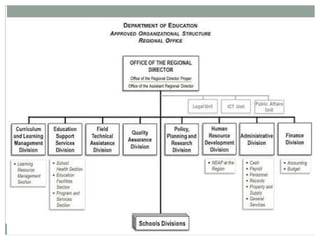
REGIONAL OFFICE
Regional Office
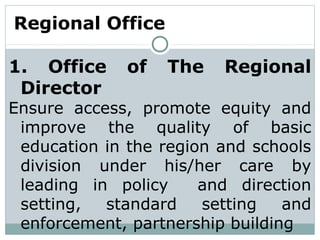
1. Office of The Regional
Director
Ensure access, promote equity and
improve the quality of basic
education in the region and schools
division under his/her care by
leading in policy and direction
setting, standard setting and
enforcement, partnership building
and networking with stakeholders
of education as well as by
effectively and efficiently
managing the financial human
and physical resources of the
region.
Legal Unit
Provide legal advice and render
legal opinions to the Regional
Director
Interpret laws and rules affecting
the operation; prepare contracts
and its provision
ICT Unit
Manage the ICT System and
infrastructure to effectively
support operations, ICT-related
plans and programs of the
division/units
Public Affairs Unit
Manage the communication
system, processes and
mechanisms to strengthen
relationship with external
partners, media, organizations,
and inform the public
2. Curriculum & Learning
Management Division
To ensure full implementation of
the articulated basic education
curriculum (pre-school,
elementary, secondary & ALS),
its localization/indigenization
and increase access to quality
and varied learning resources
towards improvement in the
quality learning outcomes.
3. Education Support Services
To support the delivery of basic
education programs, projects and
needed resources to the School
Divisions in order to create an
environment conducive to learning
and ensure learner readiness to
learn through:
• School Health and Nutrition
• Education Facilities
• Program & Services (DRRM, School
Sports, Guidance & Counselling)
4. Field Technical Assistance
(FTA)
To coordinate and integrate the
provision of technical assistance
(TA) to schools division with the
purpose of facilitating the
delivery of quality basic
education and create an
enabling environment for
schools and learning centers.
5. Quality Assurance
To ensure compliance with
standards of quality basic
education by assessing,
monitoring and evaluating the
region and schools division
performances to inform decision
making and guide policy
directions in the region toward
continuous improvement
6. Policy, Planning &
Research
To facilitate the implementation
of education plans, policies and
standards in all areas of basic
education in the region through
the conduct of research studies
and maintenance of Regional
Education Planning and Data
Management Systems
7. Human Resource
Development
To ensure competent personnel
and staff in the regional and
schools division offices through
efficient and effective training
towards professional
competencies and
organizational performance
National Educators Academy of
the Philippines At The Region
8. Administrative Services
To provide the regional office
with efficient, economical and
effective services relating to
personnel, records, receipt of
correspondence, supplies,
equipment, collection,
disbursement, security and
custody of property, and
reportorial work to oversight
agencies.
9. Finance
To provide advice to the Regional
Director on the financial
resource of the region and
provide services in budgeting,
accounting, reporting and
coordinating with government
oversight agencies.
ITS STRUCTURES AND
FUNCTIONS
SCHOOLS DIVISION
OFFICE
Schools Division Office
1. Office of The Schools
Division Superintendent
(SDS)
Ensure access, promote equity and
improve the quality of basic
education in schools division under
his/her care by leading in the
development and implementation
of the division’s education
development plans (DEDP),
building partnerships and
networking with stakeholders
of education as well as by
effectively and efficiently
managing the financial,
human, and physical
resources of the schools
division
Legal Services
Provide legal advice and render
legal opinions to the SDS,
ASDS, officials of the schools
division
Interpret laws and rules affecting
the operation; handles legal
and investigation matters
concerning schools division
ICT Services
Manage the ICT System and
infrastructure of the schools
division
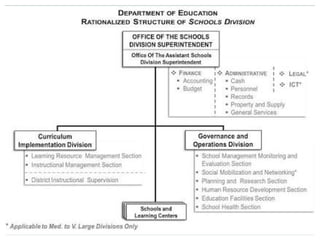
Administrative Services
Composed of Cash, Personnel,
Records, Asset Management,
and General Services
To provide management with
efficient, economical and
effective services
administrative services on
personnel, properties, cash,
facilities
Finance Services
To provide SDO management
with economical, efficient, and
effective accounting and
budgeting services to ensure
the cost-effective utilization of
financial resources of the
schools division
2. Curriculum Implementation
To ensure full implementation of
the articulated basic education
curriculum (pre-school,
elementary, secondary & ALS),
its localization/indigenization
and innovations in teaching
towards improvement in the
quality learning outcomes.
To improve the provision and
availability of quality learning
and teaching resource materials
for students and instructional
support materials for teachers
in the division
To provide technical assistance to
schools in the area of:
 curriculum implementation
 Instructional supervision
 Resource generation & social
mobilization
 SIP Implementation
To improve access to
basic/functional literacy skills
and raise the level of literacy in
the deprived, disadvantaged
and underserved areas.
Instructional Management
Learning Resource Management
District Instructional Supervision
3. School Governance and
Operations Division
3.1 Office of the Division
Chief
3.2 School Management
Monitoring & Evaluation
Quality Management System
Implementation
Assessment
Technical Assisstance
3.3 Social Mobilization &
Networking
To ensure provision of resources
needed by the schools division
office, schools, and learning
centers and compliance to
standards towards good
governance & effective
operations.
3.4 School Health & Nutrition
To serve the Division and School
Populace thru implementation
of health programs of basic
health, nutrition services and
establishment of a healthful
school environment
To develop a healthy lifestyle
habits and practices among
teachers and non teaching
personnel
3.5 Educational Facilities
To provide services to ensure
structurally and physically safe
buildings, grounds and facilities
for the Division Office, schools,
learning centres to maintain a
conducive physical
environment.
3.6 Human Resource
Development
To implement efficient and
effective Human Resource
Development Systems to ensure
availability of competent
education leaders, teaching and
non teaching personnel for the
schools, learning centers and
schools division at all times
3.7 Planning And Research
To facilitate the formulation &
implementation of education
plans, standards, policies and
guidelines in all areas of basic
education in the division
To develop and maintain Division
Education Planning and Data
Management Systems and
conduct research studies to
provide critical inputs as bases
for management’s strategic and
operational decisions.
Thank You !
Prepared by
Yhelmar Delos Reyes Bait