We will begin shortly…
Welcome
1
Using Zoom
 Turn your webcam on!
 Please remember to
mute yourself during the
presentations.
 Please send in your
attendance via the CHAT
box
Organizational Overview
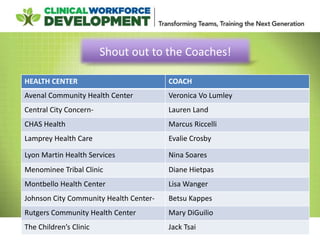
Shout out to the Coaches!
HEALTH CENTER COACH
Avenal Community Health Center Veronica Vo Lumley
Central City Concern- Lauren Land
CHAS Health Marcus Riccelli
Lamprey Health Care Evalie Crosby
Lyon Martin Health Services Nina Soares
Menominee Tribal Clinic Diane Hietpas
Montbello Health Center Lisa Wanger
Johnson City Community Health Center- Betsu Kappes
Rutgers Community Health Center Mary DiGuilio
The Children’s Clinic Jack Tsai
AGENDA- Learning Collaborative Session 3
November 9 3:00-4:30pm (EST)
 Welcome- Review Agenda and Assignments
 Program Curriculum
 Curriculum Development
 Schedules and Resources
 Marketing, Recruitment, Applications
 Western North Carolina Community Health Services
 QI Theory Burst- Process Mapping
 Action Period Items (Assignments)
Ask Questions!
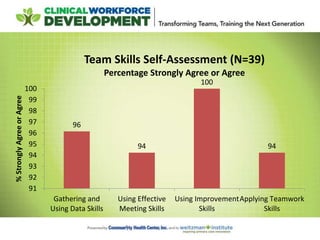
96
94
100
94
91
92
93
94
95
96
97
98
99
100
Gathering and
Using Data Skills
Using Effective
Meeting Skills
Using Improvement
Skills
Applying Teamwork
Skills
%StronglyAgreeorAgree
Team Skills Self-Assessment (N=39)
Percentage Strongly Agree or Agree
90
90
90
90
90
80
80
80
80
70
70
60
0 20 40 60 80 100
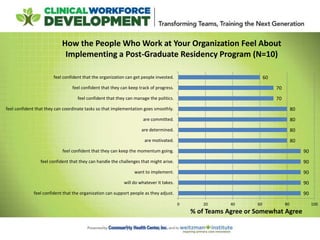
feel confident that the organization can support people as they adjust.
will do whatever it takes.
want to implement.
feel confident that they can handle the challenges that might arise.
feel confident that they can keep the momentum going.
are motivated.
are determined.
are committed.
feel confident that they can coordinate tasks so that implementation goes smoothly.
feel confident that they can manage the politics.
feel confident that they can keep track of progress.
feel confident that the organization can get people invested.
% of Teams Agree or Somewhat Agree
How the People Who Work at Your Organization Feel About
Implementing a Post-Graduate Residency Program (N=10)
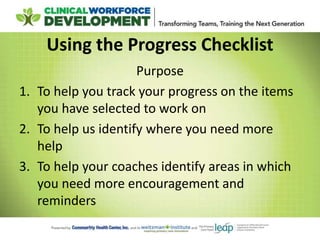
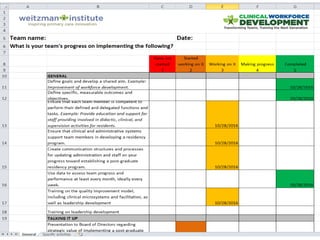
Using the Progress Checklist
Purpose
1. To help you track your progress on the items
you have selected to work on
2. To help us identify where you need more
help
3. To help your coaches identify areas in which
you need more encouragement and
reminders
What to do….
• Can be completed during a team meeting or
the coach can complete it separately based on
conversations with team members
• Just check the box or color it in
• Display it as you work
• You will do this again midway through and at
the very end of the Learning Collaborative
• Complete both tabs
Curriculum Development
Part 2
Elements of your curriculum
11
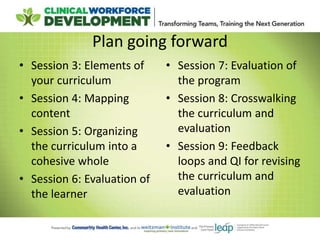
Plan going forward
• Session 3: Elements of
your curriculum
• Session 4: Mapping
content
• Session 5: Organizing
the curriculum into a
cohesive whole
• Session 6: Evaluation of
the learner
• Session 7: Evaluation of
the program
• Session 8: Crosswalking
the curriculum and
evaluation
• Session 9: Feedback
loops and QI for revising
the curriculum and
evaluation
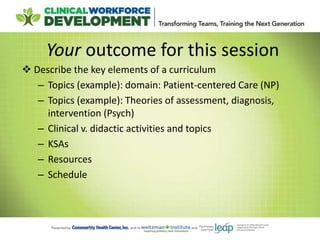
Your outcome for this session
 Describe the key elements of a curriculum
– Topics (example): domain: Patient-centered Care (NP)
– Topics (example): Theories of assessment, diagnosis,
intervention (Psych)
– Clinical v. didactic activities and topics
– KSAs
– Resources
– Schedule
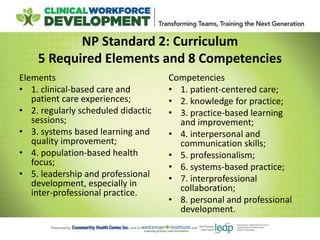
NP Standard 2: Curriculum
5 Required Elements and 8 Competencies
Elements
• 1. clinical-based care and
patient care experiences;
• 2. regularly scheduled didactic
sessions;
• 3. systems based learning and
quality improvement;
• 4. population-based health
focus;
• 5. leadership and professional
development, especially in
inter-professional practice.
Competencies
• 1. patient-centered care;
• 2. knowledge for practice;
• 3. practice-based learning
and improvement;
• 4. interpersonal and
communication skills;
• 5. professionalism;
• 6. systems-based practice;
• 7. interprofessional
collaboration;
• 8. personal and professional
development.
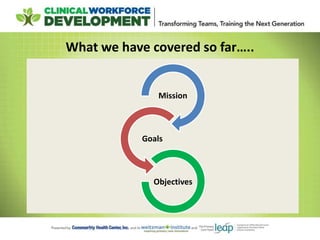
What we have covered so far…..
Mission
Goals
Objectives
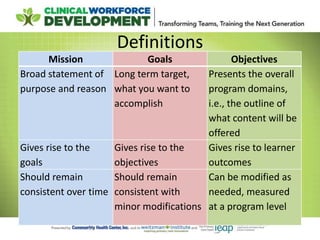
Mission Goals Objectives
Broad statement of
purpose and reason
Long term target,
what you want to
accomplish
Presents the overall
program domains,
i.e., the outline of
what content will be
offered
Gives rise to the
goals
Gives rise to the
objectives
Gives rise to learner
outcomes
Should remain
consistent over time
Should remain
consistent with
minor modifications
Can be modified as
needed, measured
at a program level
Definitions
Curriculum Objectives vs.
Learner Outcomes
• Curriculum objectives are general and measured at a program
level. They present the overall outline of what the program
will offer. The objectives introduce the curricular domains, of
the program, eg: Patient-Centered Care, Professionalism,
Clinical Practice
• Learner outcomes are a measurable benchmark, the intended
results within each curricular domain. They demonstrate
what the learner will actually do, and often use Bloom’s
taxonomy of action verbs. How you measure their
achievement of outcomes is your evidence that your residents
are learning and doing what you said they would learn and
do. These are sub-domains in the guidelines.
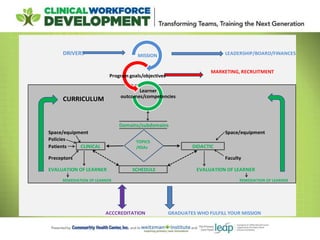
DRIVERS LEADERSHIP/BOARD/FINANCES
MARKETING, RECRUITMENT
CURRICULUM
Domains/subdomains
Space/equipment Space/equipment
Policies
Patients DIDACTIC
Preceptors Faculty
EVALUATION OF LEARNER SCHEDULE EVALUATION OF LEARNER
REMEDIATION OF LEARNER REMEDIATION OF LEARNER
ACCCREDITATION GRADUATES WHO FULFILL YOUR MISSION
CLINICAL
TOPICS
/KSAs
MISSION
Program goals/objectives
Learner
outcomes/competencies
Some definitions
• Curriculum: All activities—didactic, clinical, learner evaluation—
that provide the structure, content, and processes to ensure
that your residents achieve learner outcomes and fulfill your
mission
• Domains/subdomains (competencies): from your accreditation
standards; these help to identify topics in clinical practice that
will be incorporated into didactic and clinical activities, e.g.,
Patient-Centered Care: “treatment of health problems”
• Topics: What do your residents need to know? What do they
need to know how to do? What values do they need to
embrace and demonstrate?
– KSA: Knowledge, Skills, Attitude
Definitions cont.
• Clinical: Any activity that involves direct
patient care by the resident
– Providing care in clinic with and without a
preceptor (NP)
– Treatment sessions with patients/Supervision with
senior psychologist (Psych)
– Documentation of care
– Ordering tests, referrals, etc.
– Consultation with care team/peer about a patient
Definitions cont.
• Didactic: Any activity outside of direct care in
which preceptors and “faculty” formally
engage in teaching, training, or informing
residents about topics in clinical practice,
policies and procedures in your setting; can
include orientation
• Evaluation of the Learner: a formal process in
which learners evaluate their own learning and
practice, and faculty/preceptors evaluate the
residents; this can include reflective journaling
Definitions cont.
• Schedule: A planned outline of the timing and
topics of didactic, clinical and evaluation activities
over the course of the residency
– Use hours, not “days” or “sessions” to quantify time
spent on learner activities
– A full-time job (40hrs/wk/50 wks) is 2000 hours
– Accreditation standards do not set a minimum or
maximum amount of time
– For NP programs, 1500-1600 structured hours is
typical
– For PhD programs, minimum 1500 hours
Resources
• Space/equipment: office, exam room, computers,
etc.
• Patients: do you have enough of the type you
need?
• Faculty: anyone involved in didactic activities
• Preceptor/supervisor: professional peer
responsible for oversight of resident’s practice
• Financial resources
• Policies: any policies/procedures that may need
to be revised to accommodate resident practice
Questions to ask yourself:
1. How/why did you decide on “primary care clinic?”
2. What happens in primary care clinic?
3. What does your resident need to know to care for
these patients?
4. What does your resident need to know how to do
to care for these patients?
5. What values, attitudes, behaviors do you want your
resident to demonstrate?
Knowledge (know), Skills (do), Attitude
(behave)
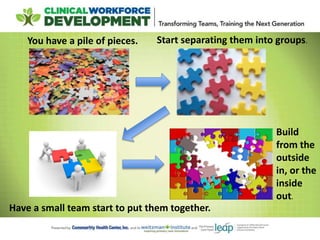
You have a pile of pieces. Start separating them into groups.
Have a small team start to put them together.
Build
from the
outside
in, or the
inside
out.
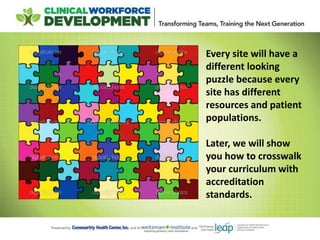
Every site will have a
different looking
puzzle because every
site has different
resources and patient
populations.
Later, we will show
you how to crosswalk
your curriculum with
accreditation
standards.
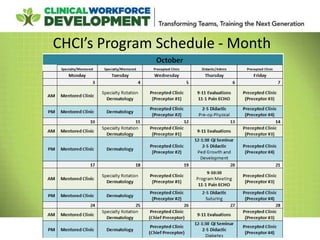
CHCI’s Program Schedule - Month
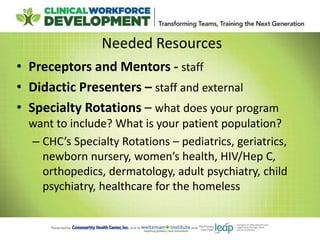
Needed Resources
• Preceptors and Mentors - staff
• Didactic Presenters – staff and external
• Specialty Rotations – what does your program
want to include? What is your patient population?
– CHC’s Specialty Rotations – pediatrics, geriatrics,
newborn nursery, women’s health, HIV/Hep C,
orthopedics, dermatology, adult psychiatry, child
psychiatry, healthcare for the homeless
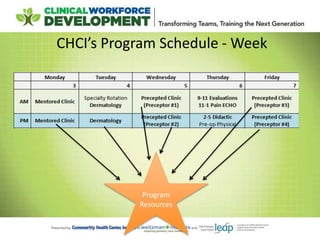
CHCI’s Program Schedule - Week
Program
Resources
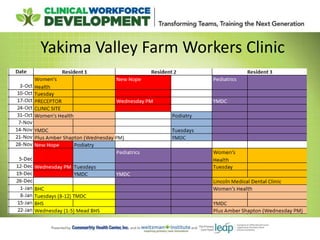
Yakima Valley Farm Workers Clinic
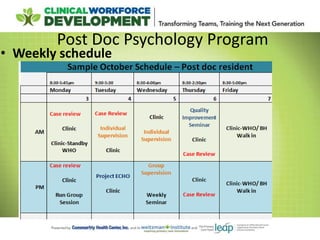
Post Doc Psychology Program
• Weekly schedule
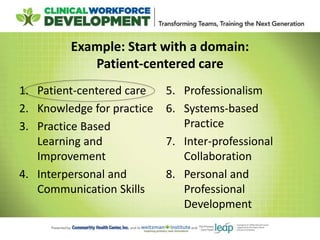
Example: Start with a domain:
Patient-centered care
1. Patient-centered care
2. Knowledge for practice
3. Practice Based
Learning and
Improvement
4. Interpersonal and
Communication Skills
5. Professionalism
6. Systems-based
Practice
7. Inter-professional
Collaboration
8. Personal and
Professional
Development
Competency/Domain: Patient Care
• Patient Care: Provide patient-centered care that is
compassionate, valued, appropriate and effective for the
treatment of health problems and the promotion of health.
• What health problems are most prominent in YOUR
population of patients?
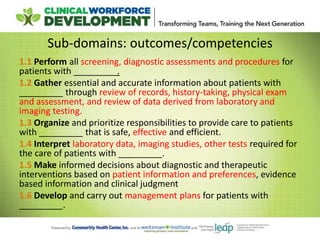
Sub-domains: outcomes/competencies
1.1 Perform all screening, diagnostic assessments and procedures for
patients with _________.
1.2 Gather essential and accurate information about patients with
_________ through review of records, history-taking, physical exam
and assessment, and review of data derived from laboratory and
imaging testing.
1.3 Organize and prioritize responsibilities to provide care to patients
with _________ that is safe, effective and efficient.
1.4 Interpret laboratory data, imaging studies, other tests required for
the care of patients with _________.
1.5 Make informed decisions about diagnostic and therapeutic
interventions based on patient information and preferences, evidence
based information and clinical judgment
1.6 Develop and carry out management plans for patients with
_________.
Care of the patient with _______
• Learner outcome: Provide appropriate and effective care for
adult patients with _______ that is compassionate and
consistent with patient preferences.
• Topics in subdomain: diagnostics, procedures, clinical
decision-making, history and physical, management of
treatment plan
• What is didactic, what is clinical? Other?
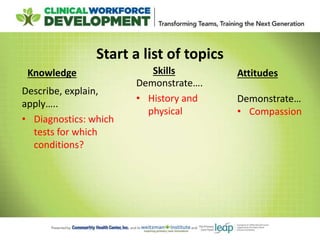
Start a list of topics
Knowledge
Describe, explain,
apply…..
• Diagnostics: which
tests for which
conditions?
Skills
Demonstrate….
• History and
physical
Attitudes
Demonstrate…
• Compassion
You should not be re-teaching content/topics
that the residents learned in graduate school.
But you can remind them as you focus on the
application of these topics in your clinical
setting with your unique patient population.
You will notice:
! There is a lot of overlap in topics, e.g., between
diagnostics and procedures
! There is a lot of overlap as you decide which
topics to put under which domain, e.g., Patient
care and Knowledge for practice
! You can use some of the same language again
and again-- Patient Care, e.g., change “patients
with _____” to “patients with HTN,” or “patients
with complex needs”
!This is how you start to organize your
curriculum!
Takeaways….
 Start with whatever piece of the curriculum seems easiest to start
with for you:
 Schedule
 List of the subdomains/topics
 What does the resident need to KNOW?
 What does the resident need to KNOW HOW TO DO?
 What behaviors do you want the resident to DEMONSTRATE?
 What belongs in didactic? In clinical? Other?
 There will be overlap—don’t worry for now
 JUST START
Patient
centered
care
Knowledge
for
practice
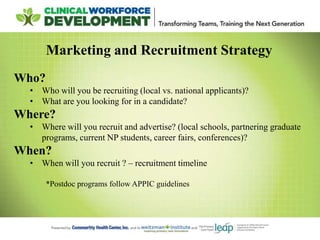
Marketing and Recruitment Strategy
Who?
• Who will you be recruiting (local vs. national applicants)?
• What are you looking for in a candidate?
Where?
• Where will you recruit and advertise? (local schools, partnering graduate
programs, current NP students, career fairs, conferences)?
When?
• When will you recruit ? – recruitment timeline
*Postdoc programs follow APPIC guidelines
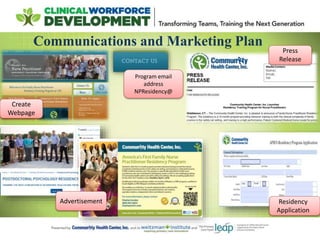
Communications and Marketing Plan
Create
Webpage
Program email
address
NPResidency@
Press
Release
Residency
Application
Advertisement
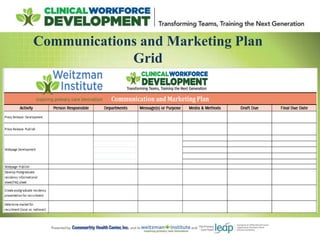
Communications and Marketing Plan
Grid
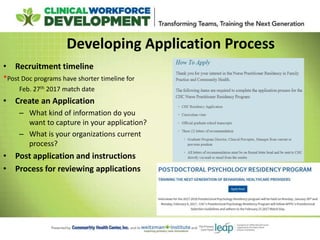
Developing Application Process
• Recruitment timeline
*Post Doc programs have shorter timeline for
Feb. 27th 2017 match date
• Create an Application
– What kind of information do you
want to capture in your application?
– What is your organizations current
process?
• Post application and instructions
• Process for reviewing applications
Interviewing and Selection
• Focus next session:
– Interviewing Process and Timeline
• Set your interview dates
• Who will be involved in your interviews?
• How will you choose who to interview?
– Selection Process and Timeline
• Selection Criteria - What kinds of characteristics are you looking
for in your candidates?
• Who will be involved in selecting your residents?
WNCCHS MARKETING
&
RECRUITMENT
PROCESS
Sara Mertz, A/GNP, Residency Director
Scott Parker, Director of Collaboration and
Development
Brief History
• April 2014 CEO sent staff up to CHC, Inc. to take a look at their
Residency Program;
• Integrated core pillars of CHC, Inc. program and customized it to
our patient population/regional needs as well as our FQHC
structure;
• CEO and Board committed to funding the residency program via
agency budget, not relying on grant/foundation funds;
• Built off our strong social media presence with currently 11,000 FB
followers and over 40,000 hits per year to our agency website to
promote the residency;
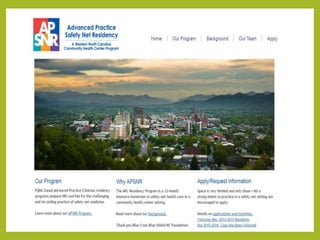
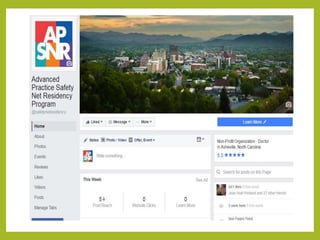
• Created our own APSNR website and FB page and began
promoting to regional/state NP/PA schools
Marketing
• 2015 BCBS Foundation $27,000 to brand, promote, market
program; as well as develop “white paper” on how to
replicate a residency program in FQHC setting in NC;
included professional video’s for marketing and imbedding in
online PDF for email campaigns;
• Target social media ads to regional PA/NP schools e.g. Duke,
UNC, Wake Forest, ETSU,WCU, etc.
• Contact staff at programs at each school via email bi-
annually to remind them of program
• Attend many of the schools’ job fairs
Recruiting
• New graduates from NP or PA schools
• NPs and PAs who wish to transition to practice in safety net
primary care from other specialties
• Start application process in early Spring
• End application process usually before most have completed
their education;
• Interview ALL applicants (web-based or in person);
• Select residents for start in September to overlap training
with current residency “class”
• Offer good benefits package and salary
Recruiting Road Bumps
• On-call requirement
• Due to regulations as an FQHC, ALL of our residents must be
fully credentialed before stepping in our building to start the
residency (this may take month(s)
• PA schools in our region usually don’t graduate until August
or December so we have had reduced numbers of PA
applicants
• We did not overlap residency classes between the first and
second years and had a month long “gap” in care so had to
hire locums tenens for that gap ($$$$$) and providers had to
orient the locums tenens creating significant additional
workload
Questions?
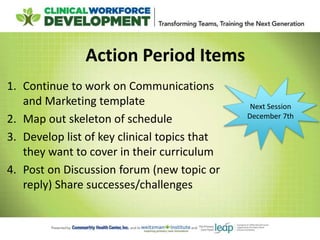
Action Period Items
1. Continue to work on Communications
and Marketing template
2. Map out skeleton of schedule
3. Develop list of key clinical topics that
they want to cover in their curriculum
4. Post on Discussion forum (new topic or
reply) Share successes/challenges
Next Session
December 7th

NCA Residency Session 3 Nov 9 2016

  • 1.
    We will beginshortly… Welcome 1
  • 2.
    Using Zoom  Turnyour webcam on!  Please remember to mute yourself during the presentations.  Please send in your attendance via the CHAT box
  • 3.
  • 4.
    Shout out tothe Coaches! HEALTH CENTER COACH Avenal Community Health Center Veronica Vo Lumley Central City Concern- Lauren Land CHAS Health Marcus Riccelli Lamprey Health Care Evalie Crosby Lyon Martin Health Services Nina Soares Menominee Tribal Clinic Diane Hietpas Montbello Health Center Lisa Wanger Johnson City Community Health Center- Betsu Kappes Rutgers Community Health Center Mary DiGuilio The Children’s Clinic Jack Tsai
  • 5.
    AGENDA- Learning CollaborativeSession 3 November 9 3:00-4:30pm (EST)  Welcome- Review Agenda and Assignments  Program Curriculum  Curriculum Development  Schedules and Resources  Marketing, Recruitment, Applications  Western North Carolina Community Health Services  QI Theory Burst- Process Mapping  Action Period Items (Assignments) Ask Questions!
  • 6.
    96 94 100 94 91 92 93 94 95 96 97 98 99 100 Gathering and Using DataSkills Using Effective Meeting Skills Using Improvement Skills Applying Teamwork Skills %StronglyAgreeorAgree Team Skills Self-Assessment (N=39) Percentage Strongly Agree or Agree
  • 7.
    90 90 90 90 90 80 80 80 80 70 70 60 0 20 4060 80 100 feel confident that the organization can support people as they adjust. will do whatever it takes. want to implement. feel confident that they can handle the challenges that might arise. feel confident that they can keep the momentum going. are motivated. are determined. are committed. feel confident that they can coordinate tasks so that implementation goes smoothly. feel confident that they can manage the politics. feel confident that they can keep track of progress. feel confident that the organization can get people invested. % of Teams Agree or Somewhat Agree How the People Who Work at Your Organization Feel About Implementing a Post-Graduate Residency Program (N=10)
  • 8.
    Using the ProgressChecklist Purpose 1. To help you track your progress on the items you have selected to work on 2. To help us identify where you need more help 3. To help your coaches identify areas in which you need more encouragement and reminders
  • 10.
    What to do…. •Can be completed during a team meeting or the coach can complete it separately based on conversations with team members • Just check the box or color it in • Display it as you work • You will do this again midway through and at the very end of the Learning Collaborative • Complete both tabs
  • 11.
  • 12.
    Plan going forward •Session 3: Elements of your curriculum • Session 4: Mapping content • Session 5: Organizing the curriculum into a cohesive whole • Session 6: Evaluation of the learner • Session 7: Evaluation of the program • Session 8: Crosswalking the curriculum and evaluation • Session 9: Feedback loops and QI for revising the curriculum and evaluation
  • 13.
    Your outcome forthis session  Describe the key elements of a curriculum – Topics (example): domain: Patient-centered Care (NP) – Topics (example): Theories of assessment, diagnosis, intervention (Psych) – Clinical v. didactic activities and topics – KSAs – Resources – Schedule
  • 14.
    NP Standard 2:Curriculum 5 Required Elements and 8 Competencies Elements • 1. clinical-based care and patient care experiences; • 2. regularly scheduled didactic sessions; • 3. systems based learning and quality improvement; • 4. population-based health focus; • 5. leadership and professional development, especially in inter-professional practice. Competencies • 1. patient-centered care; • 2. knowledge for practice; • 3. practice-based learning and improvement; • 4. interpersonal and communication skills; • 5. professionalism; • 6. systems-based practice; • 7. interprofessional collaboration; • 8. personal and professional development.
  • 16.
    What we havecovered so far….. Mission Goals Objectives
  • 17.
    Mission Goals Objectives Broadstatement of purpose and reason Long term target, what you want to accomplish Presents the overall program domains, i.e., the outline of what content will be offered Gives rise to the goals Gives rise to the objectives Gives rise to learner outcomes Should remain consistent over time Should remain consistent with minor modifications Can be modified as needed, measured at a program level Definitions
  • 18.
    Curriculum Objectives vs. LearnerOutcomes • Curriculum objectives are general and measured at a program level. They present the overall outline of what the program will offer. The objectives introduce the curricular domains, of the program, eg: Patient-Centered Care, Professionalism, Clinical Practice • Learner outcomes are a measurable benchmark, the intended results within each curricular domain. They demonstrate what the learner will actually do, and often use Bloom’s taxonomy of action verbs. How you measure their achievement of outcomes is your evidence that your residents are learning and doing what you said they would learn and do. These are sub-domains in the guidelines.
  • 19.
    DRIVERS LEADERSHIP/BOARD/FINANCES MARKETING, RECRUITMENT CURRICULUM Domains/subdomains Space/equipmentSpace/equipment Policies Patients DIDACTIC Preceptors Faculty EVALUATION OF LEARNER SCHEDULE EVALUATION OF LEARNER REMEDIATION OF LEARNER REMEDIATION OF LEARNER ACCCREDITATION GRADUATES WHO FULFILL YOUR MISSION CLINICAL TOPICS /KSAs MISSION Program goals/objectives Learner outcomes/competencies
  • 20.
    Some definitions • Curriculum:All activities—didactic, clinical, learner evaluation— that provide the structure, content, and processes to ensure that your residents achieve learner outcomes and fulfill your mission • Domains/subdomains (competencies): from your accreditation standards; these help to identify topics in clinical practice that will be incorporated into didactic and clinical activities, e.g., Patient-Centered Care: “treatment of health problems” • Topics: What do your residents need to know? What do they need to know how to do? What values do they need to embrace and demonstrate? – KSA: Knowledge, Skills, Attitude
  • 21.
    Definitions cont. • Clinical:Any activity that involves direct patient care by the resident – Providing care in clinic with and without a preceptor (NP) – Treatment sessions with patients/Supervision with senior psychologist (Psych) – Documentation of care – Ordering tests, referrals, etc. – Consultation with care team/peer about a patient
  • 22.
    Definitions cont. • Didactic:Any activity outside of direct care in which preceptors and “faculty” formally engage in teaching, training, or informing residents about topics in clinical practice, policies and procedures in your setting; can include orientation • Evaluation of the Learner: a formal process in which learners evaluate their own learning and practice, and faculty/preceptors evaluate the residents; this can include reflective journaling
  • 23.
    Definitions cont. • Schedule:A planned outline of the timing and topics of didactic, clinical and evaluation activities over the course of the residency – Use hours, not “days” or “sessions” to quantify time spent on learner activities – A full-time job (40hrs/wk/50 wks) is 2000 hours – Accreditation standards do not set a minimum or maximum amount of time – For NP programs, 1500-1600 structured hours is typical – For PhD programs, minimum 1500 hours
  • 24.
    Resources • Space/equipment: office,exam room, computers, etc. • Patients: do you have enough of the type you need? • Faculty: anyone involved in didactic activities • Preceptor/supervisor: professional peer responsible for oversight of resident’s practice • Financial resources • Policies: any policies/procedures that may need to be revised to accommodate resident practice
  • 25.
    Questions to askyourself: 1. How/why did you decide on “primary care clinic?” 2. What happens in primary care clinic? 3. What does your resident need to know to care for these patients? 4. What does your resident need to know how to do to care for these patients? 5. What values, attitudes, behaviors do you want your resident to demonstrate? Knowledge (know), Skills (do), Attitude (behave)
  • 26.
    You have apile of pieces. Start separating them into groups. Have a small team start to put them together. Build from the outside in, or the inside out.
  • 27.
    Every site willhave a different looking puzzle because every site has different resources and patient populations. Later, we will show you how to crosswalk your curriculum with accreditation standards.
  • 28.
  • 29.
    Needed Resources • Preceptorsand Mentors - staff • Didactic Presenters – staff and external • Specialty Rotations – what does your program want to include? What is your patient population? – CHC’s Specialty Rotations – pediatrics, geriatrics, newborn nursery, women’s health, HIV/Hep C, orthopedics, dermatology, adult psychiatry, child psychiatry, healthcare for the homeless
  • 30.
    CHCI’s Program Schedule- Week Program Resources
  • 31.
    Yakima Valley FarmWorkers Clinic
  • 32.
    Post Doc PsychologyProgram • Weekly schedule
  • 33.
    Example: Start witha domain: Patient-centered care 1. Patient-centered care 2. Knowledge for practice 3. Practice Based Learning and Improvement 4. Interpersonal and Communication Skills 5. Professionalism 6. Systems-based Practice 7. Inter-professional Collaboration 8. Personal and Professional Development
  • 34.
    Competency/Domain: Patient Care •Patient Care: Provide patient-centered care that is compassionate, valued, appropriate and effective for the treatment of health problems and the promotion of health. • What health problems are most prominent in YOUR population of patients?
  • 35.
    Sub-domains: outcomes/competencies 1.1 Performall screening, diagnostic assessments and procedures for patients with _________. 1.2 Gather essential and accurate information about patients with _________ through review of records, history-taking, physical exam and assessment, and review of data derived from laboratory and imaging testing. 1.3 Organize and prioritize responsibilities to provide care to patients with _________ that is safe, effective and efficient. 1.4 Interpret laboratory data, imaging studies, other tests required for the care of patients with _________. 1.5 Make informed decisions about diagnostic and therapeutic interventions based on patient information and preferences, evidence based information and clinical judgment 1.6 Develop and carry out management plans for patients with _________.
  • 36.
    Care of thepatient with _______ • Learner outcome: Provide appropriate and effective care for adult patients with _______ that is compassionate and consistent with patient preferences. • Topics in subdomain: diagnostics, procedures, clinical decision-making, history and physical, management of treatment plan • What is didactic, what is clinical? Other?
  • 37.
    Start a listof topics Knowledge Describe, explain, apply….. • Diagnostics: which tests for which conditions? Skills Demonstrate…. • History and physical Attitudes Demonstrate… • Compassion
  • 38.
    You should notbe re-teaching content/topics that the residents learned in graduate school. But you can remind them as you focus on the application of these topics in your clinical setting with your unique patient population.
  • 39.
    You will notice: !There is a lot of overlap in topics, e.g., between diagnostics and procedures ! There is a lot of overlap as you decide which topics to put under which domain, e.g., Patient care and Knowledge for practice ! You can use some of the same language again and again-- Patient Care, e.g., change “patients with _____” to “patients with HTN,” or “patients with complex needs” !This is how you start to organize your curriculum!
  • 40.
    Takeaways….  Start withwhatever piece of the curriculum seems easiest to start with for you:  Schedule  List of the subdomains/topics  What does the resident need to KNOW?  What does the resident need to KNOW HOW TO DO?  What behaviors do you want the resident to DEMONSTRATE?  What belongs in didactic? In clinical? Other?  There will be overlap—don’t worry for now  JUST START Patient centered care Knowledge for practice
  • 41.
    Marketing and RecruitmentStrategy Who? • Who will you be recruiting (local vs. national applicants)? • What are you looking for in a candidate? Where? • Where will you recruit and advertise? (local schools, partnering graduate programs, current NP students, career fairs, conferences)? When? • When will you recruit ? – recruitment timeline *Postdoc programs follow APPIC guidelines
  • 42.
    Communications and MarketingPlan Create Webpage Program email address NPResidency@ Press Release Residency Application Advertisement
  • 43.
  • 44.
    Developing Application Process •Recruitment timeline *Post Doc programs have shorter timeline for Feb. 27th 2017 match date • Create an Application – What kind of information do you want to capture in your application? – What is your organizations current process? • Post application and instructions • Process for reviewing applications
  • 45.
    Interviewing and Selection •Focus next session: – Interviewing Process and Timeline • Set your interview dates • Who will be involved in your interviews? • How will you choose who to interview? – Selection Process and Timeline • Selection Criteria - What kinds of characteristics are you looking for in your candidates? • Who will be involved in selecting your residents?
  • 46.
    WNCCHS MARKETING & RECRUITMENT PROCESS Sara Mertz,A/GNP, Residency Director Scott Parker, Director of Collaboration and Development
  • 47.
    Brief History • April2014 CEO sent staff up to CHC, Inc. to take a look at their Residency Program; • Integrated core pillars of CHC, Inc. program and customized it to our patient population/regional needs as well as our FQHC structure; • CEO and Board committed to funding the residency program via agency budget, not relying on grant/foundation funds; • Built off our strong social media presence with currently 11,000 FB followers and over 40,000 hits per year to our agency website to promote the residency; • Created our own APSNR website and FB page and began promoting to regional/state NP/PA schools
  • 50.
    Marketing • 2015 BCBSFoundation $27,000 to brand, promote, market program; as well as develop “white paper” on how to replicate a residency program in FQHC setting in NC; included professional video’s for marketing and imbedding in online PDF for email campaigns; • Target social media ads to regional PA/NP schools e.g. Duke, UNC, Wake Forest, ETSU,WCU, etc. • Contact staff at programs at each school via email bi- annually to remind them of program • Attend many of the schools’ job fairs
  • 51.
    Recruiting • New graduatesfrom NP or PA schools • NPs and PAs who wish to transition to practice in safety net primary care from other specialties • Start application process in early Spring • End application process usually before most have completed their education; • Interview ALL applicants (web-based or in person); • Select residents for start in September to overlap training with current residency “class” • Offer good benefits package and salary
  • 52.
    Recruiting Road Bumps •On-call requirement • Due to regulations as an FQHC, ALL of our residents must be fully credentialed before stepping in our building to start the residency (this may take month(s) • PA schools in our region usually don’t graduate until August or December so we have had reduced numbers of PA applicants • We did not overlap residency classes between the first and second years and had a month long “gap” in care so had to hire locums tenens for that gap ($$$$$) and providers had to orient the locums tenens creating significant additional workload
  • 54.
  • 55.
    Action Period Items 1.Continue to work on Communications and Marketing template 2. Map out skeleton of schedule 3. Develop list of key clinical topics that they want to cover in their curriculum 4. Post on Discussion forum (new topic or reply) Share successes/challenges Next Session December 7th

Editor's Notes

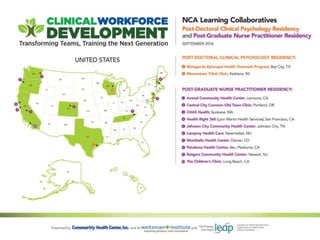
  • #4 We have 12 health centers participating from 9 states. 2 of these health centers are participating with the intention of starting a residency for Post-Doc Clinical Psychologists while the other 10 will be implementing a residency program for Nurse Practitioners. We are thrilled to have such a diverse, and widely spread group of health centers from around the country.
  • #15 Candice
  • #16 Candice
  • #17 Everything from your program mission to your evaluation methods should align: use the same concepts throughout What do you want to accomplish: goals, objectives/domains How will you demonstrate that you accomplished it: learner outcomes/domains and learner evaluation
  • #19 Ask Candice
  • #21 Curriculum and learner evaluation are separated into two different standards in accreditation. For now, try to think of them as a whole.
  • #23 Peers can also be “faculty” Will talk about it more later
  • #24 Always use the smallest unit of measurable time: hours
  • #34 You can group the domains into 3-4 general concepts These become your goals Your objectives come from your goals
  • #35 Introduce KSA---compassion is A
  • #36 Here are your topics.
  • #39 Maybe not re-teach but certainly REMIND