Competency Models
By: Bhanu Arora
SUPERVISORY GENERIC COMPETENCY MODEL -
ENTRY LEVEL
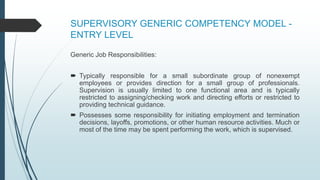
Generic Job Responsibilities:
 Typically responsible for a small subordinate group of nonexempt
employees or provides direction for a small group of professionals.
Supervision is usually limited to one functional area and is typically
restricted to assigning/checking work and directing efforts or restricted to
providing technical guidance.
 Possesses some responsibility for initiating employment and termination
decisions, layoffs, promotions, or other human resource activities. Much or
most of the time may be spent performing the work, which is supervised.
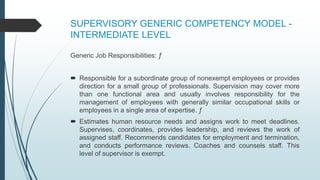
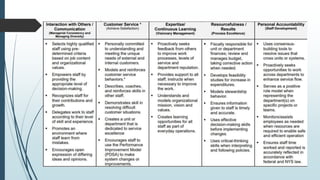
SUPERVISORY GENERIC COMPETENCY MODEL -
INTERMEDIATE LEVEL
Generic Job Responsibilities: ƒ
 Responsible for a subordinate group of nonexempt employees or provides
direction for a small group of professionals. Supervision may cover more
than one functional area and usually involves responsibility for the
management of employees with generally similar occupational skills or
employees in a single area of expertise. ƒ
 Estimates human resource needs and assigns work to meet deadlines.
Supervises, coordinates, provides leadership, and reviews the work of
assigned staff. Recommends candidates for employment and termination,
and conducts performance reviews. Coaches and counsels staff. This
level of supervisor is exempt.
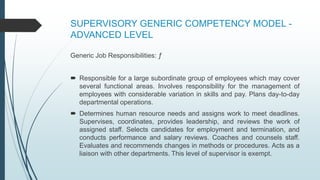
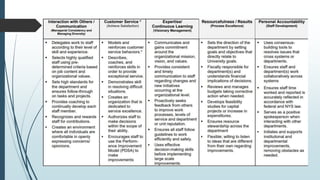
SUPERVISORY GENERIC COMPETENCY MODEL -
ADVANCED LEVEL
Generic Job Responsibilities: ƒ
 Responsible for a large subordinate group of employees which may cover
several functional areas. Involves responsibility for the management of
employees with considerable variation in skills and pay. Plans day-to-day
departmental operations.
 Determines human resource needs and assigns work to meet deadlines.
Supervises, coordinates, provides leadership, and reviews the work of
assigned staff. Selects candidates for employment and termination, and
conducts performance and salary reviews. Coaches and counsels staff.
Evaluates and recommends changes in methods or procedures. Acts as a
liaison with other departments. This level of supervisor is exempt.
Lancaster Model of Competencies
Lancaster model of competencies was developed by Burgoyne & Stuart
(1976).
This model of competencies has eleven competencies under three levels.
LEVEL ONE
 Competence One: Command of basic facts. Basic facts like awareness
and knowledge about work and organization, Key performance areas and
key result areas.
 Competence Two: Relevant professional knowledge. Knowledge about
management and business affairs.
LEVEL TWO
 Competence One: Continuing sensitivity to events. Includes information
updation, an open mind to all the events of business, organization and
people.
 Competence Two: Analytical, problem-solving and decision-making skills.
 Competence Three: Social skills and abilities, like excellent
communication both formal and informal, persuasion, peace- maker,
resolving conflict, leadership, negotiation, motivation etc.
 Competence Four: Emotional resilience, Burgoyne & Stuart explain:
“Resilient means that when feeling stressed, we don’t get thick skinned
and insensitive but manage to cope by maintaining self-control and by
‘giving’ to some extent”.
 Competence Five: Pro activity or inclination to respond purposefully to
events.
LEVEL THREE
 Competence One: Creativity, ability to coming up with innovations and
ideas, and an insight to choose the best one.
 Competence Two: Mental agility, alertness and balanced mindset to
respond quickly and accurately to problems.
 Competence Three: Balanced learning habits and skills.
 Competence Four: Self knowledge.
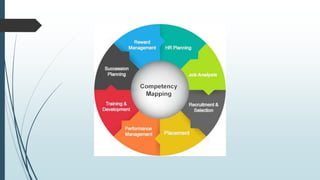
Competency Mapping
 Competency Mapping is a process of identifying key competencies for an
organization and/or a job and incorporating those competencies
throughout the various processes (i.e. job evaluation, training, recruitment)
of the organization.
Steps involved in competency mapping
 Conduct a job analysis by asking incumbents to complete a position
information questionnaire (PIQ). The primary goal is to gather from
incumbents what they feel are the key behaviors necessary to perform
their respective jobs.
 Using the results of the job analysis, you are ready to develop a
competency based job description.
 With a competency based job description, we are on your way to
begin mapping the competencies throughout your HR processes. Using
competencies will help guide you to perform more objective evaluations
based on displayed or not displayed behaviors.
 Taking the competency mapping one step further, you can use the results
of your evaluation to identify in what competencies individuals need
additional development or training.
Competency dictionary
 A competency dictionary is a tool or data structure that includes all or most
of the general competencies needed to cover all job families and
competencies that are core or common to all jobs within
an organization (e.g., teamwork; adaptability; communication). They may
also include competencies that are more closely related to the knowledge
and skills needed for specific jobs or functions (e.g., IT skills, financial
administration skills)
Comprehensive
 A typical comprehensive competency dictionary should include a broad
range of competencies developed through extensive literature search,
review of best practices as well as ongoing refinement based on field
research with various client groups.
 Many Comprehensive Competency Dictionaries are divided into two sets
of competencies:
1. General job competencies – common across many jobs and demonstrate
the key behaviors required for success regardless of position.
2. Job-specific competencies – these are required for success in particular
functions or jobs
Thank You

Competency Models

  • 1.
  • 2.
    SUPERVISORY GENERIC COMPETENCYMODEL - ENTRY LEVEL Generic Job Responsibilities:  Typically responsible for a small subordinate group of nonexempt employees or provides direction for a small group of professionals. Supervision is usually limited to one functional area and is typically restricted to assigning/checking work and directing efforts or restricted to providing technical guidance.  Possesses some responsibility for initiating employment and termination decisions, layoffs, promotions, or other human resource activities. Much or most of the time may be spent performing the work, which is supervised.
  • 4.
    SUPERVISORY GENERIC COMPETENCYMODEL - INTERMEDIATE LEVEL Generic Job Responsibilities: ƒ  Responsible for a subordinate group of nonexempt employees or provides direction for a small group of professionals. Supervision may cover more than one functional area and usually involves responsibility for the management of employees with generally similar occupational skills or employees in a single area of expertise. ƒ  Estimates human resource needs and assigns work to meet deadlines. Supervises, coordinates, provides leadership, and reviews the work of assigned staff. Recommends candidates for employment and termination, and conducts performance reviews. Coaches and counsels staff. This level of supervisor is exempt.
  • 6.
    SUPERVISORY GENERIC COMPETENCYMODEL - ADVANCED LEVEL Generic Job Responsibilities: ƒ  Responsible for a large subordinate group of employees which may cover several functional areas. Involves responsibility for the management of employees with considerable variation in skills and pay. Plans day-to-day departmental operations.  Determines human resource needs and assigns work to meet deadlines. Supervises, coordinates, provides leadership, and reviews the work of assigned staff. Selects candidates for employment and termination, and conducts performance and salary reviews. Coaches and counsels staff. Evaluates and recommends changes in methods or procedures. Acts as a liaison with other departments. This level of supervisor is exempt.
  • 8.
    Lancaster Model ofCompetencies Lancaster model of competencies was developed by Burgoyne & Stuart (1976). This model of competencies has eleven competencies under three levels.
  • 9.
    LEVEL ONE  CompetenceOne: Command of basic facts. Basic facts like awareness and knowledge about work and organization, Key performance areas and key result areas.  Competence Two: Relevant professional knowledge. Knowledge about management and business affairs.
  • 10.
    LEVEL TWO  CompetenceOne: Continuing sensitivity to events. Includes information updation, an open mind to all the events of business, organization and people.  Competence Two: Analytical, problem-solving and decision-making skills.  Competence Three: Social skills and abilities, like excellent communication both formal and informal, persuasion, peace- maker, resolving conflict, leadership, negotiation, motivation etc.  Competence Four: Emotional resilience, Burgoyne & Stuart explain: “Resilient means that when feeling stressed, we don’t get thick skinned and insensitive but manage to cope by maintaining self-control and by ‘giving’ to some extent”.  Competence Five: Pro activity or inclination to respond purposefully to events.
  • 11.
    LEVEL THREE  CompetenceOne: Creativity, ability to coming up with innovations and ideas, and an insight to choose the best one.  Competence Two: Mental agility, alertness and balanced mindset to respond quickly and accurately to problems.  Competence Three: Balanced learning habits and skills.  Competence Four: Self knowledge.
  • 12.
    Competency Mapping  CompetencyMapping is a process of identifying key competencies for an organization and/or a job and incorporating those competencies throughout the various processes (i.e. job evaluation, training, recruitment) of the organization.
  • 13.
    Steps involved incompetency mapping  Conduct a job analysis by asking incumbents to complete a position information questionnaire (PIQ). The primary goal is to gather from incumbents what they feel are the key behaviors necessary to perform their respective jobs.  Using the results of the job analysis, you are ready to develop a competency based job description.  With a competency based job description, we are on your way to begin mapping the competencies throughout your HR processes. Using competencies will help guide you to perform more objective evaluations based on displayed or not displayed behaviors.  Taking the competency mapping one step further, you can use the results of your evaluation to identify in what competencies individuals need additional development or training.
  • 15.
    Competency dictionary  Acompetency dictionary is a tool or data structure that includes all or most of the general competencies needed to cover all job families and competencies that are core or common to all jobs within an organization (e.g., teamwork; adaptability; communication). They may also include competencies that are more closely related to the knowledge and skills needed for specific jobs or functions (e.g., IT skills, financial administration skills)
  • 16.
    Comprehensive  A typicalcomprehensive competency dictionary should include a broad range of competencies developed through extensive literature search, review of best practices as well as ongoing refinement based on field research with various client groups.  Many Comprehensive Competency Dictionaries are divided into two sets of competencies: 1. General job competencies – common across many jobs and demonstrate the key behaviors required for success regardless of position. 2. Job-specific competencies – these are required for success in particular functions or jobs
  • 17.