
HR COMPETENCY FRAMEWORK WORKSHOP Nagpur,India NHRDN Learning Center – March 30 th , 2011 Vijayan  Pankajakshan Faculty-HR( WESchool, Mumbai) & Principal Consultant-HCM(ELS ,P une) NHRDN
Acknowledgement-Content NHRDN Archives(NHRDN –National Secretariat) HDFC Bank Maruti - Suzuki NHRDN
Pre Reading/Setting Expectations Understanding Competencies Why Competencies Developing a Competency Model HR Compass- Model for HRD competencies Linking Competency Model to HR Systems Assessment and Tools Examples Contents
NHRDN Understanding What is A Competency
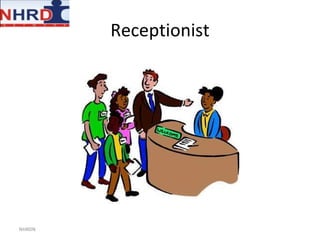
Receptionist NHRDN
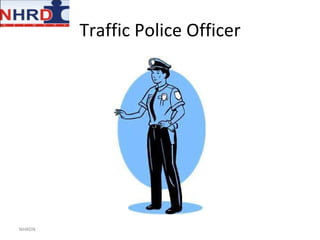
Traffic Police Officer NHRDN
Receptionist Example  Top Performer NHRDN
Traffic Police Officer example Top Performer NHRDN
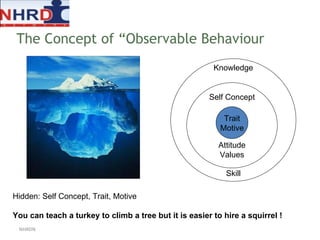
Hidden: Self Concept, Trait, Motive You can teach a turkey to climb a tree but it is easier to hire a squirrel ! Trait Motive Self Concept Attitude Values Knowledge Skill The Concept of “Observable Behaviour NHRDN
NHRDN
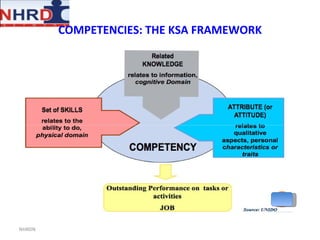
A FEW DEFINITIONS  Competency is  an  underlying characteristic of an employee (i.e., a motive, trait, skill, aspects of one’s self-image, social role, or a body of knowledge) which results in effective and/or superior performance . (Prof. Boyatzis, 1982) a  set of skills, related knowledge and attributes that allow an individual to successfully perform a task or an activity within a specific function or job . (UNIDO, 2002) Competencies are  coachable, observable, measurable, and critical to successful individual or corporation performance . NHRDN
Causally related to criterion referenced superior performance  in a job  Causally related means that a  competency causes or predicts behavior and performance Deep and enduring part of a person’s personality and  can predict behavior in a wide variety of situations and job tasks  Actually  predicts who does something well or poorly as measured on a specific criterion or standard  (e.g.: volume of sales for a sales person) Definitions………….Important concepts NHRDN
Motive:  Drive, Direct & Select towards certain action or goals   ((Achievement motivated people will consistently set challenging goals, take personal responsibility, use feedback to do better)) Traits : consistent responses to situations or information ((People will act above and beyond call of duty to solve problems under stress)) Self Concept : A person’s attitudes, values and self image  (( People who do not like to influence others motives struggle as leaders)) Knowledge  : specific content areas.  Which facts exist that are relevant to a specific problem and where to find them Skill:  ability to perform a certain activity.  Mental or cognitive skills to handle complexity Definitions………….Important concepts NHRDN
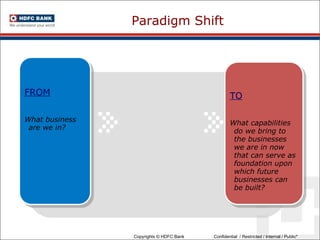
TO What capabilities do we bring to the businesses we are in now that can serve as foundation upon which future businesses can be built? Write your matter here. Paradigm Shift FROM What business are we in?
Criticality of Competencies  Competencies, when correctly identified and used, have proved to be one of the most  powerful tools for an organization to meet its business results, through its most valuable resource – its people Very effective for communicating about performance because they help people frame expectations and goals in clear behavioral terms -  help companies ‘raise the Bar’ of performance expectations Help in establishing  common criteria for hiring, training, measuring, and rewarding people  with the right capabilities to help the company gain competitive advantage
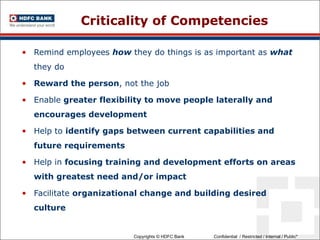
Criticality of Competencies  Remind employees  how  they do things is as important as  what  they do  Reward the person , not the job Enable  greater flexibility to move people laterally and encourages development Help to  identify gaps between current capabilities and future requirements Help in  focusing training and development efforts on areas with greatest need and/or impact Facilitate  organizational change and building desired culture
COMPETENCIES: THE KSA FRAMEWORK NHRDN
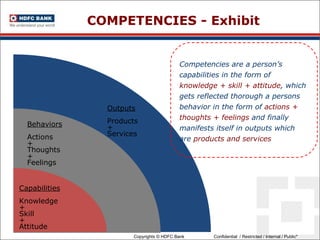
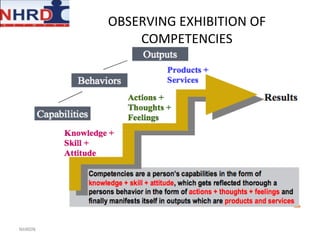
COMPETENCIES - Exhibit Outputs Products  +  Services Behaviors Actions  +  Thoughts  +  Feelings Capabilities Knowledge  +  Skill  +  Attitude Competencies are a person’s capabilities in the form of  knowledge + skill + attitude , which gets reflected thorough a persons behavior in the form of  actions + thoughts + feelings  and finally manifests itself in outputs which are  products and services
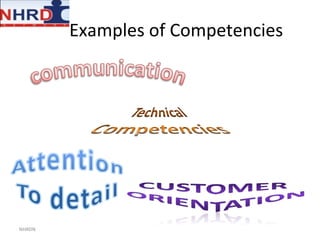
Examples of Competencies NHRDN
CLASSIFYING COMPETENCIES Universal : Reflections of the company’s values, culture, and business imperatives that should be exhibited by all employees  For example, guiding behaviors such as cost effective service delivery, customer focus, teamwork, communication skills, initiative NHRDN
CLASSIFYING COMPETENCIES Transferable: Skills and abilities needed within several roles in varying degrees of importance and mastery  For example, managerial and leadership skills NHRDN
CLASSIFYING COMPETENCIES Unique : Specialized know-how or abilities required within a specific role or job  For example, technical/ functional skills (Marketing Strategy, Drug Discovery) NHRDN
OBSERVING EXHIBITION OF COMPETENCIES NHRDN
NHRDN
NHRDN Developing a Competency Model
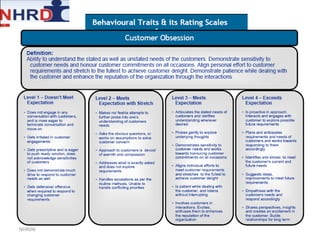
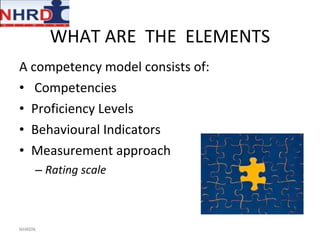
WHAT ARE  THE  ELEMENTS A competency model consists of: Competencies  Proficiency Levels  Behavioural Indicators  Measurement approach Rating scale NHRDN
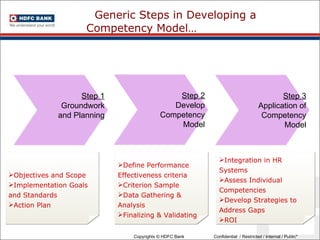
Integration in HR Systems Assess Individual Competencies Develop Strategies to Address Gaps ROI Step 1 Groundwork and Planning Step 2 Develop Competency Model Generic Steps in Developing a   Competency Model… Objectives and Scope Implementation Goals and Standards Action Plan Define Performance Effectiveness criteria Criterion Sample Data Gathering & Analysis Finalizing & Validating Step 3 Application of Competency Model
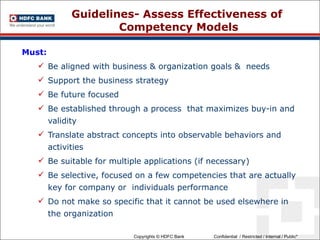
Guidelines- Assess Effectiveness of  Competency Models Must: Be aligned with business & organization goals &  needs Support the business strategy Be future focused Be established through a process  that maximizes buy-in and validity Translate abstract concepts into observable behaviors and activities Be suitable for multiple applications (if necessary) Be selective, focused on a few competencies that are actually key for company or  individuals performance  Do not make so specific that it cannot be used elsewhere in the organization
BREAK NHRDN
NHRDN The HR COMPASS model ( Developed by NHRDN )
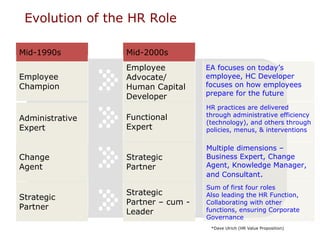
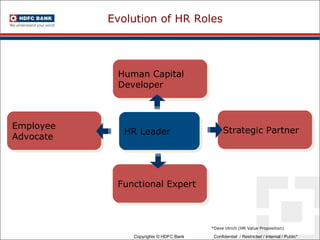
Strategic  Partner Administrative Expert Employee Champion Mid-1990s Change Agent Strategic Partner – cum - Leader Functional  Expert Employee Advocate/  Human Capital Developer Mid-2000s Strategic  Partner Sum of first four roles Also leading the HR Function, Collaborating with other functions, ensuring Corporate Governance HR practices are delivered through administrative efficiency (technology), and others through policies, menus, & interventions EA focuses on today’s employee, HC Developer focuses on how employees prepare for the future Multiple dimensions – Business Expert, Change Agent, Knowledge Manager, and Consultant .  Evolution of the HR Role *Dave Ulrich (HR Value Proposition)
Small Group Work : WHAT ARE THE EXPECTED OUTPUTS (KRA’S) OF THE JOB ?  WHAT ARE THE EXPECTED BEHAVIORS THAT WILL LEAD TO SUCCESSFUL DELIVERY OF THE EXPECTED OUTPUTS ? WHAT KNOWLEDGE, SKILL & ABILITY WILL THIS POSITION NEED IN ORDER TO BE SUCCESSFUL ? NHRDN
Context-1 Small Group Work: You are on tour far away from home. You get a phone call from your mother stating that the wash basin tap is broken and water is flowing. It is likely to flood into the room since the drain is also partially clogged. What will be your choices/ responses? What are the relevant competencies that would need to be exhibited in this situation? NHRDN
Context-2 Small Group Work: *Your close relative is admitted at hospital for a surgery in the  eyes. After consulting several doctors, you have to finally zero  down on a doctor to perform the surgery. Are any competency(ies) required to make the above decision? What are the 3 important competencies , you would place highest emphasis on? NHRDN
Context -3 * You have been recruited by a CEO of a Organization as the only HR professional which has 100 employees.  *This Organization is highly power intensive and has a 66 KV substation.  *You have an Electrical Engineer named Ramu, who is with your organization for the last 15 years.  He takes care of the substation and all High voltage installations. *Ramu is leaving the job.  *You have identified another candidate along with your CEO, who has committed to join on 1 March 2010.  *15 Feb 2010- the candidate informs that he is not joining.  What will be your options/choices and actions? What are the relevant competencies , that will need to be exhibited in this situation? NHRDN
Competencies for HR Professionals  Do they exist? Are they needed? Is there any specific competency required for  the HR role in the Time Office ? Is there any competency required for the HR role , who is responsible for Employee Personal files & Data management? Are their specific competencies required for the HR person responsible for:  Recruitment Training Performance Management Compensation & benefits etc NHRDN
Human Capital Developer Employee Advocate Functional Expert Strategic Partner HR Leader Evolution of HR Roles *Dave Ulrich (HR Value Proposition)
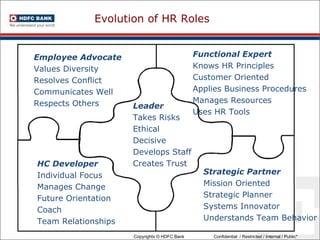
Leader Takes Risks Ethical Decisive Develops Staff Creates Trust Employee Advocate Values Diversity Resolves Conflict Communicates Well Respects Others HC Developer Individual Focus Manages Change Future Orientation Coach Team Relationships Functional Expert Knows HR Principles Customer Oriented Applies Business Procedures Manages Resources Uses HR Tools Strategic Partner Mission Oriented Strategic Planner Systems Innovator Understands Team Behavior Evolution of HR Roles
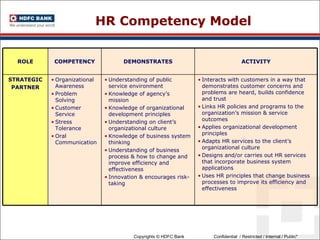
HR Competency Model ROLE COMPETENCY DEMONSTRATES ACTIVITY STRATEGIC PARTNER Organizational Awareness Problem Solving Customer Service Stress Tolerance Oral Communication Understanding of public service environment Knowledge of agency’s mission Knowledge of organizational development principles Understanding on client’s organizational culture Knowledge of business system thinking Understanding of business process & how to change and improve efficiency and effectiveness Innovation & encourages risk-taking Interacts with customers in a way that demonstrates customer concerns and problems are heard, builds confidence and trust Links HR policies and programs to the organization’s mission & service outcomes Applies organizational development principles Adapts HR services to the client’s organizational culture Designs and/or carries out HR services that incorporate business system applications Uses HR principles that change business processes to improve its efficiency and effectiveness
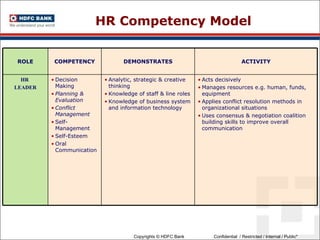
HR Competency Model ROLE COMPETENCY DEMONSTRATES ACTIVITY HR  LEADER Decision Making Planning & Evaluation Conflict Management Self-Management Self-Esteem Oral Communication Analytic, strategic & creative thinking Knowledge of staff & line roles Knowledge of business system and information technology Acts decisively Manages resources e.g. human, funds, equipment Applies conflict resolution methods in organizational situations Uses consensus & negotiation coalition building skills to improve overall communication
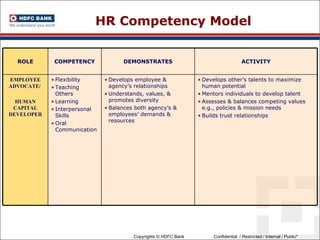
HR Competency Model ROLE COMPETENCY DEMONSTRATES ACTIVITY EMPLOYEE ADVOCATE/  HUMAN CAPITAL DEVELOPER Flexibility Teaching Others Learning Interpersonal Skills Oral Communication Develops employee & agency’s relationships Understands, values, & promotes diversity Balances both agency’s & employees’ demands & resources Develops other’s talents to maximize human potential Mentors individuals to develop talent Assesses & balances competing values e.g., policies & mission needs Builds trust relationships
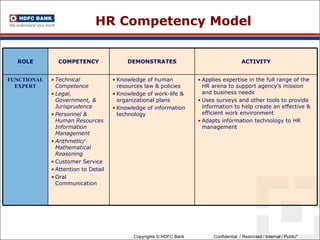
HR Competency Model ROLE COMPETENCY DEMONSTRATES ACTIVITY FUNCTIONAL EXPERT Technical Competence Legal, Government, & Jurisprudence Personnel & Human Resources   Information Management Arithmetic/ Mathematical Reasoning Customer Service Attention to Detail Oral Communication Knowledge of human resources law & policies Knowledge of work-life & organizational plans Knowledge of information technology Applies expertise in the full range of the HR arena to support agency’s mission and business needs Uses surveys and other tools to provide information to help create an effective & efficient work environment Adapts information technology to HR management
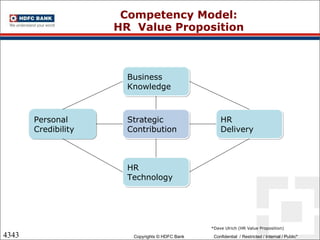
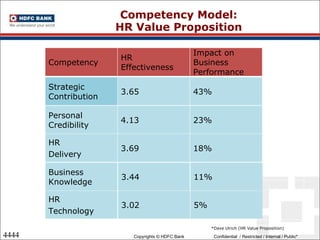
Competency Model: HR  Value Proposition Strategic Contribution Business Knowledge HR  Technology Personal Credibility HR  Delivery *Dave Ulrich (HR Value Proposition)
Competency Model: HR Value Proposition 18% 3.69 HR  Delivery 23% 4.13 Personal Credibility 43% 3.65 Strategic Contribution Impact on Business Performance HR Effectiveness Competency  3.44 Business Knowledge 5% 3.02 HR  Technology 11% *Dave Ulrich (HR Value Proposition)
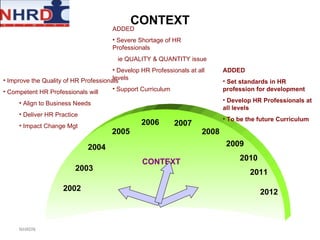
CONTEXT CONTEXT 2002 Improve the Quality of HR Professionals Competent HR Professionals will Align to Business Needs Deliver HR Practice Impact Change Mgt 2003 2004 2005 2006 2007 2008 ADDED Severe Shortage of HR Professionals ie QUALITY & QUANTITY issue Develop HR Professionals at all levels Support Curriculum 2009 2010 2011 2012 ADDED Set standards in HR profession for development Develop HR Professionals at all levels To be the future Curriculum NHRDN
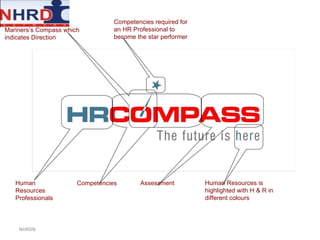
Human Resources Professionals Competencies Assessment Human Resources is highlighted with H & R in different colours Mariners’s Compass which indicates Direction Competencies required for an HR Professional to become the star performer NHRDN
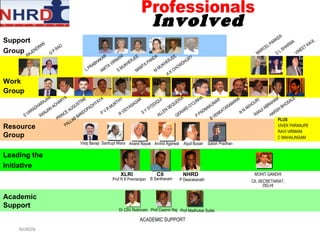
Involved Professionals NHRD CII XLRI ACADEMIC SUPPORT Dr CSV Rathinam Prof Casimir Raj Prof Madhukar Sukla MOHIT GANDHI CII, SECRETARIAT, DELHI Prof R K Premarajan B Santhanam P Dwarakanath Satish Pradhan Aquil Busari Arvind Agarwal Anand Nayak Santrupt Misra Visty Banaji PLUS VIVEK PARANJPE RAVI VIRMANI C MAHALINGAM S VARADHARAJAN RANJAN ACHARYA R VIDYASAGAR PALLAB BANDOPADHYAYA P V R MURTHY PRINCE AUGUSTINE S Y SYDDIQUI ALLEN SEQUERIA RANJI ABRAHAM GERARD D’CUNHA P PADMAKUMAR B VENKATARAMANA N N AKHOURI HARSH BHOSALE L PRABHAKAR AMITA VIRMANI MAMTA PANDA M MUKHERJEE S MUKHERJEE A K CHOWDHURY Resource Group Work Group Leading the  Initiative Support Group Academic Support VINEET KAUL D L SHARMA MARCEL PARKER G P RAO RAJENDRAN NHRDN
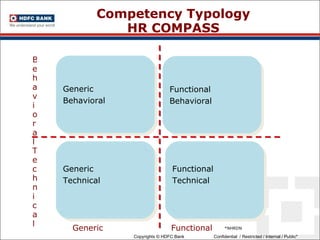
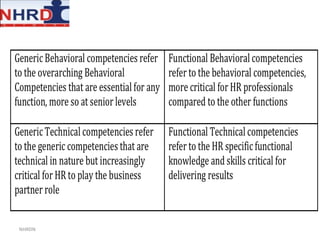
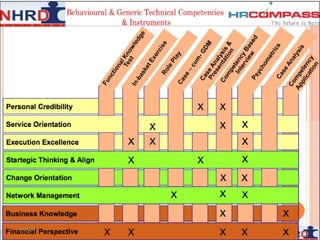
Competency Typology HR COMPASS Generic  Behavioral Generic  Technical  Functional  Technical Functional Behavioral  Behavioral Technical Generic Functional *NHRDN
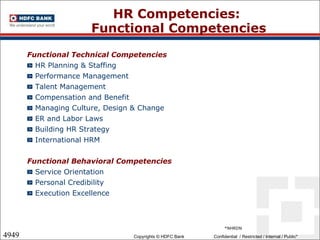
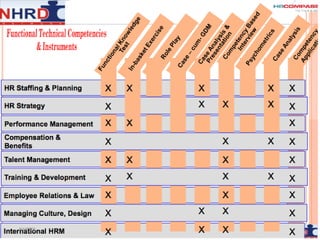
HR Competencies:  Functional Competencies Functional Technical Competencies HR Planning & Staffing Performance Management Talent Management Compensation and Benefit Managing Culture, Design & Change ER and Labor Laws Building HR Strategy International HRM Functional Behavioral Competencies Service Orientation  Personal Credibility  Execution Excellence *NHRDN
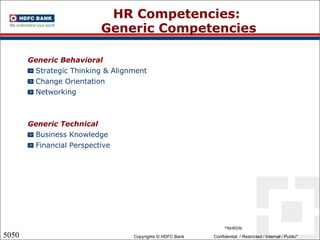
HR Competencies:  Generic Competencies Generic Behavioral Strategic Thinking & Alignment  Change Orientation  Networking Generic Technical Business Knowledge Financial Perspective *NHRDN
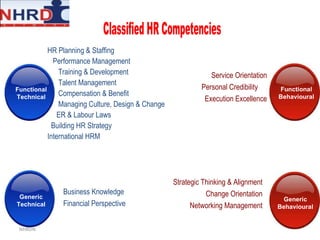
Classified HR Competencies HR Planning & Staffing Performance Management Training & Development Talent Management Compensation & Benefit Managing Culture, Design & Change ER & Labour Laws Building HR Strategy International HRM Service Orientation Personal Credibility  Execution Excellence Business Knowledge Financial Perspective Strategic Thinking & Alignment Change Orientation Networking Management NHRDN Functional Behavioural Generic Behavioural Functional Technical Generic Technical
NHRDN
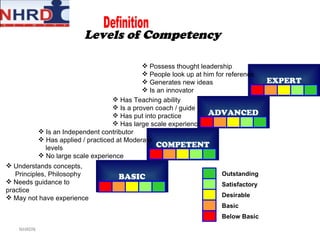
Levels of Competency Definition BASIC COMPETENT ADVANCED EXPERT Understands concepts,  Principles, Philosophy Needs guidance to practice May not have experience  Is an Independent contributor Has applied / practiced at Moderate  levels No large scale experience  Has Teaching ability Is a proven coach / guide Has put into practice Has large scale experience  Possess thought leadership People look up at him for reference Generates new ideas Is an innovator  Outstanding Satisfactory Desirable Basic Below Basic NHRDN
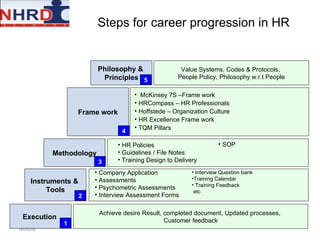
Instruments &  Tools Philosophy &  Principles Value Systems, Codes & Protocols,  People Policy, Philosophy w.r.t People Frame work McKinsey 7S –Frame work HRCompass – HR Professionals  Hoffstede – Organization Culture HR Excellence Frame work TQM Pillars Methodology HR Policies  Guidelines / File Notes Training Design to Delivery Execution  Achieve desire Result, completed document, Updated processes,  Customer feedback 1 2 3 4 5 Company Application Assessments Psychometric Assessments Interview Assessment Forms Interview Question bank  Training Calendar Training Feedback etc Steps for career progression in HR SOP NHRDN
LUNCH BREAK NHRDN
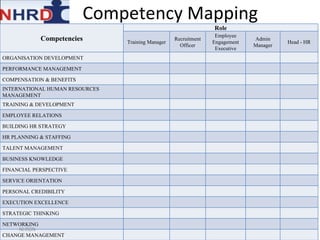
Competency Mapping NHRDN Competencies Role Training Manager Recruitment Officer Employee Engagement Executive Admin Manager Head - HR ORGANISATION DEVELOPMENT PERFORMANCE MANAGEMENT COMPENSATION & BENEFITS INTERNATIONAL HUMAN RESOURCES MANAGEMENT TRAINING & DEVELOPMENT EMPLOYEE RELATIONS BUILDING HR STRATEGY HR PLANNING & STAFFING TALENT MANAGEMENT BUSINESS KNOWLEDGE FINANCIAL PERSPECTIVE SERVICE ORIENTATION PERSONAL CREDIBILITY EXECUTION EXCELLENCE STRATEGIC THINKING NETWORKING CHANGE MANAGEMENT
NHRDN Linking Competency Model to HR Systems
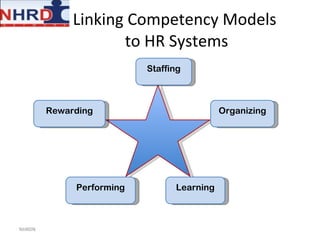
Linking Competency Models  to HR Systems NHRDN Staffing Organizing Learning Performing Rewarding
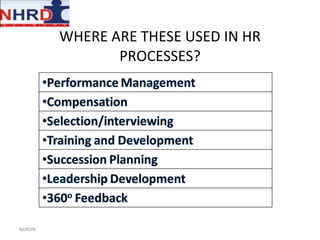
WHERE ARE THESE USED IN HR PROCESSES? NHRDN
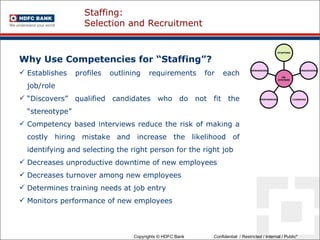
Why Use Competencies for “Staffing”? Establishes profiles outlining requirements for each job/role “ Discovers” qualified candidates who do not fit the “stereotype” Competency based interviews reduce the risk of making a costly hiring mistake and increase the likelihood of identifying and selecting the right person for the right job Decreases unproductive downtime of new employees Decreases turnover among new employees Determines training needs at job entry Monitors performance of new employees Staffing:   Selection and Recruitment STAFFING ORGANISING LEARNING PERFORMING REWARDING HR  SYSTEMS
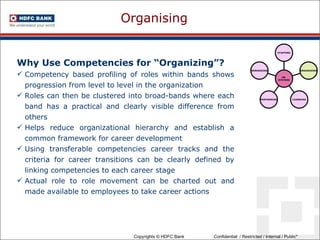
Organising Why Use Competencies for “Organizing”? Competency based profiling of roles within bands shows progression from level to level in the organization Roles can then be clustered into broad-bands where each band has a practical and clearly visible difference from others Helps reduce organizational hierarchy and establish a common framework for career development Using transferable competencies career tracks and the criteria for career transitions can be clearly defined by linking competencies to each career stage Actual role to role movement can be charted out and made available to employees to take career actions STAFFING ORGANISING LEARNING PERFORMING REWARDING HR  SYSTEMS
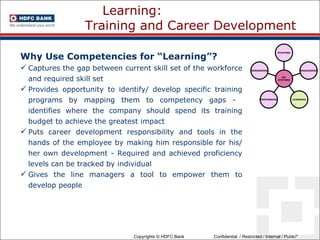
Learning:   Training and Career Development Why Use Competencies for “Learning”? Captures the gap between current skill set of the workforce and required skill set Provides opportunity to identify/ develop specific training programs by mapping them to competency gaps -  identifies where the company should spend its training budget to achieve the greatest impact  Puts career development responsibility and tools in the hands of the employee by making him responsible for his/ her own development - Required and achieved proficiency levels can be tracked by individual Gives the line managers a tool to empower them to develop people STAFFING ORGANISING LEARNING PERFORMING REWARDING HR  SYSTEMS
BREAK NHRDN
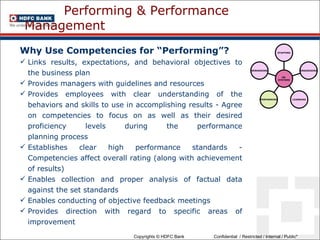
Performing & Performance  Management Why Use Competencies for “Performing”? Links results, expectations, and behavioral objectives to the business plan Provides managers with guidelines and resources  Provides employees with clear understanding of the behaviors and skills to use in accomplishing results - Agree on competencies to focus on as well as their desired proficiency levels during the performance planning process Establishes clear high performance standards - Competencies affect overall rating (along with achievement of results) Enables collection and proper analysis of factual data against the set standards Enables conducting of objective feedback meetings  Provides direction with regard to specific areas of improvement STAFFING ORGANISING LEARNING PERFORMING REWARDING HR  SYSTEMS
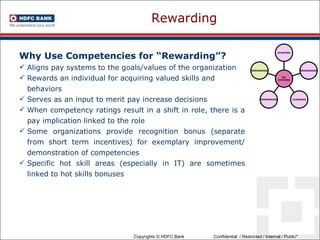
Rewarding Why Use Competencies for “Rewarding”? Aligns pay systems to the goals/values of the organization Rewards an individual for acquiring valued skills and behaviors Serves as an input to merit pay increase decisions  When competency ratings result in a shift in role, there is a pay implication linked to the role Some organizations provide recognition bonus (separate from short term incentives) for exemplary improvement/ demonstration of competencies Specific hot skill areas (especially in IT) are sometimes linked to hot skills bonuses  STAFFING ORGANISING LEARNING PERFORMING REWARDING HR  SYSTEMS
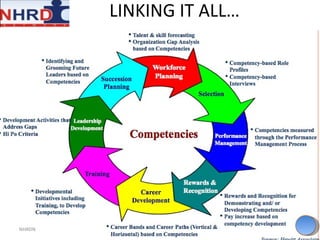
LINKING IT ALL… NHRDN
NHRDN Assessment and Tools
A fact Finding Exercise is a group activity for the group to solve or attempt to solve  It tests the ability to work in groups -Group Dynamics (Interactive technique) It also tests the ability to look for gaps in any situation and solve problems with limited information Uses simulation techniques Tests the ability of the person to handle dynamic situations Multiple data and multiple variables Some variables are hidden and some are explicit Understanding Fact Finding Exercises Development Center
Technique involves structured questioning about specific events to extract data on specific competencies Data is based on actual events in the work situation (in last 1-2 yrs) The emphasis is to collect as much data on the individual's behaviour in the situation including: Feelings; Thinking; and Actions Also useful for clarifying specific actions/issues observed during the other exercises during the center  High validity of the tool (assuming the assessor is well trained to conduct the BEI) Interview process requires delicate handling as it is a direct interface between the assessor and the assessee Behavioral Event Interviews: Key Features Development Center
A case study is a problem for the reader to solve or attempt to solve  A case has enough information such that readers can  Understand what the “problem” is Analyze the information Arrive at a proposed solution Information is arranged such that the reader is put in the same position as the incumbent from the case Understanding Case Studies Development Center
Interactive technique (one –on –one interaction) Participant is given specific data/ situation Demonstrates skills in handling specific situations Participant assumes an identity other than his own Role Plays have three parts  Situation  (given to all the role players) Role Sheet 1 ( Participant’s  brief about the role) Role Sheet 2 ( Assessor Brief- for the person who provides the opportunity for the participant to try and demonstrate his/her skills) Typical Role Play Situation Customer Interaction Role Plays Subordinate –Boss Role Plays  Peer / Third Party Interaction Role Plays Understanding Role Plays Development Center
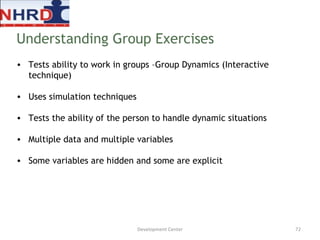
Tests ability to work in groups –Group Dynamics (Interactive technique) Uses simulation techniques Tests the ability of the person to handle dynamic situations Multiple data and multiple variables Some variables are hidden and some are explicit Understanding Group Exercises Development Center
NHRDN
NHRDN
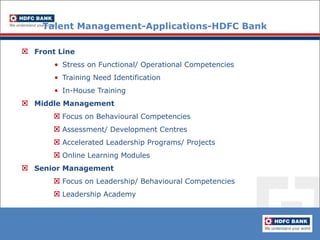
Talent Management-Applications-HDFC Bank Front Line Stress on Functional/ Operational Competencies Training Need Identification In-House Training   Middle Management Focus on Behavioural Competencies Assessment/ Development Centres Accelerated Leadership Programs/ Projects Online Learning Modules Senior Management Focus on Leadership/ Behavioural Competencies Leadership Academy
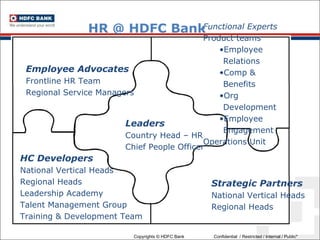
HR @ HDFC Bank Leaders Country Head – HR Chief People Officer Employee Advocates Frontline HR Team Regional Service Managers HC Developers National Vertical Heads Regional Heads Leadership Academy Talent Management Group Training & Development Team Functional Experts Product teams Employee Relations Comp & Benefits Org Development Employee Engagement Operations Unit  Strategic Partners National Vertical Heads Regional Heads
Example A MNC- approx: Rs 200 crores  top line Engineering and Project Management NHRDN
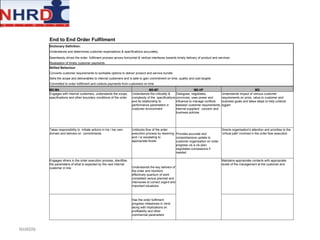
NHRDN End to End Order Fulfilment Dictionary Definition: Understands and determines customer expectations & specifications accurately. Seamlessly drives the order  fulfilment process across horizontal & vertical interfaces towards timely delivery of product and services  Realisation of timely customer payments Skilled Behaviour       Converts customer requirements to workable options to deliver product and service bundle Sells the scope and deliverables to internal customers and is able to gain commitment on time, quality and cost targets Committed to order fulfillment and collects payments from customers on time M2-M4 M5-M7 M8-VP MD Engages with internal customers, understands the scope, specifications and other boundary conditions of the order Understands the criticality & complexity of the  specifications and its relationship to performance parameters in customer environment Dialogues, negotiates, convinces, uses power and influence to manage conflicts between customer requirements, internal suppliers'  concern and business policies Understands impact of various customer requirements on price, value to customer and business goals and takes steps to help unblock logjam Takes responsibility to  initiate actions in his / her own domain and delivers on  commitments Unblocks flow of the order execution process by resolving and / or escalating to appropriate levels Provides accurate and comprehensive update to customer organization on order progress vis a vis plan, negotiates concessions if needed Directs organisation's attention and priorities to the 'critical path' involved in the order flow execution Engages others in the order execution process, identifies the parameters of what is expected by the next internal customer in line Understands the key delivers of the order and monitors effectively quantum of work completed versus planned and intervenes to correct urgent and important situations   Maintains appropriate contacts with appropriate levels of the management at the customer end   Has the order fulfilment progress milestones in mind along with implications on profitability and other commercial parameters  
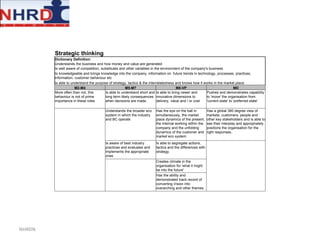
NHRDN Strategic thinking Dictionary Definition: Understands the business and how money and value are generated Is well aware of competition, substitutes and other variables in the environment of the company's business Is knowledgeable and brings knowledge into the company, information on  future trends in technology, processes, practices, information, customer behaviour etc Is able to understand the purpose of strategy, tactics & the interrelatedness and knows how it works in the market place M2-M4 M5-M7 M8-VP MD More often than not, this behaviour is not of prime importance in these roles Is able to understand short and long term likely consequences when decisions are made. Is able to bring newer and innovative dimensions to delivery, value and / or cost Pushes and demonstrates capability to 'move' the organisation from 'current state' to 'preferred state'   Understands the broader eco system in which the industry and BC operate Has the eye on the ball in simultaneously, the market place dynamics of the present, the internal working within the company and the unfolding dynamics of the customer and market eco system Has a global 360 degree view of markets, customers, people and other key stakeholders and is able to see their interplay and appropriately positions the organisation for the right responses. Is aware of best industry practices and evaluates and implements the appropriate ones Is able to segregate actions, tactics and the differences with strategy.     Creates climate in the organisation for 'what it might be into the future' Has the ability and demonstrated track record of converting Vision into overarching and other themes
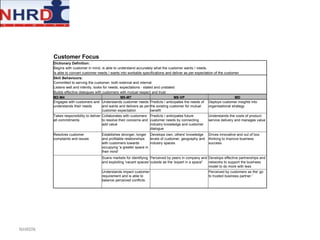
NHRDN Customer Focus Dictionary Definition: Begins with customer in mind, is able to understand accurately what the customer wants / needs. Is able to convert customer needs / wants into workable specifications and deliver as per expectation of the customer Skill Behaviours:   Committed to serving the customer- both external and internal Listens well and intently, looks for needs, expectations - stated and unstated Builds effective dialogues with customers with mutual respect and trust M2-M4 M5-M7 M8-VP MD Engages with customers and understands their needs Understands customer needs and wants and delivers as per customer expectation Predicts / anticipates the needs of the existing customer for mutual benefit Deploys customer insights into organisational strategy Takes responsibility to deliver all commitments Collaborates with customers to resolve their concerns and  add value Predicts / anticipates future customer needs by connecting industry knowledge and customer dialogue Understands the costs of product-service delivery and manages value Resolves customer complaints and issues Establishes stronger, longer  and profitable relationships with customers towards occupying 'a greater space in their mind' Develops own, others' knowledge levels of customer, geography and industry spaces Drives innovative and out of box thinking to improve business success   Scans markets for identifying and exploiting 'vacant spaces' Perceived by peers in company and outside as the 'expert in a space" Develops effective partnerships and networks to support the business model to do more with less Understands impact customer requirement and is able to balance perceived conflicts.   Perceived by customers as the' go to trusted business partner.'
Example A B school- Offering Masters HR programme NHRDN
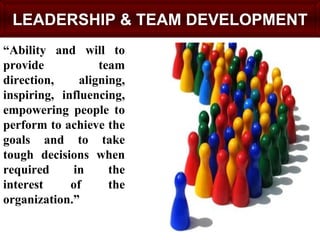
“ Ability and will to provide team direction, aligning, inspiring, influencing, empowering people to perform to achieve the goals and to take tough decisions when required in the interest of the organization.” LEADERSHIP & TEAM DEVELOPMENT
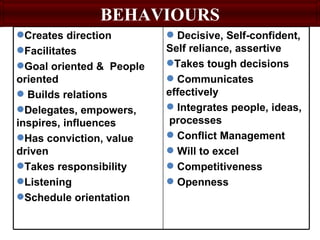
BEHAVIOURS Creates direction  Facilitates Goal oriented &  People oriented Builds relations Delegates, empowers, inspires, influences Has conviction, value driven Takes responsibility Listening Schedule orientation  Decisive, Self-confident, Self reliance, assertive  Takes tough decisions Communicates effectively Integrates people, ideas,  processes  Conflict Management Will to excel Competitiveness Openness
Q& A Contact me: [email_address] Cell +91 9833477278 NHRDN
Thank you NHRDN

HR Competency Workshop - Presentation by Vijayan Pankajakshan

  • 1.
    HR COMPETENCY FRAMEWORKWORKSHOP Nagpur,India NHRDN Learning Center – March 30 th , 2011 Vijayan Pankajakshan Faculty-HR( WESchool, Mumbai) & Principal Consultant-HCM(ELS ,P une) NHRDN
  • 2.
    Acknowledgement-Content NHRDN Archives(NHRDN–National Secretariat) HDFC Bank Maruti - Suzuki NHRDN
  • 3.
    Pre Reading/Setting ExpectationsUnderstanding Competencies Why Competencies Developing a Competency Model HR Compass- Model for HRD competencies Linking Competency Model to HR Systems Assessment and Tools Examples Contents
  • 4.
    NHRDN Understanding Whatis A Competency
  • 5.
  • 6.
  • 7.
    Receptionist Example Top Performer NHRDN
  • 8.
    Traffic Police Officerexample Top Performer NHRDN
  • 9.
    Hidden: Self Concept,Trait, Motive You can teach a turkey to climb a tree but it is easier to hire a squirrel ! Trait Motive Self Concept Attitude Values Knowledge Skill The Concept of “Observable Behaviour NHRDN
  • 10.
  • 11.
    A FEW DEFINITIONS Competency is an underlying characteristic of an employee (i.e., a motive, trait, skill, aspects of one’s self-image, social role, or a body of knowledge) which results in effective and/or superior performance . (Prof. Boyatzis, 1982) a set of skills, related knowledge and attributes that allow an individual to successfully perform a task or an activity within a specific function or job . (UNIDO, 2002) Competencies are coachable, observable, measurable, and critical to successful individual or corporation performance . NHRDN
  • 12.
    Causally related tocriterion referenced superior performance in a job Causally related means that a competency causes or predicts behavior and performance Deep and enduring part of a person’s personality and can predict behavior in a wide variety of situations and job tasks Actually predicts who does something well or poorly as measured on a specific criterion or standard (e.g.: volume of sales for a sales person) Definitions………….Important concepts NHRDN
  • 13.
    Motive: Drive,Direct & Select towards certain action or goals ((Achievement motivated people will consistently set challenging goals, take personal responsibility, use feedback to do better)) Traits : consistent responses to situations or information ((People will act above and beyond call of duty to solve problems under stress)) Self Concept : A person’s attitudes, values and self image (( People who do not like to influence others motives struggle as leaders)) Knowledge : specific content areas. Which facts exist that are relevant to a specific problem and where to find them Skill: ability to perform a certain activity. Mental or cognitive skills to handle complexity Definitions………….Important concepts NHRDN
  • 14.
    TO What capabilitiesdo we bring to the businesses we are in now that can serve as foundation upon which future businesses can be built? Write your matter here. Paradigm Shift FROM What business are we in?
  • 15.
    Criticality of Competencies Competencies, when correctly identified and used, have proved to be one of the most powerful tools for an organization to meet its business results, through its most valuable resource – its people Very effective for communicating about performance because they help people frame expectations and goals in clear behavioral terms - help companies ‘raise the Bar’ of performance expectations Help in establishing common criteria for hiring, training, measuring, and rewarding people with the right capabilities to help the company gain competitive advantage
  • 16.
    Criticality of Competencies Remind employees how they do things is as important as what they do Reward the person , not the job Enable greater flexibility to move people laterally and encourages development Help to identify gaps between current capabilities and future requirements Help in focusing training and development efforts on areas with greatest need and/or impact Facilitate organizational change and building desired culture
  • 17.
    COMPETENCIES: THE KSAFRAMEWORK NHRDN
  • 18.
    COMPETENCIES - ExhibitOutputs Products + Services Behaviors Actions + Thoughts + Feelings Capabilities Knowledge + Skill + Attitude Competencies are a person’s capabilities in the form of knowledge + skill + attitude , which gets reflected thorough a persons behavior in the form of actions + thoughts + feelings and finally manifests itself in outputs which are products and services
  • 19.
  • 20.
    CLASSIFYING COMPETENCIES Universal: Reflections of the company’s values, culture, and business imperatives that should be exhibited by all employees For example, guiding behaviors such as cost effective service delivery, customer focus, teamwork, communication skills, initiative NHRDN
  • 21.
    CLASSIFYING COMPETENCIES Transferable:Skills and abilities needed within several roles in varying degrees of importance and mastery For example, managerial and leadership skills NHRDN
  • 22.
    CLASSIFYING COMPETENCIES Unique: Specialized know-how or abilities required within a specific role or job For example, technical/ functional skills (Marketing Strategy, Drug Discovery) NHRDN
  • 23.
    OBSERVING EXHIBITION OFCOMPETENCIES NHRDN
  • 24.
  • 25.
    NHRDN Developing aCompetency Model
  • 26.
    WHAT ARE THE ELEMENTS A competency model consists of: Competencies Proficiency Levels Behavioural Indicators Measurement approach Rating scale NHRDN
  • 27.
    Integration in HRSystems Assess Individual Competencies Develop Strategies to Address Gaps ROI Step 1 Groundwork and Planning Step 2 Develop Competency Model Generic Steps in Developing a Competency Model… Objectives and Scope Implementation Goals and Standards Action Plan Define Performance Effectiveness criteria Criterion Sample Data Gathering & Analysis Finalizing & Validating Step 3 Application of Competency Model
  • 28.
    Guidelines- Assess Effectivenessof Competency Models Must: Be aligned with business & organization goals & needs Support the business strategy Be future focused Be established through a process that maximizes buy-in and validity Translate abstract concepts into observable behaviors and activities Be suitable for multiple applications (if necessary) Be selective, focused on a few competencies that are actually key for company or individuals performance Do not make so specific that it cannot be used elsewhere in the organization
  • 29.
  • 30.
    NHRDN The HRCOMPASS model ( Developed by NHRDN )
  • 31.
    Strategic PartnerAdministrative Expert Employee Champion Mid-1990s Change Agent Strategic Partner – cum - Leader Functional Expert Employee Advocate/ Human Capital Developer Mid-2000s Strategic Partner Sum of first four roles Also leading the HR Function, Collaborating with other functions, ensuring Corporate Governance HR practices are delivered through administrative efficiency (technology), and others through policies, menus, & interventions EA focuses on today’s employee, HC Developer focuses on how employees prepare for the future Multiple dimensions – Business Expert, Change Agent, Knowledge Manager, and Consultant . Evolution of the HR Role *Dave Ulrich (HR Value Proposition)
  • 32.
    Small Group Work: WHAT ARE THE EXPECTED OUTPUTS (KRA’S) OF THE JOB ? WHAT ARE THE EXPECTED BEHAVIORS THAT WILL LEAD TO SUCCESSFUL DELIVERY OF THE EXPECTED OUTPUTS ? WHAT KNOWLEDGE, SKILL & ABILITY WILL THIS POSITION NEED IN ORDER TO BE SUCCESSFUL ? NHRDN
  • 33.
    Context-1 Small GroupWork: You are on tour far away from home. You get a phone call from your mother stating that the wash basin tap is broken and water is flowing. It is likely to flood into the room since the drain is also partially clogged. What will be your choices/ responses? What are the relevant competencies that would need to be exhibited in this situation? NHRDN
  • 34.
    Context-2 Small GroupWork: *Your close relative is admitted at hospital for a surgery in the eyes. After consulting several doctors, you have to finally zero down on a doctor to perform the surgery. Are any competency(ies) required to make the above decision? What are the 3 important competencies , you would place highest emphasis on? NHRDN
  • 35.
    Context -3 *You have been recruited by a CEO of a Organization as the only HR professional which has 100 employees. *This Organization is highly power intensive and has a 66 KV substation. *You have an Electrical Engineer named Ramu, who is with your organization for the last 15 years. He takes care of the substation and all High voltage installations. *Ramu is leaving the job. *You have identified another candidate along with your CEO, who has committed to join on 1 March 2010. *15 Feb 2010- the candidate informs that he is not joining. What will be your options/choices and actions? What are the relevant competencies , that will need to be exhibited in this situation? NHRDN
  • 36.
    Competencies for HRProfessionals Do they exist? Are they needed? Is there any specific competency required for the HR role in the Time Office ? Is there any competency required for the HR role , who is responsible for Employee Personal files & Data management? Are their specific competencies required for the HR person responsible for: Recruitment Training Performance Management Compensation & benefits etc NHRDN
  • 37.
    Human Capital DeveloperEmployee Advocate Functional Expert Strategic Partner HR Leader Evolution of HR Roles *Dave Ulrich (HR Value Proposition)
  • 38.
    Leader Takes RisksEthical Decisive Develops Staff Creates Trust Employee Advocate Values Diversity Resolves Conflict Communicates Well Respects Others HC Developer Individual Focus Manages Change Future Orientation Coach Team Relationships Functional Expert Knows HR Principles Customer Oriented Applies Business Procedures Manages Resources Uses HR Tools Strategic Partner Mission Oriented Strategic Planner Systems Innovator Understands Team Behavior Evolution of HR Roles
  • 39.
    HR Competency ModelROLE COMPETENCY DEMONSTRATES ACTIVITY STRATEGIC PARTNER Organizational Awareness Problem Solving Customer Service Stress Tolerance Oral Communication Understanding of public service environment Knowledge of agency’s mission Knowledge of organizational development principles Understanding on client’s organizational culture Knowledge of business system thinking Understanding of business process & how to change and improve efficiency and effectiveness Innovation & encourages risk-taking Interacts with customers in a way that demonstrates customer concerns and problems are heard, builds confidence and trust Links HR policies and programs to the organization’s mission & service outcomes Applies organizational development principles Adapts HR services to the client’s organizational culture Designs and/or carries out HR services that incorporate business system applications Uses HR principles that change business processes to improve its efficiency and effectiveness
  • 40.
    HR Competency ModelROLE COMPETENCY DEMONSTRATES ACTIVITY HR LEADER Decision Making Planning & Evaluation Conflict Management Self-Management Self-Esteem Oral Communication Analytic, strategic & creative thinking Knowledge of staff & line roles Knowledge of business system and information technology Acts decisively Manages resources e.g. human, funds, equipment Applies conflict resolution methods in organizational situations Uses consensus & negotiation coalition building skills to improve overall communication
  • 41.
    HR Competency ModelROLE COMPETENCY DEMONSTRATES ACTIVITY EMPLOYEE ADVOCATE/ HUMAN CAPITAL DEVELOPER Flexibility Teaching Others Learning Interpersonal Skills Oral Communication Develops employee & agency’s relationships Understands, values, & promotes diversity Balances both agency’s & employees’ demands & resources Develops other’s talents to maximize human potential Mentors individuals to develop talent Assesses & balances competing values e.g., policies & mission needs Builds trust relationships
  • 42.
    HR Competency ModelROLE COMPETENCY DEMONSTRATES ACTIVITY FUNCTIONAL EXPERT Technical Competence Legal, Government, & Jurisprudence Personnel & Human Resources Information Management Arithmetic/ Mathematical Reasoning Customer Service Attention to Detail Oral Communication Knowledge of human resources law & policies Knowledge of work-life & organizational plans Knowledge of information technology Applies expertise in the full range of the HR arena to support agency’s mission and business needs Uses surveys and other tools to provide information to help create an effective & efficient work environment Adapts information technology to HR management
  • 43.
    Competency Model: HR Value Proposition Strategic Contribution Business Knowledge HR Technology Personal Credibility HR Delivery *Dave Ulrich (HR Value Proposition)
  • 44.
    Competency Model: HRValue Proposition 18% 3.69 HR Delivery 23% 4.13 Personal Credibility 43% 3.65 Strategic Contribution Impact on Business Performance HR Effectiveness Competency 3.44 Business Knowledge 5% 3.02 HR Technology 11% *Dave Ulrich (HR Value Proposition)
  • 45.
    CONTEXT CONTEXT 2002Improve the Quality of HR Professionals Competent HR Professionals will Align to Business Needs Deliver HR Practice Impact Change Mgt 2003 2004 2005 2006 2007 2008 ADDED Severe Shortage of HR Professionals ie QUALITY & QUANTITY issue Develop HR Professionals at all levels Support Curriculum 2009 2010 2011 2012 ADDED Set standards in HR profession for development Develop HR Professionals at all levels To be the future Curriculum NHRDN
  • 46.
    Human Resources ProfessionalsCompetencies Assessment Human Resources is highlighted with H & R in different colours Mariners’s Compass which indicates Direction Competencies required for an HR Professional to become the star performer NHRDN
  • 47.
    Involved Professionals NHRDCII XLRI ACADEMIC SUPPORT Dr CSV Rathinam Prof Casimir Raj Prof Madhukar Sukla MOHIT GANDHI CII, SECRETARIAT, DELHI Prof R K Premarajan B Santhanam P Dwarakanath Satish Pradhan Aquil Busari Arvind Agarwal Anand Nayak Santrupt Misra Visty Banaji PLUS VIVEK PARANJPE RAVI VIRMANI C MAHALINGAM S VARADHARAJAN RANJAN ACHARYA R VIDYASAGAR PALLAB BANDOPADHYAYA P V R MURTHY PRINCE AUGUSTINE S Y SYDDIQUI ALLEN SEQUERIA RANJI ABRAHAM GERARD D’CUNHA P PADMAKUMAR B VENKATARAMANA N N AKHOURI HARSH BHOSALE L PRABHAKAR AMITA VIRMANI MAMTA PANDA M MUKHERJEE S MUKHERJEE A K CHOWDHURY Resource Group Work Group Leading the Initiative Support Group Academic Support VINEET KAUL D L SHARMA MARCEL PARKER G P RAO RAJENDRAN NHRDN
  • 48.
    Competency Typology HRCOMPASS Generic Behavioral Generic Technical Functional Technical Functional Behavioral Behavioral Technical Generic Functional *NHRDN
  • 49.
    HR Competencies: Functional Competencies Functional Technical Competencies HR Planning & Staffing Performance Management Talent Management Compensation and Benefit Managing Culture, Design & Change ER and Labor Laws Building HR Strategy International HRM Functional Behavioral Competencies Service Orientation Personal Credibility Execution Excellence *NHRDN
  • 50.
    HR Competencies: Generic Competencies Generic Behavioral Strategic Thinking & Alignment Change Orientation Networking Generic Technical Business Knowledge Financial Perspective *NHRDN
  • 51.
    Classified HR CompetenciesHR Planning & Staffing Performance Management Training & Development Talent Management Compensation & Benefit Managing Culture, Design & Change ER & Labour Laws Building HR Strategy International HRM Service Orientation Personal Credibility Execution Excellence Business Knowledge Financial Perspective Strategic Thinking & Alignment Change Orientation Networking Management NHRDN Functional Behavioural Generic Behavioural Functional Technical Generic Technical
  • 52.
  • 53.
    Levels of CompetencyDefinition BASIC COMPETENT ADVANCED EXPERT Understands concepts, Principles, Philosophy Needs guidance to practice May not have experience Is an Independent contributor Has applied / practiced at Moderate levels No large scale experience Has Teaching ability Is a proven coach / guide Has put into practice Has large scale experience Possess thought leadership People look up at him for reference Generates new ideas Is an innovator Outstanding Satisfactory Desirable Basic Below Basic NHRDN
  • 54.
    Instruments & Tools Philosophy & Principles Value Systems, Codes & Protocols, People Policy, Philosophy w.r.t People Frame work McKinsey 7S –Frame work HRCompass – HR Professionals Hoffstede – Organization Culture HR Excellence Frame work TQM Pillars Methodology HR Policies Guidelines / File Notes Training Design to Delivery Execution Achieve desire Result, completed document, Updated processes, Customer feedback 1 2 3 4 5 Company Application Assessments Psychometric Assessments Interview Assessment Forms Interview Question bank Training Calendar Training Feedback etc Steps for career progression in HR SOP NHRDN
  • 55.
  • 56.
    Competency Mapping NHRDNCompetencies Role Training Manager Recruitment Officer Employee Engagement Executive Admin Manager Head - HR ORGANISATION DEVELOPMENT PERFORMANCE MANAGEMENT COMPENSATION & BENEFITS INTERNATIONAL HUMAN RESOURCES MANAGEMENT TRAINING & DEVELOPMENT EMPLOYEE RELATIONS BUILDING HR STRATEGY HR PLANNING & STAFFING TALENT MANAGEMENT BUSINESS KNOWLEDGE FINANCIAL PERSPECTIVE SERVICE ORIENTATION PERSONAL CREDIBILITY EXECUTION EXCELLENCE STRATEGIC THINKING NETWORKING CHANGE MANAGEMENT
  • 57.
    NHRDN Linking CompetencyModel to HR Systems
  • 58.
    Linking Competency Models to HR Systems NHRDN Staffing Organizing Learning Performing Rewarding
  • 59.
    WHERE ARE THESEUSED IN HR PROCESSES? NHRDN
  • 60.
    Why Use Competenciesfor “Staffing”? Establishes profiles outlining requirements for each job/role “ Discovers” qualified candidates who do not fit the “stereotype” Competency based interviews reduce the risk of making a costly hiring mistake and increase the likelihood of identifying and selecting the right person for the right job Decreases unproductive downtime of new employees Decreases turnover among new employees Determines training needs at job entry Monitors performance of new employees Staffing: Selection and Recruitment STAFFING ORGANISING LEARNING PERFORMING REWARDING HR SYSTEMS
  • 61.
    Organising Why UseCompetencies for “Organizing”? Competency based profiling of roles within bands shows progression from level to level in the organization Roles can then be clustered into broad-bands where each band has a practical and clearly visible difference from others Helps reduce organizational hierarchy and establish a common framework for career development Using transferable competencies career tracks and the criteria for career transitions can be clearly defined by linking competencies to each career stage Actual role to role movement can be charted out and made available to employees to take career actions STAFFING ORGANISING LEARNING PERFORMING REWARDING HR SYSTEMS
  • 62.
    Learning: Training and Career Development Why Use Competencies for “Learning”? Captures the gap between current skill set of the workforce and required skill set Provides opportunity to identify/ develop specific training programs by mapping them to competency gaps - identifies where the company should spend its training budget to achieve the greatest impact Puts career development responsibility and tools in the hands of the employee by making him responsible for his/ her own development - Required and achieved proficiency levels can be tracked by individual Gives the line managers a tool to empower them to develop people STAFFING ORGANISING LEARNING PERFORMING REWARDING HR SYSTEMS
  • 63.
  • 64.
    Performing & Performance Management Why Use Competencies for “Performing”? Links results, expectations, and behavioral objectives to the business plan Provides managers with guidelines and resources Provides employees with clear understanding of the behaviors and skills to use in accomplishing results - Agree on competencies to focus on as well as their desired proficiency levels during the performance planning process Establishes clear high performance standards - Competencies affect overall rating (along with achievement of results) Enables collection and proper analysis of factual data against the set standards Enables conducting of objective feedback meetings Provides direction with regard to specific areas of improvement STAFFING ORGANISING LEARNING PERFORMING REWARDING HR SYSTEMS
  • 65.
    Rewarding Why UseCompetencies for “Rewarding”? Aligns pay systems to the goals/values of the organization Rewards an individual for acquiring valued skills and behaviors Serves as an input to merit pay increase decisions When competency ratings result in a shift in role, there is a pay implication linked to the role Some organizations provide recognition bonus (separate from short term incentives) for exemplary improvement/ demonstration of competencies Specific hot skill areas (especially in IT) are sometimes linked to hot skills bonuses STAFFING ORGANISING LEARNING PERFORMING REWARDING HR SYSTEMS
  • 66.
  • 67.
  • 68.
    A fact FindingExercise is a group activity for the group to solve or attempt to solve It tests the ability to work in groups -Group Dynamics (Interactive technique) It also tests the ability to look for gaps in any situation and solve problems with limited information Uses simulation techniques Tests the ability of the person to handle dynamic situations Multiple data and multiple variables Some variables are hidden and some are explicit Understanding Fact Finding Exercises Development Center
  • 69.
    Technique involves structuredquestioning about specific events to extract data on specific competencies Data is based on actual events in the work situation (in last 1-2 yrs) The emphasis is to collect as much data on the individual's behaviour in the situation including: Feelings; Thinking; and Actions Also useful for clarifying specific actions/issues observed during the other exercises during the center High validity of the tool (assuming the assessor is well trained to conduct the BEI) Interview process requires delicate handling as it is a direct interface between the assessor and the assessee Behavioral Event Interviews: Key Features Development Center
  • 70.
    A case studyis a problem for the reader to solve or attempt to solve A case has enough information such that readers can Understand what the “problem” is Analyze the information Arrive at a proposed solution Information is arranged such that the reader is put in the same position as the incumbent from the case Understanding Case Studies Development Center
  • 71.
    Interactive technique (one–on –one interaction) Participant is given specific data/ situation Demonstrates skills in handling specific situations Participant assumes an identity other than his own Role Plays have three parts Situation (given to all the role players) Role Sheet 1 ( Participant’s brief about the role) Role Sheet 2 ( Assessor Brief- for the person who provides the opportunity for the participant to try and demonstrate his/her skills) Typical Role Play Situation Customer Interaction Role Plays Subordinate –Boss Role Plays Peer / Third Party Interaction Role Plays Understanding Role Plays Development Center
  • 72.
    Tests ability towork in groups –Group Dynamics (Interactive technique) Uses simulation techniques Tests the ability of the person to handle dynamic situations Multiple data and multiple variables Some variables are hidden and some are explicit Understanding Group Exercises Development Center
  • 73.
  • 74.
  • 75.
    Talent Management-Applications-HDFC BankFront Line Stress on Functional/ Operational Competencies Training Need Identification In-House Training Middle Management Focus on Behavioural Competencies Assessment/ Development Centres Accelerated Leadership Programs/ Projects Online Learning Modules Senior Management Focus on Leadership/ Behavioural Competencies Leadership Academy
  • 76.
    HR @ HDFCBank Leaders Country Head – HR Chief People Officer Employee Advocates Frontline HR Team Regional Service Managers HC Developers National Vertical Heads Regional Heads Leadership Academy Talent Management Group Training & Development Team Functional Experts Product teams Employee Relations Comp & Benefits Org Development Employee Engagement Operations Unit Strategic Partners National Vertical Heads Regional Heads
  • 77.
    Example A MNC-approx: Rs 200 crores top line Engineering and Project Management NHRDN
  • 78.
    NHRDN End toEnd Order Fulfilment Dictionary Definition: Understands and determines customer expectations & specifications accurately. Seamlessly drives the order fulfilment process across horizontal & vertical interfaces towards timely delivery of product and services Realisation of timely customer payments Skilled Behaviour       Converts customer requirements to workable options to deliver product and service bundle Sells the scope and deliverables to internal customers and is able to gain commitment on time, quality and cost targets Committed to order fulfillment and collects payments from customers on time M2-M4 M5-M7 M8-VP MD Engages with internal customers, understands the scope, specifications and other boundary conditions of the order Understands the criticality & complexity of the specifications and its relationship to performance parameters in customer environment Dialogues, negotiates, convinces, uses power and influence to manage conflicts between customer requirements, internal suppliers' concern and business policies Understands impact of various customer requirements on price, value to customer and business goals and takes steps to help unblock logjam Takes responsibility to initiate actions in his / her own domain and delivers on commitments Unblocks flow of the order execution process by resolving and / or escalating to appropriate levels Provides accurate and comprehensive update to customer organization on order progress vis a vis plan, negotiates concessions if needed Directs organisation's attention and priorities to the 'critical path' involved in the order flow execution Engages others in the order execution process, identifies the parameters of what is expected by the next internal customer in line Understands the key delivers of the order and monitors effectively quantum of work completed versus planned and intervenes to correct urgent and important situations   Maintains appropriate contacts with appropriate levels of the management at the customer end   Has the order fulfilment progress milestones in mind along with implications on profitability and other commercial parameters  
  • 79.
    NHRDN Strategic thinkingDictionary Definition: Understands the business and how money and value are generated Is well aware of competition, substitutes and other variables in the environment of the company's business Is knowledgeable and brings knowledge into the company, information on future trends in technology, processes, practices, information, customer behaviour etc Is able to understand the purpose of strategy, tactics & the interrelatedness and knows how it works in the market place M2-M4 M5-M7 M8-VP MD More often than not, this behaviour is not of prime importance in these roles Is able to understand short and long term likely consequences when decisions are made. Is able to bring newer and innovative dimensions to delivery, value and / or cost Pushes and demonstrates capability to 'move' the organisation from 'current state' to 'preferred state'   Understands the broader eco system in which the industry and BC operate Has the eye on the ball in simultaneously, the market place dynamics of the present, the internal working within the company and the unfolding dynamics of the customer and market eco system Has a global 360 degree view of markets, customers, people and other key stakeholders and is able to see their interplay and appropriately positions the organisation for the right responses. Is aware of best industry practices and evaluates and implements the appropriate ones Is able to segregate actions, tactics and the differences with strategy.     Creates climate in the organisation for 'what it might be into the future' Has the ability and demonstrated track record of converting Vision into overarching and other themes
  • 80.
    NHRDN Customer FocusDictionary Definition: Begins with customer in mind, is able to understand accurately what the customer wants / needs. Is able to convert customer needs / wants into workable specifications and deliver as per expectation of the customer Skill Behaviours: Committed to serving the customer- both external and internal Listens well and intently, looks for needs, expectations - stated and unstated Builds effective dialogues with customers with mutual respect and trust M2-M4 M5-M7 M8-VP MD Engages with customers and understands their needs Understands customer needs and wants and delivers as per customer expectation Predicts / anticipates the needs of the existing customer for mutual benefit Deploys customer insights into organisational strategy Takes responsibility to deliver all commitments Collaborates with customers to resolve their concerns and add value Predicts / anticipates future customer needs by connecting industry knowledge and customer dialogue Understands the costs of product-service delivery and manages value Resolves customer complaints and issues Establishes stronger, longer and profitable relationships with customers towards occupying 'a greater space in their mind' Develops own, others' knowledge levels of customer, geography and industry spaces Drives innovative and out of box thinking to improve business success   Scans markets for identifying and exploiting 'vacant spaces' Perceived by peers in company and outside as the 'expert in a space" Develops effective partnerships and networks to support the business model to do more with less Understands impact customer requirement and is able to balance perceived conflicts.   Perceived by customers as the' go to trusted business partner.'
  • 81.
    Example A Bschool- Offering Masters HR programme NHRDN
  • 82.
    “ Ability andwill to provide team direction, aligning, inspiring, influencing, empowering people to perform to achieve the goals and to take tough decisions when required in the interest of the organization.” LEADERSHIP & TEAM DEVELOPMENT
  • 83.
    BEHAVIOURS Creates direction Facilitates Goal oriented & People oriented Builds relations Delegates, empowers, inspires, influences Has conviction, value driven Takes responsibility Listening Schedule orientation Decisive, Self-confident, Self reliance, assertive Takes tough decisions Communicates effectively Integrates people, ideas, processes Conflict Management Will to excel Competitiveness Openness
  • 84.
    Q& A Contactme: [email_address] Cell +91 9833477278 NHRDN
  • 85.

Editor's Notes

  • #6 What could be some of the competencies that will distinguish a high performing receptionist from a an average performing comparator? What organisation results, can the receptionist impact?
  • #7 What are some of the competencies that will distinguish a top performing Officer from an average performing colleague? What end result is the Officer likely to influence and effect?
  • #54 Get them to come up with what they think is each level?
  • #55 Finish by 2 pm
  • #57 Use the worksheet given to them to map required competencies.
  • #58 Shyam will do this.
  • #68 Mapping exercise.