A Practical Guide to
Competency Management
What works, what doesn’t and why
© Centranum Group 2015
 Introductory ****
If you have little practical experience of competency management, or you are
new to the field. Explains the fundamental principles, concepts and
strategies.
 Intermediate
For those with some basic experience of competency management. Shows
how to implement a range of competency models from the most simple to
the more complex.
 Advanced
For knowledge based organisations where competency gaps can have critical
outcomes. Shows how to integrate competency management with quality
assurance and risk management.
Is this presentation for me?
2 © Centranum Group 2015
 Part 1 – About competencies and competency models 4
 Part 2 – Common Usage 9
 Part 3 - Reality Check – Claims versus Research Evidence 12
 Part 4 – What works and what doesn’t 16
 Part 5 – Choosing the right competency model 23
Contents
© Centranum Group 2015
3
About competencies and
competency models
Part 1
© Centranum Group 2015
4
There are many different definitions of competencies but all are based on one of 3
perspectives;
 Competencies as educational standards – knowledge, skills and abilities assessed
by a criterion – an observable behavioral standard (1970s)
 Competencies as behavioral repertoires (1980s)
“any individual characteristic that can be measured or counted reliably and that can be shown to
differentiate significantly between superior and average performers” Spencer et al 1994
 Competencies as core competencies of the organisation (1990s)
“loosely coupled patterns of behavior or “behavioral themes that are considered to be critical success
factors or strategic performance drivers.” Sanchez and Levine 2012
© Centranum Group 20155
What is a competency?
 For a competency framework to add value to an organization competencies
must be measurable.
 Competency is equivalent to skill – the ability to do something.
 Skills require knowledge of principles, and procedural steps.
 It is also important to know when – in what situations - to use the skill. Much
training does not transfer from the classroom to the workplace because this
link is not made.
Competency means knowledge, skill and the ability to apply
these in the right context.
© Centranum Group 20156
What is a competency
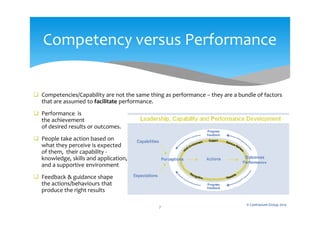
 Competencies/Capability are not the same thing as performance – they are a bundle of factors
that are assumed to facilitate performance.
 Performance is
the achievement
of desired results or outcomes.
 People take action based on
what they perceive is expected
of them, their capability -
knowledge, skills and application,
and a supportive environment
 Feedback & guidance shape
the actions/behaviours that
produce the right results results
© Centranum Group 2015
7
Competency versus Performance
 It is important to validate the assumed relationship between competencies and
performance, but unfortunately this is rarely done.
 When competencies are relevant, well defined and measurable, and data on achievement
of outcomes is available, it is possible to establish the relationship and identify which
competencies are more important for success.
 Research has not established causal relationships between broadly defined competencies
and individual or organizational performance
© Centranum Group 20158
Validation
 A competency model is a list or catalogue of competencies
 It may be arranged in categories
 Competencies may have subheadings
 A competency model should provide a definition for each competency and subheading
 There should be a set of measurable or observable indicators against which individuals
can be assessed.
 Competency models may be generic, many vendors offer generic catalogues.
 Preferably competency models are customized, defined to reflect the environment,
purpose and activity of the organisation.
© Centranum Group 20159
What is a competency model?
Common Usage
Part 2
© Centranum Group 2015
10
 The use of competency models is increasing.
 A 2004 survey by Meta Group found approximately 30% of respondents were using
competency models. In 2007 a survey by the UK based CIPD ( ) found 60% of respondents
using competency models.
 As you might expect usage is highest in larger organisations, organisations with HR staff,
government organisations and in knowledge based industries such as engineering and
healthcare.
© Centranum Group 2015 11
Who uses competency models
How are competency models used?
© Centranum Group 2015 12
Competency models are typically designed for use across all HR processes, the
competency agenda includes:
 Recruitment and selection – assess occupational competence
 Performance expectations – shape behaviors contributing to organisational effectiveness
 Individual development - the behavioral repertoire
 Career & Succession Planning
 Workforce planning -– identify future requirements
 Strategic HR – create a common language
Reality Check – Claims versus
Research Evidence
Part 3
© Centranum Group 2015
13
 Performance benefits are promised by the various definitions which include the causal or
instrumental relationship of competencies and job performance and competencies and
organisational performance.
 It is widely claimed that organizations with competency frameworks in place, especially leadership
competencies, perform better.
 They see improved recruitment outcomes through more focus on required competencies
 They have improved communication through a common language for strategic HR practices
 They achieve improvements in performance management by improved assessment
 They have more effective training and individual development and
 More effective career and succession planning programs
The underlying assumption of all competency initiatives is that individual skill development, exemplified by particular behaviors, will lead to
improved job performance and, in turn, organisational performance.
© Centranum Group 2015 14
Claims
 There are very few independent studies of the link between competency and performance, most are
by vendors of generic competency libraries, tools or consulting services.
 Some large studies of HR practices show a linkage of the use of competency models in organisations
that are more successful. However the direction of the linkage is not clear. Perhaps organisations
that are successful can better afford the resources required for competency management initiatives.
 Many of the studies that are reported are anecdotal, that is
they do not involve systematic collection and analysis of data. Many
others are based on case studies where little or no details of the methodology is provided.
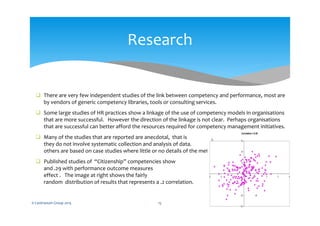
 Published studies of “Citizenship” competencies show correlations between .1
and .29 with performance outcome measures – a very small
effect . The image at right shows the fairly
random distribution of results that represents a .2 correlation.
© Centranum Group 2015 15
Research
 At the individual level different competencies predict success
 Surveys of top performing salespeople, assessed on performance outputs - sales
results, show that most rate highly on only one or two generic sales
competencies, which are not the same for all successful salespeople.
 In fact some successful salespeople rated very poorly on some sales
competencies.
 In line with research on successful job performance that shows a strong
correlation of job specific knowledge with top performance, it is the more
specific knowledge and technical competencies that have the highest correlation
with performance outcomes.
© Centranum Group 2015 16
Individual competencies
What works & what doesn’t
Part 4
© Centranum Group 2015
17
 Many competencies are defined at too high a level to enable effective or consistent
assessment.
 When such competencies that are used in the selection process are close to being
personality traits. Research shows that with the exception of the factors covered by the
Big Five personality dimension of “Conscientiousness” (achievement drive, persistence
and personal organization), trait based competencies do not add much to the predictive
power of general mental ability for job success.
 Assessment center measurements of trait based competencies over a range of exercises
are not accurate predictors of job performance.
© Centranum Group 2015 18
Recruitment & Selection
 Organisations often rate staff on broadly defined core competencies
(“citizenship” competencies such as Teamwork, Service Orientation, Business
Acumen, Commitment, Conscientiousness) and values based behaviors.
 Supervisors ratings of job performance, as opposed to objective measures of
performance, are modestly correlated with ratings of citizenship competencies.
 It is suggested that this is because supervisors are observed to tolerate poor
performance in staff with high levels of citizenship behaviours.
 There is little evidence of any systematic impact of perceived levels of these
competencies on organisational outcomes.
© Centranum Group 2015 19
 Performance Management
 Many competencies are a a smorgasbord of high level behaviours,
knowledge, “to dos”, abilities and characteristics.
 In most competency sets these definitions are very broad, and therefore
open to different interpretations.
 Diverse interpretations are due to lack of precision in ‘operational’
definitions and terminology
© Centranum Group 2015 20
 Common Language
 Competency based development works well for technical competencies and on job training.
Standards can be defined precisely and used as checklists for competency gap analysis.
 Subject matter experts should be used to develop the competencies and relevant standards for
the organisation.
 “Lean” Training can be just in time and targeted at the identified gaps.
 When training is done as it is needed, and in the context that it will be used, – on the job – it is
much more effective – studies show that 90% of learning takes place on the job.
© Centranum Group 2015 21
 Individual Development
 Career & Succession Planning
© Centranum Group 2015 22
 A competency framework is an effective tool to define and communicate the career
pathways through the organisation. Different core competencies and different
levels of competency can be specified as roles increase in seniority.
 Typically technical competencies increase in specialisation from lower to mid level
roles. Senior roles often involve competencies of project management, innovation
and oversight.
 Competency frameworks are also key to the development of appropriate leadership
practices at the various management levels of the organisation.
 Workforce planning
© Centranum Group 2015 23
 In a rapidly changing environment organisations are constantly developing strategies
to sustain and grow their revenue and profits. As new markets, technologies,
products and services come on line new competencies are required.
 A competency framework enables the identification, specification and quantum of
the knowledge and skills that will be required for new initiatives and changes in the
organization.
 The competency management system provides a real time picture of current
competencies and where the gaps are.
 Those organizations with good data on both competency and business outcomes can
identify the key drivers of successful performance.
Choosing the right competency
model
Part 5
© Centranum Group 2015
24
 Your competency framework is a strategic management tool for the organisation.
 The kind of framework you choose will be determined by your objectives which may
be:
 To communicate and shape core competencies and or values based behaviors
throughout the organisation
 Ensure that staff have the knowledge and skills necessary to perform well
 Support quality assurance programmes
 Manage risk
 Develop proven leadership practices
 Encourage staff to develop along career pathways
 Provide for the future develop talent pools and successors
© Centranum Group 2015 25
Clarify your purpose
26
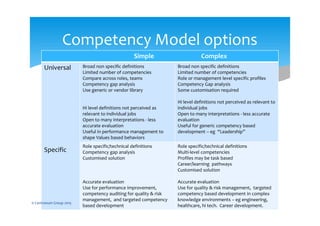
Competency Model options
Simple Complex
Universal
Specific
Broad non specific definitions
Limited number of competencies
Compare across roles, teams
Competency gap analysis
Use generic or vendor library
Hi level definitions not perceived as
relevant to individual jobs
Open to many interpretations - less
accurate evaluation
Useful in performance management to
shape Values based behaviors
Broad non specific definitions
Limited number of competencies
Role or management level specific profiles
Competency Gap analysis
Some customisation required
Hi level definitions not perceived as relevant to
individual jobs
Open to many interpretations - less accurate
evaluation
Useful for generic competency based
development – eg “Leadership”
Role specific/technical definitions
Competency gap analysis
Customised solution
Accurate evaluation
Use for performance improvement,
competency auditing for quality & risk
management, and targeted competency
based development
Role specific/technical definitions
Multi-level competencies
Profiles may be task based
Career/learning pathways
Customised solution
Accurate evaluation
Use for quality & risk management, targeted
competency based development in complex
knowledge environments – eg engineering,
healthcare, hi tech. Career development.
© Centranum Group 2015
 If you have no competency framework in place now
 Select a Simple framework – start with the Universal option to communicate expectations
of values based behaviours
 If you are a knowledge based organisation
 Add in role based competencies with specific definitions to improve individual
performance, quality and risk management.
 If you are in healthcare, engineering or hi-tech industries with a talent shortage
 consider using the more complex frameworks for critical areas of expertise to develop
staff along career pathways.
Your competency management system should be able to support a mixture of models so that
different areas of the organisation can use the model that is right for them.
© Centranum Group 2015 27
Selecting a competency model
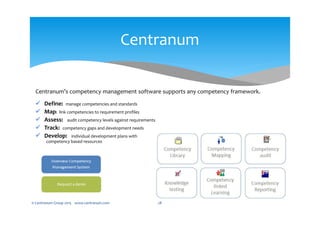
Centranum’s competency management software supports any competency framework.
 Define: manage competencies and standards
 Map: link competencies to requirement profiles
 Assess: audit competency levels against requirements
 Track: competency gaps and development needs
 Develop: individual development plans with
competency based resources
© Centranum Group 2015 www.centranum.com 28
Centranum

A practical guide to competency management

  • 1.
    A Practical Guideto Competency Management What works, what doesn’t and why © Centranum Group 2015
  • 2.
     Introductory **** Ifyou have little practical experience of competency management, or you are new to the field. Explains the fundamental principles, concepts and strategies.  Intermediate For those with some basic experience of competency management. Shows how to implement a range of competency models from the most simple to the more complex.  Advanced For knowledge based organisations where competency gaps can have critical outcomes. Shows how to integrate competency management with quality assurance and risk management. Is this presentation for me? 2 © Centranum Group 2015
  • 3.
     Part 1– About competencies and competency models 4  Part 2 – Common Usage 9  Part 3 - Reality Check – Claims versus Research Evidence 12  Part 4 – What works and what doesn’t 16  Part 5 – Choosing the right competency model 23 Contents © Centranum Group 2015 3
  • 4.
    About competencies and competencymodels Part 1 © Centranum Group 2015 4
  • 5.
    There are manydifferent definitions of competencies but all are based on one of 3 perspectives;  Competencies as educational standards – knowledge, skills and abilities assessed by a criterion – an observable behavioral standard (1970s)  Competencies as behavioral repertoires (1980s) “any individual characteristic that can be measured or counted reliably and that can be shown to differentiate significantly between superior and average performers” Spencer et al 1994  Competencies as core competencies of the organisation (1990s) “loosely coupled patterns of behavior or “behavioral themes that are considered to be critical success factors or strategic performance drivers.” Sanchez and Levine 2012 © Centranum Group 20155 What is a competency?
  • 6.
     For acompetency framework to add value to an organization competencies must be measurable.  Competency is equivalent to skill – the ability to do something.  Skills require knowledge of principles, and procedural steps.  It is also important to know when – in what situations - to use the skill. Much training does not transfer from the classroom to the workplace because this link is not made. Competency means knowledge, skill and the ability to apply these in the right context. © Centranum Group 20156 What is a competency
  • 7.
     Competencies/Capability arenot the same thing as performance – they are a bundle of factors that are assumed to facilitate performance.  Performance is the achievement of desired results or outcomes.  People take action based on what they perceive is expected of them, their capability - knowledge, skills and application, and a supportive environment  Feedback & guidance shape the actions/behaviours that produce the right results results © Centranum Group 2015 7 Competency versus Performance
  • 8.
     It isimportant to validate the assumed relationship between competencies and performance, but unfortunately this is rarely done.  When competencies are relevant, well defined and measurable, and data on achievement of outcomes is available, it is possible to establish the relationship and identify which competencies are more important for success.  Research has not established causal relationships between broadly defined competencies and individual or organizational performance © Centranum Group 20158 Validation
  • 9.
     A competencymodel is a list or catalogue of competencies  It may be arranged in categories  Competencies may have subheadings  A competency model should provide a definition for each competency and subheading  There should be a set of measurable or observable indicators against which individuals can be assessed.  Competency models may be generic, many vendors offer generic catalogues.  Preferably competency models are customized, defined to reflect the environment, purpose and activity of the organisation. © Centranum Group 20159 What is a competency model?
  • 10.
    Common Usage Part 2 ©Centranum Group 2015 10
  • 11.
     The useof competency models is increasing.  A 2004 survey by Meta Group found approximately 30% of respondents were using competency models. In 2007 a survey by the UK based CIPD ( ) found 60% of respondents using competency models.  As you might expect usage is highest in larger organisations, organisations with HR staff, government organisations and in knowledge based industries such as engineering and healthcare. © Centranum Group 2015 11 Who uses competency models
  • 12.
    How are competencymodels used? © Centranum Group 2015 12 Competency models are typically designed for use across all HR processes, the competency agenda includes:  Recruitment and selection – assess occupational competence  Performance expectations – shape behaviors contributing to organisational effectiveness  Individual development - the behavioral repertoire  Career & Succession Planning  Workforce planning -– identify future requirements  Strategic HR – create a common language
  • 13.
    Reality Check –Claims versus Research Evidence Part 3 © Centranum Group 2015 13
  • 14.
     Performance benefitsare promised by the various definitions which include the causal or instrumental relationship of competencies and job performance and competencies and organisational performance.  It is widely claimed that organizations with competency frameworks in place, especially leadership competencies, perform better.  They see improved recruitment outcomes through more focus on required competencies  They have improved communication through a common language for strategic HR practices  They achieve improvements in performance management by improved assessment  They have more effective training and individual development and  More effective career and succession planning programs The underlying assumption of all competency initiatives is that individual skill development, exemplified by particular behaviors, will lead to improved job performance and, in turn, organisational performance. © Centranum Group 2015 14 Claims
  • 15.
     There arevery few independent studies of the link between competency and performance, most are by vendors of generic competency libraries, tools or consulting services.  Some large studies of HR practices show a linkage of the use of competency models in organisations that are more successful. However the direction of the linkage is not clear. Perhaps organisations that are successful can better afford the resources required for competency management initiatives.  Many of the studies that are reported are anecdotal, that is they do not involve systematic collection and analysis of data. Many others are based on case studies where little or no details of the methodology is provided.  Published studies of “Citizenship” competencies show correlations between .1 and .29 with performance outcome measures – a very small effect . The image at right shows the fairly random distribution of results that represents a .2 correlation. © Centranum Group 2015 15 Research
  • 16.
     At theindividual level different competencies predict success  Surveys of top performing salespeople, assessed on performance outputs - sales results, show that most rate highly on only one or two generic sales competencies, which are not the same for all successful salespeople.  In fact some successful salespeople rated very poorly on some sales competencies.  In line with research on successful job performance that shows a strong correlation of job specific knowledge with top performance, it is the more specific knowledge and technical competencies that have the highest correlation with performance outcomes. © Centranum Group 2015 16 Individual competencies
  • 17.
    What works &what doesn’t Part 4 © Centranum Group 2015 17
  • 18.
     Many competenciesare defined at too high a level to enable effective or consistent assessment.  When such competencies that are used in the selection process are close to being personality traits. Research shows that with the exception of the factors covered by the Big Five personality dimension of “Conscientiousness” (achievement drive, persistence and personal organization), trait based competencies do not add much to the predictive power of general mental ability for job success.  Assessment center measurements of trait based competencies over a range of exercises are not accurate predictors of job performance. © Centranum Group 2015 18 Recruitment & Selection
  • 19.
     Organisations oftenrate staff on broadly defined core competencies (“citizenship” competencies such as Teamwork, Service Orientation, Business Acumen, Commitment, Conscientiousness) and values based behaviors.  Supervisors ratings of job performance, as opposed to objective measures of performance, are modestly correlated with ratings of citizenship competencies.  It is suggested that this is because supervisors are observed to tolerate poor performance in staff with high levels of citizenship behaviours.  There is little evidence of any systematic impact of perceived levels of these competencies on organisational outcomes. © Centranum Group 2015 19  Performance Management
  • 20.
     Many competenciesare a a smorgasbord of high level behaviours, knowledge, “to dos”, abilities and characteristics.  In most competency sets these definitions are very broad, and therefore open to different interpretations.  Diverse interpretations are due to lack of precision in ‘operational’ definitions and terminology © Centranum Group 2015 20  Common Language
  • 21.
     Competency baseddevelopment works well for technical competencies and on job training. Standards can be defined precisely and used as checklists for competency gap analysis.  Subject matter experts should be used to develop the competencies and relevant standards for the organisation.  “Lean” Training can be just in time and targeted at the identified gaps.  When training is done as it is needed, and in the context that it will be used, – on the job – it is much more effective – studies show that 90% of learning takes place on the job. © Centranum Group 2015 21  Individual Development
  • 22.
     Career &Succession Planning © Centranum Group 2015 22  A competency framework is an effective tool to define and communicate the career pathways through the organisation. Different core competencies and different levels of competency can be specified as roles increase in seniority.  Typically technical competencies increase in specialisation from lower to mid level roles. Senior roles often involve competencies of project management, innovation and oversight.  Competency frameworks are also key to the development of appropriate leadership practices at the various management levels of the organisation.
  • 23.
     Workforce planning ©Centranum Group 2015 23  In a rapidly changing environment organisations are constantly developing strategies to sustain and grow their revenue and profits. As new markets, technologies, products and services come on line new competencies are required.  A competency framework enables the identification, specification and quantum of the knowledge and skills that will be required for new initiatives and changes in the organization.  The competency management system provides a real time picture of current competencies and where the gaps are.  Those organizations with good data on both competency and business outcomes can identify the key drivers of successful performance.
  • 24.
    Choosing the rightcompetency model Part 5 © Centranum Group 2015 24
  • 25.
     Your competencyframework is a strategic management tool for the organisation.  The kind of framework you choose will be determined by your objectives which may be:  To communicate and shape core competencies and or values based behaviors throughout the organisation  Ensure that staff have the knowledge and skills necessary to perform well  Support quality assurance programmes  Manage risk  Develop proven leadership practices  Encourage staff to develop along career pathways  Provide for the future develop talent pools and successors © Centranum Group 2015 25 Clarify your purpose
  • 26.
    26 Competency Model options SimpleComplex Universal Specific Broad non specific definitions Limited number of competencies Compare across roles, teams Competency gap analysis Use generic or vendor library Hi level definitions not perceived as relevant to individual jobs Open to many interpretations - less accurate evaluation Useful in performance management to shape Values based behaviors Broad non specific definitions Limited number of competencies Role or management level specific profiles Competency Gap analysis Some customisation required Hi level definitions not perceived as relevant to individual jobs Open to many interpretations - less accurate evaluation Useful for generic competency based development – eg “Leadership” Role specific/technical definitions Competency gap analysis Customised solution Accurate evaluation Use for performance improvement, competency auditing for quality & risk management, and targeted competency based development Role specific/technical definitions Multi-level competencies Profiles may be task based Career/learning pathways Customised solution Accurate evaluation Use for quality & risk management, targeted competency based development in complex knowledge environments – eg engineering, healthcare, hi tech. Career development. © Centranum Group 2015
  • 27.
     If youhave no competency framework in place now  Select a Simple framework – start with the Universal option to communicate expectations of values based behaviours  If you are a knowledge based organisation  Add in role based competencies with specific definitions to improve individual performance, quality and risk management.  If you are in healthcare, engineering or hi-tech industries with a talent shortage  consider using the more complex frameworks for critical areas of expertise to develop staff along career pathways. Your competency management system should be able to support a mixture of models so that different areas of the organisation can use the model that is right for them. © Centranum Group 2015 27 Selecting a competency model
  • 28.
    Centranum’s competency managementsoftware supports any competency framework.  Define: manage competencies and standards  Map: link competencies to requirement profiles  Assess: audit competency levels against requirements  Track: competency gaps and development needs  Develop: individual development plans with competency based resources © Centranum Group 2015 www.centranum.com 28 Centranum