International Journal of Management (IJM), ISSN 0976 – 6502(Print), ISSN 0976 - 6510(Online), 
Volume 5, Issue 7, July (2014), pp. 73-80 © IAEME 
INTERNATIONAL JOURNAL OF MANAGEMENT (IJM) 
 
ISSN 0976-6502 (Print) 
ISSN 0976-6510 (Online) 
Volume 5, Issue 7, July (2014), pp. 73-80 
© IAEME: http://www.iaeme.com/IJM.asp 
Journal Impact Factor (2014): 7.2230 (Calculated by GISI) 
www.jifactor.com 
73 
 
IJM 
© I A E M E 
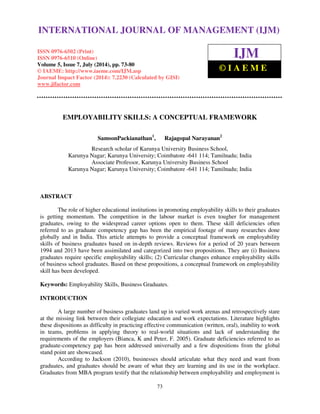
EMPLOYABILITY SKILLS: A CONCEPTUAL FRAMEWORK 
SamsonPackianathan1, Rajagopal Narayanan2 
Research scholar of Karunya University Business School, 
Karunya Nagar; Karunya University; Coimbatore -641 114; Tamilnadu; India 
Associate Professor, Karunya University Business School 
Karunya Nagar; Karunya University; Coimbatore -641 114; Tamilnadu; India 
ABSTRACT 
The role of higher educational institutions in promoting employability skills to their graduates 
is getting momentum. The competition in the labour market is even tougher for management 
graduates, owing to the widespread career options open to them. These skill deficiencies often 
referred to as graduate competency gap has been the empirical footage of many researches done 
globally and in India. This article attempts to provide a conceptual framework on employability 
skills of business graduates based on in-depth reviews. Reviews for a period of 20 years between 
1994 and 2013 have been assimilated and categorized into two propositions. They are (i) Business 
graduates require specific employability skills; (2) Curricular changes enhance employability skills 
of business school graduates. Based on these propositions, a conceptual framework on employability 
skill has been developed. 
Keywords: Employability Skills, Business Graduates. 
INTRODUCTION 
A large number of business graduates land up in varied work arenas and retrospectively stare 
at the missing link between their collegiate education and work expectations. Literature highlights 
these dispositions as difficulty in practicing effective communication (written, oral), inability to work 
in teams, problems in applying theory to real-world situations and lack of understanding the 
requirements of the employers (Bianca, K and Peter, F. 2005). Graduate deficiencies referred to as 
graduate-competency gap has been addressed universally and a few dispositions from the global 
stand point are showcased. 
According to Jackson (2010), businesses should articulate what they need and want from 
graduates, and graduates should be aware of what they are learning and its use in the workplace. 
Graduates from MBA program testify that the relationship between employability and employment is
International Journal of Management (IJM), ISSN 0976 – 6502(Print), ISSN 0976 - 6510(Online), 
Volume 5, Issue 7, July (2014), pp. 73-80 © IAEME 
 
far from straight forward (Wilton 2011). Research also articulates that business studies have a 
positive effect on skills, employability and compensation and moderate effect on career advancement 
(Dimitrios and Kristina, 2006). When supervisors / managers were asked to rate their perceptions on 
graduate-skill gap, they claim that graduates are proficient in non-technical skills and deficient in 
essential managerial skill set (Jackson and Chapman, 2011). Pedagogy is the source which is targeted 
for bridging this graduate skill gap and they are advised to reflect and articulate required 
competencies in recruitment situations (Jackson, 2010). James (2013) sums up these factors and 
urges researchers to re-direct their efforts to investigations which focus on provision of graduate 
skills which is based on demand, development and deployment. 
74 
 
Exploring the business graduates’ employability skill in the Indian perspective, exposes 
research generated content which requires exemplification in the pursuit of generating solutions to 
the existing trend. Shrivastava (2013) claims that developing soft skills is no more a matter of choice 
rather it is essential for efficient work performance, growth and success at an international platform. 
Jog (2013) synonymizes the same by stating that there is a definite mismatch of skills that are 
required in the real world of work compared to mainstream education. The answers to these 
empirical situations is summarized by Noronha (2011) who recommends that business schools must 
meet the challenge to deliver management education and knowledge that is relevant in both global 
and local settings. There is a need to improve the skilled based training in business education. 
OBJECTIVE 
The major objectives of the study are: 
• To develop propositions related to employability skills of business graduates 
• To identify the factors related to employability skills of business graduates 
• To develop a conceptual framework on employability skills of business graduates 
METHODOLOGY 
Systematic review was done to ascertain the existing literature on the competencies required 
by business graduates to market themselves to the recruiters and to sustain their employability. A 
total of 57 research work for a span of 20 years (1994 and 2013) was assimilated and were classified 
into two propositions. These proportions are: 
• Business graduates require specific employability skills 
• Curricular Changes Enhance Employability skills of Business graduates 
These propositions give clear indications about factors related to employability skills, and 
based on that a conceptual framework has been developed. 
DISCUSSION ON PROPOSITIONS 
Proposition I: Business School Graduates require specific employability skills 
Business graduates are placed in varied employment capacities and the norm of the day is for 
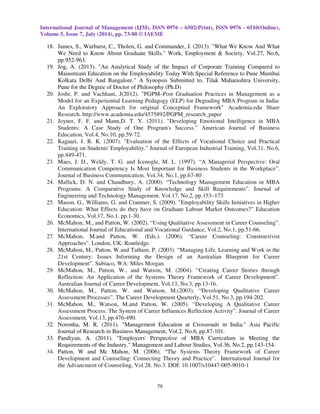
them to possess certain competencies which will help them to transit from a graduate to an 
employee. The competencies often cited as important for the employment of business graduatesare 
written communication, oral communication, investigating and analyzing skills, planning and 
organizing skills, negotiating and persuading skills, cooperation, leadership, and numeracy. 
Literature points out that these competencies have been repeatedly magnified by employers,
International Journal of Management (IJM), ISSN 0976 – 6502(Print), ISSN 0976 - 6510(Online), 
Volume 5, Issue 7, July (2014), pp. 73-80 © IAEME 
 
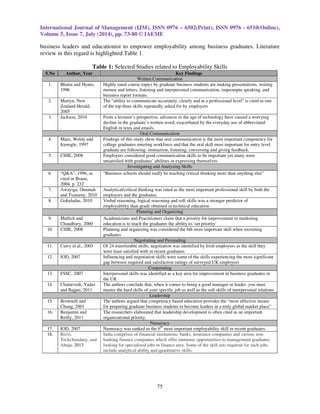
business leaders and educationist to empower employability among business graduates. Literature 
review in this regard is highlighted Table 1. 
75 
 
Table 1: Selected Studies related to Employability Skills 
S.No Author, Year Key Findings 
Written Communication 
1. Bhatia and Hynes, 
1996 
Highly rated course topics by graduate business students are making presentations, writing 
memos and letters, listening and interpersonal communication, impromptu speaking, and 
business report formats. 
2. Martyn, New 
Zealand Herald, 
2005 
The “ability to communicate accurately, clearly and at a professional level” is cited as one 
of the top three skills repeatedly asked for by employers 
3. Jackson, 2010 From a lecturer’s perspective, advances in the age of technology have caused a worrying 
decline in the graduate’s written word; exacerbated by the everyday use of abbreviated 
English in texts and emails. 
Oral Communication 
4. Maes, Weldy and 
Icenogle, 1997 
Findings of this study show that oral communication is the most important competency for 
college graduates entering workforce and that the oral skill most important for entry level 
graduate are following: instruction, listening, conversing and giving feedback. 
5. CIHE, 2008 Employers considered good communication skills to be important yet many were 
unsatisfied with graduates’ abilities in expressing themselves 
Investigating and Analyzing Skills 
6. “QA”, 1996, as 
cited in Braun, 
2004, p. 232 
“Business schools should really be teaching critical thinking more than anything else” 
7. Awayiga, Onumah 
and Tsameny, 2010 
Analytical/critical thinking was rated as the most important professional skill by both the 
employers and the graduates. 
8. Gokuladas, 2010 
Verbal reasoning, logical reasoning and soft skills was a stronger predictor of 
employability than grade obtained in technical education 
Planning and Organizing 
9. Mallick and 
Chaudhury, 2000 
Academicians and Practitioners claim that a priority for improvement in marketing 
education is to teach the graduates the ability to ‘set priority’ 
10. CIHE, 2008 Planning and organizing was considered the 6th most important skill when recruiting 
graduates 
Negotiating and Persuading 
11. Curry et al., 2003 Of 24 transferable skills, negotiation was identified by Irish employers as the skill they 
were least satisfied with in recent graduates 
12. IOD, 2007 Influencing and negotiation skills were some of the skills experiencing the most significant 
gap between required and satisfaction ratings of surveyed UK employers 
Cooperating 
13. FSSC, 2007 Interpersonal skills was identified as a key area for improvement in business graduates in 
the UK 
14. Chaturvedi, Yadav 
and Bajpai, 2011 
The authors conclude that, when it comes to being a good manager or leader, you must 
master the hard skills of your specific job as well as the soft skills of interpersonal relations 
Leadership 
15. Brownell and 
Chung, 2001 
The authors argued that competency based education provides the “most effective means 
for preparing graduate business students to become leaders in a truly global market place” 
16. Benjamin and 
Reilly, 2011 
The researchers elaborated that leadership development is often cited as an important 
organizational priority. 
Numeracy 
17. IOD, 2007 Numeracy was ranked as the 6th most important employability skill in recent graduates. 
18. Rizvi, 
Teckchandany, and 
Ahuja, 2013 
India comprises of financial institutions, banks, insurance companies and various non-banking 
finance companies which offer immense opportunities to management graduates 
looking for specialized jobs in finance area. Some of the skill sets required for such jobs 
include analytical ability and quantitative skills.
International Journal of Management (IJM), ISSN 0976 – 6502(Print), ISSN 0976 - 6510(Online), 
Volume 5, Issue 7, July (2014), pp. 73-80 © IAEME 
 
Proposition II: Curricular Changes Enhance Employability Skills of Business Graduates 
76 
 
Researchers urge the need to infuse essential competencies in the educational arena to make 
business graduates employable and useful to society. The implications in most of the above stated 
abstracts are for curricular changes which foster employability skills. Major research findings on 
integrative curricular changes from the global and national front are briefed in Table 2. 
Table 2: Selected Studies related to curricular change and employability 
S. 
No 
Author, Year Key Findings 
1. Kagaari, 2007 This paper calls for involvement of stakeholders in design, 
implementation and evaluation of the university curriculum. 
2. Mason, 2009 
He found that structured work experience and employer involvement in 
degree course design and delivery have clear positive effects on the 
ability of graduates to secure employment 
3. Wellman, 2010 
They suggest a need for pruning of the theory syllabus and the 
creation of a toolbox of practical methods and techniques is required 
to resolve the gap between theory and practice 
4. Pandiyan, 2011 
A flexible MBA program is suggested to accommodate the needs of 
changing industrial scenario, keeping in mind only a program which 
allows constant assessment and re-evaluation with scope for 
modification will help achieve meeting the changing demands of the 
industries. 
5. Joyner and 
Mann, 2011 
They conclude that emotional intelligence (EI) is gaining ground in 
academic settings 
6. Chynoweth, 
2012 
Internship programs improves the employability of new graduates 
7. Crayford, 2012 
There is a need for personal development, employability skills and 
attributes of an entrepreneurial mind-set among graduates for the post 
2011 workplace 
8. Joshi, 2012 There is a need to introduce a new Experiential Learning Pedagogy 
9. Shrivastava, 
2013 
Read, revise and restructure the India education system and joint 
initiatives by the industry, academia  government to wash out the 
talent gap 
A Conceptual Framework of Employability Skills of Business Graduates 
The framework takes its root from Systems Theory Framework (STF) of career development 
and counseling (Patton, W  Mc Mahon, M. 2006). This theory was founded primarily for career 
counseling and is based on the philosophy of traditional predictive theories and more recent 
constructivist career counseling approaches (McMahon  Patton, 2002; McMahon, Patton  
Watson, 2003; 2004; McMahon, Watson,  Patton, 2005). This framework functions as a link 
between theory and practice, which is the core need behind graduate competency gap. 
The reviews summarized in table 1 and 2 provide sufficient information about the required 
skills of business graduate and the curricular changes which could enhance employability. It is also 
needed to be understood that the required skills vary according to personal characteristics (age, 
gender, religion, family background, personality trait, educational background, previous job 
experience and future job preference). In Figure 1, the propositions are magnified and are connected 
by ‘bolded arrows’ to the employability of business graduates, due to their strong evidence based 
foundation. The influence of personal characteristics in the development of employability skills is 
illustrated in Figure 1 with ‘dotted arrows’ as it is a grey area to reckon with.
International Journal of Management (IJM), ISSN 0976 – 6502(Print), ISSN 0976 - 6510(Online), 
Volume 5, Issue 7, July (2014), pp. 73-80 © IAEME 
 
77 
 
PERSONAL 
CHARACTERISTICS 
Age 
Gender 
Religion 
Family background 
Personality trait 
Educational background 
Previous job experience 
Future job preference 
Employability of Business 
Graduates 
PROPOSITION I 
Employability Skills 
Written Communication 
Verbal Communication 
Investigating and Analyzing 
Planning and Organizing 
Negotiating and Persuading 
Co-operating 
Leadership 
Numeracy 
PROPOSITION II 
Curricular Changes and 
Employability 
Stake holder involvement in 
curriculum planning 
Experential learning pedagogy 
Flexible curriculum 
Soft skill training 
Mock interviews 
Figure 1: Conceptual Framework on Employability skill 
CONCLUSION 
This model can be used as a tool that helps the business graduates to: - (1) self-assess their 
capabilities, potentials and strengths; (2) self-initiate in acquiring skills which is required for their 
expected job performance; and (3) constantly self-realize their achievement in the ever-evolving 
education-employment arenas. Assessing these behaviors will foster self-confidence among business 
graduates which will enhance their chances of employment. The focus for the business schools is to 
provide effective and efficient graduates equipped with the skill-set required by the the job market. 
This requires them to be up-to-date with current literature and also forces them to perform empirical 
surveys on novel pedagogical methodologies. The burden is heavy on the educationist and they need 
to modulate themselves to perform what they have been called for. A summary from the research 
work of Rao (2011) amplifies the multifaceted approach to be undertaken by the nurturing 
institutions. Rao (2011) presented factors which enhances employability from the preview of 
curriculum, teacher and student experiences. He purports that curriculum should be mapped with the 
current market demand. Teachers should be well aware of market conditions and potential of their 
students, and know, how to enhance those potentials. Students should be exposed to quality work-integrated 
learning, cooperative learning, and mentoring programs. Business leaders and recruitment 
agencies are called to be stake holders and contribute to the revisions required in the curricular 
content and teaching-learning methodologies.
International Journal of Management (IJM), ISSN 0976 – 6502(Print), ISSN 0976 - 6510(Online), 
Volume 5, Issue 7, July (2014), pp. 73-80 © IAEME 
 
78 
 
In short, both education and employment are life-long processes, which require mediating 
and modulating to suit the recruiters’ requirement. Effective collaboration between the teaching 
institution and changing labour market, will spring forth a work force which will be a priceless gift to 
the society, contributing to the economic growth of a nation. 
REFERENCES 
1. Awayiga, J. Y., Onumah, J. M. and Tsameny, M. (2010). Knowledge and Skills 
Development of Accounting Graduates: The Perceptions of Graduates and Employers in 
Ghana. Accounting Education: An International Journal, Vol.19, No.1-2, pp. 139-158. 
2. Benjamin, B. and O'Reilly, C. (2011). Becoming a Leader: Early Career Challenges Faced 
by MBA Graduates. Academy of Management Learning  Education, Vol.10, No.3, 
pp. 452-472. 
3. Bhatia, G. and Hynes, V. (1996). “Graduate Business Students' Preferences for the 
Managerial Communication Course Curriculum”. Business Communication Quarterly, 
Vol.59, No.2, pp. 45-55. 
4. Bianca, K. and Peter, F. (2005). Economics Subject Centre: Student Employability Profile. 
5. Braun, N. M. (2004). “Critical Thinking in the Business Curriculum”. Journal of Education 
for Business, Vol.79, pp. 232-236. 
6. Brownell, J. and Chung, B. G. (2001). “The Management Development Program: A 
Competency-Based Model for Preparing Hospitality Leaders”. Journal of Management 
Education, Vol.25, pp. 124-145. doi:10.1177/105256290102500203 
7. Chaturvedi. A., Yadav. A. K. and Bajpai. S. (2011). “Communicative Approach to Soft  
Hard Skills:. VSRD-IJBMR, Vol.1, No.1, pp. 1-6 
8. Chynoweth, C. (2012). Work the Experience. People Management: pp. 42-46. 
9. Council for Industry and Higher Education (2008). “Graduate Employability: What do 
Employers Think and Want?” (W. Archer and J. Davison, Eds). London: Author. 
10. Crayford, J., Fearon, C., McLaughlin, H. and Vuuren, W. (2012) Affirming Entrepreneurial 
Education: Learning, Employability and Personal Development, Industrial and Commercial 
Training, Vol.44, No.4, pp.187 – 193 
11. Curry, P., Sherry, R., and Tunney, O. (2003). “What Transferable Skills do Employers Look 
for in Third-Level Graduates?” Results of Employer Survey Summary Report. Dublin: 
University of Dublin Trinity College. 
12. Dimitrios M.M. and Kristina, A. E. (2006) Perceived Effects of an MBA Degree on 
Employability and Career Advancement: The Case of Greece, Career Development 
International, Vol.11, No.4, pp.352 – 361 
13. Financial Services Skills Council (2007). The skills bill: Analysis of Skills Needs in UK 
Financial Services. London: Author. 
14. Gokuladas, V. K. (2010). Technical and Non-Technical Education and the Employability of 
Engineering Graduates: An Indian Case Study. International Journal of Training  
Development, Vol.14, No.2, pp.130-143. 
15. Institute of Directors (2007). Institute of Directors Skills Briefing - December 2007: 
Graduates’ Employability Skills. London: Author. 
16. Jackson, D and Chapman, E. (2011). Non-technical Skills Gaps in Australian Business 
Graduates. www.emeraldinsight.com/0040-0912.htm, pg 95-113 
17. Jackson, D. (2010). An International Profile of Industry-Relevant Competencies and Skill 
Gaps in Modern Graduates. International Journal of Management Education, Vol.8, No.3, 
pp.29-58.
International Journal of Management (IJM), ISSN 0976 – 6502(Print), ISSN 0976 - 6510(Online), 
Volume 5, Issue 7, July (2014), pp. 73-80 © IAEME 
 
79 
 
18. James, S., Warhurst, C., Tholen, G. and Commander, J. (2013). What We Know And What 
We Need to Know About Graduate Skills. Work, Employment  Society, Vol.27, No.6, 
pp.952-963. 
19. Jog, A. (2013). An Analytical Study of the Impact of Corporate Training Compared to 
Mainstream Education on the Employability Today With Special Reference to Pune Mumbai 
Kolkata Delhi And Bangalore. A Synopsis Submitted to, Tilak Maharashtra University, 
Pune for the Degree of Doctor of Philosophy (Ph.D) 
20. Joshi, P. and Vachhani, J(2012). PGPM–Post Graduation Practices in Management as a 
Model for an Experiential Learning Pedagogy (ELP) for Degrading MBA Program in India: 
An Exploratory Approach for original Conceptual Framework Academia.edu Share 
Research. http://www.academia.edu/4575892/PGPM_research_paper 
21. Joyner, F. F. and Mann,D. T. Y. (2011). Developing Emotional Intelligence in MBA 
Students: A Case Study of One Program's Success. American Journal of Business 
Education, Vol.4, No.10, pp.59-72. 
22. Kagaari, J. R. K. (2007). Evaluation of the Effects of Vocational Choice and Practical 
Training on Students' Employability. Journal of European Industrial Training, Vol.31, No.6, 
pp.449-471. 
23. Maes, J. D., Weldy, T. G. and Icenogle, M. L. (1997). “A Managerial Perspective: Oral 
Communication Competency Is Most Important for Business Students in the Workplace”. 
Journal of Business Communication. Vol.34, No.1, pp.67-80 
24. Mallick, D. N. and Chaudhury, A. (2000). “Technology Management Education in MBA 
Programs: A Comparative Study of Knowledge and Skill Requirements”. Journal of 
Engineering and Technology Management. Vol.17, No.2, pp.153–173 
25. Mason, G., Williams, G. and Cranmer, S. (2009). Employability Skills Initiatives in Higher 
Education: What Effects do they have on Graduate Labour Market Outcomes? Education 
Economics, Vol.17, No.1. pp.1-30. 
26. McMahon, M., and Patton, W. (2002). “Using Qualitative Assessment in Career Counseling”. 
International Journal of Educational and Vocational Guidance, Vol.2, No.1, pp.51-66. 
27. McMahon, M.and Patton, W. (Eds.). (2006). “Career Counseling: Constructivist 
Approaches”. London, UK: Routledge. 
28. McMahon, M., Patton, W.and Tatham, P. (2003). “Managing Life, Learning and Work in the 
21st Century: Issues Informing the Design of an Australian Blueprint for Career 
Development”. Subiaco, WA: Miles Morgan. 
29. McMahon, M., Patton, W., and Watson, M. (2004). “Creating Career Stories through 
Reflection: An Application of the Systems Theory Framework of Career Development”. 
Australian Journal of Career Development, Vol.13, No.3, pp.13-16. 
30. McMahon, M., Patton, W. and Watson, M.(2003). “Developing Qualitative Career 
Assessment Processes”. The Career Development Quarterly, Vol.51, No.3, pp.194-202. 
31. McMahon, M., Watson, M.and Patton, W. (2005). “Developing A Qualitative Career 
Assessment Process: The System of Career Influences Reflection Activity”. Journal of Career 
Assessment, Vol.13, pp.476-490. 
32. Noronha, M. R. (2011). Management Education at Crossroads in India. Asia Pacific 
Journal of Research in Business Management, Vol.2, No.6, pp.87-101. 
33. Pandiyan, A. (2011). Employers' Perspective of MBA Curriculum in Meeting the 
Requirements of the Industry. Management and Labour Studies, Vol.36, No.2, pp.143-154. 
34. Patton, W and Mc Mahon, M. (2006). “The Systems Theory Framework of Career 
Development and Counseling: Connecting Theory and Practice”. International Journal for 
the Advancment of Counseling, Vol.28. No.3. DOI: 10.1007/s10447-005-9010-1
International Journal of Management (IJM), ISSN 0976 – 6502(Print), ISSN 0976 - 6510(Online), 
Volume 5, Issue 7, July (2014), pp. 73-80 © IAEME 
 
80 
 
35. Rao, A. A., Shah, S. S. H., Jabran, A., Raza, J. A., Wasiq, E., Ehsan, U. and Neiman, R. S. 
(2011). Employability in MNCs: Challenge for Graduates. Interdisciplinary Journal of 
Contemporary Research in Business, Vol.3, No.4, pp.189-200. 
36. Rizvi, S. Teckchandany, S. and Ahuja, G. (2013). “A Study of Competencies and Skill Sets 
Needed by Potential Recruiters in the Financial Sector for Management Graduates”. 
Management Dynamics, Vol.13, No.1, pp.54-69. 16. 
37. Shrivastava, S. (2013). The Problem of Soft Skills in Indian Workforce, India Fights Back: 
an Eye-opener Study. Indian Journal of Management and Indian Business Studies, Vol.1, 
No.1, pp.35-56. 
38. Wellman, N. (2010). Relating the Curriculum to Marketing Competence: A Conceptual 
Framework. Marketing Review, Vol.10, No.2, pp.119-134. 
39. Wilton, N. (2011). Do Employability Skills Really Matter in the UK Graduate Labour 
Market? The Case of Business and Management Graduates. Work, Employment  Society, 
Vol.25, No.1, pp.85-100. 
40. A.M. Kulkarni, H.K. Abhyankar and S.S. Kulkarni, “It/Ites Industry Perspectives on 
Improving Fresher’s Employability – A Case Study”, International Journal of Management 
(IJM), Volume 4, Issue 6, 2013, pp. 183 - 191, ISSN Print: 0976-6502, ISSN Online: 
0976-6510. 
41. Dr. Amarja Satish Nargunde, “Soft Skills: A Theoretical Perspective”, International Journal 
of Marketing  Human Resource Management (IJMHRM), Volume 4, Issue 3, 2013, 
pp. 38 - 44, ISSN Print: 0976 – 6421, ISSN Online: 0976- 643X. 
42. Saundarya Rajesh and Dr. B. Kalpana, “Impact of Career Enablers and Flexible Working 
Methods on Workforce Participation of Women: An Empirical Study using Path Model”, 
International Journal of Management (IJM), Volume 3, Issue 3, 2012, pp. 42 - 50, 
ISSN Print: 0976-6502, ISSN Online: 0976-6510. 
43. M. Radhakrishnan and Dr. S. Sudha, “An Overview of Employability Skills Required for 
Engineering College Leavers”, International Journal of Management (IJM), Volume 3, 
Issue 1, 2012, pp. 231 - 236, ISSN Print: 0976-6502, ISSN Online: 0976-6510.

10120140507007

  • 1.
    International Journal ofManagement (IJM), ISSN 0976 – 6502(Print), ISSN 0976 - 6510(Online), Volume 5, Issue 7, July (2014), pp. 73-80 © IAEME INTERNATIONAL JOURNAL OF MANAGEMENT (IJM) ISSN 0976-6502 (Print) ISSN 0976-6510 (Online) Volume 5, Issue 7, July (2014), pp. 73-80 © IAEME: http://www.iaeme.com/IJM.asp Journal Impact Factor (2014): 7.2230 (Calculated by GISI) www.jifactor.com 73 IJM © I A E M E EMPLOYABILITY SKILLS: A CONCEPTUAL FRAMEWORK SamsonPackianathan1, Rajagopal Narayanan2 Research scholar of Karunya University Business School, Karunya Nagar; Karunya University; Coimbatore -641 114; Tamilnadu; India Associate Professor, Karunya University Business School Karunya Nagar; Karunya University; Coimbatore -641 114; Tamilnadu; India ABSTRACT The role of higher educational institutions in promoting employability skills to their graduates is getting momentum. The competition in the labour market is even tougher for management graduates, owing to the widespread career options open to them. These skill deficiencies often referred to as graduate competency gap has been the empirical footage of many researches done globally and in India. This article attempts to provide a conceptual framework on employability skills of business graduates based on in-depth reviews. Reviews for a period of 20 years between 1994 and 2013 have been assimilated and categorized into two propositions. They are (i) Business graduates require specific employability skills; (2) Curricular changes enhance employability skills of business school graduates. Based on these propositions, a conceptual framework on employability skill has been developed. Keywords: Employability Skills, Business Graduates. INTRODUCTION A large number of business graduates land up in varied work arenas and retrospectively stare at the missing link between their collegiate education and work expectations. Literature highlights these dispositions as difficulty in practicing effective communication (written, oral), inability to work in teams, problems in applying theory to real-world situations and lack of understanding the requirements of the employers (Bianca, K and Peter, F. 2005). Graduate deficiencies referred to as graduate-competency gap has been addressed universally and a few dispositions from the global stand point are showcased. According to Jackson (2010), businesses should articulate what they need and want from graduates, and graduates should be aware of what they are learning and its use in the workplace. Graduates from MBA program testify that the relationship between employability and employment is
  • 2.
    International Journal ofManagement (IJM), ISSN 0976 – 6502(Print), ISSN 0976 - 6510(Online), Volume 5, Issue 7, July (2014), pp. 73-80 © IAEME far from straight forward (Wilton 2011). Research also articulates that business studies have a positive effect on skills, employability and compensation and moderate effect on career advancement (Dimitrios and Kristina, 2006). When supervisors / managers were asked to rate their perceptions on graduate-skill gap, they claim that graduates are proficient in non-technical skills and deficient in essential managerial skill set (Jackson and Chapman, 2011). Pedagogy is the source which is targeted for bridging this graduate skill gap and they are advised to reflect and articulate required competencies in recruitment situations (Jackson, 2010). James (2013) sums up these factors and urges researchers to re-direct their efforts to investigations which focus on provision of graduate skills which is based on demand, development and deployment. 74 Exploring the business graduates’ employability skill in the Indian perspective, exposes research generated content which requires exemplification in the pursuit of generating solutions to the existing trend. Shrivastava (2013) claims that developing soft skills is no more a matter of choice rather it is essential for efficient work performance, growth and success at an international platform. Jog (2013) synonymizes the same by stating that there is a definite mismatch of skills that are required in the real world of work compared to mainstream education. The answers to these empirical situations is summarized by Noronha (2011) who recommends that business schools must meet the challenge to deliver management education and knowledge that is relevant in both global and local settings. There is a need to improve the skilled based training in business education. OBJECTIVE The major objectives of the study are: • To develop propositions related to employability skills of business graduates • To identify the factors related to employability skills of business graduates • To develop a conceptual framework on employability skills of business graduates METHODOLOGY Systematic review was done to ascertain the existing literature on the competencies required by business graduates to market themselves to the recruiters and to sustain their employability. A total of 57 research work for a span of 20 years (1994 and 2013) was assimilated and were classified into two propositions. These proportions are: • Business graduates require specific employability skills • Curricular Changes Enhance Employability skills of Business graduates These propositions give clear indications about factors related to employability skills, and based on that a conceptual framework has been developed. DISCUSSION ON PROPOSITIONS Proposition I: Business School Graduates require specific employability skills Business graduates are placed in varied employment capacities and the norm of the day is for them to possess certain competencies which will help them to transit from a graduate to an employee. The competencies often cited as important for the employment of business graduatesare written communication, oral communication, investigating and analyzing skills, planning and organizing skills, negotiating and persuading skills, cooperation, leadership, and numeracy. Literature points out that these competencies have been repeatedly magnified by employers,
  • 3.
    International Journal ofManagement (IJM), ISSN 0976 – 6502(Print), ISSN 0976 - 6510(Online), Volume 5, Issue 7, July (2014), pp. 73-80 © IAEME business leaders and educationist to empower employability among business graduates. Literature review in this regard is highlighted Table 1. 75 Table 1: Selected Studies related to Employability Skills S.No Author, Year Key Findings Written Communication 1. Bhatia and Hynes, 1996 Highly rated course topics by graduate business students are making presentations, writing memos and letters, listening and interpersonal communication, impromptu speaking, and business report formats. 2. Martyn, New Zealand Herald, 2005 The “ability to communicate accurately, clearly and at a professional level” is cited as one of the top three skills repeatedly asked for by employers 3. Jackson, 2010 From a lecturer’s perspective, advances in the age of technology have caused a worrying decline in the graduate’s written word; exacerbated by the everyday use of abbreviated English in texts and emails. Oral Communication 4. Maes, Weldy and Icenogle, 1997 Findings of this study show that oral communication is the most important competency for college graduates entering workforce and that the oral skill most important for entry level graduate are following: instruction, listening, conversing and giving feedback. 5. CIHE, 2008 Employers considered good communication skills to be important yet many were unsatisfied with graduates’ abilities in expressing themselves Investigating and Analyzing Skills 6. “QA”, 1996, as cited in Braun, 2004, p. 232 “Business schools should really be teaching critical thinking more than anything else” 7. Awayiga, Onumah and Tsameny, 2010 Analytical/critical thinking was rated as the most important professional skill by both the employers and the graduates. 8. Gokuladas, 2010 Verbal reasoning, logical reasoning and soft skills was a stronger predictor of employability than grade obtained in technical education Planning and Organizing 9. Mallick and Chaudhury, 2000 Academicians and Practitioners claim that a priority for improvement in marketing education is to teach the graduates the ability to ‘set priority’ 10. CIHE, 2008 Planning and organizing was considered the 6th most important skill when recruiting graduates Negotiating and Persuading 11. Curry et al., 2003 Of 24 transferable skills, negotiation was identified by Irish employers as the skill they were least satisfied with in recent graduates 12. IOD, 2007 Influencing and negotiation skills were some of the skills experiencing the most significant gap between required and satisfaction ratings of surveyed UK employers Cooperating 13. FSSC, 2007 Interpersonal skills was identified as a key area for improvement in business graduates in the UK 14. Chaturvedi, Yadav and Bajpai, 2011 The authors conclude that, when it comes to being a good manager or leader, you must master the hard skills of your specific job as well as the soft skills of interpersonal relations Leadership 15. Brownell and Chung, 2001 The authors argued that competency based education provides the “most effective means for preparing graduate business students to become leaders in a truly global market place” 16. Benjamin and Reilly, 2011 The researchers elaborated that leadership development is often cited as an important organizational priority. Numeracy 17. IOD, 2007 Numeracy was ranked as the 6th most important employability skill in recent graduates. 18. Rizvi, Teckchandany, and Ahuja, 2013 India comprises of financial institutions, banks, insurance companies and various non-banking finance companies which offer immense opportunities to management graduates looking for specialized jobs in finance area. Some of the skill sets required for such jobs include analytical ability and quantitative skills.
  • 4.
    International Journal ofManagement (IJM), ISSN 0976 – 6502(Print), ISSN 0976 - 6510(Online), Volume 5, Issue 7, July (2014), pp. 73-80 © IAEME Proposition II: Curricular Changes Enhance Employability Skills of Business Graduates 76 Researchers urge the need to infuse essential competencies in the educational arena to make business graduates employable and useful to society. The implications in most of the above stated abstracts are for curricular changes which foster employability skills. Major research findings on integrative curricular changes from the global and national front are briefed in Table 2. Table 2: Selected Studies related to curricular change and employability S. No Author, Year Key Findings 1. Kagaari, 2007 This paper calls for involvement of stakeholders in design, implementation and evaluation of the university curriculum. 2. Mason, 2009 He found that structured work experience and employer involvement in degree course design and delivery have clear positive effects on the ability of graduates to secure employment 3. Wellman, 2010 They suggest a need for pruning of the theory syllabus and the creation of a toolbox of practical methods and techniques is required to resolve the gap between theory and practice 4. Pandiyan, 2011 A flexible MBA program is suggested to accommodate the needs of changing industrial scenario, keeping in mind only a program which allows constant assessment and re-evaluation with scope for modification will help achieve meeting the changing demands of the industries. 5. Joyner and Mann, 2011 They conclude that emotional intelligence (EI) is gaining ground in academic settings 6. Chynoweth, 2012 Internship programs improves the employability of new graduates 7. Crayford, 2012 There is a need for personal development, employability skills and attributes of an entrepreneurial mind-set among graduates for the post 2011 workplace 8. Joshi, 2012 There is a need to introduce a new Experiential Learning Pedagogy 9. Shrivastava, 2013 Read, revise and restructure the India education system and joint initiatives by the industry, academia government to wash out the talent gap A Conceptual Framework of Employability Skills of Business Graduates The framework takes its root from Systems Theory Framework (STF) of career development and counseling (Patton, W Mc Mahon, M. 2006). This theory was founded primarily for career counseling and is based on the philosophy of traditional predictive theories and more recent constructivist career counseling approaches (McMahon Patton, 2002; McMahon, Patton Watson, 2003; 2004; McMahon, Watson, Patton, 2005). This framework functions as a link between theory and practice, which is the core need behind graduate competency gap. The reviews summarized in table 1 and 2 provide sufficient information about the required skills of business graduate and the curricular changes which could enhance employability. It is also needed to be understood that the required skills vary according to personal characteristics (age, gender, religion, family background, personality trait, educational background, previous job experience and future job preference). In Figure 1, the propositions are magnified and are connected by ‘bolded arrows’ to the employability of business graduates, due to their strong evidence based foundation. The influence of personal characteristics in the development of employability skills is illustrated in Figure 1 with ‘dotted arrows’ as it is a grey area to reckon with.
  • 5.
    International Journal ofManagement (IJM), ISSN 0976 – 6502(Print), ISSN 0976 - 6510(Online), Volume 5, Issue 7, July (2014), pp. 73-80 © IAEME 77 PERSONAL CHARACTERISTICS Age Gender Religion Family background Personality trait Educational background Previous job experience Future job preference Employability of Business Graduates PROPOSITION I Employability Skills Written Communication Verbal Communication Investigating and Analyzing Planning and Organizing Negotiating and Persuading Co-operating Leadership Numeracy PROPOSITION II Curricular Changes and Employability Stake holder involvement in curriculum planning Experential learning pedagogy Flexible curriculum Soft skill training Mock interviews Figure 1: Conceptual Framework on Employability skill CONCLUSION This model can be used as a tool that helps the business graduates to: - (1) self-assess their capabilities, potentials and strengths; (2) self-initiate in acquiring skills which is required for their expected job performance; and (3) constantly self-realize their achievement in the ever-evolving education-employment arenas. Assessing these behaviors will foster self-confidence among business graduates which will enhance their chances of employment. The focus for the business schools is to provide effective and efficient graduates equipped with the skill-set required by the the job market. This requires them to be up-to-date with current literature and also forces them to perform empirical surveys on novel pedagogical methodologies. The burden is heavy on the educationist and they need to modulate themselves to perform what they have been called for. A summary from the research work of Rao (2011) amplifies the multifaceted approach to be undertaken by the nurturing institutions. Rao (2011) presented factors which enhances employability from the preview of curriculum, teacher and student experiences. He purports that curriculum should be mapped with the current market demand. Teachers should be well aware of market conditions and potential of their students, and know, how to enhance those potentials. Students should be exposed to quality work-integrated learning, cooperative learning, and mentoring programs. Business leaders and recruitment agencies are called to be stake holders and contribute to the revisions required in the curricular content and teaching-learning methodologies.
  • 6.
    International Journal ofManagement (IJM), ISSN 0976 – 6502(Print), ISSN 0976 - 6510(Online), Volume 5, Issue 7, July (2014), pp. 73-80 © IAEME 78 In short, both education and employment are life-long processes, which require mediating and modulating to suit the recruiters’ requirement. Effective collaboration between the teaching institution and changing labour market, will spring forth a work force which will be a priceless gift to the society, contributing to the economic growth of a nation. REFERENCES 1. Awayiga, J. Y., Onumah, J. M. and Tsameny, M. (2010). Knowledge and Skills Development of Accounting Graduates: The Perceptions of Graduates and Employers in Ghana. Accounting Education: An International Journal, Vol.19, No.1-2, pp. 139-158. 2. Benjamin, B. and O'Reilly, C. (2011). Becoming a Leader: Early Career Challenges Faced by MBA Graduates. Academy of Management Learning Education, Vol.10, No.3, pp. 452-472. 3. Bhatia, G. and Hynes, V. (1996). “Graduate Business Students' Preferences for the Managerial Communication Course Curriculum”. Business Communication Quarterly, Vol.59, No.2, pp. 45-55. 4. Bianca, K. and Peter, F. (2005). Economics Subject Centre: Student Employability Profile. 5. Braun, N. M. (2004). “Critical Thinking in the Business Curriculum”. Journal of Education for Business, Vol.79, pp. 232-236. 6. Brownell, J. and Chung, B. G. (2001). “The Management Development Program: A Competency-Based Model for Preparing Hospitality Leaders”. Journal of Management Education, Vol.25, pp. 124-145. doi:10.1177/105256290102500203 7. Chaturvedi. A., Yadav. A. K. and Bajpai. S. (2011). “Communicative Approach to Soft Hard Skills:. VSRD-IJBMR, Vol.1, No.1, pp. 1-6 8. Chynoweth, C. (2012). Work the Experience. People Management: pp. 42-46. 9. Council for Industry and Higher Education (2008). “Graduate Employability: What do Employers Think and Want?” (W. Archer and J. Davison, Eds). London: Author. 10. Crayford, J., Fearon, C., McLaughlin, H. and Vuuren, W. (2012) Affirming Entrepreneurial Education: Learning, Employability and Personal Development, Industrial and Commercial Training, Vol.44, No.4, pp.187 – 193 11. Curry, P., Sherry, R., and Tunney, O. (2003). “What Transferable Skills do Employers Look for in Third-Level Graduates?” Results of Employer Survey Summary Report. Dublin: University of Dublin Trinity College. 12. Dimitrios M.M. and Kristina, A. E. (2006) Perceived Effects of an MBA Degree on Employability and Career Advancement: The Case of Greece, Career Development International, Vol.11, No.4, pp.352 – 361 13. Financial Services Skills Council (2007). The skills bill: Analysis of Skills Needs in UK Financial Services. London: Author. 14. Gokuladas, V. K. (2010). Technical and Non-Technical Education and the Employability of Engineering Graduates: An Indian Case Study. International Journal of Training Development, Vol.14, No.2, pp.130-143. 15. Institute of Directors (2007). Institute of Directors Skills Briefing - December 2007: Graduates’ Employability Skills. London: Author. 16. Jackson, D and Chapman, E. (2011). Non-technical Skills Gaps in Australian Business Graduates. www.emeraldinsight.com/0040-0912.htm, pg 95-113 17. Jackson, D. (2010). An International Profile of Industry-Relevant Competencies and Skill Gaps in Modern Graduates. International Journal of Management Education, Vol.8, No.3, pp.29-58.
  • 7.
    International Journal ofManagement (IJM), ISSN 0976 – 6502(Print), ISSN 0976 - 6510(Online), Volume 5, Issue 7, July (2014), pp. 73-80 © IAEME 79 18. James, S., Warhurst, C., Tholen, G. and Commander, J. (2013). What We Know And What We Need to Know About Graduate Skills. Work, Employment Society, Vol.27, No.6, pp.952-963. 19. Jog, A. (2013). An Analytical Study of the Impact of Corporate Training Compared to Mainstream Education on the Employability Today With Special Reference to Pune Mumbai Kolkata Delhi And Bangalore. A Synopsis Submitted to, Tilak Maharashtra University, Pune for the Degree of Doctor of Philosophy (Ph.D) 20. Joshi, P. and Vachhani, J(2012). PGPM–Post Graduation Practices in Management as a Model for an Experiential Learning Pedagogy (ELP) for Degrading MBA Program in India: An Exploratory Approach for original Conceptual Framework Academia.edu Share Research. http://www.academia.edu/4575892/PGPM_research_paper 21. Joyner, F. F. and Mann,D. T. Y. (2011). Developing Emotional Intelligence in MBA Students: A Case Study of One Program's Success. American Journal of Business Education, Vol.4, No.10, pp.59-72. 22. Kagaari, J. R. K. (2007). Evaluation of the Effects of Vocational Choice and Practical Training on Students' Employability. Journal of European Industrial Training, Vol.31, No.6, pp.449-471. 23. Maes, J. D., Weldy, T. G. and Icenogle, M. L. (1997). “A Managerial Perspective: Oral Communication Competency Is Most Important for Business Students in the Workplace”. Journal of Business Communication. Vol.34, No.1, pp.67-80 24. Mallick, D. N. and Chaudhury, A. (2000). “Technology Management Education in MBA Programs: A Comparative Study of Knowledge and Skill Requirements”. Journal of Engineering and Technology Management. Vol.17, No.2, pp.153–173 25. Mason, G., Williams, G. and Cranmer, S. (2009). Employability Skills Initiatives in Higher Education: What Effects do they have on Graduate Labour Market Outcomes? Education Economics, Vol.17, No.1. pp.1-30. 26. McMahon, M., and Patton, W. (2002). “Using Qualitative Assessment in Career Counseling”. International Journal of Educational and Vocational Guidance, Vol.2, No.1, pp.51-66. 27. McMahon, M.and Patton, W. (Eds.). (2006). “Career Counseling: Constructivist Approaches”. London, UK: Routledge. 28. McMahon, M., Patton, W.and Tatham, P. (2003). “Managing Life, Learning and Work in the 21st Century: Issues Informing the Design of an Australian Blueprint for Career Development”. Subiaco, WA: Miles Morgan. 29. McMahon, M., Patton, W., and Watson, M. (2004). “Creating Career Stories through Reflection: An Application of the Systems Theory Framework of Career Development”. Australian Journal of Career Development, Vol.13, No.3, pp.13-16. 30. McMahon, M., Patton, W. and Watson, M.(2003). “Developing Qualitative Career Assessment Processes”. The Career Development Quarterly, Vol.51, No.3, pp.194-202. 31. McMahon, M., Watson, M.and Patton, W. (2005). “Developing A Qualitative Career Assessment Process: The System of Career Influences Reflection Activity”. Journal of Career Assessment, Vol.13, pp.476-490. 32. Noronha, M. R. (2011). Management Education at Crossroads in India. Asia Pacific Journal of Research in Business Management, Vol.2, No.6, pp.87-101. 33. Pandiyan, A. (2011). Employers' Perspective of MBA Curriculum in Meeting the Requirements of the Industry. Management and Labour Studies, Vol.36, No.2, pp.143-154. 34. Patton, W and Mc Mahon, M. (2006). “The Systems Theory Framework of Career Development and Counseling: Connecting Theory and Practice”. International Journal for the Advancment of Counseling, Vol.28. No.3. DOI: 10.1007/s10447-005-9010-1
  • 8.
    International Journal ofManagement (IJM), ISSN 0976 – 6502(Print), ISSN 0976 - 6510(Online), Volume 5, Issue 7, July (2014), pp. 73-80 © IAEME 80 35. Rao, A. A., Shah, S. S. H., Jabran, A., Raza, J. A., Wasiq, E., Ehsan, U. and Neiman, R. S. (2011). Employability in MNCs: Challenge for Graduates. Interdisciplinary Journal of Contemporary Research in Business, Vol.3, No.4, pp.189-200. 36. Rizvi, S. Teckchandany, S. and Ahuja, G. (2013). “A Study of Competencies and Skill Sets Needed by Potential Recruiters in the Financial Sector for Management Graduates”. Management Dynamics, Vol.13, No.1, pp.54-69. 16. 37. Shrivastava, S. (2013). The Problem of Soft Skills in Indian Workforce, India Fights Back: an Eye-opener Study. Indian Journal of Management and Indian Business Studies, Vol.1, No.1, pp.35-56. 38. Wellman, N. (2010). Relating the Curriculum to Marketing Competence: A Conceptual Framework. Marketing Review, Vol.10, No.2, pp.119-134. 39. Wilton, N. (2011). Do Employability Skills Really Matter in the UK Graduate Labour Market? The Case of Business and Management Graduates. Work, Employment Society, Vol.25, No.1, pp.85-100. 40. A.M. Kulkarni, H.K. Abhyankar and S.S. Kulkarni, “It/Ites Industry Perspectives on Improving Fresher’s Employability – A Case Study”, International Journal of Management (IJM), Volume 4, Issue 6, 2013, pp. 183 - 191, ISSN Print: 0976-6502, ISSN Online: 0976-6510. 41. Dr. Amarja Satish Nargunde, “Soft Skills: A Theoretical Perspective”, International Journal of Marketing Human Resource Management (IJMHRM), Volume 4, Issue 3, 2013, pp. 38 - 44, ISSN Print: 0976 – 6421, ISSN Online: 0976- 643X. 42. Saundarya Rajesh and Dr. B. Kalpana, “Impact of Career Enablers and Flexible Working Methods on Workforce Participation of Women: An Empirical Study using Path Model”, International Journal of Management (IJM), Volume 3, Issue 3, 2012, pp. 42 - 50, ISSN Print: 0976-6502, ISSN Online: 0976-6510. 43. M. Radhakrishnan and Dr. S. Sudha, “An Overview of Employability Skills Required for Engineering College Leavers”, International Journal of Management (IJM), Volume 3, Issue 1, 2012, pp. 231 - 236, ISSN Print: 0976-6502, ISSN Online: 0976-6510.