BUS5033W
Reward Management and
Talent Retention
Dr Anton F. SchlechterDr Anton F. Schlechter
Reward Management and
Talent Retention
 Welcome
 Lecturer
 Course outline
 Course materials
 Lectures
 Assignments
 Assignment due-dates
 Course administration
Background to the Course
 Compensating employees represents a critical
human resource practice. Without sound
compensation systems, companies cannot attract,
motivate and retain the best-qualified employees.
 Compensation systems can promote a companies’
competitive advantage when properly (strategically)
aligned with strategic goals.
Background to the Course
 The aim of this course is to provide students with
the required knowledge of the art of strategic
compensation practice so that they, as strategic
partners, may play a role in ensuring an
organisations’ competitive advantage.
 One of the greatest challenges facing companies
today is retaining top talent. The expense to an
organisation of replacing an employee (including
separation, replacement, training and lost
performance costs) can be as much as that
employee’s salary for a year. Turnover further
erodes morale among those who stay and harms
customer retention.
Course Learning Outcomes
After completion of this module, students
should have a good understanding of:
 what an equitable reward programme is;
 when reward discrimination is justified and
how to design models for rewarding special
groups;
 how to deal with inequitable rewards;
 retention strategies that organisations can
make use of to retain top talent.
Course Content
Week 1-3: Strategic Compensation Management
 Reward analyses as strategic interventions.
 Factors influencing reward management decisions.
 The strategic role of compensation in ensuring
competitive advantage.
 Fixed and variable compensation – base pay,
commission and share options.
 Legally required and discretionary employee benefits.
 Total annual reward.
Course Content
Week 4: Fair Discrimination Practices in Reward
Management
 Reward equity analyses
 Reward disparities and how to deal with them
 Rewarding special groups as fair discrimination practice
 BEE share schemes
Week 5-9: Talent Retention:
 The psychological and motivational processes the leads up
to job withdrawal and the decision to separate or not to
separate.
 Integrating compensation with strategic talent management.
 Talent retention strategies for competitive advantage.
Introduction: Strategic Reward
Management
• Where and how does reward management
and talent retention feature in strategic
planning?
• How does a human resource manager’s
expertise in reward management and talent
retention add value to strategic planning in
the organisation?
• The concept of total reward
• The components of reward management
• Factors affecting rewards
Historical Development
 Traditional approaches (60s – 70s) to managing
pay
 Salary administration: emphasised need to
attract, motivate and retain employees; focus on
competitive attributes rather than
strategic/tactical issues – reflected on how
(rigidly) organisations were structured and
managed.
 The advent of “reward management” – late 80s
 Emphasis on performance of all employees
contributing to success of the organisation.
Dynamic: more than just money. Non-financial
rewards provide intrinsic and extrinsic
motivation.
Historical Development …
 The “new pay” (Lawler, 1990)
 Need to understand the goals, values and
culture of an organisation and challenges of a
competitive global economy – people-based
rather than job-based pay – paying people for
the value they add to the organisation
 Going into the future…
 Contribution-related pay, broad-banding, job
family structures and team based pay
Reward Trends
 From …
 Narrowly-defined jobs
and job standards
 Inflexible job-evaluation
systems sizing tasks,
rewarding non-adaptive
behaviour and empire-
building, encouraging
point-grabbing
 To …
 Broad, generic roles
-emphasis on
competence and
continuous
development
 Flexible job evaluation
processes assessing
the value added by
people in roles, often
within job families
Reward Trends (cont.)…
 From …
 Hierarchical and rigid pay
structures - only way to get
on, is to move up. Focus on
next promotion.
 Emphasis on individual
performance-related pay
(PRP)
 Consolidation of rewards into
base pay
 To …
 Broad-banded and job family
pay structures emphasising
flexibility, career
development pay and
continuous improvement.
Focus on next challenge.
 More focus on team
performance, team-based
pay; contribution-related pay
 More emphasis on ‘at risk’
pay
Reward Management
 Definition: RM is concerned with the formulation
and implementation of strategies and policies
that aim to reward employees fairly, equitably
and consistently in accordance with their value to
the organisation (Armstrong, 2003).
 Strategic aims: to develop and implement the
reward policies, processes and practices
required to support the achievement of the
organisation’s goals by helping to ensure that it
has the skilled, competent, well motivated and
committed people it needs.
Reward Strategy
 What the organisation intends to do in the longer
term to develop and implement reward policies,
practices and processes that will further the
achievement of business goals:
 Clearly defined goals and linked to business
objectives
 Well designed pay and reward programmes,
tailored to the organisation and its people,
consistent and integrated with one another
 Need to be effective and supportive HR and
reward processes in place
What are the
key pay issues
right now?
What are the key pay issues right
now?
According to Zingheim & Schuster (2007):
 Individual vs. collective performance
 Absolute or relative performance
 Team based pay
 Short or long term performance
 Differentiating performance and paying for
performance
 The Top 5 “wants” expressed by
employees:
 Quality of work
 Opportunity for Training and Development
 Work/life balance
 Climate, Reputation and Values of the
Organisation
 Leadership, Feedback and
Recognition/Reward
“Reward is no longer just
about money.”
A New Employment Contract:
The Modern Organisation
Employers want: Employees want:
 A “just in time” workforce • An entrepreneurial environment
 Creativity with speed • Strong skill development
opportunities
 High productivity and morale • High visibility in the organisation
 To retain and motivate the best • Career mentoring - more and
the brightest discretion in job development
 To pay only for performance • Flexibility and work/life balance
 Adaptability and change • Competitive compensation and
benefits & recognition for their
contribution
 A low promise of job security
From
‘Working to live’
To
Work is a means to
allow my self
development and
self actualisation
Safety Needs
Physical needs
Social Needs
Me-Needs
Self-
Develop
ment
(Maslow)
Implications for employment –
the new employment contract
High
Incentive
Low
Short Long
Duration
Base salary Culture, Values, Brand
Bonus Leadership & Coaching
Incentives Feedback & Development
Benefits Career
Recognition
Can commitment & loyalty be
bought?
TOTAL
HOLISTIC
REWARDS
TOTAL
HOLISTIC
REWARDS
Work
Content
Work
Environment
Direct
Financial
Indirect
Financial
Career
• Base Salary
• Incentives
• Ownership/Shares
• Cash recognition
• Premium pay
• Organisation commitment
• Organisation support
• Work environment
• Organisation citizenship
• Benefits
• Non-cash recognition
• Creative Rewards
• Advancement
• Personal Growth
• Training
• Employment security
• Variety
• Challenge
• Autonomy
• Meaningfulness
• Feedback
A Total Rewards Approach
Total Reward Model
Pay
base pay
annual bonuses
long-term incentives
shares
profit sharing
Benefits
pensions
health care
holidays
perks
flexibility
Learning and development
workplace learning
training
performance management
career development/-
progression
Work environment
organisation core values
leadership
employee voice
work-life balance
job/work design
Individual
Transactional (tangible)
Communal
Relational (intangible)
A Typical Total Reward Strategy Model
No interest
in customers
Customers
as target
View customers
as old friends
Customers
as potential
relationship
FocusonFinancialPerformance
Focus on Customers
Apathy for our
people and
our business
What people
want
People
as
Commodity
People
as an
Asset
FocusonFinancialPerformance
Focus on People
HRStrategy
MarketingStrategy
Mirror employer and customer brands
People as an Asset:
Much more than financial rewards
Developing a Reward Strategy
Business strategy
• Satisfy needs and expectations of stakeholders
• Provide added value to customers
HR strategy
• Obtain, develop and retain skilled, motivated and
committed people to the organisation’s needs
Reward strategy
• Define what the organisation wants and is prepared to pay for
• Encourage and support desired behaviour
• Develop and maintain competitive pay policies which will attract and retain
high quality people
• Adopt a total rewards approach which includes a mix of rewards that best
meets business and individual needs
Business StrategyHR Strategy
Working
Environment
Org
Values &
Culture
Management
Style
Employee
Well-being
Recognition
& Creative
Rewards
Reward Environment
Performance Management
& People Development
Performance
Management
Training &
development
Career
Management
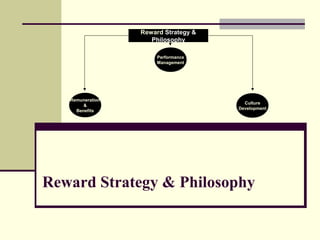
Reward Strategy &
Philosophy
Shares
Remuneration & Benefits
Pension
& Medical
Other
(Leave, etc.)
IncentivesSalary
FIXED VARIABLE
A Total Reward Strategy
Reward Strategy & Philosophy
Reward Strategy &
Philosophy
Performance
Management
Remuneration
&
Benefits
Culture
Development
Reward Strategy &
Philosophy
Performance
Management
Remuneration
&
Benefits
Culture
Development
Business
Strategy
&
Values
HR
Strategy
Programmes
&
Practices
Programmes
&
Practices
Programmes
&
Practices
Reward Strategy & Philosophy
 The reward strategy and
philosophy forms the
bridge/link between the
business strategy and
values.
 It facilitates and directs the
desired reward behaviour,
reward decisions, reward
communication and reward
programmes.
 Reward Strategy consist
of:
 Strategic Reward
Objectives
 Reward Philosophy
(Reward
Values/Principles)
What is a Reward Philosophy?
 Provides the guiding principles and sets out the
beliefs and values upon which:
 reward strategies,
 reward policies,
 reward procedures are based.
What is a Reward Philosophy?
 The basic beliefs and values expressed in a reward
philosophy relate to issues such as:
 The role reward plays in achieving performance
goals
 Achieving fairness, equity and consistency
 The importance attached to team as distinct from
individual rewards
 The extent to which employees should be regarded
as partners, sharing in success
 The extent to which emphasis should be placed on
achieving internal equity or external
competitiveness
 How much flexibility, if any, should be allowed in
administering the reward system
Creating an effective
Reward Environment
Working
Environment
Org
Values &
Culture
Management
Style
Employee
Well-being
Recognition
& Creative
Rewards
Reward Environment
Creating an effective Reward
Environment
1. Does the organisation’s reward and recognition policies
and habits support the development of the desired
culture?
2. Is their a balance between the formal and informal
reward and recognition initiatives?
3. Is the working environment inspiring and does it make
employees feel at home/special?
4. Is it a caring environment/culture and does the
organisation carry the employee’s well-being at heart?
5. Is the management style promoting/facilitating
development and growth?
6. Do people believe in the organisation and it’s leadership?
7. Does the organisation have formal recognition/award
plans in place?
Creating an effective Reward
Environment
1. Recognition Plans:
 Celebrate objective and/or goal achievement
 Reinforce extraordinary performance, normally
outside of job expectations.
 Recognise activities/ events/ milestones
 Peer-to-peer, managerial recognition
2. Award Schemes:
 Cash awards (Once off bonus payment, vouchers,
car-hire, etc.)
 Non-cash awards (Development programmes,
overseas tours, trophies, certificates, etc.)
 Spot awards
 Risk prevention awards
Creating an effective Reward
Environment
 Organisation taking care of personal needs (Dry
cleaning, shopping, etc.)
 Grocery delivery service
 Creche facilities
 Hiring of Executive Cars for Employees (Ferrari’s,
Porsche, Chauffeur-driven, etc.)
 Overseas tours
 Health, golf, country club membership
 Virtual offices
 Secure working environment
 Flexible working hours/output based performance
contracts
 Rewarding/involving spouses/family members
Structuring of pay according to
function value
Development of
pay according to
job fulfilment and
role behaviour
Development of pay
according to personal
performance and
business result
Performance /
Result
Competencies
Positioning of pay
structure in the market
• Product Market
Competition
• Labour Market
Competition
Business strategy
Creating of pay structure
according to business
requirements
Variable pay
JOB GRADE
REMUNERATION
5 4 3 2 1
Reward Strategy
Function
Base pay
Employee
fringe
benefits
Market
What drives the Remuneration
& Benefits Strategy?
What drives the Remuneration & Benefits
Strategy? Husain & Huysamen
 The top 5 factors that drive change to
remuneration policy:
 retention of key staff,
 financial results,
 strategic thrust,
 surveys/benchmarking, and
 Internal advisers.
 the top 5 changes in order of
extent of change were in:
 Fringe benefits policy
 Total package policy
 Merit pay/performance
related pay policy
 Short term incentives
policy
 Long term incentives
policy
 In public sector / parastatals,
the top 5 changes in order of
extent of change were in:
 Job evaluation /
broadbanding policy
 Short term incentives
policy
 Competency based pay
policy
 Market position policy
 Merit pay/performance
related pay policy
What drives the Remuneration & Benefits
Strategy? Husain & Huysamen
 The greatest positive impact
in the private sector in order
of strength for the top 5 was
in the following areas:
 Total package policy
 Merit/Performance
related pay policy
 Retention strategy policy
 Short term incentives
policy
 Competence base pay
policy
 For the public sector /
parastatals, the greatest
positive impact in order of
strength for the top 5 was in
the following areas:
 Competency based pay
policy
 Long term incentives
policy
 International
remuneration policy
 Total package policy
 Market position policy
What drives the Remuneration & Benefits
Strategy? Husain & Huysamen
Base
Incentives
Benefits
Equity
FIXED
VARIABLE• Bonuses
• Incentives
• Commissions
• Share Options
• Share Purchase
• Share Grant
Baisc +
“Add Ons”
Or
Cost-to-
Company
Approach
13th
Cheque
*Attracting and retaining
key skills will require
the “right mix”at
the right levels and for
various groups of
people in the
Organisation.
*Attracting and retaining
key skills will require
the “right mix”at
the right levels and for
various groups of
people in the
Organisation.
Total Remuneration &
Benefit Mix
*See Gerhart & Milkovich
Pay Reward Macro Model
Board Compensation
Committee
(BCC)
Line
Managers
Decides what the
Overall Increase
Budget is
Grant Salary
Increases to
Individual Employees
Job
Evaluation
Performance
Management
Salary Surveys and
Market Anchors
Salary Equity Model
Actual vs. Target
Salary Distribution
Internal Equity
Audit Checklist
Employee
Perception of
Salary Fairness
Tools
Decisions
Measure
Role Players
Guidance
From
HR
Benefits of total reward approach
 Increased flexibility
 Recruitment and retention
 Reduced costs
 Heightened visibility in a tight labour market
 Enhanced profitability
Strategy and Compensation Mix
 Strategies (Porter)
 Cost Leadership / Cost reduction
 Differentiation / Quality Improvement
 Innovation
Class discussion
 In groups discuss the strategic role of
compensation given each of the above
organisational strategies.
Matching Strategy to
Operating Strategy
Pay Strategy Dimension
Business Unit Strategy
Defenders Prospectors
Risk Sharing (variable pay)
Time Orientation
Pay level (short run)
Pay level (long run)
Benefits Level
Where Pay Decision Made
Pay Unit of Analysis
Low
Short-term
Above market
Above market
Above market
Centralized
Job
High
Long-term
Below market
Above market
Below market
Decentralized
Skills
Remuneration strategy based on the
business life cycle
Stage Base Pay
Start-up Low Depends on
resources
Very high – key
people
Low
Growth Increasing High Very high – wider
group
Increasing
Maturity High High Decreasing High
Decline Frozen / cut High potential /
low payoff
May be used to
motivate
Frozen / cut
Renewal Depends on
strategy
Depends on
strategy
Depends on
strategy
Depends on
strategy
VARIABLE
Short term
Incentives
Long term
Incentives
Indirect
Rewards
FIXED OTHER

Rmppt

  • 1.
    BUS5033W Reward Management and TalentRetention Dr Anton F. SchlechterDr Anton F. Schlechter
  • 2.
    Reward Management and TalentRetention  Welcome  Lecturer  Course outline  Course materials  Lectures  Assignments  Assignment due-dates  Course administration
  • 3.
    Background to theCourse  Compensating employees represents a critical human resource practice. Without sound compensation systems, companies cannot attract, motivate and retain the best-qualified employees.  Compensation systems can promote a companies’ competitive advantage when properly (strategically) aligned with strategic goals.
  • 4.
    Background to theCourse  The aim of this course is to provide students with the required knowledge of the art of strategic compensation practice so that they, as strategic partners, may play a role in ensuring an organisations’ competitive advantage.  One of the greatest challenges facing companies today is retaining top talent. The expense to an organisation of replacing an employee (including separation, replacement, training and lost performance costs) can be as much as that employee’s salary for a year. Turnover further erodes morale among those who stay and harms customer retention.
  • 5.
    Course Learning Outcomes Aftercompletion of this module, students should have a good understanding of:  what an equitable reward programme is;  when reward discrimination is justified and how to design models for rewarding special groups;  how to deal with inequitable rewards;  retention strategies that organisations can make use of to retain top talent.
  • 6.
    Course Content Week 1-3:Strategic Compensation Management  Reward analyses as strategic interventions.  Factors influencing reward management decisions.  The strategic role of compensation in ensuring competitive advantage.  Fixed and variable compensation – base pay, commission and share options.  Legally required and discretionary employee benefits.  Total annual reward.
  • 7.
    Course Content Week 4:Fair Discrimination Practices in Reward Management  Reward equity analyses  Reward disparities and how to deal with them  Rewarding special groups as fair discrimination practice  BEE share schemes Week 5-9: Talent Retention:  The psychological and motivational processes the leads up to job withdrawal and the decision to separate or not to separate.  Integrating compensation with strategic talent management.  Talent retention strategies for competitive advantage.
  • 8.
    Introduction: Strategic Reward Management •Where and how does reward management and talent retention feature in strategic planning? • How does a human resource manager’s expertise in reward management and talent retention add value to strategic planning in the organisation? • The concept of total reward • The components of reward management • Factors affecting rewards
  • 9.
    Historical Development  Traditionalapproaches (60s – 70s) to managing pay  Salary administration: emphasised need to attract, motivate and retain employees; focus on competitive attributes rather than strategic/tactical issues – reflected on how (rigidly) organisations were structured and managed.  The advent of “reward management” – late 80s  Emphasis on performance of all employees contributing to success of the organisation. Dynamic: more than just money. Non-financial rewards provide intrinsic and extrinsic motivation.
  • 10.
    Historical Development … The “new pay” (Lawler, 1990)  Need to understand the goals, values and culture of an organisation and challenges of a competitive global economy – people-based rather than job-based pay – paying people for the value they add to the organisation  Going into the future…  Contribution-related pay, broad-banding, job family structures and team based pay
  • 11.
    Reward Trends  From…  Narrowly-defined jobs and job standards  Inflexible job-evaluation systems sizing tasks, rewarding non-adaptive behaviour and empire- building, encouraging point-grabbing  To …  Broad, generic roles -emphasis on competence and continuous development  Flexible job evaluation processes assessing the value added by people in roles, often within job families
  • 12.
    Reward Trends (cont.)… From …  Hierarchical and rigid pay structures - only way to get on, is to move up. Focus on next promotion.  Emphasis on individual performance-related pay (PRP)  Consolidation of rewards into base pay  To …  Broad-banded and job family pay structures emphasising flexibility, career development pay and continuous improvement. Focus on next challenge.  More focus on team performance, team-based pay; contribution-related pay  More emphasis on ‘at risk’ pay
  • 13.
    Reward Management  Definition:RM is concerned with the formulation and implementation of strategies and policies that aim to reward employees fairly, equitably and consistently in accordance with their value to the organisation (Armstrong, 2003).  Strategic aims: to develop and implement the reward policies, processes and practices required to support the achievement of the organisation’s goals by helping to ensure that it has the skilled, competent, well motivated and committed people it needs.
  • 14.
    Reward Strategy  Whatthe organisation intends to do in the longer term to develop and implement reward policies, practices and processes that will further the achievement of business goals:  Clearly defined goals and linked to business objectives  Well designed pay and reward programmes, tailored to the organisation and its people, consistent and integrated with one another  Need to be effective and supportive HR and reward processes in place
  • 16.
    What are the keypay issues right now?
  • 17.
    What are thekey pay issues right now? According to Zingheim & Schuster (2007):  Individual vs. collective performance  Absolute or relative performance  Team based pay  Short or long term performance  Differentiating performance and paying for performance
  • 18.
     The Top5 “wants” expressed by employees:  Quality of work  Opportunity for Training and Development  Work/life balance  Climate, Reputation and Values of the Organisation  Leadership, Feedback and Recognition/Reward “Reward is no longer just about money.”
  • 19.
    A New EmploymentContract: The Modern Organisation Employers want: Employees want:  A “just in time” workforce • An entrepreneurial environment  Creativity with speed • Strong skill development opportunities  High productivity and morale • High visibility in the organisation  To retain and motivate the best • Career mentoring - more and the brightest discretion in job development  To pay only for performance • Flexibility and work/life balance  Adaptability and change • Competitive compensation and benefits & recognition for their contribution  A low promise of job security
  • 20.
    From ‘Working to live’ To Workis a means to allow my self development and self actualisation Safety Needs Physical needs Social Needs Me-Needs Self- Develop ment (Maslow) Implications for employment – the new employment contract
  • 21.
    High Incentive Low Short Long Duration Base salaryCulture, Values, Brand Bonus Leadership & Coaching Incentives Feedback & Development Benefits Career Recognition Can commitment & loyalty be bought?
  • 22.
    TOTAL HOLISTIC REWARDS TOTAL HOLISTIC REWARDS Work Content Work Environment Direct Financial Indirect Financial Career • Base Salary •Incentives • Ownership/Shares • Cash recognition • Premium pay • Organisation commitment • Organisation support • Work environment • Organisation citizenship • Benefits • Non-cash recognition • Creative Rewards • Advancement • Personal Growth • Training • Employment security • Variety • Challenge • Autonomy • Meaningfulness • Feedback A Total Rewards Approach
  • 23.
    Total Reward Model Pay basepay annual bonuses long-term incentives shares profit sharing Benefits pensions health care holidays perks flexibility Learning and development workplace learning training performance management career development/- progression Work environment organisation core values leadership employee voice work-life balance job/work design Individual Transactional (tangible) Communal Relational (intangible)
  • 24.
    A Typical TotalReward Strategy Model
  • 25.
    No interest in customers Customers astarget View customers as old friends Customers as potential relationship FocusonFinancialPerformance Focus on Customers Apathy for our people and our business What people want People as Commodity People as an Asset FocusonFinancialPerformance Focus on People HRStrategy MarketingStrategy Mirror employer and customer brands People as an Asset: Much more than financial rewards
  • 26.
    Developing a RewardStrategy Business strategy • Satisfy needs and expectations of stakeholders • Provide added value to customers HR strategy • Obtain, develop and retain skilled, motivated and committed people to the organisation’s needs Reward strategy • Define what the organisation wants and is prepared to pay for • Encourage and support desired behaviour • Develop and maintain competitive pay policies which will attract and retain high quality people • Adopt a total rewards approach which includes a mix of rewards that best meets business and individual needs
  • 27.
    Business StrategyHR Strategy Working Environment Org Values& Culture Management Style Employee Well-being Recognition & Creative Rewards Reward Environment Performance Management & People Development Performance Management Training & development Career Management Reward Strategy & Philosophy Shares Remuneration & Benefits Pension & Medical Other (Leave, etc.) IncentivesSalary FIXED VARIABLE A Total Reward Strategy
  • 28.
    Reward Strategy &Philosophy Reward Strategy & Philosophy Performance Management Remuneration & Benefits Culture Development
  • 29.
    Reward Strategy & Philosophy Performance Management Remuneration & Benefits Culture Development Business Strategy & Values HR Strategy Programmes & Practices Programmes & Practices Programmes & Practices RewardStrategy & Philosophy  The reward strategy and philosophy forms the bridge/link between the business strategy and values.  It facilitates and directs the desired reward behaviour, reward decisions, reward communication and reward programmes.  Reward Strategy consist of:  Strategic Reward Objectives  Reward Philosophy (Reward Values/Principles)
  • 30.
    What is aReward Philosophy?  Provides the guiding principles and sets out the beliefs and values upon which:  reward strategies,  reward policies,  reward procedures are based.
  • 31.
    What is aReward Philosophy?  The basic beliefs and values expressed in a reward philosophy relate to issues such as:  The role reward plays in achieving performance goals  Achieving fairness, equity and consistency  The importance attached to team as distinct from individual rewards  The extent to which employees should be regarded as partners, sharing in success  The extent to which emphasis should be placed on achieving internal equity or external competitiveness  How much flexibility, if any, should be allowed in administering the reward system
  • 32.
    Creating an effective RewardEnvironment Working Environment Org Values & Culture Management Style Employee Well-being Recognition & Creative Rewards Reward Environment
  • 33.
    Creating an effectiveReward Environment 1. Does the organisation’s reward and recognition policies and habits support the development of the desired culture? 2. Is their a balance between the formal and informal reward and recognition initiatives? 3. Is the working environment inspiring and does it make employees feel at home/special? 4. Is it a caring environment/culture and does the organisation carry the employee’s well-being at heart? 5. Is the management style promoting/facilitating development and growth? 6. Do people believe in the organisation and it’s leadership? 7. Does the organisation have formal recognition/award plans in place?
  • 34.
    Creating an effectiveReward Environment 1. Recognition Plans:  Celebrate objective and/or goal achievement  Reinforce extraordinary performance, normally outside of job expectations.  Recognise activities/ events/ milestones  Peer-to-peer, managerial recognition 2. Award Schemes:  Cash awards (Once off bonus payment, vouchers, car-hire, etc.)  Non-cash awards (Development programmes, overseas tours, trophies, certificates, etc.)  Spot awards  Risk prevention awards
  • 35.
    Creating an effectiveReward Environment  Organisation taking care of personal needs (Dry cleaning, shopping, etc.)  Grocery delivery service  Creche facilities  Hiring of Executive Cars for Employees (Ferrari’s, Porsche, Chauffeur-driven, etc.)  Overseas tours  Health, golf, country club membership  Virtual offices  Secure working environment  Flexible working hours/output based performance contracts  Rewarding/involving spouses/family members
  • 36.
    Structuring of payaccording to function value Development of pay according to job fulfilment and role behaviour Development of pay according to personal performance and business result Performance / Result Competencies Positioning of pay structure in the market • Product Market Competition • Labour Market Competition Business strategy Creating of pay structure according to business requirements Variable pay JOB GRADE REMUNERATION 5 4 3 2 1 Reward Strategy Function Base pay Employee fringe benefits Market What drives the Remuneration & Benefits Strategy?
  • 37.
    What drives theRemuneration & Benefits Strategy? Husain & Huysamen  The top 5 factors that drive change to remuneration policy:  retention of key staff,  financial results,  strategic thrust,  surveys/benchmarking, and  Internal advisers.
  • 38.
     the top5 changes in order of extent of change were in:  Fringe benefits policy  Total package policy  Merit pay/performance related pay policy  Short term incentives policy  Long term incentives policy  In public sector / parastatals, the top 5 changes in order of extent of change were in:  Job evaluation / broadbanding policy  Short term incentives policy  Competency based pay policy  Market position policy  Merit pay/performance related pay policy What drives the Remuneration & Benefits Strategy? Husain & Huysamen
  • 39.
     The greatestpositive impact in the private sector in order of strength for the top 5 was in the following areas:  Total package policy  Merit/Performance related pay policy  Retention strategy policy  Short term incentives policy  Competence base pay policy  For the public sector / parastatals, the greatest positive impact in order of strength for the top 5 was in the following areas:  Competency based pay policy  Long term incentives policy  International remuneration policy  Total package policy  Market position policy What drives the Remuneration & Benefits Strategy? Husain & Huysamen
  • 40.
    Base Incentives Benefits Equity FIXED VARIABLE• Bonuses • Incentives •Commissions • Share Options • Share Purchase • Share Grant Baisc + “Add Ons” Or Cost-to- Company Approach 13th Cheque *Attracting and retaining key skills will require the “right mix”at the right levels and for various groups of people in the Organisation. *Attracting and retaining key skills will require the “right mix”at the right levels and for various groups of people in the Organisation. Total Remuneration & Benefit Mix *See Gerhart & Milkovich
  • 41.
    Pay Reward MacroModel Board Compensation Committee (BCC) Line Managers Decides what the Overall Increase Budget is Grant Salary Increases to Individual Employees Job Evaluation Performance Management Salary Surveys and Market Anchors Salary Equity Model Actual vs. Target Salary Distribution Internal Equity Audit Checklist Employee Perception of Salary Fairness Tools Decisions Measure Role Players Guidance From HR
  • 42.
    Benefits of totalreward approach  Increased flexibility  Recruitment and retention  Reduced costs  Heightened visibility in a tight labour market  Enhanced profitability
  • 43.
    Strategy and CompensationMix  Strategies (Porter)  Cost Leadership / Cost reduction  Differentiation / Quality Improvement  Innovation Class discussion  In groups discuss the strategic role of compensation given each of the above organisational strategies.
  • 44.
    Matching Strategy to OperatingStrategy Pay Strategy Dimension Business Unit Strategy Defenders Prospectors Risk Sharing (variable pay) Time Orientation Pay level (short run) Pay level (long run) Benefits Level Where Pay Decision Made Pay Unit of Analysis Low Short-term Above market Above market Above market Centralized Job High Long-term Below market Above market Below market Decentralized Skills
  • 45.
    Remuneration strategy basedon the business life cycle Stage Base Pay Start-up Low Depends on resources Very high – key people Low Growth Increasing High Very high – wider group Increasing Maturity High High Decreasing High Decline Frozen / cut High potential / low payoff May be used to motivate Frozen / cut Renewal Depends on strategy Depends on strategy Depends on strategy Depends on strategy VARIABLE Short term Incentives Long term Incentives Indirect Rewards FIXED OTHER

Editor's Notes

  • #3 Discuss the various points. Outline important dates in the course framework, as well as the way marks are allocated and computed for the course. Discuss the manner in which assessment is dealt with and answer any questions in this regard.