Co-clustering of Multi-View Datasets:
a Parallelizable Approach
Authors/ Gilles Bisson and Clement Grimal
Affiliation/ University Joseph Forier, France
Source/ International Conference on Data Mining 2012
Presenter/ Allen

1
Outline
•
•
•
•
•
•

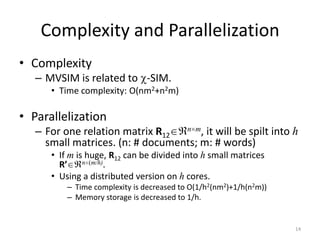
Introduction
Multi-View Learning
The -SIM algorithm
The MVSIM architecture
Experiments
Conclusion

2
Introduction
• Co-clustering have been proposed to observe the intensity
of relation between two objects.
• However, datasets involving more than two types of
interacting objects are also frequent.
– In addition to analyze users’ relation in a social network, the
relations between documents and users are also needed to be
analyzed.

• A simple way is to process such datasets into many
matrices and co-cluster them separately.
– Interactions between objects in difference matrices are not
considered.
3
Introduction (Cont.)
• Multi-view clustering task, handle the views
together, was proposed to solve this problem.
•

-SIM is a co-clustering algorithm, which builds
similarity matrices rather than produce co-cluster
results.
– It is flexible to combine different views together.
– It can be easily inject priori knowledge into initialized
similarity matrix.
– It’s possible to transfer the similarities form one view
to the others.
4
Multi-view learning
• Multi-view learning became highly popular
with the seminal work of co-training, which
trained two algorithms on two different views.

• Several extensions of classical clustering
methods have been proposed to deal with
multi-view data.
– Multi-view K-means (MVKM)
– Multi-view EM
5
Multi-view learning
• Multi-view clustering aims at combining multiple
results into one.
– Occurrence
• Fred et al. produced a meta-similarity matrix based on how many
times objects appear in the same cluster.

– Clustering ensemble selection problem
• Li et al. built a weighted consensus clustering methods to select
the best clustering among multi views.
• Azimi et al. adapts their selection strategy according to stability of
clustering.

– Fusion manner
• Combining multiple similarity matrices to perform a given learning
task.
– Linked Matrix Factorization, fuzzy clustering

6
Notations
• Type of objects
– Let N be the number of objects in the dataset. (i.e.
users, documents, words, etc.)
• Ti is an object. i 1…N
• For simplify, object Ti has ni instances.

– Relation matrices
• Let M be the number of relations between objects.
ni nj is the relation matrix between objects T and T .
• Rij
i
j

– Similarity matrices
ni ni is the square and symmetrical
• Similarity matrix Si
matrix of Ti, where the values must be in [0,1].

7
The -SIM algorithm [SDM’10]
• Let R12 is a [documents/words] matrix and that
the task is to compute the similarity matrix S1
(documents) and S2 (words).
• The idea of -SIM is to capture the duality
between documents and words.
• This is achieved by simultaneously calculating
document-document similarities based on words,
and word-word similarities based on documents.
8
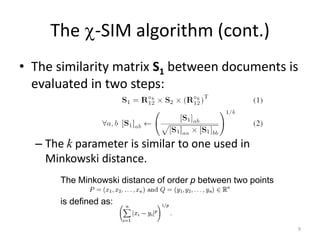
The -SIM algorithm (cont.)
• The similarity matrix S1 between documents is
evaluated in two steps:

– The k parameter is similar to one used in
Minkowski distance.
The Minkowski distance of order p between two points
is defined as:
9
The -SIM algorithm (cont.)
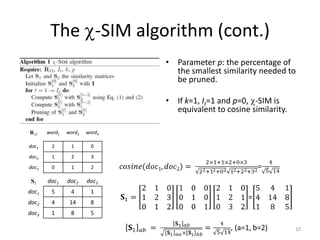
• Parameter p: the percentage of
the smallest similarity needed to
be pruned.
• If k=1, It=1 and p=0, -SIM is
equivalent to cosine similarity.
R12

word1

word2

word3

doc1

2

1

0

doc2

1

2

3

doc3

0

1

2

S1

doc1

doc2

doc3

doc1

5

4

1

doc2

4

14

8

doc3

1

8

5
10
The MVSIM architecture
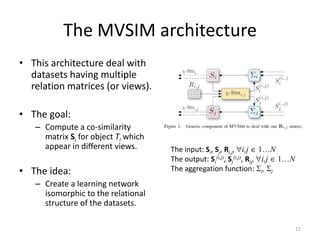
• This architecture deal with
datasets having multiple
relation matrices (or views).
• The goal:
– Compute a co-similarity
matrix Si for object Ti which
appear in different views.

• The idea:

The input: Si, Sj, Ri,j, i,j 1…N
The output: Si(i,j), Sj(i,j), Rij, i,j 1…N
The aggregation function: i, j

– Create a learning network
isomorphic to the relational
structure of the datasets.
11
Aggregation Function
• Functions

i

have two important roles:

– Aggregate the multiple similarity matrices
produced by -SIM.
• F(Si(i,1), Si(i,2),..): merging function combining matrices.

– Ensure the convergence
• Use damping factor

[0,1] to balance the function

i

12
The MVSIM algorithm

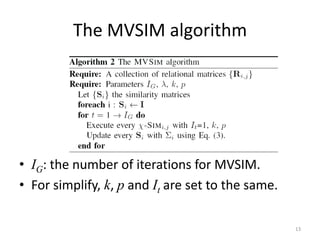
• IG: the number of iterations for MVSIM.
• For simplify, k, p and It are set to the same.
13
Complexity and Parallelization
• Complexity
– MVSIM is related to -SIM.
• Time complexity: O(nm2+n2m)

• Parallelization
n m, it will be spilt into h
– For one relation matrix R12
small matrices. (n: # documents; m: # words)

• If m is huge, R12 can be divided into h small matrices
n (m/h).
R’
• Using a distributed version on h cores.
– Time complexity is decreased to O(1/h2(nm2)+1/h(n2m))
– Memory storage is decreased to 1/h.

14
Evaluation of multi-view approaches
• Evaluating the correlation between the learned
and known clusters in the confusion matrix.
– Measurement: micro-averaged precision
• Datasets (Ground truth: document class)
– IMDB
– CiteSeer
– 4 universities datasets: Cornell, Texas, Washington and
Wisconsin
– Reuters RCV1/RCV2
15
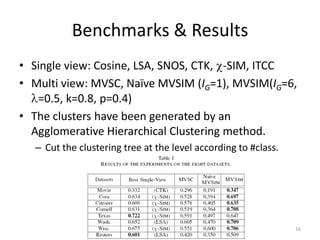
Benchmarks & Results
• Single view: Cosine, LSA, SNOS, CTK, -SIM, ITCC
• Multi view: MVSC, Naïve MVSIM (IG=1), MVSIM(IG=6,
=0.5, k=0.8, p=0.4)
• The clusters have been generated by an
Agglomerative Hierarchical Clustering method.
– Cut the clustering tree at the level according to #class.

16
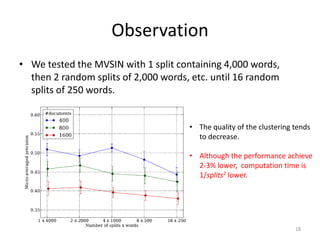
Evaluation of Splitting Approach
• Dataset
– NG20: 20,000 newsgroup
– Ground truth: 10 categories

• How is the quality of the clustering influenced,
when #splits increases with a total #features
kept constant?

17
Observation
• We tested the MVSIN with 1 split containing 4,000 words,
then 2 random splits of 2,000 words, etc. until 16 random
splits of 250 words.
• The quality of the clustering tends
to decrease.
• Although the performance achieve
2-3% lower, computation time is
1/splits2 lower.

18
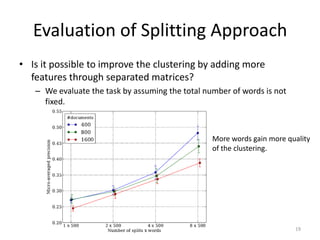
Evaluation of Splitting Approach
• Is it possible to improve the clustering by adding more
features through separated matrices?
– We evaluate the task by assuming the total number of words is not
fixed.

More words gain more quality
of the clustering.

19
Conclusion
• The MVSIM architecture deal with the problem of
learning co-similarities from a collection of
matrices describing interrelated types of objects.
• It provides interesting properties in terms of
convergence and scalability, and allows a
straightforward parallelization of the process.
• The experiments demonstrate that this method
outperform both single-view and multi-view
approaches.
20

Co-clustering of multi-view datasets: a parallelizable approach

  • 1.
    Co-clustering of Multi-ViewDatasets: a Parallelizable Approach Authors/ Gilles Bisson and Clement Grimal Affiliation/ University Joseph Forier, France Source/ International Conference on Data Mining 2012 Presenter/ Allen 1
  • 2.
    Outline • • • • • • Introduction Multi-View Learning The -SIMalgorithm The MVSIM architecture Experiments Conclusion 2
  • 3.
    Introduction • Co-clustering havebeen proposed to observe the intensity of relation between two objects. • However, datasets involving more than two types of interacting objects are also frequent. – In addition to analyze users’ relation in a social network, the relations between documents and users are also needed to be analyzed. • A simple way is to process such datasets into many matrices and co-cluster them separately. – Interactions between objects in difference matrices are not considered. 3
  • 4.
    Introduction (Cont.) • Multi-viewclustering task, handle the views together, was proposed to solve this problem. • -SIM is a co-clustering algorithm, which builds similarity matrices rather than produce co-cluster results. – It is flexible to combine different views together. – It can be easily inject priori knowledge into initialized similarity matrix. – It’s possible to transfer the similarities form one view to the others. 4
  • 5.
    Multi-view learning • Multi-viewlearning became highly popular with the seminal work of co-training, which trained two algorithms on two different views. • Several extensions of classical clustering methods have been proposed to deal with multi-view data. – Multi-view K-means (MVKM) – Multi-view EM 5
  • 6.
    Multi-view learning • Multi-viewclustering aims at combining multiple results into one. – Occurrence • Fred et al. produced a meta-similarity matrix based on how many times objects appear in the same cluster. – Clustering ensemble selection problem • Li et al. built a weighted consensus clustering methods to select the best clustering among multi views. • Azimi et al. adapts their selection strategy according to stability of clustering. – Fusion manner • Combining multiple similarity matrices to perform a given learning task. – Linked Matrix Factorization, fuzzy clustering 6
  • 7.
    Notations • Type ofobjects – Let N be the number of objects in the dataset. (i.e. users, documents, words, etc.) • Ti is an object. i 1…N • For simplify, object Ti has ni instances. – Relation matrices • Let M be the number of relations between objects. ni nj is the relation matrix between objects T and T . • Rij i j – Similarity matrices ni ni is the square and symmetrical • Similarity matrix Si matrix of Ti, where the values must be in [0,1]. 7
  • 8.
    The -SIM algorithm[SDM’10] • Let R12 is a [documents/words] matrix and that the task is to compute the similarity matrix S1 (documents) and S2 (words). • The idea of -SIM is to capture the duality between documents and words. • This is achieved by simultaneously calculating document-document similarities based on words, and word-word similarities based on documents. 8
  • 9.
    The -SIM algorithm(cont.) • The similarity matrix S1 between documents is evaluated in two steps: – The k parameter is similar to one used in Minkowski distance. The Minkowski distance of order p between two points is defined as: 9
  • 10.
    The -SIM algorithm(cont.) • Parameter p: the percentage of the smallest similarity needed to be pruned. • If k=1, It=1 and p=0, -SIM is equivalent to cosine similarity. R12 word1 word2 word3 doc1 2 1 0 doc2 1 2 3 doc3 0 1 2 S1 doc1 doc2 doc3 doc1 5 4 1 doc2 4 14 8 doc3 1 8 5 10
  • 11.
    The MVSIM architecture •This architecture deal with datasets having multiple relation matrices (or views). • The goal: – Compute a co-similarity matrix Si for object Ti which appear in different views. • The idea: The input: Si, Sj, Ri,j, i,j 1…N The output: Si(i,j), Sj(i,j), Rij, i,j 1…N The aggregation function: i, j – Create a learning network isomorphic to the relational structure of the datasets. 11
  • 12.
    Aggregation Function • Functions i havetwo important roles: – Aggregate the multiple similarity matrices produced by -SIM. • F(Si(i,1), Si(i,2),..): merging function combining matrices. – Ensure the convergence • Use damping factor [0,1] to balance the function i 12
  • 13.
    The MVSIM algorithm •IG: the number of iterations for MVSIM. • For simplify, k, p and It are set to the same. 13
  • 14.
    Complexity and Parallelization •Complexity – MVSIM is related to -SIM. • Time complexity: O(nm2+n2m) • Parallelization n m, it will be spilt into h – For one relation matrix R12 small matrices. (n: # documents; m: # words) • If m is huge, R12 can be divided into h small matrices n (m/h). R’ • Using a distributed version on h cores. – Time complexity is decreased to O(1/h2(nm2)+1/h(n2m)) – Memory storage is decreased to 1/h. 14
  • 15.
    Evaluation of multi-viewapproaches • Evaluating the correlation between the learned and known clusters in the confusion matrix. – Measurement: micro-averaged precision • Datasets (Ground truth: document class) – IMDB – CiteSeer – 4 universities datasets: Cornell, Texas, Washington and Wisconsin – Reuters RCV1/RCV2 15
  • 16.
    Benchmarks & Results •Single view: Cosine, LSA, SNOS, CTK, -SIM, ITCC • Multi view: MVSC, Naïve MVSIM (IG=1), MVSIM(IG=6, =0.5, k=0.8, p=0.4) • The clusters have been generated by an Agglomerative Hierarchical Clustering method. – Cut the clustering tree at the level according to #class. 16
  • 17.
    Evaluation of SplittingApproach • Dataset – NG20: 20,000 newsgroup – Ground truth: 10 categories • How is the quality of the clustering influenced, when #splits increases with a total #features kept constant? 17
  • 18.
    Observation • We testedthe MVSIN with 1 split containing 4,000 words, then 2 random splits of 2,000 words, etc. until 16 random splits of 250 words. • The quality of the clustering tends to decrease. • Although the performance achieve 2-3% lower, computation time is 1/splits2 lower. 18
  • 19.
    Evaluation of SplittingApproach • Is it possible to improve the clustering by adding more features through separated matrices? – We evaluate the task by assuming the total number of words is not fixed. More words gain more quality of the clustering. 19
  • 20.
    Conclusion • The MVSIMarchitecture deal with the problem of learning co-similarities from a collection of matrices describing interrelated types of objects. • It provides interesting properties in terms of convergence and scalability, and allows a straightforward parallelization of the process. • The experiments demonstrate that this method outperform both single-view and multi-view approaches. 20